


Abstract
Hybrid contractions serve as a flexible and versatile framework for establishing fixed-point Theorems and analyzing the convergence of iterative algorithms. This paper demonstrates the adapted form of the admissible hybrid fuzzy -contraction in the perspective of £-fuzzy set-valued maps for extended ♭-metric spaces. Sufficient criteria for obtaining £-fuzzy fixed points for this contraction have been established. In addition, the hypotheses of its main result are endorsed by some nontrivial supportive examples featuring graphical illustrations. Consequently, the concept of graphical extended ♭-metric spaces is introduced and a £-fuzzy fixed point result in the context of newly defined space is derived. Illustrative examples, incorporating relevant graphs, are provided with the support of a computer simulation to validate the established results, enhancing the understanding of the underlying notions and investigations. The concepts presented here not only considerably improve, enrich, and extend a number of well-known pre-existing fixed-point results but also assemble and merge several ones in the corresponding domain.
Keywords:
extended ♭-metric space; metric space equipped with a graph; £-fuzzy set-valued map; £-fuzzy fixed point; hybrid contraction; simulation function; MSC:
03G10; 46S40; 47H10
1. Introduction
Metric fixed-point theory has its roots traced back to the Banach contraction principle (BCP, in short), which is considered as its foundational concept and is a crucial technique for determining the existence and solutions of multiple problems, together with differential and integral equations. A number of articles have since been published on the expansion and advancement of Banach’s Theorem for mappings, both single and set valued. This has been achieved through modifications to the contraction conditions or by expanding the metric space (MS)’s structural definition, see [1]. This exceptional Theorem has been explored and generalized to increase its applicability in numerous other ambient spaces (see, for instance, refs. [2,3] and the references therein). In this setting, through their respective contributions, Czerwik [4] and Bakhtin [5] developed the idea of a ♭-MS by relaxing the triangle inequality of an MS. Following that, a number of articles covered fixed-point (FP, in short) Theorems for single-valued and set-valued mappings by considering ♭-MS, which is a generalized form of MS, see [6,7,8,9]. Later, Fagin [10] used this type of relaxed triangular inequality to combine with pattern matching. A similar approach was implemented to measure ice floes and trade measures. In this context, Kamran et al. [11], in 2017, proposed the concept of extended ♭-MS by generalizing the structure of ♭-MS. He weakened the ♭-metric’s triangular inequality and developed FP Theorems for a class of contractions. It is helpful to extend the Banach contraction principle from MSs to ♭-MSs, and subsequently to extended ♭-MSs, in order to demonstrate the existence and uniqueness of Theorems for various integral and differential equation types.
Since Zadeh’s [12] discovery of fuzzy set (FS) theory in 1965, real-world problems have been solved more easily and effectively because it makes the description of ambiguity and inaccuracy more precise and understandable. When dealing with the uncertainties and imprecision in given data, FS theory is regarded as a crucial tool to handle a variety of challenges. The system is now extensively utilized to comprehend confusions arising from various materialistic circumstances. FS theory has made notable advancement in recent years. Not only does FS theory have applications in physical and applied sciences, but it also has applications in mathematical evaluation, decision making, clustering, data mining, and soft sciences, which can easily be found in [13,14] and the references therein. Afterward, Heilpern [15] presented the theory of fuzzy mapping (FM) by utilizing the idea of FSs and furnished an FP Theorem for fuzzy contraction maps which is considered as a fuzzy version of Nadler’s [16] and Banach’s [17] FP Theorems. After that, a wide number of researchers worked for the existence of FPs for FMs, see, for example, [18,19]. Later, in 1967, the concept of £-FSs was furnished by Goguen [20], which is an intriguing generalization of FSs because it replaced the interval by a complete distributive lattice. So, it makes £-FSs superior to FSs.
On the other hand, Samet et al. [21] introduced the notion of -admissibility for single-valued mappings and applied it to illustrate the validity of FP Theorems. After that, Asl et al. [22] expanded this idea to -multi-valued mappings. Later, Mohammadi et al. [23] inaugurated the above-mentioned concept for multi-valued mappings in the sense it was different from the one given in [22].
Recently, Phiangsungneon et al. [24] used Mohammadi’s concept of -admissibility [23] and demonstrated some FFP Theorems. Then, Rashid et al. [25], in 2014, launched its generalized version for a pair of £-FS-valued maps and named it -admissible. By using this idea, they evinced the existence of a common £-FFP result. In the same year, for £-FSs, Rashid et al. [26] initiated the theories of Hausdorff distances for -cuts and the -metric. The authors investigated a few coincidence and FP Theorems for £-FMs and a crisp mapping along with a sequence of £-FMs, respectively. Equivalently, coincidence Theorems for fuzzy and multi-valued mappings have been yielded as the consequence of the main result. In 2016, Azam et al. [27] examined some £-FFP results by using local and global contractions. Later, in 2017, Rashid et al. [28] presented some £-FFP results by involving £-fuzzy contractive mappings. Then, in 2018, Rawashdeh et al. [29] applied the idea of an integral -admissible to derive a few coincidence and common FP Theorems for a pair of £-FMs and to also generalize an integral contraction. In 2019, Kanwal and Azam [30] established common coincidence points for £-FMs under a generalized contractive condition and obtained many beneficial results as corollaries of the main result. For more results in this regard, see [31,32].
The present article inaugurates the modified form of an admissible hybrid fuzzy -contraction in the bodywork of £-FS-valued maps for extended ♭-MSs and furnished the sufficient criteria for £-FFP results. Some special cases of the main result are also discussed in the form of corollaries. The application lies in the £-FFP result in the framework of an extended ♭-MS equipped with a graph. All the results in this paper are followed by nontrivial examples to validate the hypotheses of the results. As far as we are aware, FP Theorems within the framework of £-FSs using simulation functions have not been covered yet. Consequently, the concepts presented here are novel and specifically complement the main results provided in [4,15,16,21,33,34,35,36,37,38] and a lot more in the corresponding domain.
2. Preliminaries
Within this particular section, we provide a brief summary of key definitions, outcomes, and instances from the existing literature that are vital for a proper understanding of the subject matter. Throughout this article, , and represent the sets of non-negative real, real, and natural numbers, respectively.
2.1. Basic Framework
Definition 1
([4,5]). Let Ξ be a non-empty set and be a predetermined real number. If all the listed below criteria are fulfilled for all , then the real-valued function is referred to as a ♭-metric on Ξ.
- (δ1)
- if and only if ;
- (δ2)
- ;
- (δ3)
- .
The triple is known as a ♭-MS.
Remark 1.
The concept of a ♭-MS coincides with the concept of an MS in the case of .
Example 1.
Let be a non-empty set and is defined as for all . Then, is a ♭-MS.
For more details on ♭-MSs, the readers are referred to [39,40]. Kamran et al. [11] defined the notion of an extended ♭-MS by weakening the triangle inequality of a ♭-MS.
Definition 2
([11]). Let Ξ be a non-empty set and be a function. Then, an extended ♭-metric is a function that fulfills the following conditions for every :
- (δe1)
- if and only if ;
- (δe2)
- ;
- (δe3)
- .
The pair is referred to as an extended ♭-MS.
Remark 2.
The definition of extended ♭-MS reduces to that of ♭-MS if for .
Example 2.
Taking , we define the functions and as:
Of course, , for all . Then, is an extended ♭-MS.
Definition 3
([11]). Let be an extended ♭-MS. Then, the sequence is said to be as follows:
- (i)
- Convergent to if for every , there exists a natural number (depending on ε) N such that for all .
- (ii)
- A Cauchy sequence if for every , there exists a natural number (depending on ε) N such that for all .
If every Cauchy sequence converges in Ξ, then the extended ♭-MS is said to be complete.
Definition 4
([41]). A subset U of an extended ♭-MS is termed as compact if, for any sequence in U, there exists a subsequence and a point such that .
Definition 5.
Let ∇ be a non-empty subset of an extended ♭-MS . If for any there exists an element such that , then ∇ is considered to be proximal (prox).
Let and denote, respectively, the set of all non-empty compact and prox subsets of .
Definition 6
([41]). Let be an extended ♭-MS. For , the real-valued function H on , described by
is called the Pompeiu–Hausdorff metric induced by , where .
Khojasteh et al. [36] recently proposed a family of auxiliary functions known as simulation functions (SF) in an effort to standardize various contraction types.
Definition 7
([36]). An SF is a mapping that satisfies the properties listed below:
- (S1)
- ;
- (S2)
- for all ;
- (S3)
- If and are two sequences with terms in the interval in such a way that , then
The set comprising all SFs can be represented by .
Example 3
([42]). Take a function with for every and for any two sequences and in such that , and we have . Then, a function given by:
is an example of an SF.
Example 4
([42]). Define a function by
where . Then, ρ is an SF.
We refer the readers to [36,43,44,45] for further and more interesting examples of SFs. In 2015, Khojasteh [36] introduced the notion of a -contraction, which serves as a generalized version of the Banach contraction along with its corresponding FP Theorem.
Definition 8
([36]). Let be an MS. If the mapping satisfies:
then it is identified as a -contraction with respect to .
Theorem 1
([36]). Let Ξ be a complete MS on which the self-map is a -contraction, and then T admits a unique FP in Ξ.
2.2. Fundamental Concepts from Fuzzy Set Theory
Definition 9
([12]). An FS on a set Ξ is a kind of generalized characteristic function on Ξ, whose degrees of membership may be more general than yes or no. Formally, it can be stated as follows: An FS on Ξ is a function from a non-empty set Ξ to I where . If Γ is an FS and , then the function value is known as the degree of membership of σ in Γ. The α-cut set of an FS Γ, denoted by , is defined by
where .
The family of all the fuzzy subsets of is represented by or .
Definition 10
([15]). For a non-empty set Ξ and an MS ∇, a function is called an FS-valued map.
Definition 11
([15]). An element is said to be the FP of an FM if where .
Definition 12
([20]). Let be a non-empty partially ordered set.
- (£1)
- If and for all , then £ is known as a lattice.
- (£2)
- If and for all , then £ is termed as a complete lattice.
- (£3)
- If , for all , then £ is said to be a distributive lattice.
- (£4)
- If , for all , then £ is a complete distributive lattice (or simply CDL).
- (£5)
- If in addition to a lattice, £ satisfies , for each , where and are, respectively, the top and bottom elements of lattice £, then £ is referred to as a bounded lattice.
Example 5.
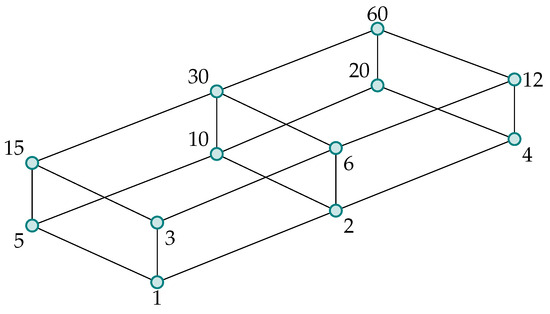
Consider the set of non-negative integers, partially ordered by division, that is, if τ divides κ. Let the join and meet for any , be defined as:
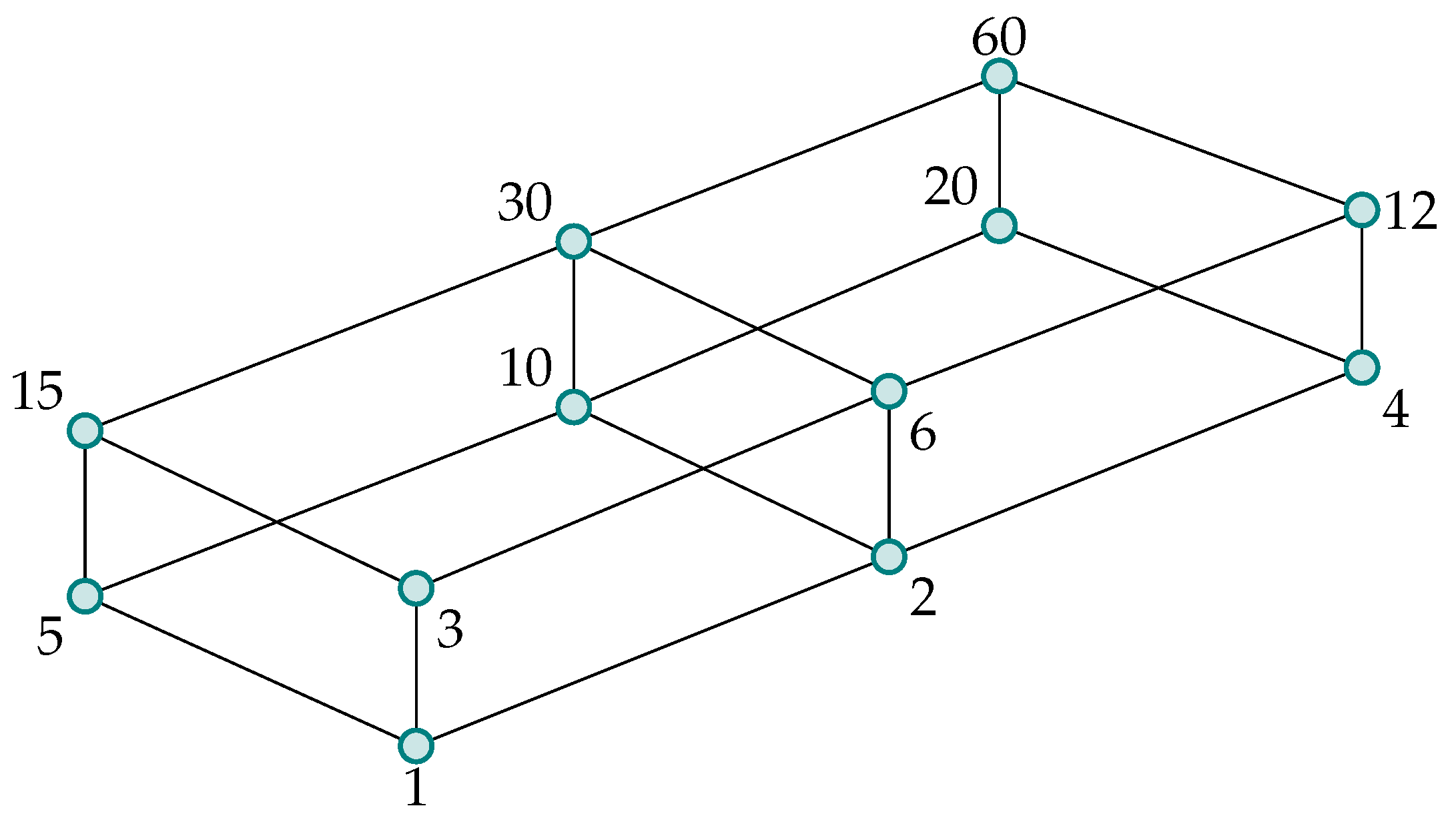
Then, is a lattice. Moreover, this is a CDL with 0 and 1 as the top and bottom elements, respectively. Figure 1 depicts a finite sublattice having integer divisors of 60.
Figure 1.
Lattice of integer divisors of 60, ordered by “divides”.
Definition 13
([20]). Consider a non-empty set Ξ and a CDL L having and . Then, the function is said to be a £-FS on Ξ.
The set of all the £-fuzzy subsets of is indicated by .
Remark 3.
The family of £-FSs is bigger than that of FSs as a £-FS becomes an FS by considering .
The -cut set of a £-FS , symbolized by , is characterized as:
where cl indicates the closure of set .
The characteristic function of a £-FS is defined as:
Definition 14
([26]). In a metric linear space Λ, a £-FS Γ is considered an approximate quantity if and only if two conditions are met: First, must be both compact and convex in Λ, and second, . The set comprising all the approximate quantities in Λ is represented by . For such that , define
Definition 15
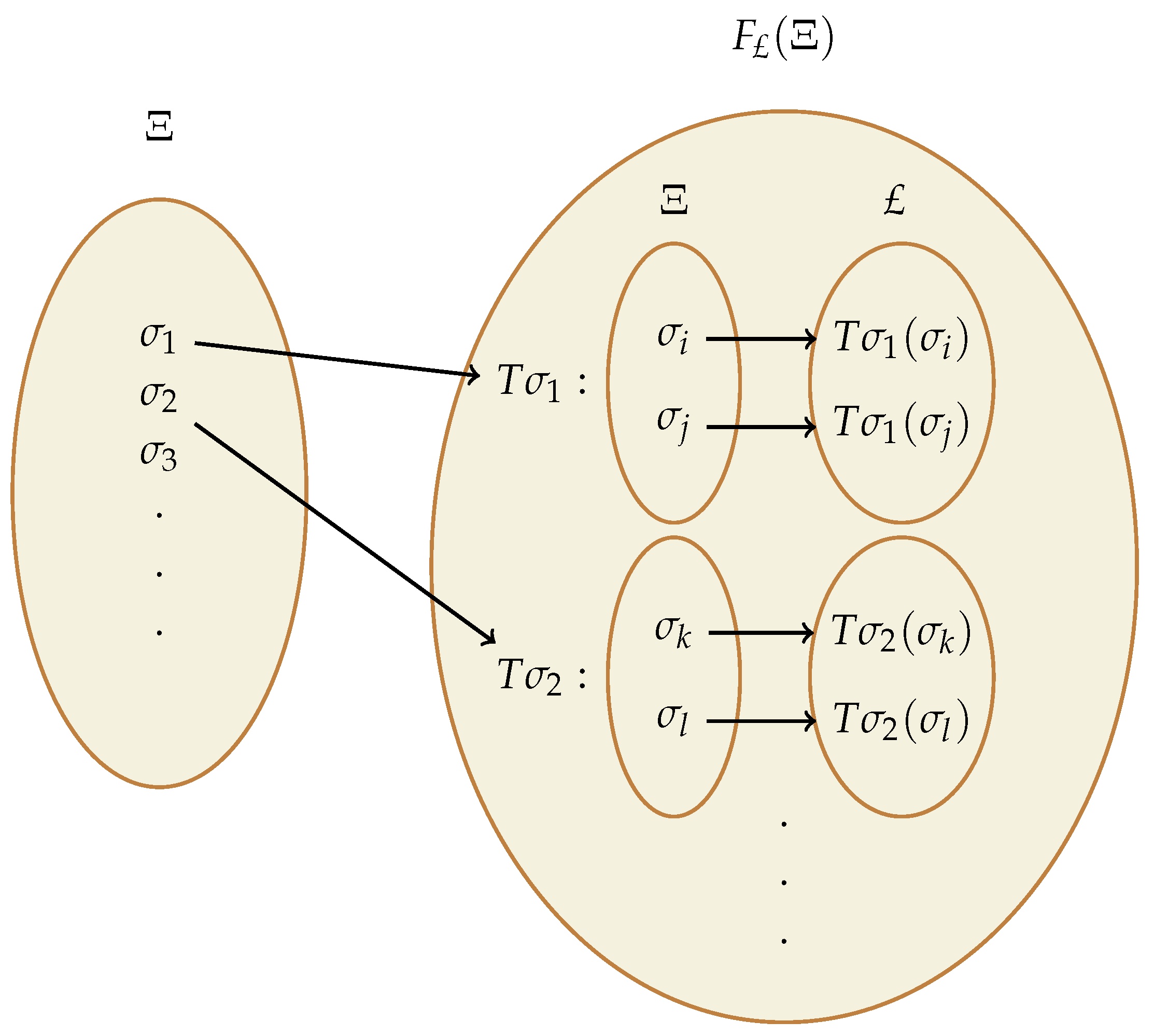
([25]). Consider an arbitrary set Ξ and any MS ∇. A mapping T is called a £-FM if T is a mapping from Ξ into . A £-FM T is a £-fuzzy subset of with a membership function . The function value is called the degree of membership of ν in .
The concept is better understood through Figure 2.
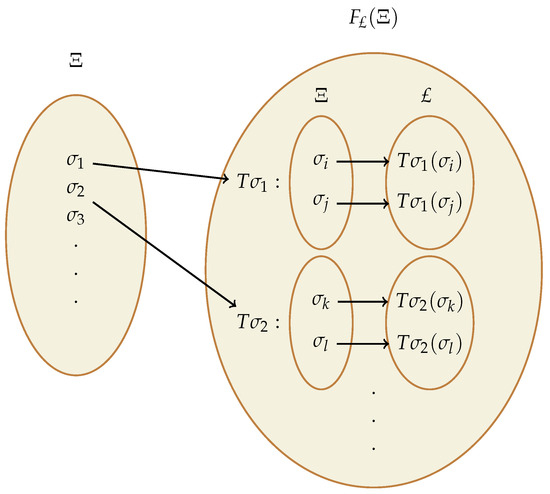
Figure 2.
An illustration of L-FM.
Definition 16
([25]). Consider an MS Ξ and a £-FM , and then a point is referred to as a £-FFP of T if there exists an such that .
In an effort to extend the range of contraction-type mappings, Rus [46] first proposed the notion of a comparison function, which has since been thoroughly explored by several authors.
Definition 17
([46]). A nondecreasing function is said to be a comparison function (CF) if the condition is fulfilled for all .
Example 6.
For all , consider the below-defined functions as examples of CFs.
- (i)
- , where .
- (ii)
- .
Definition 18
([35]). A function is called a c-CF if it is nondecreasing and satisfies the requirement for each .
Definition 19
([47]). Consider a real number and a CF ϑ for which there exists a convergent series of positive terms and a real number α, with such that
and then ϑ is called a ♭-CF.
Lemma 1
([47]). A function is called a ♭-CF if it is nondecreasing and the series converges for each .
Definition 20
([48]). Let be an extended ♭-MS and , and then a nondecreasing function is said to be an extended ♭-CF if there exists a mapping such that for some , and the series converges for every and for all . Here, for , and ϑ is an extended ♭-CF for h at .
Remark 4
([48]). By taking for any , the notion of an extended ♭-CF coincides with that of a ♭-CF for any arbitrary self-map h on Ξ.
Example 7
([48]). Let be an extended ♭-metric space and h a self-map on X, and assume that for exist. Define as
Then, by using the ratio test, one can easily see that the series converges.
Let denote the collection of all the continuous extended ♭-CFs fulfilling
Lemma 2
([46]). For a CF , every iteration also serves as a CF. Additionally, for all .
Lemma 3
([49]). For an extended ♭-MS and , the below-listed properties always hold for all .
- (i)
- , for each .
- (ii)
- , for any .
- (iii)
- if and only if .
- (iv)
- if and only if .
- (v)
- .
- (vi)
- .
where is defined as
with .
Definition 21
([32]). Let Ξ be a non-empty set and be a £-FM. Then, T is called β-admissible with respect to a real-valued function , if there exists an such that for each and with we have for all .
3. Main Results
Within this section, we introduce the concept of modified admissible hybrid £-fuzzy -contractions, along with the necessary definitions needed to establish the results.
Definition 22.
Let be an extended ♭-MS and be a £-FS-valued map. Then, T is termed as a modified admissible hybrid £-fuzzy -contraction with respect to , if there exists , a function , and an extended ♭-CF such that it satisfies the following inequality:
for each , where
and
with .
Remark 5.
- (i)
- In the above definition, if , then T is a modified hybrid £-fuzzy -contraction with respect to .
- (ii)
- If T is a modified admissible hybrid £-fuzzy -contraction with respect to , then by using the second axiom of Definition 7, we can easily formulate:for all .
The customary definition of continuity for a set-valued mapping typically relies on the concepts of lower and upper semicontinuity, employing the notion of the Hausdorff separation. Within the framework of extended ♭-MSs, we introduce a complementary approach to this concept as follows.
Definition 23.
Let be an extended ♭-MS and is a £-FS-valued map. Then, T is referred to as Hausdorff-continuous (H-continuous) at , if for any sequence in Ξ,
where . A function T is considered to be H-continuous if it exhibits continuity at every single point within the set Ξ.
The above definition can be rewritten as follows: is known as H-continuous at a point if for every , there exists a and an such that
Let us consider an example to aid our comprehension of the definition.
Example 8.
Let be a non-void set. For each , define as and as . Then, is an extended ♭-MS. Moreover, let with and , where are not comparable. Then, is a CDL. For each , define a £-FS, as:
Let , and then
Suppose for and for all . Then, we have
Let , and then implies . Thus, T is H-continuous.
Let be a subset of defined by
Theorem 2.
Let be a complete extended ♭-MS and be an admissible hybrid £-fuzzy -contraction with respect to . Also, consider the following:
- (i)
- T is β-admissible;
- (ii)
- There exists and such that , where ;
- (iii)
- T is H-continuous;
- (iv)
- The set is prox for each .
Then, T has at least one £-FFP in Ξ.
Proof.
Using , we have , and such that . If , then from (2) we obtain
which is equivalent to
Then, by using the proximality of T for , we have that
Similarly, . Hence, (3) becomes . This implies that , which means , that is, is a £-FFP of T. Hence, hereafter we presume that and ; therefore, . Because and , there exists with such that
From (2), we have
Combining (4) and (5) generates
Given that T is -admissible and , we have . If , then taking , as we have proved earlier, we directly find out that is a £-FFP of T. Therefore, assume that so . Because and , there exists a point with such that
Putting and in (2), we obtain
which is equivalent to
Combining (6) and (7), we obtain
In this way, a sequence can be generated in with and such that
Now, we examine (8) under the below-mentioned scenarios:
Case 1: Taking and utilizing the proximality of T, one obtains from (2) that
From (8) and (9), we have
Assume that . Because is nondecreasing, from (10), we have
which is a contradiction. Therefore, (10) becomes
Let with , and then
Using (11), we obtain
Because is an extended ♭-CF, the series .
is therefore convergent. Setting and . Thus, (12) can be written as
Applying on both sides of the above inequality, we obtain indicating that is a Cauchy sequence in . Seeing that is a complete extended ♭-MS, there exists an element such that
Now, by using the triangle inequality in , we obtain
Because T is H-continuous, by applying lim as in (13), we obtain , which implies .
Case 2: . In this case, take and in (2), and then by the proximality of T,
Using (14) in (8) and noting that is nondecreasing, we obtain
We will take into consideration the following scenarios to clarify the inequality above:
- (i)
- If , then from (15),a contradiction.
- (ii)
- If . Then, (15) implies,Two subcases arise:
- (a)
- Assume that , and thenOn the other hand, from (16), we haveFrom the inequality mentioned above, we can easily calculate thatwhich deviates from the assumption (17).
- (b)
- Suppose that , thenAdditionally, we see from (16) thatThe above inequality leads to the simple evaluation thatwhich contradicts the assumption (18).
- (iii)
- If , then (15) gives
Therefore, (15) becomes
Repeating the process similar to Case , it can be deduced from (19) that is a Cauchy sequence in . As is complete, there exists an element such that
Next, we demonstrate that .
Applying in the above inequality and using the H-continuity of T, one can easily see that , which implies . □
The following result is established from Case 1 in the proof of Theorem 2.
Theorem 3.
Let be a complete extended ♭-MS and be a £-FS-valued map satisfying the following:
- (i)
- T is β-admissible;
- (ii)
- There exists and such that , where
- (iii)
- T is H-continuous;
- (iv)
- is a prox set for every .
Furthermore, suppose that there exists , and such that for each ,
where is defined earlier. Then, T has at least one £-FFP in Ξ.
Example 9.
Let . Define and as and , for each . Then, is a complete extended ♭-MS, which is not an MS, as by taking , and , we have
Furthermore, it is worth noting that is not a b-MS due to the fact that is not equal to any constant term as it depends on σ and ν. Moreover, let with and , where are non-comparable. Then, is a CDL. For each , consider a £-FS , which we define as:
If
If
Let , and then
Clearly, for each . Define the functions and by
and , for every . Let for every . Obviously, and . Next, we proceed to verify (20) in the subsequent cases:
Case 1: If , then , and so, for all . Therefore,
Case 2: If with , then let and so , , , and .
Thus, (20) becomes
Case 3: If , then , and therefore
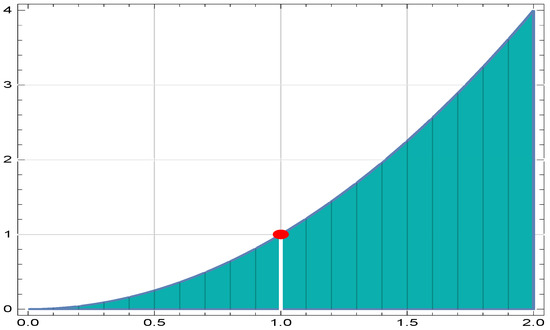
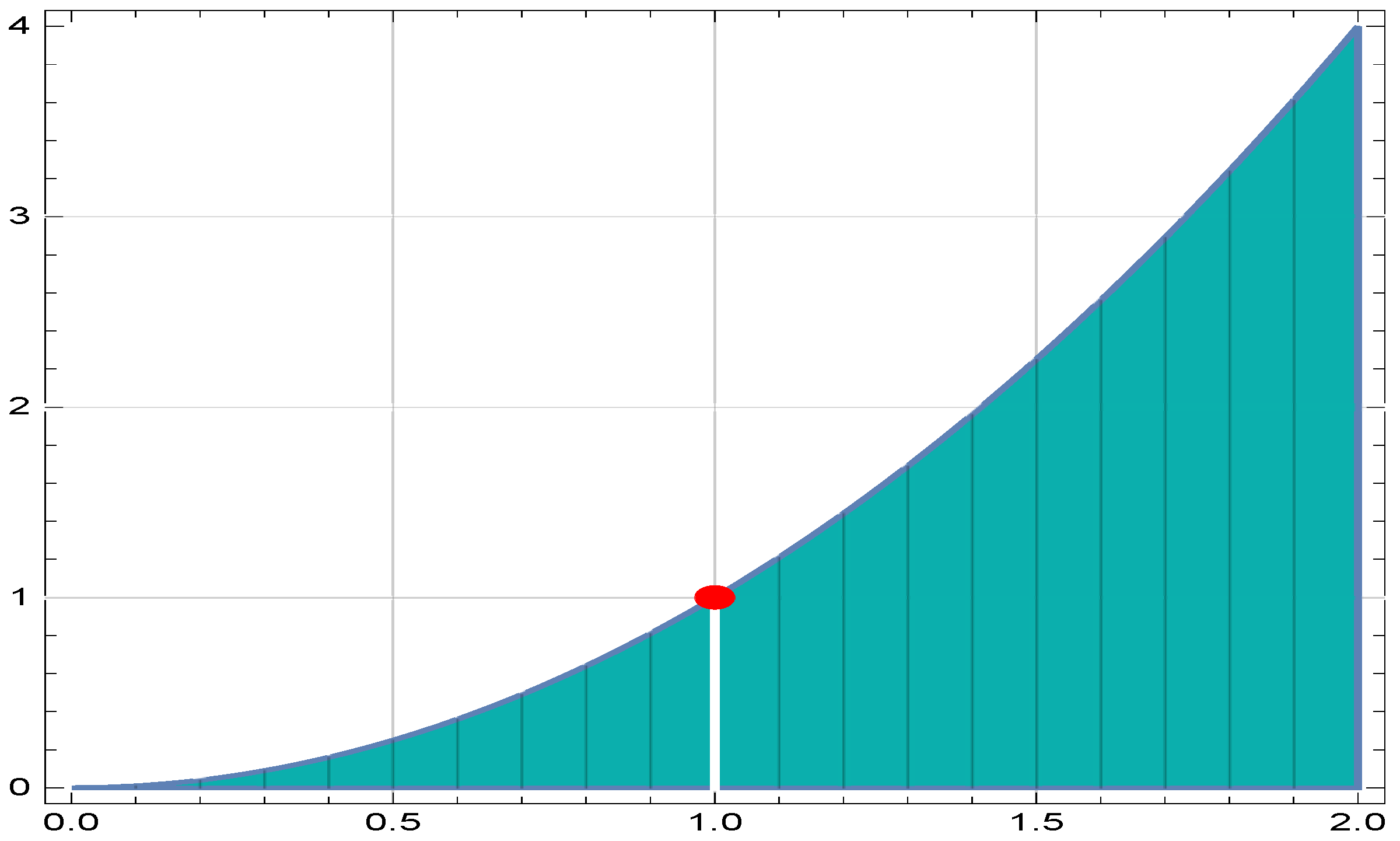
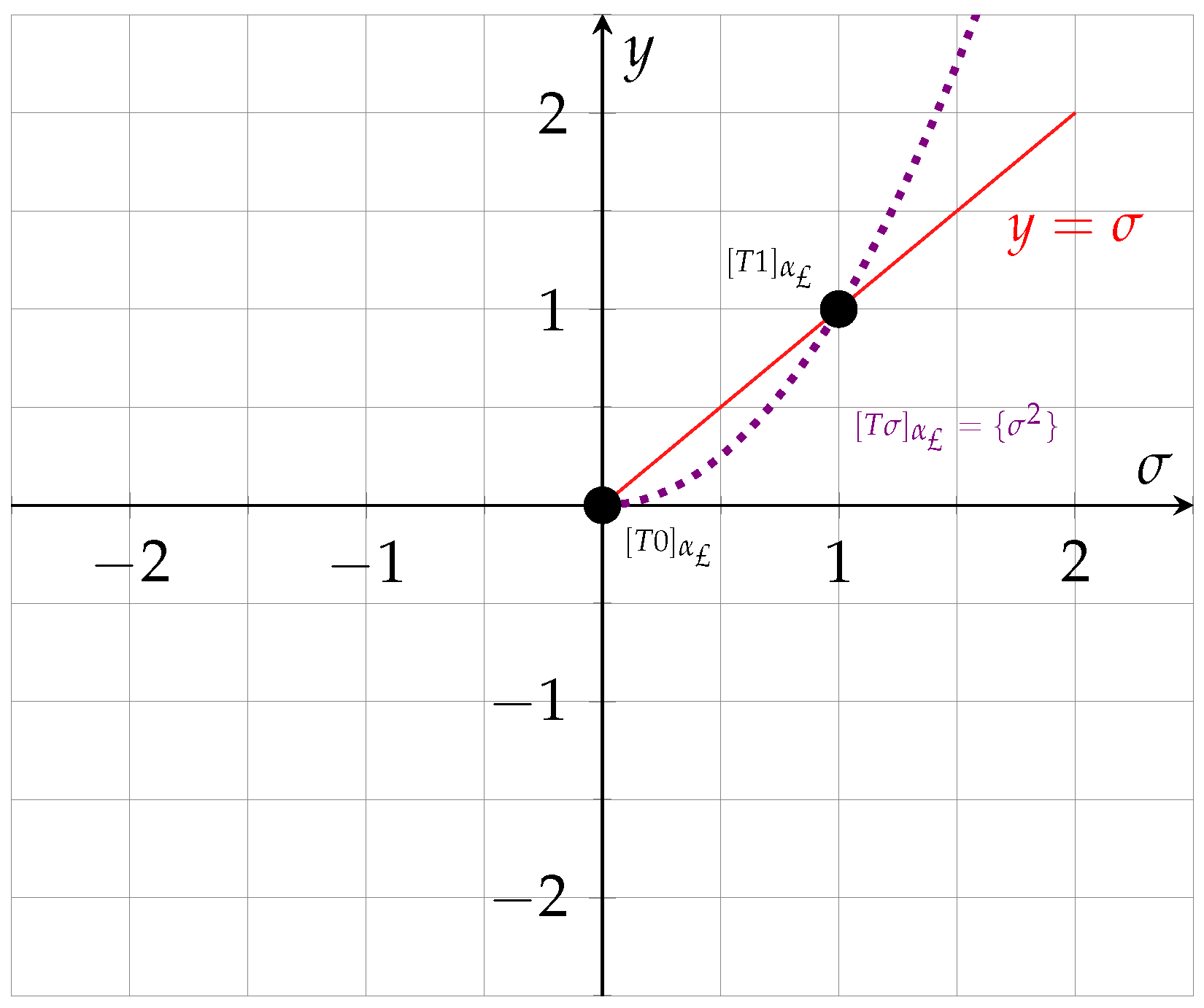
Additionally, it is clear that the £-FS-valued map T is β-admissible and H-continuous. It can also be shown that is prox for each . Because Theorem 3 meets all its assumptions, T possesses numerous £-FFPs within Ξ. It can also be observed by the Figure 3, where the red dot represents the point and the teal-colored region corresponds to .
Figure 3.
Graphical illustration of (21) representing infinitely many fixed points.
Now, we provide another example supporting our results.
Example 10.
Let . Define and by
and , respectively, for each . Then, is a complete extended ♭-MS. Additionally, let with and , where are non-comparable. Then, is a CDL. For each , consider a £-FS , which is defined as:
Then, for , we obtain
Clearly, for each . Define the functions and by
and , for every . Let for every . Then, and . By following the pattern described in the example above, it becomes evident that T possesses £-FFPs within Ξ.
4. Consequences
In this section, we demonstrate how our main Theorem can be used to derive a number of intriguing FP results existing in the literature, especially when using different forms of SFs. That is, SFs are very beneficial to express different kinds of contractivity conditions.
Corollary 1.
Let be a complete extended ♭-MS and be a £-FS-valued map satisfying the condition:
for all , where and is a function. Also, assume the following:
- (i)
- T is a β-admissible £-FS-valued map;
- (ii)
- There exists and such that , where ;
- (iii)
- T is H-continuous;
- (iv)
- is prox for each .
Then, T has at least one £-FFP in Ξ.
Proof.
Set for all in Theorem 2. Then, (22) follows easily. Note that . Consequently, Theorem 2 can be applied to find such that . □
The below-mentioned corollary is the proper extension and fuzzification of the result of Rhoades [38].
Corollary 2.
Consider a complete extended ♭-MS and let be a £-FS-valued map such that there exists a lower semicontinuous function verifying and satisfying the following condition:
for all . Further, assume the following:
- (i)
- T is H-continuous;
- (ii)
- is prox for each .
Then, there exists such that .
Proof.
This result follows by taking in Theorem 2 where the function is defined by for all . Clearly, . □
The following corollary is the improvement in the first metric FP Theorem under multi-valued contractions due to Nadler [16] by considering and defining a crisp set-valued map as for all .
Corollary 3.
Consider a complete extended ♭-MS and suppose is a £-FS-valued map that satisfies:
for all , where . Moreover, assume the following:
- (i)
- T is H-continuous;
- (ii)
- is prox for each .
Then, T has a £-FFP in Ξ.
Proof.
It is the special case of Theorem 2 that is derived by using the SF for all , , for all with along with (taking ). □
Given below is the definition of a single-valued -admissible map raised by Samet in [21].
Definition 24
([21]). Let and be mappings. Then, ϝ is known as β-admissible if for all ,
The main finding of Chifu and Karapinar [33] (Theorem 2) without involving the triangular -admissibility of is stated as follows:
Corollary 4.
Consider a complete extended ♭-MS and let be a β-admissible single-valued map satisfying:
for all , where ,
and
with . Then, there exists such that .
Proof.
Let and consider a £-FS-valued map for each , defined by
Then,
Clearly, . In the present case, . Hence, Theorem 2 can be used to obtain such that , which implies that . □
Corollary 5.
The main result of Shagari in [37] can be expressed as a consequence of our main result by taking in Theorem 2.
5. Application in Graphic Contraction
In this section, the main focus centers on the application of the £-FFP result in a graphic contraction. The exploration is supplemented with examples that feature intriguing 2D and 3D graphs and captivating computer simulations. We begin by recalling some definitions from graph theory.
5.1. Exploring the Basics from Graph Theory
Jachymski, in [34], generalizes the BCP by proposing the conception of contraction mapping and FPs for an MS equipped with a directed graph. In this subsection, we consider an extended ♭-MS which is equipped with a graph and derive an FP result. In the light of [34], let be an extended ♭-MS and the diagonal of the Cartesian product is represented by . Let be a directed graph with no parallel edges, where represents the set of vertices, while manifests the set of edges in . Then, is said to be equipped with if and involves all loops , that is, . Additionally, the graph is considered to be a weighted graph by allotting to every edge the distance between its vertices. In a graph , a walk comprises a sequence of edges and is a way of getting from one vertex to another of the form , in which any two edges are adjacent. A sequence of vertices can be determined by this type of walk. A walk in which no vertex appears more than once is called a path. Formally, for , a path from to of length l (the number of edges in a walk is called its length) is a sequence of vertices such that and for . Furthermore, a graph is defined as connected if, whenever its set of vertices is divided into two non-empty sets and ∇, there exists an edge that connects a vertex from to a vertex from ∇, that is, for each pair of vertices there always exists a path between them.
Example 11.
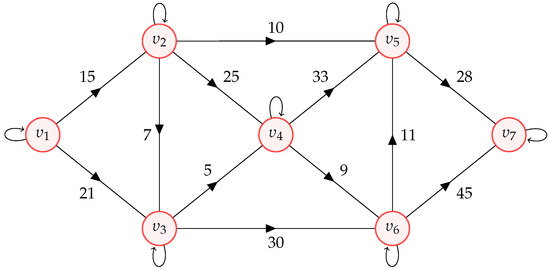
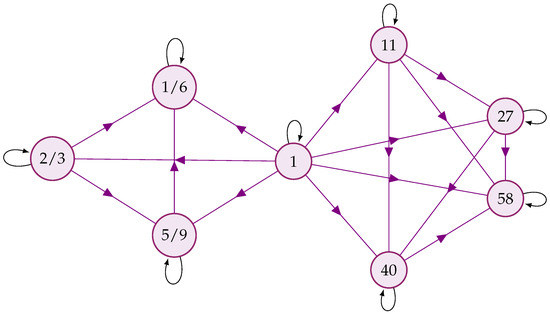
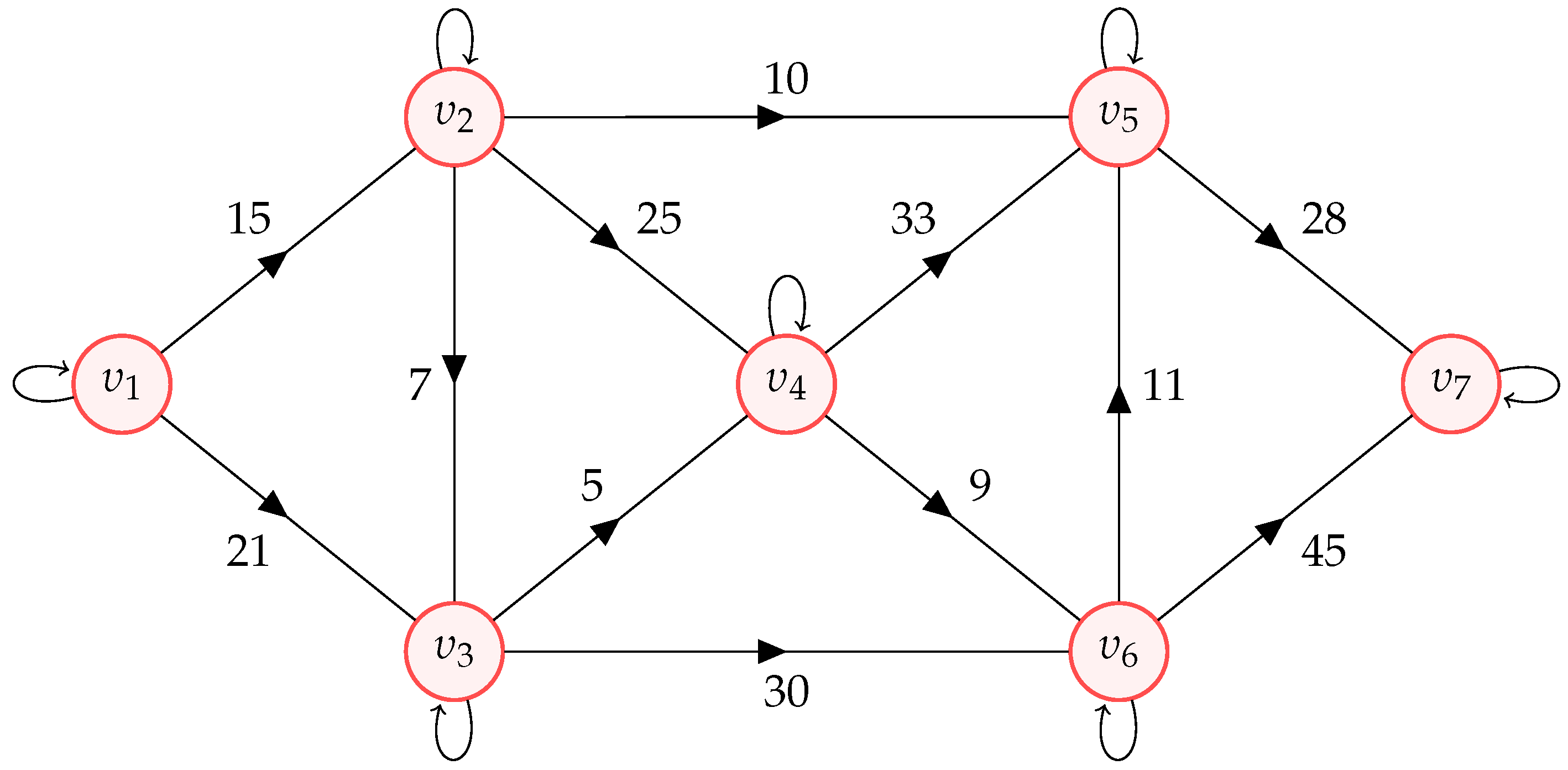
Let be a directed graph with as a set of vertices and as a set of edges. It can be observed that , and the graph does not have any parallel edge. Additionally, each edge of is assigned a numerical value, known as its edge-weight. Hence, can be classified as a weighted graph. The visual representation of is depicted by Figure 4.
Figure 4.
Visual representation of weighted graph .
5.2. £-Fuzzy Fixed Points in Graphical Extended b-MSs
Keeping in mind Jachymski’s definition of -continuity for a single-valued map in [34], we define it for a £-FS-valued map.
Definition 25.
Let be an extended ♭-MS equipped with a graph . A £-FS-valued map is known as -continuous at a point , if the following condition holds: for any sequence in Ξ with as and for all , we have as . To be classified as -continuous, a function T must show continuity at every point in the set Ξ.
Some other concepts needed for our result are also established.
Definition 26.
Let be a non-empty set. A £-FS-valued map is edge-preserving if for all , there exists an such that .
Definition 27.
Let be an extended ♭-MS equipped with a graph . A subset Γ of Ξ is termed as prox if for every point , there exists an element with an edge such that .
Theorem 4.
Let be a complete extended ♭-MS with a graph and be a £-FS-valued map. Suppose there exists and such that it satisfies:
for all . Additionally, suppose the following:
- (i)
- implies for all ;
- (ii)
- There exists and with , where ;
- (iii)
- For each and with , we have for all ;
- (iv)
- T is -continuous;
- (v)
- is prox for every element σ in Ξ.
Then, T has at least a £-FFP in Ξ.
Proof.
Define by
To show that T is -admissible, we consider and with . Then, from (24), we have that, by condition , implies that . Therefore, by , we obtain for all , which further implies . So, . We see that condition of Theorem 2 is satisfied. Furthermore, it is clear that the axioms , and stated in Theorem 4 imply, respectively, the assertions , and of Theorem 2. As a result, all the claims of Theorem 2 are satisfied. Hence, T has a £-FFP in . □
Example 12.
Let and define by with by for every . Let be a directed graph where and . Then, is a complete extended ♭-MS equipped with a graph . Let with and , where are not comparable. Then, is a CDL. For each , consider a £-FS, , which is defined as:
Then, for , we can obtain
We can easily see that for each . Now, defining by
and by , for all . Let for all . Then, and . Following the pattern discussed in Example 9, we can also verify (23) under the above-mentioned cases. Also, it is not difficult to show that T is edge-preserving and -continuous, and the subset of Ξ is prox for each , and the conditions and of Theorem 4 are also met. Because all the hypotheses of Theorem 4 are fulfilled, it can be concluded that T has £-FFPs in Ξ.
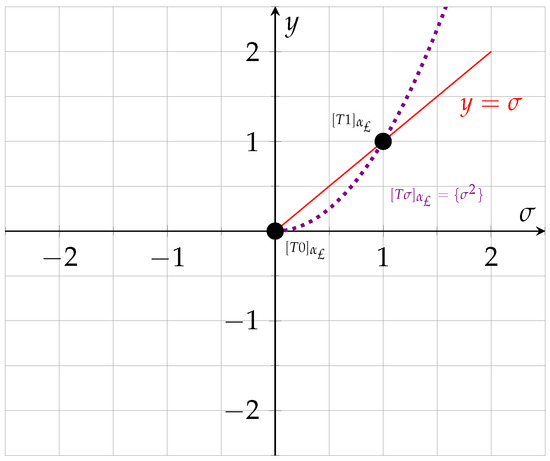
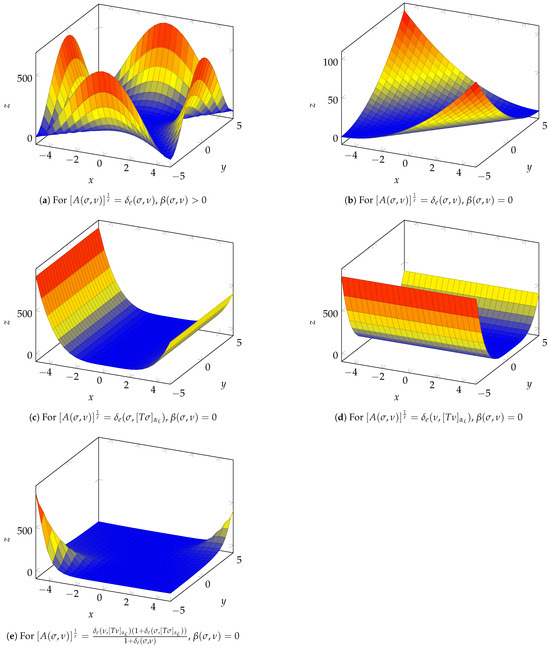
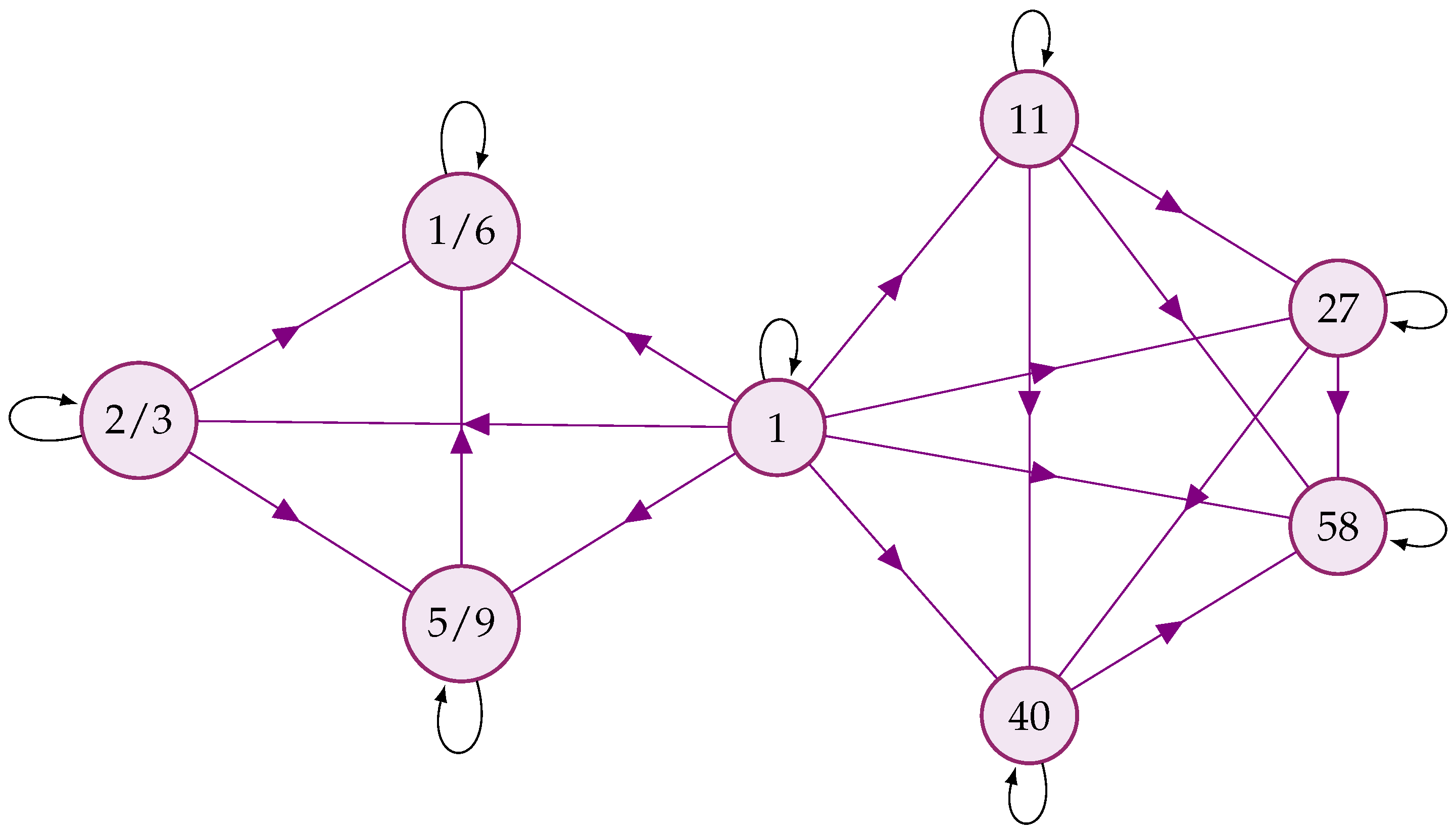
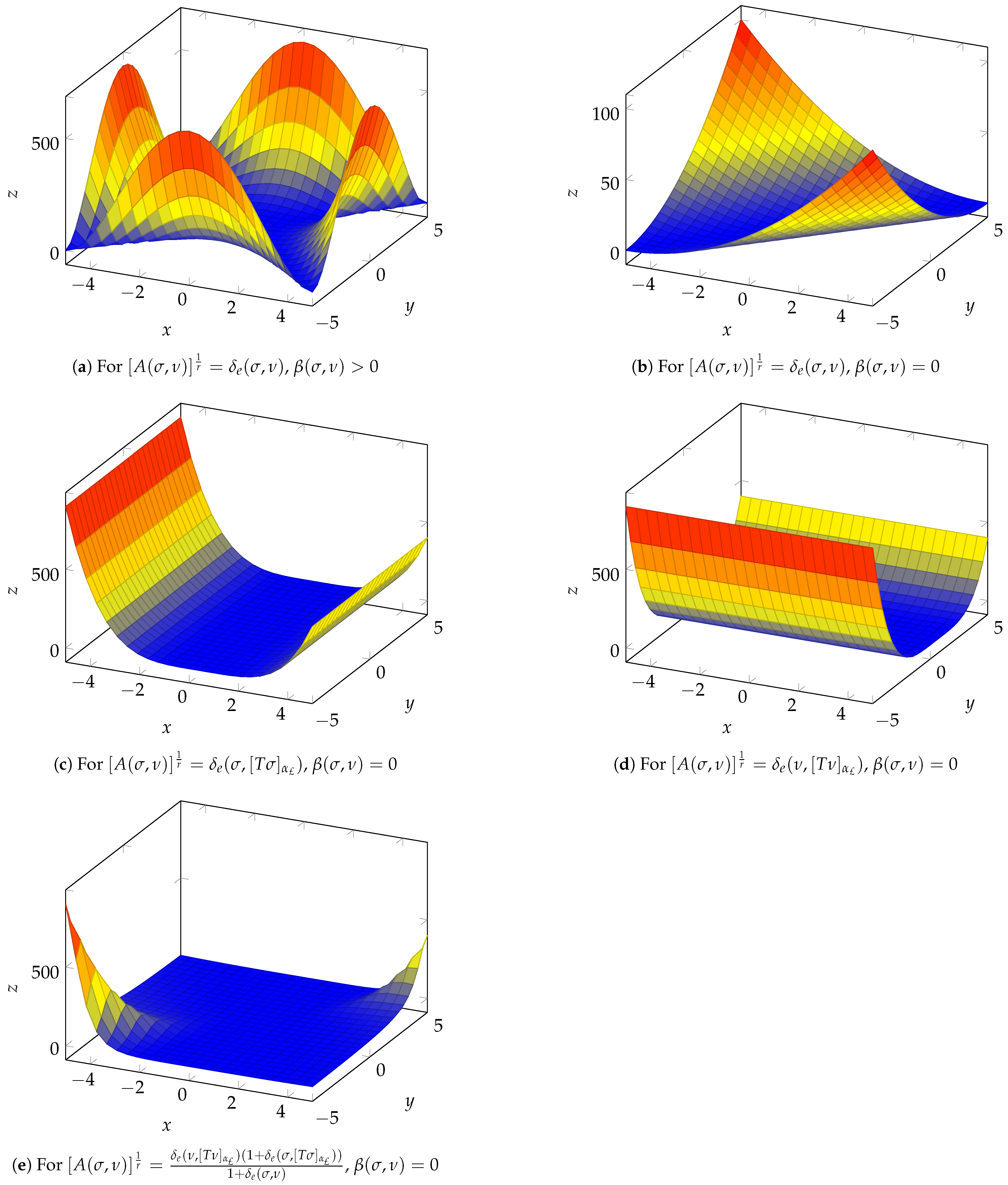
Figure 5 illustrates the weighted graph for where the weight of edge is given by , Figure 6 displays the FPs of , and Figure 7 justifies the inequality (23) under various cases of and function β (a detailed explanation can be found in the Appendix A at the end of this paper).
Figure 5.
Weighted graph for having edge-weight for each edge .
Figure 6.
Graph indicating that are the fixed points of mapping defined in (25).
Figure 7.
Validation of inequality (23) under different cases of and .
6. Conclusions
In this paper, a number of existing FP results in the literature have been fused and rectified by proposing the term modified admissible hybrid £-fuzzy -contraction in the framework of extended ♭-MSs. The concepts of -admissible mappings, SFs, and hybrid contractions have been implemented to consolidate several published results. Consequently, the above-mentioned results are accurate in the setup of complete ♭-MSs by considering , for some , and also in the bodywork of complete MSs by letting . In addition, the proved Theorems are also valid for FSs by taking . It is essential to note that by using various forms of SFs, one can obtain a number of new implications of the existing findings.
Open Problems:
- While this article extensively addresses the existence criteria for fixed points, what criteria can be formulated to determine the uniqueness of fixed points within the context of the discussed problems?
- Is it possible to extend the results obtained for L-fuzzy mappings to the domain of L-q-rung orthopair fuzzy mappings? What are the specific challenges and considerations that need to be addressed in order to achieve this extension?
Author Contributions
Conceptualization, M.R. and A.A.; formal analysis, M.R.; investigation, F.D., F.A. and M.A.A.-K.; writing—original draft preparation, M.R., A.A., F.D., F.A. and M.A.A.-K.; writing—review and editing, F.D. and F.A.; supervision, M.R.; funding acquisition, F.A. All authors have read and agreed to the published version of the manuscript.
Funding
This work was funded by the Deanship of Scientific Research at Imam Mohammad Ibn Saud Islamic University (IMSIU) (grant number IMSIU-RP23070).
Data Availability Statement
Not applicable.
Acknowledgments
The authors gratefully acknowledge the technical and financial support provided by the Imam Mohammad Ibn Saud Islamic University, Saudi Arabia (grant number IMSIU-RP23070).
Conflicts of Interest
The authors have clearly stated that they have no competing financial interests or personal relationships that could potentially influence their work. Moreover, the funder was involved in the writing and editing of the manuscript.
Abbreviations
The following abbreviations are used in this manuscript:
| BCP | Banach Contraction Principle |
| CS | Cauchy Sequence |
| CF | Comparison Function |
| CDL | Complete Distributive Lattice |
| FP | Fixed Point |
| TLA | Fuzzy Set |
| FM | Fuzzy Mapping |
| FFP | Fuzzy Fixed Point |
| MS | Metric Space |
| SF | Simulation Function |
Appendix A. Explanation of Figure 7
The modified admissible hybrid £-fuzzy -contraction:
using from Example 12 in the above inequality, we obtain
for , and the contraction condition is reduced to
Here, we observe six different cases which are given below:
Case 1. If , then (A1) reduces to .
Case 2. If , then (A1) becomes .
Case 3. If , then (A1) becomes .
Case 4. If , then (A1) becomes .
Case 5. If , then (A1) becomes .
Case 6. If , then (A1) becomes .
It is worth mentioning here that each of the above-mentioned cases further divides into three subcases, each corresponding to different values of the function already defined in Example 12. Thus, considering all the cases and their subcases under the contraction condition, we have a total of 18 inequalities, all of which are verified through computer simulations in Figure 7. For clarity, we included in this paper only those 3D graphs that exhibit distinct shapes, as some of them have similar representations.
References
- Van An, T.; Van Dung, N.; Kadelburg, Z.; Radenovic, S. Various generalizations of metric spaces and fixed point Theorems. Rev. R. Acad. Cienc. Exactas Fís. Nat. Ser. A Math. RACSAM 2015, 109, 175–198. [Google Scholar]
- Ciric, L.B. A generalization of Banach’s contraction principle. Proc. Am. Math. Soc. 1974, 45, 267–273. [Google Scholar] [CrossRef]
- Suzuki, T. A generalized Banach contraction principle that characterizes metric completeness. Proc. Am. Math. Soc. 2008, 136, 1861–1869. [Google Scholar] [CrossRef]
- Czerwik, S. Contraction mappings in b-metric spaces. Acta Math. Inform. Univ. Ostrav. 1993, 1, 5–11. [Google Scholar]
- Bakhtin, I. The contraction mapping principle in quasimetric spaces. J. Funct. Anal. 1989, 30, 26–37. [Google Scholar]
- Ali, M.U.; Kamran, T.; Postolache, M. Solution of Volterra integral inclusion in b-metric spaces via new fixed point Theorem. Nonlinear Anal. Model. 2017, 22, 17–30. [Google Scholar] [CrossRef]
- Berinde, V. Sequences of operators and fixed points in quasimetric spaces. Stud. Univ. Babes-Bolyai Math. 1996, 16, 23–27. [Google Scholar]
- Hussain, A.; Kanwal, T.; Al-Rawashdeh, A. Global best approximate solutions for set valued contraction in b-metric spaces with applications. Commun. Math. Sci. 2018, 9, 293. [Google Scholar]
- Shatanawi, W.; Pitea, A.; Lazovic, R. Contraction conditions using comparison functions on b-metric spaces. Fixed Point Theory Appl. 2014, 2014, 135. [Google Scholar]
- Fagin, R.; Stockmeyer, L. Relaxing the triangle inequality in pattern matching. Int. J. Comput. Vis. 1998, 30, 219–231. [Google Scholar] [CrossRef]
- Kamran, T.; Samreen, M.; UL Ain, Q. A generalization of b-metric space and some fixed point Theorems. Mathematics 2017, 5, 19. [Google Scholar] [CrossRef]
- Zadeh, L.A. Fuzzy sets. Inf. Control 1965, 8, 338–353. [Google Scholar] [CrossRef]
- Li, H.; Yen, V.C. Fuzzy Sets and Fuzzy Decision-Making; CRC Press: Boca Raton, FL, USA, 1995. [Google Scholar]
- Zhan, J.; Alcantud, J.C.R. A novel type of soft rough covering and its application to multicriteria group decision making. Artif. Intell. Rev. 2019, 52, 2381–2410. [Google Scholar]
- Heilpern, S. Fuzzy mappings and fixed point Theorem. J. Math. Anal. 1981, 83, 566–569. [Google Scholar] [CrossRef]
- Nadler, S.B., Jr. Multi-valued contraction mappings. Pac. J. Math. 1969, 30, 475–488. [Google Scholar] [CrossRef]
- Banach, S. Sur les opérations dans les ensembles abstraits et leur application aux équations intégrales. Fundam. Math. 1922, 3, 133–181. [Google Scholar] [CrossRef]
- Al-Mazrooei, A.E.; Ahmad, J. Fixed point Theorems for fuzzy mappings with applications. Intell. Fuzzy Syst. 2019, 36, 3903–3909. [Google Scholar] [CrossRef]
- Shagari, M.S.; Azam, A. Integral type contractions of soft set-valued maps with application to neutral differential equations. AIMS Math. 2020, 5, 342–358. [Google Scholar] [CrossRef]
- Goguen, A. L-fuzzy sets. J. Math. Anal. Appl. 1967, 18, 145–174. [Google Scholar] [CrossRef]
- Samet, B.; Vetro, C.; Vetro, P. Fixed point Theorems for α − ψ-contractive type mappings. Nonlinear Anal. Theory Methods Appl. 2012, 75, 2154–2165. [Google Scholar] [CrossRef]
- Asl, J.H.; Rezapour, S.; Shahzad, N. On fixed points of α − ψ-contractive multifunctions. Fixed Point Theory Appl. 2012, 2012, 212. [Google Scholar] [CrossRef]
- Mohammadi, B.; Rezapour, S.; Shahzad, N. Some results on fixed points of α − ψ-Ciric generalized multifunctions. Fixed Point Theory Appl. 2013, 2013, 24. [Google Scholar] [CrossRef]
- Phiangsungnoen, S.; Sintunavarat, W.; Kumam, P. Fuzzy fixed point Theorems for fuzzy mappings via β-admissible with applications. J. Uncertain. Anal. Appl. 2014, 2, 20. [Google Scholar] [CrossRef]
- Rashid, M.; Azam, A.; Mehmood, N. L-Fuzzy fixed points Theorems for L-fuzzy mappings via βFL-admissible pair. Sci. World J. 2014, 2014, 853032. [Google Scholar] [CrossRef]
- Rashid, M.; Kutbi, M.A.; Azam, A. Coincidence Theorems via alpha cuts of L-fuzzy sets with applications. Fixed Point Theory Appl. 2014, 2014, 212. [Google Scholar] [CrossRef]
- Azam, A.; Mehmood, N.; Rashid, M.; Pavlovic, M. L-fuzzy fixed points in cone metric spaces. J. Adv. Math. Stud. 2016, 9, 121–131. [Google Scholar]
- Rashid, M.; Shahzad, A.; Azam, A. Fixed point Theorems for L-fuzzy mappings in quasi-pseudo metric spaces. J. Intell. Fuzzy Syst. 2017, 32, 499–507. [Google Scholar] [CrossRef]
- Al Rawashdeh, A.; Mehmood, N.; Rashid, M. Coincidence and common fixed points of integral contractions for L-fuzzy maps with applications in fuzzy functional inclusions. J. Intell. Fuzzy Syst. 2018, 35, 2173–2187. [Google Scholar] [CrossRef]
- Kanwal, S.; Azam, A. Bounded lattice fuzzy coincidence Theorems with applications. J. Intell. Fuzzy Syst. 2019, 36, 1531–1545. [Google Scholar] [CrossRef]
- Kanwal, S.; Hanif, U.; Noorwali, M.E.; Alam, M.A. Existence of αL-fuzzy fixed points of L-fuzzy mappings. Math. Probl. Eng. 2022, 2022, 6878428. [Google Scholar]
- Sirajo Abdullahi, M.; Azam, A. L-fuzzy fixed point Theorems for L-fuzzy mappings via βFL-admissible with applications. J. Uncertain. Anal. Appl. 2017, 5, 2. [Google Scholar] [CrossRef]
- Chifu, I.C.; Karapinar, E. Admissible hybrid Z-contractions in b-metric spaces. Axioms 2019, 9, 2. [Google Scholar] [CrossRef]
- Jachymski, J. The contraction principle for mappings on a metric space with a graph. Proc. Am. Math. Soc. 2008, 136, 1359–1373. [Google Scholar] [CrossRef]
- Karapinar, E.; Agarwal, R.P. Interpolative Rus-Reich-Ciric type contractions via simulation functions. Analele Stiintifice Ale Univ. Ovidius Constanta Ser. Mat. 2019, 27, 137–152. [Google Scholar] [CrossRef]
- Khojasteh, F.; Shukla, S.; Radenovic, S. A new approach to the study of fixed point theory for simulation functions. Filomat 2015, 29, 1189–1194. [Google Scholar] [CrossRef]
- Mohammed, S.S.; Fulatan, I.A. Fuzzy fixed point results via simulation functions. Math. Sci. 2022, 16, 137–148. [Google Scholar] [CrossRef]
- Rhoades, B. Some Theorems on weakly contractive maps. Nonlinear Anal. Theory Methods Appl. 2001, 47, 2683–2693. [Google Scholar] [CrossRef]
- Aydi, H.; Bota, M.F.; Karapinar, E.; Moradi, S. A common fixed point for weak ϕ-contractions on b-metric spaces. Fixed Point Theory 2012, 13, 337–346. [Google Scholar]
- Bota, M.F.; Chifu, C.; Karapinar, E. Fixed point Theorems for generalized (α − ψ)-Ciric-type contractive multivalued operators in b-metric spaces. J. Nonlinear Sci. Appl. 2016, 9, 1165–1177. [Google Scholar] [CrossRef]
- Subashi, L.; Gjini, N. Some results on extended b-metric spaces and Pompeiu-Hausdorff metric. Progress. Res. J. 2017, 12, 2021–2029. [Google Scholar]
- Roldán-López-de-Hierro, A.F.; Karapinar, E.; Roldán-López-de-Hierro, C.; Martínez-Moreno, J. Coincidence point Theorems on metric spaces via simulation functions. J. Comput. Appl. Math. 2015, 275, 345–355. [Google Scholar] [CrossRef]
- Alharbi, A.S.; Alsulami, H.H.; Karapinar, E. On the power of simulation and admissible functions in metric fixed point theory. J. Funct. Spaces 2017, 2017, 2068163. [Google Scholar] [CrossRef]
- Alqahtani, B.; Fulga, A.; Karapinar, E. Fixed point results on δ-symmetric quasi-metric space via simulation function with an application to Ulam stability. Mathematics 2018, 6, 208. [Google Scholar] [CrossRef]
- Aydi, H.; Felhi, A.; Karapinar, E.; Alojail, F.A. Fixed points on quasi-metric spaces via simulation functions and consequences. J. Math. Anal. Appl. 2018, 9, 10–24. [Google Scholar]
- Rus, I.A. Generalized Contractions and Applications; Cluj University Press: Cluj-Napoca, Romania, 2001. [Google Scholar]
- Berinde, V. Generalized contractions in quasimetric spaces. Semin. Fixed Point Theory 1993, 3, 3–9. [Google Scholar]
- Samreen, M.; Kamran, T.; Postolache, M. Extended b-metric space, extended b-comparison function and nonlinear contractions. UPB Sci. Bull. A Appl. Math. Phys. 2018, 80, 21–28. [Google Scholar]
- Subashi, L. Some topological properties of extended b-metric space. In Proceedings of the 5th International Virtual Conference on Advanced Scientific Results, Belgrade, Serbia, 5–9 June 2017; Volume 5, pp. 164–167. [Google Scholar]
Disclaimer/Publisher’s Note: The statements, opinions and data contained in all publications are solely those of the individual author(s) and contributor(s) and not of MDPI and/or the editor(s). MDPI and/or the editor(s) disclaim responsibility for any injury to people or property resulting from any ideas, methods, instructions or products referred to in the content. |
© 2023 by the authors. Licensee MDPI, Basel, Switzerland. This article is an open access article distributed under the terms and conditions of the Creative Commons Attribution (CC BY) license (https://creativecommons.org/licenses/by/4.0/).