Abstract
Using the notions of clique partitions and edge clique covers of graphs, we consider the corresponding incidence structures. This connection furnishes lower bounds on the negative eigenvalues and their multiplicities associated with the adjacency matrix, bounds on the incidence energy, and on the signless Laplacian energy for graphs. For the more general and well-studied set of all real symmetric matrices associated with a graph G, we apply an extended version of an incidence matrix tied to an edge clique cover to establish several classes of graphs that allow two distinct eigenvalues.
Keywords:
clique partition; edge clique cover; vertex-clique incidence matrix; eigenvalues of graphs; graph energy; minimum number of distinct eigenvalues MSC:
05C50; 15A29
1. Introduction
Let be a simple undirected graph with n vertices and m edges. A clique in G is a subset such that all vertices in C are pairwise adjacent. An edge clique cover F of G is a set of cliques that together contain each edge of G at least once. The smallest size of an edge clique cover of G is called the edge clique cover number of G and is denoted by cc. An edge clique cover of G with size is called a minimum edge clique cover of G. A special case of an edge clique cover in which every edge belongs to exactly one clique is called a clique partition of G. The size of the smallest clique partition of G is called the clique partition number of G, and is denoted by . A clique partition of G with size is referred to as a minimum clique partition of G. It is clear that both and exist as E forms a clique partition (and hence an edge clique cover) of G. Further, note that any minimum clique partition does not contain any cliques of order one, and, by convention, the clique partition number of the empty graph is defined to be zero. Information concerning clique partitions and edge clique covers of a graph can be found in the works [1,2,3,4].
Before defining the various matrices associated with a graph, we make note of standard matrix notations: denotes the identity matrix; O denotes the zero matrix (size determined by context); J denotes the all ones matrix (size determined by context); and denotes the all ones vector (size determined by context).
Given a graph G with and , the (vertex-edge) incidence matrix M of G is the matrix defined as follows: the rows and the columns of M are indexed by V and E, respectively, and the -entry of M is 0 if and 1 otherwise. Similarly, the adjacency matrix is a -matrix of G such that if and 0 otherwise. It is well known that [5]
where is the diagonal matrix of vertex degrees (, ) and the matrix is known as the signless Laplacian matrix of the graph G; the line graph, , of the graph G is the graph whose vertex set is in one-to-one correspondence with the set of edges of G, where two vertices of are adjacent if and only if the corresponding edges in G have a vertex in common [6]. Finally, the equations in (1) imply an important spectral relation between the signless Laplacian matrix and , see Lemma 6.
As we are also interested in studying more general symmetric matrices associated with a graph on n vertices, we let denote the collection of real symmetric matrices such that for , if and only if . The main diagonal entries of any such A in are not constrained. Observe that for any graph G, both and belong to .
We denote the spectrum of A, i.e., the multiset of eigenvalues of A, by . In particular, where the distinct eigenvalues of A are given by with corresponding multiplicities of these eigenvalues are , respectively. Further, we consider the ordered multiplicity list of A as the sequence . For brevity, a simple eigenvalue is simply denoted by .
With respect to the set , the parameter is defined by where is the number of distinct eigenvalues of A (see [7,8]). The number is known as the minimum number of distinct eigenvalues of the graph G. The class of matrices has been of recent interest (see [9,10,11] and the references therein), and there has been considerable development on the inverse eigenvalue problem for graphs (see [12]) which continues to receive considerable and deserved attention, as it remains one of the most interesting unresolved issues in combinatorial matrix theory.
Using the notions of clique partitions and edge clique covers of a graph we generalize the conventional vertex-edge incidence matrix M by considering an incidence matrix called the vertex-clique incidence matrix of a graph. Eigenvalues of graphs and clique partitions have arisen previously, see, for example, the works [13,14], and for other types of graph decompositions see [15]. Suppose is an edge clique cover of a graph G with . The vertex-clique incidence matrix of G associated with the edge clique cover F is defined as follows: the -entry of is real and nonzero if and only if the vertex i belongs to the clique . In the particular case when F is actually a clique partition, the vertex-clique incidence matrix is denoted by , and the -entry of is equal to one if and only if the vertex i belongs to the clique . We observe that for any graph G, the vertex-clique incidence matrix corresponding to a clique partition F preserves several main properties of its vertex-edge incidence matrix. For instance, in Section 3, , where , where is the number of cliques in F containing the vertex i (this parameter is discussed in more detail in Section 3). Note that for each i, . This fact enables us to determine lower bounds for the negative eigenvalues of the graph.
This paper is organized as follows. In Section 2, we provide the necessary notions, notations, and known results that are needed in the sections containing our main observations. In Section 3, using the notion of a clique partition F of a graph G, we define a signless Laplacian matrix of the graph G associated with the clique partition F. A graph is introduced as a generalization for the line graph of G. In Section 3.1, applying this theory of a vertex-clique incidence matrix, we produce lower bounds for the negative eigenvalues of the graph. Moreover, we present lower bounds for the negative inertia of a graph G in terms of its order n and the rank of its vertex-clique incidence matrix. We also provide a sufficient condition under which the well-known inequality holds with equality, where is the independence number of G. In Section 3.2, we introduce graph energies associated with a clique partition F of the graph G and study several associated properties. Moreover, upper bounds for the energies of the graph G and its clique partition graph and line graph are determined. In Section 4, studies on the vertex-clique incidence matrix of a graph associated with an edge clique cover lead to a derivation of some new classes of graphs with (see also Section 4.1).
2. Notations and Preliminaries
In this section, we provide known notions, notations, and results that are used later in this work.
We begin by introducing the notion of the eigenvalues of a graph. The eigenvalues of the adjacency matrix (or shortened to when reference to the graph G is clear from context) of the graph G are also called the eigenvalues of G. The number of positive (negative) eigenvalues in the spectrum of the graph G is called the positive (negative) inertia of the graph G, and is denoted by (). The energy of the graph G is defined as
Further details on various properties of graph energy can be found in [16,17,18,19,20]. Suppose be the eigenvalues of the matrix . Then, the signless Laplacian energy of the graph G is defined as
More information on properties of the signless Laplacian energy can be found in [21], and the energy of a line graph and its relations with other graph energies are studied in [22,23].
A subgraph H of a graph G is a graph whose vertex set and edge set are subsets of those of G. If H is a subgraph of G, then G is said to be a supergraph of H. The subgraph of G obtained by deleting either a vertex v of G or an edge e of G is denoted by and , respectively. Suppose H is a graph on n vertices. Then, we let denote the graph obtained from the complete graph, , by removing the edges from H (this graph is also known as the complement of the graph H). An independent set in the graph G is a set of vertices in G, no two of which are adjacent. The independence number of G is the number of vertices in the largest independent set of G. A matching in a graph G, is a collection of independent edges from G (i.e., no two edges in a matching share a common vertex from G). Additionally, a matching is referred to as perfect if each vertex from G is incident with one edge from the matching.
An real symmetric matrix B is a positive semi-definite matrix if all of its eigenvalues are nonnegative. In this case, we denote . For real symmetric matrices B and C, if , then we write .
Lemma 1
([24]). Let A and B be real symmetric matrices of order n, and assume that . Then, for all , where is the ith largest eigenvalue of a square matrix M.
The following result was obtained in [5].
Lemma 2
([5]). If B and C are matrices such that and are both defined, then and have the same nonzero eigenvalues with the same multiplicity.
The Schur product of two matrices and of the same size is defined to be . An symmetric matrix A is said to have the Strong Spectral Property (or A has the SSP for short) if the only symmetric matrix X satisfying , and is (see [25]). The following result is given in Theorem. 10 [25].
Lemma 3
([25]). If has the SSP, then every supergraph of G with the same vertex set has a matrix realization that has the same spectrum as A and has the SSP.
Given two graphs G and H, the join of G and H, denoted by , is the graph obtained from , by adding all possible edges between G and H. Suppose G is a graph with . Then, among all matrix realizations A in with two distinct eigenvalues, we define the multiplicity bi-partition associated with A if the two eigenvalues of A have respective multiplicities and k. Further, we define the minimal multiplicity bi-partition to be the least integer such that G achieves the multiplicity bi-partition . We close this section with two useful results concerning specific classes of graphs realizing two distinct eigenvalues with respect to the set .
Lemma 4
([26,27]). Let G be a connected graph on n vertices. Then,
- (1)
- if and only if G is the complete graph, .
- (2)
- if and only if for non-negative integers with , and G is not isomorphic to either one of a complete graph or .
Lemma 5
([28]). If G is a connected graph of order and , then , where .
3. Matrices Associated with a Clique Partition
In this section, we consider the vertex-clique incidence matrix associated with a clique partition of a graph G. Recall from the introduction that for a given clique partition of G, the matrix has -entry is equal to one if and only if the vertex i belongs to the clique (see also [13,14]). Observe that when , is simply the conventional incidence matrix of the graph G. For each vertex of the graph G, we define the parameter to be the number of cliques in F containing the vertex i, that is, We call the clique-degree of the vertex i in graph G associated with F, and, without loss of generality, after a re-labelling of the vertices if necessary, we assume that (see also [13]). Given clique partition of G, we consider different possible classes of graphs as follows:
- (i)
- The graph G is t clique-regular if , for some positive integer t;
- (ii)
- The graph G is s clique-uniform if , for some positive integer s;
- (iii)
- The graph G is regular if and , for positive integers . Any graph is 2 clique-uniform and any d-regular graph is also d clique-regular using the trivial clique partition .
Let be the diagonal matrix with row and column indexed by the vertex set V with -entry equal to , that is, . It follows that the inner product of row i and row j (with ) of equals the number of cliques in F containing the vertices i and j. By definition of the clique partition F, if i and j are adjacent, then this number is equal to 1 and otherwise 0. This leads to the following result:
Theorem 1.
Let be the vertex-clique incidence matrix of G associated with a given clique partition F. Then where and is the adjacency matrix of G.
As mentioned above, in the case of , the matrix is the incidence matrix M of G and consequently, is the signless Laplacian matrix of G, where we assume, after possibly re-labelling, that the sequence of vertex degrees is ordered as . Notice that in this case, for . Motivated by this observation, for any clique partition F we call the signless Laplacian matrix of the graph G associated with the clique partition F. Since we always have , it follows . Now define the clique partition graph with k vertices, where each vertex i corresponds to each clique in F such that each pair of vertices of are adjacent if and only if the corresponding cliques in F have a vertex in common. If , then the line graph of G. The inner product of two columns of is nonzero if and only if the corresponding cliques have a common vertex. From the definition of a clique partition, this nonzero value must be 1. These facts immediately yield the following result:
Theorem 2.
Let be the incidence matrix of G associated with a clique partition F. Then, where and and denote the adjacency matrix of the graph .
For the case of , we have , and so for .
3.1. Applications of the Vertex-Clique Incidence Matrix to Graph Spectrum
In this section, we develop several results on the spectrum of the graph G and its clique partition graph by the vertex-clique incidence matrix of a graph. Considering with Lemma 2 we conclude that the nonzero eigenvalues of matrices and are the same. This fact leads to the following basic results.
Theorem 3.
We have the following.
- (i)
- If , then .
- (ii)
- If , then for .
- (iii)
- If , then for .
Recall that if , then and . Combining these equations with Theorem 3 leads to the following well-known result [22,29]:
Lemma 6.
Let G be a graph of order n with m edges. Then, In particular if then for , and if then for .
The following result is obtained by applying Theorem 3 for a regular graph G with the clique partition F.
Theorem 4.
Let G be a regular graph of order n with a clique partition F of size k.
- (i)
- If , then
- (ii)
- If , then for .
- (iii)
- If , then for .
Proof.
(i) By Theorem 3 (i), if , then , that is, , that is, , that is,
- (ii)
- By Theorem 3 (ii), if then for , that is, for , that is, for .
- (iii)
- By Theorem 3 (iii), if then for , that is, for , that is, for .
□
Example 1.
(i) Considering the complete graph and its minimum clique partition F with only one clique, we have , and . Applying Theorem 4 here we have for , and , that is, is a regular graph. From this with Theorem 4 we arrive at that is, , and by Theorem 4 , for .
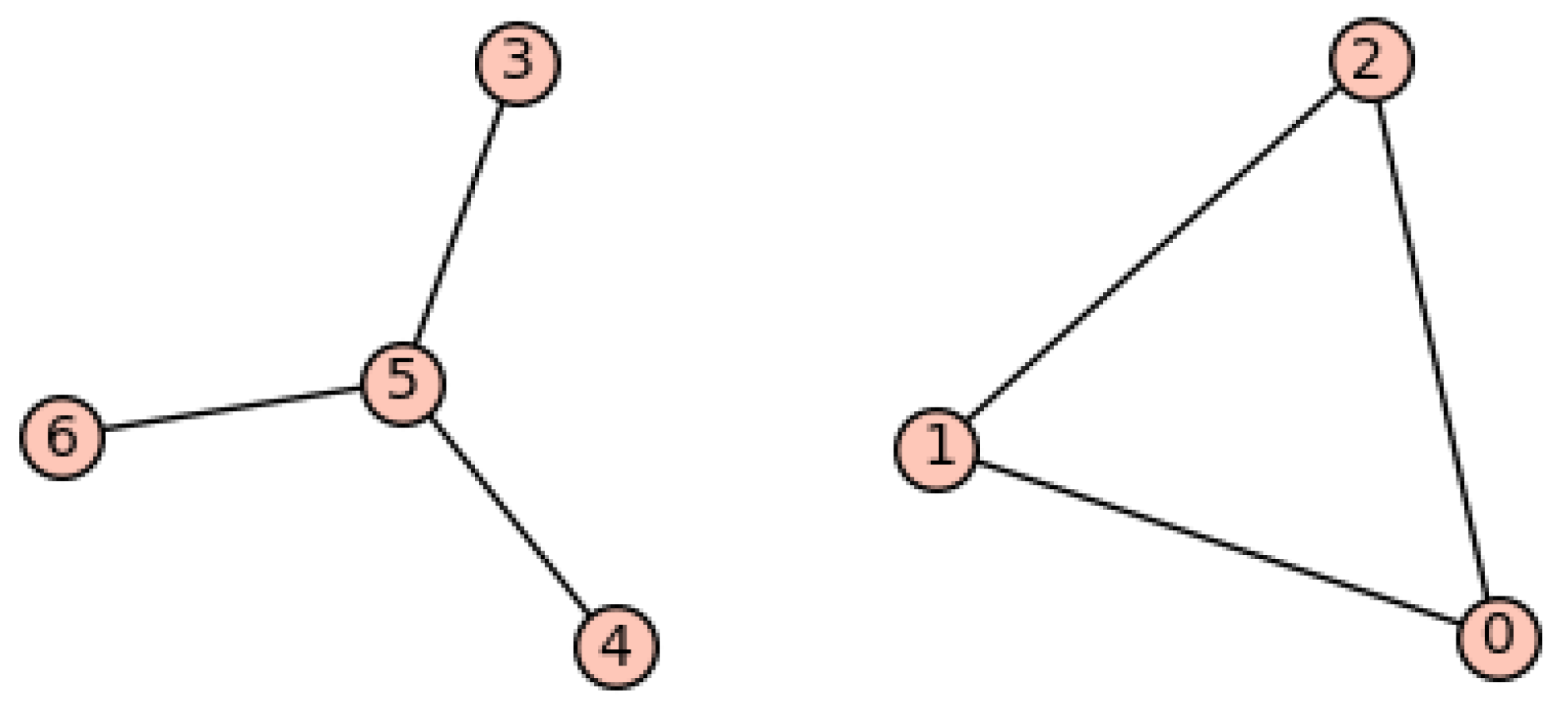
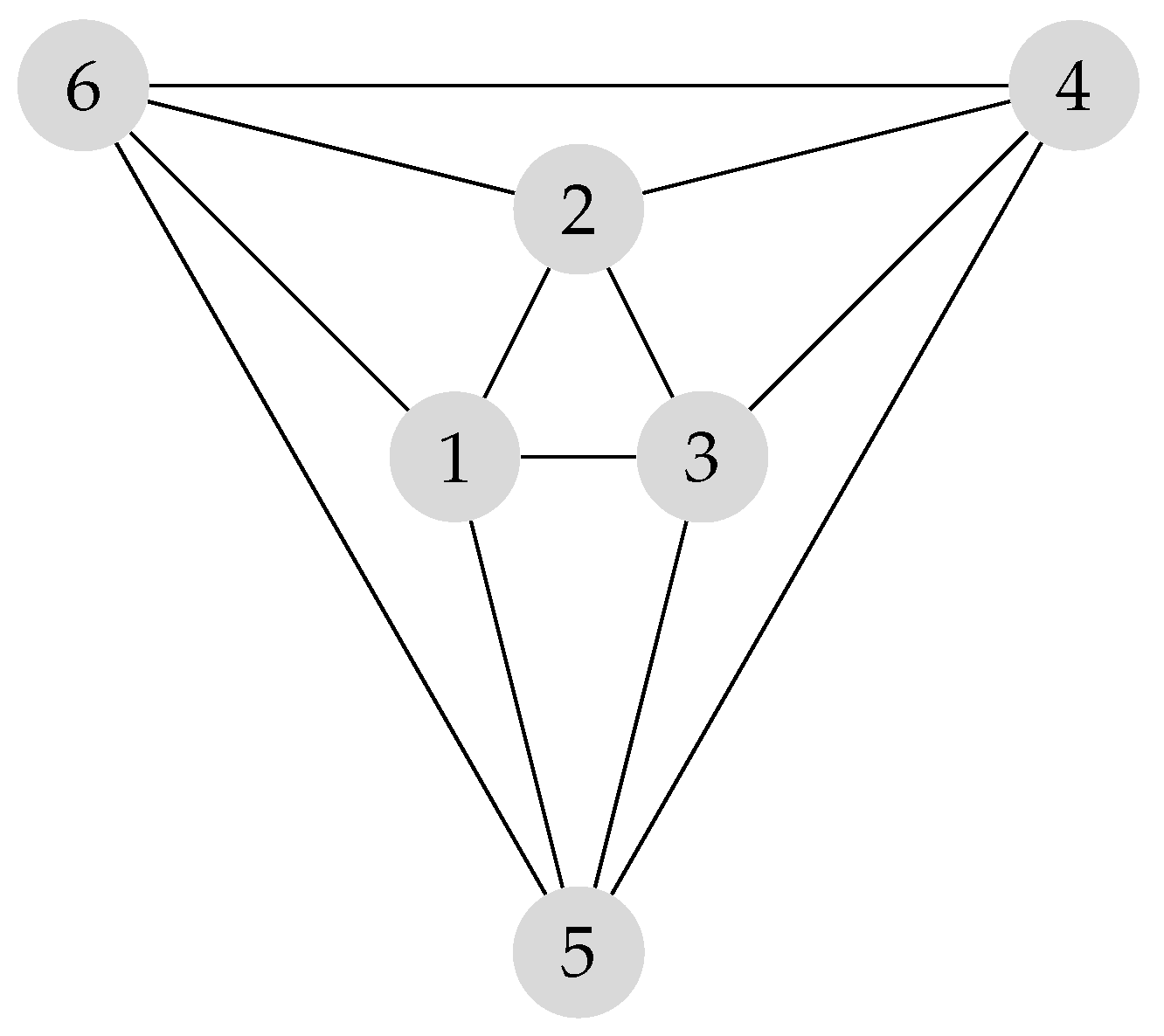
Considering the clique partition for G isomorphic to the complete tripartite graph (or ) in Figure 1, we have for and for . Then, G is a regular graph. Moreover,
and by Theorem 4, we have for and for . From these facts with , we arrive at .
Figure 1.
The graph .
Now applying the theory of clique partitions and vertex-clique incidence matrices, we obtain a lower bound for the smallest eigenvalue of a graph. During the review of a previous version, we were made aware of the work in [15] where the first statement in the next result can also be found in Corollary 3.1 [15]. We include a proof here for completeness.
Theorem 5.
Let G be a graph of order n and let be the largest clique-degree of G with a given clique partition F. Then
Proof.
Since is a positive semi-definite matrix, we have and by Lemma 1 we arrive at
Considering we arrive at , which gives the required result in (4).
For the second part of the proof, suppose that . Then . This with the relation , gives , that is, . Now we assume that . If then , that is, for , that is, as , that is, with the multiplicity at least . □
Corollary 1.
All regular bipartite graphs and all clique-regular graphs with satisfy the equality in (4).
Proof.
First we assume that G is a regular bipartite graph. Since G is bipartite, we have for and . On the other hand, since G is regular, we have . These facts with Theorem 5 give the fact that all regular bipartite graphs satisfies the equality in (4).
Next, assume that G is a clique-regular graph with . Since , the required result is obtained by Theorem 5. □
Theorem 5 holds for any clique partition F of G, which leads to the following. However, during the review of a previous version, we were made aware of the work [13] where a version of the next result can also be found in Corollary 3.2 [13]. We include a proof here for completeness.
Corollary 2.
Let G be a graph of order n and let be the largest clique-degree of G with a given clique partition F. Then,
where the minimum is over all clique partitions F of G.
The following example shows that for the equality the graph G need not be clique-regular.
Example 2.
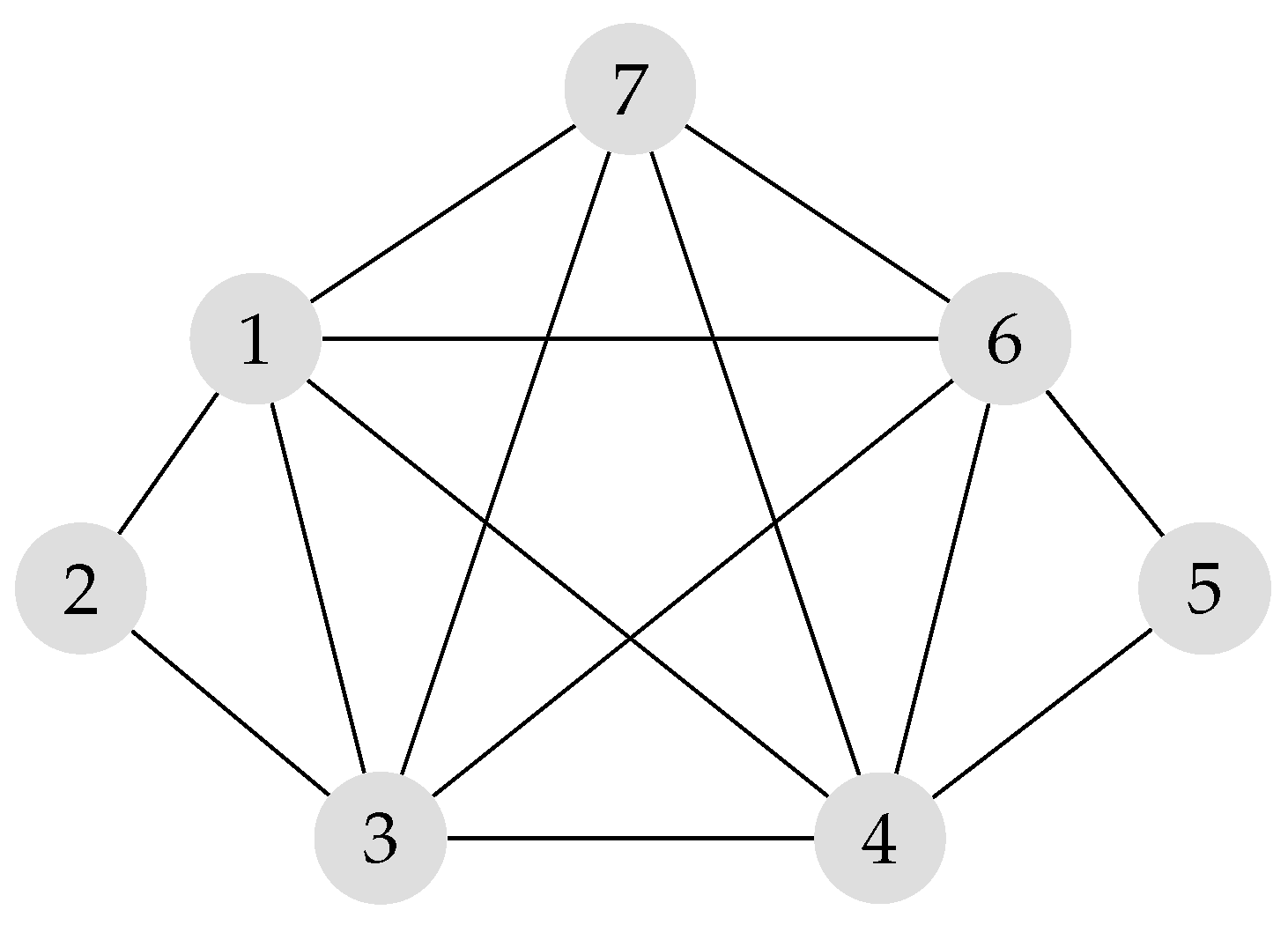
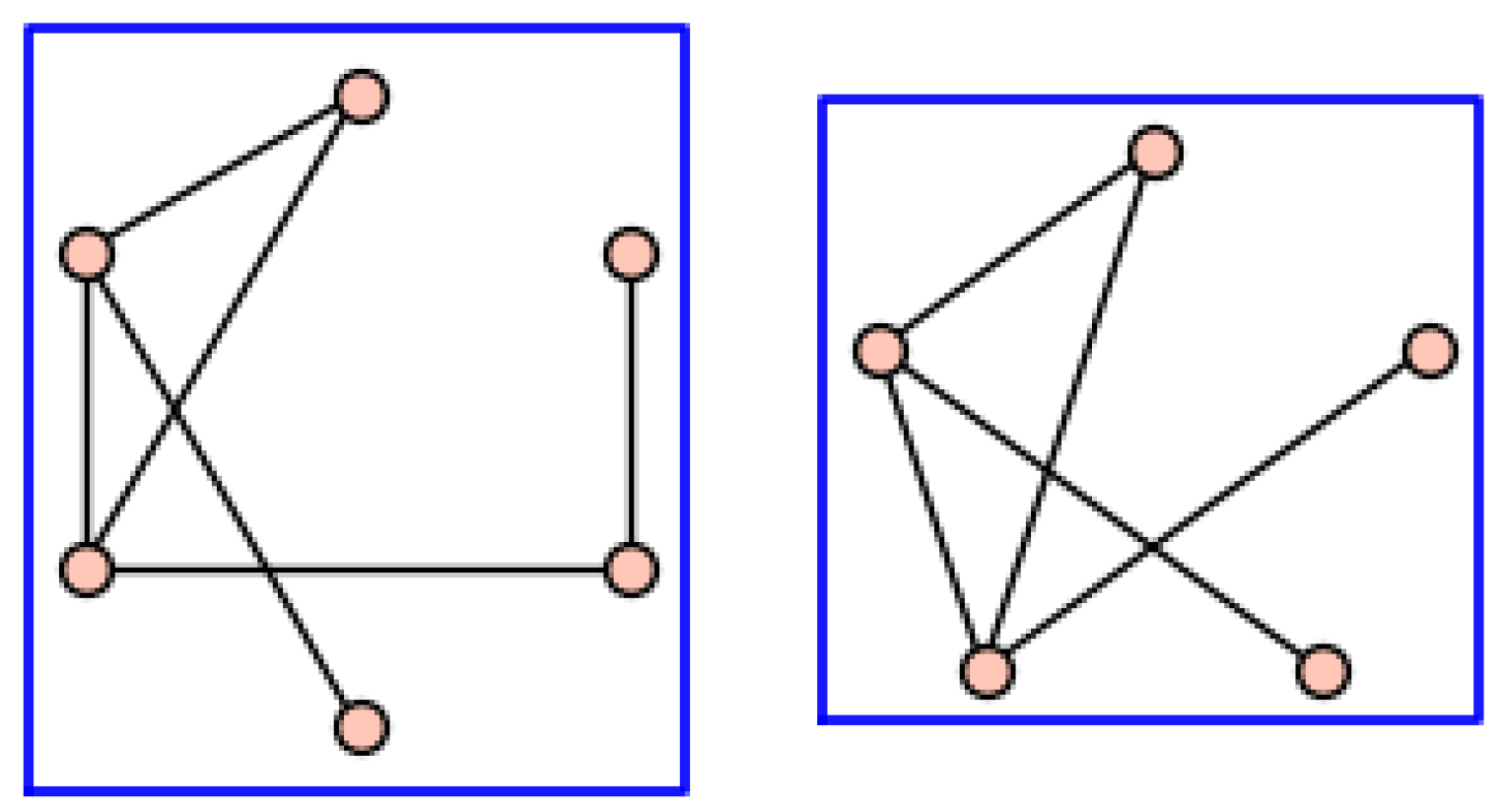
For the graph G given in Figure 2, we have This gives for and . The graph is the line graph of the graph of order 6 with 7 edges. Then the smallest eigenvalue of G is while .
Figure 2.
The Graph G.
In the following we provide a lower bound for the negative inertia of a graph G of order n.
Theorem 6.
Let G be a graph of order n. Then,
where minimum is over all clique partitions F of G. Moreover, if , then for .
Proof.
If , then the result in (6) is obvious. Assume that is a clique partition of G with . In this case, since and is positive semi-definite matrix, we have for . From this and the fact that , we have for , which gives the required results. □
The following result is obtained by Theorem 6 and the fact .
Corollary 3.
Let G be a graph of the order n and a clique partition F such that . Then,
- (i)
- for .
- (ii)
- .
Furthermore, if F is a minimum clique partition of G the next consequence immediately follows from Corollary 3.
Corollary 4.
Let G be a graph of the order n and clique partition number . If , then
- (i)
- for .
- (ii)
- .
For any graph G of order n we have [29]
where and are the negative and positive parts of the inertia, respectively of the graph G. This implies that
In the following we present a sufficient condition for which equality in (8) holds.
Theorem 7.
Let G be a graph of order n with the independence number and the clique partition number . If F is a clique partition with , then In particular, if , then
Proof.
By Theorem 6 we have This fact along with (8) gives
The assumption that is equivalent to . This with (9) gives the first required result.
Without loss of generality, we may assume that the vertex set is a maximum independent set in G and is a clique of a minimum clique partition containing the vertex . Now in we consider the submatrix induced by the rows and columns corresponding to the vertex set and the clique set , respectively. Obviously, this square principal submatrix is equivalent to the identity matrix of size and hence . Since and using the assumption we arrive at and, therefore, by the first part of the theorem. □
The following result is obtained from (5). During the review of a previous version, we were made aware of the work [13] where the next result can also be found in Theorem 3.1 [13]. We include a proof here for completeness.
Theorem 8.
Let G be a graph of order n and the negative inertia . Let be the ith largest clique-degree of G with a clique partition F. Then, for , we have
Equality holds in (10) if G is a clique-regular graph with .
Since is a positive semi-definite matrix, using a similar argument as in the proof of Theorem 5, we obtain the following result.
Theorem 9.
Let G be a graph of order n with a clique partition and let for such that . Then,
Equality holds in (11) if G is a clique-uniform graph with .
Proof.
Since is a positive semi-definite matrix, we have and by Lemma 1, it follows that
Considering we have which gives the required result in (11).
Now assume that G is a clique-uniform graph with . By Theorem 3 (ii) with , we arrive at for . On the other hand, since we have , and consequently . That is, for , that is, with multiplicity at least . □
Theorem 9 holds for any clique partition F of G, which gives the following result.
Corollary 5.
Let G be a graph of order n with a clique partition and let for such that . Then,
where minimum is over all clique partitions F of G.
In the case of , we have for by Theorem 3. Since , we get . We summarize this in the next result.
Theorem 10.
Let G be a graph of order n and a clique partition F with . Then,
- (i)
- for .
- (ii)
- .
The following result follows from (12).
Theorem 11.
Let G be a graph of order n with a clique partition and let for such that . If is the corresponding clique partition graph of G, then for ,
Equality in (14) holds if G is a clique-uniform graph with .
The following concerns the signless Laplacian eigenvalues of a graph.
Theorem 12.
Let G be a graph of order n and having a clique partition F with and assume .
- (i)
- If G is a t clique-regular graph, then .
- (ii)
- If G is a s clique-uniform graph, then .
Proof.
From Section 3, the signless Laplacian matrix Q of G satisfies . This fact with Lemma 1 gives , where and are, respectively, the ith largest signless Laplacian eigenvalue of G and the ith largest eigenvalue of matrix . Using the above analysis combined with Theorem 3 and the facts and implies the required results in and . □
3.2. Applications to Energy of Graphs and Matrices
In this section, using the theory of vertex-clique incidence matrices of a graph, we introduce notions of graph energies, as a generalization of the incidence energy and the signless Laplacian energy of the graph. Finally, we present upper bounds on energies of a graph, its clique partition graph and line graph.
The energy of the graph G defined in (2) has the equivalent expressions as follows [22]:
where and are, respectively, the positive and the negative inertia of G. Nikiforov [30,31,32] proposed a significant extension and generalization of the graph energy concept. The energy of an matrix B is the summation of its singular values, that is,
where denotes the ith singular value of B which is equal to .
Consonni and Todeschini [33] introduced an entire class of matrix-based quantities, defined as
where are the eigenvalues of the respective matrix, and is their arithmetic mean.
According to (16) and (17), two types of energies can then be defined for any matrix B. The incidence energy of a graph G is defined to be the energy of the incidence matrix of G of the type (16), i.e.,
Similarly, the vertex-clique incidence energy of G associated with the clique partition F is defined as the energy of the vertex-clique incidence matrix , i.e.,
Observe
From the above and using Lemma 1 we have and, consequently, we have
with equality if and only if .
Moreover,
Applying the fact that the diagonal entries are majorized by the eigenvalues of and by a similar method given in [34] it can be shown that
Considering the energy of the matrix of the type (17) gives
where . The energy can be viewed as a generalization of the signless Laplacian energy of G which is defined in [21] as follows:
Due to the similarity of the definitions for signless Laplacian energy and it follows that in most cases, results derived about can be generalized to . For example, from Lemma 2.12 in [22] for , we obtain the following:
where is the largest positive integer such that .
Using a method similar to the proof of Corollary 5 in [35] for , we have
In the next result, we show that for a clique-regular graph G associated with a clique partition F, .
Theorem 13.
If G is a clique-regular graph associated with a clique partition F, then .
Proof.
Suppose that G is t clique-regular. Then,
□
Note that for any t clique-regular graph G, we have . Next, we show that for a clique-uniform graph G we have .
Theorem 14.
If G is a clique-uniform graph with the clique partition graph , then .
Proof.
Suppose that G is a s clique-uniform graph. Then,
□
Note that for any s clique-uniform graph G with the clique partition graph , we have
In [22] Theorem 3.3, a relation between the energy of the line graph and the signless Laplacian energy of G is given. In the following, we generalize this result by using the notion of clique partition of a graph and we provide a comparison between the energy of the clique partition graph of and . For this, we need the following lemma, which is obtained from Theorem 3 and is a generalization of Lemma 6.
Lemma 7.
Let G be an s clique-uniform graph of order n associated with a clique partition F where . Then,
Theorem 15.
Let G be an s clique-uniform graph of order n associated with a clique partition F where .
- (i)
- If , then .
- (ii)
- If , then .
- (iii)
- If , then .
Proof.
Let . By Lemma 7 we have
On the other hand, from (15) we have
Recall that is the largest positive integer such that and let . Again by Lemma 7 we have On the other hand, by (19) and Lemma 7 we have
From (15) with the above equation we have
If , then by and , i.e., if , then .
It suffices to show that if , then . Indeed, if , then
Since with Lemma 7 we have □
In the following, we present an upper bound for the energy of a graph G.
Theorem 16.
Let G be a graph of order n and the negative inertia and let be the largest clique degree of G associated with the clique partition F, for . Then,
where the minimum is given over all clique partitions F of G. Equality holds if G is a clique-regular graph associated with a minimum clique partition of size .
Proof.
The following result provides an upper bound on the energy of G in terms of the vertex degrees.
Theorem 17.
Let G be a graph of order n with the vertex degrees . Then
where .
Proof.
Since for along with Theorem 16 gives
On the other hand, the Laplacian matrix of G is a positive semi-definite matrix, so . From this with Lemma 1 we obtain for . Then, . Using the previous inequality with (21) completes the proof. □
From Theorem 16 with (7) we obtain the following upper bound for the energy of G:
where is the independence number of the graph G. By (15) and (14) applying a similar method carried out for the proof of Theorem 16, we obtain the next result.
Theorem 18.
Let G be a graph of order n with a clique partition and let for such that . For the clique partition graph of G, we have
Equality holds if G is a clique-uniform graph associated with a minimum clique partition of size .
Next, we present an upper bound on the energy of the line graph with a full characterization of the corresponding extremal graphs.
Theorem 19.
Let G be a graph with the line graph . Then,
Equality holds if and only if G is a graph with connected components for with and , and possibly some isolated vertices or single edges. Further, each non-bipartite connected component satisfies and , and each bipartite connected component is either a 4-cycle or satisfies and .
Proof.
As previously noted, if the clique partition F of G is as same as the edge set E of G, then for and . Using Theorem 18, we have
which gives the required result in (22).
To characterize these extreme graphs in (22), we assume equality holds in (23). Then, all negative eigenvalues of must be equal to by (23). We then consider the following two cases:
Case (1) G is connected. First, assume that . If G is non-bipartite, then by Lemma 6, for and as . Since must be nonnegative, we have . Otherwise G is bipartite and by Lemma 6 along with , for and as . Since must be nonnegative, it follows that . Next, assume that . Since all negative eigenvalues of are equal to , we have . If , then and is the cycle of order 4. Otherwise , and , that is, , which is a contradiction as G is connected. Finally, assume that . Since G is connected it must be a tree and hence . In this case we have , that is, , which again leads to a contradiction.
Case (2) Assume G is disconnected. Since isolated vertices and single edges do not affect the negative inertia of , we may assume that G has connected components along with the possibility of some isolated vertices and single edges. Now each connected component of G can be characterized by the first case, and the proof is complete. □
4. Vertex-Clique Incidence Matrix of a Graph Associated with an Edge Clique Cover
In this section, we consider the vertex-clique incidence matrix, denoted by , associated with an edge clique cover F of a graph G. Recall that the -entry of is real and nonzero if and only if the vertex i belongs to the clique . A strategy for minimizing the number of distinct eigenvalues of , is to minimize the number of distinct eigenvalues of the related matrix . Consequently, we obtain an upper bound on the parameter . A key technique used here is to consider an extended version of , by considering arbitrary real entries in the matrix , but simultaneously paying careful attention to preserving the condition that .
4.1. Applications to the Minimum Number of Distinct Eigenvalues of a Graph
In this section, applying the tool of the vertex-clique incidence matrix of a graph associated with its edge clique cover, we characterize a few new classes of graphs with .
If G and H are graphs then the Cartesian product of G and H denoted by , is the graph on the vertex set with and adjacent if and only if either and and are adjacent in H or and are adjacent in G and . The first statement in the next theorem can also be found in [7], however, we include a proof here to aid in establishing the second claim.
Theorem 20.
Let with . Then, and G has an SSP matrix realization with two distinct eigenvalues.
Proof.
Let where and . Then, we have
where
From the structure of A, we have . On the other hand,
where . Hence and .
Now, we show that the matrix A has SSP. We need to prove that the only symmetric matrix satisfying , , and is .
From the two equations , , X must have the following form: , where . The equality gives . Also, we have , i.e., .
Hence . Then for . Considering , we have and , and then . Considering for we arrive at for . This means that the row and column sums in are equal to zero. Now, consider where .
We have
Thus, and, consequently, . Hence, the proof is complete. □
Corollary 6.
For even n, we have .
Proof.
Let and let H be the graph obtained from the complete bipartite graph by removing a perfect matching. Then, by Theorem 20 and Lemma 3, for H or any subgraph of H, . Considering this and that is a subgraph of H, the result is obtained. □
Theorem 21.
Let G be a graph obtained from by removing a perfect matching between and a copy of . Then and G has an SSP matrix realization with two distinct eigenvalues.
Proof.
Let where and . Considering the fact that and are symmetric, we have
where
From the structure of A, we have . On the other hand,
where . This gives , which proves .
Now, we show that the matrix A has SSP. We need to prove that the only symmetric matrix satisfying , , and is .
From the two equations , , X must have the following form: , where , and . The matrix equation
gives . From (25) we also have , i.e., , i.e., . This gives , i.e., .
Again from (25), we have , that is, , that is, , i.e.,
Considering a main diagonal entry, say , in the above matrix equation, we obtain
Considering the -entry in the above matrix equation, we obtain . From the above and (26), , that is, . Using the equation , we arrive at the matrix equation . Following a similar argument as in the proof of Theorem 20 we obtain .
Again from (25), we have . Since , we get , i.e., . Considering both the and entries from the matrix equation, we arrive at and , that is, , which gives . □
Corollary 7.
Consider the complete bipartite graph by removing a perfect matching. Define a new graph H by adding a copy of to this graph such that each vertex in is adjacent to the corresponding vertex in a copy of . Then, . Moreover, the result holds for any subgraph of H on the same vertex set.
In [36], the authors studied the problem of graphs requiring property . A graph G has if it contains a path of length r and every path of length r is contained in a cycle of length s. They prove that the smallest integer m so that every graph on n vertices with m edges has (or each path of length 2 is contained either in a 3-cycle, or a 4-cycle) is for all . Using this, it was noted in [37] that the above equation from [36] implies that the smallest number of edges required to guarantee that all graphs G on n vertices satisfy is at least . For small values of n, it is known that in fact, equality holds in the previous claim. Namely, if at most edges are removed from the complete graph with , then the resulting graph has a matrix realization with two distinct eigenvalues. Along these lines and based on [37] the following is a natural conjecture:
Conjecture 1.
Removing up to edges from does not change the number of distinct eigenvalues of . That is, for any subgraph H of with ,
We confirm Conjecture 1 for and note that our analysis of the case differs slightly from [37]. For this, we need the next few lemmas.
Lemma 8.
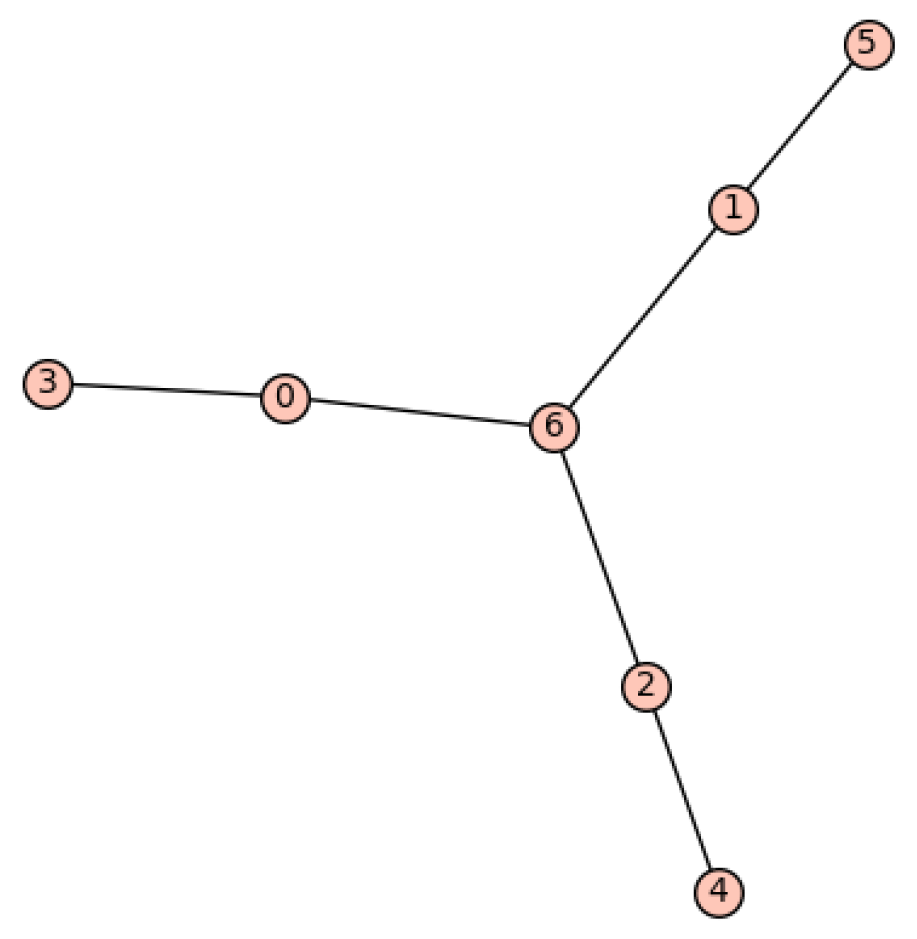
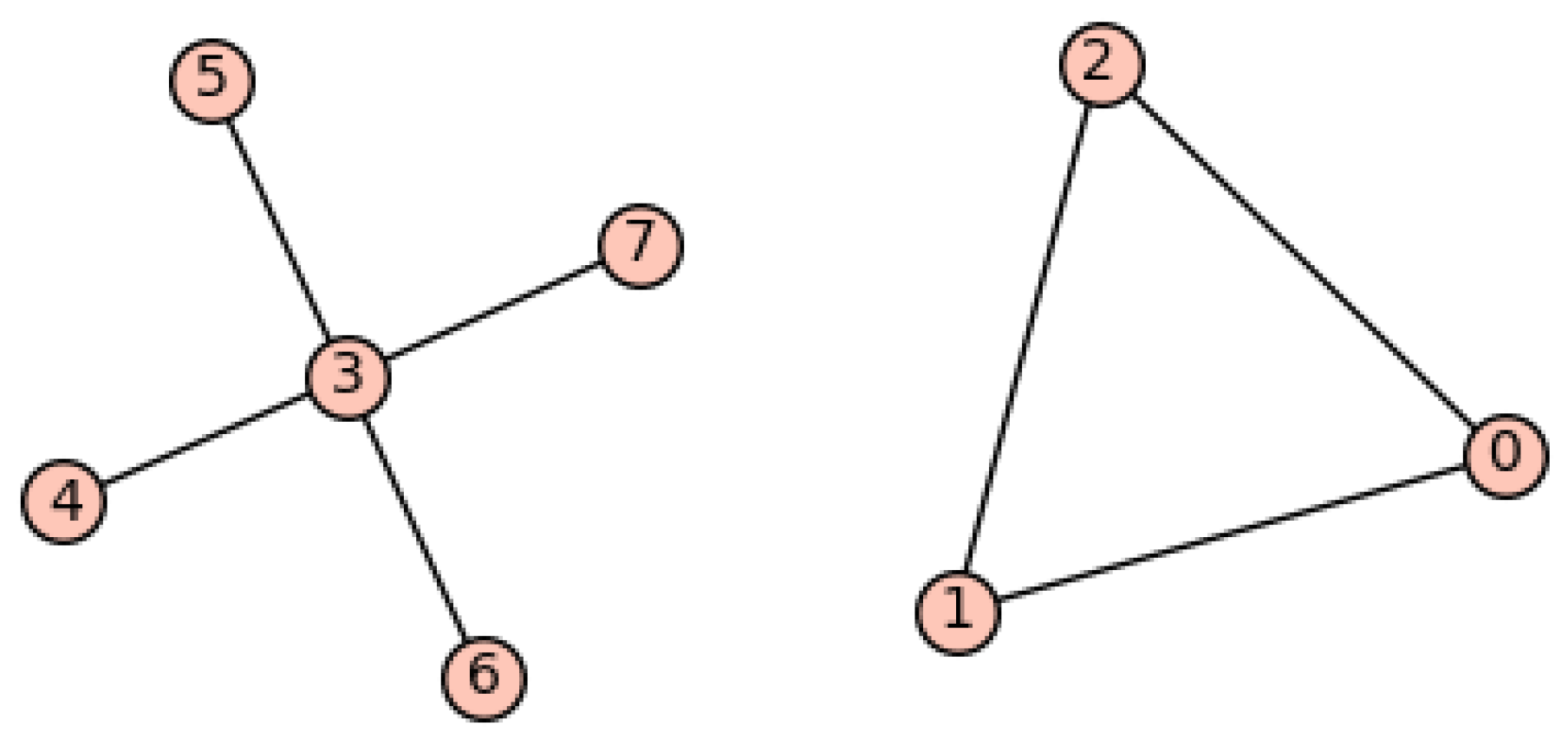
Let be the tree given in Figure 3. We have and has an SSP matrix realization with two distinct eigenvalues.
Figure 3.
Tree .
Proof.
Consider the matrix as follows:
Using the Gram–Schmidt method we arrive at a column orthonormal matrix . In this case, we have . In addition, and . This proves that . Furthermore, A has SSP (this can be confirmed using SageMath [38]), and by Lemma 3, the complement of any subgraph of on the same vertex set also has a matrix realization with two distinct eigenvalues. □
Lemma 9.
Let . Then, and has an SSP matrix realization with two distinct eigenvalues.
Proof.
Figure 4.
The graph G.
. Also and . This proves that . Furthermore, A has SSP (a computation that can be verified by SageMath [38]), and by Lemma 3, the complement of any subgraph of G on the same vertex set also has a matrix realization with two distinct eigenvalues. □
We now verify that Conjecture 1 holds for .
Theorem 22.
Removing up to four edges from does not change the number of distinct eigenvalues of , i.e., for any subgraph H of on seven vertices, with we have
Proof.
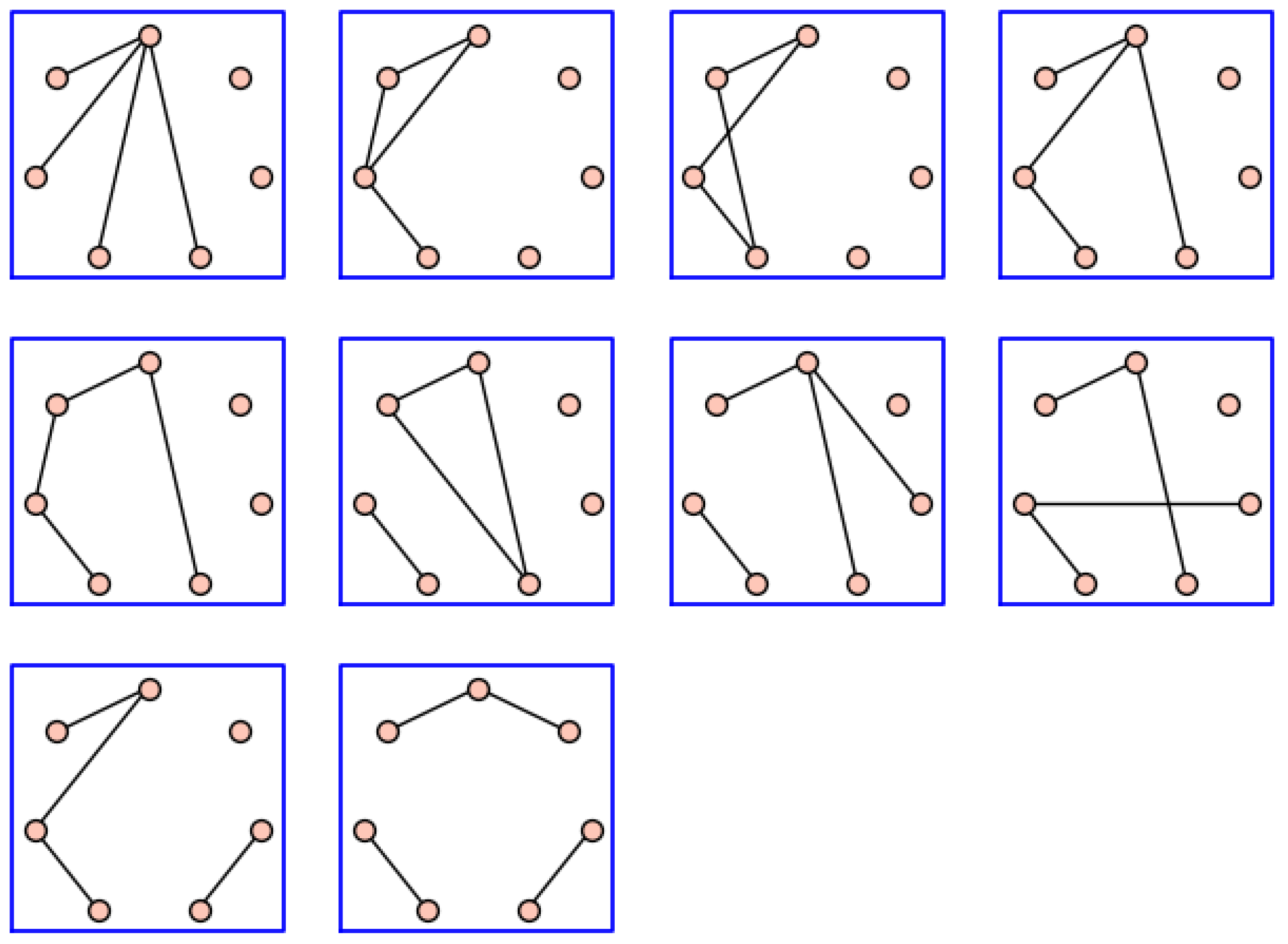
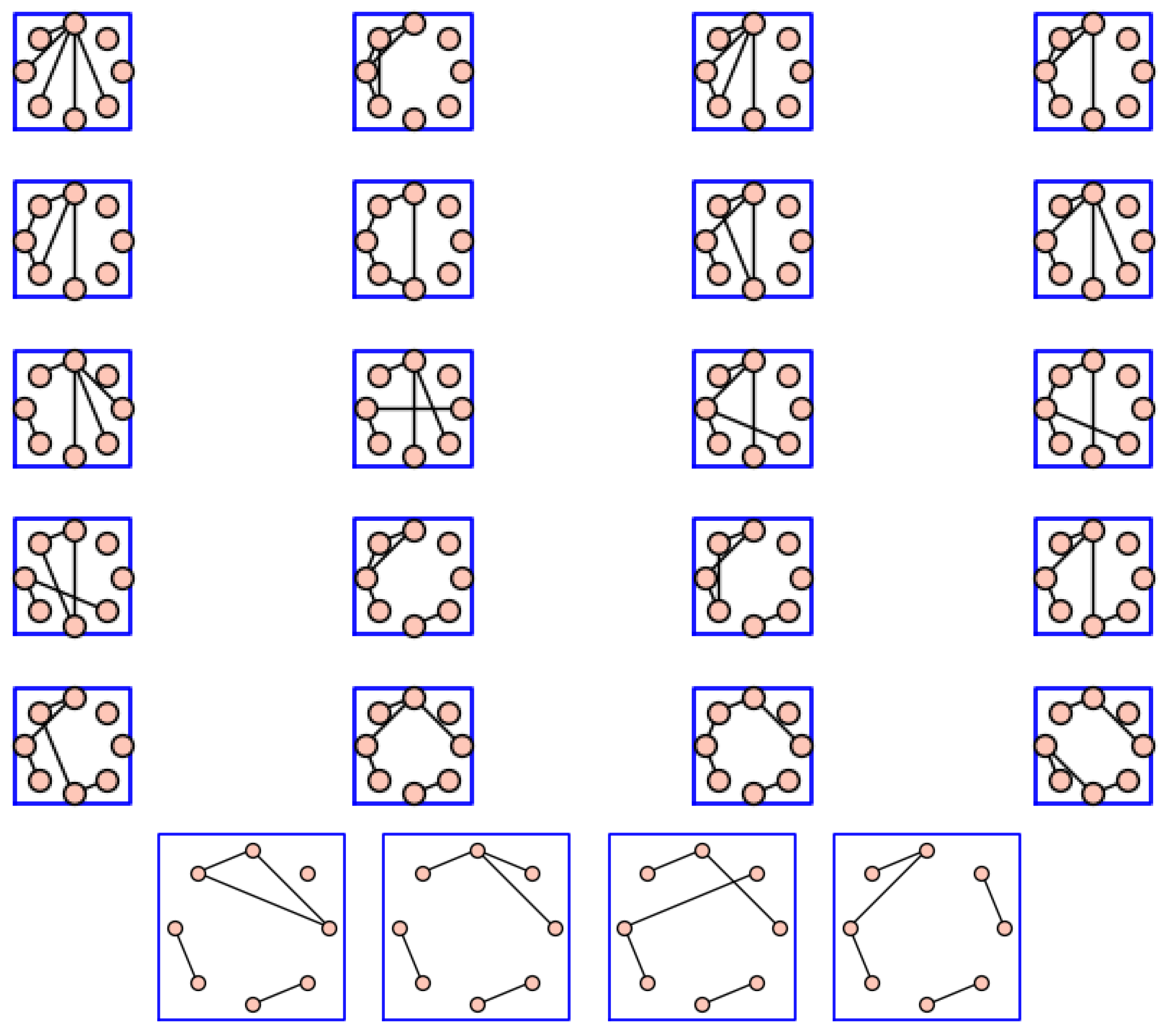
To establish this result, it is sufficient to prove the complement of any graph H in Figure 5 has a matrix realization with two distinct eigenvalues. Suppose that the graphs in Figure 5 are denoted by for from left to right in each row. Then, the graphs for are the union of complete bipartite graphs with some isolated vertices. By Lemma 4 (2), the complements of these graphs and any subgraph of these graphs have a matrix realization with two distinct eigenvalues. Additionally, for and for any subgraph of , by Lemma 8. Moreover, and for any subgraph of , by Lemma 9. Additionally, from Lemmas 8 and 9 such realizations exist with the SSP. Hence any subgraph of these graphs has a matrix realization with two distinct eigenvalues. To complete the proof, we need to show the complement graph of has a matrix realization with two distinct eigenvalues with the SSP. To this end, consider the matrix as follows:
Figure 5.
All graphs with 7 vertices and 4 edges.
Using the Gram–Schmidt method we arrive at a column orthonormal matrix . We have . In addition, and . Hence, . Furthermore, A has SSP (a computation that can be verified by SageMath [38]), and by Lemma 3, the complement of any subgraph of on the same vertex set also has a matrix realization with two distinct eigenvalues. □
We require the following results to confirm Conjecture 1 for .
Lemma 10.
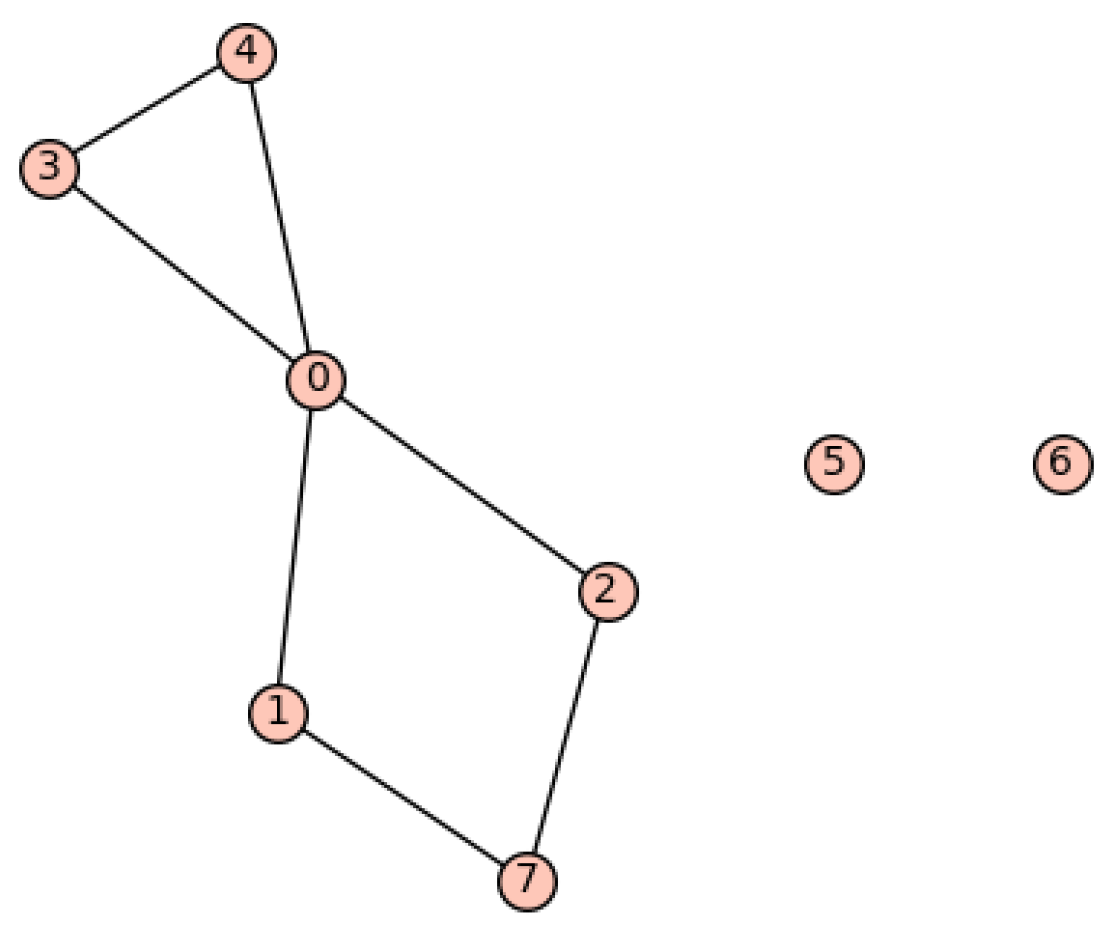
Let , where is the graph on the left given in Figure 6. Then and has an SSP matrix realization with two distinct eigenvalues.
Figure 6.
The graphs (left) and (right).
Proof.
Given G as assumed it can be shown without too much difficulty that , where is the graph on the right given in Figure 6 minus an edge e with one endpoint in and the other endpoint in with degree three.
Suppose is a vertex-clique incidence matrix of , where the blocks and are vertex-clique incidence matrices corresponding to graphs and , that is, From (24) we have and . On the other hand, we have
Consider a vertex-clique incidence matrix as follows:
Then we have and . Given above, the remainder of the proof is devoted to constructing a matrix so that following (27) we have , for some scalar c. Consider a matrix so that
where a is a constant. Suppose the matrix This with (28) leads to the following equations:
Solving this system of non-linear equations, we have a candidate matrix : , where , , and .
Thus
It is obvious that and . Since the matrices and have same nonzero eigenvalues, we have , and then . Moreover, applying a basic computation from SageMath [38], we can confirm that has SSP and this completes the proof. □
By Lemma 10, has an SSP realization with two distinct eigenvalues. Then by Lemma 3, any supergraph on the same vertex set as G has a realization with the same spectrum as A. In particular, . This is stated in the following corollary.
Corollary 8.
Let , where is the right graph given in Figure 6. Then, and has an SSP matrix realization with two distinct eigenvalues.
Lemma 11.
Let , where is obtained from by joining a vertex to any vertex in . Then, and has an SSP matrix realization with two distinct eigenvalues.
Proof.
We know that , where e is an edge with one endpoint in and the other in . Suppose is a vertex-clique incidence matrix of , where blocks and are vertex-clique incidence matrices corresponding to graphs and , that is, From (24) we have and . On the other hand, we also have the equations in (27). Now, we consider a vertex-clique incidence matrix as follows:
Then, and . Given above, the remainder of the proof is devoted to constructing a matrix so that following (27) we have , for some scalar c. We need to create a matrix so that
where a is a constant. Suppose This with (29) leads to the following equations:
Solving these non-linear equations we have . Thus, we have
It is clear that and . Since the matrices and have same nonzero eigenvalues, we have , and . Moreover, applying a basic computation from SageMath [38], it follows that has SSP and this completes the proof. □
By Lemma 11, has an SSP realization with two distinct eigenvalues. By Lemma 3, any supergraph on the same set of vertices as G has a matrix realization with the same spectrum as A. Thus, . This is stated in the following corollary.
Corollary 9.
Let . Then, and has an SSP matrix realization with two distinct eigenvalues.
Proposition 1.
Let , where . Then and has an SSP matrix realization with two distinct eigenvalues.
Proof.
We show that the complement of G has a matrix realization with two distinct eigenvalues with the SSP. Consider matrix with rows labeled as given in Figure 7 for :
Figure 7.
The graph G.
We have . Also and . This proves that . To verify that A has SSP, suppose X is a symmetric matrix such that , , and . Note to verify it is equivalent to prove that is symmetric. Now assume that X has the form:
and x is a (possibly) nonzero vector of size . Since is symmetric, comparing the (1,3) and (3,1) blocks of we note that . So if we set , then . Comparing the (1,2) and (2,1) blocks of gives
Hence, it follows that and . Finally, comparing the (2,3) and (3,2) blocks of , we have
From the above equations we deduce that . Substituting the equations , , and into the equation , yields . Assuming , implies an immediate contradiction. Thus , and it follows, based on the analysis above that . Hence A has the SSP. Using the fact that this matrix realization has the SSP together with Lemma 3, it follows that the complement of any subgraph of G on the same vertex set also realizes distinct eigenvalues. □
Lemma 12.
Let G be the graph given in Figure 8. Then, and has an SSP matrix realization with two distinct eigenvalues.
Figure 8.
The graph G.
Proof.
We show that the complement graph of G has a matrix realization with two distinct eigenvalues with the SSP. To do this, first we consider matrix M as follows:
We have . Also so . This proves that . Furthermore, A has SSP (observed using SageMath [38]) and by Lemma 3, the complement of any subgraph of G on the same vertex has a matrix realization having two distinct eigenvalues. □
Now we are in a position to establish that Conjecture 1 holds for .
Theorem 23.
Removing up to five edges from does not change the number of distinct eigenvalues of , i.e., for any subgraph H on eight vertices of with ,
Proof.
To establish this result, it is sufficient to prove the complement of any graph H in Figure 9 has a matrix realization with two distinct eigenvalues. Suppose that the graphs in Figure 9 are denoted by for from left to right in each row. The graphs for are the union of complete bipartite graphs with some isolated vertices. By Lemma 4 (2), the complements of these graphs and any subgraph of these graphs have a matrix realization with two distinct eigenvalues. Additionally, for and for any subgraph of , by Theorem 20. For , we have and for any subgraph of , by Lemma 12. Additionally, from Theorem 20 and Lemma 12 such realizations exist with the SSP. Hence, any subgraph of these graphs has a matrix realization with two distinct eigenvalues.
Figure 9.
All graphs with 8 vertices and 5 edges.
Further, by Lemma 5, where the graph is connected. If we remove any edges in from the triangle, then the complement of the result graph has at least two distinct eigenvalues by Lemma 4 (2), and if we remove any edges in from out of the triangle, again by Lemma 5, we have that the complement of the result graph has a matrix realization with at least two distinct eigenvalues. We have and the complement of any subgraph of this graph has a matrix realization with two distinct eigenvalues, by Corollary 8. Moreover, , and the complement of any subgraph of this graph also has a matrix realization with two distinct eigenvalues, by Corollary 9. This completes the proof of the theorem. □
5. Concluding Remarks and Open Problems
In this work, we utilized the notions of a clique partition and an edge clique cover of a graph to introduce and explore the various properties of a vertex-clique incidence matrix of the graph, which can be viewed as a generalization of the vertex-edge incidence matrix. Using these incidence matrices, we obtained sharp interesting lower bounds concerning the negative eigenvalues and thus the negative inertia of a graph, and we generalized the notion of the line graph of a graph by introducing the clique partition graph of the given graph. Additionally, we determined the relations between the spectrum of a graph and its clique partition graph. Further, we generalized the notion of incidence energy and signless Laplacian energy of a graph and provided some novel upper bounds for the energies of a graph, its clique partition graph, and the line graph. Finally, applying a general version of a vertex-clique incidence matrix of a graph associated with its edge clique cover, we were able to characterize a few classes of graphs with . To close, we list two important and unresolved issues related to some of the content of the current work.
Problem 1:
Problem 2:
Prove that Conjecture 1 is valid for any graph G of an order of at least nine.
Author Contributions
Writing and original draft, S.A.M.; Review and editing, S.F. All authors have read and agreed to the published version of the manuscript.
Funding
Fallat’s research is supported in part by an NSERC Discovery Research Grant, application No.: RGPIN-2019-03934.
Institutional Review Board Statement
Not applicable.
Informed Consent Statement
Not applicable.
Data Availability Statement
Not applicable.
Acknowledgments
We extend our sincere gratitude to the reviewers for their careful reading and constructive feedback which greatly improved our manuscript.
Conflicts of Interest
The authors declare no conflict of interest.
References
- Cavers, M.S. Clique Partitions and Coverings of Graphs. Master’s Thesis, University of Waterloo, Waterloo, ON, Canada, 2005. [Google Scholar]
- Erdös, P.; Goodman, A.W.; Pósa, L. The representation of a graph by set intersections. Can. J. Math. 1966, 18, 106–112. [Google Scholar] [CrossRef]
- Li, B.-J.; Chang, G.J. Clique coverings and partitions of line graphs. Discret. Math. 2008, 308, 2075–2079. [Google Scholar] [CrossRef]
- McGuinness, S.; Rees, R. On the number of distinct minimal clique partitions and clique covers of a line graph. Discret. Math. 1990, 83, 49–62. [Google Scholar] [CrossRef]
- Godsil, C.; Royle, G. Algebraic Graph Theory; Springer: New York, NY, USA, 2001. [Google Scholar]
- Harary, F. Graph Theory; Addison-Wesley: Boston, MA, USA, 1972. [Google Scholar]
- Ahmadi, B.; Alinaghipour, F.; Cavers, M.S.; Fallat, S.M.; Meagher, K.; Nasserasr, S. Minimum number of distinct eigenvalues of graphs. Electron. J. Linear Algebra 2013, 26, 673–691. [Google Scholar] [CrossRef]
- Levene, R.H.; Oblak, P.; Šmigoc, H. A Nordhaus–Gaddum conjecture for the minimum number of distinct eigenvalues of a graph. Linear Algebra Appl. 2019, 564, 236–263. [Google Scholar] [CrossRef]
- Fallat, S.; Hogben, L. The minimum rank of symmetric matrices described by a graph: A survey. Linear Algebra Appl. 2007, 426, 558–582. [Google Scholar] [CrossRef]
- Fallat, S.; Hogben, L. Variants on the minimum rank problem: A survey II. arXiv 2011, arXiv:1102-5142v1. [Google Scholar]
- Ferguson, W.E. The construction of Jacobi and periodic Jacobi matrices with prescribed spectra. Math. Comp. 1980, 35, 1203–1220. [Google Scholar] [CrossRef]
- Hogben, L. Spectral graph theory and the inverse eigenvalue problem of a graph. Electron. J. Linear Algebra 2005, 14, 12–31. [Google Scholar] [CrossRef]
- Zhou, J.; Bu, C.J. Eigenvalues and clique partitions of graphs. Adv. Appl. Math. 2021, 129, 102220. [Google Scholar] [CrossRef]
- Zhou, J.; van Dam, E.R. Spectral radius and clique partitions of graphs. Linear Algebra Appl. 2021, 630, 84–94. [Google Scholar] [CrossRef]
- Cioabă, S.M.; Elzinga, R.J.; Gregory, D.A. Some observations on the smallest adjacency eigenvalue of a graph. Discuss. Math. 2020, 40, 467–493. [Google Scholar] [CrossRef]
- Gutman, I. Bounds for total π-electron energy of polymethines. Chem. Phys. Lett. 1977, 50, 488–490. [Google Scholar] [CrossRef]
- Gutman, I. Bounds for all graph energies. Chem. Phys. Lett. 2012, 528, 72–74. [Google Scholar] [CrossRef]
- Koolen, J.; Moulton, V. Maximal energy graphs. Adv. Appl. Math. 2001, 26, 47–52. [Google Scholar] [CrossRef]
- Li, X.; Shi, Y.; Gutman, I. Graph Energy; Springer: New York, NY, USA, 2012. [Google Scholar]
- McClelland, B.J. Properties of the latent roots of a matrix: The estimation of π-electron energies. J. Chem. Phys. 1971, 54, 640–643. [Google Scholar] [CrossRef]
- Abreu, N.; Cardoso, D.M.; Gutman, I.; Martins, E.A.; Robbiano, M. Bounds for the signless Laplacian energy. Linear Algebra Appl. 2011, 435, 2365–2374. [Google Scholar] [CrossRef]
- Das, K.C.; Mojallal, S.A. Relation between signless Laplacian energy, energy of graph and its line graph. Linear Algebra Appl. 2016, 493, 91–107. [Google Scholar] [CrossRef]
- Gutman, I.; Robbiano, M.; Martins, E.A.; Cardoso, D.M.; Medina, L.; Rojo, O. Energy of line graphs. Linear Algebra Appl. 2010, 433, 1312–1323. [Google Scholar] [CrossRef]
- Bernstein, D.S. Matrix Mathematics; Princeton University Press: New York, NY, USA, 2005. [Google Scholar]
- Barrett, W.; Fallat, S.; Hall, H.T.; Hogben, L.; Lin, J.C.-H.; Shader, B.L. Generalizations of the strong Arnold property and the minimum number of distinct eigenvalues of a graph. Electron. J. Comb. 2017, 24, 2–40. [Google Scholar] [CrossRef] [PubMed]
- Barrett, W.; van der Holst, H.; Loewy, R. Graphs whose minimal rank is two. Electron. J. Linear Algebra 2004, 11, 258–280. [Google Scholar] [CrossRef]
- Chen, Z.; Grimm, M.; McMichael, P.; Johnson, C.R. Undirected graphs of Hermitian matrices that admit only two distinct eigenvalues. Linear Algebra Appl. 2014, 458, 403–428. [Google Scholar] [CrossRef]
- Levene, R.H.; Oblak, P.; Šmigoc, H. Orthogonal symmetric matrices and joins of graphs. Linear Algebra Appl. 2022, 652, 213–238. [Google Scholar] [CrossRef]
- Cvetković, D.; Rowlinson, P.; Simić, S. An Introduction to the Theory of Graph Spectra; Cambridge University Press: Cambridge, UK, 2012. [Google Scholar]
- Nikiforov, V. The energy of graphs and matrices. J. Math. Anal. Appl. 2007, 326, 1472–1475. [Google Scholar] [CrossRef]
- Nikiforov, V. Graphs and matrices with maximal energy. J. Math. Anal. Appl. 2007, 327, 735–738. [Google Scholar] [CrossRef]
- Nikiforov, V. Extremal norms of graphs and matrices. J. Math. Sci. 2012, 182, 164–174. [Google Scholar] [CrossRef]
- Consonni, V.; Todeschini, R. New spectral indices for molecule description. Match Commun. Math. Comput. Chem. 2008, 60, 3–14. [Google Scholar]
- Das, K.C.; Mojallal, S.A.; Gutman, I. Relations between Degrees, Conjugate Degrees and Graph Energies. Linear Algebra Appl. 2017, 515, 24–37. [Google Scholar] [CrossRef]
- So, W.; Robbiano, M.; de Abreu, N.M.; Gutman, I. Applications of a theorem by Ky Fan in the theory of graph energy. Linear Algebra Appl. 2010, 432, 2163–2169. [Google Scholar] [CrossRef]
- Reid, K.B.; Thomassen, C. Edge sets contained in circuits. Isr. J. Math. 1976, 24, 305–319. [Google Scholar] [CrossRef]
- Barrett, W.; Brigham Young University, Provo, UT, USA; Fallat, S.; University of Regina, Regina, SK, Canada; Furst, V.; Fort Lewis College, Durango, CO, USA; Nasserasr, S.; Rochester Institute of Technology, Rochester, NY, USA; Rooney, B.; Rochester Institute of Technology, Rochester, NY, USA; Tait, M.; Villanova University, Villanova, PA, USA. Personal Communication. 2022. [Google Scholar]
- Tracy Hall, H. SAP/SSP/SMP Tester–SAGE. Available online: https://sage.math.iastate.edu/home/pub/79/ (accessed on 15 November 2022).
Disclaimer/Publisher’s Note: The statements, opinions and data contained in all publications are solely those of the individual author(s) and contributor(s) and not of MDPI and/or the editor(s). MDPI and/or the editor(s) disclaim responsibility for any injury to people or property resulting from any ideas, methods, instructions or products referred to in the content. |
© 2023 by the authors. Licensee MDPI, Basel, Switzerland. This article is an open access article distributed under the terms and conditions of the Creative Commons Attribution (CC BY) license (https://creativecommons.org/licenses/by/4.0/).