


Abstract
In this article, we derive a closed-form expression for computing the probabilities of p-dimensional rectangles by means of a multivariate skew-normal distribution. We use a stochastic representation of the multivariate skew-normal/independent distributions to derive expressions that relate their probability density functions to the expected values of positive random variables. We also obtain an analogous expression for probabilities of p-dimensional rectangles for these distributions. Based on this, we propose a procedure based on Monte Carlo integration to evaluate the probabilities of p-dimensional rectangles through multivariate skew-normal/independent distributions. We use these findings to evaluate the probability density functions of a truncated version of this class of distributions, for which we also suggest a scheme to generate random vectors by using a stochastic representation involving a truncated multivariate skew-normal random vector. Finally, we derive distributional properties involving affine transformations and marginalization. We illustrate graphically several of our methodologies and results derived in this article.
Keywords:
marginal distribution; Monte Carlo integration; multivariate skew-normal/independent distributions; random vector; truncated distribution MSC:
60E05; 62-08; 65C05
1. Introduction
Truncated multivariate distributions have been widely used in theoretical and applied statistics. The applications of these distributions require efficient computations of their densities, which involve probabilities in multiple dimensions that typically need to be computed by using numerical approximations. On the other hand, the study of models based on truncated multivariate distributions using Monte Carlo simulations requires methods for generating random samples from these distributions. The above and related issues have been primarily studied in the class of truncated elliptical distributions and two of its members, namely the truncated multivariate normal and t distributions. For example, see Manjunath and Wilhelm [1], Morán-Vásquez and Ferrari [2,3], Maatouk and Bay [4], Kim [5], Arellano-Valle et al. [6], Kan and Robotti [7], Arismendi [8], Ho et al. [9], Genz and Bretz [10], Nadarajah [11], Horrace [12,13], Tallis [14,15,16] and Birnbaum and Meyer [17].
Numerical computations of multivariate distributions are significantly more difficult than the numerical evaluation of univariate distributions. Genz and Bretz [10] proposed algorithms to efficiently compute multivariate normal and t probabilities of p-dimensional rectangles. These algorithms are implemented in the mvtnorm package (Genz et al. [18]) of the R software (version 4.1.1).
Based on these algorithms, Morán-Vásquez and Ferrari [3] proposed a method for evaluating the probabilities of p-dimensional rectangles for the multivariate slash distribution. The sn package (Azzalini [19]) of R software (version 4.1.1) includes several routines associated with computational aspects of the multivariate skew-normal distribution. This package also incorporates routines to evaluate certain functions of the cumulative distribution function (CDF) of the multivariate skew-normal distribution. However, there is no methodology with which to evaluate the probabilities of p-dimensional rectangles for this distribution. In this article, we derive an expression to compute the probabilities of p-dimensional rectangles for the multivariate skew-normal distribution that involves the CDF of a multivariate normal distribution. This allows us to compute these probabilities efficiently by using the algorithms proposed by Genz and Bretz [10].
An extension of the multivariate skew-normal distribution is included in the class of the multivariate skew-normal/independent distributions (Azzalini and Capitanio [20]), which has members with heavy-tailed skewed distributions that are useful for robust inference (Basso et al. [21]). Some of its members are the multivariate skew-normal, skew-t and skew-slash distributions, among others. A more general class of distributions is obtained by truncation; it is derived as the conditional distribution of a multivariate skew-normal/independent random vector given that it belongs to a subset of , which yields bounds on the domains of multivariate skew-normal/independent distributions. This class is called the truncated multivariate skew-normal/independent class of distributions, which includes the truncated multivariate skew-normal (Morán-Vásquez et al. [22]), the truncated multivariate skew-t (Morán-Vásquez et al. [23]) and the truncated multivariate skew-slash families as particular cases. The statistical modeling of skewed multivariate data with values restricted to a subset of is of interest in theoretical and applied statistics, especially in the presence of outliers. Some examples can be found in Marchenko and Genton [24], Morán-Vásquez and Ferrari [2], and Morán-Vásquez et al. [25,26], who proposed parametric methodologies to model correlated skewed multivariate positive data. However, the literature when this type of data is restricted to an arbitrary subset of is less frequent.
Computations related to truncated multivariate skew-normal/independent distributions require the evaluation of probabilities of measurable sets in for multivariate skew-normal/independent distributions. In this article, we propose a methodology to compute these probabilities of p-dimensional rectangles through Monte Carlo integration mixed with the computation of multivariate skew-normal probabilities. On the other hand, we describe a procedure to simulate random samples from the truncated multivariate skew-normal/independent distributions by means of a stochastic representation involving a truncated multivariate skew-normal random vector. We also derive some distributional properties of the truncated multivariate skew-normal/independent distributions involving affine transformations and marginalization. These results generalize some properties of the truncated multivariate skew-normal and the truncated multivariate skew-t distributions studied by Morán-Vásquez et al. [22,23]. Special cases of our results establish some new properties of the truncated multivariate skew-slash distribution.
The study of truncated multivariate skew-normal/independent distributions is motivated by the need to model correlated skewed and possibly heavy-tailed multivariate data, the values of which are restricted to a subset of . This type of data appears in environmental science, medicine, economics, public health, and engineering, among others. For example, the dataset analyzed by Flecher et al. [27] includes observations of the relative humidity (in %) of an air–water mixture, which exhibit skewness and their values are restricted to the interval . Another example can be found in Morán-Vásquez and Ferrari [2], who used truncated distributions to study measurements on vitamins B2 (in mg), B3 (in mg), B12 (in mcg), and D (in mcg) intakes based on the first 24-h dietary recall interview. These data are positively correlated, exhibit multivariate skewness, and outliers are present. The datasets in Flecher et al. [27] and Morán-Vásquez and Ferrari [2] are real-world examples where the truncated multivariate skew-normal/independent distributions can be used.
The article is organized as follows. Section 2 is devoted to computations of the multivariate skew-normal/independent densities and probabilities. Section 3 deals with computations of the truncated multivariate skew-normal/independent densities and random vector generation. Some distributional properties of the truncated multivariate skew-normal/independent distributions are derived in Section 4. Finally, Section 5 closes the article with final remarks.
2. Computations of Multivariate Skew-Normal/Independent Densities and Probabilities
If and are vectors, then means that , . The rectangle in is defined as
It is widely known that the p-dimensional random vector is said to have a multivariate normal (Gaussian) distribution, denoted by , if its probability density function (PDF) is given by , where and are the mean vector and the covariance matrix, respectively, and is the square of the Mahalanobis distance between and with respect to . Further, the CDF of is defined by
If is a measurable set, then we denote , which is given by
Genz and Bretz [10] present efficient numerical integration methods to compute this integral when is a rectangle in .
The multivariate skew-normal distribution with location vector , dispersion matrix , and shape parameter of a random vector are defined by
where , with ⊙ being the Hadamard product, and is the CDF of a standard normal random variable . A notation to designate that has pdf (1) is .
If , then we denote , which is given by
We are interested in computing the above probability when A is a p-dimensional rectangle. This is necessary for the evaluation of the probabilities of p-dimensional rectangles through the multivariate skew-normal/independent distributions and computations related to their truncated versions. For this purpose, we use a stochastic representation of the multivariate skew-normal distribution via a conditioning mechanism, which is provided by the following lemma.
Lemma 1.
Let , , and . Let , and such that , with
Then, .
Proof.
Azzalini and Capitanio ([20], Section 5.1.3). □
In the following theorem, we derive a closed-form expression to evaluate the probabilities of p-dimensional rectangles for the multivariate skew-normal distribution.
Theorem 1.
Proof.
Since , then
Hence, from Lemma 1, we have
where . The result follows by noting that
and . □
Theorem 1 indicates that the evaluation of the probabilities of p-dimensional rectangles for can be carried out through the computation of probabilities of –dimensional rectangles through a multivariate normal distribution, which can be performed efficiently by using the approach proposed by Genz and Bretz [10].
Definition 1 presents the class of multivariate skew-normal/independent distributions (Azzalini and Capitanio [20]).
Definition 1.
The random vector has a multivariate skew-normal/independent distribution with location vector , dispersion matrix , and shape parameter , denoted by , if , where and U are independent, with U being a positive random variable with CDF and PDF , with being a vector of extra parameters induced by H.
Equivalently, if , with . The PDF of is given by
Clearly, the distribution of the positive random variable U generates each family of a multivariate skew-normal/independent class of distributions. Consequently, if U has a degenerated distribution at , then in (4) we have the PDF of given in (1). If , with PDF
we get the PDF of a random vector with multivariate skew-t distribution (Morán-Vásquez et al. ([23], Eqaution (2)), which has as a particular case, namely, the multivariate skew-Cauchy distribution when . If , with PDF
then the PDF of slides to the PDF of a multivariate skew-slash distribution with location vector , dispersion matrix , shape parameter , and tail parameter . In this case, we write .
The parameter determines the tail behavior of multivariate skew-t and skew-slash distributions. For smaller values of , these distributions have heavier tails than the multivariate skew-normal distribution, which makes them suitable for robust statistical modeling since they can take into account skewness and outliers in the data. When , the multivariate skew-normal distribution can be derived as a limiting case of multivariate skew-t and skew-slash families. The multivariate skew-contaminated-normal distribution, the skew-Pearson type VII distribution, and the skew-Laplace distribution comprise additional members of the class of the multivariate skew-normal/independent distributions. This class includes heavy-tailed families for which expectation-maximization algorithms can easily be developed for maximum likelihood estimation, making it appropriate for robust statistical modeling (Basso et al. [21]). The class of multivariate skew-elliptical distributions (Azzalini and Capitanio [20], Branco and Dey [28]) includes the multivariate skew-normal/independent distributions as a subclass.
For in (4), we get the PDF of a multivariate normal/independent distribution with location vector and dispersion matrix (Lange and Sinsheimer [29], Morán-Vásquez et al. [25]), which has the form
We write if the PDF of is given by (7).
Let be a measurable set and . We denote , which is given by
Note that, by plugging in (8), we obtain , , given by
An issue of interest in this article is to develop a method for the evaluation of the probability given in (8) when A is a p-dimensional rectangle. In this case, Equation (8) can be expressed in terms of expected values with respect to a positive random variable U. On the other hand, the PDF of can also be expressed in terms of expected values with respect to U. We derive these results in Theorem 2.
Theorem 2.
Let and be a rectangle in . Then,
- 1.
- , where .
- 2.
- , where .
Proof.
Assertion 1 follows from (4). Now,
where the last line is obtained by Fubini’s theorem. By noting , we get assertion 2. □
Corollary 1.
If , then
- 1.
- , where .
- 2.
- , where .
Proof.
Substitute in Theorem 2. □
Theorem 2 allows us to approximate the PDF of and the probability by using Monte Carlo integration mixed with the computation of multivariate skew-normal densities and probabilities, respectively. In fact, by drawing a random sample of large size n from , say , we obtain the approximations
respectively, where , , can be efficiently computed through (3) by using the methods proposed by Genz and Bretz [10]. Approximations for the PDF of and the probability can be obtained from (9) and (10) when , respectively.
It is noteworthy that our proposal permits us to evaluate the PDF of a multivariate skew-normal/independent distribution as a sum of PDFs of multivariate skew-normal distributions. Similarly, the probability of a p-dimensional rectangle for a multivariate skew-normal/independent distribution is computed by means of a sum of probabilities of for multivariate skew-normal distributions.
3. Computations of Truncated Multivariate Skew-Normal/Independent Densities and Random Vector Generation
A situation referred to as truncation occurs when certain members of the population have a lesser likelihood of being chosen in a sample owing to measurements. For instance, it may be too expensive or time-consuming to draw a random sample from a target group concerning studies of lifetime. In particular, one is unable to identify an individual whose lifetime is shorter or longer than a certain threshold, known as the truncation limit (Dörre and Emura [30]). In the multivariate setting, truncation results in values of a random vector that are limited, yielding a multivariate truncated sample. The conditional distribution of , , given , being a measurable set, is called the truncated multivariate skew-normal/independent distribution. This class of distributions is presented through its PDF in the next definition.
Definition 2.
Let be a measurable set. The random vector has a truncated multivariate skew-normal/independent distribution with support A and parameters , , , denoted by , if its PDF is given by
where and are the CDF and of a positive random variable U, respectively, with being a vector of extra parameters induced by U.
Note that the PDF of can be expressed as
If in (11), we obtain the multivariate skew-normal/independent class of distributions (Definition 1) as a particular case of the class of truncated multivariate skew-normal/independent distributions. For in (11), we obtain the PDF of a truncated multivariate normal/independent distribution with support A and parameters , , denoted by , where H is as in Definition 2. This class is in turn a special case of the class of truncated elliptical distributions (Morán-Vásquez and Ferrari [2,3]).
The key challenge of the computational tractability of the truncated multivariate skew-normal/independent distributions is the evaluation of the normalizing constant determined by the integral given in (8). We now propose a procedure to evaluate the PDF (11) when is a p-dimensional rectangle. From (12) and Theorem 2, we have that the PDF of can be expressed in an equivalent form as
where the expected values are calculated with respect to the random variable . The above allows us to evaluate the PDF (11) combining Monte Carlo integration with the methods proposed by Genz and Bretz [10]. In fact, by using (9) and (10), just draw a random sample of large size n from , namely , to approximate the PDF of as
where , , is efficiently computed through (3) by using the methods proposed by Genz and Bretz [10].
A correspondence between the members of the class of the truncated multivariate skew-normal/independent distributions and the class of multivariate skew-normal/independent distributions is obtained according to the distribution of the positive random variable U. In this manner, if U has a degenerate distribution at , then its application in (11) provides
which is the PDF of a random vector with a truncated multivariate skew-normal distribution with support A and parameters , and . We write if the PDF of is given by (14). A detailed study on this family can be found in Morán-Vásquez et al. [22]. When U has a PDF as in (5), we obtain in (11) the PDF of a random vector with a truncated multivariate skew-t distribution (Morán-Vásquez et al. ([23], Equation (7)), which includes the truncated multivariate skew-Cauchy distribution as a particular case. If U has a PDF as in (6), then in (11) we obtain the PDF of a random vector with a truncated multivariate skew-slash distribution with support A and parameters , , and , denoted by .
The parameter controls the tails of the truncated multivariate skew-t and skew-slash distributions, which have heavier tails than the truncated multivariate skew-normal distribution for smaller values of . As expected, the truncated multivariate skew-normal distribution is obtained from the truncated multivariate skew-t and skew-slash distributions when . Additional members of the class of truncated multivariate skew-normal/independent distributions are the truncated versions of the multivariate skew-contaminated-normal, skew-Pearson type VII, skew-Laplace distributions, among others. The moments of the truncated multivariate skew-normal/independent distributions with rectangular support can be derived as a particular case from the moments of the doubly truncated selection elliptical distributions obtained in Galarza Morales et al. [31].
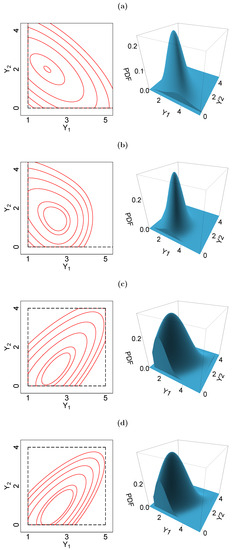
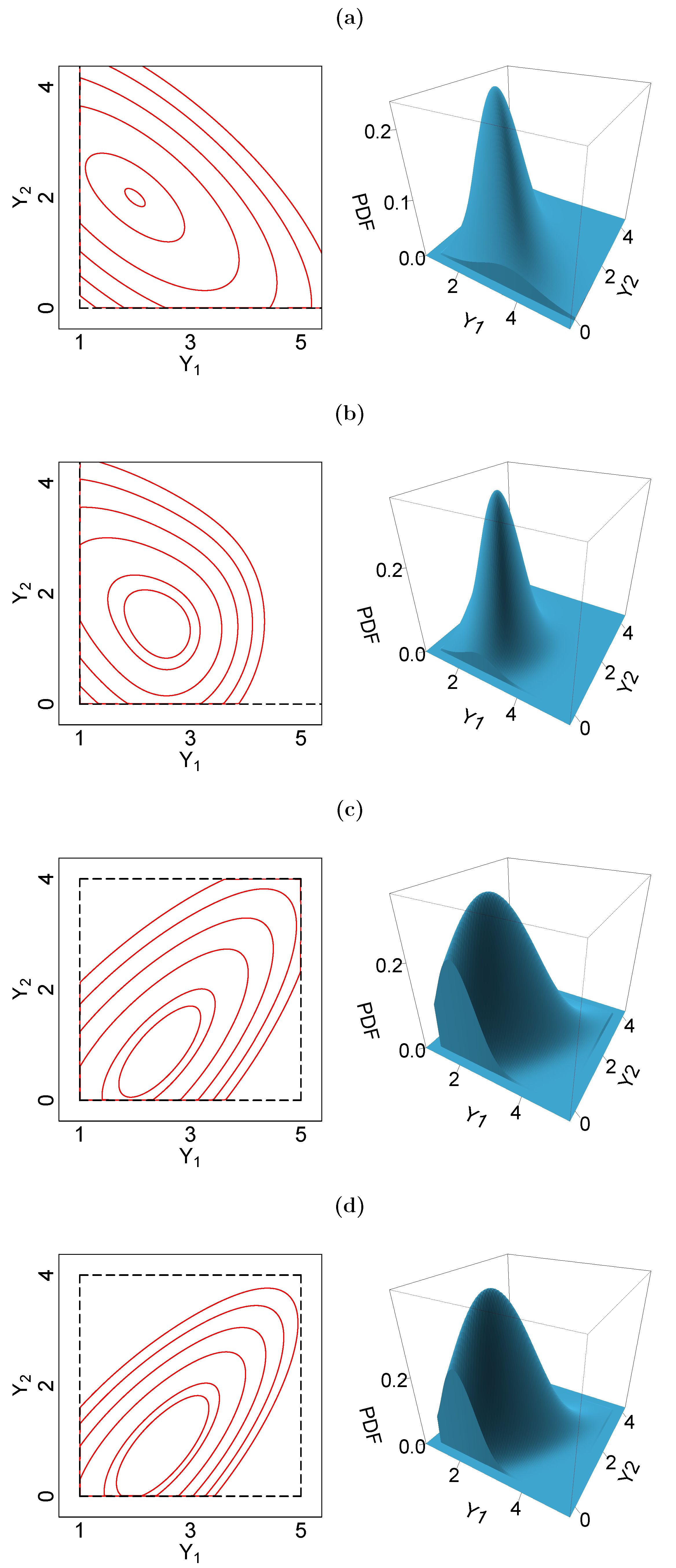
Figure 1 displays different shapes of the truncated bivariate skew-slash distribution according to its support and parameters. We approximate the PDF (2) by way of (13) by taking different supports and parameter values and plot the surface of the PDF and its contours for different levels, namely , where . The legend explains the support and values of each parameter in the first plot, which vary, in alphabetical order, from a plot to the subsequent one. Figure 1a corresponds to the truncated bivariate slash distribution (), which has truncated ellipses as contours. When , the elliptical shape is no longer present and a multivariate skewness is apparent (Figure 1b–d). Figure 1b,c shows the impact of the parameter and a change in the support. As the parameter increases, the contours of the truncated bivariate skew-slash distribution approach the contours of the truncated bivariate skew-normal distribution (Figure 1c,d). The tails of the truncated bivariate skew-slash distribution are heavier than the truncated bivariate skew-normal ones for smaller values of . All the PDFs in Figure 1 show rectangular truncation regions obtained from constraining the values of bivariate skew-slash distributions. This restriction induces a normalization constant given by the denominator of (12). The different shapes of the PDFs displayed in Figure 1 indicate that the truncated multivariate skew-slash distribution can be appropriate to model skewed multivariate data with outliers, whose values are restricted to a subset of .
Figure 1.
Contour plots and PDF of , with (a) , , , , , and (b) , , , , (c) , , (d) .
Next, we present a procedure for generating random vectors from a truncated multivariate skew-normal/independent distribution. In the procedure below, if , and , we denote by the set
Our proposal is based on the stochastic representation for the multivariate skew-normal/independent distribution given in Definition 1, where the support of the random vector is restricted through the positive random variable . Specifically, if , then , with . So, our procedure for the generation of a random vector from a truncated multivariate skew-normal/independent distribution requires the generation of a random vector from a truncated multivariate skew-normal distribution, which can be achieved by using the methodology proposed by Morán-Vásquez et al. ([23], Section 4).
The generation of a random vector from is carried out through the following steps:
- Generate u from .
- Generate from .
- Compute .
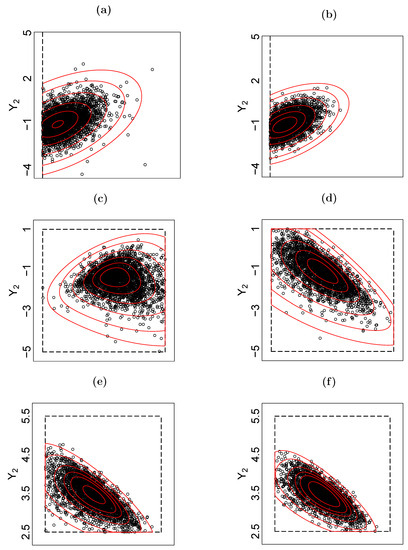
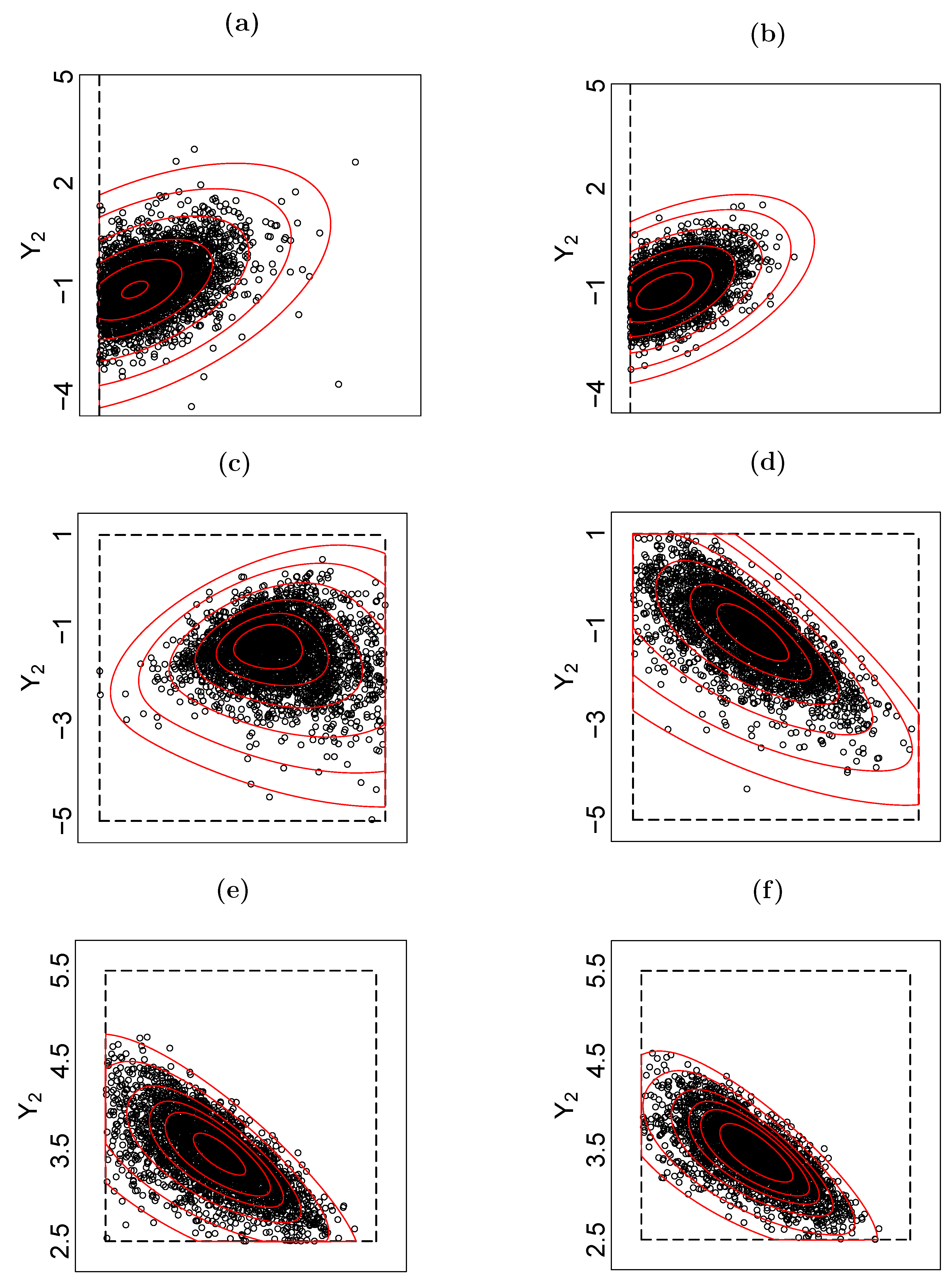
In Figure 2, we build scatter plots of random samples drawn from truncated bivariate skew-slash distributions overlaid with contour plots of the PDF (11). In each plot, a sample size of 3000 is considered, and the supports of the distributions are rectangular. We consider the following levels for the contours: , where for Figure 2a–d, and for Figure 2e,f. The random sample shown in Figure 2a comes from a truncated bivariate slash distribution with heavy tails ( and small ), instead the random sample displayed in Figure 2b comes from a truncated bivariate normal distribution ( and ).Figure 2c–e display skewed and heavy-tailed random samples drawn from truncated bivariate skew-slash distributions ( and small ). Figure 2f shows a random sample generated from a distribution with the values of the parameters , and as in Figure 2e, and , thus we have a random sample from a truncated bivariate skew-normal distribution. The plots in Figure 2 indicate that the methodology for generating random vectors of the truncated multivariate skew-normal/independent distributions is suitable due to the good agreement between the scatterplots of the simulated samples and the contour plots. Our procedure can be useful for performing simulation studies on statistical models based on the class of the truncated multivariate skew-normal/independent distributions.
Figure 2.
Scatter plots of simulated random samples overlaid with contour plots of the PDF of . For plots (a,b): , , , , , and (a) , (b) . For plots (c,d): , , , , , and (c) , , (d) , . For plots (e,f): , , , , , , , and (e) , (f) .
4. Affine Transformations and Marginal Distributions of Truncated Multivariate Skew-Normal/Independent Random Vectors
In Theorem 3, we state a property of closedness of the truncated multivariate skew-normal/independent distributions under affine transformations.
Theorem 3.
Let be the transformation , with and a non-singular matrix. If , then , where , , and , with .
Proof.
In order to graphically illustrate Theorem 3 for the truncated bivariate skew-slash distribution, we transform the truncated bivariate skew-slash random sample of Figure 2d to obtain the truncated bivariate skew-slash random sample of Figure 2e. For this purpose, we chose the affine transformation , where
Corollary 2.
Let be the transformation , with and a non-singular matrix. If , then .
Proof.
Substitute in Theorem 3. □
The result stated in the above corollary can also be obtained as a particular case of Theorem 3.3 of Morán-Vásquez and Ferrari [3].
In order to establish a result on marginal distributions of the truncated multivariate skew-normal/independent distributions with rectangular supports, we consider partitions associated to as follows
where , , , , , , , , , , , , and and are such that . Also, we define and . The Schur complement of the block of the matrix is given by . In addition, we define . The dimension p is such that . Note that the support set can be written as the Cartesian product .
Consider the partitions given in (15) for . Integrating (11) with respect to , the marginal PDF of is obtained as
where . The above PDF does not necessarily have the form of (11). In Theorem 4, we give conditions on the support set for some marginals to preserve the parent family in the class of the truncated multivariate skew-normal/independent distributions. For this, we first state the following preliminary result.
Lemma 2.
If , , and k is a scalar, then
Proof.
See Azzalini ([20], Lemma 5.3). □
Theorem 4.
Let and consider partitions as in (15). If , then , where
Proof.
By using the factorization
and Fubini’s theorem, we get
By using the identity
and subsequently changing the variable , we have that the integral with respect to is evaluated as
where the last line is obtained by using Lemma 2 with , , and . Finally, substituting the above integral in (17), we get
where the last line is obtained from (1). This completes the proof. □
Corollary 3.
Let . Consider the partitions given in (15). If , then .
Proof.
Substitute in Theorem 4. □
According to Theorem 3.7 in Morán-Vásquez and Ferrari [3], it is possible to establish that when , the marginals of a truncated multivariate normal/independent distribution fall within the class of truncated elliptical distributions (but do not necessarily belong to the same parent family). Corollary 3 establishes that the parent family of a truncated multivariate normal/independent distribution is preserved for some marginals when the support set is restricted, without constraining the values of .
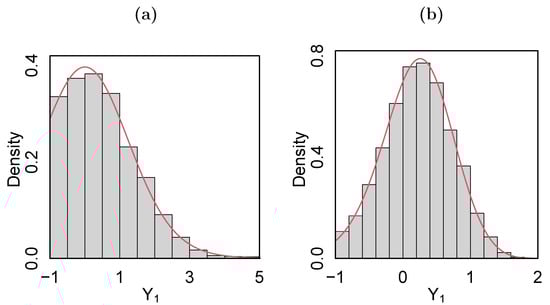
Figure 3a shows the histogram of a random sample obtained from the marginal distribution of of the truncated bivariate-slash random sample displayed in Figure 2a. The bivariate distribution has support , which implies that the random sample from the marginal distribution of follows a truncated univariate slash distribution with support . This is supported by Corollary 3. On the other hand, Figure 3b shows the histogram of another marginal random sample obtained from the marginal distribution of of the truncated bivariate skew-slash random sample displayed in Figure 2e. The support of this bivariate distribution is , making Theorem 4 inapplicable. However, the random sample from the marginal distribution of follows a distribution with a PDF given by (16). To assess the behavior of the random samples obtained from the marginal distribution of , the histograms in Figure 3 are overlaid by the corresponding marginal PDFs. The first histogram is overlaid by the marginal PDF derived from Corollary 3, while the second histogram is overlaid by the marginal PDF specified in (16). The agreement between the histograms and the respective PDFs indicates a favorable behavior of the random samples obtained from the marginal distribution of .
Figure 3.
Histograms of simulated random samples from the marginal distribution of overlaid by the PDF (a) established in Corollary 3, (b) given in (16).
A shortcoming of the class of the truncated multivariate normal/independent distributions is that it does not preserve families under conditioning. In fact, consider partitions in (15) for , from (11) and (16), the conditional PDF of is given by
Morán-Vásquez et al. [22,23] showed that, for the normal and t cases, the PDF (18) reduces to the PDFs of the truncated multivariate extended skew-normal and truncated multivariate extended skew-t distributions, respectively. However, obtaining similar results for other families is challenging due to the complexity of the expression (18) according to H.
5. Final Remarks
- We derived an expression to evaluate probabilities of rectangles in for the multivariate skew-normal distribution. Since this expression is given in terms of a multivariate normal distribution, efficient evaluation is made possible by using the approach by Genz and Bretz [10].
- The aforementioned finding enabled us to establish a method based on Monte Carlo integration for evaluating the probabilities of rectangles in for the multivariate skew-normal/independent distributions.
- Computations of the PDFs of the truncated multivariate skew-normal/independent distributions and the generation of random vectors from members of this class were also addressed in this article, as well as the study of some distributional properties such as affine transformations and the marginal distributions. Our results provide new properties for the truncated multivariate skew-slash distribution.
- The truncated multivariate skew-normal/independent distributions have some limitations such as the lack of closedness under conditioning. Also, there is no closed form for the maximum likelihood estimators of the parameters of its members.
- The computation of the maximum likelihood estimates of the truncated multivariate skew-normal/independent distributions requires numerical optimization algorithms to maximize the log-likelihood functions. For this it is essential to have efficient methods with which to evaluate the PDF (11), the complexity of which lies in the computation of the multiple integral that appears in its denominator.
- The method that we proposed in this article for the evaluation of (11) opens the possibility of addressing estimation issues for the class of the truncated multivariate skew-normal/independent distributions. This problem, together with simulation studies and applications to real data, will be dealt with in a future paper.
Author Contributions
Conceptualization, R.A.M.-V., E.Z. and D.K.N.; methodology, R.A.M.-V., E.Z. and D.K.N.; investigation, R.A.M.-V., E.Z. and D.K.N.; writing—original draft preparation, R.A.M.-V., E.Z. and D.K.N.; writing—review and editing, R.A.M.-V., E.Z. and D.K.N. All authors have read and agreed to the published version of the manuscript.
Funding
This research received no external funding.
Data Availability Statement
Not applicable.
Conflicts of Interest
The authors declare that there are no conflict of interest regarding the publication of this article.
References
- Manjunath, B.G.; Wilhelm, S. Moments Calculation for the Doubly Truncated Multivariate Normal Density. J. Behav. Data Sci. 2021, 1, 17–33. [Google Scholar] [CrossRef] [Scilit]
- Morán-Vásquez, R.A.; Ferrari, S.L.P. Box-Cox elliptical distributions with application. Metrika 2019, 82, 547–571. [Google Scholar] [CrossRef] [Scilit]
- Morán-Vásquez, R.A.; Ferrari, S.L.P. New results on truncated elliptical distributions. Commun. Math. Stat. 2021, 9, 299–313. [Google Scholar] [CrossRef] [Scilit]
- Maatouk, H.; Bay, X. A new rejection sampling method for truncated multivariate Gaussian random ariables restricted to convex sets. In Monte Carlo and Quasi-Monte Carlo Methods; Springer: New York, NY, USA, 2016; pp. 521–530. [Google Scholar]
- Kim, H.-J. A class of weighted multivariate elliptical models useful for robust analysis of nonnormal and bimodal data. J. Korean Stat. Soc. 2010, 39, 83–92. [Google Scholar] [CrossRef] [Scilit]
- Arellano-Valle, R.B.; Branco, M.D.; Genton, M.G. A unified view on skewed distributions arising from selections. Can. J. Stat. 2006, 34, 581–601. [Google Scholar] [CrossRef] [Scilit]
- Kan, R.; Robotti, C. On moments of folded and truncated multivariate normal distributions. J. Comput. Graph. Stat. 2017, 26, 930–934. [Google Scholar] [CrossRef] [Scilit]
- Arismendi, J.C. Multivariate truncated moments. J. Multivar. Anal. 2013, 117, 41–75. [Google Scholar] [CrossRef] [Scilit]
- Ho, H.J.; Lin, T.I.; Chen, H.Y.; Wang, W.L. Some results on the truncated multivariate t distribution. J. Stat. Plan. Inference 2012, 142, 25–40. [Google Scholar] [CrossRef] [Scilit]
- Genz, A.; Bretz, F. Computation of Multivariate Normal and t Probabilities; Springer: Berlin/Heidelberg, Germany, 2009. [Google Scholar]
- Nadarajah, S. A truncated bivariate t distribution. Econ. Qual. Control. 2007, 22, 303–313. [Google Scholar] [CrossRef] [Scilit]
- Horrace, W.C. Some results on the multivariate truncated normal distribution. J. Multivar. Anal. 2005, 94, 209–221. [Google Scholar] [CrossRef] [Scilit]
- Horrace, W.C. On ranking and selection from independent truncated normal distributions. J. Econom. 2005, 126, 335–354. [Google Scholar] [CrossRef] [Scilit]
- Tallis, G.M. The moment generating function of the truncated multi-normal distribution. J. R. Stat. Soc. 1961, 23, 223–229. [Google Scholar] [CrossRef] [Scilit]
- Tallis, G.M. Elliptical and radial truncation in normal populations. Ann. Math. Stat. 1963, 34, 940–944. [Google Scholar] [CrossRef] [Scilit]
- Tallis, G.M. Plane truncation in normal populations. J. R. Stat. Soc. 1965, 27, 301–307. [Google Scholar] [CrossRef] [Scilit]
- Birnbaum, Z.; Meyer, P.L. On the effect of truncation in some or all coordinates of a multi-normal population. J. Indian Soc. Agric. Stat. 1953, 5, 17–28. [Google Scholar]
- Genz, A.; Bretz, F.; Miwa, T.; Mi, X.; Leisch, F.; Scheipl, F.; Hothorn, T. mvtnorm: Multivariate Normal and t Distributions, Version 1.1-3. 2021. Available online: https://CRAN.R-project.org/package=mvtnorm (accessed on 27 June 2023).
- Azzalini, A. The R Package sn: The Skew-Normal and Related Distributions such as the Skew-t and the SUN, Version 2.1.0. 2022. Available online: https://cran.r-project.org/package=sn (accessed on 27 June 2023).
- Azzalini, A.; Capitanio, A. The Skew-Normal and Related Families; Cambridge University Press: Cambridge, UK, 2014. [Google Scholar]
- Basso, R.M.; Lachos, V.H.; Barbosa Cabral, C.R.; Ghoshc, P. Robust mixture modeling based on scale mixtures of skew-normal distributions. Comput. Stat. Data Anal. 2010, 54, 2926–2941. [Google Scholar] [CrossRef] [Scilit]
- Morán-Vásquez, R.A.; Cataño Salazar, D.H.; Nagar, D.K. Some results on the truncated multivariate skew-normal distribution. Symmetry 2022, 14, 970. [Google Scholar] [CrossRef] [Scilit]
- Morán-Vásquez, R.A.; Zarrazola, E.; Nagar, D.K. Some Statistical Aspects of the Truncated Multivariate Skew-t Distribution. Mathematics 2022, 10, 2793. [Google Scholar] [CrossRef] [Scilit]
- Marchenko, Y.V.; Genton, M.G. Multivariate log-skew-elliptical distributions with applications to precipitation data. Environmetrics 2010, 21, 318–340. [Google Scholar] [CrossRef] [Scilit]
- Morán-Vásquez, R.A.; Mazo-Lopera, M.A.; Ferrari, S.L.P. Quantile modeling through multivariate log-normal/independent linear regression models with application to newborn data. Biom. J. 2021, 63, 1290–1308. [Google Scholar] [CrossRef] [Scilit]
- Morán-Vásquez, R.A.; Roldán-Correa, A.; Nagar, D.K. Quantile-Based Multivariate Log-Normal Distribution. Symmetry 2023, 15, 1513. [Google Scholar] [CrossRef] [Scilit]
- Flecher, C.; Allard, D.; Naveau, P. Truncated skew-normal distributions: Moments, estimation by weighted moments and application to climatic data. METRON 2010, 68, 331–345. [Google Scholar] [CrossRef] [Scilit]
- Branco, M.D.; Dey, D.K. A general class of multivariate skew-elliptical distributions. J. Multivar. Anal. 2001, 79, 99–113. [Google Scholar] [CrossRef] [Scilit]
- Lange, K.; Sinsheimer, J.S. Normal/independent distributions and their applications in robust regression. J. Comput. Graph. Stat. 1993, 2, 175–198. [Google Scholar]
- Dörre, A.; Emura, T. Analysis of Doubly Truncated Data: An Introduction; SpringerBriefs in Statistics: Singapore, 2019. [Google Scholar]
- Galarza, C.E.; Matos, L.A.; Castro, L.M.; Lachos, V.H. Moments of the doubly truncated selection elliptical distributions with emphasis on the unified multivariate skew-t distribution. J. Multivar. Anal. 2022, 189, 104944. [Google Scholar] [CrossRef] [Scilit]
Disclaimer/Publisher’s Note: The statements, opinions and data contained in all publications are solely those of the individual author(s) and contributor(s) and not of MDPI and/or the editor(s). MDPI and/or the editor(s) disclaim responsibility for any injury to people or property resulting from any ideas, methods, instructions or products referred to in the content. |
© 2023 by the authors. Licensee MDPI, Basel, Switzerland. This article is an open access article distributed under the terms and conditions of the Creative Commons Attribution (CC BY) license (https://creativecommons.org/licenses/by/4.0/).