


Abstract
In this article we introduce three new subclasses of the class of bi-univalent functions , namely , and , by using the subordinations with the functions whose coefficients are Gregory numbers. First, we evidence that these classes are not empty, i.e., they contain other functions besides the identity one. For functions in each of these three bi-univalent function classes, we investigate the estimates and of the Taylor–Maclaurin coefficients and Fekete–Szegő functional problems. The main results are followed by some particular cases, and the novelty of the characterizations and the proofs may lead to further studies of such types of similarly defined subclasses of analytic bi-univalent functions.
Keywords:
univalent functions; bi-univalent functions; starlike and convex functions of some order; subordination; Fekete–Szegő problem MSC:
30C45; 30C50; 30C80
1. Definitions and Preliminaries
Let denote the class of all analytic (holomorphic) functions f defined in the open unit disk
and normalized by the conditions and . Thus, each has a Taylor–Maclaurin series expansion of the form
Further, let denote the class of all functions that are univalent in . If we say that is subordinate to , written as or if there exists , such that , . Moreover, if is univalent in , then, equivalently, we have
The Koebe one-quarter theorem confirms that the image of under every univalent function comprises a disk of radius . Thus, every function has an inverse , defined by
and
Suppose that has an analytic continuation to . Then, the function f is said to be bi-univalent in if both f and are univalent in and are represented by
Let denote the class of bi-univalent functions defined in The functions
are in . However, the familiar Koebe function is not a member of , while other common examples of analytic functions in , such as
are also not members of . Lewin [1] examined the class and found it to be . Subsequently, Brannan and Clunie [2] conjectured that . On the other hand, Netanyahu [3] showed that . The problem of estimating the coefficient for each Taylor–Maclaurin coefficient of , , is still considered an open problem.
Analogous to the familiar subclasses and of starlike and convex function of order , , respectively, Brannan and Taha [4] (see also [5]) introduced certain subclasses of , namely the subclasses and of bi-starlike functions and of bi-convex functions of order , , respectively. For and , they found non-sharp estimates and of initial Taylor–Maclaurin coefficients. In fact, Srivastava et al. [6] considered the study of analytic and bi-univalent functions in recent years for some intriguing examples of functions and characterization of the class (see [6,7,8,9,10,11,12,13,14]).
Fekete–Szegő functional of is well known due to its rich history of application in geometric function theory. Its origin is in the disproof of the hypothesis of Fekete and Szegő [15] by Littlewood and Paley, finding that the coefficients of odd univalent functions are bounded by unity. Since then, this work has received great attention, especially for many subclasses of . The problem of finding the sharp boundary of the for any complex is often referred to as the classical Fekete–Szegő problem (or inconsistencies).
Gregory coefficients . Gregory coefficients, also known as reciprocal logarithmic numbers, Bernoulli numbers of the second kind, or Cauchy numbers of the first kind, are the decreased rational numbers . They occur in the Maclaurin series expansion of the reciprocal logarithm
These numbers are named after James Gregory, who introduced them in 1670 in the numerical integration context. They were later revived by many mathematicians and frequently appear in the works of modern authors, such as Laplace, Mascheroni, Fontana, Bessel, Clausen, Hermit, Pearson, and Fisher.
In this paper, we consider the generating function of the Gregory coefficients (see [16,17]) to be given by
where and the function log is considered at the main branch, i.e., . Clearly, for some values of are
To find the upper bound for the Taylor coefficients has been one of the critical topics of research in geometric characteristics, because it offers numerous properties for many subclasses of . Therefore, we are interested in the subsequent problem in this section: find if for subclasses of . In particular, the bound for offers growth and distortion theorems for features of these subclasses. Further, the use of the Hankel determinant is relevant (which also deals with the bounds of the coefficients), and we also mention that Cantor [18] proved that “if the ratio of two bounded analytic features in , then the function is rational”. In this article, for the first time, we make an attempt to improve the initial non-sharp coefficients for certain subclasses of .
2. Coefficient Bounds of the Class
In 2010, Srivastava et al. [6] revived the study of analytic and bi-univalent functions. Inspired by this, in this section, we consider the class of analytic bi-univalent functions related to the generating functions of the Gregory coefficients to obtain initial coefficients and .
Definition 1.
Remark 1.
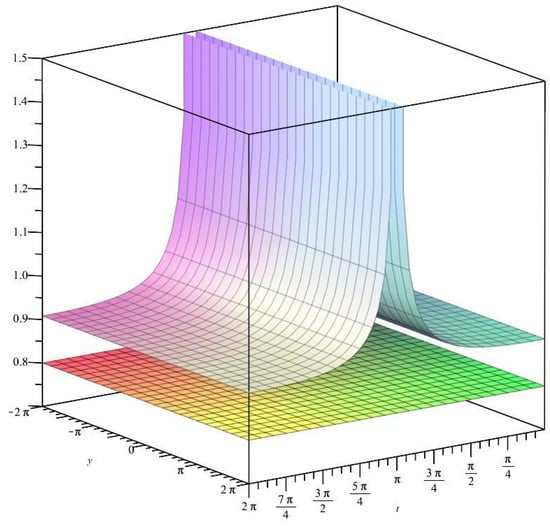
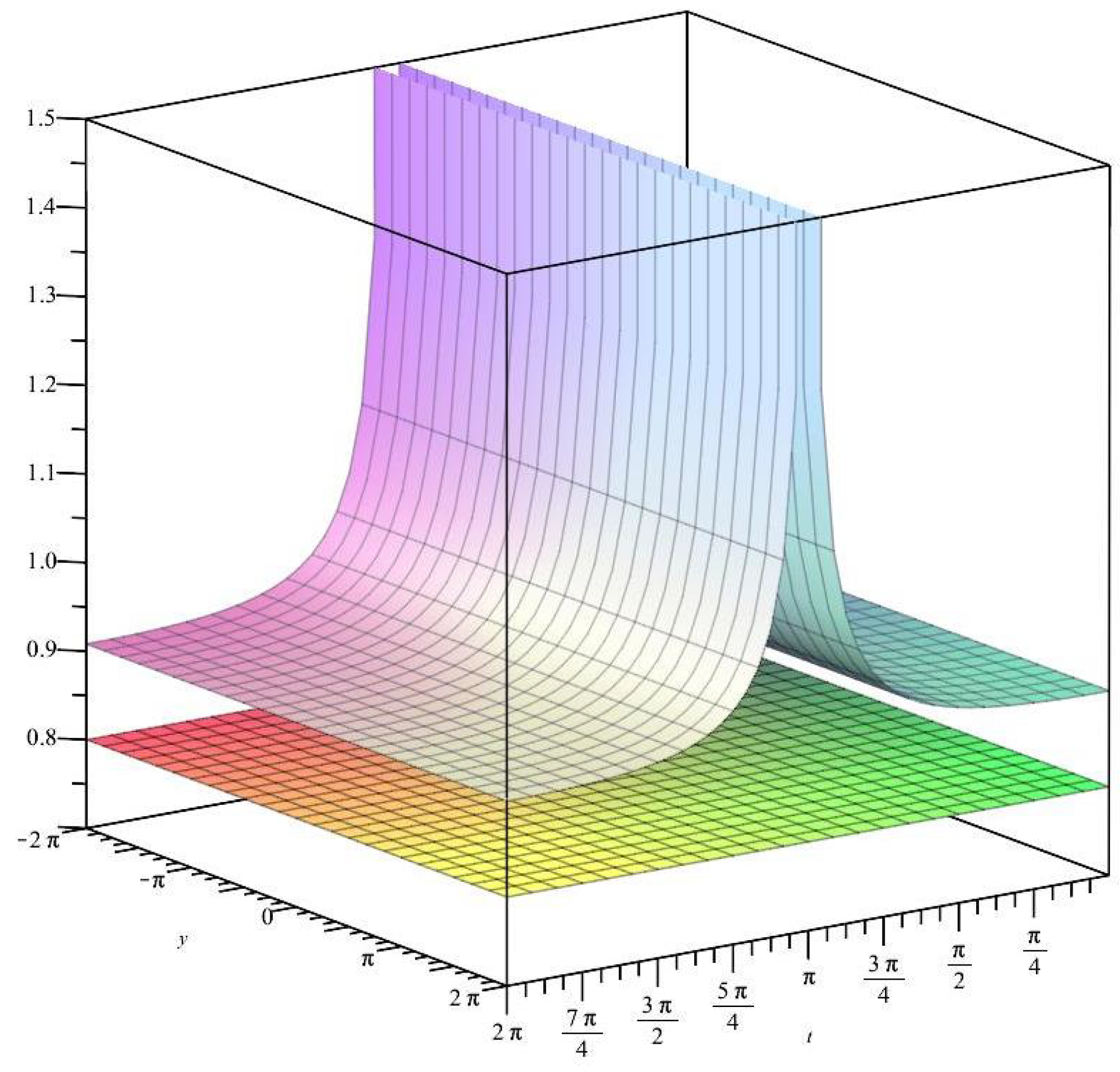
1. For the function , we have , , and using the 3D plot of the MAPLE™ computer software, we obtain that the image of the open unit disk by the function
is positive; hence, is a starlike (and also univalent) function with respect to the point 1 (see Figure 1).
Figure 1.
The image of .
2. We would like to emphasize that the class is not empty. Thus, if we consider , , then it is easy to check that , and, moreover, with .
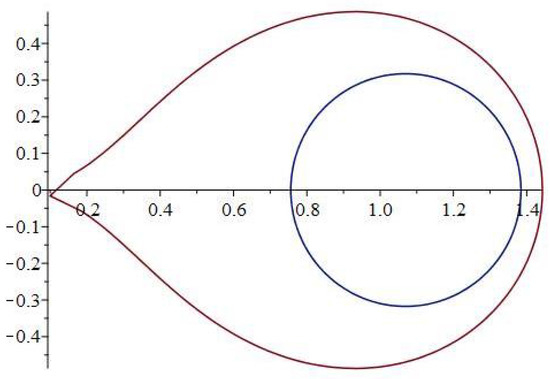
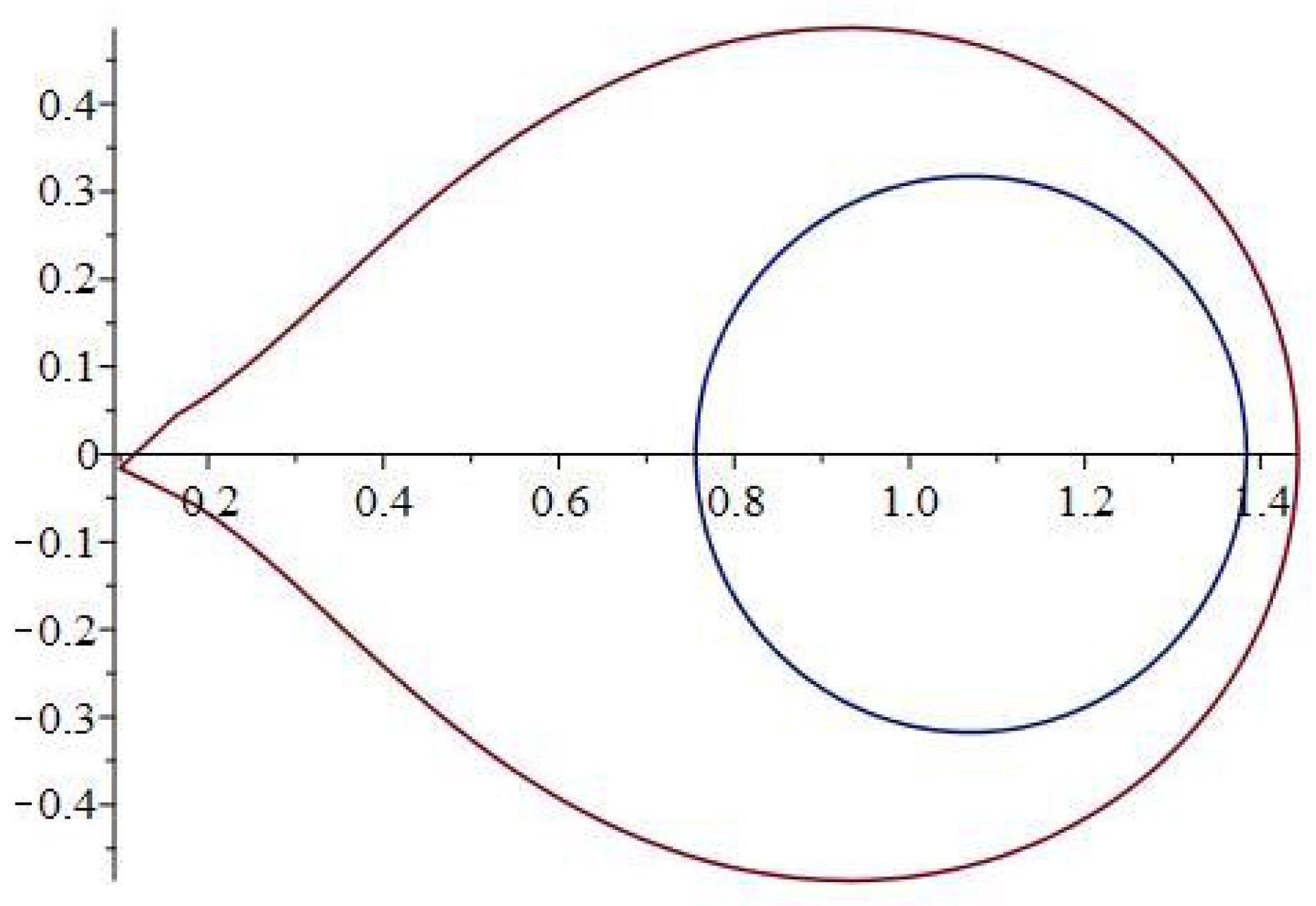
Using the fact that for all , it follows that . For the particular case , using the 2D plot of the MAPLE™ computer software, we obtain the image of the boundary by the functions , , and , shown in Figure 2. Since is univalent in , the previous explanation yields that the subordinations and hold whenever and (see Figure 2). In conclusion, ; hence, the class is not empty and contains other functions besides the identity.
Figure 2.
The images of , (blue color) and , (red color).
In our first results, we obtain better upper bounds for and for given in Definition 1. Further, we use the following lemmas, which were introduced by Zaprawa in [19,20], and we discuss the Fekete–Szegő functional problems [15].
Let , with , denote the class of analytic functions p in with and , . In particular, we use the notation instead of for the usual Carathéodory class of functions.
The next two lemmas are used in our study.
Lemma 1
([21]). If has the form , , then
and this inequality is sharp for each .
We mention that this inequality is the well-known result of the Carathéodory lemma [21] (see also [22], Corollary 2.3, p. 41, [23], Carathéodory’s Lemma, p. 41).
The second lemma is a generalization of Lemma 6 from [20], which can be obtained for .
Lemma 2
([20], Lemma 7, p. 2). Let and . If and ; then,
The following result gives the upper bounds for the first two coefficients of the functions that belong to .
Theorem 1.
If is given by (1), then
Proof.
If , from Definition 1, the subordinations (4) and (5) hold. Then, there exists an analytic function u in with and , , such that
and an analytic function v in with and , , such that
Therefore, the function
belongs to the class ; hence,
and
The function
belongs to the class ; therefore,
and
From the equalities (7) and (8), we obtain that
and
Comparing the corresponding coefficients in (11) and (12), we obtain
If we add the equalities (14) and (16), we obtain
and removing the value of from (18) in (19), we deduce that
Using (6) together with the triangle inequality in the relations (13) and (20), it follows that
which proves our first result.
Using the above values for and , we prove the following Fekete–Szegő-type inequality for the functions of the class .
Theorem 2.
If is given by (1), then, for any , the following inequality holds:
3. Coefficient Bounds for the Class
In the second set of results, we obtain the upper bounds for the modules of the first two coefficients for the functions that belong to the class defined below; then, we study the Fekete–Szegő functional problems for this function class.
Definition 2.
By fixing or , we have the following special subclasses.
Remark 2.
1. For , let be the subclass of functions satisfying
with .
Fixing , let be the subclass of functions that satisfy
where .
Remark 3.
We prove that the appropriate choice of the parameter μ in the class is not empty. Letting , , it easily follows that , and, additionally, with .
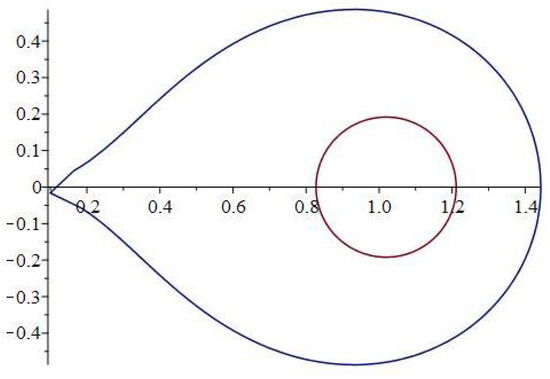
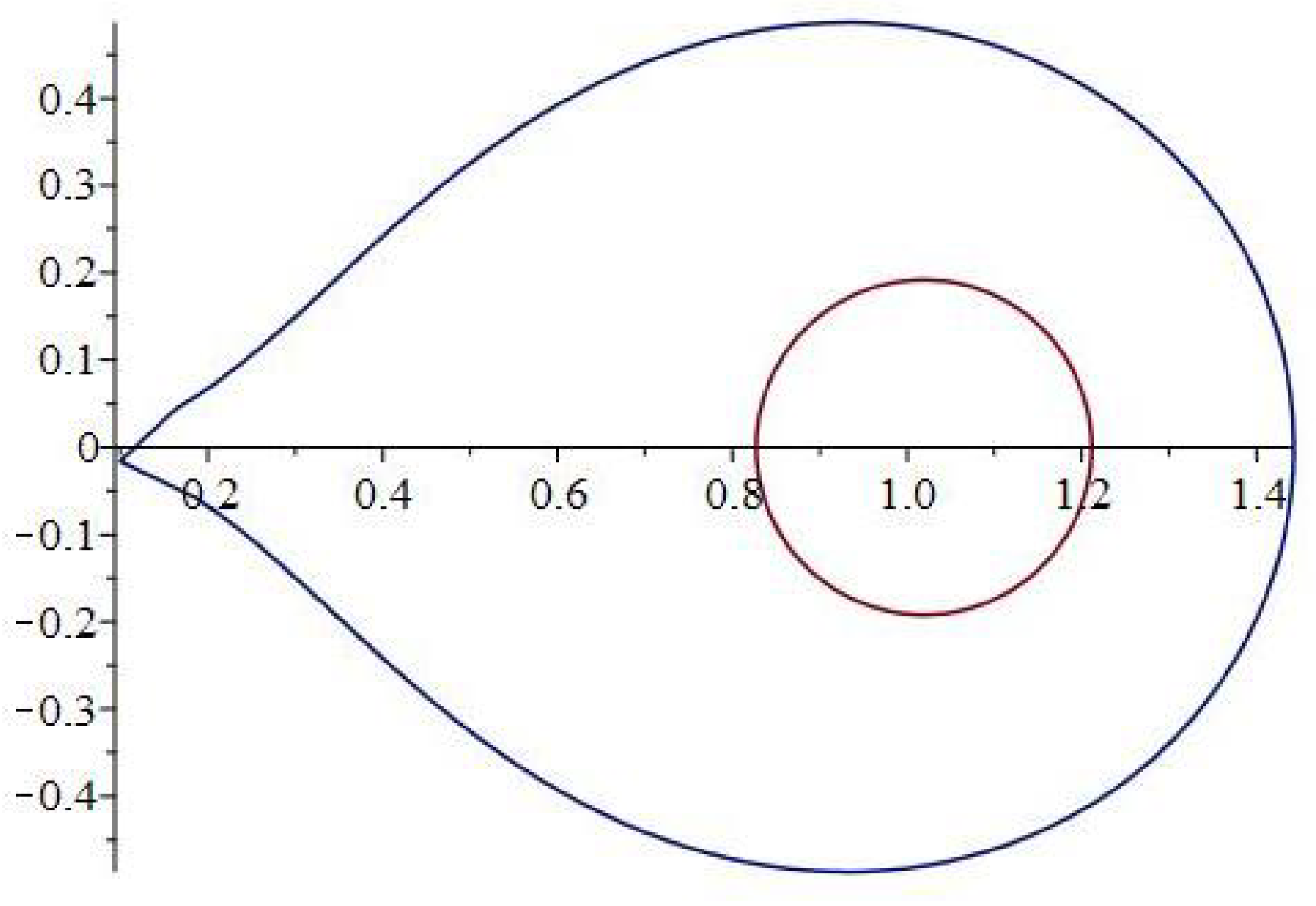
With the notations of (24) and (25), simple computation shows that for all , which implies that . Taking the particular case and , using the 2D plot of the MAPLE™ computer software, we obtain the image of the boundary by the functions Φ, Ψ, and , presented in Figure 3. Using the fact that is univalent in , the above explanation means that the subordinations and hold whenever and (see Figure 3). Therefore, ; hence, the class is not empty and contains other functions besides the identity.
Figure 3.
The images of , (red color) and , (blue color).
Theorem 3.
If is given by (1), then
Proof.
If has the form (1), from Definition 2, for some analytic functions in , namely u and v such that and , for all , we can write
and
From the equalities (26) and (27), combined with (9) and (10), we obtain
and
Equating the first coefficients of (28) and (29), we have
For the same reasons as in the proof of Theorem 1, using (6) in (30), (36), and (38), we find that
Simple computations shows that whenever ; hence, we obtain our first inequality.
The next result gives an upper bound for the Fekete–Szegő functional for the class .
Theorem 4.
Proof.
For and , the above theorem reduces to the following two results, respectively.
4. Coefficient Bounds of the Class
In this section, we obtain the upper bounds for the modules of the first two coefficients for the functions that belong to the class that will be introduced, and we find an upper bound for the Fekete–Szegő functional for this class.
Definition 3.
Remark 4.
Note that by fixing , we obtain as was given in Example 2. For , we obtain the class .
Remark 5.
We prove that for a suitable choice of the parameter λ, the class is not empty. Taking , , it can be easily shown that and with .
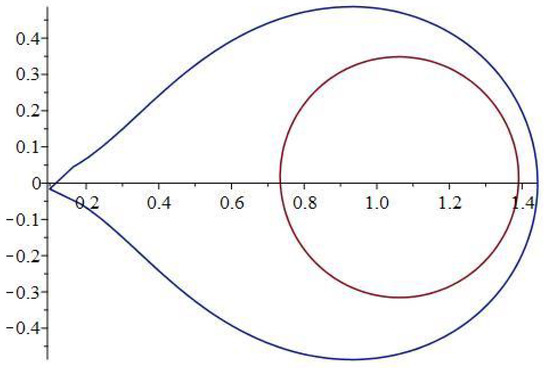
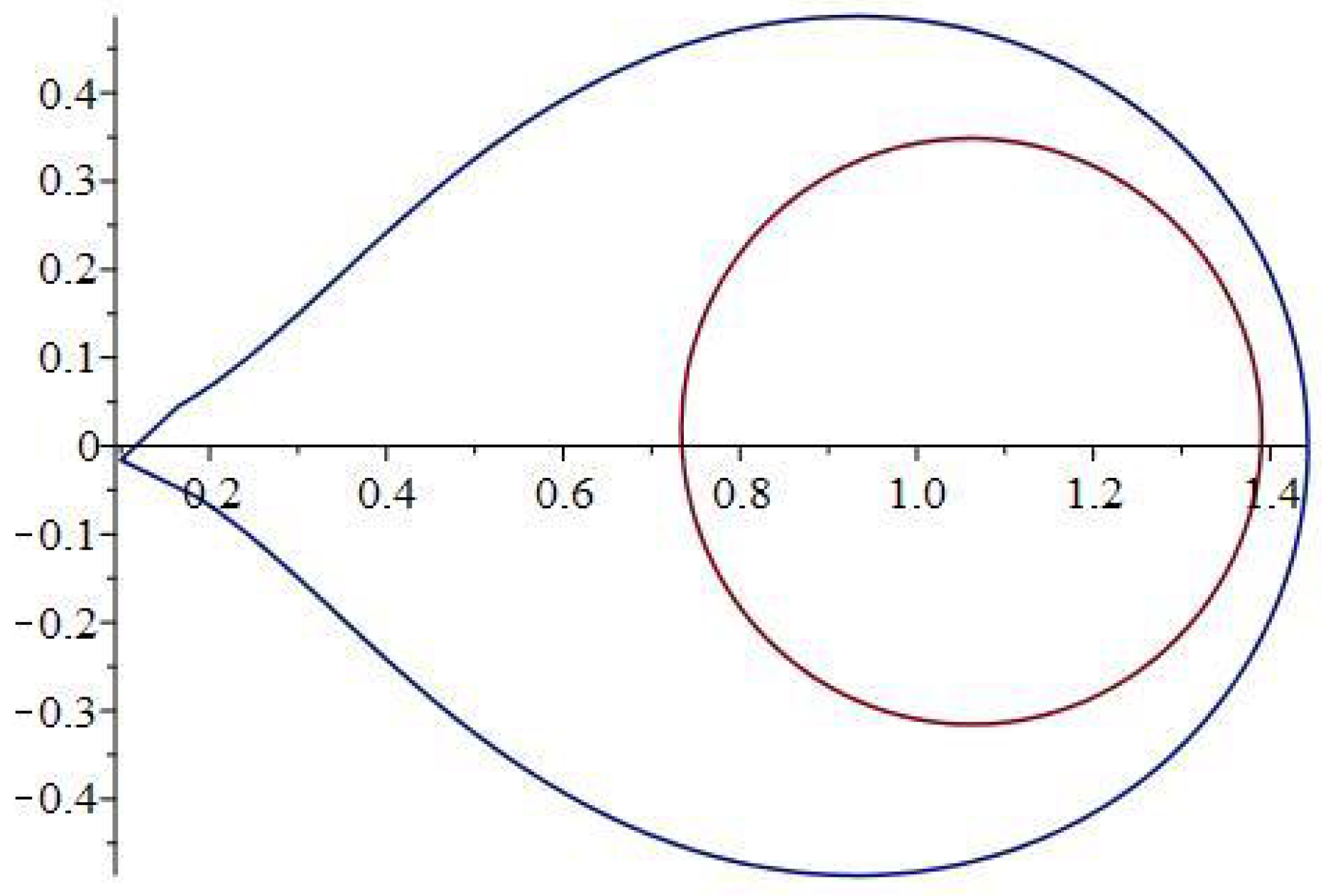
Using the notations of the Definition 3, it is easy to check that for all ; hence, . Taking the particular case , , and using the 2D plot of the MAPLE™ computer software, we obtain the image of the boundary by the functions Θ, Λ, and , presented in Figure 4. Since the function is univalent in , the subordinations and hold because , and (see Figure 4). Hence, ; therefore, the class is not empty and contains other functions besides the identity.
Figure 4.
The images of , (red color) and , (blue color).
In the following theorem, we determine the results for the initial coefficient bounds of the class .
Theorem 5.
Proof.
If , from Definition 3, there exist two analytic functions in , namely u and v, such that and , for all , with
With the same notations as in the proof of Theorem 3, from the equalities (44) and (45), we obtain that
and
Equating the corresponding coefficients in (46) and (47), we have
and
If we add (49) and (51), we obtain
and substituting the value of from (53) in the right-hand side of (54), we deduce that
and thus
Using (6) of Lemma 1 and the triangle inequality in (53) and (55), we obtain
which proves our first inequality.
To determine the upper bound of the Fekete–Szegő functional for the class , we use the following lemma.
Lemma 3
([24], (3.9), (3.10) p. 254). If , with , then there exist some x, ζ with , , such that
Theorem 6.
If is given by (1), then
Proof.
With the same notations as in the proof of Theorem 3, from Lemma 3, we have and , , , and using (52), we obtain
and thus
From the triangle inequality, taking , , , and without losing generality, we can assume that , ; thus, we obtain
Denoting and , the above relation can be rewritten in the form
Therefore,
and substituting the value and in the above equality, we obtain
Next we will determine the maximum of H on . Since
it is clear that if and only if . In this case, function H is a decreasing function on ; therefore,
It is easy to check that if and only if ; hence, the function H is an increasing function on , and consequently
and the estimation (57) is proven. □
5. Conclusions
In our present investigation, we have introduced and studied the initial coefficient problems associated with each of the new subclasses , and of the well-known bi-univalent class . These bi-univalent function subclasses are given by Definitions 1–3, respectively. For the functions in each of these bi-univalent subclasses, we have obtained an improvement in the estimates of the Taylor–Maclaurin coefficients and , and we have given solutions for the Fekete–Szegő functional problems. New results are shown to follow upon specializing the parameters involved in our main results, as given in Remark 2 for the class of bi-starlike and bi-convex functions associated with Gregory coefficients, which are new and have not been studied so far. Further, we can extend these types of studies based on generalized telephone numbers (see [25,26,27]).
Author Contributions
Conceptualization, G.M., K.V. and T.B.; methodology, G.M., K.V. and T.B.; software, G.M., K.V. and T.B.; validation, G.M., K.V. and T.B.; formal analysis, G.M., K.V. and T.B.; investigation, G.M., K.V. and T.B.; resources, G.M., K.V. and T.B.; data curation, G.M., K.V. and T.B.; writing—original draft preparation, G.M. and K.V.; writing—review and editing, G.M., K.V. and T.B.; visualization, G.M., K.V. and T.B.; supervision, G.M., K.V. and T.B.; project administration, G.M., K.V. and T.B. All authors have read and agreed to the published version of the manuscript.
Funding
This research received no external funding.
Data Availability Statement
Not applicable.
Acknowledgments
The authors are grateful to the reviewers of this article, who gave valuable remarks, comments, and advice in order to improve the quality of the paper.
Conflicts of Interest
The authors declare no conflict of interest.
References
- Lewin, M. On a coefficient problem for bi-univalent functions. Proc. Am. Math. Soc. 1967, 18, 63–68. [Google Scholar] [CrossRef]
- Brannan, D.A.; Clunie, J.G. Aspects of contemporary complex analysis. In Proceedings of the NATO Advanced Study Institute held at the University of Durham, Durham, UK, 1–20 July 1979; Academic Press: New York, NY, USA; London, UK, 1980. [Google Scholar]
- Netanyahu, E. The minimal distance of the image boundary from the origin and the second coefficient of a univalent function in |z|<1. Arch. Ration. Mech. Anal. 1969, 32, 100–112. [Google Scholar]
- Brannan, D.A.; Taha, T.S. On some classes of bi-univalent functions. Stud. Univ. Babeş-Bolyai Math. 1986, 31, 70–77. [Google Scholar]
- Taha, T.S. Topics in Univalent Function Theory. Ph.D. Thesis, University of London, London, UK, 1981. [Google Scholar]
- Srivastava, H.M.; Mishra, A.K.; Gochhayat, P. Certain subclasses of analytic and bi-univalent functions. Appl. Math. Lett. 2010, 23, 1188–1192. [Google Scholar] [CrossRef]
- Bulut, S. Coefficient estimates for a class of analytic and bi-univalent functions. J. Egypt. Math. Soc. 2013, 43, 59–65. [Google Scholar]
- Frasin, B.A.; Aouf, M.K. New subclasses of bi-univalent functions. Appl. Math. Lett. 2011, 24, 1569–1573. [Google Scholar] [CrossRef]
- Murugusundaramoorthy, G.; Magesh, N.; Prameela, V. Coefficient bounds for certain subclasses of bi-univalent function. Abstr. Appl. Anal. 2013, 2013, 573017. [Google Scholar] [CrossRef]
- Srivastava, H.M.; Murugusundaramoorthy, G.; El-Deeb, S.M. Faber polynomial coefficient estimates of bi-close-convex functions connected with the Borel distribution of the Mittag-Leffler type. J. Nonlinear Var. Anal. 2021, 5, 103–118. [Google Scholar] [CrossRef]
- Srivastava, H.M.; Murugusundaramoorthy, G.; Bulboacă, T. The second Hankel determinant for subclasses of bi-univalent functions associated with a nephroid domain. Rev. Real Acad. Cienc. Exactas, FíSicas Nat. Ser. Matemáticas 2022, 116, 145. [Google Scholar] [CrossRef]
- Srivastava, H.M.; Eker, S.S.; Ali, R.M. Coefficient bounds for a certain class of analytic and bi-univalent functions. Filomat 2015, 29, 1839–1845. [Google Scholar] [CrossRef]
- Srivastava, H.M.; Sakar, F.M.; Güney, H.Ö. Some general coefficient estimates for a new class of analytic and bi-univalent functions defined by a linear combination. Filomat 2018, 32, 1313–1322. [Google Scholar] [CrossRef]
- Yousef, F.; Amourah, A.; Frasin, B.A.; Bulboacă, T. An avant-garde construction for subclasses of analytic bi-univalent functions. Axioms 2022, 11, 267. [Google Scholar] [CrossRef]
- Fekete, M.; Szegő, G. Eine Bemerkung Über Ungerade Schlichte Funktionen. J. Lond. Math. Soc. 1933, 1, 85–89. [Google Scholar] [CrossRef]
- Phillips, G.M. Gregory’s method for numerical integration. Am. Math. Mon. 1972, 79, 270–274. [Google Scholar] [CrossRef]
- Berezin, I.S.; Zhidkov, N.P. Computing Methods; Pergamon, North Atlantic Treaty Organization and London Mathematical Society: Oxford, UK, 1965. [Google Scholar]
- Cantor, D.G. Power series with integral coefficients. Bull. Am. Math. Soc. 1963, 69, 62–366. [Google Scholar] [CrossRef]
- Zaprawa, P. On the Fekete-Szegő problem for classes of bi-univalent functions. Bull. Belg. Math. Soc. Simon Stevin 2014, 21, 169–178. [Google Scholar] [CrossRef]
- Zaprawa, P. Estimates of initial coefficients for bi-univalent functions. Abstr. Appl. Anal. 2014, 2014, 357480. [Google Scholar] [CrossRef]
- Carathéodory, C. Über den Variabilitätsbereich der Koeffizienten von Potenzreihen, die gegebene Werte nicht annehmen. Math. Ann. 1907, 64, 95–115. [Google Scholar] [CrossRef]
- Pommerenke, C. Univalent Functions; Vandenhoeck and Ruprecht: Göttingen, Germany, 1975. [Google Scholar]
- Duren, P.L. Univalent Functions; Springer: Amsterdam, The Netherlands, 1983. [Google Scholar]
- Libera, R.J.; Zlotkiewicz, E.J. Coefficient bounds for the inverse of a function with derivative in P. Proc. Am. Math. Soc. 1983, 87, 251–257. [Google Scholar] [CrossRef]
- Murugusundaramoorthy, G.; Vijaya, K. Certain subclasses of snalytic functions associated with generalized telephone numbers. Symmetry 2022, 14, 1053. [Google Scholar] [CrossRef]
- Vijaya, K.; Murugusundaramoorthy, G. Bi-starlike function of complex order involving Mathieu-type series associated with telephone numbers. Symmetry 2023, 15, 638. [Google Scholar] [CrossRef]
- Deniz, E. Sharp coefficient bounds for starlike functions associated with generalized telephone numbers. Bull. Malays. Math. Sci. Soc. 2021, 44, 1525–1542. [Google Scholar] [CrossRef]
Disclaimer/Publisher’s Note: The statements, opinions and data contained in all publications are solely those of the individual author(s) and contributor(s) and not of MDPI and/or the editor(s). MDPI and/or the editor(s) disclaim responsibility for any injury to people or property resulting from any ideas, methods, instructions or products referred to in the content. |
© 2023 by the authors. Licensee MDPI, Basel, Switzerland. This article is an open access article distributed under the terms and conditions of the Creative Commons Attribution (CC BY) license (https://creativecommons.org/licenses/by/4.0/).