


Abstract
We consider a system of two differential equations modeling chemotaxis. The system consists of a parabolic equation describing the behavior of a biological species “u” coupled to an ODE patterning the concentration of a chemical substance “v”. The growth of the biological species is limited by a logistic-like term where the carrying capacity presents a time-periodic asymptotic behavior. The production of the chemical species is described in terms of a regular function h, which increases as “u” increases. Under suitable assumptions we prove that the solution is globally bounded in time by using an Alikakos-Moser iteration, and it fulfills a certain periodic asymptotic behavior. Besides, numerical simulations are performed to illustrate the behavior of the solutions of the system showing that the model considered here can provide very interesting and complex dynamics.
1. Introduction
Chemotaxis is the ability of some living organisms to direct their movement in response to the presence of a chemical gradient. This response can be either positive (chemoattractant) or negative (chemorepellent). Mathematical models for chemotaxis have been studied since 1970 when Keller and Segel proposed a system of two parabolic equations involving nonlinear second order terms in the form
in the u-equation. Since the publication of the model, an extensive mathematical literature has treated the topic, see also [1]. To present an exhaustive literature review is not the aim of this article, therefore we refer to the reader to the survey works of Horstmann [2,3], and Bellomo et al. [4] for more details (see also [5]).
The mathematical model that we study in this article describes the behavior of a biological species “u” in terms of a PDE of parabolic type. The problem is posed in a bounded domain , with a regular boundary as follows
The equation includes the linear diffusion of “u” which also moves following the direction of the chemical gradient of a non-diffusive substance “v”. The chemotactic coefficient is assumed to be constant and positive, i.e., the biological species moves to a higher concentration of “v”. The logistic term includes a carrying capacity that limits the growth of “u” and it presents a spatial and time dependence, . Then, the reaction part is given by the quadratic term where is a positive constant. The chemical substance “v” is considered non-diffusive, i.e., once it is secreted by the biological species “u”, it is maintained up to degradation. The evolution of “v” is given in terms of a general function “h” satisfying some technical assumptions presented in this section.
Function f, in the reaction term, is a smooth bounded given function, fulfilling
with being a time-periodic function independent of the space variable “x”.
In Ref. [6] the fully parabolic system is considered, i.e., the equation for the chemical includes a diffusive term and the equation for v reads
The global existence of solutions for the fully parabolic system is achieved by employing an iterative method based on the Alikakos-Moser iteration. By using an energy method through a Lyapunov functional, the convergence of the solution to a homogeneous in space and periodic in time function is given. The parabolic-elliptic case, i.e., for v satisfying the equation
has been studied in Negreanu, Tello and Vargas [7], where the global existence and similar asymptotic behavior are done. In that case, the proof follows a sub-super solutions method already featured in Pao [8], Tello and Winkler [9], Galakhov, Salieva and Tello [10] and Negreanu and Tello [11,12] among others. In [7], the problem is addressed for a non constant function f and satisfying the ODE
where is a periodic in time function such that
In Issa and Shen [13] the logistic term is
and the authors got the existence of periodic solutions when the coefficients (for ) are periodic in time.
Parabolic-ODE systems with chemotactic terms have been considered from the last three decades, and after the pionering works of Levine and Sleeman [14] and Anderson and Chaplain [15] modeling tumor angiogenesis, a considerable number of authors have analyzed such models. In Othmer and Stevens [16] and Stevens [17], the authors address a Parabolic-ODE system of chemotaxis passing to the limit from a discrete to a continuous system of equations. Concerning angiogenesis, the model has been raised in Kubo and Suzuki [18], Suzuki [19] and Kubo, H. Hoshino and K. Kimura [20]. Mathematical analysis of these models with two equations can be found in Fontelos, Friedman and Hu [21], Friedman and Tello [22] and Negreanu and Tello [11] among others. Systems with three or more equations involving chemotaxis and diffusive or non-diffusive processes also appear in ecology and other biological applications (see [12,23]). In Ref. [24] the authors study a similar Parabolic-Parabolic-ODE system
where the chemosensitivities are non-constant. Global existence and convergence of the solution to a steady-state satisfying are presented under suitable assumptions on the coefficients and the spatial dimension of the domain. The results in [24] have been improved in Mizukami and Yokota [25] for a larger range of parameters.
Also in the context of cancer dynamics, chemotactic systems with non-diffusive equations have been recently used to model cancer cell invasion in Stinner, Surulescu and Winkler [26] with a model consisting of six equations where the cancer cells behavior is described by a parabolic equation with chemotactic terms. Denoting by “u” the cancer cells density, by “v” the fibers of the extracellular matrix (ECM) and by “l”, “” and “” the concentration of chemoattractant, integrins bound to ECM fibers and integrins bound to proteolitic residuals then, their model is the following
The authors prove the existence of global weak solutions together with some boundedness properties. The proof is based on the properties of the functional
Notice that, in this case, three of the variables leading the movement satisfy ordinary differential equations (see also Stinner, Surulescu and Uatay [27], Tao and Winkler [28], Zhigun, Surulescu and Hunt [29] and Zhigun, Surulescu and Uatay [30] for similar models). Throughout the article we use the notation , for , we assume, without loss of generality, that and we denote by g the function
We work under the following hypotheses
- There exists a periodic function verifyingand
- Function h fulfills
- For a given constant (defined in Lemma 6) we have that
The functions given by and , with verify the hypotheses.
2. Main Results
Our particular analysis will address the initial-boundary value problem (1) in a bounded open domain , where the initial data are as in (4). The issue of the global solvability is presented in the following theorem.
Theorem 1.
Afterwards, we study the asymptotic properties of the solutions. We introduce the function as set out by
for defined by
and as in (6). Notice that satisfies Equation (2) and it is an homogeneous in space and periodic in time function. We denote by , the solution of the ordinary differential equation
The following assertion is the main result on the asymptotic behavior of solutions of (1).
Theorem 2.
The paper is organized as follows: in Section 3 we proof the existence of a unique pair of classical solutions. A first key step consists in findining a maximal weak solution following [31], and we then get the boundedness of the solution. As a crucial ingredient in our derivation of a bound for u, we employ a Alikakos-Moser-type iterative procedure [32]. By means of these and some further higher regularity properties will assert the statements on global existence and boundedness of u and v from Theorem 1. Our collection of estimates of Section 3 will moreover turn out to be sufficient to derive the stabilization result from Theorem 2 in Section 4 through an analysis into two steps. First, we prove that the solutions converge to their respective averages, i.e.,
using energy estimates to conclude that these averages converge to the functions and , respectively. Finally, in Section 5 we perform a brief numerical study of the system under consideration. Some of the results presented in this paper were announced in [33].
3. Global Existence of Solutions
The present section is devoted to the proof of Theorem 1. We study the local-in-time existence of classical solutions to (1) and we prove some preliminary technical facts. In order to prove the global existence of the solutions, we first obtain the local existence using classical results on partial differential equations and then we conclude the proof by constructing uniform bounds.
Lemma 1.
Proof.
We consider the system (6.2) of [31] where
and
We can rewrite then (1) as follows
with the same initial data as (1). We apply Theorem 6.4 in [31] and consider maximal interval of existence. So, the local-in-time existence for (1) is proved.
In order to see the non-negativity of u we introduce the following change of variables:
Then we can rewrite the first equation in (1) as
Now, deriving with respect to the spatial variable in the previous equation we get
and
Notice that the equation for v remains as an ordinary differential equation
So, the original system (1) becomes (16) and (17) together with the initial data
and the Neumann boundary condition
Finally, the Maximum Principle for parabolic equations and the regularity of h prove the non-negativity of u, taking into account that
This completes the proof. □
Let us now collect some basic properties thereof which in our subsequent analysis will play important roles not only by providing some useful fundamental regularity features, but also by establishing the first quantitative information (18) on large time behavior. We remember that for the next matches, and also, .
Lemma 2.
Proof.
We integrate the first equation of (1) directly over to get
Applying the Cauchy-Schwarz inequality, since ,
we directly obtain
□
Lemma 3.
Under the same assumptions of Lemma 2, the solution to (1) satisfies
for all , where and
Proof.
We integrate (19) over the interval for to obtain
, or, equivalently,
By the previous lemma it follows
Finally, since we have
thereby completes the proof. □
Lemma 4.
Under hypotheses of Theorem 1, the following assertion is verified: there exists a positive constant defined by
for such that
Proof.
Notice that
for some , such that . Then, we get
□
We are now prepared to perform an iterative argument of Alikakos-Moser type in order to derive bounds for u and v.
The proof starts with the following lemma.
Lemma 5.
Proof.
We proceed by induction in p, then, for we have
For the first integral in (23) we infer that
From the expression of the above identity, we deduce
Moreover, for the restant term of (23), we have
Lemma 6.
Let us consider and as in (15). Let ϵ be a positive constant defined by
then, there exist and given by
and
for as in Lemma 4, such that
and
Proof.
For the result is a consequence of Lemmas 2 and 3. For we proceed by induction and assume the result for , i.e.,
Taking , thanks to (22), we have
We first recall the Young’s inequality:
multiplying it by we get
which is equivalent to
we integrate in space over , and in view of , we get
Thanks to the definition (27) of , we have
By solving the differential Equation (33) after integration in time, we obtain
Dropping the nonpositive term and making use of a favorable cancellation, it yields
and
Then, it results
□
Lemma 7.
Under the assumptions of Theorem 1, we have
where has been defined in Lemma 6.
Proof.
According to Lemma 6 we have that
and therefore
Since
we take limits when , to obtain (36). □
Lemma 8.
Proof.
By contradiction, we assume that for any there exists such that which is the first fulfilling this condition. Since by assumption (4) v must be an increasing function in a neighborhood of . Then, by applying (11), we obtain
then, since h is increasing in the first variable, we have
Thanks to assumption (11) we have that for large enough
which is a contradiction and the proof ends. □
The above results entail the claimed qualitative properties of u:
Lemma 9.
Under assumptions of Theorem 1, the solution u is uniformly bounded by
Proof.
The result is a consequence of Lemmas 7 and 8. □
Proof of Theorem 1.
The global existence of over is a direct consequence of the local existence (Lemma 3.1, Theorem 6.4 in [31]) and the uniform boundedness of in established in the previous Lemmas.□
4. Asymptotic Behavior
The main propose of this section is to demonstrate Theorem 2, i.e., to obtain the convergence of the solution to . We proceed in two steps: first of all we get the convergence of the solution u to its average , to get later the convergence of the average to the periodic function given by (12). For it, we need to prove the boundedness of in . The result is enclosed in the following lemma.
Lemma 10.
Suppose that the assumptions of Theorem 2 hold. Then, there exists , independent of t, such that
where v is the solution of (1).
Proof.
We consider Equation (22), for , and integrate over to obtain, after routinary computations and thanks to Lemmas 4, 6 and 7
for any . Recalling that v satisfies
then taking gradients we get
Now, we multiply (38) by and integrate over to obtain, in view of assumptions (9)
and therefore, by the Young’s inequality
After integration in time we get
and due to (37), we conclude the lemma. □
Lemma 11.
Under the assumptions of Theorem 2, there exists a positive constant such that
Proof.
We proceed as in Mizukami-Yokota [25] (Lemma 4.2.) and multiply the equation of u by for some , after integration by parts we obtain
Since , we have that
Notice that, thanks to the Mean Value Theorem it yields for some . Assumptions (8)–(10) imply
with . Therefore we have that
and then
In view of assumption over h, for close enough to 2, we get, by the Maximum Principle that
and the non-negativity of v implies
with positive constants c and . Moreover, the Hölder inequality implies
After some computations, the proof ends. □
Similar results can be found in Tao and Winkler [28] (Theorem 1.1) and [34] for parabolic-elliptic and fully parabolic systems.
Proof.
We divide by in (2) and integrate over to obtain the result. □
We now define the positive function
thus we achieve the following.
Lemma 13.
Under the assumptions of Theorem 2, there exists a positive constant independent of t such that the following estimate holds
Proof.
Since f and are uniformly bounded, we have
and
for any . We take and then
We divide by to get
Since satisfies
we have
Now, we consider the following functions
Functionals of quite a similar form have previously been used in several works on related chemotaxis problems, e.g., in [35]. Notice that and . Let be defined in (18), then
and also
We take gradients in the equation of v, multiply the obtained equation by and integrate over to get
Now we add both expressions to obtain
We apply the Cauchy-Swartz inequality to the term
then, operating we achieve
which is reduced to
Due to the discriminant of the polynomial
is given by , which is positive, we have two different roots and that are both positive. Since
we have that
Then, we take to obtain
Through the inequality (43) it results
After integration over and taking limits when we conclude the lemma. □
Lemma 14.
Under the assumptions of Theorem 2 the following estimate holds
with a positive constant.
Proof.
We first notice that defined in (45) achieves its minimum at
and
where is a compact set of . Due to (44) we get
We now proceed as in Lemma 13 and we obtain
After integration over , in view of
we end the proof. □
We have the following boundedness
Lemma 15.
Under the assumptions of Theorem 2, there exists a positive constant such that the following inequality holds
Proof.
After integration in the time variable the expression
by Lemma 14, we obtain
with . In view of the boundedness of u we have
and the proof ends. In Negreanu, Tello and Vargas [6], a similar problem is studied for the fully parabolic system. □
Lemma 16.
Proof.
The following relations hold:
and
By applying the Young’s inequality we have
The boundedness of u and Lemma 14 imply the result. □
The following lemma is used to prove the behavior of the solution. The proof follows Lemma 5.1 in Friedman-Tello [22], where is uniformly bounded, i.e., . Here, the boundedness of is replaced by a weaker assumption given in .
Lemma 17.
Let a function satisfying
- (i)
- for any
- (ii)
- (iii)
- for any ,
then, as .
Proof.
By contradiction, we assume that there exists a sequence such that and . Then, there exist a subsequence such that and
Then, in the interval for . So
and taking limits when we reach the contradiction. □
Lemma 18.
Under assumptions of Theorem 2 we have
Proof.
We consider defined in (39), then, thanks to Lemmas 13 and 16 we have
Now, we define as follows
We multiply by and due to the Mean Value Theorem we claim
for some if or otherwise. After integration it results
Notice that Lemma 2 implies
for some positive constant . Therefore, there exists such that
In view of Lemma 2, assumption (6) and Lemma 9 it is easy to see that
In order to obtain
we proceed as before in the following lemma.
Proof.
By the Mean Value Theorem, it follows
We call , by multiplying by z the above equation and after integrating over , it yields
where we have applied the Hölder inequality to the last term. Now, by assumption (9) it results
where is uniformly bounded. We obtain the result by solving the differential inequality. □
Proof.
(End of the proof of Theorem 2.) The asymptotic behavior (14) of is a direct consequence of Lemmas 18 and 19 and the uniform bounds of u and v established therein. □
5. Numerical Tests
Now we show some numerical results for the purpose of further clarifying that all conditions in the statement of the previous theorems play a relevant role in the behavior of the solution of (1). The suppression of some of the above conditions, together with the election of the initial data, may end up in the existence of blow-up of the solutions. We illustrate numerically the uniform boundedness and the convergence for the solution to obtain a numerical validation of Theorem 2. We use the Generalized Finite Differences Method for the space discretization and we performed several tests showing the explosion of solutions in the case that certain hypotheses of Theorem 2 are not verified as thus the asymptotic behavior of solutions.
5.1. Example 1: Uniform and Periodic Asymptotic Behavior
For our purpose, let us consider and . The initial data used are
and the function f is
which fulfils assumptions (6) and (7). Direct calculations lead
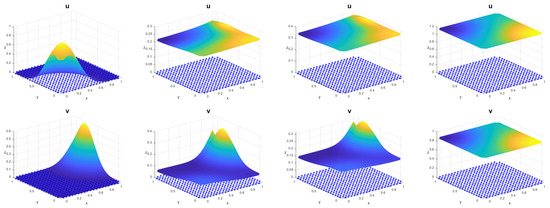
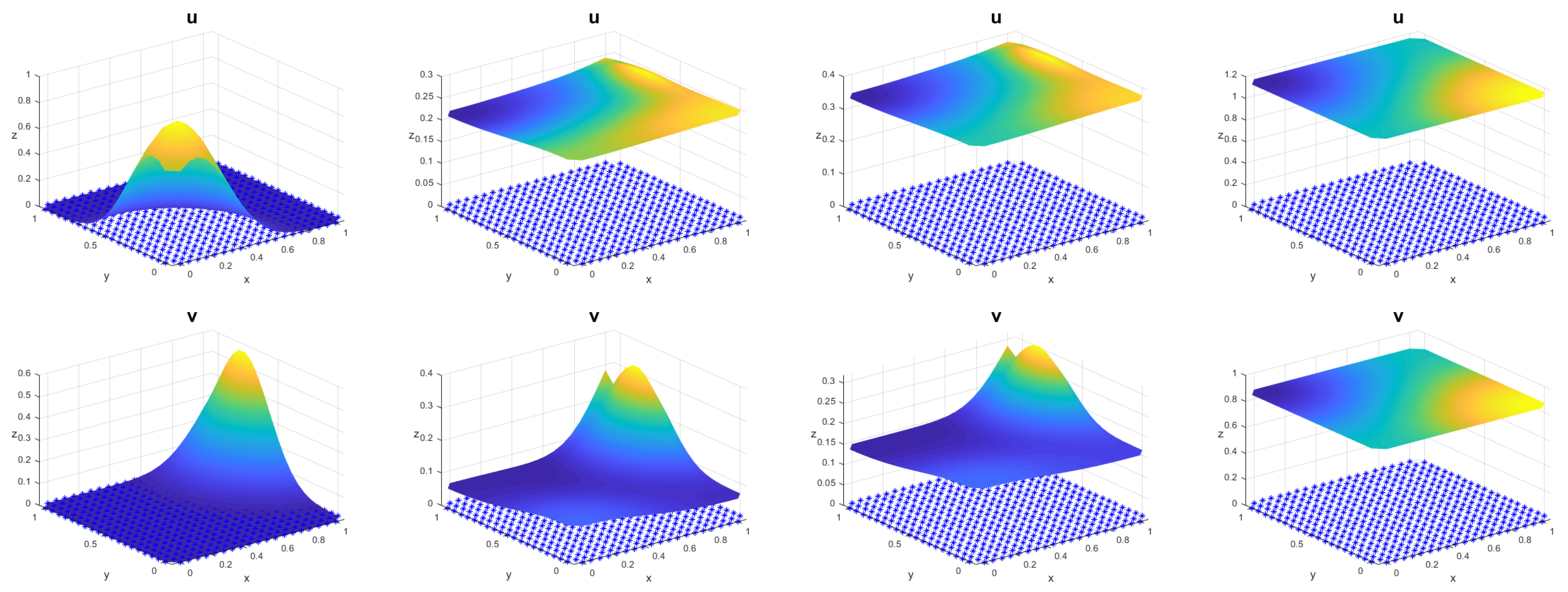
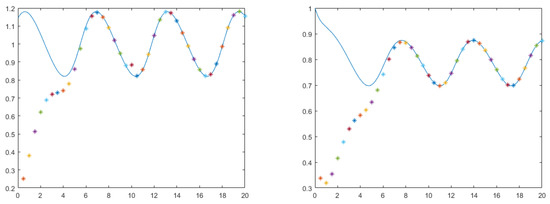
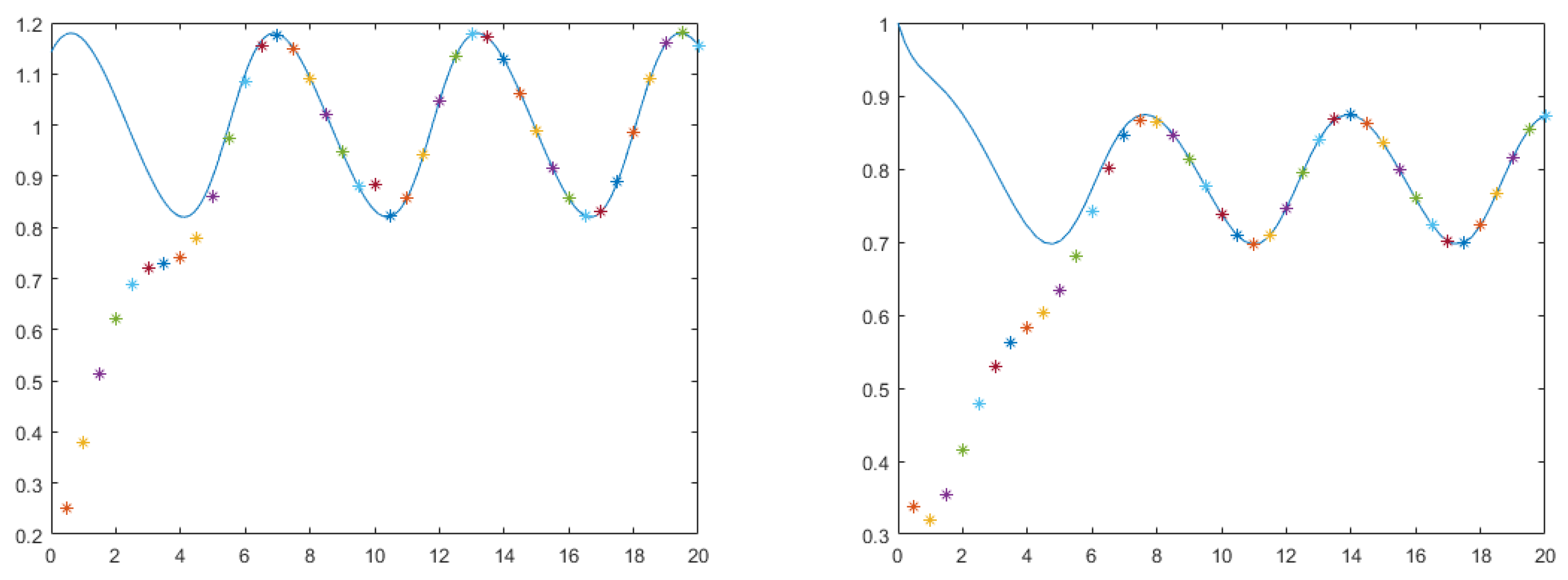
The function , as it is easy to check, is in accordance with the hypothesis of the theorem. We find the solution of the second ODE of (2) and (13) by numerical integration using the ode45 function of Matlab R2019a. In Figure 1, the solution is presented for 0, 0.5, 1 and 20 s. Table 1 shows the norm of the discrete solution and the value of for different times. In Figure 2 we illustrate the asymptotic solution (solid line) and the value of the discrete solution for times in .
Figure 1.
Approximate solution for 0, 0.5, 11 and 20 s.
Table 1.
Values of the asymptotic solutions and norms of the numerical solutions.
Figure 2.
The solid lines correspond to and , respectively, and the stars to the values of the approximate solutions.
Our simulations are in keeping with the theoretical results about global existence and boundedness of solutions to (1).
5.2. Example 2: Blow-Up Solutions
Next in order we present the results for the explosion of solutions in the case that certain hypotheses of Theorem 2 are not verified. We choose and . The initial data used are
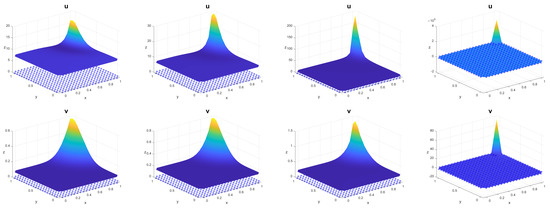
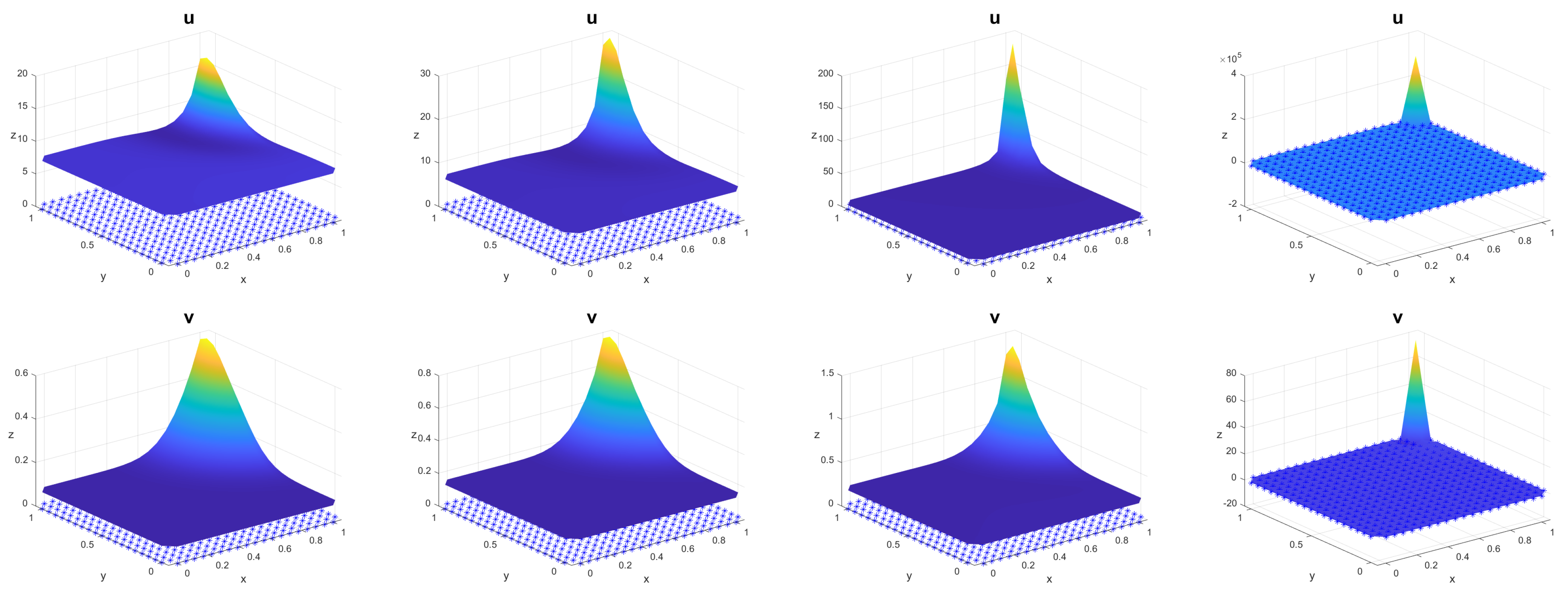
and the same function f of the previous example. Now, we consider clearly it does not fulfil the assumptions. As we see from Table 2 and Figure 3, the solutions become unbounded before 0.40 s.
Table 2.
Values of the asymptotic solutions and norms of the numerical solutions in the example 2.
Figure 3.
Approximate solution o in the example 2 for 0.1, 0.2, 0.3 and 0.37 s.
The formation of various patterns due to the effect of chemotaxis rate, domain size, initial data, the nature of the functions f and h or the complexity arisen in the solutions for large values of the chemotactic term are our goal for immediate studies.
6. Conclusions
We have obtained, under suitable assumptions, that the solution of a chemotaxis system is globally bounded in time by using an Alikakos-Moser iteration, and it fulfills a periodic asymptotic behavior. A possible future work is the consideration of the non-constant chemosensitivity, , as in [23,24,25,26,27,28,29,30,31,32,33,34,35,36], and to also consider biological systems with two species, two chemotactic terms and one chemical substance verifying a similar equation as in (1). Furthemore, a parabolic-parabolic-ordinary system with periodic terms serves as a model for some chemotaxis phenomena and appears naturally in the interaction of two biological species and a chemical. The presence of the periodic terms has a strong impact on the behavior of the solutions. We would find conditions on the system’s data that guarantee the global existence of solutions, the convergence to some periodical solutions of an associated ODE’s system. We got a similar result in [37] for a parabolic-parabolic-elliptic system.
Author Contributions
Conceptualization, M.N. and A.M.V.; methodology, M.N.; software, A.M.V.; validation, M.N. and A.M.V.; formal analysis, M.N.; investigation, M.N.; resources, A.M.V.; data curation, M.N.; writing—original draft preparation, A.M.V.; writing—review and editing, M.N.; visualization, A.M.V.; supervision, M.N.; funding acquisition, A.M.V. and M.N. All authors have read and agreed to the published version of the manuscript.
Funding
The authors acknowledge the support of the Escuela Técnica Superior de Ingenieros Industriales (UNED) of Spain, project 2021-IFC02. This work is also partially support by the Project MTM2017-83391-P DGICT, Spain.
Institutional Review Board Statement
Not applicable.
Informed Consent Statement
Not applicable.
Data Availability Statement
Not applicable.
Conflicts of Interest
The authors declare that they have no conflict of interest.
References
- Patlak, C.S. Random walk with persistence and external bias. Bull. Math. Biophys. 1953, 15, 311–338. [Google Scholar] [CrossRef] [Scilit]
- Horstmann, D. From 1970 until present: The Keller-Segel model in chemotaxis and its consequences. Jahresber. Dtsch. Math.-Ver. 2003, 105, 103–165. [Google Scholar]
- Horstmann, D. Generalizing the Keller-Segel model: Lyapunov functionals, steady state analysis, and blow-up results for multi-species chemotaxis models in the presence of attraction and repulsion between competitive interacting species. J. Nonlinear Sci. 2011, 21, 231–270. [Google Scholar] [CrossRef] [Scilit]
- Bellomo, N.; Bellouquid, A.; Tao, Y.; Winkler, M. Toward a mathematical theory of Keller-Segel models of pattern formation in biological tissues. Math. Model. Methods Appl. Sci. 2015, 25, 1663–1763. [Google Scholar] [CrossRef] [Scilit]
- Steinbock, O.; Hashimoto, H.; Müller, S.C. Quantitative analysis of periodic chemotaxis in aggregation patterns of Dictyostelium discoideum. Phys. D Nonlinear Phenom. 1991, 49, 233–239. [Google Scholar] [CrossRef] [Scilit]
- Negreanu, M.; Tello, J.I.; Vargas, A.M. On a fully Parabolic chemotaxis system with source term and periodic asymptotic behavior. Z. Angew. Math. Phys. 2020, 71, 65. [Google Scholar] [CrossRef] [Scilit]
- Negreanu, M.; Tello, J.I.; Vargas, A.M. On a Parabolic-Elliptic chemotaxis system with periodic asymptotic behavior. Math. Meth. Appl. Sci. 2018, 42, 1–17. [Google Scholar] [CrossRef] [Scilit]
- Pao, C.V. Comparison methods and stability analysis of reaction-diffusion systems. In Comparison Methods and Stability Theory; Lecture Notes in Pure and Applied Mathematics; Dekker: New York, NY, USA, 1994; Volume 162, pp. 277–292. [Google Scholar]
- Tello, J.I.; Winkler, M. A chemotaxis system with logistic source. Commun. Partial. Differ. Equ. 2007, 32, 849–877. [Google Scholar] [CrossRef] [Scilit]
- Galakhov, E.; Salieva, O.; Tello, J.I. On a Parabolic-Elliptic system with chemotaxis and logistic type growth. J. Differ. Equ. 2016, 261, 4631–4647. [Google Scholar] [CrossRef] [Scilit]
- Negreanu, M.; Tello, J.I. On a Comparison method to reaction diffusion systems and applications. Discret. Contin. Dyn. Syst. Ser. B 2013, 18, 2669–2688. [Google Scholar]
- Negreanu, M.; Tello, J.I. On a two species chemotaxis model with slow chemical diffusion. SIAM J. Math. Anal. 2014, 46, 3761–3781. [Google Scholar] [CrossRef] [Scilit]
- Issa, T.B.; Shen, W. Dynamics in chemotaxis models of parabolic-elliptic type on bounded domain with time and space dependent logistic sources. SIAM J. Appl. Dyn. Syst. 2017, 16, 926–973. [Google Scholar] [CrossRef] [Scilit]
- Levine, H.A.; Sleeman, B.D. A system of reaction diffusion equation arising in the theory of reinforced random walks. SIAM J. Appl. Math. 1997, 57, 683–730. [Google Scholar]
- Anderson, A.R.; Chaplain, M.A. Continuous and discrete mathematical models of tumor-induced angiogenesis. Bull. Math. Biol. 1998, 60, 857–899. [Google Scholar] [CrossRef] [Scilit]
- Othmer, H.G.; Stevens, A. Aggregation, blowup, and collapse: The ABC’s of taxis in reinforced random walks. SIAM J. Appl. Math. 1997, 57, 1044–1081. [Google Scholar]
- Stevens, A. The derivation of chemotaxis equations as limit dynamics of moderately interacting stochastic many-particle systems. SIAM J. Appl. Math. 2000, 61, 183–212. [Google Scholar] [CrossRef] [Scilit]
- Kubo, A.; Suzuki, T. Mathematical models of tumour angiogenesis. J. Comput. Appl. Math. 2007, 204, 48–55. [Google Scholar] [CrossRef] [Scilit]
- Suzuki, T. Mathematical models of tumor growth systems. Math. Bohem. 2012, 137, 201–218. [Google Scholar] [CrossRef] [Scilit]
- Kubo, A.; Hoshino, H.; Kimura, K. Global existence and asymptotic behaviour of solutions for nonlinear evolution equations related to a tumour invasion. In Proceedings of the Dynamical Systems, Differential Equations and Applications, AIMS Proceedings, Madrid, Spain, 7–11 July 2014; pp. 733–744. [Google Scholar]
- Fontelos, M.A.; Friedman, A.; Hu, B. Mathematical analysis of a model for the initiation of angiogenesis. SIAM J. Math. Anal. 2002, 33, 1330–1355. [Google Scholar] [CrossRef] [Scilit]
- Friedman, A.; Tello, J.I. Stability of solutions of chemotacis equations in reinforced random walks. J. Math. Anal. Appl. 2002, 272, 138–163. [Google Scholar] [CrossRef] [Scilit]
- Negreanu, M. Global existence and asymptotic behavior of solutions to a chemotaxis system with chemicals and prey-predator terms. Discret. Contin. Dyn. Syst. Ser. B 2020, 25, 3335–3356. [Google Scholar] [CrossRef] [Scilit]
- Negreanu, M.; Tello, J.I. Asymptotic stability of a two species chemotaxis system with non-diffusive chemoattractant. J. Differ. Equ. 2015, 258, 1592–1617. [Google Scholar] [CrossRef] [Scilit]
- Mizukami, M.; Yokota, T. Global existence and asymptotic stability of solutions to a two-species chemotaxis system with any chemical diffusion. J. Differ. Equ. 2016, 261, 2650–2669. [Google Scholar] [CrossRef] [Scilit]
- Stinner, C.; Surulescu, C.; Winkler, M. Global weak solutions in a PDE-ODE system modeling multiscale cancer cell invasion. SIAM J. Math. Anal. 2014, 46, 1969–2007. [Google Scholar] [CrossRef] [Scilit]
- Stinner, C.; Surulescu, C.; Uatay, A. Global existence for a go-or-grow multiscale model for tumor invasion with therapy. Math. Model. Methods Appl. Sci. 2016, 26, 2163–2201. [Google Scholar] [CrossRef] [Scilit]
- Tao, Y.; Winkler, M. Large Time Behavior in a Multidimensional Chemotaxis-Haptotaxis Model with Slow Signal Diffusion. SIAM J. Math. Anal. 2015, 47, 4229–4250. [Google Scholar] [CrossRef] [Scilit]
- Zhigun, A.; Surulescu, C.; Hunt, A. A strongly degenerate diffusion-haptotaxis model of tumour invasion under the go-or-grow dichotomy hypothesis. Math. Meth. Appl. Sci. 2018, 41, 2403–2428. [Google Scholar] [CrossRef] [Scilit]
- Zhigun, A.; Surulescu, C.; Uatay, A. Global existence for a degenerate haptotaxis model of cancer invasion. Z. Angew. Math. Phys. 2016, 67, 146. [Google Scholar] [CrossRef] [Scilit]
- Amann, H. Dynamic theory of quasilinear parabolic equations. II. Reaction-diffusion systems. Differ. Integral Equ. 1990, 3, 13–75. [Google Scholar]
- Alikakos, N.D. An application of the invariance principle to reaction-diffusion equations. J. Differ. Equ. 1979, 33, 201–225. [Google Scholar] [CrossRef] [Scilit]
- Negreanu, M.; Tello, J.I.; Vargas, A.M. A note on a periodic Parabolic-ODE chemotaxis system. Appl. Math. Lett. 2020, 106, 106351. [Google Scholar] [CrossRef] [Scilit]
- Tao, J.I.; Winkler, M. Persistence of mass in a chemotaxis system with logistic source. J. Differ. Equ. 2015, 259, 6142–6161. [Google Scholar] [CrossRef] [Scilit]
- Bai, X.; Winkler, M. Equilibration in a Fully Parabolic Two-species Chemotaxis System with Competitive Kinetics. Indiana Univ. Math. J. 2016, 65, 553–583. [Google Scholar]
- Negreanu, M.; Tello, J.I. On a parabolic-elliptic chemotactic system with non-constant chemotactic sensivity. Nonlinear Anal. 2013, 80, 1–13. [Google Scholar] [CrossRef] [Scilit]
- Negreanu, M.; Vargas, A.M. Continuous and discrete periodic asymptotic behavior of solutions to a competitive chemotaxis PDEs system. Commun. Nonlinear Sci. Numer. Simul. 2021, 95, 105592. [Google Scholar] [CrossRef] [Scilit]

Publisher’s Note: MDPI stays neutral with regard to jurisdictional claims in published maps and institutional affiliations. |
© 2022 by the authors. Licensee MDPI, Basel, Switzerland. This article is an open access article distributed under the terms and conditions of the Creative Commons Attribution (CC BY) license (https://creativecommons.org/licenses/by/4.0/).