Abstract
In this article, we derive the above and below bounds for parameterized-type inequalities using the Riemann–Liouville fractional integral operators and limited second derivative mappings. These established inequalities generalized the midpoint-type, trapezoid-type, Simpson-type, and Bullen-type inequalities according to the specific choices of the parameter. Thus, a generalization of many inequalities and new results were obtained. Moreover, some examples of obtained inequalities are given for better understanding by the reader. Furthermore, the theoretical results are supported by graphs in order to illustrate the accuracy of each of the inequalities obtained according to the specific choices of the parameter.
Keywords:
bounded functions; Hermite–Hadamard type inequality; trapezoid inequalities; midpoint-type inequalities; Simpson-type inequalities; Bullen-type inequalities MSC:
26D07; 26D10; 26D15; 26A33
1. Introduction
The theory of inequality, one of the cornerstones of mathematics, is used in many fields of science. Midpoint-type and Trapezoid-type inequalities formed by the right and left sides of Hermite–Hadamard-type inequality, Simpson-type inequalities, and Bullen-type inequalities have brought solutions to numerous important studies in the literature. In addition to these, fractional calculus is an important topic for explaining physical states as well as real-world problems. For more information about these topics, see [1,2,3,4] and references therein. One of the most famous types of fractional integrals is the Riemann–Liouville fractional integral. It has been the subject of many studies in the literature. The theory of inequality has been the focus of many researchers in the field.
Midpoint-type and trapezoid-type inequalities have been the focus of many researchers in recent years. Trapezoid-type inequalities for convex functions were given for the first time in [5]. On the other hand, midpoint inequalities were presented for the first time in [6]. Chen gave a refinement of the Hermite–Hadamard inequality via convex functions with the help of the Riemann–Liouville fractional integrals in [7]. In [8], the authors possessed the below and above bounds for the right and left-hand sides of fractional Hermite–Hadamard inequalities. In [9,10], Budak et al. derived two different versions of generalized fractional midpoint type and generalized fractional trapezoid-type inequalities for functions with second bounded derivatives. Barani et al. obtained inequalities involving twice differentiable convex mappings which are connected with Hadamard’s inequality in [11,12].
Since the convex theory is an efficient and useful way to obtain several problems from kind branches of science, many researchers have investigated Simpson-type inequalities in the case of a convex function. For instance, Alomari et al. [13] proved some inequalities of Simpson’s type with the aid of s-convex mappings via differentiable functions. Moreover, new variants of Simpson-type inequalities involving differentiable convex functions are presented in [14,15]. Sarıkaya et al. [16] obtained several Simpson-type inequalities for mappings whose second derivatives are convex. Some Simpson-type inequalities are investigated for functions whose absolute values are convex in [17]. The Simpson inequalities via differentiable mappings are extended to Riemann–Liouville fractional integrals in [18]. Furthermore, a large number of fractional Simpson-type inequalities for twice-differentiable mappings were given in [19].
In [20], Bullen introduced Bullen-type inequalities as one of the important inequalities in 1978. Sarikaya et al. [21] investigated generalized Bullen inequalities including a generalized convex function. Erden and Sarikaya obtained the generalized Bullen-type inequalities based on local fractional integrals in [22]. İşcan [23] proved some Hadamard-type and Bullen-type inequalities via Lipschitzian mappings based on Riemann–Liouville fractional integrals. Çakmak obtained a new identity via differentiable mappings and derived some new inequalities for differentiable mappings thought s-convexity based on Riemann–Liouville fractional integrals involving Gaussian hyper-geometric mapping in [24]. Moreover, Du et al. [25] investigated the generalized fractional integrals to possess Bullen-type inequalities. Furthermore, some generalizations of integral inequalities of Bullen-type for twice differentiable functions involving Riemann–Liouville fractional integrals were obtained in [26].
The main goal of this paper is to demonstrate that some parameterized type inequalities based on Riemann–Liouville fractional integrals on twice-differentiable functions are bounded. The general outline of the article consists of four sections including an introduction. In Section 2, after giving a general literature review and the definition of Riemann–Liouville fractional integral operators, we will build the main results of this research on three theorems that exist in the literature. These theorems about the above and below bounds of Hermite–Hadamard type inequalities for different versions based on Riemann–Liouville fractional integral operators are constructed using the second derivative bounded functions. Section 3 will consist of three subtitles. Different versions of the Riemann–Liouville fractional integral will be discussed in each other. It shows that these obtained inequalities generalize some studies in the literature with special choices of the parameter. Moreover, new results were obtained with some special choices of the parameter. Examples of the obtained inequalities are given in the graphs. In Section 4, comments and suggestions will make to the reader about the researched subject. Information will be given about future work for interested readers.
2. Preliminaries
Throughout this section, mathematical preliminaries about fractional calculus theory will be given as follows:
Definition 1
([27]). Let us consider a first-order integrable function f in the interval such that . The Riemann–Liouville integrals and of order are described by:
and
respectively. Here, is the Gamma function, and it is described as follows:
Let us also note that
Theorem 1
([8]). Let denotes a twice differentiable positive mapping and If is bounded, i.e., , then we derived the following inequalities:
and
Theorem 2
([8]). Suppose that the all conditions of Theorem 1 are valid. Then, it follows:
and
F. Chen proved the following inequalities:
Theorem 3
([7]). If all conditions of Theorem 1 hold, then it yields:
and
for Here,
3. Main Results
In this section, new inequalities will be obtained by using the inequalities given in the preliminary section. Instead of using convexity, condition is used in these inequalities for all . Each version has been examined in the form of three subtitles.
3.1. Parameterized Type Inequalities of the First Sense
Theorem 4.
Let us consider that all conditions of Theorem 1 hold and Then, we establish the following inequalities:
Proof.
Remark 3.
Let us consider in Theorem 4. Then, we possess fractional Simpson-type inequalities:
which is given by Budak et al. in [28].
Corollary 1.
If we assume that in Theorem 4, then we have the following Bullen-type inequalities:
Example 1.
Let us define the function as such that and . Let us consider the left-hand side of the inequalities (7) as follows:
From the definitions of fractional integrals, the equalities
are valid. Finally, the last expression of (7) is calculated as follows:
Hence, we have the following double inequality:
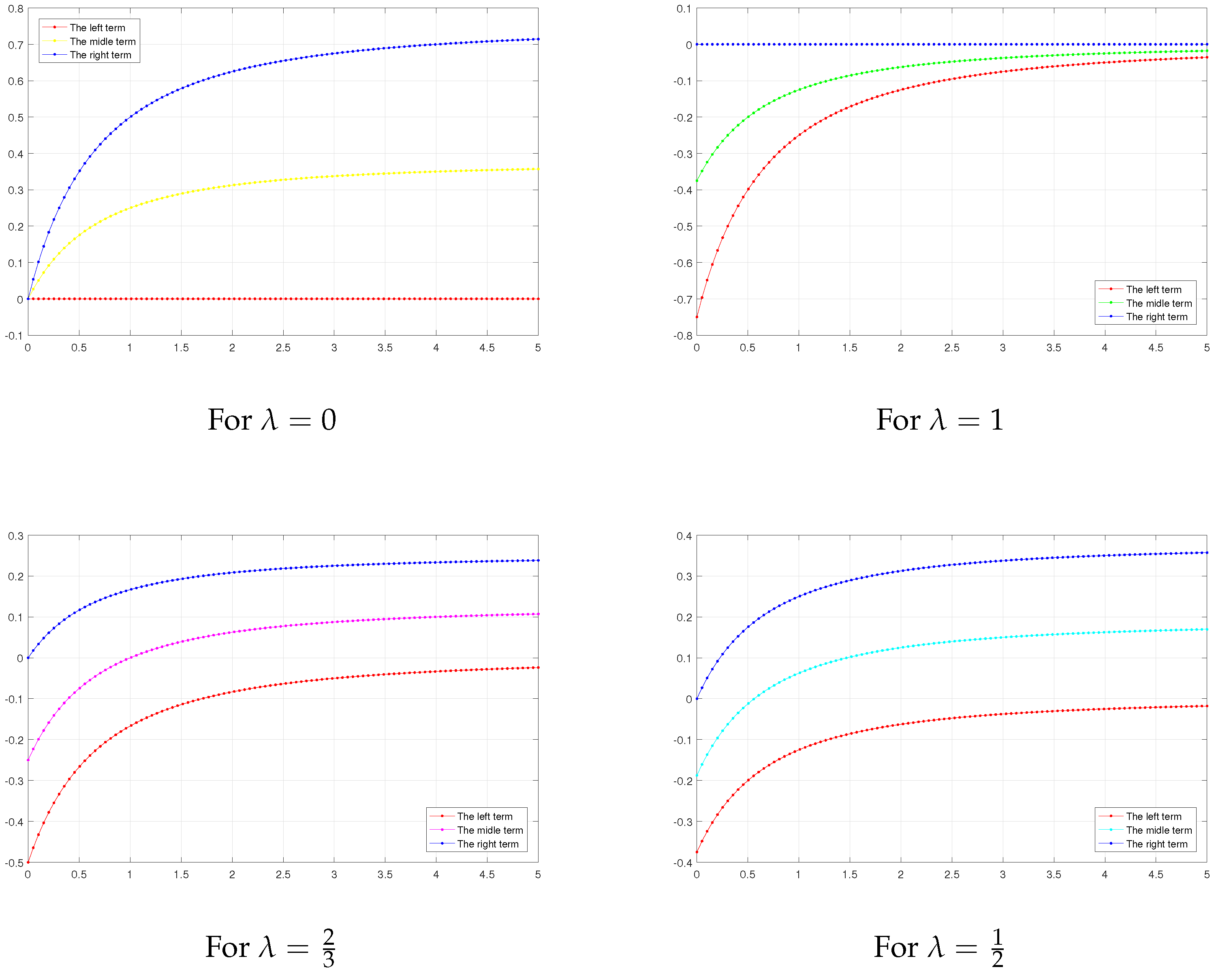
As one can see in Figure 1, (10) in Example 1 shows the correctness of this inequality for all values of and special choices of λ.
Figure 1.
Graph of both sides of (10) in Example 1, depending on and , computed and plotted with MATLAB.
3.2. Parameterized-Type Inequalities of the Second Sense
Theorem 5.
Assume that the all conditions of Theorem 4 hold. Then, we obtain the following double inequality:
Proof.
Remark 5.
Remark 6.
Consider in Theorem 5. Then, the following fractional Simpson-type inequalities hold:
This double inequality is established by Budak et al. in [28].
Corollary 2.
If we assume λ equals to in Theorem 5, then the following inequalities hold:
Example 2.
If we define a function by , then we obtain and . Let us consider the left-hand side of the inequalities (11) as follows:
With the help of the Riemann–Liouville fractional integral operators, we obtain:
Hence,
Consequently, we have the inequality:
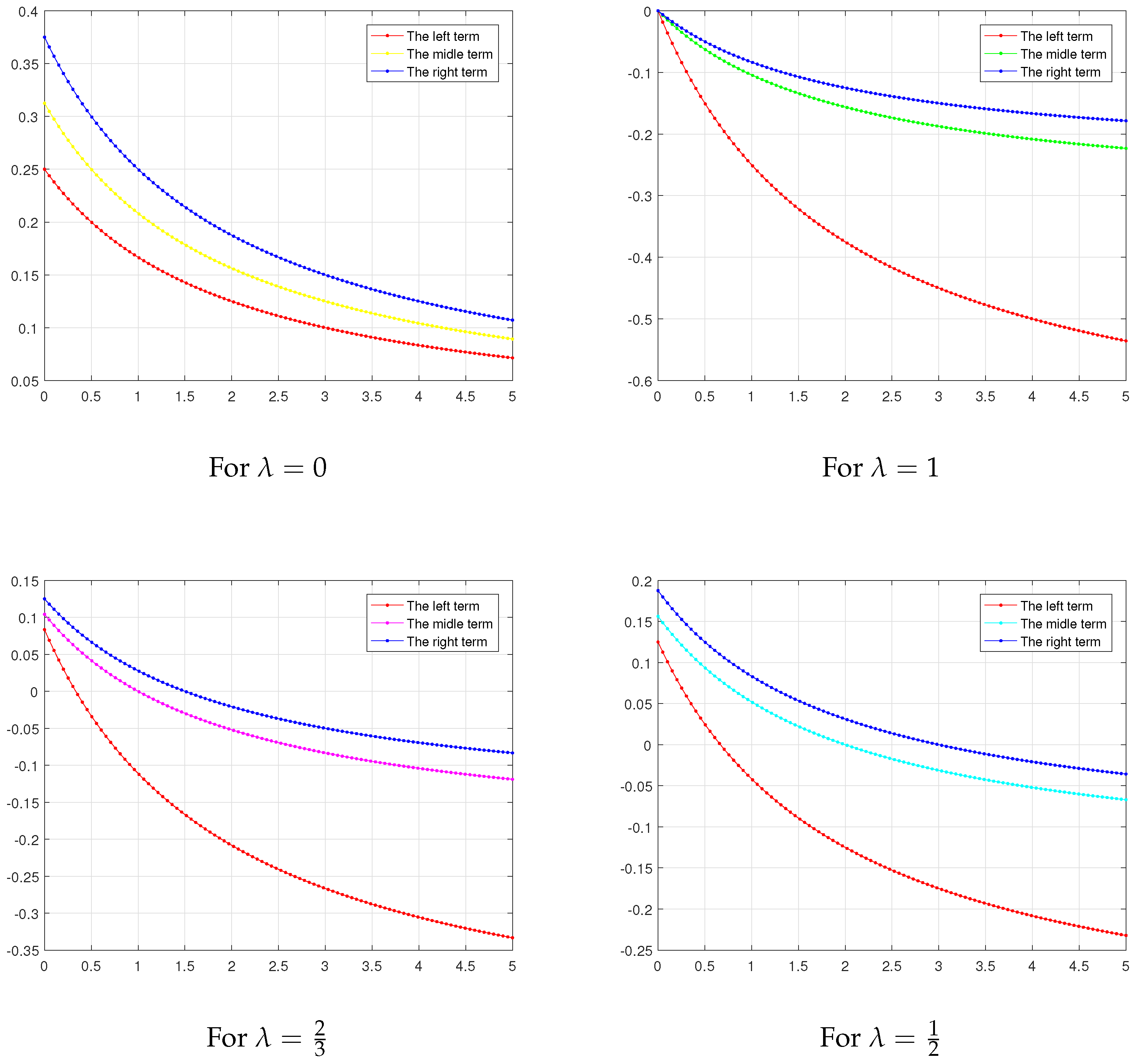
As it can be seen in Figure 2, the accuracy of inequality (12) in Example 2 is obvious for all values of and for special choices of λ.
Figure 2.
Graph of both sides of (12) in Example 2, depending on and , evaluated and drawn with MATLAB.
3.3. Parameterized-Type Inequalities of the Third Sense
Theorem 6.
If all conditions of Theorem 4 hold, then we have the following inequalities:
Proof.
Remark 8.
Remark 9.
Assume λ is equal to in Theorem 6. Then, the following fractional Simpson-type inequalities
are satisfied. This double inequality has been obtained by Budak et al. in [28].
Corollary 3.
If we let in Theorem 6, then we obtain fractional Bullen-type inequalities:
Example 3.
Let us note the function is . Then, it is clear that and . Here, the first expression of the inequalities (13) is as follows:
From the fact of the Definition 1, it will be calculated as follows:
Finally, the right-hand side of the inequality (13) is as follows:
Thus, we have the inequality:
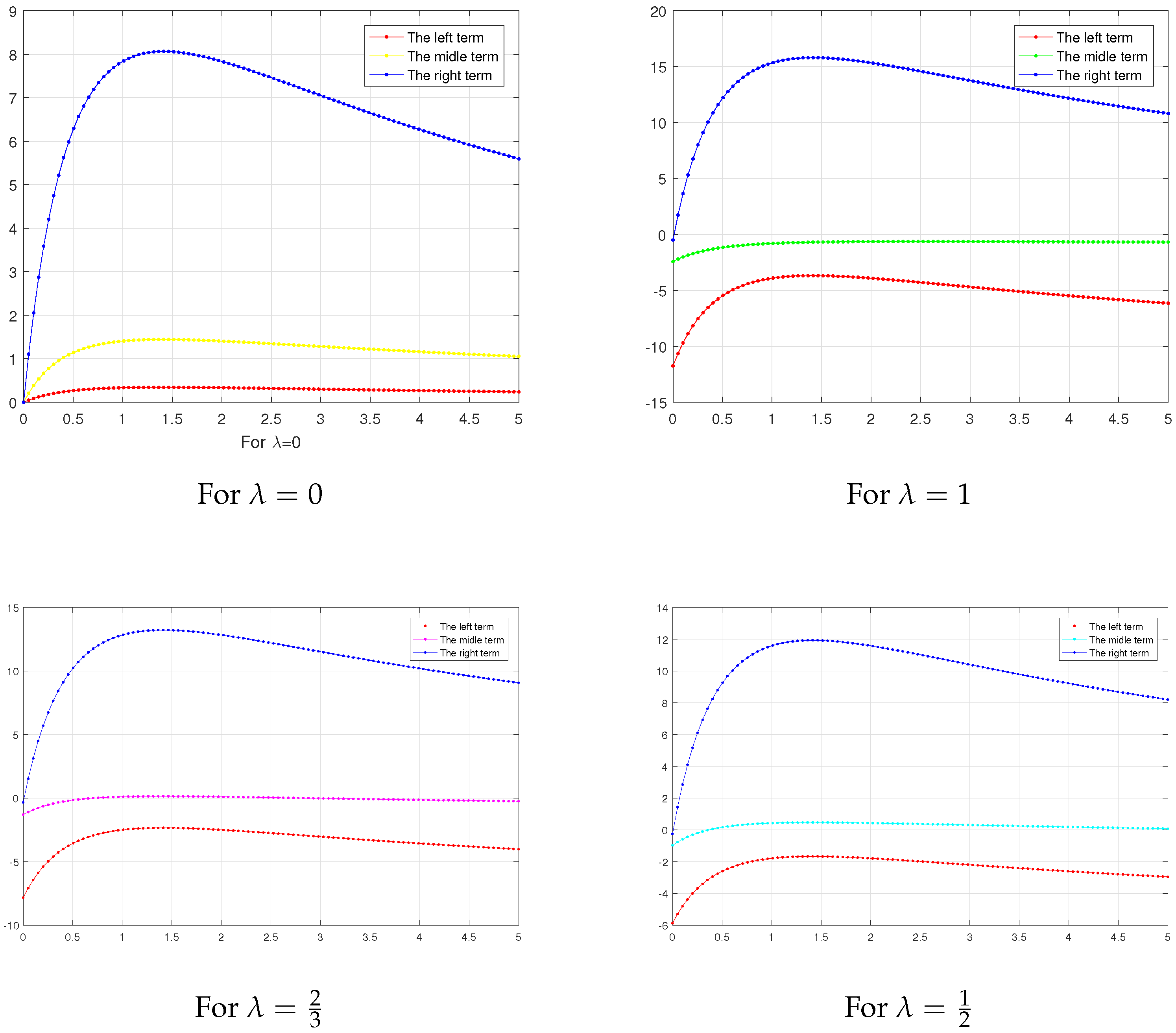
Looking at Figure 3, the correctness of inequalities (14) in Example 3 are clear for all values of and special choices of λ.
Figure 3.
Graph of both sides of (14) in Example 3, depending on and , calculated and drawn with MATLAB.
4. Conclusions
In the present research, we investigated some Parameterized type inequalities including Riemann–Liouville fractional integral operators using the functions whose second derivatives are bounded. In addition, some examples with graphs are posses to demonstrate the main results. Interested readers can explore the other fractional types of the resulting inequalities. These given inequalities can be developed under the condition for all for different convexity types of mappings. With the motivation from this study, different types of inequalities can be developed in future studies.
Author Contributions
Conceptualization, H.K.; investigation, H.K. and H.B.; methodology, F.H.; validation, H.K. and F.H.; visualization, H.B. and F.H.; writing—original draft, H.K. and F.H.; writing—review and editing, H.B. All authors read and approved the final manuscript.
Funding
This research received no external funding.
Data Availability Statement
Data sharing is not applicable to this paper as no data sets were generated or analyzed during the current study.
Acknowledgments
The authors would like to express their sincere thanks to the editor and the anonymous reviewers for their helpful comments and suggestions.
Conflicts of Interest
The authors declare that they have no competing interest.
References
- Liu, J.G.; Yang, X.J.; Feng, Y.Y.; Geng, L.L. Fundamental results to the weighted Caputo-type differential operator. Appl. Math. Lett. 2021, 121, 107421. [Google Scholar] [CrossRef]
- Liu, J.G.; Yang, X.J.; Feng, Y.Y.; Geng, L.L. On the generalized weighted Caputo-type differential operator. Fractals 2022, 30, 2250032. [Google Scholar] [CrossRef]
- Liu, J.G.; Yang, X.J.; Geng, L.L.; Fan, Y.R.; Yan, X.Z. Fundamental analysis of the time fractional coupled Burgers-type equations. Fractals 2021, 169, 104334. [Google Scholar] [CrossRef]
- Yang, X.J. General Fractional Derivatives: Theory, Methods and Applications, 1st ed.; Chapman and Hall/CRC: London, UK, 2019. [Google Scholar] [CrossRef]
- Dragomir, S.S.; Agarwal, R.P. Two inequalities for differentiable mappings and applications to special means of real numbers and to trapezoidal formula. Appl. Math. Lett. 1998, 11, 91–95. [Google Scholar] [CrossRef]
- Kirmaci, U.S. Inequalities for differentiable mappings and applications to special means of real numbers to midpoint formula. Appl. Math. Comput. 2004, 147, 137–146. [Google Scholar] [CrossRef]
- Chen, F.X. Extensions of the Hermite-Hadamard inequality for convex functions via fractional integrals. J. Math. Inequal 2016, 10, 75–81. [Google Scholar] [CrossRef]
- Budak, H.; Kara, H.; Sarikaya, M.Z.; Kiriş, M.E. New extensions of the Hermite-Hadamard inequalities involving Riemann-Liouville fractional integrals. Miskolc Math. Notes 2020, 21, 665–678. [Google Scholar] [CrossRef]
- Budak, H.; Pehlivan, E.; Kösem, P. On new extensions of Hermite-Hadamard inequalities for generalized fractional integrals. Sahand Commun. Math. Anal. 2021, 18, 73–88. [Google Scholar]
- Budak, H.; Pehlivan, E.; Kösem, P. On extensions of generalized fractional Hermite-Hadamard inequalities. Bull. Allahabad Math. Soc. 2020, 35, 1–15. [Google Scholar]
- Barani, A.; Barani, S.; Dragomir, S.S. Refinements of Hermite–Hadamard type inequality for functions whose second derivatives absolute values are quasi convex. RGMIA Res. Rep. Coll. 2011, 14, 1–9. [Google Scholar]
- Barani, A.; Barani, S.; Dragomir, S.S. Refinements of Hermite–Hadamard inequalities for functions when a power of the absolute value of the second derivative is P-convex. J. Appl. Math. 2012, 2012, 615737. [Google Scholar] [CrossRef]
- Alomari, M.; Darus, M.; Dragomir, S.S. New inequalities of Simpson’s type for s-convex functions with applications. RGMIA Res. Rep. Coll. 2009, 12, 1–18. [Google Scholar]
- Sarikaya, M.Z.; Set, E.; Özdemir, M.E. On new inequalities of Simpson’s type for convex functions. RGMIA Res. Rep. Coll. 2010, 13, 2. [Google Scholar] [CrossRef]
- Sarikaya, M.Z.; Set, E.; Özdemir, M.E. On new inequalities of Simpson’s type for s-convex functions. Comput. Math. Appl. 2010, 60, 2191–2199. [Google Scholar] [CrossRef]
- Sarikaya, M.Z.; Set, E.; Özdemir, M.E. On new inequalities of Simpson’s type for functions whose second derivatives absolute values are convex. J. Appl. Math. Stat. Inform. 2013, 9, 37–45. [Google Scholar] [CrossRef]
- Sarikaya, M.Z.; Aktan, N. On the generalization of some integral inequalities and their applications. Math. Comput. Model. 2011, 54, 2175–2182. [Google Scholar] [CrossRef]
- Iqbal, M.; Qaisar, S.; Hussain, S. On Simpson’s type inequalities utilizing fractional integrals. J. Comput. Anal. Appl. 2017, 23, 1137–1145. [Google Scholar]
- Hezenci, F.; Budak, H.; Kara, H. New version of Fractional Simpson type inequalities for twice differentiable functions. Adv. Differ. Equ. 2021, 2021, 460. [Google Scholar] [CrossRef]
- Bullen, P.S. Error estimates for some elementary quadrature rules. Publikacije Elektrotehničkog fakulteta. Serija Matematika i fizika 1978, 602/633, 97–103. [Google Scholar]
- Sarikaya, M.Z.; Budak, H. Some integral inequalities for local fractional integrals. Int. J. Anal. Appl. 2017, 14, 9–19. [Google Scholar] [CrossRef]
- Erden, S.; Sarikaya, M.Z. Generalized Bullen-type inequalities for local fractional integrals and its applications. Palest. Math. 2020, 9, 81. [Google Scholar]
- İşcan, İ. Hadamard-type and Bullen-type inequalities for Lipschitzian functions via fractional integrals. Math. Sci. Appl.-Notes 2016, 4, 77–87. [Google Scholar] [CrossRef]
- Çakmak, M. Refinements of bullen-type inequalities for s–convex functions via Riemann-Liouville fractional integrals involving Gauss hypergeometric function. J. Interdiscip. Math. 2019, 22, 975–989. [Google Scholar] [CrossRef]
- Du, T.; Luo, C.; Cao, Z. On the Bullen-type inequalities via generalized fractional integrals and their applications. Fractals 2021, 29, 2150188. [Google Scholar] [CrossRef]
- Ciobotariu-Boer, V. On Some Common Generalizations of two classes of integral inequalities for twice differentiable functions. Fasc. Mat. 2018, XXV, 43–50. [Google Scholar]
- Gorenflo, R.; Mainardi, F. Fractional Calculus: Integral and Differential Equations of Fractional Order; Springer: Wien, Austria, 1997; pp. 223–276. [Google Scholar]
- Budak, H.; Hezenci, F.; Kara, H.; Sarikaya, M.Z. Fractional Simpson type inequalities for bounded functions. 2022; submitted. [Google Scholar]
Publisher’s Note: MDPI stays neutral with regard to jurisdictional claims in published maps and institutional affiliations. |
© 2022 by the authors. Licensee MDPI, Basel, Switzerland. This article is an open access article distributed under the terms and conditions of the Creative Commons Attribution (CC BY) license (https://creativecommons.org/licenses/by/4.0/).