


Abstract
Design Thinking (DT) has been widely promoted as a creative, human-centred approach for engaging students with real-world problems. Yet, research consistently shows that DT in mainstream schooling often struggles with ambiguity, superficial engagement with socio-scientific issues, weak integration of disciplinary knowledge, and epistemological tensions with school learning. In this paper, we examine whether DT can become more effective and educationally meaningful when enacted through a socio-constructionist environment using digital media as both design tools and design products. Drawing on a school-based intervention with 70 students using ChoiCo—an open-source digital authoring system for creating socio-scientific games—we analysed critical incidents of student interaction to explore how constructionist digital media mediate reasoning, collaboration, and conceptual development. Our findings show that ChoiCo supports conceptual clarity, iterative refinement, and epistemic grounding by requiring students to encode ideas into rules, thresholds, and consequences. The system’s malleability and embedded feedback align with a special socio-constructionist DT model developed through a multi-organisational European Research and Innovation Project ExtenDT2, enabling rapid prototyping and collaborative meaning-making. We argue that socio-constructionist DT offers a promising way to address long-standing shortcomings of DT in education, shifting the focus from producing polished artefacts to engaging in meaningful, iterative, and epistemically rich design activity. Implications for curriculum design, teacher practice, and the integration of constructionist digital media in DT pedagogy are discussed.
1. Introduction
Design Thinking (DT) entered mainstream education with considerable enthusiasm. Borrowed from industrial and product design, DT was heralded as a creative, human-centred, and collaborative approach capable of engaging students with real-world, ill-structured problems and fostering a design culture aligned with citizenship and sustainability (Sharples et al., 2016; Wahlin & Buhler, 2020). The promise was that disciplinary concepts would become more meaningful when applied to authentic societal challenges, and that students would develop the creative confidence and problem-solving skills needed for participation in a complex world.
However, as DT travelled from design schools into compulsory schooling, research began to document a series of persistent challenges. Studies across Europe, North America, and Asia report that students rarely use disciplinary concepts meaningfully (Panke, 2019; Li & Zhan, 2022), that design products remain amateurish and disconnected from real-world constraints (Vinsel, 2018a, 2018b), that group work can be fraught with conflict (Razali et al., 2022), and that teachers often feel uncertain about how to integrate DT into curriculum and assessment (Zebdyah, 2022; Lor, 2017). Moreover, DT’s pragmatic epistemology—based on abductive reasoning and iterative prototyping—sits uneasily within the abstraction-oriented epistemology of school subjects (Laursen & Haase, 2019; Hernández-Ramírez, 2018a).
In reviewing this landscape, we were struck by an unexpected absence: despite the widespread enthusiasm for educational technology, digital media had rarely been used as design tools or design products in school-based DT projects. This is surprising given the long history of constructionism (Papert, 1980; Kafai & Resnick, 1996), which emphasises learning through the design of expressive digital artefacts such as models, simulations, and games. Constructionist media afford interaction, feedback, malleability, and extensibility—properties that align closely with the iterative, exploratory nature of DT. Yet constructionism had been largely marginalised in DT pedagogy (Girvan et al., 2023).
In this paper, we argue that integrating DT with socio-constructionist pedagogy and constructionist digital media offers a promising way to address the shortcomings of DT in mainstream education. We examine this claim through an empirical study of a DT project in a Greek secondary school, where students used ChoiCo—an open-source digital authoring system—to design socio-scientific games. ChoiCo allows users to define values, choices, and consequences, embedding socio-scientific concepts into a rule-based microworld. This makes it possible to treat digital artefacts not only as design products but also as epistemic objects that mediate reasoning, collaboration, and conceptual development.
Our analysis focuses on five well-documented shortcomings of DT in schooling:
- (1)
- frustration with ill-defined issues;
- (2)
- overconfidence without epistemic grounding;
- (3)
- superficial engagement with social issues;
- (4)
- unclear academic content; and;
- (5)
- epistemological tensions between DT and school knowledge.
Within the context of a multi-organisational Research and Innovation European project ExtenDT2, we show how the socio-constructionist use of ChoiCo—and its alignment with a special DT model developed in the project (Herodotou et al., 2025)—can mitigate these challenges by supporting conceptual clarity, iterative refinement, and collaborative inquiry. The empirical sections that follow illustrate how students negotiate meaning, test assumptions, and refine their designs through interaction with a computationally expressive medium.
2. Theoretical Framework
2.1. The Main Shortcomings in DT Implementations in Mainstream Education
Design Thinking was adopted in schools amid great excitement. It was framed as a creative, human-centred, collaborative process capable of engaging students with real-world, ill-structured problems and fostering a design culture aligned with citizenship and sustainability (Sharples et al., 2016; Wahlin & Buhler, 2020). Lor (2017) defines DT as “an innovative, creative and human-centered process and mindset that employs collaborative multidisciplinary teams in order to generate user-focused products, services or experiences” (p. 40). In school settings, DT is typically enacted through iterative cycles of divergent and convergent thinking, often represented through a ‘Double Diamond’ model depicting an activity sequence of ‘discover, define, develop, deliver’ in the context of a ‘divergence–convergence’ cycle of joint work (Jnychka, 2016).
However, as DT travelled from design schools into compulsory schooling, a growing body of research began to document its limitations in practice (Panke, 2019; Rusmann & Ejsing-Duun, 2022; Li & Zhan, 2022; Razali et al., 2022; Lor, 2017; Laursen & Haase, 2019). More recent analyses reinforce these concerns, highlighting persistent ambiguity, superficial engagement with socio-scientific issues, and weak epistemic grounding (Macgilchrist et al., 2024; Fitriyah et al., 2025; Blundell, 2025).
In this paper, we focus on the aforementioned five shortcomings that recur across DT implementations internationally:
Frustration with ill-defined issues. DT requires students to engage with “wicked problems” (Rittel & Webber, 1973), yet many students and teachers experience ambiguity as confusing, overwhelming, or demotivating (Panke, 2019; Razali et al., 2022; Li & Zhan, 2022). Teachers often feel unsafe or unprepared to integrate DT into classroom practice (Zebdyah, 2022).
Overconfidence without epistemic grounding. DT encourages “creative confidence” (Lor, 2017; Henriksen et al., 2020), but this confidence may not be accompanied by the disciplinary knowledge or methodological rigour needed to evaluate ideas (Panke, 2019; Li & Zhan, 2022; Vinsel, 2018a, 2018b).
Social issues narrowly addressed. Although DT is often used to address social or environmental challenges (Li & Zhan, 2022), students’ solutions frequently remain superficial, lacking engagement with political, economic, or scientific dimensions (Fayard & Fathallah, 2023; Vinsel, 2018b).
Unclear academic content. DT projects can drift away from curricular goals, resulting in creative artefacts that are academically thin or disconnected from disciplinary knowledge (Bereiter, 2018; Lor, 2017; Panke, 2019).
Epistemological tensions. DT’s pragmatic, abductive epistemology (Stompff et al., 2022; Rusmann & Ejsing-Duun, 2022) can clash with the abstraction-oriented epistemology of school subjects, leaving teachers uncertain about what counts as “learning” (Laursen & Haase, 2019; Hernández-Ramírez, 2018a, 2018b).
We suggest that these shortcomings do not imply that DT should be abandoned. Rather, they suggest the need for a more robust pedagogical framing—one that supports students in navigating ambiguity, grounding ideas in disciplinary knowledge, and iteratively refining their designs. This is where constructionism, and more specifically socio-constructionism, becomes relevant.
2.2. DT with Digital Media: What Is Socio-Constructionism?
Constructionism, as articulated by Papert (1975, 1980) and later developed by Kafai and Resnick (1996), emphasises learning through the design and public sharing of meaningful artefacts. Digital media play a central role in this vision: they allow learners to embed concepts, rules, and relationships into malleable artefacts that can be tested, modified, and discussed. Constructionist environments—microworlds, programmable simulations, game builders—provide expressive languages for thinking with powerful ideas (Noss & Hoyles, 1996; Kynigos, 2007, 2015).
Socio-constructionism extends this perspective by emphasising collaborative meaning making. Students negotiate interpretations, test ideas, and refine artefacts together. The digital artefact becomes a shared object of reference that mediates discourse, supports hypothesis building, and provides a window into students’ thinking (Holbert et al., 2020; Kynigos & Grizioti, 2020).
Despite these conceptual affinities, constructionism occupies an unexpectedly minor role in DT pedagogy. DT emphasises prototyping, iteration, and user centred design; constructionism emphasises tinkering, remixing, and expressive modelling. Both value agency, creativity, and the public sharing of artefacts. Yet few studies have integrated them theoretically or operationalised their synergy in classroom practice.
Recent work in digital constructionist media (Grizioti & Kynigos, 2025; Techakosit & Rukngam, 2023; Levin et al., 2025) highlights the potential of authoring systems to embed domain concepts, support epistemic agency, and scaffold iterative refinement—features that align closely with the needs of DT in schools.
2.3. Extending DT with Digital Technologies: The ExtenDT2 Model
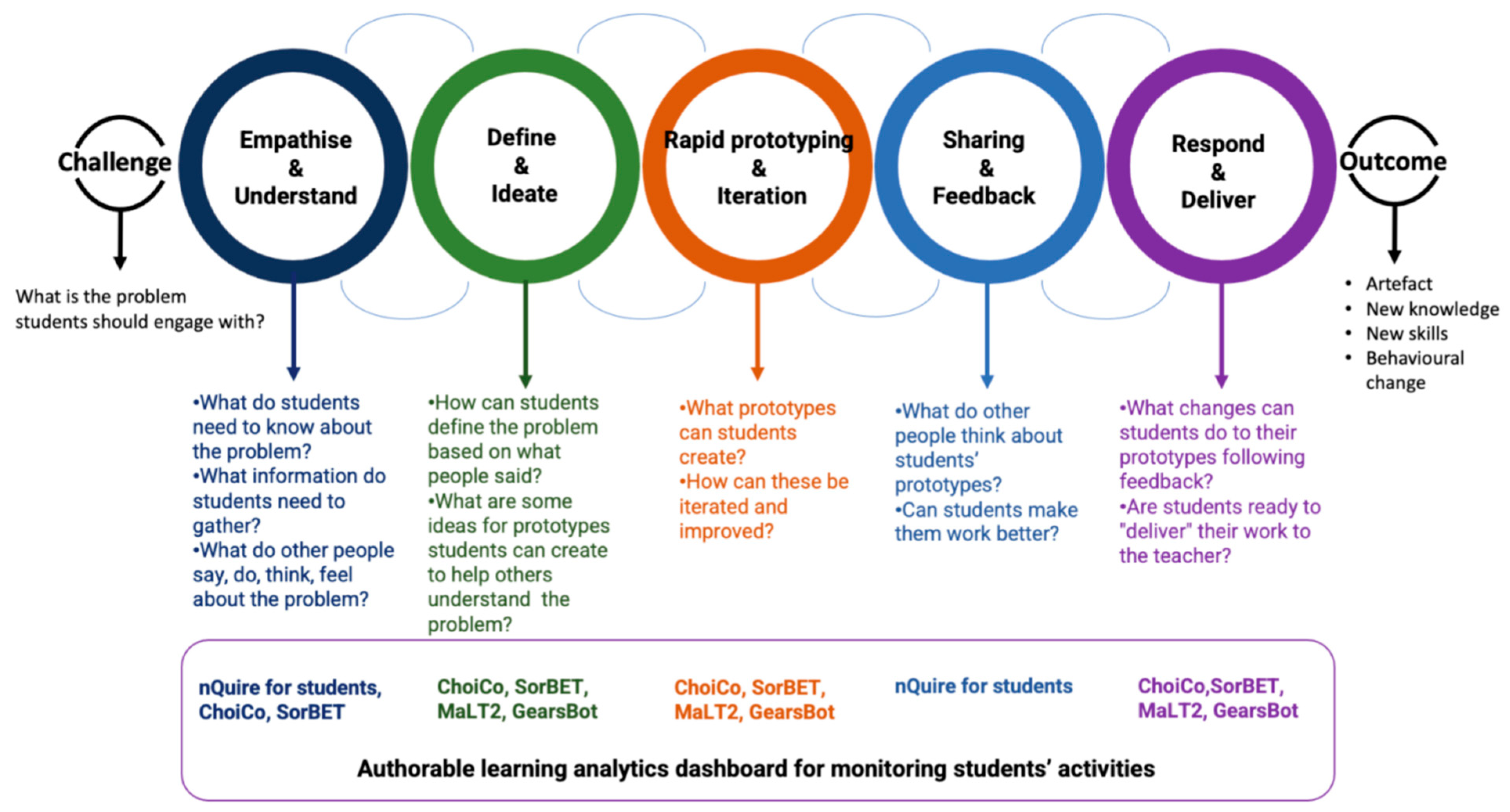
The ExtenDT2 project (Herodotou et al., 2025) offers a contemporary refinement of DT that explicitly integrates digital technologies into the design process. ExtenDT2 was developed to address the limitations of traditional DT models—such as the Double Diamond—when applied in K-12 contexts.
The model (Figure 1) emphasises:
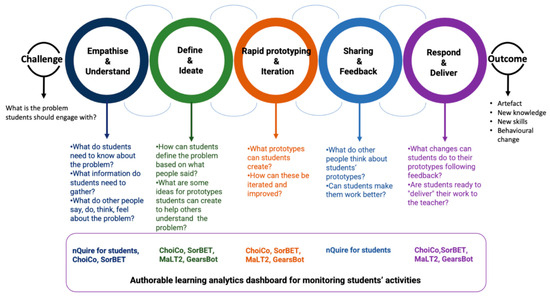
Figure 1.
The ExtenDT2 Digital Design Thinking Model (Herodotou et al., 2025) and https://extendt2.eu/digital-design-thinking-model/, accessed on 22 December 2025.
- Digitally supported ideation, where students explore problem spaces through interactive tools.
- Rapid digital prototyping, enabling multiple iterations within limited classroom time.
- Embedded feedback, where digital artefacts respond immediately to students’ design choices.
- Iterative refinement cycles, shorter and more structured than those in conventional DT.
- Epistemic integration, where domain concepts are encoded directly into the artefact.
ExtenDT2 aligns naturally with socio-constructionist pedagogy. It frames digital artefacts not as add-ons but as central mediators of thinking, collaboration, and learning. It also provides a more structured process model compared to the Double Diamond model, addressing concerns about DT’s vagueness and lack of methodological grounding in schools (Fayard & Fathallah, 2023; Laursen & Haase, 2019).
ChoiCo was employed to operationalise ExtenDT2 in practice. Students define fields (values), choices, and consequences; embed socio-scientific rules; test their games through play; and iteratively refine their designs. The system’s malleability and rule-based structure are designed to support conceptual clarity, epistemic grounding, and collaborative meaning-making.
2.4. Socio-Constructionist DT: A Digital System for Design and Production
ChoiCo is an open-source digital authoring system designed to support the creation of serious socio-scientific games. At its core lies a simple but powerful idea: a single player navigates a map-based environment by making successive choices, each of which has consequences for a set of values or “fields.” No choice is purely beneficial or purely detrimental; instead, each action shifts multiple fields in different directions. The player’s goal is to maintain a delicate balance across these fields and avoid crossing predefined “red lines” that signal failure. The more choices made without getting ‘thrown out’ the better the player.
As an authoring system, ChoiCo enables users to take on multiple roles—players, modifiers, and designers. Students can define any number of fields (e.g., health, cost, environmental impact, enjoyment), assign numerical values to choices, set thresholds, and configure prompts or warnings. They can also modify the map, adjust the geo-spatial semantics, and rework the underlying rules (ChoiCo, n.d.). In this sense, ChoiCo functions as a microworld construction kit in the Papertian tradition: a malleable, extensible digital environment that embeds conceptual structures and invites expressive modelling (Papert, 1980; Papert & Harel, 1991; Kynigos, 2007; Kynigos & Grizioti, 2020; Noss & Hoyles, 1996).
Constructionist media have long been recognised for their expressive and epistemic affordances—interaction, feedback, malleability, extensibility, and the capacity to embed powerful ideas (Papert, 1975; Kafai & Resnick, 1996; Holbert et al., 2020). Recent work has revisited these affordances in the light of contemporary digital ecosystems, highlighting how authoring systems can support epistemic agency, conceptual modelling, and socio-scientific reasoning (Grizioti & Kynigos, 2025; Techakosit & Rukngam, 2023; Levin et al., 2025). ChoiCo draws directly on this lineage.
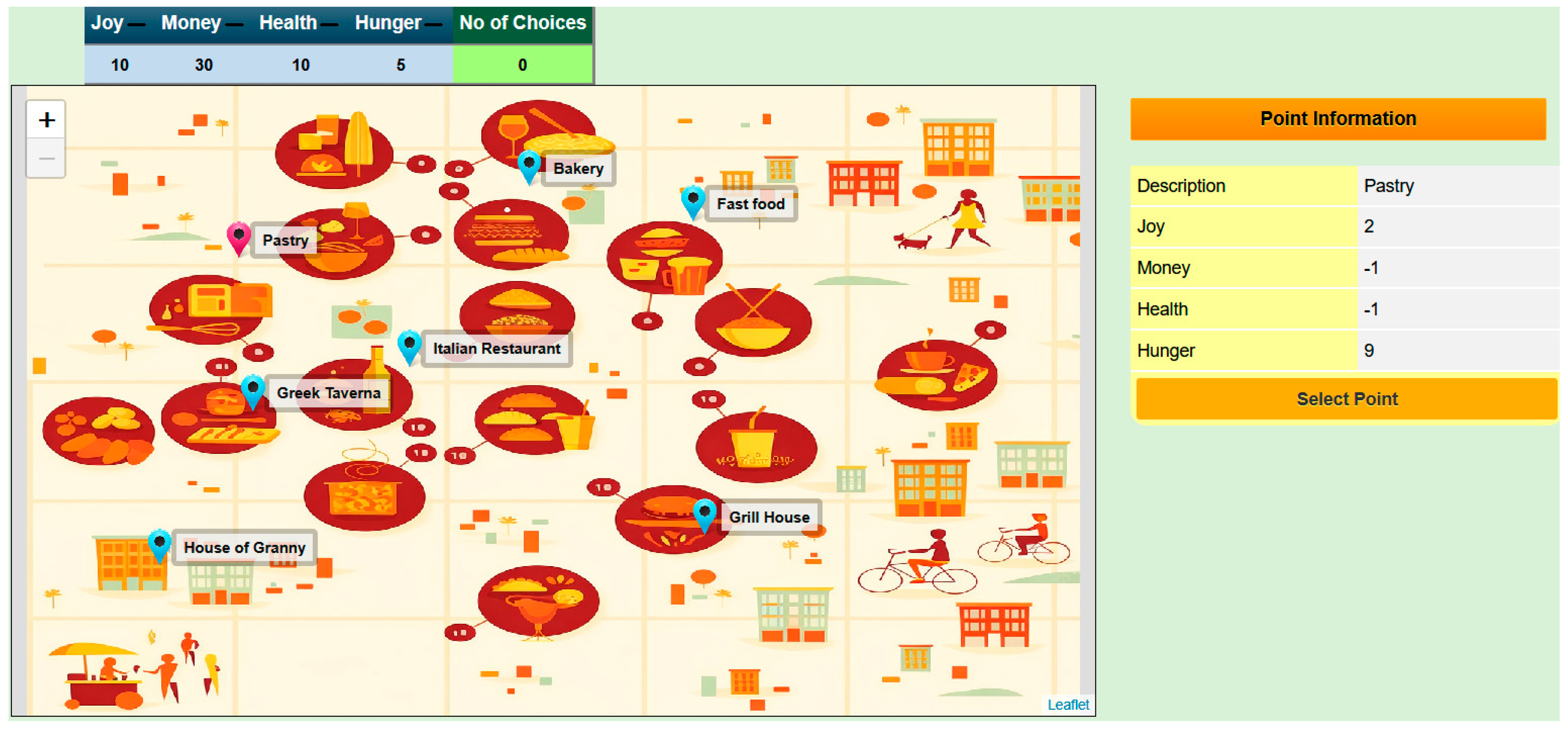
To illustrate the system’s adaptability, we draw on a recent example created by students: “Eating Out—Healthy Food Choices” (Figure 2, Grizioti, 2025). In this game, players move through a cityscape choosing between different food options—fast food, home-cooked meals, snacks, beverages—each affecting fields such as health, cost, environmental footprint, and enjoyment. Students debated which fields to include, how to quantify trade-offs, and what thresholds should count as “too unhealthy” or “too expensive.” This process required them to articulate socio-scientific concepts, negotiate meanings, and formalise their ideas in a rule-based form.
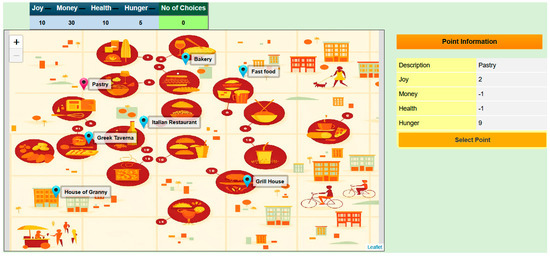
Figure 2.
Screenshot of a ChoiCo game in play mode: “Eating Out”, the player’s view. http://etl.ppp.uoa.gr/choico/?eatingOut_Eng, accessed on 26 December 2025.
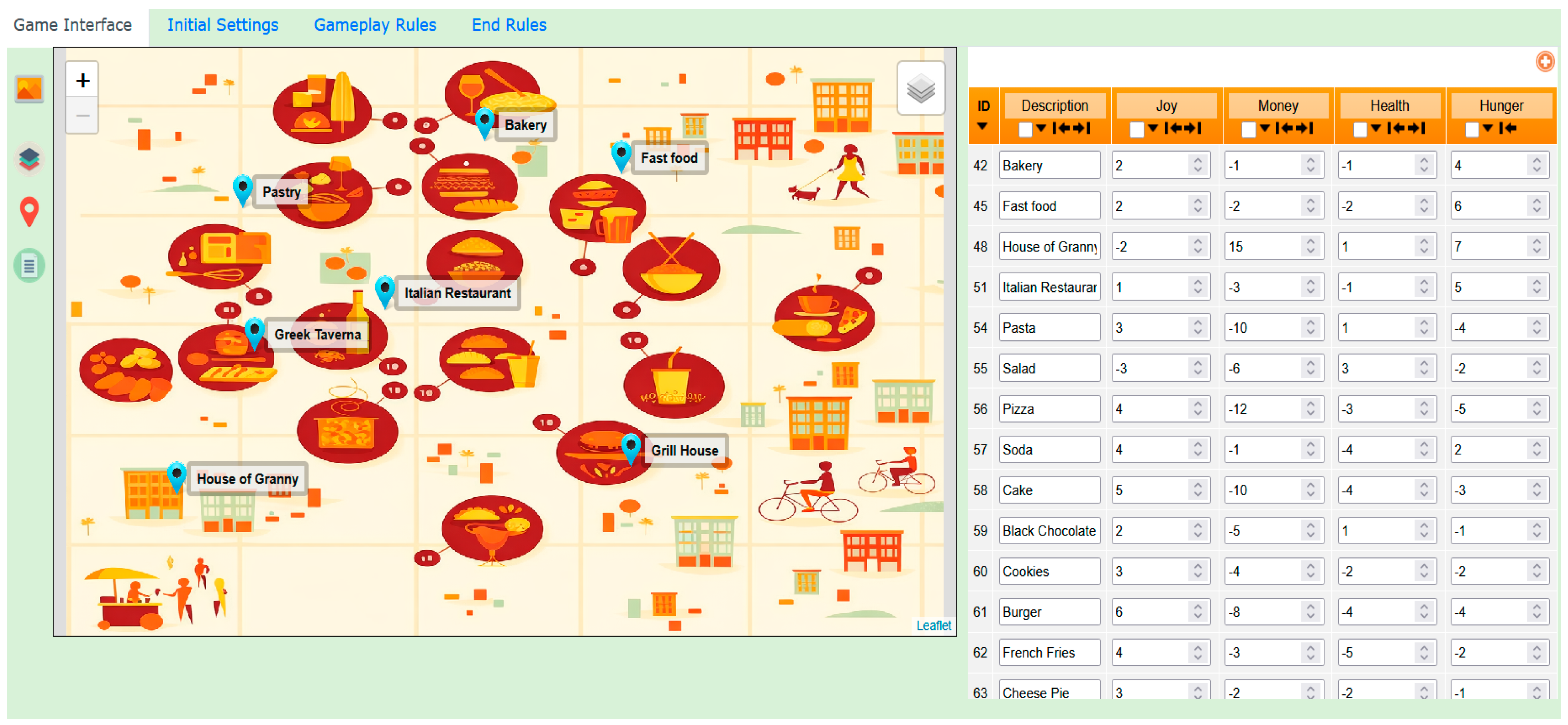
The design mode of ChoiCo makes these conceptual negotiations visible. Students must decide, for example, whether eating a salad increases health by +10 or +5, whether ordering a sugary drink should reduce health or increase enjoyment, and how to balance environmental impact against cost (Figure 3). These decisions are not arbitrary; they require students to reason about the relationships between choices and consequences, to justify their assumptions, and to test their models through play. This aligns with research showing that constructionist authoring environments can scaffold conceptual clarity and support the development of representational fluency (Holbert et al., 2020; Kynigos, 2015).
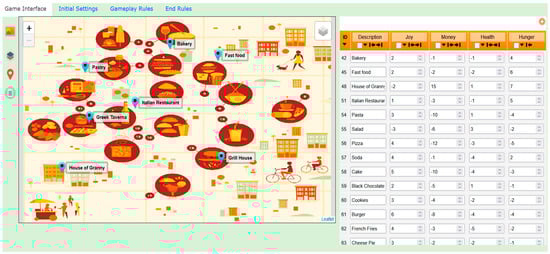
Figure 3.
ChoiCo game “Eating Out” in Design mode, including game fields, game choices, and numerical values. http://etl.ppp.uoa.gr/choico/?eatingOut_Eng, accessed on 26 December 2025.
We felt that ChoiCo also aligns naturally with the ExtenDT2 model (Herodotou et al., 2025). The system affords rapid digital prototyping: students can implement an idea, test it immediately, observe its effects, and refine it. The feedback loop is short and concrete, allowing for multiple iterations within a single lesson—an important improvement over the more open-ended and sometimes unwieldy cycles of the Double Diamond (Fayard & Fathallah, 2023). The artefact itself becomes a shared reference point for discussion, enabling students to externalise their thinking and negotiate interpretations collaboratively.
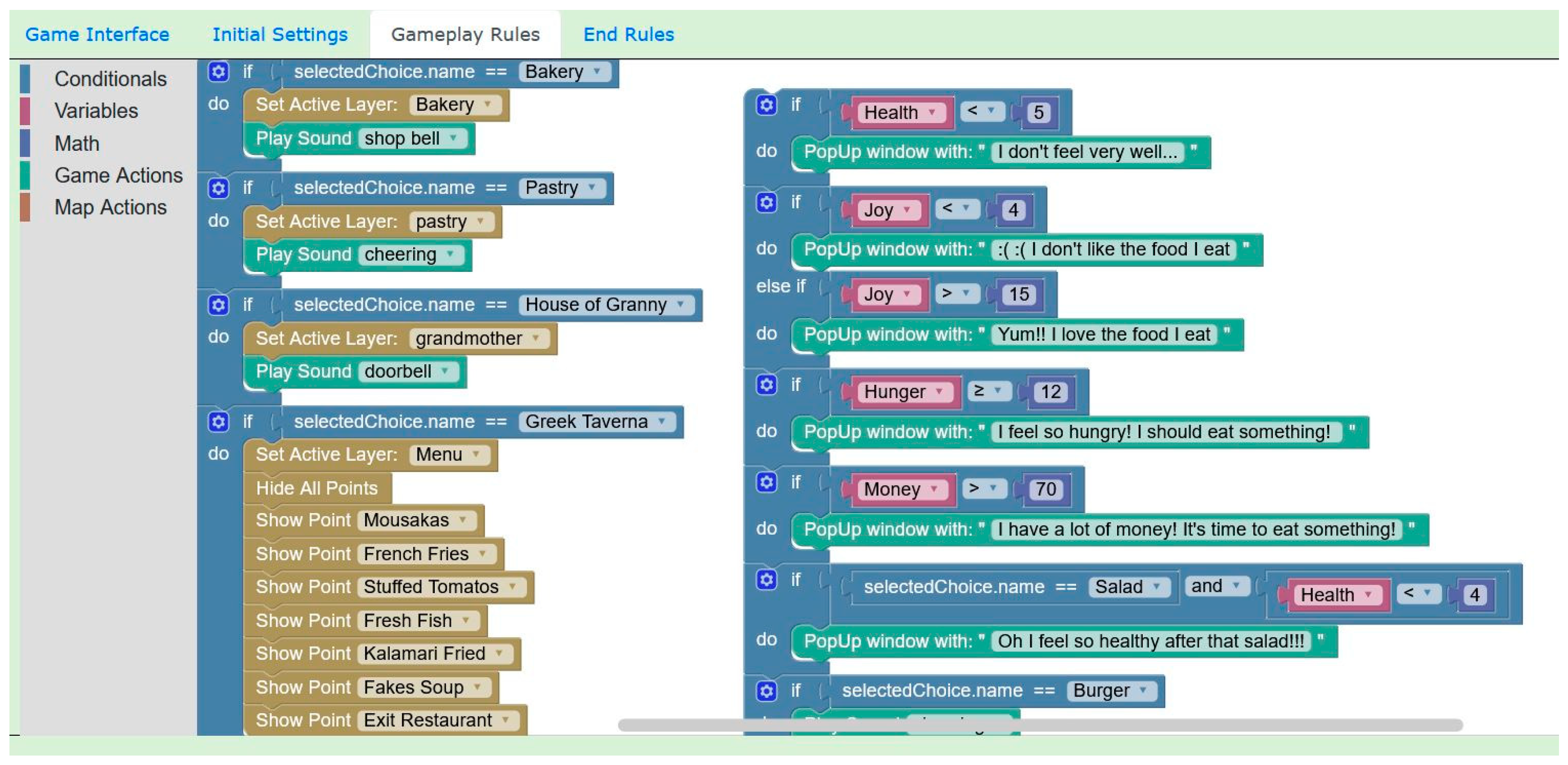
Moreover, ChoiCo was designed to support a form of socio-constructionist DT that differs from conventional DT projects using cardboard, markers, or physical materials. Because the medium is computational, students can embed rules, dependencies, and values directly into the artefact (Figure 4). The game becomes not only a product but also a model—a representation of a socio-scientific system that can be interrogated, modified, and improved. This dual role of the artefact as both expressive medium and epistemic object is central to constructionist pedagogy (Papert, 1980; Kafai & Resnick, 1996) and provides a richer foundation for DT in school settings.
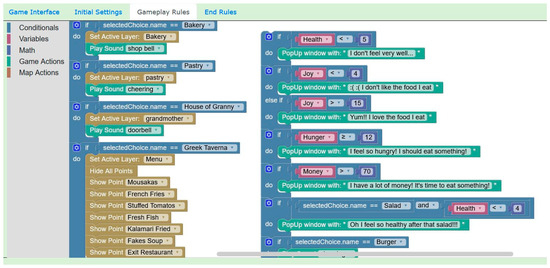
Figure 4.
ChoiCo: Example of gameplay rules code and programming skills to build a socio-scientific game. http://etl.ppp.uoa.gr/choico/?eatingOut_Eng, accessed on 26 December 2025.
In the empirical sections that follow, we examine how students engaged with ChoiCo during a DT project on environmental issues. Through excerpts of classroom interaction, we show how the socio-constructionist use of digital media can address several of the shortcomings of DT identified earlier, particularly those related to ambiguity, overconfidence, superficial treatment of social issues, and epistemic grounding.
3. An Empirical Study: Context and Method
In the following sections, we draw on excerpts from the communication between pairs or triads of students engaged in the co-design of a ChoiCo game. These excerpts were selected from verbatim transcripts collected after a full ethical process of consent and anonymisation. They function as critical incidents (Tripp, 1993)—episodes that illuminate how students reason, negotiate, and make design decisions within a socio-constructionist DT project. We use them as empirical evidence to examine how the use of a constructionist digital medium can address several of the reservations expressed by critics of DT in mainstream schooling.
The empirical material derives from a series of interventions conducted in a Model Junior High School in Athens between March and May 2023. The project took place within the Computer Science curriculum and spanned eight 45-min teaching hours. Seventy students participated, organised into six larger class groups and then self-selected into smaller design teams of two or three. All students were informed about the study and consented to video and audio recording. None had prior experience with ChoiCo.
The intervention followed the school’s existing DT structure, which was based on the Double Diamond model (Jnychka, 2016). In the first session, students played and modified ready-made ChoiCo games to familiarise themselves with the system’s affordances. The teacher introduced the overarching theme—“Educational games for the environment”—and the activity plan titled “Playing with environmental issues.” Students brainstormed ideas on paper, formulated questions for “market research,” implemented their initial designs, exchanged games for peer evaluation, and finally revised their prototypes and created a promotional poster.
While the school’s DT framework provided the procedural outline, the socio-constructionist use of ChoiCo introduced a different dynamic. The digital medium afforded rapid prototyping, embedded feedback, and iterative refinement—features aligned with the ExtenDT2 model (Herodotou et al., 2025). Students could implement an idea, test it immediately through gameplay, observe the consequences of their design decisions, and revise their models. This iterative cycle created a rich context for examining how students navigate ambiguity, negotiate meaning, and engage with socio-scientific concepts.
This approach responds directly to critiques that DT in schools often lacks methodological grounding (Laursen & Haase, 2019), produces superficial solutions (Fayard & Fathallah, 2023; Vinsel, 2018b), or fails to integrate disciplinary knowledge (Bereiter, 2018; Panke, 2019). By embedding rules, thresholds, and values into a computational artefact, students are required to articulate and formalise their ideas—an affordance highlighted in constructionist research (Papert, 1980; Kafai & Resnick, 1996; Holbert et al., 2020; Kynigos, 2007, 2015). Recent work on constructionist media reinforces the value of such environments for supporting epistemic agency and conceptual modelling (Grizioti & Kynigos, 2025; Techakosit & Rukngam, 2023; Levin et al., 2025).
To guide the analysis, we formulated the following research questions:
RQ1: How do students engage with socio-scientific issues when co-designing a ChoiCo game within a DT project?
RQ2: How does the use of a constructionist digital medium influence students’ ability to navigate ambiguity and refine prototypes?
RQ3: To what extent does socio-constructionist DT address the five documented shortcomings of DT in mainstream education?
These questions are grounded in the hypothesis that digital authoring environments can provide the epistemic scaffolding missing from many school-based DT projects, enabling students to formalise ideas, test assumptions, and iteratively refine their designs.
Analytic Approach
Our analysis combines thematic coding with the identification of critical incidents—moments in which students’ reasoning, negotiation, or design decisions reveal how they are grappling with the challenges of DT. The unit of analysis is the interaction episode. We examined how students:
- Articulated and clarified socio-scientific concepts;
- Negotiated the meaning of fields, values, and consequences;
- Reasoned about rules and thresholds;
- Responded to feedback from peers or the teacher;
- And iteratively refined their prototypes.
Two researchers independently coded 20% of the data, discussed discrepancies, and reached a consensus on the coding scheme. The final analysis maps each critical incident onto one or more of the five shortcomings of DT identified earlier, allowing us to examine how the socio-constructionist use of ChoiCo mediates students’ engagement with ambiguity, overconfidence, social issues, academic content, and epistemic reasoning.
In the next section, we present the results of this analysis, organised around the five shortcomings. Through the selected excerpts, we show how students’ interactions with ChoiCo—and with one another—shed light on the potential of socio-constructionist DT to address long-standing challenges in the implementation of DT in mainstream schooling.
4. Results: Socio-Constructionist DT Addressing DT Shortcomings
The analysis of classroom interaction revealed how students engaged with the design of their ChoiCo games and how the socio-constructionist use of digital media mediated their reasoning, collaboration, and conceptual development. The excerpts presented below were selected as critical incidents (Tripp, 1993) that illuminate how students navigated ambiguity, negotiated meaning, and refined their prototypes.
To structure the analysis, we mapped each incident onto one or more of the five shortcomings of DT identified earlier in the literature (Panke, 2019; Rusmann & Ejsing-Duun, 2022; Li & Zhan, 2022; Laursen & Haase, 2019; Fayard & Fathallah, 2023; Fitriyah et al., 2025). Table 1 summarises the relationship between the shortcomings, the indicators we observed, and the excerpts that illustrate them.

Table 1.
Mapping DT shortcomings to indicators and critical incidents.
4.1. Frustration with Ill-Defined Issues
DT requires students to engage with “wicked problems” (Rittel & Webber, 1973), yet ambiguity often leads to confusion, anxiety, and disengagement (Panke, 2019; Razali et al., 2022; Li & Zhan, 2022). This was evident in the early stages of ideation, when students struggled to define the problem space and identify the values or fields that would structure their game.
In Excerpt 1, students grapple with vague notions such as “reforestation,” “environmental representations,” and “fatigue.” Their dialogue reveals both the productive ambiguity of the task and the need for structure, echoing findings that students often feel lost when DT lacks clear scaffolding (Zebdyah, 2022; Morrison, 2013).
Excerpt 1. S1: How will this decision help us with our game? [productive ambiguity]
S2: I don’t know. We will do this for the environment’s sake.
S1: What do you mean “this”? What is “this”?
S2: Reforestation. That is “this”! [conceptual clarification, reasoning required]
S1: So, write down there….
S2: Representations for the environment. [formalising choices into rules channel]
S1: Environmental representations. [peer evaluation]
S2: Field 1… Which one will be field 1? [ambiguity in defining fields, need for structure, reasoning required]
S1: Money?
S2: Sleeping, not doing anything for the environment. Not money… Just being indifferent.
S1: It’s not that you don’t care…
S2: What do you mean? The guy will not get any sleep, just to plant trees? [negotiation of meaning, conceptual clarification, reasoning required]
S1: That’s right!
S2: It is just that when you do lots of things all the time and you get tired, when you sleep, you make up for your fading strength. It’s nothing, you just waste your time, but ok… [encoding consequences, negotiation of meaning]
S1: Yes, indeed.
S2: So, we have wood logs, money, environmental… whatever [sc. representations] and lives… no, not lives. Basically… fatigue. [encoding ideas into fields]
ChoiCo’s design mode plays a crucial role here. Because students must encode their ideas into fields, thresholds, and consequences, the system forces conceptual clarification—a hallmark of constructionist media (Papert, 1980; Kafai & Resnick, 1996; Holbert et al., 2020). The malleability of the digital medium supports trial-and-error exploration, while the need to formalise choices into rules channels brainstorming into structured decision-making.
The teacher’s prompts in Excerpt 2—asking students to consider differences between cities or justify their choices—mirror the role of the facilitator in DT (Scheer et al., 2012; Henriksen et al., 2020) and help students move from vague ideas to more precise conceptualisations.
Excerpt 2. T: For the Earth? Change yourself! What does this mean? [teacher as facilitator]
S1: If you care for the earth, you should change yourself. [conceptual clarification]
T: That’s right. This is the translation [in Greek] of the title.
S2: Look what an amazing thing we have here. We have a map. And there is that cute little guy who wants to move to…. And, like, this cute little guy moves to Los Angeles. In Los Angeles this is what his life would look like…
[Students show on the map the cities they have added.] [encoding ideas into the game]
S1: He turns on the lights. And then according to his choices…
[S1 indicates the choices that the man has in his house according to students’ predefined choices.] [encoding ideas into the game]
T: So, what should the player do here? [teacher prompts for contextualization]
S1: To live and survive all over the world.
S2: If “energy” goes below, then it means that he doesn’t care for the environment. [“Energy” is a field that the students have introduced.] [trial and error exploration, conceptual clarification, reasoning required]
S1: And then he goes to Greece.
T: Those different cities, do they have some different when they are compared? Do you have a different approach, according to the city that this man visits? [teacher as facilitator, need for reasoning and articulation of more nuanced explanation]
S3: Yes. For example, we have added [different numbers] in the value “money”, “environmental ethos”, because if he goes to New York there is no natural physical world, while in Greece there is a rich physical world. [structuring ideas, encoding ideas and choices into rules, precise conceptualization, intuitive reasoning]
T: That’s great.
Our commentary in the brackets in both excerpts aims to highlight how the students may tackle the alien nature of a wicked problem in a manner that connects to their experience with the clear cut normal science assumptions in schooling. They found themselves in a situation where the problem was too complex to be resolved by means of employment of some taught concepts and reasonings. In fact, they were told that the problem may not even have an agreed upon solution. The teacher facilitated the student’s use of the affordances of ChoiCo—the fields, the thresholds, and the ambivalent consequences—to aim to make sense of this ambiguity rather than give up in frustration.
4.2. Overconfidence
A recurring critique of DT is that it fosters “creative confidence” (Lor, 2017; Henriksen et al., 2020) without necessarily developing the skills or knowledge needed to justify or refine ideas (Panke, 2019; Li & Zhan, 2022; Vinsel, 2018b). In socio-constructionist DT, however, the digital medium itself can temper overconfidence by requiring students to consider the player’s perspective and test their assumptions.
In Excerpt 3, students debate the appropriate age range for their game. Their discussion shows them checking their assumptions about the user and adjusting their design accordingly. This aligns with research showing that constructionist tools can reduce premature certainty by making assumptions testable (Kynigos, 2007; Noss & Hoyles, 1996).
Excerpt 3. S1: This game is not aimed at elementary school children, I think. [The students themselves estimate and suggest suitable ages for the game.] [Assumption about user knowledge, reasoning is required.]
S2: Yes, at least ages twelve, ten, eleven to fourteen. [They estimate the age of the prospective player, taking into account personal knowledge and experience.] [peer evaluation of the assumption]
S1: Because, now, how is an eight-year-old kid supposed to know which materials go into recycling and which are regular? I didn’t know. I still don’t know some materials. [reconsideration when confronted with player perspective, reasoning required]
S2: It’s okay. [peer evaluation]
S1: Fourteen-year-old kid […]. A fourteen-year-old child […]. I can imagine Kiko playing this now… [After determining the appropriate ages, one student brings up an older student they know (goes by the nickname “Kiko”) as an example and jokingly comments that this student could play the game they will create].
Our analytic commentary in the brackets points to the way in which the malleability of the tool’s affordances enabled the students to question and discuss the age of their prospective end users. Rather than being placed in a situation of assuming a certainty about the usefulness of the tool and the credibility of the data they inserted, they found themselves in a position that allowed negotiation.
Because ChoiCo provides immediate feedback through gameplay, students quickly discover when their assumptions do not hold. This iterative loop—design, test, revise—supports a more grounded form of confidence, consistent with the ExtenDT2 emphasis on rapid digital prototyping (Herodotou et al., 2025).
4.3. Social Issues Narrowly Addressed
DT is often used to address social or environmental issues (Li & Zhan, 2022), yet students’ solutions can remain superficial if they are not supported to consider broader contexts (Fayard & Fathallah, 2023; Vinsel, 2018b). Our data show similar tendencies.
In Excerpt 2, students assert that New York has “no natural physical world,” while Greece has “a rich physical world.” These statements reflect intuitive reasoning rather than evidence-based analysis. The teacher’s questions prompt students to reconsider their assumptions and articulate more nuanced explanations, aligning with calls for DT to incorporate contextualised, data-informed reasoning (Bereiter, 2018; Formosa, 2025).
In Excerpt 4, students debate the consequences of using an oven versus a toaster. This moment illustrates how students begin to recognise that real-world problems allow for multiple plausible actions, and that their game must account for this variability. The digital medium supports this recognition by requiring students to encode consequences explicitly, making their assumptions visible and open to critique.
Excerpt 4. S1: When he presses “oven”… [This implies that the player playing the game will choose to use the oven.]
S2: What should he do? [The student means what is the player’s goal?]
S1: They should cook, considering energy… energy… preparing food. So, first, you lose energy. When you touch the oven you lose -50, the toaster loses -5 and the fridge loses…. [“Food preparation” denotes an action corresponding to a point in the image with both positive and negative properties.] [Students encode consequences explicitly and they make assumptions visible.]
S2: Okay, so what do you have to do? [By using the word “you”, the student places his/her classmate in the player’s position.]
S1: You’re gonna have a meal and you’re gonna have to…
S2: And when do you lose? [reasoning required]
S1: As soon as the energy or supplies go to zero. [making assumptions visible]
S2: But who says he won’t just use the oven? [Here, stepping into the player’s shoes, the student tries to predict the player’s actions and questions the estimated flow of actions on which the design of the “kitchen” of the game is based.] [multiple plausible actions open to critique, reasoning required]
Our interpretative effort in both the excerpts aimed to capture instances where the students widened their perspective of a socio-scientific issue by employing ChoiCo’s affordance which consider several ambivalent consequences of a respective choice. In the above two cases the choice was about either the element of nature in two specific locations or the method of food preparation. In both cases we identified instances of a growing appreciation of the complexity and ambiguity of issues within a wicked problem. Far from claiming that the students exhausted the complexity of the issues, our point is that rather than trying to simplify in order to make sense the tool’s affordances allowed them to think in the opposite direction.
4.4. Unclear Academic Content
One of the most persistent challenges in DT is aligning creative design work with disciplinary knowledge (Lor, 2017; Panke, 2019; Bereiter, 2018). In socio-constructionist DT, the digital medium can serve as a bridge between creativity and academic content by embedding domain concepts directly into the artefact.
From our point of view, excerpt 5 illustrates this clearly. Students encountered a misunderstanding regarding comparison operators (<, >, =) when programming some rules for their game. The teacher intervened to introduce the Boolean operator AND, to help them understand how to express “in-between” values computationally. The following discussion took place after the students inserted two rules. First: if field1 value is less than 50 output the message ‘watch out. Low score!’. Second rule: if field1 value is less than 30 output ‘very low score!’.
Excerpt 5. T: So, you can see on your screen two rules that will lead to two different popup messages. Just skim through the rules and tell me: if the number in field 1 is 60, what message will pop up? [teacher scaffolding]
S1: None. [integration of mathematical and scientific concepts]
T: If the number in field 1 is 50, what message will appear? [teacher scaffolding]
S2: None. [integration of mathematical and scientific concepts]
T: None, because we don’t have the operators “less than” or “equal to”. If the number is 45, what message will pop up? [integration of disciplinary concepts and reasoning]
S3: Watch out. Low score!
T: If the value is 25, what message will appear? [teacher scaffolding]
S4: Very low [score]!
T: Do you agree?
Students: Yes.
T: And why won’t the first message pop up? [need for disciplinary concepts, teacher scaffolding]
S1: If it is up to 31… if it is lower than 30 then a different message appears. [misunderstanding of rules, reasoning]
T: What you say is what we, people, would like to happen. But this is not what we have coded the computer to do. [need for disciplinary concepts, computational thinking, teacher scaffolding]
S1: What I understand is that if it is lower than 50, in-between 50 and 30, you get this message. If you are lower than 30, you get the other [sc. the previous] message. [requires reasoning about logic and thresholds, integrating mathematical and scientific concepts]
T: But the computer on its own does not do that. The computer will show both messages, because both apply. Let’s see how we can fix this “in-between”. [explains how to code ‘below 50 AND above 30’, need for disciplinary concepts, teacher scaffolding]
This episode demonstrates how, in the context of grappling with a wicked problem, the students nevertheless had to focus on the use of a very specific mathematical programming concept involving computational thinking (Wing, 2006; Techakosit & Rukngam, 2023) and reasoning about logic and thresholds while integrating mathematical and scientific concepts into the design process (Noss & Hoyles, 1996; Kynigos, 2007).
The digital medium thus becomes pivotal in a situation where disciplinary knowledge is not merely referenced but operationalised.
4.5. DT Epistemology in Schooling
A key challenge in implementing DT in mainstream schooling has been the deep epistemological tension between DT’s abductive, pragmatic epistemology (Stompff et al., 2022; Rusmann & Ejsing-Duun, 2022) and its clash with the abstraction-oriented epistemology of school subjects (Laursen & Haase, 2019). In using a tool such as ChoiCo, we suggest that this kind of tension, although inevitable, can be addressed more explicitly and can potentially become productive in leveraging a realistic process answering a widely sought after transformation in schooling which the (anonymised) project strived to answer. Rather than adding one more excerpt to make the argument, we point the reader to all five excerpts discussed so far. We suggest that what is inherent in the discussions and interactions with the tool’s affordances is an engagement with both worlds in conjunction.
Across Excerpts 1–5, students engaged in:
- Abductive reasoning (suggesting plausible rules);
- Inductive reasoning (generalising from gameplay);
- Deductive reasoning (testing rules against thresholds);
- And metacognitive reflection (considering the player’s perspective).
The digital artefact mediates these forms of reasoning since it is used to make ideas concrete, testable, and revisable. This aligns with constructionist accounts of learning as the iterative refinement of ideas through interaction with expressive media (Papert, 1980; Kafai & Resnick, 1996; Holbert et al., 2020).
In this sense, socio-constructionist DT offers a way to reconcile DT’s pragmatic epistemology with the epistemic demands of schooling, addressing concerns that DT in K-12 often lacks methodological rigour or disciplinary grounding (Hernández-Ramírez, 2018a; Laursen & Haase, 2019; Panke, 2019).
5. Discussion
The findings from our empirical study suggest that socio-constructionist DT, when enacted through a computationally expressive medium such as ChoiCo, can address several of the shortcomings identified in the literature (Panke, 2019; Rusmann & Ejsing-Duun, 2022; Li & Zhan, 2022; Laursen & Haase, 2019; Fayard & Fathallah, 2023; Fitriyah et al., 2025). By embedding concepts, rules, and values directly into a digital artefact, students are required to articulate their assumptions, test their ideas, and refine their prototypes iteratively—processes that are often underdeveloped in conventional DT projects using physical materials (Vinsel, 2018a, 2018b; Morrison, 2013).
A key advantage of constructionist digital media is that they lower the stakes of failure. Because prototypes can be rapidly modified, tested, and iterated, “failure” becomes a negotiable and productive aspect of the design process rather than a demotivating endpoint. This aligns with Papert’s (1980) vision of learning through tinkering and with contemporary accounts of constructionist futures (Holbert et al., 2020). Digital artefacts also provide a permanent window into students’ thinking, enabling teachers to observe how students reason, negotiate, and refine ideas—an affordance highlighted in earlier constructionist research (Noss & Hoyles, 1996; Kynigos, 2007, 2015).
Moreover, digital media such as ChoiCo act as idea generators. They support argumentation, inquiry learning, and abstraction by requiring students to encode socio-scientific concepts into rules, thresholds, and consequences. This aligns with recent work showing how constructionist authoring systems can scaffold epistemic agency and conceptual modelling (Grizioti & Kynigos, 2025; Techakosit & Rukngam, 2023; Levin et al., 2025). The expressive power of the medium encourages students to explore relationships, test hypotheses, and generalise patterns—activities that resonate with Bereiter’s (2018) call for explanatory coherence and knowledge-building.
Importantly, constructionist digital media also afford didactical engineering. Teachers can design “half-baked microworlds”—intentionally incomplete or buggy artefacts—to guide students toward specific conceptual challenges or methodological approaches. This dual-level design (teacher-designed microworlds and student-designed games) provides a structured yet flexible environment that supports both creativity and conceptual rigour. It also helps prevent DT from devolving into naïve bricolage (Louridas, 1999; Laursen & Haase, 2019), a concern frequently raised in critiques of school-based DT.
The integration of ExtenDT2 (Herodotou et al., 2025) further strengthens this argument. ExtenDT2 emphasises digitally supported ideation, rapid prototyping, embedded feedback, and epistemic integration—features that align naturally with constructionist media. When DT is framed through ExtenDT2 and enacted through a system like ChoiCo, students are supported to engage in abductive, inductive, and deductive reasoning (Stompff et al., 2022; Rusmann & Ejsing-Duun, 2022), to test and refine their ideas iteratively, and to ground their designs in disciplinary knowledge.
In this sense, socio-constructionist DT offers a way to re-construe DT pedagogy in schools. It shifts the focus from producing polished artefacts or “solutions” to wicked problems toward engaging in meaningful, iterative, and epistemically grounded design activity. Digital models and games become valid DT productions—not because they solve real-world problems, but because they support reflection, conceptual understanding, and collaborative meaning-making around socio-scientific issues.
6. Conclusions
This paper set out to examine whether Design Thinking (DT) can become more effective and educationally meaningful in mainstream schooling when enacted through a socio-constructionist environment using digital media as both design tools and design products. Drawing on empirical data from a school-based intervention using the ChoiCo authoring system, we showed that constructionist digital media can address several long-standing shortcomings of DT in education: frustration with ambiguity, unfounded overconfidence, superficial engagement with social issues, weak integration of academic content, and epistemological tensions between DT and school knowledge.
By requiring students to encode socio-scientific concepts into rules, thresholds, and consequences, ChoiCo supports conceptual clarity, iterative refinement, and collaborative meaning-making. The digital artefact becomes a shared epistemic object that mediates reasoning, supports hypothesis-building, and provides a window into students’ thinking. This aligns with constructionist principles (Papert, 1980; Kafai & Resnick, 1996) and with contemporary refinements of DT such as the ExtenDT2 model (Herodotou et al., 2025), which emphasise rapid digital prototyping, embedded feedback, and epistemic integration.
Our findings suggest that DT does not need to be dismissed as a failed innovation in schooling. Instead, when supported by constructionist digital media and framed through socio-constructionist pedagogy, DT can become a more robust, conceptually grounded, and educationally valuable approach. Digital models and games do not need to “solve” wicked problems; rather, they can serve as expressive, testable, and revisable artefacts that support students in exploring socio-scientific issues, developing disciplinary understanding, and engaging in collaborative inquiry.
Future research could explore how teacher-designed “half-baked microworlds” (Kynigos, 2007) can scaffold DT processes across different subjects, how socio-constructionist DT can be integrated into curriculum design, and how digital authoring systems can support assessment of both DT competencies and disciplinary learning. As digital media continue to evolve, the intersection of DT and constructionism offers fertile ground for reimagining how students learn to think, design, and act in complex socio-scientific worlds.
7. Limitations
Our ambition in this paper is not to propose a new “recipe” for replacing existing DT practices in schools, nor to suggest that a change in technological tools alone can resolve the broad pedagogical challenges associated with DT. We do not advocate a techno-centric solution, nor do we claim that digital media inherently improve learning outcomes. Instead, we argue that it is worth exploring how DT can be strengthened—rather than abandoned—by integrating socio-constructionist pedagogy and constructionist digital media into its processes and products. Context is a key factor that determines the success of DT. In some education systems, such as the Irish (Byrne, 2022), DT is well received and readily understood while in others it clashes with constituent aspects of the respective education paradigm (Kynigos, 2020), which means that it could go as far as to constitute a disruptive innovation. This study took place in a context closer to the latter case. Furthermore, design-based research often involves the researchers in more than one role with respect to implementation which provides insightful interpretational value but has inherent weakness with respect to replication and transferability. The very selection of the excerpts as tools to gain insight into complex situated and nuanced practices and their meaning is an example of this affording interpretative depth which nevertheless is highly subjective even when triangulated. All in all, this study was meant to illuminate aspects of educational value to which special attention can be given and that can form part of new designs of DT in socio-constructionist environments where digital media are tools for design and production.
Author Contributions
Conceptualization, C.K. and A.V.; methodology, A.V.; software, C.K.; formal analysis, A.V.; investigation, M.X.; resources, C.K.; writing—original draft preparation, A.V.; writing—review and editing, C.K.; project administration, M.X. and C.K.; funding acquisition, C.K. All authors have read and agreed to the published version of the manuscript.
Funding
This project titled “Exten.D.T.2—Extending Design Thinking with Emerging Digital Technologies” has received funding from Horizon Europe for Research and Innovation and Innovate UK, under grant number 101060231. This paper reflects the authors’ view, and the Horizon Europe and Innovate UK are not responsible for any use that may be made.
Institutional Review Board Statement
The study was conducted in accordance with the Declaration of Helsinki, and approved by the Ethics Committee of the National and Kapodistrian University of Athens (protocol code: 71934, 19 July 2022).
Informed Consent Statement
Informed consent was obtained from all subjects involved in the study.
Data Availability Statement
Data supporting the findings of this study are available upon reasonable request. No publicly archived datasets were generated due to privacy and ethical restrictions.
Conflicts of Interest
The authors declare no conflicts of interest. The funders had no role in the design of the study; in the collection, analyses, or interpretation of data; in the writing of the manuscript; or in the decision to publish the results.
Abbreviations
| DT | Design Thinking |
| ExtenDT2 | Extending Design Thinking with Emerging Digital Technologies |
| ChoiCo | Choices with Consequences |
References
- Bereiter, C. (2018, August 14–17). Applying design thinking in school subjects. 22nd Annual Knowledge Building Summer Institute, Toronto, ON, Canada. [Google Scholar]
- Blundell, C. N. (2025). Using design thinking to embrace the complexities of teacher learning-practice with digital technologies. Professional Development in Education, 51(3), 386–404. [Google Scholar] [CrossRef]
- Byrne, J. R. (2022). Embedding design thinking in secondary education: Lessons from Irish classrooms. International Journal of Technology and Design Education, 32(4), 987–1005. [Google Scholar]
- ChoiCo. (n.d.). Choices with consequences—Beta version. Available online: http://etl.ppp.uoa.gr/choico/ (accessed on 26 December 2025).
- Fayard, A.-L., & Fathallah, S. (2023). Design thinking misses the mark. Stanford Social Innovation Review, 22, 28–35. [Google Scholar]
- Fitriyah, I. J., Saputro, S., & Sajidan. (2025). Research trends in design thinking education: A systematic literature review from 2014 to 2024. European Journal of Educational Research, 14(2), 381–391. [Google Scholar] [CrossRef]
- Formosa, D. (2025). Design education is too important to be left to designers. Design Studies, 98, 101301. [Google Scholar] [CrossRef]
- Girvan, C., Kynigos, C., & Verevi, A. (2023). Leveraging the powerful ideas of constructionism to enhance emergent design thinking pedagogy. In N. Holbert, & P. Blikstein (Eds.), Proceedings of Constructionism/FabLearn 2023 (pp. 185–194). Carnegie Mellon University (Etc Press). [Google Scholar]
- Grizioti, M. (2025). Computational thinking beyond coding: Exploring student computational practices while playing and modifying a socio-scientific simulation game with integrated computational tools. Educational Technology Research and Development, 73, 2251–2278. [Google Scholar] [CrossRef]
- Grizioti, M., & Kynigos, C. (2025). Extending constructionist media with emerging digital technologies for critical computational thinking. Emerging technologies for critical CT. Constructionism Conference Proceedings, 8, 123–136. [Google Scholar] [CrossRef]
- Henriksen, D., Gretter, S., & Richardson, C. (2020). Design thinking and the practicing teacher: Addressing problems of practice in teacher education. Teaching Education, 31(2), 209–229. [Google Scholar] [CrossRef]
- Hernández-Ramírez, R. (2018a). On design thinking, bullshit, and innovation. Journal of Science and Technology of the Arts, 10(3), 45–57. [Google Scholar] [CrossRef]
- Hernández-Ramírez, R. (2018b, July 12–13). Design thinking, bullshit, and what thinking about design could do about it. 6th Conference on Computation, Communication, Aesthetics & X (pp. 1–10), Madrid, Spain. [Google Scholar]
- Herodotou, C., Shrestha, S., Zhang, F., Gkreka, C., Girvan, C., Papavlasopoulou, S., Grizioti, M., Scanlon, E., Kynigos, C., & Milrad, M. (2025). Teaching and learning with design thinking and emerging digital technologies in K-12: Impact on students and teaching recommendations. In T. E. Kim, M. Milrad, & I. Remolar (Eds.), Integrating emerging technologies into education and training: Proceedings of the 2nd E TELT 2024 workshop. MIS4TEL 2024 (vol. 1274). Lecture Notes in Networks and Systems. Springer. [Google Scholar] [CrossRef]
- Holbert, N., Berland, M., & Kafai, Y. B. (Eds.). (2020). Designing constructionist futures: The art, theory, and practice of learning designs. MIT Press. [Google Scholar]
- Jnychka. (2016, November 25). Double diamond design model 2021.jpg [Image]. Wikimedia Commons. [Google Scholar]
- Kafai, Y. B., & Resnick, M. (Eds.). (1996). Constructionism in practice: Designing, thinking, and learning in a digital world. Routledge. [Google Scholar]
- Kynigos, C. (2007). Half-baked logo microworlds as boundary objects in integrated design. Informatics in Education, 6(2), 335–358. [Google Scholar] [CrossRef]
- Kynigos, C. (2015). Constructionism: Theory of learning or theory of design? In S. Cho (Ed.), Selected regular lectures from the 12th international congress on mathematical education (pp. 417–438). Springer. [Google Scholar] [CrossRef]
- Kynigos, C. (2020). Half-baked constructionism: The challenge of infusing constructionism in education in Greece. In N. Holbert, M. Berland, & Y. Kafai (Eds.), Designing constructionist futures: The art, theory, and practice of learning designs (pp. 61–72). MIT Press. [Google Scholar]
- Kynigos, C., & Grizioti, M. (2020). Modifying games with ChoiCo: Integrated affordances and engineered bugs for computational thinking. British Journal of Educational Technology, 51(6), 2252–2267. [Google Scholar] [CrossRef]
- Laursen, L. N., & Haase, L. M. (2019). The shortcomings of design thinking when compared to designerly thinking. The Design Journal, 22(6), 813–832. [Google Scholar] [CrossRef]
- Levin, I., Semenov, A. L., & Gorsky, M. (2025). Smart learning in the 21st century: Advancing constructionism across three digital epochs. Education Sciences, 15(1), 45. [Google Scholar] [CrossRef]
- Li, T., & Zhan, Z. (2022). A systematic review on design thinking integrated learning in K-12 education. Applied Sciences, 12(16), 8077. [Google Scholar] [CrossRef]
- Lor, R. (2017, May 24–26). Design thinking in education: A critical review of literature. International Academic Conference on Social Sciences and Management, Asian Conference on Education and Psychology (pp. 36–68), Bangkok, Thailand. [Google Scholar]
- Louridas, P. (1999). Design as bricolage: Anthropology meets design thinking. Design Studies, 20(6), 517–535. [Google Scholar] [CrossRef]
- Macgilchrist, F., Jarke, J., Allert, H., & Cerratto Pargman, T. (2024). Design beyond design thinking: Designing postdigital futures when weaving worlds with others. Postdigital Science and Education, 6, 1–12. [Google Scholar] [CrossRef]
- Morrison, D. (2013, August 6). Why ‘design thinking’ doesn’t work in education. Online Learning Insights. [Google Scholar]
- Noss, R., & Hoyles, C. (1996). Windows on mathematical meanings: Learning cultures and computers. Kluwer Academic Publishers. [Google Scholar]
- Panke, S. (2019). Design thinking in education: Perspectives, opportunities and challenges. Open Education Studies, 1(1), 281–306. [Google Scholar] [CrossRef]
- Papert, S. (1975). Teaching children thinking. Journal of Structural Learning, 4(2), 219–229. [Google Scholar] [CrossRef]
- Papert, S. (1980). Mindstorms: Children, computers, and powerful ideas. Basic Books. [Google Scholar]
- Papert, S., & Harel, I. (1991). Situating constructionism. In I. Harel, & S. Papert (Eds.), Constructionism (pp. 1–11). Ablex. [Google Scholar]
- Razali, N. H., Ali, N. N. N., Safiyuddin, S. K., & Khalid, F. (2022). Design thinking approaches in education and their challenges: A systematic literature review. Creative Education, 13(7), 2289–2299. [Google Scholar] [CrossRef]
- Rittel, H. W. J., & Webber, M. M. (1973). Dilemmas in a general theory of planning. Policy Sciences, 4(2), 155–169. [Google Scholar] [CrossRef]
- Rusmann, A., & Ejsing-Duun, S. (2022). When design thinking goes to school: A literature review of design competences for the K-12 level. International Journal of Technology and Design Education, 32(4), 2063–2091. [Google Scholar] [CrossRef]
- Scheer, A., Noweski, C., & Meinel, C. (2012). Transforming constructivist learning into action: Design thinking in education. In P. Israsena, J. Tangsantikul, & D. Durling (Eds.), Research: Uncertainty Contradiction Value—DRS International Conference 2012, Bangkok, Thailand, 1–4 July 2012. Available online: https://dl.designresearchsociety.org/drs-conference-papers/drs2012/researchpapers/122 (accessed on 22 December 2025).
- Sharples, M., de Roock, R., Ferguson, R., Gaved, M., Herodotou, C., Koh, E., Kukulska-Hulme, A., Looi, C.-K., McAndrew, P., Rienties, B., Weller, M., & Wong, L. H. (2016). Innovating pedagogy 2016: Open University innovation report 5. The Open University. [Google Scholar]
- Stompff, G., van Bruinessen, T., & Smulders, F. (2022). The generative dance of design inquiry: Exploring Dewey’s pragmatism for design research. Design Studies, 83, 101136. [Google Scholar] [CrossRef]
- Techakosit, S., & Rukngam, T. (2023). Constructionist approach instructional model in the digital learning ecosystem to promote self-directed learning skills. International Journal of Emerging Technologies in Learning, 18(10), 4–20. [Google Scholar] [CrossRef]
- Tripp, D. (1993). Critical incidents in teaching: Developing professional judgement. Routledge. [Google Scholar]
- Vinsel, L. (2018a, May 21). Design thinking is a boondoggle. The Chronicle of Higher Education. [Google Scholar]
- Vinsel, L. (2018b, November 26). The design thinking movement is absurd. Medium. [Google Scholar]
- Wahlin, W., & Buhler, C. (2020, November 11–13). Design thinking and civics education: A collaborative and creative approach to empowering young change-makers with the Creative Citizen Project. Fourteenth International Conference on Design Principles & Practices: Advocacy in Design: Engagement, Commitment, and Action (pp. 1–42), Brooklyn, NY, USA. [Google Scholar]
- Wing, J. M. (2006). Computational thinking. Communications of the ACM, 49(3), 33–35. [Google Scholar] [CrossRef]
- Zebdyah, S. W. (2022). English language teachers’ perceptions about design thinking. Journal of Curriculum and Teaching, 11(4), 97–107. [Google Scholar] [CrossRef]
Disclaimer/Publisher’s Note: The statements, opinions and data contained in all publications are solely those of the individual author(s) and contributor(s) and not of MDPI and/or the editor(s). MDPI and/or the editor(s) disclaim responsibility for any injury to people or property resulting from any ideas, methods, instructions or products referred to in the content. |
© 2026 by the authors. Licensee MDPI, Basel, Switzerland. This article is an open access article distributed under the terms and conditions of the Creative Commons Attribution (CC BY) license.