Learning to Argue: How Do 4th and 6th Grade Students Use Multimodal Materials to Solve a Socioscientific Issue?

 ,
,  ,
,  and
and 
Abstract
1. Introduction
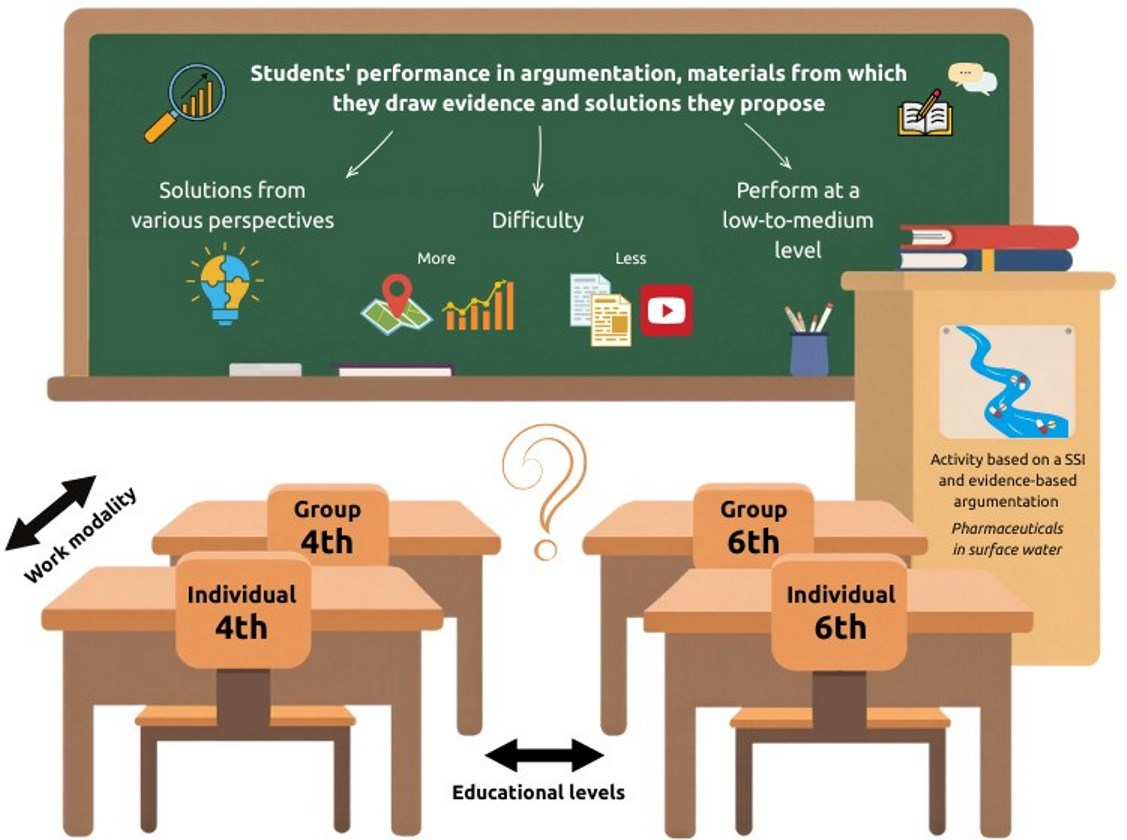
- RQ1. What levels of performance do students show when solving this SSI compared to the reference answer, and what differences are observed depending on the type of work (individual or group) and the grade (4th or 6th)?
- RQ2. What materials do they draw when formulating arguments, how do they use them in relation to their level of understanding, and what differences can be observed depending on the type of work (individual or group) and the grade (4th or 6th)?
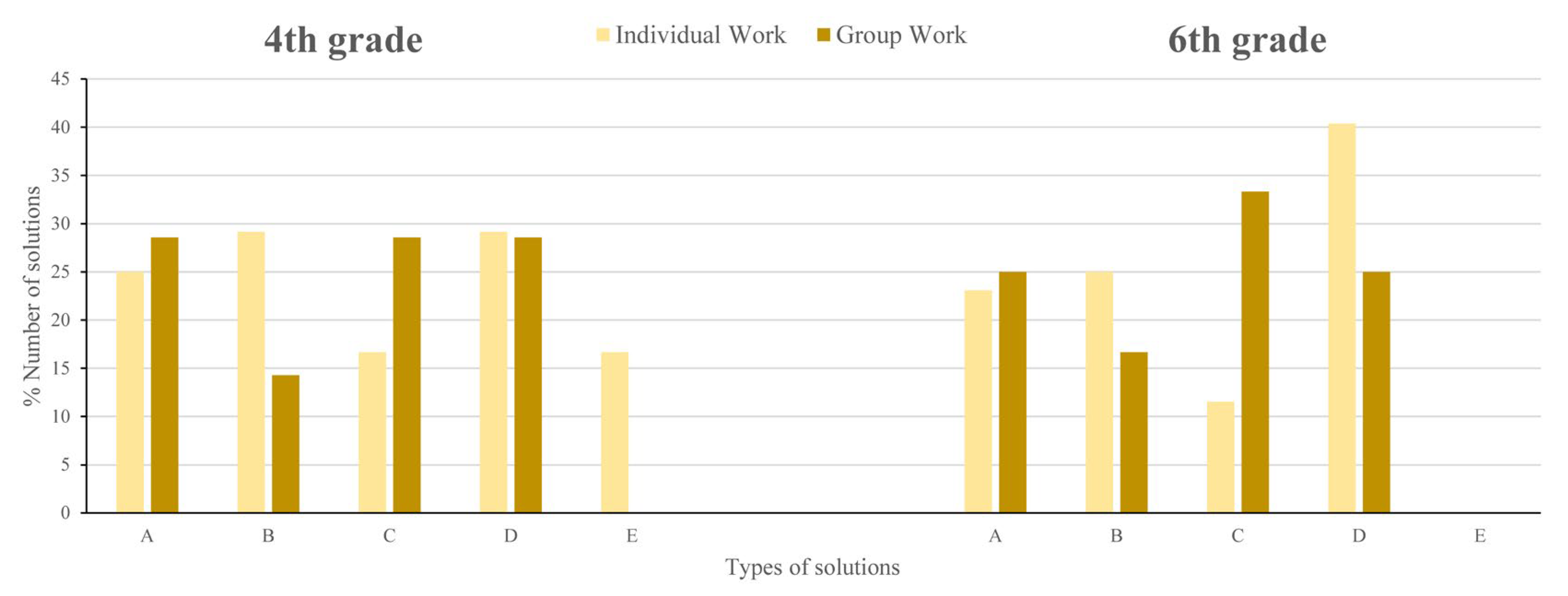
- RQ3. What kind of solutions do students propose to prevent the presence of pharmaceuticals in the river, and what differences are observed depending on the type of work (individual or group) and the grade (4th or 6th)?
2. Method
2.1. Context
2.2. Data Analysis
3. Results and Discussion
3.1. Analysis of the Performance Level of Students in 4th and 6th Grade of PE (RQ1)
- -
- S33: If the pharmaceuticals most commonly found in the Bodonal stream are not the best-selling ones, how and why do they end up in such large quantities in the stream?
- -
- S34: Because in pharmacies, if a product, that is, a medicine, is not sold…, they throw it away.
- -
- S35: And because they are the most difficult to eliminate.
- -
- S36: And it also expires.
- -
- S35: They are also the most difficult to eliminate.
- -
- S33: Yes, but…
- -
- S35: The best sellers are the easiest to eliminate. And the worst sellers…
- -
- S34: No, but not that. It says… How and why do so many of them end up in the stream? Because pharmacies throw them away when they don’t sell them. And also when they expire.
- -
- S36: Because if they don’t stock them and they expire, pharmacies throw them away.
3.2. Analysis of the Use of Materials by Students in 4th and 6th Grade of PE (RQ2)
3.2.1. Q1: “Based on What You Have Read and Seen, What Is Polluting the River?”
3.2.2. Q2: “Based on What You Have Read and Seen, Where Do the Pharmaceuticals in the River Come from?
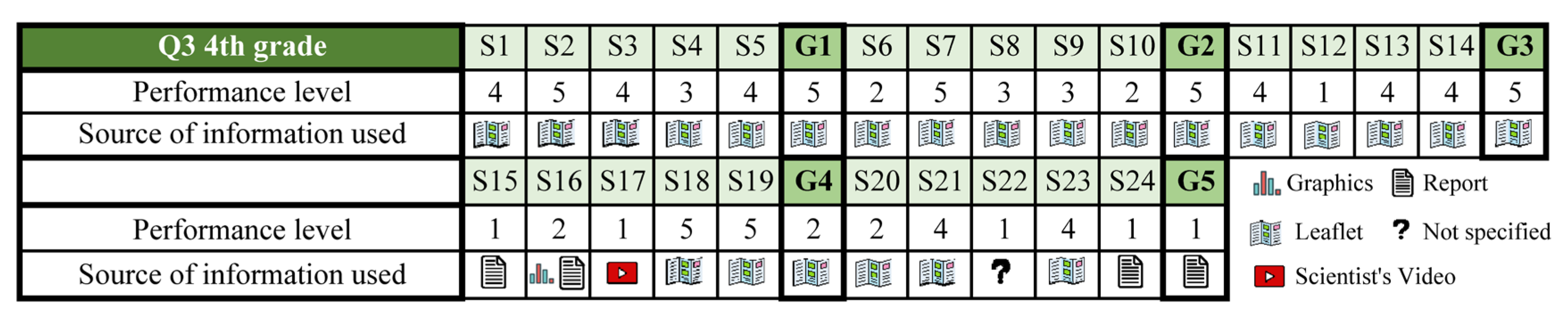
3.2.3. Q3: “What Diseases Do These Pharmaceuticals Treat?”
3.2.4. Q4: “If the Pharmaceuticals Most Commonly Found in the Bodonal Stream Are Not the Best-Selling Ones, How and Why Do They End Up in Such Large Quantities in the Stream?”
3.2.5. Q5: “Is It Harmful for Pharmaceuticals to Be in the River? Why?”
3.2.6. Q6: “Would It Be Better to Take Medication or Not? Why?”
3.3. Analysis of the Type of Solutions Proposed by Students in 4th and 6th Grade of PE (RQ3)
4. Conclusions
Supplementary Materials
Author Contributions
Funding
Institutional Review Board Statement
Informed Consent Statement
Data Availability Statement
Acknowledgments
Conflicts of Interest
Abbreviations
| TEE | Transformative Environmental Education |
| SSI | Socioscientific issue |
| PE | Primary Education |
| ECE | Early Child-hood Education |
| MEFP | Ministerio de Educación y Formación Profesional |
| TIMSS | Trends in International Mathematics and Science Study |
| PIRLS | Progress in International Reading Literacy Study |
| SDGs | Sustainable Development Goals |
| GMOs | Genetically Modified Organisms |
| OECD | Organisation for Economic Co-operation and Development |
| SSC | Socioscientific Controversy |
References
- Akyol, C., & Kanadli, S. (2022). Investigating the effect of socioscientific issues-based instruction on the academic achievement of students: A mixed-research synthesis. FIRE: Forum for International Research in Education, 7(2), 64–85. [Google Scholar] [CrossRef]
- Arifin, Z., Sukarmin, S., & Saputro, S. (2025). Trends and research frontiers in socioscientific issues for sustainable science education: A systematic and bibliometric analysis from 2014–2024. Journal of Pedagogical Research, 9(1), 407–434. [Google Scholar] [CrossRef]
- Armas-Quintá, F. X., Rodríguez-Lestegás, F., Macía-Arce, X. C., & Pérez-Guilarte, Y. (2022). Teaching and learning landscape in primary education in Spain: A necessary curricular review to educate citizens. Acta Geographica Slovenica, 62(1), 55–64. [Google Scholar] [CrossRef]
- Arteaga, P., Díaz-Levicoy, D., & Batanero, C. (2021). Primary school students’ reading levels of line graphs. Statistics Education Research Journal, 20(2), 6. [Google Scholar] [CrossRef]
- Ayuldeş, M., & Akbaş, Y. (2023). The effect of orienteering on the sixth-grade students’ academic achievement and map literacy. Education and Science, 48(213), 113–142. [Google Scholar] [CrossRef]
- Bader, J. D., Ahearn, K. A., Allen, B. A., Anand, D. M., Coppens, A. D., & Aikens, M. L. (2023). The decision is in the details: Justifying decisions about socioscientific issues. Journal of Research in Science Teaching, 60(10), 2147–2179. [Google Scholar] [CrossRef]
- Barrett, T. C. (1968). Taxonomy of cognitive and affective dimensions of reading comprehension. In H. M. Robinson (Ed.), Innovation and change in reading instruction (pp. 17–23). University of Chicago Press. [Google Scholar]
- Batanero, C., Díaz-Levicoy, D., & Arteaga, P. (2018). Evaluación del nivel de lectura y la traducción de pictogramas por estudiantes chilenos de educación básica. Avances de Investigación en Educación Matemática, 14, 49–64. [Google Scholar] [CrossRef]
- Byrne, J., Ideland, M., Malmberg, C., & Grace, M. (2014). Climate change and everyday life: Repertoires children use to negotiate a socio-scientific issue. International Journal of Science Education, 36(9), 1491–1509. [Google Scholar] [CrossRef]
- Canché, L. (2009). La comprensión gráfica de los alumnos del nivel primaria [Tesis de maestría, Universidad Autónoma de Yucatán]. [Google Scholar]
- Caracuel-González, M., Benarroch, A. B., Cobos, T. L., & López, Á. B. (2024). Preferences and reasoning of 14–15 year-old students in relation to natural or synthetic products in different contexts: Influence of an instructional module. Research in Science Education, 54, 909–932. [Google Scholar] [CrossRef]
- Catling, S. (2018). To know maps: Primary school children and contextualised map learning. Boletim Paulista de Geografia, 99, 268–290. Available online: https://publicacoes.agb.org.br/boletim-paulista/article/view/1480 (accessed on 20 June 2025).
- Chen, L., & Xiao, S. (2021). Perceptions, challenges and coping strategies of science teachers in teaching socioscientific issues: A systematic review. Educational Research Review, 32, 100377. [Google Scholar] [CrossRef]
- Christenson, N., Gericke, N., & Chang-Rundgren, S. N. (2017). Science and language teachers’ assessment of upper secondary students’ socioscientific argumentation. International Journal of Science and Mathematics Education, 15(8), 1403–1422. [Google Scholar] [CrossRef]
- Creswell, J. W., & Plano Clark, V. L. (2018). Designing and conducting mixed methods research (3rd ed.). Sage. [Google Scholar]
- Cruz, A. (2013). Erros e dificuldades de alunos do 1.º ciclo na representação de dados estatísticos [Tesis de maestría, Universidade de Lisboa]. [Google Scholar]
- Curcio, F. R. (1989). Developing graph comprehension. National Council of Teachers of Mathematics. [Google Scholar]
- Dawson, V. (2023). Teachers’ support in developing year 7 students’ argumentation skills about water-based socioscientific issues. International Journal of Science Education, 46(3), 222–239. [Google Scholar] [CrossRef]
- Dawson, V. (2025). Using socioscientific issues to teach argumentation to year 7 science students in a low socioeconomic rural Australian school. Research in Science Education, 55, 989–1004. [Google Scholar] [CrossRef]
- Dawson, V., & Carson, K. (2020). Introducing argumentation about climate change socioscientific issues in a disadvantaged school. Research in Science Education, 50(3), 863–883. [Google Scholar] [CrossRef]
- Dawson, V., & Venville, G. (2020). Testing a methodology for the development of socioscientific issues to enhance middle school students’ argumentation and reasoning. Research in Science & Technological Education, 40(4), 499–514. [Google Scholar] [CrossRef]
- Eidin, E., & Shwartz, Y. (2023). From ideal to practical—A design of teacher professional development on socioscientific issues. Sustainability, 15(14), 11394. [Google Scholar] [CrossRef]
- Engel, J. (2017). Statistical literacy for active citizenship: A call for data science education. Statistics Education Research Journal, 16(1), 44–49. [Google Scholar] [CrossRef]
- Esquivel-Martín, T., Pérez-Martín, J. M., & Bravo-Torija, B. (2023). Does pollution only affect human health? A scenario for argumentation in the framework of One Health education. Sustainability, 15, 6984. [Google Scholar] [CrossRef]
- Evangelista, B. (2013). Activities on interpreting bar and line graphs: What do 5th grade students know? In J. M. Contreras, G. R. Cañadas, M. M. Gea, & P. Arteaga (Eds.), Proceedings of the virtual conference on teaching statistics, probability and combinatorics (pp. 121–128). University of Granada. [Google Scholar]
- Fang, S. C., Hsu, Y. S., & Lin, S. S. (2019). Conceptualizing socioscientific decision making from a review of research in science education. International Journal of Science and Mathematics Education, 17(3), 427–448. [Google Scholar] [CrossRef]
- Fernández-Huetos, N., Pérez-Martín, J. M., Guevara-Herrero, I., & Esquivel-Martín, T. (2025). Primary-education students’ performance in arguing about a socioscientific issue: The case of pharmaceuticals in surface water. Sustainability 17, 1618. [Google Scholar] [CrossRef]
- Freitas, A. C., Do Nascimento, A. L., De Castro, R. G., Motokane, M. T., & Reis, P. (2023). Biodiversity and citizenship in an argumentative socioscientific process. Sustainability, 15(4), 2987. [Google Scholar] [CrossRef]
- Gee, J. P. (2014). An introduction to discourse analysis: Theory and method (4th ed.). Routledge. [Google Scholar]
- Guevara-Herrero, I. (2024). Is consuming avocados equally sustainable worldwide? An activity to promote eco-social education from science education. Education Sciences, 14, 560. [Google Scholar] [CrossRef]
- Guevara-Herrero, I., Bravo-Torija, B., & Pérez-Martín, J. M. (2024a). Educational practice in education for environmental justice: A systematic review of the literature. Sustainability, 16(7), 2805. [Google Scholar] [CrossRef]
- Guevara-Herrero, I., Esquivel-Martín, T., Fernández-Huetos, N., & Pérez-Martín, J. M. (2024b). Towards transformative environmental education: Effective activities for primary education. In A. M. Güneş, & E. Yünkül (Eds.), Interdisciplinary approach to fostering change in schools (pp. 70–97). IGI Global. [Google Scholar] [CrossRef]
- Guimarães, G. (2002). Interpretando e construindo gráficos de barras [Tesis doctoral, Universidade Federal de Pernambuco]. [Google Scholar]
- Havelková, L., & Hanus, M. (2019). Map skills in education: A systematic review of terminology, methodology, and influencing factors. Review of International Geographical Education Online, 9(2), 361–401. [Google Scholar] [CrossRef]
- Henderson, S., Tomas, L., & King, D. (2025). Does topic matter? Investigating students’ interest, emotions and learning when writing stories about socioscientific issues. Research in Science Education, 55, 1537–1555. [Google Scholar] [CrossRef]
- Herman, B. C., Newton, M. H., & Zeidler, D. L. (2021). Impact of place-based socioscientific issues instruction on students’ contextualization of socioscientific orientations. Science Education, 105(4), 585–627. [Google Scholar] [CrossRef]
- Hernández-Sampieri, R., Fernández-Collado, C., & Baptista-Lucio, P. (2014). Metodología de la investigación (6ª ed.). McGraw-Hill. [Google Scholar]
- Högström, P., Gericke, N., Wallin, J., & Bergman, E. (2024). Teaching socioscientific issues: A systematic review. Science Education, 34, 3079–3122. [Google Scholar] [CrossRef]
- Iordanou, K. (2022). Supporting strategic and meta-strategic development of argument skill: The role of reflection. Metacognition and Learning, 17, 399–425. [Google Scholar] [CrossRef]
- Jiménez-Aleixandre, M. (2020). ¿Cómo sabemos lo que sabemos? Mediante la argumentación y el uso de pruebas, herramientas para aprender y desarrollar el pensamiento crítico. In Enseñando ciencia con ciencia (D. Couso, M. R. Jiménez-Liso, C. Refojo, & J. A. Sacristán, Coord.; pp. 75–86). FECYT & Fundación Lilly. [Google Scholar]
- Jonuzi, E., & Selvi, H. Z. (2023). Enhancing map comprehension via symbols: Developing symbols for thematic maps based on children’s cognitive development. Necmettin Erbakan University Journal of Science and Engineering, 5(2), 88–110. [Google Scholar] [CrossRef]
- Käsper, M., Uibu, K., & Mikk, J. (2019). Primary school teachers’ teaching strategies for the development of students’ text comprehension. Education 3–13, 48(5), 512–526. [Google Scholar] [CrossRef]
- Kiili, C., Coiro, J., & Hämäläinen, J. (2016). An online inquiry tool to support the exploration of controversial issues on the Internet. Journal of Literacy and Technology, 17(1–2), 31–52. [Google Scholar]
- Klaver, L. T., Walma van der Molen, J. H., Sins, P. H., & Guérin, L. J. (2023). Students’ engagement with socioscientific issues: Use of sources of knowledge and attitudes. Journal of Research in Science Teaching, 60(5), 1125–1161. [Google Scholar] [CrossRef]
- Kokolaki, A., & Stavrou, D. (2022). Pre-service primary teachers develop teaching artifacts on contemporary socioscientific issues. Journal of Science Teacher Education, 34(3), 287–306. [Google Scholar] [CrossRef]
- Kumar, V., Choudhary, S. K., & Singh, R. (2024). Environmental socio-scientific issues as contexts in developing scientific literacy in science education: A systematic literature review. Social Sciences & Humanities Open, 9, 100765. [Google Scholar] [CrossRef]
- Lassoued, K., Awad, A., & Guirat, R. (2020). The impact of managerial empowerment on problem solving and decision making skills: The case of Abu Dhabi University. Management Science Letters, 10(4), 769–780. [Google Scholar] [CrossRef]
- Leden, L., Hansson, L., & Redfors, A. (2017). From black and white to shades of grey. Science & Education, 26, 483–511. [Google Scholar] [CrossRef]
- Lee, H., & Yang, J. E. (2019). Science teachers taking their first steps toward teaching socioscientific issues through collaborative action research. Research in Science Education, 49(1), 51–71. [Google Scholar] [CrossRef]
- Levinson, R. (2018). Realising the school science curriculum. The Curriculum Journal, 29(4), 522–537. [Google Scholar] [CrossRef]
- List, A. (2022). Demonstrating the effectiveness of two scaffolds for fostering students’ domain perspective reasoning. European Journal of Psychology of Education, 38(4), 1343–1376. [Google Scholar] [CrossRef]
- Lu, Y. H., Shih, J. L., Chen, P. C., Hong, G. D., & Chen, H. W. (2024). Exploring elementary school students’ perceptions towards socioscientific issues through the role-playing game Future City. IIAI Letters on Informatics and Interdisciplinary Research, 5, 237. [Google Scholar] [CrossRef]
- Martini, M., Widodo, W., Qosyim, A., Mahdiannur, M., & Jatmiko, B. (2021). Improving undergraduate science education students’ argumentation skills through debates on socioscientific issues. Jurnal Pendidikan IPA Indonesia, 10(3), 428–438. [Google Scholar] [CrossRef]
- McNeill, K. L. (2011). Elementary students’ views of explanation, argumentation and evidence, and their abilities to construct arguments over the school year. Journal of Research in Science Teaching, 48(7), 793–823. [Google Scholar] [CrossRef]
- Ministerio de Educación y Formación Profesional. (2022). Real Decreto 157/2022, de 1 de marzo. Boletín Oficial del Estado, 52, 1–109. Available online: https://www.boe.es/buscar/act.php?id=BOE-A-2022-3296 (accessed on 21 June 2025).
- Ministerio de Educación y Formación Profesional. (2023). PIRLS 2021: Estudio internacional de progreso en comprensión lectora. Informe español. Instituto Nacional de Evaluación Educativa. [Google Scholar]
- Ministerio de Educación y Formación Profesional. (2024). TIMSS 2023: Estudio internacional de tendencias en matemáticas y ciencias. Informe español. Instituto Nacional de Evaluación Educativa. [Google Scholar]
- Míguez-Álvarez, C., Cuevas-Alonso, M., Saavedra, A., & Cabanach, R. G. (2022). The role of text characteristics in the reading comprehension of primary school children in Spanish. Revista Iberoamericana de Psicología y Salud, 13(1), 41–55. [Google Scholar] [CrossRef]
- Mohamedi-Amaruch, A., & Rico-Martín, A. M. (2020). Assessment of reading comprehension in primary education: Reading processes and texts. Lenguas Modernas, 55, 37–52. [Google Scholar]
- Monserrat, M. R., Cantó, J., & Solbes, J. (2025). El uso de las cuestiones sociocientíficas para mejorar la imagen de la ciencia y el interés del alumnado de ESO. Revista Eureka sobre Enseñanza y Divulgación de las Ciencias, 22(1), 1101. [Google Scholar] [CrossRef]
- Narayanan, B., Kumar, A. G., Gunasekaran, D., Vengayil, R., Maduvegadde, K., & Alampady, N. (2025). Perspectives of socio-scientific issues in educational research: A bibliometric analysis. Journal of Teaching and Learning, 19(1), 50–84. [Google Scholar] [CrossRef]
- Nepraš, K., Strejčková, T., & Kroufek, R. (2022). Climate change education in primary and lower secondary education: Systematic review results. Sustainability, 14(22), 14913. [Google Scholar] [CrossRef]
- OECD. (2023). PISA 2025 science framework (second draft). OECD. Available online: https://pisa-framework.oecd.org/science-2025/assets/docs/PISA_2025_Science_Framework.pdf (accessed on 21 June 2025).
- Olsson, D., & Gericke, N. (2016). The adolescent dip in students’ sustainability consciousness. Journal of Environmental Education, 47, 35–51. [Google Scholar] [CrossRef]
- Osborne, J., Simon, S., Christodoulou, A., Howell-Richardson, C., & Richardson, K. (2013). Learning to argue: A study of four schools and their attempt to develop the use of argumentation as a common instructional practice and its impact on students. Journal of Research in Science Teaching, 50(3), 315–347. [Google Scholar] [CrossRef]
- Ottander, K., & Simon, S. (2021). Learning democratic participation? Meaning-making in discussion of socioscientific issues in science education. International Journal of Science Education, 43(12), 1895–1925. [Google Scholar] [CrossRef]
- Ozcan-Ermis, G., & Hervé, N. (2024). Identifying pre- and in-service teachers’ stances on teaching socioscientific issues: A systematic review of empirical studies. Canadian Journal of Science, Mathematics and Technology Education, 23(4), 741–764. [Google Scholar] [CrossRef]
- Öhman, J., & Öhman, M. (2012). Participatory approach in practice: An analysis of student discussions about climate change. Environmental Education Research, 19(3), 324–341. [Google Scholar] [CrossRef]
- Öztürk, S., & Karakaş, H. (2024). Scenario-based teaching process in the life science course based on socioscientific issues. Turkish Journal of Education, 13(5), 441–464. [Google Scholar] [CrossRef]
- Pagan, A., Leite, A. P., Magina, S., & Cazorla, I. (2008). A leitura e interpretação de gráficos e tabelas no ensino fundamental e médio. In V. Gitirana, F. Bellemain, & V. Andrade (Eds.), Anais do 2º Simpósio Internacional de Pesquisa em Educação Matemática (pp. 1–10). Universidade Federal de Pernambuco. [Google Scholar]
- Papancheva, R. Y. (2017). Working with data tables and graphs at primary school. Journal of Process Management—New Technologies, 5(4), 8–12. [Google Scholar] [CrossRef]
- Peña-García, S. N. (2019). The challenge of reading comprehension in primary education. Panorama, 13(24), 43–56. [Google Scholar] [CrossRef]
- Pérez-Martín, J. M., Calurano-Tena, M. T., Martín-Aguilar, C., Esquivel-Martín, T., & Bravo-Torija, B. (2019). Natural science questions in primary education textbooks: Processing or reproducing contents? ReiDoCrea 8, 186–201. [Google Scholar]
- Pérez-Martín, J. M., & Esquivel-Martín, T. (2024). New insights for teaching the One Health approach: Transformative environmental education for sustainability. Sustainability 16, 7967. [Google Scholar] [CrossRef]
- Reid, A., Dillon, J., Ardoin, N., & Ferreira, J. A. (2021). Scientists’ warnings and the need to reimagine, recreate, and restore environmental education. Environmental Education Research, 27, 783–795. [Google Scholar] [CrossRef]
- Richmond, A. S., & Hagan, L. K. (2011). Promoting higher level thinking in psychology: Is active learning the answer? Teaching of Psychology, 38(2), 102–105. [Google Scholar] [CrossRef]
- Ridgway, J., Nicholson, J., Sutherland, S., & Hedger, S. (2019). Critical statistical literacy and interactive data visualisations. In J. Evans, S. Ruane, & H. Southall (Eds.), Data in society: Challenging statistics in an age of globalisation (pp. 349–357). Policy Press. [Google Scholar]
- Roberts, D. A. (2007). Scientific literacy. In S. K. Abell, & N. G. Lederman (Eds.), Handbook of research on science education (pp. 729–780). Routledge. [Google Scholar]
- Romero-Ariza, M., Quesada, A., & Estepa, A. (2021). Promoting critical thinking through mathematics and science teacher education: The case of argumentation and graphs interpretation about climate change. European Journal of Teacher Education, 47, 41–59. [Google Scholar] [CrossRef]
- Sakamoto, M., Yamaguchi, E., Yamamoto, T., & Wakabayashi, K. (2021). An intervention study on students’ decision-making towards consensus building on socio-scientific issues. International Journal of Science Education, 43(12), 1965–1983. [Google Scholar] [CrossRef]
- Salcedo, A., González, J., & González, J. (2021). Lectura e interpretación de gráficos estadísticos, ¿cómo lo hace el ciudadano? Paradigma, 41(e1), 61–88. [Google Scholar] [CrossRef]
- Schreier, M. (2012). Qualitative content analysis in practice. SAGE. [Google Scholar]
- Sekelj, A., & Rigo, I. (2011). Teaching English grammar in primary school. Tabula, 9, 188–199. [Google Scholar] [CrossRef]
- Siarova, H., Sternadel, D., & Szőnyi, E. (2019). Science and scientific literacy as an educational challenge. European Union. [Google Scholar]
- Sjöström, J. (2024). Vision III of scientific literacy and science education: An alternative vision for science education emphasising the ethico-socio-political and relational-existential. Studies in Science Education, 61(2), 239–274. [Google Scholar] [CrossRef]
- Şaşmazören, F., Karapınar, A., Sarı, K., & Demirer, T. (2023). Teaching socioscientific issues through scientific scenarios: A case evaluation based on secondary school students’ views. Bartın University Journal of Faculty of Education, 14(1), 124–145. [Google Scholar] [CrossRef]
- Tang, K. Y., Lin, T. C., & Hsu, Y. S. (2023). Status and trends of socioscientific issues in educational literature: Insights and extensions from a co-word analysis. International Journal of Science Education, 46(11), 1073–1097. [Google Scholar] [CrossRef]
- Tang, X., Kikas, E., Pakarinen, E., Lerkkanen, M. K., Muotka, J., & Nurmi, J. E. (2017). Profiles of teaching practices and first and third graders’ reading skills in Finland and Estonia. Teaching and Teacher Education, 64, 150–161. [Google Scholar] [CrossRef]
- Torres, N., & Solbes, J. (2018). Pensamiento crítico desde cuestiones socio-científicas. In D. M. Conrado, & N. Nunes-Neto (Eds.), Questões sociocientíficas: Fundamentos, propostas de ensino e perspectivas para ações sociopolíticas (pp. 59–76). EDUFBA. [Google Scholar] [CrossRef]
- Valladares, L. (2021). Scientific literacy and social transformation. Science & Education, 30, 557–587. [Google Scholar] [CrossRef]
- Van de Wetering, J., Leijten, P., Spitzer, J., & Thomaes, S. (2022). Does environmental education benefit environmental outcomes in children and adolescents? A meta-analysis. Journal of Environmental Psychology, 81, 101782. [Google Scholar] [CrossRef]
- White, P., Ferguson, J., O’Connor Smith, N., & O’Shea Carre, H. (2022). School strikers enacting politics for climate justice: Daring to think differently about education. Australian Journal of Environmental Education, 38(1), 26–39. [Google Scholar] [CrossRef]
- Wiyarsi, A., & Çalik, M. (2019). Revisiting the scientific habits of mind scale for socio-scientific issues in the Indonesian context. International Journal of Science Education, 41(17), 2430–2447. [Google Scholar] [CrossRef]
- Yin, R. K. (2018). Case study research and applications: Design and methods (6th ed.). SAGE. [Google Scholar]
- Zamalloa, T., Salgado, M., & Berciano, A. (2025). How to promote scientific practices in early childhood education: The teachers’ role. International Journal of Science and Mathematics Education, 23, 2975–2995. [Google Scholar] [CrossRef]
- Zeidler, D. L., & Sadler, T. D. (2023). Exploring and expanding the frontiers of socioscientific issues. In N. G. Lederman, D. L. Zeidler, & J. S. Lederman (Eds.), Handbook of research on science education (pp. 899–929). Routledge. [Google Scholar]
- Zhang, J., Lopez Wui, M. G., Nam, R., Relyea, J. E., & Wong, S. S. (2023). Improving argumentative writing of sixth-grade adolescents through dialogic inquiry of socioscientific issues. Journal of Writing Research, 14(3), 375–419. [Google Scholar] [CrossRef]
- Zhang, W. X., & Hsu, Y. S. (2025). Professional development for socioscientific issue teaching: Exploring the discourse of in-service teachers in community activities through epistemic network analysis. Research in Science Education, 55, 961–987. [Google Scholar] [CrossRef]





| Individual (I) | Group (G) | ||
|---|---|---|---|
| Mean ± Variance | 4th | 2.59 ± 1.71 * | 2.90 ± 2.02 |
| 6th | 2.88 ± 1.57 * | 3.00 ± 1.89 |
| Q1 | Q2 | Q3 | Q4 | Q5 | Q6 | ||||||||
|---|---|---|---|---|---|---|---|---|---|---|---|---|---|
| I | G | I | G | I | G | I | G | I | G | I | G | ||
| Mean ± Variance | 4th | 2.83 ± 0.58 | 3.20 ± 0.20 | 1.58 ± 0.78 | 1.80 ± 1.20 | 3.08 ± 2.08 | 3.60 ± 3.80 | 1.25 ± 0.37 | 1.20 ± 0.20 | 3.04 ± 0.48 | 3.20 ± 0.20 | 3.75 ± 1.50 | 4.40 ± 0.30 |
| 6th | 3.00 ± 0.15 | 3.00 ± 0.00 | 1.78 ± 0.93 | 1.56 ± 0.78 | 3.66 ± 1.48 | 4.00 ± 1.50 | 1.76 ± 1.04 | 1.67 ± 1.00 | 3.24 ± 0.79 | 3.44 ± 0.53 | 3.85 ± 0.98 | 4.33 ± 1.00 | |
Disclaimer/Publisher’s Note: The statements, opinions and data contained in all publications are solely those of the individual author(s) and contributor(s) and not of MDPI and/or the editor(s). MDPI and/or the editor(s) disclaim responsibility for any injury to people or property resulting from any ideas, methods, instructions or products referred to in the content. |
© 2026 by the authors. Licensee MDPI, Basel, Switzerland. This article is an open access article distributed under the terms and conditions of the Creative Commons Attribution (CC BY) license.
Share and Cite
Fernández-Huetos, N.; Pérez-Martín, J.M.; Esquivel-Martín, T.; Guevara-Herrero, I. Learning to Argue: How Do 4th and 6th Grade Students Use Multimodal Materials to Solve a Socioscientific Issue? Educ. Sci. 2026, 16, 321. https://doi.org/10.3390/educsci16020321
Fernández-Huetos N, Pérez-Martín JM, Esquivel-Martín T, Guevara-Herrero I. Learning to Argue: How Do 4th and 6th Grade Students Use Multimodal Materials to Solve a Socioscientific Issue? Education Sciences. 2026; 16(2):321. https://doi.org/10.3390/educsci16020321
Chicago/Turabian StyleFernández-Huetos, Nuria, José Manuel Pérez-Martín, Tamara Esquivel-Martín, and Irene Guevara-Herrero. 2026. "Learning to Argue: How Do 4th and 6th Grade Students Use Multimodal Materials to Solve a Socioscientific Issue?" Education Sciences 16, no. 2: 321. https://doi.org/10.3390/educsci16020321
APA StyleFernández-Huetos, N., Pérez-Martín, J. M., Esquivel-Martín, T., & Guevara-Herrero, I. (2026). Learning to Argue: How Do 4th and 6th Grade Students Use Multimodal Materials to Solve a Socioscientific Issue? Education Sciences, 16(2), 321. https://doi.org/10.3390/educsci16020321