


Abstract
Centers for Teaching and Learning (CTLs) have emerged as crucial change agents in preparing faculty to integrate employment-relevant skills into higher education, yet limited research examines how these centers operate in resource-constrained contexts. This study investigates how CTLs in Israeli higher education prepare faculty to teach employment skills and what insights this experience offers for understanding effective strategies in similar contexts. Using an embedded single-case study design, we conducted semi-structured interviews with 31 CTL directors (77.5% response rate) across universities, academic colleges, and education colleges, supplemented by document analysis. Our findings reveal three distinct implementation approaches: embedded integration (47% of centers), industry partnership (32%), and competency framework (21%) models. Despite operating with limited formal authority and resources, Israeli CTLs demonstrate “networked legitimacy”, achieving institutional influence through strategic relationship-building rather than hierarchical position. University-based CTLs emphasize cognitive-analytical skills but show lower implementation rates (29%), while college-based CTLs demonstrate higher implementation levels (57%) with stronger workplace connections. The study extends institutional entrepreneurship theory by explaining how resource-constrained organizations drive change without formal authority. These findings offer actionable frameworks for CTL directors, demonstrating that embedded integration can achieve high faculty engagement without separate program infrastructure, while industry partnerships enhance workplace relevance. The research contributes to understanding how educational institutions can enhance graduate employability through strategic faculty development, with implications for workforce-responsive higher education policy development globally.
1. Introduction
The contemporary labor market is undergoing fundamental transformations influenced by globalization, technological innovation, and the evolving knowledge economy (World Economic Forum, 2020). These transformations have created a persistent ‘skills gap’, the mismatch between the competencies graduates possess upon completion of their studies and the competencies employers require for successful workplace performance (McGuinness et al., 2018). This gap manifests both in graduates lacking specific technical skills and, more critically, in deficiencies in transversal competencies such as critical thinking, communication, and adaptability that enable professional success across varied contexts. These changes require higher education systems to prepare graduates with transversal skills alongside traditional disciplinary knowledge (Binkley et al., 2012).
Centers for Teaching and Learning (CTLs) in higher education institutions serve as key change agents in addressing this challenge, being responsible for the professional development of academic staff and the implementation of pedagogical innovation (Bitar & Davidovich, 2024).
This study aims to examine how Centers for Teaching and Learning in Israeli higher education function as change agents in preparing faculty to integrate employment-relevant skills into their teaching practice. Despite the critical importance of CTLs in mediating between academic values and labor market demands, limited empirical research examines how these centers operate in resource-constrained dual higher education systems. The Israeli context, characterized by a distinctive combination of research universities and teaching-oriented colleges, mandatory military service that shapes workforce preparation, and a renowned entrepreneurial ecosystem, offers valuable insights for understanding CTL effectiveness in similar contexts globally. By analyzing implementation approaches, institutional variations, and strategic adaptations employed by Israeli CTLs, this study seeks to contribute both theoretical insights regarding organizational change without formal authority and practical frameworks for enhancing graduate employability through strategic faculty development. The research addresses a significant knowledge gap concerning the specific mechanisms through which CTLs prepare faculty to deliver employment-relevant competencies, moving beyond curriculum-level analysis to examine the intermediary role of faculty development infrastructure.
We address the following research questions:
- How do Centers for Teaching and Learning in Israel’s dual higher education system prepare faculty to integrate employment-relevant skills, and what institutional factors shape these approaches?
- What theoretical and practical insights does the Israeli experience contribute to understanding effective CTL strategies for employment skills preparation in resource-constrained higher education contexts?
To address these questions, Section 4 presents the findings regarding implementation models (RQ1), Section 5 analyzes the institutional factors (RQ1), and Section 6 discusses the theoretical and practical insights, including the proposed Integrated Model (RQ2).
This study examines Israeli CTLs in depth, contextualized within international scholarship. Through detailed analysis of current practices, identification of institutional variations, and documentation of successful implementation strategies, this research provides valuable insights for policymakers, institutional leaders, and CTL directors seeking to enhance the employment relevance of higher education in an era of rapid technological change.
2. Literature Review
CTLs began developing in the United States during the 1960s and 1970s, concurrent with demographic changes in higher education, and expanded access to diverse populations.
Before examining how CTLs prepare faculty to teach employment-relevant skills, it is essential to clarify what constitutes “employment skills” in contemporary higher education discourse. For this study, we define employment skills as competencies that enhance graduates’ ability to successfully transition to and thrive in professional environments, encompassing both discipline-specific technical capabilities and transversal competencies applicable across varied workplace contexts.
This conceptualization emphasizes adaptable capabilities rather than task-specific training. It incorporates both immediately applicable skills and metacognitive capabilities that support ongoing professional development.
As Yorke and Knight (2006) argue, such skills represent a set of achievements, understandings and personal attributes that make individuals more likely to gain employment and be successful in their chosen occupations. Yorke and Knight’s framework emphasizes embedding employability within curriculum design at the institutional level. Our study extends this perspective by examining the specific mechanisms through which CTLs prepare faculty to deliver these competencies, focusing on the intermediary role of faculty development rather than direct curriculum intervention.
Employment skills can be categorized into four interconnected domains that emerged consistently in our literature review: (1) cognitive-analytical skills, including critical thinking, complex problem-solving, and evaluative judgment; (2) social-collaborative skills such as teamwork, communication, and intercultural competence; (3) technological-digital skills encompassing digital literacy, data analysis, and technological adaptability; and (4) self-management skills including adaptive learning, professional identity development, and career navigation capabilities.
These domains align closely with major international employment skills frameworks, demonstrating theoretical coherence across different policy contexts. The World Economic Forum’s Future of Jobs Report (2020) identifies virtually identical competency categories: analytical thinking and innovation (corresponding to our cognitive-analytical domain), active learning and learning strategies (self-management domain), complex problem-solving (cognitive-analytical), creativity and originality (cognitive-analytical), leadership and social influence (social-collaborative), technology use and monitoring (technological-digital), and emotional intelligence (social-collaborative). Similarly, the European Union’s Key Competences for Lifelong Learning framework emphasizes personal, social and learning-to-learn competences that map directly onto our four-domain structure.
This convergence across international frameworks strengthens the validity of our conceptual approach while acknowledging the contextual nature of how these skills manifest across different professional environments and disciplinary traditions. The OECD’s Skills for Social Progress framework further supports our emphasis on both cognitive and social-emotional skills, recognizing that contemporary employment requires the integration of technical competencies with interpersonal and self-regulatory capabilities. Our four-domain framework thus provides a locally grounded taxonomy that maintains international theoretical alignment while enabling contextual adaptation within Israeli higher education institutions.
This conceptual clarification provides the foundation for examining how CTLs prepare faculty to integrate employment skills into teaching practices.
As Ankrah and Omar’s (2015) systematic review demonstrates, this shift necessitated new forms of industry–academia collaboration, significantly beyond traditional academic boundaries. Centers increasingly developed what Conley et al. (2016) term “employment-responsive pedagogies”, instructional approaches explicitly designed to cultivate transferable competencies including critical thinking, communication efficacy, and technological fluency across disciplinary contexts.
While this international trend toward employment skills preparation followed relatively similar patterns across developed nations, the Israeli context presents a distinctive case that merits separate examination. Specifically, while US centers often operate with substantial endowments and formal faculty governance roles, Israeli centers typically function within a more centralized regulatory framework but with fewer direct resources (Hatiba, 2002).
The US model, exemplified by centers such as the Derek Bok Center at Harvard and the Center for Teaching and Learning at Stanford, typically features dedicated professional staff, substantial programming budgets, and formal integration into faculty promotion processes (Sorcinelli et al., 2006). These centers often operate as semi-autonomous units with direct reporting lines to provosts. In contrast, POD Network surveys indicate that even well-resourced US centers face challenges in demonstrating impact on student learning outcomes (Beach et al., 2016). This international comparison contextualizes the Israeli case as representing a resource-constrained variant of a global phenomenon rather than an entirely unique model.
Unlike their international counterparts, Israeli CTLs emerged within a dual higher education system of research universities and teaching-focused colleges, developing systematically only in the 1990s. Distinctively, academic colleges pioneered these efforts before research universities adopted similar structures (Hatiba, 2002; Cohen & Davidovitch, 2022).
The formal recognition phase (2013–2020) began with the implementation of the Babad Committee recommendations, which marked the first systematic integration of teaching quality into institutional assessment frameworks in Israeli higher education. As Former CTL director PB9 noted in Bitar and Davidovich (2025) study, “The Babad Committee greatly influenced institutional perspectives on teaching advancement”. This committee’s recommendations provided the first formal policy foundation for CTL operations and initiated more systematic approaches to teaching quality enhancement across the system.
Subsequent national policy documents have reinforced this direction. The Council for Higher Education’s Multi-Year Plan (2017–2022) explicitly identified teaching quality enhancement as a strategic priority, allocating dedicated funding for CTL operations (Council for Higher Education, 2017). The Digital Israel National Initiative further positioned CTLs as key implementers of technological integration in higher education (Ministry of Social Equality, 2017). These policy frameworks provide the regulatory context within which Israeli CTLs operate, distinguishing them from more market-driven systems.
The strategic transformation phase (2020–present) has witnessed the elevation of CTLs to essential institutional partners, accelerated by two critical developments: the Digital Learning Initiative and the COVID-19 pandemic. The Digital Learning Initiative expanded CTLs’ strategic role while providing substantial resources for technological integration. As CTL director PA27 explained, “The digital learning call was super significant… it enabled very broad, very deep processes, especially regarding digital learning”. The COVID-19 pandemic further consolidated this transformation, with 87.1% of CTL directors identifying this period as crucial for institutional integration.
Despite this evolutionary progress, Israeli CTLs continue to face what Bitar and Davidovich (2025) term the “recognition-resources gap”—a persistent disconnect between institutional appreciation and operational support.
This distinctive evolutionary pattern provides the analytical context for our study, explaining why contemporary Israeli CTLs must rely on ‘networked legitimacy’ rather than formal structural authority to drive change. Unlike their international counterparts, Israeli centers typically operate with more limited resources and formal authority, necessitating innovative approaches to program development and stakeholder engagement. However, their demonstrated resilience and adaptability—particularly during crisis periods—provides valuable insights into how centers can effectively prepare faculty for employment-oriented teaching despite structural constraints.
Skills matching theory (Spence, 1973; Bills, 2003) provides the theoretical foundation for understanding how CTLs can enhance graduates’ labor market outcomes by improving alignment between academic preparation and workplace demands. Research demonstrates that faculty receiving intensive CTL training are more effective at imparting employment skills, with significant improvements in work-readiness metrics (Conley et al., 2016).
While extensive research exists on CTLs and on employment skills separately, there is limited systematic research on how CTLs function specifically as agents for preparing faculty to impart employment-relevant skills, particularly in comparative international contexts. The Israeli context presents an especially interesting case due to its unique combination of a strong research orientation, dual structure of universities and colleges, distinctive security-employment connections, and entrepreneurial culture. This study addresses this gap by providing a comprehensive analysis of the role, challenges, and potential of CTLs in preparing faculty for employment-oriented teaching in Israel compared to international models.
3. Theoretical Framework
This study is grounded in two complementary theoretical perspectives that together provide a comprehensive lens for understanding how CTLs function as change agents in higher education contexts.
Drawing on DiMaggio and Powell’s (1983) institutional isomorphism theory, we examine how CTLs navigate competing institutional pressures while maintaining legitimacy within academic contexts. Scott’s (2014) three pillars of institutional theory, regulative (formal rules), normative (professional standards), and cognitive (taken-for-granted assumptions), provide a framework for understanding how CTLs operate within existing institutional logics while promoting change. Of particular relevance is Battilana et al.’s (2009) concept of “institutional entrepreneurship”, which describes how organizations can drive institutional change despite limited formal authority. This concept helps explain how CTLs can influence faculty behavior and institutional priorities through relationship-building rather than hierarchical mandate.
Complementing institutional theory, we draw on skills matching theory and educational signaling perspectives. Building on Spence’s (1973) signaling theory and Bills’ (2003) extension to educational credentialing, we examine how CTLs enhance the signaling value of higher education credentials by improving skill–job matching. This perspective views educational institutions as active agents that can strengthen their graduates’ labor market outcomes through targeted skill development. Recent developments in skills matching theory (Autor et al., 2020) emphasize the role of educational intermediaries in bridging the gap between academic preparation and workplace requirements. CTLs represent a specific type of educational intermediary that can enhance institutional responsiveness to labor market demands.
Synthesizing these perspectives, we propose that CTLs function as “institutional mediators”, organizational units that bridge competing institutional logics (academic vs. market) while adapting external innovations to local contexts. This theoretical synthesis guides our analysis of how Israeli CTLs navigate the employment skills challenge while maintaining academic legitimacy.
4. Methodology
This study employed an embedded single-case study design within a constructivist paradigm to examine CTL directors’ experiences and perspectives regarding faculty preparation for employment-oriented skills teaching.
The embedded single-case study design (Yin, 2018) enables deep examination of CTLs within their institutional contexts while maintaining analytical rigor. This approach is particularly appropriate for understanding complex organizational phenomena where contextual factors significantly influence outcomes (Stake, 2005). The Israeli higher education system, with its dual structure of research universities and teaching colleges, provides a bounded case that allows for systematic analysis while offering insights relevant to similar contexts internationally.
Our sampling strategy focused on working from the Council for Higher Education’s database. We recruited 31 current CTL directors (77.5% response rate) representing institutional diversity across Israel’s higher education system: seven research universities, thirteen academic colleges, nine education colleges, and two private colleges. Additionally, we included five national stakeholders with expertise in teaching quality policy and nine former directors with significant leadership experience.
Table 1 provides demographic and professional information about research participants.

Table 1.
Demographic and professional information about research participants.
Among current CTL directors, the average tenure in position was 4.8 years, with significant variation (range: 0.5–22 years). This diverse experience base provided rich perspectives on CTL evolution and employment skills preparation approaches.
To preserve anonymity while maintaining distinction between participant groups, interviewees were assigned codes based on their role; ‘PA’ indicates a current CTL director, ‘PB’ indicates a former director, and ‘PC’ indicates a national stakeholder, followed by a specific identification number (e.g., PA7, PB9).
Data collection included semi-structured interviews and document analysis of institutional strategic plans (n = 27), CTL annual reports (n = 43), and national policy directives (n = 5), enabling triangulation across data sources.
We contextualize our Israeli findings within international scholarship through systematic literature review of 58 publications addressing CTL operations and employment skills development.
Analysis followed systematic procedures to ensure rigor analysis used ATLAS.ti 24 software following Braun and Clarke’s (2006) six-phase thematic analysis approach, combining inductive and deductive coding. We selected thematic analysis rather than IPA because our sample size (45 participants) and research questions focused on patterns across the case rather than individual lived experiences. Thematic analysis provides the flexibility to identify patterns while maintaining analytical rigor (Braun & Clarke, 2019).
Initial coding generated codes from participant language, with 30% of transcripts independently coded to establish reliability. Inter-coder agreement = 89%, calculated using percentage agreement which is appropriate for qualitative thematic analysis (Campbell et al., 2013). The focused coding phase grouped these codes into theoretical categories, while theoretical coding examined relationships between categories, leading to the development of our conceptual framework.
Initial coding identified recurring patterns in directors’ change management approaches, resulting in 127 distinct codes grouped into 15 broader categories. Theoretical coding revealed three distinct layers of operation: the ‘environmental forces’ layer emerged from references to external pressures, the ‘institutional context’ layer from references to organizational dynamics, and the implementation phases from patterns in foundation-building, adaptation strategies, and cultural embedding practices.
Quality Assurance
To ensure the rigor and trustworthiness of findings, we employed multiple validation strategies. Data triangulation compared interview accounts with 75 institutional documents (strategic plans, CTL annual reports, and national policy directives), providing multi-dimensional understanding of CTL operations and validating self-reported data. Inter-coder reliability analysis (89% agreement) on 30% of transcripts confirms analytical consistency. Regular reflexivity journaling and peer debriefing sessions with external colleagues provided critical examination of emerging interpretations. The high response rate (77.5%) strengthens confidence that findings represent the diversity of Israeli CTL approaches rather than select cases. This comprehensive approach to quality assurance ensures credible findings while acknowledging the study’s interpretive nature.
5. Findings
Our thematic analysis revealed four interconnected themes that address our research questions about how Israeli CTLs prepare faculty for employment skills integration and what insights this experience offers for understanding CTL effectiveness in resource-constrained contexts.
5.1. Adaptive Implementation Models
Israeli CTLs have developed three distinct approaches to employment skills preparation, each reflecting different institutional contexts and resource constraints. The embedded integration model, employed by 47% of centers, integrates employment skills development within existing pedagogical training rather than creating separate programs. Centers using this model report higher faculty engagement rates but acknowledge challenges in systematic coverage.
Centers using this approach report higher faculty participation rates (78% vs. 52%) while maintaining resource efficiency (PA30, Education College).
The industry partnership model, used by 32% of centers, develops systematic collaborations with employers, alumni networks, and professional associations to inform faculty development. These centers organize regular “reality check” sessions with industry representatives to identify skill gaps and inform faculty development priorities (PA12, Private College). While this approach provides stronger connections between faculty training and workplace requirements, centers face sustainability challenges when industry partnerships are not formalized.
The competency framework model, employed by 21% of centers, develops systematic skill taxonomies and assessment tools that faculty can apply across disciplines. These centers create comprehensive mapping of essential employment skills to specific pedagogical strategies, enabling faculty to redesign courses with explicit employment skill integration (PA15, Research University). While offering the most comprehensive coverage, this approach encounters faculty resistance to standardization, with implementation success varying significantly by disciplinary culture.
5.2. Institutional Context Variations
These three implementation approaches do not operate in isolation but are significantly shaped by the institutional contexts in which CTLs operate. The dual structure of Israeli higher education significantly influences how CTLs approach employment skills preparation. University-based CTLs (n = 7) demonstrate stronger theoretical knowledge of employment skills frameworks but show lower systematic implementation rates, with only 29% reporting structured programs.
Notably, while the three implementation models identified in this study are not exclusive to specific institutional types, our analysis reveals patterns of association between models and institutional context. The competency framework model is more prevalent among research university CTLs (43% of university centers vs. 15% of college centers), reflecting universities’ orientation toward systematic, theory-driven approaches. Conversely, the industry partnership model predominates in academic and private colleges (41% vs. 14% in universities), aligning with colleges’ stronger vocational orientation and employer connections. The embedded integration model shows relatively even distribution across institutional types, suggesting its adaptability to diverse contexts. These patterns demonstrate how Israel’s dual higher education structure shapes not only the emphasis on different skill domains but also the strategic approaches CTLs employ for implementation.
These centers emphasize cognitive-analytical skills but struggle with workplace connections, with only 34% explicitly linking analytical reasoning to employment contexts. As one director explained, “We excel at developing analytical thinking within disciplinary contexts, but we’re still learning how to help faculty make workplace applications explicit to students” (PA13, Research University).
In contrast, college-based CTLs (n = 13) show higher implementation levels, with 57% reporting structured programs and stronger emphasis on immediately applicable skills. These centers prioritize social-collaborative skills including teamwork, communication, and interpersonal effectiveness with explicit workplace connections.
Evidence demonstrates that 76% of college-based centers report programs addressing professional communication and teamwork, compared to 43% of university centers. As one director noted, “Our faculty training explicitly addresses how to teach students professional communication and collaborative skills. We can’t afford to be theoretical—our graduates need immediate workplace readiness” (PA6, Academic College).
Education college CTLs (n = 9) demonstrate the highest integration of transferable skills, with 73% reporting structured programs, but face challenges with industry-specific technical competencies. These institutional variations reflect different missions and stakeholder expectations, suggesting complementary approaches that could benefit from cross-institutional learning.
5.3. Resource-Constrained Innovation
Despite these institutional variations and the different approaches they generate, Israeli CTLs face common challenges in implementing and evaluating their employment skills initiatives. A significant finding was the limited development of robust assessment mechanisms for employment skills initiatives. Only 18% of centers reported using systematic assessment frameworks to evaluate the effectiveness of their faculty development programs in this domain. As one director explained, “We know anecdotally that our workshops help faculty incorporate these skills into their teaching, but we lack structured ways to measure impact on actual student employment outcomes” (PA7, Academic College).
This assessment gap appears most pronounced in research universities, where traditional academic metrics maintain primacy, and least severe in private colleges where market responsiveness creates stronger accountability pressures. A private college director noted, “As a private institution, we track graduate employment outcomes carefully, and this creates natural feedback loops for our faculty development programs” (PA29, Private College).
Despite resource constraints, CTL directors identified several effective strategies for preparing faculty to teach employment-relevant skills. Discipline-specific skills translation involves centers developing workshops that help faculty identify relevant employment skills for their disciplines and make workplace connections explicit through authentic assignments (PA4, Academic College).
Industry–faculty dialog programs create structured opportunities for faculty–industry interaction through collaborative curriculum review sessions where employers provide direct input on course design (PA12, Private College). Employment-focused learning communities establish cross-disciplinary faculty groups that create spaces for collaborative development of teaching approaches bridging academic content and workplace application (PA15, Research University).
Our research identified successful implementation models despite resource limitations. Tel Aviv University’s “Teaching for the Future” program involved 87 faculty and demonstrated significant employment readiness improvements. Cross-institutional learning communities in engineering colleges showed improved employer assessments through resource sharing and collaborative approaches.
Many Israeli CTL directors demonstrated awareness of international practices through their professional networks, conference attendance, and study visits. This international awareness influenced their perceptions of their own centers. As one director observed, “I’ve visited teaching centers in Europe and the US. They have much more robust industry partnerships than we do, and their faculty seem more engaged in the employment skills aspect” (PA17, Research University).
Another director noted, “What I’ve seen at conferences is that in some countries, teaching centers have more institutional influence. They’re at the table when important decisions are made” (PA4, Academic College). These perspectives suggest that Israeli directors actively benchmark their operations against international practices, even as they acknowledge contextual differences that limit direct comparability.
5.4. Technological Challenges and Opportunities
Artificial Intelligence represents the most immediate and disruptive ‘skills gap’ challenge facing higher education today. Therefore, we utilize AI readiness as a primary case study to demonstrate how CTLs can lead rapid pedagogical adaptation (RQ2).
This international awareness extends to emerging global challenges that transcend national boundaries, particularly technological disruptions that are reshaping employment landscapes worldwide. CTL directors reported significant concern about the impact of artificial intelligence on employment skills preparation. As one director explained, “AI is changing everything. We need to rethink what skills will remain relevant when AI can handle so many traditional tasks” (PA6, Academic College). Another director added, “We’re seeing a shift in focus from content knowledge to critical evaluation of AI outputs, ethical decision-making, and human-AI collaboration skills” (PA13, Research University).
Directors identified two primary challenges: keeping pace with rapidly evolving technology and faculty anxiety about professional identity (PA6, PA28). Promising strategies include modular training components and industry partnerships, with disciplinary variations requiring differentiated approaches across fields.
5.5. AI Integration Across Implementation Models
The three implementation models identified in our research respond differently to artificial intelligence challenges, creating distinct approaches to AI-readiness preparation. Centers using the embedded integration model incorporate AI literacy within existing pedagogical training, focusing on how faculty can integrate AI tools into traditional teaching methods while maintaining academic integrity. This approach emphasizes gradual skill-building and addresses faculty anxiety through familiar pedagogical frameworks. As one director explained, “We don’t want to overwhelm faculty with separate AI training. Instead, we show them how AI can enhance their existing teaching practices within workshops they already attend” (PA22, Education College).
The industry partnership model leverages external collaborations to provide faculty with current workplace applications of AI technology. These centers organize joint sessions with industry partners who demonstrate real-world AI implementation, helping faculty understand how their students will encounter AI in professional contexts. This approach provides authentic learning experiences but requires partners willing to share proprietary AI applications. A director noted, “Our industry partners are actually eager to help faculty understand AI because they want graduates who can work effectively with these tools, not fear them” (PA11, Academic College).
Centers employing the competency framework model develop systematic AI competency taxonomies that can be applied across disciplines. These centers create structured progressions from basic AI literacy through advanced pedagogical integration, enabling faculty to self-assess and develop their capabilities systematically. However, this approach faces challenges in keeping competency frameworks current with rapidly evolving technology. As one director observed, “We’re constantly updating our AI competency map. What seemed advanced six months ago is now basic literacy” (PA19, Research University).
6. Discussion
6.1. Theoretical Contributions
Our findings extend institutional theory by revealing how organizations can achieve influence and drive change despite limited formal authority. Israeli CTLs demonstrate what we term “networked legitimacy”, organizational influence derived from cultivating multiple relationship networks rather than hierarchical position. This concept extends Battilana et al.’s (2009) institutional entrepreneurship theory by showing how resource-constrained organizations develop alternative sources of legitimacy.
While traditional institutional entrepreneurship often assumes adequate resources and formal authority, networked legitimacy operates through relationship cultivation, expertise demonstration, and strategic partnership development. Empirical evidence supports this concept, with 73% of CTL directors reporting achieving institutional influence through “informal networks and trusted relationships” rather than formal authority structures. This finding challenges assumptions about organizational change that emphasize hierarchical power and suggests alternative pathways for institutional transformation in resource-constrained contexts.
The three implementation models also contribute to skills matching theory by demonstrating how educational institutions enhance their signaling value through diverse, contextually tailored approaches. Our findings reveal CTLs as dynamic mediators that continuously recalibrate academic–workplace alignment, with institutional missions shaping whether cognitive-analytical or social-collaborative skills receive emphasis.
Our findings also challenge sequential developmental models in faculty development theory. Instead of the linear progression suggested by Amundsen and Wilson (2012), our evidence indicates a more contextual and non-linear development pattern when learning to teach employment skills, with institutional type and disciplinary identity significantly influencing faculty approaches. The three implementation approaches we identified suggest that faculty development for employment skills may require multiple concurrent pathways rather than a single developmental trajectory. This theoretical extension helps explain how CTLs navigate the recognition–resources gap while maintaining effectiveness in employment skills preparation.
6.2. Practical Implications
These theoretical insights have direct implications for practice, offering guidance for multiple stakeholder groups seeking to enhance their employment skills preparation efforts. Our findings provide actionable frameworks for multiple stakeholder groups seeking to enhance employment skills preparation through CTLs.
For CTL directors, the three implementation models offer strategic guidance for assessing institutional context and selecting appropriate approaches. In resource-constrained contexts, the embedded integration model offers high faculty engagement without requiring separate program infrastructure, with implementation success depending on skillful integration of employment skills within existing pedagogical training. For institutions with strong external connections, the industry partnership model leverages external relationships but requires careful attention to sustainability and formalization of industry connections. In systematic-orientation contexts, the competency framework model provides comprehensive coverage but requires significant cultural change management and faculty buy-in.
For institutional leaders, key enabling conditions include senior leadership endorsement, faculty champion networks, and measurement systems connecting faculty development to student outcomes. Strategic partnerships and comprehensive measurement systems amplify impact.
For policy makers, the Israeli experience demonstrates how national policy can support CTL effectiveness while preserving institutional adaptation. Resource mechanisms should provide targeted funding that rewards innovation rather than standardization, recognizing that different institutional contexts require different approaches to employment skills preparation. Cross-institutional learning platforms can facilitate sharing of effective practices across institutional types, enabling centers to learn from each other while maintaining their distinctive approaches. Assessment frameworks should capture employment skill development without constraining implementation approaches, balancing accountability with flexibility for contextual adaptation.
Table 2 summarizes our key recommendations, directly deriving practical implications from the findings regarding resource constraints and implementation gaps presented in Section 4 and Section 5.
Table 2.
Summary of Recommendations for Enhancing Employment Skills Preparation.
6.3. Transferability and Contextual Adaptation
While our findings emerge from the distinctive Israeli context, several elements demonstrate transferability to other higher education systems, particularly those facing similar resource constraints and dual institutional structures. The concept of networked legitimacy appears broadly applicable to contexts where CTLs lack formal hierarchical authority but must drive institutional change. The three implementation models, embedded integration, industry partnership, and competency framework, represent strategic approaches that can be adapted to different national contexts while respecting local institutional cultures and regulatory environments.
However, direct transfer of specific practices requires careful attention to contextual factors. The Israeli emphasis on security-employment connections, entrepreneurial culture, and rapid technological adoption may not apply elsewhere. Similarly, the specific dynamics of Israel’s dual higher education system, with its particular division between research universities and teaching colleges, may differ significantly from other national contexts. The effectiveness of embedded integration approaches, for instance, may depend on existing pedagogical development traditions and faculty attitudes toward skills-oriented teaching that vary across cultural contexts.
Most transferable are the underlying strategic principles directly derived from our findings: specifically, the use of networked legitimacy to bypass structural weakness, and the adoption of adaptive implementation models to match institutional constraints. These principles can guide CTL development in diverse contexts while acknowledging that specific implementation tactics must be adapted to local conditions, regulatory frameworks, and stakeholder expectations. International practitioners should focus on adapting the strategic logic of our findings rather than attempting direct replication of specific practices.
6.4. AI Integration as a Strategic Opportunity
The artificial intelligence disruption presents CTLs with a unique strategic opportunity to demonstrate their institutional value while addressing one of higher education’s most pressing contemporary challenges. Unlike traditional pedagogical innovations that develop gradually, AI integration requires immediate, systematic response across all disciplines simultaneously. This urgency positions CTLs as essential institutional partners rather than optional support services, potentially resolving the recognition–resources gap that has historically constrained their effectiveness.
This disruption fundamentally restructures the legitimacy landscape within which CTLs operate. Traditional academic hierarchies derive authority from established disciplinary expertise accumulated over decades of scholarship. However, AI’s rapid evolution creates what we term a “legitimacy vacuum”—a domain where no existing institutional structure possesses definitive expertise or historical precedent for guidance. CTLs, through their distinctive positioning at the intersection of pedagogy and technology, combined with their capacity for rapid institutional response unencumbered by disciplinary conservatism, are strategically positioned to occupy this vacuum. This represents a profound shift: from peripheral support units seeking legitimacy through relationship-building, to essential institutional actors whose networked position becomes their primary source of authority. The resource constraints that historically limited CTL effectiveness paradoxically become advantages in this context, as smaller units can adapt more rapidly to technological disruption than traditional academic departments.
Our findings suggest that CTLs can leverage AI integration to strengthen their networked legitimacy through three strategic approaches. First, positioning as AI literacy champions enables CTLs to become institutional experts on a topic where traditional academic hierarchies provide limited guidance, creating opportunities for influence independent of formal authority structures. Second, facilitating cross-disciplinary AI conversations allows CTLs to demonstrate their unique capacity to bridge different academic communities around shared challenges, reinforcing their role as institutional mediators. Third, developing institution-specific AI guidelines enables CTLs to contribute directly to policy development, moving beyond service provision toward strategic institutional leadership.
The employment skills preparation focus documented in our research aligns particularly well with AI integration needs. As artificial intelligence automates routine cognitive tasks, the employment skills that CTLs help faculty develop, critical thinking, complex problem-solving, ethical reasoning, and human collaboration, become increasingly valuable and difficult to replicate technologically. This alignment suggests that CTLs addressing AI integration through employment skills frameworks may achieve greater institutional impact than those treating AI as a separate technological challenge.
However, successful AI integration requires addressing the resource constraints and assessment gaps identified in our research. CTLs need dedicated funding for rapidly evolving AI training programs, systematic frameworks for evaluating AI integration effectiveness, and institutional support for the experimental approaches required in such a dynamic technological environment. The centers that successfully navigate AI integration may emerge as models for how CTLs can transform institutional challenges into opportunities for enhanced organizational legitimacy and effectiveness.
6.5. The Integrated Model for Faculty Development
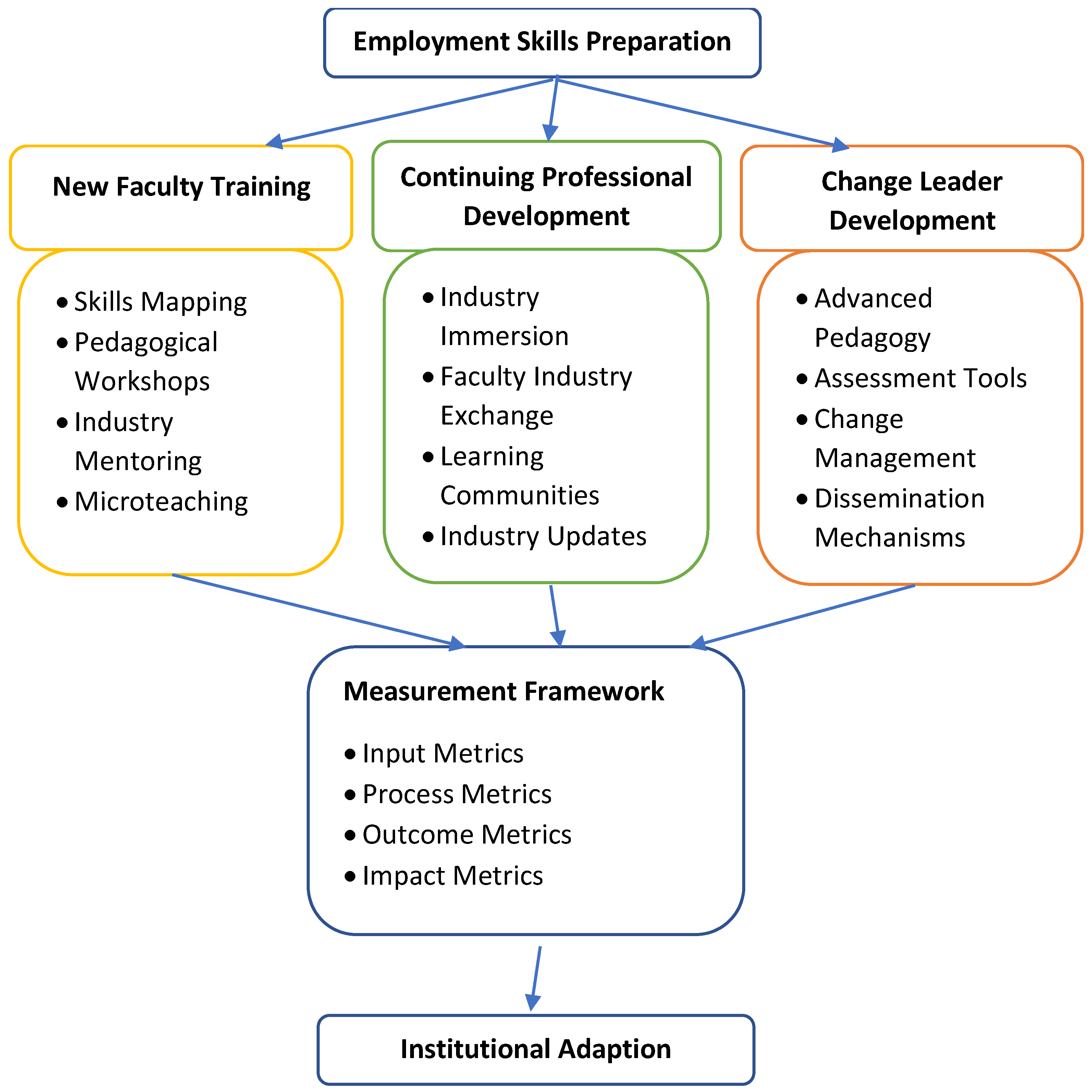
Based on our findings, we propose an Integrated Model for Faculty Development that directly addresses the barriers identified in our analysis, specifically the assessment gap (only 18% systematic evaluation), veteran faculty disengagement, and the recognition–resources paradox, while operationalizing the networked legitimacy approach that characterizes successful Israeli CTLs (see Figure 1).
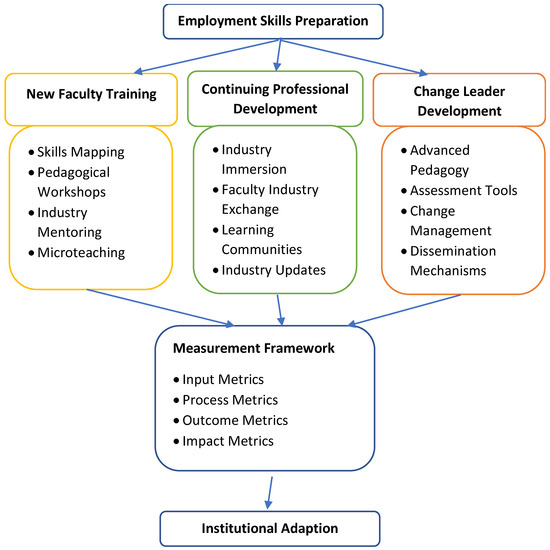
Figure 1.
Integrated Model for Employment Skills Faculty Development.
The model’s three interconnected circles derive from patterns observed in our data; the distinction between new and veteran faculty engagement strategies emerged from director accounts of differential participation rates, while the ‘change leader’ circle reflects the peer influence mechanisms through which networked legitimacy operates in practice. The measurement framework addresses the critical assessment gap our findings identified as constraining CTL effectiveness.
The first circle focuses on new faculty training through employment skills mapping, pedagogical workshops, and industry mentoring. The second circle addresses veteran faculty through industry immersion and learning communities. The third circle develops change leaders who serve as networked legitimacy agents, promoting employment skills integration among colleagues.
Supporting these three circles is a comprehensive measurement framework with four levels: input metrics assessing resource investment and participation rates, process metrics evaluating implementation quality, outcome metrics measuring immediate effects on teaching practices, and impact metrics assessing long-term effects on graduate outcomes.
This model addresses identified barriers while leveraging successful practices from international and local implementations. The emphasis on differentiated approaches for different faculty groups acknowledges the challenge of engaging veteran faculty, while the comprehensive measurement framework addresses the identified need for better evidence of effectiveness.
This Integrated model reflects the networked legitimacy approach that characterizes successful Israeli CTLs, emphasizing relationship-building and peer influence rather than top-down mandate. The model’s flexibility allows for adaptation to different institutional contexts while maintaining systematic attention to employment skills development across all faculty development activities.
7. Limitations
Several limitations merit careful consideration when interpreting our findings. First, privileging director perspectives, while yielding strategic insights into organizational decision-making, necessarily excludes the experiences of faculty who receive CTL training and students who are the ultimate beneficiaries. Although we mitigated this through extensive document triangulation and systematic analysis of divergent perspectives between current and former directors, recall bias and social desirability bias may affect retrospective accounts of program development. Future research should incorporate multiple stakeholder voices to validate whether CTL strategies actually impact teaching and learning outcomes, strengthening the ecological validity of findings regarding CTL effectiveness.
Second, while our single-country case study design enables deep contextual analysis of how CTLs operate within Israel’s distinctive higher education system, it limits direct generalizability to other national contexts. The Israeli context possesses unique characteristics, including its dual institutional structure, security–employment connections, start-up nation entrepreneurial culture, and mandatory military service, that may not exist elsewhere. Consequently, practitioners in other national contexts should approach our findings as transferable principles requiring contextual adaptation rather than directly replicable practices. We partially addressed these generalizability concerns through systematic contextualization within international scholarship and explicit identification of Israel-specific factors that may limit transferability. Comparative studies examining employment skills preparation across different national contexts would further refine the concept of networked legitimacy and its applicability across diverse settings.
Third, the cross-sectional nature of this research, focusing on current practices and retrospective accounts, precludes demonstration of long-term impact on graduate employability or career trajectories. Future studies should employ longitudinal designs tracking how specific CTL approaches affect employment outcomes across disciplines and institutional types over multi-year periods, evaluating whether the identified implementation models translate into sustained institutional change and improved student marketability.
Finally, the rapid evolution of employment landscapes, particularly due to artificial intelligence and automation, suggests that our findings represent a snapshot of current practices that may quickly become outdated. Longitudinal studies examining how centers respond to technological disruption would provide valuable insights for institutions navigating these dynamic environments.
Despite these acknowledged limitations, several factors strengthen confidence in our findings. The robust response rate across diverse institutional sectors, combined with systematic triangulation as detailed in the methodology section, provides strong empirical grounding despite acknowledged constraints. The analytical framework’s grounding in established institutional theory provides theoretical coherence, while the identification of three distinct implementation models demonstrates pattern recognition beyond individual cases. Most significantly, our conceptual contribution, networked legitimacy as an alternative pathway to organizational influence, emerges from systematic cross-case analysis rather than single-institution observation, suggesting theoretical generalizability despite empirical specificity to the Israeli context.
The Assessment Challenge: A Critical Policy Gap
The assessment gap identified in our findings represents a critical policy priority, defined here as an urgent area requiring immediate regulatory intervention to prevent resource misallocation, with only 18% of centers reporting systematic evaluation mechanisms for employment skills initiatives.
The lack of robust assessment mechanisms creates a vicious cycle where CTLs cannot demonstrate their effectiveness in preparing faculty for employment-oriented teaching, which in turn limits their ability to secure resources and institutional support. This challenge is most pronounced in research universities, where traditional academic metrics maintain primacy over employment-focused outcomes, and least severe in private colleges where market pressures create natural accountability mechanisms.
From a policy perspective, this assessment gap has three critical implications. First, it limits evidence-based decision-making about resource allocation for employment skills initiatives, as institutional leaders lack systematic data on program effectiveness. Second, it constrains the ability of CTLs to refine and improve their approaches based on outcome data, potentially perpetuating ineffective practices. Third, it undermines the credibility of CTL claims about their contribution to graduate employability, weakening their position in institutional priority-setting discussions.
Addressing this assessment challenge requires coordinated action across multiple levels. National policy makers should develop standardized frameworks for measuring employment skills development that can be adapted across different institutional contexts. Institutional leaders must invest in data collection systems that connect faculty development activities to student learning outcomes and employment success. CTL directors need training and resources to implement assessment methodologies that capture both immediate pedagogical changes and longer-term employment impacts.
The successful case studies in our research demonstrate that assessment systems are feasible and valuable when properly resourced and institutionally supported. However, the current widespread absence of such systems represents a critical barrier to the systematic improvement of employment skills preparation in higher education.
8. Conclusions
This study examined how Centers for Teaching and Learning in Israeli higher education prepare faculty to integrate employment-relevant skills, contributing both theoretical insights through the concept of networked legitimacy and practical guidance for resource-constrained educational contexts worldwide. Our findings demonstrate that despite operating with limited formal authority and resources, CTLs can achieve significant institutional influence through strategic relationship-building and adaptive innovation.
The key contributions of this research are threefold. Theoretically, we introduce the concept of networked legitimacy to explain how organizations achieve influence without formal hierarchical authority, extending institutional entrepreneurship theory to resource-constrained contexts. This concept helps explain how CTLs navigate the recognition-resources gap while maintaining effectiveness in employment skills preparation.
Empirically, we identify three distinct implementation approaches, embedded integration (47%), industry partnership (32%), and competency framework (21%), that centers employ to navigate institutional contexts and resource constraints. These models demonstrate how different institutional types develop complementary approaches to employment skills preparation, with research universities emphasizing cognitive-analytical skills while academic colleges focus on social-collaborative competencies.
Practically, our integrated faculty development model provides a systematic framework for enhancing CTL effectiveness through differentiated approaches for different faculty groups, supported by comprehensive measurement systems.
Beyond these specific contributions, our findings reveal how CTLs function as institutional mediators, bridging academic logic (prioritizing theoretical depth and disciplinary rigor) and market logic (prioritizing practical employability and skills application) while adapting international practices to local contexts. The successful implementations documented in our case studies demonstrate that structural and cultural barriers can be overcome through strategic leadership, effective incentive systems, and cross-institutional collaboration. The embedded integration approach, in particular, offers a viable strategy for resource-constrained contexts, achieving employment skills integration without requiring separate program infrastructure.
The emerging challenge of artificial intelligence presents both difficulties and opportunities for CTLs. As traditional knowledge transmission becomes increasingly automated, the distinctive value of higher education shifts toward developing complex cognitive, social, and self-management skills that remain difficult to automate. By positioning themselves as leaders in helping faculty navigate this technological transition, CTLs can strengthen their institutional role while preparing graduates for an increasingly automated workplace.
As higher education continues to face demands for greater alignment with employment needs, CTLs have the potential to serve as crucial agents of institutional transformation. Realizing this potential requires addressing the paradox of recognition without authority through more robust institutional positioning, resource allocation, and policy support. The networked legitimacy approach identified in our findings offers a pathway for CTLs to strengthen their influence through relationship cultivation and strategic partnership development rather than waiting for formal authority structures to change.
The implications extend beyond the Israeli context to other higher education systems facing similar pressures for employment relevance amid resource constraints, offering transferable frameworks for enhancing institutional responsiveness through strategic faculty development initiatives.
Author Contributions
Conceptualization, N.D. and N.B.; methodology, N.B.; software, N.B.; validation, N.D. and N.B.; formal analysis, N.B.; investigation, N.D.; resources, N.D.; data curation, N.B.; writing—original draft preparation, N.B.; writing—review and editing, N.D.; visualization, N.B.; supervision, N.D.; project administration, N.D.; funding acquisition, N.D. All authors have read and agreed to the published version of the manuscript.
Funding
The authors did not receive support from any organization for the submitted work.
Institutional Review Board Statement
The study was conducted in accordance with the Declaration of Helsinki, and approved by the Institutional Review Board (or Ethics Committee) of The Max Stern Yezreel Valley College (protocol code 2024-119 YVC EMEK; 7 July 2024) and by the Institutional Review Board (or Ethics Committee) of Ariel University (protocol code AU-SOC-ND-20240208; 8 February 2024).
Informed Consent Statement
Informed consent was obtained from all individual participants included in the study.
Data Availability Statement
The datasets generated and analyzed during the current study are not publicly available due to privacy protections for study participants but are available from the corresponding author upon reasonable request.
Conflicts of Interest
The authors have no competing interests to declare that are relevant to the content of this article.
References
- Amundsen, C., & Wilson, M. (2012). Are we asking the right questions? A conceptual review of the educational development literature in higher education. Review of Educational Research, 82(1), 90–126. [Google Scholar] [CrossRef]
- Ankrah, S., & Omar, A. T. (2015). Universities–industry collaboration: A systematic review. Scandinavian Journal of Management, 31(3), 387–408. [Google Scholar] [CrossRef]
- Autor, D., Mindell, D., & Reynolds, E. (2020). The work of the future: Building better jobs in an age of intelligent machines. MIT Press. [Google Scholar]
- Battilana, J., Leca, B., & Boxenbaum, E. (2009). How actors change institutions: Towards a theory of institutional entrepreneurship. Academy of Management Annals, 3(1), 65–107. [Google Scholar] [CrossRef]
- Beach, A. L., Sorcinelli, M. D., Austin, A. E., & Rivard, J. K. (2016). Faculty development in the age of evidence: Current practices, future imperatives. Stylus Publishing. [Google Scholar]
- Bills, D. B. (2003). Credentials, signals, and screens: Explaining the relationship between schooling and job assignment. Review of Educational Research, 73(4), 441–469. [Google Scholar] [CrossRef]
- Binkley, M., Erstad, O., Herman, J., Raizen, S., Ripley, M., Miller-Ricci, M., & Rumble, M. (2012). Defining twenty-first century skills. In P. Griffin, B. McGaw, & E. Care (Eds.), Assessment and teaching of 21st century skills (pp. 17–66). Springer. [Google Scholar] [CrossRef]
- Bitar, N., & Davidovich, N. (2024). Transforming pedagogy: The digital revolution in higher education. Educational Sciences, 14(8), 811. [Google Scholar] [CrossRef]
- Bitar, N., & Davidovich, N. (2025). From margin to center: Positioning centers for teaching and learning as strategic partners in Israeli higher education. Higher Education. [Google Scholar] [CrossRef]
- Braun, V., & Clarke, V. (2006). Using thematic analysis in psychology. Qualitative Research in Psychology, 3(2), 77–101. [Google Scholar] [CrossRef]
- Braun, V., & Clarke, V. (2019). Reflecting on reflexive thematic analysis. Qualitative Research in Sport, Exercise and Health, 11(4), 589–597. [Google Scholar] [CrossRef]
- Campbell, J. L., Quincy, C., Osserman, J., & Pedersen, O. K. (2013). Coding in-depth semistructured interviews: Problems of unitization and intercoder reliability and agreement. Sociological Methods & Research, 42(3), 294–320. [Google Scholar] [CrossRef]
- Cohen, A., & Davidovitch, N. (2022). The council for higher education in Israel model 2021: A retrospective look at more than six decades. Regulation Studies, 6, 233–272. (In Hebrew) [Google Scholar]
- Conley, D. T., Beach, P., Thier, M., Lench, S. C., & Chadwick, K. L. (2016). Measures for a college and career indicator: Career-readiness assessments in higher education. Educational Policy, 32(4), 547–578. [Google Scholar]
- Council for Higher Education. (2017). Multi-year plan for the higher education system 2017–2022. Council for Higher Education. (In Hebrew) [Google Scholar]
- DiMaggio, P. J., & Powell, W. W. (1983). The iron cage revisited: Institutional isomorphism and collective rationality in organizational fields. American Sociological Review, 48(2), 147–160. [Google Scholar] [CrossRef]
- Hatiba, N. (2002). Review of activities and institutions for teaching enhancement in higher education worldwide and a proposal for designing teaching centers in Israel. Al Hagova, 1, 48–52. (In Hebrew) [Google Scholar]
- McGuinness, S., Pouliakas, K., & Redmond, P. (2018). Skills mismatch: Concepts, measurement and policy approaches. Journal of Economic Surveys, 32(4), 985–1015. [Google Scholar] [CrossRef]
- Ministry of Social Equality. (2017). Digital Israel national initiative. Government of Israel.
- Scott, W. R. (2014). Institutions and organizations: Ideas, interests, and identities. Sage Publications. [Google Scholar]
- Sorcinelli, M. D., Austin, A. E., Eddy, P. L., & Beach, A. L. (2006). Creating the future of faculty development: Learning from the past, understanding the present. Anker Publishing. [Google Scholar]
- Spence, M. (1973). Job market signaling. The Quarterly Journal of Economics, 87(3), 355–374. [Google Scholar] [CrossRef]
- Stake, R. E. (2005). Qualitative case studies. In N. K. Denzin, & Y. S. Lincoln (Eds.), The sage handbook of qualitative research (3rd ed., pp. 443–466). Sage Publications. [Google Scholar]
- World Economic Forum. (2020). The future of jobs report 2020. World Economic Forum. [Google Scholar]
- Yin, R. K. (2018). Case study research and applications: Design and methods (6th ed.). Sage Publications. [Google Scholar]
- Yorke, M., & Knight, P. T. (2006). Embedding employability into the curriculum. Higher Education Academy. [Google Scholar]
Disclaimer/Publisher’s Note: The statements, opinions and data contained in all publications are solely those of the individual author(s) and contributor(s) and not of MDPI and/or the editor(s). MDPI and/or the editor(s) disclaim responsibility for any injury to people or property resulting from any ideas, methods, instructions or products referred to in the content. |
© 2026 by the authors. Licensee MDPI, Basel, Switzerland. This article is an open access article distributed under the terms and conditions of the Creative Commons Attribution (CC BY) license.