Skip to Content
Education SciencesEducation Sciences
  • Article
  • Open Access

9 February 2026

A Teaching–Learning Sequence Integrating Nature of Science and Scientific Inquiry: Design Implementation and the Role of Historical Experiments


,
and
1
School of Education, Aristotle University of Thessaloniki, 54124 Thessaloniki, Greece
2
Department of Primary Education, School of Humanities and Social Sciences, University of Thessaly, 38221 Volos, Greece
*
Author to whom correspondence should be addressed.

Abstract

This study investigates the development and impact of a teaching–learning sequence (TLS) designed for biology students with the aim of enhancing their understanding of key aspects of the nature of science (NOS) and the nature of scientific inquiry (NOSI). The TLS was developed within a design-based research (DBR) framework and centers on Griffith’s pivotal historical experiment to provide contextual depth and integrate both epistemic and non-epistemic dimensions of science. Instruction was based on explicit and reflective inquiry involving progressive scaffolding of students from structured towards more open investigative activities. An initial implementation with nine students, drawing on data from questionnaires and interviews, revealed their prior views regarding several NOS and NOSI aspects. Following the TLS, students demonstrated a more sophisticated understanding of the role of research questions in guiding experimental design, as well as a richer conception of scientific hypotheses. They also internalized the experimental logic underlying Griffith’s work and recognized the importance of creativity and imagination in scientific practice. The study discusses contextual limitations and highlights the potential of TLSs to provide robust instructional contexts, making NOS and NOSI aspects meaningful and accessible to students through historical experiments.

1. Introduction

Scientific literacy is widely recognized as a central objective of science education internationally and is commonly conceptualized as comprising four interrelated components (Henke & Höttecke, 2015; Höttecke et al., 2012; Kampourakis, 2016; N. G. Lederman et al., 2013). Achieving this aim requires that learners develop not only conceptual and procedural understanding but also informed views of the Nature of Science (NOS) and the Nature of Scientific Inquiry (NOSI).
NOS knowledge encompasses the characteristics that define science as a distinctive way of constructing, evaluating, and revising knowledge. It focuses on the epistemic features of scientific knowledge—its cognitive, methodological, and rational foundations (Aragón-Méndez et al., 2019)—as well as its non-epistemic dimensions, including the social, cultural, psychological, and historical factors that shape scientific activity (García-Carmona, 2021; García-Carmona & Acevedo-Díaz, 2017).
Complementarily, NOSI knowledge extends beyond procedural competence or the isolated mastery of process skills such as observing, inferring, classifying, predicting, measuring, or analyzing data. It focuses on the processes and norms through which scientific knowledge is generated and validated. NOSI emphasizes the epistemic logic of inquiry—why scientists work in particular ways, how investigative decisions are justified, and how claims become accepted within scientific communities (N. G. Lederman, 2018; Schwartz et al., 2008).
Research on teaching and learning NOS has expanded substantially over the past decades, offering valuable insights into students’ non-informed views of science and the difficulties they encounter in fostering informed views of its nature (Khishfe, 2023). A systematic review by Cofré et al. (2019) analyzing 52 intervention studies revealed that secondary students frequently hold non-informed views of the empirical and tentative nature of scientific knowledge, often perceiving science as the accumulation of absolute truths. Regarding NOSI, several studies consistently show that students often hold naïve or mixed views of how scientific knowledge is developed and validated, such as scientific inquiry as a fixed, linear, and prescriptive process rather than a flexible, context-dependent, and iterative enterprise (Penn et al., 2021; Senler, 2015; Yang et al., 2017). Despite the recognized importance of NOSI, explicit research on its teaching and learning remains comparatively limited.
While the epistemic dimensions of science have drawn considerable research interest, students’ views of its non-epistemic aspects remain underexplored (García-Carmona, 2021, 2025). Historical, cultural, institutional, and sociological influences have long influenced the development of scientific knowledge. However, traditional school science and textbook representations often portray science as a timeless, value-free endeavor conducted by isolated individuals adhering to a universal scientific method. This portrayal reinforces a narrow and idealized image of science that obscures its imaginative, creative, and socio-cultural aspects.
Integrating epistemic and non-epistemic aspects of science can help students appreciate scientific knowledge as a creative, human enterprise situated within broader cultural and societal contexts (Bell et al., 2012; Cheung, 2020; Gandolfi, 2019, 2021). Recent scholarship highlights the need for instructional designs that purposefully integrate both NOS and NOSI with disciplinary content. Researchers advocate explicit, structured instruction supported by clear learning goals, targeted activities, aligned assessments, and reflective prompts that encourage discussion and metacognition (García-Carmona, 2022, 2025).
Within this context, the History of Science (HOS) has emerged as a powerful resource. The findings of the study by Nouri and McComas (2021)—which includes a review of research examining or employing historical experiments and episodes in educational contexts—confirmed that HOS can serve as a valuable “vehicle” for communicating NOS, provided that the design of instructional interventions aligns with recommendations from the international literature advocating explicit and reflective approaches. Furthermore, the study notes the risk of reinforcing a naïve positivist view of science among learners if their engagement with history in the classroom remains superficial and lacks an activity framework that positions them as reflective and active participants (Kim & Irving, 2010; Nouri & McComas, 2021). Historical case studies enrich conceptual learning while deepening students’ understanding of NOS and NOSI (Höttecke et al., 2012; Nouri & McComas, 2021). They also illuminate the human character of scientific work, revealing how imagination, creativity, subjectivity, and sociopolitical forces contribute to scientific change (Henke & Höttecke, 2015).
Teaching–Learning Sequences (TLSs) offer a promising framework for addressing the observed deficiency in a balanced integration of both epistemic and non-epistemic aspects of science as they combine educational research and instructional innovation in an iterative, design-based manner (Psillos & Kariotoglou, 2016). TLSs provide robust instructional contexts capable of incorporating multiple research-informed strategies and theoretical perspectives, while being iteratively refined in response to students’ prior conceptions, reasoning patterns and learning difficulties.
Against this backdrop, the present study investigates the design, development, and implementation of an inquiry-based TLS that integrates curriculum content with both NOS and NOSI as well as non-epistemic aspects of science. The study further examines the impact of this TLS on students’ integrated understanding of aspects of science.

3. Designing a TLS Focusing on the Griffin Experiment

The design and implementation of the TLS were informed by a design-based research perspective. Specifically, we drew inspiration from the framework proposed by Guisasola et al. (2017, 2023) to articulate the nature of the scientific content and pedagogy, develop specific learning objectives, make explicit design decisions, and design an envisioned educational scenario. This approach aimed to render the TLS design process more explicit and transparent. In addition, we proceeded with the development of materials and implementation of the TLS, naming this phase as enactment instead of the original building (p. 6). Finally, we investigated students’ responses to do an initial evaluation of the TLS.

3.1. Focus on the Choice of Scientific Topic

This study focuses on designing a Teaching–Learning Sequence (TLS) that integrates aspects of the Nature of Science (NOS) and the Nature of Scientific Inquiry (NOSI) through historical experiments related to the discovery of DNA as the genetic material. The topic of genetic material is part of the content of the national biology curriculum in Greece, addressed to the third grade of Lyceum, which is the Greek general education high school. It is included in the relevant biology textbook used in the Life Sciences and Health specialization of the third grade of upper secondary education (Lyceum) in Greece. The relevant chapter of the official compulsory biology textbook includes topics like the chemical constitution and structure of DNA and the number and shape of chromosomes in humans and prokaryotic organisms. The TLS concerns the crucial historical experiment of Griffith, which is part of the chapter. Notably, this emblematic experiment appears often in the curricula worldwide since it was instrumental in advancing scientific knowledge, leading later to identifying DNA as the genetic material (Mader & Windelspecht, 2019; Urry et al., 2017).

3.2. Understand: The Nature of the Content and Students’ Conceptions

Educational Context: Greek Lyceum students typically experience traditional teacher-centered instruction in which the textbook plays a dominant role. The main text of the book is the following (Table 1) (Aleporou-Marinou et al., 1999):
Table 1. Extract from the official Biology textbook.
Due to contextual constraints, like available time, in the present TLS, we opted to focus only on Griffith’s experiment, identifying and examining the significant epistemic and non-epistemic aspects of this historical experiment, which are relevant to the present study and raise learning demands in relation to students’ conceptions, as we will further discuss.
Analysis of the textbook and the national curriculum reveals that the representations of Griffith’s experiment are presented sequentially as a descriptive narrative, with no substantial discussion of the scientific debates or community practices that shaped its development. In this context, the compulsory textbook plays a dominant role in the way science is taught. Consequently, the resulting image of science conveyed to students is one of an objective, ahistorical, logical and non-creative endeavor that advances through a straightforward progression of experiments or trial-and-error procedures.
Students, aged 17–18 years, enrolled in the strand Life Sciences and Health are typically preparing for university entrance examinations in health-related disciplines, such as Medicine and Pharmacology. They possess a solid theoretical background in natural sciences, specifically in biology, and are highly motivated to master the required demanding biological scientific content. They normally read the book chapter and memorize the described experiments as if they were abstract, decontextualized scientific facts. They generally have limited prior experience with inquiry-based approaches to science learning. They lack opportunities for active engagement and meaningful encounters with the nature of scientific inquiry. Such instruction reinforces students’ views about nature and the development of scientific knowledge in line with international research.
Epistemological Analysis: An epistemological analysis of Griffith’s experiment reveals its character and important consequences on the development of scientific knowledge concerning genetic material. Griffith’s investigations were conducted within the prevailing theory of early twentieth-century bacteriology, which generally held that proteins were responsible for heredity due to their apparent structural complexity and resulting functional diversity.
Working with Streptococcus pneumoniae, Griffith designed and performed three initial experiments examining the effects of non-virulent rough (R) and virulent smooth (S) strains on mice. These experiments produced rather expected findings. The fourth experiment, however, involving the mixture of live R strains with heat-killed S strains, resulted in the death of the mice. This was a highly unexpected result in the context of the prevailing theory of that time. These experimental findings constituted an experimental, conceptual, and epistemic “anomaly,” as they were incongruent with theoretical expectations and could not be explained by existing scientific models of heredity. Griffith rigorously verified and corroborated his findings, demonstrating their experimental reproducibility. Moreover, he made the inference that was that these results implied a transformation phenomenon caused by a stable, unidentified transforming factor capable of influencing and permanently altering phenotypes (Mader & Windelspecht, 2019; Urry et al., 2017). However, he did not identify the nature of this factor.
Griffith’s experiment is widely regarded as a pivotal and historically crucial experiment in Biology. It stands alongside other crucial experiments in the history of science, such as Millikan’s oil drop and the Michelson-Morley experiment. However, as Kuhn (2012) argues, these experiments are not purely objective “truth-tellers” but function as experimental “anomalies” that fundamentally challenge accepted conceptual frameworks, ultimately leading to a reconceptualization of core scientific concepts. Notably, from an epistemological perspective, this historical shift challenges the traditional widespread conception held by students and teachers that scientific progress is a linear process. It highlights that reconceptualization in scientific fields emerges from a dynamic interaction between “anomalous” findings, rigorous methodological refinement, debates within the scientific community, and subsequent theoretical re-evaluation.
Griffith’s work refers to several key epistemic and non-epistemic aspects of scientific practice (Mesci et al., 2020). It shows that scientific knowledge is fundamentally empirically based but involves inference, imagination and creativity, since Griffith did not stick to the data but went beyond them, employing imaginative reasoning to hypothesize an unobserved agent responsible for the phenomenon. Griffith’s work demonstrates that investigations do not necessarily begin with formal hypotheses. They often originate from an observation, a problem, or a pertinent, researchable question. Experimental manipulation must align with the research question, and scientific conclusions must be logically consistent with the data collected, revealing experimental rigor. From a non-epistemic perspective is an example of investigations placed in a specific historical context and framed within the prevailing conceptual frame.
This brief analysis illuminates the interplay between the sophisticated experimental abilities and reasoning of Griffith and the creativity and imagination demonstrated. It is also an exemplary case study showing that scientists work within specific socially and conceptually prevailing contexts. Together, these aspects shed light on several epistemic and non-epistemic aspects of scientific progress. However, in the context of the present study, it is neither feasible nor pedagogically productive to address every historical factor and event, given the available time, the background of participant students, and contextual constraints. Therefore, the focus is confined to Griffith’s experiment, examining certain significant epistemic and non-epistemic aspects of the Nature of Science (NOS), leading to considerable learning demands in relation to students’ conceptions. These aspects are summarized in Table 2. In the middle column of Table 2 are presented six important aspects, in the left column their reference to HOS, NOSI and NOS, and in the right column the relevant learning goals, which are presented further on (Section 3.3).
Table 2. Epistemic and non- epistemic aspects regarding Griffith’s historical experiment.
Students’ Views Concerning NOS and NOSI: As noted in the introduction, research consistently demonstrates that students’ understandings of both NOS and NOSI remain limited and resistant to change. Secondary students often fail to recognize the motivations that lead scientists to design experiments and therefore struggle to appreciate the epistemic role of experimentation in scientific research. They frequently have difficulty discerning the relationship between experimental design and the scientific questions or hypotheses that guide it, as well as the relationship between observations and their subsequent interpretation (Sandoval & Morrison, 2003). In a large cross-national study across 32 countries, J. S. Lederman et al. (2021) found that 12th-grade students typically display naïve understandings of NOSI, such as equating the mere performance of experiments with an understanding of the nature of scientific inquiry.
Many students believe that scientific investigations must begin with a hypothesis to be tested, without recognizing that inquiry often begins with a question that may or may not involve hypothesis testing. Learners frequently do not understand that research procedures are shaped by research questions, and they struggle to determine the relationship between these questions and the procedures used to investigate them. Consequently, they fail to appreciate that research questions structure experimental design and that the validity of research conclusions depends on the reliability of the data collected (Leblebicioglu et al., 2017; Mesci et al., 2020). Students also encounter difficulties distinguishing scientific data from scientific evidence. Although many acknowledge that these are distinct components of scientific inquiry, they are often unable to clearly articulate the distinction. Such views can persist even after instructional interventions intended to illustrate the diversity of scientific methods (Bell & Lederman, 2003; Khishfe, 2023).
Furthermore, students tend not to recognize the subjective and theory-laden aspects of science, nor do they appreciate that scientific knowledge emerges from diverse interpretations, assumptions, and perspectives. Evidence indicates that students’ conceptions of how scientific knowledge is produced and validated within the scientific community remain underdeveloped. In particular, they tend to overlook the roles of creativity and imagination in scientific investigations and discoveries (J. Lederman et al., 2019; J. S. Lederman et al., 2021).

3.3. Define: The Goals of the TLS

The constructive integration of Griffith’s pivotal experiment and subsequent discovery into the TLS can significantly enhance student understanding regarding the processes by which scientific knowledge is generated and how scientific inquiry is conducted. Furthermore, it enriches the curriculum by introducing complementary learning objectives related to NOS and NOSI. To immerse participants in Griffith’s experimental endeavor, a specific set of instructional goals was collaboratively developed by the authoring team and colleagues, informed by the arguments detailed in Section 3.2.
More specifically, the instructional goals of the TLS are:
(a)
To promote students’ understanding of how scientific inquiries originate, highlighting the roles of curiosity, observation, and problem identification in initiating investigation.
(b)
To support students in appreciating the function of scientific questions, and to recognize how such questions shape the trajectory of inquiry.
(c)
To develop students’ familiarity with the nature and function of scientific hypotheses, emphasizing their central role in structuring investigations and guiding data interpretation.
(d)
To enable students to design experimental procedures that allow for the systematic testing of hypotheses.
(e)
To help students distinguish between observation, the design and execution phases of experimentation, fostering awareness of how theoretical planning and practical implementation interact within scientific inquiry or hypothesis.
(f)
To enhance students’ recognition of the creativity inherent in scientific work, allowing them to view science not merely as a collection of facts but as a dynamic and imaginative process of investigation and discovery.
(g)
To promote students to understand that scientists face challenges and work within the prevailing theories and concepts of their time.

3.4. Conceive: Pedagogy and Educational Scenario

Pedagogical Approach: The TLS was developed through a participatory and developmental design process involving close collaboration between experienced teachers and researchers constituting the authoring team and involving other colleagues as well. This iterative, co-constructed approach ensured alignment between theoretical foundations and classroom realities through continuous dialogue that integrated the researchers’ scientific and epistemological expertise with the teachers’ practical knowledge of instructional contexts.
The inquiry-based approach adopted in this TLS is grounded in principles of social constructivism, which conceptualize learning as an active, socially mediated process. Students construct scientific understanding by engaging in authentic inquiry practices, collaboratively reflecting on evidence, and participating in knowledge-building activities characteristic of scientific communities. Social interaction within collaborative activities enhances the development of higher mental functions. Learning aspects of NOS NOSI is mediated through language interactions with peers and the teacher. Structured worksheets provide learners with scaffolding, enabling them to perform tasks they could not initially do independently. The integration of inquiry pedagogy with a social constructivist perspective is intended to foster student active engagement with investigative, experimental and linguistic tasks, leading to the accomplishment of procedural and epistemological goals central to this TLS.
Moreover, inquiry is based on explicit teaching, which has been shown to enhance students’ epistemological understanding. In this context, explicit instruction implies leading students’ consideration to key elements of NOS and of NOSI through guidance when they encounter required tasks (Capps & Crawford, 2013; (Karagianni & Psillos, 2022). Several approaches to explicit teaching, inquiry investigations and their characteristics related to the nature of NOS and NOSI have been implemented. Research suggests that the presence and elaboration of appropriate, carefully planned metacognition tasks, prompting reflection by students on their experiences with experimental and conceptual procedures and their nature, is essential for effective implementation (Leblebicioglu et al., 2017, 2020; Vorholzer et al., 2020).
The integration of elements from HOS within the TLS seeks to enhance students’ understanding of both NOS and NOSI by situating scientific concepts within their historical and epistemological contexts. Prior research demonstrates that incorporating HOS into science teaching provides a powerful pedagogical framework for explicitly contextualizing NOS and NOSI instruction through targeted activities that prompt students to reflect critically on scientific processes. The historical problems, questions, and conceptual challenges encountered by scientists can serve as meaningful contexts for student-centered inquiry activities that promote understanding of scientific content, the logic of research processes, and learners’ epistemological conceptions (Henke & Höttecke, 2015; Hosson & Kaminski, 2007; Höttecke et al., 2012). Such approaches help students appreciate not only the influence of epistemic factors on scientific practice but also the role of non-epistemic factors in shaping research (Gandolfi, 2021; García-Carmona, 2025; Kim & Irving, 2010). However, challenges for employing HOS (Henke & Höttecke, 2015) include issues related to lesson structuring and the risk of students developing misconceptions due to possible simplification of historical events, and difficulties in linking past theories with contemporary scientific concepts.
Design Principles: In the context of the theoretical perspectives, explicit designing principles were elaborated to guide the development of the TLS as follows.
(a)
Participatory, developmental design, involving teachers and researchers throughout all design, development, and evaluation phases.
(b)
Promotion of procedural, epistemic and non-epistemic learning, ensuring that students develop integrated understandings of scientific practices and ideas.
(c)
Integration of HOS to illuminate the historical and epistemic contexts in which scientific problems were formulated and investigated, thereby enhancing students’ understanding of aspects of NOS and NOSI.
(d)
Engagement with authentic, context-rich learning experiences, enabling students to work with genuine scientific problems and processes.
(e)
Adoption of an explicit and reflective Inquiry-Based Science Education (IBSE) framework.
(f)
Design of guided inquiry activities, supported by structured worksheets that scaffold students through the process of investigation.
(g)
Progressive scaffolding, moving students from guided toward more open inquiry as their competence develops.
(h)
Integration of simulated experiments alongside real laboratory investigations, ensuring accessibility while maintaining authenticity.
(i)
Use of collaborative learning structures, enabling students to exchange ideas, compare perspectives, and develop shared understandings.
Outline of Educational Scenario: Drawing Outline of the Educational Scenario.
Drawing on the analysis conducted in the preceding design phases, an innovative educational scenario was developed to represent the intended transformed content aligned with the objectives of the TLS within the specific educational context. By situating scientific investigations within their social and cultural context, the TLS highlights how non-epistemic factors influence the interests, motivations, and research aims of scientists such as Griffith. Central to this scenario is the analysis and reconstruction of Griffith’s experiment. Through virtual engagement with the four experimental pivotal investigations, students work with empirical evidence that serves as a foundation for constructing both epistemic and non-epistemic aspects of science. This engagement fosters a deeper appreciation of the empirical, tentative, and inferential nature of scientific knowledge, as well as the evolving processes through which scientific explanations are produced.
More specifically, in the first phase, the scenario is designed so that students, with teacher guidance, are gradually introduced to the historical context, dominant ideas, and scientific knowledge of the period in which the pivotal experiments were conducted. This step is essential, as research indicates that students often interpret historical experiments through the lens of contemporary scientific knowledge. Students’ initial conceptions about nature and the role of scientific hypotheses are elicited and discussed, and the motivations that guided Griffith’s experimental work are examined. Such familiarization is crucial, as historical inquiry differs fundamentally from the typical execution of decontextualized, “timeless” experiments commonly presented in traditional classroom instruction. Students with several years of biology education are expected to experience a form of cultural reach-out as they attempt to genuinely understand past scientific debates—particularly those concerning the nature of genetic material in this and the following phases.
In the next phase, students engage in experimentation by designing and reproducing the first three experimental studies conducted by Griffith. This process is supported by structured worksheets and digital technology that together create an engaging learning environment. Simulated interactive experiments allow students to meaningfully integrate historical scientific knowledge with experimental manipulation within realistic instructional time constraints. Additional scaffolding is provided for students with limited prior experience to help them engage effectively with structured and guided inquiry. Knowledge construction is mediated through technological tools, scientific language, *teacher- and peer-led discussion, and collaborative formulation of responses to experimental questions. Scaffolding embedded in the activity worksheets enhances students’ questioning and argumentation on the relationships between experimental actions and resulting outcomes, thereby promoting active learning. Through this process, students gradually develop the capacity to formulate research questions and hypotheses arising from their own observations of Griffith’s experiments, as exemplified in the enactment Section 4.2.
Students’ engagement in scientific inquiry culminates in the third and final phase of the scenario. In this stage, students examine Griffith’s fourth experiment, which yielded an unexpected result that fundamentally influenced scientific views about genetic material. They are gaining insights, attempting to interpret the unexpected results within the scientific understanding of the time. This phase is crucial: although students already know the modern explanation of the transformation principle, they must immerse themselves in the historical context and attempt to reason as Griffith might have—interpreting virtual data without the benefit of contemporary molecular knowledge. Students formulate hypotheses by interpreting the unexpected outcome of Griffith’s fourth experimental manipulation. With the support of guiding (scaffolding) questions, they recognize the need for Griffith to proceed with an additional investigative step—an extension of the fourth experimental manipulation—to test his hypothesis concerning this unexpected result. This step involved examining the blood of the dead mice and identifying the presence of “transformed” live smooth pneumococci. Although this step does not constitute an autonomous experimental manipulation in the strict sense, it was deliberately treated as such through didactic transformation. This design choice served to make explicit the different epistemic functions involved—namely, the experimental intervention leading to an unexpected result and the subsequent evidence-generating procedure aimed at hypothesis testing. This latter procedure typically attracts minimal student attention and is rarely perceived by students as an essential component of the fourth experimental manipulation. The scenario concludes with student reflection on Griffith’s investigation.

4. Research Methodology

4.1. Participants

The TLS was initially implemented with a group of nine biology students attending this strand, as presented in Section 3.1 and Section 3.2. All 9 students agreed to participate in this innovative approach to Griffith’s experiment, focusing on NOS and NOSI aspects.

4.2. Enactment of the TLS

The TLS consists of three modules, each comprising two 45 min sessions, for a total of six teaching hours, implemented over the course of one week (Table 3). The TLS is enacted following compulsory traditional instruction based on the textbook, which provides students with an essential acquaintance with the scientific content (Table 1).
Table 3. Structure and Duration of the TLS.
The core instructional materials include specially developed educational activities embedded within structured thematic worksheets aligned with the learning objectives of each module. The teacher’s version of the worksheets includes instructional suggestions and expected student responses. Typically, two worksheets correspond to each module. The activities are designed to foster student engagement through prompts encouraging active participation in individual tasks and collaborative work in small groups. Knowledge construction is supported through the use of scientific language, written responses, and whole-class, teacher-led discussions. Guidance is provided both within the worksheets and by the teacher, gradually assisting students in becoming familiar with and progressing through inquiry-based procedures.
The tasks are intentionally structured to scaffold students’ understanding through progressively deeper engagement with historical experiments and their epistemological implications. During implementation, the teacher monitored students’ work and provided assistance using a gradually fading approach, reducing support as students’ competence and independence increased. A brief outline of worksheet components follows.
  • Module 1: Historical Contextualization and Epistemological Activation.
The first module establishes the epistemic foundation for the subsequent inquiry activities and prepares students to meaningfully engage with historical experimentation.
Worksheet 1 begins with a textbook excerpt stating that scientists of the time believed that proteins, rather than nucleic acids, carried genetic information due to their greater structural diversity. Students are then asked: What was the scientists’ hypothesis about the molecules that carry genetic information? Can you formulate it? What reasons led scientists to assume that proteins, rather than nucleic acids, carried genetic information? These prompts are followed by a whole-class discussion led by the teacher on the nature and function of scientific hypotheses. Scaffolds help students decode textbook content and reflect on their own views of scientific hypotheses.
Worksheet 2 introduces Griffith’s research problem, asking students to articulate why he carried out his experiments, what he was seeking, and what they believe his purpose was. Once again, students engage in a discussion about nature and the role of hypotheses. Students also participate in a discussion concerning the influence of the social and cultural factors of the time on scientists’ research decisions, as well as the significance of the research question in research design (Griffith had a research aim and specific research questions he sought to answer). In a hypothetical scenario, and with the support of scaffolding, students describe the research trajectory they themselves would follow (materials and procedures) if they shared Griffith’s research aim. By developing their research design on paper and in groups, they refer to experimental materials and procedures that Griffith himself employed, thereby recognizing their necessity.
  • Module 2: Reconstruction and engagement with Griffith’s first three Experiments.
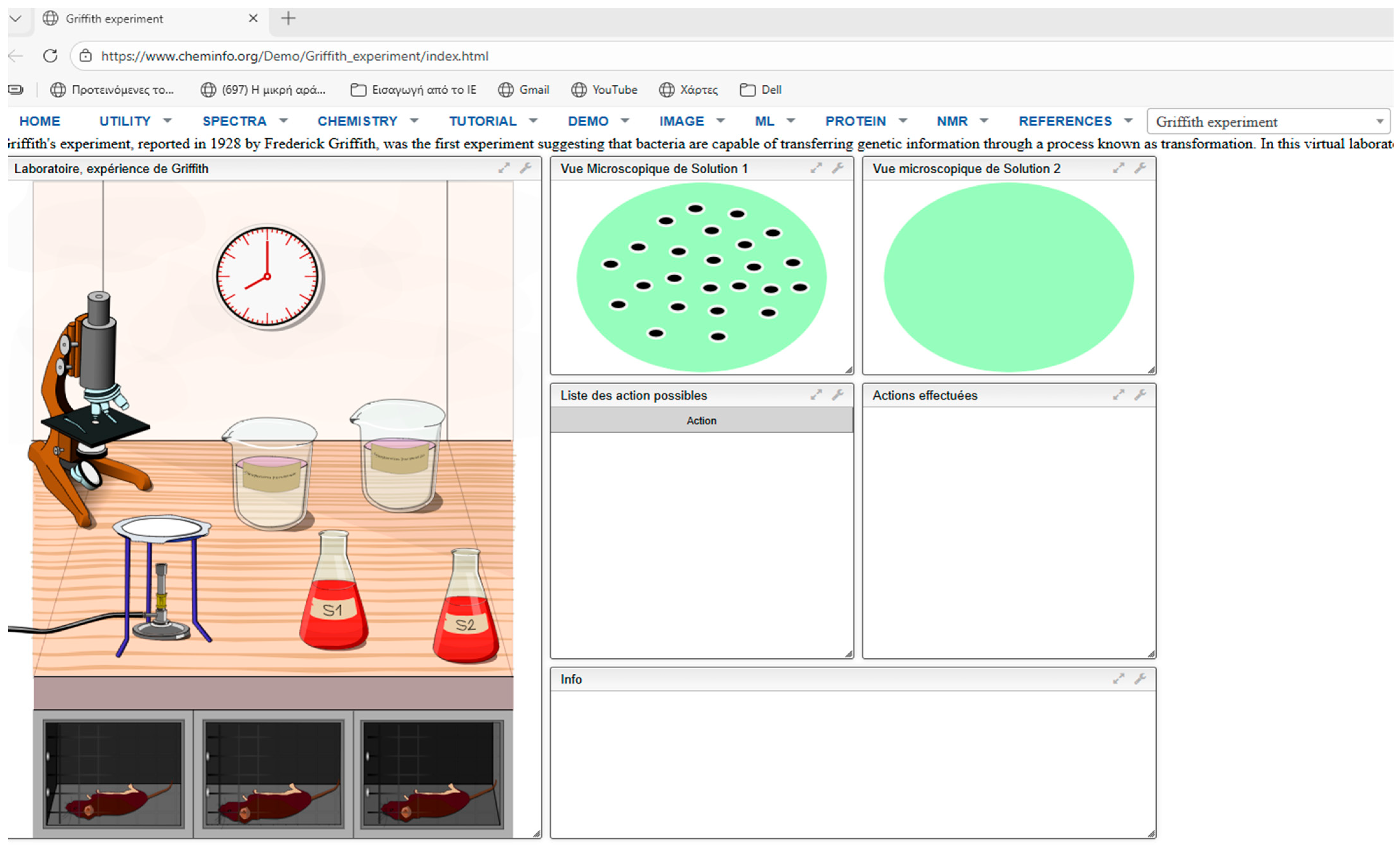
In Worksheet 3, students investigate Griffith’s first three experimental studies using an interactive simulation (Figure 1). This phase cultivates core inquiry skills such as questioning, prediction, experimentation, observation, and interpretation. Students learn that Griffith introduced S and R strains in the first and second experiments; the teacher then prompts them to formulate hypotheses explaining why Griffith conducted additional experimental investigations. Students predict outcomes, conduct the virtual experiment, and infer Griffith’s purpose.
Figure 1. Screenshot of the simulated experiment.
In Worksheet 4, students respond to questions prompting them to reflect on why Griffith performed further manipulations—particularly why he introduced heat-killed pathogenic bacteria into mice—and to explain why heating a suspension of living bacteria results in their death. http://www.cheminfo.org/Demo/Griffith_experiment/index.html (accessed on 29 January 2026).
As students work through these tasks, they begin formulating their own research questions based on their observations, engaging in authentic inquiry and connecting historical scientific knowledge with experimental manipulation within a manageable timeframe. Reflection and discussion follow the completion of Worksheet 4.
  • Module 3: Griffith’s Fourth Experiment and Construction of Scientific Hypotheses.
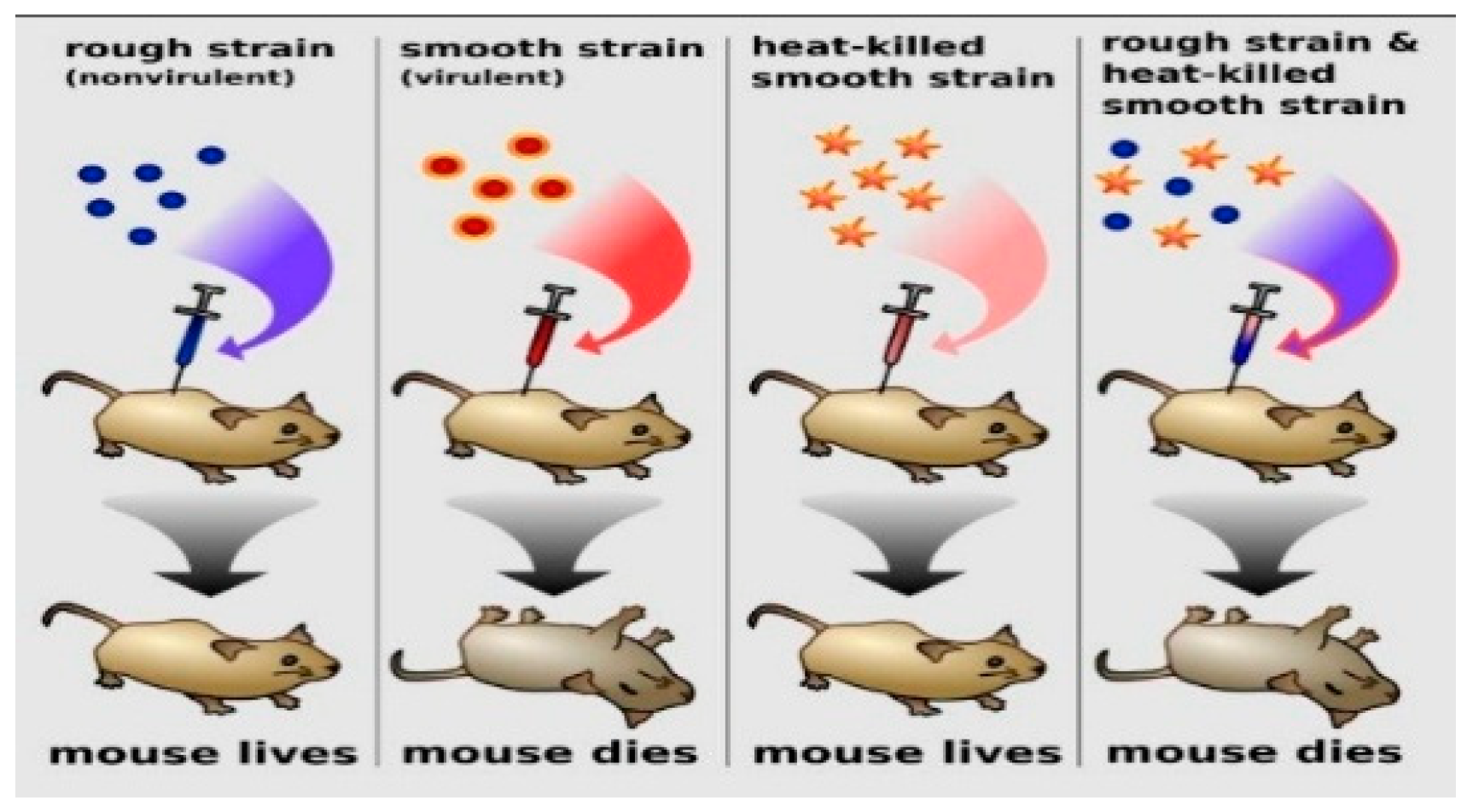
The third module focuses on Griffith’s fourth and most consequential experiment. Worksheet 5 guides students to articulate pertinent scientific questions, replicate the experiment in the virtual laboratory, interpret their findings, and reflect on Griffith’s original interpretation. Substantial time is devoted to designing and executing the virtual experiment, discussing results, and constructing a schematic representation of the “transformation principle” (Figure 2). The activities highlight the dual role of hypotheses in science: explaining observed phenomena and guiding the design of further investigations. In this instance, the students identify the final experimental manipulation conducted by Griffith, as described in detail in Section 3.4. Finally, following Worksheet 6, students are engaged in reflective discussions within groups and in the classroom on Griffith’s motivation, experimentation and findings.
Figure 2. Representation of the transformation principle. https://en.wikipedia.org/wiki/Griffith%27s_experiment (accessed on 29 January 2026).

4.3. Data Collection

Data was collected through a questionnaire and in-depth interviews. The questionnaire assessed students’ understanding of the procedural and epistemological aspects of Griffith’s five experimental manipulations and was administered before and after the TLS. It consisted of multiple-choice and open-ended questions and was refined through a two-stage review by a panel of experts, including the study’s authors, two experienced teachers with PhDs in Science Education, and an independent high-school biologist. During this process, items were reworded, removed, or added as necessary. The final instrument comprised eleven questions addressing the nature and role of scientific hypotheses, the research questions guiding Griffith’s manipulations, the rationale underlying these manipulations, the role of creativity and imagination, and the historical context of the experiments. All tasks are presented in the results and discussion section together with an analysis of students’ responses.
The interviews, lasting up to 30 min, were conducted before and after the intervention to allow participants to elaborate on their questionnaire responses and clarify their reasoning. The second author conducted all interviews and used probing questions to elicit deeper explanations and more nuanced understandings.

4.4. Data Analysis

The questionnaire responses were analyzed using descriptive statistical methods to identify patterns and trends. All interviews were audio-recorded, transcribed, and subjected to content analysis following a procedure like that described in previous publications (Schizas et al., 2020, 2023). Participants’ responses to each questionnaire item served as units of analysis, as these items guided the interview discussions around central themes or specific aspects of the TLS. A qualitative content-analysis was conducted using four analytically distinct but interrelated categories, which were later used as column headings in the analytical tables, were: Subject’ (epistemic or experimental issues discussed), Text’ (participants’ questionnaire responses and interviewer questions), Vocabulary’ (definitions of epistemic concepts), and ‘Ideas’ (participants’ assertions, assumptions and inferred reasoning related to epistemological and inquiry-related issues). The ‘Text’ category documented the empirical verbal category, while the subject category was used to classify the group textual responses according to the epistemic or experimental issues they addressed, thereby enabling meaningful comparison across participants and questions. The verbal material was further analyzed horizontally across table rows with interpretations articulated within the Vocabulary and Ideas categories, informed by their role as guiding analytical constructs. Intis way, theoretically defined NOS and NOSi dimensions were operationalized through these categories. The results presented in the following section reflect the synthesized outcomes of this integrative analysis.
Finally, interrater reliability was established through a two-stage calibration process using randomly selected subsets of the data. In the first round, all authors independently coded a 20% sample and then met to examine discrepancies, discuss interpretations, and refine the coding scheme until a shared understanding was achieved. A second round, conducted on an additional 20% random sample, yielded a 92% agreement rate. Following this calibration, the third author carried out the analysis of the remaining data set.

5. Results and Discussion

Data collected before and after implementation consist of students’ written and oral responses (transcribed) and are presented and discussed question-by-question in a qualitative manner in the following sections (Creswell & Creswell, 2018).

5.1. Understanding of Scientific Hypothesis Before and After TLS

The first question of the pre- and post-test was designed to probe students’ understanding of the concept of scientific hypothesis (Schizas et al., 2024):
  • The reason that led scientists to believe that proteins, not nucleic acids, are the molecules that carry genetic information is based on:
    (a)
    Unsupported speculation;
    (b)
    Prior knowledge and inference, i.e., reasoning based on that knowledge;
    (c)
    Experimental data that supports the hypothesis that proteins are the genetic material;
    (d)
    An educated guess;
    (e)
    Other.
In Question 1, students’ responses were mainly divided between two options that ultimately reflected a shared misconception about the nature of scientific hypotheses (McComas, 1996). Five out of nine students selected the view that the hypothesis pertaining to proteins carrying genetic information was an educated guess, while another three chose ‘other’. When asked during interviews to elaborate on their choice and clarify their position, these students consistently repeated the hypothesis found in the school textbook: that scientists during Griffith’s time believed proteins, rather than DNA, were the genetic material because proteins are made up of 20 amino acids, whereas DNA is composed of only four nucleotides.
However, when prompted to explain why this compositional difference led scientists to hypothesize that proteins were the genetic material of biological organisms, students encountered significant explanatory difficulties. None of them referred to the concept of information, nor did they attempt to reason about what it would mean for an organism to encode genetic instructions in a molecule composed of 20 versus 4 building blocks. Instead, all students framed their reasoning in terms of abstract notions such as complexity and diversity, often leading—explicitly or implicitly—to the tautological argument that the more complex or diverse proteins were considered the genetic material because they were more complex or diverse.
Considering this, no student succeeded in inferring the scientific hypothesis that proteins are genetic material from the prior knowledge that proteins have 20 amino acids and DNA only four nucleotides. For this reason, we classify their responses under the category of educated guessing, the sense of a non-scientifically grounded hypothesis, an intuitive or textbook-based explanation lacking inferential reasoning.
After the intervention, a marked improvement was observed. All students (8/8) correctly answered Question 1, acknowledging that hypotheses can be grounded in existing scientific knowledge and inferences.
This shift in understanding was clear in the interviews. When asked why scientists formulate scientific hypotheses, most students described hypothesis formulation as a process followed by empirical testing through experiments. A representative example comes from S6: “Scientists can formulate scientific hypotheses based on the analysis of scientific data … A scientist formulates a hypothesis before conducting an experiment because he wants to test this hypothesis with empirical findings.”
However, despite the progress in understanding how hypotheses are formed and their role in the structure of scientific inquiry (SI), difficulties persisted regarding why scientists in Griffith’s era believed that proteins, rather than DNA, were the genetic material. In the interviews, students’ responses largely mirrored those given during the pre-test: they cited the textbook explanation about the compositional difference between proteins and DNA but failed to explain why this difference led scientists to favor proteins as genetic material.
Only one student, S5, demonstrated partial engagement with the concept of information, moving beyond purely chemical or molecular complexity. Although she did not use the term “information” explicitly, she employed a near-synonymous concept—“instructions”—in her explanation: “Because proteins are a combination of 20 amino acids, while DNA is only 4 nucleotides. Scientists believed that proteins could give more accurate and detailed instructions to the cell than DNA…”

5.2. Griffith’s Experiment

5.2.1. The First Two Experimental Manipulations

Questions two and three of the questionnaire focused on the research questions behind Griffith’s first two experimental manipulations. They were phrased as follows:
2.
In the first experimental manipulation, Griffith injected mice with Diplococcus pneumoniae bacteria that had a capsule. Briefly state whether he intended to investigate a research question (if so, what was it—if not, simply state that there was no research question) and what the result was.
3.
In the second experimental procedure, Griffith injected mice with Diplococcus pneumoniae bacteria that did not have a capsule. Briefly state whether he intended to investigate a research question (if so, what was it—if not, simply state that there was no research question) and what the result was.
Students’ pre-test responses to these questions were varied. One student did not respond (S4), while another (S1) referred only to the experimental results. Two students (S3, S5) stated that Griffith did not have specific research questions in mind during these experimental manipulations. In the interview, S5 explained: “Personally, I believe that Griffith didn’t have something specific in mind before conducting the experiment; however, he had the hypotheses from other scientists, and through this experiment, he wanted to clarify what the genetic material was.” Similarly, S3 justified his response by pointing to what he perceived as a logical progression in Griffith’s experimental design: “I believe there wasn’t really a question here either [regarding the second experimental manipulation]—he was just continuing the line of experimental reasoning. After all, it was already known to those researchers that rough bacteria don’t cause harm to mice when injected… So, the outcome was already expected…”
Most students (5 out of 9: S2, S6, S7, S8, S9) answered that Griffith did have research questions about the pathogenicity of different bacterial types. However, in their interviews, they expressed uncertainty. A representative example comes from S6: “In reality, we can’t be sure. The book doesn’t mention anything clearly about whether Griffith had specific research questions when conducting his initial experimental manipulations…”.
Because the textbook offers no historical background on these experimental manipulations, all students in the interviews demonstrated limited awareness of the historical context in which Griffith’s work was conducted. When asked why Griffith investigated the pathogenicity of the two bacterial strains, students tended to retrospectively connect his experiments to the main scientific question of the time—and the central theme of the textbook section—namely, whether DNA is the genetic material of living organisms. The opinion of S9 illustrates this tendency: “I don’t think anything in science happens by accident, and obviously, he must have had something in mind—probably to prove that DNA is the genetic material. That’s why he did these experiments with mice, and most likely why he used two different strains… maybe to draw a more definitive conclusion about DNA, I don’t know…”.
These responses reveal a misconceived view of SI in student reasoning. Students projected retrospective scientific knowledge—such as the identification of DNA as the genetic material of living organisms—onto Griffith’s original intentions and demonstrated a kind of teleological thinking, in which Griffith’s experimental manipulations were seen as steps intentionally designed to reach a known end goal (e.g., proving that DNA is the genetic material).
This form of hindsight bias is reinforced by the way the textbook presents Griffith’s experiment. It depicts Griffith’s historical discovery of bacterial transformation as a stepping stone in a linear progression toward modern knowledge (e.g., DNA as the genetic material) and portrays his experiment as if it were purposefully designed to confirm such ideas.
As a result, students tended to treat Griffith’s experiment as part of a larger, coherent narrative aligned with the content of the textbook chapter in which it is presented, focusing on issues related to DNA as the genetic material. This perspective not only obscures the epistemic modesty and uncertainty characteristic of Griffith’s original inquiry but also oversimplifies the historical complexity of how new scientific knowledge is generated, interpreted, and accepted.
These findings highlight the need for instructional approaches that can challenge students’ retrospective and teleological thinking, fostering their capacity to reason from within the historical context of scientific inquiry. Our instructional strategy, grounded in the history of science (HOS), invited students to reason from the conceptual standpoint of Griffith as a scientist working in his own time and helped them develop a more authentic understanding of his first two experimental manipulations.
Indeed, students’ post-test responses showed significant improvement. In Question 2, six students (S1, S4, S5, S6, S7, S9) accurately identified the research question as an investigation into the pathogenicity of the smooth strain and reported that the mice died as a result. The remaining three students (S2, S3, S8) provided additional historical context, referencing Griffith’s background in immunobiology and his broader goal of developing a pneumonia vaccine. For example, in her interview, S3 stated: “Since we learnt that he was an immunobiologist, the question he had was which of the two strains was pathogenic… he wasn’t expecting a particular result… he conducted experiments because he wanted to develop a vaccine…”.
Similarly, in response to Question 3, all students identified Griffith’s research question as concerning the pathogenicity of the rough strain of Streptococcus pneumoniae, with the expected outcome being the survival of the mice. S2 and S8 again emphasized the vaccine-development context, situating Griffith’s work within its historical era.

5.2.2. The Third Experimental Manipulation

Questions four and five of the questionnaire focused on Griffith’s third experimental manipulation:
4.
In the third experimental manipulation, Griffith injected mice with heat-killed (smooth) bacteria that had a capsule. Griffith carried out this experiment:
(a)
Because he was trying to answer a research question.
(b)
Because he was running various tests on bacterial strains without having a specific research question in mind.
(c)
Without any reason, this experiment could have been avoided, since it is widely known that dead microorganisms do not cause disease.
(d)
Other.
5.
Describe how Griffith attempted to kill the bacteria and why the bacteria died.
Regarding question 4, most students (5 out of 9: S3, S5, S7, S8, S9) viewed Griffith’s third experimental manipulation as just another test in a series of trials with Diplococcus pneumoniae strains—an experiment conducted without a clear research question. In his interview, S3 even suggested that this manipulation could have been omitted: “[Griffith] was running tests without a question in mind, and since he already knew the outcome, he could have avoided it altogether, because it is known that dead microorganisms don’t cause disease.”
A smaller group of students (4 out of 9: S1, S2, S4, S6) than those who had earlier asserted that Griffith’s first two manipulations were guided by research questions, believed that a research question was present in this third manipulation. However, even these students were unable to articulate what that question was during the interviews.
Student responses to question 5 were quite varied. Two students (S1, S4) did not respond at all, while three others (S2, S3, S5) noted that Griffith used heat to kill the bacteria. However, none of them explained why heating kills bacteria, and in several cases, their explanations amounted to tautologies. For instance, S3 stated: “He used heat to kill the smooth bacteria. And that’s why they died.” Similarly, S5 explained: “Griffith heated the bacteria to very high temperatures. Since they can’t survive at those temperatures, they died.”.
To offer a meaningful explanation, students need to move beyond experiential or phenomenological descriptions, focus on the cellular level and provide mechanistic explanations. Only four students (S6, S7, S8, S9) began to move in that direction, attempting to link heating to the denaturation of bacterial proteins. They correctly identified protein denaturation as a cause of bacterial death, but their reasoning remained incomplete. For example, S8 explained: “… he heated them … and since with an increase in temperature… bacteria have proteins, and those proteins denature, the bacterial cells were destroyed.”
Reconstructed in a formal logical structure, S8’s reasoning yields the following incomplete explanatory argument:
  • Premise 1: Bacteria contain proteins.
  • Premise 2: Proteins denature when exposed to high temperatures.
  • (Missing Premise): Denatured proteins can no longer maintain cellular integrity (if structural) or carry out vital metabolic functions (if functional, e.g., enzymes).
  • Conclusion: Therefore, heating destroys bacteria.
For a more complete and logically sound explanation, students need to describe how protein denaturation leads to death—specifically, how it disrupts cellular structures or results in the loss of vital functions such as respiration (in which proteins act as enzymes catalyzing essential chemical reactions), and what this loss implies for the living organism (e.g., how the loss of respiration ultimately deprives the organism of the energy needed to sustain life).
Although students had been previously taught about life functions, protein biochemistry, and denaturation—as outlined in the national curriculum—they nonetheless remained at the level of memorized facts (e.g., “heat denatures proteins”) and struggled to construct mechanistic explanations connecting molecular events to cellular and organismal consequences.
After the instructional intervention, post-test results showed both improvement and persistent difficulties. Most students (8 out of 9: S2, S3, S4, S5, S6, S7, S8, S9) recognized that Griffith’s third experimental manipulation was conducted to answer a research question. In interviews, they linked this manipulation to Griffith’s broader goals, such as vaccine development or his immunological interest in whether bacterial death affects pathogenicity. However, when asked why Griffith specifically investigated the pathogenicity of heat-killed smooth bacteria, they were unable to provide a clear explanation—even though the research question had been explicitly addressed in instruction.
These findings suggest that while students developed a better appreciation for the role of research questions in experimental design, they still lacked a deeper conceptual understanding of how specific research questions are related to specific experimental manipulations, especially within instructional contexts that draw on historical narratives.
The difficulties students encountered in explaining why Griffith tested the pathogenicity of heat-killed smooth bacteria point to a broader issue: the challenge of engaging students with the historical epistemic context of past scientific practices. Students need support in fusing their own conceptual frameworks with the interpretive horizons of historical scientists, especially when this fusing is impeded by contemporary and rather common-sense generalizations, such as that “dead organisms are not pathogenic”. In Griffith’s time, it was not yet known that dead organisms do not cause disease. His aim was to determine whether the pathogenicity of smooth bacteria was due to the living organisms themselves or to heat-resistant chemical substances within bacteria.
Students’ responses to Question 5, both in the post-test questionnaire and during interviews, were quite similar to those in the pre-test. Although more students identified protein denaturation as the result of heating the smooth bacteria and the cause of bacterial death, their responses revealed persistent difficulty in constructing complete and coherent mechanistic explanations free from circular logic or conceptual gaps.
Some students (S2, S3, and S7) attempted to causally link protein denaturation to the breakdown of cellular structure, drawing on their knowledge that some proteins play structural roles. However, they were unable to explain why denaturing these proteins causes cellular breakdown, reiterating, in most cases, their initial incomplete explanatory argument.
Only one student (S5) followed another route, linking heat-induced protein denaturation to the loss of life-essential cellular functions, ultimately resulting in bacterial death. In her own words: “[Griffith] heated the smooth bacteria… they… died as a result. This happened because … proteins undergo denaturation above a certain temperature, so the bacteria can no longer perform cellular functions, and thus they die.” Yet when prompted to specify a biological function and why its loss would be fatal, she was unable to elaborate, revealing an incomplete grasp of mechanistic reasoning.
These ongoing difficulties in explaining why heat causes bacterial death underscore a well-documented challenge in science education: students often struggle to build multi-level explanations that involve processes belonging to different organizational levels, such as molecular, cellular, and organismal (Tsui & Treagust, 2003; Schwartz et al., 2004). Their reasoning often remains largely empiricist and based on rote recall of already known scientific information.

5.2.3. The Fourth Experimental Manipulation

Questions six and seven of the questionnaire focused on Griffith’s fourth experimental manipulation and were phrased as follows:
6.
In the fourth experimental manipulation, Griffith injected mice with a mixture of heat-killed (smooth) bacteria with capsules and live (rough) bacteria without capsules. Briefly state whether he intended to investigate a research question (if so, what was it—if not, simply state that there was no research question) and what the result was.
7.
The results that Griffith obtained in the fourth experimental manipulation:
(a)
Were expected by Griffith based on the design of the overall experiment and earlier results during his previous experimental manipulations.
(b)
Were unexpected by Griffith based on his experimental design and the outcomes of his previous experimental manipulations.
(c)
Were unexpected not only by Griffith but also by the broader scientific community of the time, based on the contemporary knowledge.
(d)
We cannot know whether they were expected or not—the only thing that matters is the outcome of the experiment.
In response to question 6, two students (S1, S4) did not provide an answer, while another two (S3, S7) stated that there was no research question, mentioning only the outcome of the experiment. Most students (5 out of 9: S2, S5, S6, S8, S9), however, indicated that Griffith did have a research question in conducting the fourth manipulation. While their responses were often hesitant or vague, they generally believed that Griffith aimed to explore the interaction between the heat-killed smooth bacteria and the live rough bacteria in relation to pathogenicity. A representative example comes from S6, who remarked: “…I can’t get into Griffith’s mind, but I believe that… he just… wanted to continue his experiments. And he probably wanted to see if the interaction of the two bacteria, the two strains, would have a different result from just injecting the heat-killed smooth bacteria into the organism…the result was … the mice died… and we can say that luckily, he did this experiment.”
Additionally, some students connected their belief that Griffith had a research question to the broader scientific question of the time and of the textbook unit. For example, S2 explained in her interview: “… [H]e wanted to conclude that DNA is the genetic material… and [the textbook] doesn’t clarify anything further. I mean, it just explains to us…what he did in the experiments, without telling us why he made each move… some rough ones were transformed into smooth ones, and the mice were killed…”.
These responses are consistent with the findings concerning students’ responses to previous questions (2 and 3) and ensure that many students conflicted with Griffith’s original research objectives with the retrospective framing provided by the textbook narrative, which is centered on DNA as the genetic material.
In response to question 7, one student did not answer, while two students (S8, S2) selected option (d), stating that it is not possible to determine whether the results were expected or not. S2’s interview response illustrates this view: “…The textbook doesn’t tell us whether he expected it or not, because the result was that he didn’t draw any conclusion [about the identification of DNA as genetic material] from it. Other researchers were the ones who drew the conclusion. So, he didn’t reach any finding after all that. We can’t know whether it was expected or not.”
Most students (7 out of 9: S1, S3, S4, S5, S6, S7, S9), however, assessed the results in the fourth experimental manipulation as unexpected. Notably, none of them linked Griffith’s sense of surprise to the logic of the experimental sequence itself and the outcomes in the previous experimental manipulations. Instead, they attributed the unexpected nature of the results to the prevailing scientific beliefs of the era—specifically, the widespread assumption that proteins, not DNA, were the genetic material. This is, for example, clearly illustrated in S3’s interview comment: “Yes, I believe that the results were not expected—neither by Griffith nor by the scientific community of the time—because the outcomes of his experiments marked a major step in the discovery of genetic material, and nothing similar had happened in previous years. That’s why I believe they were unexpected.”
These responses ensure the presence of hindsight bias and teleological reasoning in students’ engagement with the historical experiment of Griffith. Rather than reasoning forward from the design, logic and implementation of Griffith’s sequential manipulations, most students reasoned backward from the known outcome—that the experiment contributed to the eventual discovery that DNA is the genetic material. This backward-looking perspective led them to evaluate the result of Griffith’s fourth experimental manipulation as unexpected, not based on Griffith’s immediate expectations or the experimental results available to him during the previous experimental manipulations, but rather on their awareness of the scientific shift that followed decades later.
Regarding Question 6 of the post-test questionnaire, all students recognized that Griffith was guided by a research question in designing the fourth experimental manipulation. However, when asked to articulate that question, several students offered vague or erroneous responses. For example, student S3 acknowledged that Griffith had a research question but did not specify its content and instead suggested that the fourth experimental manipulation merely followed the logical progression of his prior manipulations. Similarly, S1 gave an inaccurate response: “He wanted to investigate the same question as in the third experiment…whether the dead smooth bacteria were lethal… and the result was that …mice died.” Remarkably, this response overlooks the critical difference in design between the third and fourth manipulations: the addition of live rough bacteria to the heat-killed smooth strain. This change in experimental setup introduced a new variable—one that S1 should have recognized as altering the logical structure of the experiment.
In contrast to the above responses, most students (7 out of 9: S2, S4, S5, S6, S7, S8, S9) interpreted Griffith’s research question as exploring the outcome of combining live rough bacteria with heat-killed smooth bacteria and injecting them into the mice.
In question 7 of the post-test, all students evaluated the results of the fourth experimental procedure as unexpected, demonstrating varying degrees of understanding of both Griffith’s earlier experimental results and the broader historical context.
Most of these students (7 out of 9: S1, S2, S3, S5, S6, S7, S9) correctly attributed the unexpected nature of the outcome to the results of Griffith’s previous experimental manipulations. In the words of S6 and S3:
S6: “They were unexpected, not only for Griffith but for the entire scientific community. Since he had killed the smooth bacteria, which were the pathogenic ones, and mixed them with non-pathogenic ones, he assumed they wouldn’t cause death, given that he knew he had mixed two non-pathogenic strains.”
S3: “They were unexpected … in the fourth experimental manipulation, he would have expected that the mice wouldn’t die, because the smooth bacteria had been killed by heating and didn’t cause death in the mice, while he knew that the live rough ones are non-pathogenic”.
Other students, such as S8 and S4, characterized the outcome as unexpected but grounded their reasoning in the limited knowledge of the scientific community at the time, particularly their lack of awareness of bacterial transformation. As S8 stated: “I chose that the results were unexpected, because in general they didn’t expect those outcomes, since at that time they had less knowledge than we do now—and just like with proteins, they believed something similar about the experiments Griffith conducted. That is, they didn’t expect that by introducing dead smooth bacteria, the rough ones would transform and become live smooth ones”. Similarly, S4 noted: “The results he got in the fourth experimental manipulation were unexpected, not only for Griffith but also for the scientific community of the time, because he didn’t know that transformation could occur.”.
Their responses reflected an effort not only to situate the unexpected outcome within the broader epistemic limitations of the time but also to reinterpret it in light of subsequent developments (fifth experimental manipulation)—namely, the discovery of bacterial transformation. Thus, even after our instructional intervention, some students’ reasoning remained retrospective, proceeding backward from the future to the past rather than forward from the past to the future, as the notion of historicity would require.
Our intervention addressed this notion by presenting Griffith’s experimental manipulations as historical episodes and by emphasizing the role of time as a variable in the transformation process, particularly within the virtual lab environment used during instruction. While working in the simulation-based environment and guided by structured worksheets, all students expressed surprise and excitement upon discovering that time played a crucial role in transforming live rough bacteria into live smooth forms during Griffith’s fourth experiment.
Their worksheet responses and behavioral observations, documented by the researcher acting as participant-observer, revealed the following pattern: during their simulated replication of Griffith’s fourth experimental manipulation, students initially observed that the mice did not die, contradicting the outcome they had previously learned from the textbook. Confronted with this discrepancy, and prompted by worksheet activities, students intervened by adjusting the time variable using the simulation’s built-in timer. They advanced the timer by several hours and repeated the injection of the bacterial mixture. Upon doing so, they observed that the mice did die, thereby aligning the simulation with the historically recorded experimental outcome.
These students’ experience suggests that engaging them in simulated experimentation with manipulable variables, combined with structured guidance, can foster deeper conceptual understanding and promote meaningful engagement with historical scientific reasoning.

5.2.4. Griffith’s Final Experimental Manipulation

Questions eight and nine of the questionnaire focused on the final experimental manipulation conducted by Griffith. The items were as follows:
8.
Griffith’s final experimental manipulation:
(a)
It resulted from random testing conducted by Griffith.
(b)
It stemmed from the experimental plan Griffith had designed at the outset random.
(c)
It emerged because of the results obtained from the previous experimental manipulation.
(d)
It was the outcome of Griffith’s interpretation of the results from the previous experimental manipulation.
9.
In his final experimental manipulation, Griffith:
(a)
Expected a particular result based purely on intuition, though this expectation played no role in how the experiment was designed.
(b)
Expected a result based on earlier experimental procedures, and this expectation guided his design of the new experiment.
(c)
Had no expectations and simply waited to observe the outcome—if he had expected a result, he would not have performed the new experiment.
(d)
We cannot know whether he had a hypothesis, and if he did, it is irrelevant—only the resulting outcome matters.
In response to these questions, none of the students correctly identified the final experimental manipulation as Griffith’s final procedure. Instead, all students interpreted the fourth manipulation as the last in the experimental sequence, and their responses to Questions 8 and 9 were therefore not evaluated.
This misconception likely stemmed from students’ failure to recognize the outcome of the fourth experimental manipulation as unexpected and in need of explanation. Griffith formulated a hypothesis to explain this outcome and designed a follow-up inquiry process, namely the final experimental manipulation, to test this hypothesis. In overlooking such steps, students missed a key feature of the logic behind scientific inquiry and Griffith’s fifth manipulation in particular: the way that surprising results generate new questions and guide further experimentation.
We hypothesized that if students had recognized the fourth manipulation’s results as unexpected and understood that Griffith responded by formulating a scientific hypothesis and designing a subsequent experiment to test this hypothesis, they might have been better equipped to identify the final procedure as a distinct and purposeful part of the overall experimental sequence.
Supporting our instructional intervention with this hypothesis proved beneficial. After its implementation, all students correctly identified the fifth procedure as Griffith’s final experimental manipulation and selected the correct answer to Question 8, recognizing that it stemmed from Griffith’s interpretation of the previous results. For example, S2 explained: “The last experimental procedure was a result of Griffith’s interpretation of the previous results… Griffith hypothesized that the live rough bacteria were transformed into live smooth ones…took blood samples from the mice and found live smooth bacteria there, which means that transformation had occurred.”
Similarly, in response to Question 9, all students stated that Griffith anticipated a specific outcome—namely, the presence of live smooth bacteria in the blood of dead mice—and that this expectation guided the design of the final experimental manipulation. S6 articulated this understanding:
“Before conducting the final procedure, he expected a result based on his fourth manipulation. The expected result was that he would find a pathogenic strain in the blood, since the mice had died—and he wanted to investigate exactly what had caused their death.”
These responses suggest that students’ ability to reconstruct the logic of Griffith’s experimental progression improved significantly once they were supported in recognizing the unexpected nature of the fourth experiment’s outcome. Our instructional strategy to prompt students formulate hypotheses in response to this outcome played a crucial role in helping them perceive the fifth manipulation as the final one.
In the context of our instrumental intervention, a mutual relationship between procedural and NOSΙ knowledge was established: explicit instruction on the concept of scientific hypothesis reinforced procedural awareness, while simultaneously this awareness fostered deeper epistemological insight into NOSΙ knowledge. Several students began to express a more sophisticated understanding of scientific hypotheses and their role in scientific inquiry processes—as testable explanations guiding the design of subsequent experiments.
However, traces of retrospective and teleological reasoning persisted. For instance, S5 stated: “He saw that the mice died after a while, so Griffith concluded there was some substance and wanted to confirm it through the blood of the mice—the one transferred.” Similarly, S8 added: “He took the blood from the mice and identified the components it contained. He chose some of those components found in the blood as the cause of bacterial transformation”.
These interview responses indicate that, even after our instructional intervention, some students continued to view Griffith’s experiment through the retrospective lens of the textbook narrative, which centers on the inquiry processes that identified DNA as the genetic material. Although this perspective shaped how students understood multiple aspects of Griffith’s experiment—and was explicitly addressed by our intervention across all these aspects—it proved highly resistant to change.

5.3. On the Nature of Experimentation and the Role of Imagination and Creativity in Griffith’s Work

Questions 10 and 11 of the questionnaire addressed students’ perceptions of the nature of scientific experimentation and the role of imagination and creativity in Griffith’s experiment. The questions were phrased as follows:
10.
In biological experiments, researchers:
(a)
Follow a strictly defined sequence of investigative steps determined by the nature of the experiment.
(b)
Follow a sequence of steps determined by the initial design of the experiment.
(c)
Follow a sequence of steps guided both by the original design and by how the experiment unfolds (e.g., the presence of unexpected results).
(d)
Proceed through an investigative process of ongoing trials, evaluation of results, and revision through new trials, and so on.
11.
In Griffith’s experiment:
(a)
Logic plays a major role, but imagination and creativity are essential at all stages—from interpreting results to designing experimental procedures.
(b)
Logic plays a major role, and imagination and creativity are entirely absent, since Griffith had to remain objective.
(c)
Logic plays a major role, while imagination and creativity play a minor one, since experimental design is a strictly logical process.
(d)
Imagination and creativity played the central role, while logic played a minor one.
In response to Question 10, no student selected options (a) or (b), which portray experimentation as a strictly predetermined sequence. Instead, most students chose options (c) or (d), reflecting an understanding of scientific inquiry as a dynamic and adaptive process, in which researchers revise procedures in response to emerging results.
A representative response came from S3, who stated: “… depending on the experiment, the research process may differ. In many cases, after the design of the experiments and the course of the experiment, there may be results that the researcher did not expect, but I believe that there is also a specific research process. I don’t think everything is done randomly… that is, there are ongoing tests, evaluations, and new tests until the result is found.”.
However, some student interpretations revealed misconceptions of SI. For example, S6 and S7 interpreted Griffith’s experimental flexibility as a product of individual agency rather than as an inherent aspect of the scientific method, attributing an element of randomness to the process. In their words:
S6: “… Griffith was one of the few researchers who aimed to find more information about genetic material, so the process was a bit more open—not so fixed. In addition, he was working alone at first, so I think he added his own elements into the experiment.”
S7: “Griffith followed a research process of trials to prove that DNA was the scientific material… [involving] ongoing testing, evaluation of those tests… [In this process] certain outcomes emerged, and those led to new trials…”
Despite the retrospective rationalization already discussed, these students share an individualized view of SI. This perspective reflects a tendency to attribute scientific development to the voluntarism of individual scientists, which in turn implies a sense of randomness in the scientific method.
In Question 11, students’ responses revealed notable variation in their views about the role of imagination and creativity in scientific inquiry. With the exception of one student (S7), who selected the view that imagination and creativity played the primary role in Griffith’s experiment while logic played a minor one, the majority believed that imagination and creativity were either entirely absent (S1, S4, S8) or played only a minimal role (S2, S5) in the design of the research.
This pattern indicates that, for most students, scientific inquiry is perceived as a strictly logical process, one in which the scientist—Griffith, in this case—must prioritize objectivity over imaginative reasoning. As S4 characteristically explained in her interview:
“Logic plays a major role, and there should be no imagination or creativity involved because the scientist must be objective in the results they produce.”
Such responses reflect a rather positivistic view of NOS, which was more evident in their responses to follow-up questions in the interview. Some of the students (S2, S4, S8) who downplayed the role of imagination in Griffith’s work stated that experiments are necessary for acquiring scientific knowledge and lack imagination because this knowledge needs to be objective. A representative example is the response of S8: “… all scientific research is based on experiments … this is how scientific knowledge becomes objective…there is no room for imagination”. Since none of these students accepted that experimentation is a strictly predetermined sequence, their positivistic stance likely reflects more implicit commitment to methodological empiricism. From a positivist viewpoint, methodological empiricism is the belief that scientific knowledge derives solely from direct sensory observation and experimentation, with empirical facts regarded as objective, theory-free data. In this view, the generation of scientific knowledge is seen as a neutral process in which nature “speaks for itself,” independent of human interpretation, creativity, or imaginative thinking.
In contrast, only a minority of students (S3, S6, S9) selected the informed view that both logic and imagination are indispensable in all stages of scientific research—including design, interpretation, and revision. S3 articulated this more nuanced perspective: “I believe that logic plays a major role, because there cannot be no rational foundation behind any experimental reasoning or test, but of course, for results to come—results that may be a major discovery—imagination and creativity certainly play a major role. Because without these, a test like the one conducted in Griffith’s experiment could not have been carried out.”
The findings from Question 11 reveal a notable epistemological gap in students’ understanding of the nature of scientific inquiry. While a few students recognized the interplay between rationality and creativity, most adhered to a narrow, objectivist view of science—one that downplays imagination in scientific inquiry and constrains their understanding of how breakthroughs emerge. This gap underscores the importance of explicit, reflective NOS instruction that emphasizes creativity, imagination, and interpretation as integral to authentic scientific practice. Integrating these themes into our teaching enabled students to develop a more nuanced and human-centered view of science as an interpretive endeavor.
In response to Question 10 on the post-test, all students selected the response indicating that research steps are guided both by initial experimental design and by how the experiment actually unfolds, emphasizing the importance of emergent results in shaping subsequent decisions. The recognition that Griffith’s research plan evolved in response to unexpected findings played a significant role in the justification of their choice. As S5 explained: “I chose answer C, because it says that scientists follow a sequence of research steps, which is determined by the initial design of the experiment as well as the actual course of the experiment. As we said earlier about the possible results, logically Griffith had a specific plan for what he wanted to do with the bacteria; however, later on, some results emerged that he did not expect, so, as I said before, he also carried out some entirely different experimental manipulations.”
These findings are encouraging. They suggest that students begin to view scientific experimentation as a rational, dynamic, and responsive process—one shaped by the ongoing interpretation of emerging data and the revision of initial experimental design. They also foreshadow and pave the way for a different, less reified understanding of science. Specifically, when students experienced the unexpected outcome of Griffith’s fourth experimental manipulation as surprising and were then asked to explain it and design a new experimental manipulation to test their explanation—mirroring Griffith’s own behavior—many began to appreciate that science is a human and creative endeavor. They came to recognize that it relies on human capabilities such as envisioning new possibilities, formulating novel hypotheses, and generating explanations that go beyond the available data. They also acknowledged that while a researcher’s involvement—and especially their logical reasoning—is fundamental, from experimental design to interpretation, scientific reasoning often demands creative thinking that can neither be reduced to procedural rules nor erased by the ‘voice’ of empirical data. In doing so, students began to move beyond the framework of methodological empiricism and to question the notion of science as a purely objective enterprise, recognizing that even when scientists share the same research results, their interpretations and subsequent investigations may diverge—shaped by their individual perspectives, decisions, and creative engagement with the research process.
This growing awareness enabled students to articulate a more sophisticated understanding of the role of imagination and creativity in SI. This was reflected in their responses to Question 11, where all students correctly selected the view that, in Griffith’s experiment, logic played a major role, but imagination and creativity were also essential at all stages of inquiry— from interpreting results and generating scientific hypotheses to designing experimental procedures that test these hypotheses.
Interview responses further illustrated this epistemological awareness. For instance, S5 emphasized that some of Griffith’s experimental actions were unplanned and emerged in response to surprising findings, requiring imagination:
“Some of Griffith’s experimental steps weren’t planned in advance; they came out of the experimental results—so imagination and creativity were needed.”
S9 echoed this view, highlighting the role of imagination in responding to unexpected results:
“Logic is needed to look at the scientific data of your time and conduct the experiment, but imagination and creativity are needed if unexpected results arise, so that you can explain them.”
S3 emphasized the complementarity of logic and creativity:
“Without logic, scientists would be unable to plan their investigations—it’s not as if you can just carry out random experiments. …but they could not craft trials without imagination and creativity.”
Finally, S2 articulated a view that synthesized the group’s evolving understanding:
“Logic plays a role in the experiment, because the scientist must design their experiments, but… they must also imagine what they will do when faced with unexpected results or, in general, during the course of the experiments.”
Together, these responses suggest that the intervention successfully supported a more nuanced epistemological view of science. Students began to see scientific inquiry as an interplay of rational planning, creative problem-solving, and interpretive judgment—particularly when confronting the unknown. This marks a meaningful departure from pre-intervention beliefs, where logic was often seen as the sole driver of scientific work and imagination was viewed as unnecessary or even unscientific. This shift reflects an important alignment with current NOS-informed educational goals and provides further evidence of the value of integrating historical cases into science and NOS teaching.

6. Summary and Conclusions

The Teaching–Learning Sequence (TLS) presented in this study constitutes an innovative, research-informed educational resource explicitly designed to enhance students’ understanding of the Nature of Science (NOS) and the Nature of Scientific Inquiry (NOSI). Its pedagogical scope extends well beyond procedural engagement with a historical experiment, encompassing the epistemological, interpretive, and reflective dimensions that characterize authentic scientific practice. The design and implementation of the TLS were informed by a design-based research (DBR) methodology and situated within the broader research and innovation tradition of Teaching–Learning Sequences in science education (Psillos & Kariotoglou, 2016; Tinoca et al., 2022). Accordingly, the TLS emerged through a participatory design process involving researchers and expert teacher(s), integrating theoretical insights with practical pedagogical knowledge grounded in the specific realities of the Greek Lyceum context.
The development of the TLS was guided by the design framework proposed by Guisasola et al. (2017, 2023), which operates at an intermediate level of theorization, mediating between overarching theoretical perspectives—such as social constructivism and inquiry-based learning—and the topic-specific requirements of TLS design. The historical case of Griffith’s seminal experiment was subjected to a systematic epistemological and conceptual analysis, leading to the identification of central epistemic and non-epistemic aspects of scientific practice relevant to NOS and NOSI, as well as to the recognition of the distance between these aspects and students’ views documented in prior research. Through the interactive application of the framework’s phases, explicit pedagogical design goals and guiding principles were articulated, resulting in the construction of an envisioned educational scenario in which historically situated scientific knowledge was transformed into pedagogically meaningful and instructionally viable proposals. The subsequent enactment phase involved the selection, adaptation, and development of instructional materials and inquiry-based activities aligned with this envisioned scenario.
Comparative analyses of pre- and post-intervention data indicate noticeable progress in students’ understanding of the targeted NOS and NOSI aspects. Prior to engagement with the TLS, students predominantly expressed non-informed epistemic and non-epistemic views and tended to interpret Griffith’s experiment as a predetermined, linear sequence of steps aimed at demonstrating DNA as the genetic material. Their reasoning was strongly characterized by hindsight bias: contemporary scientific knowledge was retrospectively projected onto early twentieth-century research questions, and Griffith was attributed intentions shaped by modern conceptual frameworks. These retrospective interpretations were further reinforced by the decontextualized presentation of the experiment in the official textbook, as well as by prevailing instructional practices in the Greek Lyceum, where scientific progress is often portrayed as an objective, linear accumulation of empirical facts.
Following participation in the TLS, students demonstrated a more sophisticated understanding of the role of research questions in shaping experimental design and developed a more nuanced conception of scientific hypotheses, internalizing the experimental logic underlying Griffith’s work. Moreover, they increasingly recognized the dynamic and responsive nature of scientific inquiry, acknowledging that unexpected findings may open new investigative trajectories and that creativity and imagination are integral components of scientific reasoning. Notably, students came to view scientific inquiry as non-linear and interpretive rather than as a fixed procedural sequence, articulating richer accounts of experimentation as an interplay among planning, interpretation, and creative hypothesis generation.
We argue that the TLS developed and implemented in this study provided participating students with engaging and intellectually demanding learning experiences. By immersing themselves in Griffith’s experimental endeavor, students were confronted with a portrayal of science as a dynamic and socially embedded enterprise, rather than as a linear sequence of timeless events. Within this context, students engaged in meaningful inquiry-based activities that gradually increased in complexity and were supported by reflective discussions, as well as by explicitly articulated demands and objectives. This approach proved particularly important for addressing persistent reasoning patterns—such as retrospective interpretations and limited recognition of creativity in science—and for refining instructional scaffolds that supported epistemically productive engagement with historical experimentation. Instructional enactment was guided by the DBR-based design framework, characterized by distinct yet interactive phases, and particularly by the clear differentiation between the construction of the educational scenario and its enactment, which was adapted to the realities of the educational context. This feature was instrumental in ensuring the coherence of the TLS and resulted in innovative, engaging modular structures and activities that promote an integrated understanding of NOS and NOSI.
These findings align with and extend prior research highlighting the pedagogical value of the history of science in rendering NOS and NOSI explicit and meaningful (Clough, 2020; Long & Hock, 2025; Nouri & McComas, 2021). By situating students within historically grounded problem spaces rather than decontextualized laboratory exercises, the TLS encouraged them to “reason forward” from the epistemic standpoint of historical scientists. This approach appears to mitigate teleological explanations and hindsight reasoning—two well-documented challenges in students’ engagement with historical scientific inquiry (Clough, 2011a, 2011b; Henke & Höttecke, 2015; Höttecke & Silva, 2011; Höttecke et al., 2012; Irwin, 2000; Rudge & Howe, 2009). We contend that inviting students—even those with strong scientific backgrounds—to engage meaningfully with historical scientific debates is both intellectually demanding and pedagogically fruitful. Such engagement requires a form of “cultural reach-out” that supports shifts in both epistemic and non-epistemic stances toward science, an issue that warrants further systematic investigation.

7. Limitations of the Study

The initial implementation of the TLS took place within the constraints of the Greek Lyceum system, where the biology course is offered only to a limited subset of students and opportunities to collaborate with teachers willing to reconsider traditional instructional approaches are scarce. Despite the small, convenient sample, the study provides valuable insights into the potential of history of science situated inquiry to enrich students’ understandings of the nature and development of scientific knowledge.

8. Implications and Future Research

More broadly, we argue that TLSs can serve as generative instructional contexts that integrate diverse, research-informed pedagogical strategies and extend well beyond supporting the learning of disciplinary content. They create fertile environments for systematic inquiry, critical interrogation, and creative transformation of canonical scientific knowledge. This potential becomes particularly evident when epistemic and non-epistemic aspects of science are deliberately embedded into their design.
The instructional approach developed in this study offers both a conceptual framework and a set of design principles for teaching science through historically situated inquiry that explicitly addresses aspects of NOS and NOSI and innovative educational materials. Looking ahead, our project aims to further refine the TLS as a research-based intervention, iteratively enhancing the integration of key NOS and NOSI aspects and strengthening its capacity to support meaningful student engagement with the history and practice of science.

Author Contributions

All authors have contributed equally to this paper. All authors have read and agreed to the published version of the manuscript.

Funding

This research received no external funding.

Institutional Review Board Statement

The study involved secondary school students. The research protocol was reviewed and approved by the Ethics Committee of the Department of Primary Education, University of Thessaly, Greece, and the approval was subsequently ratified by the General Assembly of the Department prior to data collection (Approval date: [14 February 2024]). Written informed consent was obtained from the legal guardians of all participating students, and assent was obtained from the students themselves.

Data Availability Statement

The data presented in this study is available on request from the corresponding author.

Conflicts of Interest

The authors declare no conflicts of interest.

References

  1. Aleporou-Marinou, V., Argirokastritis, A., Komitopoulou, A., Pialoglou, P., & Sgouritsa, V. (1999). Biology. Ministry of Education and Religion. [Google Scholar]
  2. Andersson, B., & Bach, F. (2005). On designing and evaluating teaching sequences taking geometrical optics as an example. Science Education, 89(2), 196–218. [Google Scholar] [CrossRef]
  3. Aragón-Méndez, M. M., Acevedo-Díaz, J. A., & García-Carmona, A. (2019). Prospective biology teachers’ understanding of the nature of science through an analysis of the historical case of Semmelweis and childbed fever. Cultural Studies of Science Education, 14, 525–555. [Google Scholar] [CrossRef]
  4. Battaglia, O. R., Gallitto, A. A., Termini, G., & Fazio, C. (2023). Outcomes of a teaching-learning sequence on modelling surface phenomena in liquids. Education Sciences, 13(4), 425. [Google Scholar] [CrossRef]
  5. Bell, R. L., & Lederman, N. G. (2003). Understandings of the nature of science and decision making on science and technology based issues. Science Education, 87(3), 352–377. [Google Scholar] [CrossRef]
  6. Bell, R. L., Mulvey, B. K., & Maeng, J. L. (2012). Beyond understanding: Process skills as a context for nature of science instruction. In M. S. Khine (Ed.), Advances in nature of science research: Concepts and methodologies (pp. 225–245). Springer. [Google Scholar] [CrossRef]
  7. Budimaier, F., & Hopf, M. (2024). Evaluation of a new teaching-learning sequence on the particulate nature of matter using crystal structures. Physical Review Physics Education Research, 20(1), 020104. [Google Scholar] [CrossRef]
  8. Capps, D., & Crawford, B. (2013). Inquiry-based instruction and teaching about nature of science: Are they happening? Journal of Science Teacher Education, 24(3), 497–526. [Google Scholar] [CrossRef]
  9. Cascarosa Salillas, E., Sánchez-Azqueta, C., Gimeno, C., & Aldea, C. (2024). A teaching-learning sequence to develop epistemic thinking in engineering students at master’s educational level. Journal of Applied Research in Higher Education, 17(5), 1524–1538. [Google Scholar] [CrossRef]
  10. Cheung, K. K. C. (2020). Exploring the inclusion of nature of science in biology curriculum and high-stakes assessments in Hong Kong: Epistemic network analysis. Science & Education, 29, 491–512. [Google Scholar]
  11. Clough, M. P. (2011a). Teaching and assessing the nature of science: How to effectively incorporate the nature of science in your classroom. The Science Teacher, 78(6), 56–60. [Google Scholar]
  12. Clough, M. P. (2011b). The story behind the science: Bringing science and scientists to life in post-secondary science education. Science & Education, 20(7–8), 701–717. [Google Scholar] [CrossRef]
  13. Clough, M. P. (2020). Using stories behind the science to improve understanding of nature of science, science content, and attitudes toward science. In W. F. McComas (Ed.), Nature of science in science instruction: Rationales and strategies (pp. 197–233). Springer. [Google Scholar] [CrossRef]
  14. Cobb, P., & Gravemeijer, K. (2009). Experimenting to support and understand learning processes. In A. E. Kelly, R. A. Lesh, & J. Y. Baek (Eds.), Handbook of design research methods in education: Innovations in science, technology, engineering, and mathematics learning and teaching (pp. 68–95). Routledge. [Google Scholar]
  15. Cofré, H., Núñez, P., Santibáñez, D., Pavez, J. M., Valencia, M., & Vergara, C. (2019). A critical review of students’ and teachers’ understandings of nature of science. Science & Education, 28(3), 205–248. [Google Scholar] [CrossRef]
  16. Creswell, J. W., & Creswell, J. D. (2018). Research design: Qualitative, quantitative, and mixed methods approaches (5th ed.). Sage. [Google Scholar]
  17. Design-Based Research Collective. (2003). Design-based research: An emerging paradigm for educational inquiry. Educational Researcher, 32(1), 5–8. [Google Scholar] [CrossRef]
  18. Duit, R., Gropengieber, H., Kattmann, U., Komorek, M., & Parchmann, I. (2012). The model of educational reconstruction—A framework for improving teaching and learning science. Cultural Perspectives in Science, 5, 13–37. [Google Scholar]
  19. Eugenio-Gozalbo, M., Ramos-Truchero, G., Suárez-López, R., Andaluz Romanillos, M. S., & Rees, S. (2022). Introducing food sustainability in formal education: A teaching-learning sequence contextualized in the garden for secondary school students. Education Sciences, 12(3), 168. [Google Scholar] [CrossRef]
  20. Fazio, C., Gallitto, A. A., Galiano, C. G., Giarratano, G., Grazia, I., Termini, G., & Battaglia, O. R. (2023). An approach to research-based design of teaching-learning sequences in the context of physics education: Theoretical frameworks, pedagogical methods, and examples of data analysis. Nuovo Cimento C, 46(6), 199–227. [Google Scholar] [CrossRef]
  21. Gandolfi, H. E. (2019). In defense of non-epistemic aspects of nature of science: Insights from an intercultural approach to history of science. Cultural Studies of Science Education, 14(3), 557–567. [Google Scholar] [CrossRef]
  22. Gandolfi, H. E. (2021). “It’s a lot of people in different places working on many ideas”: Possibilities from global history of science to learning about nature of science. Journal of Research in Science Teaching, 58(4), 551–588. [Google Scholar] [CrossRef]
  23. García-Carmona, A. (2021). Improving pre-service elementary teachers’ understanding of the nature of science through an analysis of the historical case of Rosalind Franklin and the structure of DNA. Research in Science Education, 51, 347–373. [Google Scholar] [CrossRef]
  24. García-Carmona, A. (2022). Spanish science teacher educators’ preparation, experiences, and views about nature of science in science education. Science and Education, 31(3), 685–711. [Google Scholar] [CrossRef]
  25. García-Carmona, A. (2025). The non-epistemic dimension, at last a key component in mainstream theoretical approaches to teaching the nature of science. Science & Education, 34, 1149–1165. [Google Scholar]
  26. García-Carmona, A., & Acevedo-Díaz, J. A. (2017). Understanding the nature of science through a critical and reflective analysis of the controversy between Pasteur and Liebig on fermentation. Science & Education, 26, 65–91. [Google Scholar] [CrossRef]
  27. Guisasola, J., Zuza, K., Ametller, J., & Gutierrez-Berraondo, J. (2017). Evaluating and redesigning teaching learning sequences at the introductory physics level. Physical Review Physics Education Research, 13(2), 020139. [Google Scholar] [CrossRef]
  28. Guisasola, J., Zuza, K., Sarriugarte, P., & Ametller, J. (2023). Research-based teaching learning sequences in physics education: A rising line of research. In M. F. Taşar, & P. R. L. Heron (Eds.), The international handbook of physics education research: Special topics (Vol. 26-1). AIP Publishing. [Google Scholar]
  29. Henke, A., & Höttecke, D. (2015). Physics teachers’ challenges in using history and philosophy of science in teaching. Science & Education, 24, 349–385. [Google Scholar]
  30. Hjalmarson, M., & Lesh, R. (2008). Engineering and design research: Intersections for education research and design. In A. E. Kelly, J. Y. Baek, & R. A. Lesh (Eds.), Handbook of design research methods in education (pp. 96–110). Routledge. [Google Scholar]
  31. Hosson, C., & Kaminski, W. (2007). Historical controversy as an educational tool: Evaluating elements of a teaching-learning sequence conducted with the text “dialogue on the ways that vision operates”. International Journal of Science Education, 29(5), 617–642. [Google Scholar] [CrossRef]
  32. Höttecke, D., Henke, A., & Riess, F. (2012). Implementing history and philosophy in science teaching: Strategies, methods, results and experiences from the European HIPST Project. Science & Education, 21, 1233–1261. [Google Scholar]
  33. Höttecke, D., & Silva, C. C. (2011). Why implementing history and philosophy in school science education is a challenge: An analysis of obstacles. Science & Education, 20, 293–316. [Google Scholar]
  34. Irwin, A. R. (2000). Historical case studies: Teaching the nature of science in context. Science Education, 84(1), 5–26. [Google Scholar] [CrossRef]
  35. Kampourakis, K. (2016). The ‘general aspects’ conceptualization as a pragmatic and effective means to introducing students to nature of science. Journal of Research in Science Teaching, 53(5), 667–682. [Google Scholar] [CrossRef]
  36. Karagianni, H., & Psillos, D. (2022). Investigating the effectiveness of explicit and implicit inquiry oriented instruction on primary students views about the non-linear nature of inquiry. International Journal of Science Education, 44(4), 604–626. [Google Scholar] [CrossRef]
  37. Kelly, A., Baek, J., Lesh, R., & Bannan-Ritland, B. (2008). Enabling innovations in education and systematizing their impact. In A. E. Kelly, R. Lesh, & J. Baek (Eds.), Handbook of design research methods in education: Innovations in science, technology, mathematics and engineering learning and teaching (pp. 3–16). Routledge. [Google Scholar]
  38. Khishfe, R. (2023). Improving students’ conceptions of nature of science: A review of the literature. Science & Education, 32(6), 1887–1931. [Google Scholar]
  39. Kim, S. Y., & Irving, K. E. (2010). History of science as an instructional context: Student learning in genetics and nature of science. Science & Education, 19, 187–215. [Google Scholar]
  40. Kortland, K., & Klaassen, K. (Eds.). (2010). Designing theory-based teaching-learning sequences for science education. CDBeta Press. [Google Scholar]
  41. Kuhn, T. (2012). The structure of scientific revolutions. Chicago University Press. [Google Scholar]
  42. Leach, J., Ametleur, J., & Scott, P. (2010). Establishing and communicating knowledge about teaching and learning scientific content: The role of design briefs. In K. Kortland, & K. Klaassen (Eds.), Designing theory-based teaching—Learning sequences for science education (pp. 7–35). CDBeta Press—Fisme, Utrecht University. [Google Scholar]
  43. Leach, J., & Scott, P. (2002). Designing and evaluating science teaching sequences: An approach drawing upon the concept of learning demand and a social constructivist perspective on learning. Studies in Science Education, 38, 115–142. [Google Scholar] [CrossRef]
  44. Leblebicioglu, G., Capkinoglu, E. Y., Peten, D. M., & Schwartz, R. S. (2020). Views of nature of scientific inquiry of students in different high schools. TED Eğitim ve Bilim, 45(203), 143–165. [Google Scholar] [CrossRef]
  45. Leblebicioglu, G., Metin, D., Çapkınoğlu, E., Çetin, P. S., Eroğlu Doğan, E., & Schwartz, R. (2017). Changes in students’ views about nature of scientific inquiry at a science camp. Science & Education, 26, 889–917. [Google Scholar] [CrossRef]
  46. Lederman, J., Lederman, N., Bartels, S., Jimenez, J., Akubo, M., Aly, S., Bao, C., Blanquet, E., Blonder, R., de Andrade, M. B. S., Buntting, C., Cakir, M., EL-Deghaidy, H., ElZorkani, A., Gaigher, E., Guo, S., Hakanen, A., Al-Lal, S. H., Han-Tosunoglu, C., … Zhou, Q. (2019). An international collaborative investigation of beginning seventh-grade students’ understandings of scientific inquiry: Establishing a baseline. Journal of Research in Science Teaching, 56(4), 486–515. [Google Scholar] [CrossRef]
  47. Lederman, J. S., Lederman, N. G., Bartels, S., Jimenez, J., Acosta, K., Akubo, M., Aly, S., de Andrade, M. A. B. S., Atanasova, M., Blanquet, E., Blonder, R., Brown, P., Cardoso, R., Castillo-Urueta, P., Chaipidech, P., Concannon, J., Dogan, O. K., El-Deghaidy, H., Elzorkani, A., … Wishart, J. (2021). International collaborative follow-up investigation of graduating high school students’ understandings of the nature of scientific inquiry: Is progress being made? International Journal of Science Education, 43(6), 991–1016. [Google Scholar] [CrossRef]
  48. Lederman, N. G. (2018). Nature of scientific knowledge and scientific inquiry in biology teaching. In K. Kampourakis, & M. J. Reiss (Eds.), Teaching biology in schools: Global research, issues, and trends (pp. 216–235). Routledge. [Google Scholar]
  49. Lederman, N. G., Lederman, J. S., & Antink, A. (2013). Nature of science and scientific inquiry as contexts for the learning of science and achievement of scientific literacy. International Journal of Education in Mathematics, Science and Technology, 1(3), 138–147. [Google Scholar]
  50. Long, J., & Hock, T. Y. (2025). Integrating the 5E model with explicit-reflective NOSI teaching to enhance pre-service science teachers’ understanding of scientific inquiry. Journal of Baltic Science Education, 24(3), 448–464. [Google Scholar] [CrossRef]
  51. Mader, S., & Windelspecht, M. (2019). Biology. McGraw-Hill. [Google Scholar]
  52. Marzari, A., Di Mauro, M., Rosi, T., Onorato, P., & Malgieri, M. (2023). Investigating the principle of relativity and the principle of equivalence in classical mechanics: Design and evaluation of a teaching–learning sequence based on experiments and simulations. Education Sciences, 13(7), 712. [Google Scholar] [CrossRef]
  53. McComas, W. F. (1996). Ten myths of science: Reexamining what we think we know about the nature of science. School Science and Mathematics, 96(1), 10–16. [Google Scholar] [CrossRef]
  54. Mesci, G., Çavuş-Güngören, S., & Yesildag-Hasancebi, F. (2020). Investigating the development of pre-service science teachers’ NOSI views and related teaching practices. International Journal of Science Education, 42(1), 50–69. [Google Scholar] [CrossRef]
  55. Metaxas, I., Michailidi, E., Stavrou, D., & Pavlidis, I. V. (2022). Educational reconstruction of size-depended properties in nanotechnology for teaching in tertiary education. Chemistry Teacher International, 4(2), 127–134. [Google Scholar] [CrossRef]
  56. Méheut, M., & Psillos, D. (2004). Teaching–learning sequences: Aims and tools for science education research. International Journal of Science Education, 26(5), 515–535. [Google Scholar] [CrossRef]
  57. Muñoz-Campos, V., Franco-Mariscal, A.-J., & Blanco-López, Á. (2020). Integration of scientific practices into daily living contexts: A framework for the design of teaching-learning sequences. International Journal of Science Education, 42(15), 2574–2600. [Google Scholar] [CrossRef]
  58. Nouri, N., & McComas, W. F. (2021). History of science (HOS) as a vehicle to communicate aspects of nature of science (NOS): Multiple cases of HOS instructors’ perspectives regarding NOS. Research in Science Education, 51, 289–305. [Google Scholar] [CrossRef]
  59. Ntinolazou, C., & Papadopoulou, P. (2025). An effort to strengthen the objectives of education for sustainable development, based on the use of the Cosmos–Evidence–Ideas model. Sustainability, 17(7), 3212. [Google Scholar] [CrossRef]
  60. Parlati, A., Giuliana, G., & Testa, I. (2024). Design and development of a teaching–learning sequence about deterministic chaos using Tracker software. Education Sciences, 14(8), 842. [Google Scholar] [CrossRef]
  61. Pedrera, O., Barrutia, O., & Díez, J. R. (2024). Effectiveness of a model-based inquiry instructional sequence in overcoming students’ teaching-learning difficulties on plant nutrition. International Journal of Science Education, 46(12), 1183–1204. [Google Scholar] [CrossRef]
  62. Peikos, G., Spyrtou, A., Pnevmatikos, D., & Papadopoulou, P. (2022). A teaching learning sequence on nanoscience and nanotechnology content at primary school level: Evaluation of students’ learning. International Journal of Science Education, 44(12), 1932–1957. [Google Scholar] [CrossRef]
  63. Penn, M., Ramnarain, U., Kazeni, M., Dhurumraj, T., Mavuru, L., & Ramaila, S. (2021). South African primary school learners’ understandings about the nature of scientific inquiry. Education 3-13, 49(3), 263–274. [Google Scholar] [CrossRef]
  64. Psillos, D., & Kariotoglou, P. (2016). Theoretical issues related to designing and developing teaching learning sequences. In D. Psillos, & P. Kariotoglou (Eds.), Iterative design of teaching-learning sequences: Introducing the science of materials in European schools (pp. 11–34). Springer. [Google Scholar]
  65. Rico, A., Agirre-Basurko, E., Ruiz-González, A., Palacios-Agundez, I., & Zuazagoitia, D. (2021). Integrating mathematics and science teaching in the context of education for sustainable development: Design and pilot implementation of a teaching-learning sequence about air quality with pre-service primary teachers. Sustainability, 13(8), 4500. [Google Scholar] [CrossRef]
  66. Ros, G., Fraile Rey, A., Calonge, A., & López-Carrillo, M. D. (2022). The design of a teaching-learning sequence on simple machines in elementary education and its benefit on creativity and self-regulation. Eurasia Journal of Mathematics, Science and Technology Education, 18(1), em2066. [Google Scholar] [CrossRef]
  67. Rudge, D. W., & Howe, E. M. (2009). An explicit and reflective approach to the use of history to promote understanding of the nature of science. Science & Education, 18(5), 561–580. [Google Scholar] [CrossRef]
  68. Ruthven, K., Laborde, C., Leach, J., & Tiberghien, A. (2009). Design tools in didactical research: Instrumenting the epistemological and cognitive aspects of the design of teaching sequences. Educational Researcher, 38(5), 329–342. [Google Scholar] [CrossRef]
  69. Sandoval, W. A., & Morrison, K. (2003). High school students’ ideas about theories and theory change after a biological inquiry unit. Journal of Research in Science Teaching, 40(4), 369–392. [Google Scholar] [CrossRef]
  70. Schizas, D., Psillos, D., & Asimopoulos, S. (2024). Advancing scientific literacy: Integrating nature of science and nature of scientific inquiry in teaching Griffith’s and Avery-MacLeod-McCarty experiments. Interdisciplinary Journal of Environmental and Science Education, 20, e2421. [Google Scholar] [CrossRef]
  71. Schizas, D., Psillos, D., & Stamou, G. (2020). Exploring secondary school biology teachers’ conceptions of explanations. International Journal of Biological Education, 2(1), 22–32. [Google Scholar]
  72. Schizas, D., Psillos, D., & Stamou, G. (2023). Exploring secondary school biology teachers’ conceptions of scientific laws and methods. International Journal of Science Education, 45(7), 503–520. [Google Scholar] [CrossRef]
  73. Schwartz, R. S., Lederman, N. G., & Crawford, B. A. (2004). Developing views of nature of science in an authentic context: An explicit approach to bridging the gap between nature of science and scientific inquiry. Science Education, 88(4), 610–645. [Google Scholar] [CrossRef]
  74. Schwartz, R. S., Lederman, N. G., & Lederman, J. S. (2008). An instrument to assess views of scientific inquiry: The VOSI questionnaire. National Association for Research in Science Teaching. [Google Scholar]
  75. Senler, B. (2015). Middle school students’ views of scientific inquiry: An international comparative study. Science Education International, 26(2), 166–179. [Google Scholar]
  76. Testa, I., Colantonio, A., Galano, S., Marzoli, I., Trani, F., & Scotti Di Uccio, U. (2020). Effects of instruction on students’ overconfidence in introductory quantum mechanics. Physical Review Physics Education Research, 16(1), 010143. [Google Scholar] [CrossRef]
  77. Tiberghien, A., Vince, J., & Gaidioz, P. (2009). Design-based research: Case of a teaching sequence on mechanics. International Journal of Science Education, 31, 2275–2314. [Google Scholar] [CrossRef]
  78. Tinoca, L., Pereira, A., & Oliveira, I. (2022). Design-based research in the educational field: A systematic literature review. Education Sciences, 12(6), 410. [Google Scholar] [CrossRef]
  79. Toffaletti, S., Di Mauro, M., Rosi, T., Malgieri, M., & Onorato, P. (2022). Guiding students towards an understanding of climate change through a teaching–learning sequence. Education Sciences, 12(11), 759. [Google Scholar] [CrossRef]
  80. Tsui, C. Y., & Treagust, D. F. (2003). Genetics reasoning with multiple external representations. Research in Science Education, 33(1), 111–135. [Google Scholar] [CrossRef]
  81. Urry, L., Cain, M., Wasserman, S., Minorsky, P., & Reece, J. (2017). Campbell biology. Pearson. [Google Scholar]
  82. Vázquez-Alonso, Á., Aponte, A., Manassero-Mas, M.-A., & Montesano, M. (2016). A teaching–learning sequence on a socio-scientific issue: Analysis and evaluation of its implementation in the classroom. International Journal of Science Education, 38(11), 1727–1746. [Google Scholar] [CrossRef]
  83. Vorholzer, A., von Aufschnaiter, C., & Boone, W. J. (2020). Fostering upper secondary students’ ability to engage in practices of scientific investigation: A comparative analysis of an explicit and an implicit instructional approach. Research in Science Education, 50, 333–359. [Google Scholar] [CrossRef]
  84. Yang, I. H., Park, S. W., Shin, J. Y., & Lim, S. M. (2017). Exploring Korean middle school students’ view about scientific inquiry. Eurasia Journal of Mathematics. Science and Technology Education, 13(7), 3935–3958. [Google Scholar] [CrossRef]
  85. Zoupidis, A., Pnevmatikos, D., Spyrtou, A., & Kariotoglou, P. (2016). The impact of procedural and epistemological knowledge on conceptual understanding: The case of density and floating-sinking phenomena. Instructional Science, 44(4), 315–334. [Google Scholar] [CrossRef]
  86. Zoupidis, A., Spyrtou, A., Pnevmatikos, D., & Kariotoglou, P. (2021). Teaching and learning floating and sinking: Didactic transformation in a density-based approach. Education Sciences, 6(4), 158. [Google Scholar] [CrossRef]
Disclaimer/Publisher’s Note: The statements, opinions and data contained in all publications are solely those of the individual author(s) and contributor(s) and not of MDPI and/or the editor(s). MDPI and/or the editor(s) disclaim responsibility for any injury to people or property resulting from any ideas, methods, instructions or products referred to in the content.

Article Metrics

Citations

Article Access Statistics

Multiple requests from the same IP address are counted as one view.