


Abstract
This study explores how school principals evacuated from their schools in the wake of the 7 October 2023 war perceived their unique challenges, the strategies they adopted, and the ways in which their agency was shaped during the extreme crisis. Using semi-structured, in-depth interviews with 33 displaced principals from elementary, middle, secondary, and special education schools, we identified four interconnected dimensions of the principals’ agency during wartime. Intrapersonal agency reflected the principal’s inner identity as a foundation for action. Critical agency emerged from frustration with systemic failures and bureaucratic obstacles, motivating the pursuit of meaningful change. Collaborative agency was expressed in building and maintaining trust-based networks and partnerships that enabled effective solutions. Finally, proactive agency was driven by an internal desire for growth and influence, promoting innovative strategies and renewal processes at organizational, emotional, and community levels. This leadership framework for understanding principalship in wartime highlights agency as a holistic framework that enables principals not only to ensure the survival of their schools, but also to respond to chaotic realities. Practically, the findings inform the design of models for ensuring educational continuity in emergencies, and tailored support mechanisms for displaced educational communities.
1. Introduction
The school principal’s role, complex and multi-dimensional in normal times, becomes particularly challenging during emergencies (e.g., Sheena et al., 2025). During a crisis, principals are required to deal with the psychological stress of students and staff, often in geographically dispersed communities. They must continue to manage the school, promote the emotional wellbeing of the students and faculty, and ensure the continuity of instruction (Bhaduri, 2019; Fernandes et al., 2023).
To accomplish these goals, researchers have focused on the concept of agentic leadership, describing the ability of individuals or groups, especially in times of crisis, to influence, choose, and act independently and intentionally to achieve goals and impact their environment (Biesta et al., 2017). This leadership perspective is expressed not only in the creation of new practices in times of crisis, but also in the utilization of existing knowledge and its adaptation to changing and extreme circumstances (Fernandes et al., 2023; Oolbekkink-Marchand et al., 2017). Leadership agency during crisis is embedded in the social, cultural, and material context in which it is realized, and is reflected in the professional identities of its participants (Gordin Yoskovitz & Schechter, 2024; Liddicoat & Taylor-Leech, 2021).
There are numerous studies that have focused on the role of school principals during crises. Examples include the COVID-19 pandemic (e.g., Striepe & Kafa, 2025) and natural disasters (e.g., Karasavidou & Alexopoulos, 2019). However, war crises pose unique challenges that require school principals to develop adapted coping skills and mechanisms (Tlili et al., 2024). The literature to date is limited, calling for empirical and narrative research to explore the challenges school principals face during wartime.
Israel’s educational system faced numerous challenges following the 7 October war, which took a heavy toll and severely traumatized students and educational staff. Approximately 25,000 students and hundreds of educators were forced to evacuate their homes immediately, requiring the entire educational system and school administrators to deal with the widely dispersed student body that was relocated to other parts of the country. Hence, this study research question was how do principals evacuated from their schools in the wake of the 7 October war perceive their capacity to initiate change during wartime, and in which areas?
2. Literature Review
2.1. Crises in the Educational System
The term “crisis” describes a sudden and significant disruption in the normal functioning of a system, community, or organization. The word’s origin is Greek, and means “turning point” or “critical stage.” A crisis is defined as an extreme event with a negative impact on human life, human activity, and the environment, requiring an immediate and decisive response from the organization and its leaders (Al-Dahash et al., 2016; Sheena et al., 2025). This is often an unexpected event that threatens stakeholders’ expectations, may destabilize and endanger the organization, and can severely affect organizational performance, generating negative outcomes (Smith & Riley, 2012; Striepe & Cunningham, 2022).
A crisis in the educational system threatens the safety, stability, and wellbeing of the school community, and may have traumatic consequences for students, teachers, and their families (Stephen, 2024). Unforeseen events such as natural disasters or terrorist attacks negatively impact the physical and mental health of school community members and disrupt teaching and learning processes (Karasavidou & Alexopoulos, 2019). For example, the COVID-19 pandemic disrupted routines and led to remote learning that was not accessible to everyone, thus widening educational gaps (Al-Dahash et al., 2016; Head, 2022; Thawnghmung et al., 2023). Moreover, research indicates that refugee children, such as Ukrainian children in Poland or Syrian children in Lebanon, experience personal and social adjustment difficulties stemming from the loss of continuity and stability in their lives. A study conducted in five UK schools across three London districts revealed that refugee children from Afghanistan, Albania, Congo, Ethiopia, Pakistan, and Somalia frequently reported cases of bullying and racial harassment. These incidents had harmful ramifications, including feelings of self-blame, helplessness, and a sense of social and cultural non-belonging (Kidman & Chang, 2020; Mohamed & Thomas, 2017).
A crisis may be man-made, natural, or a combination of both, and it can lead to a lack of preparedness that affects the system’s capacity to cope, which requires the principal to possess a set of skills and attributes different from those used in routine times (Striepe & Cunningham, 2022). Schools are required to reorganize using prior knowledge, functional flexibility, and alternative plans that include ongoing evaluation and monitoring (Al-Dahash et al., 2016). The educational system must manage information, impart coping skills, adapt teaching methods, and support the emotional wellbeing of students and faculty (Kidman & Chang, 2020). Kerr and King (2019) emphasize the importance of training emergency teams, collaborating with community emergency services, and effective communication as part of a crisis management system. Maintaining a collective interpretation of crises is also necessary for drawing lessons and future preparedness (Zhou et al., 2018). Tailored strategies need to be developed, especially for vulnerable populations, as the impact of the crisis extends beyond the school and affects the entire community (Karasavidou & Alexopoulos, 2019; Khorram-Manesh et al., 2021).
A crisis is not merely a threat; it may also function as a catalyst for systemic change and organizational growth. Smith and Riley (2012) contend that crises should be understood as “opportunity solutions” that enable organizations to renew their energy, experiment with innovative ideas, and ultimately emerge in a stronger position than prior to the event. Large-scale crises create a unique opportunity to reconsider educational goals and redesign outdated and ineffective systems, fostering the development of collaborative networks and strengthened community solidarity, even under extreme conditions (Azorín, 2020; Harris, 2020; Striepe & Kafa, 2025). Moreover, crises may stimulate innovation, facilitate the development of novel curricula that would be unattainable under routine conditions, enhance pedagogical and organizational practices, and expand principals’ role perceptions toward community leadership with broader systemic impact (Hudson et al., 2024; Sheena et al., 2025).
2.2. Principals in Times of Crisis: Challenges and Opportunities
The school principal’s role, complex and multi-dimensional even in normal times, becomes particularly challenging during emergencies (Fernandes et al., 2023). During a crisis, principals must be flexible and rapidly activate mechanisms to respond to the uncertainty and stress that crises bring in their wake. Poor preparation can lead to severe failures in the short and long term (Bhaduri, 2019; Schechter et al., 2024; Sheena et al., 2025). Hence, effective leaders are problem solvers, collaborate with stakeholders, and lead change processes on the fly (Da’as et al., 2024). Successful principals demonstrate flexibility, critical thinking, and the ability to quickly adapt to changing situations during a crisis (Ramos-Pla et al., 2021). They must also have the foresight to develop contingency plans for a variety of emergency scenarios (Bhaduri, 2019; Sadovnikova et al., 2018). Leadership during a crisis departs markedly from routine and centers on providing exceptional emotional and community care while prioritizing collective wellbeing. It requires flexible role adaptation, broad collaboration, and collective decision-making, alongside rapid, open communication to maintain trust and enable swift, complex decisions. These practices are shaped by environmental and personal contexts, including geographic location, school culture, and the leader’s values (Striepe & Cunningham, 2022).
Effective communication that strengthens the team, maintains continuous contact with parents and the community, and supports diverse populations including students who speak different languages are some of the practical strategies for coping with crises (Polatcan et al., 2024). In addition, principals must maintain work routines and adapt dynamically to the changing reality (Stephen, 2024). They need to build a sense of belonging and security among students (Rozenfeld et al., 2020), adapt teaching methods to pedagogical, technological, and emotional challenges in the changing reality (Rozenfeld et al., 2020; Stephen, 2024), and maintain sensitivity to and empathy with staff, students, and the community, while managing and overseeing daily tasks (Comanducci, 2020). Maintaining a work–life balance and functional continuity also pose key challenges in times of crisis (Brion & Kiral, 2021).
The COVID-19 crisis offered a saliant example of the importance of context-dependent leadership. Principals who demonstrated resilience, innovation, and creativity were able to maintain educational continuity and community support (Striepe & Kafa, 2025). Decentralized leadership models gain validity in emergency situations, as they contribute to organizational flexibility, collaboration, and a heightened sense of belonging (Azorín, 2020; Harris, 2020). Successful coping with crises combines emotional intelligence and professional skills. In such situations, successful leaders must adapt constantly and build strong relationships (Mutch, 2015; Smith & Riley, 2012).
Despite the critical importance of school leadership during a war crisis, existing research still lacks a comprehensive overview of the skills and attributes principals need to navigate these complex challenges. Very few have specifically investigated the principal’s role in building school resilience and fostering meaningful learning under war-crisis conditions (Lafferty et al., 2024; Mahfouz et al., 2019; Pepper et al., 2010; Tlili et al., 2024). For example, Brooks and Brooks (2019), focusing on Mindanao, Philippines, highlighted how culturally sensitive leadership, led by female principals, contributed to fostering inclusive learning environments, even under protracted conflict. Similarly, Brooks’ (2015) work in southern Thailand demonstrated principals’ strategic thinking and willingness to compromise with government agencies for the benefit of their schools and communities in areas of ethno-political conflict. From an internal-reflective standpoint, Pherali’s (2016) investigation into the psychological impact of war on Nepali principals indicated these individuals were traumatized by the ongoing pressures of the conflict. The study revealed that attempting to maintain a balanced relationship with the warring parties, to secure their own survival and that of the schools they managed, was a traumatic experience.
For principals, coping successfully during wartime depends heavily on their ability to be flexible and innovative with regard to operational planning, the management of quality learning, and continuous monitoring (Alon & Schechter, in press; Hudson et al., 2024). Principals who can foster a sense of belonging and security within an educational setting are considered a key factor in successfully coping with the crises brought on by war and ensuring educational continuity (Pherali, 2016; Schechter et al., 2024). For example, Hudson et al. (2024) highlighted the need for adaptive educational leadership in Ukraine to address the emotional, social, political, and academic consequences of the prolonged conflict with Russia. Although war crises pose unique challenges that require school principals to develop adapted coping skills and mechanisms (Tlili et al., 2024), the literature to date is limited, calling for empirical and narrative research to explore the challenges and opportunities facing school principals in war zones.
2.3. Conceptual Framework: Agentic Leadership During Crises
Agency is defined as the ability of individuals or groups to act independently, based on conscious and informed choices and with an understanding of the consequences of their actions, in order to achieve goals and influence their environment (Chen-Levi et al., 2024; Oolbekkink-Marchand et al., 2017). In an educational context, agency is expressed through the ability to initiate and regulate, exercise judgment, effect change, challenge established norms, and shape responses in the face of challenging circumstances (Liddicoat & Taylor-Leech, 2021). This capacity develops gradually and is influenced by personal resources, efforts, and structural contexts (Biesta et al., 2015, 2017).
Agency is not equivalent to absolute freedom of action. It always exists within a socio-cultural context. Thus, social structures can both enable and limit agency. This is a multi-dimensional concept that includes autonomy, initiative, choice under constraints, influence on the environment, dynamism, goal orientation, and the ability to grow within the limitations of the system (Liddicoat & Taylor-Leech, 2021). The ability of the individual or organization to be an active player in change, identify needs, and align goals with their social and physical environment of operation determines their level of agency (Koskela & Kärkkäinen, 2021).
Agency is linked to identity, values, courage, and creativity. It involves understanding the past and the implications of the present, and the ability to influence the future (Biesta et al., 2017; Richardson et al., 2021; Umpstead et al., 2024). Unlike traditional approaches that view school principals as the “top-down” policy implementer, the concept of principals’ agency sees them as active agents of change. This agency is reflected in their ability to navigate conflicting demands from the Education Ministry, the local government, and the community (Gordin Yoskovitz & Schechter, 2024); to act proactively rather than merely react to events (Oolbekkink-Marchand et al., 2017); to interpret and implement policies in an adapted rather than compliant manner; to obtain resources innovatively; and to view crises as an opportunity for growth (Wenner & Settlage, 2015).
In this context, the school principals’ perceptions of their role as an active leader in a crisis—one who navigates chaos, maintains balance, and promotes meaningful processes—are also important (Kim & Gewirtz, 2020; Mars & Rhoades, 2012). During crises, principals work to strengthen the emotional community within the school, with their position in the system largely determining the boundaries of their agency (Jabbar, 2016). The success of principals during a crisis depends on the connection between their personal perceptions and those of the system, and the environmental conditions in which the school operates (Wilcox & Lawson, 2018). A deep understanding of agentic leadership, with an emphasis on educational principalship in crisis situations, can help shape effective responses during emergencies.
2.4. Research Context
In the wake of the 7 October war, 25,000 students and thousands of staff members were evacuated from communities near the Gaza border and sent to other parts of the country for their safety. The educational system was required to quickly establish alternative instructional frameworks and deal with the broad geographical dispersion of students and staff. Many schools pivoted to online teaching, requiring the rapid adaptation of teaching content and methods. The uniqueness of this situation provides an opportunity to explore how displaced school principals coped with the challenges facing their educational institutions during a war.
3. Method
The study focuses on the questions: how do principals evacuated from their schools in the wake of the 7 October war perceive their capacity to initiate change during wartime, and in which areas? We employed a qualitative methodology to collect rich, detailed descriptions of how the displaced principals perceived their roles and navigated the challenges they faced as school leaders. Thus, our study is a narrative inquiry that explores the meaning-making processes (Patton, 2002) experienced by displaced principals during the war.
3.1. Participants
The study’s population consisted of 33 school principals evacuated from educational institutions in the region. Using a purposive sampling method allowed us to consciously select participants with relevant knowledge and experience related to the phenomenon under investigation. 18 principals headed public schools, 10 worked in public religious schools, one was a principal in a recognized but unofficial school and 4 worked in ultra-Orthodox schools. There were 18 elementary school principals, 4 middle school principals, 9 high school principals, and 2 special education school principals. Twenty-three of them were women, and 10 men. There were 29 master’s degree holders and 4 bachelor’s degree holders. They had worked as principals for 1 to 18 years, with an average of 7.5 years.
3.2. Data Collection
Data were collected using semi-structured in-depth interviews. This method is suitable for studying complex phenomena in their natural context, and allowed us to identify various themes in the data (Clarke & Braun, 2016; Kvale & Brinkmann, 2008). The narrative approach also reveals the meanings that participants attribute to their personal experiences (Tuval-Mashiach & Spector-Mersel, 2010). The interview protocol was developed based on both the theoretical and empirical literature and a pilot study with two displaced school principals. Following the pilot phase, the interview questions were refined to enable the extraction of rich and comprehensive data regarding the areas of agency in which the principals were engaged. After this refinement, a total of 22 questions were formulated, focusing on the principals’ domains of activity during the war. These domains included actual management practices, proactivity and leadership, meaningful experiences, support systems, partnerships, reflection, and personal and institutional resilience. It is important to note that while the interview addressed multiple topics, the present study specifically focused on the perspective of agency within the principals’ areas of action. For example, displaced principals were asked questions focusing on when they felt they were acting as agents of change for themselves or for the school, what processes they started, who they affected—the community, the local authority, the Education Ministry—and what encouraged them to initiate changes during the war. All 33 interviews were conducted over a six-week period in 2025.
The research was approved by the ethics committee of the Chief Scientist’s Unit at the Ministry of Education. After receiving approval, we approached the district administration, which approved the research proposal for the group of principals. We assured the participants that their names or any other identifying details would not be mentioned, and that the information would be used for research purposes only. We took these steps to ensure the confidentiality, respect, and privacy of the participants.
3.3. Data Analysis
Data collection and analysis were conducted continuously through four stages: condensing, coding, categorizing, and theorizing (Miles et al., 2014). In the first stage, we identified segments related to the displaced principals’ perceptions regarding the domains in which they exercised agency during the evacuation period. In the second, each statement was inductively coded according to the aspect of the principals’ perceptions about their role that it represented, reflecting their views rather than predefined categories (Rossman & Rallis, 2012). The third stage involved grouping similar statements into broader categories and refining contradictory data through ongoing analysis (Richards & Morse, 2013). We then examined the relationships among the categories. The final stage was to construct a unified conceptual framework by integrating the categories and exploring their interconnections (Richards & Morse, 2013). We reorganized the coded statements with common elements until coherent categories emerged. These categories were subsequently combined to form a comprehensive conceptual structure. We performed the analysis in two phases: First, we analyzed displaced principals’ perspectives separately. Then, in the second phase, we analyzed these perspectives to generate common categories and elucidate differences between the voices (Cohen et al., 2011). We used a coding index throughout the analysis process, thus generating categories was an inductive process, based on various perspectives articulated by participants (Rossman & Rallis, 2012).
4. Findings
In light of the research question, which focused on the question: How do evacuated school principals perceive their capacity to initiate change during wartime, and in which areas? four central domains of principals’ agency emerged: intrapersonal agency, critical agency, collaborative agency, and proactive agency.
4.1. Intrapersonal Agency
The crisis revealed the softer dimensions of leadership, grounded in a deep personal commitment that does not stem solely from the principals’ formal role but from the very core of their identity, experiences, and values. This commitment is expressed in the blurring of boundaries between the personal and the professional, in identifying with the role as a mission, and in the ability to transform personal experiences of the crisis into a source of strength and resilience. In this way, the personal identity of school leaders serves as a driving force for action.
4.1.1. Blurring the Line Between One’s Personal Identity and Role
One of the most prominent characteristics of this leadership is the deep intertwining of the principals’ family and personal life with their professional role. They did not set aside their identity as family people, but actively integrated it into their work, even at a heavy personal cost. Elin, a middle-high-school principal, exemplified extreme personal sacrifice, leaving her home to live alone in a hotel in Netanya for four months:
In our community, there were several homes in mourning […] a lookout from the community was murdered, a police officer on duty was killed, and another family was mourning after a death of one of its members. My husband is also 100% in his role, and I need to be 100% as well, with the children in the middle. In my prayers I said to God, I take care of your children, you take care of my children, because my children at home also needed me […] and I traveled for days on end.
Many of the principals interviewed not only managed the crisis but also experienced it personally and deeply. Often, this experience became a lever and source of strength for action. Opal, an elementary school principal, noted that she was not only managing the crisis but also living it as well, blurring the line between her personal and professional lives:
I myself come from the same place, I myself have experienced the terrorists, I myself know what it is like. But I also know what it is like to be in action […] I feel like my head is just above water, despite everything I’ve been through. I see my surroundings, the community members, how lost they were, how confused. And I saw myself, like flashes of light, because of the work I do.
Many of the principals described how performing their role, despite its difficulties, helped them cope with their personal crisis and trauma. Ari, an elementary school principal, admitted that, “It was precisely the work, precisely the senior position I held … understanding that I have a responsibility toward people that helped me function.” Jan, a middle-high-school principal, explicitly linked his personal struggle with his wife’s illness:
And I tell myself, the team, and anyone who asks, that whoever lives with an ill partner knows that your life hangs by a thread from month to month. You are forced to learn, to handle the situation and live with a crazy sense of uncertainty about the future […] For me, war is a trifle. I am preoccupied with larger existential questions of uncertainty, and if anything prepared me for the war situation—it was my private war at home.
The blurring of boundaries between their personal and professional identities turned the principals into role models and personal examples, serving as an anchor of hope and resilience amidst chaos.
4.1.2. A Sense of Mission
Many principals experienced their role during the crisis as a kind of mission, which often became an anchor and a source of strength for themselves as well. This perception gave their actions deep meaning and strengthened their commitment. Elin, for example, saw her role as a heavenly mission: “I really see this as a kind of mission, because we are kind of a mouthpiece to convey the message […] The chair I am sitting on was sent from heaven for me to sit on […] This mission is to influence our future generations.”
May, as a new principal, described her entry into the role as a defining moment in her professional life:
A true leader should say ‘here I am’ in every situation, be mobilized even when it is inconvenient for them […] This is a role of self-sacrifice, of life-and-death matters. My husband told me, ‘May, you were made queen.’ […] It was indeed a challenge, but my personality grew from it in to a level I never believed possible […] What motivated me was realizing that I was needed, that I was significant to these students.
Diana, an elementary school principal, saw her role as deeply meaningful and a call to action: “How I chose to do what I loved, connected … The price seemed fair to me because it was for something I had dreamed of doing.” Thus, the very dealing with the role of principal, despite its many difficulties, was a significant psychological anchor and a source of personal strength for the principals, even helping them cope with the trauma they experienced.
4.1.3. Acknowledging Personal Difficulties: The Authenticity of Vulnerable Leadership
Alongside the immense commitment, the principals expressed touching sincerity about their personal difficulties, fears, workload, and the prices they paid, precisely within the context of their deep commitment. This recognition of difficulties did not impair their functioning. It complemented it and strengthened the authenticity of their leadership. David shared candidly: “We haven’t been sleeping much at night on a regular basis for about a month and a half now, even longer. The team is very, very tired, exhausted… Most of them were also evacuated from their homes, and everyone experienced 7 October at very, very extreme levels.”
Rosie, an elementary school principal, said, “I put my family aside, sad to say,” but chose to share her daily struggles with the team: “Today I am having a difficult day, today went like this and that. As if by sharing, I was creating a ‘bonding moment.’” Taylor, a middle-high-school principal, admitted to sometimes being unable to show empathy when she herself needed it, and needing detachment: “I need to disappear for a while to restart.” Lucy, an elementary school principal, was honest about her personal difficulty: “I just want to collapse now, just want to get into bed and not to get out.” She emphasized the need “to disconnect and take care of myself, sharing moments of helplessness.” These difficulties, expressed sincerely, illustrate that leaders are not invincible. Yet, despite the pain, fear, and stress, they managed to function and lead. Their authenticity is what allowed them to connect better with their teachers and serve as a human anchor for them.
4.1.4. Leadership as an Expression of Personal Growth
Agency based on personal commitment is not just a response to a crisis. It is also driven by a deep internal drive for growth, learning, and impact. The principals did not just react to the existing circumstances. They also initiated changes, sought ways to develop, and saw the crisis as an opportunity to innovate and improve themselves and their environment. Many principals experienced the crisis as a catalyst for personal growth and the discovery of abilities they were not previously aware of. For example, Alex said “I discovered that in times of distress I have special strengths—strengths that may have been hidden within me.” Nancy learned about powers she did not know she possessed: “I broke the glass ceiling; I did things and broke out of the box […] I knew I was doing crazy things.” Natalie, a middle-high-school principal, admitted:
I decided that no matter what, I would project confidence to everyone, because the last thing people needed to feel in the war was my own insecurity […] In the end, one of the teachers told me: ‘You know what I discovered about you during the war? You’re more of a leader than a principal, and therefore you are a good principal.’
The internal drive of the principals was also expressed in their active initiatives for change and the constant seeking of innovations. Ari, an elementary school principal, spoke about his call for long-term support and investment in developing a vision and work plan for the coming years. Ron saw the opportunities the war created:
I was looking to be relevant in places where no one else would be […] Suddenly you can create something from nothing and, with God’s help, rebuild a school. Being a school principal in every sense of the word, responding to parents, responding to students, building curricula that you create yourself regardless of what students are used to, improvising, juggling […] You’re constantly working inside and out, so you’re an ultra-manager.
These principals demonstrated an inexhaustible internal drive for change, learning, and development, not only for the organization but also for their personal growth. They saw the crisis as a platform for discovering new strengths and the fulfilment of their potential.
4.2. Critical Agency
The second theme that emerged was the tension between the need for autonomy and flexibility in the field, and bureaucratic rigidity. The crisis placed the principals in situations without an existing infrastructure, or familiar models. In response, many principals became proactive. They willingly broke the molds and thought outside the box. Thus, for example, Alex opened up a kindergarten in the hotel in which the evacuees were relocated. Opal, an elementary school principal, built a school in tents for 600 students and staff whom she did not know at all. Sheila, an elementary school principal, refused the option offered to her by the hotel, stating that “it’s not suitable for my community,” and went to look for another place herself. Adam, an elementary school principal, examined the general open education spaces and stated that this model “would not provide the response children needed.” Instead of giving in to the easy or default solution, he initiated and developed a unique framework for his school. Maggie, a middle-and high-school principal, challenged the assumption that regular classes were necessary and focused on lessons that would improve the wellbeing of the children and staff:
Personally, the war really proved to me the importance of school as an anchor, as a kind of a sense of belonging, as a kind of place that gives me stability. The education system is much more than just graduating children with a matriculation diploma but rather providing them with a toolbox for life.
Additionally, the principals demonstrated creativity in changing learning structures and breaking conventions. Ron, a middle-high-school principal, rearranged the classes into levels rather than grades, focused on teaching core subjects, to get students out of the hotels and away from the computer screens.
The principals also showed exceptional flexibility in utilizing human and physical resources. May established learning spaces in buildings such as a spa, a restaurant, and a clothing store not intended for a special education school. Shein, a high school principal, created a learning model divided into three physical locations and a Zoom hub. Nancy set up a soccer field in the parking lot. Jonathan integrated non-teaching staff into teaching roles. All of these actions demonstrate the principals’ ability to act courageously and with initiative to create innovative solutions even under extreme pressure, breaking established norms and assumptions.
4.3. Collaborative Agency
The third theme was the principals’ ability to build, maintain, and manage an extensive network of connections and interfaces with various internal and external stakeholders. Through these collaborations, they could promote their organizational, educational, and therapeutic goals, and cope with the challenges the crisis created. The principals consistently emphasized the critical importance of these relationships for functioning effectively and achieving goals. The relationships allowed them to find resources, build trust and resilience, and help the schools continue to function in an uncertain environment.
4.3.1. Managing Internal Relationships
The ability to manage strong internal relationships, especially with staff, students, and parents, is the basis for the school’s ability to function effectively in both emergency and routine situations. The principals invested tremendous effort in maintaining the team, many of whose members were evacuees or trauma victims themselves. Eitan described a team that was “not well maintained.” He was required to step in to recruit members, assign roles, build teams, grant teachers the autonomy to act, and provide personal and therapeutic support. Julie, an elementary school principal, observed that “the power of the teacher is revealed precisely in these moments.” Maya, a special education principal, emphasized the importance of watching over the staff:
Let’s say a teacher comes and says, “I am overwhelmed, I cannot do this anymore.” Then, let’s see who of the staff can replace you in the classroom for a moment, Breathe, relax. You have to watch closely, every morning, the minute they arrive, in order to know how to start managing them, so that they can function themselves and influence the students […] Knowing that in the end, a person finds strength when they feel meaningful.
The principals emphasized the need to invest in the team. The emphasis was on caring for the “team’s wellbeing” through regular online meetings, personal talks, listening to their difficulties, treating them to meals and workshops, and providing emotional and psychological support. As Opal put it, the principals were “flexible with the teachers according to their needs,” and supported them individually. As Lucy described: “We tailored the suit to each person.” Diana noted: “My relationships, my trust, and the fact that I trust people from my educational team who are capable of doing things, ultimately allowed me to get things done.” Principals who were successful in establishing strong teams had staffs that demonstrated exceptional dedication.
The relationships with parents were described as challenging and complex, but vital. The principals built mutual trust with parents through complete transparency, personal talks, meetings, and workshops. They acted in close cooperation with the parent representative committee, which “was an integral part of the school,” as Rita noted. As Emmanuel stated, it was important to “recruit them and promote the children.”
4.3.2. External Collaborations
In addition to internal collaborations, the principals also built extensive networks of contacts, formal and informal, with a wide range of external groups. These connections were vital for recruiting resources, securing systemic support, and advancing educational and therapeutic goals.
The first group that was vital were the Education Ministry. Principals mentioned the strong relationship with the Ministry of Education’s supervisory authorities and a special budget from the Education Ministry as a critical resource that allowed consultation, learning and financial flexibility in funding programs, treatments, and activities. Ari, a primary school principal, shares that “I can say only positive things about the Ministry of Education. I feel that they are making a genuine effort to support me, both in terms of the budgets we receive and the backing they provide.” Similarly, Rosie, an elementary school principal said:
I have to give a big ‘hats off’ (kudos) to the Ministry of Education for giving the mandate and the autonomy to make decisions and for being with us throughout this entire process. Whether it was the school inspector who stood behind every decision I made after I presented my rationale and was a full partner in advancing the processes, or meetings with the District and Headquarters. I felt that they trusted me … I felt that the bureaucracy was reduced and things happened quickly.
The second group was the local governments of the communities. They were key partners in logistics, budgeting, and coordination. Many principals praised the close cooperation with local municipalities and education departments. Adele said that the municipality provided them with good budgets and was a full partner. Elin noted: “When this connection is strong and then a war comes, it is clear that I am taken into account in all initiatives. The education department at the municipality is highly functional and provided strength by weekly Zoom meetings and information dissemination.”
The third group of external collaborations was with non-governmental organizations and volunteers who provided complementary support, particularly in the areas of enrichment and logistics. Principals initiated contacts with external entities such as non-profit organizations, student groups, research institutes, high-tech companies, private donors, and museums to obtain resources, personnel, and enrichment activities.
The fourth group of external collaborations was with the existing schools in the evacuation areas. The principals encouraged them to take in evacuated students and sought to utilize the existing infrastructure. Some principals brought in teams from other schools to teach in the learning clusters they opened. The principals of both schools helped each other and provided mutual support, advice, and knowledge sharing, as Aline emphasized:
The fact that here in the municipality there is a very strong community of principals gave me the resilience to always listen and consult. Despite being the principal of a tiny high school compared to the large [high] schools in the city, there was a high level of mutual respect, so they shared every Zoom meeting they had with me.
Collaborative agency is not just a tool, but a worldview that places relationships at the center of action. It requires flexibility, empathy, constant initiative, and the ability to garner trust and commitment from all stakeholders, within and outside the organization.
4.4. Proactive Agency
The fourth theme was proactive agency, meaning the ability to actively influence the environment, initiate changes, and work toward achieving goals, even under conditions of uncertainty and trauma. In times of crisis, this agency is not only a necessary response, but also a driving force for initiative and growth on various levels: personal, organizational, pedagogical, emotional, and communal. This perception of their role as proactive agents allowed the principals to transcend the boundaries of passive response and become generators of action, innovation, and rehabilitation.
During the crisis, school administrators not only responded to the changing reality but also initiated and established new frameworks in an unprecedented manner to deal with the enormous logistical, educational, and emotional challenges. Many principals took on the unimaginable task of “opening a school” or establishing a “center where students would come” in various evacuation locations such as hotels, colleges, and public buildings. Anna, an elementary school principal, established a “school from scratch” in Netanya as a “house for healing.”
This initiative stemmed from a deep understanding of the need to create a calm, stable, and quiet work environment as a foundation for healing, within an educational reality that had never existed before. Beyond the physical structures, the principals introduced educational content and methods that addressed the changing needs. For example, Yonatan implemented new therapeutic programs such as a “therapeutic kitchen space, and therapeutic horseback riding” as part of a long-term response to the emotional needs of the students and staff. Adele’s agency led to a significant increase in the number of students her school serviced (from 150 to 380), thanks to the positive atmosphere created and the ability to maintain an educational and experiential framework despite the difficulties. She even won an award for her work. Similarly, the changes that Limor made in the areas of emotional support, water sports, and other programs had a “profound impact on the student and staff experience at the school and beyond … she created a movement of learning and development out of the crisis.”
The principals’ proactive agency not only enabled the continued existence and functioning of the schools but was also a key factor in their growth and strengthening, both at the institutional and individual levels. Diana noted that the reopening of the original school was a key factor that allowed communities to return home. “If there were no education, they would not return.” In this context, Rita said:
I really think thanks to the war I understood the importance and significance of this mission, and to what extent school is the anchor for children. And how much we are doing the most important thing in the world. I do not know how many years I will hold this position of principal. But I do know we are doing the right thing. I simply save people, I touch people. I am a principal … I know that if I do it right, I save children, families, and the world here, for years ahead.
The principals focused on emotional growth, mental wellbeing, and resilience. Natalie quoted a student who said that the educational system “saved him and brought him back to sanity.” Sean created a “wonderful emotional envelope for the students,” noting that a student whose father was murdered on 7 October managed to graduate with excellent grades. David strengthened the sense of belonging through memorial and remembrance events, “creating a sense of hope in the face of despair.”
The principals’ agency was not limited to their immediate responses only, but also to their foresight and building a future. Natalie’s most notable tangible result was the large percentage of students who graduated with matriculation diplomas despite the difficulties. The principals aimed to provide a sense of stability and presence, build personal and systemic resilience, and most importantly, “saving these children, not ruining their future,” by maintaining educational continuity and matriculation exams. Nancy’s impact was measured not only by results such as reaching the finals of the space competition, and an increase in the school’s ranking, but also by the emotional and perceptual changes in the community. She stated:
I diverted their attention from the sirens, the darkness, the frustration, the pain […] I diverted their attention to learning. I believe I saved lives […] what we do here is social mobility […] I will continue to do everything on this shift to justify the responsibility placed on me.
Thelma maintained that their initiatives would have an impact on the future: “They will come to learn from us about what we did during this period.” Elin has received widespread recognition, and thanks to “our performance, we were nominated for an education award this year.” Lucy mentioned:
The war was a lever for progress. Things I couldn’t do before, like providing emotional support to 425 students in the schedule […] We jumped into it without thinking twice […] This is something I most want to continue with because it’s essential […] The war allowed us to advance a few more steps forward. It has not taken us back, by no means.
Thus, the agency of school principals during the crisis proved to be a decisive factor not only in survival and functioning, but also as a powerful engine for initiative and growth.
5. Discussion
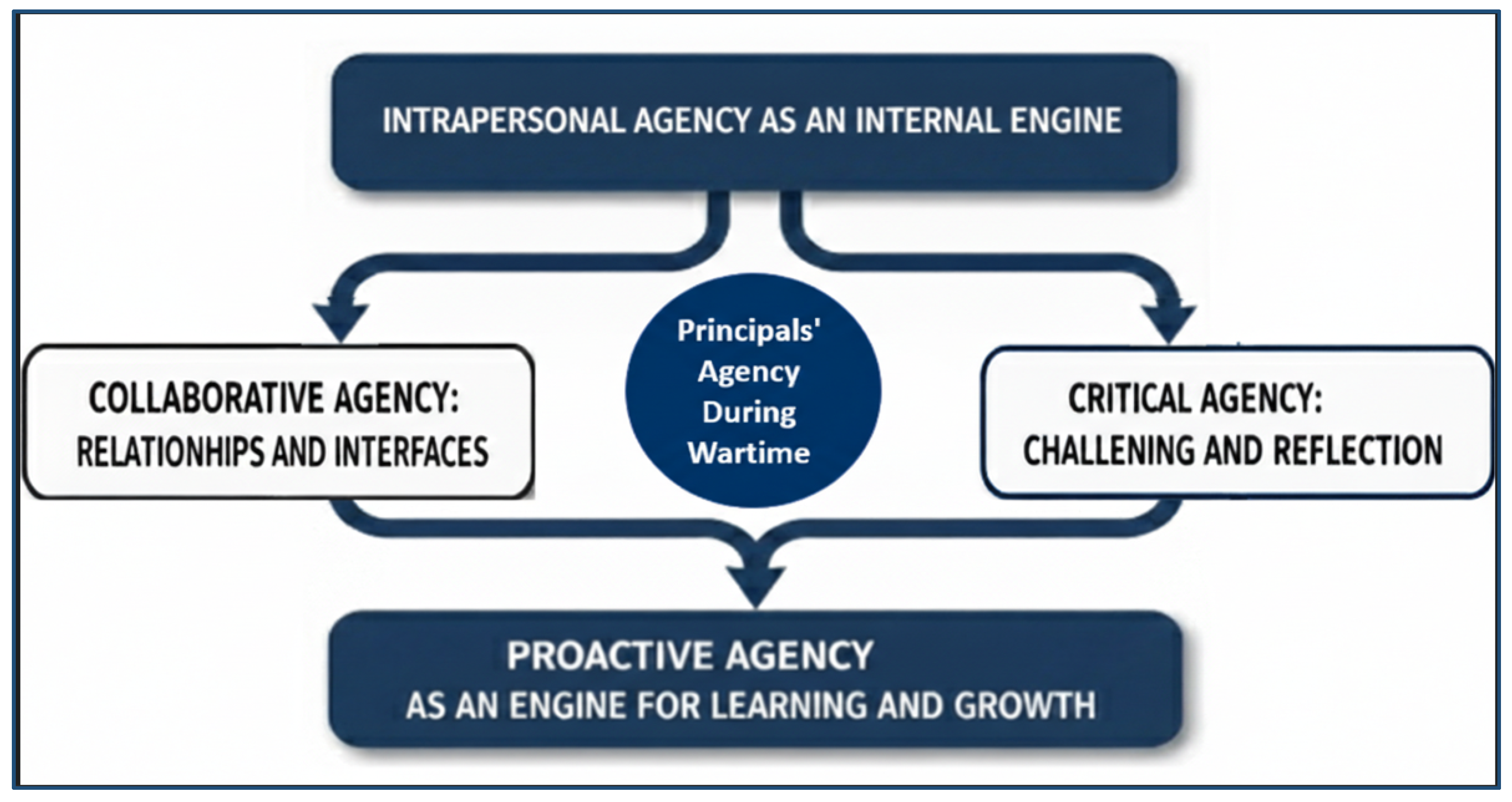
The four dimensions of agency we identified in our displaced school principals are interconnected (please see Figure 1). Their intrapersonal agency emerged as the primary driving force. This form of agency is a deep engine that stems from the principals’ personal identity, values, and experiences. It blurs the lines between the personal and professional, and transforms the crisis into a source of strength and a desire to make an impact (Wilcox & Lawson, 2018). The actions of managers during times of crisis are directly influenced by their past experiences, personal values, and professional characteristics (Striepe & Cunningham, 2022). The principals’ inner drive, therefore, can be understood as a reflection of their professional habitus, as a system of durable dispositions that shapes individuals’ perceptions, practices, and responses within specific contexts, formed through long-term immersion in the educational field and activated during times of crisis (Bourdieu, 1990).
Figure 1.
Illustrates how the four dimensions of principals’ agency interact.
From this basis, two courses of action arise: critical agency and collaborative agency. Critical agency stems from frustration with the absence of infrastructures, and the lack of established models for education’s operating under such extreme conditions. It created a sense of mission in the principals and a drive to operate outside of the norms, break conventions, and cross hierarchical boundaries (Wenner & Settlage, 2015). In this regard, Alexander (2013) notes that crises often expose the weaknesses and contradictions of bureaucratic systems, creating both a moral and operational imperative for leaders to act autonomously and adaptively. Decision-making processes in complex crises do not follow conventional pathways and at times require “radical decisions” and calculated risks in order to address urgent needs (Striepe & Cunningham, 2022).
The principals’ critical agency emerged from the frustration they experienced due to the prevailing uncertainty. Some principals felt that the guidelines provided did not always align with their needs and that there was a lack of educational models for addressing this crisis. It is important to remember that the crisis was unprecedented in its scope, and the system faced challenges of an unparalleled nature, thus working around the clock to provide responses and resources. The emotions of these principals reflect a ground-level perspective and point to communication gaps that require careful consideration. The need to “think outside the box” and “break the mold” was a clear expression of agency within limited or controversial spaces. When the rules are unclear or contradictory, room for agentic action opens up (Gourd, 2015). Displaced principals initiated and established new educational frameworks under impossible conditions. This proactive approach went beyond the expectations of “objective truth” and was rooted in the internal logic of the principals’ narratives within their social, political, and cultural context. They often played the role of change agents opposed to certain aspects of the policy or its interpretations (Liddicoat & Taylor-Leech, 2021). These acts of resistance illustrate Bourdieu’s (1991) insight that social actors are not passive products of structure but capable of reflexive action within constraints—embodying both compliance and transformation.
Collaborative agency relies on creating a network of internal and external connections, and places relationships at the heart of the principals’ activities (Koskela & Kärkkäinen, 2021). In extreme situations, conventional managerial hierarchies tend to break down and be replaced by a collective and collaborative approach, enabling various stakeholders to contribute their unique expertise to coping with the situation (Striepe & Cunningham, 2022). Alexander (2021) argues that effective disaster leadership depends not only on individual competence but also on cultivating collaborative structures of trust and communication that enable communities to recover and adapt. In times of crisis, the interface between critical agency and collaborative agency is pivotal, driving innovation and growth. In the absence of established reaction models, critical agency creates the imperative to develop creative solutions. Collaborative agency enables the realization of these solutions by mobilizing numerous partners from across systems and building deep trust relationships. In this regard, Alexander (2013) highlights that crises serve as laboratories for innovation, where traditional protocols are suspended and new adaptive strategies emerge through interaction, experimentation, and shared learning. Through this synergy, where the critical approach identifies the need and the collaborative approach enables its realization, the principals’ agency becomes a driving force for growth.
To accomplish their goals, the principals established collaborations internally and externally. They consistently emphasized the critical importance of these relationships for their effective performance. Principals cultivated strong internal relationships with staff, students, and parents, viewing them as the basis for the school’s ability to function in emergency situations. Developing formal and informal learning networks was a significant challenge, with principals relying on teams, peer principals, and professional WhatsApp groups. These communities were an important source of learning, information gathering, and support (Schechter et al., 2024; Sheena et al., 2025). These professional networks constitute spaces for the accumulation of social and symbolic capital that reinforce collective agency (Bourdieu, 1990). The principals also built an extensive network of connections with the Ministry of Education, local authorities, organizations, and volunteers. These networks served as a “critical lifeline” in providing solutions that were not available within the official institutional frameworks (Liddicoat & Taylor-Leech, 2021).
Finally, the principals experienced the crisis created by the war as an agentic engine for initiative and personal growth. This internal drive led to educational initiatives and creative activities, such as establishing schools in buildings not made for them, and challenging traditional perceptions of a school’s function. Although disasters are regarded as pushing the ability of normal systems to function effectively (Al-Dahash et al., 2016), the principals in this study not only coped with the crisis but also turned it into a lever for change and renewal (Bhaduri, 2019; Fernandes et al., 2023). This corresponds with Bourdieu’s (1990) claim that practice emerges from the creative tension between objective structures and embodied dispositions. Alexander (2013, 2021) contends that genuine resilience in disaster contexts arises when leadership transforms adversity into innovation, embedding learning and moral purpose within institutional and community recovery. Thus, this extreme crisis provided both challenges and opportunities for the school principals to exercise their agency (Gourd, 2015).
Theoretical and Practical Contribution and Future Research
From a theoretical perspective, this study adds to our understanding of educational leadership during wartime crises, an area about which we know little, particularly concerning the roles of principals in displaced communities and schools. The study highlights the unique complexity of principals’ functioning in times of emergency and provides a holistic framework for examining their agency that integrates personal, critical, collaborative, and proactive dimensions (Biesta et al., 2017; Chen-Levi et al., 2024; Fernandes et al., 2023). Hence, the study reinforces the notion that crises are not only threats but also turning points that create opportunities for innovation, professional renewal, and the development of new strategic directions in school leadership (Bowers et al., 2017; Sadovnikova et al., 2018). Moreover, the findings underscore that school leadership in wartime is not limited to survival, but also centered on sustaining community resilience and educational continuity despite displacement, trauma, and security threats (Hudson et al., 2024). This perspective highlights the role of principals as proactive change agents who balance systemic demands with the needs of their communities (Wenner & Settlage, 2015; Wilcox & Lawson, 2018).
From the practical perspective, the study demonstrates how agency, as opposed to passive reaction, is an active driving force that enables not only survival but also growth and deep change within a chaotic environment. It clarifies that such growth can also occur even in the face of trauma (Whitaker & Kniffin, 2022). It is a positive response of leaders to crisis, indicating development rather than merely reaction. Therefore, the Education Ministry and local municipalities should accord school principals flexibility, administrative autonomy, and support, and recognize the paramount importance of their proactive and supported agency. There is a need for emergency plans and the development of wartime leadership models. It is important to include training for dealing with conditions of extreme uncertainty in the principals’ professional development and to develop their ability to transform personal difficulties into a source of strength, as they build and manage formal and informal learning networks.
This study has a number of limitations that provide opportunities for future research. First, this qualitative study was based solely on reports from displaced principals without cross-referencing the information with other stakeholders involved in the school system, such as teachers, parents, students, or superintendents. Furthermore, the principals were interviewed only once, so they provided a retrospective reflection on their experiences. Future research could consider the perspectives of additional stakeholders in the educational system to create a more comprehensive picture of agency and examine the long-term effects of the principals’ agency on schools and educational communities during crises.
Author Contributions
Y.B.-O. and C.S. are equally responsible for conceptualization, methodology, investigation, analysis, and writing. All authors have read and agreed to the published version of the manuscript.
Funding
This research received no external funding.
Institutional Review Board Statement
The study was conducted in accordance with the Declaration of Helsinki, and approved by Ministry of Education—Office of the Chief Scientist—Research Regulation and Approval (protocol code 14975 and date of approval: 20 August 2025).
Informed Consent Statement
Informed consent was obtained from all subjects involved in the study.
Data Availability Statement
Data are unavailable due to privacy and ethical restrictions.
Conflicts of Interest
The authors declare no conflicts of interest.
References
- Al-Dahash, H., Thayaparan, M., & Kulatunga, U. (2016, September 5–7). Understanding the terminologies: Disaster, crisis and emergency. Association of Researchers in Construction Management (ARCOM) (pp. 1191–1200), Manchester, UK. Available online: https://www.arcom.ac.uk/-docs/proceedings/9ac79958d9024495cd81e13909ed08cb.pdf (accessed on 11 December 2025).
- Alexander, D. E. (2013). Resilience and disaster risk reduction: An etymological journey. Natural Hazards and Earth System Sciences, 13(11), 2707–2716. [Google Scholar] [CrossRef] [Scilit]
- Alexander, D. E. (2021). Disaster and crisis preparedness. In Oxford research encyclopedia of politics. Oxford University Press. [Google Scholar] [CrossRef] [Scilit]
- Alon, S., & Schechter, C. (in press). Wartime leadership: Leading schools in a war crisis. Journal of Educational Administration and History. [CrossRef] [Scilit]
- Azorín, C. (2020). Beyond COVID-19 supernova. Is another education coming? Journal of Professional Capital and Community, 5(3/4), 381–390. [Google Scholar] [CrossRef] [Scilit]
- Bhaduri, R. M. (2019). Leveraging culture and leadership in crisis management. European Journal of Training and Development, 43(5/6), 554–569. [Google Scholar] [CrossRef] [Scilit]
- Biesta, G., Priestley, M., & Robinson, S. (2015). The role of beliefs in teacher agency. Teachers and Teaching, Theory and Practice, 21(6), 624–640. [Google Scholar] [CrossRef] [Scilit]
- Biesta, G., Priestley, M., & Robinson, S. (2017). Talking about education: Exploring the significance of teachers’ talk for teacher agency. Journal of Curriculum Studies, 49(1), 38–54. [Google Scholar] [CrossRef] [Scilit]
- Bourdieu, P. (1990). The logic of practice. Stanford University Press. [Google Scholar]
- Bourdieu, P. (1991). Language and symbolic power. Polity Press. [Google Scholar]
- Bowers, C., Kreutzer, C., Cannon-Bowers, J., & Lamb, J. (2017). Team resilience as a second-order emergent state: A theoretical model and research directions. Frontiers in Psychology, 8, 1360. [Google Scholar] [CrossRef] [Scilit] [PubMed]
- Brion, C., & Kiral, B. (2021). COVID-19 Crisis challenges and management strategies of educational leaders in America. International Journal of Contemporary Educational Research, 8(4), 170–183. [Google Scholar] [CrossRef] [Scilit]
- Brooks, M. C. (2015). School principals in Southern Thailand: Exploring trust with community leaders during conflict. Educational Management Administration & Leadership, 43(2), 232–252. [Google Scholar]
- Brooks, M. C., & Brooks, J. S. (2019). Culturally (ir) relevant school leadership: Ethno-religious conflict and school administration in the Philippines. International Journal of Leadership in Education, 22(1), 6–29. [Google Scholar] [CrossRef] [Scilit]
- Chen-Levi, T., Buskila, Y., & Schechter, C. (2024). Transformative agency in times of global crisis. Journal of Transformative Education, 22(4), 358–378. [Google Scholar] [CrossRef] [Scilit]
- Clarke, V., & Braun, V. (2016). Thematic analysis. The Journal of Positive Psychology, 12(3), 297–298. [Google Scholar] [CrossRef] [Scilit]
- Cohen, L., Manion, L., & Morrison, K. R. B. (2011). Research methods in education (7th ed). Routledge. [Google Scholar]
- Comanducci, R. (2020, July 4). School leadership in times of crisis. Smart Brief Industry News. Available online: https://www.smartbrief.com/original/school-leadership-times-crisis (accessed on 1 January 2025).
- Da’as, R., Qadach, M., & Schechter, C. (2024). Crisis leadership: Principals’ metaphors during COVID-19. Educational Management, Administration & Leadership, 53(2), 357–379. [Google Scholar]
- Fernandes, V., Wong, W., & Noonan, M. (2023). Developing adaptability and agility in leadership amidst the COVID-19 crisis: Experiences of early-career school principals. International Journal of Educational Management, 37(2), 483–506. [Google Scholar] [CrossRef] [Scilit]
- Gordin Yoskovitz, G., & Schechter, C. (2024). Agentic leadership: Principals’ agency during the COVID-19 crisis. Leadership and Policy in Schools, 23(4), 920–937. [Google Scholar] [CrossRef] [Scilit]
- Gourd, T. Y. (2015). Toward a theory for understanding teacher agency: Grounded theory with inclusion co-teachers [Doctoral dissertation, University of Washington]. [Google Scholar]
- Harris, A. (2020). COVID-19–school leadership in crisis? Journal of Professional Capital and Community, 5(3/4), 321–326. [Google Scholar] [CrossRef] [Scilit]
- Head, B. W. (2022). Wicked problems, the science-policy nexus, and the limits of evidence-based policy. Public Administration Review, 82(1), 19–31. [Google Scholar]
- Hudson, C., Tigchelaar, D., & Zastavnyi, A. (2024). Educational leadership during a time of war in Ukraine. Journal of Professional Capital and Community, 9(4), 281–290. [Google Scholar] [CrossRef] [Scilit]
- Jabbar, H. (2016). Between structure and agency: Contextualizing school leaders’ strategic responses to market pressures. American Journal of Education, 122(3), 399–431. [Google Scholar] [CrossRef] [Scilit]
- Karasavidou, E., & Alexopoulos, N. (2019). School crisis management: Attitudes and perceptions of primary school teachers. European Journal of Educational Management, 2(2), 73–84. [Google Scholar] [CrossRef] [Scilit]
- Kerr, M., & King, G. (2019). School crisis prevention and intervention (2nd ed.). Waveland Press. [Google Scholar]
- Khorram-Manesh, A., Goniewicz, K., Hertelendy, A., & Dulebenets, M. (Eds.). (2021). Handbook of disaster and emergency management. Kompendiet. [Google Scholar]
- Kidman, G., & Chang, C. H. (2020). What does “crisis” education look like? International Research in Geographical and Environmental Education, 29(2), 107–111. [Google Scholar] [CrossRef] [Scilit]
- Kim, C., & Gewirtz, S. (2020). Socioeconomic inequality and adjustments in children’s perceptions of their agency as they age in South Korea. Children & Society, 34(5), 371–391. [Google Scholar] [CrossRef] [Scilit]
- Koskela, T., & Kärkkäinen, S. (2021). Student teachers’ change agency in education for sustainable development. Journal of Teacher Education for Sustainability, 23(1), 84–98. [Google Scholar] [CrossRef] [Scilit]
- Kvale, S., & Brinkmann, S. (2008). Interviews: Learning the craft of qualitative research interviewing (2nd ed.). Sage. [Google Scholar]
- Lafferty, N., Blom, N., Starkie, A., McNamara, P. M., & Shaoan, M. M. R. (2024). School leaders’ experiences and perceptions of the movement of Ukrainian child refugees into Irish schools. International Journal of Educational Research, 127, 102416. [Google Scholar] [CrossRef] [Scilit]
- Liddicoat, A. J., & Taylor-Leech, K. (2021). Agency in language planning and policy. Current Issues in Language Planning, 22(1–2), 1–18. [Google Scholar] [CrossRef] [Scilit]
- Mahfouz, J., El-Mehtar, N., Osman, E., & Kotok, S. (2019). Challenges and agency: Principals responding to the Syrian refugee crisis in Lebanese public schools. International Journal of Leadership in Education, 23(1), 24–40. [Google Scholar] [CrossRef] [Scilit]
- Mars, M. M., & Rhoades, G. (2012). Socially oriented student entrepreneurship: A study of student change agency in the academic capitalism context. The Journal of Higher Education, 83(3), 435–459. [Google Scholar] [CrossRef] [Scilit]
- Miles, M. B., Huberman, A. M., & Saldaña, J. (2014). Qualitative data analysis: A methods sourcebook (4th ed.). Sage. [Google Scholar]
- Mohamed, S., & Thomas, M. (2017). The mental health and psychological well-being of refugee children and young people: An exploration of risk, resilience and protective factors. Educational Psychology in Practice, 33(3), 249–263. [Google Scholar] [CrossRef] [Scilit]
- Mutch, C. (2015). Leadership in times of crisis: Dispositional, relational and contextual factors influencing school principals’ actions. International Journal of Disaster Risk Reduction, 14, 186–194. [Google Scholar] [CrossRef] [Scilit]
- Oolbekkink-Marchand, H. W., Hadar, L. L., Smith, K., Helleve, I., & Ulvik, M. (2017). Teachers’ perceived professional space and their agency. Teaching and Teacher Education, 62, 37–46. [Google Scholar] [CrossRef] [Scilit]
- Patton, M. Q. (2002). Two decades of developments in qualitative inquiry: A personal, experiential perspective. Qualitative Social Work, 1(3), 261–283. [Google Scholar] [CrossRef] [Scilit]
- Pepper, M. J., London, T. D., Dishman, M. L., & Lewis, J. L. (2010). Leading schools during crisis: What school administrators must know. R&L Education. [Google Scholar]
- Pherali, T. (2016). School leadership during violent conflict: Rethinking education for peace in Nepal and beyond. Comparative Education, 52(4), 473–491. [Google Scholar] [CrossRef] [Scilit]
- Polatcan, M., Özkan, P., & Bellibaş, M. Ş. (2024). Cultivating teacher innovativeness through transformational leadership and teacher agency in schools: The moderating role of teacher trust. Journal of Professional Capital and Community, 9(3), 227–242. [Google Scholar] [CrossRef] [Scilit]
- Ramos-Pla, A., Tintoré, M., & Del Arco, I. (2021). Leadership in times of crisis: School principals facing COVID-19. Heliyon, 7(11), e08443. [Google Scholar] [CrossRef] [Scilit]
- Richards, L., & Morse, J. M. (2013). Readme first for a user’s guide to qualitative methods. Sage. [Google Scholar]
- Richardson, J. W., Bathon, J., & McLeod, S. (2021). Leadership for deeper learning: Facilitating school innovation and transformation. Eye on Education. [Google Scholar]
- Rossman, G. B., & Rallis, S. F. (2012). The research journey: Introduction to inquiry. Sage. [Google Scholar]
- Rozenfeld, Y., Beam, J., Maier, H., Haggerson, W., Boudreau, K., Carlson, J., & Medows, R. (2020). A model of disparities: Risk factors associated with COVID-19 infection. International Journal for Equity in Health, 19(1), 126. [Google Scholar] [CrossRef] [Scilit] [PubMed]
- Sadovnikova, N. O., Sergeeva, T. B., & Kotova, S. S. (2018). The psychological content of coping behaviour in educational environment. International Journal of Engineering & Technology, 7(4), 38–44. [Google Scholar]
- Schechter, C., Da’as, R., & Qadach, M. (2024). Crisis leadership: Leading schools in a global pandemic. Management in Education, 38(4), 164–171. [Google Scholar] [CrossRef] [Scilit]
- Sheena, D., Berkovich, I., & Benoliel, P. (2025). Effective crisis leadership: Insights from school leaders during the pandemic. Journal of Educational Administration and History, 1–20. [Google Scholar] [CrossRef] [Scilit]
- Smith, L., & Riley, D. (2012). School leadership in times of crisis. School Leadership & Management, 32(1), 57–71. [Google Scholar] [CrossRef] [Scilit]
- Stephen, R. (2024). Secondary principals’ perception of their coping skills during a crisis: A case study [Doctoral dissertation, University of Houston]. [Google Scholar]
- Striepe, M., & Cunningham, C. (2022). Understanding educational leadership during times of crises: A scoping review. Journal of Educational Administration, 60(2), 133–147. [Google Scholar] [CrossRef] [Scilit]
- Striepe, M., & Kafa, A. (2025). School leadership during the COVID-19 crisis: A scoping review of empirical research. Journal of Educational Administration, 63(1), 48–62. [Google Scholar] [CrossRef] [Scilit]
- Thawnghmung, A. M., Thazin Aung, S. M., Moo Paw, N. M., & Boughton, D. (2023). “Water in One Hand, Fire in the Other”: Coping with multiple crises in post-coup Myanmar. Critical Asian Studies, 55(2), 306–329. [Google Scholar] [CrossRef] [Scilit]
- Tlili, A., Salha, S., Shehata, B., Zhang, X., Endris, A., Arar, K., & Jemni, M. (2024). How to maintain education during wars? An integrative approach to ensure the right to education. Open Praxis, 16(2), 160–179. [Google Scholar] [CrossRef] [Scilit]
- Tuval-Mashiach, R., & Spector-Mersel, G. (2010). Mehkar eichutani: Teoria, yeczira veparshnut. Magnes and Mofet. [Google Scholar]
- Umpstead, R. R., Hacker, N. L., & Akanwa, E. E. (2024). Transformation of school leaders’ understandings and practices of change leadership, deeper learning and equity through participation in a leadership academy. Journal of Educational Administration, 62(1), 57–72. [Google Scholar] [CrossRef] [Scilit]
- Wenner, J. A., & Settlage, J. (2015). School leader enactments of the structure/agency dialectic via buffering. Journal of Research in Science Teaching, 52(4), 503–515. [Google Scholar] [CrossRef] [Scilit]
- Whitaker, B. L., & Kniffin, L. E. (2022). Crisis as pedagogy: Recommendations for using the pandemic in leadership education. Journal of Leadership Education, 21(3), A2. [Google Scholar] [CrossRef] [Scilit]
- Wilcox, K. C., & Lawson, H. A. (2018). Teachers’ agency, efficacy, engagement, and emotional resilience during policy innovation implementation. Journal of Educational Change, 19(2), 181–204. [Google Scholar] [CrossRef] [Scilit]
- Zhou, S., Battaglia, M., & Frey, M. (2018). Organizational learning through disasters: A multi-utility company’s experience. Disaster Prevention and Management, 27(2), 243–254. [Google Scholar] [CrossRef] [Scilit]
Disclaimer/Publisher’s Note: The statements, opinions and data contained in all publications are solely those of the individual author(s) and contributor(s) and not of MDPI and/or the editor(s). MDPI and/or the editor(s) disclaim responsibility for any injury to people or property resulting from any ideas, methods, instructions or products referred to in the content. |
© 2026 by the authors. Licensee MDPI, Basel, Switzerland. This article is an open access article distributed under the terms and conditions of the Creative Commons Attribution (CC BY) license.