Latvia’s National Strategy for Simulation-Based Healthcare Education
 ,
,  ,
,  and
and
Abstract
1. Introduction
1.1. Quality Education—The Foundation of Quality Healthcare
1.2. Statistical Data Indicates
- Each year, approximately 3.2 million patients in the EU experience adverse events while receiving medical care. It is estimated that 20% to 30% of these cases are preventable (European Union, n.d.).
- Each year, 8% to 12% of hospitalised patients suffer complications related to the care they receive in European Union (EU) hospitals (European Union, 2020).
- Both the World Health Organization (WHO) and the Organisation for Economic Co-operation and Development (OECD) highlight the following in their reports:
- ○
- Globally, unsafe healthcare results in more than 3 million deaths annually.
- ○
- Around 1 in 10 patients are harmed in healthcare.
- ○
- In OECD countries, approximately 15% of inpatient expenditure is consumed by treating the effects of hospital-acquired harm (OECD, 2022; World Health Organization, 2023).
- In Latvia, over €1 million is paid annually from the Medical Risk Fund for harm caused to patients (LIKUMI.LV, n.d.-c).
1.3. General Aspects Justifying the Need for Integration of Simulation-Based Approach in Medical and Healthcare Education
- Quality is the optimal balance between implemented opportunities and the system of norms and values. It arises from the interaction between participants who agree on standards (norms and values) and components (opportunities) (Mitchell, 2008).
- The norms and values of the 21st century in the context of healthcare are reflected in the aspects outlined by the WHO’s concept of “healthcare quality”—safe, effective, people-centred, timely, efficient, equitable and integrated (World Health Organization, 2018).
- Notably, patient safety has long been seen as an entry point for efforts to improve quality of care, and safe care can be seen as a barometer of the success of basic systems to improve quality (World Health Organization, 2018).
- Safety is the foundation upon which all other aspects of quality care are built (Mitchell, 2008). All aspects characterising healthcare quality influence or can influence patient safety, which justifies the belief that patient safety is the starting point for efforts to improve care quality.
- Patient safety is a framework of organised activities that creates cultures, processes, procedures, behaviours, technologies and environments in healthcare that consistently and sustainably lower risks, reduce the occurrence of avoidable harm, make error less likely and reduce impact of harm when it does occur (World Health Organization, 2021).
- Health systems can only function with health workers (WHO, n.d.-b), and the quality of healthcare services is directly linked to the performance of healthcare professionals, which largely depends on their competence (knowledge, skills, and attitudes). The cornerstone of competence development is education (Busse et al., 2019a).
- To ensure the production of skilled and confident future doctors, students, and residents must be given ample opportunities to practice and refine their abilities before engaging with real patients (Agrawal et al., 2023). Simulation is increasingly being used in healthcare education to teach cognitive, psychomotor, and affective skills to individuals and teams (Motola et al., 2013).
1.4. Breadth of Simulation-Based Medical Education and Justifying Aspects of Simulation-Based Educational Approaches in Medical and Healthcare Education
- By applying an appropriate methodology in the implementation of simulation-based medical and healthcare education, and integrating simulation-specific technologies and solutions in a suitable environment, it is possible to acquire new skills, enhance previously learned ones, and practise rarely used technical and non-technical skills, ultimately improving patient safety and clinical outcomes (Elendu et al., 2024).
- The integration of simulations into medical and healthcare education programmes enables preparation for both common daily practice scenarios and rare, complex clinical situations, encountered in daily practice (Elendu et al., 2024).
- One of the most significant advantages is the opportunity for deliberate practice, where learners can repeatedly perform tasks and refine their skills without risk to patients (Motola et al., 2013). This repetition is crucial for developing proficiency and ensuring that skills are retained over time (Barry Issenberg et al., 2005).
- No risk to patients.
- Many scenarios can be presented, including uncommon but critical situations in which a rapid response is needed.
- Participants can see the results of their decisions and actions; errors can be allowed to occur and reach their conclusion (in real life a more capable clinician would have to intervene).
- Identical scenarios can be presented to different clinicians or teams.
- The underlying causes of the situation are known.
- With mannequin-based simulators clinicians can use actual equipment, exposing limitations in the human–machine interface.
- Full recreations of actual clinical environments allow to explore complete interpersonal interactions with other clinical staff and provide training on teamwork, leadership and communication.
- Intensive and intrusive recording of the simulation session is feasible, including audio taping and videotaping, there are no issues of patient confidentiality–the recordings can be preserved for research, performance assessment or accreditation.
- Offers opportunities to work with equipment and tools used in real clinical settings within simulation scenarios, identifying and evaluating limitations in human-technology interaction (World Health Organization & WHO Patient Safety, 2011).
- Simulation provides a safe environment for learners to make and learn from mistakes, essential for effective learning (Elendu et al., 2024).
- Fosters clinical reasoning, decision-making, and critical thinking skills while enhancing communication, leadership, and teamwork abilities. It also provides opportunities to test administrative problem-solving skills (Saleem & Khan, 2023).
- Supports adaptation to evolving demands in the healthcare system (Diaz-Navarro et al., 2024a).
1.5. Challenges to Implementing Simulation-Based Educational Approaches
2. Methods
2.1. Conceptual Framework for the Development Strategy of Simulation-Based Medical and Healthcare Education
2.1.1. Vision
2.1.2. Mission
2.1.3. Values
- Safety at various levels:
- 1.1.
- Safety aspects in healthcare in the broadest sense.
- 1.2.
- Safety of healthcare professionals and patients.
- 1.3.
- Physical and psychological safety of simulation participants and simulation professionals.
- Simulation activities as a sustainable resource in the educational process (ensuring compliance with specific requirements regarding content, design, and implementation, as well as effective resource utilisation, considering the ecological impact across all aspects of simulation practices, while supporting the growth and development of the field.
- Promoting excellence is rooted in the improvement and advancement of all aspects of simulation practice.
- Mutual respect is a key factor in fostering and maintaining positive collaboration, which is fundamental to the success of any simulation-based education activity.
- Collaboration is driven by a shared commitment to achieving a common goal: providing the best possible experience for learners while upholding the highest standards of practice.
2.1.4. Overarching Goal
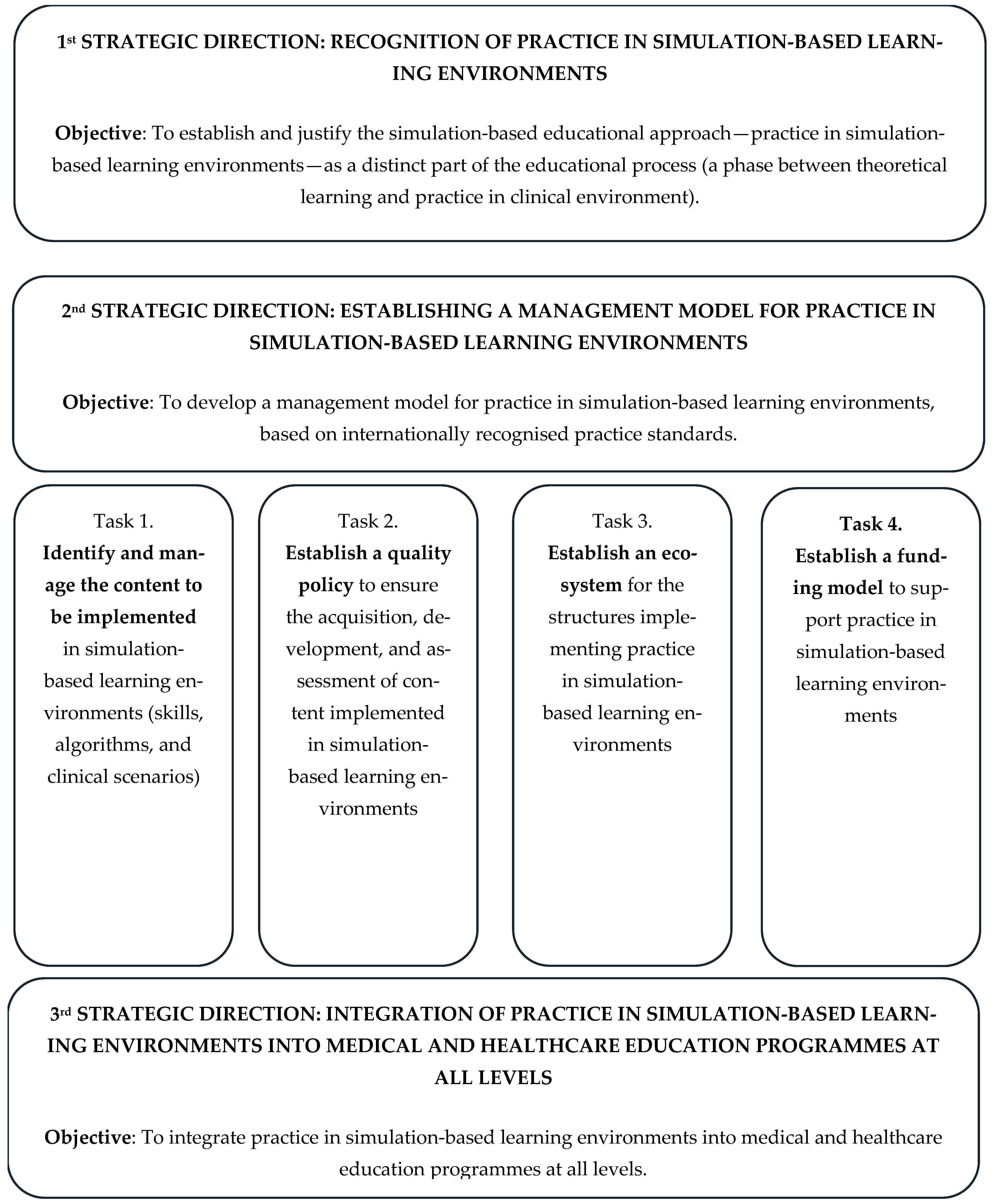
2.2. 1st Strategic Direction: Recognition of Practice in Simulation Learning Environments
2.2.1. Objective
2.2.2. Aspects Supporting the Objective
- Healthcare quality and safety.
- Quality of education in the medical and healthcare fields.
2.3. Healthcare Quality and Safety Within the Scope of Legal Regulations
- Article 6 of the Treaty on the Functioning of the European Union (TFEU) stipulates that Union shall have competence to carry out actions to support, coordinate or supplement the actions of the Member States, including in the field of protecting and improving human health (European Union, 2012).
- The EU Regulation (EU) 2021/522 of the European Parliament and Council sets a general objective to improve and promote health across the Union, while one of its specific objectives is to enhance access to quality, patient-centred, outcome-based healthcare and related care services, with the aim of achieving universal health coverage (European Parliament, 2021).
- The Directive 2011/24/EU of the European Parliament and Council emphasises that, regardless of the opportunities for patients to receive cross-border healthcare, Member States are obligated to ensure safe, high-quality, effective, and quantitatively sufficient healthcare within their own territory (European Parliament, 2011).
2.4. Quality of Education in the Medical and Healthcare Fields Within the Scope of Legal Regulations
- Education quality refers to the educational process, content, environment, and management that provide inclusive education and opportunities for individuals to achieve excellent outcomes aligned with the objectives set by society and defined by the state (LIKUMI.LV, n.d.-a).
- The Bologna Process, initiated with the Bologna Declaration in 1999 (signed by Latvia) (European Higher Education Area and Bologna Process, n.d.), is one of the key initiatives at the European level, establishing a unified European Higher Education Area (EHEA) (European Higher Education Area and Bologna Process, n.d.).
- One of the purposes of the Bologna Declaration (1999) was to encourage European cooperation in quality assurance of higher education with a view to developing comparable criteria and methodologies. The European Ministers of Education adopted in 2005 the “Standards and Guidelines for Quality Assurance in the European Higher Education Area (ESG)” drafted by the European Association for Quality Assurance in Higher Education (ENQA) in co-operation and consultation with its member agencies and the other members of the “E4 Group” (ENQA, EUA, EURASHE and ESU). A new version was adopted in 2015 at Yerevan (Bologna Process, n.d.-b).
- A key goal of the Standards and Guidelines for Quality Assurance in the European Higher Education Area (ESG) is to contribute to the common understanding of quality assurance for learning and teaching across borders and among all stakeholders. The ESG considers the frameworks for qualifications and the European Credit Transfer and Accumulation System (ECTS), contributing to transparency and mutual trust in higher education within the EHEA (AIC, n.d.):
- ○
- A qualifications framework encompasses all the qualifications in a higher education system—or in an entire education system if the framework is developed for this purpose. It shows what a learner knows, understands and is able to do on the basis of a given qualification—that is, it shows the expected learning outcomes for a given qualification (Bologna Process, n.d.-a).
- ○
- The European Credit Transfer and Accumulation System (ECTS) reflects learning based on specific learning outcomes and the associated workload (European Education Area, n.d.).
- Learning outcomes are statements regarding what a learner knows, understands and is able to do on completion of a learning process. The definitions and descriptions of learning outcomes as used in qualifications frameworks; qualification standards and curricula are statements and expressions of intentions. They are not outcomes of learning, but desired targets. Achieved learning outcomes can only be identified following the learning process, through assessments and demonstration (European Centre for the Development of Vocational Training, 2022).
Tasks to Achieve the Objective
- Develop a glossary of terms in the national language that defines the concepts characterising the simulation-based approach in medical and healthcare education.
- Enshrine in national legal regulations the provision that the simulation-based approach in all levels of medical and healthcare education is classified as a distinct part of the educational process (a phase between theory and practice), incorporating aspects specific to this field (in the context of 2nd and 3rd Strategic Directions).
2.5. 2nd Strategic Direction: Establishing a Management Model for Practice in Simulation-Based Learning Environments
- Society for Simulation in Healthcare (SSH) (Society for Simulation in Healthcare, n.d.).
- Society in Europe for Simulation Applied to Medicine (SESAM) (SESAM, n.d.).
- International Nursing Association for Clinical Simulation and Learning (INACL) (INACL, n.d.-a).
- Association for Simulated Practice in Healthcare (ASPiH) (ASPiH, n.d.).
- The Association of Standardized Patient Educators (ASPE) (Association of SP Educators, n.d.).
- International Network of Simulation Experts “EuSim” (EuSim, n.d.).
- Swedish Association for Clinical Training and Medical Simulation “KlinSim” (KlinSim, n.d.).
2.5.1. Objective
2.5.2. Aspects Supporting the Objective
- The European Economic and Social Committee in its opinion highlights that strong and resilient healthcare systems can only be built on an educated, qualified, and motivated healthcare workforce. This workforce is a critical factor in implementing successful health policies and, consequently, improving people’s health (WHO, 2022).
- The OECD in its report states that the foundations for system resilience and a capacity to minimise harm are found in strong safety governance, a 21st century information infrastructure, and sufficient staffing with a workforce skilled in handling safety risks in complex, dynamic environments, working in a supportive and just safety culture that values continuous learning and improvement (OECD, 2022).
- World Health Organization (WHO):
- ○
- Educational and training institutions for healthcare professionals should utilise simulation methods with a fidelity level appropriate to the context (high-fidelity methods in resource-rich settings and lower-fidelity methods in resource-limited settings) (World Health Organization, 2013).
- ○
- The Global Patient Safety Action Plan 2021–2030 provides specific recommendations on healthcare workforce education, skill development, and safety, including promoting the use of simulation methods in professional education for medical and healthcare professionals at all levels (World Health Organization, 2021).
- Adoption of the Healthcare Simulation Standards demonstrates a commitment to quality and implementation of rigorous evidence-based practices in healthcare education to improve patient care (INACL, n.d.-b).
2.5.3. Tasks to Achieve the Objective
- 1.
- Identify and manage the content implemented in practice in simulation-based learning environments (skills, algorithms, and clinical scenarios), which includes:
- 1.1.
- Define criteria to identify which skills, algorithms, and clinical scenarios should be acquired, developed, and/or assessed in simulation-based learning environments, specifying the educational programme and level.
- 1.2.
- Create a shared database that provides access to the content (skills, algorithms and clinical situations) to be learned in the simulation learning environment.
- 1.3.
- Develop an operational model (processes and technical solutions) for organising the acquisition, development, and assessment of content implemented in simulation-based learning environments (skills, algorithms, and clinical scenarios).
- 2.
- Establish a quality policy to ensure the acquisition, development, and assessment of content implemented in practice simulation-based learning environments, which includes:
- 2.1.
- Develop a model for the accreditation of organisations implementing simulations or determining the rights to conduct practice in simulation-based learning environments.
- 2.2.
- Develop a certification and recertification model for simulation-implementing personnel (with priority given to simulation instructors).
- 2.3.
- Develop a quality assurance model specifying requirements for the design, implementation, and evaluation of practice in simulation learning environments.
- 2.4.
- Develop and approve a quality policy for recruiting and engaging role players in simulation activities.
- 2.5.
- Develop and approve an ethics code tailored to the specifics of the field, considering recommendations and best practices from leading organisations in simulation-based medical and healthcare education.
- 3.
- Establish an ecosystem for the structures implementing practice in simulation-based learning environments, which includes:
- 3.1.
- Establish a structure based on principles of interinstitutional collaboration, involving practising professionals with appropriate expertise (hereinafter referred to as domain experts);
- 3.2.
- Develop a system to ensure the acquisition, development, and assessment of content implemented in practice in simulation-based learning environments.
- 4.
- Establish a funding model to support practice in simulation-based learning environments, which includes:
- 4.1.
- Create a funding calculation model for ensuring the content implementation (skills, algorithms, and clinical scenarios) in simulation-based learning environments, based on previously identified content and considering the resources required for its implementation: technologies, environment, human resources.
- 4.2.
- Develop an interinstitutional shared financial responsibility model for supporting practice in simulation-based learning environments, which includes defining goals and needs, identifying the involved institutions, determining funding sources.
2.6. 3rd Strategic Direction: Integration of Practice in Simulation-Based Learning Environments into All Levels of Medical and Healthcare Education Programmes
Tasks to Achieve the Objective
- 1.
- Develop a digital shared platform for key topics in simulation-based medical and healthcare education, including:
- 1.1.
- Educational materials,
- 1.2.
- A database of accredited organisations authorised to implement simulation-based learning environments,
- 1.3.
- A database of certified and recertified simulation instructors,
- 1.4.
- A database of simulation-based medical and healthcare education programmes, etc.
- 2.
- Educate and inform the creators and implementers of medical and healthcare education programmes about:
- 2.1.
- The simulation-based education approach in medical and healthcare education, its concepts, and associated terminology.
- 2.2.
- Legal regulatory aspects in the context of simulation-based medical and healthcare education.
- 2.3.
- The management and organisational model of practice in simulation-based learning environments.
- 3.
- Ensure the availability and integration of simulation learning environment infrastructure and technologies in the implementation of simulation-based educational programmes.
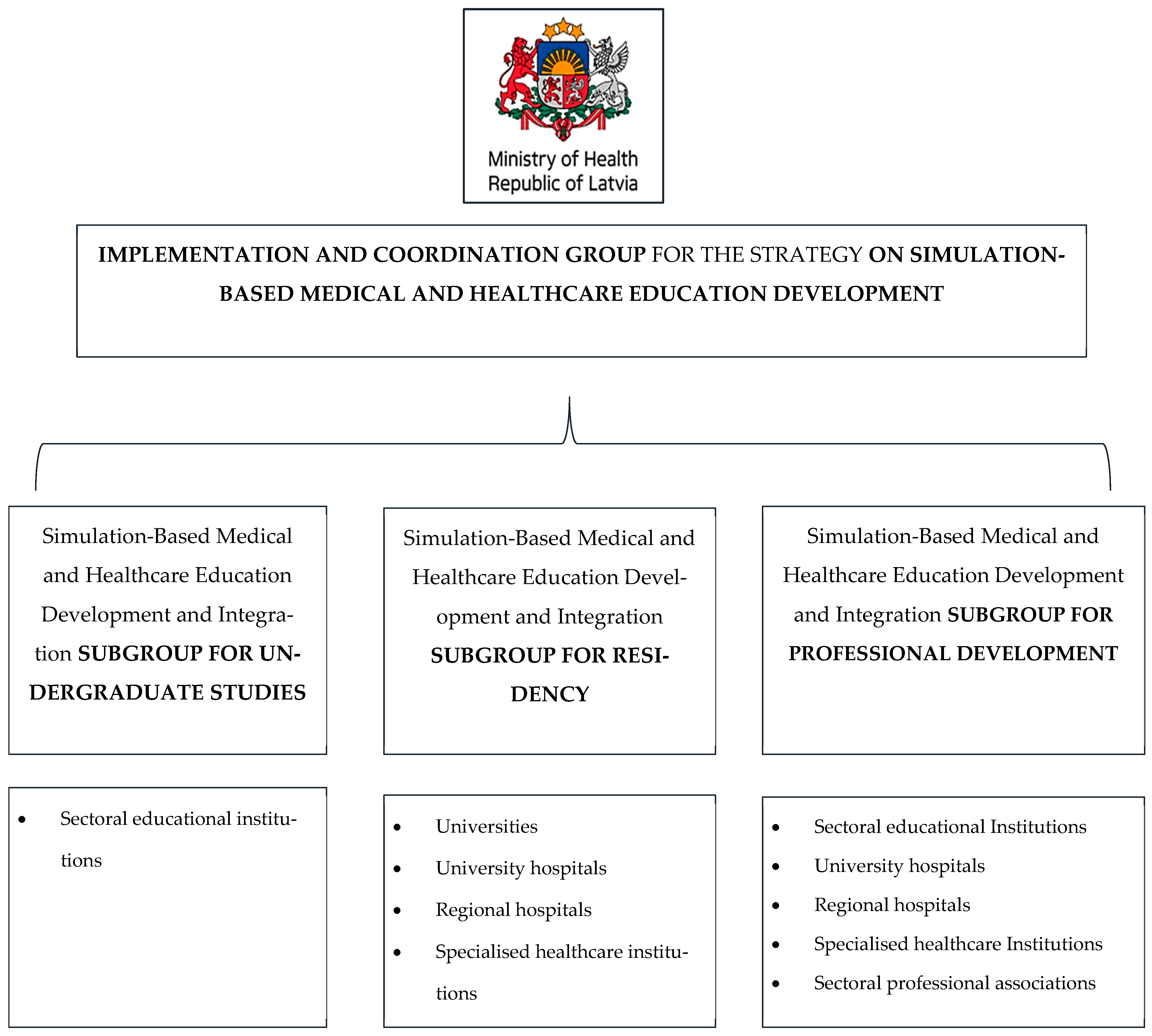
2.7. Concept for the Implementation of the Strategy for Simulation-Based Medical and Healthcare Education Development in Latvia for 2025–2027
3. Conclusions
- Robust and sustainable collaboration among institutions delivering medical and healthcare education programmes, healthcare institutions, domain experts, and national health policy planners and implementers.
- The involvement and support of public administration.
- Long-term resource availability.
- Regular analysis, evaluation, and timely improvements based on the Strategy’s implementation outcomes.
Author Contributions
Funding
Institutional Review Board Statement
Informed Consent Statement
Data Availability Statement
Conflicts of Interest
References
- Agrawal, P., Kushwaha, V., Khan, N., Singh, S., Goel, S., & Aamir, M. (2023). A comprehensive review of simulation-based medical education: Current practices and future perspective. European Journal Pharmaceutical and Medical Research, 11, 396–402. [Google Scholar]
- AIC. (n.d.). Standarti un vadlīnijas kvalitātes nodrošināšanai Eiropas augstākās izglītības telpā (ESG). Available online: https://www.aika.lv/wp-content/uploads/2019/12/ESG_2015_latviski.pdf (accessed on 28 November 2024).
- ASPiH. (n.d.). Association for simulated practice in healthcare. Available online: https://aspih.org.uk/ (accessed on 28 November 2024).
- Association of SP Educators. (n.d.). Available online: https://www.aspeducators.org/ (accessed on 28 November 2024).
- Barry Issenberg, S., Mcgaghie, W. C., Petrusa, E. R., Lee Gordon, D., & Scalese, R. J. (2005). Features and uses of high-fidelity medical simulations that lead to effective learning: A BEME systematic review. Medical Teacher, 27(1), 10–28. [Google Scholar] [CrossRef] [Scilit] [PubMed]
- Bologna Process. (n.d.-a). Qualifications frameworks in the EHEA—2009—European higher education area and Bologna process. Available online: https://ehea.info/cid102842/qualifications-frameworks-the-ehea-2009.html (accessed on 28 November 2024).
- Bologna Process. (n.d.-b). Quality assurance—European higher education area and Bologna process. Available online: https://ehea.info/pid34433/quality-assurance.html (accessed on 28 November 2024).
- Busse, R., Klazinga, N., Panteli, D., & Quentin, W. (Eds.). (2019a). Improving healthcare quality in Europe: Characteristics, effectiveness and implementation of different strategies. European Observatory on Health Systems and Policies. Available online: http://www.ncbi.nlm.nih.gov/books/NBK549276/ (accessed on 28 October 2025).
- Busse, R., Panteli, D., & Quentin, W. (2019b). An introduction to healthcare quality: Defining and explaining its role in health systems. In Improving healthcare quality in Europe: Characteristics, effectiveness and implementation of different strategies [Internet]. European observatory on health systems and policies. Available online: https://www.ncbi.nlm.nih.gov/books/NBK549277/ (accessed on 28 October 2025).
- Charnetski, M., & Jarvill, M. (2021). Healthcare simulation standards of best PracticeTM operations. Clinical Simulation in Nursing, 58, 33–39. [Google Scholar] [CrossRef] [Scilit]
- Clinical Situation. (n.d.). [Topic]. Available online: https://archive.datadictionary.nhs.uk/DD%20Release%20June%202021/nhs_business_definitions/clinical_situation.html (accessed on 28 November 2024).
- Code of Ethics. (n.d.). Available online: https://www.ssih.org/healthcare-simulationist-code-ethics (accessed on 28 November 2024).
- Cristina, D.-N., Robert, A., Matthew, C., Kirsty, F. J., Sabrina, K., Gabriel, R., Jayne, S., Pier, I. L., Francisco, M. M., & Barry, I. (2024). Global consensus statement on simulation-based practice in healthcare. Simulation in Healthcare: The Journal of the Society for Simulation in Healthcare, 19(3), e52–e59. [Google Scholar] [CrossRef] [Scilit] [PubMed]
- Diaz-Navarro, C., Armstrong, R., Charnetski, M., Freeman, K. J., Koh, S., Reedy, G., Smitten, J., Ingrassia, P. L., Matos, F. M., & Issenberg, B. (2024a). Global consensus statement on simulation-based practice in healthcare. Advances in Simulation, 9(1), 19. [Google Scholar] [CrossRef] [Scilit] [PubMed]
- Diaz-Navarro, C., Jones, B., Pugh, G., Moneypenny, M., Lazarovici, M., & Grant, D. J. (2024b). Improving quality through simulation; developing guidance to design simulation interventions following key events in healthcare. Advances in Simulation, 9(1), 30. [Google Scholar] [CrossRef] [Scilit] [PubMed]
- Elendu, C., Amaechi, D. C., Okatta, A. U., Amaechi, E. C., Elendu, T. C., Ezeh, C. P., & Elendu, I. D. (2024). The impact of simulation-based training in medical education: A review. Medicine, 103(27), e38813. [Google Scholar] [CrossRef] [Scilit] [PubMed]
- European Centre for the Development of Vocational Training. (2022). Defining, writing and applying learning outcomes: A European handbook: Second edition. Publications Office. Available online: https://data.europa.eu/doi/10.2801/703079 (accessed on 28 October 2025).
- European Education Area. (n.d.). Eiropas kredītpunktu pārneses un uzkrāšanas sistēma (ECTS)—European education area. Available online: https://education.ec.europa.eu/lv/education-levels/higher-education/inclusive-and-connected-higher-education/european-credit-transfer-and-accumulation-system (accessed on 28 November 2024).
- European Higher Education Area and Bologna Process. (n.d.). Available online: https://www.ehea.info/page-ministerial-conference-budapest-vienna-2010 (accessed on 6 January 2024).
- European Parliament. (2011). Directive 2011/24/EU of the European parliament and of the council of 9 March 2011 on the application of patients’ rights in cross-border healthcare (Vol. 57). European Parliament. [Google Scholar]
- European Parliament. (2021). Regulation (EU) 2021/522 of the European parliament and of the council of 24 March 2021 establishing a programme for the union’s action in the field of health (‘EU4Health programme’) for the period 2021–2027, and repealing regulation (EU) No 282/2014 (Text with EEA relevance), 107 OJ L (2021). Available online: http://data.europa.eu/eli/reg/2021/522/oj/eng (accessed on 28 October 2025).
- European Union. (n.d.). Patient safety and quality of care in EU public health systemsEUR-Lex. Available online: https://eur-lex.europa.eu/legal-content/EN/TXT/?uri=legissum:2901_5 (accessed on 15 January 2025).
- European Union. (2012). Consolidated version of the treaty on the functioning of the European union, 326 OJ C. Available online: http://data.europa.eu/eli/treaty/tfeu_2012/oj/eng (accessed on 28 October 2025).
- European Union. (2020). Patient safety and the prevention of healthcare-associated infections. Available online: https://eur-lex.europa.eu/EN/legal-content/summary/patient-safety-and-the-prevention-of-healthcare-associated-infections.html (accessed on 28 October 2025).
- EuSim. (n.d.). EuSim. Available online: https://eusim.org/ (accessed on 1 February 2025).
- Grigorovica, E., Slavinska, A., & Bahs, G. (2024). Navigating Challenges: A new conceptual model for human capital management in healthcare. European Conference on Knowledge Management, 25(1), 284–291. [Google Scholar] [CrossRef] [Scilit]
- INACL. (n.d.-a). Available online: https://www.inacsl.org/ (accessed on 28 November 2024).
- INACL. (n.d.-b). INACL healthcare simulation standards. Available online: https://www.inacsl.org/healthcare-simulation-standards (accessed on 28 November 2024).
- KlinSim. (n.d.). KlinSim—Svensk förening för klinisk träning och medicinsk simulering. Available online: https://www.klinsim.se/ (accessed on 1 February 2025).
- Kreutzberg, A., Reichebner, C., Maier, C. B., Destrebecq, F., & Panteli, D. (2019). Regulating the input: Health professions. In Improving healthcare quality in Europe: Characteristics, effectiveness and implementation of different strategies [Internet]. European Observatory on Health Systems and Policies. Available online: https://www.ncbi.nlm.nih.gov/books/NBK549267/ (accessed on 28 October 2025).
- Lewis, K. L., Bohnert, C. A., Gammon, W. L., Hölzer, H., Lyman, L., Smith, C., Thompson, T. M., Wallace, A., & Gliva-McConvey, G. (2017). The Association of Standardized Patient Educators (ASPE) Standards of Best Practice (SOBP). Advances in Simulation, 2(1), 10. [Google Scholar] [CrossRef] [Scilit] [PubMed]
- LIKUMI.LV. (n.d.-a). Izglītības likums. Available online: https://likumi.lv/doc.php?id=50759 (accessed on 26 February 2024).
- LIKUMI.LV. (n.d.-b). Noteikumi par ārstniecības personu un studējošo, kuri apgūst medicīniskās izglītības programmas, kompetenci ārstniecībā un šo personu teorētisko un praktisko zināšanu apjomu. Available online: https://likumi.lv/doc.php?id=355161 (accessed on 28 November 2024).
- LIKUMI.LV. (n.d.-c). Sabiedrības veselības pamatnostādnes 2021–2027. Gadam. LIKUMI.LV. Available online: https://likumi.lv/doc.php?id=332751 (accessed on 25 November 2024).
- Lioce, L. (Ed.). (2020). Healthcare Simulation Dictionary, 2nd ed.; Agency for Healthcare Research and Quality. Available online: https://www.ahrq.gov/patient-safety/resources/simulation/terms.html (accessed on 28 October 2025). [CrossRef] [Scilit]
- Mitchell, P. H. (2008). Defining Patient Safety and Quality Care. R. G. Hughes, Ed.In Patient safety and quality: An evidence-based handbook for nurses. Agency for Healthcare Research and Quality (US). Available online: http://www.ncbi.nlm.nih.gov/books/NBK2681/ (accessed on 28 October 2025).
- Motola, I., Devine, L. A., Chung, H. S., Sullivan, J. E., & Issenberg, S. B. (2013). Simulation in healthcare education: A best evidence practical guide. AMEE Guide No. 82. Medical Teacher, 35(10), e1511–e1530. [Google Scholar] [CrossRef] [Scilit] [PubMed]
- Nayahangan, L. J., Thinggaard, E., Khan, F., Gustafsson, A., Mørcke, A. M., Dubrowski, A., Hirshfield, L. E., & Konge, L. (2024). A view from the top: A qualitative exploration of top-level health care leaders’ perceptions on the implementation of simulation-based education in postgraduate medical education. Medical Education, 58(4), 415–429. [Google Scholar] [CrossRef] [Scilit] [PubMed]
- OECD. (2022). The economics of patient safety: From analysis to action (OECD Health Working Papers 145; OECD Health Working Papers, Vol. 145). OECD. Available online: https://www.oecd.org/en/publications/the-economics-of-patient-safety_761f2da8-en.html (accessed on 28 October 2025). [CrossRef]
- Saleem, M., & Khan, Z. (2023). Healthcare simulation: An effective way of learning in health care. Pakistan Journal of Medical Sciences, 39(4), 1185–1190. [Google Scholar] [CrossRef] [Scilit] [PubMed]
- SESAM. (n.d.). Available online: https://www.sesam-web.org/ (accessed on 28 November 2024).
- Slavinska, A., Palkova, K., Grigoroviča, E., Edelmers, E., & Pētersons, A. (2024). Narrative review of legal aspects in the integration of simulation-based education into medical and healthcare curricula. Laws, 13(2), 15. [Google Scholar] [CrossRef] [Scilit]
- Society for Simulation in Healthcare. (n.d.). Available online: https://www.ssih.org/ (accessed on 26 May 2024).
- SPKC. (n.d.). Klīniskie algoritmi, pacientu ceļi, indikatori (ESF projekts)|Slimību profilakses un kontroles centrs. Available online: https://www.spkc.gov.lv/lv/kliniskie-algoritmi-pacientu-celi-indikatori-esf-projekts (accessed on 28 November 2024).
- Standards for Organisations That Deliver Simulation-Based Education. (n.d.). Available online: https://www.hee.nhs.uk/sites/default/files/documents/Standards%20for%20organisations%20that%20deliver%20simulation.pdf (accessed on 28 November 2024).
- The Global Goals. (n.d.). Goal 3: Good health and well-being. Available online: https://globalgoals.org/goals/3-good-health-and-well-being/ (accessed on 20 May 2025).
- United Nations. (n.d.). THE 17 GOALS|Sustainable development. Available online: https://sdgs.un.org/goals (accessed on 22 November 2024).
- WHO. (n.d.-a). Charter: Health worker safety: A priority for patient safety. Available online: https://www.who.int/publications-detail-redirect/9789240011595 (accessed on 26 May 2024).
- WHO. (n.d.-b). Health workforce. Available online: https://www.who.int/teams/health-workforce/about (accessed on 19 October 2023).
- WHO. (n.d.-c). Health workforce education technology assessment: Background research report. Available online: https://www.who.int/publications/i/item/9789240070929 (accessed on 5 March 2025).
- WHO. (n.d.-d). Patient safety rights charter. Available online: https://www.who.int/publications-detail-redirect/9789240093249 (accessed on 26 May 2024).
- WHO. (2022, January 29). Health workforce and care strategy for the future of Europe|EESC. Available online: https://www.eesc.europa.eu/en/our-work/opinions-information-reports/opinions/health-workforce-and-care-strategy-future-europe (accessed on 28 October 2025).
- World Health Organization. (2013). Transforming and scaling up health professionals’ education and training: World Health Organization guidelines 2013. World Health Organization. Available online: https://iris.who.int/handle/10665/93635 (accessed on 28 October 2025).
- World Health Organization. (2018). Handbook for national quality policy and strategy: A practical approach for developing policy and strategy to improve quality of care. World Health Organization. Available online: https://iris.who.int/handle/10665/272357 (accessed on 28 October 2025).
- World Health Organization. (2021). Global patient safety action plan 2021–2030. World Health Organization. Available online: https://www.who.int/publications/i/item/9789240032705 (accessed on 28 October 2025).
- World Health Organization. (2023). Patient safety fact sheet. Available online: https://www.who.int/news-room/fact-sheets/detail/patient-safety (accessed on 28 October 2025).
- World Health Organization & WHO Patient Safety. (2011). Patient safety curriculum guide: Multi-professional edition. 272. Available online: https://iris.who.int/handle/10665/44641 (accessed on 28 October 2025).


| Stakeholders Involved in the Implementation of the Strategy | Benefits of Implementing the Strategy | |||||
|---|---|---|---|---|---|---|
| Ministry of Health |
| |||||
| Implementers of medical and healthcare education at all levels |
| |||||
| Undergraduate studies | Residency | Professional development | ||||
| Lecturers. Healthcare Professionals Qualified to Provide Training Instructors. | ||||||
|
|
| ||||
| Recipients of medical and healthcare education at all levels |
| |||||
| Students | Residents |
| ||||
| Healthcare service providers |
| |||||
| Healthcare institutions Healthcare professionals and healthcare support persons | ||||||
| Pre-hospital phase | Primary healthcare | Secondary healthcare | Tertiary healthcare | |||
| Recipients of healthcare services—patients and their relatives |
| |||||
| Society | ||||||
| The integration of simulation-based education into medical and healthcare education is an investment in the availability of high-quality and safe healthcare services. | ||||||
| Comments: * The Cabinet of Ministers Regulation of Latvian Republic No.617 “Regulations on the Competence of Medical Practitioners and Students Studying Medical Education Programmes in Medical Practice and the Scope of Theoretical and Practical Knowledge of Medical Practitioners and Students Studying Medical Education Programmes” stipulates that: A simulation-based learning environment is a physical space (surroundings or conditions) replicating aspects and elements of a real-world setting. It facilitates controlled simulation-based educational activities, ensuring participants’ physical, emotional, and psychological safety to support learning, assessment, or testing LIKUMI.LV (n.d.-b). **
| ||||||
| No | Action. Tasks and Sub-Tasks | Performance | Performance Indicator | Responsible Authority |
|---|---|---|---|---|
| 1st STRATEGIC DIRECTION: RECOGNITION OF PRACTICE IN SIMULATION LEARNING ENVIRONMENTS | ||||
| 1.1. | Develop a glossary of terms in the national language that defines the concepts characterising the simulation-based approach in medical and healthcare education. | A glossary of terms has been developed, encompassing the concepts and terminology that characterise simulation-based medical and healthcare education to promote a unified understanding of the field and facilitate the precise formulation of legal regulations | A glossary containing 100–150 terms has been created, published, and made available in electronic format. | Sectoral Educational Institutions |
| 1.2. | Enshrine in national legal regulations the provision that the simulation-based approach in all levels of medical and healthcare education is classified as a distinct part of the educational process | (1) A rationale and proposals for amendments to legal regulations have been developed, stipulating that practice in simulation-based learning environments constitutes a distinct phase of the educational process (between theoretical learning and practice in clinical environment). These amendments include specific requirements for implementing practice in simulation-based learning environments within medical and healthcare education programmes | A rationale and proposals for amendments to legal regulations have been developed to establish practice in simulation-based learning environments as a distinct part of the educational process, and these have been submitted for consideration to the Ministry of Health of the Republic of Latvia. | Sectoral Educational Institutions |
| (2) Relevant legal regulatory documents requiring the integration of the proposals formulated in Subparagraph 1.2.1 have been identified and are being advanced for inclusion in legal acts. | Necessary amendments have been made to the legal framework, classifying practice in simulation-based learning environments within medical and healthcare education programmes as a distinct part of the educational process with clearly defined requirements and procedures. | The Ministry of Health of the Republic of Latvia The Ministry of Education and Science of the Republic of Latvia | ||
| 2nd STRATEGIC DIRECTION: ESTABLISHING A MANAGEMENT MODEL FOR PRACTICE IN SIMULATION-BASED LEARNING ENVIRONMENTS | ||||
| 2.1. | Identify and manage the content implemented in practice in simulation-based learning environments | |||
| 2.1.1. | Define criteria to identify which skills, algorithms, and clinical scenarios should be acquired, developed, and/or assessed in simulation-based learning environments, specifying the educational programme and level See explanatory comment below. | (1) Criteria have been established to determine which skills, algorithms, and clinical scenarios must be acquired, refined, or assessed within simulation-based learning environments, aligned with the specificity and level of designated medical and healthcare education programmes. This ensures a unified approach to implementing medical and healthcare education programmes. | Criteria for identifying content to be implemented in simulation-based learning environments have been developed and submitted for review to the Ministry of Health of the Republic of Latvia. | Sectoral Educational Institutions |
| (2) Relevant regulatory documents requiring the integration of proposals formulated in Subsection 2.1.1 of Point 2.1 have been identified and are being submitted for inclusion in legal acts. | Necessary amendments have been made to the regulatory framework to establish criteria for identifying the content (skills, algorithms, and clinical scenarios) to be implemented in practice in simulation-based learning environments. | The Ministry of Health of the Republic of Latvia The Ministry of Education and Science of the Republic of Latvia | ||
| 2.1.2. | Create a shared database that provides access to the content (skills, algorithms and clinical situations) to be learned in the simulation learning environment | A database prototype has been developed that: (1) Contains information on the content to be implemented in simulation-based learning environments (skills, algorithms, and clinical scenarios), providing up-to-date data for the development and updating of professional standards. (2) Facilitates the sharing of relevant methodological materials (descriptions, checklists, assessment criteria, video materials, etc.) among medical and healthcare education institutions and sector specialists, promoting standardisation in the medical and healthcare field. | A shared database prototype (Version 1.0) has been developed, providing educational institutions and industry professionals with access to standardised information on the content implemented in simulation-based learning environments, as well as methodological materials. | Sectoral Educational Institutions |
| 2.1.3. | Develop an operational model (processes and technical solutions) for organising the acquisition, development, and assessment of content implemented in simulation-based learning environments (skills, algorithms, and clinical scenarios). See explanatory comment below. | A prototype operational model has been developed and implemented, defining processes and technical solutions to ensure the effective organisation and monitoring of the identification, acquisition, enhancement, and assessment of content (skills, algorithms, and clinical scenarios) implemented in simulation-based learning environments. This model also facilitates data collection and management to establish individual skills portfolios and institutional skills portfolios for healthcare facilities. | The developed process and technical solution prototype have been adapted and implemented in at least three undergraduate education programmes, three residency-level programmes, and three professional development programmes within the field of medical and healthcare education. | Sectoral Educational Institutions |
| 2.2. | Establish a quality policy to ensure the acquisition, development, and assessment of content implemented in practice simulation-based learning environments | |||
| 2.2.1. | Develop a model for the accreditation of organisations implementing simulations or determining the rights to conduct practice in simulation-based learning environments. | A model for accreditation and granting rights to implement practice in simulation-based learning environments has been developed and implemented. This model includes clear criteria and procedures for organisations to obtain the rights to conduct practice in simulation-based learning environments within medical and healthcare education programmes. | At least one organisation has obtained accredited organisation status/three additional organisations have acquired the rights to implement practice in simulation-based learning environments. Information about these organisations is publicly available. | Sectoral Educational Institutions |
| 2.2.2. | Develop a certification and recertification model for simulation-implementing personnel (with priority given to simulation instructors). | A certification and recertification model for simulation instructors has been developed and implemented, outlining the requirements and procedures for obtaining and maintaining the status of a simulation instructor. | At least 10 simulation instructors have been certified, and this information is publicly available, ensuring transparency and accessibility for all stakeholders | Sectoral Educational Institutions |
| 2.2.3. | Develop a quality assurance model specifying requirements for the design, implementation, and evaluation of practice in simulation learning environments. | A quality assurance model for practice in simulation-based environments within medical and healthcare education programmes has been developed and implemented, defining the requirements for the design, implementation, and evaluation of simulation-based practice environments. | The quality assurance model for practice in simulation-based environments has been implemented in at least 10 medical and healthcare education programmes of varying scope (undergraduate studies, residency, and professional development) in accordance with the requirements defined in the guidelines. | Sectoral Educational Institutions |
| 2.2.4. | Develop and approve a quality policy for recruiting and engaging role players in simulation activities. | A quality policy for the recruitment and participation of role players involved in simulation activities (e.g., simulated patients and other simulation participants) has been developed and implemented. This policy includes clear guidelines for the selection, training, and involvement of participants in simulations to achieve educational objectives and ensure reliable simulation outcomes. | A database of trained role players for simulation activities has been established and maintained, ensuring transparency and accessibility for all stakeholders. The database includes at least 20 trained simulation participants who meet the established policy requirements and are ready to participate in simulation sessions. | Sectoral Educational Institutions |
| 2.2.5. | Develop and approve an ethics code tailored to the specifics of the field, considering recommendations and best practices from leading organisations in simulation-based medical and healthcare education. | An ethics code has been developed and approved, tailored to the specifics of simulation-based medical and healthcare education, and aligned with the recommendations and best practices of SSH, INACSL, and ASPiH. This ensures the implementation of high ethical standards in practice simulation-based learning environments | The developed and approved ethics code is publicly accessible, officially recognised, and practically integrated into all accredited organisations and those granted the rights to implement practice in simulation-based learning environments. | Sectoral Educational Institutions |
| 2.3. | Establish an ecosystem for the structures implementing practice in simulation-based learning environments | |||
| 2.3.1. | Establish a structure based on principles of interinstitutional collaboration, involving practising professionals with appropriate expertise (hereinafter referred to as domain experts) | A structure has been established based on interinstitutional collaboration principles, engaging field experts to ensure comprehensive development and management of practice in simulation-based learning environments in accordance with unified quality standards. | A structure has been established to lead, coordinate, and ensure the implementation of practice in simulation-based learning environments following a unified approach, | The Ministry of Health of the Republic of Latvia The Ministry of Education and Science of the Republic of Latvia |
| 2.3.2. | Develop a system to ensure the acquisition, development, and assessment of content implemented in practice in simulation-based learning environments See explanatory comment below. | An ecosystem of organisations implementing practice in simulation-based learning environments (Phase 1) has been established, ensuring the acquisition, development, and assessment of content across all levels of medical and healthcare education programmes. | An ecosystem of structures implementing simulation-based learning environments (Phase 1) has been established, ensuring that all organisations and institutional units related to the field (educational institutions, university hospitals, regional hospitals, specialised medical institutions) operate in accordance with defined requirements. | The Ministry of Health of the Republic of Latvia The Ministry of Education and Science of the Republic of Latvia |
| 2.4. | Establish a funding model to support practice in simulation-based learning environments | |||
| 2.4.1. | Create a funding calculation model for ensuring the content implementation (skills, algorithms, and clinical scenarios) in simulation-based learning environments | A prototype for funding calculation has been developed to determine the costs of implementing and maintaining practice in simulation-based learning environments. The calculations prioritise necessary simulation technologies, learning infrastructure, and human resources (instructors, technical specialists, administrative staff) to ensure consistent and accurate cost planning | The developed funding calculation prototype has been integrated into the core operations of at least one accredited simulation-based organisation. | Sectoral Educational Institutions |
| 2.4.2 | Develop an interinstitutional shared financial responsibility model for supporting practice in simulation-based learning environments | A model for interinstitutional shared financial responsibility has been developed to support the maintenance of the simulation-based learning environment ecosystem, defining clear principles and procedures for financial accountability and resource allocation among the participating institutions. | Investments are being made in the establishment and maintenance of the simulation-based learning environment in accordance with the chosen model. | Sectoral Educational Institutions |
| 3rd STRATEGIC DIRECTION: INTEGRATION OF PRACTICE IN SIMULATION-BASED LEARNING ENVIRONMENTS INTO ALL LEVELS OF MEDICAL AND HEALTHCARE EDUCATION PROGRAMMES | ||||
| 3.1. | Develop a digital shared platform for key topics in simulation-based medical and healthcare education | A digital shared platform has been established, providing up-to-date information relevant to the specific needs of the field. | One digital shared platform has been established, ensuring access to up-to-date information. | The Ministry of Health of the Republic of Latvia The Ministry of Education and Science of the Republic of Latvia |
| 3.2. | Educate and inform the creators and implementers of medical and healthcare education programmes | A comprehensive plan has been developed to strengthen the competence of medical and healthcare education programme developers and implementers regarding the concept of simulation-based medical and healthcare education, with secured funding for its implementation. | Trained personnel for implementing practice in simulation-based learning environments. | The Ministry of Health of the Republic of Latvia The Ministry of Education and Science of the Republic of Latvia |
| 3.3. | Ensure the availability and integration of simulation learning environment infrastructure and technologies in the implementation of simulation-based educational programmes | Infrastructure necessary for implementing practice in simulation-based learning environments has been established. | Make initial financial investments. | The Ministry of Health of the Republic of Latvia |
| Comments: 2.1.1. In accordance with the Cabinet of Ministers Regulation of Latvian Republic No.617 “Regulations on the Competence of Medical Practitioners and Students Studying Medical Education Programmes in Medical Practice and the Scope of Theoretical and Practical Knowledge of Medical Practitioners and Students Studying Medical Education Programmes”—the skills (practical manipulation) in medical and healthcare education programmes must be acquired in a simulation environment, as defined by the relevant occupational standard and the professional qualification requirements contained therein (hereinafter referred to as the occupational standard). The learning of skills (practical manipulation) in a simulation environment shall be expected at least in the following cases:
Potential Operating Model should:
To develop a mutually coordinated system of institutions implementing simulation-based learning environments, it is necessary to:
| ||||
Disclaimer/Publisher’s Note: The statements, opinions and data contained in all publications are solely those of the individual author(s) and contributor(s) and not of MDPI and/or the editor(s). MDPI and/or the editor(s) disclaim responsibility for any injury to people or property resulting from any ideas, methods, instructions or products referred to in the content. |
© 2025 by the authors. Licensee MDPI, Basel, Switzerland. This article is an open access article distributed under the terms and conditions of the Creative Commons Attribution (CC BY) license (https://creativecommons.org/licenses/by/4.0/).
Share and Cite
Slavinska, A.; Edelmers, E.; Grigoroviča, E.; Palkova, K.; Pētersons, A. Latvia’s National Strategy for Simulation-Based Healthcare Education. Educ. Sci. 2025, 15, 1465. https://doi.org/10.3390/educsci15111465
Slavinska A, Edelmers E, Grigoroviča E, Palkova K, Pētersons A. Latvia’s National Strategy for Simulation-Based Healthcare Education. Education Sciences. 2025; 15(11):1465. https://doi.org/10.3390/educsci15111465
Chicago/Turabian StyleSlavinska, Andreta, Edgars Edelmers, Evita Grigoroviča, Karina Palkova, and Aigars Pētersons. 2025. "Latvia’s National Strategy for Simulation-Based Healthcare Education" Education Sciences 15, no. 11: 1465. https://doi.org/10.3390/educsci15111465
APA StyleSlavinska, A., Edelmers, E., Grigoroviča, E., Palkova, K., & Pētersons, A. (2025). Latvia’s National Strategy for Simulation-Based Healthcare Education. Education Sciences, 15(11), 1465. https://doi.org/10.3390/educsci15111465