


Abstract
Background: This study revisits whether oil revenue windfalls translate into higher socio-economic welfare in oil-exporting economies and explains why oil price booms often fail to generate sustained gains in real GDP per capita. Methods: Using annual data for ten oil-exporting countries over 1990–2024, we estimate country-specific ARDL/ECM models under a unified specification. The dependent variable is log real GDP per capita, explained by log real oil prices, the log share of government expenditure in GDP, population growth, and world GDP growth, with political and devaluation dummies where relevant. Results: Cointegration and significant error correction terms hold for most exporters, but adjustment speeds differ sharply. Long-run oil price elasticities are heterogeneous: strongly positive in Qatar, weak or insignificant in several cases (including Azerbaijan), and negative in a post-rentier pattern (UAE/Oman). Fiscal and demographic channels emerge as systematic constraints: government expenditure shares are often negatively associated with long-run welfare, and population growth typically reduces GDP per capita. World GDP growth is generally positive but uneven in significance. Conclusions: Resource use is conditional: welfare outcomes depend on fiscal regimes, demographic pressures, and structural transformation rather than windfall size alone.
Keywords:
oil price; oil revenues; fiscal channel; demographic pressure; resource curse; welfare; ARDL/ECM JEL Classification:
C22; Q43; O47; E62
1. Introduction
1.1. Problem Statement and Motivation
Increases in oil prices and the resulting unexpected revenues (“windfalls”) should, according to classical logic, lead to a rapid improvement in welfare. However, in practice, the linear relationship “windfalls → welfare” is often disrupted. In a number of oil-dependent countries, real income per capita is either limited to episodic and short-lived increases or, in some periods, even declines. At the core of this paradox lie three major mechanisms: (a) macroeconomic volatility and the exchange rate channel; (b) price level dynamics and inflation pass-through; (c) fiscal composition and the quality of governance.
According to the exchange rate channel, high oil prices improve the balance of payments, increase capital inflows, and lead to an appreciation of the real effective exchange rate (REER). As a result of the “Dutch disease” effect, the competitiveness of tradable sectors—particularly manufacturing—weakens, and part of the productivity gains is effectively “absorbed.” When oil prices decline, the exchange rate adjusts sharply in the opposite direction, triggering cyclical contraction. This “stop–go” dynamic prevents real GDP per capita from rising steadily over the medium term and instead keeps it on a volatile trajectory.
According to the price level and inflation channel, the rapid and large-scale transmission of oil revenues into the economy—through expanding government expenditures or credit booms, for example—creates domestic demand shocks. Imported inflation, the full or partial pass-through of energy prices, and import dependence reinforce both headline and core inflation. As a result, real income gains are distributed unevenly, and household welfare does not increase as expected (Hobdari, 2004; Gulaliyev et al., 2018).
According to the fiscal composition and governance channel, expenditures during oil booms are often pro-cyclical. The share of current expenditures—including subsidies, wages, and administrative spending—increases, while the quality of capital expenditures remains weak and absorptive capacity is limited. When sovereign wealth funds or fiscal rules are not robustly designed, revenue smoothing does not occur. Inefficient investments, project delays, and procurement risks reduce long-term productivity gains. At the same time, institutional weaknesses—such as limited transparency, accountability, and governance quality—diminish the welfare dividend derived from increased public spending. Recent evidence from GCC and broader MENA oil producers confirms that oil price volatility and fiscal policy interact dynamically, and that the growth effects of resource windfalls are strongly conditioned by governance quality and institutional design (Sadraoui & Mili, 2025; Belloumi & Almashyakhi, 2025).
To rigorously demonstrate the paradoxes discussed above, our study evaluates the impact of oil price shocks on real GDP per capita across 10 oil-dependent countries within a unified methodological framework and investigates the underlying transmission channels. Accordingly, the study systematically assesses when and why the “windfalls → welfare” paradox emerges, and which combinations of policies—such as rule-based fiscal frameworks, sovereign wealth fund rules, counter-cyclical spending, exchange rate regimes, and import-substituting reforms—can transform this paradox into a sustainable welfare dividend.
Although the existing literature examines the relationship between oil shocks and economic growth using various methods—including VAR/VECM models, panel estimations, and structural identification approaches—it often either averages countries into a single panel parameter or remains limited to single-country case studies. These approaches tend to be either overly aggregated or fragmented in capturing the strength and direction of country-specific transmission mechanisms. Moreover, asymmetries—namely, the differential effects of positive and negative oil shocks—as well as structural breaks, such as the 2014–2016 price collapse, the pandemic period, and major political or exchange rate events, are frequently considered either separately or only in a limited manner, often through ad hoc or restricted dummy specifications.
1.2. Contribution of the Research
The contribution of this article is threefold. First, we apply a unified methodological framework—namely, the country-specific ARDL/ECM approach combined with the Bounds cointegration test—to 10 countries. Nine of these are oil-rich economies from the MENA region, while the tenth is Azerbaijan. The application of this consistent framework allows us to compare short-run dynamics (via the ECM term) and long-run elasticities across countries, and to structurally assess the relative importance of fiscal, global demand, demographic, and oil price channels on a country-by-country basis. Second, through a structural comparative approach, we analyze how different exchange rate and fiscal regimes, as well as institutional differences, shape the empirical results under an identical set of variables. This analysis provides an empirical answer to the question: why do oil prices exert a positive long-run effect in some countries, while in others the effect is negative or statistically insignificant? Third, the study incorporates an extensive robustness program. Specifically, robustness is ensured through: (a) Newey–West (HAC) standard errors; (b) lag sensitivity tests; (c) NARDL specifications to capture asymmetry (treating oil price increases and decreases as separate components); (d) structural break dummies, including national political shocks and devaluation episodes; (e) parameter stability diagnostics such as CUSUM and CUSUMSQ tests, along with alternative specification checks.
1.3. Research Gap
In the literature, country-level time series studies examining the impact of oil price shocks or oil revenues on macroeconomic welfare are relatively extensive. These studies, typically conducted within ARDL/ECM, SVAR, VECM, and similar frameworks, provide detailed evidence on long-run relationships, short-run adjustment mechanisms, and the role of structural breaks for individual countries. However, the main limitation of the existing single-country literature is that the findings often remain analytically fragmented. The question “Why is the effect strong in one country but weak in another?” is not addressed in a systematic manner. More importantly, deriving comparative regional conclusions from these isolated results becomes difficult.
This gap arises for several reasons. First, ARDL/ECM studies conducted for individual countries are often built on different sets of variables, alternative measurement approaches, varying sample periods, and distinct lag selection criteria. Such methodological heterogeneity limits the direct comparability of coefficient magnitudes and signs across countries and weakens the scientific validity of generalizing the results as a “regional average effect.” Second, in single-country models, break years, shock dummies, or nonlinearity assumptions are frequently selected in a country-specific manner. As a result, the same phenomenon—such as the 2014–2016 oil price decline or the 2020 pandemic shock—is modeled differently across countries, which narrows the possibility of comparing the impact of common shocks at the group level.
The second major gap concerns the insufficient systematic modeling of structural breaks, particularly in light of the profound transformations in the oil market and the broader macroeconomic environment over recent decades. Events such as the 2008 global financial crisis, the 2014–2016 oil price collapse, the 2020 pandemic shock, and regime changes in several countries—including shifts in exchange rate regimes, fiscal rules, subsidies, and sovereign fund governance—may alter the parameters of the “oil → welfare” relationship. When such structural breaks are not properly accounted for, both stationarity and cointegration decisions, as well as the stability of long-run coefficients, become questionable. The results may turn out to be period-dependent, spurious, or unstable. Therefore, the tendency in the literature to treat structural breaks either in an ad hoc manner through simple dummy variables or to omit them altogether remains a significant methodological shortcoming that limits the reliability of empirical findings.
In this context, an important issue that a significant portion of the existing literature leaves unaddressed is the joint application of asymmetric shock modeling—such as “oil+/oil−” decompositions—together with NARDL-type approaches and the systematic treatment of structural breaks. When break tests, regime dummies, subsample comparisons, and parameter stability tests are implemented in an integrated framework, the transmission mechanisms of oil shocks to welfare can be identified in a more realistic and policy-relevant manner.
1.4. Research Questions (RQ)
- RQ1: How do oil shocks and oil dependence affect welfare (GDP per capita) in the long run?
- RQ2: Why does this effect differ across countries?
1.5. Research Hipotesis
H1.
In the long run, the effect of real oil prices on GDP per capita is heterogeneous across countries:
- H1a (GCC cluster): In the GCC countries (UAE, Qatar, Kuwait, Bahrain, Saudi Arabia), the long-run coefficient β_oil ≠ 0, and in many cases it is negative or statistically insignificant;
- H1b (Non-GCC cluster): For Iraq, Egypt, Libya, and Azerbaijan, β_oil is more likely to be marginally positive and statistically insignificant.
H2.
In the long run, β_govexp (the share of government expenditures in GDP) depends on the economic structure:
- H2a: When expenditures are consumption-oriented and have a high import content, β_govexp < 0 (as in the case of the UAE, for example);
- H2b: In investment-oriented or fiscally rule-based environments, β_govexp ≥ 0 may hold.
H3.
In the long run, β_popgrowth < 0. High population growth exerts a dilution effect on GDP per capita.
H4.
In the long run, β_wgdpgrowth is typically insignificant or small.
H5.
In the long run, the political shock dummy (Dummy1) is negative (reflecting institutional risk and capital flow effects), while devaluation shocks (Dummy2) are neutral or small in magnitude.
2. Literature Review
The recent literature explains the impact of oil price shocks on economic growth through three main channels: (a) the exchange rate and terms-of-trade channel (Dutch disease, pass-through); (b) the price level and inflation channel (import price channel); and (c) the fiscal channel (budgetary spending, fiscal rules, oil funds) (Moshiri, 2015). Differences in countries’ institutional and macroeconomic regimes—including exchange rate regimes, import dependence, and fiscal rules—render both the sign and the magnitude of these effects heterogeneous (Agboola et al., 2024). Recent studies focusing on MENA and GCC countries show that this heterogeneity is pronounced. In some countries, the long-run effect of oil prices is positive, while in others it is negative or insignificant. In the short run, by contrast, the role of global demand—such as growth in world average GDP—is often positive (Moshiri, 2015; Fueki et al., 2020; Abuzayed & Al-Fayoumi, 2021; Alkathery et al., 2022).
Country-specific ARDL/ECM studies show that long-run cointegration in the oil–growth relationship is widespread, while the ECM coefficient (φ < 0) ensures convergence back to equilibrium. SVAR results for Azerbaijan document that oil shocks can be transmitted positively to GDP per capita, while exerting negative effects through the exchange rate channel (Alquist et al., 2020; Mukhtarov et al., 2021; Yildirim & Arifli, 2021; Gülaliyev et al., 2022). The ARDL/Bounds framework ensures the proper modeling of short-run dynamics and lag structures (Javed et al., 2020). Nonlinear approaches (NARDL/panel-NARDL) emphasize that oil+ and oil− deviations generate different effects and that importer–exporter status can sharply alter outcomes (Akinsola & Odhiambo, 2020; Krishkumar & Naseem, 2022; Belloumi et al., 2023). Studies employing SVAR and structural identification show that the “unexpected growth” component of the global cycle plays a central role in explaining oil shocks, and that disentangling demand-, supply-, and risk-driven shocks is critical for explaining responses in the short and medium run (El Anshasy & Bradley, 2012; Gong et al., 2021; Lin & Bai, 2021; Kilian, 2022). Overall, this line of research indicates that the speed of adjustment (|φ|) differs substantially across countries and that long-run elasticities depend on regime characteristics and institutional features.
In the MENA/GCC context, heterogeneous panel estimators (PMG/MG) show that the impact of government expenditure as a share of GDP on growth depends on the regime—namely, rules-based versus pro-cyclical frameworks—and on the composition of spending (consumption/import-oriented versus capital-oriented) (Alshammary et al., 2022; Zulfigarov & Neuenkirch, 2020; Poku et al., 2022). The size of the fiscal multiplier varies over the oil cycle. Rules-based smoothing mechanisms (sovereign wealth funds, structural balance rules) weaken shock transmission and enhance the resilience of the non-oil economy (Aizenman & Pinto, 2013; Castro & Jiménez-Rodríguez, 2024). Region-specific SVAR results also confirm the variability of multipliers across oil regimes (Al Jabri et al., 2022; Bentour, 2023; Bensafta, 2023; Bentour, 2025). Structural models explaining the resource revenue–spending trajectory–growth nexus emphasize that fiscal design is decisive for long-run growth sustainability (Cherif & Hasanov, 2013; Liu et al., 2023). This evidence clarifies the economic foundations of the heterogeneous β_gov signs (positive/neutral/negative) observed in the article.
The exchange rate pass-through mechanism can be decisive in transmitting oil shocks to real income through import prices and the inflation channel. Evidence from multi-country and country-specific studies shows that oil–exchange rate covariation plays a strong role in explaining inflation and, particularly in high pass-through economies, generates short-run negative pressure on GDP per capita (Al-Fayoumi et al., 2023; Ding et al., 2023; Bigerna, 2023; Yildirim & Arifli, 2021; Gulaliyev et al., 2024; Attílio & Mollick, 2026). TVP-VAR results indicate that the response of global activity to oil supply shocks varies over time, thereby supporting the rationale for using global demand as a proxy in the short run (Jiménez-Rodríguez, 2022; Dąbrowski et al., 2022). At the same time, economic and oil policy uncertainty indicators (EPU/OPU) modulate pass-through intensity and growth outcomes (Hailemariam et al., 2019; Alqahtani & Klein, 2021; Lee et al., 2021; Lin & Bai, 2021). These findings justify the choice in this article of WGDPgrowth and shock dummies as practical proxies that partially capture the pass-through and price-level channels.
In GCC countries, the long-run effect of oil prices on GDP per capita is often found to be negative or marginally significant, while the effect of fiscal expenditure is typically negative or neutral. This is explained by Dutch disease effects, import-intensive high public spending, and the weakening of fiscal multipliers under pro-cyclical policies (Zhang & Baek, 2022; Belloumi et al., 2023). For Saudi Arabia in particular, recent evidence also highlights a tight linkage between oil prices, oil-related energy dynamics, and output, reinforcing the importance of accounting for oil-price-driven transmission in country-specific welfare modeling (Alkofahi & Bousrih, 2024). In the non-GCC group (Irak, Libya, Egypt, and Azerbaijan), greater variability in coefficient signs is associated with reconstruction phases, investment composition, exchange rate regimes, and institutional design (Mohammed et al., 2020; Mukhtarov et al., 2021). Regime and institutional differences are also strongly reflected in TVP-VAR and quantile-based approaches (Balcilar et al., 2021; Dąbrowski et al., 2022). This body of evidence supports the comparative framework adopted in the article to explain why long-run β_oil, β_gov, and adjustment speeds (|φ|) differ across countries.
The common conclusions of the literature converge along three dimensions. First, cointegration is widespread and the ECM mechanism ensures convergence back to equilibrium; however, the speed of adjustment differs sharply across countries. Second, the sign of long-run elasticities is regime-dependent. Specifically, when pass-through is strong and public spending is heavily import- or consumption-oriented, β_oil and β_gov may be negative. This strand of the literature is consistent with the view that the welfare impact of oil revenues depends less on windfall size and more on fiscal regime design—especially the capacity of fiscal rules and sovereign wealth arrangements to smooth spending and mitigate volatility spillovers (Sadraoui & Mili, 2025). When rules-based smoothing and capital-oriented expenditures dominate, the effect shifts toward neutral or positive. Third, in the short run, shocks to global demand (ΔWGDPgrowth) play a positive role in almost all cases (Fueki et al., 2020; Kilian, 2022; Agboola et al., 2024).
3. Data & Methodology
The study employs annual time series data for 10 oil-exporting countries (Saudi Arabia, Bahrain, the United Arab Emirates, Kuwait, Qatar, Irak, Oman, Egypt, Libya, and Azerbaijan) covering 1990–2024, subject to data availability. Country-specific ARDL/ECM models are estimated using a uniform set of variables and tests, and the results are synthesized for structural comparison.
In the study, the dependent variable is loggdppc, defined as the logarithm of real GDP per capita (in USD). Real values are obtained by deflating nominal GDP using the GDP deflator, with 2015 taken as the base year. The independent variables are defined as follows: (1) logoilprice—the real average annual oil price (Brent or a broad market benchmark), deflated by the CPI; (2) loggov_exp—the share of government expenditure in GDP, expressed as ln(GE/GDP); (3) popgrowth—population growth, measured in annual percentage terms; (4) wgdpgrowth—global GDP growth (worldwide), measured in annual percentage terms; (5) dummy1 (political); and (6) dummy2 (devaluation), which are binary indicators capturing country-specific shocks. All log-level variables are converted into logarithms after real deflation, while growth variables are retained in percentage form. Time alignment and index base adjustments are implemented using a unified procedure across all countries to ensure quantitative comparability.
The data used in this study are obtained from the official database of the World Bank (World Bank, 2025). Annual average oil prices are employed (U.S. Energy Information Administration, 2025). In calculating real GDP per capita, 2015 is taken as the base year. Annual average real oil prices are computed using the U.S. CPI index, with 1990 as the base year. Dummy variables are used for some countries to capture policy shocks or national currency devaluation episodes. In the econometric estimations, logarithmic transformations are applied to selected variables, such as GDPpc, oilprice, and gov.exp.
4. Empirical Results
4.1. Country ARDL/ECM Results—“Standardized Summary”
This section condenses the country-specific ARDL/ECM evidence to the core diagnostics referenced in Table 1—namely, the bounds F-statistic (cointegration), the error correction speed (ECM φ), long-run coefficient signs and significance (oil, government expenditures, population growth, world GDP growth), selected short-run signals, and minimal stability/diagnostics. Table 1 (“Country ARDL/ECM results—standardized summary”) provides a compact cross-country reading of three key dimensions: (i) the presence of long-run relationships (Bounds F-statistics), (ii) the magnitude of adjustment toward equilibrium (CointEq(−1), φ), and (iii) the sign and statistical salience of the long-run elasticities (oil price, government expenditure, population growth, and world GDP growth), complemented by standard diagnostics (JB, BG-LM, BPG, RESET, CUSUM/CUSUMSQ).

Table 1.
Country ARDL/ECM results–“standardized summary”.
Overall, the evidence points to pronounced heterogeneity: cointegration is confirmed for several cases with economically meaningful and typically negative error correction terms, indicating convergence back to the long-run path, yet the speed of adjustment differs markedly across countries; likewise, long-run oil and fiscal elasticities are not uniform, ranging from positive/neutral to negative patterns depending on the country’s fiscal regime and transmission structure. In the short run, global cycle signals (world GDP growth) appear recurrently important, while the diagnostic panel in Table 1 indicates that most baseline specifications satisfy core stability/adequacy checks (and any country-specific deviations are transparently documented). Full country-by-country ARDL outputs and diagnostic details are reported in Table A1, Table A2, Table A3, Table A4, Table A5, Table A6, Table A7, Table A8, Table A9 and Table A10 and Figure A1 to ensure replicability without overloading the main narrative.
For Saudi Arabia, the estimated model is ARDL(1, 0, 0, 0, 3), where the dependent variable is the logarithm of real GDP per capita (loggdppc). The lag structure is selected based on the AIC criterion. According to the results of the Bounds test for the long-run relationship, the F-statistic equals 10.88, which exceeds the upper critical bounds at both the 5% and 1% significance levels. Therefore, we can state with confidence that cointegration exists in levels. The results obtained (Table A1) indicate that the speed of adjustment is relatively fast, as the error correction term is estimated at CointEq(−1) = −0.158 (p < 0.001), implying a rapid return to the long-run equilibrium following a shock.
The long-run elasticities (Levels) are as follows: logoilprice ≈ +0.112 (p ≈ 0.108)—positive but borderline significant; loggov_exp ≈ −0.142 (p ≈ 0.54)—not statistically significant; popgrowth ≈ −0.050 (p = 0.006)—negative and statistically significant; and wgdpgrowth ≈ −0.041 (p ≈ 0.19)—not statistically significant. Short-run effects: Δwgdpgrowth (t, t − 1, t − 2) is positive and mostly statistically significant, indicating that an increase in global demand raises GDP per capita in the short run. Diagnostics: The residuals are normally distributed (JB p = 0.764); there is no serial correlation (BG-LM p = 0.404/0.542); heteroskedasticity is rejected (BPG p ≈ 0.156); the functional form is correctly specified (RESET p = 0.439); and the CUSUM/CUSUMSQ statistics lie within the 5% confidence bands, indicating satisfactory parameter stability (Figure A1).
The Saudi Arabia patterns align with recent country-level findings that emphasize an economically meaningful oil–growth linkage and underscore the role of oil-price-driven dynamics in shaping output responses, supporting the plausibility of our estimated Saudi long-run and short-run signals within the ARDL/ECM framework (Alkofahi & Bousrih, 2024).
For Qatar, the selected ARDL model is ARDL(3, 3, 3, 0, 2, 0). The model is chosen using the AIC criterion from a total of 3,072 candidate specifications. The estimation results are LogL = 76.80, AIC = −4.5999 (the lowest value), BIC = −3.7773, HQ = −4.3630, and Adj. R2 = 0.978. These results indicate that parsimony and goodness-of-fit performance are jointly supported by the AIC as well as the BIC/HQ criteria. Based on the obtained results (Table A2), the Bounds test yields F = 21.95, which exceeds the upper critical bounds at the 1–5% significance levels, indicating the existence of cointegration in levels. Long-run relationship (Levels equation): LOGOILPRICE = +0.269 (p < 0.001)—positive and statistically significant. LOGGOV_EXP = −0.166 (p = 0.014)—negative and statistically significant. POPGROWTH = −0.0136 (p < 0.001)—negative and statistically significant. WGDPGROWTH = +0.060 (p < 0.001)—positive and statistically significant. DUMMY1 is not statistically significant. CointEq(−1) = −0.895 (p < 0.001) indicates very rapid convergence.
Following shocks, the return to equilibrium occurs over a short period. In the short run, the coefficients on ΔLOGOILPRICE at t and t − 2 are negative and statistically significant. ΔWGDPGROWTH is significant at t (positive) and at t − 1 (negative). This implies that an increase in global demand raises GDP per capita in the short run. The residuals are normally distributed (JB p ≈ 0.112). The BG-LM tests indicate autocorrelation up to lags 1 and 2 (p < 0.001; p ≈ 0.0004). The BPG test yields p ≈ 0.77/0.59, and the RESET test yields p ≈ 0.765; therefore, no statistical evidence of heteroskedasticity is found and there is no functional form misspecification. Since the CUSUM and CUSUMSQ statistics lie within the 5% confidence bands, parameter stability is satisfactory. It should be noted that HAC/Newey–West standard errors are used in the main ARDL estimation.
In selecting the ARDL/ECM model for Oman, the best candidate according to the AIC criterion is ARDL(3, 1, 1, 3, 3): LogL = 94.22, AIC = −5.0467 (the lowest), BIC = −4.3066, HQ = −4.8054, and Adj. R2 = 0.9408. This specification implies that three lags are selected for loggdppc, one lag for logoilprice and loggov.exp, and three lags for popgrowth and wgdpgrowth. The lowest AIC value indicates that the model explains the data with the best balance between goodness of fit and parsimony; the BIC and HQ criteria are also competitive (BIC is a relatively stricter criterion and remains low). Having p = 3 in the lag structure suggests strong inertia in GDP per capita dynamics. The choice of q = 1 for oilprice and gov.exp indicates that the effects of commodity prices and fiscal expenditure materialize with relatively short lags. In contrast, q = 3 for popgrowth and WGDPgrowth suggests that demographic and global cycle shocks follow longer transmission paths. The closest alternative specifications to the selected model are ARDL(3, 2, 1, 3, 3) and ARDL(3, 1, 1, 3, 2). Although these models have very similar AIC values (−5.014 and −5.009, respectively), the chosen baseline model has the lowest AIC, and its BIC and HQ values are also competitive.
Based on the results of the Bounds test for the ARDL(3, 1, 1, 3, 3) model, F = 5.413, which exceeds the upper critical bounds at the 5% and 1% significance levels; therefore, cointegration exists in levels (Table A3). In the long run (Levels), LOGOILPRICE = −0.0835 (p = 0.0115) and LOGGOV_EXP = −0.6773 (p = 0.0004)—both are negative and statistically significant. POPGROWTH = +0.0089 (p ≈ 0.054) is borderline significant, while WGDPGROWTH is not statistically significant. ECM (adjustment): CointEq(−1) = −0.439 (p < 0.001), indicating a medium-speed return to equilibrium; the half-life is approximately 1.2 years. Short-run dynamics: ΔLOGGOV_EXP is negative and statistically significant; ΔPOPGROWTH (including the −2 lag) is negative and statistically significant; ΔWGDPGROWTH(−2) is negative and statistically significant; ΔLOGOILPRICE is not statistically significant. The diagnostic tests indicate that the residuals are normally distributed (JB p ≈ 0.993). The BG-LM test shows no evidence of serial correlation at one lag (F-p ≈ 0.205); at two lags, F-p ≈ 0.188 is weak, although the Obs*R2 p ≈ 0.030 result is more restrictive. The BPG test results (p ≈ 0.976/0.926) confirm the absence of heteroskedasticity. The RESET test yields p ≈ 0.130, indicating no functional form misspecification. Since the CUSUM and CUSUMSQ statistics lie within the 5% confidence bands, parameter stability is satisfactory (Figure A1).
For Libya, the model selection based on the AIC criterion indicates that the best specification (marked with an asterisk) is ARDL(3, 3, 3, 3, 2, 3, 3): LogL = 92.08, AIC = −4.0673 (the lowest), BIC = −2.8306, HQ = −3.6573, and Adj. R2 = 0.9776. This suggests that three lags for LOGGDPPC and relatively high lag orders (2–3) for most explanatory variables provide a better representation of short-run dynamics. The closest alternative models are ARDL(3, 3, 3, 3, 3, 3, 3) (Model 1) and ARDL(3, 3, 3, 3, 2, 2, 3) (Model 21), which have similar LogL values but slightly worse AIC/BIC scores. These models may therefore be used only for robustness checks. The summary of results for the ARDL(3, 3, 3, 3, 2, 3, 3) model for Libya (Table A4) reports the outcomes of the tests and diagnostics. According to the Bounds test results, F = 9.954, which exceeds the upper critical bounds at the 1–5% significance levels, indicating the existence of cointegration in levels. Long-run relationship (Levels): LOGOILPRICE = −0.102 (p = 0.447) and LOGGOV_EXP = −0.608 (p = 0.215)—both are not statistically significant. POPGROWTH = +0.430 (p = 0.0049)—positive and statistically significant. WGDPGROWTH = +0.222 (p ≈ 0.089)—borderline significant. DUMMY2 = +0.892 (p ≈ 0.046)—positive and statistically significant.
The ECM (adjustment) results indicate that CointEq(−1) = −0.629 (p < 0.001), implying a rapid adjustment process, with convergence back to the long-run equilibrium occurring approximately within 1–2 years. For the short-run dynamics, the results show that ΔLOGOILPRICE at time t and t − 2 is negative and statistically significant, while ΔWGDPGROWTH is positive and significant at time t and negative and significant at time t − 1. The effects of the shock indicators (ΔDUMMY1/ΔDUMMY2) are mostly statistically significant. Based on the diagnostic test results, normality is rejected (JB p ≈ 0.0286). The BG-LM test with 1 lag yields F-p ≈ 0.352, indicating no problem; however, for 2 lags, F-p ≈ 0.0375 and χ2-p ≈ 0.0000, pointing to a risk of autocorrelation. The BPG test results (p ≈ 0.958/0.741) indicate no heteroskedasticity. The RESET test (p ≈ 0.001) suggests the presence of a specification or functional form problem. The CUSUM and CUSUMSQ plots lie within the 5% confidence bands (visually), implying satisfactory parameter stability (Figure A1).
For Kuwait, the best-specified model, marked with an AIC asterisk, is ARDL(1, 1, 1, 0, 0, 1). In this model, LogL = 66.31, AIC = −3.5193, BIC = −3.0612, HQ = −3.3674, and Adj. R2 = 0.9653. This specification indicates a model with one lag of the dependent variable (loggdppc), one lag for the key explanatory variables logoilprice and loggov_exp, no lags for popgrowth and wgdpgrowth, and one lag in the last column (dummy or alternative explanatory variable), yielding the most parsimonious model with strong explanatory power. The closest competing models are ARDL(1, 1, 1, 1, 0, 1) and ARDL(1, 1, 1, 0, 1, 1). Although these models have similar LogL values, their AIC values are higher. Therefore, it is reasonable to select ARDL(1, 1, 1, 0, 0, 1) as the baseline model, while using the others for robustness checks. In the ARDL(1, 1, 1, 0, 0, 1) model, when the lag order is p = 1, the short-run dynamics of GDPpc capture one-year inertia in the dependent variable. Since q = 1 for oil prices and government expenditures, shocks to these variables are transmitted to GDPpc with a short lag.
For population growth and global GDP growth, q = 0, indicating that the contemporaneous effect is dominant and that lagged effects are not statistically necessary. The q = 1 in the final column implies that the effect of the included dummy variable materializes with a one-year delay. Based on the results of the ARDL(1, 1, 1, 0, 0, 1) model for Kuwait (Table A5), the F-Bounds statistic is F = 1.633 (k = 5), which does not even exceed the lower critical bounds; therefore, cointegration at levels is not confirmed. Consequently, short-run dynamics attract greater attention. According to the ECM results of the model, CointEq(−1) = −0.1856 (p ≈ 0.001) is negative and statistically significant; however, as noted by EViews-12, the standard p-values for the t-statistic are not appropriate within the Bounds framework, and thus the F-Bounds result is considered dominant in this case. Based on the short-run (ECM) results, ΔLOGGOV_EXP = −0.816 (p < 0.001), ΔLOGOILPRICE = −0.328 (p < 0.001), and ΔDUMMY1 = −0.734 (p ≈ 0.0056)—all exhibit negative and statistically significant effects.
Based on the long-run results, LOGGOV_EXP = −1.437 (p < 0.001) and LOGOILPRICE = −0.326 (p ≈ 0.012) are negative, while POPGROWTH and WGDPGROWTH are not statistically significant. However, since cointegration is not confirmed, these coefficients cannot be given a strong economic interpretation. Based on the results of the diagnostic tests, the residuals are normally distributed (JB p ≈ 0.250). The Breusch–Godfrey LM test indicates no serious serial correlation at 1 lag (p ≈ 0.295) and 2 lags (F-p ≈ 0.147; χ2-p ≈ 0.061), although the χ2 statistic at 2 lags is close to the significance threshold. The Breusch–Pagan–Godfrey test shows no heteroskedasticity (p ≈ 0.83/0.76). The Ramsey RESET test (p ≈ 0.457) indicates no functional form misspecification. The CUSUM/CUSUMSQ statistics lie within the 5% confidence bands, implying satisfactory parameter stability (Figure A1).
For Iraq, model selection indicates that ARDL(1, 2, 1, 1, 3, 0, 2) is the most appropriate specification. Specifically, this model yields LogL = 50.31, AIC = −2.0819 (the lowest), BIC = −1.3033, HQ = −1.8238, and Adjusted R2 = 0.9324. This specification implies one lag for LOGGDPPC, two lags for logoilprice, one lag for loggov.exp, one lag for popgrowth, three lags for wgdpgrowth, zero lag for dummy1, and two lags for dummy2. From an economic interpretation perspective, p = 1 indicates the presence of short-run inertia in GDP per capita. With q = 2 for oil prices and q = 1 for government expenditure, oil price shocks and the fiscal channel are transmitted with a short delay. The fact that wgdpgrowth has q = 3 suggests that the global business cycle affects the Iraqi economy through a longer transmission path. Both dummy1 and dummy2 variables are included in the model for Iraq. Of these shocks, the first may be contemporaneously relevant, while the second may exert significant effects with one- and two-year lags. For Iraq, the closest alternatives to the ARDL(1, 2, 1, 1, 3, 0, 2) model are ARDL(1, 2, 3, 1, 3, 0, 2) and ARDL(1, 2, 2, 1, 3, 0, 2), with AIC ≈ −2.067.
Although the differences in the AIC criterion among these models are small, the baseline model remains superior. Naturally, these two alternatives can also be tested as part of robustness checks. Based on the results of the ARDL(1, 2, 2, 1, 3, 0, 2) model (Table A6), the Bounds test yields F = 7.068 (k = 6), which exceeds the upper critical bounds at the 1–5% significance levels, indicating the presence of cointegration in levels. For the long run, the results are as follows: LOGGOV_EXP = +0.469 (p < 0.001)—positive and statistically significant; LOGOILPRICE ≈ −0.003—not significant; POPGROWTH ≈ −0.014—not significant; WGDPGROWTH ≈ +0.078 (p ≈ 0.058)—marginally significant; DUMMY1 (political) = −0.489 (p < 0.001)—negative and significant; DUMMY2—not significant.
According to the ECM (adjustment) results, CointEq(−1) = −0.7927 (p < 0.001), indicating a strong and rapid adjustment mechanism toward the long-run equilibrium. For the short run, the results indicate that ΔLOGGOV_EXP = +0.2757 (p < 0.001) and ΔLOGGOV_EXP(−1) = −0.1120 (p = 0.002), implying an asymmetric response to changes in the share of government expenditures. ΔPOPGROWTH = −0.0555 (p = 0.0046) is negative and statistically significant. ΔWGDPGROWTH at time t and t − 2 is positive and significant. However, ΔLOGOILPRICE is not statistically significant. ΔDUMMY2(−1) ≈ +0.254 (p = 0.005) indicates a positive short-run effect. Based on the diagnostic results for the ARDL(1, 2, 2, 1, 3, 0, 2) model, the residuals are normally distributed (JB p ≈ 0.128). The Breusch–Godfrey LM tests indicate no serial correlation up to one and two lags (F-p ≈ 0.80/0.58; χ2-p ≈ 0.70/0.28). The Breusch–Pagan–Godfrey test shows no evidence of heteroskedasticity (p ≈ 0.98/0.94), and the RESET test (p ≈ 0.694) suggests no functional form misspecification. Since the CUSUM and CUSUMSQ statistics lie within the 5% confidence bands, parameter stability is confirmed (Figure A1).
Based on the ARDL/ECM results for Egypt (Table A7), the ARDL(3, 2, 3, 3, 0, 0, 2) model can be selected as the best specification according to the AIC, BIC, and HQ criteria. Specifically, this model reports LogL = 132.39, AIC = −7.0242 (the lowest), BIC = −6.1081, HQ = −6.7205, and Adj. R2 = 0.9992. The sample covers the period 1990–2024. In this model, a lag of 3 for LOGGDPPC indicates strong growth persistence (own inertia). A lag of 2 for logoilprice suggests that oil price shocks are transmitted with a short delay. A lag of 3 for loggov.exp implies that the fiscal channel operates with a longer transmission path. A lag of 3 for popgrowth indicates that demographic dynamics affect GDP per capita with multi-year delays. A lag of 0 for WGDPgrowth shows that contemporaneous global demand is sufficient to capture its effect. A lag of 0 for dummy1 implies that political shocks affect the economy contemporaneously, while a lag of 2 for dummy2 indicates that the impact of devaluation shocks materializes with a two-year delay. Based on the results of the ARDL(3, 2, 3, 3, 0, 0, 2) model for Egypt, the Bounds F-statistic equals 7.498 (k = 6), which exceeds both the asymptotic and small-sample critical values, indicating the existence of cointegration at levels.
For the long-run estimates: LOGGOV_EXP = +1.569 (p = 0.196)—not statistically significant; LOGOILPRICE = −0.199 (p = 0.359)—not statistically significant; POPGROWTH = −2.736 (p ≈ 0.083)—marginally significant and negative; WGDPGROWTH = +0.028 (p = 0.468)—not statistically significant; DUMMY1 = −0.851 (p = 0.211) and DUMMY2 = −1.490 (p = 0.187)—both not statistically significant. Based on the ECM (adjustment) results, CointEq(−1) = −0.0438 (p < 0.001). This means a very slow correction (~4.4%/year). Based on the short-run (ECM) results, ΔLOGGOV_EXP = −0.167 (p < 0.001) and ΔLOGGOV_EXP(−1) = −0.226 (p < 0.001) are negative and statistically significant; ΔLOGOILPRICE = −0.0175 (p = 0.0047) and ΔLOGOILPRICE(−2) = −0.0134 (p = 0.014) are also negative and statistically significant; ΔPOPGROWTH(−1) = +0.1026 (p = 0.0002) is positive and statistically significant; ΔDUMMY2 = −0.0088 (p = 0.021) and ΔDUMMY2(−1) = +0.0235 (p = 0.0001) indicate a mixed but statistically significant effect. Based on the diagnostic results for the ARDL(3, 2, 3, 3, 0, 0, 2) model for Egypt, the residuals are normally distributed (JB p ≈ 0.545). For the Breusch–Godfrey LM test, the 1-lag F-statistic p ≈ 0.094 and 2-lag F-statistic p ≈ 0.171, indicating no serious problem according to the F-tests; however, the χ2 p-values (≈0.006/0.009) are stringent, suggesting a risk of serial correlation. The Breusch–Pagan–Godfrey test yields p ≈ 0.175/0.224, indicating no heteroskedasticity. The RESET test (F-p ≈ 0.141) suggests no functional form misspecification. Both CUSUM and CUSUMSQ statistics lie within the 5% confidence bands, allowing us to confirm parameter stability (Figure A1).
For Bahrain, based on the AIC, BIC, and HQ criteria, we select the ARDL(3, 3, 3, 3, 2, 2) model as the best specification. In this model, LogL = 110.64, AIC = −5.7189 (the lowest), BIC = −4.7013, HQ = −5.3872, and Adjusted R2 = 0.8557. The sample covers the period 1990–2023. In this specification, a lag of 3 is used for LOGGDPPC, oil prices, government expenditure, and population growth, while dummy1 and dummy2 are included with a lag of 2. Based on the results of the ARDL(3, 3, 3, 3, 2, 2) model (Table A8), the Bounds test yields F = 6.422 (k = 5), which exceeds the small-sample upper critical bounds, indicating the existence of cointegration in levels. For the long run: LOGGOV_EXP = +0.0528 (p ≈ 0.389)—not statistically significant; LOGOILPRICE = +0.0209 (p ≈ 0.211)—not statistically significant; POPGROWTH = −0.0120 (p < 0.001)—negative and statistically significant; WGDPGROWTH = +0.0295 (p < 0.001)—positive and statistically significant; DUMMY1 (political) = −0.1639 (p ≈ 0.0017)—negative and statistically significant. According to the ECM (adjustment) results, CointEq(−1) = −1.200 (p < 0.001), indicating a very rapid adjustment speed (greater than 100% per year) toward the long-run equilibrium.
Based on the short-run (ECM) results, the coefficients for ΔLOGGOV_EXP, ΔLOGGOV_EXP(−1), and ΔLOGGOV_EXP(−2) are +0.1919, +0.2913, and +0.4021, respectively, and all are statistically significant. For ΔLOGOILPRICE, ΔLOGOILPRICE(−1), and ΔLOGOILPRICE(−2), the coefficients are +0.1016, +0.0429, and +0.0720, respectively, and all are statistically significant. ΔPOPGROWTH(−1) = +0.0080 and ΔPOPGROWTH(−2) = +0.0049 are positive and statistically significant. ΔWGDPGROWTH(−1) = −0.0127 is negative and statistically significant. For the political dummy, ΔDUMMY1 ≈ −0.0633 (borderline significance) and ΔDUMMY1(−1) = +0.0968, indicating mixed but statistically significant effects. Based on the diagnostic results of the ARDL(3, 3, 3, 3, 2, 2) model, the residuals are not normal (JB p ≈ 0.000041). BG-LM (at 2 lags): F-p ≈ 0.763, χ2-p ≈ 0.315 → no serial correlation. BPG: p ≈ 0.542/0.423 → no heteroskedasticity. RESET: p ≈ 0.673 → no functional form problem. CUSUM/CUSUMSQ: since they are within the 5% bands, parameter stability can be confirmed (Figure A1).
For Azerbaijan, the ARDL/ECM model selected is ARDL(1, 3, 2, 2, 3, 3, 3). In this model, LogL = 94.83, AIC = −4.42699 (the lowest), BIC = −3.32769, HQ = −4.06260, and Adj. R2 = 0.99844. This selection best preserves the balance between goodness of fit and parsimony. In this model, the lag order is 1 for LOGGDPPC, 3 for logoilprice, 2 for loggov.exp, 2 for popgrowth, and 3 for WGDPgrowth, dummy1, and dummy2. Based on the results of the ARDL(1, 3, 2, 2, 3, 3, 3) model for Azerbaijan (Table A9), the F-Bounds statistic equals 32.84 (k = 6), which far exceeds both the asymptotic and small-sample critical values, indicating the presence of cointegration at levels. According to the ECM (adjustment speed) results, CointEq(−1) = −0.159 (p < 0.001), implying an adjustment toward long-run equilibrium of approximately 16% per year, i.e., a moderate speed of convergence. For the long-run (levels) results: LOGGOV_EXP = −6.632 (p ≈ 0.065)—negative with borderline significance; LOGOILPRICE = −0.074 (non-significant); POPGROWTH = −1.675 (p ≈ 0.011)—negative and significant; WGDPGROWTH = +0.225—non-significant; DUMMY1 (political) = +4.186 (p ≈ 0.018)—positive and significant; DUMMY2 = +0.174—non-significant.
Based on the short-run (ECM) results: ΔLOGGOV_EXP = −0.435, ΔLOGGOV_EXP(−1) = +0.548, ΔLOGGOV_EXP(−2) = +0.265 (all significant)—initial (−), subsequently (+) (overshoot); ΔLOGOILPRICE(−1) = +0.159—positive; ΔPOPGROWTH = −0.226 (significant), ΔPOPGROWTH(−1) = +0.072 (significant)—mixed effect; ΔWGDPGROWTH(−1) = −0.038, ΔWGDPGROWTH(−2) = −0.015 (significant)—negative; ΔDUMMY1(−1) = −0.217, ΔDUMMY1(−2) = −0.239 (significant)—negative; ΔDUMMY2 = +0.073, ΔDUMMY2(−1) = +0.064, ΔDUMMY2(−2) = +0.061 (all significant)—a positive effect is present. Based on the diagnostic results of the ARDL(1, 3, 2, 2, 3, 3, 3) model for Azerbaijan: the residuals are normally distributed (JB p ≈ 0.225); BG-LM (2 lags): p ≈ 0.641/0.110 → no serial correlation; BPG (heteroskedasticity): p ≈ 0.836/0.623 → homoskedasticity is observed; according to the RESET test, p ≈ 0.513, indicating no functional form problem; based on the CUSUM/CUSUMSQ test results, parameter stability is ensured within the 5% bands.
For the UAE, the ARDL(1, 0, 0, 0, 1) model is selected. For this model, LogL = 52.37, AIC = −4.3213 (the lowest), BIC = −3.9731, HQ = −4.2457, and Adj. R2 = 0.9522. This choice provides the best balance between goodness of fit and parsimony. In this model, the lag length is 1 for LOGGDPPC, 0 for logoilprice, loggov_exp, and popgrowth, and 1 for WGDPgrowth. Based on the ARDL/ECM results of the ARDL(1, 0, 0, 0, 1) model (Table A10). F-Bounds = 6.762 (k = 4) exceeds the small-sample 5% upper critical bound, indicating the presence of cointegration. Based on the ECM (adjustment speed) results, CointEq(−1) = −0.252 (p < 0.001), implying an adjustment toward equilibrium of approximately 25% per year. For the long run (Levels): LOGGOV_EXP = −0.552 (p = 0.0038)—negative and significant; LOGOILPRICE = −0.260 (p = 0.0094)—negative and significant; POPGROWTH ≈ −0.0366 and WGDPGROWTH ≈ +0.0957 are not significant.
Based on the short-run (ECM) results, ΔWGDPGROWTH = +0.0158 (p < 0.001) is positive and strong. The short-run effects of the other variables do not appear in differential form in this specification (ARDL(1, 0, 0, 0, 1)). ARDL equation (short form): LOGGDPPC(−1) = +0.748 (p < 0.001)—high inertia; on the level side, LOGOILPRICE has a borderline significant negative effect (p ≈ 0.072), POPGROWTH is negative and significant (p ≈ 0.009), and WGDPGROWTH (current and −1) is positive and significant. Based on the diagnostic results of the ARDL(1, 0, 0, 0, 1) model, the residuals are normally distributed (JB p ≈ 0.790). The BG-LM test (2 lags) yields p ≈ 0.662/0.509, indicating no serial correlation. The BPG test results (p ≈ 0.857/0.791/0.985) show no heteroskedasticity. According to the RESET test, p ≈ 0.251, implying no functional form problem. The CUSUM/CUSUMSQ statistics lie within the 5% confidence bands, confirming parameter stability (Figure A1).
4.2. Heterogeneity Map and Its Interpretation
Table 2 summarizes country ARDL/ECM results into a heterogeneity map (cointegration, adjustment speeds, and long-run elasticities), revealing four clusters. Cluster 1 features a strong positive long-run oil effect and very rapid adjustment (|φ| ≈ 0.7–0.9), consistent with a “classic rentier” transmission (core case: Qatar; Saudi Arabia is broadly close).
Table 2.
Heterogeneity map.
Cluster 2 is characterized by weak/insignificant oil effects but a large negative long-run fiscal effect under slow-to-moderate adjustment, implying fiscal over-expansion as the dominant welfare channel (core case: Azerbaijan; Saudi Arabia may be transitional). Cluster 3 exhibits the “post-rentier/Dutch-disease” pattern: both oil and government spending are negative in the long run with cointegration and moderate adjustment—higher oil prices raise spending but reduce welfare (core case: UAE; Oman shows similar dynamics). Cluster 4 consists of countries where cointegration is weak/atypical or coefficients are largely insignificant, and welfare is shaped more by idiosyncratic factors such as conflict, reconstruction, or demographic shocks than by standard rentier mechanisms (Egypt, Bahrain, Irak, Kuwait, Libya).
4.3. Country Case Deep Dive
Country-level ARDL/ECM results show that the oil–fiscal–demographic transmission from windfalls to welfare differs markedly across exporters.
Each case integrates the ARDL/ECM evidence from Table 2 with key stylised facts on the country’s growth model, fiscal behavior, and exposure to global oil price shocks. The aim is not to present full country narratives, but to demonstrate how the same empirical framework yields markedly different welfare outcomes depending on institutional settings and policy choices.
4.3.1. Azerbaijan: Slow Adjustment and Fiscal Over-Expansion
Azerbaijan is a mid-sized hydrocarbon exporter whose post-Soviet growth model has relied on large oil and gas projects and a rapidly expanding public sector. Since the early 2000s, oil revenues have funded extensive public investment, social transfers, and wage increases, while non-oil sectors have remained highly dependent on state demand. Episodes such as the mid-2000s oil boom, the 2014–2016 price collapse, and the exchange rate crisis illustrate both the strengths and vulnerabilities of this model.
The ARDL/ECM results confirm a long-run cointegrating relationship for Azerbaijan, with the bounds F-statistic exceeding the upper critical value. However, the error correction coefficient is small (around −0.15 to −0.20) but significant, indicating slow adjustment: only 15–20% of deviations from long-run equilibrium are corrected annually. As a result, oil price, fiscal, or demographic shocks can keep welfare away from equilibrium for extended periods.
The long-run elasticities point to an unfavorable welfare transmission. Government expenditure has a large and highly significant negative effect on per capita income, indicating that persistent fiscal expansion reduces long-run welfare. Population growth also exerts a strong negative impact, reflecting demographic pressure and limited non-oil job creation. In contrast, the long-run effect of oil prices is weak, and the positive influence of global GDP growth is modest.
Overall, Azerbaijan’s experience indicates that oil windfalls have expanded the state rather than generated a diversified growth engine. Oil price increases translate only weakly into welfare gains, while fiscal expansion strongly crowds out private activity and productivity. Slow adjustment further magnifies these effects, allowing inefficiencies to persist. Azerbaijan therefore illustrates a fiscal over-expansion variant of the windfalls–welfare paradox.
4.3.2. Qatar: Fast Adjustment and Strong Oil–Welfare Transmission
Qatar represents a distinct type of hydrocarbon exporter: a very small, exceptionally resource-rich economy with high per capita income, large sovereign wealth assets, and an export base dominated by oil and gas. Despite substantial revenue swings over the sample period, Qatar has largely maintained macroeconomic stability, supported by a managed exchange rate regime and sizeable financial buffers.
The country-specific ARDL/ECM results indicate a very strong and rapid error correction mechanism. The estimated ECT coefficient is close to −0.9 and highly significant, suggesting that about 90% of deviations from the long-run equilibrium in per capita GDP are corrected within one year. This implies that Qatar’s welfare dynamics are tightly anchored to long-run fundamentals, making persistent disequilibria unlikely.
The long-run elasticities reflect a textbook rentier pattern. Real oil and gas prices have a strong positive and significant effect (about 0.25–0.30), implying that a 1% permanent price increase raises per capita income by roughly 0.25% in the long run. Government spending has a moderate but significant negative effect, partially offsetting oil-driven gains. Population growth exerts a small negative impact, while world GDP growth has a strong positive effect, reflecting Qatar’s integration into global energy and financial markets.
In contrast to Azerbaijan, Qatar represents a case of strong oil–welfare transmission with rapid adjustment. Rising oil prices quickly and substantially raise per capita income, and deviations from equilibrium are swiftly corrected. Institutional factors such as large sovereign wealth funds, disciplined macro-fiscal management, and a highly profitable export base support this outcome. Nonetheless, the negative long-run effect of government spending indicates that even in a classic rentier state, excessive government expansion can crowd out efficiency and limit welfare gains.
4.3.3. United Arab Emirates: Diversified Exporter and the “Post-Rentier” Paradox
The United Arab Emirates (UAE) represents a more paradoxical case. Unlike Qatar, it has actively pursued diversification, building large non-oil sectors in trade, logistics, aviation, tourism, and real estate. Dubai functions as a regional services hub, while Abu Dhabi hosts most hydrocarbon production and sovereign wealth assets, creating a hybrid economy that remains a major oil exporter but with a diversified domestic base.
The ARDL/ECM results for the UAE indicate a long-run cointegrating relationship, with the bounds F-statistic exceeding critical values and an error correction coefficient of about −0.25, implying moderate adjustment. However, unlike the Qatar case, the long-run coefficients on both oil prices and government expenditure are negative and statistically significant. Persistent increases in oil prices and a higher government spending share are thus associated with lower long-run per capita income. In contrast, the effects of population growth and world GDP growth are weaker and often statistically insignificant.
This pattern reflects a “post-rentier paradox.” In a diversified, service-based economy like the UAE, oil booms can appreciate the currency, inflate asset prices, and spur large public projects that crowd out private non-oil activity. Expansionary fiscal responses may weaken non-oil competitiveness and raise domestic costs, lowering long-run per capita income. The negative long-run effects of oil prices and government spending are consistent with Dutch disease and overinvestment dynamics in a post-hydrocarbon context.
The UAE case shows that diversification does not automatically resolve the windfalls–welfare paradox but instead alters its form. Qatar represents a classic rentier model with strong oil–welfare transmission, while Azerbaijan reflects a fiscally heavy, slow-adjusting system with weak oil benefits. By contrast, the UAE illustrates a mature exporter where additional oil booms and fiscal expansion may reduce long-run welfare. This underscores that institutional design, fiscal rules, and spending quality are as critical as resource abundance in shaping welfare outcomes.
5. Discussion
This section interprets the empirical findings through the lens of the “oil–fiscal–demographic” mechanism outlined in Section 3 and links them to the existing literature on oil, growth, and welfare in resource-rich economies. The country-specific ARDL/ECM results and the heterogeneity map illustrate the extent to which individual exporters deviate from this “average” transmission mechanism.
5.1. Interpretation of the Core Mechanism: Welfare Transmission
An increase in oil prices is associated with higher welfare; however, the magnitude of the effect is moderate and can easily be offset by excessive fiscal expansion and demographic pressure. This finding is consistent with recent evidence suggesting that oil shocks often exert asymmetric and nonlinear effects on growth and welfare, where the net impact depends not only on the size of the revenue windfall but also on policy frameworks and structural conditions (e.g., Akinsola & Odhiambo, 2020; Belloumi et al., 2023).
5.2. Positioning the Results in the Broader Literature
The integration of country-specific ARDL/ECM estimations in this study directly engages with several strands of the contemporary literature on oil, macroeconomic dynamics, and welfare.
First, the widespread evidence of cointegration and negative, statistically significant error correction terms in the country-level ARDL models confirms that per capita income in oil-exporting economies is linked to a relatively compact set of macro-fiscal fundamentals, even in the presence of large and recurrent shocks. This finding is consistent with recent ARDL/NARDL studies focusing on individual Middle Eastern and North African economies, which document stable long-run relationships among output, oil prices, and government expenditures, alongside significant cross-country variation in adjustment speeds and in the sign and magnitude of long-run elasticities (e.g., Akinsola & Odhiambo, 2020; Belloumi et al., 2023).
Second, the strongly negative role of government expenditures in several exporters and the wide dispersion of β_gov across countries (ranging from approximately −6.6 in Azerbaijan to +1.6 in Egypt) resonate with heterogeneous panel studies emphasizing that the growth impact of fiscal policy in the MENA region critically depends on expenditure composition, cyclicality, and institutional quality (e.g., Alshammary et al., 2022; Poku et al., 2022; Bentour, 2025). Our findings are aligned with this literature but add nuance: by applying a common empirical framework across ten exporters, we demonstrate that in several cases the long-run fiscal elasticity is not only negative but also large in absolute value, suggesting that persistent oil-financed expansions may reduce welfare when directed toward low-productivity uses.
Third, the heterogeneity in oil price elasticities—and the negative oil coefficient (β_oil) observed in the post-rentier cluster—reflects growing evidence that output and welfare responses to oil shocks are nonlinear and asymmetric, shaped by exchange rate regimes, financial development, exposure to global demand, and inflation dynamics (e.g., Ding et al., 2023; Bigerna, 2023; Lin & Bai, 2021).
In more diversified exporters such as the UAE, where non-oil tradables and services have become central to growth, oil booms may amplify Dutch disease-type effects and asset price cycles to such an extent that the net long-run welfare impact turns negative. This outcome is consistent with a “post-rentier” version of the resource curse hypothesis.
The ARDL/ECM results and the case-based evidence show when and why individual exporters deviate from this average pattern. In this sense, the findings support a conditional view of the resource curse: windfalls are neither a universal curse nor a guaranteed blessing. The welfare impact of oil revenues depends on how they interact with fiscal behavior, demographic pressures, and the degree and nature of structural diversification.
5.3. Theoretical Implications and Avenues for Further Work
From a theoretical perspective, the results suggest refining the canonical resource curse narrative in at least three ways. First, in many exporters, the main constraint appears to lie less in oil revenues themselves and more in the fiscal channel: where public expenditures are large, persistent, and weakly disciplined, the long-run elasticity of welfare with respect to government spending becomes sharply negative, and demographic pressures further amplify this effect. Second, diversification does not automatically neutralize the resource curse (Bayramov et al., 2021). In the post-rentier cluster, diversification combined with pro-cyclical fiscal behavior and asset price dynamics may actually generate a “reversed” income–welfare relationship, in which higher oil prices reduce long-run per capita income. Third, the speed of adjustment to shocks is itself highly regime-dependent. Some exporters exhibit very rapid correction, while others allow imbalances to persist for many years. This has important implications for the design of fiscal rules and stabilization funds. These insights open several avenues for future research. One direction would be to enrich the empirical framework with explicit institutional variables—such as measures of fiscal transparency, rule-based budgeting, or sovereign wealth fund governance—to directly test whether differences in institutional quality explain the cluster patterns documented here. Another direction would be to extend the robustness analysis to all exporters using NARDL models and structural break techniques to measure asymmetries between positive and negative oil shocks and to evaluate the welfare effects of major regime shifts, such as the 2014–2016 oil price collapse or the post-2020 pandemic dynamics.
Overall, the combination of a rich battery of country-specific ARDL/ECM models and a visual heterogeneity map provides a coherent empirical narrative. Oil revenues affect welfare in all exporting countries; however, the sign and magnitude of this effect are mediated by fiscal choices, demographic pressures, and structural transformation. Understanding and managing these mediating channels—more than the oil price itself—emerges as the central challenge for resource-rich economies seeking to convert revenues into sustainable welfare gains.
6. Policy Implications
6.1. Rethinking the “Windfalls → Welfare” Strategy
The first key result is that oil prices themselves are not the main constraint. Two channels consistently and strongly emerge: (a) the share of government expenditures in GDP exerts a large and predominantly negative long-run effect on welfare; (b) population growth—especially when job creation outside the hydrocarbon sector is weak—has a broadly negative long-run impact.
These findings suggest a reorientation of three strategic priorities. First, there must be a transition from “spending more” to “spending better and more efficiently.” Policies based on simply “spending the windfall” contradict the empirical evidence. The central task is to prevent the permanent overexpansion of the public sector as oil revenues increase and to redirect expenditures away from recurrent wage bills, prestige projects, or poorly targeted subsidies toward high-return, productivity-enhancing uses—such as human capital development, core infrastructure investment, and institutional capacity building. In countries such as Azerbaijan, where the long-run fiscal elasticity is strongly negative, there is an urgent need for fiscal consolidation and expenditure reallocation rather than further state expansion.
Second, demographic indicators should be treated not as background variables but as binding constraints. The consistently negative coefficients on population growth indicate that rapid demographic expansion can systematically dilute oil rents and place pressure on fiscal systems. This calls for policies that align productivity, the education system, and labor market absorption capacity. Improving the quality of education, increasing female labor force participation, facilitating formal job creation, and managing migration in line with non-oil growth prospects are essential.
Third, greater attention must be paid to the interaction between oil, fiscal, and structural policies. The positive effect of oil prices is conditional: it materializes only when fiscal policy and structural conditions do not undermine incentives in the non-oil sector. Therefore, policy debates should move beyond simplistic questions such as “Is oil a curse?” and instead focus on concrete design issues: What should be the optimal size of government? How procyclical should public spending is? Which sectors should be protected from Dutch disease effects—and how?
6.2. Cluster-Specific Policy Priorities
Well-capitalized sovereign wealth funds that smooth expenditures over the cycle, together with conservative fiscal rules, should be maintained. Temporary price booms should not be used to lock in permanently higher levels of recurrent spending. Sharp expansions in the size of government must be avoided. Even in Cluster 1, government expenditures exhibit negative long-run effects beyond certain thresholds. Explicit expenditure growth limits should be implemented, and ex-ante evaluation of large capital projects should be strengthened. The “good regime” window created by strong oil revenues should be used to accelerate diversification—directing resources toward tradable sectors and knowledge-intensive services rather than toward additional rent-seeking opportunities.
In Cluster 2—“fiscal overexpansion amid declining oil effectiveness” (Azerbaijan-type)—policy priorities are more demanding. A medium-term consolidation strategy is needed to reduce the government’s share in GDP, particularly low-productivity current spending and quasi-fiscal operations. Expenditures should be reoriented toward: (a) high-quality education and skills upgrading; (b) core productivity-enhancing infrastructure; (c) targeted social protection instead of broad subsidies. Since oil revenues are not translating into strong welfare gains, countries such as Azerbaijan should broaden non-oil tax bases and gradually reduce dependence on hydrocarbon revenues. This requires reforms in the business environment, competition policy, state-owned enterprise governance, and financial sector depth to stimulate private investment (World Bank, 2025; Hobdari, 2004; Coutinho et al., 2022; Gulaliyev et al., 2019). The strong negative impact of population growth on GDP per capita suggests that job creation—not merely aggregate GDP growth—must be central. Active labor market policies, regional development strategies, and migration management (including internal migration and post-conflict settlement policies) become core elements of a “revenues-to-jobs” strategy.
In Cluster 3—the “post-rentier paradox,” including UAE- and Oman-type economies—where both oil price and government expenditure coefficients are negative in the long run, policy faces a subtler challenge. Oil booms and fiscal expansions may undermine achieved diversification. Key priorities include: (a) designing countercyclical, rule-based fiscal frameworks that decouple domestic demand from oil price cycles; (b) managing Dutch disease in service-rich economies; (c) using a mix of exchange rate policy, wage-setting frameworks, and macroprudential tools to limit excessive real appreciation during booms; (d) preventing high-productivity, export-oriented services (logistics, tradable business services, advanced manufacturing niches) from being crowded out by construction, real estate, and low-productivity domestic services; (e) actively managing macro-financial and asset price cycles; (f) strengthening macroprudential instruments and carefully managing sovereign wealth fund domestic investments to avoid overheating and capital misallocation in real estate and equity markets.
In Cluster 4—where cointegration is weak and oil/fiscal coefficients are small or atypical—demography, conflict, and reconstruction dominate the welfare process rather than a stable oil–fiscal mechanism. Policy implications here are more fundamental but no less important. First, macro-fiscal and institutional foundations must be established: strengthening core budget institutions, revenue administration, and public financial management. Rather than fine-tuning fiscal multipliers, the focus should be on macroeconomic stabilization and debt sustainability. Second, reconstruction and basic service provision must be treated as binding constraints. In Iraq-type environments, positive fiscal coefficients partly reflect reconstruction spending. The priority is not sophisticated stabilization rules but rebuilding core infrastructure, security, and human capital. In Egypt-type environments, where demographic pressures are strongly negative, long-run welfare depends more on education quality, labor absorption, and urban governance than on marginal adjustments in oil-related variables. Third, weak cointegration and unstable coefficients often reflect data quality issues and structural breaks. Investing in better statistics, longer time series, and higher-frequency monitoring is itself a policy priority in Cluster 4 regimes, enabling more reliable future modeling and policy evaluation.
6.3. Designing Fiscal Rules and Sovereign Wealth Strategies
Across all clusters, the results highlight the central role of fiscal frameworks and sovereign wealth management in transforming windfall revenues into sustainable welfare gains. One key element of such fiscal frameworks is the determination of the optimal size of government. Likewise, an important dimension of sovereign wealth management is the design of operational SWF (sovereign wealth fund) rules that are explicitly aligned with long-term welfare objectives.
7. Limitation of the Research
Although the findings of this study allow for several new empirical and theoretical insights into the “windfalls → welfare” mechanism, the data set and methodology employed entail certain limitations. Explicitly acknowledging these limitations is important both for exercising caution in interpreting the results and for clarifying directions for future research.
8. Conclusions
This study deliberately revisits the classic “resource curse” debate by asking whether oil revenues are transformed into higher welfare in resource-rich economies—and through which macro-fiscal–demographic channels this transmission occurs, or fails to occur. We employ a systematic set of country-specific ARDL/ECM models and intentionally adopt a parsimonious yet theoretically motivated set of variables: real GDP per capita, real oil prices, the share of government expenditures in GDP, population growth, and world GDP growth.
The results indicate that oil prices have a positive but modest long-run elasticity with respect to per capita income: revenues matter, but they do not automatically or proportionally translate into welfare gains. Instead, fiscal and demographic variables emerge as systematic constraints. Government expenditures, measured as a share of GDP, exhibit a large and predominantly negative long-run coefficient, while population growth is associated with lower per capita income in the long run. World GDP growth enters with a positive sign, reflecting the dependence of hydrocarbon revenues and capital inflows on global demand conditions. Country-specific ARDL/ECM estimations and the heterogeneity map confirm that the “oil–fiscal–demographic” mechanism is not uniform. For most exporters, the bounds tests support a stable long-run relationship between per capita income and the core macro-fiscal variables. These channels appear to represent relatively common structural features of resource-rich economies: a large and persistent public sector, combined with rapid demographic expansion, tends to undermine long-term welfare when not supported by strong productivity growth and sustained job creation.
Second, the pattern for oil prices and world GDP growth is more heterogeneous. World GDP growth generally enters with a positive sign across most countries, but it is statistically significant only within a subset of them. These findings suggest that oil and global demand channels are not universal; rather, they are strongly regime-dependent. The study identifies four empirical regime types. The first cluster (Qatar-type) exhibits strong oil–welfare elasticity and very rapid adjustment, approaching the textbook rentier case in which oil revenues are quickly translated into higher per capita income. The second cluster (Azerbaijan-type) combines weak oil effects with strongly negative fiscal and demographic coefficients, pointing to a regime of fiscal overexpansion and weak oil gains, where a large public sector and demographic pressure dominate the positive impact of oil. The third cluster (UAE/Oman-type) is characterized by negative long-run oil and fiscal elasticities. This pattern is consistent with “post-rentier” economies, where oil booms and rising public expenditures amplify Dutch disease effects and asset price cycles, ultimately reducing long-run welfare. This outcome can be described as the “post-rentier paradox.” The fourth group consists of conflict-affected or otherwise idiosyncratic regimes (Egypt, Iraq, Libya, Bahrain, and borderline Kuwait). In these cases, cointegration is weaker, oil and fiscal coefficients are small or unstable, and welfare dynamics are driven less by a stable oil—fiscal mechanism and more by demography, reconstruction needs, and institutional fragility.
Overall, the findings support a conditional interpretation of the resource curse hypothesis. Oil revenues are neither inherently a “curse” nor automatically a “blessing.” Their impact on welfare depends critically on how they interact with fiscal expansion, demographic pressures, and the structural composition of the non-oil economy. Across different regime types, the fiscal channel emerges as central: once the size and persistence of the state exceed the capacity of the non-oil base, the long-run elasticity of welfare with respect to government spending tends to become negative—irrespective of whether the country represents a classical rentier model, a late diversifier, or a conflict-affected economy. Moreover, evidence from post-rentier regimes indicates that diversification, if accompanied by procyclical fiscal behavior and asset price booms, may itself produce negative oil–welfare elasticities. This suggests that weakly managed structural transformation can substitute one form of resource dependence for another rather than eliminate it.
Author Contributions
Conceptualization, M.G.; methodology, M.G.; validation, M.G., S.A., and S.M.; formal analysis, M.G. and A.A.; investigation, M.G., J.K., and A.A.; resources, M.G.; data curation, M.G.; writing—original draft preparation, M.G.; writing—review and editing, M.G., S.A., and S.M.; visualization, J.K.; supervision, J.K.; project administration, S.M. All authors have read and agreed to the published version of the manuscript.
Funding
This research received no external funding.
Institutional Review Board Statement
Not applicable.
Informed Consent Statement
Not applicable.
Data Availability Statement
The data used in this study are publicly available from the World Bank database.
Conflicts of Interest
The authors declare no conflicts of interest.
Appendix A
Table A1.
Saudy Arabia ARDL/ECM full outputs.
Table A1.
Saudy Arabia ARDL/ECM full outputs.
| Blok | Indicator | Value (Approximate) | Note |
|---|---|---|---|
| Long-run | LOGOILPRICE (β_oil) | +0.112 (p ≈ 0.108) | Positive, marginally significant. |
| Long-run | LOGGOV_EXP (β_gov) | −0.142 (p ≈ 0.538) | Not significant. |
| Long-run | POPGROWTH | −0.050 (p = 0.006) | Negative and significant. |
| Long-run | WGDPGROWTH | −0.041 (p ≈ 0.186) | Not significant. |
| ECM | CointEq(−1) (φ) | −0.158 (p < 0.001) | Rapid adjustment. |
| Bounds | F-stat (k = 4) | 10.882 | Cointegration is confirmed. |
| Diagnostics | Normality (JB p) | 0.764 | Not rejected. |
| Diagnostics | BG-LM (p) | 0.404/0.542 | No serial correlation. |
| Diagnostics | BPG (p) | ≈0.156 | Homoskedasticity not rejected. |
| Diagnostics | RESET (p) | 0.439 | No functional form problem. |
| Stability | CUSUM/CUSUMSQ | Within the bands | Parameter stability. |
Table A2.
Qatar ARDL/ECM full outputs.
Table A2.
Qatar ARDL/ECM full outputs.
| Blok | Indicator | Value/Test | Short Comment |
|---|---|---|---|
| Long-run | LOGOILPRICE (β_oil) | +0.269 (p < 0.001) | Positive, significant. |
| Long-run | LOGGOV_EXP (β_gov) | −0.166 (p = 0.014) | Negative, significant. |
| Long-run | POPGROWTH | −0.0136 (p < 0.001) | Negative, significant. |
| Long-run | WGDPGROWTH | +0.060 (p < 0.001) | Positive, significant. |
| Long-run | DUMMY1 | ≈0.0015 (p ≈ 0.93) | Not significant. |
| ECM | CointEq(−1) (φ) | −0.895 (p < 0.001) | Very rapid convergence. |
| Bounds | F-stat (k = 5) | 21.95 | Cointegration is present. |
| Diagnostics | Normality (JB p) | 0.112 | Normality is not rejected. |
| Diagnostics | BG-LM (1/2 lag) | p < 0.001/p ≈ 0.0004 | Autocorrelation is present. |
| Diagnostics | BPG | p ≈ 0.77/0.59 | There is no heteroskedasticity. |
| Diagnostics | RESET | p ≈ 0.765 | No functional form problem. |
| Stability | CUSUM/CUSUMSQ | 5% Within the bands | Parameter stability. |
Table A3.
Oman ARDL/ECM full outputs.
Table A3.
Oman ARDL/ECM full outputs.
| Blok | Indicator | Value/Test | Short Comment |
|---|---|---|---|
| Long-run | LOGOILPRICE (β_oil) | −0.0835 (p = 0.0115) | Negative, significant. |
| Long-run | LOGGOV_EXP (β_gov) | −0.6773 (p = 0.0004) | Negative, significant. |
| Long-run | POPGROWTH | +0.0089 (p ≈ 0.054) | Positive, borderline. |
| Long-run | WGDPGROWTH | −0.0077 (p = 0.524) | Not significant. |
| ECM | CointEq(−1) (φ) | −0.439 (p < 0.001) | Medium Rapid adjustment. |
| Bounds | F-stat (k = 4) | 5.413 | Cointegration is confirmed. |
| Diagnostics | Normality (JB p) | 0.993 | Normality is not rejected. |
| Diagnostics | BG-LM (1/2 lag) | 0.205/0.188 (F-p) | No serial correlation. |
| Diagnostics | BPG (heterosked.) | 0.976/0.926 | There is no heteroskedasticity. |
| Diagnostics | RESET (t-p) | 0.130 | No functional form problem. |
| Stability | CUSUM/CUSUMSQ | 5% Within the bands | Parameter stability. |
Table A4.
Libya ARDL/ECM full outputs.
Table A4.
Libya ARDL/ECM full outputs.
| Blok | Indicator | Value/Test | Short Comment |
|---|---|---|---|
| Long-run | LOGOILPRICE (β_oil) | −0.102 (p = 0.447) | Not significant. |
| Long-run | LOGGOV_EXP (β_gov) | −0.608 (p = 0.215) | Not significant. 3-Bound test. |
| Long-run | POPGROWTH | +0.430 (p = 0.0049) | Positive and significant. |
| Long-run | WGDPGROWTH | +0.222 (p ≈ 0.089) | Border importance. |
| Long-run | DUMMY1 (political) | +0.234 (p = 0.325) | Not significant. |
| Long-run | DUMMY2 (devalvasiya) | +0.892 (p ≈ 0.046) | Positive, significant. |
| ECM | CointEq(−1) (φ) | −0.629 (p < 0.001) | Rapid adjustment. |
| Bounds | F-stat (k = 6) | 9.954 | Cointegration is confirmed. |
| Diagnostics | Normality (JB p) | ≈0.0286 | Normality is rejected. |
| Diagnostics | BG-LM (1/2 lag) | 0.3515/0.0375 (F-p) | Autocorrelation in 2 lags. |
| Diagnostics | BPG (heterosked.) | 0.958/0.741 | There is no heteroskedasticity. |
| Diagnostics | RESET (p) | ≈0.001 | No form problem. |
| Stability | CUSUM/CUSUMSQ | 5% Within the bands | Parameter stability (visual). |
Table A5.
Kuwait ARDL/ECM full outputs.
Table A5.
Kuwait ARDL/ECM full outputs.
| Blok | Indicator | Value/Test | Short Comment |
|---|---|---|---|
| Bounds | F-stat (k = 5) | 1.633 | There is no cointegration. |
| ECM | CointEq(−1) | −0.1856 (p ≈ 0.001) | Negative/significant; but Bounds does not confirm. |
| Short-run | ΔLOGGOV_EXP | −0.816 (p < 0.001) | Negative and significant. |
| Short-run | ΔLOGOILPRICE | −0.328 (p < 0.001) | Negative and significant. |
| Short-run | ΔDUMMY1 | −0.734 (p ≈ 0.0056) | Negative and significant. |
| Long-run * | LOGGOV_EXP | −1.437 (p < 0.001) | With caution (Bounds not crossed). |
| Long-run * | LOGOILPRICE | −0.326 (p ≈ 0.012) | With caution. |
| Diagnostics | Normality (JB p) | 0.250 | Normality is OK. |
| Diagnostics | BG-LM (1/2 lag) | 0.295/0.147 (F-p) | No serial correlation. |
| Diagnostics | BPG (heterosked.) | p ≈ 0.83/0.76 | There is no heteroskedasticity. |
| Diagnostics | RESET (p) | ≈0.457 | No functional form problem. |
| Stability | CUSUM/CUSUMSQ | 5% Within the bands | Parameter stability. |
* The coefficients in the long-run block are for reference only; cointegration is not confirmed.
Table A6.
Iraq ARDL/ECM full outputs.
Table A6.
Iraq ARDL/ECM full outputs.
| Blok | Indicator | Value/Test | Short Comment |
|---|---|---|---|
| Bounds | F-stat (k = 6) | 7.068 | Cointegration is confirmed. |
| ECM | CointEq(−1) | −0.7927 (p < 0.001) | Powerful, Rapid adjustment. |
| Long-run | LOGGOV_EXP | +0.469 (p < 0.001) | Positive, significant. |
| Long-run | LOGOILPRICE | −0.003 (p ≈ 0.96) | Not significant. |
| Long-run | POPGROWTH | −0.0138 (not significant) | Not significant. |
| Long-run | WGDPGROWTH | +0.078 (p ≈ 0.058) | Border importance. |
| Long-run | DUMMY1 (political) | −0.489 (p < 0.001) | Negative, significant. |
| Short-run | ΔLOGGOV_EXP | +0.2757 (p < 0.001) | Positive, significant. |
| Short-run | ΔLOGGOV_EXP(−1) | −0.1120 (p = 0.002) | Negative, significant. |
| Short-run | ΔLOGOILPRICE | +0.0909 (p ≈ 0.126) | Not significant. |
| Short-run | ΔPOPGROWTH | −0.0555 (p = 0.0046) | Negative, significant. |
| Short-run | ΔWGDPGROWTH; ΔWGDPGROWTH(−2) | +0.0199 (p = 0.0248); +0.0203 (p = 0.0117) | Positive, significant. |
| Short-run | ΔDUMMY2(−1) | +0.254 (p = 0.0050) | Positive, significant. |
| Diagnostics | Normality (JB p) | 0.128 | Normality is OK. |
| Diagnostics | BG-LM (1/2 lag) | 0.802/0.584 (F-p) | No serial correlation. |
| Diagnostics | BPG (heterosked.) | p ≈ 0.98/0.94 | There is no heteroskedasticity. |
| Diagnostics | RESET (p) | ≈0.694 | No functional form problem. |
| Stability | CUSUM/CUSUMSQ | 5% Within the bands | Parameter stability. |
Table A7.
Egypt ARDL/ECM full outputs.
Table A7.
Egypt ARDL/ECM full outputs.
| Blok | Indicator | Value/Test | Short Comment |
|---|---|---|---|
| Bounds | F-stat (k = 6) | 7.498 | Cointegration is confirmed. |
| ECM | CointEq(−1) | −0.0438 (p < 0.001) | Slow adjustment. |
| Long-run | LOGGOV_EXP | +1.569 (p = 0.196) | Not significant. |
| Long-run | LOGOILPRICE | −0.199 (p = 0.359) | Not significant. |
| Long-run | POPGROWTH | −2.736 (p ≈ 0.083) | Border (−). |
| Long-run | WGDPGROWTH | +0.028 (p = 0.468) | Not significant. |
| Long-run | DUMMY1/DUMMY2 | −0.851/−1.490 (not significant) | Not significant. |
| Short-run | ΔLOGGOV_EXP; ΔLOGGOV_EXP(−1) | −0.167; −0.226 (p < 0.001) | Negative, significant. |
| Short-run | ΔLOGOILPRICE; ΔLOGOILPRICE(−2) | −0.0175 (p = 0.0047); −0.0134 (p = 0.014) | Negative, significant. |
| Short-run | ΔPOPGROWTH(−1) | +0.1026 (p = 0.0002) | Positive, significant. |
| Short-run | ΔDUMMY2; ΔDUMMY2(−1) | −0.0088; +0.0235 (significant) | Mixed effect. |
| Diagnostics | Normality (JB) | p ≈ 0.545 | Normality is OK. |
| Diagnostics | BG-LM (1/2 lag) | F-p ≈ 0.094/0.171; χ2-p ≈ 0.006/0.009 | χ2 hard → risk. |
| Diagnostics | BPG (heterosked.) | p ≈ 0.175/0.224 | No problem. |
| Diagnostics | RESET (F-p) | ≈0.141 | No functional form problem. |
| Stability | CUSUM/CUSUMSQ | 5% Within the bands | Parameter stability. |
Table A8.
Bahrain ARDL/ECM full outputs.
Table A8.
Bahrain ARDL/ECM full outputs.
| Blok | Indicator | Value/Test | Short Comment |
|---|---|---|---|
| Bounds | F-stat (k = 5) | 6.422 | Cointegration is confirmed. |
| ECM | CointEq(−1) | −1.200 (p < 0.001) | Very rapid adjustment. |
| Long-run | LOGGOV_EXP | +0.0528 (not significant) | Not significant. |
| Long-run | LOGOILPRICE | +0.0209 (ns) | Not significant. |
| Long-run | POPGROWTH | −0.0120 (p < 0.001) | Negative, significant. |
| Long-run | WGDPGROWTH | +0.0295 (p < 0.001) | Positive, significant. |
| Long-run | DUMMY1 (political) | −0.1639 (p ≈ 0.0017) | Negative, significant. |
| Short-run | ΔLOGGOV_EXP; ΔLOGGOV_EXP(−1); ΔLOGGOV_EXP(−2) | +0.192; +0.291; +0.402 (significant) | Positive, significant. |
| Short-run | ΔLOGOILPRICE; ΔLOGOILPRICE(−1); ΔLOGOILPRICE(−2) | +0.102; +0.043; +0.072 (significant) | Positive, significant |
| Short-run | ΔPOPGROWTH(−1); ΔPOPGROWTH(−2) | +0.0080; +0.0049 (significant) | Positive, significant |
| Short-run | ΔWGDPGROWTH(−1) | −0.0127 (significant) | Negative significant. |
| Short-run | ΔDUMMY1; ΔDUMMY1(−1) | −0.0633; +0.0968 (significant) | Mixed effect. |
| Diagnostics | Normality (JB) | p ≈ 0.000041 | Normality is rejected. |
| Diagnostics | BG-LM (2 lag) | F-p ≈ 0.763; χ2-p ≈ 0.315 | No serial correlation. |
| Diagnostics | BPG (heterosked.) | p ≈ 0.542/0.423 | No problem. |
| Diagnostics | RESET (p) | ≈0.673 | No functional form problem. |
| Stability | CUSUM/CUSUMSQ | 5% Within the bands | Parameter stability. |
Table A9.
Azerbaijan ARDL/ECM full outputs.
Table A9.
Azerbaijan ARDL/ECM full outputs.
| Blok | Indicator | Value/Test | Short Comment |
|---|---|---|---|
| Bounds | F-stat (k = 6) | 32.84 | Strong confirmation of cointegration. |
| ECM | CointEq(−1) | −0.159 (p < 0.001) | ~16%/ year correction. |
| Long-run | LOGGOV_EXP | −6.632 (p ≈ 0.065) | Borderline significance, negative. |
| Long-run | LOGOILPRICE | −0.074 (not significant | Not significant. |
| Long-run | POPGROWTH | −1.675 (p ≈ 0.011) | Negative and significant. |
| Long-run | WGDPGROWTH | +0.225 (ns) | Not significant. |
| Long-run | DUMMY1 (political) | +4.186 (p ≈ 0.018) | Positive and significant. |
| Long-run | DUMMY2 (devalv.) | +0.174 (ns) | Not significant. |
| Short-run | ΔLOGGOV_EXP; ΔLOGGOV_EXP(−1); ΔLOGGOV_EXP(−2) | −0.435; +0.548; +0.265 (significant) | First (−), then (+). |
| Short-run | ΔLOGOILPRICE(−1) | +0.159 (significant) | Positive effect. |
| Short-run | ΔPOPGROWTH; ΔPOPGROWTH(−1) | −0.226; +0.072 (significant) | Mixed effect. |
| Short-run | ΔWGDPGROWTH(−1); ΔWGDPGROWTH(−2) | −0.038; −0.015 (significant) | Negative effect. |
| Short-run | ΔDUMMY1(−1); ΔDUMMY1(−2) | −0.217; −0.239 (significant) | Negative effect. |
| Short-run | ΔDUMMY2; ΔDUMMY2(−1); ΔDUMMY2(−2) | +0.073; +0.064; +0.061 (significant) | Positive effect. |
| Diagnostics | Normality (JB) | p ≈ 0.225 | Normality is not rejected. |
| Diagnostics | BG-LM (2 lag) | F-p ≈ 0.641; χ2-p ≈ 0.110 | No serial correlation. |
| Diagnostics | BPG (heterosked.) | p ≈ 0.836/0.623 | Homoskedastic. |
| Diagnostics | RESET (F-p) | ≈0.513 | No functional form problem. |
| Stability | CUSUM/CUSUMSQ | 5% Within the bands | Parameter stability. |
Table A10.
UAE ARDL/ECM full outputs.
Table A10.
UAE ARDL/ECM full outputs.
| Blok | Indicator | Value/Test | Short Comment |
|---|---|---|---|
| Bounds | F-stat (k = 4) | 6.762 | Cointegration is confirmed. |
| ECM | CointEq(−1) | −0.252 (p < 0.001) | ~25%/ year correction. |
| Long-run | LOGGOV_EXP | −0.552 (p = 0.0038) | Negative, significant. |
| Long-run | LOGOILPRICE | −0.260 (p = 0.0094) | Negative, significant. |
| Long-run | POPGROWTH | −0.0366 (not significant) | Not significant. |
| Long-run | WGDPGROWTH | +0.0957 (ns) | Not significant. |
| Short-run | ΔWGDPGROWTH | +0.0158 (p < 0.001) | Positive and significant. |
| ARDL (level) | LOGGDPPC(−1) | +0.748 (p < 0.001) | High inertia. |
| Diagnostics | Normality (JB) | p ≈ 0.790 | Normality is OK. |
| Diagnostics | BG-LM (2 lag) | F-p ≈ 0.662; χ2-p ≈ 0.509 | No serial correlation. |
| Diagnostics | BPG | p ≈ 0.857/0.791/0.985 | There is no heteroskedasticity. |
| Diagnostics | RESET | p ≈ 0.251 | No functional form problem. |
| Stability | CUSUM/CUSUMSQ | 5% Within the bands | Parameter stability. |
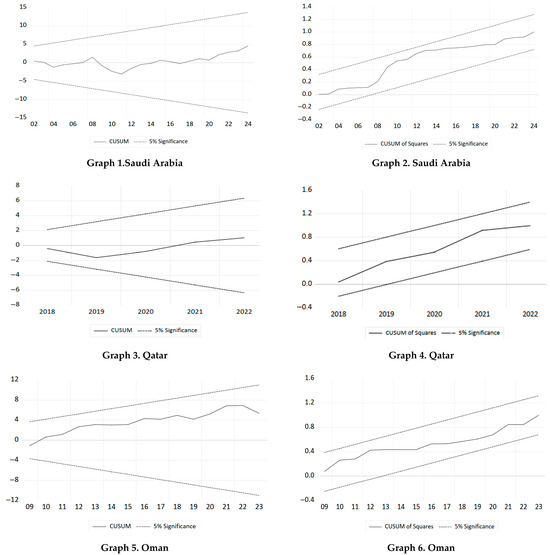
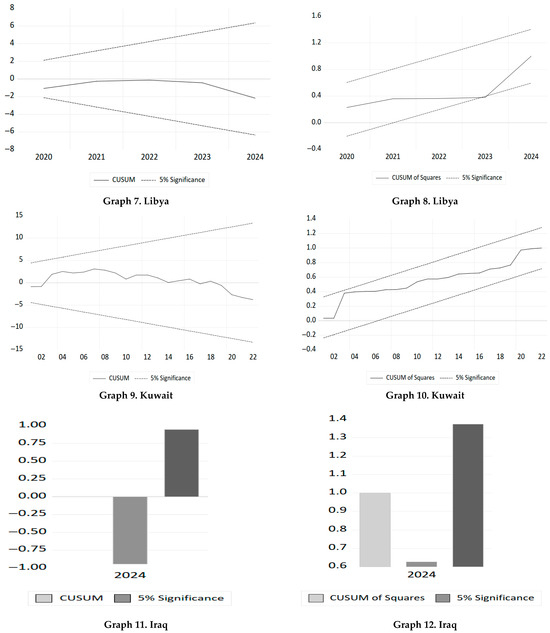
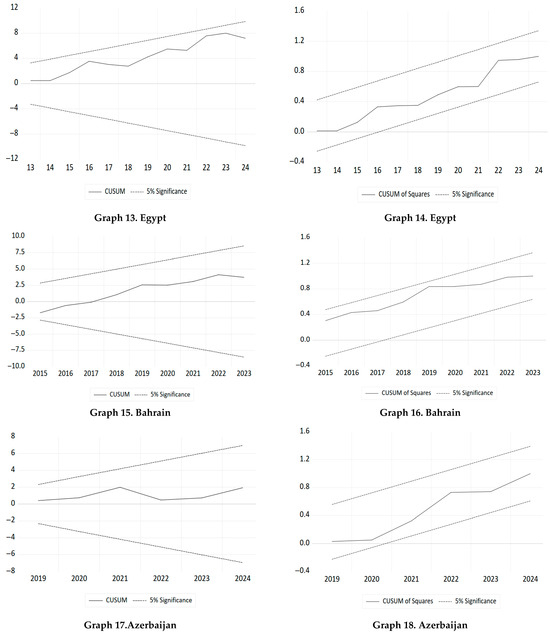
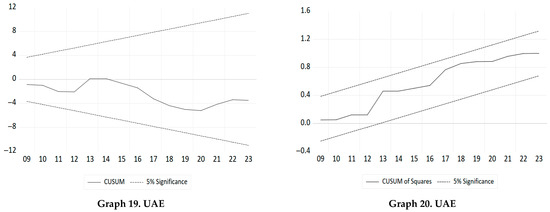
Figure A1.
Graphs of CUSUM & CUSUM-SQ.
Figure A1.
Graphs of CUSUM & CUSUM-SQ.
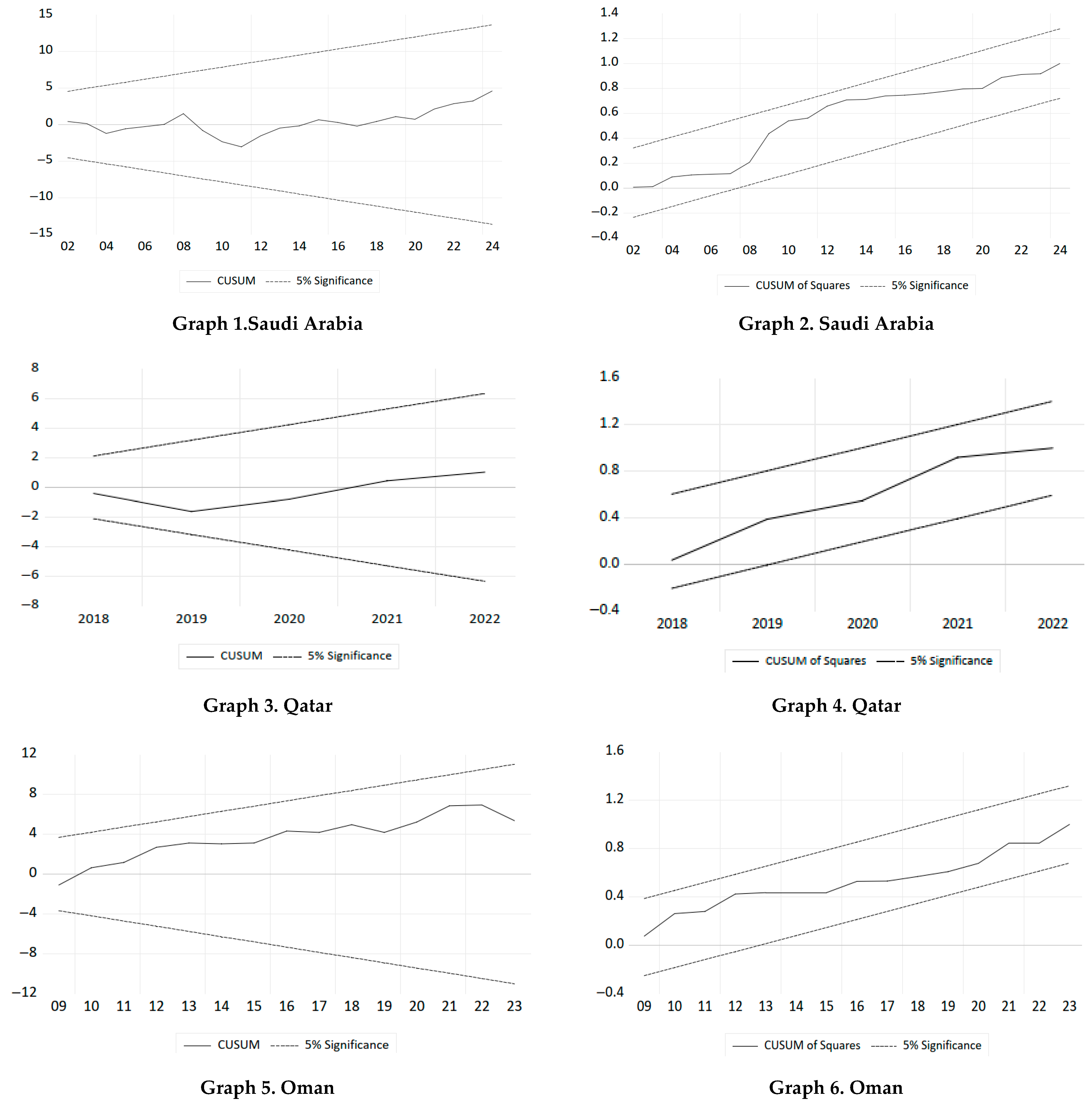
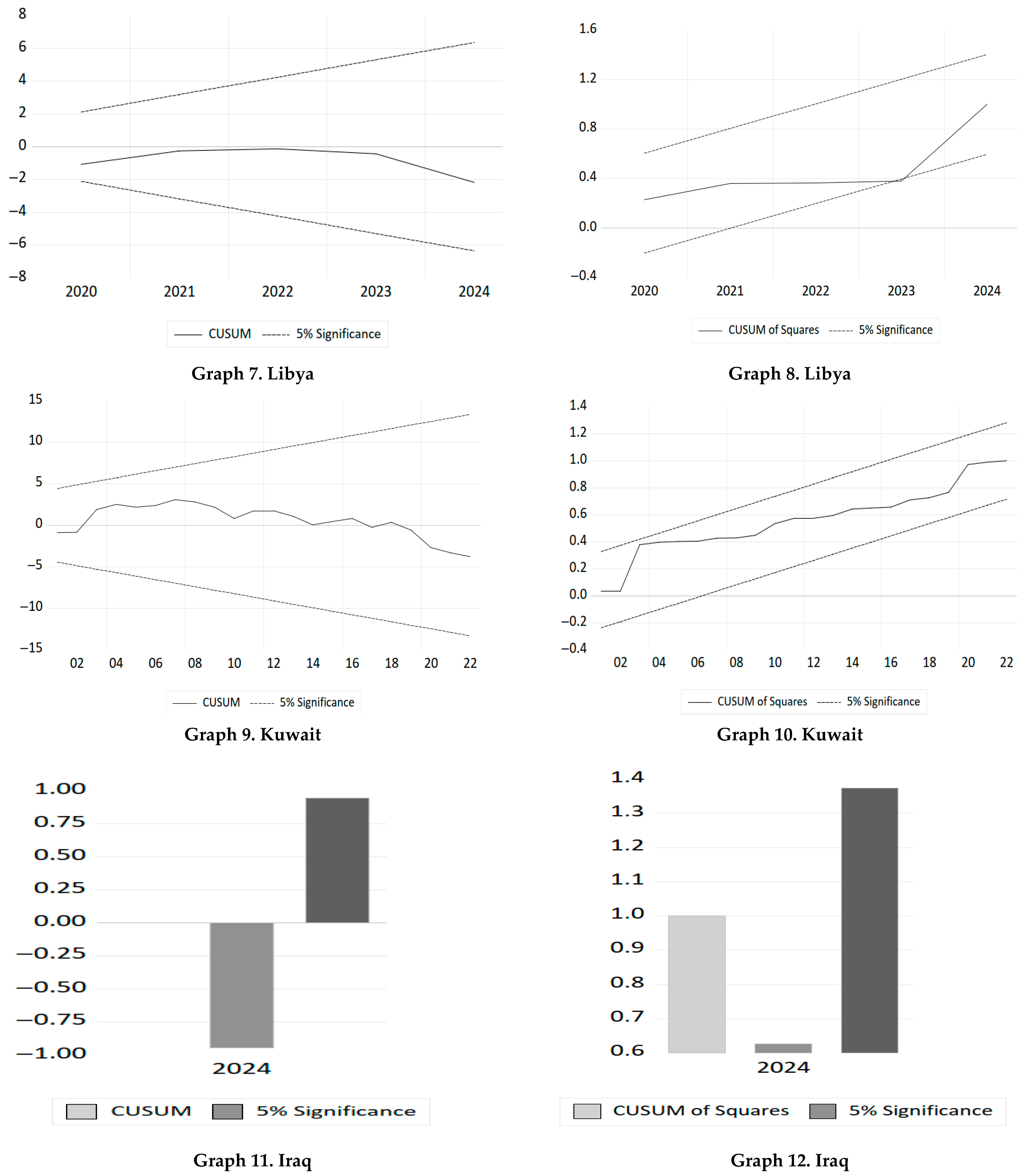
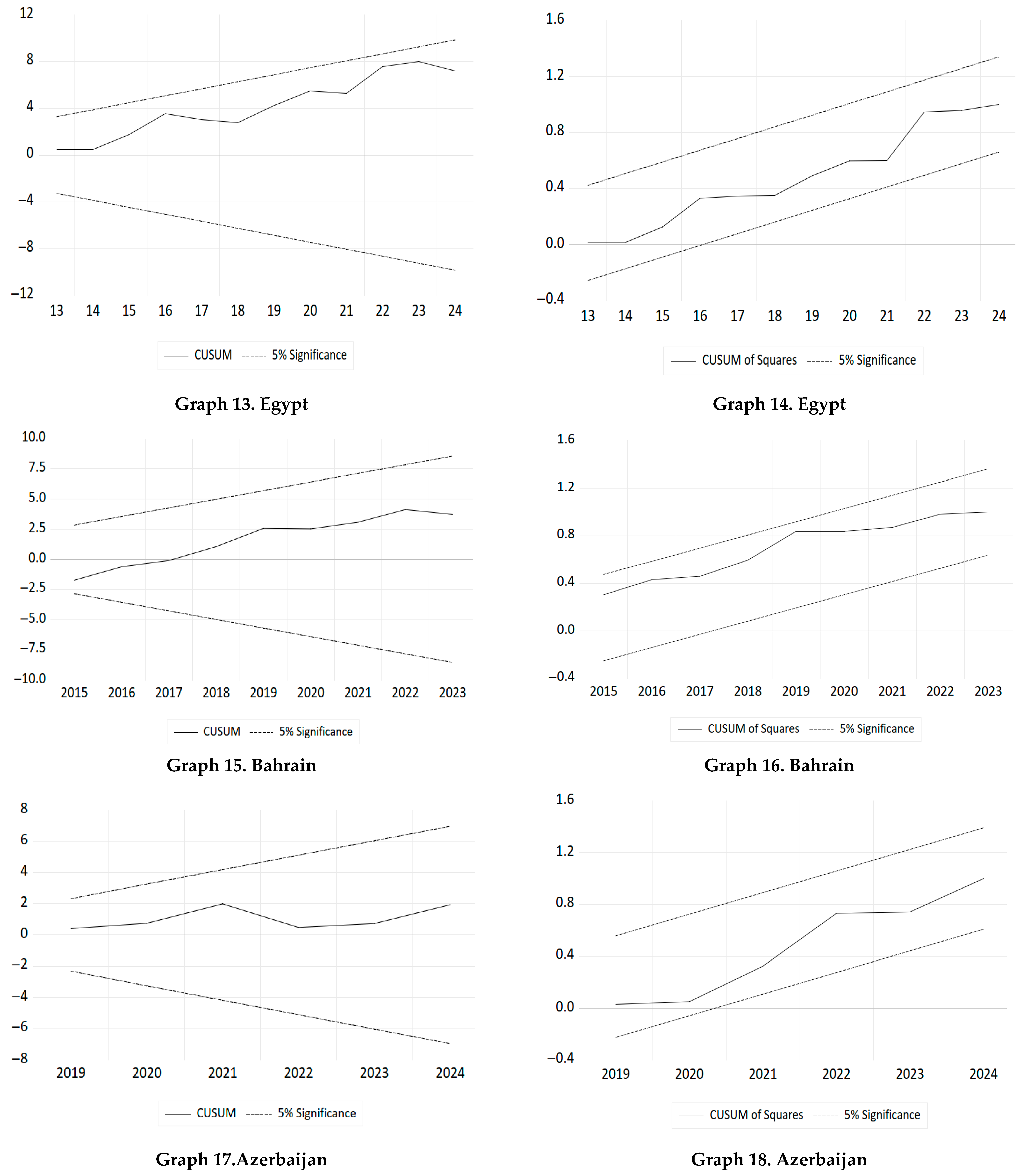
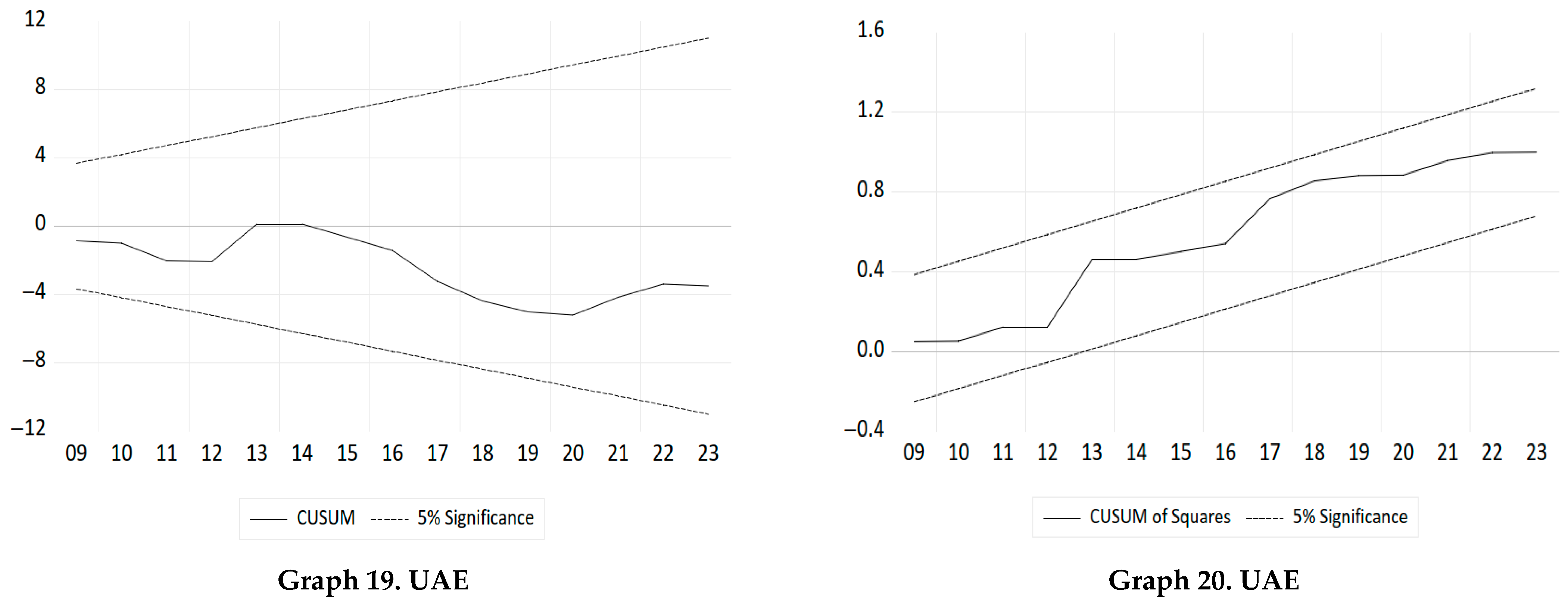
References
- Abuzayed, B., & Al-Fayoumi, N. (2021). Risk spillover from crude oil prices to GCC stock market returns: New evidence during the COVID-19 outbreak. The North American Journal of Economics and Finance, 58, 101476. [Google Scholar] [CrossRef]
- Agboola, E., Chowdhury, R., & Yang, B. (2024). Oil price fluctuations and their impact on oil-exporting emerging economies. Economic Modelling, 132, 106665. [Google Scholar] [CrossRef]
- Aizenman, J., & Pinto, B. (2013). Managing financial integration and capital mobility—Policy lessons from the past two decades. Review of International Economics, 21(4), 636–653. [Google Scholar] [CrossRef]
- Akinsola, M. O., & Odhiambo, N. M. (2020). Asymmetric effect of oil price on economic growth: Panel analysis of low-income oil-importing countries. Energy Reports, 6, 1057–1066. [Google Scholar] [CrossRef]
- Al-Fayoumi, N., Bouri, E., & Abuzayed, B. (2023). Decomposed oil price shocks and GCC stock market sector returns and volatility. Energy Economics, 126, 106930. [Google Scholar] [CrossRef]
- Al Jabri, S., Raghavan, M., & Vespignani, J. (2022). Oil prices and fiscal policy in an oil-exporter country: Empirical evidence from Oman. Energy Economics, 111, 106103. [Google Scholar] [CrossRef]
- Alkathery, M. A., Chaudhuri, K., & Nasir, M. A. (2022). Implications of clean energy, oil and emissions pricing for the GCC energy sector stock. Energy Economics, 112, 106119. [Google Scholar] [CrossRef]
- Alkofahi, K., & Bousrih, J. (2024). The nexus between oil consumption, economic growth, and crude oil prices in Saudi Arabia. Economies, 12, 105. [Google Scholar] [CrossRef]
- Alqahtani, A., & Klein, T. (2021). Oil price changes, uncertainty, and geopolitical risks: On the resilience of GCC countries to global tensions. Energy, 236, 121541. [Google Scholar] [CrossRef]
- Alquist, R., Ellwanger, R., & Jin, J. (2020). The effect of oil price shocks on asset markets: Evidence from oil inventory news. Journal of Futures Markets, 40(8), 1186–1211. [Google Scholar] [CrossRef]
- Alshammary, M. D., Khalid, N., Abdul Karim, Z., & Ahmad, R. (2022). Government expenditures and economic growth in the MENA region: A dynamic heterogeneous panel estimation. International Journal of Finance & Economics, 27(3), 3287–3299. [Google Scholar] [CrossRef]
- Attílio, L. A., & Mollick, A. V. (2026). Oil price shocks and interest rates in major economies. International Economics and Economic Policy, 23, 14. [Google Scholar] [CrossRef]
- Balcilar, M., Gabauer, D., & Umar, Z. (2021). Crude oil futures contracts and commodity markets: New evidence from a TVP-VAR extended joint connectedness approach. Resources Policy, 73, 102219. [Google Scholar] [CrossRef]
- Bayramov, S. V., Mehdiyeva, G. Y., Eyvazov, A. A., & Mustafayev, E. R. (2021). Diversification rate of energy balance and energy export demand risk impacts on economic growth: The Case of Azerbaijan. Cuestiones Políticas, 39(68), 290–314. [Google Scholar] [CrossRef]
- Belloumi, M., Aljazea, A., & Alshehry, A. (2023). Study of the impact of crude oil prices on economic output and inflation in Saudi Arabia. Resources Policy, 86, 104179. [Google Scholar] [CrossRef]
- Belloumi, M., & Almashyakhi, A. A. (2025). Impact of natural resource rents and governance on economic growth in major MENA oil-producing countries. Energies, 18, 2066. [Google Scholar] [CrossRef]
- Bensafta, K. M. (2023). The impact of oil price shocks on economic growth in Algeria. Economics and Policy of Energy and the Environment, 2022(2), 63–82. [Google Scholar] [CrossRef]
- Bentour, E. M. (2023). On the government consumption multipliers evolvement over time: An SVAR analysis. Applied Economics Letters, 30(12), 1612–1617. [Google Scholar] [CrossRef]
- Bentour, E. M. (2025). Assessing government expenditures multipliers under oil price swings. Journal of Commodity Markets, 38, 100477. [Google Scholar] [CrossRef]
- Bigerna, S. (2023). Energy price shocks, exchange rates and inflation nexus. Energy Economics, 128, 107156. [Google Scholar] [CrossRef]
- Castro, C., & Jiménez-Rodríguez, R. (2024). The impact of oil shocks on the stock market. Global Finance Journal, 60, 100967. [Google Scholar] [CrossRef]
- Cherif, R., & Hasanov, F. (2013). Oil exporters’ dilemma: How much to save and how much to invest. World Development, 52, 120–131. [Google Scholar] [CrossRef]
- Coutinho, L., Georgiou, D., Heracleous, M., Michaelides, A., & Tsani, S. (2022). Limiting fiscal procyclicality: Evidence from resource-dependent countries. Economic Modelling, 106, 105700. [Google Scholar] [CrossRef]
- Dąbrowski, M. A., Papież, M., Rubaszek, M., & Śmiech, S. (2022). The role of economic development for the effect of oil market shocks on oil-exporting countries: Evidence from the interacted panel VAR model. Energy Economics, 110, 106017. [Google Scholar] [CrossRef]
- Ding, S., Zheng, D., Cui, T., & Du, M. (2023). The oil price–inflation nexus: The exchange rate pass-through effect. Energy Economics, 125, 106828. [Google Scholar] [CrossRef]
- El Anshasy, A. A., & Bradley, M. D. (2012). Oil prices and the fiscal policy response in oil-exporting countries. Journal of Policy Modeling, 34(5), 605–620. [Google Scholar] [CrossRef]
- Fueki, T., Nakajima, J., Ohyama, S., & Tamanyu, Y. (2020). Identifying oil price shocks and their consequences: The role of expectations in the crude oil market. International Finance, 23(3), 373–401. [Google Scholar] [CrossRef]
- Gong, X., Liu, Y., & Wang, X. (2021). Dynamic volatility spillovers across oil and natural gas futures markets based on a time-varying spillover method. International Review of Financial Analysis, 76, 101790. [Google Scholar] [CrossRef]
- Gulaliyev, M., Aga, A., Azizov, A., Kazimov, F., & Mir-Babayev, R. (2018). Assessing the degree of inequality in the distribution of national income and its macroeconomic consequences in Azerbaijan. Revista Amazonia Investiga, 7(17), 85–108. [Google Scholar]
- Gulaliyev, M., Ashurbayli-Huseynova, N. P., Gubadova, A. A., Ahmedov, B. N., Mammadova, G. M., & Jafarova, R. T. (2019). Stability of the banking sector: Deriving stability indicators and stress-testing. Polish Journal of Management Studies, 19(2), 182–195. [Google Scholar] [CrossRef]
- Gulaliyev, M., Musayeva, J., Musayeva, F., Jabbarova, A., & Hatamov, F. (2024). Effects of oil price shock on the exchange rate of national currencies in oil-rich countries: In the case of some Arab countries and Azerbaijan. WSEAS Transactions on Business and Economics, 21, 44–58. [Google Scholar] [CrossRef]
- Gülaliyev, M. G., Nuraliyeva, R. N., Huseynova, R. A., Hatamov, F. E., Yegana, A., & Abdullayev, E. S. (2022). Assessing the impact of the oil price shocks on economic growth in oil-exporting Arab countries. WSEAS Transactions on Business and Economics, 19, 462–473. [Google Scholar] [CrossRef]
- Hailemariam, A., Smyth, R., & Zhang, X. (2019). Oil prices and economic policy uncertainty: Evidence from a nonparametric panel data model. Energy Economics, 83, 40–51. [Google Scholar] [CrossRef]
- Hobdari, N. (2004). Country experiences with managing natural resource windfalls. In J. Wakeman-Linn, C. Aturupane, S. Danninger, K. Gvenetadze, N. Hobdari, & E. Le Borgne (Eds.), Managing oil wealth: The case of Azerbaijan. International Monetary Fund. Available online: https://www.imf.org/external/pubs/nft/2004/aze/oil/ (accessed on 1 November 2025).
- Javed, S. A., Furqan, M., & Bajwa, I. A. (2020). An ARDL investigation on the nexus of oil factors and economic growth: A timeseries evidence from Sultanate of Oman. Cogent Economics & Finance, 8(1), 1838418. [Google Scholar] [CrossRef]
- Jiménez-Rodríguez, R. (2022). Oil shocks and global economy. Energy Economics, 115, 106373. [Google Scholar] [CrossRef]
- Kilian, L. (2022). Understanding the estimation of oil demand and oil supply elasticities. Energy Economics, 107, 105844. [Google Scholar] [CrossRef]
- Krishkumar, S., & Naseem, N. A. M. (2022). Investigating the asymmetric effect of oil price on the economic growth in Malaysia: An augmented NARDL approach. SAGE Open, 12(2), 21582440221079936. [Google Scholar] [CrossRef]
- Lee, C.-C., Lee, C.-C., & Li, Y.-Y. (2021). Oil price shocks, geopolitical risks, and green bond market dynamics. The North American Journal of Economics and Finance, 55, 101309. [Google Scholar] [CrossRef]
- Lin, B., & Bai, R. (2021). Oil prices and economic policy uncertainty: Evidence from global, oil importers, and exporters’ perspective. Research in International Business and Finance, 56, 101357. [Google Scholar] [CrossRef]
- Liu, F., Umair, M., & Gao, J. (2023). Assessing oil price volatility co-movement with stock market volatility through quantile regression approach. Resources Policy, 81, 103375. [Google Scholar] [CrossRef]
- Mohammed, J. I., Karimu, A., Fiador, V. O., & Abor, J. Y. (2020). Oil revenues and economic growth in oil-producing countries: The role of domestic financial markets. Resources Policy, 69, 101832. [Google Scholar] [CrossRef]
- Moshiri, S. (2015). Asymmetric effects of oil price shocks in oil-exporting countries: The role of institutions. OPEC Energy Review, 39(2), 222–246. [Google Scholar] [CrossRef]
- Mukhtarov, S., Humbatova, S., Mammadli, M., & Hajiyev, N. G. (2021). The impact of oil price shocks on national income: Evidence from Azerbaijan. Energies, 14(6), 1695. [Google Scholar] [CrossRef]
- Poku, K., Opoku, E., & Ennin, P. A. (2022). The influence of government expenditure on economic growth in Ghana: An ARDL approach. Cogent Economics & Finance, 10(1), 2160036. [Google Scholar] [CrossRef]
- Sadraoui, T., & Mili, H. (2025). Dynamic interactions between oil price volatility and fiscal policy: Empirical evidence from GCC countries. Economies, 13, 334. [Google Scholar] [CrossRef]
- U.S. Energy Information Administration. (2025). Spot prices for crude oil and petroleum products [Data set]. Available online: https://www.eia.gov/dnav/pet/pet_pri_spt_s1_d.htm (accessed on 2 November 2025).
- World Bank. (2025). World development indicators [Data set]. Available online: https://databank.worldbank.org/source/world-development-indicators (accessed on 5 November 2025).
- Yildirim, Z., & Arifli, A. (2021). Oil price shocks, exchange rate and macroeconomic fluctuations in a small oil-exporting economy. Energy, 219(C), 119527. [Google Scholar] [CrossRef]
- Zhang, X., & Baek, J. (2022). The role of oil price shocks on exchange rates for the selected Asian countries: Asymmetric evidence from nonlinear ARDL and generalized IRFs approaches. Energy Economics, 112, 106178. [Google Scholar] [CrossRef]
- Zulfigarov, F., & Neuenkirch, M. (2020). The impact of oil price changes on selected macroeconomic indicators in Azerbaijan. Economic Systems, 44(4), 100814. [Google Scholar] [CrossRef] [PubMed]
Disclaimer/Publisher’s Note: The statements, opinions and data contained in all publications are solely those of the individual author(s) and contributor(s) and not of MDPI and/or the editor(s). MDPI and/or the editor(s) disclaim responsibility for any injury to people or property resulting from any ideas, methods, instructions or products referred to in the content. |
© 2026 by the authors. Licensee MDPI, Basel, Switzerland. This article is an open access article distributed under the terms and conditions of the Creative Commons Attribution (CC BY) license.