


Abstract
It is estimated that around 1.3 billion people, roughly 16% of the global population, live with some form of disability, which can be physical, auditory, visual, intellectual, or psychosocial (mental). To help this group overcome daily functional limitations and improve their ability to perform activities independently, Assistive Technologies (AT) are used. However, understanding the complex effects of these technologies on users’ lives poses challenges in measurement. This research aims to identify and systematise the impacts caused by AT within society, analysing the relationships among these impacts to offer a comprehensive understanding of their scope. A Systematic Literature Review (SLR) was carried out following the PRISMA protocol, supplemented by association rule analysis using the Apriori algorithm with Weka software. Metrics such as Support, Confidence, and Lift were used to evaluate the associations identified by the algorithm. This analysis revealed fourteen distinct types of impacts, categorised into three groups: User Quality of Life, Social and Psychosocial, and Work Environment and Productivity. The findings demonstrated consistent associations, including Autonomy → Independence, Socioeconomic Status → Social Impact, and Education → Social Impact, indicating interconnected effects of assistive devices across functional, educational, emotional, social, economic, and productivity areas. This study supports the Sustainable Development Goals by promoting the development of AT standardisation tools, guiding more inclusive public policies, and encouraging collaborative networks among stakeholders involved in AT research and development.
1. Introduction
The World Health Organisation (WHO) defines Assistive Technology (AT) as an inclusive term covering products, systems, and services designed to enhance the functional abilities of individuals with both long-term and temporary disabilities. Assistive products can be physical, such as glasses, wheelchairs, and prostheses, or digital, including software and alternative communication applications. These services aim to assist in the selection, acquisition, and use of AT by end users [1,2]. The scope includes assistive technologies and tools developed to promote accessibility, adaptation, and inclusion, thereby fostering greater autonomy, independence, and positive socioeconomic and psychosocial outcomes for users [3]. Another term used in this field is assistive products, which, according to ISO 9999:2022 (International Organisation for Standardisation) [4], refers to any product—such as devices, equipment, instruments, and software—used by individuals with disabilities to accommodate bodily limitations and reduce the impact of disability. However, such products often require assistance from specialised professionals for operation [4].
According to WHO data, it is estimated that about 2.5 billion people worldwide need one or more assistive products. With the ageing population and the rise in chronic non-communicable diseases, this number is expected to reach 3.5 billion by 2050 [5]. Additionally, according to UNICEF (United Nations Children’s Fund), approximately 240 million children live with disabilities, and the lack of access to AT hampers their educational inclusion, exposing them to risks like child labour, stigmatisation, and discrimination—factors that undermine their confidence and well-being. This situation highlights the strategic and future-oriented importance of AT, which necessitates in-depth research due to the increasing demand from users and specialised professionals, as well as the urgent need to develop innovative and personalised solutions [1,6].
For the development of innovative assistive products and service delivery, it is evident that AT involves professionals from various fields, making it an interdisciplinary area. Despite advances, the literature on AT often displays recurring limitations: the impacts of assistive devices are still studied in isolation without a strong conceptual framework. Studies tend to focus on technical details [7] or specific aspects [8,9] but rarely examine impacts in a comprehensive and connected way. Measuring the results and impacts of AT is essential to understanding its benefits and to developing evidence-based policies and systems that ensure universal access. For this, the adoption of management metrics with an adequate number of variables can be suggested [10]. The Global Alliance of Assistive Technology Organisations (GAATO), for instance, has used a consensus-based, collective approach and consultative processes involving over 400 local and global stakeholders to identify key challenges in the assistive products sector, including the difficulty of measuring AT’s results and impacts on users and communities at regional, national, and global levels [1]. This gap hinders the development of a knowledge base necessary for the broad evaluation and assessment of AT’s effects on users’ lives and society. Therefore, the literature clearly demonstrates how AT transforms lives but does not systematically identify which impacts are most important, how they interrelate, or which are being overlooked.
In this context, a recent study by Lourenço et al. [11] states that AT should not be viewed merely as isolated devices or services, but rather as part of an interconnected ecosystem of concepts and applications. This study grouped the terms and definitions of AT into five main categories: Technologies for Assistance and Inclusion, Functional Assistive Devices, Assistive Interaction Interfaces, Assistive Environmental Technologies, and Assistive Systems. This classification demonstrates that these technologies span from broad solutions aimed at social inclusion and cultural adaptation to personalised functional devices, user-centred interfaces, intelligent environments, and occupational-focused systems. Therefore, the clusters highlight not only the diversity but also the links among the technical, social, and environmental aspects of AT, reinforcing the significance of integrated analyses that acknowledge its multiple impacts on users’ lives and society as a whole.
In summary, this article aims to identify and systematise the impacts of AT on society, explore the relationships that can be established between them, and provide a cross-sectional understanding of the impacts and their dimensions. To achieve this, a Systematic Review of the Literature (SRL) was conducted following the PRISMA protocol. For the meta-analysis of the data collected from the review, association rules—specifically, Support, Confidence, and Lift—were applied using the Apriori algorithm via Weka software 3.8. The goal was to identify, organise, and analyse the relationships between the impacts of AT.
Therefore, this research makes significant contributions to the field of AT. First, it organises the impacts uniquely identified in the literature, bringing clarity to a field often characterised by isolated studies. Next, it proposes a structured classification of the mapped impacts into three clusters (User Quality of Life, Social and Psychosocial, and Work Environment and Productivity), enabling a comprehensive understanding of how AT influences different areas of life. From a methodological standpoint, it is important because it applies the Apriori algorithm in the Weka software, incorporating association metrics that highlight relationships between impacts that require reinforcement. Additionally, it offers valuable practical implications by providing evidence to guide public policies, marketing strategies, and the development of products better aligned with user needs. Finally, it aligns with the UN 2030 Agenda, especially SDGs 3 (health and well-being), 4 (quality education), 8 (decent work and economic growth), and 10 (reduction of inequalities), reaffirming the social and global importance of AT as a tool for inclusion and sustainability [12].
2. Methodological Procedures
The methodological procedures of this research were divided into two phases: Phase 1—Systematic Literature Review (SLR) and Phase 2—Meta-analysis.
2.1. Phase 1—Systematic Literature Review
The SLR was created to identify the different impacts of assistive technologies on their users. This approach aligns directly with the international definitions of AT established by the WHO and ISO. While the WHO defines AT as a set of products, services, and systems designed to enhance the functionality and inclusion of people with disabilities or functional limitations, ISO 9999:2022 describes it as any product, device, equipment, or software developed to support, replace, or train bodily functions, as well as to prevent disabilities and limitations in daily activities [1].
Therefore, this SLR examines the various impacts generated by AT and its relations, aiming to supplement these definitions by demonstrating that understanding AT products and services alone is insufficient. It is also crucial to understand their effects on users’ lives and their interactions with society. Consequently, the research questions guiding the review were: What are the impacts of AT on society? How can these impacts be linked? Thus, this study aims to deepen the understanding of AT as an ecosystem where societal impacts are interconnected and interdependent, while providing empirical and conceptual foundations aligned with the recommendations of the WHO and ISO.
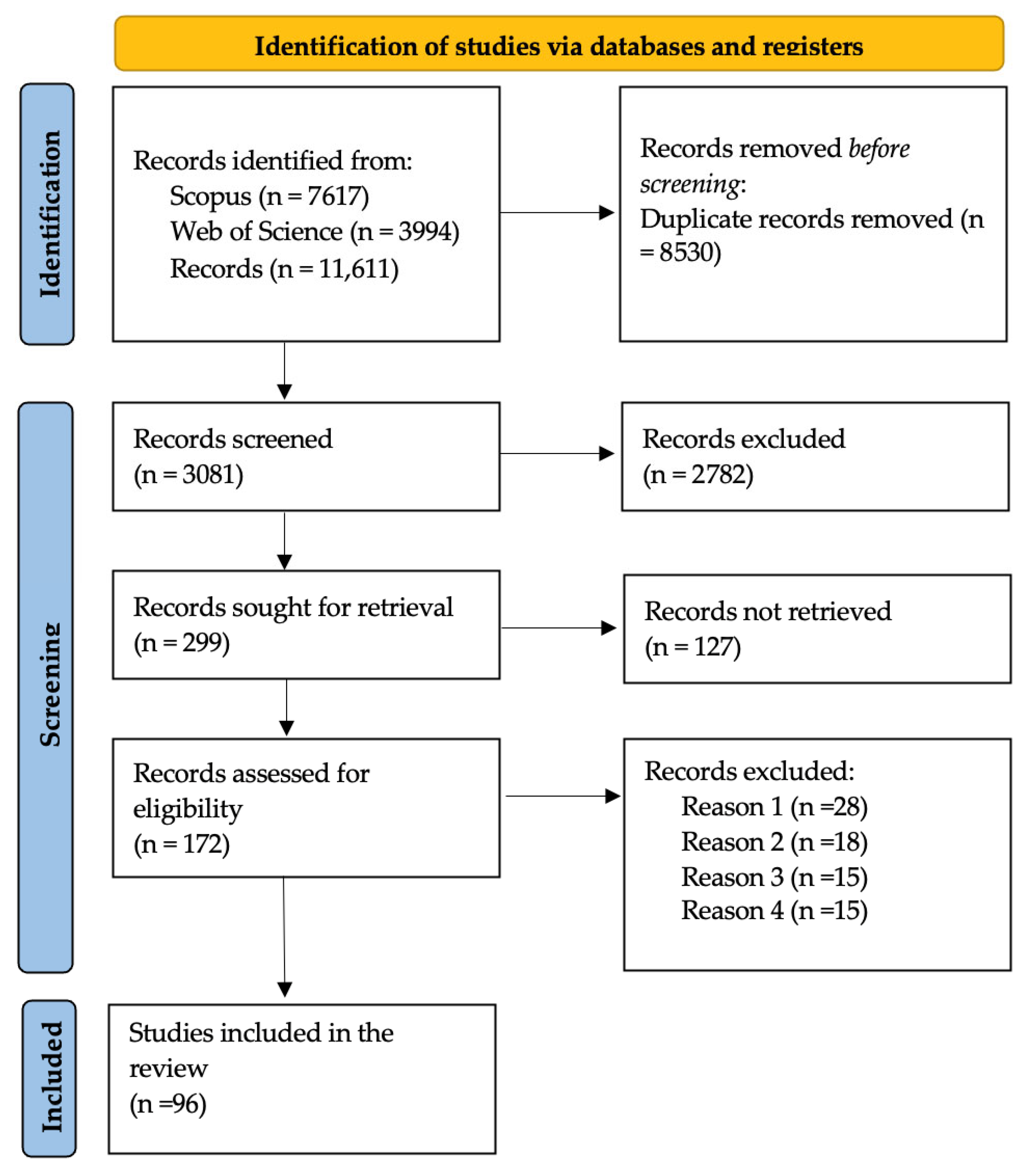
The PRISMA statement [13], shown in Figure 1, was used to guide the review. The process involved four main phases: Identification, Screening, Eligibility, and Inclusion. During the identification phase, conducted in November 2024, considering the thematic scope of this research, which focused on understanding a management perspective on the impacts of AT on society, keywords were tested in various databases to determine which were most suitable and, at the same time, met the research needs. Furthermore, it is not possible to state which databases should be consulted for systematic reviews; therefore, it is recommended to use at least two to make the search more comprehensive [14,15,16]. In this context, the Scopus and Web of Science databases were selected because they retrieve a greater number of high-quality articles with a thematic perspective related to this research. The selected time filter included all available years to provide an overview of research in this area and the evolution of relevant scientific discourse. In this sense, the first article identified in this SLR was from 1989. The other filters applied (Table 1) included: document type (articles), language (English), and interdisciplinary fields related to AT. The keywords used were: “Assistive technology” OR “Self-care technology” OR “Assistive User Interfaces” OR “Ambient Assistant Living” OR “Work Assistance” OR “Adaptive work” OR “Assistance systems.” This search produced 11,611 documents. Subsequently, duplicate records were removed using Mendeley software (Mendeley Cite, v1.55.1.0), reducing the number of articles to be analysed.
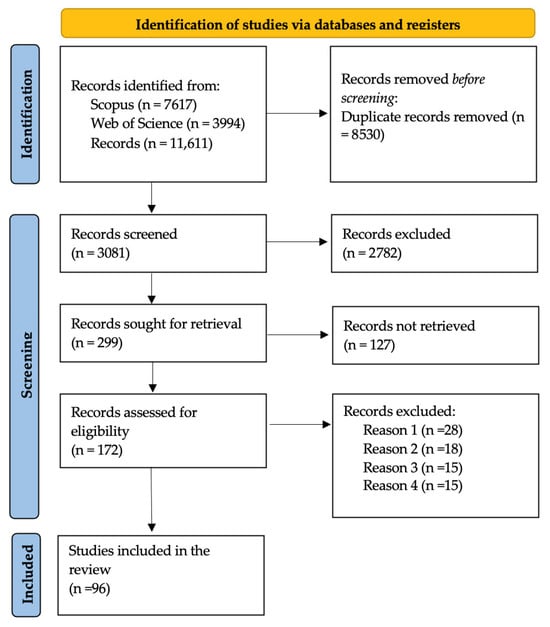
Figure 1.
Prisma flow diagram used to include studies in the systematic review.

Table 1.
Search filters used in the systematic literature review.
During the screening phase, after removing duplicates, the titles and abstracts of the articles were assessed for relevance to the AT theme and scientific importance. Priority was given to articles classified as Q1 and Q2 in the Scimago Journal Rank, which ensured higher academic rigour and methodological quality. By the end of this screening, 172 articles were selected for full review.
Regarding eligibility, the articles were analysed to verify compliance with four conditions: 28 articles were excluded because they did not explicitly address AT and its effects on users’ lives; 18 lacked measurable empirical data; 15 were technical or engineering papers focused on prototypes and circuits; and 15 were excluded due to the unavailability of the full text. Table 2 shows the criteria used to exclude articles from the eligibility.
Table 2.
Criteria used as reasons for excluding articles in the eligibility phase.
Finally, in the inclusion phase, 96 articles were obtained that met the research’s objective. These studies represent the most relevant literature on the impacts of AT, covering different contexts, populations, and methodological approaches, and serve as support for phase 2.
2.2. Phase 2—Meta-Analysis
A meta-analysis was conducted to synthesise the results obtained from the SLR, assisting in the logical organisation of the findings [13]. The methodology for this meta-analysis was based on association rules, a data mining technique that detects frequent associations within a database [17]. According to these rules, if two terms appear in the same document, they can be considered part of a network [18]. Association rules of the Apriori algorithm were utilised. Apriori enables the establishment of dependency relationships and confidence levels between two variables by identifying patterns in a database and determining Boolean association rules [19]. The Weka software, an open-access tool for association, classification, clustering, and regression tasks [20], performs Apriori calculations.
To conduct this, the selected articles were read in full to complete the spreadsheet, where the types of impacts resulting from the use of AT were identified. Each mention of an impact type was recorded in the spreadsheet using the symbols “?” and “1”, with “?” indicating no mention of the impact and “1” indicating its mention. The spreadsheet file was then converted to *.csv format for analysis in Weka.
The definition of support, confidence, and lift rules using Apriori follows the idea [21,22]: I is the set of items (I1, I2, …, In), D is the database containing transactions T represented as binary vectors, where T[k] = 1 if T bought item Ik, and T[k] = 0 otherwise. Each transaction T → I has an identifier k, and each transaction corresponds to a tuple in database D. Let A be a set of items within I. Transaction T contains A if and only if A ⊆ T. An association rule is an implication of the form A → B, where A ⊆ I, B ⊆ I, and A ∩ B = Φ.
Support: Rule A → B is valid on the supported set D, where s is the percentage of transactions D containing A ∪ B. The probability in this rule is P (A ∪ B).
Support (A → B) = P (A ∪ B)
Confidence: Rule A → B has confidence c in set D, where c is the percentage of transactions containing A that also contain B; thus, it is the conditional probability P (B | A).
Confidence (A → B) = P (B | A)
Lift: This metric assesses the degree of correlation between the occurrences of items.
Elevator (A, B) = [P (A ∪ B)/(P (A) × P (B))]
Regarding lift, when the result is less than 1, the occurrences of A and B are negatively correlated; when the result is greater than 1, the occurrences of A and B are positively correlated; and when the result equals 1, then A and B are independent [19]. Thus, to build the networks and understand the relationships between different types of impacts, it was established that the confidence should be equal to or greater than 0.75, and the lift should be greater than 1.0, indicating confidence in the occurrence of impacts and that these relationships are positively dependent. The results of the Apriori analysis were used to create graphs illustrating the networks with the connections between the different impact types identified through the AT ecosystem.
3. Results and Discussions
The results and discussions of the Systematic Review of the Literature and the Apriori rules are presented in this section.
3.1. Beneficiaries and Potential Beneficiaries of AT
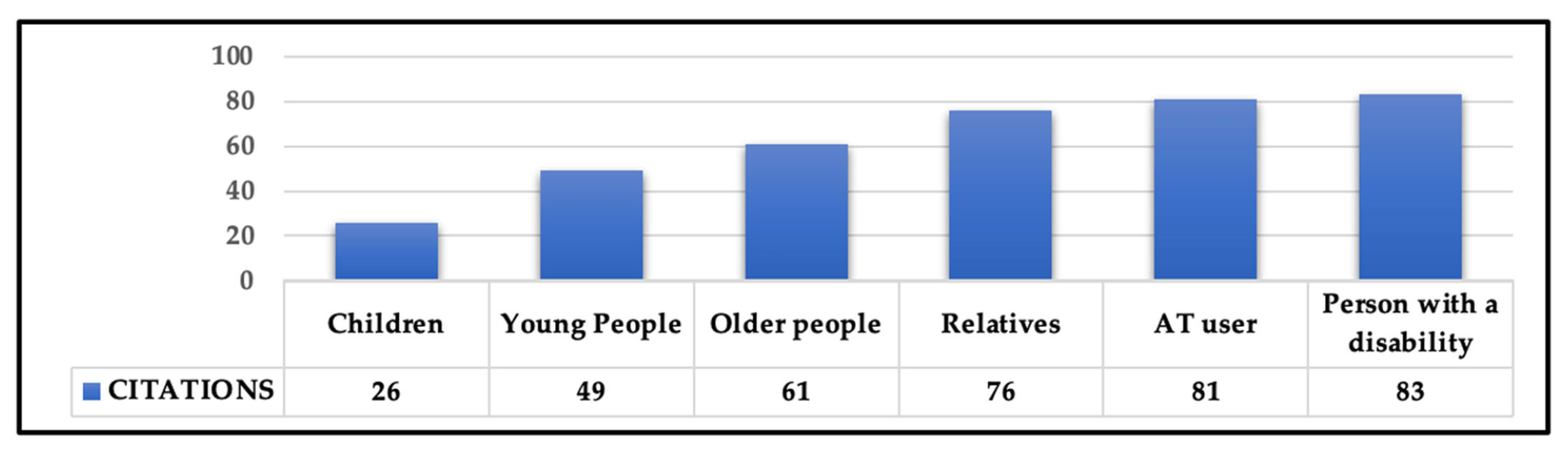
Using the SLR, the nominal figures and percentages of AT beneficiaries were compiled from a total of 96 articles studied, as shown in Table 3 and Figure 2. It is observed that the main actors in the articles were persons with disabilities, AT users, and relatives, with percentages of 86.46%, 84.38%, and 79.17%, respectively. This suggests that these groups are closely interconnected, and it further indicates that the production chain of assistive devices revolves around these actors.
Table 3.
Beneficiaries and potential beneficiaries of AT.
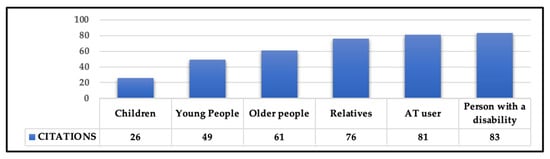
Figure 2.
Number of citations of actors benefiting from AT identified in the SLR.
AT users are individuals who utilise one or more assistive technologies to compensate for inherent functional limitations, whether physical, mental, intellectual, or sensory. On the other hand, persons with disability are potential users who, due to the influence of social, political, economic, geographic and psychological barriers, object to the acquisition of assistive products [1,23]. Studies indicate that the main barriers to the use of AT are cost, non-functional or defective product (flaws in the device’s software), lack of training for handling, eligibility (such as assessment of need and medical prescription), stigma, lack of acceptance of disability by the user, and the complexity of the use of assistive devices [24]. Figure 2 shows the number of citations to AT users in ascending order.
Furthermore, it is observed that the AT is not only centred on AT users and potential users, but also on their relatives. Thus, spouses, adult children, and parents, in addition to accounting for 80% of the services related to the care of loved ones with disabilities or the elderly [25], also have their role in the AT ecosystem, whether for support, handling, selection, adherence, and/or efficient adaptation of assistive devices [26].
Paid professionals carry out formal care, while informal care is provided by family members, friends, or neighbours who are directly linked to the disabled person [27]. Previous research indicates that, in addition to the benefits for AT users, family caregivers also experience notable improvements in their quality of life with the introduction of assistive products in the home environment [25,27]. These devices decrease stress and physical strain by turning some mechanical and repetitive care tasks into monitoring activities. This shift not only alleviates physical and emotional burdens but also allows caregivers more time to focus on their own economic and self-care activities, thereby extending the benefits of AT beyond the immediate user.
Regarding age groups, Table 3 shows that older people, children, and young people have percentage values of 63.54%, 27.08%, and 51.04%, respectively. The analysis of the impacts of AT on these three groups reveals distinct yet complementary benefits. For older people, assistive products help support an independent and dignified life by increasing functional autonomy, reducing caregivers’ burden, promoting self-care in health, and decreasing feelings of isolation and anxiety [28]. For children and young people, AT serves as a tool for empowerment and prospects by ensuring access to education, supporting the development of professional skills, and fostering the construction of identity, self-esteem, and social belonging [29]. Thus, while for the elderly AT maintains quality of life in the present, for young people it creates opportunities for future social and labour inclusion, demonstrating that its effects vary across the life cycle but aim towards the same goal: promoting inclusion, autonomy, and full participation in society.
In summary, this research highlights the need for supplementary studies examining other actors within the AT ecosystem and their potential collaborations to enhance impacts and benefits for users, individuals with disabilities, and their families. Therefore, further research is necessary to go beyond the typical relationships discussed in existing literature, such as those between AT providers and these three main actors (focusing on direct customer services) [29] to include new connections with additional specialists and professionals in the assistive devices sector (physicians, nurses, physiotherapists, occupational therapists, psychologists, teachers, designers, engineers, financing, and government institutions), acknowledging that the development, production, management, and supply chain of these devices tend to be generalist in nature [30].
3.2. Impacts of AT
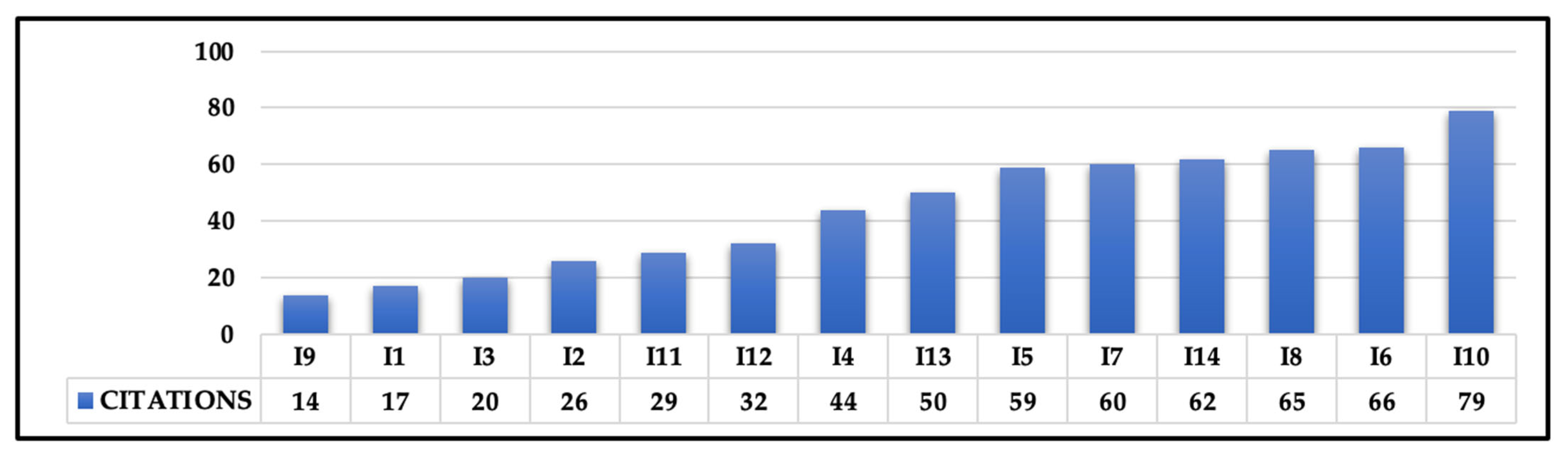
Table 4 lists 14 impacts of AT on users’ daily lives. These, in turn, were quantified by the number of citations, percentage values, and coded with the letter “I,” ranging from 1 (I1-Workplace Competencies) to 14 (I14-Psychosocial Impact), as shown in Figure 3. Based on the analysis of the 96 articles included in the SLR and the interpretation of the context described for each of the 14 identified impacts, it became possible to group these effects into three analytical clusters. The first, called Work Environment and Productivity, considers aspects associated with the work environment, such as the development of professional skills with AT, adaptation to disability, productivity, and experiences in the workplace. The second, called User Quality of Life, encompasses impacts related to the daily life of AT users, such as greater satisfaction, autonomy, independence, and a sense of belonging. Finally, the Social and Psychosocial covers factors linked to the social and emotional dimensions, such as trust, psychological well-being, socioeconomic status, and community inclusion.
Table 4.
Impacts associated with the Assistive Technology ecosystem identified in the systematic literature review.
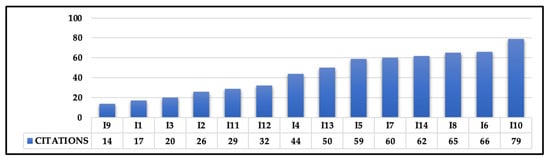
Figure 3.
Number of citations and percentage values of the Impacts associated with the AT ecosystem identified in the SLR.
Additionally, Figure 3 shows that impacts I10 (Social Impact), I6 (Independence), and I8 (Social Belongingness) were the most frequently mentioned in the articles studied, with statistical relevance of 82.29%, 68.75%, and 67.71%, respectively.
In Figure 3, relevant gaps were identified concerning the inclusion and impacts of individuals with disabilities in the labour market (I2-27.08%), as well as their relationship with employers and co-workers. Notably, there is a scarcity of studies on the skills (I1) developed by AT users in the corporate environment, as well as the anxiety (I9) experienced during the job search or the process of obtaining a job during the contractual probationary period. Therefore, an extensive approach is necessary, correlating the socioeconomic (I13) and psychological (I14) impacts on the lives of these users in the workplace.
It is also observed in Figure 3 that the impacts I1-Workplace Competencies and I9-Anxious feelings correspond to 17.71% and 14.58%, respectively, which are proportionally lower than the I10- Social impact (82.29%). Although these impacts are less frequent, they should not be overlooked, as they reflect important dimensions. I1-Workplace Competencies indicate the potential of AT to enhance productive integration; meanwhile, I9-Anxious feelings highlight emotional vulnerabilities that need stabilisation to ensure social gains are sustainable.
3.3. Network of Relations of the Impacts of AT
To demonstrate the calculation of data association rules, the link between I7-Autonomy and I10-Social impact can be shown. Therefore, I7-Autonomy is the antecedent (A) and I10-Social impact is the consequent (B). To find the support for the association between A and B, it is necessary to determine how many times A and B are cited together in the same article (53 times, as shown in Table 3, in the column “Apparitions as the successor”) and the total number of articles (96). So:
Support (A → B) = P (A ∪ B) = 53/96 = 0.552 = 55.2%
The confidence association rule is derived from the ratio of transactions that contain A (60 times, as shown in the column in Table 3 “Apparitions as the antecedent”) and include B (53 times, as shown in the column in Table 3 “Apparitions as the successor”).
Confidence (A → B) = P (B|A) = 53/60 = 0.88 = 88%
The supporting association rule is derived by comparing the Support (A → B) (previously calculated as 0.552) and multiplying the probabilities of occurrence in the full set of items of A (which occurs 60 times, as shown in Table 2) and B (which occurs 79 times, as shown in Table 2). It is like this:
P (A) = 60/96 = 0.625
P (B) = 79/96 = 0.822
Lift (A, B) = [P (A ∪ B)/(P (A) × P (B))] = [0.552/(0.625 × 0.822)] = 0.552/0.514 = 1.07
Table 5 displays the key associations identified between the impacts of AT. To highlight the relationship within the AT impact network, a minimum support level of at least 0.10, a confidence level of at least 0.75, and a lift above 1.0 were used [19].
Table 5.
Best association rules found between impacts associated with the AT ecosystem.
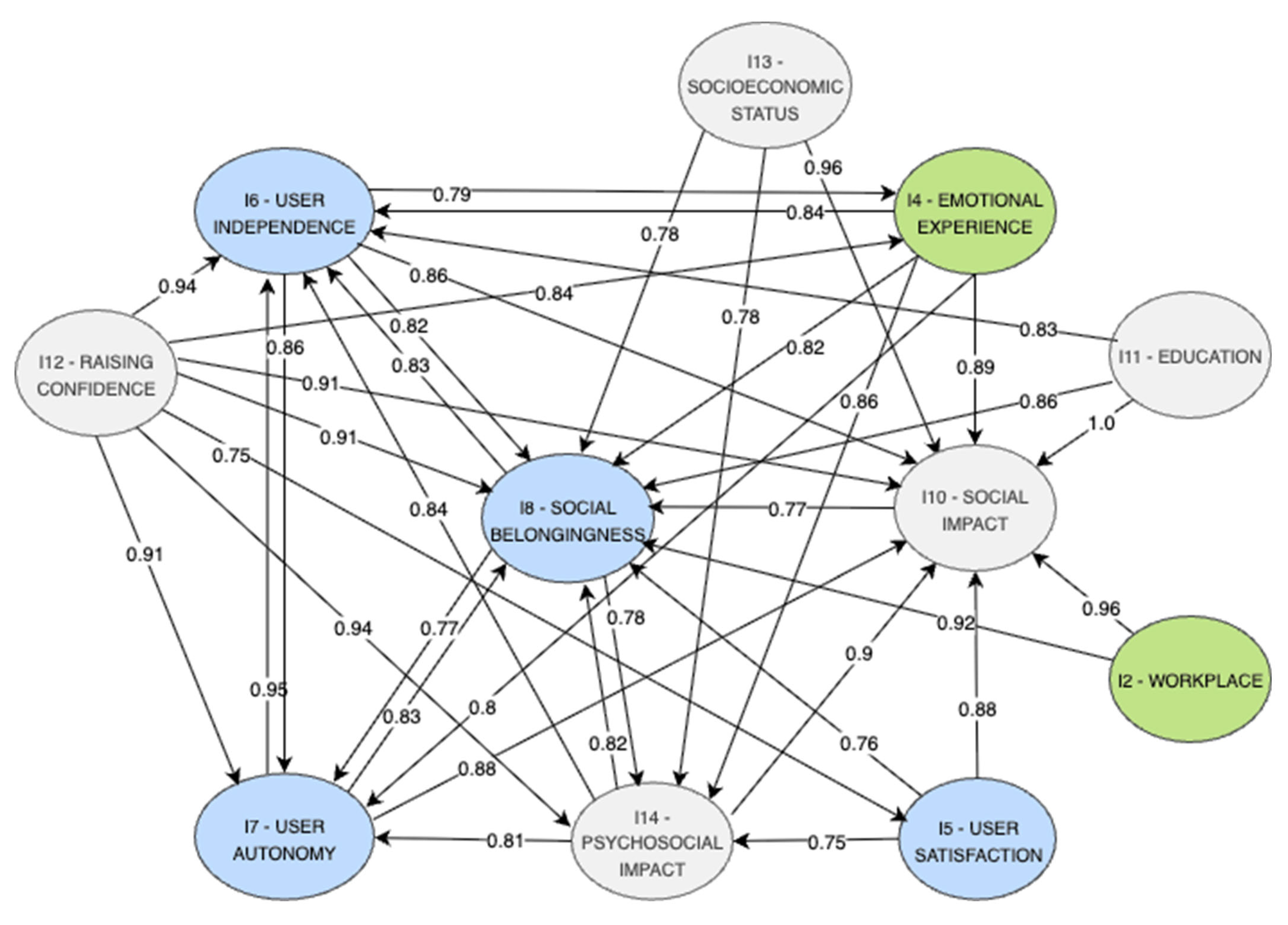
Figure 4 displays the network of relationships among the impacts, with 11 out of the 14 impacts listed in the SLR showing relevance and appearing in the network. The numbers on the arrows indicate the confidence values between the impacts. Additionally, each impact is coloured according to its original cluster: Work Environment and Productivity in green, User Quality of Life in blue, and Social and Psychosocial in grey.
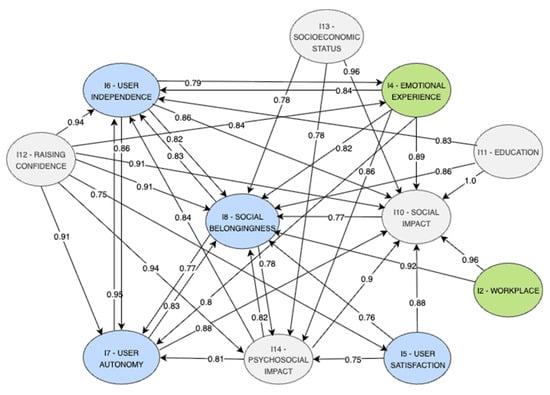
Figure 4.
Impacts’ network of the AT ecosystem.
Following the lift rule, there is a dependency relationship in all the rules presented in Figure 4 because, in each case, the lift exceeds 1.0. According to the Apriori confidence rule in Figure 4, the arrow always points to the successor, indicating the level of confidence that if the predecessor appears, the successor will also be mentioned in the same article. For example, in the I7-Autonomy and I10-Social impact rules, a confidence of 0.88 means that in 88% of the articles where I7-Autonomy is cited, I10-Social impact is also mentioned.
It is also noteworthy, according to Table 5 and Figure 4, that the relationship with the highest confidence value (0.96) is between I13-Socioeconomic status/I10-Social impact and I2-Impacts on the workplace/I10-Social impact. This demonstrates a strong association between them, indicating that socioeconomic status and the influence exerted by AT in a user’s work environment have a significant impact on their productive and economic integration in society.
The second connection with the highest confidence value (0.95) is between I7-Autonomy and I6-Independence. Although the expressions autonomy and independence denote similarity, they carry conceptual nuances. Autonomy refers to the ability to make decisions and act independently, whereas independence relates to performing activities without external assistance. Therefore, it is expected that AT users achieve increased autonomy through AT, thus experiencing greater independence in their daily activities [7].
Additionally, based on the analysis of Table 5 together with Figure 4, which relates I14-Psychosocial impact to I10-Social impact, a confidence value of 0.9 is observed. This suggests that social impact is also mentioned in 90% of the articles where psychosocial impact appears. Therefore, it is evident that I14 and I10 are bidirectional impacts; that is, the benefits provided by assistive devices in social integration activities are directly proportional to the social and psychological well-being of users.
Then, in Section 3.3.1, Section 3.3.2, Section 3.3.3 and Section 3.3.4, the Work Environment and Productivity (green), User Quality of Life (blue), and Social and Psychosocial (grey) clusters will be discussed in an interconnected way, providing a contextual overview of Figure 4.
3.3.1. User Quality of Life
The User Quality of Life cluster includes impacts such as user satisfaction (I5), independence (I6), autonomy (I7), sense of social belonging (I8), and feelings of anxiety (I9). These elements are directly linked to the daily experience of AT users and reflect the most apparent extent of their device use.
This cluster is primarily supported by the most consistent associations identified in the Apriori analysis. The rule I7-Autonomy → I6-Independence showed a confidence of 0.95 and a lift of 1.38, indicating that these two impacts nearly always occur together (95%). Although often regarded as synonyms, in the context of AT, autonomy and independence are related but distinct concepts. Independence pertains to the AT user’s capacity to perform daily activities without assistance from third parties (family members, formal caregivers, or friends), thus representing a functional improvement (eating, communicating, moving, studying, and working). Conversely, autonomy relates to cognitive freedom to make decisions regarding one’s own life (power of choice) [1]. Differentiating these two impacts is vital, as it helps us understand that the effectiveness of AT extends beyond overcoming functional barriers to also fostering protagonism, freedom, and user empowerment.
The sense of social belonging develops when AT enables users to engage effectively and equally in educational, cultural, and community environments, broadening their social interactions, decreasing isolation, and facilitating communication. Therefore, quality of life is shaped by social participation and personal relationships. Studies indicate, for example, that the involvement of AT users in adapted sports has a positive impact on psychological aspects, particularly those related to self-esteem, self-efficacy, and a sense of belonging [31]. Understanding that assistive products go beyond just functionality, but also give users the feeling that their presence is appreciated and that they are recognised as an important part of society, is essential to grasp the full benefits of AT.
Although the conditionals I5-Impact on user satisfaction and I9-Anxious feelings are absent from Figure 4, they remain relevant to the lives of AT users. The omission is justified by the limited support and confidence in the rules of association; however, their mention in qualitative research suggests that they still have a significant impact within the AT context [26,32].
In this context, I5-Impact on user satisfaction acts as an indicator of the quality of assistive products. Devices that fail to meet expectations for usability, comfort, reliability, and aesthetics lead to abandonment [33,34,35]. I9-Anxious feelings, on the other hand, emerge from technological dependence, fear of stigma, or insecurity about acceptance in educational settings or related to the labour market [31]. Ignoring this aspect means overlooking a significant psychosocial barrier, especially during the user’s adaptation to the assistive device.
3.3.2. Social and Psychosocial
The Social and Psychosocial cluster encompasses impacts such as social impact (I10), education (I11), increased confidence (I12), socioeconomic status (I13), and psychosocial impact (I14). Unlike the previous cluster, which highlights more personal and specific aspects of the individual, this one emphasises the collective and relational effects of AT, illustrating how assistive products affect social integration, self-esteem, and the socioeconomic circumstances of users.
In the I11-Education → I10-Social impact interaction, with a confidence of 1 and a lift of 1.22 (Table 5), the significance of education as a gateway to social, economic, and professional opportunities that positively influence the lives of AT users is recognised. The right to education is enshrined in international and regional legal documents, such as Article 26 of the Universal Declaration of Human Rights and Article 24 of the United Nations Convention on the Rights of Persons with Disabilities. Although nations have ratified at least one treaty that guarantees the right to education for all [1], there are still barriers to access and equity in education for Children (Table 3), such as disabling environments, difficulty in accessing educational materials, inflexible educational systems, stigma, and prejudice [36,37]. Removing barriers to access to education and the integration of AT in this environment promotes equal opportunities for the future of these children and simultaneously strengthens SDG 4 [12].
In the I12-Raising Confidence → I14-Psychosocial Impact association (confidence 0.94; lift 1.45), it is observed that enhancing the user’s confidence through AT results in greater self-esteem, emotional well-being, and psychological stability. Similarly, the association between I12-Raising Confidence → I10-Impact Social, with confidence of 0.91 and lift 1.10, demonstrates that trust extends beyond the individual level, serving as a foundation for social acceptance and community participation. Along these lines, the strong link between I14-Psychosocial Impact → I10-Social Impact (confidence 0.90; lift 1.10) indicates that emotional stability and increased self-esteem influence the user’s ability to socially integrate, reinforcing I12-Raising Confidence as a mediating factor between functionality, well-being, and social inclusion [38].
Another notable connection in this cluster relates to the association rule established between I13-Socioeconomic status → I10-Social impact, with a confidence of 0.96 and a high lift of 1.17, indicating that economic improvements from AT (such as access to the labour market) are directly associated with perceptions of recognition and social inclusion. Similarly, rule I13-Socioeconomic status → I14-Psychosocial impact (confidence 0.78; lift 1.21) shows that users’ economic gains from integration into the work environment, for example, influence not only their social position but also their well-being [39].
Therefore, this cluster demonstrates a cycle of mutual reinforcement where education, increased confidence, and socioeconomic conditions interact to maintain social inclusion and psychosocial balance.
3.3.3. Work Environment and Productivity
The Work Environment and Productivity cluster covers impacts related to skills in the workplace (I1), effects of AT in the work environment (I2), how disability influences the use of AT (I3), and emotional experiences (I4). It refers to a group of conditionals that links the use of AT to one of the most vital aspects of full inclusion: the integration and ongoing presence of AT users in the labour market.
The results revealed significant associations, such as I2-Impacts on the workplace → I10-Social impact (confidence 0.96; lift 1.17), indicating that integration in the productive space is directly connected to broader social recognition and active economic participation. This evidence aligns with the CDPR (UN Convention on the Rights of Persons with Disabilities), which considers disability not as an individual trait but as a result of the interaction between personal limitations and social barriers. In this context, AT plays a crucial role in reducing obstacles that hinder full participation, enabling people with disabilities to live more independently, healthily, and productively, access education, and act as dignified protagonists both in the labour market and broader society [40,41].
Another relevant finding in this cluster is the relationship between I4-Emotional experiences → I14-Psychosocial impact (confidence 0.86; lift 1.34), demonstrating how AT influences the way users perceive themselves and integrate into the work environment. Although the work environment may be associated with emotional vulnerabilities, it can become a space of self-esteem and empowerment when mediated by assistive devices. Users report that being employed has a positive impact on their mental health and quality of life [39]. However, this potential is limited by persistent barriers in the work environment, such as the absence of accessible transportation, inadequate physical adaptations, discrimination, and negative attitudes among employers [39]. Such obstacles can produce feelings of anxiety and insecurity, intensified by the fear of losing government benefits while facing pressures to enter the labour market. In this scenario, AT acts as an important facilitator. Still, its effectiveness depends on inclusive public policies and cultural transformation in the workplace, ensuring that the emotional benefits provided by AT translate into sustainable psychosocial integration.
However, impacts such as I1-Workplace Competencies did not appear in the network due to limited support in Apriori rules. This does not imply that the topic is unimportant, but indicates that the literature lacks studies that systematically examine this context. Therefore, it remains a research gap concerning the relationship between AT and professional qualification, the anxiety associated with using AT in selection processes and probationary periods, and those that examine how the competencies gained through AT affect organisational productivity and performance in the workplace [42,43].
3.3.4. Relationships Between Clusters
The results from analysing the association rules reveal that the impacts of AT are not limited to their individual clusters but also involve significant interactions among them, creating a dynamic and interconnected ecosystem. These links reinforce the notion that advantages in one area can benefit another, paving the way for more comprehensive transformation pathways.
An example of this interrelationship is seen in Figure 4, which illustrates the connection between the Work Environment and Productivity cluster (green) and the Social and Psychosocial cluster (grey). The rule linking I2-Impacts on the workplace (green) to I10-Social impact (grey) has a confidence of 0.96 and a lift of 1.17, indicating that labour gains lead to increased social recognition and community participation [39,42,44].
Similarly, the connections between the User Quality of Life cluster (blue) and the Social and Psychosocial cluster (grey) are also significant. I7-Autonomy and I6-Independence (blue), which form the functional core of the quality of life of AT users, are strongly associated with I10-Social impact (grey), with confidences of 0.88 and 0.86, respectively. These results demonstrate that functional gains do not remain limited to the individual level but translate into greater social acceptance.
Another inter-cluster axis is established from the emotional dimensions. I4-Emotional experiences (green), linked to the work environment, show significant connections with both I6-Independence (blue; confidence 0.84; lift 1.22) and I8-Social belongingness (blue; confidence 0.82; lift 1.21). These findings demonstrate that experiences in the work environment, whether positive or negative, influence not only the user’s productivity in AT but also their self-esteem and effective integration into society [45].
I12-Raising Confidence (grey) stands out as a key point of convergence between the clusters, showing itself not only as a subjective effect (since it appears primarily emotional or psychological) but also as a mediator, helping to understand, for example, how changes in the Social and Psychosocial cluster (grey) can influence User Quality of Life (blue). Therefore, it is observed that I12-Raising Confidence (grey) is directly connected to quality of life impacts, such as I6-Independence (blue; 0.94; 1.36) and I7-Autonomy (blue; 0.91; 1.45), indicating that confidence acts as a stimulant, because by increasing the perception of self-efficacy, the AT user becomes more likely to develop functional autonomy and maintain their independence in daily life [46].
Table 6 summarises the relationships between the impacts of different groups on each other, illustrating the source and target clusters and highlighting the practical implications and significance of these interactions for AT users and society.
Table 6.
Inter-cluster relationships of AT impacts.
Therefore, these findings show that clusters should not be analysed in isolation; conversely, AT functions as an interdependent system where improvements in individual capabilities encourage social recognition, while opportunities for education and employment expand belonging and boost the user’s self-esteem. This view of AT underlines its role as an ecosystem of interconnected effects capable of creating chains of change across personal, social, and productive spheres.
3.4. Implications
The findings of this study have significant implications for both academic and practical fields, aligning with the Sustainable Development Goals. By combining SLR with the analysis of association rules (Apriori algorithm), this research not only categorises the impacts of AT into 14 dimensions grouped into three clusters, but also empirically demonstrates, through support, confidence, and lift metrics, how these impacts interrelate. Therefore, this article aims to move beyond purely qualitative analyses by proposing a quantitative, relational, and reproducible study to understand the impacts of AT.
From a theoretical perspective, the findings establish an unparalleled systematisation of 14 impacts across three interconnected clusters (User Quality of Life, Social and Psychosocial, and Work Environment and Productivity). More than merely categorising, this model uncovers a logic of operation within the AT ecosystem: dimensions such as Autonomy and Independence (confidence 0.95; lift 1.38) serve as the foundations supporting social and labour market participation, while factors like Socioeconomic Status and Social Impact (confidence 0.96; lift 1.17) show that economic inclusion and social acceptance are mutually reinforcing. Therefore, this ecosystem and interconnected perspective represent a significant advancement for the literature, which has traditionally considered such impacts in isolation.
In practice, the results highlight key points for developing public policies and professional practices. Strong associations (Autonomy → Independence/Socioeconomic Status → Social Impact) show that promoting functional autonomy and socioeconomic inclusion are strategic directions to increase the benefits of AT. This suggests that government programmes, health services, and educational initiatives should prioritise creating conditions for full social and labour participation. For industry and device engineers, the findings reinforce the importance of investing in user-centred design, considering not only the technical performance of the AT but also its capacity to foster satisfaction, a sense of belonging, and emotional well-being.
These results also position AT as a cross-cutting tool of the 2030 Agenda, connecting directly with the Sustainable Development Goals. In this way, maximising autonomy and reducing psychosocial stress align with SDG 3 (Good Health and Well-being); the Education → Social Impact rule (confidence 1.0; lift 1.22) reinforces its contribution to SDG 4 (Quality Education); integrating AT users into the labour market and enhancing skills support SDG 8 (Decent Work and Economic Growth), while the links between Social Belongingness, Autonomy, and Social Impact correspond to SDG 10 (Reduction of Inequalities) [12]. Therefore, this research shows that AT is not only a resource for care but also a strategic means for sustainable development and fostering an inclusive society.
4. Conclusions
The present study conducted a systematic and quantitative analysis of 14 impacts of AT, organised into three categories: User Quality of Life, Social and Psychosocial factors, and Work Environment and Productivity. The analysis showed that these impacts are interconnected, forming connectivity patterns with a high degree of statistical reliability, where autonomy, independence, social belonging, and labour inclusion are key elements.
Among the results, the strong associations between I13-Socioeconomic Status and I10-Social Impact (confidence of 0.96), as well as between I7-Autonomy and I6-Independence (confidence of 0.95), stand out, demonstrating that the use of AT extends beyond its technical-structural role and acts as a catalyst for social, emotional, and economic transformations in users’ lives. The data also revealed that the key actors—Person with a disability (86.46%), AT user (84.38%), and Relatives (79.17%)—play leading roles in the AT chain.
Figure 4 also shows that only 11 of the 14 impacts were present. Workplace Competencies (I1), Impact of Disability on AT (I3), and Anxious feelings (I9) did not appear because they did not meet the minimum support and trust levels set in the methodology. However, their absence in the network does not indicate irrelevance, but rather a low co-occurrence in the reviewed articles. Therefore, these three impacts should be regarded as insights for future research.
Furthermore, the findings emphasise the importance of enhancing public policies focused on accessibility, standardisation, and financing of assistive devices. Future research analysing the connection between public bodies (WHO, government, and funding institutions) and private entities (manufacturers, service providers, and health professionals) is crucial for establishing a well-organised care network based on principles of equity, autonomy, and social inclusion.
In summary, this research advances academic knowledge by using quantitative data mining methods in a field mainly characterised by descriptive and qualitative approaches. This way, the approach enables us to understand, in an objective and replicable manner, how these dimensions of the AT ecosystem correlate and impact the quality of life of users.
Despite the contributions, certain limitations must be acknowledged in this study. This research has limitations regarding the scope of the systematic literature review, which focuses on management and public policy issues, utilising the Scopus and Web of Science databases for this purpose. Therefore, evidence published in other databases may have been excluded from the analysis. The use of selecting articles from Q1 and Q2 journals may be another limitation of this research. Another limitation that can be mentioned is the terms used to retrieve articles, as AT is a broad area, and different terminologies have been employed, which may impact the number of articles included in the SLR. Additionally, while the application of the Apriori algorithm is robust, it relies on the frequency of impacts reported in the articles, which may have limited the discovery of less frequently reported yet equally significant relationships. Future research should expand the database, explore alternative analysis methods, and empirically verify the identified impacts with AT users and their families. These advancements will enhance the theoretical understanding of AT impacts and help establish practical evidence for fostering a more inclusive society.
Supplementary Materials
The following supporting information can be downloaded at: https://www.mdpi.com/article/10.3390/technologies13110506/s1, PRISMA 2020 Checklist [47].
Author Contributions
Conceptualization, P.A.C.d.J., J.W.L. and J.L.S.; methodology, P.A.C.d.J. and J.L.S.; software, J.L.S. and P.A.C.d.J.; validation, J.L.S., I.C.B. and O.C.J.; formal analysis, P.A.C.d.J., J.W.L. and I.C.B.; investigation, P.A.C.d.J. and J.W.L.; appeals, I.C.B., J.L.S. and O.C.J.; data curation, P.A.C.d.J. and J.L.S.; writing—preparation of the original draft, P.A.C.d.J. and J.W.L.; writing—revision and editing, J.L.S., I.C.B. and O.C.J.; visualisation, P.A.C.d.J. and J.W.L.; supervision, J.L.S., I.C.B. and O.C.J.; project administration, J.L.S. and O.C.J.; acquisition of funding, J.L.S. and O.C.J. All authors have read and agreed to the published version of the manuscript.
Funding
This research was funded by Fundação Araucária, grant numbers Convênio APC FA NAPI-Tecnologia Assistiva 054/2023 and Convênio APC FA 281/2025. Schaefer was supported by Conselho Nacional de Desenvolvimento Científico e Tecnológico, grant number 303691/2025-5.
Institutional Review Board Statement
Not applicable.
Informed Consent Statement
Not applicable.
Data Availability Statement
The original contributions presented in this study are included in the article/Supplementary Material. Further inquiries can be directed to the corresponding author(s).
Acknowledgments
The authors thank the Industrial and Systems Engineering Graduate Program (PPGEPS) from Pontifical Catholic University of Parana (PUCPR), Fundação Araucária, and Conselho Nacional de Desenvolvimento Científico e Tecnológico for supporting this research.
Conflicts of Interest
The authors declare no conflicts of interest.
References
- WHO. Global Report on Assistive Technology; WHO: Geneva, Switzerland, 2022; pp. 1–11. [Google Scholar]
- Schraner, I.; de Jonge, D.; Layton, N.; Bringolf, J.; Molenda, A. Using the ICF in Economic Analyses of Assistive Technology Systems: Methodological Implications of a User Standpoint. Disabil. Rehabil. 2008, 30, 916–926. [Google Scholar] [CrossRef]
- Mensah-Gourmel, J.; Thépot, M.; Gorter, J.W.; Bourgain, M.; Kandalaft, C.; Chatelin, A.; Letellier, G.; Brochard, S.; Pons, C. Assistive Products and Technology to Facilitate Activities and Participation for Children with Disabilities. Int. J. Environ. Res. Public Health 2023, 20, 2086. [Google Scholar] [CrossRef]
- ISO 9999:2022; Assistive Products—Classification and Terminology. ISO: Geneva, Switzerland, 2022.
- World Health Organization. Available online: https://www.who.int/ (accessed on 24 July 2025).
- Bridge, C.; Zmudzki, F.; Huang, T.; Owen, C.; Faulkner, D. Impacts of New and Emerging Assistive Technologies for Ageing and Disabled Housing. In AHURI Final Report; Australian Housing and Urban Research Institute Limitted: Melbourne, VIC, Australia, 2021; pp. 1–128. [Google Scholar] [CrossRef]
- Steel, E.J.; Janeslätt, G. Drafting Standards on Cognitive Accessibility: A Global Collaboration. Disabil. Rehabil. Assist. Technol. 2017, 12, 385–389. [Google Scholar] [CrossRef]
- Balasubramanian, G.V.; Beaney, P.; Chambers, R. Digital Personal Assistants Are Smart Ways for Assistive Technology to Aid the Health and Wellbeing of Patients and Carers. BMC Geriatr. 2021, 21, 1–10. [Google Scholar] [CrossRef]
- Löfqvist, C.; Slaug, B.; Ekström, H.; Kylberg, M.; Haak, M. Use, Non-Use and Perceived Unmet Needs of Assistive Technology among Swedish People in the Third Age. Disabil. Rehabil. Assist. Technol. 2016, 11, 195–201. [Google Scholar] [CrossRef]
- Schaefer, J.L.; Tardio, P.R.; Baierle, I.C.; Nara, E.O.B. GIANN—A Methodology for Optimizing Competitiveness Performance Assessment Models for Small and Medium-Sized Enterprises. Adm. Sci. 2023, 13, 56. [Google Scholar] [CrossRef]
- Lourenço, J.W.; de Jesus, P.A.C.; Lourenço, F.; Canciglieri Junior, O.; Schaefer, J.L. A Systematic Review on Assistive Technology Terminologies, Concepts, and Definitions. Technologies 2025, 13, 349. [Google Scholar] [CrossRef]
- Agenda 2030—Fealq. Available online: https://fealq.org.br/agenda2030/ (accessed on 1 November 2025).
- Liberati, A.; Altman, D.G.; Tetzlaff, J.; Mulrow, C.; Gøtzsche, P.C.; Ioannidis, J.P.A.; Clarke, M.; Devereaux, P.J.; Kleijnen, J.; Moher, D. The PRISMA Statement for Reporting Systematic Reviews and Meta-Analyses of Studies That Evaluate Health Care Interventions: Explanation and Elaboration. Ital. J. Public Health 2009, 6, 354–391. [Google Scholar] [CrossRef]
- Bramer, W.M.; Rethlefsen, M.L.; Kleijnen, J.; Franco, O.H. Optimal Database Combinations for Literature Searches in Systematic Reviews: A Prospective Exploratory Study. Syst. Rev. 2017, 6, 1–12. [Google Scholar] [CrossRef]
- Goossen, K.; Hess, S.; Lunny, C.; Pieper, D. Database Combinations to Retrieve Systematic Reviews in Overviews of Reviews: A Methodological Study. BMC Med. Res. Methodol. 2020, 20, 1–15. [Google Scholar] [CrossRef]
- Rathbone, J.; Carter, M.; Hoffmann, T.; Glasziou, P. A Comparison of the Performance of Seven Key Bibliographic Databases in Identifying All Relevant Systematic Reviews of Interventions for Hypertension. Syst. Rev. 2016, 5, 1–6. [Google Scholar] [CrossRef]
- Yafi, E.; Alam, A.; Al-Hegami, A.S.; Biswas, R. YAMI: Incremental Mining of Interesting Association Patterns. Int. Arab. J. Inf. Technol. 2012, 9, 504–510. [Google Scholar]
- Abbas, N.N.; Ahmed, T.; Shah, S.H.U.; Omar, M.; Park, H.W. Investigating the Applications of Artificial Intelligence in Cyber Security. Scientometrics 2019, 121, 1189–1211. [Google Scholar] [CrossRef]
- de Carvalho, P.S.; Siluk, J.C.M.; Schaefer, J.L. Mapping of Regulatory Actors and Processes Related to Cloud-Based Energy Management Environments Using the Apriori Algorithm. Sustain. Cities Soc. 2022, 80, 103762. [Google Scholar] [CrossRef]
- Witten, I.H.; Frank, E.; Hall, M.A.; Pal, C.J. Data Mining Practical Machine Learning Tools and Techniques, 4th ed.; Elsevier: Amsterdam, The Netherlands, 2017; ISBN 9780128042915. [Google Scholar]
- Cheng, M.; Xu, K.; Gong, X. Research on Audit Log Association Rule Mining Based on Improved Apriori Algorithm. In Proceedings of the 2016 IEEE International Conference on Big Data Analysis, ICBDA 2016, Hangzhou, China, 12–14 March 2016; Institute of Electrical and Electronics Engineers Inc.: New York, NY, USA, 2016. [Google Scholar]
- Turčínek, P.; Turčínková, J. Exploring Consumer Behavior: Use of Association Rules. Acta Univ. Agric. Silvicutlurae Mendel. Brun. 2015, 63, 1031–1042. [Google Scholar] [CrossRef]
- Roel Porta, A.; Garabal-Barbeira, J.; Pousada García, T. Impact on Occupations and Social Participation Derived from Communication Processes in People with Amyotrophic Lateral Sclerosis. World Fed. Occup. Ther. Bull. 2023, 79, 147–154. [Google Scholar] [CrossRef]
- Ben Mortenson, W.; Pysklywec, A.; Fuhrer, M.J.; Jutai, J.W.; Plante, M.; Demers, L. Caregivers’ Experiences with the Selection and Use of Assistive Technology. Disabil. Rehabil. Assist. Technol. 2018, 13, 562–567. [Google Scholar] [CrossRef]
- Saborowski, M.; Kollak, I. “How Do You Care for Technology?”—Care Professionals’ Experiences with Assistive Technology in Care of the Elderly. Technol. Forecast. Soc. Change 2015, 93, 133–140. [Google Scholar] [CrossRef]
- Cleland, J.; Hutchinson, C.; Williams, P.A.H.; Manuel, K.; Laver, K. A Scoping Review to Explore the Health, Social and Economic Outcomes of Home Automation for People with Disability. Disabil. Rehabil. Assist. Technol. 2024, 19, 1446–1453. [Google Scholar] [CrossRef]
- Demers, L.; Ben Mortenson, W.; Fuhrer, M.J.; Jutai, J.W.; Plante, M.; Mah, J.; Deruyter, F. Effect of a Tailored Assistive Technology Intervention on Older Adults and Their Family Caregiver: A Pragmatic Study Protocol. BMC Geriatr. 2016, 16, 1–11. [Google Scholar] [CrossRef]
- Baisch, S.; Kolling, T.; Schall, A.; Rühl, S.; Selic, S.; Kim, Z.; Rossberg, H.; Klein, B.; Pantel, J.; Oswald, F.; et al. Acceptance of Social Robots by Elder People: Does Psychosocial Functioning Matter? Int. J. Soc. Robot. 2017, 9, 293–307. [Google Scholar] [CrossRef]
- Rios, A.; Miguel Cruz, A.; Guarín, M.R.; Caycedo Villarraga, P.S. What Factors Are Associated with the Provision of Assistive Technologies: The Bogotá D.C. Case. Disabil. Rehabil. Assist. Technol. 2014, 9, 432–444. [Google Scholar] [CrossRef]
- Boger, J.; Jackson, P.; Mulvenna, M.; Sixsmith, J.; Sixsmith, A.; Mihailidis, A.; Kontos, P.; Miller Polgar, J.; Grigorovich, A.; Martin, S. Principles for Fostering the Transdisciplinary Development of Assistive Technologies. Disabil. Rehabil. Assist. Technol. 2017, 12, 480–490. [Google Scholar] [CrossRef]
- Pedersen, H.; Söderström, S.; Kermit, P.S. “The Fact That I Can Be in Front of Others, I Am Used to Being a Bit behind”: How Assistive Activity Technology Affects Participation in Everyday Life. Disabil. Rehabil. Assist. Technol. 2021, 16, 83–91. [Google Scholar] [CrossRef]
- Rasouli, O.; Kvam, L.; Husby, V.S.; Røstad, M.; Witsø, A.E. Understanding the Possibilities and Limitations of Assistive Technology in Health and Welfare Services for People with Intellectual Disabilities, Staff Perspectives. Disabil. Rehabil. Assist. Technol. 2023, 18, 989–997. [Google Scholar] [CrossRef]
- Jiménez-Arberas, E.; Díez, E. Psychosocial Impact of Assistive Devices and Other Technologies on Deaf and Hard of Hearing People. Int. J. Environ. Res. Public Health 2021, 18, 7259. [Google Scholar] [CrossRef]
- Lamond, B.; Cunningham, T. Understanding Teacher Perceptions of Assistive Technology. J. Spec. Educ. Technol. 2020, 35, 97–108. [Google Scholar] [CrossRef]
- Moxham, L.J.; Stutchbury, T.K.; Spinks, G.; de Vet, E.; Ikutegbe, V.; Traynor, V.; Taylor, L.; Michielin, N. Understanding the Assistive Technology Needs of People over 55: The Future of Mobility Aids. Australas. J. Ageing 2019, 38, e127–e134. [Google Scholar] [CrossRef]
- Hunt, P.F. Inclusive Education: The Case for Early Identification and Early Intervention in Assistive Technology. Assist. Technol. 2021, 33, 94–101. [Google Scholar] [CrossRef]
- Lourenço, J.W.; de Jesus, P.A.C.; Schaefer, J.L.; Junior, O.C. Challenges and Strategies for the Development and Diffusion of Assistive Technologies. Disabil. Rehabil. Assist. Technol. 2025, 5, 1–14. [Google Scholar] [CrossRef]
- Jiménez, E.; Ordóñez, F. A Pilot Study of the Psychosocial Impact of Low-Cost Assistive Technology for Sexual Functioning in People with Acquired Brain Injury. Int. J. Environ. Res. Public Health 2021, 18, 3765. [Google Scholar] [CrossRef]
- Beneteau, E.; Feldner, H.; Pratt, W. “I Miss Work:” Employment Experiences and Attitudes of Adults with Acquired Disabilities Who Use Assistive Technologies. Disabil. Rehabil. Assist. Technol. 2024, 19, 1600–1609. [Google Scholar] [CrossRef]
- King, P.; Guevara Martinez, E. Robotic Assistive Technologies: Principles and Practice. IEEE Pulse 2020, 11, 27–28. [Google Scholar] [CrossRef]
- Piai, M.P.; Farias, V.A.; Fernandes, R.H.; Angrisani, L.; Fotiou, N.; Butun, I.; Pasetto De Freitas, M.; Aquino Piai, V.; Farias, R.H.; Fernandes, A.M.R.; et al. Artificial Intelligence of Things Applied to Assistive Technology: A Systematic Literature Review. Sensors 2022, 22, 8531. [Google Scholar] [CrossRef]
- De Jonge, D.M.; Rodger, S.A. Consumer-Identified Barriers and Strategies for Optimizing Technology Use in the Workplace. Disabil. Rehabil. Assist. Technol. 2006, 1, 79–88. [Google Scholar] [CrossRef]
- Long, J. Users of Assistive Technology Also Require Assistance with Ergonomics. Work 2011, 39, 79–84. [Google Scholar] [CrossRef]
- Morash-Macneil, V.; Johnson, F.; Ryan, J.B. A Systematic Review of Assistive Technology for Individuals with Intellectual Disability in the Workplace. J. Spec. Educ. Technol. 2018, 33, 15–26. [Google Scholar] [CrossRef]
- Layton, N.; Bell, D.; Borg, J.; Steel, E.; Maclachlan, M.; Tebbutt, E.; Khasnabis, C.; Swaminathan, S. Assistive Technology as a Pillar of Universal Health Coverage: Qualitative Analysis of Stakeholder Responses to the World Health Assembly Resolution on Assistive Technology. Disabil. Rehabil. Assist. Technol. 2020, 15, 825–831. [Google Scholar] [CrossRef]
- Kabacińska, K.; Vu, K.; Tam, M.; Edwards, O.; Miller, W.C.; Robillard, J.M. “Functioning Better Is Doing Better”: Older Adults’ Priorities for the Evaluation of Assistive Technology. Assist. Technol. 2023, 35, 367–373. [Google Scholar] [CrossRef]
- Page, M.J.; McKenzie, J.E.; Bossuyt, P.M.; Boutron, I.; Hoffmann, T.C.; Mulrow, C.D.; Shamseer, L.; Tetzlaff, J.M.; Akl, E.A.; Brennan, S.E.; et al. The PRISMA 2020 statement: An updated guideline for reporting systematic reviews. BMJ 2021, 372, n71. [Google Scholar] [CrossRef]
Disclaimer/Publisher’s Note: The statements, opinions and data contained in all publications are solely those of the individual author(s) and contributor(s) and not of MDPI and/or the editor(s). MDPI and/or the editor(s) disclaim responsibility for any injury to people or property resulting from any ideas, methods, instructions or products referred to in the content. |
© 2025 by the authors. Licensee MDPI, Basel, Switzerland. This article is an open access article distributed under the terms and conditions of the Creative Commons Attribution (CC BY) license (https://creativecommons.org/licenses/by/4.0/).