Skip to Content

Aerospace, Volume 7, Issue 12

2020 December - 16 articles

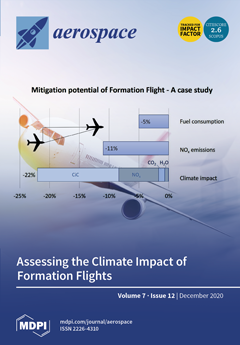
Cover Story: Inspired by migrant birds, flying in aerodynamic formation aims at the mitigation of the aviation climate impact. When this operational measure is adapted to commercial aviation it saves fuel and is expected to reduce the climate impact of aviation. Besides the total emission amount, this mitigation option also leads to saturation effects of NOx emissions and contrails. Here, we assess these CO2 and non-CO2 climate impacts with a climate response model to confirm a benefit for climate. The results of the case studies show that the implementation of formation flight decreases fuel consumption by 5% and NOx emissions by 11%. The climate impact, in terms of average near-surface temperature change, is estimated to be reduced by 22% (median value). View this paper.
  • Issues are regarded as officially published after their release is announced to the table of contents alert mailing list .
  • You may sign up for email alerts to receive table of contents of newly released issues.
  • PDF is the official format for papers published in both, html and pdf forms. To view the papers in pdf format, click on the "PDF Full-text" link, and use the free Adobe Reader to open them.

Articles (16)

  • Article
  • Open Access
4 Citations
5,673 Views
22 Pages

20 December 2020

The aircraft cabin and boarding procedures are steadily increasing focus points for both aircraft manufacturers and airlines, as they play a key part in the customer experience. In the German research project AVACON (AdVAnced Aircraft CONcepts), the...

  • Review
  • Open Access
72 Citations
10,564 Views
24 Pages

Energy Transition in Aviation: The Role of Cryogenic Fuels

  • Arvind Gangoli Rao,
  • Feijia Yin and
  • Henri G.C. Werij

18 December 2020

Aviation is the backbone of our modern society. In 2019, around 4.5 billion passengers travelled through the air. However, at the same time, aviation was also responsible for around 5% of anthropogenic causes of global warming. The impact of the COVI...

  • Article
  • Open Access
5 Citations
4,377 Views
9 Pages

Deployment of Solar Sails by Joule Effect: Thermal Analysis and Experimental Results

  • Gianluigi Bovesecchi,
  • Sandra Corasaniti,
  • Girolamo Costanza,
  • Fabrizio Paolo Piferi and
  • Maria Elisa Tata

16 December 2020

Space vehicles may be propelled by solar sails exploiting the radiation pressure coming from the sun and applied on their surfaces. This work deals with the adoption of Nickel-Titanium Shape Memory Alloy (SMA) elements in the sail deployment mechanis...

  • Article
  • Open Access
2 Citations
8,184 Views
31 Pages

Trajectory Design of Perseus: A CubeSat Mission Concept to Phobos

  • Ravi teja Nallapu,
  • Graham Dektor,
  • Nalik Kenia,
  • James Uglietta,
  • Shota Ichikawa,
  • Mercedes Herreras-Martinez,
  • Akshay Choudhari,
  • Aman Chandra,
  • Stephen Schwartz and
  • Jekanthan Thangavelautham
  • + 1 author

15 December 2020

The Martian satellites Phobos and Deimos hold many unanswered questions that may provide clues to the origin of Mars. These moons are low Δv stopover sites to Mars. Some human missions to Mars typically identify Phobos and Deimos as staging bas...

  • Article
  • Open Access
13 Citations
3,923 Views
20 Pages

11 December 2020

The higher satellite production rates expected in new megaconstellation scenarios involve radical changes in the way design trade-offs need to be considered by electric propulsion companies. In relative comparison, flexibility and qualification abili...

  • Article
  • Open Access
5 Citations
4,301 Views
19 Pages

Application of the HPCMP CREATETM-AV Kestrel to an Integrated Propeller Prediction

  • Pooneh Aref,
  • Mehdi Ghoreyshi,
  • Adam Jirasek and
  • Jürgen Seidel

11 December 2020

This article presents the results of a computational investigation of an integrated propeller test case using the HPCMP CREATETM-AV Kestrel simulation tools. There is a renewed interest in propeller-driven aircraft for unmanned aerial vehicles, elect...

  • Article
  • Open Access
13 Citations
11,891 Views
28 Pages

11 December 2020

The maintenance of aircraft presents considerable challenges to the personnel that maintain them. Challenges such as time pressure, system complexity, sparse feedback, cramped workspaces, etc., are being faced by these personnel on a daily basis. Som...

  • Article
  • Open Access
17 Citations
7,846 Views
17 Pages

10 December 2020

The present work explores some critical aspects of the numerical modeling of a rotorcraft seat and subfloor equipped with energy-absorbing stages, which are paramount in crash landing conditions. To limit the vast complexity of the problem, a purely...

  • Article
  • Open Access
11 Citations
3,876 Views
22 Pages

10 December 2020

The current airspace route system consists mainly of pre-defined routes with a low number of intersections to facilitate air traffic controllers to oversee the traffic. Our aim is a method to create an artificial and reliable route network based on p...

  • Article
  • Open Access
15 Citations
5,261 Views
12 Pages

Assessing the Climate Impact of Formation Flights

  • Katrin Dahlmann,
  • Sigrun Matthes,
  • Hiroshi Yamashita,
  • Simon Unterstrasser,
  • Volker Grewe and
  • Tobias Marks

8 December 2020

An operational measure that is inspired by migrant birds aiming toward the mitigation of aviation climate impact is to fly in aerodynamic formation. When this operational measure is adapted to commercial aircraft it saves fuel and is, therefore, expe...

  • Article
  • Open Access
6 Citations
5,662 Views
18 Pages

8 December 2020

The design of aircraft and engine components hinges on the use of computer aided design (CAD) models and the subsequent geometry-based analyses for evaluation of the quality of a concept. However, the generation (and variation) of CAD models to inclu...

  • Article
  • Open Access
70 Citations
11,955 Views
22 Pages

Using Convolutional Neural Networks to Automate Aircraft Maintenance Visual Inspection

  • Anil Doğru,
  • Soufiane Bouarfa,
  • Ridwan Arizar and
  • Reyhan Aydoğan

7 December 2020

Convolutional Neural Networks combined with autonomous drones are increasingly seen as enablers of partially automating the aircraft maintenance visual inspection process. Such an innovative concept can have a significant impact on aircraft operation...

  • Article
  • Open Access
17 Citations
5,318 Views
22 Pages

5 December 2020

Formation flight is one potential measure to increase the efficiency of aviation. Flying in the upwash region of an aircraft’s wake vortex field is aerodynamically advantageous. It saves fuel and concomitantly reduces the carbon foot print. How...

  • Article
  • Open Access
84 Citations
14,442 Views
18 Pages

How Well Can Persistent Contrails Be Predicted?

  • Klaus Gierens,
  • Sigrun Matthes and
  • Susanne Rohs

2 December 2020

Persistent contrails and contrail cirrus are responsible for a large part of aviation induced radiative forcing. A considerable fraction of their warming effect could be eliminated by diverting only a quite small fraction of flight paths, namely thos...

  • Article
  • Open Access
11 Citations
8,950 Views
40 Pages

28 November 2020

In vertical cold launch the missile starts without the function of the main engine. Over the launcher, the attitude of the missile is controlled by a set of lateral thrusters. However, a quick turn might be disturbed by various uncertainties. This st...

  • Article
  • Open Access
10 Citations
4,208 Views
29 Pages

Constructive Aerodynamic Interference in a Network of Weakly Coupled Flutter-Based Energy Harvesters

  • Emmanuel Beltramo,
  • Martín E. Pérez Segura,
  • Bruno A. Roccia,
  • Marcelo F. Valdez,
  • Marcos L. Verstraete and
  • Sergio Preidikman

24 November 2020

Converting flow-induced vibrations into electricity for low-power generation has received growing attention over the past few years. Aeroelastic phenomena, good candidates to yield high energy performance in renewable wind energy harvesting (EH) syst...

Get Alerted

Add your email address to receive forthcoming issues of this journal.

XFacebookLinkedIn
Aerospace - ISSN 2226-4310