1. Introduction
A hypersonic vehicle (HV) refers to an aircraft operating in near space at flight Mach number ≥ 5. With its extremely high flight speed and altitude, as well as strong penetration capability, it has revolutionary potential in military strategy and civil fields, and has become a frontier hotspot in international research [
1,
2]. However, its unique configuration and extreme flight environment result in complex characteristics such as strong nonlinearity, strong coupling, and fast time-variation in its dynamic model [
1]. A more severe challenge stems from multi-source uncertainties, including aerodynamic parameter perturbations, unmodeled elastic modal dynamics, and unpredictable external wind disturbances [
2]. These uncertainties are often equivalent to composite additive disturbances, which, if not properly handled, will severely deteriorate control performance and even lead to system instability [
2]. Therefore, designing a robust controller capable of effectively suppressing strong uncertainties while maintaining high-precision tracking performance is a critical issue to be addressed in the field of HV control.
Regarding the above challenge in this field, researchers both domestically and internationally have proposed various methods, including backstepping control [
3,
4], sliding mode control [
5,
6,
7], predictive control [
8,
9], and prescribed performance control [
10], etc. A summary of the key advantages and disadvantages of these representative methods is provided in
Table 1.
As illustrated in
Table 1, among these strategies, Sliding Mode Control (SMC) has been widely studied for HVs primarily due to its inherent robustness against matched uncertainties and straightforward implementation. However, traditional SMC also exhibits notable drawbacks, such as chattering and limited performance under mismatched disturbances. To overcome these limitations, researchers have developed multiple improved SMC schemes in recent years, which can be categorized into three main directions:
(1) SMC for Chattering Suppression. Chattering remains a critical issue for HV actuators, prompting two key improvements: High-order SMC (HOSMC) achieves continuous control signals but suffers from amplified sensor noise due to precise derivative calculations [
5]; SMC with continuous switching functions reduces chattering but relies on empirical parameter tuning, with excessive smoothing weakening disturbance rejection [
6].
(2) SMC for Mismatched Disturbance Rejection. To handle mismatched disturbances, SMC is increasingly paired with disturbance observers (DOs): dynamic decomposition strategies apply SMC to matched subsystems but increase complexity and rely on strict decoupling, hard to satisfy for strongly coupled HVs [
7]; NDO-based SMC improves rejection but shows slow convergence for fast-time-varying disturbances, causing residual errors [
11].
(3) Intelligent SMC for Uncertainty Approximation. For unmodeled uncertainties, SMC integrates neural networks (NNs) or fuzzy logic: NN-SMC enhances transient performance but suffers from high latency due to online RBF-NN tuning [
12]; fuzzy SMC adapts gains via rules but degrades under unforeseen disturbances due to incomplete rule bases [
13].
However, existing SMC schemes still face three critical limitations when dealing with HV multi-source disturbances:
(1) Passive robustness and performance trade-offs. Many robust control strategies (such as adaptive control [
14] and intelligent control [
15]) inherently rely on the controller’s own adjustment mechanisms to passively suppress disturbances. Such passive compensation often compromises nominal tracking performance [
13]. Furthermore, when encountering strong disturbances, their limited regulation capability may lead to performance degradation or even instability [
13].
(2) Inadequate disturbance estimation and compensation. While existing approaches (such as the Nonlinear Disturbance Observer (NDO) in [
11]) can estimate disturbances, they still confront challenges in estimation accuracy, convergence speed, when dealing with complex, fast-time-varying compound disturbances within HV models. Particularly for disturbances arising from difficult-to-measure elastic modes [
16], there is a lack of efficient and rapid online estimation and compensation mechanisms.
(3) Perturbation estimation overly relies on the system model. Existing disturbance estimation methods, such as nonlinear disturbance observers, neural network disturbance observers, and extended state observers, all need to be based on the system’s dynamic equations. Therefore, it is necessary to develop new disturbance estimation methods to realize disturbance observation under the condition of limited prior knowledge, so as to meet the strong robust control requirements of the HV.
To address the aforementioned challenges, this paper proposes a decoupled sliding mode predictive control (SMPC) method integrated with an Extreme Learning Machine (ELM)-based disturbance observer. The key innovations are summarized as follows:
(1) Integrated design of sliding mode predictive controller. For the velocity subsystem, a proportional-integral sliding mode surface is designed, and the optimal control law is directly obtained through predictive optimization. For the altitude subsystem, sliding mode predictive controllers are embedded step by step in the backstepping framework, and an objective function-driven optimization mechanism is constructed for the virtual control law, realizing the deep coupling of the structural advantages of backstepping and the rolling optimization capability of sliding mode prediction.
(2) Active compensation driven by model-free ELM disturbance observer. An ELM disturbance observer is constructed based on tracking errors. Utilizing its characteristics of random feature mapping and least squares analytical solution to achieve fast estimation, the multi-source disturbance estimation values are feedforward compensated into the control laws of each subsystem, significantly enhancing the system’s active suppression capability against unknown disturbances, thus overcoming the limitation of passive robustness.
(3) Stability and performance analysis. Based on Lyapunov stability theory, the semi-global uniform ultimate boundedness (SGUUB) of all error signals in the closed-loop system is strictly proved. The influences of parameters such as prediction horizon, control weighting, and integral coefficient on system convergence and stability are analyzed in depth, providing theoretical guidance for parameter tuning.
The remainder of this paper is organized as follows.
Section 2 presents the flexible air-breathing hypersonic vehicle (FAHV) model and preliminaries. The controller design and system stability analysis are developed in
Section 3 and
Section 4, respectively. Simulation studies are made in
Section 5 and the conclusions are presented in
Section 6.
2. Flexible Air-Breathing Hypersonic Vehicle Model
Considering the longitudinal dynamic model of the FAHV established by Bolender and Doman [
17], it consists of five rigid-body states (velocity
, flight path angle
, altitude
, angle of attack
, and pitch rate
) and a vector of elastic modes
, which are described by first-order differential equations:
where
denote gravitational acceleration, moment of inertia, vehicle mass, natural frequencies of elastic modes, and damping ratios, respectively.
represent system disturbances, including parameter perturbations and unknown external disturbances. The expressions for lift
, drag
, thrust
, pitching moment
, and generalized elastic force
are given as follows [
18]:
where
.
,
, and
denote reference area, thrust arm, and mean aerodynamic chord, respectively. The dynamic pressure is calculated using
, the air density model is
with
, where
is the instantaneous altitude and
is the scale altitude.
The expressions for aerodynamic parameters under nominal conditions are given as follows [
18]:
where
,
and
denote fuel equivalence ratio, elevator deflection angle, and canard deflection angle, respectively, which are the control inputs of the vehicle. Since the canard deflection and elevator deflection have a negative gain relationship
, the actual control inputs to be designed are
. The meanings and specific values of the coefficients in Equation (3) refer to Reference [
18].
It can be seen from Equations (1)–(3) that the longitudinal model of the FAHV is a highly nonlinear, strongly coupled uncertain system, and elastic states have a significant impact on thrust, lift, drag, and moments. However, the elastic states of the system are difficult to measure [
16]. Therefore, during controller design process, they can be treated as disturbances to the rigid-body model, estimated by a disturbance observer, and compensated in the control law. Based on the above analysis, the control-oriented model is established as follows:
where the expressions of each function are:
In the above equations, , , , represent comprehensive uncertainties caused by aerodynamic parameter uncertainties, external disturbances, and elastic modes.
The control objective of this paper is to achieve high-precision tracking of velocity and altitude reference signals for hypersonic vehicles under various disturbances. To this end, the fuel equivalence ratio and elevator deflection angle are designed by integrating backstepping control, sliding mode predictive control, and an ELM neural network disturbance observer.
3. Controller Design
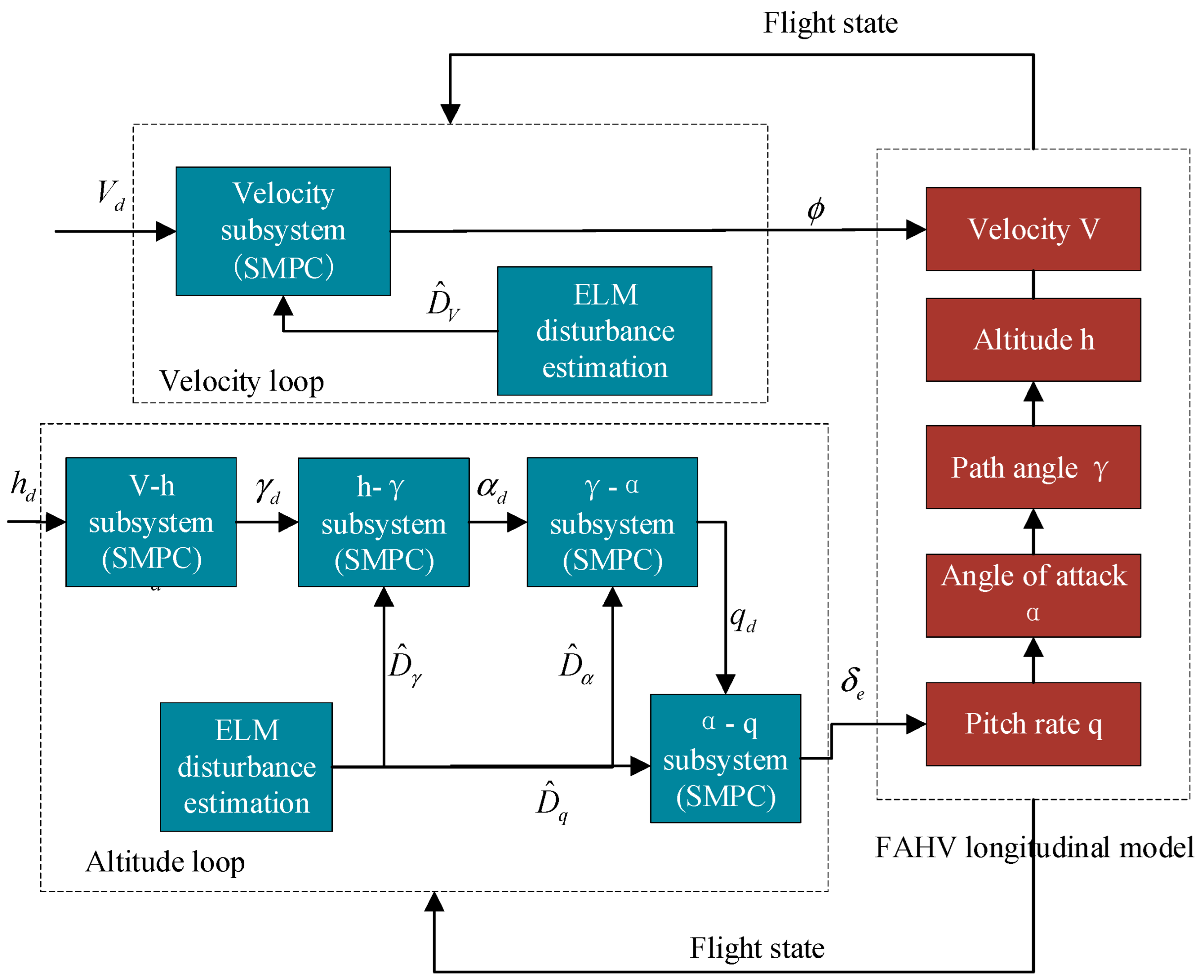
The block diagram of the designed control system is shown in
Figure 1. Therein, SMPC denotes sliding mode predictive control. To handle system disturbances, an ELM neural network is designed for estimation, and SMPC laws are designed for the velocity and altitude subsystems, respectively. For the velocity subsystem, the weighted sum of the velocity tracking error and its integral is selected as the sliding mode surface, and the SMPC law is designed based on optimal control theory and disturbance estimation signals. For the altitude subsystem, by integrating backstepping control strategy with optimal control theory, SMPC laws for each channel are devised, and the control laws are compensated using disturbance estimation signals. To solve the “explosion of derivatives” inherent problem in backstepping and further enhance control accuracy, an arctangent tracking differentiator is introduced to replace the traditional first-order low-pass filter for calculating the derivative of the virtual control law.
3.1. ELM Neural Network Disturbance Observer
During the cruise phase of HV, it encounters complex situations such as parameter uncertainty, strong nonlinearity, and strong coupling. The system disturbances suffered by the system will seriously degrade the control performance. Traditional disturbance observers, which depend on precise system models, often suffer from reduced disturbance estimation accuracy under model uncertainty, and their design process is relatively intricate.
The ELM neural network exhibits strong nonlinear approximation capability. It does not need to rely on an accurate system model and can learn the characteristics of disturbances only based on the tracking error state. Moreover, the connection weights between the input and hidden layers, along with the neuron thresholds of the hidden layer, are randomly generated, resulting in a simple and efficient design that provides a new approach for accurately estimating disturbance signals.
To handle , , , in system (4) and make full use of the advantages of neural networks, an ELM neural network disturbance observer that does not rely on the system model and be based on the tracking error state is constructed. This observer enables the effective estimation and compensation of disturbances and improve the control performance of the HV.
The ELM disturbance observer is constructed as:
where
is the input signal of the neural network,
is the output signal of the hidden layer,
is the estimated output weight,
(
is the number of hidden layer nodes), and
are randomly generated input weights and hidden layer node biases, respectively.
According to the universal approximation theorem of single-hidden-layer neural networks [
19], there exists an optimal output weigh
satisfying:
where
is the approximation error and is bounded [
20], i.e.,
Subtracting Formula (9) from Formula (10), the disturbance estimation error satisfies
where,
represents the disturbance estimation error, and
is the output weighting error of the neural network.
The estimated value of the output weight is updated by the following adaptive law:
where
denotes the learning rate of the neural network, and
represents the sliding mode surface of the corresponding channel, whose specific design is given in
Section 3.2 and
Section 3.3.
3.2. Velocity Controller Design
In this section, the controller is designed based on the first dynamic equation of Equation (4), i.e., the velocity subsystem. The ELM neural network disturbance observer presented in
Section 3.1 is used to estimate disturbances, and on this basis, a SMPC law with a proportional-integral sliding mode surface is designed to enable the velocity track the given reference signal accurately.
Define the velocity error as
where
is the velocity reference command.
Taking the derivative of
gives
The sliding mode function is designed as
where
.
The predicted sliding mode surface after time
is
can also be expressed as
with
The objective function is designed as
where
is the control weighting.
According to optimal control theory, the condition
must be satisfied, i.e.,
From Equations (14)–(16), (18) and (19), it can be obtained that
Substituting Formulas (18) and (22) into (21), we obtain
Then the control law is derived as
In the above equation,
is estimated by the ELM disturbance observer in
Section 3.1:
3.3. Altitude Controller Design
In this section, the controller is designed for the other four dynamic equations in Equation (4), i.e., the altitude subsystem. The ELM neural network is used to estimate system disturbances, and a sliding mode predictive controller is designed based on backstepping control. The controller design process is as follows:
Define the altitude tracking error
where
is the altitude reference command.
Taking the derivative of
gives
The sliding mode surface is designed as
where
.
The predicted sliding mode surface after time
is
can also be expressed as
where
The objective function is designed as
According to optimal control theory, it is necessary to satisfy the condition
, that is,
Based on Equations (26)–(28) and (31), it is obtained that
Then the optimal control condition is transformed into
Hence, the virtual control law
is designed as
The flight path angle tracking error is defined as
Taking the derivative of
gives
The sliding mode surface is designed as
where
.
The objective function is designed as
where
is the predictive time.
Similarly to the derivation process in Step 1, the virtual control law
is designed as
where
is estimated by the ELM neural network in
Section 3.2:
Define the angle of attack tracking error
Differentiating the angle of attack error
yields
Design the sliding mode surface as
where
.
The objective function is designed as
where
is the predicted duration.
Similarly to the derivation process in step 1, the virtual control law
is obtained as:
where,
is estimated by the following ELM neural network.
Define the pitch rate tracking error
Differentiating the pitch rate error
yields
Design the sliding mode surface as
where
.
Design the objective function as
Similarly to the derivation process of the velocity controller in
Section 3.2, the control law
is obtained as
where,
is the prediction time, and
is the weight of the control quantity
.
is estimated by the following ELM neural network
It can be seen from the control law calculation Formulas (42), (48) and (54) that they all require the first-order derivative of the virtual control law. To solve the “differential explosion” problem and further improve control accuracy, an arctangent tracking differentiator is designed to obtain the derivative of the virtual control law.
In the above formula, corresponds to , or , or , respectively; corresponds to , or , or , respectively; it is the input signal of the tracking differentiator, that is, the virtual control law designed in this paper. are the design parameters of the differential tracker, and their values should all be greater than 0.
4. Stability Analysis and Controller Parameter Design
4.1. Stability Analysis
The stability of the closed-loop system can be summarized in the following theorem.
Theorem 1. Consider system (4) with control laws (24), (37), (42), (48), (54), and tracking differentiator (56), and neural network disturbance observer update laws (25), (43), (49), (55). All error signals in the closed-loop system are semi-globally uniformly ultimately bounded.
Proof. Select the Lyapunov function as
where
,
,
,
are the estimation errors of the neural network output weights for the velocity, flight path angle, angle of attack, and pitch rate channels, respectively.
Taking the first derivative of
, we obtain
It is obtained from the control law calculation Formula (24)
If condition
is met, then
A similar calculation process can be obtained
When
, the following equation is satisfied
Substitute Formulas (61)–(65) into Equation (58), and according to Formula (12), it is obtained that
The neural network output weighted update laws (25), (43), (49) and (55) are substituted into (66), and the result is obtained as
If the selected control parameters satisfy , , , , and , then if , or , or , or , or , the first-order derivative . Therefore, the error states of the system , , , and are semi-globally uniformly ultimately bounded. □
In the proof process above, for the sake of convenience in writing, , , , and are abbreviated as , , , and , respectively. , , , , are abbreviated as , , , and , respectively. , , , and are abbreviated as , , , and , respectively.
4.2. Influence of Parameters on Convergence
Next, taking the velocity channel as an example, the influence of system parameter selection on convergence is analyzed. The analysis process for other channels is similar and will not be repeated.
- (1)
Selection of prediction horizon and control quantity weighting parameter
From the above stability analysis process, it can be known that if , then when , the system can be guaranteed to be semi-globally uniformly stable. And is used to adjust the control energy and does not affect the stability of the system. However, since the condition needs to be satisfied, the selection of is limited by the prediction horizon parameter .
- (2)
Selection of integral coefficient
Under the condition that the system is stable, i.e.,
, the control law (24) is equivalent to
Substitute Formula (73) into (15) and (19) to obtain
Ignoring the disturbance estimation error
, compute the zero-input response of Equation (74) to obtain
It can be seen from Formula (75) that as long as , , and , both the sliding mode surface and the tracking error converge exponentially. Among them, the convergence speed of the sliding mode surface depends on ; the smaller is, the faster the convergence speed is. The convergence speed of the tracking error depends on and ; the smaller is and the larger is, the faster the convergence speed is. Overall, its convergence speed depends on the slower pole (that is, the characteristic root with a smaller amplitude, ).
In summary, restricted by the control energy constraint, the value of should not be too small; otherwise, it will lead to control input saturation. The value of needs to be balanced between system stability and convergence speed. Theoretically, a larger value of is, the more conducive it is to improving the convergence performance. However, when , the convergence speed of the velocity tracking error is dominated by . At this time, further increasing has little impact on improving the convergence speed and may even exacerbate chattering.
4.3. Practical Parameter Tuning Guidelines
Based on the above theoretical analysis, this subsection provides a systematic procedure for tuning the parameters , , and in practical applications. Given that the system is nonlinear and the analytical control law is derived after decoupling design, the following guidelines offer qualitative insights that are generally valid across the operating envelope, as opposed to precise quantitative relationships.
Step 1: Initialize the Prediction Horizon (TV)
Purpose: Directly controls the convergence rate of the sliding surface .
Practical Guidance: Set its initial value based on the desired response speed of the sliding dynamics. For instance, if a desired time constant is , start with .
Key Consideration: Recall that a smaller tightens the critical stability condition , which may necessitate a smaller and consequently higher control effort.
Step 2: Tune the Integral Coefficient ()
Purpose: Primarily determines the convergence rate of the tracking error .
Practical Guidance: As a rule of thumb, set to ensure the error converges faster than the sliding surface.
Key Consideration: Note that for , the convergence speed becomes dominated by (see Equation (75)). Further increasing has limited benefit and can amplify noise, leading to chattering.
Step 3: Configure the Control Weight ()
Purpose: Used to manage control energy and prevent actuator saturation.
Practical Guidance: The stability condition mandates . A practical initial choice is with .
Key Consideration: This is the primary parameter for trading off performance against control effort. Increase if saturation occurs; decrease it (within the stability limit) if convergence is too slow and control authority is underutilized.
5. Simulation Results and Analysis
To verify the effectiveness of the proposed control strategy, simulations are conducted under three cases. The initial states and controller parameters are given in
Table 2 and
Table 3, respectively. Control input constraints are
and
.
The reference signals for velocity and altitude are generated by a second-order filter,
with final values
and
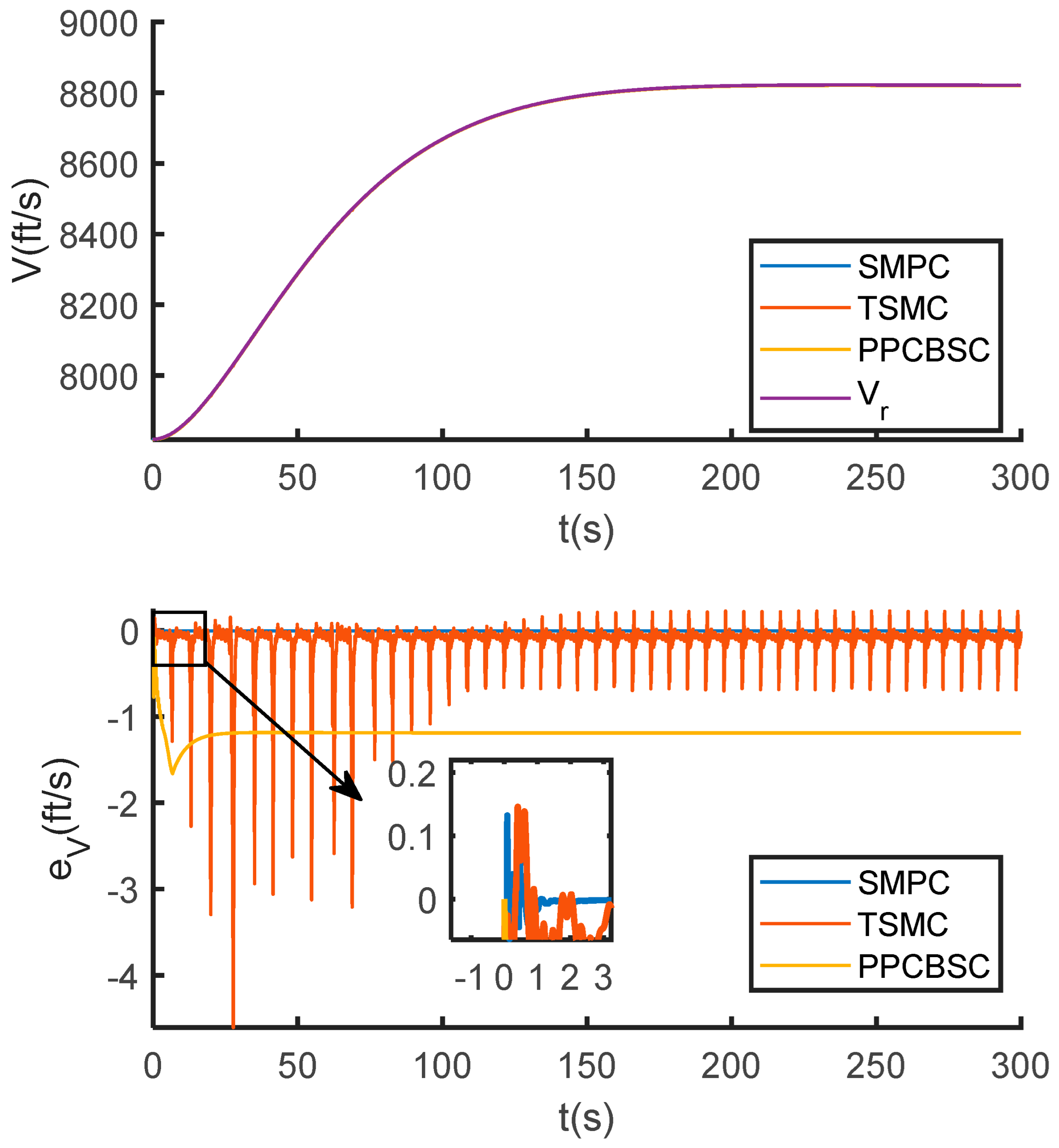
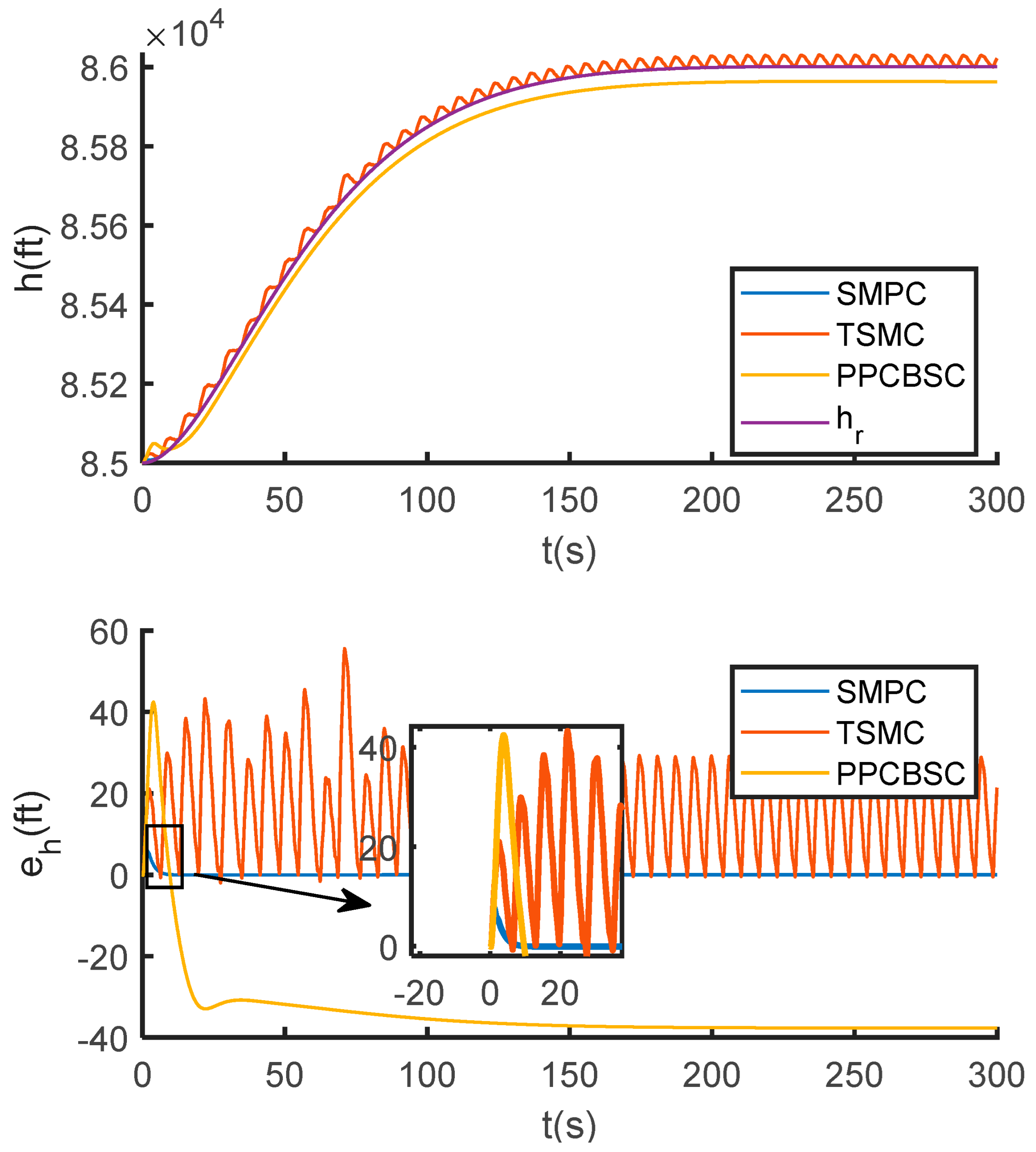
As shown in
Figure 2 and
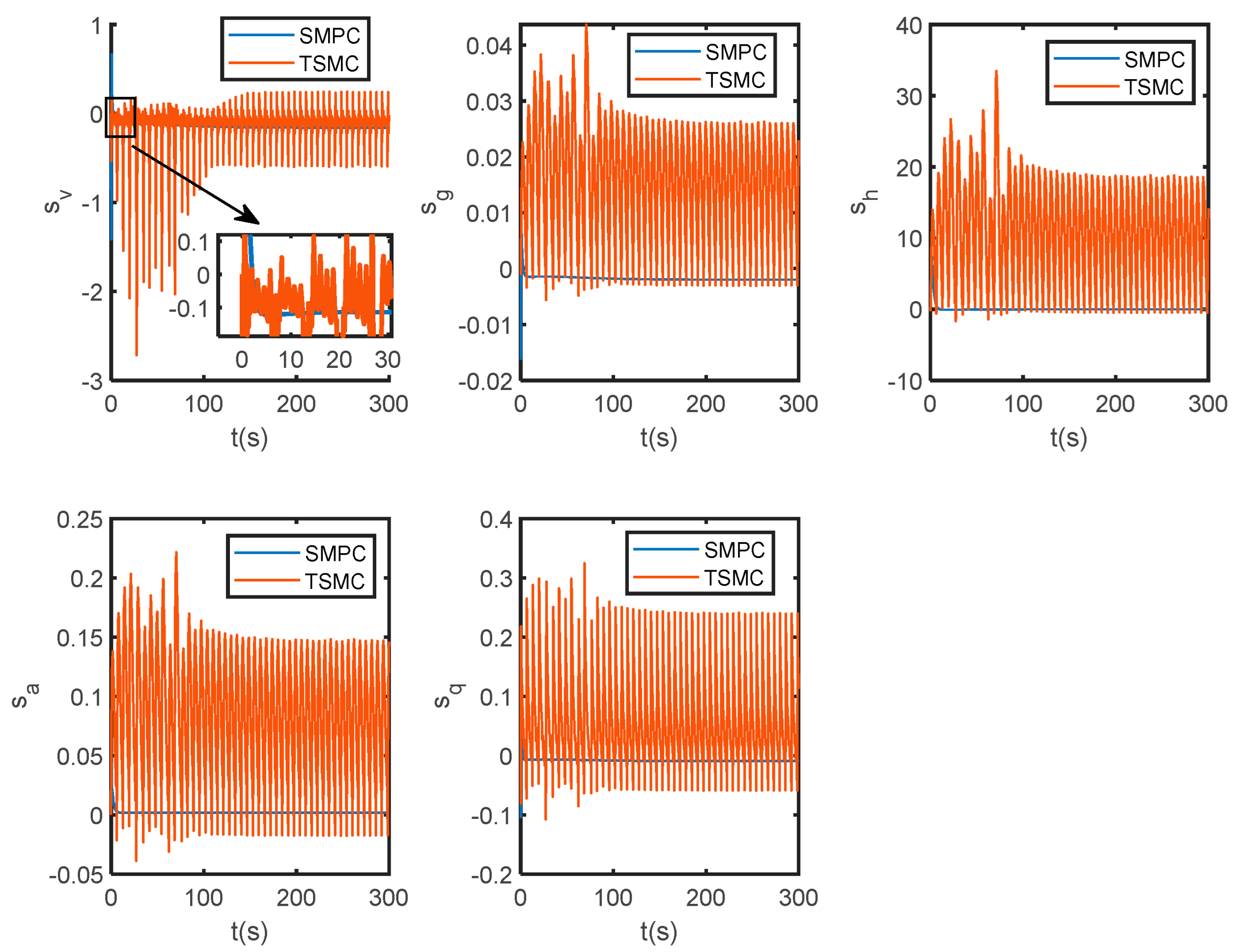
Figure 3, the SMPC-based system rapidly converges to the reference commands for both velocity and altitude, with tracking errors approaching zero. Furthermore, the sliding surfaces of all subsystems converge quickly to zero (
Figure 4), while the control inputs strictly adhere to the constraints at all times (
Figure 5).
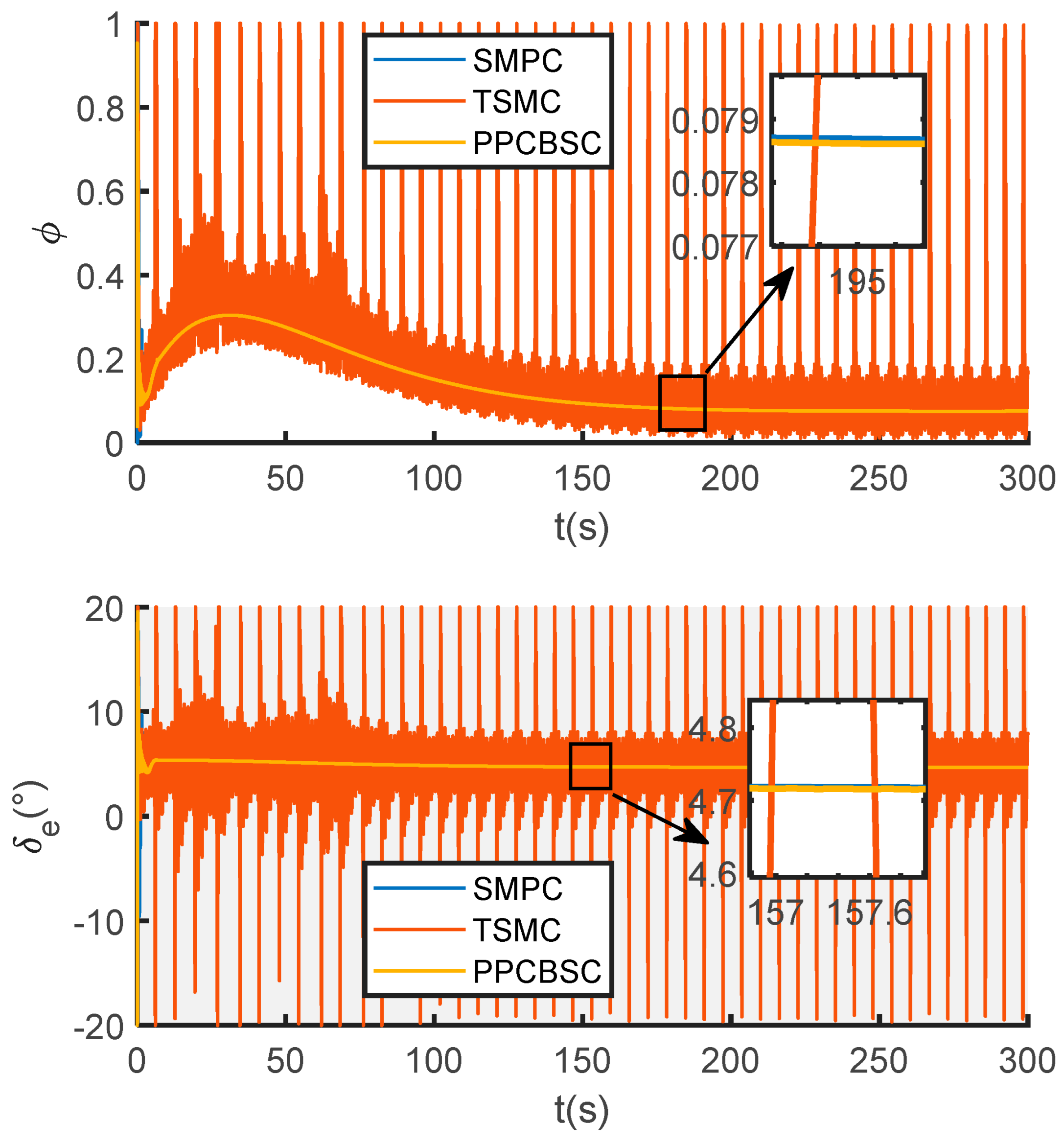
In contrast, the Terminal Sliding Mode Control (TSMC) exhibits significant chattering, which leads to observable steady-state errors in velocity and persistent oscillations in altitude tracking. The Prescribed Performance Control with Backstepping Control (PPCBSC), although chatter-free, incurs large steady-state errors in both velocity and altitude due to the inherent limitations on control degrees of freedom imposed by its performance constraints.
Quantitative results from
Table 4 underscore this performance gap. SMPC reduces the velocity RMSE from 0.3132 ft/s (TSMC) to 0.0048 ft/s, and the altitude RMSE from 19.9532 ft (TSMC) to 0.5751 ft. The RMSE values for PPCBSC are considerably higher (1.1936 ft/s for velocity and 34.9274 ft for altitude). Moreover, the root mean square value of the altitude sliding surface, a metric for chattering, is 0.5752 for SMPC—over 95% lower than the 12.9737 recorded for TSMC.
The underlying reasons for these differences are clear: TSMC’s switching mechanism induces chattering that compromises accuracy, while PPCBSC’s design is inherently constrained by its performance boundaries, limiting its tracking precision. SMPC, by harmonizing prediction and constraint handling, effectively smoothens the control signal, suppresses chattering, and avoids the accuracy loss associated with the other two methods, thereby achieving superior tracking performance and steady-state accuracy.
To validate the inherent robustness of the sliding mode predictive control (SMPC) method and the enhanced performance provided by the Extreme Learning Machine (ELM) disturbance observer, this study further conducts simulations under two cases: aerodynamic parameter perturbations and external disturbances. The control performance of standalone SMPC, SMPC combined with Radial Basis Function [
12] (donated as SMPC + RBF) or Extended State Observer [
21] (donated as SMPC + ESO), and SMPC integrated with the ELM disturbance observer (donated as SMPC + ELM) are compared.
Case 2: Referring to reference [
22], the following aerodynamic coefficient uncertainties are considered
where,
represents the nominal value of the corresponding aerodynamic coefficient;
represents the uncertainty. The uncertainties of drag, lift, thrust, and pitching moment are taken as 15%, −15%, −15%, and −15%, respectively.
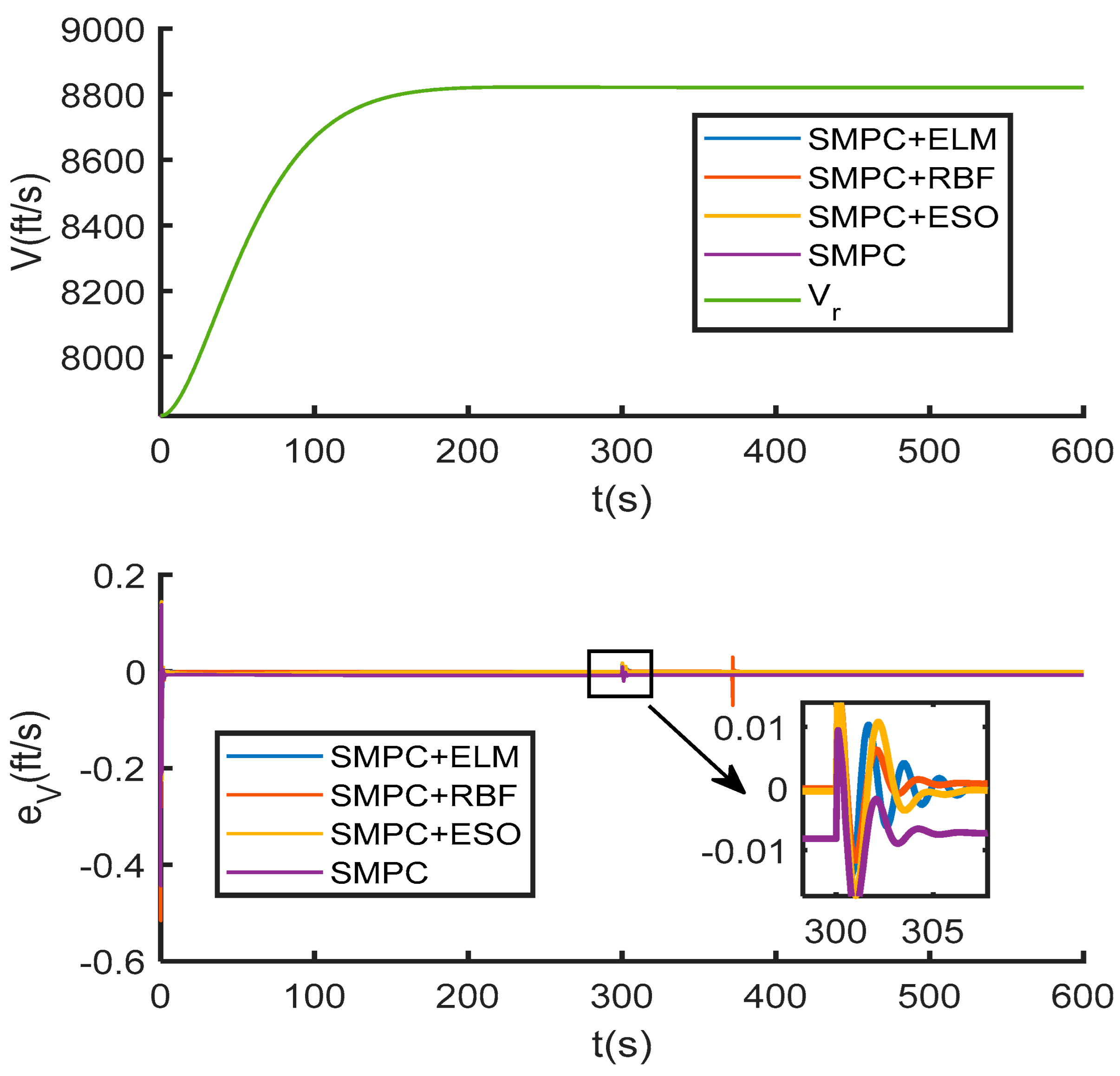
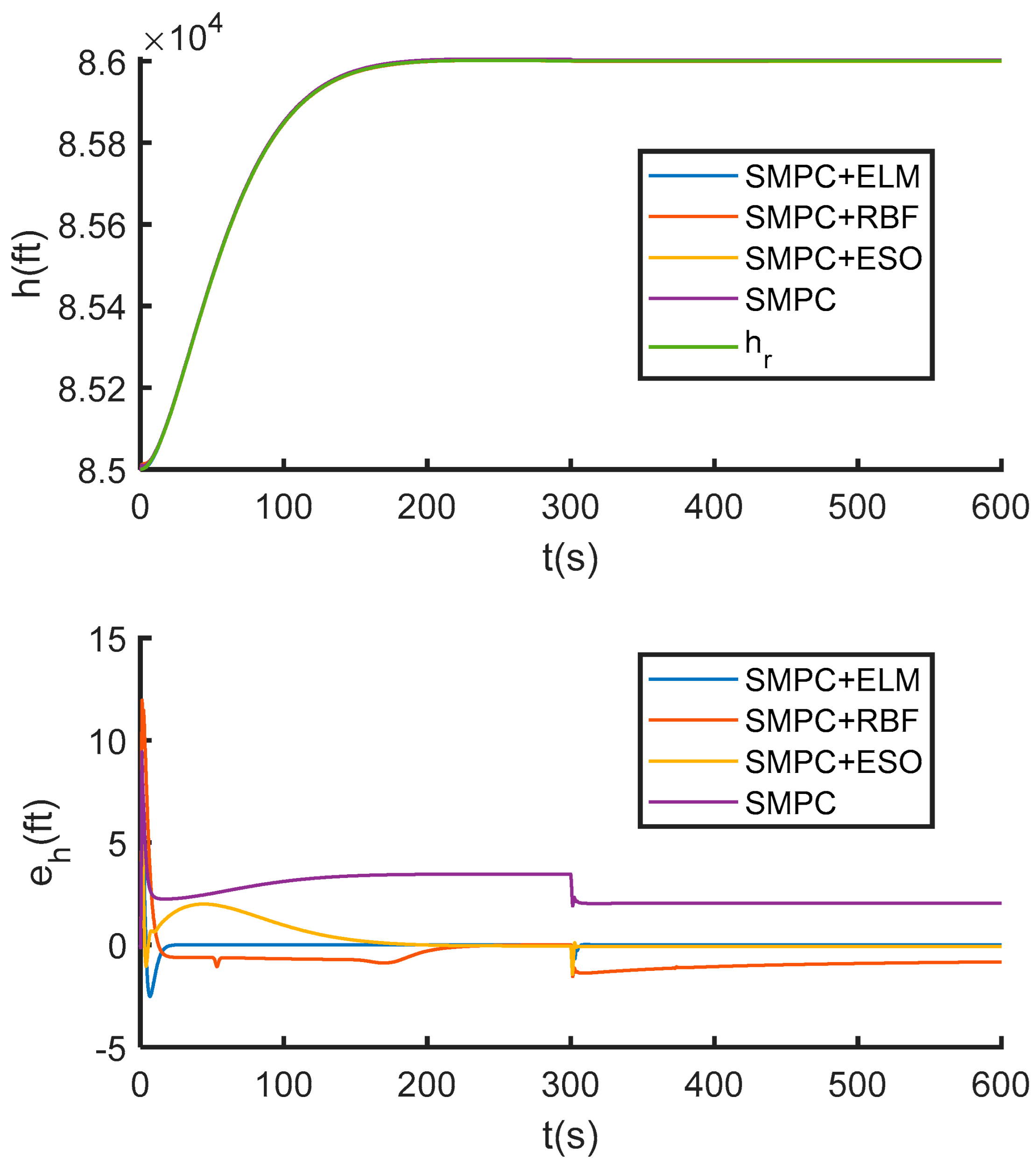
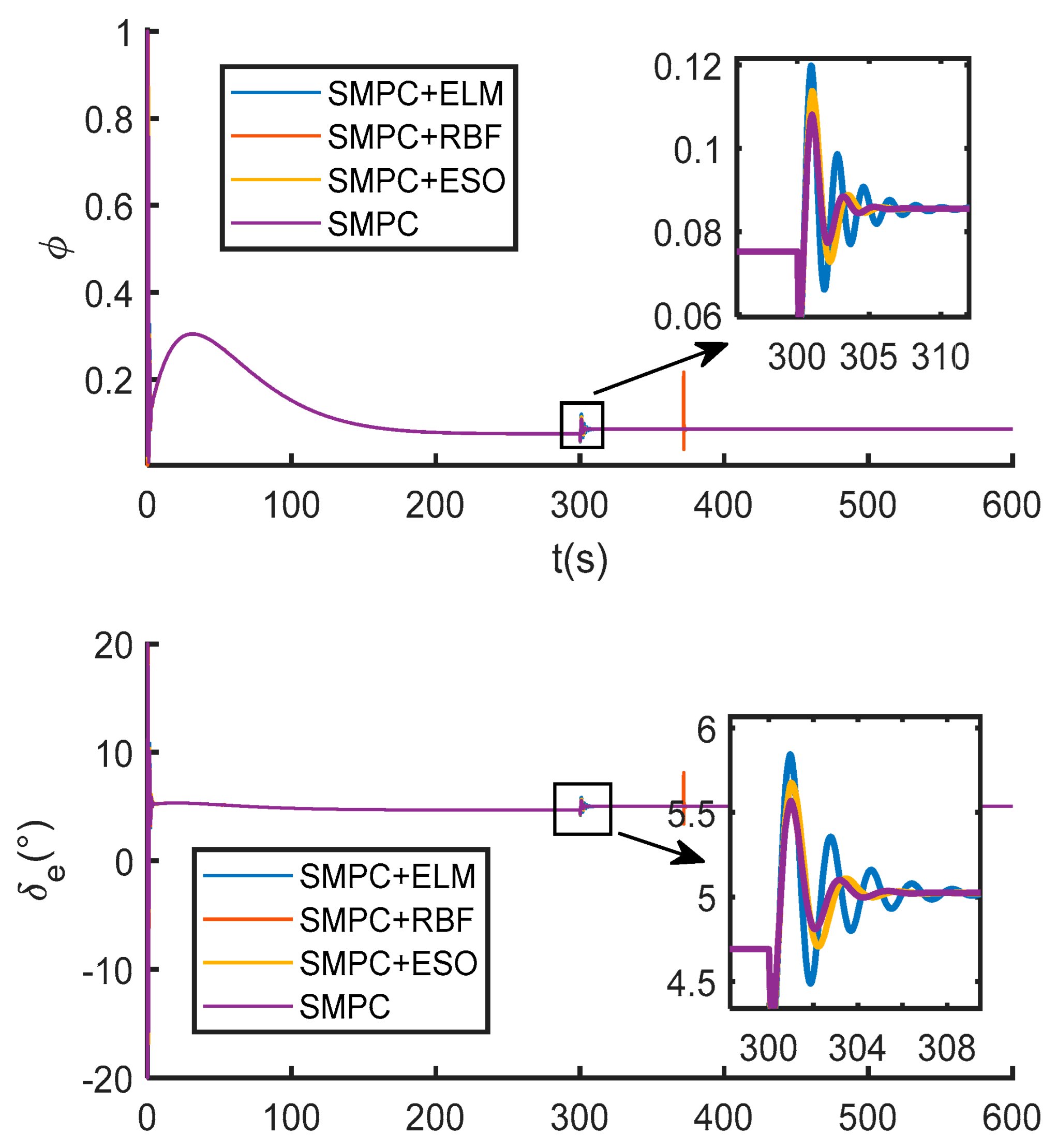
Simulation results are presented in
Figure 6,
Figure 7 and
Figure 8. As shown in
Figure 6 and
Figure 7, during the initial flight phase (0–300 s) where elastic modes are dominant, the standalone SMPC exhibits minor tracking errors, while all observer-enhanced SMPC methods achieve accurate tracking. This demonstrates the effectiveness of disturbance observers in compensating for unmodeled elastic dynamics. When parameter uncertainties are introduced (300–600 s), the standalone SMPC shows significantly increased altitude errors, revealing its limited robustness. In contrast, SMPC + ELM recovers high-precision tracking after a brief transient. Compared to SMPC + ELM, both SMPC + RBF and SMPC + ESO exhibit slower response and larger error fluctuations. Furthermore,
Figure 8 confirms that all control inputs satisfy the prescribed constraints.
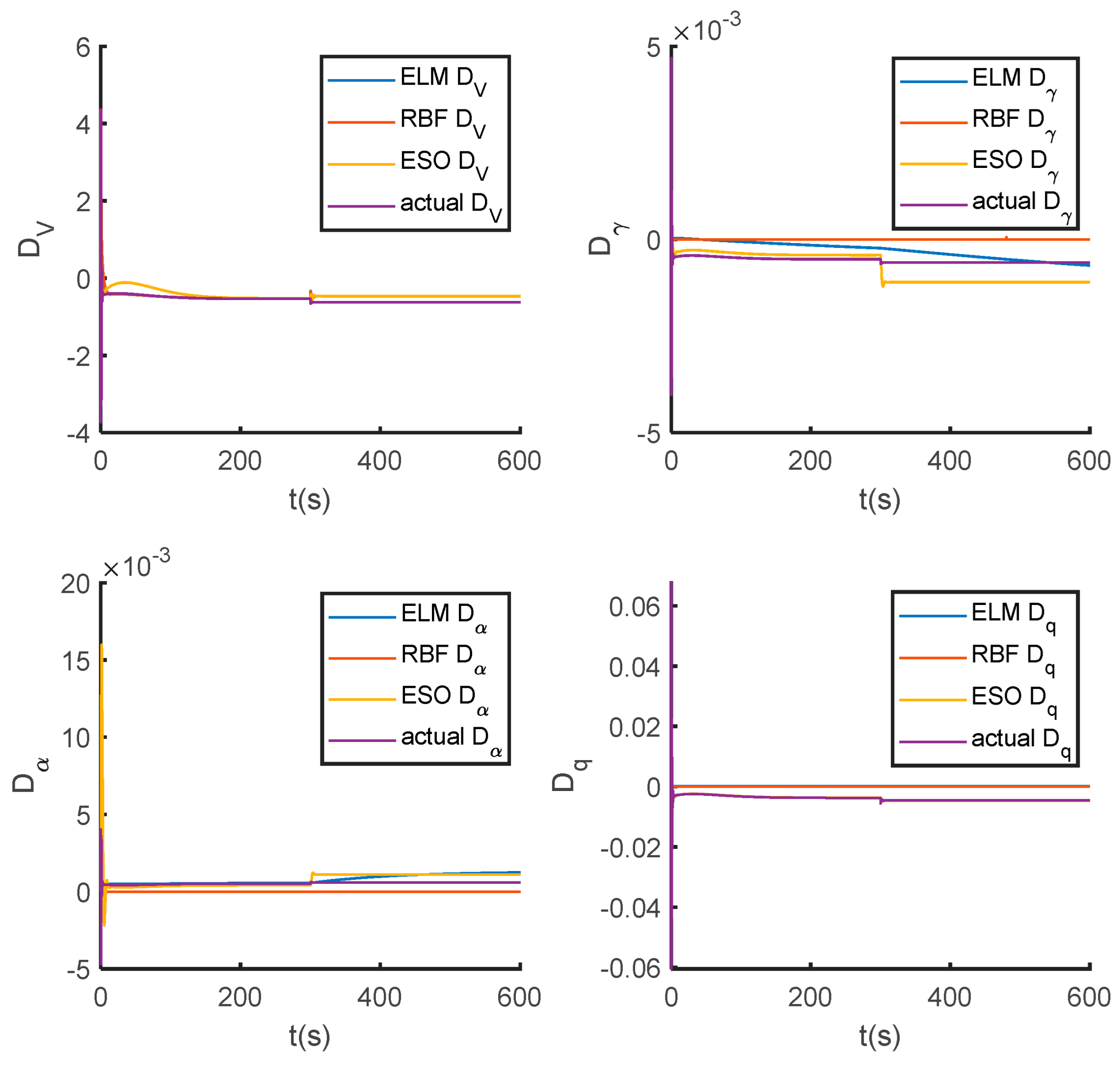
The superior performance of SMPC + ELM is directly attributable to its precise disturbance estimation capability. As evidenced in
Figure 9, the ELM observer (blue curve) accurately estimates the composite disturbances
,
,
, and
, closely aligning with the actual values (purple). In contrast, the RBF (orange) and ESO (yellow) observers exhibit significant estimation deviations. This accurate estimation enables more effective compensation, which is quantitatively reflected in the RMSE data in
Table 5, where SMPC + ELM yields the lowest tracking errors for both velocity and altitude. In summary, the ELM observer’s estimation accuracy underlies the enhanced tracking precision and robustness of the proposed method.
Case 3: Considers the following unknown external disturbances:
Simulation results are shown in
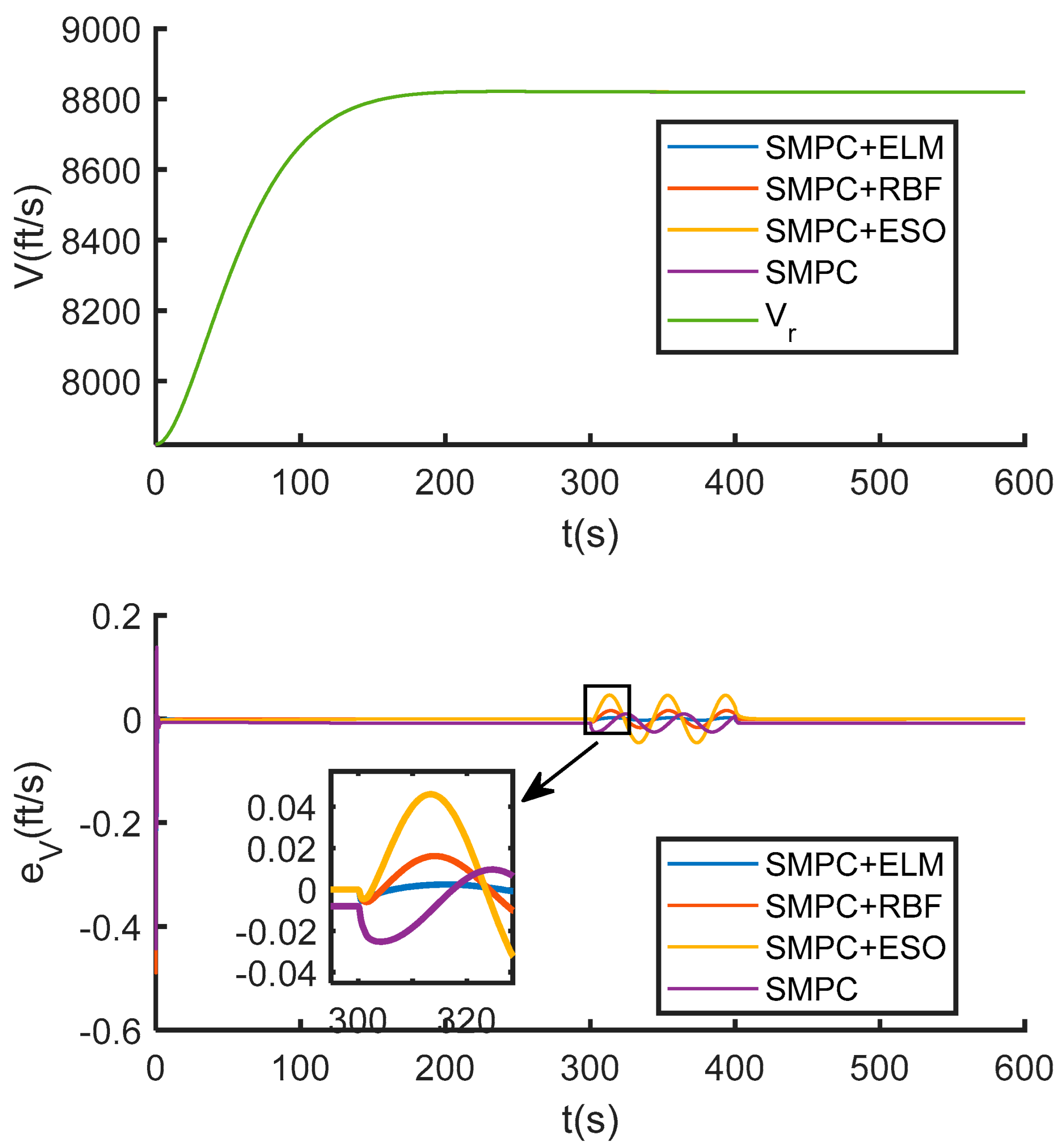
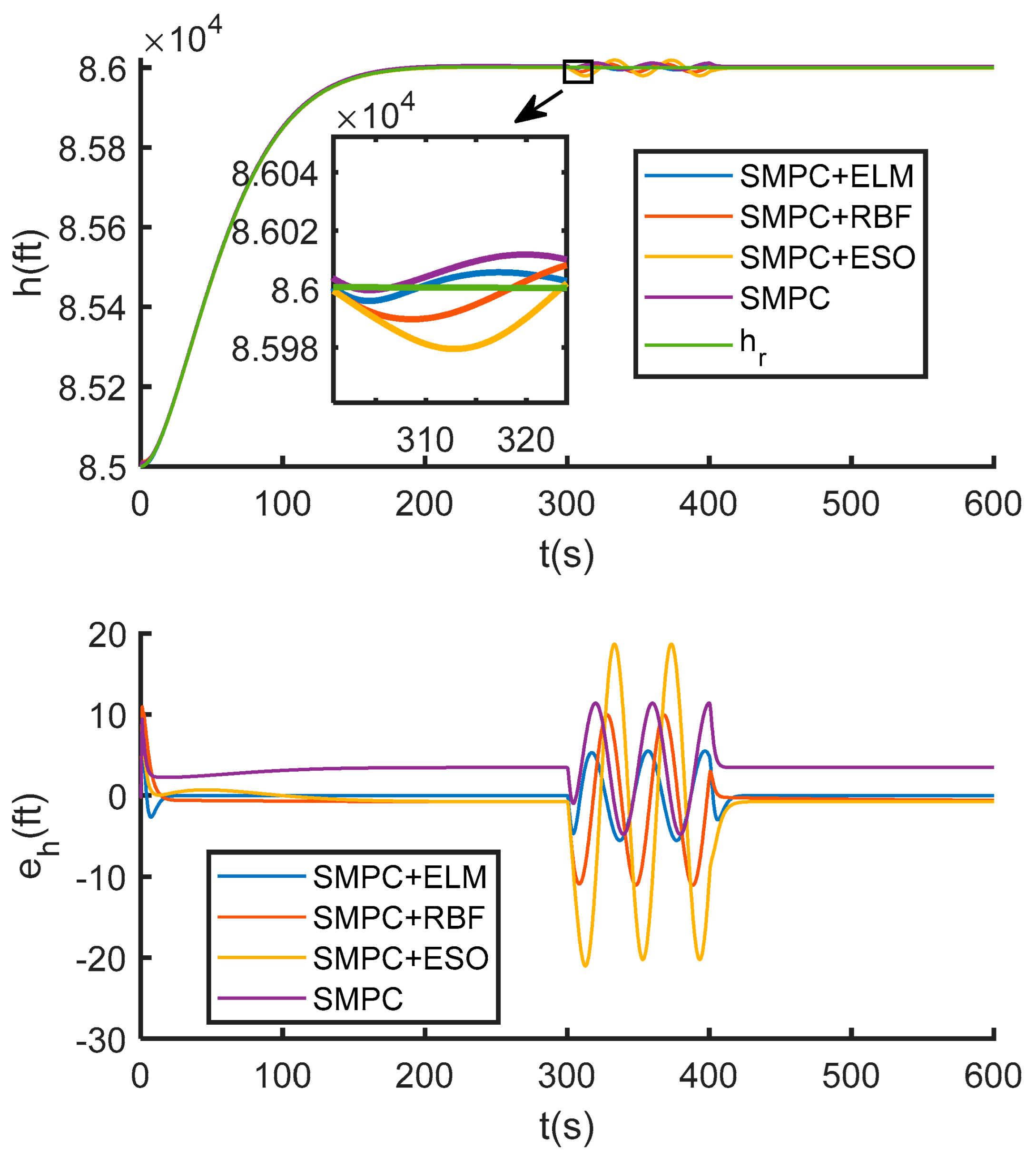
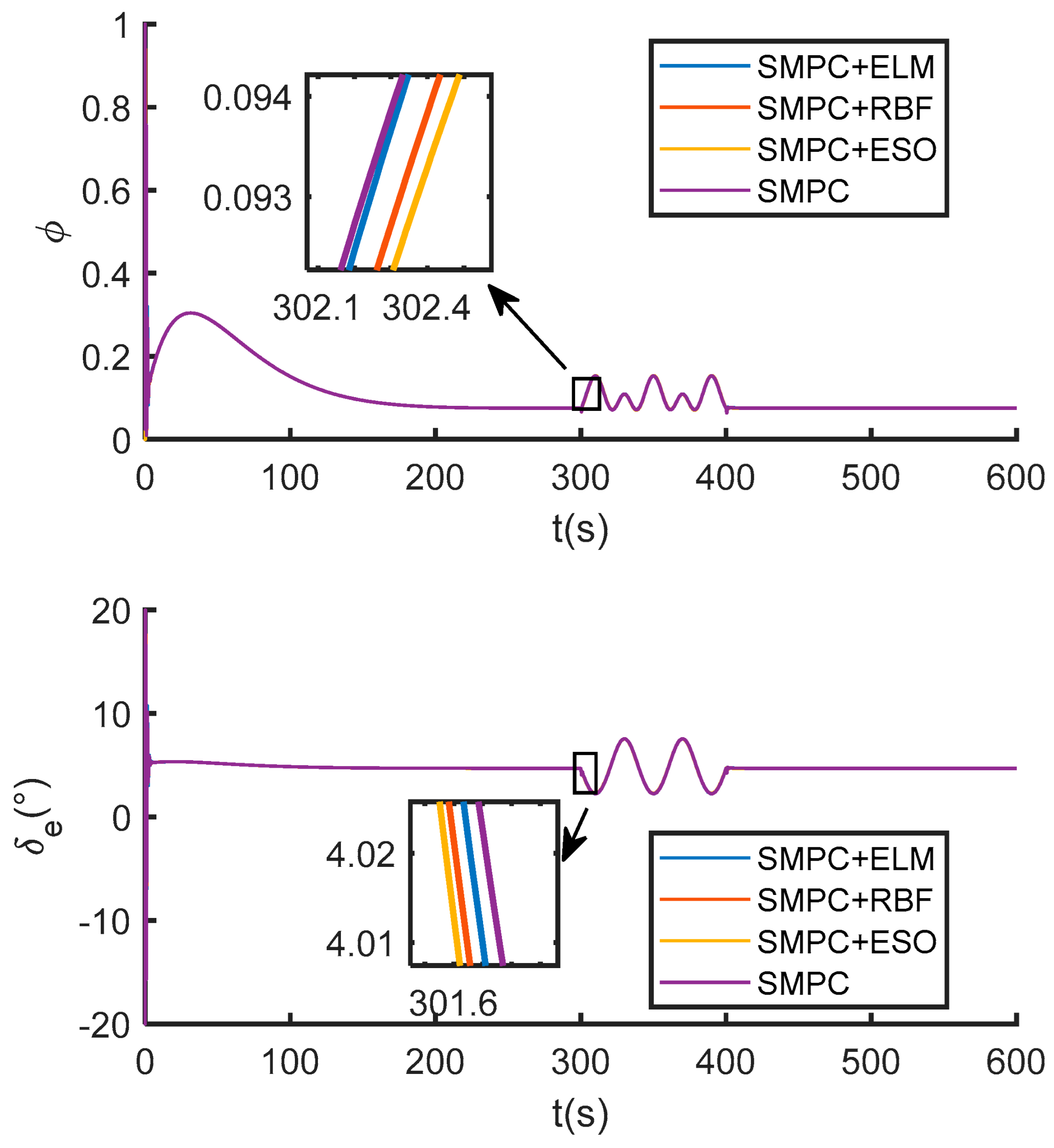
Figure 10,
Figure 11 and
Figure 12. As shown in
Figure 10 and
Figure 11, during the 300–400 s disturbance period, the standalone SMPC exhibits fluctuations in both altitude and velocity tracking errors, with performance recovering after disturbance removal, demonstrating its inherent robustness. In comparison, the proposed SMPC + ELM strategy shows significantly smaller error amplitudes and a faster recovery to high-precision tracking than SMPC + RBF, SMPC + ESO, and standalone SMPC. The superior performance of SMPC + ELM is quantitatively confirmed by its lowest Root Mean Square Error (RMSE) values for both velocity and altitude, as documented in
Table 6. Furthermore,
Figure 12 verifies that the control inputs of all strategies remain within the prescribed constraints throughout the operation.
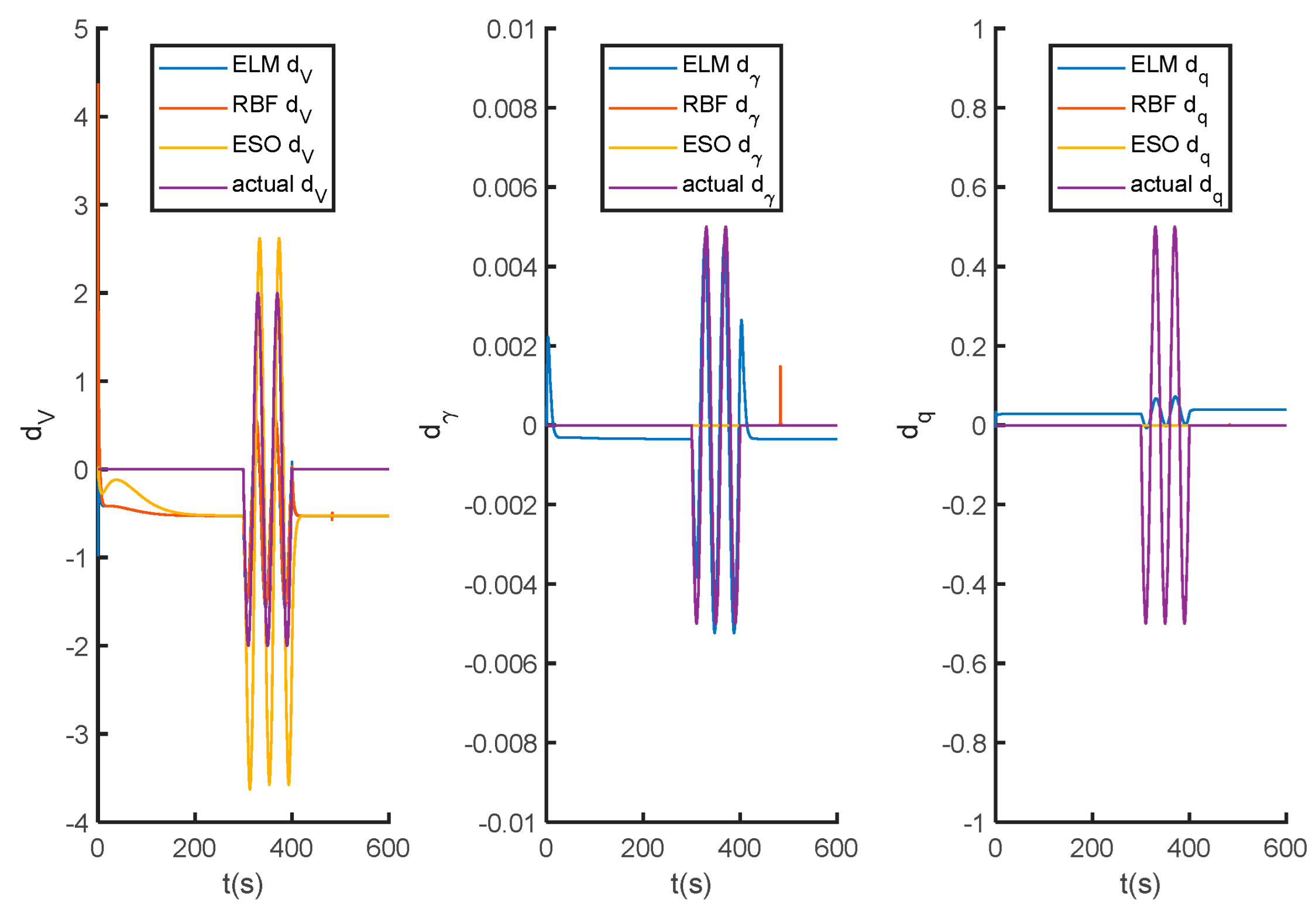
The exceptional tracking performance of SMPC + ELM is directly attributable to the precise estimation capability of the ELM disturbance observer. As evidenced in
Figure 13, the ELM observer accurately estimates the disturbances
,
and
, with its estimation curve closely following the actual values even during rapid pulse disturbances. In contrast, the RBF observer shows limited responsiveness, particularly in estimating
and
, while ESO exhibits significant fluctuations in estimating
and fails to estimate
and
effectively. The accurate estimation provided by the ELM observer enables timely and effective compensation, which is the fundamental reason for the enhanced tracking accuracy and robustness of the closed-loop system under external disturbances.