


Abstract
Leguminosae (legumes) are one of the largest plant families. They are widely used for a variety of purposes by people around the world and include many important cultivated economic food crops. On local scales, legumes are commonly used by various ethnic groups. However, the data are incomplete and scattered, not least in Thailand. We found that species of legumes were important in Karen communities, so we decided to investigate in detail the traditional knowledge of legumes on a local scale among Karen people in northern Thailand. We interviewed six herbalists and eighty-four nonherbalist informants in three Karen villages in Chiang Mai province about their use of legumes, and about the local names for the species, using semistructured interviews. A total of 83 legumes species (in 45 genera) had 4443 use reports. Five of the 83 legume species had not been reported previously as used in Thailand. Most Karen use reports (43%) of legumes were for food, medicine (36%), and materials (8%), but in term of species more legumes (68 species) were used for medicine than for food (53 species). The legume genera with most used species were Crotalaria and Flemingia each with six species. The most important species are Tamarindus indica (CI = 3.38), Senegalia rugata (CI = 2.39), Glycine max (CI = 1.27) respectively.
1. Introduction
Leguminosae (legumes) are the third largest plant family, with approximately 19,400 species [1], and they are found throughout the world in all biomes [2]. In Thailand, this family comprises about 133 genera and 778 species [3,4,5]. Legumes include many useful plants, such as crops, vegetables, timber, ornamentals, and medicinal plants [6], and are also important as fodder and green manure [7]. On a global level, many legumes are grown as economic crops. Legumes are the second most important crop family following the Poaceae [8].
Legumes are also important at the local scale. Many ethnobotanical studies in Thailand have demonstrated that legumes have always had more uses and used species than other plant families [9,10,11]. Unfortunately, many ethnobotanical studies in Thailand are focused only on single ethnic groups and many are unpublished. Therefore, information about legume uses in Thailand remains incomplete. Because legumes are so important at all scales, it is important to document their uses.
The Karen is the largest ethnic minority group in Thailand. They have migrated from Myanmar and settled in the northern and western parts of Thailand since the eighteenth century [12]. The largest proportion of the Thai Karen population live in northwestern Thailand in Chiang Mai, Mae Hong Son, and Tak provinces [13]. The Karen community’s livelihood depends on agriculture and livestock farming. They typically live surrounded by natural forest in the mountains. The Karen lifestyle still relies on nature, and they maintain large proportions of their traditional knowledge [14]. Therefore, the Karen are good representatives for studying local ethnobotanical uses of legumes.
Considering the global importance of legumes, in combination with the limited research into their local uses among ethnic groups, we expect many unreported local uses of legumes and that they may be underutilized. New studies that focus on legumes and on discovering their local uses may expose their overall usefulness. To do so, we focus on ethnobotanical uses of legumes in Karen communities in Thailand. Specifically, we asked the following questions: (1) How many legume species do the Karen use? (2) Which uses of legumes remain unreported in previous ethnobotanical studies? (3) Which use categories are the most important? (4) In which habitats do the useful legumes grow, which lifeform do they have, and which part of the plants are used? Finally, to rank the species we calculated the cultural importance index (CI) and to estimate the distribution of traditional knowledge in the communities we calculated the fidelity level (FL) for each legume encountered.
2. Results
2.1. Traditionally Used Leguminosae
A total of 83 legume species in 45 genera were used by the Karen and mentioned by the six key informants and the 84 nonspecialists from three studied villages (Table 1 and Table 2). The genera Crotalaria and Flemingia had the most useful species (6 in total), followed by Senna and Vigna (5 in total) (Table 2).
Table 1.
Basic information for three Karen villages in northern Thailand where traditional uses of Leguminosae were studied.
Table 2.
Qualitative and quantitative data on Leguminosae species with traditional uses, registered in three Karen villages in northern Thailand.
2.2. Previously Unreported Legume Uses
Comparing with previous ethnobotanical studies of the Thai Karen [15,16,17,18,19,20], we found 17 species of legumes that had not been recorded as useful among the Karen (Table 2). Some of the species that had not been recorded for the Karen, however, did have records of use among other ethnic groups. For example, Bauhinia purpurea L. is commonly consumed by Tai Yuan [21], and here we documented that the Karen cultivated it in their home gardens and used its young leaves as a vegetable. For five of the legume species recorded here (Aeschynomene americana L., Crotalaria lejoloba Bartl., Flemingia paniculata Benth., Indigofera hendecaphylla Jacq., and Vigna dalzelliana (Kuntze) Verdc.) we could not find any report of traditional use elsewhere in Thailand [22].
2.3. Use Categories
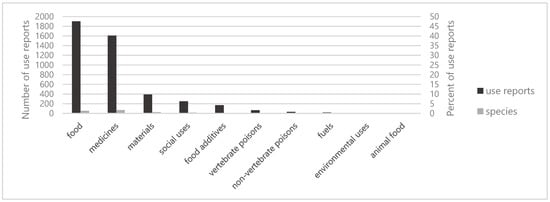
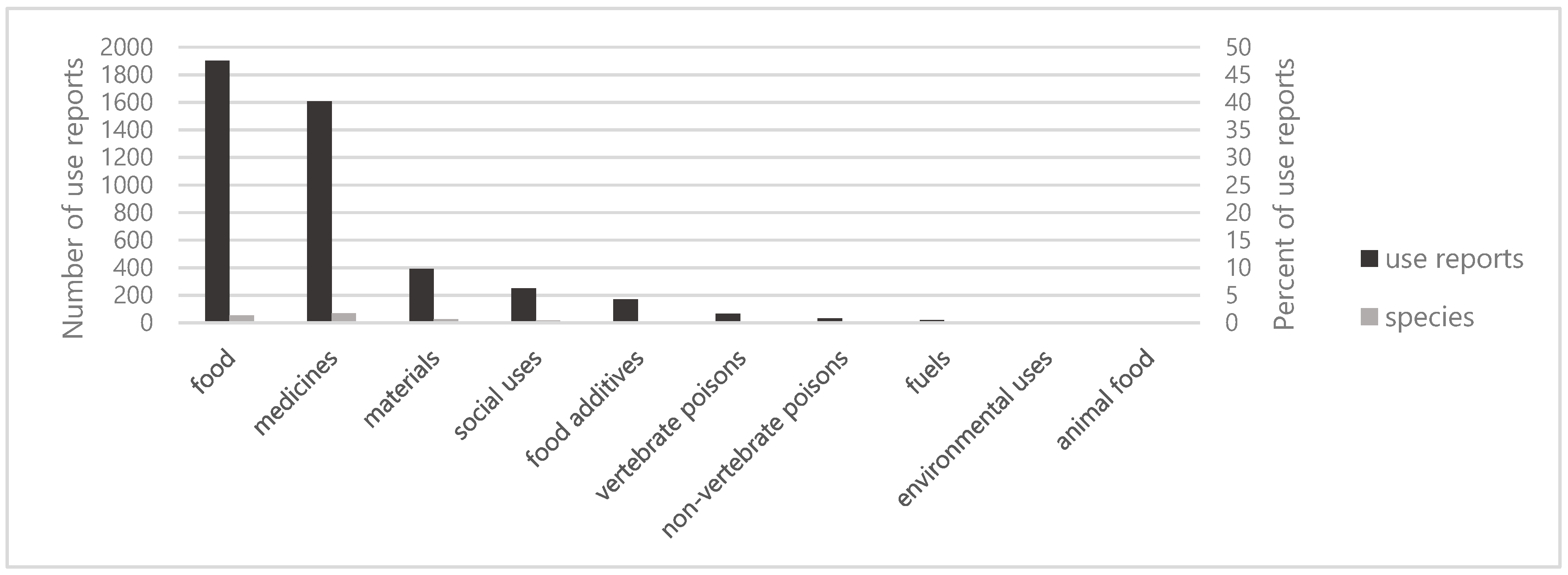
Our fieldwork generated 4443 use reports for the 83 legume species mentioned by ninety informants, including six specialists and 84 nonspecialists, from the three Karen communities in Thailand (Table 2). Khuntae had the highest total number of use reports (1609, 36%), followed by Pakanok (1469, 33%) and Tuan (1365, 31%) (Table 1). The uses of the legumes belonged to ten use categories in the system of Cook (1995) [23]. Food (1901 use reports; 43%), medicine (1608 use reports; 36%), and materials (390 use reports; 8%) were the three most important use categories (Figure 1).
Figure 1.
Number and percentage of use reports of Leguminosae in in each use categories in three Karen villages in northern Thailand.
2.4. Habitats, Life Forms, and Parts Used
Over half (56 species) of the useful legumes were found in the forests surrounding the villages, whereas other habitats were less important, such as village areas (20 species), home gardens (14 species), and agricultural areas (13 species). Most of the legumes used for food were, not surprisingly, found in the agricultural fields (e.g., Phaseolus vulgaris L., Vigna mungo (L.) Hepper, and Vigna umbellata (Thunb.) Ohwi and H.Ohashi) and home gardens (e.g., Cajanus cajan (L.) Millsp., Canavalia ensiformis (L.) DC., and Lablab purpureus (L.) Sweet). Medicinal plants and plants in other use categories were found both in natural forests (e.g., Crotalaria alata D.Don, Phyllodium longipes (Craib) Schindl, and Xylia xylocarpa (Roxb.) Taub.) and in the village areas (e.g., Aeschynomene americana L., Indigofera hendecaphylla Jacq., and Millettia caerulea Baker).
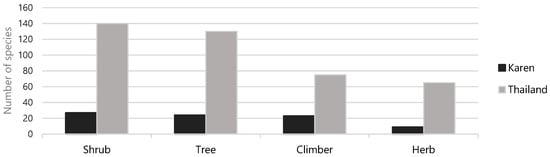
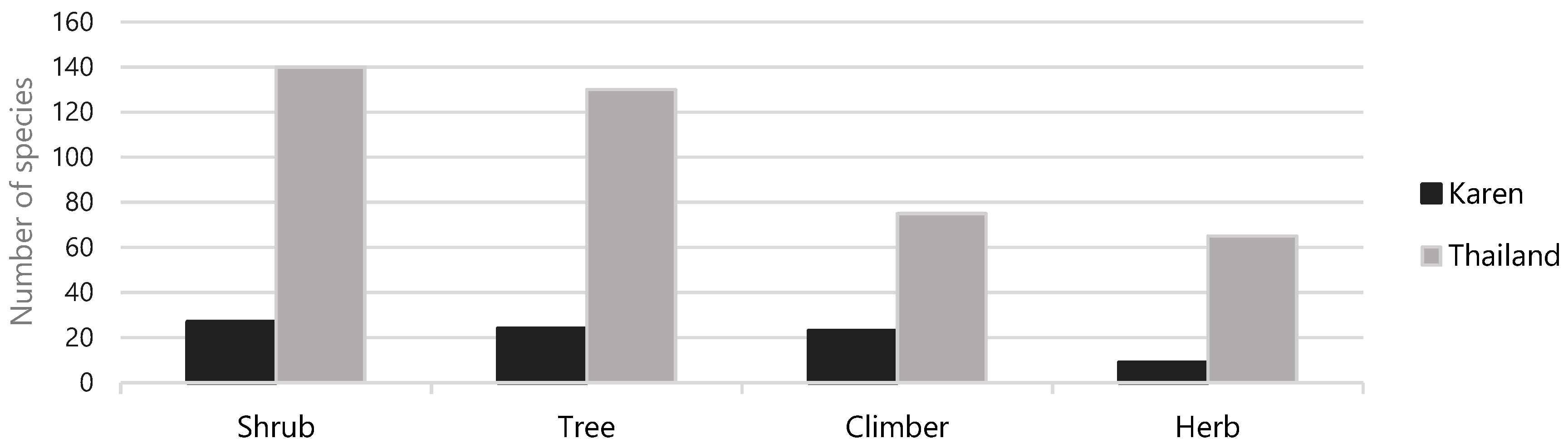
Legume species may comprise various life forms. Among the legumes used in the three Karen villages, shrubs were the most common life form, followed by trees, climbers, and herbs, which corresponds to the proportion of the same life forms in the Thai legume flora (Figure 2).
Figure 2.
Number of species of Leguminosae in each life form with traditional uses in three Karen villages in northern Thailand compared to their total number of species in each life form in the Thai legume flora.
For the parts used, the Karen most often used the leaves of the legumes (22%). Otherwise, the proportion of used parts were fruits (20%), seeds (15%), roots (12%), stems (9%), whole plants (8%), bark (7%), inflorescences (6%), and exudates (1%). The leaves were used mostly for food and medicine. The fruits, the seeds, and the inflorescences were generally used for food. The roots, the stems, and the whole plants were often used for medicine, and the stems were popular for materials. The exudates were used for social and medicinal purposes (Table 2).
2.5. Cultural Importance Index (CI) and Fidelity Level (FL)
The cultural importance index (CI) for legume species used by the Karen varied from 0.02 for Mimosa diplotricha to 3.38 for Tamarindus indica (Table 2). The highest CI value for a legume used by the Karen was for Tamarindus indica (CI = 3.38), the second was for Senegalia rugata (CI = 2.39), and the third was for Glycine max (CI = 1.27). The CI value ranked how important the 83 legume species were to the Karen communities (Table S1).
The fidelity level (FL) showed the informants’ consensus about the use of legumes in each category (Table 2). The highest value that can be obtained of the fidelity index is one hundred. Lower number of fidelity value means fewer uses in that use categories and less agreement about the uses among the informants. Obtaining a hundred percent fidelity level means that a species is used in only one category. The species that were used in only one category by the Karen, such as Aeschynomene americana L., Flemingia congesta Roxb. Ex W.T. Aiton, Huangtcia renifolia (L.) H.Ohashi and K.Ohashi, and Uraria oblonga (Wall. ex Benth.) H.Ohashi and K.Ohashi, were all used exclusively for medicine. Many of the edible species were only used for food, for example, Bauhinia variegata L., Phaseolus vulgaris L., and Vigna umbellata (Thunb.) Ohwi and H.Ohashi. The calculation of FL value showed in Table S2.
3. Discussion
3.1. Traditionally Used Leguminosae
Among the 45 useful legume genera, Crotalaria, Flemingia, Senna, and Vigna had the most useful species. Crotalaria is common in Thailand, where it is represented by 38 species [24]. At a global level, Crotalaria species are used for food and green manure, and are consumed by humans throughout the tropics. Crotalaria plants have a high nutrient content and they contain starch, protein, dietary fiber, oligosaccharides, and several active compounds and minerals [25]. Crotalaria is also popular for cultivation as green manure to improve soil quality. Crotalaria juncea L. and C. trichotoma Bojer are used elsewhere in this manner [26,27]. We found that all Crotalaria species in the Karen villages we studied were used for medicinal purposes, which was different from their popular uses at a global level. Because Crotalaria species contain useful secondary compounds, such as alkaloids, saponins, and flavonoids, they can be used as medicine [28]. Flemingia and Senna are commonly found in the villages, making them easy to obtain and use by villagers [29], and both genera are much used in traditional medicine. Flemingia mainly has flavonoids, which are useful in health care, whereas Senna has a variety of bioactive compounds that stimulate the digestive system, such as sennosides, glycosides, and naphthalene glycosides [30,31]. Vigna contains many species used as food in many local communities [32].
The village Khuntae had the highest number of use reports, possibly because it is a big community and quite isolated from urban centers. In the past, Khuntae could only be reached by a dirt road on steep slopes in the mountains. The paved road to Khuntae was finished as recently as in 2016. The isolation from urban communities forced the Khuntae villagers to maintain their traditional knowledge of useful legumes more than was necessary for the other two study villages. The Pakanok and Tuan villages had nearly the same distances to the nearest urban centers (Table 1) but the access to Pakanok is still along a dirt road. Therefore, Pakanok villagers are less affected by urban civilization than the villagers of Tuan. Other studies have found that the further away from urban centers, the more traditional knowledge is maintained [33,34].
3.2. Previously Unreported Legume Uses
We found 17 useful legume species that had not previously been reported among the Karen and five species that had no previous uses recorded among any other Thai ethnic group. Some species may have been overlooked in previous studies, which often gave more attention to the surrounding forest area. Several legumes were found in agricultural fields and home gardens, such as the cultivated crops Vigna mungo (L.) Hepper and Vigna umbellata (Thunb.) Ohwi and H. Ohashi. The discovery of five new useful legume species shows that a study of traditional uses focusing on one taxonomic group may help the informants to remember more uses for each species. Ethnobotanical studies that are focused on a particular plant group can, therefore, find species with previously unreported uses and which may be underutilized.
3.3. Use Categories
At a global level, legumes are commonly mentioned as important food crops [7,35]. In our local scale study, the most important use category for legumes was medicine. In total, 68 medicinal legume species were recorded in this study, which was an outstanding number among the studies of medicinal uses of legumes. Studies of medicinal legumes from Argentina and Chile reported 35 species [36], from Bangladesh 32 species [37], and from India 50, 28, 20, and 14 species, respectively [38,39,40,41]. The Karen used many medicinal legumes probably because they still maintained their traditional knowledge of medicinal plants. Additionally, legumes were common in the natural forests surrounding many villages and they are known to contain many useful bioactive components [42]. In a recent study of traditional medicinal plant diversity in Thailand [11], Leguminosae was represented by more species than any other plant family. The food plants were represented by 53 species. In general, legumes are important food plants for low income people [43]. In the study villages, the Karen grew legumes in paddy cultivation areas and harvested them at the same time as the paddy rice, and kept some seeds for growing the following years. The food category has more use reports but has a lower number of species, surely because the food plants are used on a daily basis and they were mentioned by almost all the informants. Medicine legumes, in contrast, have more specific uses and were mentioned by fewer informants.
3.4. Habitats, Life Forms, and Parts Used
Most of the useful legumes were found in the forests, which showed that the Karen livelihood remained highly dependent on the natural vegetation surrounding their villages, as pointed out in previous studies of this ethnic group [18]. The habitat of useful legumes is related to their uses. The legumes used for food were found mostly in the agricultural fields, because there the villagers could harvest them easily for daily consumption. Medicinal plants and plants in other use categories were found both in the natural forest and in the village areas, reflecting that they were used less often.
The legumes have various life forms. Shrubs appear in all seasons, and it is easy to collect all parts of them throughout the year. This may be the reason why shrubs were the most commonly used by the Karen. Legume trees were also present in all seasons, but their height sometimes made it hard to collect their leaves and flowers or fruits for use. Some legume climbers and herbs are dormant during the dry season and flourish again after the rain starts. This seasonal appearance may have affected the proportion of used species, especially of herbs, which are simply not available in parts of the annual cycle. Finally, the number of used species in each lifeform was influenced by the size of the species pool in each of the lifeform categories (Figure 2).
The reason why Karen people used the leaves of legumes may be because it is convenient and easy. Legume leaves can be used for many purposes, especially for food and medicine. On a global level, in many ethnobotanical studies, leaves are the most commonly used [44,45,46,47] because they are abundantly available. In comparison, in an ethnomedicinal study of Acanthaceae in Africa, including herbs, shrubs, and climbers, the most commonly used part was the leaf, while the whole plants was also commonly used [48]. For Annonaceae, most of which are trees, a study in Africa showed that the commonly used parts were bark and stem [49]. The most popular plant parts used depend on the plant habit. As legumes have various life forms, the parts used depends on the convenience of use. Fruit and seed are the most commonly used parts of legumes for consumption.
3.5. Cultural Importance Index (CI) and Fidelity Level (FL)
The cultural importance index (CI) ranks the species according to their value to the community [50,51]. When measured by their CI value, Tamarindus indica (tamarind) was the most important legume in the Karen communities. The tamarind was mentioned as useful by every informant, and it was used in six different use categories. The Karen used tamarind for food, food additives, fuel, materials, medicines, and for social uses. The tamarind was commonly found in the village areas, where it was easy to access and it had high use value [52]. Senegalia rugata, the second most important legume in the Karen communities, was easily found in the villages, and it was used for many purposes. such as food, food additives, materials, medicines, and also social uses, including Karen rituals where they paid respect to elderly people and evicted wickedness. Glycine max (soybeans), the third most important legume, was used for food and food additives by almost all informants. The Karen grow and harvest seeds for food and make traditional fermented soybeans.
The fidelity level (FL), which shows the evenness of traditional knowledge about a particular plant among the villagers, was calculated for each species to indicate the preference of Karen people. The fidelity level could be used to determine which species should be studied in more detail in the future, for instance to discover if they possess bioactive compounds.
4. Materials and Methods
4.1. Study Site
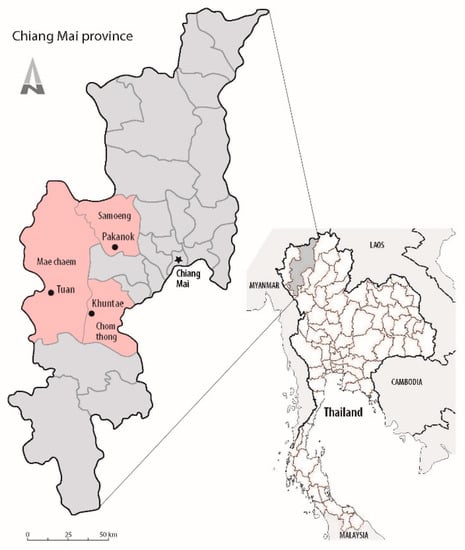
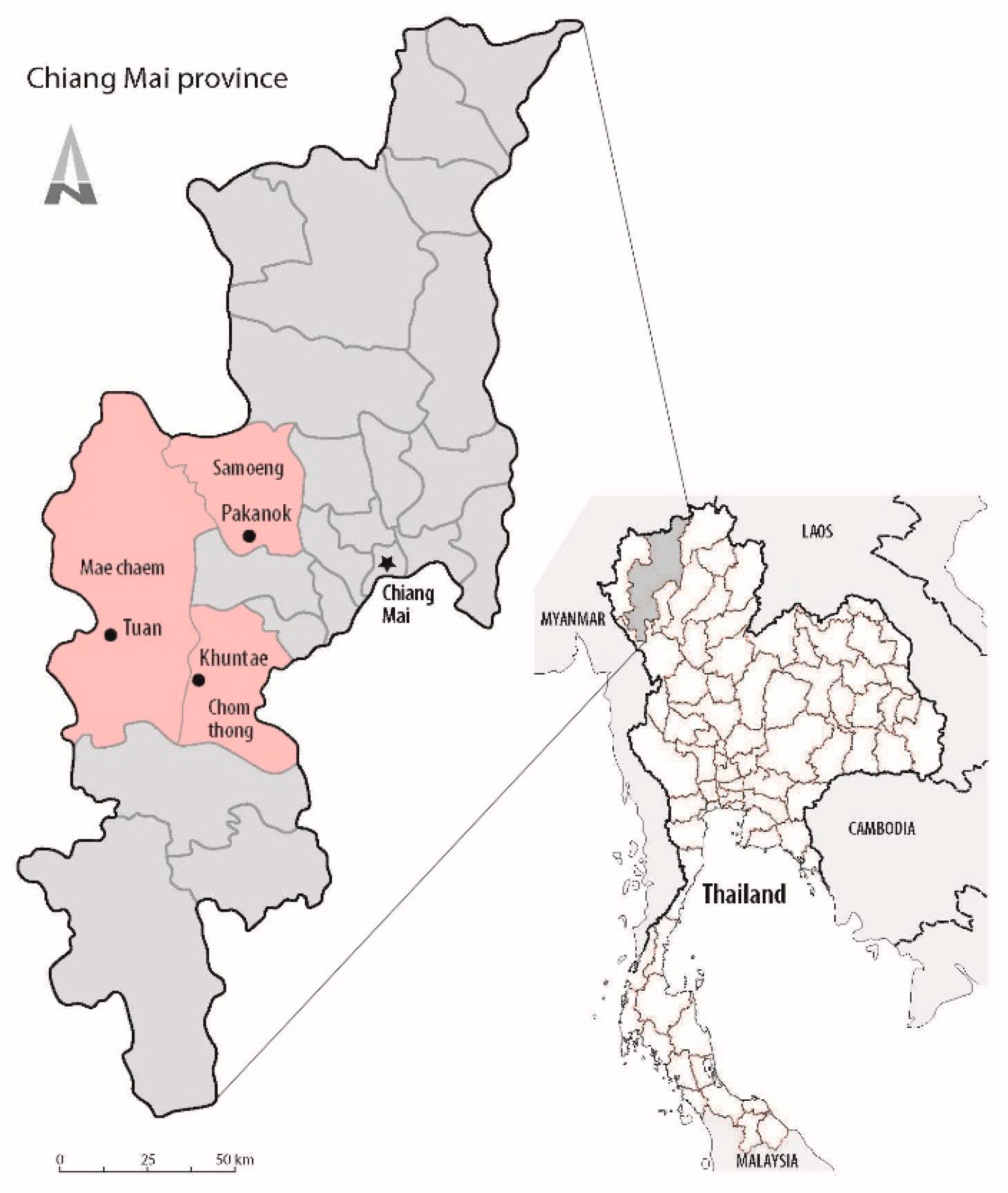
The field work was done in three Karen villages in Chiang Mai province, northern Thailand (Figure 3), in districts with high Karen populations: Tuan in Mae Chaem district, Pakanok in Samoeng district, and Khuntae in Chom Thong district. Their distances from the nearest urban centers range 15–26 km, and they are located at elevations ranging 863–1265 m above sea level (Table 1). All three study villages are surrounded by natural vegetation of mixed deciduous and dry evergreen forests. Most of their villagers practice agriculture, planting upland rice and some vegetables, and they raise livestock for consumption and sale. All villages have electricity and public upland water resources.
Figure 3.
Location of three Karen villages in Chiang Mai province, Thailand, where traditional uses of Leguminosae were studied.
4.2. Data Collection
Traditional use data concerning legumes were collected from 90 informants in three Karen villages between July 2016 and December 2018. The research protocol was approved by Chiang Mai University Research Ethics Committee with the certificate of approval number certificate of analysis (COA) No. 018/61. The key informants were selected for their traditional knowledge, and because they were recommended by the village headmen and other villagers. The key informants were interviewed through field interviews and semistructured interviews [53]. Field interviews were done in the areas around the villages in forests, home gardens, agricultural areas, and village areas. The key informants walked through the areas and told us about legumes usage. The data were collected from semistructured interviews, including their local names, the plant parts used, and when the plants had medicinal uses, the mode of preparation and how the derived medicines were applied. The key informants were interviewed in Thai language or through a translator when they could not communicate in Thai. The plants were photographed, and voucher specimens were collected and deposited in the Queen Sirikit Botanic Garden Herbarium (QBG), Chiang Mai, Thailand. The plants were identified using standard taxonomic literature at the Ethnobotany and Northern Thai Flora Laboratory, Chiang Mai University.
All legume use data derived from the interviews, with the six key informants used to prepare a questionnaire for interviewing nonspecialist villagers. Twenty-eight nonspecialist villagers were selected in each village by snowball sampling methods [54]. The snowball sampling method began with interviewing the key informants and asking them to suggest the next informant who had traditional knowledge about plant use. The informant who was suggested by key informants suggested the next informant continuously until the total number of all informants reach 30 in each village. Plant pictures were shown and Karen plant names were mentioned to each of the informants. Questions were asked individually about legume uses, including their local names, the plant parts used, and routes of administration. Plant use data were categorized following the Economic Botany Data Collection Standard [23]. The plant uses recorded covered 10 categories, namely (1) food: human food, including beverages; (2) food additives: processing agents and additional ingredient that are used for seasoning during food preparation; (3) animal food: forage and fodder for vertebrate animals; (4) materials: primary staples for making derived products; (5) fuels: woods, fibers, petroleum substitutes, fuel alcohols; (6) social uses: used for social purposes; (7) vertebrate poisons: plants that are poisonous to vertebrates; (8) nonvertebrate poisons: plants that are poisonous to nonvertebrates; (9) medicines: plants that are used to treat illness both in humans and domestic animals; (10) environmental uses: plants that are used to improv the environment.
4.3. Data Analysis
Ethnobotanical indices were used to analyze the traditional knowledge about legumes to determine which species were the most important to the Karen communities. The cultural importance index (CI) ranks the species according to their value to the community; the value is high when a species is often mentioned by informants and when it can be used in various use categories [49,50]. The cultural importance index (CI) [55] was calculated based on data obtained from the key informants as:
where NC is the total number of use categories for species i, URui is the total number of use reports of each category, and N is the total number of informants. The value of CI varies between zero and the number of use categories. A species is more important when its CI value is high. The CI value was calculated with common Excel spreadsheet (Microsoft Excel for Office 365, 2014).
CI = ∑(u = 1)NC ∑(i = 1)N URui/N
The fidelity level is an indication of agreement among informants about the use of a species. The highest value that can be obtained for the fidelity level is one hundred. Lower values of fidelity level mean that fewer informants knew the uses of a species in a use category. Obtaining one hundred percent fidelity level means that a species is used in only one category. The fidelity level was calculated for each species to indicate the popular use categories and to show the potential of each species. The fidelity level [56] was calculated as:
where Np is the number of use reports in each of the use categories and N is the total number of use reports. The summed fidelity level value for all plant is one hundred. High fidelity level value means that a use category is more popular. The Fidelity Level value was calculated with common Excel spreadsheet (Microsoft Excel for Office 365, 2014).
FL (%) = (Np/N) × 100
5. Conclusions
A total of 83 species in 45 genera of legumes had traditional uses in the three Karen villages. Five of the species had never before been documented for their traditional use in Thailand, and 17 were reported for the first time for traditional uses among the Karen. Most of the legumes were used as medicinal plants, which differed from the general appreciation of legumes as important food plants at the global level. Our study confirms that legumes are economically important, not only at the global level, but also at the local scale. Encountering so many new uses of the legumes demonstrated the value of focusing on a particular plant group in ethnobotanical studies. We suggest that the traditional uses of legumes should be studied in more details among other ethnic groups to discover additional useful species. Our future research will be focused on medicinal uses of legumes to investigate which species of legumes among the Karen communities have therapeutic potentials that can be developed further in pharmacology.
Supplementary Materials
The following are available online at https://www.mdpi.com/2223-7747/8/12/600/s1, Table S1: Calculation of Cultural Important Index (CI) values for legume species used in three Karen villages in northern Thailand, Table S2: Calculation of Fidelity Level (FL) values for 83 legume species used in three Karen villages in northern Thailand.
Author Contributions
Conceptualization, N.S. and H.B.; methodology, N.S. and A.I.; formal analysis, N.S.; investigation, N.S.; writing—original draft preparation, N.S.; writing—review and editing, H.B.; supervision, H.B., A.I., and P.W.
Funding
This research was funded by Human Resource Development in Science Project (Science Achievement Scholarship of Thailand, SAST). Henrik Balslev thanks the Carlsberg foundation for support to study the Thai flora, grant #CF14-0245.
Acknowledgments
We would like to thank the headmen of Khuntae, Pakanok, and Tuan villages, who provided support with facilities and accommodation during field work. We also thank all Karen informants and villagers who kindly gave us information about legume uses. We are very grateful to the Center of Excellence in Bioresources for Agriculture, Industry, and Medicine, Chiang Mai University, for providing financial support.
Conflicts of Interest
The authors declare no conflict of interest.
References
- Lewis, G.P.; Schrire, B.; Mackinder, B.; Lock, M. Legumes of the World; Royal Botanic Gardens Kew: London, UK, 2005. [Google Scholar]
- Schrire, B.; Lavin, M.; Lewis, G. Global distribution patterns of the leguminosae: Insights from recent phylogenies. Biologiske skrifter. In International Symposium, Plant Diversity and Complexity Patterns: Local, Regional and Global Dimensions; Det Kongelige Danske videnskabernes selskab: Copenhagen, Denmark, 2005; pp. 375–422. [Google Scholar]
- Larsen, K.; Larsen, S.S.; Vidal, J.E. Leguminosae-Caesalpinioideae. In Flora of Thailand; Part 1; Smitinand, T., Larsen, K., Eds.; TISTR Press: Bangkok, Thailand, 1984; Volume 4, pp. 1–129. [Google Scholar]
- Nielsen, I.C. Leguminosae-Mimosoideae. In Flora of Thailand; Part 2; Smitinand, T., Larsen, K., Eds.; TISTR Press: Bangkok, Thailand, 1984; Volume 4, pp. 131–222. [Google Scholar]
- Niyomdham, C. Key to the genera of Thai Papilionaceae plants. Thai F Bull (Bot.) 1994, 22, 26–88. [Google Scholar]
- Yahara, T.; Javadi, F.; Onoda, Y.; de Queiroz, L.P.; Faith, D.P.; Prado, D.E.; Akasaka, M.; Kadoya, T.; Ishihama, F.; Davies, S. Global legume diversity assessment: Concepts, key indicators, and strategies. Taxon 2013, 62, 249–266. [Google Scholar] [CrossRef] [Scilit]
- Azani, N.; Babineau, M.; Bailey, C.D.; Banks, H.; Barbosa, A.R.; Pinto, R.B.; Boatwright, J.S.; Borges, L.M.; Brown, G.K.; Bruneau, A. A new subfamily classification of the leguminosae based on a taxonomically comprehensive phylogeny. The legume phylogeny working group (lpwg). Taxon 2017, 66, 44–77. [Google Scholar] [CrossRef] [Scilit]
- Gepts, P.; Beavis, W.D.; Brummer, E.C.; Shoemaker, R.C.; Stalker, H.T.; Weeden, N.F.; Young, N.D. Legumes as a model plant family. Genomics for food and feed report of the cross-legume advances through genomics conference. ASPB Am. Soc. Plant Biol. 2005, 137, 1228–1235. [Google Scholar] [CrossRef] [Scilit]
- Khamfachuea, K.; Trisonthi, P.; Trisonthi, C. Ethnobotany of the karen at ban chan and chaem luang subdistricts, mae chaem district, chiang mai province. Thai J. Bot. 2010, 2, 275–297. [Google Scholar]
- Khuankaew, S.; Srithi, K.; Tiansawat, P.; Jampeetong, A.; Inta, A.; Wangpakapattanawong, P. Ethnobotanical study of medicinal plants used by tai yai in northern thailand. J. Ethnopharmacol. 2014, 151, 829–838. [Google Scholar] [CrossRef] [Scilit]
- Phumthum, M.; Srithi, K.; Inta, A.; Junsongduang, A.; Tangjitman, K.; Pongamornkul, W.; Trisonthi, C.; Balslev, H. Ethnomedicinal plant diversity in thailand. J. Ethnopharmacol. 2018, 214, 90–98. [Google Scholar] [CrossRef] [Scilit]
- Anderson, E.F. Plants and People of the Golden Triangle. Ethnobotany of the Hill Tribes of Northern Thailand; Dioscorides Press: Portland, OR, USA, 1993. [Google Scholar]
- Ministry of Social Development and Human Welfare. Highland Communities within 20 Provinces of Thailand; Coordinate Group for Human Welfare in Highland Area: Bangkok, Thailand, 2016. [Google Scholar]
- Tangjitman, K.; Wongsawad, C.; Winijchaiyanan, P.; Sukkho, T.; Kamwong, K.; Pongamornkul, W.; Trisonthi, C. Traditional knowledge on medicinal plant of the karen in northern thailand: A comparative study. J. Ethnopharmacol. 2013, 150, 232–243. [Google Scholar] [CrossRef] [Scilit]
- Kamwong, K. Ethnobotany of Karens at Ban Mai Sawan and Ban Huay Pu Ling, Ban Luang Sub-District, Chom Thong District, Chiang Mai Province. Ph.D. Thesis, Chiang Mai University, Chiang Mai, Thailand, 2009. [Google Scholar]
- Khamfachuea, K. Ethnobotany of Karen at Ban Chan and Chaem Luang Subdistricts, Mae Chaem District, Chiang Mai Province. Ph.D. Thesis, Chiang Mai University, Chiang Mai, Thailand, 2008. [Google Scholar]
- Sukkho, T. A Survey of Medicinal Plants Used by Karen People at Ban Chan and Chaem Luang Subdistricts, Mae Chaem District, Chiang Mai Province. Master’s Thesis, Chiang Mai University, Chiang Mai, Thailand, 2008. [Google Scholar]
- Trisonthi, C.; Trisonthi, P. Ethnobotanical study in thailand, a case study in khun yuam district maehongson province. Thai J. Bot. 2009, 1, 1–23. [Google Scholar]
- Winijchaiyanan, P. Ethnobotany of Karen in Chiang Mai. Master’s Thesis, Chiang Mai University, Chiang Mai, Thailand, 1995. [Google Scholar]
- Pongamornkul, W. An Ethnobotanical Study of the Karen at Ban Yang Pu Toh and Ban Yang Thung Pong, Chiang Dao District, Chiang Mai Province. Master’s Thesis, Chiang Mai University, Chiang Mai, Thailand, 2003. [Google Scholar]
- Muangyen, N.; Trisonthi, C.; Inta, A. Ethnobotanical study of the tai lue and kon muang in samoeng district, chiang mai province. Thai J. Bot. 2012, 4, 31–36. [Google Scholar]
- Pongamornkul, W.; Trisonthi, C.; Trisonthi, P.; Inta, A. Northern Thailand Ethnobotanical Index; Wanida Printing: Chiang Mai, Thailand, 2017. [Google Scholar]
- Cook, F.E. Economic Botany Data Collection Standard; Royal botanic gardens (Kew): Richmond, UK, 1995. [Google Scholar]
- Ninkaew, S.; Balslev, H.; Pornpongrungrueng, P.; Chantaranothai, P. Crotalaria l. (fabaceae: Faboideae) in continental southeast asia. Phytotaxa 2017, 320, 1–74. [Google Scholar] [CrossRef] [Scilit]
- Kathirvel, P.; Kumudha, P. Comparative analysis and nutritional assessment of raw seeds of crotalaria species. Int. J. Plant Anim. Environ. Sci. 2012, 2, 87–98. [Google Scholar]
- International Institute of Rural Reconstruction. Low-External Input Rice Production (Lirp): Technology Information Kit; IIRR: Silang, Philippines, 1990. [Google Scholar]
- Crotalaria juncea, a Promising Green Manure Crop for the Tropics. 2009. Available online: https://www.echocommunity.org/resources/c65ca0cc-6d71-4ba0-979b-1016459a70b4 (accessed on 18 March 2018).
- Devendra, B.N.; Srinivas, N.; Solmon, K.S. A comparative pharmacological and phytochemical analysis of in vivo & in vitro propagated crotalaria species. Asian Pac. J. Trop. Med. 2012, 5, 37–41. [Google Scholar] [PubMed]
- Inta, A.; Trisonthi, P.; Trisonthi, C. Analysis of traditional knowledge in medicinal plants used by yuan in thailand. J. Ethnopharmacol. 2013, 149, 344–351. [Google Scholar] [CrossRef] [Scilit] [PubMed]
- Balasankar, D.; Vanilarasu, K.; Preetha, P.; Rajeswari, S.; Umadevi, M.; Bhowmik, D. Senna—A medical miracle plant. J. Med. Plants Stud. 2013, 1, 41–47. [Google Scholar]
- Gahlot, K.; Lal, V.; Jha, S. Phytochemical and pharmacological potential of flemingia roxb. Ex wt aiton (fabaceae). Phytomedicine 2012, 3, 294–307. [Google Scholar]
- Fery, R.L. New Opportunities in Vigna. Trends in New Crops and New Uses; ASHS Press: Alexandria, VA, USA, 2002; pp. 424–428. [Google Scholar]
- Tangjitman, K.; Wongsawad, C.; Kamwong, K.; Sukkho, T.; Trisonthi, C. Ethnomedicinal plants used for digestive system disorders by the karen of northern thailand. J. Ethnobiol. Ethnomed. 2015, 11, 27. [Google Scholar] [CrossRef] [Scilit]
- Vandebroek, I.; Calewaert, J.-B.; Sanca, S.; Semo, L.; Van Damme, P.; Van Puyvelde, L.; De Kimpe, N. Use of medicinal plants and pharmaceuticals by indigenous communities in the bolivian andes and amazon. Bull. World Health Organ. 2004, 82, 243–250. [Google Scholar]
- List of Plants in the Family Fabaceae. 2018. Available online: https://www.britannica.com/topic/list-of-plants-in-the-family-Fabaceae-2021803 (accessed on 17 March 2018).
- Molares, S.; Ladio, A. The usefulness of edible and medicinal fabaceae in argentine and chilean patagonia: Environmental availability and other sources of supply. Evid. Based Complement. Alternat. Med. 2012, 2012, 901918. [Google Scholar] [CrossRef] [Scilit]
- Rahman, A.; Parvin, M.I.A. Study of medicinal uses on fabaceae family at rajshahi, bangladesh. Res. Plant Sci. 2014, 2, 6–8. [Google Scholar]
- Sinku, R.; Sinha, M.R. Study of the flora of fabaceae family and its ethanopharmacological impotance documented from west singhbhum district of jharkhand. IJEK Int. J. Entrep. Knowl. 2015, 2, 37–45. [Google Scholar]
- Tirkey, A. Some ethnomedicinal plants of family-fabaceae of chhattisgarh state. IJTK Indian J. Tradit. Knowl. 2006, 5, 551–553. [Google Scholar]
- Gwalwanshi, D.; Vyas, D.; Bishwas, A.; Salunkhe, O.; Tiwari, P. Ethnomedicinal and ecological studies on fabaceae of runj forest panna (mp), india. Int. J. Recent Sci. Res. 2014, 5, 1264–1269. [Google Scholar]
- Devi, S.; Gupta, A.; Singh, M. Ethno-medicinal use of plants belonging to families fabaceae and solanaceae, hamirpur district (hp). Int. J. Sci. Res. Publ. 2012, 2, 1–4. [Google Scholar]
- Ramrakhiyani, C.; Gaur, V.N.; Athaley, R. Comparative and therapeutic studies of some medicinal plants of family fabaceae. Int. J. Pharm. Biol. Sci. 2016, 11, 17–19. [Google Scholar]
- Tharanathan, R.; Mahadevamma, S. Grain legumes—A boon to human nutrition. Trends Food Sci. Technol. 2003, 14, 507–518. [Google Scholar] [CrossRef] [Scilit]
- Araya, S.; Abera, B.; Giday, M. Study of plants traditionally used in public and animal health management in seharti samre district, southern tigray, ethiopia. J. Ethnobiol. Ethnomed. 2015, 11, 22. [Google Scholar] [CrossRef] [Scilit]
- Fortini, P.; Di Marzio, P.; Guarrera, P.; Iorizzi, M. Ethnobotanical study on the medicinal plants in the mainarde mountains (central-southern apennine, italy). J. Ethnopharmacol. 2016, 184, 208–218. [Google Scholar] [CrossRef] [Scilit]
- Ouelbani, R.; Bensari, S.; Mouas, T.N.; Khelifi, D. Ethnobotanical investigations on plants used in folk medicine in the regions of constantine and mila (north-east of algeria). J. Ethnopharmacol. 2016, 194, 196–218. [Google Scholar] [CrossRef] [Scilit]
- Sivasankari, B.; Anandharaj, M.; Gunasekaran, P. An ethnobotanical study of indigenous knowledge on medicinal plants used by the village peoples of thoppampatti, dindigul district, tamilnadu, india. J. Ethnopharmacol. 2014, 153, 408–423. [Google Scholar] [CrossRef] [Scilit]
- Fongod, A.; Modjenpa, N.; Veranso, M. Ethnobotany of acanthaceae in the mount cameroon region. J. Med. Plant Res. 2013, 7, 2859–2866. [Google Scholar]
- Bele, M.Y.; Focho, D.A.; Egbe, E.A.; Chuyong, B.G. Ethnobotanical survey of the uses of annonaceae around mount cameroon. Afr. J. Plant Sci. 2011, 5, 237–247. [Google Scholar]
- Nasab, F.K.; Khosravi, A.R. Ethnobotanical study of medicinal plants of sirjan in kerman province, iran. J. Ethnopharmacol. 2014, 154, 190–197. [Google Scholar] [CrossRef] [Scilit] [PubMed]
- Tuttolomondo, T.; Licata, M.; Leto, C.; Savo, V.; Bonsangue, G.; Gargano, M.L.; Venturella, G.; La Bella, S. Ethnobotanical investigation on wild medicinal plants in the monti sicani regional park (sicily, italy). J. Ethnopharmacol. 2014, 153, 568–586. [Google Scholar] [CrossRef] [Scilit]
- Havinga, R.M.; Hartl, A.; Putscher, J.; Prehsler, S.; Buchmann, C.; Vogl, C.R. Tamarindus indica l. (fabaceae): Patterns of use in traditional african medicine. J. Ethnopharmacol. 2010, 127, 573–588. [Google Scholar] [CrossRef] [Scilit]
- Gerique, A. An introduction to ethnoecology and ethnobotany: Theory and methods. In Integrative Assessment and Planning Methods for Sustainable Agroforestry in Humid and Semiarid Regions; Advanced Scientific Training: Loja, Ecuador, 2006. [Google Scholar]
- Naderifar, M.; Goli, H.; Ghaljaie, F. Snowball sampling: A purposeful method of sampling in qualitative research. Strides Dev. Med. Educ. 2017, 14, e67670. [Google Scholar] [CrossRef] [Scilit]
- Tardío, J.; Pardo-de-Santayana, M. Cultural importance indices: A comparative analysis based on the useful wild plants of southern cantabria (northern spain). Econ. Bot. 2008, 62, 24–39. [Google Scholar] [CrossRef] [Scilit]
- Friedman, J.; Yaniv, Z.; Dafni, A.; Palewitch, D. A preliminary classification of the healing potential of medicinal plants, based on a rational analysis of an ethnopharmacological field survey among bedouins in the negev desert, israel. J. Ethnopharmacol. 1986, 16, 275–287. [Google Scholar] [CrossRef] [Scilit]

© 2019 by the authors. Licensee MDPI, Basel, Switzerland. This article is an open access article distributed under the terms and conditions of the Creative Commons Attribution (CC BY) license (http://creativecommons.org/licenses/by/4.0/).