


Abstract
In this study we focused on the need to fill a knowledge gap among Italian botanical studies namely that of ornamental species census. In particular, we addressed one of the regions in southern Italy with less knowledge in the field of such studies and with an obvious presence of non-native species. A widespread census of the Apulian territory was carried out between 2021 and 2024 in both urban and suburban areas including street trees, parks, and private and historic gardens. The inventory of ornamental trees, shrubs, and succulents of Apulia (southern Italy) was carried out in six provinces, i.e., Bari, Barletta-Andria-Trani, Brindisi, Foggia, Lecce, and Taranto. The checklist comprises 287 taxa (including 265 species, 6 varieties, 5 subspecies, and 11 forms) included in 179 genera belonging to 78 families. We evaluated the number of taxa per families and genera, the presence of each taxa in the provinces of Apulia, the number of taxa per occurrence status, growth forms, geographical origin, and the number of native and alien taxa and also the artificial hybrids. Remarks of the most significant taxa and evaluation of geographical distribution in Italy were also taken into consideration. A large number of surveyed taxa (51.74%) are comprised in the list reported in the recent study on allochthonous vascular flora in Italy with a marked prevalence of Neophyte Casual Alien and Neophyte Naturalized Alien species.
1. Introduction
Ornamental plants are important elements of urban areas useful in improving air quality, water quality, climate regulation, nutrient recycling, and pollination. Within urban parks and historic gardens, they also play a cultural role by providing recreational opportunities for citizens resulting in improved well-being [1].
Ornamental plants are also used in the form of city street trees for aesthetic beauty but also to help reduce air pollution and temperature by shading asphalt and buildings with a direct impact on Urban Heat Islands [2]. Some of these ornamental species are of particular aesthetic value and, at times, of considerable age and therefore considered by citizens as part of the urban landscape.
On the other hand, the prevalence of alien ornamental species over native species leads to a number of critical issues that have been studied by several authors [3,4,5]. Many of the invasive plants recorded in Italy were intentionally introduced for ornamental reasons than for any other purpose.
The number of allochthonous species is gradually and steadily increasing, and the phenomenon of biological invasions is known to cause damage to biodiversity, ecosystem services, human health, and the economy [6,7]. This is in line with the growing trend of biological invasions resulting from the intentional or accidental introduction of species as ornamentals by humans into areas outside their native range. Anthropogenic factors play a key role in the establishment and subsequent spread of alien species. Emblematic is the example of Ailanthus altissima (Mill.) Swingle, a tree that belongs to the large group of ornamental trees dispersed by wind or birds, which is an important management problem for the conservation of cultural heritage sites [4]. Also not to be underestimated is the spread of novel plant diseases through the introduction of alien ornamental species both in nurseries and within urban centers [8,9].
However, the analysis of urban street trees is often overlooked, although they are key green elements within cities, because of their specific ecological and socio-economic functions [10]. In Italy, previous studies have dealt marginally with ornamental species, and some references can be found in papers dealing more generally with allochthonous vascular flora or alien species [11]. On the contrary, reports from other countries demonstrated a wide interest in ornamental plants as a source of multiple ecosystem services, including their utility in the phytoremediation of contaminated soil, air, and water [12], their capacity to remove volatile organic compounds from indoor air [13], and their role as sinks and bioindicators [14], as well as for the analysis of the toxicity of many ornamental shrubs used for their aesthetics due to accidental ingestion [15], etc.
In 2021, we launched a census of ornamental plants in Apulia, a region in southern Italy, with the aim of providing an inventory of trees, shrubs, and succulents grown in street trees, parks, private gardens, and historic villas.
The unpublished data collected during the census are the subject of this survey which provides an important contribution to the knowledge of an important aspect of the alien and native flora of Apulia.
A further purpose of this research is to highlight the presence of ornamental species in the Apulian territory, an under-researched area of botanical studies in the region. The objective of this study is to provide a list as close to reality as possible of the ornamental species in Apulia that will allow subsequent assessments by local governments of the aesthetic value of the plants but also of the possible risks related to invasiveness and public health mainly in terms of increased allergies.
2. Results
A total of 287 taxa (including 265 species, 6 varieties, 5 subspecies, and 11 forms) included in 179 genera belonging to 78 families were surveyed in the six provinces of the Apulia region, i.e., Bari, Barletta-Andria-Trani, Brindisi, Foggia, Lecce, and Taranto.
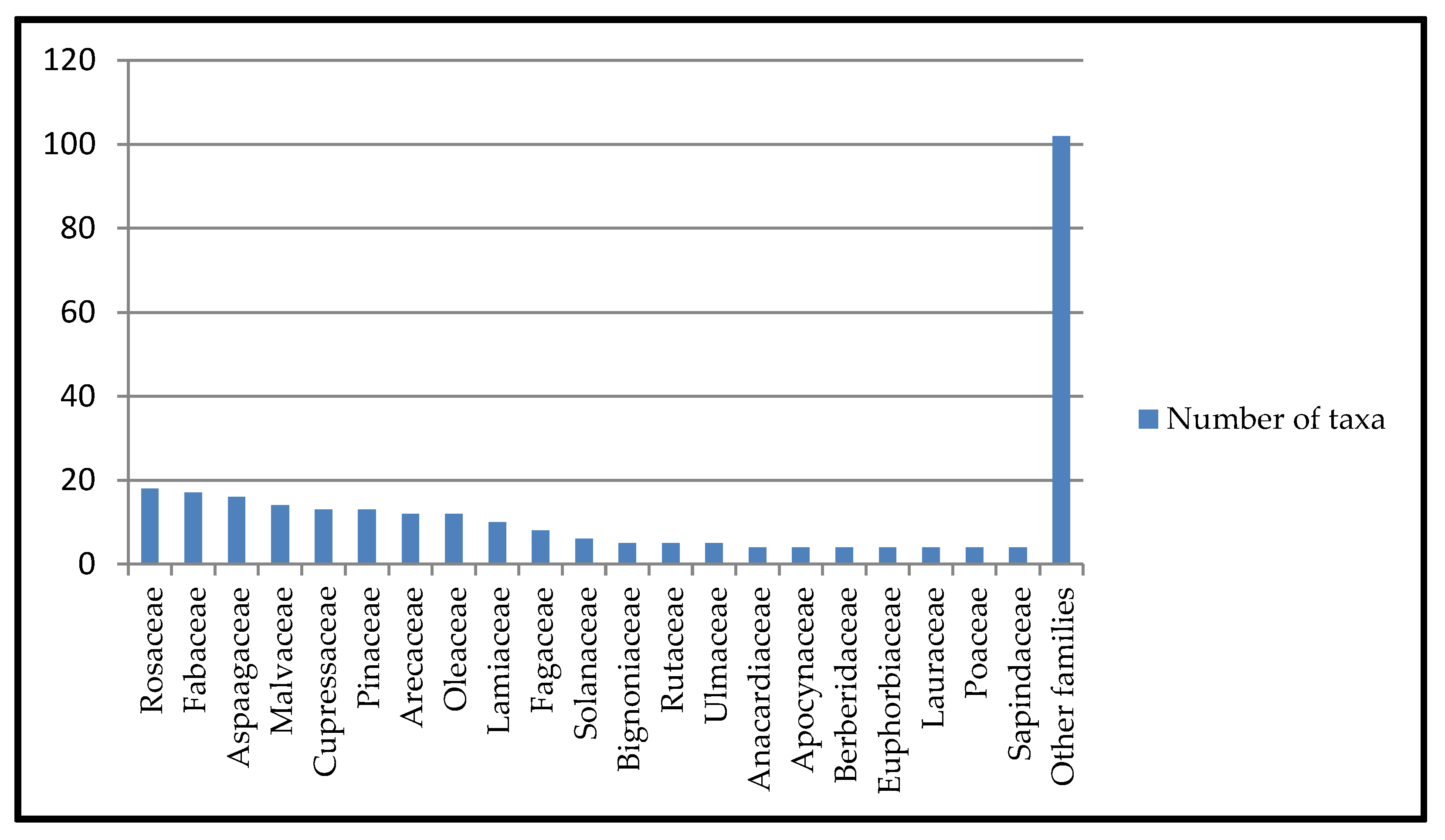
The highest number of taxa (Figure 1) is found in the families Rosaceae (18 taxa), Fabaceae (17 taxa), Asparagaceae (16 taxa), Malvaceae (14 taxa), Cupressaceae (13 taxa), Pinaceae (13 taxa), Arecaceae (12 taxa), Oleaceae (12 taxa), Lamiaceae (10 taxa), Fagaceae (8 taxa), Solanaceae (6 taxa), Bignoniaceae (5 taxa), Rutaceae (5 taxa), Ulmaceae (5 taxa), Anacardaceae (4 taxa), Apocynaceae (4 taxa), Berberidaceae (4 taxa), Euphorbiaceae (4 taxa), Lauraceae (4 taxa), Poaceae (4 taxa), and Sapindaceae (4 taxa).
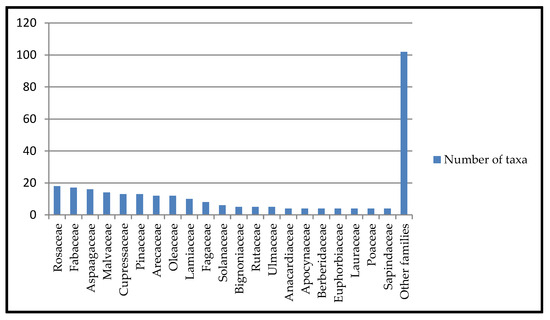
Figure 1.
Number of taxa per family based on taxa surveyed in the Apulian territory.
The largest number of taxa is found in the genera Quercus L. (eight taxa), Prunus L. (seven taxa), Tamarix L. (seven taxa), Pinus L. (six taxa), Asparagus Tourn. ex L. (five taxa), Ficus Tourn. ex L (five taxa), Ligustrum L. (five taxa), Ulmus L. (five taxa), Brachychiton Schott and Endl. (four taxa), Citrus L. (four taxa), Euphorbia L. (four taxa), Salvia L. (four taxa), and Yucca L. (four taxa).
A total of 31.2% (90 taxa) of the taxa listed in Appendix A Table A1 are found in all six provinces where the census was conducted, while 103 taxa (35.76%) have only been surveyed in one province.
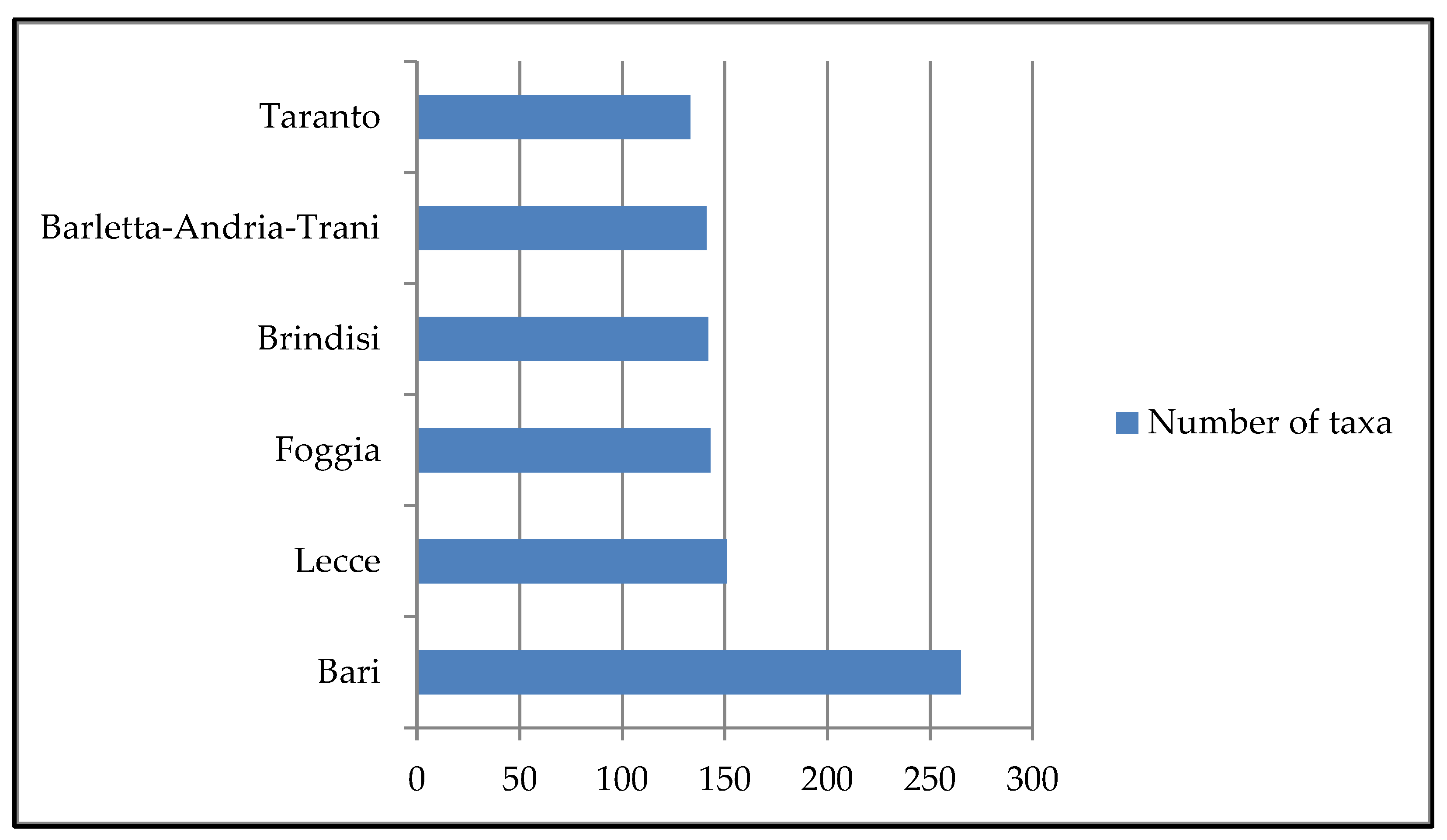
Bari (264 taxa) is the province in Apulia with the largest number of taxa surveyed (Figure 2) followed by Lecce (151 taxa), Foggia (143 taxa), Brindisi (142 taxa), Barletta-Andria-Trani (141 taxa), and Taranto (133 taxa).
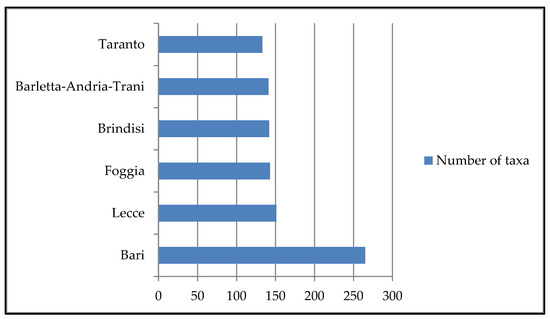
Figure 2.
Number of taxa surveyed in each Apulian province.
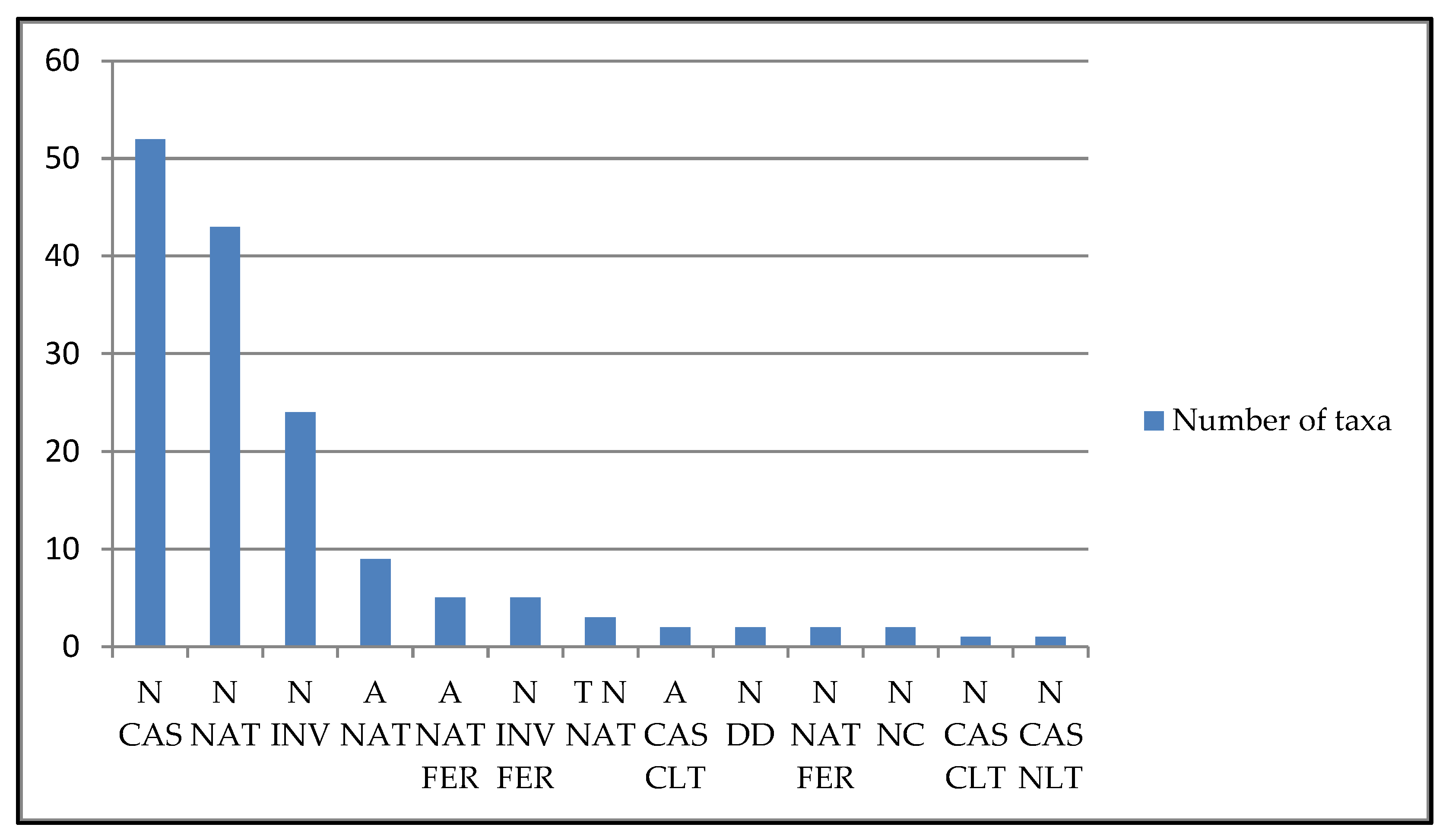
A large number of the surveyed taxa (51.74%) are included in the list reported in the recent study on allochthonous vascular flora in Italy [16]. According to Galasso et al. [17], most of them fall into the category Neophyte Casual Alien (N CAS) (52 taxa) followed by Neophyte Naturalized Alien (N NAT) (43 taxa), Neophyte Invasive Alien (N INV) (24 Taxa), Archeophyte Naturalized Alien (A NAT) (9 taxa), Neophyte Invasive Alien Feral (N INV FER) (5 taxa), Archeophyte Invasive Alien Feral (A NAT FER) (5 taxa), Taxonomically Doubtful Neophyte Naturalized Alien (T N NAT) (3 taxa), Neophyte Naturalized Alien Feral (N NAT FER) (2 taxa), Archeophyte Casual Alien Culton (A CAS CLT) (2 taxa), Neophyte Unclear Alien Status (N NC) (2 taxa), Naturalized Data Deficient N DD (2 taxa), Neophyte Casual Alien Culton (N CAS CLT) (1 taxa), and Neophyte Casual Alien Naturalized (N CAS NLT) (1 taxa) (Figure 3).
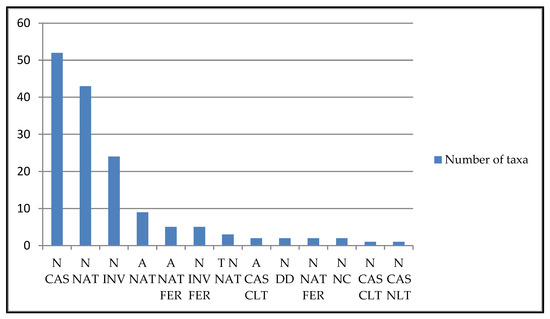
Figure 3.
Number of taxa per occurrence status (sensu Galasso et al. [17]) based on taxa surveyed in the Apulian territory.
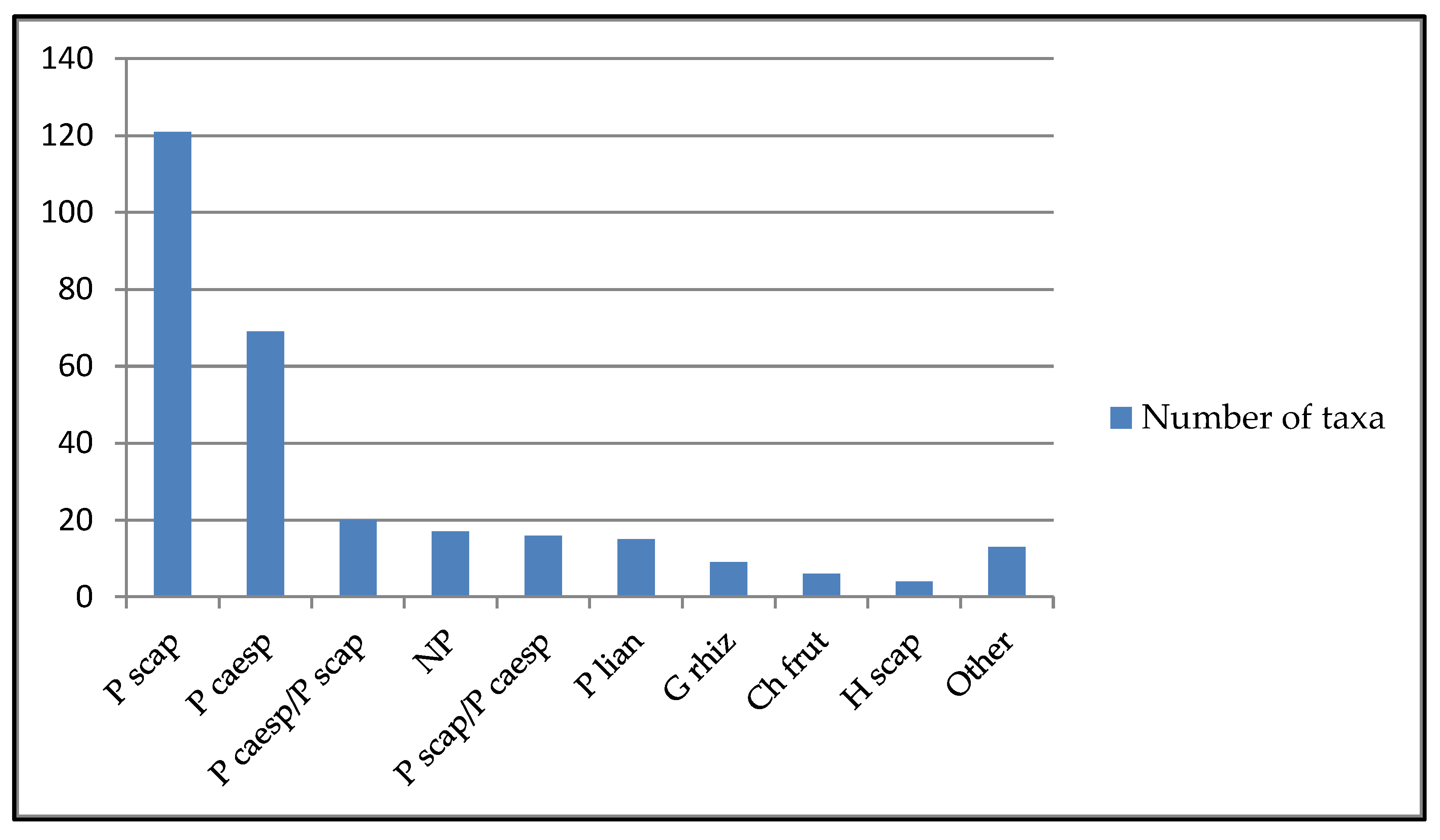
Based on what can be gleaned from “Plants of the World Online” edited by the Royal Botanic Gardens, Kew, among the plants surveyed, scapose phanerophytes (P scap) clearly predominate followed by caespitose phanerophytes (P caesp) (Figure 4) while there is a clear prevalence of Asian, African, and Central and South American geographic origins over European ones (Appendix A Table A2). From Appendix A Table A2, it is possible also to see the clear predominance of alien species (217 taxa) over native species (60 taxa) and 10 artificial hybrids (AH).
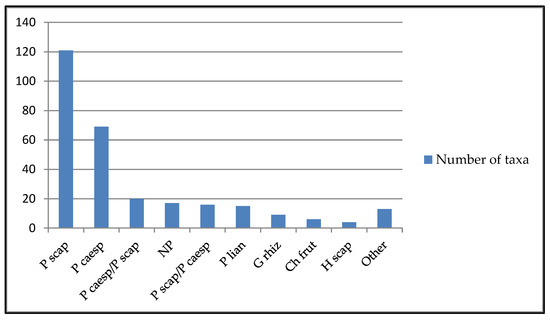
Figure 4.
Number of taxa per biological form categorized according to Plants of the World Online (POWO 2024).
Most of the species surveyed are also commonly used as ornamentals in the other regions of Italy.
Taxa at the upper limit of their distribution in Italy are Bauhinia variegata L. var. candida Voigt, Brachychiton sp. pl., Brahea armata S. Watson, Ceiba speciosa (A. St.-Hil., A. Juss., and Cambess.) Ravenna, Erythrina crista-galli L., Erythrina herbacea L., Euphorbia ingens E. May. ex Boiss, Euphorbia murielii N.E.Br, Euphorbia tirucalli L., Ficus sp. pl., Hibiscus ×rosa-sinensis L., Jacaranda mimosifolia D. Don, Musa ×paradisiaca L., Persea indica (L.) Spreng, Sabal palmetto (Walter) Lodd. ex Schult. and Schult.f., Sideroxylon spinosum L., and Yucca rostrata Engelm. ex Trel.
Erythrina crista-galli and Jacaranda mimosifolia are species of high ornamental value that are fairly common but have only been expanding in southern Italy for a few years and, moreover, only locally.
Widespread in the Apulian provinces is the use of plants providing both productivity and ornamental value such as Annona cherimola Mill., Citrus ×limon (L.) Osbeck, Citrus reticulata Blanco, Citrus ×sinensis (L.) Osbeck, Corylus avellana L., Feijoa sellowiana (O. Berg) O. Berg, Ficus carica L., Juglans regia L., Musa ×paradisiaca L., Punica granatum L., Prunus domestica L., and Prunus dulcis (Mill.) D.A. Webb.
Moreover, Sideroxylon spinosum is of particular botanical interest providing ecological services and socioeconomic value. Its fruits provide an edible and marketable oil for cooking, cosmetic, and medicinal purposes. The vigorous tree cultivated in the University Campus of Bari is one of the few plants to date grown in Italy [18].
Another plant of application interest is Euphorbia tirucalli whose oil obtained from the modified stems and leaves is a valuable alternative energy source for biofuel production in some Arab and African countries [19].
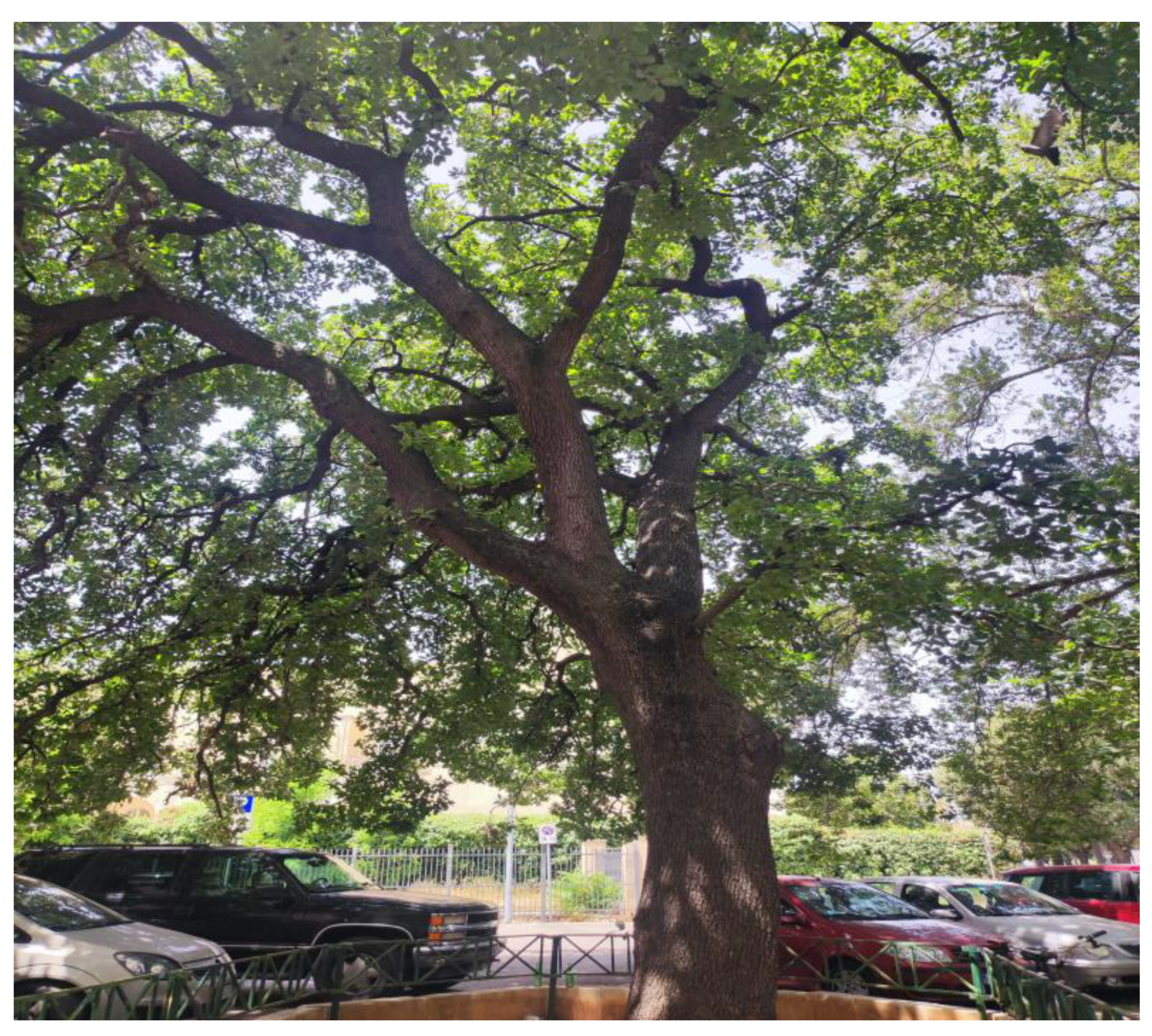
Finally, extensive use of species of the genus Quercus L. is noted. Quercus ilex L. is widely used in the streets of the city of Lecce where the crowns of the trees make contact with each other forming tunnels that provide coolness on hot days for citizens. In the city of Lecce, it is also possible to observe a monumental tree of Quercus ithaburensis subsp. macrolepis (Kotschy) Hedge and Yalt, (Figure 5), a species found in Italy only in Apulia and more precisely in Salento, mainly in the province of Lecce, and to a lesser extent in the province of Bari and Brindisi. This is a relict species from an old botanical garden that was dismantled in the early 20th century. Since 1993, Q. ithaburensis subsp. macrolepis is included in the Red List of the endangered botanical species in Italy. At the international level, the need to establish reserves to safeguard its genetic heritage has been recognized.
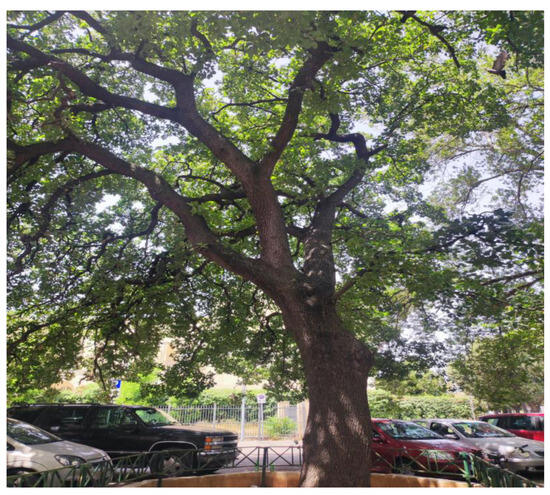
Figure 5.
Monumental tree of Quercus ithaburensis subsp. macrolepis in the city of Lecce.
Trees of Quercus pubescens Willd. are used as ornamentals in the cities of Bari and Foggia.
Instead, Quercus cerris L., Q. petraea (Matt.) Liebl, Q. trojana Webb, Q. robur L., Q. suber L., and Q. trojana Webb are used in the newly planted gardens in the city of Bari.
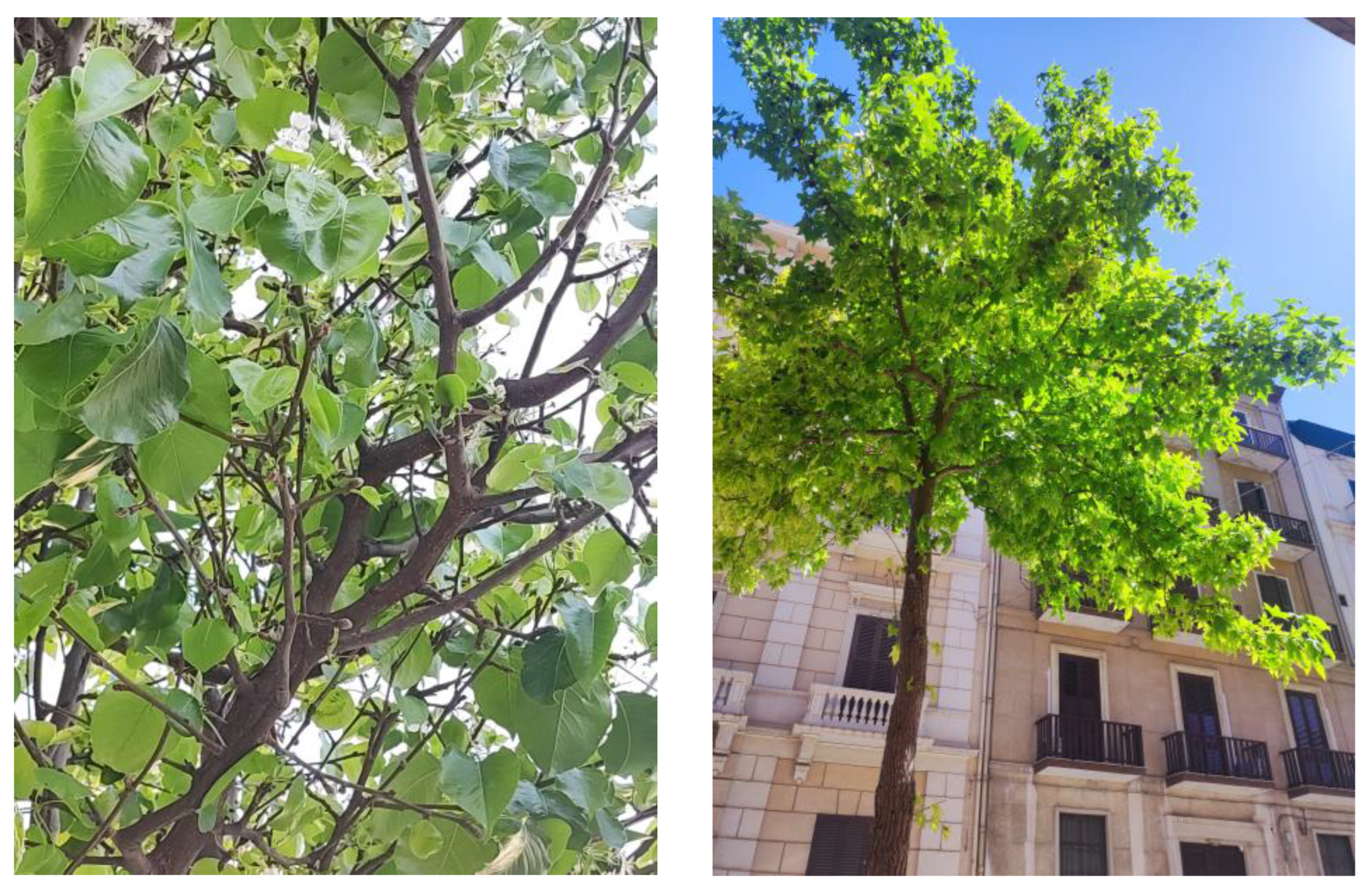
In the cities of Bari and Taranto, among the newly planted species (Figure 6), we found Liquidambar styraciflua L., a medium-to-large tree, which is an excellent choice as it can provide protection from the sun’s rays in summer. Also, from a decorative point of view, it provides distinctive color effects in autumn thanks to the golden-yellow, orange, or red color of its leaves. In addition, it is a fast-growing species that does not require special care. On the contrary, the choice to plant Pyrus calleryana Decne is open to criticism since in Canada it is considered an invasive species, demonstrating the not-always prudent choices made by municipal administrations.
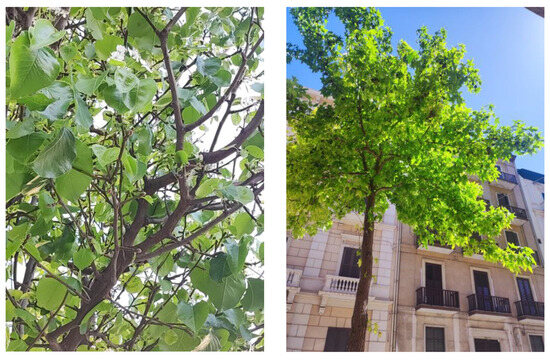
Figure 6.
Pyrus calleryana (left) and Liquidambar styraciflua (right), two species widely used as ornamentals along the streets of Bari and Taranto.
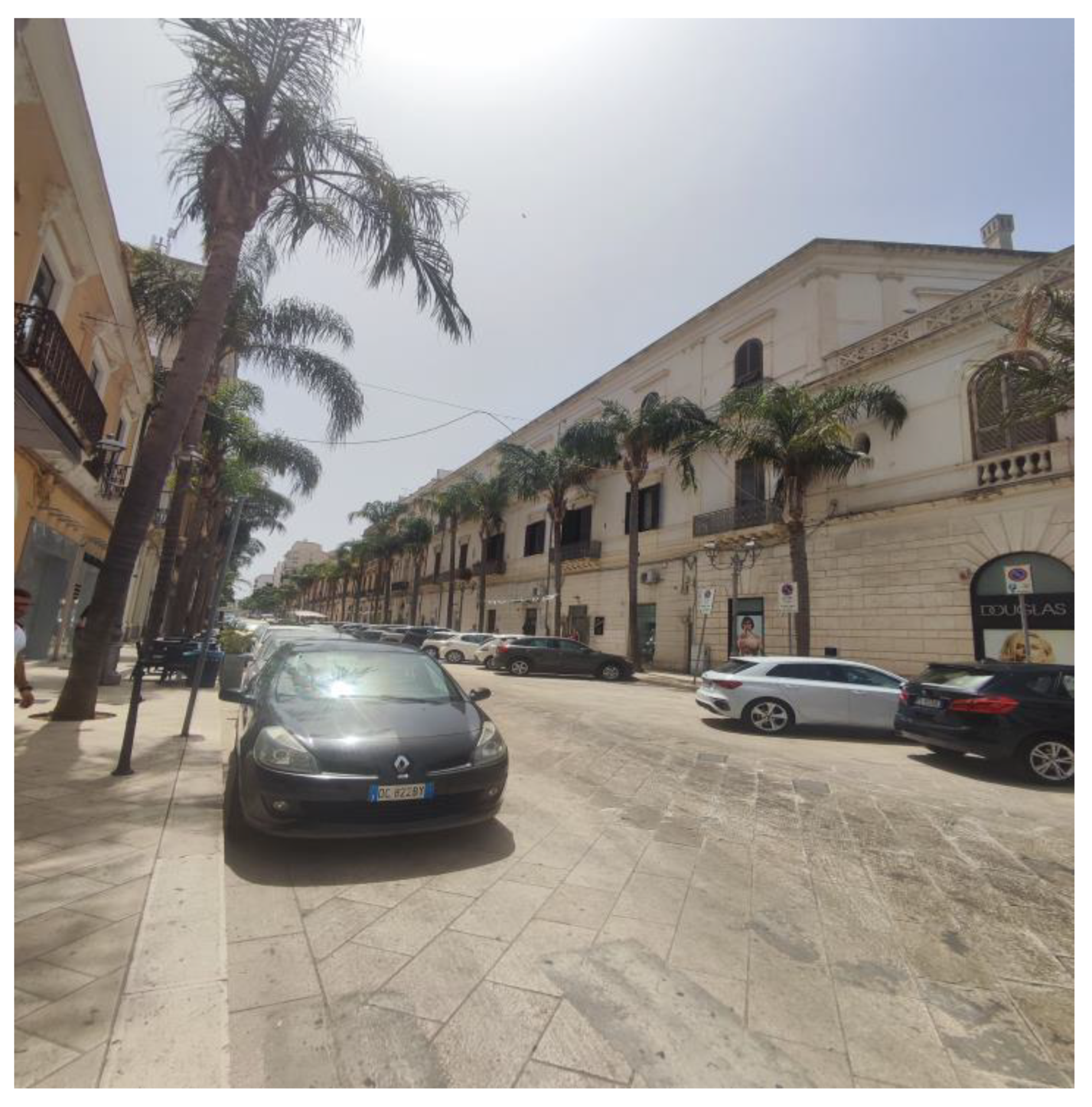
Finally, among the various palms of ornamental use, Syagrus romanzoffiana (Cham.) Glassman is widely used in towns along the Apulian coast, as it is partially resistant to marine aerosols, and particularly in Barletta where it characterizes one of the main streets of the city (Figure 7).
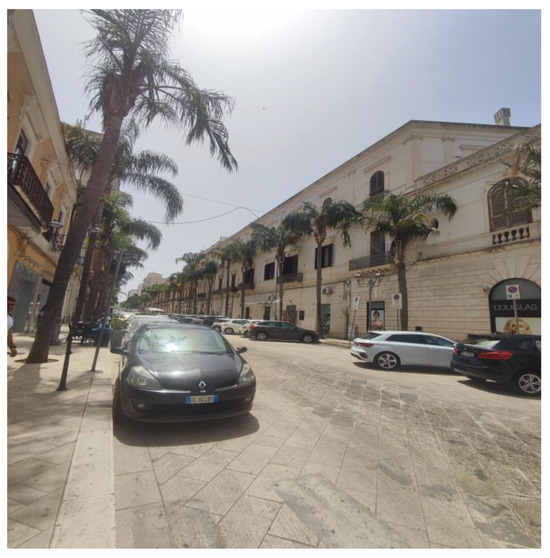
Figure 7.
An unusual row of Syagrus romanzoffiana along the streets of Barletta.
From the comparison made on the Portal to the flora of Italy 2024.2 https://dryades.units.it/floritaly/ (accessed on 15 June 2024) with other Italian regions, the following interesting results emerged: 111 taxa (38.5%) out of 288 taxa surveyed are new to Apulia, meaning by new taxa that those taxa were erroneously reported for Apulia previously but are now confirmed by us or other taxa that have so far escaped reporting because of poor exploration of the Apulian territory or because they have not yet begun the process of spontaneization. Cedrus libani A. Rich, Phoenix dactylifera L., Photinia serratifolia (Desf.) Kalkman cv. Red Robin, Phyllostachys nigra (Lodd. ex Lindl.) Munro, Picea abies (L.) H. Karst., Pinus halepensis Mill. subsp. brutia (Ten.) Holmboe, Platanus ×hispanica Mill. ex Münchh. Portulacaria afra Jacq. Prunus cerasifera Ehrh, and Schinus terebinthifolia Raddi are new reports for Apulia.
Abies alba Mill., Berberis vulgaris L., Crataegus rhipidophylla Gand., Myoporum laetum G. Forst., Platanus orientalis L., Quercus petraea (Matt.) Liebl., and Solanum laciniatum Aiton were indicated as erroneous or doubtful reports for Apulia in the Portal to the flora of Italy 2024.2 and were found by us in Apulian territory. A scattered distribution in Italy is noted for Agave sisalana Perrine (Apulia, Sicily, and Sardinia), Asparagus africanus Lam. (Tuscany and Apulia), Polygala myrtifolia L. (Apulia, Liguria, Sicily, and Sardinia), Quercus trojana Webb and Syagrus romanzoffiana (Cham.) Glassman (Apulia and Basilicata), Prunus webbii (Spach) Vierh (Apulia and Sicily), Vachellia farnesiana (L.) Wight and Arn. (Apulia, Calabria, Sicily, and Sardinia), and Aloe arborescens Mill. and Cestrum parqui (Lam.) L’Her. (distributed only in south Italy).
Viburnum rhytidophyllum Hemsl., previously reported only for northeast Italy, and Pyrus calleryana Decne, so far known only for Emilia-Romagna, represent new reports for Apulia that extend the distribution of these taxa to southern Italy as well.
Finally, it is confirmed that only in Apulia is there the presence of Cereus repandus (L.) Mill. and Cistus ×purpureus Lam.
3. Discussion
More recent botanical studies have neglected the investigation on ornamental plants despite the fact that many plants introduced within Botanical Gardens over the past centuries have subsequently spread throughout the Italian regions such as, for example, Cedrus deodara (Roxb. ex D. Don) G. Don, Chrysojasminum fruticans (L.) Banfi, Citrus reticulata, Eriobotrya japonica (Thunb.) Lindl, and Parthenocissus quinquefolia (L.) Planch, and some others have become spontaneous such as Agave americana L., Robinia pseudoacacia L., and Ailanthus altissima (Mill.) Swingle, coming to characterize the landscape of vast areas of Italian territory.
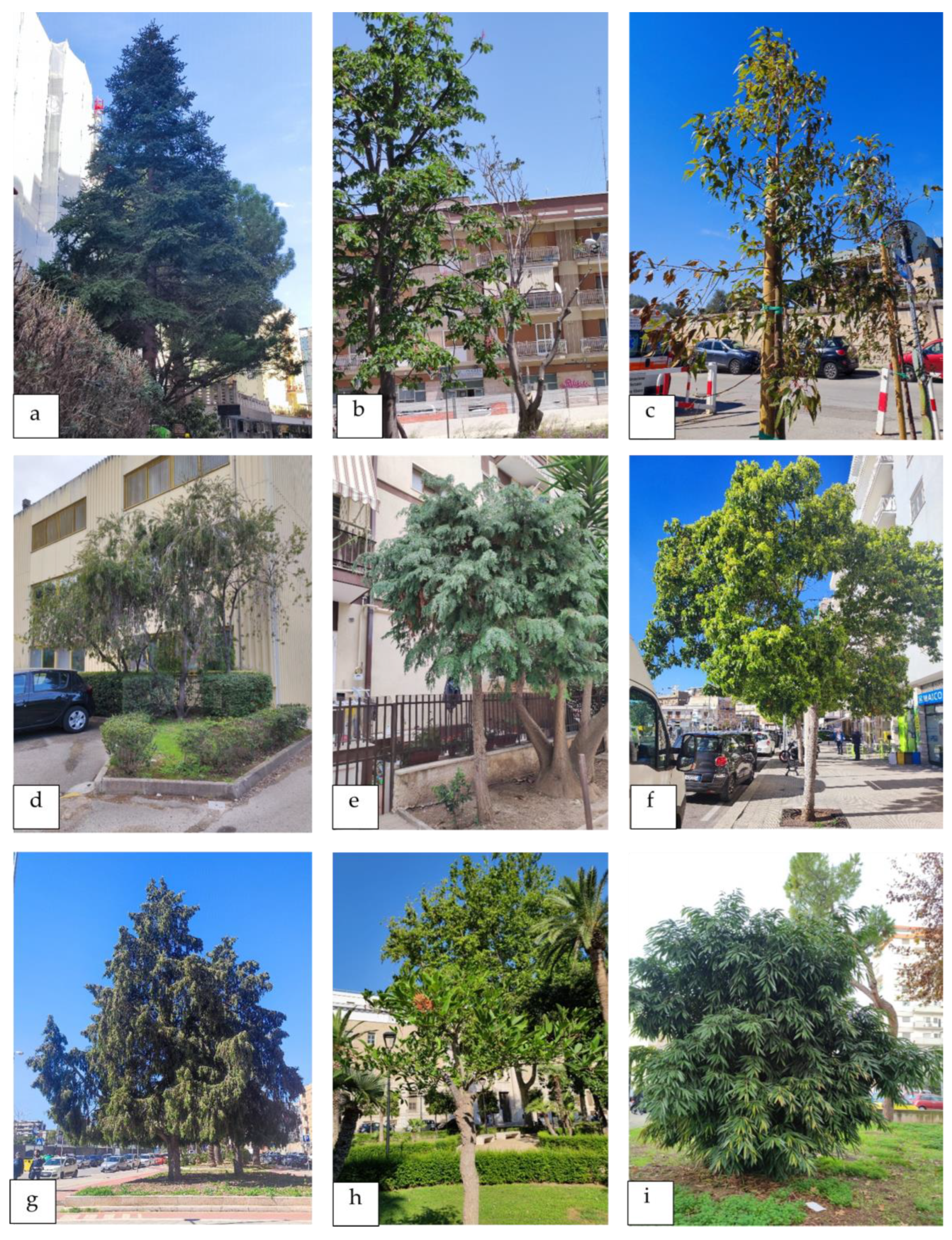
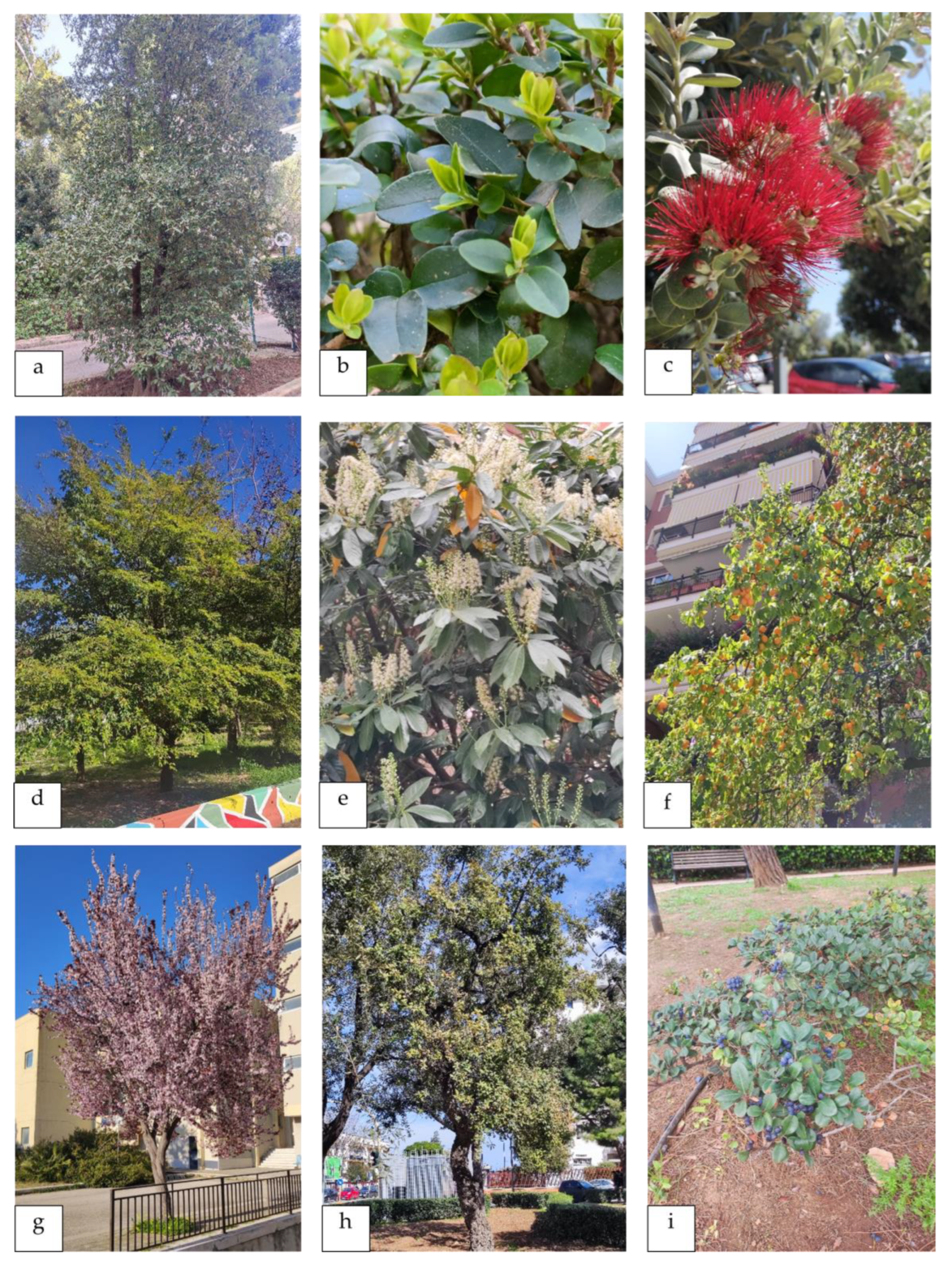
Our study highlights the abundant presence of ornamental plants in comparison with native species (Figure 8 and Figure 9) not only within urban centers but throughout the region of Apulia. The checklist is an unpublished contribution to the knowledge of ornamental plants in an Italian southern region such as Apulia, which, due to its geographical location and land characteristics, hosts a rich contingent of ornamental species from different geographical origins.
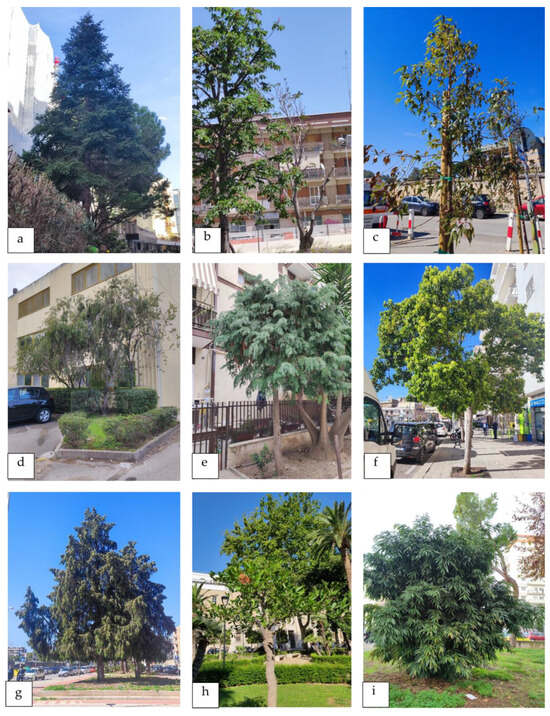
Figure 8.
Ornamental plants surveyed in private gardens, hospitals, and streets of the city of Bari. (a) Abies cephalonica, (b) Aesculus hippocastanum, (c) Brachychiton rupestris, (d) Melaleuca citrina, (e) Chamaecyparis lawsoniana, (f) Camphora officinarum, (g) Cupressus cashmeriana, (h) Erythrina crista-galli, and (i) Ficus maclellandii.
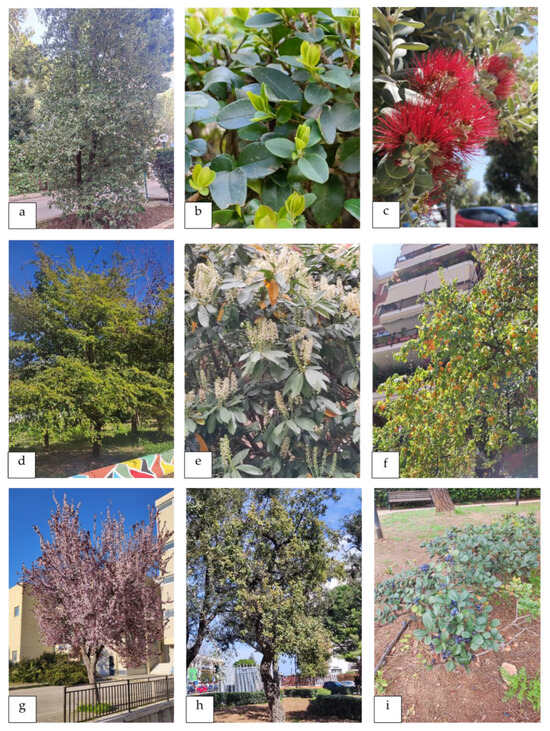
Figure 9.
Ornamental plants surveyed in private gardens, hospitals, and streets of the city of Bari. (a) Lagunaria patersonia, (b) Ligustrum ovalifolium, (c) Metrosideros excelsa, (d) Ulmus parvifolia, (e) Phytolacca dioica, (f) Prunus domestica, (g) Prunus cerasifera subsp. pissardii, (h) Quercus suber, and (i) Rhaphiolepis indica.
The high percentage of alien species (more than 50%) detected among those surveyed is another important finding to assess the role of such species used as ornamentals, especially in cities. In fact, with the funding of the National Recovery and Resilience Plan (NRP), the focus on alien species is back on the agenda, and efforts are being made to raise awareness of the risks of the introduction and spread of invasive alien species in our country with a focus on the most correct practices, both in terms of production and gardening activities, to limit/contain the risk.
Apart from Acacia saligna (Labill.) H.L. Wendl., Ailanthus altissima (Mill.) Swingle, and Robinia pseudoacacia L., by now invasive in most of the Italian territory, among the taxa surveyed in this survey, there are no cases that would let us assume with certainty, to date, the transformation into invasive aliens. Some doubt is actually left by Parkinsonia aculeata L., a species rapidly expanding in the Apulian territory as highlighted by Pardi et al. [20] and is already reported as an invasive alien also in Sicily and Sardinia by the Portal to the flora of Italy.
The checklist of ornamental trees, shrubs, and succulents of Apulia becomes also a useful tool for municipal governments to direct future choices within cities with particular reference to the health of inhabitants. For example, many of the ornamental plants are found near schools and within public gardens frequented by children and the elderly, two of the categories most exposed to the growing problem of allergies.
The most well-known ornamental plants considered as responsible for pollinosis are Cupressus sp. pl., Hesperocyparis sp. pl., Pinus sp. pl., Olea europaea L., Quercus ilex L., and Populus sp. pl., all plants that are widely used within Apulian cities. Also of wide use are some poisonous plants such as Melia azedarach L., Nerium oleander L., Nicotiana glauca Graham, and Thuja occidentalis L., as well as plants causing irritation to the eyes and hands due to the presence of latex in the leaves and stems (Euphorbia sp. pl. and Ficus sp. pl.). In addition, the wide use as ornamental of Brachychiton spp. and Lagunaria patersonia (Andrews) G. Don, due to the presence of stinging hairs inside the fruits, exposes citizens to damage on the mucous membranes of the eyes and mouth.
For what has been stated above, we can say that in most cases the choices made by the Administrations in term of ornamental plants are dictated by the aesthetics of the plants and the availability of them in nurseries rather than by a careful evaluation carried out with the professional support of botanists.
4. Materials and Methods
Periodic observations on the presence of ornamental trees, shrubs, and succulents in street trees, parks, and private and historic gardens of the six provinces of Apulia region, i.e., Bari, Barletta-Andria-Trani, Brindisi, Foggia, Lecce, and Taranto, have been carried out. Each province was visited twice in spring and autumn between 2021 and 2024. The names of the plants are listed alphabetically, and the presence within the province is indicated with an asterisk. The checklist comprises also hybrids and cultivars. The binomials and trinomials follow the database Plants of the World Online (https://powo.science.kew.org/) of the Kew Royal Botanical Gardens. The occurrence status of each taxon refers to Galasso et al. [17]. Recorded taxa are arranged in Appendix A Table A1 which comprises the binomial and trinomial, the family to which it belongs, and the presence/absence in the investigated provinces indicated, respectively, with an asterisk (★) and with a hyphen (-). An additional Appendix A Table A2 is present in which each census taxon is matched with its geographic origin, biological form, and alien or native species status. All of this information was obtained from the database Plants of the World Online (https://powo.science.kew.org/) of the Kew Royal Botanical Gardens. In Appendix A Table A1, in addition to species in sensu strictu, the forms, varieties, hybrids, and cultivars are included. Among the latter, as highlighted in Appendix A Table A2, artificial hybrids are also indicated as AH. The Portal to the flora of Italy 2024.2 https://dryades.units.it/floritaly/ (accessed on 15 June 2024) was used to compare the occurrence of the taxa we surveyed with other Italian regions. Taxa that are either new to Apulia in the above-mentioned Portal or erroneously reported for Apulia previously but confirmed by us, and other taxa that have so far escaped reporting due to the scarce exploration of the Apulian territory, or because they have not yet begun the process of spontaneization, have thus been marked with the symbol (●) in Appendix A Table A1.
5. Conclusions
In conclusion, our study makes a relevant contribution to the advancement of botanical studies in the Apulia region, being the first census on ornamental species. Even at the national level, such a type of census is so far very limited The data reported in this study are useful in noting the high rate of alien species in the Apulian territory resulting from often illogical choices made by municipal administrations that, without taking into account the possible problems related to biological invasions and the health of the most fragile citizens such as children and the elderly, leveraging only the material readily available in regional and extra-regional nurseries, they introduce species of all types and origins without consulting botanical experts. Our hope is that this census can be a useful basis for discussion with local authorities for a future public green policy based on rational choices also shared by citizens.
Author Contributions
Conceptualization, G.V. and M.L.G.; Data curation, G.V., E.D.G., R.P., F.C. and M.L.G.; Formal analysis, R.P. and F.C.; Investigation, G.V., E.D.G., R.P., F.C. and M.L.G.; Methodology, G.V., E.D.G. and M.L.G.; Project administration, G.V.; Resources, G.V.; Software, R.P. and F.C.; Supervision, G.V.; Validation, G.V. and M.L.G.; Visualization, M.L.G.; Writing—original draft, G.V. and M.L.G.; Writing—review and editing, G.V., E.D.G., R.P., F.C. and M.L.G. All authors have read and agreed to the published version of the manuscript.
Funding
Project funded under the National Recovery and Resilience Plan (NRRP), Mission 4, Component 2, Investment 1.4-Call for tender Number 3138 of 16 December 2021, rectified by Decree n. 3175 of 18 December 2021 of the Italian Ministry of University and Research funded by the European Union—NextGenerationEU Project Code CN_00000033, Concession Decree Number 1034 of 17 June 2022 adopted by the Italian Ministry of University and Research, CUP B73C22000790001, Project Title “National Biodiversity Future Center-NBFC”. This study was carried out also under Action IV.6 “Research Contracts on GREEN Themes”, Ministerial Decree 1062/2021 and Ministerial Decree 10 August 2021, Number 1061, PON “Research and Innovation”, Resources 2014–2020.
Data Availability Statement
The data that support the findings of this study are available upon request from the corresponding author.
Conflicts of Interest
The authors declare no conflicts of interest.
Appendix A

Table A1.
List of ornamental plants in the six provinces of Apulia. BA = Bari; BAT = Barletta-Andria-Trani; BR = Brindisi; FG = Foggia; LE = Lecce; TA = Taranto. The presence/absence in the investigated provinces is indicated, respectively, with an asterisk (★) and with a hyphen (-). The symbol (●) is used to denote taxa that are either new to Apulia or erroneously reported for Apulia previously but confirmed by us and other taxa that have so far escaped reporting due to the scarce exploration of the Apulian territory or because they have not yet begun the process of spontaneization.
Table A1.
List of ornamental plants in the six provinces of Apulia. BA = Bari; BAT = Barletta-Andria-Trani; BR = Brindisi; FG = Foggia; LE = Lecce; TA = Taranto. The presence/absence in the investigated provinces is indicated, respectively, with an asterisk (★) and with a hyphen (-). The symbol (●) is used to denote taxa that are either new to Apulia or erroneously reported for Apulia previously but confirmed by us and other taxa that have so far escaped reporting due to the scarce exploration of the Apulian territory or because they have not yet begun the process of spontaneization.
| Taxa | Families | BA | BAT | BR | FG | LE | TA |
|---|---|---|---|---|---|---|---|
| Abies alba Mill. | Pinaceae | ★ | - | - | ★ | - | - |
| (●) Abies cephalonica Loudon | Pinaceae | ★ | - | ★ | - | - | - |
| Acacia dealbata Link | Fabaceae | ★ | ★ | ★ | ★ | ★ | ★ |
| Acacia saligna (Labill.) H.L. Wendl. | Fabaceae | ★ | ★ | ★ | ★ | ★ | ★ |
| Acer campestre L. | Sapindaceae | ★ | - | - | ★ | - | - |
| Acer negundo L. | Sapindaceae | ★ | - | - | ★ | - | ★ |
| Aesculus hippocastanum L. | Sapindaceae | ★ | - | - | ★ | - | ★ |
| (●) Agapanthus africanus (L.) Hoffmanns | Amaryllidaceae | ★ | ★ | ★ | ★ | ★ | ★ |
| Agave americana L. | Asparagaceae | ★ | ★ | ★ | ★ | ★ | ★ |
| (●) Agave americana L. f. marginata | Asparagaceae | ★ | ★ | ★ | ★ | ★ | ★ |
| Agave sisalana Perrine | Asparagaceae | ★ | - | - | - | - | - |
| Ailanthus altissima (Mill.) Swingle | Simaroubaceae | ★ | ★ | ★ | ★ | ★ | ★ |
| (●) Allocasuarina torulosa (Aiton) L.A.S. Johnson | Casuarinaceae | ★ | ★ | ★ | ★ | ★ | ★ |
| (●) Alocasia macrorrhizos (L.) G. Don | Araceae | ★ | - | - | - | - | - |
| Aloe arborescens Mill. | Asphodelaceae | ★ | ★ | ★ | ★ | ★ | ★ |
| (●) Aloe vera (L.) Burm. f. | Asphodelaceae | ★ | ★ | ★ | ★ | ★ | - |
| (●) Annona cherimola Mill. | Annonaceae | ★ | - | - | - | - | - |
| Anthyllis barba-jovis L. | Fabaceae | ★ | - | - | - | - | - |
| (●) Araucaria columnaris (G. Forst.) Hook. | Araucariaceae | ★ | - | - | - | - | - |
| (●) Araucaria heterophylla (Salisb.) Franco | Araucariaceae | ★ | ★ | ★ | ★ | ★ | ★ |
| Arbutus unedo L. | Ericaceae | ★ | ★ | ★ | ★ | ★ | ★ |
| Asparagus acutifolius L. | Asparagaceae | ★ | - | - | - | - | - |
| Asparagus aethiopicus L. | Asparagaceae | ★ | - | - | - | - | - |
| Asparagus africanus Lam. | Asparagaceae | ★ | - | - | - | - | - |
| (●) Asparagus asparagoides (L.) Druce | Asparagaceae | ★ | - | - | - | - | - |
| (●) Asparagus densiflorus (Kunth) Jessop | Asparagaceae | ★ | ★ | ★ | ★ | ★ | ★ |
| Atriplex halimus L. | Amaranthaceae | ★ | ★ | ★ | ★ | ★ | ★ |
| Austrocylindropuntia subulata (Muehlenpf.) Backeb | Cactaceae | - | ★ | - | ★ | - | - |
| (●) Bambusa vulgaris Schrad. ex J.C. Wendl. | Poaceae | ★ | ★ | ★ | ★ | ★ | ★ |
| (●) Bauhinia variegata L. var. candida Voigt | Fabaceae | ★ | - | - | - | - | - |
| Berberis aquifolium Pursh | Berberidaceae | ★ | - | - | - | - | - |
| (●) Berberis thunbergii DC. f. atropurpuea | Berberidaceae | ★ | - | - | ★ | - | ★ |
| Berberis vulgaris L. | Berberidaceae | ★ | - | - | - | - | - |
| (●) Bougainvillea glabra Choisy | Nyctaginaceae | ★ | ★ | ★ | ★ | ★ | ★ |
| (●) Bougainvillea spectabilis Willd. | Nyctaginaceae | ★ | ★ | ★ | ★ | ★ | ★ |
| (●) Brachychiton acerifolius (A.Cunn. ex G. Don) F. Muell. | Malvaceae | - | - | - | - | ★ | - |
| (●) Brachychiton discolor F. Muell. | Malvaceae | ★ | - | - | - | - | - |
| (●) Brachychiton diversifolius R. Br. | Malvaceae | ★ | - | - | - | - | - |
| (●) Brachychiton rupestris (T. Mitch. ex Lindl.) K. Schum. | Malvaceae | ★ | - | - | - | ★ | - |
| (●) Brahea armata S. Watson | Arecaceae | ★ | - | - | - | - | - |
| Broussonetia papyrifera (L.) L’Her. ex Vent. | Moraceae | ★ | - | - | - | ★ | - |
| (●) Brugmansia arborea (L.) Sweet. | Solanaceae | ★ | ★ | ★ | - | ★ | ★ |
| Butia capitata (Mart.) Becc | Arecaceae | ★ | - | ★ | - | - | ★ |
| Buxus sempervirens L. | Buxaceae | ★ | ★ | ★ | ★ | ★ | ★ |
| (●) Calocedrus decurrens (Torr.) Florin f. aureovariegata | Cupressaceae | ★ | - | - | - | - | - |
| (●) Camphora officinarum Boerh. ex Fabr. | Lauraceae | ★ | ★ | - | - | ★ | - |
| Campsis radicans (L.) Bureau. | Bignoniaceae | ★ | ★ | ★ | ★ | ★ | ★ |
| Capparis spinosa Desf. var. ovata (Desf.) Sm. | Capparaceae | ★ | ★ | ★ | ★ | ★ | ★ |
| Carpinus orientalis Mill. | Betulaceae | ★ | - | - | ★ | - | - |
| (●) Carissa macrocarpa (Eckl.) A. DC. | Apocynaceae | ★ | ★ | ★ | ★ | ★ | ★ |
| (●) Caryota urens L. | Arecaceae | ★ | - | - | - | ★ | - |
| Casuarina equisetifolia L. | Casuarinaceae | ★ | ★ | ★ | ★ | ★ | ★ |
| (●) Catalpa bignonioides Walter | Bignoniaceae | ★ | ★ | ★ | - | ★ | - |
| Cedrus atlantica (Endl.) Manetti ex Carrière | Pinaceae | ★ | ★ | ★ | ★ | ★ | ★ |
| (●) Cedrus deodara (Roxb. ex D. Don) G. Don | Pinaceae | ★ | ★ | ★ | ★ | ★ | ★ |
| Cedrus libani A. Rich. | Pinaceae | ★ | - | - | ★ | ★ | - |
| (●) Ceiba speciosa (A. St.-Hil., A. Juss. and Cambess.) Ravenna | Malvaceae | ★ | - | ★ | - | ★ | - |
| Celtis australis L. | Cannabaceae | ★ | ★ | ★ | ★ | ★ | ★ |
| (●) Celtis occidentalis L. | Cannabaceae | - | - | - | - | - | ★ |
| Ceratonia siliqua L. | Fabaceae | ★ | ★ | ★ | ★ | ★ | ★ |
| Cercis siliquastrum L. | Fabaceae | ★ | ★ | ★ | ★ | ★ | ★ |
| Cereus repandus (L.) Mill. | Cactaceae | ★ | - | - | - | - | - |
| Cestrum parqui (Lam.) L’Her. | Solanaceae | ★ | - | - | - | ★ | - |
| (●) Chamaecyparis lawsoniana (A. Murray bis) Parl. | Cupressaceae | ★ | - | - | - | - | - |
| Chamaerops humilis L. | Arecaceae | ★ | ★ | ★ | ★ | ★ | ★ |
| (●) Chrysojasminum fruticans (L.) Banfi | Oleaceae | ★ | - | - | - | - | - |
| Cistus × purpureus Lam. | Cistaceae | ★ | - | - | - | - | - |
| Citrus × limon (L.) Osbeck | Rutaceae | ★ | ★ | ★ | ★ | ★ | ★ |
| (●) Citrus polytrifolia Govaerts | Rutaceae | ★ | - | - | - | - | - |
| (●) Citrus reticulata Blanco | Rutaceae | ★ | - | - | ★ | - | - |
| (●) Citrus ×sinensis (L.) Osbeck | Rutaceae | ★ | - | - | - | - | - |
| (●) Cordyline australis (G. Forst.) Endl. | Asparagaceae | ★ | ★ | ★ | ★ | ★ | ★ |
| Cornus sanguinea L. | Cornaceae | ★ | - | - | - | - | - |
| Cortaderia selloana (Schult. and Schult. f.) Asch. and Graebn. | Poaceae | ★ | ★ | ★ | - | ★ | - |
| Corylus avellana L. | Betulaceae | ★ | - | - | - | - | - |
| (●) Cotoneaster divaricatus Rehder and E.H. Wilson | Rosaceae | ★ | - | - | ★ | - | - |
| Crataegus rhipidophylla Gand. | Rosaceae | ★ | - | - | - | - | - |
| (●) Cupressus cashmeriana Royle ex Carriere | Cupressaceae | ★ | - | - | - | - | - |
| Cupressus sempervirens L. var. horizontalis (Mill.) Loudon | Cupressaceae | ★ | - | - | ★ | ★ | ★ |
| Cupressus sempervirens L. | Cupressaceae | ★ | ★ | ★ | ★ | ★ | ★ |
| (●) Cycas revoluta Thunb. | Cycadaceae | ★ | ★ | ★ | ★ | ★ | ★ |
| Cydonia oblonga Mill. | Rosaceae | ★ | - | - | - | - | - |
| (●) Cyperus papyrus L. | Cyperaceae | ★ | ★ | ★ | ★ | ★ | ★ |
| (●) Dasylirion serratifolium (Karw. ex Schult. and Schult. f.) Zucc. | Asparagaceae | - | ★ | - | - | - | - |
| Dendropanax arboreus (L.) Decne and Planch. f. variegata | Araliaceae | ★ | ★ | ★ | - | ★ | - |
| (●) Deutzia gracilis Siebold and Zucc. | Hydrangeaceae | ★ | - | - | - | - | - |
| (●) Deutzia scabra Thunb. | Hydrangeaceae | ★ | - | - | - | - | - |
| (●) Dolichandra unguis-cati (L.) L.G. Lohmann | Bignoniaceae | ★ | - | ★ | - | ★ | - |
| Duranta erecta L. | Verbenaceae | ★ | |||||
| (●) Elaeagnus × ebbingei J. Door. | Elaeagnaceae | ★ | ★ | ★ | ★ | ★ | ★ |
| (●) Elaeagnus × submacrophylla Servett. | Elaeagnaceae | ★ | ★ | ★ | ★ | ★ | ★ |
| Eriobotrya japonica (Thunb.) Lindl. | Rosaceae | ★ | ★ | ★ | ★ | ★ | ★ |
| (●)Erythrina crista-galli L. | Fabaceae | ★ | - | - | - | - | - |
| Erythrina herbacea L. | Fabaceae | - | - | - | - | - | ★ |
| Erythrostemon gilliesii (Hook.) Klotzsch | Fabaceae | ★ | - | - | ★ | - | - |
| Eucalyptus camaldulensis Dehnh. | Myrtaceae | ★ | ★ | ★ | ★ | ★ | ★ |
| Eugenia uniflora L. | Myrtaceae | ★ | ★ | ★ | - | ★ | - |
| Euonymus japonicus Thunb. | Celastraceae | ★ | ★ | ★ | ★ | ★ | ★ |
| (●) Euonymus japonicus Thunb. f. aureo-variegatus | Celastraceae | ★ | ★ | ★ | ★ | ★ | - |
| (●) Euonymus pulchellus Jacob-Makoj | Celastraceae | ★ | - | - | - | - | - |
| Euphorbia dendroides L. | Euphorbiaceae | ★ | - | - | - | - | - |
| Euphorbia ingens E. May. ex Boiss. | Euphorbiaceae | ★ | - | - | - | - | - |
| (●) Euphorbia murielii N.E.Br. | Euphorbiaceae | - | - | - | - | - | ★ |
| Euphorbia tirucalli L. | Euphorbiaceae | - | - | - | - | ★ | - |
| (●) Euryops pectinatus (L.) Cass. | Asteraceae | ★ | - | - | - | - | - |
| Fallopia baldeschuanica (Regel) Holub | Polygonaceae | ★ | - | - | ★ | - | - |
| (●) Feijoa sellowiana (O. Berg) O. Berg. | Myrtaceae | ★ | - | - | - | ★ | - |
| Ficus carica L. | Moraceae | ★ | ★ | ★ | ★ | ★ | ★ |
| (●) Ficus elastica Roxb. ex Hornem. | Moraceae | ★ | - | - | - | ★ | - |
| (●) Ficus elastica Hornem. var. decora Guillaumin | Moraceae | ★ | ★ | ★ | - | - | - |
| Ficus maclellandii King | Moraceae | ★ | - | - | - | - | - |
| (●) Ficus rubiginosa Desf. | Moraceae | ★ | - | - | - | - | - |
| (●) Firmiana simplex (L.) W. Wight | Malvaceae | ★ | - | - | - | - | - |
| (●) Fraxinus angustifolia subsp. oxycarpa (M. Bieb. ex Willd.) Franco and Rocha Afonso | Oleaceae | ★ | - | - | ★ | - | - |
| Fraxinus excelsior L. | Oleaceae | ★ | - | - | ★ | - | - |
| Fraxinus ornus L. | Oleaceae | ★ | - | - | ★ | - | ★ |
| (●) Furcraea selloana K. Koch | Asparagaceae | - | - | ★ | - | - | - |
| (●) Ginkgo biloba L. | Ginkgoaceae | ★ | - | - | ★ | - | ★ |
| Gleditsia triacanthos L. | Fabaceae | ★ | - | - | - | - | - |
| (●) Grevillea robusta A. Cunn. ex R. Br. | Proteaceae | ★ | - | ★ | - | ★ | - |
| Hedera helix L. | Araliaceae | ★ | ★ | ★ | ★ | ★ | ★ |
| Hedera canariensis Willd. | Araliaceae | ★ | ★ | ★ | ★ | ★ | ★ |
| Hesperocyparis harizonica (Greene) Bartel | Cupressaceae | ★ | ★ | ★ | ★ | ★ | ★ |
| (●) Hesperocyparis macrocarpa (Hartw.) Bartel. | Cupressaceae | ★ | ★ | ★ | ★ | ★ | ★ |
| (●)×Hesperotropsis leylandii (A.B. Jachs- and Dallim.) Garl. and Jerry Moore | Cupressaceae | ★ | ★ | ★ | ★ | ★ | ★ |
| (●) Hibiscus moscheutos L. | Malvaceae | - | - | - | - | - | ★ |
| (●) Hibiscus × rosa-sinensis L. | Malvaceae | ★ | ★ | ★ | - | ★ | - |
| Hibiscus syriacus L. | Malvaceae | ★ | ★ | ★ | ★ | - | ★ |
| Ilex aquifolium L. | Aquifoliaceae | ★ | - | - | ★ | - | - |
| (●) Jacaranda mimosifolia D. Don | Bignoniaceae | ★ | ★ | ★ | ★ | ★ | ★ |
| Jacobaea maritima (L.) Pelser and Meijden | Asteraceae | ★ | ★ | ★ | ★ | ★ | ★ |
| (●) Jasminum officinale L. | Oleaceae | ★ | - | - | - | - | - |
| (●) Jasminum polyanthum Franch. | Oleaceae | ★ | ★ | ★ | ★ | ★ | ★ |
| Juglans regia L. | Juglandaceae | ★ | ★ | ★ | ★ | ★ | ★ |
| Juniperus chinensis L. f. Pfitzeriana Glauca | Cupressaceae | ★ | ★ | ★ | ★ | ★ | ★ |
| Juniperus horizontalis Moench | Cupressaceae | ★ | ★ | - | ★ | ★ | ★ |
| Juniperus oxycedrus L. | Cupressaceae | ★ | - | - | - | - | - |
| (●) Justicia adhatoda L. | Acanthaceae | ★ | - | - | - | - | - |
| Koelreuteria paniculata Laxm. | Sapindaceae | ★ | - | ★ | - | ★ | - |
| (●) Lagerstroemia indica L. | Lythraceae | ★ | ★ | ★ | ★ | ★ | ★ |
| (●) Lagunaria patersonia (Andrews) G .Don | Malvaceae | ★ | - | - | - | - | ★ |
| Lantana camara L. | Verbenaceae | ★ | ★ | ★ | ★ | ★ | ★ |
| (●) Lantana montevidensis (Spreng.) Brig. | Verbenaceae | ★ | ★ | ★ | - | ★ | - |
| Laurus nobilis L. | Lauraceae | ★ | ★ | ★ | ★ | ★ | ★ |
| Lavandula angustifolia Mill. | Lamiaceae | ★ | ★ | - | - | - | - |
| Ligustrum japonicum Thunb. | Oleaceae | ★ | ★ | ★ | ★ | ★ | ★ |
| Ligustrum japonicum Thunb. f. aureo-variegatum | Oleaceae | ★ | - | ★ | ★ | ★ | ★ |
| Ligustrum lucidum W.T. Aiton | Oleaceae | ★ | ★ | ★ | ★ | ★ | ★ |
| Ligustrum ovalifolium Hassk. | Oleaceae | ★ | - | - | - | - | - |
| (●) Ligustrum sinense Lour. | Oleaceae | ★ | - | - | - | - | - |
| (●) Liquidambar styraciflua L. | Altingiaceae | ★ | - | - | - | - | ★ |
| (●) Livistona chinensis (Jacq.) R. Br. Ex Mart.. | Arecaceae | ★ | - | - | - | - | - |
| Lonicera caprifolium L. | Caprifoliaceae | ★ | |||||
| (●) Loropetalum chinense (R. Br) Oliv. f. rubrum H.T. Chang | Hamamelidaceae | ★ | - | - | ★ | - | - |
| (●) Magnolia grandiflora L. | Magnoliaceae | ★ | ★ | ★ | ★ | ★ | ★ |
| (●) Mandevilla laxa (Ruiz and Pav.) Woodson | Apocynaceae | - | - | - | - | - | ★ |
| (●) Melaleuca citrina (Curtis) Dum. Cours. | Myrtaceae | ★ | ★ | ★ | ★ | ★ | ★ |
| Melia azedarach L. | Meliaceae | ★ | ★ | ★ | ★ | ★ | ★ |
| (●) Metrosideros excelsa Sol. ex Gaertn. | Myrtaceae | ★ | ★ | ★ | ★ | ★ | ★ |
| (●) Morus alba L. f. pendula | Moraceae | ★ | ★ | ★ | ★ | ★ | ★ |
| (●) Murraya paniculata (L.) Jack | Rutaceae | ★ | - | - | - | - | - |
| (●) Musa × paradisiaca L. | Musaceae | ★ | - | - | ★ | - | ★ |
| Myoporum laetum G. Forst. | Scrophulariaceae | - | - | - | - | - | ★ |
| Myrtus communis L. | Myrtaceae | ★ | ★ | ★ | ★ | ★ | ★ |
| Myrtus communis L. f. Tarentina | Myrtaceae | ★ | - | - | - | ★ | - |
| Nandina domestica Thunb. | Berberidaceae | ★ | ★ | ★ | ★ | ★ | ★ |
| Nerium oleander L. | Apocynaceae | ★ | ★ | ★ | ★ | ★ | ★ |
| Nicotiana glauca Graham. | Solanaceae | - | - | - | - | - | ★ |
| Oenothera lindheimeri (Engelm. and A. Gray) W.L. Wagner and Hook | Onagraceaea | ★ | - | - | - | - | - |
| Olea europaea L. | Oleaceae | ★ | ★ | ★ | ★ | ★ | ★ |
| Opuntia ficus-indica (L.) Mill. | Cactaceae | ★ | ★ | ★ | ★ | ★ | ★ |
| (●) Osmanthus xburkwoodii (Burkwood and Skipwith) P.S. Green | Oleaceae | ★ | - | - | - | - | - |
| Ostrya carpinifolia Scop. | Betulaceae | ★ | - | - | ★ | - | - |
| (●) Paeonia × suffruticosa Andrews | Paeoniaceae | ★ | - | - | - | - | - |
| Parkinsonia aculeata L. | Fabaceae | ★ | - | - | - | - | - |
| Parthenocissus tricuspidata (Siebold and Zucc.) Planch. | Vitaceae | ★ | - | - | - | - | - |
| Parthenocissus quinquefolia (L.) Planch. | Vitaceae | - | ★ | ★ | ★ | ★ | ★ |
| Passiflora caerulea L. | Passifloraceae | ★ | ★ | ★ | ★ | ★ | ★ |
| (●) Persea americana Mill. | Lauraceae | ★ | - | - | - | - | - |
| (●) Persea indica (L.) Spreng. | Lauraceae | ★ | - | - | - | - | - |
| Petunia × atkinsiana (Sweet) D. Don ex W.H. Baxter | Solanaceae | ★ | ★ | ★ | ★ | ★ | ★ |
| Philadelphus inodorus L. | Hydrangeaceae | ★ | ★ | ★ | ★ | ★ | ★ |
| Phlomis fruticosa L. | Lamiaceae | ★ | - | - | - | - | - |
| (●) Phlomis purpurea L. | Lamiaceae | ★ | - | - | - | - | - |
| Phlomis viscosa Poir. | Lamiaceae | ★ | - | - | - | - | - |
| Phoenix canariensis H. Wildpret | Arecaceae | ★ | ★ | ★ | ★ | ★ | ★ |
| Phoenix dactylifera L. | Arecaceae | ★ | ★ | ★ | ★ | ★ | ★ |
| Photinia serratifolia (Desf.) Kalkman cv. Red Robin | Rosaceae | ★ | ★ | ★ | ★ | ★ | ★ |
| Phyllostachys aurea (Andrè) Rivière and C. Rivière | Poaceae | ★ | - | - | - | - | - |
| Phyllostachys nigra (Lodd. ex Lindl.) Munro | Poaceae | ★ | ★ | ★ | - | ★ | - |
| Phytolacca dioica L. | Phytolaccaceae | ★ | ★ | ★ | ★ | ★ | ★ |
| Picea abies (L.) H. Karst. | Pinaceae | ★ | - | - | ★ | - | - |
| (●) Picea pungens Engelm. Cv. Kosteriana | Pinaceae | ★ | - | - | ★ | - | - |
| Pinus canariensis C. Sm. ex DC. | Pinaceae | ★ | ★ | ★ | - | ★ | - |
| Pinus halepensis Mill. subsp. brutia (Ten.) Holmboe | Pinaceae | ★ | - | - | - | - | - |
| Pinus halepensis Mill. | Pinaceae | ★ | ★ | ★ | ★ | ★ | ★ |
| Pinus nigra J. F. Arnold | Pinaceae | ★ | - | - | - | - | ★ |
| Pinus pinea L. | Pinaceae | ★ | ★ | ★ | ★ | ★ | ★ |
| Pinus pinaster Aiton | Pinaceae | ★ | ★ | - | - | - | - |
| Pistacia lentiscus L. | Anacardiaceae | ★ | ★ | ★ | - | ★ | - |
| Pistacia terebinthus L. | Anacardiaceae | ★ | ★ | ★ | - | ★ | - |
| Pittosporum tobira (Thunb.) W.T. Aiton | Pittosporaceae | ★ | ★ | ★ | ★ | ★ | ★ |
| Pittosporum tobira (Thunb.) W.T. Aiton f. nanum | Pittosporaceae | ★ | - | - | - | - | - |
| Platanus × hispanica Mill. ex Münchh. | Platanaceae | ★ | ★ | ★ | ★ | ★ | ★ |
| Platanus orientalis L. | Platanaceae | ★ | - | - | - | - | ★ |
| Platycladus orientalis (L.) Franco | Cupressaceae | ★ | ★ | ★ | ★ | ★ | ★ |
| Plumbago auriculata Lam. | Plumbaginaceae | ★ | ★ | ★ | ★ | ★ | ★ |
| Polygala myrtifolia L. | Polygalaceae | ★ | ★ | ★ | ★ | ★ | ★ |
| Populus alba L. | Salicaceae | ★ | ★ | ★ | ★ | ★ | - |
| Populus nigra L. | Salicaceae | ★ | ★ | ★ | ★ | ★ | ★ |
| Portulacaria afra Jacq. | Didiereaceae | ★ | ★ | ★ | - | ★ | - |
| Prunus cerasifera Ehrh. | Rosaceae | ★ | - | - | - | - | - |
| (●) Prunus cerasifera subsp. pissardii (Carrière) Dostál | Rosaceae | ★ | ★ | ★ | ★ | ★ | ★ |
| Prunus domestica L. | Rosaceae | ★ | - | - | - | - | ★ |
| Prunus dulcis (Mill.) D.A. Webb | Rosaceae | ★ | - | - | - | - | - |
| Prunus laurocerasus L. | Rosaceae | ★ | ★ | ★ | ★ | ★ | ★ |
| Prunus mahaleb L. | Rosaceae | ★ | - | - | - | - | - |
| Prunus webbii (Spach) Vierh. | Rosaceae | ★ | - | - | - | - | - |
| (●) Pterocarya fraxinifolia (Poir.) Spach | Juglandaceae | ★ | - | - | - | - | - |
| Punica granatum L. | Lythraceae | ★ | ★ | ★ | ★ | ★ | ★ |
| Pyracantha coccinea M. Roem. | Rosaceae | ★ | ★ | ★ | ★ | ★ | ★ |
| (●) Pyrus calleryana Decne. | Rosaceae | ★ | - | - | - | - | ★ |
| Pyrus spinosa Forssk. | Rosaceae | ★ | - | - | - | - | - |
| Quercus cerris L. | Fagaceae | ★ | - | - | - | - | - |
| Quercus ilex L. | Fagaceae | ★ | ★ | ★ | ★ | ★ | ★ |
| Quercus ithaburensis subsp. macrolepis (Kotschy) Hedge and Yalt. | Fagaceae | ★ | - | ★ | - | ★ | - |
| Quercus petraea (Matt.) Liebl. | Fagaceae | ★ | - | - | - | - | - |
| Quercus pubescens Willd. | Fagaceae | ★ | - | - | ★ | - | - |
| Quercus robur L. | Fagaceae | ★ | - | - | - | - | - |
| Quercus suber L. | Fagaceae | ★ | - | - | - | - | - |
| Quercus trojana Webb | Fagaceae | ★ | - | - | - | - | - |
| Rhamnus alaternus L. | Rhamnaceae | ★ | ★ | ★ | - | ★ | - |
| (●) Rhaphiolepis indica (L.) Lindl. | Rosaceae | ★ | - | - | - | - | - |
| (●) Rhododendron ferrugineum L. | Ericaceae | ★ | - | - | - | - | - |
| Robinia pseudoacacia L. | Fabaceae | ★ | ★ | ★ | ★ | ★ | ★ |
| Rosa canina L. | Rosaceae | ★ | - | - | - | - | - |
| Rosa × hybrida Vill. cv. La Sevillana | Rosaceae | ★ | ★ | ★ | ★ | ★ | - |
| Ruscus aculeatus L. | Asparagaceae | ★ | ★ | ★ | - | ★ | - |
| (●) Sabal palmetto (Walter) Lodd. ex Schult. and Schult.f. | Arecaceae | ★ | - | - | - | - | - |
| (●) Salix babylonica L. | Salicaceae | ★ | ★ | ★ | - | ★ | - |
| Salvia fruticosa Mill. | Lamiaceae | - | ★ | ★ | - | ★ | - |
| (●) Salvia greggii A.Gray | Lamiaceae | - | ★ | - | - | - | - |
| Salvia officinalis L. | Lamiaceae | ★ | ★ | ★ | - | ★ | - |
| Salvia rosmarinus Spenn. | Lamiaceae | ★ | ★ | ★ | ★ | ★ | ★ |
| Schinus molle L. | Anacardiaceae | ★ | ★ | ★ | ★ | ★ | ★ |
| Schinus terebinthifolia Raddi | Anacardiaceae | ★ | - | - | - | - | - |
| Senecio angulatus L. f. | Asteraceae | ★ | - | - | - | - | - |
| (●) Senecio grandiflorus P.J. Bergius | Asteraceae | ★ | - | - | - | - | - |
| (●) Sideroxylon spinosum L. | Sapotaceae | ★ | - | - | - | - | - |
| Solanum laciniatum Aiton | Solanaceae | - | ★ | - | - | - | - |
| Spartium junceum L. | Fabaceae | ★ | - | ★ | - | ★ | - |
| (●) Sterlizia nicolai Regel and Körn. | Strelitziaceae | ★ | ★ | ★ | ★ | ★ | ★ |
| (●) Sterlizia reginae Banks | Strelitziaceae | ★ | ★ | ★ | ★ | ★ | ★ |
| Styphnolobium japonicum (L.) Schott | Fabaceae | ★ | - | - | - | - | - |
| Syagrus romanzoffiana (Cham.) Glassman | Arecaceae | ★ | ★ | ★ | ★ | ★ | ★ |
| Tamarix africana Poir. var. fluminensis (Maire) Baum | Tamaricaceae | - | - | - | - | - | ★ |
| Tamarix arborea (Ehrenb.) Bunge var. arborea | Tamaricaceae | ★ | ★ | ★ | ★ | ★ | ★ |
| Tamarix hampeana Boiss. and Heldr. | Tamaricaceae | - | - | - | - | ★ | - |
| Tamarix macrocarpa Bunge | Tamaricaceae | - | - | - | ★ | - | - |
| Tamarix meyeri Boiss. | Tamaricaceae | ★ | - | - | - | ★ | - |
| Tamarix parviflora DC. | Tamaricaceae | ★ | ★ | ★ | ★ | ★ | ★ |
| Tamarix rosea Bunge | Tamaricaceae | - | ★ | - | - | - | ★ |
| (●) Tecoma capensis Lindl. | Bignoniaceae | ★ | ★ | ★ | ★ | ★ | ★ |
| Teucrium fruticans L. | Lamiaceae | - | ★ | ★ | - | ★ | - |
| Thuja occidentalis L. | Cupressaceae | ★ | ★ | ★ | ★ | ★ | ★ |
| (●) Tilia americana L. | Malvaceae | ★ | - | - | - | - | - |
| Tilia cordata Mill. | Malvaceae | ★ | ★ | ★ | ★ | ★ | ★ |
| Tilia platyphyllos Scop. | Malvaceae | ★ | - | - | ★ | - | - |
| Tilia × europaea L. | Malvaceae | ★ | - | - | - | - | - |
| (●) Trachelospermum jasminoides Lem. | Apocynaceae | ★ | ★ | ★ | ★ | ★ | ★ |
| (●) Trachycarpus fortunei (Hook) Wendl | Arecaceae | ★ | ★ | ★ | ★ | ★ | ★ |
| (●) Trema micranthum (L.) Blume | Cannabaceae | ★ | - | - | - | - | - |
| Ulmus laevis Pall. | Ulmaceae | - | ★ | - | ★ | - | - |
| Ulmus minor Mill. | Ulmaceae | ★ | ★ | ★ | ★ | ★ | - |
| Ulmus minor Mill. subsp. canescens Bartolucci and Galasso | Ulmaceae | ★ | - | - | - | - | - |
| (●) Ulmus parvifolia Jacq. | Ulmaceae | ★ | - | - | - | - | - |
| Ulmus pumila L. | Ulmaceae | - | - | ★ | ★ | - | - |
| (●) Vachellia farnesiana (L.) Wight and Arn. | Fabaceae | ★ | - | - | - | - | - |
| Vachellia karroo (Hayne) Banfi and Galasso | Fabaceae | ★ | ★ | ★ | ★ | ★ | ★ |
| Viburnum lucidum Mill. | Viburnaceae | ★ | ★ | ★ | ★ | ★ | ★ |
| (●) Viburnum rhytidophyllum Hemsl. | Viburnaceae | ★ | - | - | ★ | - | - |
| Viburnum tinus L. | Viburnaceae | ★ | ★ | ★ | ★ | ★ | ★ |
| Vitex agnus-castus L. | Lamiaceae | ★ | ★ | ★ | ★ | ★ | ★ |
| Washingtonia filifera (T. Moore and Mast.) H. Wendl. ex de Bary | Arecaceae | ★ | ★ | ★ | ★ | ★ | ★ |
| Washingtonia robusta H. Wendl. | Arecaceae | ★ | ★ | ★ | ★ | ★ | ★ |
| Wisteria sinensis (Sims) DC: | Fabaceae | ★ | ★ | ★ | ★ | ★ | ★ |
| (●) Yucca aloifolia L. | Asparagaceae | ★ | ★ | ★ | ★ | ★ | ★ |
| Yucca gigantea Lem | Asparagaceae | ★ | ★ | ★ | ★ | ★ | ★ |
| Yucca gloriosa L. | Asparagaceae | ★ | - | - | - | - | - |
| (●) Yucca rostrata Engelm. ex Trel. | Asparagaceae | ★ | - | ★ | - | - | - |
Table A2.
List of ornamental plants per geographical origin (GO), growth form (GF), and native (N), Alien (A), and Artificial Hybrid (AH) status.
Table A2.
List of ornamental plants per geographical origin (GO), growth form (GF), and native (N), Alien (A), and Artificial Hybrid (AH) status.
| Taxa | GO | Growth Form | Native/Alien |
|---|---|---|---|
| Abies alba Mill. | Europe/Balkans | P scap | N |
| Abies cephalonica Loudon | Greece | P scap | A |
| Acacia dealbata Link | Australia | P scap | A |
| Acacia saligna (Labill.) H.L. Wendl. | Australia | P scap | A |
| Acer campestre L. | Europe/Caucasus/N.W. Africa | P scap | N |
| Acer negundo L. | C.America | P scap | A |
| Aesculus hippocastanum L. | Balkans/Caucasus | P scap | A |
| Agapanthus africanus (L.) Hoffmanns | South Africa | G rhiz | A |
| Agave americana L. | C. America | P caesp | A |
| Agave americana L. f. marginata | C. America | P caesp | A |
| Agave sisalana Perrine | C. America | P caesp | A |
| Ailanthus altissima (Mill.) Swingle | S.E. Asia | P scap | A |
| Allocasuarina torulosa (Aiton) L.A.S. Johnson | Australia | P scap | A |
| Alocasia macrorrhizos (L.) G. Don | Australia/S.E. Asia | G rhiz | A |
| Aloe arborescens Mill. | S.E. Africa | NP | A |
| Aloe vera (L.) Burm. f. | South Arabia | NP | A |
| Annona cherimola Mill. | W.S. America | P caesp/P.scap | A |
| Anthyllis barba-jovis L. | W.C. Medit | P caesp | N |
| Araucaria columnaris (G. Forst.) Hook. | Australia | P scap | A |
| Araucaria heterophylla (Salisb.) Franco | Australia | P scap | A |
| Arbutus unedo L. | Medit. | P caesp/P.scap | N |
| Asparagus acutifolius L. | Medit. | G rhiz/NP | N |
| Asparagus aethiopicus L. | South Africa | G rhiz/NP | A |
| Asparagus africanus Lam. | South Africa/Arabia/W.India | G rhiz | A |
| Asparagus asparagoides (L.) Druce | E.S. Africa | G rhiz | A |
| Asparagus densiflorus (Kunth) Jessop | E.S. Africa | G rhiz | A |
| Atriplex halimus L. | Macaronesia | P caesp | N |
| Austrocylindropuntia subulata (Muehlenpf.) Backeb | S. America | H scap | A |
| Bambusa vulgaris Schrad. ex J.C. Wendl. | S.E. Asia | P scap | A |
| Bauhinia variegata L. var. candida Voigt | S.E. Asia | P scap | A |
| Berberis aquifolium Pursh | N.C. America | P caesp | A |
| Berberis thunbergii DC. f. atropurpuea | Japan | P caesp | A |
| Berberis vulgaris L. | Europe/Caucasus | P caesp | A |
| Bougainvillea glabra Choisy | S. America | P lian | A |
| Bougainvillea spectabilis Willd. | S. America | P lian | A |
| Brachychiton acerifolius (A.Cunn. ex G. Don) F. Muell. | E. Australia | P scap | A |
| Brachychiton discolor F. Muell. | E. Australia | P scap | A |
| Brachychiton diversifolius R. Br. | N.W. Australia | P scap | A |
| Brachychiton rupestris (T. Mitch. ex Lindl.) K. Schum. | N.E. Australia | P scap | A |
| Brahea armata S. Watson | C. America | P scap | A |
| Broussonetia papyrifera (L.) L’Her. ex Vent. | S.E. Asia | P caesp/P scap | A |
| Brugmansia arborea (L.) Sweet. | W.S. America | P scap | A |
| Butia capitata (Mart.) Becc | S.W. America | P scap | A |
| Buxus sempervirens L. | Europe/Caucasus/N. Africa | P caesp/P scap | N |
| Calocedrus decurrens (Torr.) Florin f. aureovariegata | C. W. America | P scap | A |
| Camphora officinarum Boerh. ex Fabr. | E. Asia | P scap | A |
| Campsis radicans (L.) Bureau. | C. E. America | P lian | A |
| Capparis spinosa Desf. var. ovata (Desf.) Sm. | Sicily/N. Africa | NP | N |
| Carpinus orientalis Mill. | S.E. Europe/Caucasus | P scap | N |
| Carissa macrocarpa (Eckl.) A. DC. | C.S. Africa | P caesp | A |
| Caryota urens L. | India | P scap | A |
| Casuarina equisetifolia L. | S.E. Asia/Australia | P scap | A |
| Catalpa bignonioides Walter | C.E. America | P scap | A |
| Cedrus atlantica (Endl.) Manetti ex Carrière | N.W. Africa | P scap | A |
| Cedrus deodara (Roxb. ex D. Don) G. Don | W. Asia | P scap | A |
| Cedrus libani A. Rich. | Lebanon/Caucasus | P scap | A |
| Ceiba speciosa (A. St.-Hil., A. Juss. and Cambess.) Ravenna | S.America | P scap | A |
| Celtis australis L. | S. Europe/Caucasus/N.W.Africa | P scap | A |
| Celtis occidentalis L. | N.C. America | P scap | A |
| Ceratonia siliqua L. | S. Europe/Caucasus/N.W. Africa | P scap | N |
| Cercis siliquastrum L. | S.W: Europe/Caucasus | P scap | N |
| Cereus repandus (L.) Mill. | N.W. South America | Ch succ | A |
| Cestrum parqui (Lam.) L’Her. | S. America | NP | A |
| Chamaecyparis lawsoniana (A. Murray bis) Parl. | C. W. America | P scap | A |
| Chamaerops humilis L. | Medit./N. Africa | P caesp | N |
| Chrysojasminum fruticans (L.) Banfi | S. Europe/Caucasus/N.W. Africa | P caesp | N |
| Cistus × purpureus Lam. | AH | P caesp/P scap | AH |
| Citrus × limon (L.) Osbeck | AH | P scap | AH |
| Citrus polytrifolia Govaerts | China | P caesp/P scap | A |
| Citrus reticulata Blanco | China | P caesp/P scap | A |
| Citrus × sinensis (L.) Osbeck | AH | P scap | AH |
| Cordyline australis (G. Forst.) Endl. | New Zealand | P scap | A |
| Cornus sanguinea L. | Europe/Caucasus | P caesp/P scap | N |
| Cortaderia selloana (Schult. and Schult. f.) Asch. and Graebn. | S. America | H caesp | A |
| Corylus avellana L. | Europe/Caucasus | P caesp/P scap | N |
| Cotoneaster divaricatus Rehder and E.H. Wilson | China | P caesp | A |
| Crataegus rhipidophylla Gand. | Europe/Caucasus | P scap | A |
| Cupressus cashmeriana Royle ex Carriere | India | P scap | A |
| Cupressus sempervirens L. var. horizontalis (Mill.) Loudon | Caucasus/C.N. Africa | P scap | A |
| Cupressus sempervirens L. | Caucasus/C.N. Africa | P scap | A |
| Cycas revoluta Thunb. | China/Japan | G rhiz | A |
| Cydonia oblonga Mill. | Caucasus | P scap | A |
| Cyperus papyrus L. | C.S. Africa | H | A |
| Dasylirion serratifolium (Karw. ex Schult. and Schult. f.) Zucc. | Mexico | H | A |
| Dendropanax arboreus (L.) Decne and Planch. f. variegata | Mexico | P scap | A |
| Deutzia gracilis Siebold and Zucc. | Japan | P caesp | A |
| Deutzia scabra Thunb. | Japan | P caesp | A |
| Dolichandra unguis-cati (L.) L.G. Lohmann | C.S. America | P lian | A |
| Duranta erecta L. | C. America/N.South America | P caesp/P scap | A |
| Elaeagnus × ebbingei J. Door. | Korea/Japan | P caesp | A |
| Elaeagnus × submacrophylla Servett. | Korea/Japan | P caesp | A |
| Eriobotrya japonica (Thunb.) Lindl. | China | P caesp/P scap | A |
| Erythrina crista-galli L. | S. America | P scap/P caesp | A |
| Erythrina herbacea L. | C. America | P scap | A |
| Erythrostemon gilliesii (Hook.) Klotzsch | S. America | P caesp | A |
| Eucalyptus camaldulensis Dehnh. | Australia | P scap | A |
| Eugenia uniflora L. | S. America | P caesp/P scap | A |
| Euonymus japonicus Thunb. | Korea/Japan | P caesp | A |
| Euonymus japonicus Thunb. f. aureo-variegatus | Korea/Japan | P caesp | A |
| Euonymus pulchellus Jacob-Makoj | Korea/Japan | P caesp | A |
| Euphorbia dendroides L. | S. Europe/N. Africat. | P caesp | N |
| Euphorbia ingens E. May. ex Boiss. | E.S. Africa | P caesp/P scap | A |
| Euphorbia murielii N.E.Br. | Sudan | P caesp | A |
| Euphorbia tirucalli L. | Madagascar | P caesp | A |
| Euryops pectinatus (L.) Cass. | South Africa | P caesp | A |
| Fallopia baldeschuanica (Regel) Holub | E.C. Asia | P lian | A |
| Feijoa sellowiana (O. Berg) O. Berg. | S. America | P caesp | A |
| Ficus carica L. | Caucasus/Balkan | P scap/P caesp | N |
| Ficus elastica Roxb. ex Hornem. | S.E. Asia | P scap | A |
| Ficus elastica Hornem. var. decora Guillaumin | S.E. Asia | P scap | A |
| Ficus maclellandii King | S.E: Asia | P scap | A |
| Ficus rubiginosa Desf. | E. Australia | P scap | A |
| Firmiana simplex (L.) W. Wight | S.E. Asia | P scap | A |
| Fraxinus angustifolia subsp. oxycarpa (M. Bieb. ex Willd.) Franco and Rocha Afonso | C.S. Europe/Caucasus/N.W. Africa | P scap | N |
| Fraxinus excelsior L. | Europe/Caucasus | P scap | N |
| Fraxinus ornus L. | C.S. Europe/Caucasus | P scap | N |
| Furcraea selloana K. Koch | N. South America | P caesp | A |
| Ginkgo biloba L. | China | P scap | A |
| Gleditsia triacanthos L. | C. America | P scap | A |
| Grevillea robusta A. Cunn. ex R. Br. | E. Australia | P scap | A |
| Hedera helix L. | Europe/Caucasus | P lian | N |
| Hedera canariensis Willd. | Canary Islands | P lian | A |
| Hesperocyparis harizonica (Greene) Bartel | C. America | P scap | A |
| Hesperocyparis macrocarpa (Hartw.) Bartel. | W. America | P scap | A |
| × Hesperotropsis leylandii (A.B. Jachs- and Dallim.) Garl. and Jerry Moore | AH | P scap/Pcaesp | AH |
| Hibiscus moscheutos L. | N.C: America | H scap | A |
| × Hibiscus rosa-sinensis L. | AH | P caesp | AH |
| Hibiscus syriacus L. | China/Taiwan | P caesp/P scap | A |
| Ilex aquifolium L. | Europe/N.W.Africa | P caesp/P scap | N |
| Jacaranda mimosifolia D. Don | C. South America | P scap | A |
| Jacobaea maritima (L.) Pelser and Meijden | S. Europe/N.W.Africa | Ch suffr | N |
| Jasminum officinale L. | Caucasus/E.Asia | P caesp/P lian | A |
| Jasminum polyanthum Franch. | China/Myanmar | P caesp/P lian | A |
| Juglans regia L. | Caucasus | P scap | A |
| Juniperus chinensis L. f. Pfitzeriana Glauca | E. Asia | P caesp | AH |
| Juniperus horizontalis Moench | N. America | P caesp | A |
| Juniperus oxycedrus L. | W. Medit/N.W. Africa | P caesp | A |
| Justicia adhatoda L. | S.W. Asia | P caesp | A |
| Koelreuteria paniculata Laxm. | China/Korea | P scap | A |
| Lagerstroemia indica L. | S. E. Asia | P scap/P caesp | A |
| Lagunaria patersonia (Andrews) G. Don | E. Australia | P scap | A |
| Lantana camara L. | C. S. America | P caesp | A |
| Lantana montevidensis (Spreng.) Brig. | S. America | P caesp | A |
| Laurus nobilis L. | S. Europe/N Africa | P caesp/P scap | N |
| Lavandula angustifolia Mill. | S. W. Europe | NP | N |
| Ligustrum japonicum Thunb. | E. Asia | P caesp/P scap | A |
| Ligustrum japonicum Thunb. f. aureo-variegatum | E. Asia | P caesp/P scap | A |
| Ligustrum lucidum W.T. Aiton | S. E. Asia | P scap | A |
| Ligustrum ovalifolium Hassk. | Korea/Japan | P caesp | A |
| Ligustrum sinense Lour. | S. E. Asia | P caesp | A |
| Liquidambar styraciflua L. | C. America | P scap | A |
| Livistona chinensis (Jacq.) R. Br. Ex Mart.. | E. Asia | P scap | A |
| Lonicera caprifolium L. | C.E.Europe | P lian | N |
| Loropetalum chinense (R. Br) Oliv. f. rubrum H.T. Chang | S. E. Asia | P caesp | A |
| Magnolia grandiflora L. | C. America | P scap | A |
| Mandevilla laxa (Ruiz and Pav.) Woodson | S. America | P lian | A |
| Melaleuca citrina (Curtis) Dum. Cours. | E. Australia | P scap/P caesp | A |
| Melia azedarach L. | S.E. Asia/Australia | P scap | A |
| Metrosideros excelsa Sol. ex Gaertn. | New Zealand | P scap | A |
| Morus alba L. f. pendula | S.E. Asia/C.S. America | P scap | A |
| Murraya paniculata (L.) Jack | S.E. Asia/Australia | P scap/Pcaesp | A |
| Musa × paradisiaca L. | Malaysia | P scap | A |
| Myoporum laetum G. Forst. | New Zealand | P scap/Pcaesp | A |
| Myrtus communis L. | S.E. Caucasus/N.W, Africa | P caesp | N |
| Myrtus communis L. f. Tarentina | S.E. Caucasus/N.W, Africa | P caesp | N |
| Nandina domestica Thunb. | China | P caesp | A |
| Nerium oleander L. | S. Europa/Caucasus/S. Asia/NW Africa | P scap/Pcaesp | N |
| Nicotiana glauca Graham. | C. South America | NP | A |
| Oenothera lindheimeri (Engelm. and A. Gray) W.L. Wagner and Hook | C. America | H scap | A |
| Olea europaea L. | S. Europa/Caucasus/S. Asia/ Africa | P scap | N |
| Opuntia ficus-indica (L.) Mill. | Mexico | P succ | A |
| Osmanthus × burkwoodii (Burkwood and Skipwith) P.S. Green | AH | P caesp | AH |
| Ostrya carpinifolia Scop. | S. Europa/Caucasus | P scap | N |
| Paeonia × suffruticosa Andrews | China | G rhiz | A |
| Parkinsonia aculeata L. | C.S. America | P scap | A |
| Parthenocissus tricuspidata (Siebold and Zucc.) Planch. | E. Asia | P lian | A |
| Parthenocissus quinquefolia (L.) Planch. | C.N. America | P lian | A |
| Passiflora caerulea L. | S. America | P lian | A |
| Persea americana Mill. | C. America | P scap | A |
| Persea indica (L.) Spreng. | Madeira/Canary Islands | P scap | A |
| Petunia xatkinsiana (Sweet) D. Don ex W.H. Baxter | AH | T scap | AH |
| Philadelphus inodorus L. | C. America | NP | A |
| Phlomis fruticosa L. | Italy/Caucasus/Balkans | NP | N |
| Phlomis purpurea L. | Iberian Peninsula/N.W. Africa | NP | A |
| Phlomis viscosa Poir. | Middle East/Turkey | NP | A |
| Phoenix canariensis H. Wildpret | Canary Islands | P scap | A |
| Phoenix dactylifera L. | Arabian Peninsula/Caucasus | P scap | A |
| Photinia serratifolia (Desf.) Kalkman cv. Red Robin | China | P caesp | A |
| Phyllostachys aurea (Andrè) Rivière and C. Rivière | China | P caesp | A |
| Phyllostachys nigra (Lodd. ex Lindl.) Munro | China | P caesp | A |
| Phytolacca dioica L. | S. America | P scap | A |
| Picea abies (L.) H. Karst. | Europe | P scap | N |
| Picea pungens Engelm. Cv. Kosteriana | C. America | P scap | A |
| Pinus canariensis C. Sm. ex DC. | Canary Islands | P scap | A |
| Pinus halepensis Mill. subsp. brutia (Ten.) Holmboe | Italy/Balkan Peninsula/Caucasus | P scap | N |
| Pinus halepensis Mill. | S. Europa/Caucasus/N.W. Africa | P scap | N |
| Pinus nigra J. F. Arnold | S. Europa/N.W. Africa | P scap | N |
| Pinus pinea L. | S. Europe/Caucasus | P scap | A |
| Pinus pinaster Aiton | S.W. Europe/N.W. Africa | P scap | N |
| Pistacia lentiscus L. | S. Europe/Caucasus/N. Africa | P caesp | N |
| Pistacia terebinthus L. | S. Europe/Caucasus/N. Africa | P caesp | N |
| Pittosporum tobira (Thunb.) W.T. Aiton | E. Asia | P scap/NP | A |
| Pittosporum tobira (Thunb.) W.T.Aiton f. nanum | E. Asia | P scap/NP | A |
| Platanus × hispanica Mill. ex Münchh. | AH | P scap | AH |
| Platanus orientalis L. | S. Europe/Balkan Pensinsula/Caucasus | P scap | N |
| Platycladus orientalis (L.) Franco | E. Asia | P caesp | A |
| Plumbago auriculata Lam. | South Africa | Ch frut | A |
| Polygala myrtifolia L. | South Africa | NP | A |
| Populus alba L. | Europe/E. Asia/N. Africa | P scap | N |
| Populus nigra L. | Europe/E. Asia/N. Africa | P scap | N |
| Portulacaria afra Jacq. | South Africa | P succ | A |
| Prunus cerasifera Ehrh. | E. Europe/Balkan/ Caucasus | P caesp | A |
| Prunus cerasifera subsp. pissardii (Carrière) Dostál | E. Europe/Balkan/ Caucasus | P caesp | A |
| Prunus domestica L. | Caucasus | P scap | A |
| Prunus dulcis (Mill.) D.A. Webb | Caucasus | P scap | A |
| Prunus laurocerasus L. | Balkans/Caucasus/Lybia | P scap/Pcaesp | A |
| Prunus mahaleb L. | C.S: Europe/Caucasus | P caesp | N |
| Prunus webbii (Spach) Vierh. | S. Europe/Caucasus/N.W. Africa | P caesp | N |
| Pterocarya fraxinifolia (Poir.) Spach | Caucasus | P scap | A |
| Punica granatum L. | Caucasus | P caesp | A |
| Pyracantha coccinea M. Roem. | S. Europe/Caucasus | P caesp | N |
| Pyrus calleryana Decne. | E. Asia | P scap | A |
| Pyrus spinosa Forssk. | S. Europe/Caucasus | P caesp | N |
| Quercus cerris L. | S. Europe/Caucasus | P scap | N |
| Quercus ilex L. | S. Europe/Caucasus/N.W. Africa | P scap/Pcaesp | N |
| Quercus ithaburensis subsp. macrolepis (Kotschy) Hedge and Yalt. | S. E.Europe/Caucasus | P scap | N |
| Quercus petraea (Matt.) Liebl. | Europe/Caucasus | P scap | N |
| Quercus pubescens Willd. | Europe/Caucasus | P scap | N |
| Quercus robur L. | Europe/Caucasus | P scap | N |
| Quercus suber L. | S.E. Europe/N.W. Africa | P scap | N |
| Quercus trojana Webb | S.E. Europe/Caucasus | P scap | N |
| Rhamnus alaternus L. | S.E. Europe/Caucasus/C.W. Africa | P scap/P caesp | N |
| Rhaphiolepis indica (L.) Lindl. | E. Asia | P caesp | A |
| Rhododendron ferrugineum L. | C.S. Europe | NP | N |
| Robinia pseudoacacia L. | C. America | P scap | A |
| Rosa canina L. | Europe/E. Asia/N.W. Africa | NP | N |
| Rosa × hybrida Vill. cv. La Sevillana | AH | NP | AH |
| Ruscus aculeatus L. | S. Europe/Caucasus/C.W. Africa | Ch frut | N |
| Sabal palmetto (Walter) Lodd. ex Schult. and Schult.f. | C. America | P scap | A |
| Salix babylonica L. | E. Asia | P scap | A |
| Salvia fruticosa Mill. | S.E. Europe/Caucasus/Lybia | Ch frut | N |
| Salvia greggii A.Gray | C. America | H scap | A |
| Salvia officinalis L. | C.S: Europe | Ch suffr | N |
| Salvia rosmarinus Spenn. | S. Europe/Caucasus/N. Africa | NP | N |
| Schinus molle L. | S. America | P scap | A |
| Schinus terebinthifolia Raddi | S. America | P scap | A |
| Senecio angulatus L. f. | South Africa | Ch frut | A |
| Senecio grandiflorus P.J. Bergius | South Africa | T scap | A |
| Sideroxylon spinosum L. | N.W. Africa | P scap | A |
| Solanum laciniatum Aiton | S.W. Australia | NP | A |
| Spartium junceum L. | S. Europe/Caucasus | P caesp | N |
| Sterlizia nicolai Regel and Körn. | South Africa | G rhiz | A |
| Sterlizia reginae Banks | South Africa | G rhiz | A |
| Styphnolobium japonicum (L.) Schott | China | P scap | A |
| Syagrus romanzoffiana (Cham.) Glassman | S. America | P scap | A |
| Tamarix africana Poir. var. fluminensis (Maire) Baum | S.W. Europe/C.S.W. Africa | P scap/P caesp | N |
| Tamarix arborea (Ehrenb.) Bunge var. arborea | E. Africa | P scap | A |
| Tamarix hampeana Boiss. and Heldr. | Sicily/Balkans/Caucasus | P caesp | N |
| Tamarix macrocarpa Bunge | E.W. Africa | P scap | A |
| Tamarix meyeri Boiss. | Caucasus | P scap | A |
| Tamarix parviflora DC. | S.E. Europe/Caucasus | P scap/P caesp | A |
| Tamarix rosea Bunge | Caucasus | P caesp | A |
| Tecoma capensis Lindl. | S. Africa | P lian | A |
| Teucrium fruticans L. | S.Europe/C:W. Africa | P caesp | N |
| Thuja occidentalis L. | C. NE America | P caesp/P scap | A |
| Tilia americana L. | C. NE. America | P scap | A |
| Tilia cordata Mill. | Europe/C.N Asia | P scap | N |
| Tilia platyphyllos Scop. | Europe/Caucasus | P scap | N |
| Tilia × europaea L. | Europe | P scap | N |
| Trachelospermum jasminoides Lem. | E. Asia | P lian | A |
| Trachycarpus fortunei (Hook) Wendl | E. Asia | P scap | A |
| Trema micranthum (L.) Blume | C.S. America | P scap/P caesp | A |
| Ulmus laevis Pall. | Europe/N.W. Asia | P scap | A |
| Ulmus minor Mill. | Europe/W. Asia/C.W. Africa | P caesp | N |
| Ulmus minor Mill. subsp. canescens Bartolucci and Galasso | S.E. Europe/Caucasus/C.W. Africa | P caesp | N |
| Ulmus parvifolia Jacq. | C.E. Asia | P caesp | N |
| Ulmus pumila L. | C.E. Asia | P scap/P caesp | A |
| Vachellia farnesiana (L.) Wight and Arn. | C.S. America | P caesp | A |
| Vachellia karroo (Hayne) Banfi and Galasso | South Africa | P caesp | A |
| Viburnum lucidum Mill. | S. Europe/Caucasus/C.W. Africa | P caesp | A |
| Viburnum rhytidophyllum Hemsl. | China | P caesp | A |
| Viburnum tinus L. | S. Europe/Caucasus/C.W. Africa | P caesp | N |
| Vitex agnus-castus L. | S. Europe/S.W: Asia/N. America | P caesp | N |
| Washingtonia filifera (T. Moore and Mast.) H. Wendl. ex de Bary | C. America | P scap | A |
| Washingtonia robusta H. Wendl. | C. America | P scap | A |
| Wisteria sinensis (Sims) DC: | China | P lian | A |
| Yucca aloifolia L. | C. America | P caesp | A |
| Yucca gigantea Lem | C. America | P caesp/P scap | A |
| Yucca gloriosa L. | C. America | P caesp | A |
| Yucca rostrata Engelm. ex Trel. | C. America | P caesp/P scap | A |
References
- Gladkov, E.A.; Tashlieva, I.I.; Gladkova, O.V. Ornamental plants adapted to urban ecosystem pollution: Lawn grasses and painted daisy tolerating copper. Environ. Sci. Pollut. Res. 2021, 28, 14115–14120. [Google Scholar] [CrossRef] [PubMed]
- Phelan, P.E.; Kaloush, K.; Miner, M.; Golden, J.; Phelan, B.; Silva, H.; Taylor, R.A. Urban Heat Island: Mechanisms, Implications, and Possible Remedies. Annu. Rev. Environ. Resour. 2015, 40, 285–307. [Google Scholar] [CrossRef]
- Čeplová, N.; Lososová, Z.; Kalusová, V. Urban ornamental trees: A source of current invaders; a case study from a European City. Urban Ecosyst. 2017, 20, 1135–1140. [Google Scholar] [CrossRef]
- Celesti-Grapow, L.; Ricotta, C. Plant invasion as an emerging challenge for the conservation of heritage sites: The spread of ornamental trees on ancient monuments in Rome, Italy. Biol. Invasions 2021, 23, 1191–1206. [Google Scholar] [CrossRef]
- Nelufule, T.; Shivambu, T.C.; Shivambu, N.; Moshobane, M.C.; Seoraj-Pillai, N.; Nangammbi, T. Assessing Alien Plant Invasions in Urban Environments: A Case Study of Tshwane University of Technology and Implications for Biodiversity Conservation. Plants 2024, 13, 872. [Google Scholar] [CrossRef] [PubMed]
- Seebens, H.; Blackburn, T.M.; Dyer, E.E.; Genovesi, P.; Hulme, P.E.; Jeschke, J.M.; Pagad, S.; Pyšek, P.; Winter, M.; Arianoutsou, M.; et al. No saturation in the accumulation of alien species worldwide. Nat. Commun. 2017, 8, 14435. [Google Scholar] [CrossRef] [PubMed]
- Domina, G.; Di Gristina, E.; Scafidi, F.; Calvo, R.; Venturella, G.; Gargano, M.L. The urban vascular flora of Palermo (Sicily, Italy). Plant Biosyst. 2019, 154, 627–634. [Google Scholar]
- Frem, M.; Petrontino, A.; Fucilli, V.; De Lucia, B.; Tria, E.; Campobasso, A.A.; Calderoni, F.; Bozzo, F. Consumers’ Perceptions for an Outdoor Ornamental Plant: Exploring the Influence of Novel Plant Diseases Diagnostics and Sustainable Nurseries Cultivation Management. Horticulturae 2024, 10, 501. [Google Scholar] [CrossRef]
- Giambra, S.; Venturella, G.; Burruano, S.; Gargano, M.L. First report of Diplodia africana on Grevillea robusta. Phytopathol. Mediterr. 2019, 58, 671–677. [Google Scholar]
- Bartoli, F.; Savo, V.; Caneva, G. Biodiversity of urban street trees in Italian cities: A comparative analysis. Plant Biosyst. 2022, 156, 649–662. [Google Scholar] [CrossRef]
- Galasso, G.; Bartolucci, F.; Peruzzi, L.; Ardenghi, N.M.G.; Banfi, E.; Celesti-Grapow, L.; Conti, F. Checklist aggiornata della flora vascolare alloctona d’Italia [Updated checklist of the Italian alien vascular flora]. Notiz. Soc. Bot. Ital. 2016, 0, 49–50. [Google Scholar]
- Silva Rocha, C.; Rocha, D.C.; Kochi, L.Y.; Nogueira Moraes Carneiro, D.; Valquíria Dos Reis, M.; Pedrosa Gomes, M. Phytoremediation by ornamental plants: A beautiful and ecological alternative. Environ. Sci. Pollut. Res. Int. 2022, 29, 3336–3354. [Google Scholar] [CrossRef] [PubMed]
- Dela Cruz, M.; Christensen, J.H.; Dyrhauge Thomsen, J.; Müller, R. Can ornamental potted plants remove volatile organic compounds from indoor air? A review. Environ. Sci. Pollut. Res. Int. 2014, 24, 13909–13928. [Google Scholar] [CrossRef] [PubMed]
- Saxena, P.; Ghosh, C. Ornamental plants as sinks and bioindicators. Environ. Technol. 2013, 34, 3059–3067. [Google Scholar] [CrossRef] [PubMed]
- Romano, M.C. Toxic Garden and Landscaping Plants. Vet. Clin. N. Am. Equine Pract. 2024, 40, 61–76. [Google Scholar] [CrossRef] [PubMed]
- Galasso, G.; Conti, F.; Peruzzi, L.; Alessandrini, A.; Ardenghi, N.M.G.; Bacchetta, G.; Banfi, E.; Barberis, G.; Bernardo, L.; Bouvet, D.; et al. A second update to the checklist of the vascular flora alien to Italy. Plant Biosyst. 2024, 158, 219–296. [Google Scholar] [CrossRef]
- Galasso, G.; Conti, F.; Peruzzi, L.; Ardenghi, N.M.G.; Banfi, E.; Celesti-Grapow, L.; Albano, A.; Alessandrini, A.; Bacchetta, G.; Ballelli, S.; et al. An updated checklist of the vascular flora alien to Italy. Plant Biosyst. 2018, 152, 556–592. [Google Scholar] [CrossRef]
- Gargano, M.L.; Domina, G.; Venturella, G.; De Mastro, G.; D’Amico, F.S.; Di Gristina, E. Acclimatization, distribution and potential use of Argania spinosa in southern Italy. Fl. Medit. 2021, 31, 173–181. [Google Scholar]
- Nchimbi, H.J. Oil yield from Euphorbia tirucalli as an alternative bioenergy source in Tanzania. Heliyon 2021, 7, e06397. [Google Scholar] [CrossRef] [PubMed]
- Gargano, M.L.; Pardi, R.; Malacrinò, V. Invasive trend of Parkinsonia aculeata (Fabaceae) in Mediterranean Italy. In Proceedings of the XVII OPTIMA Meeting, Erice, Italy, 20–23 September 2023. [Google Scholar]
Disclaimer/Publisher’s Note: The statements, opinions and data contained in all publications are solely those of the individual author(s) and contributor(s) and not of MDPI and/or the editor(s). MDPI and/or the editor(s) disclaim responsibility for any injury to people or property resulting from any ideas, methods, instructions or products referred to in the content. |
© 2024 by the authors. Licensee MDPI, Basel, Switzerland. This article is an open access article distributed under the terms and conditions of the Creative Commons Attribution (CC BY) license (https://creativecommons.org/licenses/by/4.0/).