
Iterative Score Propagation Algorithm (ISPA): A GNN-Inspired Framework for Multi-Criteria Route Design with Engineering Applications

Abstract
1. Introduction
2. Theoretical Background and Related Work
2.1. The Foundation of Route Optimization: Least-Cost Path (LCP) Analysis
2.2. Multi-Criteria Decision-Making (MCDM) and the “Spatial Blindness” Problem
2.3. A New Paradigm for Spatial Awareness: Graph Neural Networks (GNNs)
3. Materials and Methods
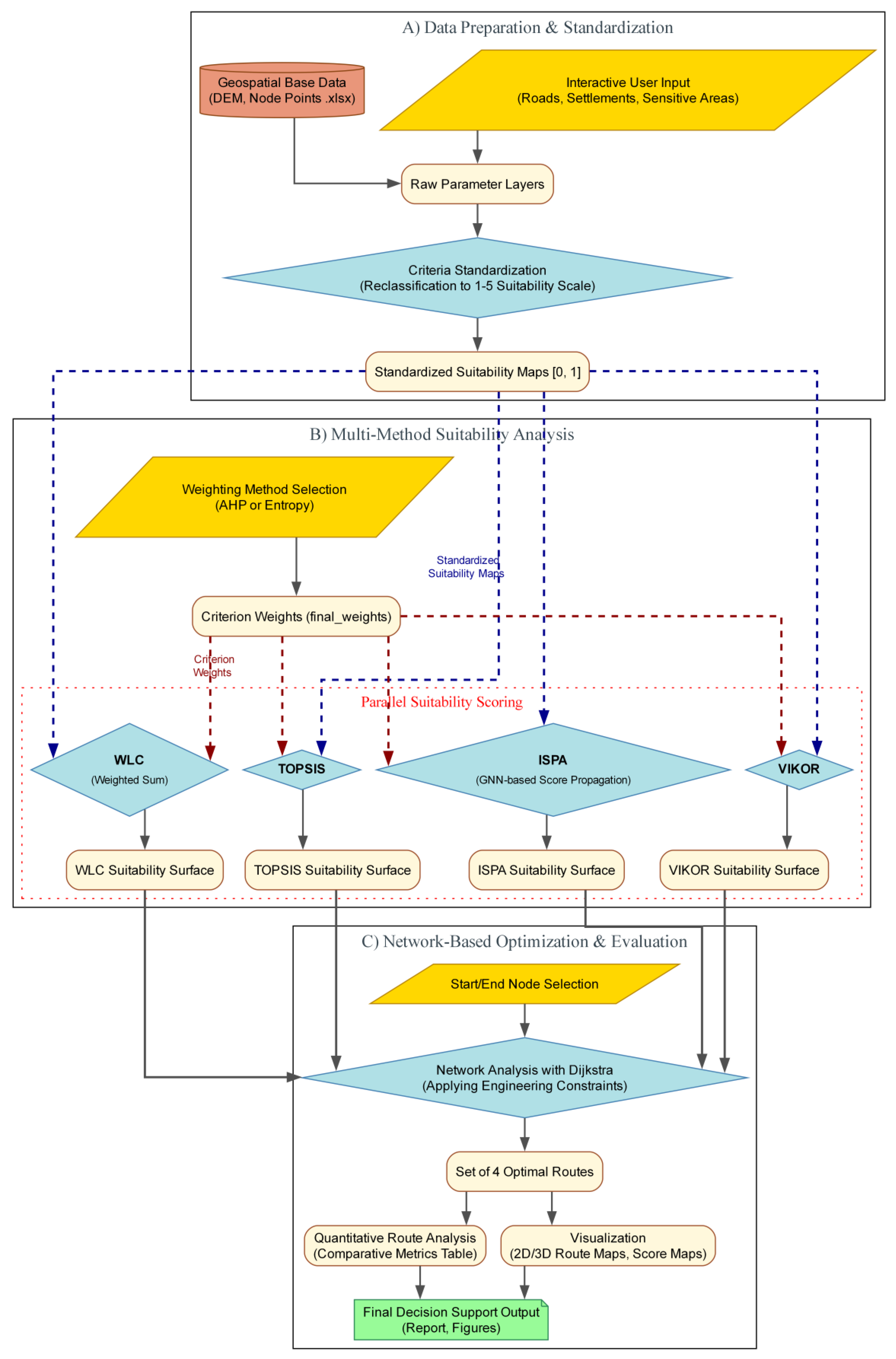
3.1. The Framework’s Foundation: Criteria, Data, and Standardization
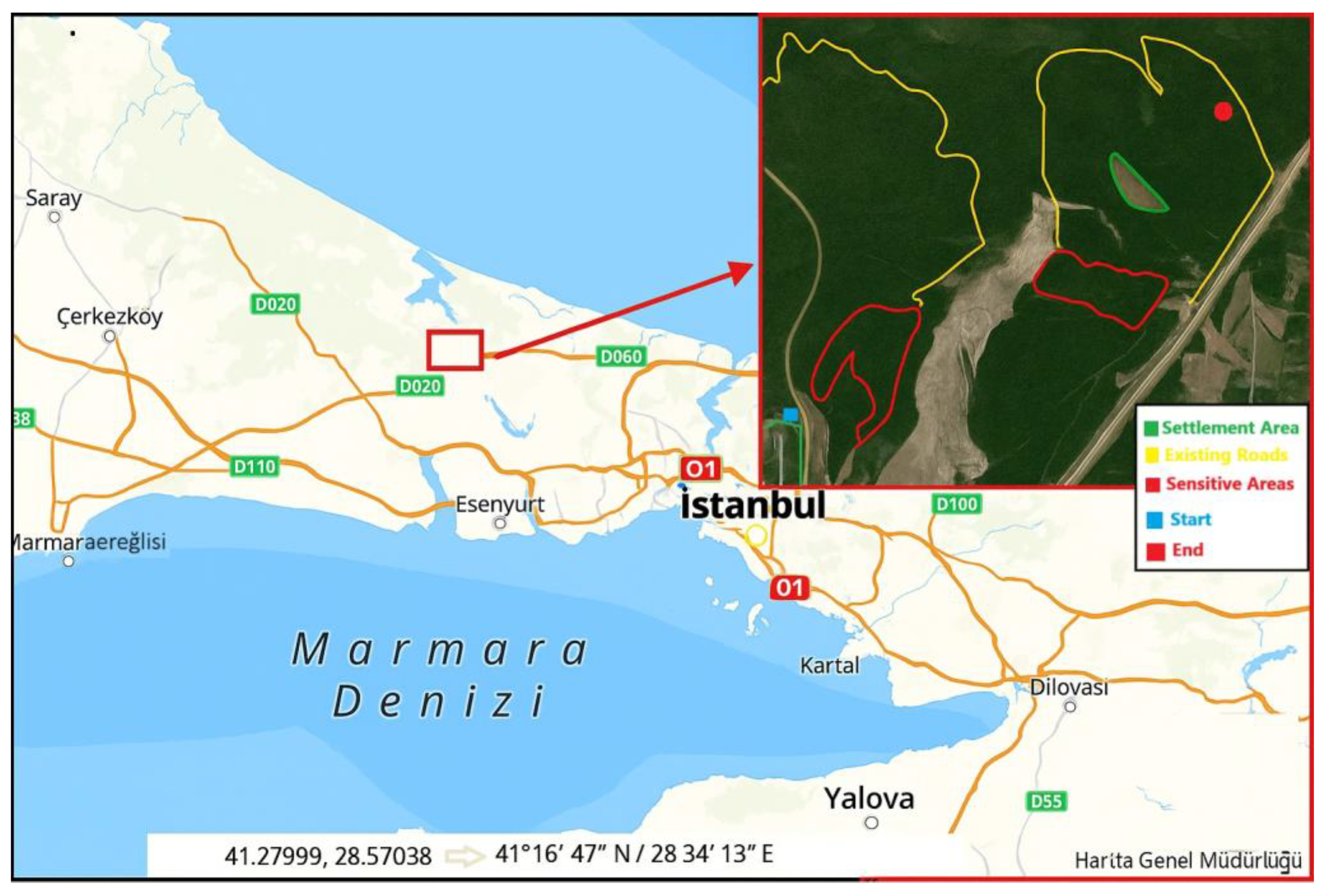
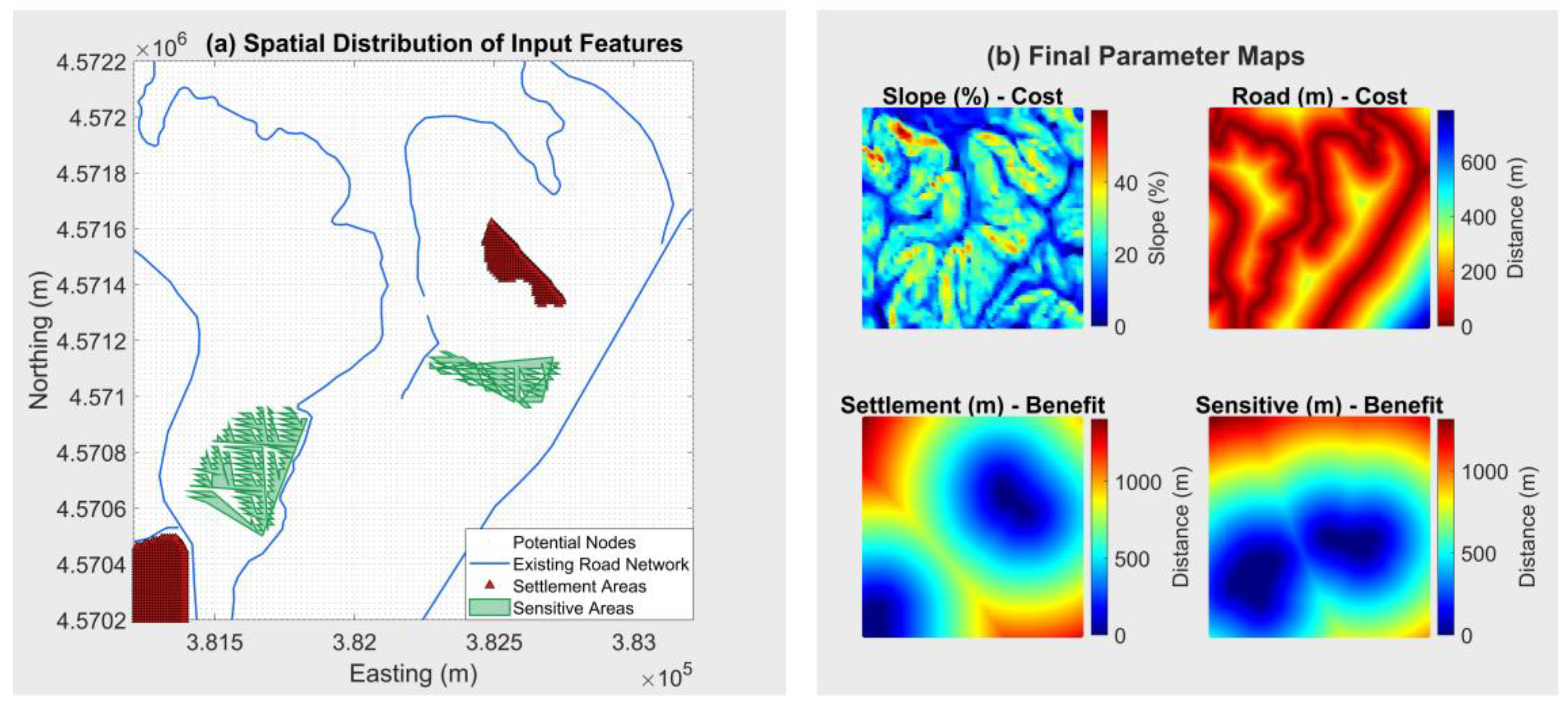
3.1.1. Study Area and Data Preparation
3.1.2. Criteria Definition and Rationale
Criterion 1: Slope (Engineering/Cost)
Criterion 2: Proximity to Existing Roads (Economic)
Criteria 3–4: Proximity to Settlements and Sensitive Areas (Social-Environmental)
3.1.3. Normalization: From Raw Parameters to Standardized Suitability Scores
- Expert-Based Reclassification (Fuzzification): In the first step, each parameter layer was reclassified into a five-level suitability scale ranging from 1 (very low suitability) to 5 (very high suitability), using expert-defined breakpoints guided by the Benefit/Cost logic. For instance, for Slope, a Cost criterion, low raw values (e.g., 0–2%) were assigned to the highest suitability class (5), while high raw values (e.g., >12%) were assigned to the lowest class (1). This expert-based process transforms the heterogeneous parameter layers into a set of homogeneous and comparable suitability maps where each node’s value represents a clear preference level.
- Linear Scaling: In the second step, to ensure full computational compatibility with the subsequent MCDM methods, these discrete 1–5 class scores (ClassScoreij) were linearly scaled to a continuous [0, 1] range, where 1 represents the highest suitability and 0 represents the lowest. This was achieved using the following formula:
3.2. Multi-Method Suitability Modeling
3.2.1. Criteria Weighting: Subjective and Objective Philosophies
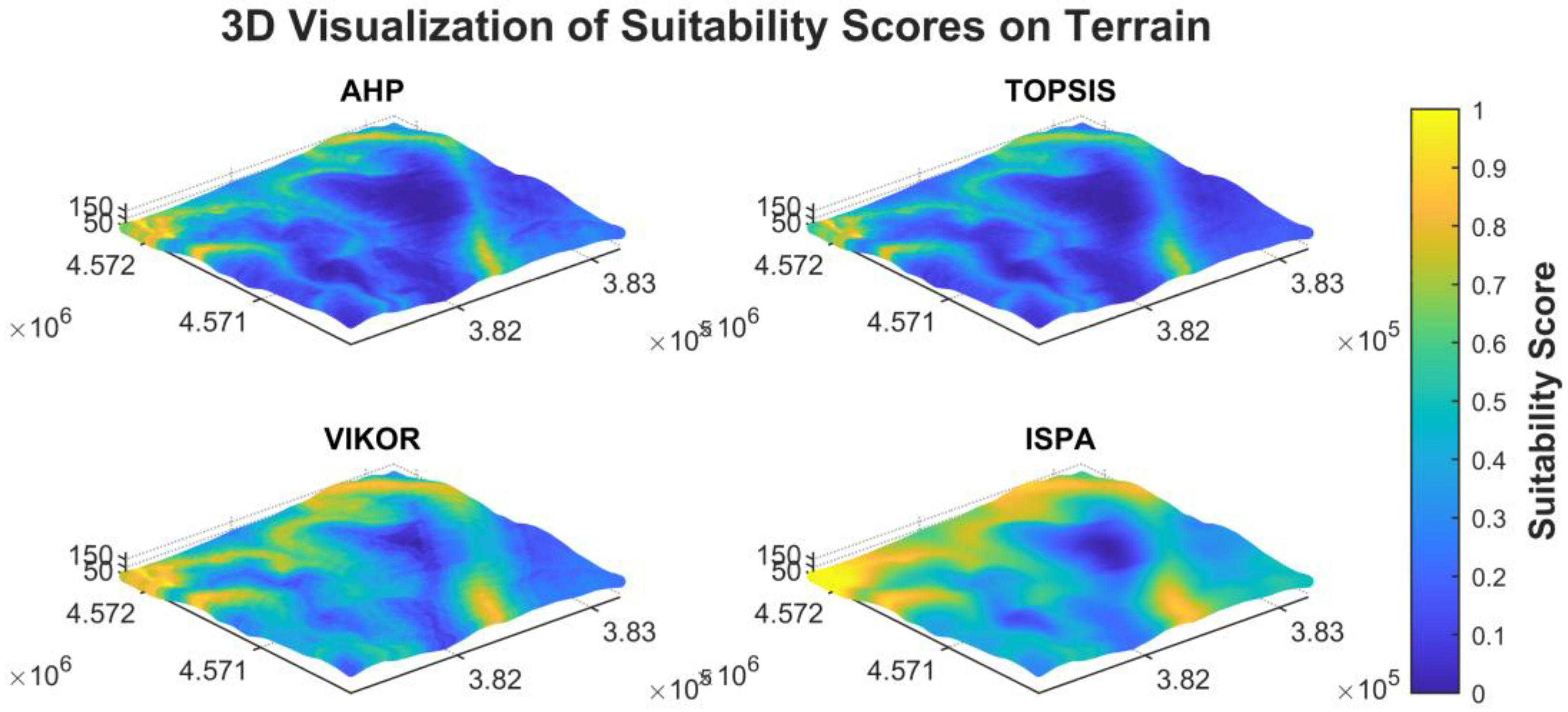
3.2.2. Conventional MCDA Approaches for Suitability Surface Generation
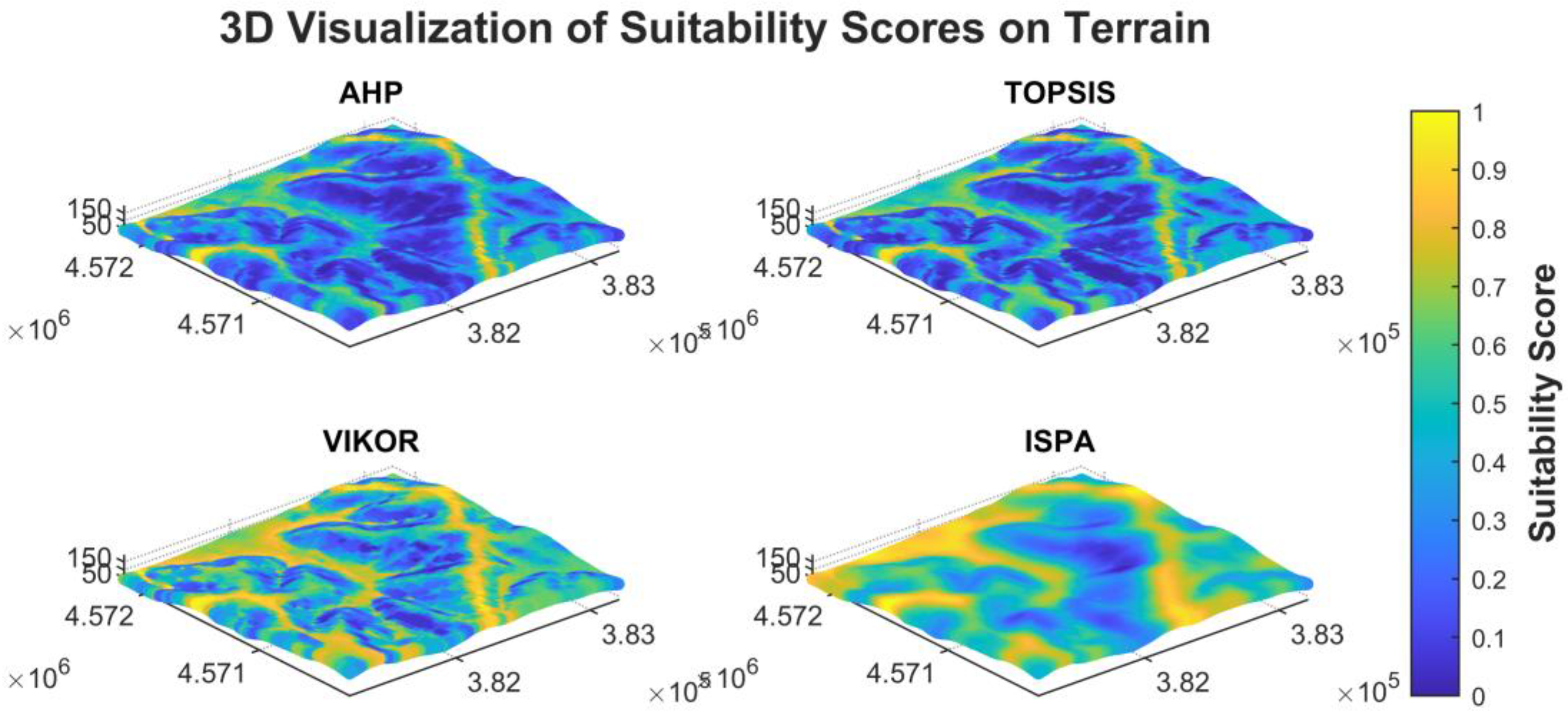
3.2.3. The Proposed ISPA Framework for Spatially-Aware Suitability Modeling
| Algorithm 1: Iterative Score Propagation Algorithm (ISPA) |
| Input: G = (V, E): Graph Network H^(0): Initial suitability scores (WLC output) K: Number of iterations alpha: Smoothing factor (Propagation factor, set to 0.5) d_max: Neighborhood search distance Output: H^(K): Final spatially-aware suitability scores 1: Initialization: Set k = 0 2: Repeat for k = 0 to K − 1: 3: For each node i in V: 4: Identify the neighbor set N_i based on d_max. 5: Calculate the mean score of neighbors: M_i^(k) = (1/|N_i|) * SUM_{j in N_i} h_j^(k) 6: Update the node’s score using the propagation rule: h_i^(k+1) = (1 − alpha) * h_i^(k) + alpha * M_i^(k) 7: End For 8: Set k = k + 1 9: End Repeat 10: Return H^(K) |
3.3. Network-Based Optimization and Route Evaluation
3.3.1. Graph Construction with Engineering Constraints
3.3.2. Multi-Layered Cost Function and Pathfinding Algorithm
3.3.3. Quantitative Route Evaluation Metrics
3.3.4. Holistic Performance and Robustness Evaluation Framework
4. Results
4.1. Experimental Setup
4.2. Multi-Scenario Analysis: Definitions and Parametric Calibration
4.3. Comparative Analysis: Results from the Objective Weighting Stream
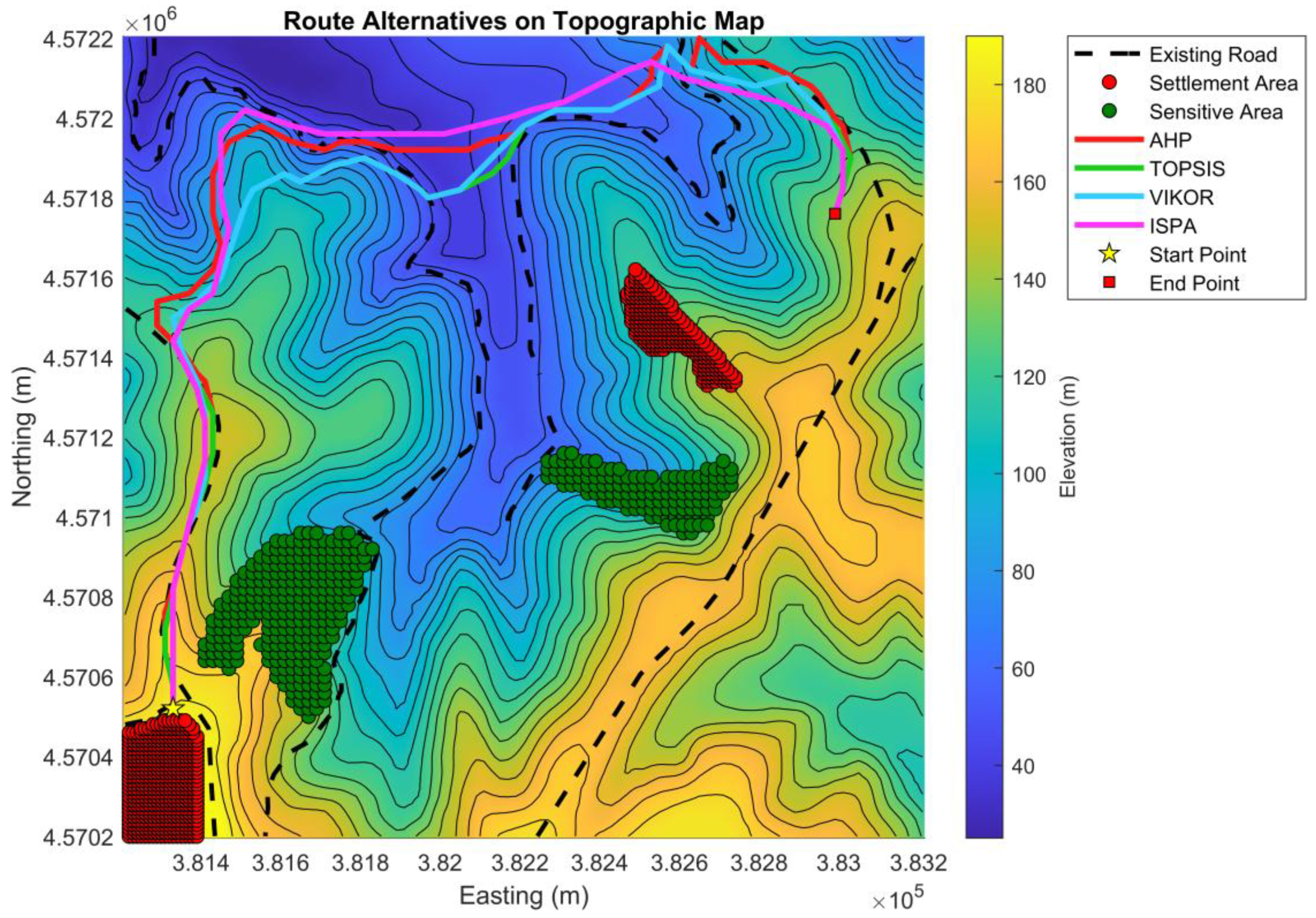
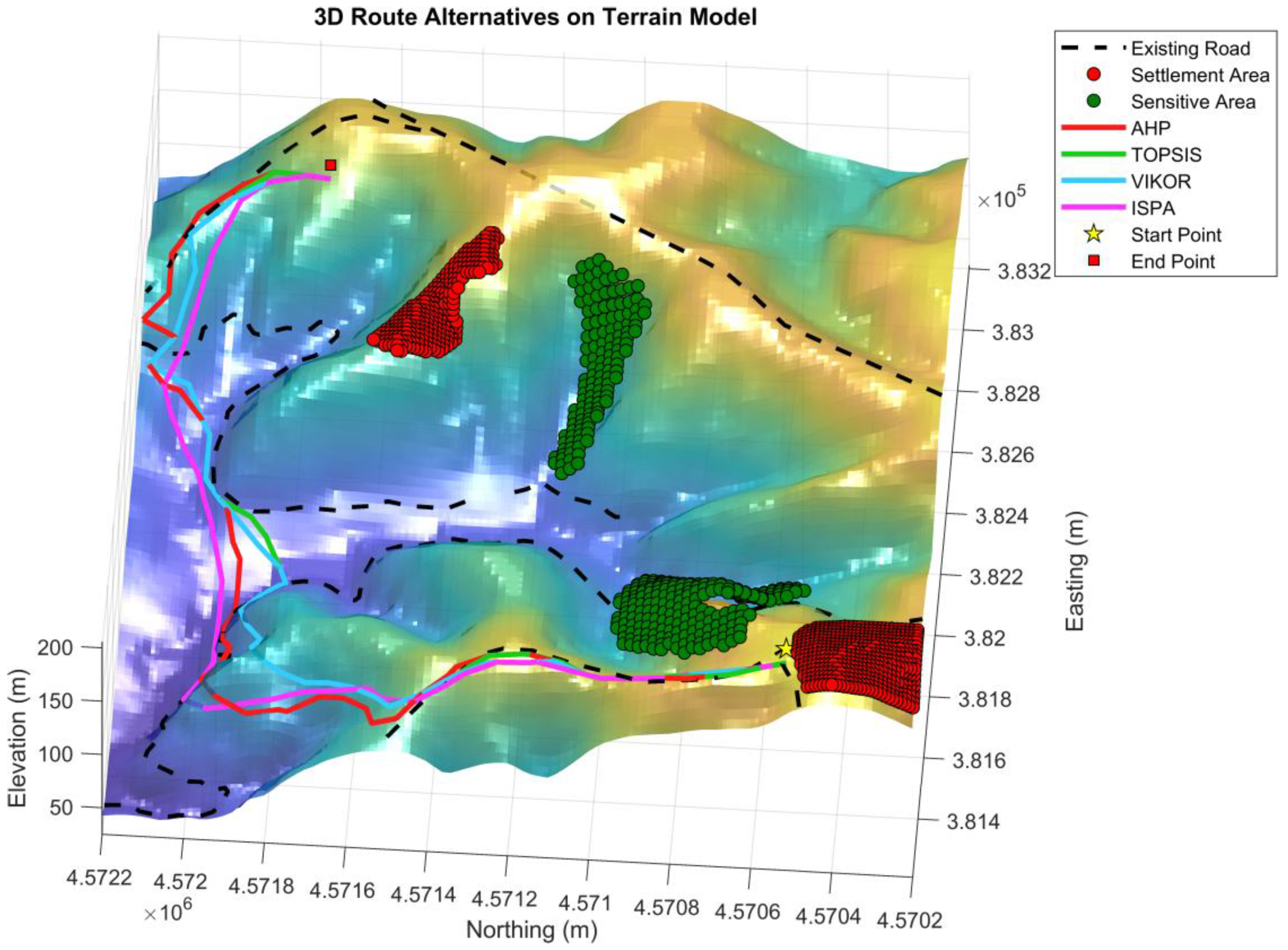
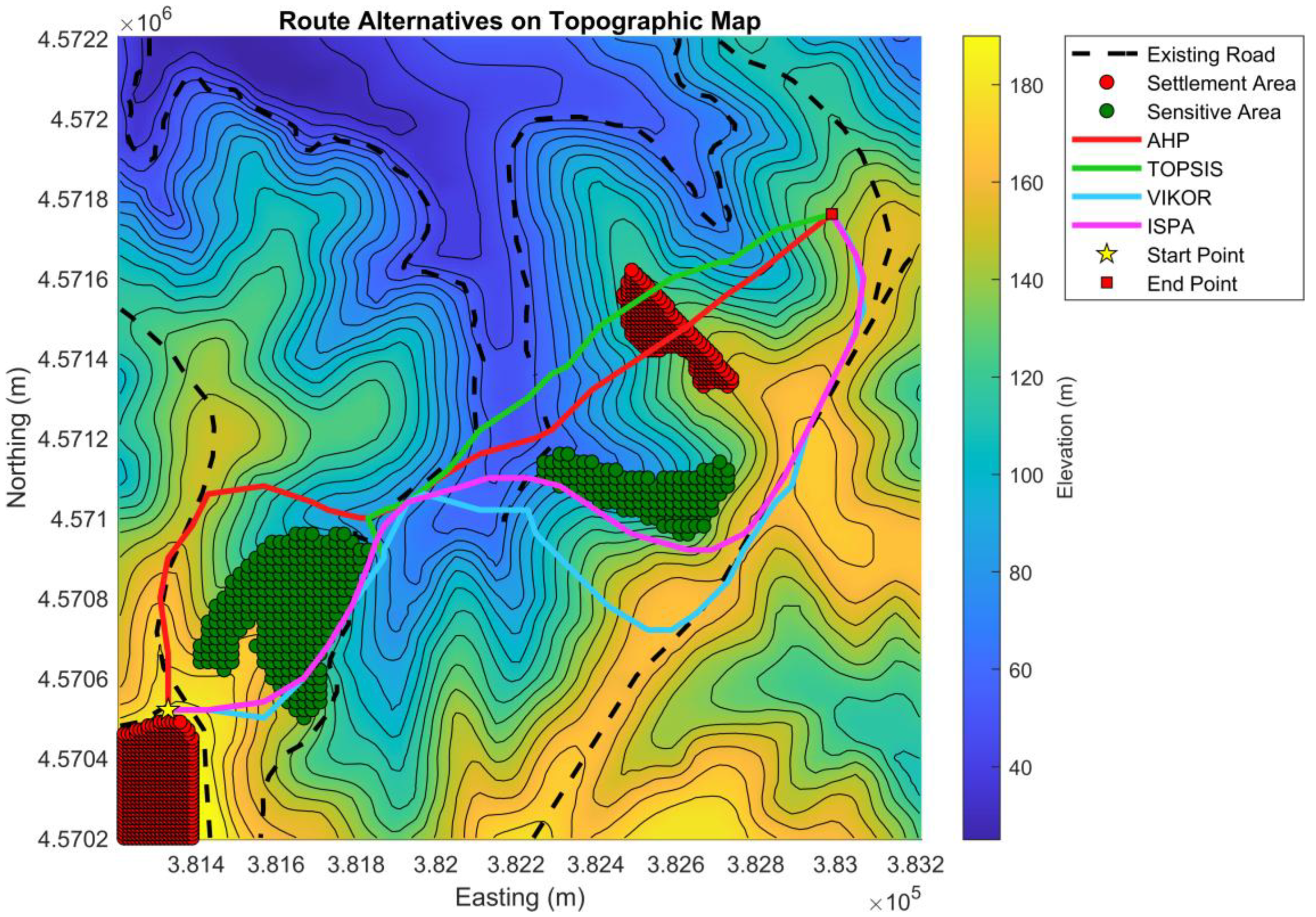
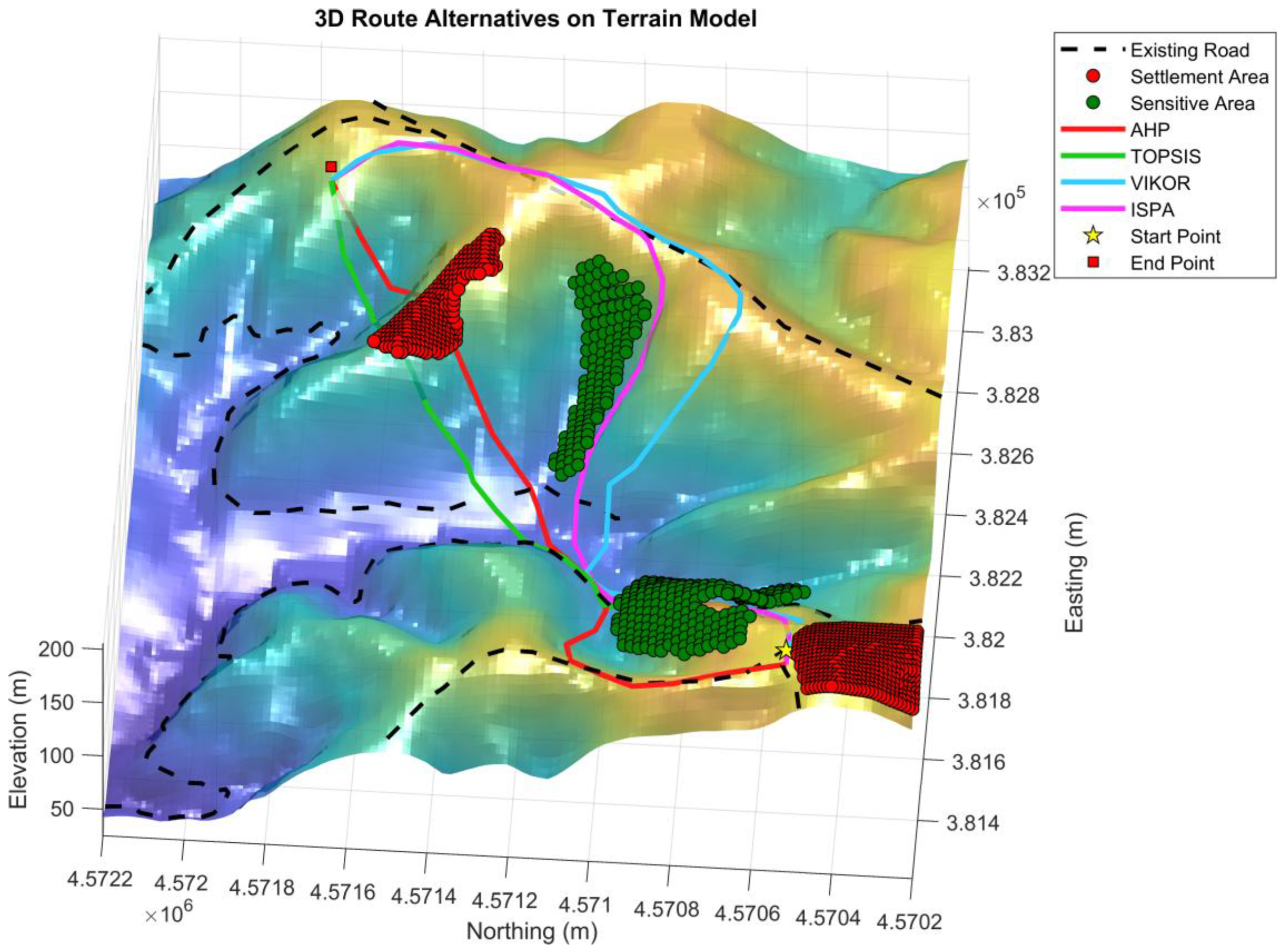
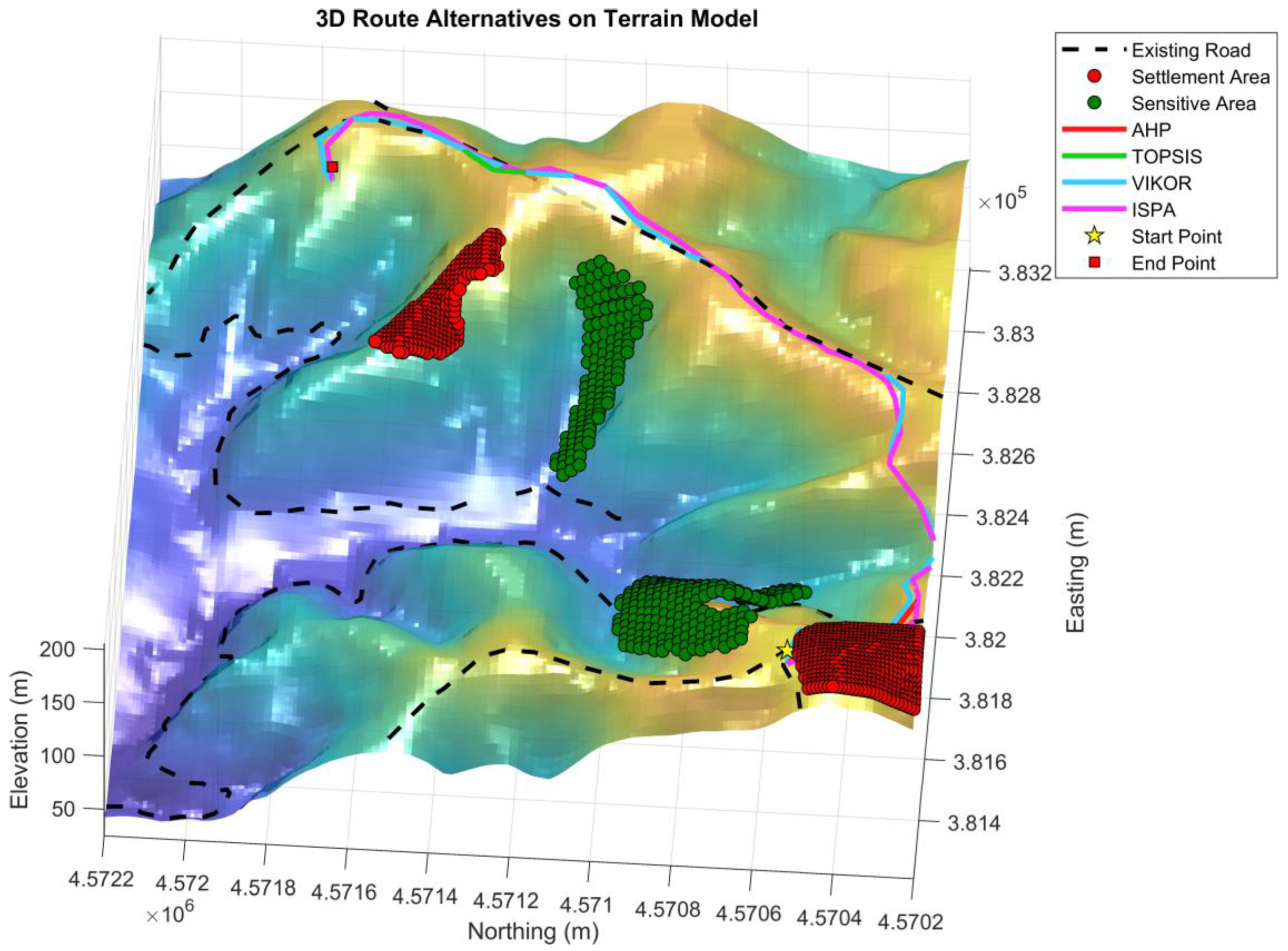
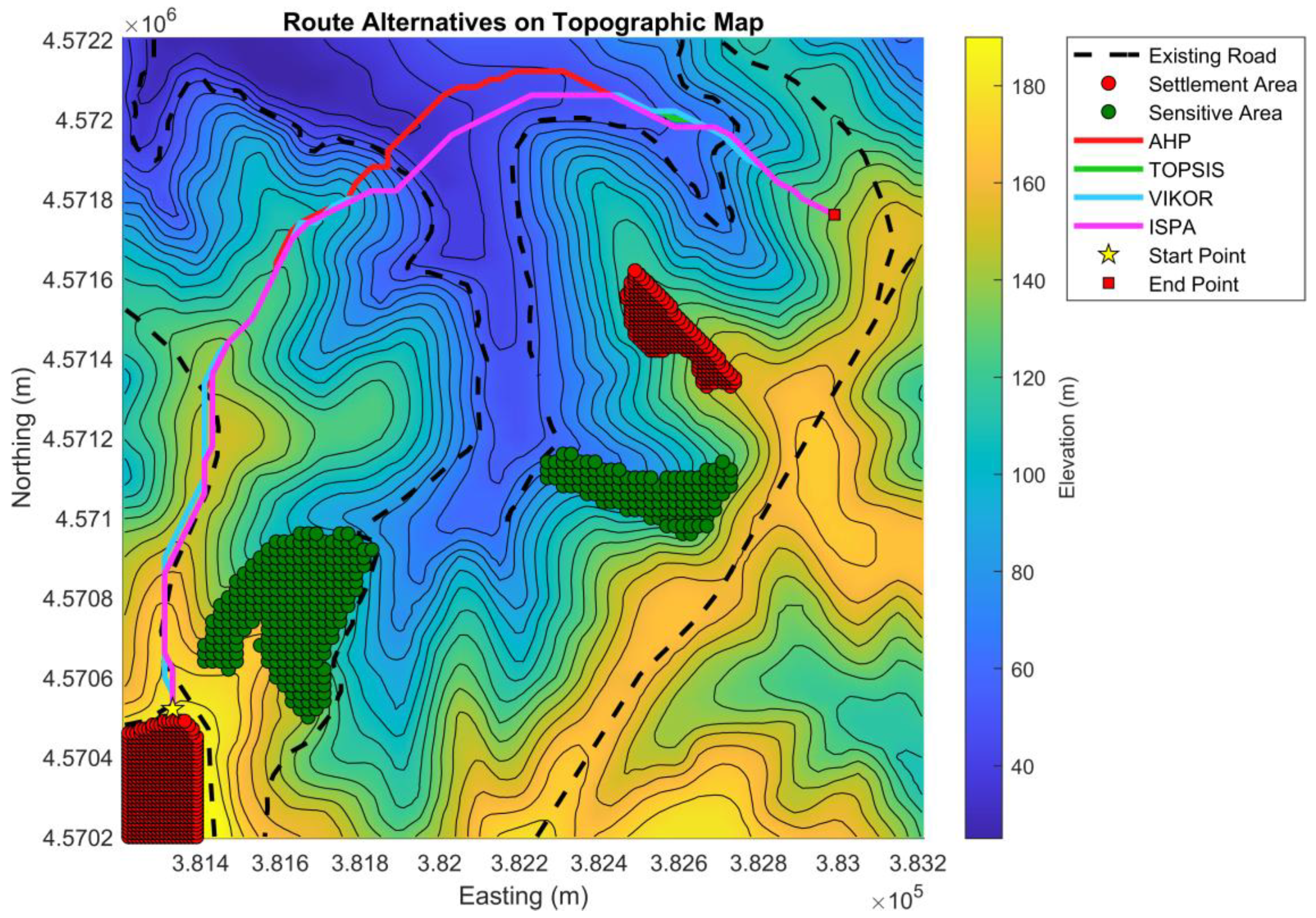
4.3.1. Scenario 1: Rural Highway (Objective Approach)
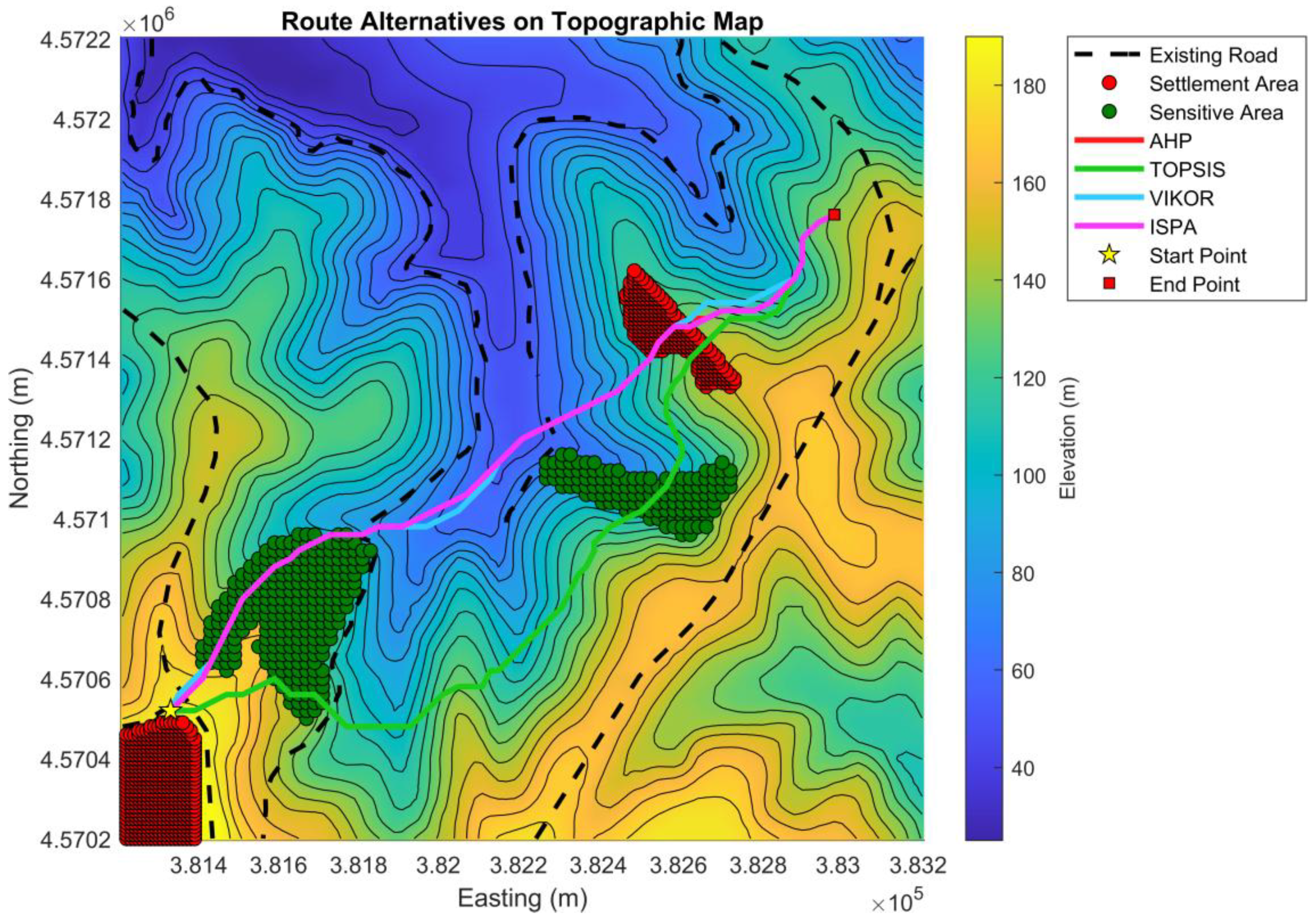
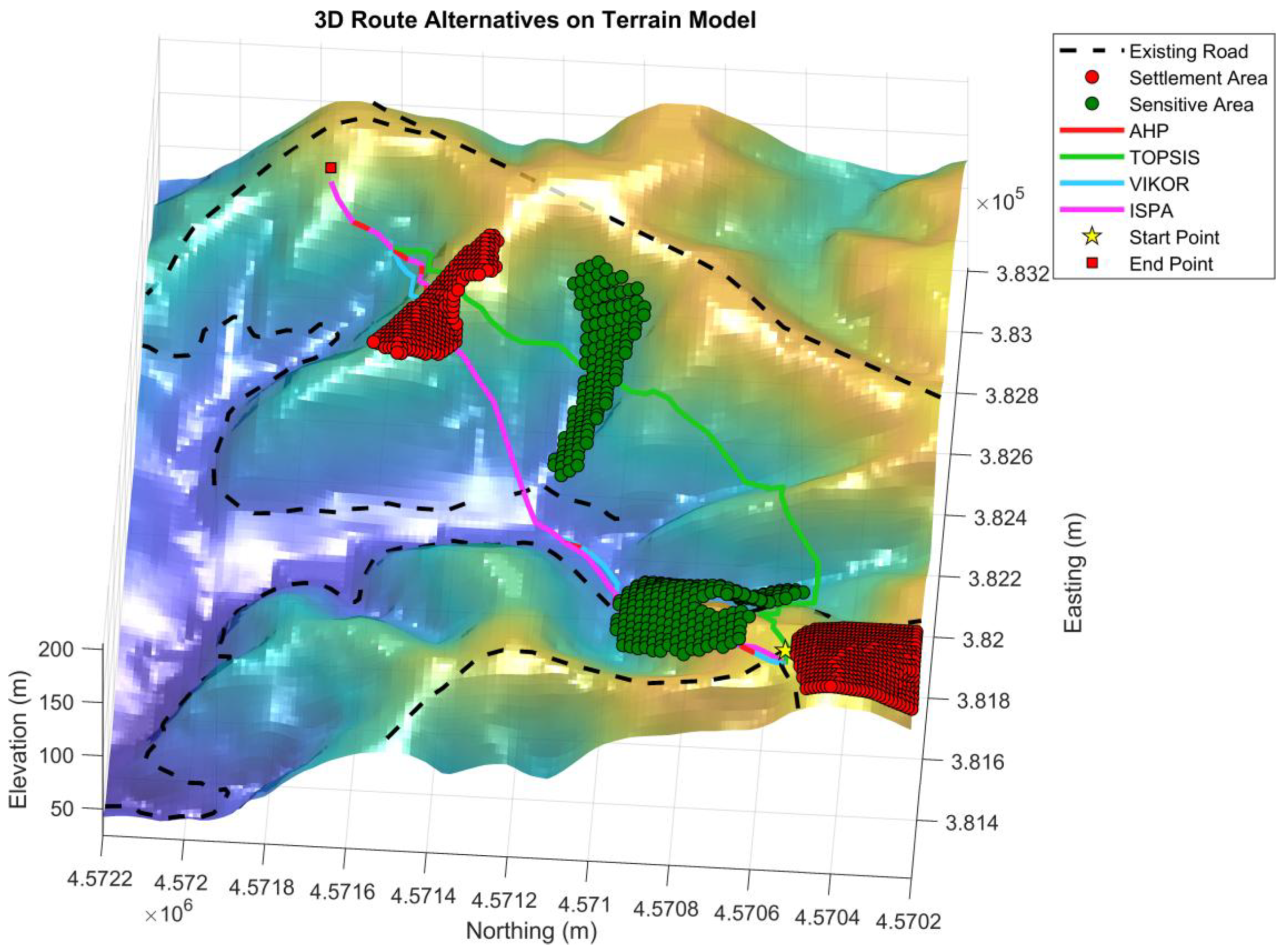
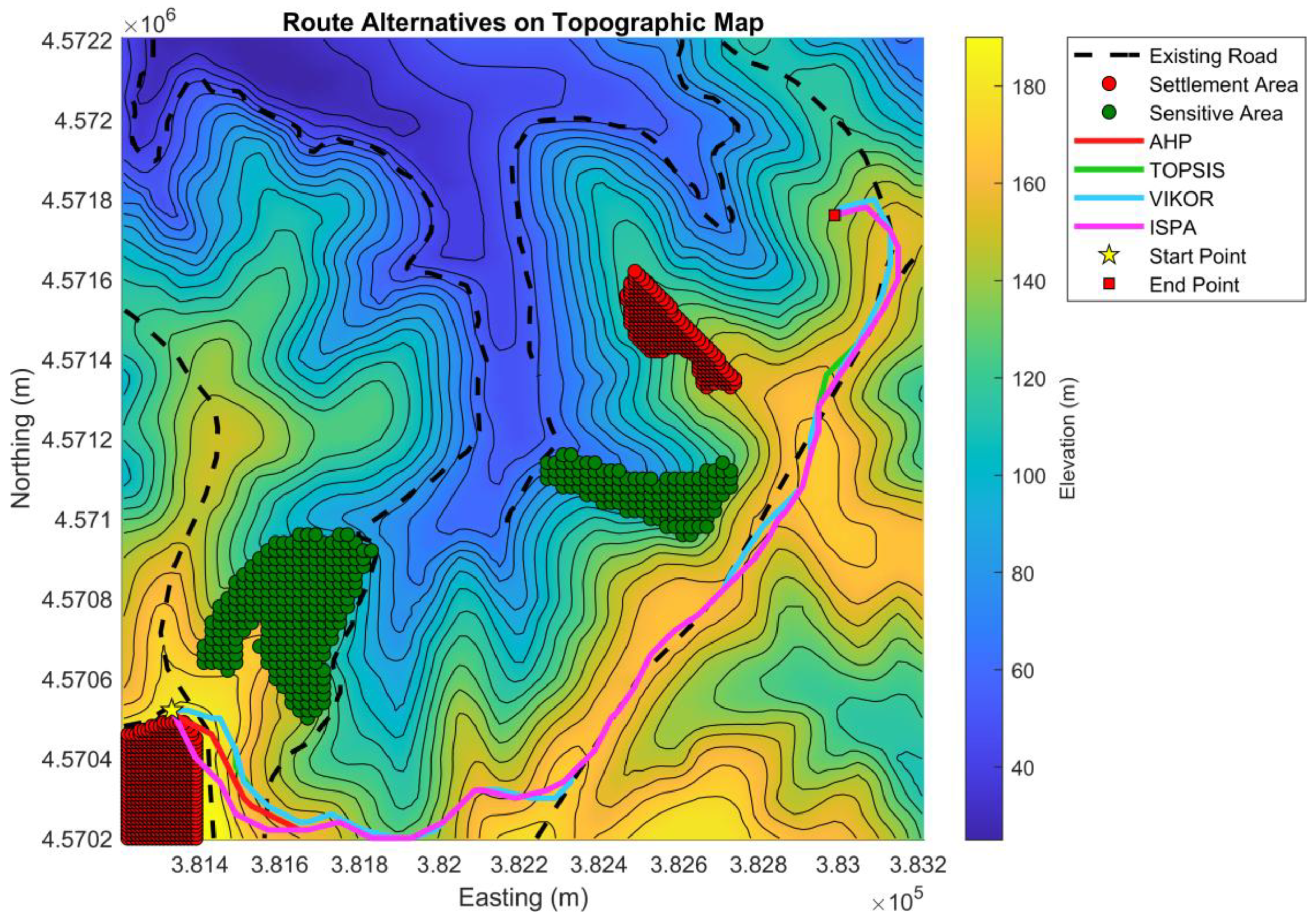
4.3.2. Scenario 2: Pipeline Corridor (Objective Approach)
4.3.3. Scenario 3: Trekking Trail (Objective Approach)
4.3.4. Synthesis of Objective Analysis Findings
4.4. Sensitivity Analysis: Results from the Subjective Weighting Stream
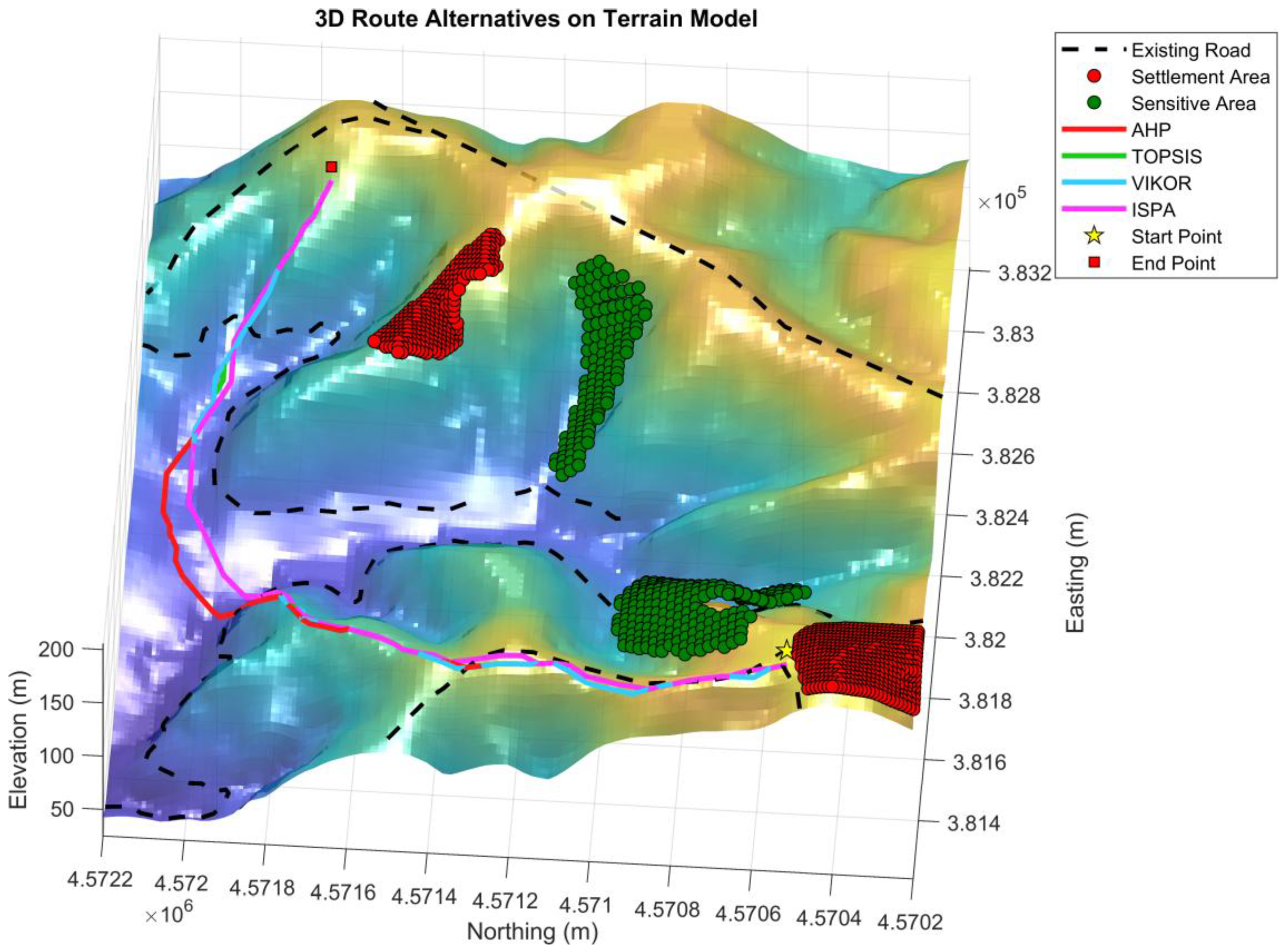
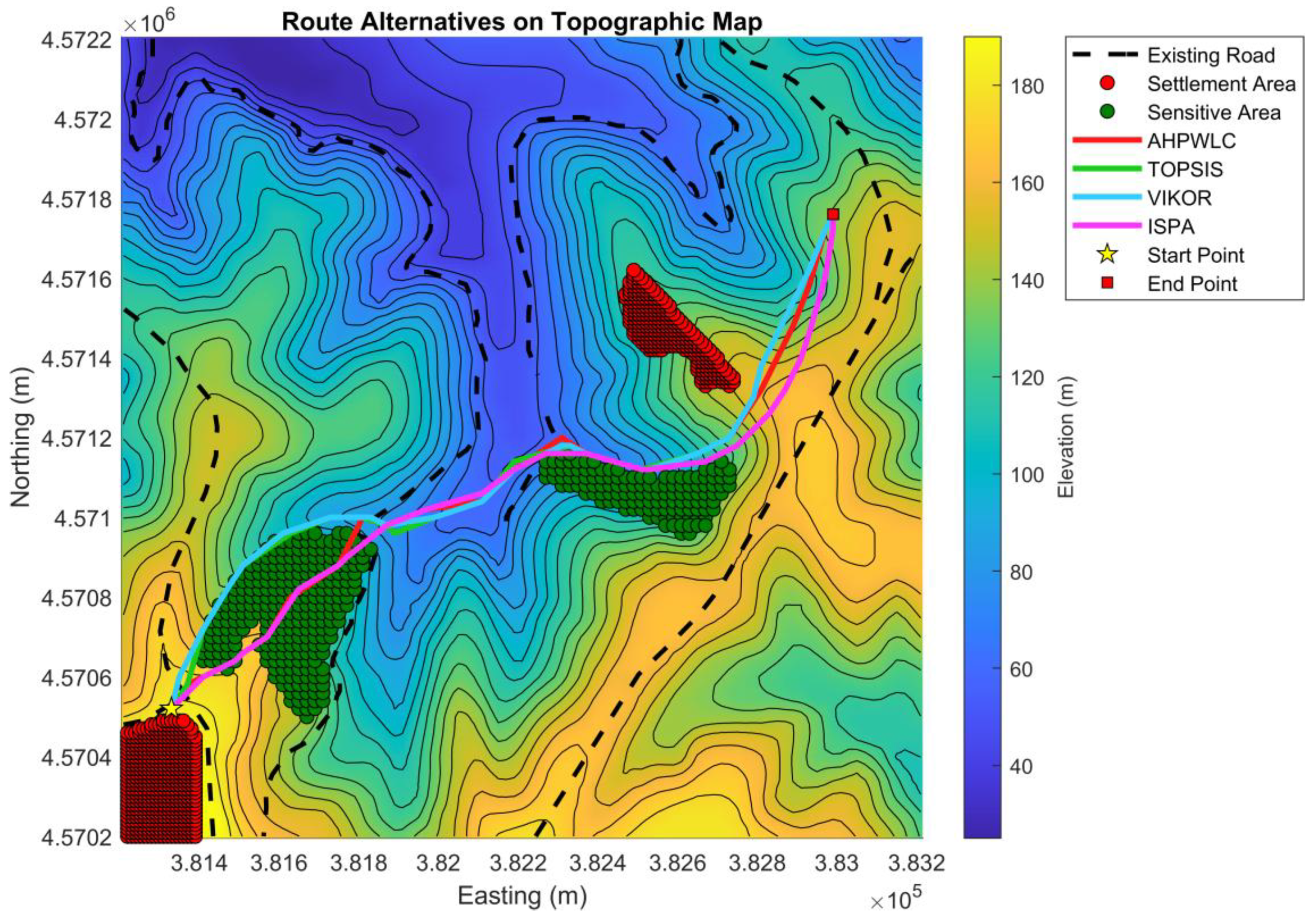
4.4.1. Scenario 1: Rural Highway (Subjective Approach)
4.4.2. Scenario 2: Pipeline Corridor (Subjective Approach)
4.4.3. Scenario 3: Trekking Trail (Subjective Approach)
4.4.4. Synthesis of Subjective Analysis Findings
4.5. Overall Performance Synthesis and Robustness Analysis
4.5.1. Performance Evaluation by Weighting Philosophy
4.5.2. Holistic Synthesis: Overall Performance and Robustness
5. Discussion
5.1. Interpretation of Methodological Superiority: Spatial Intelligence and Adaptive Behavior
5.2. Conceptual Flexibility: A Paradigm Shift from Cost to Experience
5.3. Implications for Planning Practice and Decision-Making
5.4. Limitations and Future Research Directions
6. Conclusions
Funding
Data Availability Statement
Conflicts of Interest
Abbreviations
| AHP | Analytic Hierarchy Process |
| DEM | Digital Elevation Model |
| EWM | Entropy Weight Method |
| GeoAI | Geospatial Artificial Intelligence |
| GIS | Geographic Information System |
| GNN | Graph Neural Network |
| ISPA | Iterative Score Propagation Algorithm |
| LCP | Least-Cost Path |
| MCDM | Multi-Criteria Decision-Making |
| TOPSIS | Technique for Order of Preference by Similarity to Ideal Solution |
| VIKOR | VlseKriterijumska Optimizacija I Kompromisno Resenje |
| WLC | Weighted Linear Combination |
References
- Shi, D.; Tong, Y.; Wan, Z.; Zuo, C.; Luo, J.; Cui, Z.; Wang, H.; Dai, Z. Multi-objective maintenance and rehabilitation decisionmaking modelling for highway networks: Balancing economy, environment, and maintenance benefits. Transp. A Transp. Sci. 2025, in press. [Google Scholar] [CrossRef]
- Zafar, I.; Wuni, I.Y.; Shen, G.Q.; Zahoor, H.; Xue, J. A decision support framework for sustainable highway alignment embracing variant preferences of stakeholders: Case of China Pakistan economic corridor. J. Environ. Plan. Manag. 2020, 63, 1590–1616. [Google Scholar] [CrossRef]
- Malczewski, J. GIS and Multicriteria Decision Analysis; John Wiley & Sons: New York, NY, USA, 1999. [Google Scholar]
- Atkinson, D.M.; Deadman, P.; Dudycha, D.; Traynor, S. Multi-criteria evaluation and least cost path analysis for an arctic all-weather road. Appl. Geogr. 2005, 25, 287–307. [Google Scholar] [CrossRef]
- Deo, S.; Gilmore, D.; Van Thof, M.; Enriquez, J. Infrastructure Optioneering: An Analytical Hierarchy Process Approach. In Proceedings of the Pipelines 2016, Kansas City, MO, USA, 17–20 July 2016; pp. 957–969. [Google Scholar]
- Effat, H.A.; Hassan, O.A. Designing and evaluation of three alternatives highway routes using the Analytical Hierarchy Process and the least-cost path analysis, application in Sinai Peninsula, Egypt. Egypt. J. Remote Sens. Space Sci. 2013, 16, 191–201. [Google Scholar] [CrossRef]
- Tobler, W.R. A Computer Movie Simulating Urban Growth in the Detroit Region. Econ. Geogr. 1970, 46, 234–240. [Google Scholar] [CrossRef]
- Church, R.L. Tobler’s Law and Spatial Optimization: Why Bakersfield? Int. Reg. Sci. Rev. 2018, 41, 333–353. [Google Scholar] [CrossRef]
- Wu, Z.; Pan, S.; Chen, F.; Long, G.; Zhang, C.; Yu, P.S. A Comprehensive Survey on Graph Neural Networks. IEEE Trans. Neural Netw. Learn. Syst. 2021, 32, 4–24. [Google Scholar] [CrossRef]
- Klemmer, K.; Safir, N.; Neill, D.B. Positional Encoder Graph Neural Networks for Geographic Data. In Proceedings of the 26th International Conference on Artificial Intelligence and Statistics (AISTATS), Valencia, Spain, 25–27 April 2023; pp. 6286–6305. [Google Scholar]
- He, S.; Luo, Q.; Du, R.; Zhao, L.; He, G.; Fu, H.; Li, H. STGC-GNNs: A GNN-based traffic prediction framework with a spatial–temporal Granger causality graph. Phys. A Stat. Mech. Its Appl. 2023, 623, 128913. [Google Scholar] [CrossRef]
- Guo, Y.; Hu, Q.; Liu, L.; Liu, H.; Bennamoun, M.; Wang, H. Deep Learning for 3D Point Clouds: A Survey. IEEE Trans. Pattern Anal. Mach. Intell. 2021, 43, 4338–4364. [Google Scholar] [CrossRef]
- Jiang, W.; Han, H.; Zhang, Y.; Wang, J.; He, M.; Gu, W.; Mu, J.; Cheng, X. Graph Neural Networks for Routing Optimization: Challenges and Opportunities. Sustainability 2024, 16, 9239. [Google Scholar] [CrossRef]
- Wang, H.; Liang, X. Adaptive routing via GNNs with reinforcement learning and transformers. J. Netw. Comput. Appl. 2025. submitted. [Google Scholar]
- Wu, Y.; Liu, A. GNN Advanced Heuristics Algorithm for Solving Multi-depot Vehicle Problem. In Advanced Intelligent Computing Technology and Applications. ICIC 2025; Huang, D.S., Ed.; Springer: Singapore, 2025; pp. 350–361. [Google Scholar]
- Kipf, T.N.; Welling, M. Semi-Supervised Classification with Graph Convolutional Networks. In Proceedings of the 5th International Conference on Learning Representations (ICLR), Toulon, France, 24–26 April 2017. [Google Scholar]
- Dijkstra, E.W. A note on two problems in connexion with graphs. Numer. Math. 1959, 1, 269–271. [Google Scholar] [CrossRef]
- Saaty, T.L. The Analytic Hierarchy Process: Planning, Priority Setting, Resource Allocation; McGraw-Hill: New York, NY, USA, 1980. [Google Scholar]
- Hwang, C.L.; Yoon, K. Multiple Attribute Decision Making: Methods and Applications; Springer: Berlin/Heidelberg, Germany, 1981. [Google Scholar]
- Opricovic, S. Multicriteria Optimization of Civil Engineering Systems; Faculty of Civil Engineering, University of Belgrade: Belgrade, Serbia, 1998. [Google Scholar]
- Gilmer, J.; Schoenholz, S.S.; Riley, P.F.; Vinyals, O.; Dahl, G.E. Neural Message Passing for Quantum Chemistry. In Proceedings of the 34th International Conference on Machine Learning (ICML), Sydney, Australia, 6–11 August 2017; pp. 1263–1272. [Google Scholar]
- Pehlivan, H. Route-Optimization-ISPA (Version 1.0.0) [Computer Software]. Zenodo, 2025. Available online: https://zenodo.org/records/17107788 (accessed on 12 August 2025).
- NASA/METI/AIST/Japan Spacesystems; U.S./Japan ASTER Science Team. ASTER Global Digital Elevation Model V3; NASA EOSDIS Land Processes DAAC: Sioux Falls, SD, USA, 2019. [Google Scholar] [CrossRef]
- Joerin, F.; Thériault, M.; Musy, A. Using GIS and outranking multicriteria analysis for land-use suitability assessment. Int. J. Geogr. Inf. Sci. 2001, 15, 153–174. [Google Scholar] [CrossRef]
- Basnet, B.B.; Apan, A.A.; Raine, S.R. Selecting suitable sites for animal waste application using a raster GIS. Environ. Manag. 2001, 28, 519–531. [Google Scholar] [CrossRef] [PubMed]
- Glasson, J.; Therivel, R.; Chadwick, A. Introduction to Environmental Impact Assessment, 4th ed.; Routledge: London, UK, 2012. [Google Scholar]
- Bagli, S.; Geneletti, D.; Orsi, F. A GIS-based multi-criteria approach for the assessment of the impacts of a new motorway in an alpine environment. Environ. Impact Assess. Rev. 2011, 31, 406–414. [Google Scholar] [CrossRef]
- Cao, X.; Lei, J.; Shi, D.; Yu, W.; Tao, T.; Zhang, X.; Wang, A. New Quality Productivity of Agriculture and Rural Areas at the Provincial Scale in China: Indicator Construction and Spatiotemporal Evolution. ISPRS Int. J. Geo-Inf. 2025, 14, 104. [Google Scholar] [CrossRef]
- Jiang, H.; Eastman, J.R. Application of fuzzy measures in multi-criteria evaluation in GIS. Int. J. Geogr. Inf. Sci. 2000, 14, 173–184. [Google Scholar] [CrossRef]
- Zadeh, L.A. Fuzzy sets. Inf. Control 1965, 8, 338–353. [Google Scholar] [CrossRef]
- Eastman, J.R. IDRISI Selva: GIS and Image Processing Software Manual; Clark Labs, Clark University: Worcester, MA, USA, 2012. [Google Scholar]
- Chen, Y.; Li, S.; Li, C. A fuzzy-based closed-loop evaluation approach for product solution selection in mass customization. Expert Syst. Appl. 2011, 38, 9871–9880. [Google Scholar] [CrossRef]
- Saaty, T.L.; Vargas, L.G. Models, Methods, Concepts & Applications of the Analytic Hierarchy Process; Kluwer Academic Publishers: Boston, MA, USA, 2001. [Google Scholar]
- Shannon, C.E. A Mathematical Theory of Communication. Bell Syst. Tech. J. 1948, 27, 379–423. [Google Scholar] [CrossRef]
- Zhu, Y.; Tian, D.; Yan, F. Effectiveness of Entropy Weight Method in Decision-Making. Math. Probl. Eng. 2020, 2020, 3564835. [Google Scholar] [CrossRef]
- Goodchild, M.F. Spatial Autocorrelation; Geo Books: Norwich, UK, 1986. [Google Scholar]
- Yu, C.; Lee, J.; Munro-Stasiuk, M.J. Extensions to least-cost path algorithms for roadway planning. Int. J. Geogr. Inf. Sci. 2003, 17, 361–376. [Google Scholar] [CrossRef]
- Collischonn, W.; Pilar, J.V. A direction dependent least-cost-path algorithm for roads and canals. Int. J. Geogr. Inf. Sci. 2000, 14, 397–406. [Google Scholar] [CrossRef]
- Anysz, H.; Nicał, A.; Stević, Ž.; Grzegorzewski, M.; Sikora, K. Pareto Optimal Decisions in Multi-Criteria Decision Making Explained with Construction Cost Cases. Symmetry 2021, 13, 46. [Google Scholar] [CrossRef]
- Ayan, B.; Abacıoğlu, S.; Basilio, M.P. A Comprehensive Review of the Novel Weighting Methods for Multi-Criteria Decision-Making. Information 2023, 14, 285. [Google Scholar] [CrossRef]
- Yildirim, V.; Yomralioglu, T.; Nisanci, R.; Colak, E.H.; Bediroglu, S.; Memisoglu, T. An Integrated Spatial Method for Minimizing Environmental Damage of Transmission Pipelines. Pol. J. Environ. Stud. 2016, 25, 2653–2663. [Google Scholar] [CrossRef]
- Petutschnig, L.; Clemen, T.; Klaußner, E.S.; Clemen, U.; Lang, S. Evaluating Geospatial Data Adequacy for Integrated Risk Assessments: A Malaria Risk Use Case. ISPRS Int. J. Geo-Inf. 2024, 13, 33. [Google Scholar] [CrossRef]
- Xia, W.; Guan, Q.; Li, Y.; Yue, H.; Yang, X.; Gao, H. Dynamic Load Balancing Based on Hypergraph Partitioning for Parallel Geospatial Cellular Automata Models. ISPRS Int. J. Geo-Inf. 2025, 14, 109. [Google Scholar] [CrossRef]



| Criterion Name | Symbol | Dimension Represented | Rationale and Role in Optimization |
|---|---|---|---|
| Slope | C_slope | Engineering/Cost | Directly influences construction costs (earthworks), operational efficiency (fuel consumption), and traffic safety. High slope values are undesirable. |
| Proximity to Roads | C_road | Economic | Proximity to existing road corridors reduces land acquisition needs and construction costs. Being closer is generally preferred for cost-effectiveness. |
| Proximity to Settlements | C_settle | Social | Proximity to settlement areas can lead to negative social impacts such as noise and expropriation, while distance can cause accessibility issues. |
| Proximity to Sensitive Areas | C_sensitive | Environmental | Avoiding ecologically valuable zones (e.g., forests, wetlands) minimizes the project’s environmental footprint. Being further away is generally preferred. |
| Criterion/Symbol | Scenario 1: Rural Highway | Scenario 2: Pipeline Corridor | Scenario 3: Trekking Trail |
|---|---|---|---|
| Slope/Cslope | C | C | C |
| Proximity to Roads/Croad | B | C | C |
| Proximity to Settlements/Csettle | B | B | B |
| Proximity to Sensitive Areas/Csensitive | B | B | B |
| Parameter | Symbol | Sc. * 1: Highway | Sc. * 2: Pipeline | Sc. * 3: Trekking | Rationale and Justification |
|---|---|---|---|---|---|
| Netw. Analysis Settings | |||||
| Neighborhood Search Distance (m) | dmax | 100 | 50 | 120 | Determines graph connectivity and the sensitivity of the route to terrain details. |
| Engineering Constraints | |||||
| Max. Allowable Slope (%) | αmax | 12 | 30 | 25 | A hard constraint defining physical passability; strict for highways, more flexible for others. |
| Ascent Penalty Factor | βuphill | 0.2 | 0.0 | −0.1 | A soft constraint modeling operational cost (fuel, effort). It is zero for the pipeline and a reward for the trekking trail. |
| Cost Function Settings | |||||
| Suitability Impact Factor | λ | 15 | 5 | 30 | Defines the penalty for traversing areas with low suitability scores. Highest for the aesthetics-driven trekking trail. |
| Scoring Settings | |||||
| ISPA Iterations | K | 3 | 2 | 4 | Determines the spatial receptive field of ISPA. More iterations are used for organic paths. |
| AHP Contrast Factor | γAHP | 3 | 1 | 4 | Enhances the discriminability of AHP scores. Set to 1 for the pipeline, which focuses on the shortest path. |
| TOPSIS Contrast Factor | γTOPSIS | 3 | 1 | 4 | Enhances the discriminability of TOPSIS scores, adjusted with the same logic as AHP. |
| VIKOR Contrast Factor | γVIKOR | 1 | 1 | 1 | The natural score distribution of VIKOR is often sufficiently discriminative; no additional contrast enhancement was applied. |
| ISPA Contrast Factor | γISPA | 1 | 1 | 1 | ISPA naturally enhances its own contrast through iterative propagation; no additional intervention was needed. |
| Scenario | Criterion | Slope | Proximity to Roads | Proximity to Settlements | Proximity to Sensitive Areas | Weight |
|---|---|---|---|---|---|---|
| 1. Rural Highway | Slope | 1 | 3 | 5 | 5 | 0.577 |
| (CR: 0.03) * | Proximity to Roads | 1/3 | 1 | 3 | 3 | 0.254 |
| Proximity to Settlements | 1/5 | 1/3 | 1 | 1 | 0.084 | |
| Proximity to Sensitive Areas | 1/5 | 1/3 | 1 | 1 | 0.084 | |
| 2. Pipeline | Slope | 1 | 7 | 3 | 1 | 0.463 |
| (CR: 0.06) * | Proximity to Roads | 1/7 | 1 | 1/5 | 1/7 | 0.046 |
| Proximity to Settlements | 1/3 | 5 | 1 | 1/3 | 0.198 | |
| Proximity to Sensitive Areas | 1 | 7 | 3 | 1 | 0.293 | |
| 3. Trekking Trail | Slope | 1 | 3 | 3 | 1/5 | 0.158 |
| (CR: 0.05) * | Proximity to Roads | 1/3 | 1 | 1 | 1/7 | 0.082 |
| Proximity to Settlements | 1/3 | 1 | 1 | 1/7 | 0.082 | |
| Proximity to Sensitive Areas | 5 | 7 | 7 | 1 | 0.678 |
| Method | Algorithmic Cost | Total 3D Length (m) | Mean Slope (%) | Max. Slope (%) | Total Ascent (m) | Unsuitable Dist. * (m) |
|---|---|---|---|---|---|---|
| WLC | 18,171.47 | 3686.42 | 7.11 | 12.00 | 114.72 | 83.01 |
| TOPSIS | 19,998.60 | 3442.65 | 7.75 | 12.00 | 111.41 | 190.21 |
| VIKOR | 21,631.13 | 3407.42 | 7.79 | 12.00 | 111.81 | 701.37 |
| ISPA | 18,463.92 | 3380.39 | 7.52 | 11.89 | 106.20 | 363.46 |
| Method | Algorithmic Cost | Total 3D Length (m) | Mean Slope (%) | Max. Slope (%) | Total Ascent (m) | Unsuitable Dist. (m) |
|---|---|---|---|---|---|---|
| WLC | 7825.16 | 2237.49 | 12.48 | 18.86 | 116.55 | 1739.16 |
| TOPSIS | 7557.35 | 2535.06 | 13.52 | 19.00 | 148.93 | 901.39 |
| VIKOR | 7807.71 | 2233.65 | 12.27 | 18.86 | 116.08 | 1730.75 |
| ISPA | 7443.05 | 2222.18 | 12.72 | 18.86 | 116.55 | 1511.73 |
| Method | Algorithmic Cost | Total 3D Length (m) | Mean Slope (%) | Max. Slope (%) | Total Ascent (m) | Unsuitable Dist. (m) |
|---|---|---|---|---|---|---|
| WLC | 39,320.72 | 2409.90 | 11.58 | 19.69 | 118.42 | 930.59 |
| TOPSIS | 38,755.20 | 2267.43 | 11.23 | 19.93 | 118.47 | 911.76 |
| VIKOR | 26,288.72 | 2933.32 | 8.82 | 19.98 | 118.55 | 261.98 |
| ISPA | 22,832.50 | 2693.01 | 9.84 | 19.95 | 115.81 | 0.00 |
| Method | Algorithmic Cost | Total 3D Length (m) | Mean Slope (%) | Max. Slope (%) | Total Ascent (m) | Unsuitable Dist. (m) |
|---|---|---|---|---|---|---|
| WLC (AHP-LCP) | 21,451.22 | 3069.01 | 5.05 | 11.98 | 58.86 | 702.57 |
| TOPSIS | 20,772.19 | 3090.83 | 4.93 | 11.98 | 60.92 | 751.89 |
| VIKOR | 14,225.99 | 3082.88 | 5.11 | 11.98 | 60.92 | 317.41 |
| ISPA | 16,277.25 | 3049.86 | 5.25 | 11.90 | 62.25 | 394.14 |
| Method | Algorithmic Cost | Total 3D Length (m) | Mean Slope (%) | Max. Slope (%) | Total Ascent (m) | Unsuitable Dist. (m) |
|---|---|---|---|---|---|---|
| WLC (AHP-LCP) | 7392.62 | 2961.29 | 8.01 | 28.69 | 109.37 | 684.03 |
| TOPSIS | 7271.39 | 2871.06 | 8.71 | 28.31 | 106.13 | 557.12 |
| VIKOR | 8417.35 | 2879.24 | 8.87 | 29.49 | 106.13 | 1004.79 |
| ISPA | 5829.16 | 2864.20 | 8.45 | 28.31 | 106.98 | 0.00 |
| Method | Algorithmic Cost | Total 3D Length (m) | Mean Slope (%) | Max. Slope (%) | Total Ascent (m) | Unsuitable Dist. (m) |
|---|---|---|---|---|---|---|
| WLC (AHP-LCP) | 23,144.48 | 2371.08 | 10.81 | 24.65 | 117.06 | 300.30 |
| TOPSIS | 20,160.29 | 2405.39 | 11.39 | 24.65 | 119.07 | 288.47 |
| VIKOR | 13,528.93 | 2388.75 | 10.98 | 24.65 | 116.23 | 154.09 |
| ISPA | 12,640.88 | 2327.87 | 9.74 | 24.97 | 114.24 | 162.26 |
| Analysis Stream | Method | Overall Performance Mean | Performance Stability Score | Final Score |
|---|---|---|---|---|
| Objective | ISPA | 0.627 | 0.668 | 0.647 |
| (Entropy) | VIKOR | 0.578 | 1.000 | 0.789 |
| WLC | 0.546 | 0.185 | 0.366 | |
| TOPSIS | 0.520 | 0.000 | 0.260 | |
| Subjective | ISPA | 0.556 | 1.000 | 0.778 |
| (AHP) | TOPSIS | 0.431 | 0.786 | 0.609 |
| WLC (AHP-LCP) | 0.421 | 0.661 | 0.541 | |
| VIKOR | 0.477 | 0.000 | 0.238 |
| Method | Overall Mean Performance | Overall Performance Std. Dev. | Overall Stability Score | Final Holistic Score |
|---|---|---|---|---|
| ISPA | 0.629 | 0.094 | 1.000 | 0.815 |
| VIKOR | 0.582 | 0.123 | 0.000 | 0.291 |
| TOPSIS | 0.557 | 0.114 | 0.295 | 0.426 |
| WLC | 0.557 | 0.118 | 0.166 | 0.362 |
Disclaimer/Publisher’s Note: The statements, opinions and data contained in all publications are solely those of the individual author(s) and contributor(s) and not of MDPI and/or the editor(s). MDPI and/or the editor(s) disclaim responsibility for any injury to people or property resulting from any ideas, methods, instructions or products referred to in the content. |
© 2025 by the author. Published by MDPI on behalf of the International Society for Photogrammetry and Remote Sensing. Licensee MDPI, Basel, Switzerland. This article is an open access article distributed under the terms and conditions of the Creative Commons Attribution (CC BY) license (https://creativecommons.org/licenses/by/4.0/).
Share and Cite
Pehlivan, H. Iterative Score Propagation Algorithm (ISPA): A GNN-Inspired Framework for Multi-Criteria Route Design with Engineering Applications. ISPRS Int. J. Geo-Inf. 2025, 14, 484. https://doi.org/10.3390/ijgi14120484
Pehlivan H. Iterative Score Propagation Algorithm (ISPA): A GNN-Inspired Framework for Multi-Criteria Route Design with Engineering Applications. ISPRS International Journal of Geo-Information. 2025; 14(12):484. https://doi.org/10.3390/ijgi14120484
Chicago/Turabian StylePehlivan, Hüseyin. 2025. "Iterative Score Propagation Algorithm (ISPA): A GNN-Inspired Framework for Multi-Criteria Route Design with Engineering Applications" ISPRS International Journal of Geo-Information 14, no. 12: 484. https://doi.org/10.3390/ijgi14120484
APA StylePehlivan, H. (2025). Iterative Score Propagation Algorithm (ISPA): A GNN-Inspired Framework for Multi-Criteria Route Design with Engineering Applications. ISPRS International Journal of Geo-Information, 14(12), 484. https://doi.org/10.3390/ijgi14120484