


Article

Building Climate Solutions Through Trustful, Ethical, and Localized Co-Development

by
Christy Caudill
1,*,†,
Cheila Avalon-Cullen
2,†,
Carol Archer
3,
Rose-Anne Smith
4,
Nathaniel K. Newlands
5,†,
Anne-Teresa Birthwright
6,
Peter L. Pulsifer
1 and
Markus Enenkel
7,†
1
Geomatics and Cartographic Research Centre (GCRC), Carleton University, 1125 Colonel By Dr, Ottawa, ON K1S 5B6, Canada
2
The Graduate Center, Bronx Community College, CUNY Remote Sensing Earth Systems Institute, The City University of New York, 365 5th Avenue, New York, NY 10016, USA
3
Faculty of the Built Environment, University of Technology, Jamaica, 237 Old Hope Road, Kingston 6, Jamaica
4
Department of Geography and Geology, The University of the West Indies, Kingston 7, Jamaica
5
Summerland Research and Development Centre, Science and Technology Branch, Government of Canada (Agriculture and Agri-Food Canada), 4200 Highway 97, Summerland, BC V0H 1Z0, Canada
6
Belmont Forum, 227 Belmont Ave, Cloverdale, WA 6105, Australia
7
The World Bank, 1818 H Street, N.W., Washington, DC 20433, USA
*
Author to whom correspondence should be addressed.
SIDS Climate and Adaptive Resilience Group (SCARG), International Science-Policy Advocacy Working Group, https://sites.google.com/view/scarg/home; scarg@gmail.com.
ISPRS Int. J. Geo-Inf. 2025, 14(12), 485; https://doi.org/10.3390/ijgi14120485
Submission received: 26 September 2025 / Revised: 1 December 2025 / Accepted: 4 December 2025 / Published: 8 December 2025

Abstract

The Small Island Developing States (SIDSs) in the Latin American and Caribbean region remain among the most vulnerable to climate change, as increasingly frequent and severe disasters threaten infrastructure, human life, and progress toward the Sustainable Development Goals. Addressing these risks requires urgent regional and localized approaches grounded in coordinated climate risk assessment, anticipatory action, and Earth observation science-informed modeling with key support from a strong global community of practice. However, barriers remain to achieving local adaptation measures, including global action measures that conclude before local uptake of climate resilience practices are realized, reinforcing cycles of project impermanence. In this paper, we detail a Jamaica-focused case study that articulates such barriers impeding science and data-informed disaster risk reduction strategies, policies, and durable project implementation. The case study was a longitudinal co-development initiative led by a team of Jamaican and international interdisciplinary, cross-sector experts on climate-related disasters in SIDS. Using principles of co-design, discourse analysis, and systems thinking, the study underscores the need for a place-based framework that centers relevant sectors of society and often-marginalized voices as foundational to bottom-up climate resilience. The resulting Relationship and Place-Based Framework offers a model for localized climate science and technology development and ethical international collaboration for climate action that emphasizes local ownership and self-determination, as bottom-to-top feedback loops are key for managing multi-hazard dynamics and residual risks.

1. Introduction

The Small Island Developing States (SIDSs) in the Latin American and Caribbean (LAC) region are among the most vulnerable to climate change, with intensifying and more frequent disasters posing a significant threat to infrastructure, human life, and economic development and to achieving the global Sustainable Development Goals (SDGs) [1]. SDG 13, for example, calls for urgent action based on local and international science-backed policy to combat climate change and its impacts by strengthening resilience and adaptive capacity to climate-related hazards and natural disasters, a mission highly relevant to SIDSs [2]. SIDSs are disproportionately exposed to structural vulnerabilities (i.e., non-self-inflicted) that hinder development progress due to their inherent characteristics (e.g., smallness, remoteness, high exposure to natural hazards, and climate change). Within the wider LAC region, the Caribbean Disaster Emergency Management Agency (CDEMA) serves as the regional intergovernmental agency for disaster management in the Caribbean Community (CARICOM) [3]. In addition to CDEMA, the Caribbean Catastrophe Risk Insurance Facility (CCRIF), a segregated portfolio company that is owned and operated in the Caribbean, provides liquidity when a parametric insurance policy is triggered [4]. These regional investments in climate-smart economic and infrastructure strategies are a direct result of Caribbean-led research and development. Another such regional investment in the LAC is the world’s first “climate smart zone”, a multi-stakeholder initiative aiming to transform the Caribbean into a climate-resilient and sustainable region [5]. Despite these regional coordination and investment efforts, a new SDG index (Multidimensional Structural Vulnerability Index, MSVI) has provided a measure of the extent to which SIDSs, such as Jamaica and other countries in the LAC, face greater gaps in SDG achievement than the rest of the world [6]. The Jamaican Information Service reported that hurricane Melissa, which made landfall in Jamaica in October 2025, has been the worst storm in its recorded history in terms of the resulting and widespread infrastructure damage, flooding and landslides, loss of services, and casualties. Such reporting measures and real-world impacts underscore the urgent need for international coordination and support and long-term resource commitments for the LAC region.
Jamaica is the third largest island in the hurricane belt of the LAC region with a population of 2.82 million (2020) [7], most of whom live within a few kilometers of the coastline and are at severe risk of sea level rise. Due to terrain susceptibility, Jamaica is also especially vulnerable to climate-forced landslide and flood disasters [8,9]. The Jamaican government has provided policy leadership through enacting integrated approaches to sustainable development that incorporates earth observation (EO) and climate science to increase resilience to disasters resulting from natural hazards. These include Jamaica’s National Development Plan (NDP), Vision 2030 Jamaica (2009) [10], the Climate Change Policy Framework for Jamaica (2021), and the Disaster Risk Management Act (2015) [11]. Jamaica’s Office of Disaster Preparedness and Emergency Management (ODPEM), within the Ministry of Local Government and Community Development, is the leading agency responsible for coordinating disaster risk reduction (DRR) measures at a national level and working with municipal corporations to manage coordination at the parish and community levels [11]. Despite Jamaica’s significant national investments in reducing disaster risks and demonstrating technical capacities and political will from the highest levels [12], Jamaica’s challenges in operationalizing EO and climate science-driven DRR strategies are indicative of those throughout the region [3]. Science policy advocates warn that the persistent climate risk in the Caribbean is underpinned by insufficient international funding and coordination for climate science and data and technology development [5]. In 2022, the Economic Commission for Latin America and the Caribbean (ECLAC) reported on the state of digital inequality in the Caribbean and noted that early efforts to bridge digital inequities have progressed, but new digital divides have emerged [13]. In that same year, the UN Global Assessment Report (GAR) on Disaster Risk Reduction reported that the progress made toward inclusion was in such a small measure that risk creation consistently outweighed risk reduction [1]. For decades, climate adaptation funding and programmatic support from international actors have relied on project-based funding cycles that lack project permanence as well as local development and ownership. Although these international project partnerships have been essential for SIDSs and other low- and middle-income countries like Jamaica, these mechanisms ultimately fail to provide the continuity necessary for durable capacity building, sustainable climate data streams, and institutional strengthening. Without durability and permanence, trust with local partners is broken. Science policy advocates have also noted that this fragmentation undermines the effective use of climate data and decision-support tools (DSTs), leaving many SIDSs unable to translate available EO and climate modeling data into actionable policy or community-level adaptation [14].
It is within the context of these challenges that a multi-year co-development initiative—the Jamaican case study—brought together key cross-sector actors in Jamaica, supported by international climate science and science policy experts, to elucidate the barriers to achieving science and data-informed DRR strategies, policies, and project permanence. In this paper, we relay the results of the roundtable listening sessions and other participatory interactions with the overall objectives to identify both empirical and theoretical insights emerging from the Jamaican case study and to provide a grounded model to apply the recommendations within the LAC region and beyond. Using grounded theory discourse analysis and systems thinking sociotechnological approaches, this study analyzed the co-development study data to provide the synthesized recommendations. Systems thinking provides a transdisciplinary lens to understand the interconnections among environmental, social, and technological systems that shape vulnerability and resilience in SIDSs [14,15,16]. Grounded theory, as a methodological complement, enables the systematic identification of recurring patterns, relationships, and barriers to resilience through iterative analysis of empirical data [13,17,18]. Together, these approaches offer a foundation for understanding complex adaptive systems and designing interventions that respond to real-world governance and data challenges.
The key findings of the Jamaican case study identified local and regional demand for localization and national autonomy coupled with persistent, institutionalized international coordination for SIDSs, the LAC region, and other regions disproportionately impacted by climate change. Participants articulated an urgent need for frameworks that center equitable solutions: in-country technology development, training for key multisectoral actors, and persistent climate data and analytics access. Models are not yet adequate for international commitment strategies and long-term resource investments into the LAC toward coordination, support, and sustainable international climate data access for local and regional ownership.
In response to the urgent need for collaborative models that integrate scientific evidence, policy implementation, and local expertise in ways that are trustful, ethical, and locally grounded, we have developed a Relationship and Place-Based Framework. This framework fosters trust and equity by addressing digital and geopolitical inequality gaps; local ownership is addressed through coordination and communication strategies in locally designed, led, and implemented climate science and action. Employing a systems lens, the practical application of the framework in the scope of new science policy strategies utilizes international, interdisciplinary, and cross-sector leverage points to collaborate on climate solutions and to begin positive, equitable movement toward the SDGs and beyond for those most climate-vulnerable. This paper extends the findings from the Jamaica case study toward a comprehensive framework for the implementation of DRR and climate adaptation.

2. Methods and Research Approach

Approaching just solutions amid the complexity of climate change adaptation and DRR necessarily takes a transdisciplinary and whole-systems lens. This research brings together both physical and social scientists as well as community representatives, technologists, humanitarian and non-governmental organizations, governmental agencies, and policymakers. In the following sections, we describe the transdisciplinary research approach used to engage these widely varied actors in a “socio-technical system”, referring to the interrelatedness of social and technical aspects of systems as a whole. This systems thinking approach situates the co-development of this study in the context of climate adaptation and DRR complexities. These approaches and classical grounded theory provide the basis for discourse analysis of the Jamaica case study.

2.1. Co-Development Principles and Positionality

The Future Earth Transdisciplinary Framework [19,20] defines co-development as a reflexive, learning-oriented process that goes beyond interdisciplinary research and engages both academics and non-academic actors (e.g., experts, policymakers, community members, and practitioners). This study utilized this reflexive process, which works to acquire new, collective knowledge to describe problems and reveal novel approaches. Stakeholder engagement followed the co-development principles outlined by Norström et al. [20], emphasizing equitable participation, shared decision-making, and mutual capacity exchange. Participants represented government agencies, community organizations, academic institutions, and technical specialists in climate and disaster management. Selection prioritized diversity of expertise, local representation, and prior engagement in DRR initiatives to ensure both inclusivity and relevance. As the focus of this work centered around DRR. A key framework used to support the co-development process and identify first-order qualitative data collection categories was provided by the United Nations Office for Disaster Risk Reduction (UNDRR), Effective Coordination and Collaboration to Reduce Systemic Risk and Cross-Sector Impacts [1]. The qualitative work described in this paper is supported by the previous outputs of the Jamaican case study multi-year co-development initiative, including primary quantitative EO research and an analysis of the current state of DRR management with respect to EO knowledge, data, models, and tools [8,9].
Positionality, or ethnographic reflection [21,22], was explicitly addressed in this study, particularly for researchers from the “global north”, through reflexive discussions on allyship and representation. These practices bring an awareness of the geopolitical context and of the historical and ongoing power imbalances that have resulted in digital divides across geographies and cultures [23]. This is a key condition required to build long-term, trust-based relationships and to access new knowledge of multifactorial and systemic impacts on disaster mitigation measures, framing the fundamental research objectives and processes to promote effective outputs and the trust and legitimacy of the findings [21,22].

2.2. Research Theoretical Basis

Classical, or “Glaserian”, grounded theory provided the analytical foundation for this research, allowing the team to identify emerging concepts and uncover relationships through discourse analysis [13,17]. Sociotechnical cybernetics are well-situated within grounded theory practice [15,16,24,25], helping to identify “weak communication signals” and conceptualize the latent social patterns in the structures of dynamic and complex real-world scenarios [14]. Given the importance of technological components in DRR, employing a sociotechnical systems perspective supported data collection on both social processes (such as communication, trust, and governance) and technical systems (such as EO data, infrastructure, and digital tools), as the two are interdependent in shaping disaster risk management outcomes. The systems thinking approach also informed the interpretation of the data with respect to multi-sector interactions and feedback loops that influence risk and resilience. Mauser et al. (2013) [19] recommend similar approaches in transdisciplinary research to draw out the complex challenges to make science actionable in DRR, with co-production of knowledge, a reflection of the societal context, and discourse analysis.

2.3. Research Methods

This work applied multi-modal approaches (e.g., Osejo-Bucheli (2024) [26]) to collect empirical data through participatory interactions and participant observation [27]. The dataset underpinning this study was developed through a three-year co-development process (2021–2024) involving multiple participatory formats including workshops and facilitated group conversations (see Table 1) within the ecosystem of national and international coordinated actors. In total, 43 participants contributed directly to the data collection process. The participatory interactions were conversational, semi-structured, and often roundtable discussions, designed to document real-time stakeholder reflections and collective decision-making processes. The length of the sessions was varied based on the observational setting, but they were typically 1 h in length. Data collection included exact words (terms), statements, and sentiments (Table 1) that were written or spoken by participants and recorded with consent and in accordance with the intellectual ownership of the participants. Participants represented diverse sectors such as national disaster risk management agencies, environmental and meteorological services, academic and research institutions, and community-based organizations.
Discourse analysis focuses on how language is used to create social meaning, power, and understandings about patterned relationships that actively construct current realities [28,29]. The intent of the discourse analysis was to capture and collect the individual words as well as sentiments surrounding challenges and suggested solutions that were identified during the participatory sessions throughout the Jamaica case study. For example, a sentiment might include a participant noting, “Local agencies lack access to near-real-time rainfall data to anticipate flood impacts.” Such sentiments were treated as discrete qualitative data units for coding and analysis.
A categorical and conceptual data framework was developed. Data were sifted and analyzed using NVivo software (version 15.2) as a qualitative data management and coding tool. Data collection sources were imported into NVivo and coded by category (Table 1). First, data (i.e., exact words) were coded into three predefined (deductive) first-order themes, resulting in 48 sentiment-based code subcategories; a subset of these categories are provided in Table 1. Identification of thematic patterns, supported by sentiment analysis and word frequency query analysis, was carried out from the 48 subcategories and resulted in second-order (emergent, inductive) code categories. Matrix coding and co-occurrence patterns were used to identify intersections between coded sentiments based on a sociotechnological (cross-theme) perspective [14,30], providing reliability on theme frequency and significance.
The research approach is graphically described in Figure 1. For validity, subject matter experts on the co-development team of the Jamaican case study reviewed the coding definitions and sentiment analysis results to ensure that the codes and modeling accurately reflected the data. The communications data were reduced and summarized into the themes presented in the following sections.

3. Results and Recommendations: Jamaica Case Study

The results of the discourse analysis yielded key emergent messages, representing the consolidation of the recurring sentiments that were articulated by participants and identified in the documented and coded data. These are presented in Table 2 with the data structure that emerged from the Jamaica case study findings. Quotation marks in the table indicate direct quotes that illustrate the data reduction and sentiment consolidation. The first-order categorical themes reflect key areas of systemic challenges and opportunities identified by participants (supported by key guiding documents, e.g., [1]), and the second-order emergent themes constrained the data thematically.
The key emergent messages summarize the dynamic and complex real-world scenarios as articulated by participants throughout study. The following sections briefly describe the results of the key emergent messages, including sentiments that were in the form of recommendations and are presented by first-order theme.

3.1. Governance and Coordination

Participants emphasized that governance structures must become more adaptive and locally responsive across government agencies. The most frequently cited recommendation under this theme was to “geo-enable” governing bodies, providing support to decision-makers to access and interpret, or at least integrate, EO and geospatial data effectively. Cross-sector collaboration emerged as an essential mechanism for coherence from governmental levels to non-governmental organizations, social sectors, and academia. Many participants described challenges related to fragmented data management, data sharing, and lack of interoperability across sectors, which hinder timely decision-making.
Despite in-country investments and political will to implement climate science-informed legislation, prohibitive operational challenges were described by participants as a lack of international coordination and financing for vital and timely data to address both sudden events and slow-onset disasters. Participants indicated that these challenges are worsened by the following: a lack of in-country multi-agency, multi-sector coherent data and information flow for DRR; inadequate resources to facilitate those partnerships and develop technical and organizational capacities at the national, regional, and global level; and scaling-down legislation for DRR implementation to the parish and local levels.
A primary recommendation from this theme includes enhancing our understanding of the connections between hazards and how they all cascade, as is relevant to all sectors. This may require geo-enabling governing bodies with peer-to-peer knowledge sharing across governmental agencies, policy intervention training, EO capacity building for decision-makers, and sustainable and long-term data partnerships. (Such data partnerships are most often made with international space agencies and commercial space data companies, as described further in Section 3.3).
Another recurring insight was the need for bottom-to-top governance feedback loops; for example, community observations and responses would be systematically incorporated into local, parish, and national planning. Participants suggested that such feedback loops support the development of resilience strategies, which cannot be achieved without inclusive, iterative communication between grassroots and institutional levels. New governing systems at the local level, with valued participation, decision-making power, communication with higher levels of government, and localized ownership of systemic risks would allow actors and institutions to simultaneously manage the interplay of single and multi-hazards and other residual risks. This reflexive feedback loop scenario might begin with the community use of tools or tracking mechanisms, data and experiential input, and management responses that feed into local, regional, and agency-level DRR and adaptation response mechanisms and eventually governmental policy.

3.2. Technological Considerations: Sustainability and Financing

Stakeholders identified critical technological and capacity-related barriers to implementing science-driven DRR and climate adaptation strategies. Jamaica and other SIDSs often lack the infrastructure and long-term funding needed to sustain EO systems and DSTs. Participants expressed that the lack of long-term funding impacts the capacity to host and implement DST as a localized system. Localization was indicated as an important ethical consideration surrounding national autonomy and sovereignty. The real-world impacts of the lack of long-term funding for data access and technical infrastructure have become serious disadvantages faced by Jamaica (and this was indicated for other low- and middle-income countries as well), hindering the ability to build and develop science-informed federal policy and strategies. Thus, the long-term funding challenges were identified at the nexus of climate resilience, justice, and ethics, bridging the digital divide. The use of democratized and free data as well as free and open-source software (FOSS) was indicated as a step toward sustainable and ethical climate resilience strategies, as well as in-country development of decision-support systems and tools (as opposed to the use of technologies and tools developed outside of that country’s expertise).
The primary recommendations for long-term international technology commitments included free or more equitable access to EO and climate forecasting data necessary for in-country, autonomous DRR implementation, as well as technical support, training, hardware, and software from coordinating nations and international agencies. It was noted that both initial and rolling investments for hardware and software would be required for update and maintenance, as well as to secure funding for staffing. Strengthening in-country centers for EO and climate science (e.g., existing institutes at the University of West Indies; new institutes for climate studies at the University of Technology, Jamaica) was described as essential to process and apply real-time data for climate risk prediction.
To further compound the challenges to implementing science-driven DST and sustainable climate and risk prediction mechanisms for SIDSs, participants indicated that the lack of institutional coordination with policy and decision-makers is often worsened by in-country experts being over-committed. Furthermore, participants noted that existing national capacities are underutilized because international projects frequently end before local ownership can be consolidated. Resourcing for current and developing academic programs in climate, EO, and sustainability science was a recommended measure to support in-country capacities.
Community education programs for in-country climate risk ownership combined with data capacity building for government and policymakers (as discussed in Section 3.1) was identified as a resourcing need to complete a multisectoral ownership loop. A recurrent theme in the data was resourcing academia-based in-county climate science as the primary recommended mechanism to connect policymakers and local communities, as academics often work closely with both parishes/communities and government agencies. However, as discussed in the following section, participants indicated that such measures for sustainable multisectoral participation in climate adaptation require long-term or institutionalized international financing mechanisms.
Another recurring theme was the need to establish in-country science policy advocate positions, financed by international mechanisms. Participants indicated that the science and technical capacity that exists in Jamaica is underutilized, in part due to the lack of liaisons between science (both physical and social) and policymakers. This strategic position between academia and science-to-policy pathways may bridge the gap between scientific data and actionable knowledge, particularly within small or resource-limited agencies.

3.3. International Partnerships and Global-Scale Commitments

The third major theme centered on the role of international collaboration in creating sustained and ethical partnerships. Participants highlighted that traditional project structures that are internationally led or are funded often lack time for meaningful co-design and listening sessions, as well as in-country development of DSTs and mechanisms, resulting in short-lived outcomes and lack of local risk ownership. A recommendation was to formalize co-development as a pre-project planning phase to ensure inclusive participation from inception. A key recommendation within this theme was international investment in transdisciplinary projects, which requires continuous involvement and leadership from a range of stakeholders throughout its duration. Participants underscored the importance of meaningful and resourced international partnerships that extend beyond project cycles, indicating that sustainable climate adaptation requires multi-year, decadal, or institutionalized collaborations that allow local expertise to mature and relationships of trust to deepen over time.
Participants indicated that ethical international partnerships for low- and middle-income countries disproportionately affected by climate-forced disasters include data partnerships. It was recommended that meaningful commitments from international space agencies and commercial space data companies would ensure permanent access to climate data and analytics. This would go beyond the current on-demand access for urgent disasters when the International Charter: Space and Major Disasters is triggered and to rolling or permanent access to risk management by enabling data- and science-based response policies beyond immediate disasters.
Another recommendation under the theme of international partnership and ethical engagement reflected the finance-prohibitive challenges described in Theme 1 that Jamaica and other SIDSs face in implementing DRR and climate resilience strategies. Participants recommended advocating for international debt relief for countries like Jamaica that are disproportionately affected by climate change while not being major contributors to climate change. Participants offered that this debt relief may utilize existing global mechanisms but include the cancellation of unfair and unpayable debts for low- and middle-income countries specifically due to disaster risk profiles and disproportionate climate effects.
The concept of scientists as “brokers” was widely supported to connect DRR research to policy implementation. Much like the in-country science policy role identified under Theme 2, this role was described as an international advocate who supports the translation of scientific findings into high-level policy-relevant insights based on existing international frameworks. These advocates would work with international organizations, federal space agencies, and commercial space data providers, governments, and other service providers.
The results of the Jamaican case study revealed fresh understandings about patterned relationships between social actors (local to global; scientific, governmental, and/or geopolitical) and how these relationships and interactions actively construct current climate realities faced by Jamaica and are reflected in the region. In the following sections, we discuss these findings in greater depth in the context of SIDSs and as they extend to other countries and communities more broadly. Given the identified need to establish cooperative climate solutions that are localized—including autonomous in-country climate science, analytics, and technology development—yet supported by trustful international collaborations—longitudinal commitments within an environmental and climate justice frame—we first suggest a framework for turning the case study recommendations into reality. We then discuss emerging best practices in ethical approaches to balance the sovereignty needs of nations and subnational groups with international support, recognizing global power relationships. Finally, we highlight the results specific to global financing considerations with a discussion from a systems thinking perspective, reflecting on the technical and data, social and political, and environmental equity complexities expressed in the Jamaican case study.

4. Discussion

4.1. Relationship and Place-Based Framework

The results of the Jamaican case study highlight the lived experience of Jamaicans caught in a climate-vulnerable zone, with regional climate scientists and disaster risk experts indicating that global risk ownership is critical to meet climate justice for all. Turning the recommendations of the case study into reality would take long-term trust and partnership building, long-term commitments, and local investments with coordinated international actors. For SIDSs (and other middle- and low-income countries), climate justice is situated in the context of long-term and complex geopolitical processes that continually accrue and perpetuate vulnerability and risk to climate-forced disasters [31]. These complexities include, for example, global economic disenfranchisement of the “global south”. The Jamaica case study highlights how this geopolitical context has led to the disenfranchisement of science and technology, including a lack of access to adequate climate data and analytical capacities that are key to meet climate disaster challenges. Geopolitical and economic factors have created entire societal processes that cannot withstand natural hazards without serious disruption and climate-forced humanitarian crises; these vulnerabilities extend beyond SIDSs and the geographical vulnerabilities of “islandness” [31,32,33]. However, several foundational case studies on these multi-variant vulnerabilities for SIDSs are described by Kelman, 2018 [31], and the references therein, including in Fiji [34,35]; Papua New Guinea [36]; Antigua [37]; and the Caribbean [38], highlighting the importance of focusing climate justice efforts on SIDSs.
Coordination and financing by international actors to ameliorate climate disasters in the most vulnerable regions extends beyond justice to the preservation of life-sustaining Earth systems. Thus, global ownership of climate resilience is both an ethical and practical response. Inherent in global ownership is ethics-based international partnerships, that is, centralizing the needs of low- and middle-income countries that are disproportionately affected by climate-forced disasters. To meet these climate realities, relying on the lessons synthesized from the Jamaica case study, we have developed a Relationship and Place-Based Framework. This framework comprises three interrelated domains that operationalize trustful and ethical international partnerships for climate resilience. Together, they establish a potential pathway for equitable, long-term climate action in the LAC region and beyond. The three framework domains are as follows:
Domain 1: Coherence Approach—promotes multisectoral coordination and cross-agency communication to integrate scientific, policy, and community perspectives into coherent DRR strategies (e.g., [1,3,11]).
Domain 2: Sovereignty and Support Balance—encourages locally led decision-making supported by sustained international technical and financial partnerships, ensuring both autonomy and accountability (e.g., [21,32,39]).
Domain 3: From Big Data to Better Decisions—focuses on translating Earth observation (EO) and other data-driven climate and risk insights into accessible, actionable decision-support tools (DSTs) for community and policy use (e.g., [8,9,40]).
Each domain involves relevant sectors of society and often marginalized voices, as is crucial to build real climate resilience because it is built on a bottom-up approach. The role of top-down organizations is to partner up with bottom-up processes and engage through ethical spaces of co-development in emerging best practices. These domains are mutually reinforcing: ‘coherence’ ensures alignment among stakeholders; ‘sovereignty’ balances power and responsibility; and ‘data to decisions’ translates scientific knowledge into practical application for local risk ownership and transitions to data-informed risk governance mechanisms. Together, they foster systemic resilience through ethical and participatory governance.
In any geopolitical context, the implementation of this framework would inherently be adapted to specific locations. Localization coupled with international investments entails explicit acknowledgment and integration of the complex social, political, and economic landscapes and thus serves as a basis of trustful co-development of long-term and meaningful climate projects. These efforts can lend to a greater shared understanding, appropriate nuance of language, and an integration of local societal processes (which may need to be contexted within multi-generational economic disenfranchisement, consequences of colonialism, and associated trauma). These relational and localized aspects form the basis of co-developed approaches for climate resilience strategies. In this way, the Relationship and Place-Based Framework is not meant to cover vast variances between geopolitical and other contexts, but offers tenets for ethical and trustworthy project co-development and long-term partnerships.
In the Big Data to Better Decisions domain, the balance of localization and international financing and other supports allows for investment in fit-for-purpose technologies. This would ensure that DRR, climate forecasting, and monitoring technologies are developed locally and with multisectoral stakeholders who may use the systems in a coherent bottom-up feedback loop approach. Decision-makers who are trained in localized systems may then meaningfully integrate them into data-driven policies with innovative and agile strategies. Within this domain of the framework, multisectoral actors meaningfully shape resilient futures on the ground. The Sovereignty and Support Balance domain can be used as a framework for national and international actors to collectively close the gaps between the often-disparate efforts of in-country research and internationally led projects while moving toward a model that supports actionable, long-term implementation. These primary limiting factors have been echoed by ministries throughout the LAC region and in UNDRR Global Assessment Reports (GARs) spanning 2020–2023. However, ameliorating the constraints to local and regional ownership of climate risk and adaptation in low- and middle-income countries may require an equitable redistribution and/or long-term sharing agreements among global partners for timely and high-resolution data and financing for technical infrastructure and capacity-building.
The Jamaica case study demonstrates that effective co-development requires an ethical space, which includes a shared environment for dialogue where all participants, regardless of discipline or geography, can contribute equitably to defining problems and solutions [19,20,21]. This space facilitates knowledge exchange that transcends institutional hierarchies and promotes mutual understanding across scientific and community perspectives. As identified by Klock (2019) [32], these activities must be co-developed with and provide information to the local level to successfully implement DRR and climate change adaptations. Building a foundation of local ownership and self-determination includes (1) listening and respecting the needs, approaches, pieces of knowledge, and decisions of all players, in all sectors of society, and (2) resourcing, building capacity, and creating a decentralized governance structure with points of leadership and project implementation from every sector. Emerging best-practice co-development models [19,21] insist that all actors are resourced to build an appropriate and meaningful foundation to understand the connections between the hazards, how they all cascade [1], and how they compound in the holistic context of lived experiences and the functional process of social, economic, and governance structures. Local ownership and self-determination will likely mean creating new governing systems at the local level that allow actors and institutions to simultaneously manage the interplay of single and multi-hazards and other residual risks [41].

4.2. Sociotechnical Perspective and “Degrowth”

The Jamaican case study highlighted the importance of a sociotechnical approach—considering interdependent, complex technological, environmental, and social systems in shaping disaster risk management outcomes; this clearly includes governance and economic processes. As previously discussed, one overarching message of the study included global economic realities as a primary factor that stalls disaster risk management and long-term adaptation strategies, rendering them unable to consider interconnections among complex processes and systems. A sociotechnological perspective centers human well-being and the environment, mediated by technological interventions such as forecasting and monitoring. The economic import has been articulated by the 2023 Global Assessment on Disaster Risk Reduction, which highlights that current societal, political, and global economic choices are worsening the climate crises for those most vulnerable [11]. In a bid to leverage global economics as a lever point in these complex systems, the 2022 report from the Intergovernmental Panel on Climate Change (IPCC) [42] and the Intergovernmental Science-Policy Platform on Biodiversity and Ecosystem Services (IPBES) [43] has advocated for “degrowth” policies. These policies urge wealthy nations to shift from a focus on GDP growth as the primary metric of national stability toward indicators of human well-being and ecological preservation. Hickel et al., 2021 [44], outline key policy strategies to facilitate these radical shifts, including the cancellation of unfair and unpayable debts for low- and middle-income countries—such as Jamaica—to enable the sustainable development envisioned in the SDGs.
If the recommendations of the Jamaican case study were to be implemented, immediate stop-gap measures might involve a radical shift in economic paradigms toward building equitable relationships for partnered solutions. In this way, the Sovereignty and Support Balance domain of the Relationship and Place-Based Framework may provide a foundation for these paradigm shifts, as described in the concept of degrowth. Such policy changes would provide the financing and support structures needed to fold a greater complexity of sociotechnical factors into DRR and thus enable the true resilience of coherence of systems. Complex systems produce emergent consequences that are impossible to predict, further emphasizing the pivotal role that strategic international financial decisions play in reducing risk, building resilience, and allowing for truly sustainable development. To overcome current challenges and pitfalls in resilience financing and investment, the results of the Jamaican case study highlight that global actors can create new opportunities and consider radical paradigm shifts.

4.3. Scientists as “Brokers”

The role of scientists as “brokers” emerged as a key interpretive insight, reinforcing the need to connect data, policy, and practice. Scientists can serve as translators and facilitators, bridging technical modeling and governance decision-making [40]. This concept aligns closely with the positionality and reflexivity principles introduced in Section 2.1, emphasizing awareness of power dynamics in international collaboration [45,46]. International science policy advocates, including researchers and scientists from the “global north”, can provide key strategic advocacy of international intervention for actioning climate solutions, risk reduction, and resilience-building, working to address larger systems of inequity. Moving beyond inclusion toward ownership, strategies to bridge the gap between decision-makers and climate scientists should support in-country people, data, and technology capacities, as described through the Jamaican case study. An equitable digital transformation would ensure educating, training, and building expertise to ensure that talent is localized.
The participants of the Jamaican case study articulated that the challenges presented by a lack of long-term international engagement are exacerbated by national and subnational science policy and technical gaps. Enenkel and Kruczkiewicz (2022) [40] found that when decision-makers are faced with using climate and complex, multi-factor risk assessment data for pressing and consequential decisions, they often do not have the necessary technical capacities or institutional coordination with climate scientists to bridge the gap between scientific data and actionable knowledge. The information thus remains underutilized, and climate-focused DSTs remain largely untapped. Institutionalizing such “broker” roles for in-country scientists could help sustain science–policy interfaces within governmental, academic, and international networks. By fostering dedicated positions for science communication and coordination, SIDSs can ensure that data and models are consistently integrated into DRR and adaptation planning [12,23].

4.4. Limitations of the Study and Impact in the LAC Region

As noted by Birthwright and Smith (2023) [39], progress on climate solutions in the LAC is severely constrained without robust, systematic research that measures and monitors resilience and adaptation over time and space. This research would give a scientific indication of the effectiveness of climate adaptation interventions, policies, and projects. The scope of this paper describes listening sessions and discourse analysis between interdisciplinary Jamaican experts, policymakers, science policy advocates, and community advocates, providing a roadmap of priority areas for such measurements and monitoring, while substantiating assertions made by Birthwright and Smith (2023) [39]. However, the findings of this research are limited due to currently unavailable region-wide data on efficacy measures applied broadly across national policy and international humanitarian projects. It is noted that downscaled climate change projections, policy, and project tracking are ongoing at the Climate Studies Group Mona (CSGM), Faculty of the Built Environment (University of Technology, Kingston, Jamaica), and the Caribbean Community Climate Change Centre (CCCCC). Yet, gaps and challenges remain, as have been outlined in this paper. Follow-up studies are planned as part of the ongoing initiative to realize local implementation of the detailed recommendations in Jamaica and the LAC region, which is anticipated to include data collection, analysis, and comparison of methodologies and implementation strategies. However, the implementation of these recommendations depends on international buy-in, support, and trustful coordination with local climate scientists and policymakers.

5. Conclusions

The Relationship and Place-Based Framework is presented as a model for co-developing and implementing climate change adaptation strategies, disaster risk reduction (DRR) support tools, and their societal mechanisms through open dialogue within trustful and ethical spaces, consistent with emerging best-practice approaches. The framework addresses several central issues highlighted in the findings and recommendations of the multi-year Jamaica DRR case study. In brief, these findings include:
(1)
The lack of permanent project traceability: Existing national capacities are underutilized because international projects frequently end before local ownership can be consolidated. Given the lack of continuity and durability, trust is lost with local partners.
(2)
The need for bottom-to-top governance feedback loops: Community participation should be systematically incorporated into local, parish, and national planning such that local ownership and self-determination form the basis of climate-informed governance. Actors and institutions are able to better manage the interplay of single and multi-hazards and other residual risks.
(3)
Localization—disaster support tools and other DRR technologies co-developed, owned, and managed locally—is an ethical consideration with respect to national autonomy and sovereignty. The lack of long-term, persistent funding for internal climate analytics and modeling, forecasting infrastructure, and access to Earth observation data has become a serious disadvantage for building and developing science-informed federal policy and strategies.
At its core, the Relationship- and Place-Based Framework uplifts and supports local risk ownership in a transition to local and regional climate science leadership and systemic risk governance. This is accomplished through three core strategic domains of the framework—Domain 1: Coherence Approach; Domain 2: Sovereignty and Support Balance; Domain 3: From Big Data to Better Decisions. With international support, and within the functioning framework articulated in this paper, we collaboratively envision socio-technological systems that are built on equity and autonomy and thus foster flourishing sustainability.

Author Contributions

Conceptualization and methodology: Christy Caudill; writing—original draft preparation: Christy Caudill; writing—review, and editing: Christy Caudill, Cheila Avalon-Cullen, Markus Enenkel, Carol Archer, Nathaniel K. Newlands, Rose-Anne Smith and Peter L. Pulsifer; investigation: Anne-Teresa Birthwright and Rose-Anne Smith. All authors have read and agreed to the published version of the manuscript.

Funding

Newlands was supported by funding from the Sustainable Canadian Agriculture Program (SCAP), Agriculture and Agri-Food Canada (AAFC).

Data Availability Statement

Data will be made available through the corresponding author.

Acknowledgments

The authors acknowledge the support of this initiative from the advisory circle, including USGS, AmeriGEO, NASA/NOAA, NSF, Belmont Forum, IAI, and USGCRP. Coordination of international partnerships and team-lead travel opportunities were coordinated by the Latin America and the Caribbean Initiative (LACI). LACI is a collaborative effort coordinated by USGCRP and U.S. Group on Earth Observations (USGEO), regional partners, and the Inter-American Institute (IAI) for Global Change Research, with the aim of “enhancing capacity for climate risk assessment and catalyzing partnerships to inform decisions in Latin America and the Caribbean”. Its vision is to provide opportunities for partnerships between Caribbean, Latin American, and North American countries to learn from each other’s experiences and enhance their capacities together for climate risk and vulnerability assessments that would support local and regional decision-making in response to climate change impacts.

Conflicts of Interest

The authors declare no conflicts of interest.

References

  1. UNDRR. Our World at Risk Transforming Governance for a Resilient Future, Global Assessment Report (GAR). 2022. Available online: https://www.undrr.org/gar/gar2022-our-world-risk-gar#container-actions (accessed on 17 July 2020).
  2. United Nations. UN SDG Targets and Indicators: SDG 13: Take Urgent Action to Combat Climate Change and Its Impacts. Available online: https://sdgs.un.org/goals/goal13#targets_and_indicators (accessed on 12 October 2024).
  3. International Federation of Red Cross and Red Crescent Societies (IFRC). REAP Anticipatory Action: The Enabling Environment Case Studies (Jamaica). Available online: https://www.early-action-reap.org/reap-anticipatory-action-enabling-environment-case-studies-jamaica (accessed on 15 January 2024).
  4. CCRIF. Sagicor Insurance Managers Limited, Caribbean Catastrophe Risk Insurance Facility. Available online: https://www.ccrif.org/about-us?language_content_entity=en (accessed on 3 January 2025).
  5. UNESCO Science Report: The Race Against time for Smarter Development; Executive Summary-UNESCO Digital Library. Available online: https://unesdoc.unesco.org/ark:/48223/pf0000377250 (accessed on 31 March 2025).
  6. Massa, S.I.; Marinescu, G.S.; Fuller, G.; Bermont Díaz, L.; Lafortune, G. Sustainable Development Report for SIDS 2023: Addressing Structural Vulnerability and Financing the SDGs in Small Island Developing States, United Nations; UNOPS, Small Island Developing States. 2023. Available online: https://s3.amazonaws.com/sustainabledevelopment.report/2023/2023-sustainable-development-report-for-small-island-developing-states.pdf (accessed on 1 February 2024).
  7. World Health Organization. Jamaica [Country Overview]. 2024. Available online: https://data.who.int/countries/388 (accessed on 26 September 2024).
  8. Avalon-Cullen, C.; Caudill, C.M.; Newlands, N.K.; Enenkel, M. Big Data, Small Island: Earth Observations for Improving Flood and Landslide Risk Assessment in Jamaica. Geosciences 2023, 13, 64. [Google Scholar] [CrossRef]
  9. Wang, S.-M.; Wu, J.-X.; Gunawan, H.; Tu, R.-Q. ENSO Impacts on Jamaican Rainfall Patterns: Insights from CHIRPS High-Resolution Data for Disaster Risk Management. GeoHazards 2024, 5, 91–111. [Google Scholar] [CrossRef]
  10. Planning Institute of Jamaica. Vision 2030 Jamaica: National Development Plan; National Library of Jamaica Cataloguing-in-Publication Data; Planning Institute of Jamaica: Kingston, Jamaica, 2009; ISBN 978-976-8103-28-4. Available online: https://www.vision2030.gov.jm/ (accessed on 15 March 2023).
  11. UNDRR. Disaster Risk Reduction and Climate Change Adaptation: Pathways for Sustainable Development and Policy Coherence in the Caribbean Region Through Comprehensive Risk Management; United Nations Office for Disaster Risk Reduction: Bonn, Germany, 2023. [Google Scholar]
  12. Carby, B.; Burrell, D.; Samuels, C. Jamaica: Country Document on Disaster Risk Reduction; Office of Disaster Preparedness and Emergency Management and Jamaica Red Cross: Kingston, Jamaica, 2012. [Google Scholar]
  13. Glaser, B.G.; Strauss, A.L.; Strutzel, E. The Discovery of Grounded Theory; Strategies for Qualitative Research. Nurs. Res. 1968, 17, 364. [Google Scholar] [CrossRef]
  14. Finidori, H.; Tuddenham, P. Pattern Literacy in Support of Systems Literacy—An approach from a Pattern Language perspective. In Proceedings of the 24th Conference on Pattern Language of Programs (PLoP), Vancouver, BC, Canada, 23–25 October 2017. [Google Scholar]
  15. McCulloch, W.S. What is a number, that a man may know it, and a man, that he may know a number? Systems Community of Inquiry. Gen. Semant. Bull. 1961, 26, 7–18. [Google Scholar]
  16. Bateson, G. Steps to an Ecology of Mind: Collected Essays in Anthropology, Psychiatry, Evolution, and Epistemology; University of Chicago Press: Chicago, IL, USA, 2000; Available online: https://press.uchicago.edu/ucp/books/book/chicago/S/bo3620295.html (accessed on 26 July 2024).
  17. Suddaby, R. From the editors: What grounded theory is not. Acad. Manag. J. 2006, 49, 633–642. [Google Scholar] [CrossRef]
  18. Cullen, M.M.; Brennan, N.M. Grounded Theory: Description, Divergences and Application. Account. Financ. Gov. Rev. 2021, 27, 22173. [Google Scholar] [CrossRef]
  19. Mauser, W.; Klepper, G.; Rice, M.; Schmalzbauer, B.S.; Hackmann, H.; Leemans, R.; Moore, H. Transdisciplinary global change research: The co-creation of knowledge for sustainability. Curr. Opin. Environ. Sustain. 2013, 5, 420–431. [Google Scholar] [CrossRef]
  20. ICSU: Future Earth Research for Global Sustainability. Draft Research Framework. Available online: http://www.icsu.org/future-earth/whats-new/events/documents/draft-research-framework (accessed on 22 November 2023).
  21. Norström, A.V.; Cvitanovic, C.; Löf, M.F.; West, S.; Wyborn, C.; Balvanera, P.; Bednarek, A.T.; Bennett, E.M.; Biggs, R.; De Bremond, A.; et al. Principles for knowledge co-production in sustainability research. Nat. Sustain. 2020, 3, 182–190. [Google Scholar] [CrossRef]
  22. Woodall, L.C.; Talma, S.; Steeds, O.; Stefanoudis, P.; Jeremie-Muzungaile, M.-M.; de Comarmond, A. Co-development, co-production and co-dissemination of scientific research: A case study to demonstrate mutual benefits. Biol. Lett. 2021, 17, 20200699. [Google Scholar] [CrossRef]
  23. Alexander, D.L.; Døhl Diouf, L.; Prescod, K. Prescod Digital inclusion in Caribbean digital transformation frameworks and initiatives: A review. Stud. Perspect. Ser.-ECLAC Subregional Hqrs. Caribb. 2022, 122, 48652. [Google Scholar]
  24. Ashby, W.R. An Introduction to Cybernetics; John Wiley & Sons, Inc.: New York, NY, USA, 1956. [Google Scholar]
  25. Wiener, N. The Human Use of Human Beings: Cybernetics and Society; Hachette Books: New York, NY, USA, 1988. [Google Scholar]
  26. Osejo-Bucheli, C. Prefiguring the Design of Freedom: An Informational Theory Approach to Socio-Political Cybernetics; Analysing the Messages in 2021 Colombian Uprisings. Syst. Pract. Action Res. 2024, 37, 691–717. [Google Scholar] [CrossRef]
  27. Spradley, J.P. Participant Observation; Holt, Rinehart and Winston: New York, NY, USA, 1980. [Google Scholar]
  28. Gill, R. Discourse Analysis. In Qualitative Researching with Text, Image and Sound: A Practical Handbook for Social Research; SAGE: Newcastle upon Tyne, UK, 2000; Chapter 10. [Google Scholar]
  29. Brown, G.; Yule, G. Discourse Analysis; Cambridge University Press: Cambridge, UK, 1983. [Google Scholar]
  30. Miles, M.B.; Huberman, A.M. Drawing Valid Meaning from Qualitative Data: Toward a Shared Craft. Educ. Res. 1984, 13, 20–30. [Google Scholar] [CrossRef]
  31. Kelman, I. Islandness within climate change narratives of small island developing states (SIDS). Isl. Stud. J. 2018, 13, 149–166. [Google Scholar] [CrossRef]
  32. Klöck, C.; Nunn, P.D. Adaptation to Climate Change in Small Island Developing States: A Systematic Literature Review of Academic Research. J. Environ. Dev. 2019, 28, 196–218. [Google Scholar] [CrossRef]
  33. Robinson, S. Climate change adaptation in small island developing states: Insights and lessons from a meta-paradigmatic study. Environ. Sci. Policy 2018, 85, 172–181. [Google Scholar] [CrossRef]
  34. Campbell, J.R. Dealing with Disaster: Hurricane Response in Fiji. 1984. Available online: http://hdl.handle.net/10125/21944 (accessed on 29 March 2025).
  35. Gane, M. Report of a Mission to Assess the Hurricane Factor for Planning Purposes in Fiji; University of Bradford, Disaster Research Unit: Bradford, UK, 1975; Volume 9. [Google Scholar]
  36. Heewitt, K. Interpretations of Calamity: From the Viewpoint of Human Ecology; Routledge: Oxfordshire, UK; CRC Press: London, UK. Available online: https://www.routledge.com/Interpretations-of-Calamity-From-the-Viewpoint-of-Human-Ecoogy/Hewitt/p/book/9780367350796 (accessed on 29 March 2025).
  37. Lewis, J. A multi-hazard history of Antigua. Disasters 1984, 8, 190–197. [Google Scholar] [CrossRef]
  38. Conway, C.; O’keefe, P. (Eds.) Natural Hazards in Windward Islands; University of Bradford, Disaster Research Unit: Bradford, UK, 1977. [Google Scholar]
  39. Birthwright, A.-T.; Smith, R.-A. Put the money where the gaps are: Priority areas for climate resilience research in the Caribbean. PLoS Clim. 2023, 2, e0000211. [Google Scholar] [CrossRef]
  40. Enenkel, M.; Kruczkiewicz, A. The Humanitarian Sector Needs Clear Job Profiles for Climate Science Translators Now More than Ever. Am. Meteorol. Soc. 2022, 103, E1088–E1097. [Google Scholar] [CrossRef]
  41. Triyanti, A.; Surtiari, G.A.K.; Lassa, J.; Rafliana, I.; Hanifa, N.R.; Muhidin, M.I.; Djalante, R. Governing systemic and cascading disaster risk in Indonesia: Where do we stand and future outlook. Disaster Prev. Manag. Int. J. 2022, 32, 27–48. [Google Scholar] [CrossRef]
  42. IPCC. Impacts, Adaptation and Vulnerability. Contribution of Working Group II to the Sixth Assessment Report of the Intergovernmental Panel on Climate Change; Pörtner, H.-O., Roberts, D.C., Tignor, M., Poloczanska, E.S., Mintenbeck, K., Alegría, A., Craig, M., Langsdorf, S., Löschke, S., Möller, V., et al., Eds.; Intergovernmental Panel on Climate Change; Cambridge University Press: Cambridge, UK; New York, NY, USA, 2022. [Google Scholar]
  43. IPBES Secretariat. Intergovernmental Science-Policy Platform on Biodiversity and Ecosystem Services. Available online: https://www.ipbes.net/ (accessed on 12 January 2025).
  44. Hickel, J.; Brockway, P.; Kallis, G.; Keyßer, L.; Lenzen, M.; Slameršak, A.; Steinberger, J.; Ürge-Vorsatz, D. Urgent need for post-growth climate mitigation scenarios. Nat. Energy 2021, 6, 766–768. [Google Scholar] [CrossRef]
  45. Reynolds, V. Leaning In’ as Imperfect Allies in Community Work. Confl. Narrat. Explor. Theory Pract. 2013, 1, 53–75. [Google Scholar] [CrossRef]
  46. Núñez, D.; Cuitzeo, M. A Cybercartographic Atlas of the Sky: Cybercartography, Interdisciplinary and Collaborative Work among the Pa Ipai Indigenous Families from Baja California, Mexico. ISPRS Int. J. Geo-Inf. 2022, 11, 167. [Google Scholar] [CrossRef]
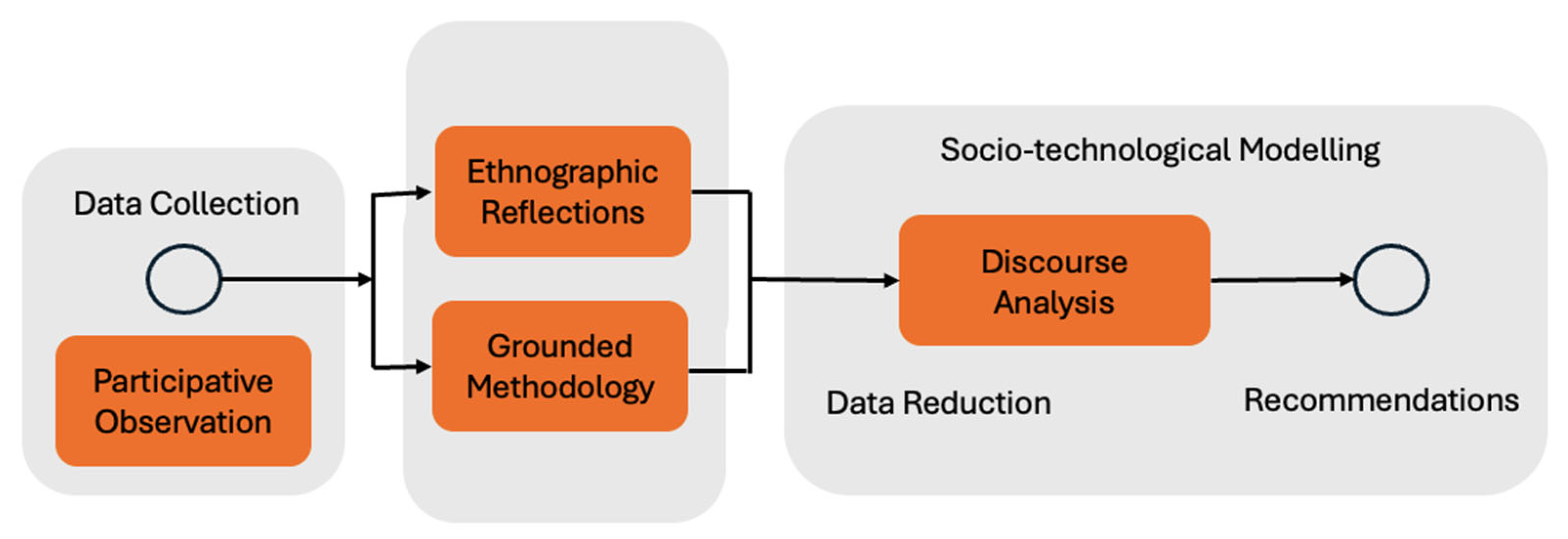
Figure 1. General research design of the Jamaica case study (after Miles and Huberman, 1984 [30] and Osejo-Bucheli, 2024 [26]). Data was collected through interactive and participatory observation. Ethnographic reflections and grounded theory provided the framework for collection of data, including terms, statements, and reflective sentiments. The data were coded and analyzed using discourse analysis, then reduced and summarized based on a sociotechnological perspective. The results of the discourse analysis included sentiments surrounding the challenges and recommendations that were identified during the participatory sessions.
Ijgi 14 00485 g001
Table 1. Data collection according to the observational setting. All observational settings were participatory (i.e., included the authors). n = number of sessions. Subcategories shown are a representative subset of the original 48 code categories.
Observational Settings (n)Data Collection SourcesFirst Order Themes and Subcategories
(Code Categories)
facilitated in-person workshops (2)Presentations, group discussion transcripts, and reports; terms, statements, and sentiment analysis.Governance:
  • local and regional knowledge
  • local risk ownership
  • cross-sector coordination
  • policy informed by climate science
  • policy integrated with climate science
  • DRR system design strategies
Technological Considerations:
  • local and regional policy, science, and urban development expertise
  • Earth observation and climate science capacities
  • data access, financing, and sustainability constraints
  • technological localization
  • academic and in-country science policy advisory mechanisms
  • science and technology autonomy
Role of International Partners:
  • project permanence (legacy)
  • sustainable partnership needs
  • climate justice mechanisms
  • pre-project development needs
  • international science policy advisors
internal team meetings and listening sessions (10)Team meeting notes and transcripts; terms, statements, and sentiment analysis.
facilitated dialogue with national and international actors (6)Meeting notes and transcripts; terms, statements, and sentiment analysis.
conference sessions (1)Presentation and question and answer period; terms, statements, and sentiment analysis.
Table 2. Data structure that emerged from the Jamaica case study findings. Demonstrative quotes from participants are provided. EO = Earth observation; DRR = disaster risk reduction; EWS = early warning system; LAC = Latin American and Caribbean; FOSS = free and open source; DST = decision-support tool. * New Urban Agenda (NUA) guides how cities are planned and managed to become more inclusive, resilient, and sustainable, thereby accelerating progress toward the SDGs (particularly SDG 11, “Sustainable Cities and Communities”) and the Sendai Framework’s goal of reducing disaster losses.
First-Order ThemesSecond-Order ThemesKey Emergent Messages
Governance and coordinationGeo-enabled governing bodiesEnhance integration of geospatial tools and EO data to support peer-to-peer knowledge sharing, policy training and implementation, and sustainable data partnerships for decision-makers.
“…training is necessary at the community level as well as for decision-makers [at the local to federal levels], so the stakeholders can be involved and that policymakers understand the importance of financing data streams in a broad and relevant approach. EO data and local data collection is working from a foundation and building on this will produce an effective response.”
“…policy adaptations need to be couched within existing frameworks, with greater inter-agency collaborations for disaster damage and loss reporting…there is a need to increase the interoperability and utility of data systems among policymakers.”
Bottom-to-top governance feedback loopsEstablish reflexive governance systems linking community-level risk information and ownership to regional and national DRR policy.
“…models [are needed] that prioritize relationship and human and technological capacity-building focus on the full social value chain, local-to-government implementation and response with practical application…”
“…bottom-to-top: community use, input, and response feeding into local, regional, agency-level DRR response mechanisms, and eventually governmental policy [are needed]…”
Cross-sector coordination and ownershipPromote data-sharing networks between government, academia, and community organizations for coherent DRR actions.
“What they [stakeholders] can benefit from is coordination. The most critical level is the most granular level.”
Technological Considerations and climate science: sustainability and financingInternational commitments for in-country investmentsStrengthen long-term technical partnerships for EO and climate forecasting, with rolling investments in hardware, software, and training to build local autonomy.
“For low-middle income countries, it is clear that we cannot rely on government finances alone to tackle the immense issues”
“A persistent challenge is that once communities have access to technologies, and this is true in academia and government, there is no consistent funding avenues for software and hardware updates…that renders them unusable over time.”
Financing for in-county EO climate scienceCreate permanent funding mechanisms for maintaining local EO data centers that inform climate adaptation and EWSs and make climate data free and accessible.
“…working with the UN in coordinating disaster response in LAC…to understand how to create better response, [from this, I am] a big believer of FOSS and sharing data, regardless of where it is from. We need to convince owners of data [major international space agencies and private companies] that it is more valuable shared.”
Support for in-country climate and DRR-related scientistsProvide resources for in-country science policy roles and for national experts to develop, host, and manage DSTs that integrate local knowledge and climate data.
“Climate data portals, and beyond this, to go toward adaptation…and meet the accessibility gap, we now recommend moving toward open access, not just to pool resources and make linkages to existing tools methodologies, but locally developed tools.”
International partnerships and global-scale commitments Scientists as “brokers”Establish dedicated international liaison roles that connect scientific data with global policy frameworks, ensuring actionable and coherent uptake of climate information.
“Translation—it is needed for the breakdown that happens at the end of the data value chain.”
“At our [academic] Center, we are working with groups to communicate science between sectors—this is sustainability in academia. We do the translation for policy, working in DRR that includes the human dimension. We are the translators who know both worlds. Resilience is the main goal, and we work under UN, Sendai, and SDGs to bring together government, society, and academia.”
Collaborative co-development modelsNecessity for international projects to include “pre-project” listening sessions and co-design phases for equitable participation and focus on localization.
“Co-production model for EWS and DRR response between academia, government, and communities for the New Urban Agenda * under climate and working with Municipalities has been the effective approach to identifying risk. We have recommended this model for Alert Systems…we recommend co-design and project planning before implementation for EWS for floods and landslides, which includes capacity building, involving women (providing childcare to help them get involved), and with Mayor’s offices to educate and train them on the tools available.”
Long-term partnerships and international support mechanismsInternational advocacy and commitments must extend beyond project cycles, instilling trust and ensuring continuity in data, capacity, and trust-building.
“What is actionable on-the-ground for resiliency, relying on good data infrastructure, and sustainable data partnerships that meet the current significant gaps”
Disclaimer/Publisher’s Note: The statements, opinions and data contained in all publications are solely those of the individual author(s) and contributor(s) and not of MDPI and/or the editor(s). MDPI and/or the editor(s) disclaim responsibility for any injury to people or property resulting from any ideas, methods, instructions or products referred to in the content.


