Unraveling the Link: Ferroptosis and Its Implications in Cerebrovascular Diseases

 and
and
Abstract
1. Introduction
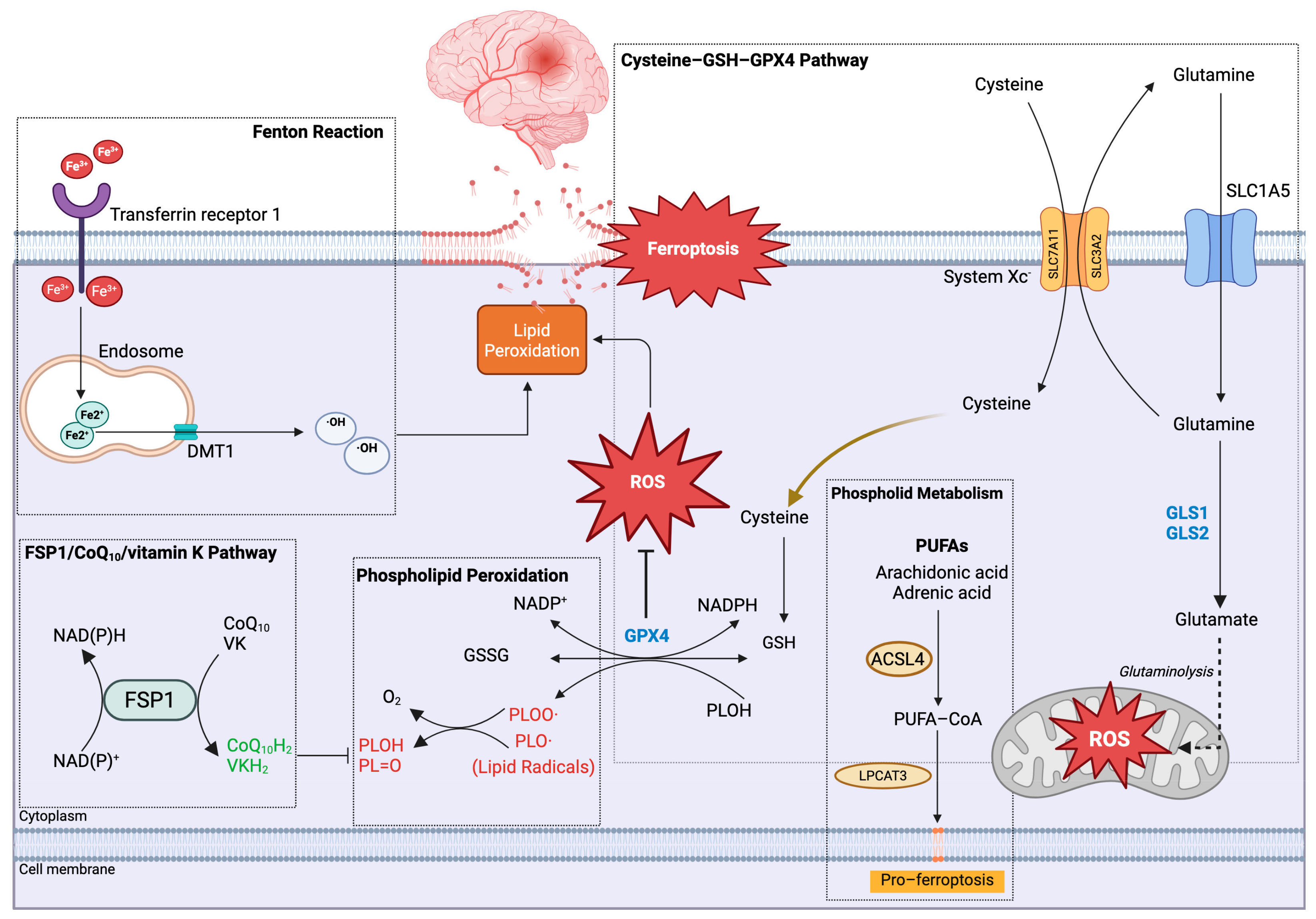
2. The Cellular Metabolic Mechanisms of Ferroptosis
2.1. Metabolism of Iron
2.2. Metabolism of Lipid Peroxide
2.3. Regulation of Ferroptosis by the System Xc−-GSH-GPX4 Antioxidant Axis
2.4. Context-Dependent Regulation of Ferroptosis by p53
3. Ferroptosis Detection in Neurovascular Disease
3.1. Detection of Cell Death
3.2. Detection of Lipid Peroxidation
3.3. Detection of Ferroptosis-Related Protein
3.4. Neuroimaging Detection of Iron
4. Ferroptosis in Intracerebral Hemorrhage
5. Ferroptosis in Atherosclerosis
6. Ferroptosis in Ischemic Stroke
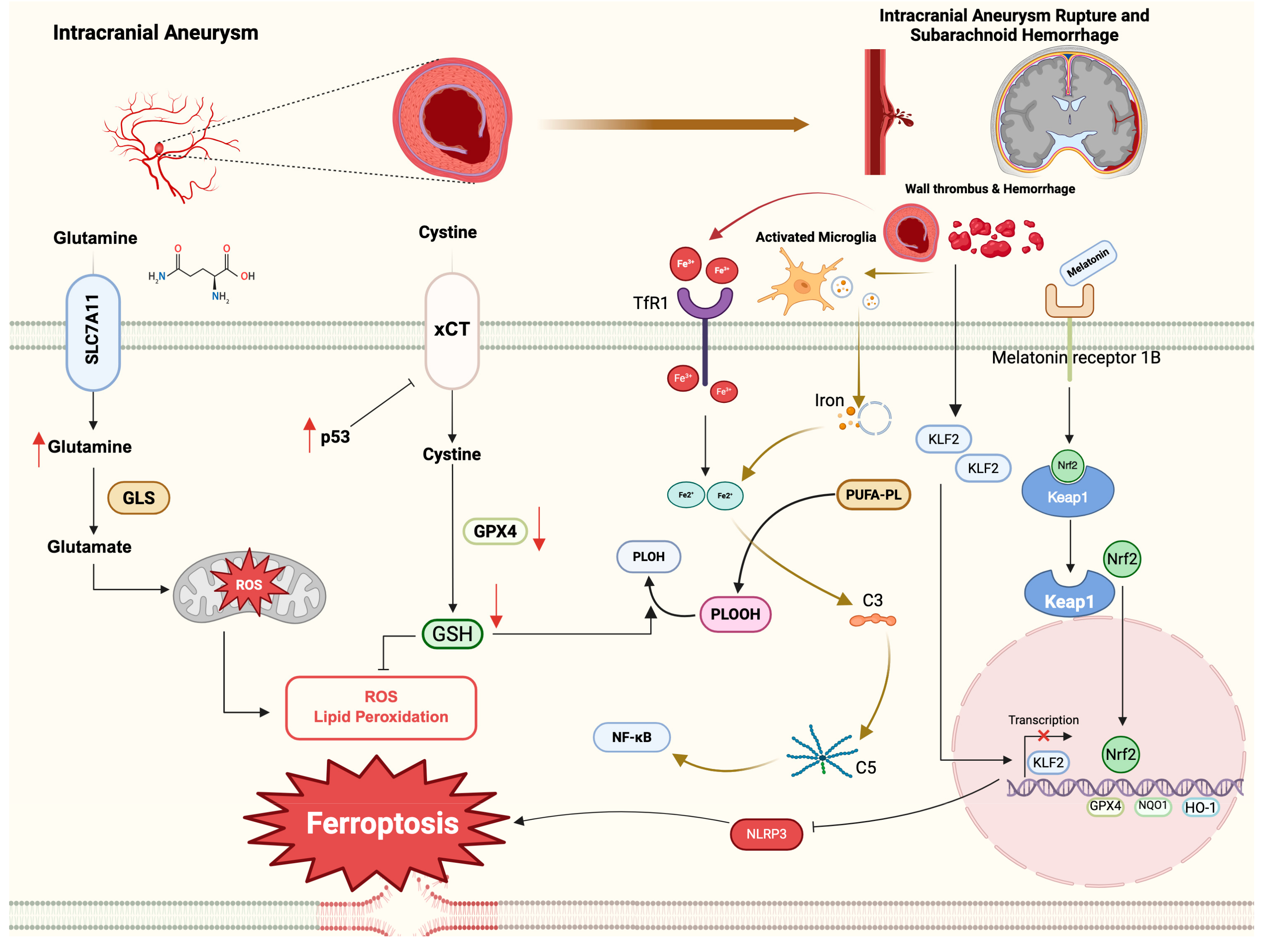
7. Ferroptosis in Intracranial Aneurysm and Subarachnoid Hemorrhage

| References | Study Types | Samples | Molecular Mechanism(s)/Impact on Intracranial Aneurysm |
|---|---|---|---|
| Matsushige et al., 2023 [121] | Clinical prospective study | Human IA samples | 7T MRI demonstrates microstructural remodeling of giant aneurysm walls, characterized by thrombus organization, repeated intramural hemorrhage, and intramural iron deposition, suggesting iron-driven pathological progression. |
| Rodemerk et al., 2020 [123] | Clinical prospective study | Human IA samples | Iron deposition within the aneurysm wall is positively correlated with the expression of the ferroptosis marker COX-2; low-intensity MRI signals may serve as a noninvasive indicator of aneurysm wall inflammation. |
| Li et al., 2022 [124] | Bioinformatics analysis | Four GEO dataset from IA patients | A total of 28 differentially expressed ferroptosis-related genes were identified, leading to the development of a potential intracranial aneurysm diagnostic model incorporating MT3, CDKN1A, ZFP69B, and ABCC1. |
| Zhu et al., 2022 [125] | Bioinformatics analysis and Clinical pathology | Two GEO datasets from IA patients | Construction of an intracranial aneurysm–associated ferroptosis-related ceRNA network revealed PVT1/hsa-miR-4644/SLC39A14 and DUXAP8/hsa-miR-378e/378f/SLC2A3 as key regulatory axes |
| Fang et al., 2025 [146] | Animal study | Human brain vascular smooth muscle cells | KLF15 is involved in the inhibition of vascular smooth muscle cell ferroptosis through interaction with p53 and regulation of SLC7A11 transcription. |
| Wu et al., 2025 [147] | Clinical prospective observational study | Blood samples from IA patients | Serum ferroptosis markers, characterized by elevated ACSL4 and reduced GPX4 levels, are significantly associated with poor outcomes after intracranial aneurysm rupture and with systemic inflammatory responses. |
| Ji et al., 2024 [148] | Bioinformatics analysis | single-cell RNA sequencing datasets of both human and murine models | A proinflammatory neutrophil subpopulation (Neu-3) was identified, revealing that neutrophils induce vascular smooth muscle cell ferroptosis via the ALOX5AP/PTGS2 pathway. |
8. Conclusions and Future Directions
Author Contributions
Funding
Institutional Review Board Statement
Informed Consent Statement
Data Availability Statement
Acknowledgments
Conflicts of Interest
References
- Dixon, S.J.; Lemberg, K.M.; Lamprecht, M.R.; Skouta, R.; Zaitsev, E.M.; Gleason, C.E.; Patel, D.N.; Bauer, A.J.; Cantley, A.M.; Yang, W.S.; et al. Ferroptosis: An Iron-Dependent Form of Nonapoptotic Cell Death. Cell 2012, 149, 1060–1072. [Google Scholar] [CrossRef] [PubMed]
- Li, J.; Cao, F.; Yin, H.; Huang, Z.; Lin, Z.; Mao, N.; Sun, B.; Wang, G. Ferroptosis: Past, Present and Future. Cell Death Dis. 2020, 11, 88. [Google Scholar] [CrossRef] [PubMed]
- Yao, Z.; Jiao, Q.; Du, X.; Jia, F.; Chen, X.; Yan, C.; Jiang, H. Ferroptosis in Parkinson’s Disease—The Iron-Related Degenerative Disease. Ageing Res. Rev. 2024, 101, 102477. [Google Scholar] [CrossRef] [PubMed]
- Song, S.; Su, Z.; Kon, N.; Chu, B.; Li, H.; Jiang, X.; Luo, J.; Stockwell, B.R.; Gu, W. ALOX5-Mediated Ferroptosis Acts as a Distinct Cell Death Pathway upon Oxidative Stress in Huntington’s Disease. Genes Dev. 2023, 37, 204–217. [Google Scholar] [CrossRef]
- Wang, Q.; Wang, W.; Zhu, H.; Huang, Y.; Huang, R.; Yang, Y.; Liao, Y. Mechanisms of Naozhenning in Inhibiting Neuronal Ferroptosis and Alleviating Brain Recurrent Mild Traumatic Brain Injury in a Rat Model. Phytomedicine 2025, 150, 157637. [Google Scholar] [CrossRef]
- Jiang, T.; Ma, W.; Dong, W.; Zhou, H.; Mao, X. Ferroptosis-Associated Transcriptional Factors in Neurological Diseases: Molecular Mechanisms and Therapeutic Prospects. Exp. Mol. Med. 2025, 57, 2763–2781. [Google Scholar] [CrossRef]
- Krishnamurthi, R.V.; Ikeda, T.; Feigin, V.L. Global, Regional and Country-Specific Burden of Ischaemic Stroke, Intracerebral Haemorrhage and Subarachnoid Haemorrhage: A Systematic Analysis of the Global Burden of Disease Study 2017. Neuroepidemiology 2020, 54, 171–179. [Google Scholar] [CrossRef]
- Candelaria, P.V.; Leoh, L.S.; Penichet, M.L.; Daniels-Wells, T.R. Antibodies Targeting the Transferrin Receptor 1 (TfR1) as Direct Anti-Cancer Agents. Front. Immunol. 2021, 12, 607692. [Google Scholar] [CrossRef]
- Harrison, P.M.; Arosio, P. The Ferritins: Molecular Properties, Iron Storage Function and Cellular Regulation. Biochim. Biophys. Acta (BBA)-Bioenerg. 1996, 1275, 161–203. [Google Scholar] [CrossRef]
- Drakesmith, H.; Nemeth, E.; Ganz, T. Ironing out Ferroportin. Cell Metab. 2015, 22, 777–787. [Google Scholar] [CrossRef]
- He, Y.-J.; Liu, X.-Y.; Xing, L.; Wan, X.; Chang, X.; Jiang, H.-L. Fenton Reaction-Independent Ferroptosis Therapy via Glutathione and Iron Redox Couple Sequentially Triggered Lipid Peroxide Generator. Biomaterials 2020, 241, 119911. [Google Scholar] [CrossRef]
- Dyall, S.C.; Balas, L.; Bazan, N.G.; Brenna, J.T.; Chiang, N.; da Costa Souza, F.; Dalli, J.; Durand, T.; Galano, J.-M.; Lein, P.J.; et al. Polyunsaturated Fatty Acids and Fatty Acid-Derived Lipid Mediators: Recent Advances in the Understanding of Their Biosynthesis, Structures, and Functions. Prog. Lipid Res. 2022, 86, 101165. [Google Scholar] [CrossRef]
- Jia, B.; Li, J.; Song, Y.; Luo, C. ACSL4-Mediated Ferroptosis and Its Potential Role in Central Nervous System Diseases and Injuries. Int. J. Mol. Sci. 2023, 24, 10021. [Google Scholar] [CrossRef]
- Glasauer, A.; Chandel, N.S. ROS. Curr. Biol. 2013, 23, R100–R102. [Google Scholar] [CrossRef] [PubMed]
- Parker, J.L.; Deme, J.C.; Kolokouris, D.; Kuteyi, G.; Biggin, P.C.; Lea, S.M.; Newstead, S. Molecular Basis for Redox Control by the Human Cystine/Glutamate Antiporter System Xc−. Nat. Commun. 2021, 12, 7147. [Google Scholar] [CrossRef] [PubMed]
- Ursini, F.; Maiorino, M. Lipid Peroxidation and Ferroptosis: The Role of GSH and GPx4. Free Radic. Biol. Med. 2020, 152, 175–185. [Google Scholar] [CrossRef] [PubMed]
- Kastenhuber, E.R.; Lowe, S.W. Putting P53 in Context. Cell 2017, 170, 1062–1078. [Google Scholar] [CrossRef]
- Maillet, A.; Pervaiz, S. Redox Regulation of P53, Redox Effectors Regulated by P53: A Subtle Balance. Antioxid. Redox Signal 2012, 16, 1285–1294. [Google Scholar] [CrossRef]
- Jiang, L.; Kon, N.; Li, T.; Wang, S.-J.; Su, T.; Hibshoosh, H.; Baer, R.; Gu, W. Ferroptosis as a P53-Mediated Activity during Tumour Suppression. Nature 2015, 520, 57–62. [Google Scholar] [CrossRef]
- Ma, W.-Q.; Sun, X.-J.; Zhu, Y.; Liu, N.-F. Metformin Attenuates Hyperlipidaemia-Associated Vascular Calcification through Anti-Ferroptotic Effects. Free Radic. Biol. Med. 2021, 165, 229–242. [Google Scholar] [CrossRef]
- Chu, B.; Kon, N.; Chen, D.; Li, T.; Liu, T.; Jiang, L.; Song, S.; Tavana, O.; Gu, W. ALOX12 Is Required for P53-Mediated Tumour Suppression through a Distinct Ferroptosis Pathway. Nat. Cell Biol. 2019, 21, 579–591. [Google Scholar] [CrossRef]
- Shi, W.; Yuan, S.; Cheng, G.; Zhang, H.; Liu, K.J.; Ji, X.; Du, L.; Qi, Z. Blood Brain Barrier-Targeted Lipid Nanoparticles Improved the Neuroprotection of Ferrostatin-1 against Cerebral Ischemic Damage in an Experimental Stroke Model. Exp. Neurol. 2024, 379, 114849. [Google Scholar] [CrossRef] [PubMed]
- Dixon, S.J.; Lee, M.J. Quick Tips for Interpreting Cell Death Experiments. Nat. Cell Biol. 2023, 25, 1720–1723. [Google Scholar] [CrossRef] [PubMed]
- Mishima, E.; Ito, J.; Wu, Z.; Nakamura, T.; Wahida, A.; Doll, S.; Tonnus, W.; Nepachalovich, P.; Eggenhofer, E.; Aldrovandi, M.; et al. A Non-Canonical Vitamin K Cycle Is a Potent Ferroptosis Suppressor. Nature 2022, 608, 778–783. [Google Scholar] [CrossRef] [PubMed]
- Piatti, L.; Batzilla, A.; Nakaki, F.; Fleckenstein, H.; Korbmacher, F.; Long, R.K.M.; Schraivogel, D.; Hawkins, J.A.; Romero-Uruñuela, T.; López-Gutiérrez, B.; et al. Plasmodium Falciparum Egress Disrupts Endothelial Junctions and Activates JAK-STAT Signaling in a Microvascular 3D Blood-Brain Barrier Model. Nat. Commun. 2025, 16, 7262. [Google Scholar] [CrossRef]
- Ubellacker, J.M.; Tasdogan, A.; Ramesh, V.; Shen, B.; Mitchell, E.C.; Martin-Sandoval, M.S.; Gu, Z.; McCormick, M.L.; Durham, A.B.; Spitz, D.R.; et al. Lymph Protects Metastasizing Melanoma Cells from Ferroptosis. Nature 2020, 585, 113–118. [Google Scholar] [CrossRef]
- Criscuolo, A.; Nepachalovich, P.; Garcia-del Rio, D.F.; Lange, M.; Ni, Z.; Baroni, M.; Cruciani, G.; Goracci, L.; Blüher, M.; Fedorova, M. Analytical and Computational Workflow for In-Depth Analysis of Oxidized Complex Lipids in Blood Plasma. Nat. Commun. 2022, 13, 6547. [Google Scholar] [CrossRef]
- Mishima, E.; Nakamura, T.; Doll, S.; Proneth, B.; Fedorova, M.; Pratt, D.A.; Friedmann Angeli, J.P.; Dixon, S.J.; Wahida, A.; Conrad, M. Recommendations for Robust and Reproducible Research on Ferroptosis. Nat. Rev. Mol. Cell Biol. 2025, 26, 615–630. [Google Scholar] [CrossRef]
- Wiernicki, B.; Dubois, H.; Tyurina, Y.Y.; Hassannia, B.; Bayir, H.; Kagan, V.E.; Vandenabeele, P.; Wullaert, A.; Vanden Berghe, T. Excessive Phospholipid Peroxidation Distinguishes Ferroptosis from Other Cell Death Modes Including Pyroptosis. Cell Death Dis. 2020, 11, 922. [Google Scholar] [CrossRef]
- Seibt, T.M.; Proneth, B.; Conrad, M. Role of GPX4 in Ferroptosis and Its Pharmacological Implication. Free Radic. Biol. Med. 2019, 133, 144–152. [Google Scholar] [CrossRef]
- Nakamura, T.; Ito, J.; Mourão, A.S.D.; Wahida, A.; Nakagawa, K.; Mishima, E.; Conrad, M. A Tangible Method to Assess Native Ferroptosis Suppressor Activity. Cell Rep. Methods 2024, 4, 100710. [Google Scholar] [CrossRef]
- Jiang, Z.; Yang, H.; Ni, W.; Gao, X.; Pei, X.; Jiang, H.; Su, J.; Weng, R.; Fei, Y.; Gao, Y.; et al. Attenuation of Neuronal Ferroptosis in Intracerebral Hemorrhage by Inhibiting HDAC1/2: Microglial Heterogenization via the Nrf2/HO1 Pathway. CNS Neurosci. Ther. 2024, 30, e14646. [Google Scholar] [CrossRef]
- Li, L.; Cao, Y.; Zhang, X.; Guo, J.; Lin, Z.; Zhou, P.; Chen, C.; Chen, J.; Liu, Y.; Luo, D.; et al. Injectable ROS Homeostasis Protective Hydrogel Inhibiting Microglial Ferroptosis through the Nrf2/Slc7a11/Gpx4 to Alleviate Neuropathic Pain and Promote Spinal Cord Injury Repair. Redox Biol. 2025, 86, 103816. [Google Scholar] [CrossRef] [PubMed]
- Kruer, M.C.; Boddaert, N.; Schneider, S.A.; Houlden, H.; Bhatia, K.P.; Gregory, A.; Anderson, J.C.; Rooney, W.D.; Hogarth, P.; Hayflick, S.J. Neuroimaging Features of Neurodegeneration with Brain Iron Accumulation. AJNR Am. J. Neuroradiol. 2012, 33, 407–414. [Google Scholar] [CrossRef] [PubMed]
- Yilmaz, A.; Budak, H.; Longo, R. Paramagnetic Contribution of Serum Iron to the Spin-Lattice Relaxation Rate (1/T1) Determined by MRI. Appl. Magn. Reson. 1998, 14, 51–58. [Google Scholar] [CrossRef]
- Li, L.; Leigh, J.S. Quantifying Arbitrary Magnetic Susceptibility Distributions with MR. Magn. Reson. Med. 2004, 51, 1077–1082. [Google Scholar] [CrossRef]
- Bilgic, B.; Pfefferbaum, A.; Rohlfing, T.; Sullivan, E.V.; Adalsteinsson, E. MRI Estimates of Brain Iron Concentration in Normal Aging Using Quantitative Susceptibility Mapping. Neuroimage 2012, 59, 2625–2635. [Google Scholar] [CrossRef]
- Chen, Y.; Li, M.; Li, J.; Gao, Y.; Sui, C.; Wang, N.; Zhang, X.; Wang, Y.; Cheng, Z.; Liang, P.; et al. Microstructural Changes in the Caudate Nucleus and Hippocampus and Their Association with Cognitive Function in Cerebral Small Vessel Disease: A Quantitative Susceptibility Mapping Study. Neurobiol. Dis. 2025, 212, 106964. [Google Scholar] [CrossRef]
- Chen, Y.; Li, M.; Li, J.; Liang, P.; Cheng, Z.; Wang, N.; Zhang, X.; Wang, Y.; Zhang, N.; Che, Y.; et al. Associations of Neurodegenerative Proteins with Brain Iron Deposition and Cognition in Cerebral Small Vessel Disease: A Quantitative Susceptibility Mapping and Plasma Biomarker Study. Alzheimer’s Dement. 2025, 21, e70710. [Google Scholar] [CrossRef]
- Chen, Y.; Ming, Y.; Ye, C.; Jiang, S.; Wu, J.; Wang, H.; Wu, K.; Zhang, S.; Wu, B.; Sun, J.; et al. Association between Iron Content in Grey Matter Nuclei and Functional Outcome in Patients with Acute Ischaemic Stroke: A Quantitative Susceptibility Mapping Study. Eur. J. Neurol. 2025, 32, e16531. [Google Scholar] [CrossRef]
- Wang, C.; Zhang, Y.; Du, J.; Huszár, I.N.; Liu, S.; Chen, Y.; Buch, S.; Wu, F.; Liu, Y.; Jenkinson, M.; et al. Quantitative Susceptibility Mapping for Characterization of Intraplaque Hemorrhage and Calcification in Carotid Atherosclerotic Disease. J. Magn. Reson. Imaging 2020, 52, 534–541. [Google Scholar] [CrossRef]
- Garton, T.; Keep, R.F.; Hua, Y.; Xi, G. Brain Iron Overload Following Intracranial Haemorrhage. Stroke Vasc. Neurol. 2016, 1, 172–184. [Google Scholar] [CrossRef]
- Sheth, K.N. Spontaneous Intracerebral Hemorrhage. N. Engl. J. Med. 2022, 387, 1589–1596. [Google Scholar] [CrossRef] [PubMed]
- Vasconcellos, L.R.C.; Martimiano, L.; Dantas, D.P.; Fonseca, F.M.; Mata-Santos, H.; Travassos, L.; Mendez-Otero, R.; Bozza, M.T.; Pimentel-Coelho, P.M. Intracerebral Injection of Heme Induces Lipid Peroxidation, Neuroinflammation, and Sensorimotor Deficits. Stroke 2021, 52, 1788–1797. [Google Scholar] [CrossRef] [PubMed]
- Li, Q.; Han, X.; Lan, X.; Gao, Y.; Wan, J.; Durham, F.; Cheng, T.; Yang, J.; Wang, Z.; Jiang, C.; et al. Inhibition of Neuronal Ferroptosis Protects Hemorrhagic Brain. JCI Insight 2017, 2, e90777. [Google Scholar] [CrossRef] [PubMed]
- Zille, M.; Karuppagounder, S.S.; Chen, Y.; Gough, P.J.; Bertin, J.; Finger, J.; Milner, T.A.; Jonas, E.A.; Ratan, R.R. Neuronal Death After Hemorrhagic Stroke In Vitro and In Vivo Shares Features of Ferroptosis and Necroptosis. Stroke 2017, 48, 1033–1043. [Google Scholar] [CrossRef]
- Chen, B.; Chen, Z.; Liu, M.; Gao, X.; Cheng, Y.; Wei, Y.; Wu, Z.; Cui, D.; Shang, H. Inhibition of Neuronal Ferroptosis in the Acute Phase of Intracerebral Hemorrhage Shows Long-Term Cerebroprotective Effects. Brain Res. Bull. 2019, 153, 122–132. [Google Scholar] [CrossRef]
- Xie, J.; Lv, H.; Liu, X.; Xia, Z.; Li, J.; Hong, E.; Ding, B.; Zhang, W.; Chen, Y. Nox4-and Tf/TfR-Mediated Peroxidation and Iron Overload Exacerbate Neuronal Ferroptosis after Intracerebral Hemorrhage: Involvement of EAAT3 Dysfunction. Free Radic. Biol. Med. 2023, 199, 67–80. [Google Scholar] [CrossRef]
- Xie, G.; Liang, Y.; Gao, W.; Wu, L.; Zhang, Y.; Ye, Z.; Qin, C. Artesunate Alleviates Intracerebral Haemorrhage Secondary Injury by Inducing Ferroptosis in M1-Polarized Microglia and Suppressing Inflammation Through AMPK/mTORC1/GPX4 Pathway. Basic Clin. Pharmacol. Toxicol. 2023, 132, 369–383. [Google Scholar] [CrossRef]
- Radermacher, K.A.; Wingler, K.; Langhauser, F.; Altenhöfer, S.; Kleikers, P.; Hermans, J.J.R.; Hrabě de Angelis, M.; Kleinschnitz, C.; Schmidt, H.H.H.W. Neuroprotection After Stroke by Targeting NOX4 as a Source of Oxidative Stress. Antioxid. Redox Signal. 2013, 18, 1418–1427. [Google Scholar] [CrossRef]
- Cheng, Y.; Zhang, Z.; Tang, H.; Chen, B.; Cai, Y.; Wei, Y.; Zhao, W.; Wu, Z.B.; Shang, H. Mitochondrial Inhibitor Rotenone Triggers and Enhances Neuronal Ferroptosis Following Intracerebral Hemorrhage. ACS Chem. Neurosci. 2023, 14, 1071–1079. [Google Scholar] [CrossRef] [PubMed]
- Xiao, Z.; Shen, D.; Lan, T.; Wei, C.; Wu, W.; Sun, Q.; Luo, Z.; Chen, W.; Zhang, Y.; Hu, L.; et al. Reduction of Lactoferrin Aggravates Neuronal Ferroptosis After Intracerebral Hemorrhagic Stroke in Hyperglycemic Mice. Redox Biol. 2022, 50, 102256. [Google Scholar] [CrossRef] [PubMed]
- Liu, M.-J.; Zhao, X.-C.; Gong, H.-S.; You, Y.-Q.; Li, J.-Y. Dexmedetomidine Prevents Hemorrhagic Brain Injury by Reducing Damage Induced by Ferroptosis in Mice. Neurosci. Lett. 2022, 788, 136842. [Google Scholar] [CrossRef] [PubMed]
- Karuppagounder, S.S.; Alim, I.; Khim, S.J.; Bourassa, M.W.; Sleiman, S.F.; John, R.; Thinnes, C.C.; Yeh, T.-L.; Demetriades, M.; Neitemeier, S.; et al. Therapeutic Targeting of Oxygen-Sensing Prolyl Hydroxylases Abrogates ATF4-Dependent Neuronal Death and Improves Outcomes After Brain Hemorrhage in Several Rodent Models. Sci. Transl. Med. 2016, 8, 328ra29. [Google Scholar] [CrossRef]
- Alim, I.; Caulfield, J.T.; Chen, Y.; Swarup, V.; Geschwind, D.H.; Ivanova, E.; Seravalli, J.; Ai, Y.; Sansing, L.H.; Ste.Marie, E.J.; et al. Selenium Drives a Transcriptional Adaptive Program to Block Ferroptosis and Treat Stroke. Cell 2019, 177, 1262–1279.e25. [Google Scholar] [CrossRef]
- Li, X.-N.; Lin, L.; Li, X.-W.; Zhu, Q.; Xie, Z.-Y.; Hu, Y.-Z.; Long, Q.-S.; Wei, X.-B.; Wen, Y.-Q.; Zhang, L.-Y.; et al. BSA-Stabilized Selenium Nanoparticles Ameliorate Intracerebral Hemorrhage’s-like Pathology by Inhibiting Ferroptosis-Mediated Neurotoxicology via Nrf2/GPX4 Axis Activation. Redox Biol. 2024, 75, 103268. [Google Scholar] [CrossRef]
- Tian, R.; Ma, H.; Ren, J.; Li, Y.; Zhang, Z.; Xu, Z.; He, L.; Zhu, C.; Xu, J.; Yu, S.; et al. Selenium-Containing Nanoscale Hydrogen-Bonded Organic Framework Nanozymes for Multienzyme Cascade Antioxidant-Targeted Therapy of Cerebral Ischemia-Reperfusion Injury. ACS Nano 2026, 20, 2435–2450. [Google Scholar] [CrossRef]
- Jin, Z.-L.; Gao, W.-Y.; Liao, S.-J.; Yu, T.; Shi, Q.; Yu, S.-Z.; Cai, Y.-F. Paeonol Inhibits the Progression of Intracerebral Haemorrhage by Mediating the HOTAIR/UPF1/ACSL4 Axis. ASN Neuro 2021, 13, 17590914211010647. [Google Scholar] [CrossRef]
- Wang, F.; Li, W.; Shen, L.; Jiang, T.; Xia, J.; You, D.; Hu, S.; Wang, L.; Wu, X. Crocin Alleviates Intracerebral Hemorrhage–Induced Neuronal Ferroptosis by Facilitating Nrf2 Nuclear Translocation. Neurotox. Res. 2022, 40, 596–604. [Google Scholar] [CrossRef]
- Zhang, Y.; Zhang, X.; Wee Yong, V.; Xue, M. Vildagliptin Improves Neurological Function by Inhibiting Apoptosis and Ferroptosis Following Intracerebral Hemorrhage in Mice. Neurosci. Lett. 2022, 776, 136579. [Google Scholar] [CrossRef]
- Diao, X.; Cui, Q.; Tian, N.; Zhou, Z.; Xiang, W.; Jiang, Y.; Deng, J.; Liao, H.; Lin, X.; Li, Q.; et al. Hemorrhage-Induced Sphingosine Kinase 1 Contributes to Ferroptosis-Mediated Secondary Brain Injury in Intracerebral Hemorrhage. Mol. Neurobiol. 2022, 59, 1381–1397. [Google Scholar] [CrossRef] [PubMed]
- Qureshi, A.I.; Caplan, L.R. Intracranial Atherosclerosis. Lancet 2014, 383, 984–998. [Google Scholar] [CrossRef] [PubMed]
- Boulouis, G.; Charidimou, A.; Auriel, E.; Haley, K.E.; van Etten, E.S.; Fotiadis, P.; Reijmer, Y.; Ayres, A.; Schwab, K.M.; Martinez-Ramirez, S.; et al. Intracranial Atherosclerosis and Cerebral Small Vessel Disease in Intracerebral Hemorrhage Patients. J. Neurol. Sci. 2016, 369, 324–329. [Google Scholar] [CrossRef] [PubMed]
- Fu, Z.; Yang, S.; Chang, X.; Liu, P.; Wang, Y. Vascular Smooth Muscle Cell Metabolic Reprogramming and Phenotypic Remodeling in Atherosclerosis. Cell Death Discov. 2025, 12, 64. [Google Scholar] [CrossRef]
- Dimmeler, S.; Haendeler, J.; Zeiher, A.M. Regulation of Endothelial Cell Apoptosis in Atherothrombosis. Curr. Opin. Lipidol. 2002, 13, 531–536. [Google Scholar] [CrossRef]
- Tricot, O.; Mallat, Z.; Heymes, C.; Belmin, J.; Lesèche, G.; Tedgui, A. Relation Between Endothelial Cell Apoptosis and Blood Flow Direction in Human Atherosclerotic Plaques. Circulation 2000, 101, 2450–2453. [Google Scholar] [CrossRef]
- Smith, C.; Mitchinson, M.J.; Aruoma, O.I.; Halliwell, B. Stimulation of Lipid Peroxidation and Hydroxyl-Radical Generation by the Contents of Human Atherosclerotic Lesions. Biochem. J. 1992, 286, 901–905. [Google Scholar] [CrossRef]
- Stadler, N.; Lindner, R.A.; Davies, M.J. Direct Detection and Quantification of Transition Metal Ions in Human Atherosclerotic Plaques: Evidence for the Presence of Elevated Levels of Iron and Copper. Arterioscler. Thromb. Vasc. Biol. 2004, 24, 949–954. [Google Scholar] [CrossRef]
- Delbosc, S.; Bayles, R.G.; Laschet, J.; Ollivier, V.; Ho-Tin-Noé, B.; Touat, Z.; Deschildre, C.; Morvan, M.; Louedec, L.; Gouya, L.; et al. Erythrocyte Efferocytosis by the Arterial Wall Promotes Oxidation in Early-Stage Atheroma in Humans. Front. Cardiovasc. Med. 2017, 4, 43. [Google Scholar] [CrossRef]
- Sakamoto, A.; Suwa, K.; Kawakami, R.; Finn, A.V.; Maekawa, Y.; Virmani, R.; Finn, A.V. Significance of Intra-Plaque Hemorrhage for the Development of High-Risk Vulnerable Plaque: Current Understanding from Basic to Clinical Points of View. Int. J. Mol. Sci. 2023, 24, 13298. [Google Scholar] [CrossRef]
- Halliwell, B.; Watt, F.; Minqin, R. Iron and Atherosclerosis: Lessons Learned from Rabbits Relevant to Human Disease. Free Radic. Biol. Med. 2023, 209, 165–170. [Google Scholar] [CrossRef] [PubMed]
- Davies, M.J.; Hawkins, C.L. The Role of Myeloperoxidase in Biomolecule Modification, Chronic Inflammation, and Disease. Antioxid. Redox Signal 2020, 32, 957–981. [Google Scholar] [CrossRef] [PubMed]
- Paumann-Page, M.; Ashby, L.V.; Khalilova, I.; Magon, N.J.; Hofbauer, S.; Paton, L.N.; Furtmüller, P.G.; Obinger, C.; Kettle, A.J. Hypochlorous Acid Inactivates Myeloperoxidase inside Phagocytosing Neutrophils. Redox Biochem. Chem. 2023, 5–6, 100008. [Google Scholar] [CrossRef]
- Kolodgie, F.D.; Gold, H.K.; Burke, A.P.; Fowler, D.R.; Kruth, H.S.; Weber, D.K.; Farb, A.; Guerrero, L.J.; Hayase, M.; Kutys, R.; et al. Intraplaque Hemorrhage and Progression of Coronary Atheroma. N. Engl. J. Med. 2003, 349, 2316–2325. [Google Scholar] [CrossRef]
- Evans, P.J.; Smith, C.; Mitchinson, M.J.; Halliwell, B. Metal Ion Release from Mechanically-Disrupted Human Arterial Wall. Implications for the Development of Atherosclerosis. Free Radic. Res. 1995, 23, 465–469. [Google Scholar] [CrossRef]
- Xu, T.; Cai, J.; Wang, L.; Xu, L.; Zhao, H.; Wang, F.; Meyron-Holtz, E.G.; Missirlis, F.; Qiao, T.; Li, K. Hormone Replacement Therapy for Postmenopausal Atherosclerosis is Offset by Late Age Iron Deposition. eLife 2023, 12, e80494. [Google Scholar] [CrossRef]
- Harel, S.; Salan, M.A.; Kanner, J. Iron Release from Metmyoglobin, Methaemoglobin and Cytochrome c by a System Generating Hydrogen Peroxide. Free Radic. Res. Commun. 1988, 5, 11–19. [Google Scholar] [CrossRef]
- Ayer, A.; Zarjou, A.; Agarwal, A.; Stocker, R. Heme Oxygenases in Cardiovascular Health and Disease. Physiol. Rev. 2016, 96, 1449–1508. [Google Scholar] [CrossRef]
- Sullivan, J.L. Iron and the Sex Difference in Heart Disease Risk. Lancet 1981, 1, 1293–1294. [Google Scholar] [CrossRef]
- Vinchi, F.; Porto, G.; Simmelbauer, A.; Altamura, S.; Passos, S.T.; Garbowski, M.; Silva, A.M.N.; Spaich, S.; Seide, S.E.; Sparla, R.; et al. Atherosclerosis Is Aggravated by Iron Overload and Ameliorated by Dietary and Pharmacological Iron Restriction. Eur. Heart J. 2020, 41, 2681–2695. [Google Scholar] [CrossRef]
- Ahluwalia, N.; Genoux, A.; Ferrieres, J.; Perret, B.; Carayol, M.; Drouet, L.; Ruidavets, J.-B. Iron Status Is Associated with Carotid Atherosclerotic Plaques in Middle-Aged Adults. J. Nutr. 2010, 140, 812–816. [Google Scholar] [CrossRef] [PubMed]
- Vinchi, F.; Muckenthaler, M.U.; Da Silva, M.C.; Balla, G.; Balla, J.; Jeney, V. Atherogenesis and Iron: From Epidemiology to Cellular Level. Front. Pharmacol. 2014, 5, 94. [Google Scholar] [CrossRef] [PubMed]
- Bai, T.; Li, M.; Liu, Y.; Qiao, Z.; Wang, Z. Inhibition of Ferroptosis Alleviates Atherosclerosis through Attenuating Lipid Peroxidation and Endothelial Dysfunction in Mouse Aortic Endothelial Cell. Free Radic. Biol. Med. 2020, 160, 92–102. [Google Scholar] [CrossRef] [PubMed]
- Liu, W.; Östberg, N.; Yalcinkaya, M.; Dou, H.; Endo-Umeda, K.; Tang, Y.; Hou, X.; Xiao, T.; Fidler, T.P.; Abramowicz, S.; et al. Erythroid Lineage Jak2V617F Expression Promotes Atherosclerosis through Erythrophagocytosis and Macrophage Ferroptosis. J. Clin. Investig. 2022, 132, 1–17. [Google Scholar] [CrossRef]
- You, J.; Ouyang, S.; Xie, Z.; Zhi, C.; Yu, J.; Tan, X.; Li, P.; Lin, X.; Ma, W.; Liu, Z.; et al. The Suppression of Hyperlipid Diet-Induced Ferroptosis of Vascular Smooth Muscle Cells Protests against Atherosclerosis Independent of P53/SCL7A11/GPX4 Axis. J. Cell. Physiol. 2023, 238, 1891–1908. [Google Scholar] [CrossRef]
- Xiang, P.; Chen, Q.; Chen, L.; Lei, J.; Yuan, Z.; Hu, H.; Lu, Y.; Wang, X.; Wang, T.; Yu, R.; et al. Metabolite Neu5Ac Triggers SLC3A2 Degradation Promoting Vascular Endothelial Ferroptosis and Aggravates Atherosclerosis Progression in ApoE−/−Mice. Theranostics 2023, 13, 4993–5016. [Google Scholar] [CrossRef]
- Meng, Z.; Liang, H.; Zhao, J.; Gao, J.; Liu, C.; Ma, X.; Liu, J.; Liang, B.; Jiao, X.; Cao, J.; et al. HMOX1 Upregulation Promotes Ferroptosis in Diabetic Atherosclerosis. Life Sci. 2021, 284, 119935. [Google Scholar] [CrossRef]
- Bao, X.; Luo, X.; Bai, X.; Lv, Y.; Weng, X.; Zhang, S.; Leng, Y.; Huang, J.; Dai, X.; Wang, Y.; et al. Cigarette Tar Mediates Macrophage Ferroptosis in Atherosclerosis through the Hepcidin/FPN/SLC7A11 Signaling Pathway. Free Radic. Biol. Med. 2023, 201, 76–88. [Google Scholar] [CrossRef]
- Zhou, Y.; Zhou, H.; Hua, L.; Hou, C.; Jia, Q.; Chen, J.; Zhang, S.; Wang, Y.; He, S.; Jia, E. Verification of Ferroptosis and Pyroptosis and Identification of PTGS2 as the Hub Gene in Human Coronary Artery Atherosclerosis. Free Radic. Biol. Med. 2021, 171, 55–68. [Google Scholar] [CrossRef]
- Caplan, L.R.; Liebeskind, D.S. Pathology, Anatomy, and Pathophysiology of Stroke. In Caplan’s Stroke: A Clinical Approach; Caplan, L.R., Ed.; Cambridge University Press: Cambridge, MA, USA, 2016; pp. 19–54. [Google Scholar]
- Gutierrez, J.; Turan, T.N.; Hoh, B.L.; Chimowitz, M.I. Intracranial Atherosclerotic Stenosis: Risk Factors, Diagnosis, and Treatment. Lancet Neurol. 2022, 21, 355–368. [Google Scholar] [CrossRef]
- Wang, Y.; Zhao, X.; Liu, L.; Soo, Y.O.Y.; Pu, Y.; Pan, Y.; Wang, Y.; Zou, X.; Leung, T.W.H.; Cai, Y.; et al. Prevalence and Outcomes of Symptomatic Intracranial Large Artery Stenoses and Occlusions in China: The Chinese Intracranial Atherosclerosis (CICAS) Study. Stroke 2014, 45, 663–669. [Google Scholar] [CrossRef] [PubMed]
- Dietrich, R.B.; Bradley, W.G. Iron Accumulation in the Basal Ganglia Following Severe Ischemic-Anoxic Insults in Children. Radiology 1988, 168, 203–206. [Google Scholar] [CrossRef] [PubMed]
- Millan, M.; Sobrino, T.; Castellanos, M.; Nombela, F.; Arenillas, J.F.; Riva, E.; Cristobo, I.; García, M.M.; Vivancos, J.; Serena, J.; et al. Increased Body Iron Stores Are Associated with Poor Outcome after Thrombolytic Treatment in Acute Stroke. Stroke 2007, 38, 90–95. [Google Scholar] [CrossRef] [PubMed]
- Bu, Z.-Q.; Yu, H.-Y.; Wang, J.; He, X.; Cui, Y.-R.; Feng, J.-C.; Feng, J. Emerging Role of Ferroptosis in the Pathogenesis of Ischemic Stroke: A New Therapeutic Target? ASN Neuro 2021, 13, 17590914211037505. [Google Scholar] [CrossRef]
- Yuan, C.; Chen, S.; Ruan, Y.; Liu, Y.; Cheng, H.; Zeng, Y.; Chen, Y.; Cheng, Q.; Huang, G.; He, W.; et al. The Stress Hyperglycemia Ratio is Associated with Hemorrhagic Transformation in Patients with Acute Ischemic Stroke. Clin. Interv. Aging 2021, 16, 431–442. [Google Scholar] [CrossRef]
- Liu, C.; Tian, Q.; Wang, J.; He, P.; Han, S.; Guo, Y.; Yang, C.; Wang, G.; Wei, H.; Li, M. Blocking P2RX7 Attenuates Ferroptosis in Endothelium and Reduces HG-Induced Hemorrhagic Transformation After MCAO by Inhibiting ERK1/2 and P53 Signaling Pathways. Mol. Neurobiol. 2023, 60, 460–479. [Google Scholar] [CrossRef]
- Wang, J.; Wu, N.; Peng, M.; Oyang, L.; Jiang, X.; Peng, Q.; Zhou, Y.; He, Z.; Liao, Q. Ferritinophagy: Research Advance and Clinical Significance in Cancers. Cell Death Discov. 2023, 9, 463. [Google Scholar] [CrossRef]
- Muralikrishna Adibhatla, R.; Hatcher, J.F. Phospholipase A2, Reactive Oxygen Species, and Lipid Peroxidation in Cerebral Ischemia. Free Radic. Biol. Med. 2006, 40, 376–387. [Google Scholar] [CrossRef]
- Lee, W.-C.; Wong, H.-Y.; Chai, Y.-Y.; Shi, C.-W.; Amino, N.; Kikuchi, S.; Huang, S.-H. Lipid Peroxidation Dysregulation in Ischemic Stroke: Plasma 4-HNE as a Potential Biomarker? Biochem. Biophys. Res. Commun. 2012, 425, 842–847. [Google Scholar] [CrossRef]
- Caso, J.R.; Pradillo, J.M.; Hurtado, O.; Lorenzo, P.; Moro, M.A.; Lizasoain, I. Toll-Like Receptor 4 Is Involved in Brain Damage and Inflammation After Experimental Stroke. Circulation 2007, 115, 1599–1608. [Google Scholar] [CrossRef]
- Chen, X.; Comish, P.B.; Tang, D.; Kang, R. Characteristics and Biomarkers of Ferroptosis. Front. Cell Dev. Biol. 2021, 9, 637162. [Google Scholar] [CrossRef]
- Yeh, S.-J.; Chen, C.-H.; Lin, Y.-H.; Tsai, L.-K.; Lee, C.-W.; Tang, S.-C.; Jeng, J.-S. Association of Ferroptosis with Severity and Outcomes in Acute Ischemic Stroke Patients Undergoing Endovascular Thrombectomy: A Case-Control Study. Mol. Neurobiol. 2023, 60, 5902–5914. [Google Scholar] [CrossRef] [PubMed]
- Álvarez-Cubero, M.J.; Cuenca-López, S.; Arenas-Rodríguez, V.; Estévez-López, F.; Martínez-González, L.J. Chapter 4—Genetics of Chronic Widespread Musculoskeletal Pain. In The Neurobiology, Physiology, and Psychology of Pain; Rajendram, R., Patel, V.B., Preedy, V.R., Martin, C.R., Eds.; Academic Press: Cambridge, MA, USA, 2022; pp. 33–44. [Google Scholar]
- Si, W.; Sun, B.; Luo, J.; Li, Z.; Dou, Y.; Wang, Q. Snap25 Attenuates Neuronal Injury via Reducing Ferroptosis in Acute Ischemic Stroke. Exp. Neurol. 2023, 367, 114476. [Google Scholar] [CrossRef] [PubMed]
- Du, Y.; Zhang, R.; Zhang, G.; Wu, H.; Zhan, S.; Bu, N. Downregulation of ELAVL1 Attenuates Ferroptosis-Induced Neuronal Impairment in Rats with Cerebral Ischemia/Reperfusion via Reducing DNMT3B-Dependent PINK1 Methylation. Metab. Brain Dis. 2022, 37, 2763–2775. [Google Scholar] [CrossRef] [PubMed]
- Xu, P.; Kong, L.; Tao, C.; Zhu, Y.; Cheng, J.; Li, W.; Shen, N.; Li, R.; Zhang, C.; Wang, L.; et al. Elabela-APJ Axis Attenuates Cerebral Ischemia/Reperfusion Injury by Inhibiting Neuronal Ferroptosis. Free Radic. Biol. Med. 2023, 196, 171–186. [Google Scholar] [CrossRef]
- Zhao, J.; Liu, Y.; Sun, W.; Li, W.; Xu, Z. KLHL8-Mediated Ubiquitination and TAX1BP1-Dependent Autophagic Degradation of GPX4 Drive Neuronal Ferroptosis. Free Radic. Biol. Med. 2025, 245, 374–389. [Google Scholar] [CrossRef]
- Liu, H.; Zhang, T.; Zhang, W.-Y.; Huang, S.-R.; Hu, Y.; Sun, J. Rhein Attenuates Cerebral Ischemia-Reperfusion Injury via Inhibition of Ferroptosis Through NRF2/SLC7A11/GPX4 Pathway. Exp. Neurol. 2023, 369, 114541. [Google Scholar] [CrossRef]
- Gao, J.; Ma, C.; Xia, D.; Chen, N.; Zhang, J.; Xu, F.; Li, F.; He, Y.; Gong, Q. Icariside II Preconditioning Evokes Robust Neuroprotection Against Ischaemic Stroke, by Targeting Nrf2 and the OXPHOS/NF-κB/Ferroptosis Pathway. Br. J. Pharmacol. 2023, 180, 308–329. [Google Scholar] [CrossRef]
- Feng, X.; Li, Y.; Wang, Y.; Li, L.; Little, P.J.; Xu, S.; Liu, S. Danhong Injection in Cardiovascular and Cerebrovascular Diseases: Pharmacological Actions, Molecular Mechanisms, and Therapeutic Potential. Pharmacol. Res. 2019, 139, 62–75. [Google Scholar] [CrossRef]
- Zhan, S.; Liang, J.; Lin, H.; Cai, J.; Yang, X.; Wu, H.; Wei, J.; Wang, S.; Xian, M. SATB1/SLC7A11/HO-1 Axis Ameliorates Ferroptosis in Neuron Cells After Ischemic Stroke by Danhong Injection. Mol. Neurobiol. 2023, 60, 413–427. [Google Scholar] [CrossRef]
- Wu, C.; Duan, F.; Yang, R.; Dai, Y.; Chen, X.; Li, S. 15, 16-Dihydrotanshinone I Protects against Ischemic Stroke by Inhibiting Ferroptosis via the Activation of Nuclear Factor Erythroid 2-Related Factor 2. Phytomedicine 2023, 114, 154790. [Google Scholar] [CrossRef]
- Myszka, K.; Schmidt, M.T.; Majcher, M.; Juzwa, W.; Czaczyk, K. β-Caryophyllene-Rich Pepper Essential Oils Suppress Spoilage Activity of Pseudomonas Fluorescens KM06 in Fresh-Cut Lettuce. LWT-Food Sci. Technol. 2017, 83, 118–126. [Google Scholar] [CrossRef]
- Dvaranauskaitė, A.; Venskutonis, P.R.; Raynaud, C.; Talou, T.; Viškelis, P.; Sasnauskas, A. Variations in the Essential Oil Composition in Buds of Six Blackcurrant (Ribes nigrum L.) Cultivars at Various Development Phases. Food Chem. 2009, 114, 671–679. [Google Scholar] [CrossRef]
- Gupta, A.D.; Bansal, V.K.; Babu, V.; Maithil, N. Chemistry, Antioxidant and Antimicrobial Potential of Nutmeg (Myristica fragrans Houtt). J. Genet. Eng. Biotechnol. 2013, 11, 25–31. [Google Scholar] [CrossRef]
- Hu, Q.; Zuo, T.; Deng, L.; Chen, S.; Yu, W.; Liu, S.; Liu, J.; Wang, X.; Fan, X.; Dong, Z. β-Caryophyllene Suppresses Ferroptosis Induced by Cerebral Ischemia Reperfusion via Activation of the NRF2/HO-1 Signaling Pathway in MCAO/R Rats. Phytomedicine 2022, 102, 154112. [Google Scholar] [CrossRef] [PubMed]
- Yang, W.; Liu, X.; Song, C.; Ji, S.; Yang, J.; Liu, Y.; You, J.; Zhang, J.; Huang, S.; Cheng, W.; et al. Structure-Activity Relationship Studies of Phenothiazine Derivatives as a New Class of Ferroptosis Inhibitors Together with the Therapeutic Effect in an Ischemic Stroke Model. Eur. J. Med. Chem. 2021, 209, 112842. [Google Scholar] [CrossRef]
- Kassell, N.F.; Torner, J.C.; Jane, J.A.; Haley, E.C.; Adams, H.P. The International Cooperative Study on the Timing of Aneurysm Surgery. Part 2: Surgical Results. J. Neurosurg. 1990, 73, 37–47. [Google Scholar] [CrossRef]
- Teunissen, L.L.; Rinkel, G.J.E.; Algra, A.; van Gijn, J. Risk Factors for Subarachnoid Hemorrhage. Stroke 1996, 27, 544–549. [Google Scholar] [CrossRef]
- Matsushige, T.; Chen, B.; Ringelstein, A.; Umutlu, L.; Forsting, M.; Quick, H.H.; Sure, U.; Wrede, K.H. Giant Intracranial Aneurysms at 7T MRI. Am. J. Neuroradiol. 2016, 37, 636–641. [Google Scholar] [CrossRef]
- Zhu, F.; Liao, L.; Bracard, S.; Derelle, A.-L.; Muszynski, P.; Merlot, I.; Planel, S.; Schmitt, E.; Braun, M.; Gory, B.; et al. Susceptibility Weighted Imaging for Ruptured Basilar Artery Perforator Aneurysms in the Setting of Angiographically Negative Subarachnoid Hemorrhage. J. NeuroInterventional Surg. 2023, 15, 1046–1049. [Google Scholar] [CrossRef]
- Rodemerk, J.; Junker, A.; Chen, B.; Pierscianek, D.; Dammann, P.; Darkwah Oppong, M.; Radbruch, A.; Forsting, M.; Maderwald, S.; Quick, H.H.; et al. Pathophysiology of Intracranial Aneurysms COX-2 Expression, Iron Deposition in Aneurysm Wall, and Correlation With Magnetic Resonance Imaging. Stroke 2020, 51, 2505–2513. [Google Scholar] [CrossRef]
- Li, S.; Zhang, Q.; Chen, Z.; Huang, Z.; Zhang, L.; Chen, F. Novel Insight into Ferroptosis-Related Genes, Molecular Subtypes, and Immune Characteristics in Intracranial Aneurysms. Inflamm. Res. 2022, 71, 1347–1364. [Google Scholar] [CrossRef]
- Zhu, H.; Tan, J.; Wang, Z.; Wu, Z.; Zhou, W.; Zhang, Z.; Li, M.; Zhao, Y. Bioinformatics Analysis Constructs Potential Ferroptosis-Related ceRNA Network Involved in the Formation of Intracranial Aneurysm. Front. Cell. Neurosci. 2022, 16, 1016682. [Google Scholar] [CrossRef]
- Su, J.; Cao, J.; Yang, H.; Xu, W.; Liu, W.; Wang, R.; Huang, Y.; Wu, J.; Gao, X.; Weng, R.; et al. Diagnosis of Unruptured Intracranial Aneurysm by High-Performance Serum Metabolic Fingerprints. Small Methods 2023, 7, 2201486. [Google Scholar] [CrossRef] [PubMed]
- De los Santos-Jiménez, J.; Campos-Sandoval, J.A.; Alonso, F.J.; Márquez, J.; Matés, J.M. GLS and GLS2 Glutaminase Isoenzymes in the Antioxidant System of Cancer Cells. Antioxidants 2024, 13, 745. [Google Scholar] [CrossRef] [PubMed]
- Buczkowska, J.; Szeliga, M. Two Faces of Glutaminase GLS2 in Carcinogenesis. Cancers 2023, 15, 5566. [Google Scholar] [CrossRef] [PubMed]
- Lawton, M.T.; Vates, G.E. Subarachnoid Hemorrhage. N. Engl. J. Med. 2017, 377, 257–266. [Google Scholar] [CrossRef]
- Macdonald, R.L.; Weir, B.K. A Review of Hemoglobin and the Pathogenesis of Cerebral Vasospasm. Stroke 1991, 22, 971–982. [Google Scholar] [CrossRef]
- Lee, J.-Y.; Keep, R.F.; He, Y.; Sagher, O.; Hua, Y.; Xi, G. Hemoglobin and Iron Handling in Brain after Subarachnoid Hemorrhage and the Effect of Deferoxamine on Early Brain Injury. J. Cereb. Blood Flow. Metab. 2010, 30, 1793–1803. [Google Scholar] [CrossRef]
- Liu, H.; Schwarting, J.; Terpolilli, N.A.; Nehrkorn, K.; Plesnila, N. Scavenging Free Iron Reduces Arteriolar Microvasospasms After Experimental Subarachnoid Hemorrhage. Stroke 2021, 52, 4033–4042. [Google Scholar] [CrossRef]
- Li, J.; Chen, J.; Mo, H.; Chen, J.; Qian, C.; Yan, F.; Gu, C.; Hu, Q.; Wang, L.; Chen, G. Minocycline Protects Against NLRP3 Inflammasome-Induced Inflammation and P53-Associated Apoptosis in Early Brain Injury After Subarachnoid Hemorrhage. Mol. Neurobiol. 2016, 53, 2668–2678. [Google Scholar] [CrossRef] [PubMed]
- Xu, W.; Yan, J.; Ocak, U.; Lenahan, C.; Shao, A.; Tang, J.; Zhang, J.; Zhang, J.H. Melanocortin 1 Receptor Attenuates Early Brain Injury Following Subarachnoid Hemorrhage by Controlling Mitochondrial Metabolism via AMPK/SIRT1/PGC-1α Pathway in Rats. Theranostics 2021, 11, 522–539. [Google Scholar] [CrossRef] [PubMed]
- Gao, Y.; Zhuang, Z.; Lu, Y.; Tao, T.; Zhou, Y.; Liu, G.; Wang, H.; Zhang, D.; Wu, L.; Dai, H.; et al. Curcumin Mitigates Neuro-Inflammation by Modulating Microglia Polarization Through Inhibiting TLR4 Axis Signaling Pathway Following Experimental Subarachnoid Hemorrhage. Front. Neurosci. 2019, 13, 1223. [Google Scholar] [CrossRef] [PubMed]
- Liu, C.; He, P.; Guo, Y.; Tian, Q.; Wang, J.; Wang, G.; Zhang, Z.; Li, M. Taurine Attenuates Neuronal Ferroptosis by Regulating GABAB/AKT/GSK3β/β-Catenin Pathway After Subarachnoid Hemorrhage. Free Radic. Biol. Med. 2022, 193, 795–807. [Google Scholar] [CrossRef]
- Li, Y.; Liu, Y.; Wu, P.; Tian, Y.; Liu, B.; Wang, J.; Bihl, J.; Shi, H. Inhibition of Ferroptosis Alleviates Early Brain Injury After Subarachnoid Hemorrhage In Vitro and In Vivo via Reduction of Lipid Peroxidation. Cell Mol. Neurobiol. 2021, 41, 263–278. [Google Scholar] [CrossRef]
- Gao, S.-Q.; Liu, J.-Q.; Han, Y.-L.; Deji, Q.-Z.; Zhaba, W.-D.; Deng, H.-J.; Liu, X.-L.; Zhou, M.-L. Neuroprotective Role of Glutathione Peroxidase 4 in Experimental Subarachnoid Hemorrhage Models. Life Sci. 2020, 257, 118050. [Google Scholar] [CrossRef]
- Cao, Y.; Li, Y.; He, C.; Yan, F.; Li, J.-R.; Xu, H.-Z.; Zhuang, J.-F.; Zhou, H.; Peng, Y.-C.; Fu, X.-J.; et al. Selective Ferroptosis Inhibitor Liproxstatin-1 Attenuates Neurological Deficits and Neuroinflammation After Subarachnoid Hemorrhage. Neurosci. Bull. 2021, 37, 535–549. [Google Scholar] [CrossRef]
- Tao, Q.; Qiu, X.; Li, C.; Zhou, J.; Gu, L.; Zhang, L.; Pang, J.; Zhang, L.; Yin, S.; Jiang, Y.; et al. S100A8 Regulates Autophagy-Dependent Ferroptosis in Microglia After Experimental Subarachnoid Hemorrhage. Exp. Neurol. 2022, 357, 114171. [Google Scholar] [CrossRef]
- Ma, S.; Li, C.; Yan, C.; Liu, N.; Jiang, G.; Yang, H.; Yan, H.; Li, J.; Liu, H.; Gao, C. Melatonin Alleviates Early Brain Injury by Inhibiting the NRF2-Mediated Ferroptosis Pathway After Subarachnoid Hemorrhage. Free Radic. Biol. Med. 2023, 208, 555–570. [Google Scholar] [CrossRef]
- Lauzier, D.C.; Jayaraman, K.; Yuan, J.Y.; Diwan, D.; Vellimana, A.K.; Osbun, J.W.; Chatterjee, A.R.; Athiraman, U.; Dhar, R.; Zipfel, G.J. Early Brain Injury After Subarachnoid Hemorrhage: Incidence and Mechanisms. Stroke 2023, 54, 1426–1440. [Google Scholar] [CrossRef]
- Kuang, H.; Wang, T.; Liu, L.; Tang, C.; Li, T.; Liu, M.; Wang, T.; Zhong, W.; Wang, Y. Treatment of Early Brain Injury After Subarachnoid Hemorrhage in the Rat Model by Inhibiting P53-Induced Ferroptosis. Neurosci. Lett. 2021, 762, 136134. [Google Scholar] [CrossRef]
- Luo, K.; Liu, Y.; Zhuang, K.; Wang, Z. HDAC Inhibitor SAHA Attenuates Inflammatory Injury in Subarachnoid Hemorrhage by Suppressing NLRP1 Signaling-Mediated Neuronal Ferroptosis via Enhanced KLF2 Acetylation. FASEB J. 2025, 39, e71375. [Google Scholar] [CrossRef]
- Li, Y.; Sun, B.; Yao, Z.; Li, X.; Sawant, H.; Huang, L.; Wang, X.-A.; Wu, P.; Meng, F.; Chen, J.; et al. Microglia-Derived Iron-Overloaded Exosomes Induce Neuronal Ferroptosis and Aggravate Neurological Impairment after Subarachnoid Hemorrhage. J. Nanobiotechnol. 2026, in press. [Google Scholar] [CrossRef]
- Fang, G.; Tian, Y.; You, L.; Xu, R.; Gao, S. KLF15 Prevents Ferroptosis in Vascular Smooth Muscle Cells via Interacting with P53. Biochem. Biophys. Res. Commun. 2025, 770, 152029. [Google Scholar] [CrossRef]
- Wu, X.; Hu, X.; Xia, Y.; Wang, B. The Serum Levels and Clinical Significance of Ferroptosis Markers in Patients with Aneurysmal Subarachnoid Hemorrhage Who Underwent Aneurysm Clipping Surgery. J. Stroke Cerebrovasc. Dis. 2025, 34, 108440. [Google Scholar] [CrossRef]
- Ji, H.; Han, Y.; Jie, D.; Li, Y.; Yang, H.; Sun, H.; You, C.; Xiao, A.; Liu, Y. Decoding the Biology and Clinical Implication of Neutrophils in Intracranial Aneurysm. Ann. Clin. Transl. Neurol. 2024, 11, 958–972. [Google Scholar] [CrossRef]


Disclaimer/Publisher’s Note: The statements, opinions and data contained in all publications are solely those of the individual author(s) and contributor(s) and not of MDPI and/or the editor(s). MDPI and/or the editor(s) disclaim responsibility for any injury to people or property resulting from any ideas, methods, instructions or products referred to in the content. |
© 2026 by the authors. Licensee MDPI, Basel, Switzerland. This article is an open access article distributed under the terms and conditions of the Creative Commons Attribution (CC BY) license.
Share and Cite
Yu, Z.; Su, J.; Gao, X.; Fei, Y.; Zhang, M.; Qi, J.; Ni, W.; Gu, Y. Unraveling the Link: Ferroptosis and Its Implications in Cerebrovascular Diseases. Biomolecules 2026, 16, 228. https://doi.org/10.3390/biom16020228
Yu Z, Su J, Gao X, Fei Y, Zhang M, Qi J, Ni W, Gu Y. Unraveling the Link: Ferroptosis and Its Implications in Cerebrovascular Diseases. Biomolecules. 2026; 16(2):228. https://doi.org/10.3390/biom16020228
Chicago/Turabian StyleYu, Zeran, Jiabin Su, Xinjie Gao, Yuchao Fei, Meng Zhang, Junhui Qi, Wei Ni, and Yuxiang Gu. 2026. "Unraveling the Link: Ferroptosis and Its Implications in Cerebrovascular Diseases" Biomolecules 16, no. 2: 228. https://doi.org/10.3390/biom16020228
APA StyleYu, Z., Su, J., Gao, X., Fei, Y., Zhang, M., Qi, J., Ni, W., & Gu, Y. (2026). Unraveling the Link: Ferroptosis and Its Implications in Cerebrovascular Diseases. Biomolecules, 16(2), 228. https://doi.org/10.3390/biom16020228