


Abstract
We focus on the study of the photodetachment of bare, i.e., single-cage as well as nested (multi-cage) singly charged fullerene anions. We calculate the attached electron’s wavefunctions, energies, oscillator strengths and photodetachment cross sections of the , , , , , and fullerene anions, where the attached electron is captured into the ground s-state by the resultant external field provided by all fullerene cages in the anion. The goal is to gain insight into the changes in behavior ofphotodetachment of this valence electron as a function of the different geometries and potentials of the various underlying fullerenes or nested fullerenes (fullerene onions) both due to their increasing size and due to “stuffing” of a larger bare fullerene with smaller fullerenes. To meet this goal, we opt for a simple semi-empirical approximation to this problem: we approximate each individual fullerene cage by a rigid potential sphere of a certain inner radius, thickness and potential depth, as in numerous other model studies performed to date. The results reveal a number of rather significant differences in the wavefunctions, oscillator strengths and photodetachment cross sections among these fullerene anions, some of which are completely counter-intuitive. The results obtained can serve as a “zeroth-order-touchstone” for future studies of single-cage and nested fullerene anions by more rigorous theories and/or experiments to build upon this work to assess the importance of interactions omitted in the present study.
1. Introduction
The photoionization/photodetachment of various neutral () and charged () fullerenes, C, and their endohedral counterparts, A@C (where A is the atom encapsulated inside C cage), has been the subject of experimental (see, e.g., [1,2,3,4,5,6,7] and references therein) as well as intense systematic theoretical studies for many years now (see, e.g., a recent review paper [8] with an abundance of references therein). In particular, Professor M.Y. Amusia, to the legacy of whom this Special Issue of Atoms is devoted to, has contributed vastly to the study of the interaction of particles and light with fullerenes and endo-fullerenes, see, e.g., [9,10,11,12,13,14,15,16,17,18], to name a few.
Although the research on the interaction of fullerenes and endo-fullerenes with light has also touched upon the subject of fullerene anions (see, e.g., [1,2,3,4,8,9,19,20,21,22,23,24] and references therein), yet, to the best of the authors’ knowledge, the subject of photodetachment of giant fullerenes anions [ with ] as well as of nested fullerene anions, , referred to as fullerene onion-anions in the present paper, has not been studied. Given the current strong interest in studying various elementary processes of basic importance involving fullerene formations, it is appealing to fill in this gap in the present state of knowledge. The present paper remedies the situation by presenting a first insight into the phenomenon of photodetachment of both giant fullerene and fullerene onion-anions.
In general, elementary processes involving fullerene formations present a formidable multifaceted problem for theorists, thereby requiring the investment of considerable efforts to comprehensibly address all facets of the problem as well as the interaction(s) between them. Therefore, before investing such efforts in a comprehensive study, a kind of roadmap is needed as a guide to the subsequent comprehensive study of this multifaceted problem. Thus, the main narrow goal of the present study is to gain insight, using the simplest reasonable approximation, for modifications of the photodetachment cross sections of giant and nested fullerene anions owing to changes in their geometry induced by stuffing of a larger bare fullerene with smaller and smaller fullerenes: , , , , and . To meet this goal, we approximate each individual fullerene cage by a rigid potential sphere of a certain inner radius , thickness and potential depth , as in many earlier model studies of fullerene-involved processes cited above. Within the framework of this approximation, we detail how the photodetachment of the fullerene onion-anions differs crucially from the photodetachment of the largest bare (i.e., single-cage) fullerene anion owing to the differences in geometries between the fullerene formations.
To label the discrete states occupied by the attached electron in a fullerene anion, we adopt, just as a matter of labeling, the traditional notation used for atoms, i.e., the -notation, where ℓ is the orbital quantum number and . Thus, in our notations, the first s-state of the attached electron is , the next s-state is a state, the first p-state is a state, the next p-state is a state, and so on.
Finally, atomic units (a.u.) (, where e and m are the electron’s charge and mass, respectively, and ℏ is a reduced Planck’s constant) are used throughout the paper unless stated otherwise.
2. Review of Theory
We model an individual C cage (N being the number of carbon atoms in the cage) by a spherical annular potential of the inner radius, , finite thickness, , and depth, :
Such modeling of a C cage was suggested in the early work by Puska and Nieminen [25] and, since then, has found an extensive use in numerous studies to date; the reader is referred to [5,13,16,18,21,22,25,26,27] and to the review paper [8] for many more references on the subject, as well as, e.g., to references [6,8–10,18,21,22,29,31,46] from [21] (and references therein).
We emphasize that, with regard to C, such model has been proven [5,18,26] (and references therein) to produce results in a reasonable agreement with the experimental photoionization spectrum of endohedral Xe@C[5] and a qualitative and even semi-quantitative agreement with experimental differential elastic electron scattering off C [6]. Such modeling was also shown [27] to result in a semi-quantitative agreement with some of the most prominent features of the total elastic electron scattering cross section predicted by a far more sophisticated ab initio molecular-Hartree–Fock approximation [27]. This lays out a supporting background for a reasonable suitability of such modelling of C for the application to photodetachment of a C fullerene anion as well. Furthermore, our model replaces the earlier fullerene-anion-photodetachment approximations [9,19], which utilized the idea of an infinitesimally thin fullerene wall, by a more realistic finite-width-wall approximation, which is certainly an improvement to the cited approximations.
A fullerene onion, then, is modeled by a potential which is a linear combination of the corresponding potentials, as in [28]:
The parameters , and of the individual C, C and C fullerene cages in fullerene onion-anions are assumed to be the same as for the corresponding isolated bare (single-cage) fullerenes. In the present paper, we take the values for , and for C/C/C from [28]: respectively.
A fullerene anion, C, or a fullerene onion-anion, , then, is formed by binding of an external electron into a s-state or a p-state in the field of corresponding or potential, respectively. Thus, the bound, , and continuum, , radial wavefunctions for the attached electron in a corresponding fullerene anion satisfy the radial Schrödinger equation:
Here, n and ℓ are is the principal and orbital quantum numbers, respectively, is the photoelectron energy and is the fullerene potential determined by Equations (1) or (2), respectively.
This equation is solved with the following boundary conditions for the discrete and continuum states:
Here, is the phase of the continuum state wavefunction and k is the photoelectron momentum.
Note that such model of fullerene anion photodetachment is similar in spirit to the one suggested earlier [9,19], albeit there is a Dirac-bubble potential, rather than the spherical annular potential, was used to approximate the C cage.
The photodetachment cross sections, , as well as the oscillator strengths of the discrete, , and continuum, , spectra of fullerene anions, were calculated using well-known formulas, see, e.g., [29]:
Here, is the fine-structure constant, is the photon energy, is the number of electron in the state (a single electron in our case), and is the reduced radial matrix element for the transition from the state to a final state.
3. Results and Discussion
3.1. Single-Cage Fullerene Anions
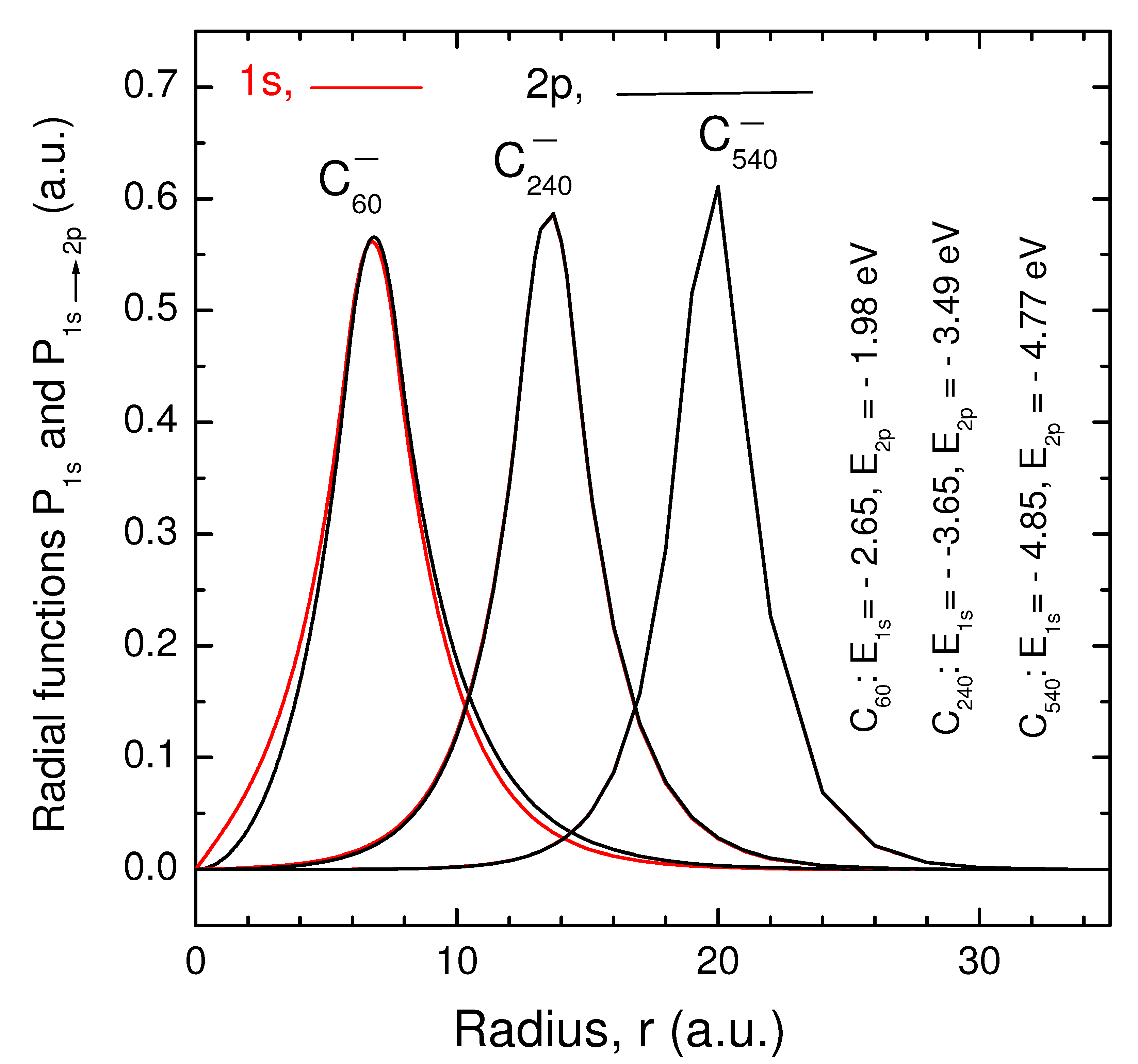
As the first step, we scrutinize the ground-states and excited-states in the bare fullerene anions: C, C and C. We note that our calculations revealed no excited-states with in any of these anions. The corresponding ground-state and excited-state radial functions and the corresponding and energies of the attached electron in the C, C and C anions are presented in Figure 1.
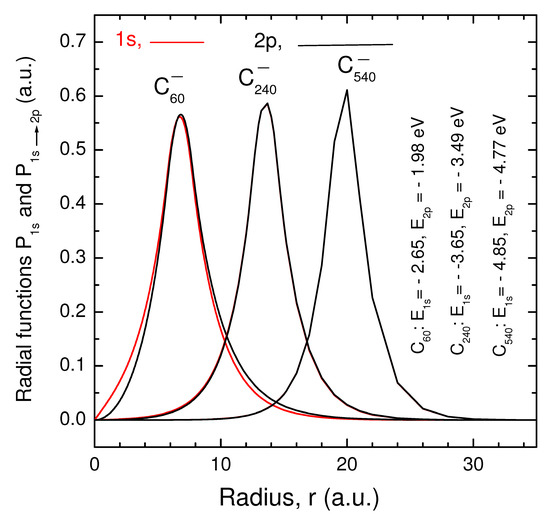
Figure 1.
Calculated ground-state and excited- state radial functions and corresponding and binding energies of the attached electron in , , and anions, as designated.
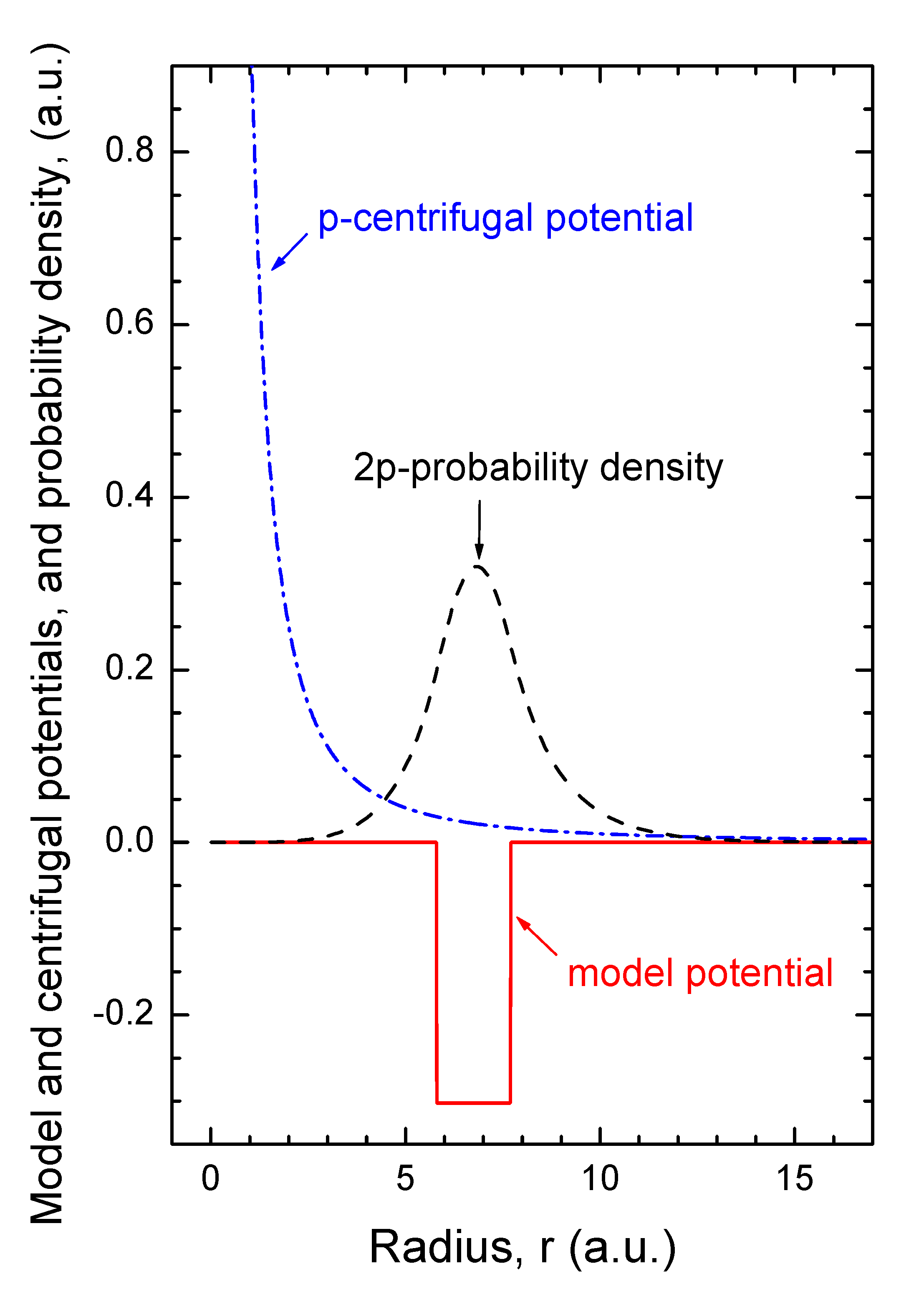
One can see that the and functions reach their maxima within the wall of a corresponding fullerene, i.e., within in C, in C and in C. This, actually, has been expected, for an obvious reason. A strikingly unexpected result (at first glance), though, is that to a high degree of approximation, particularly in C and C. This seems strange, because the Schrödinger equations for a s-state and a p-state differ by the presence of a centrifugal potential for a p-state. Correspondingly, the function should have differed from the function. To understand why the situation is opposite to the expected one, we depict, for the case of C, the cage model potential , the centrifugal potential for a p-electron, and the probability density distribution, , in Figure 2.
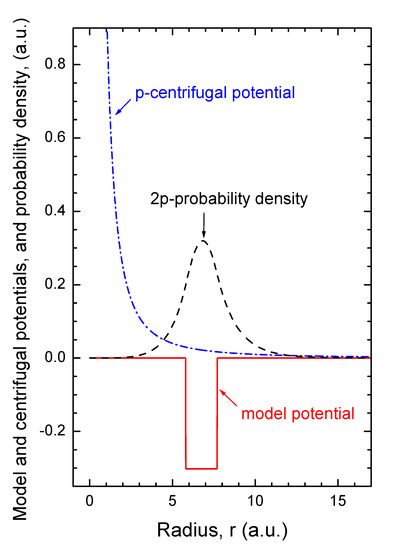
Figure 2.
Calculated cage model potential , the centrifugal potential for a p-electron, and the probability density distribution, , as designated.
One can see that, inside the hollow interior of C (), the probability density is practically a zero up to about . Therefore, the presence of the centrifugal potential, however large it is, does not matter in this spatial region. starts differ from between approximately . There, however, is already small and, additionally, only less than of electronic charge is concentrated in this spatial region. Hence, again, a role of the small is largely obliterated in there. Inside the C wall itself , on average, is less than of , whereas outside of the C wall, in addition to a rapidly damping probability density distribution. Thus, it now becomes clear that the presence of the centrifugal potential for a p-electron cannot make the solution of the Schrödinger equation to differ any notably from its solution for a s-electron. This discussion explains why differs from only insignificantly, in C. Additionally, we believe that the reader can easily extend this discussion of the behavior of and in C to giant fullerene anions to understand why and become practically identical in each of the C and C anions.
Although the energies are generally more sensitive quantities to parameters in the Schrödinger equation than the wavefunctions, the difference between and binding energies is more noticeable than between the wavefunctions, although still small: it is about of for C, for C, and for C. Note that the difference between and is decreasing with increasing size of the fullerene anion. The largest energy difference is in C, as is the largest difference between and (see Figure 1). This is because the -centrifugal potential energy in C is larger than in other fullerene anions, owing to a significantly smaller size of the C cage as compared to the other two.
Because , the corresponding oscillator strengths in the C, C and C anions must be large. Our calculations show that , , and in C, C and C, respectively (see Table 1 for more details).

Table 1.
Calculated ground-state energies, and energies of the transitions (all in eV), discrete , and continuum, , oscillator strengths in the single-cage and multi-cage fullerene anions. Note, our calculations showed no existence of the excited states with in the single-cage fullerene anions.
We note that the oscillator strength is decreasing with increasing size of the fullerene cage. At first glance this is strange, because the approximate equality is getting only stronger with increasing size of the fullerene cage, as discussed above. Thus, the overlap between and is increasing and so should have been as well, with increasing size of the anion. However, the excitation energy (see Table 1), is decreasing with the increasing size of the fullerene cage. This counterbalances the increase in the overlap between and , thereby resulting in a smaller (which is proportional to ) in a bigger fullerene anion. This decrease in the oscillator strength with increase in the fullerene size leads to an important conclusion. Namely, we conclude there is an increasing transfer of oscillator strength of a fullerene anion from a discrete spectrum to continuum with increasing size of the fullerene cage, as clearly follows from the oscillator strength sum rule: . Calculated ’s are presented in Table 1 as well. At this point it is important to emphasize that the continuum oscillator strengths, presented in Table 1, were calculated using Equation (7) rather than as from the sum rule. The fact that the independently calculated and the are equal to a high degree of approximation speaks about the adequacy of the calculated photodetachment cross sections themselves, discussed later in the paper.
3.2. Fullerene Onion-Anions
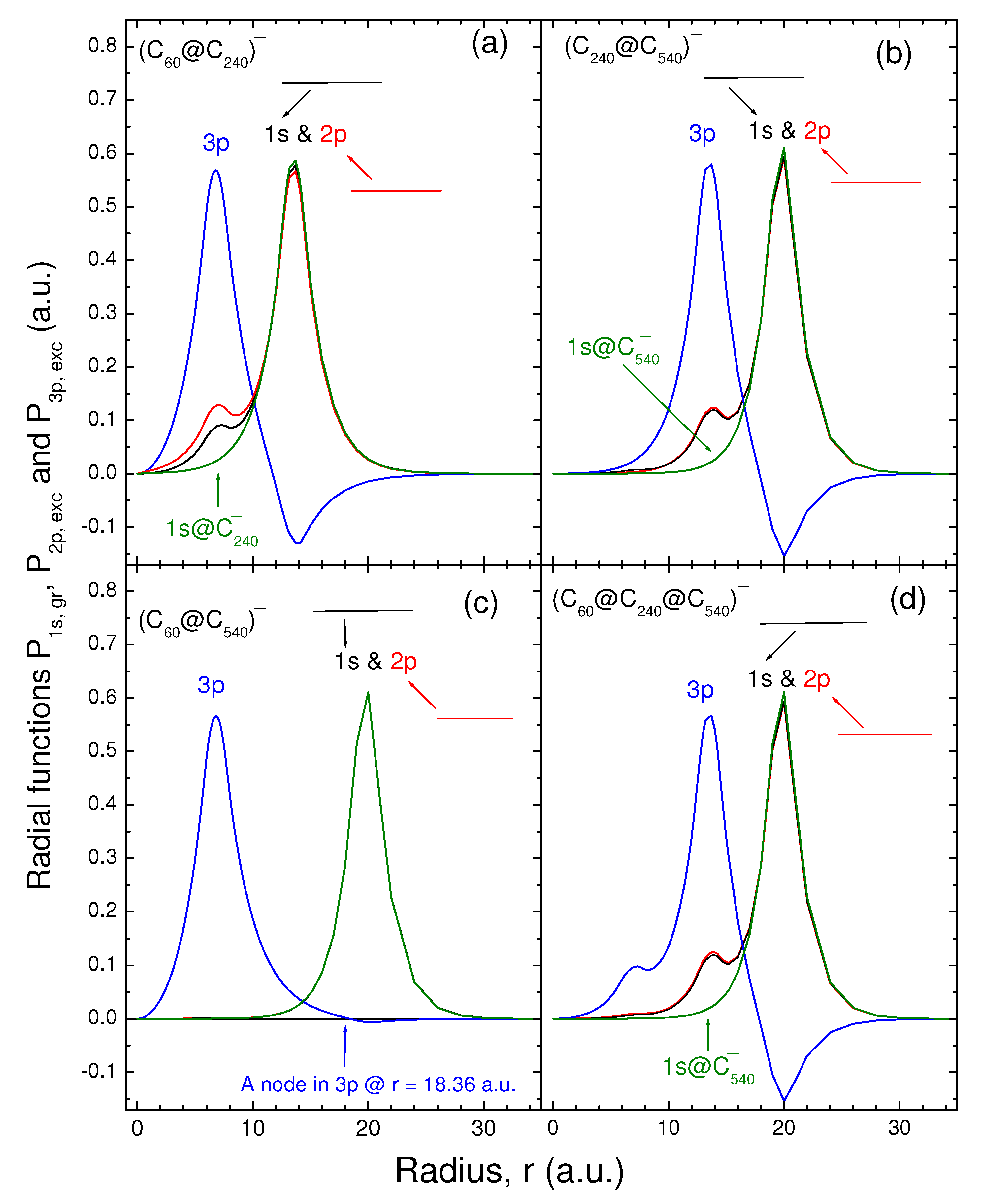
We now move to the discussion of the wavefunctions of the valence electron in the fullerene onion-anions , , and . We note first that the potentials of these fullerene onions are, obviously, either double-well or triple-well potentials. Correspondingly, one can expect a greater number of bound states available to the attached electron in these fullerene onion-anions. In our case, the calculations predicted the existence of only two discrete p-states—the and excited states—, in contrast to only the excited-state in the bare fullerene anions. The corresponding , and functions are plotted in Figure 3 where a number of new features are exhibited.
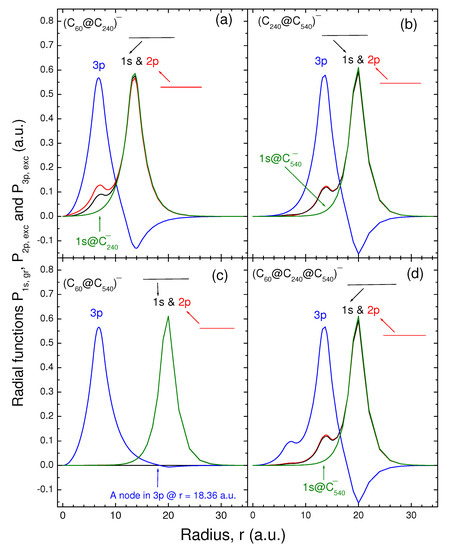
Figure 3.
Calculated radial ground-state and excited-state and (due to the transitions, , 3) of the attached electron in fullerene onion-anions: (a) , (b) , (c) , (d) : solid, ; dashed, ; dash–dot, . Also plotted are the (dash–dot–dot) functions in bare C and C, as designated, for comparison purposes. Note, to avoid any confusion, that the graphs for the and functions in the fullerene onion-anions tightly overlap with each other and are practically indistinguishable from each other with some exception in the case of .
The most striking discovery relates to the behavior of the excited-state wave functions. Their highly peculiar behavior is completely different from the behavior of the and functions in any of these fullerene onion-anions. Indeed, we find that a significant part of the function and, thus, the electron density of the attached electron, is packed inside the wall of the inner cage directly adjacent to a larger fullerene cage in each of these double- and triple-cage fullerene onion-anions. Although this is evident from Figure 3, this is also supported by looking at the mean radii, , of the orbitals in these fullerene onion-anions as well. The calculated ’s are: in both and (thus, the orbital falls into the C potential well), whereas in both and (thus, falls into the C potential well). This is in a sharp contrast to the and functions that are mainly packed in the potential well of the largest fullerene cage (C, in our case) in corresponding fullerene onion-anions, respectively, as is evident from Figure 3 (also, in all fullerene onion-anions under discussion). Especially surprising is the behavior of the function in , where its probability density is almost entirely located inside C, despite the size of C being significantly smaller than C, so that the C potential well should not have affected the attached valence electron at all, as in the case of the and functions (see Figure 3c,d). In any case, the behavior of in these fullerene onion-anions is extraordinary, a complete break with conventional wisdom.
We interpret the predicted behavior of the excited-state functions in the fullerene onion-anions as being due to both the multi-well nature of the fullerene onion-anion potentials and the fact that, in contrast to the nodeless and functions, the function has one node. That is, the function is distinctly split into an inner part (before the node) and an outer part (beyond the node). It appears that the inner part of the function falls into the potential well associated with a fullerene cage adjacent to the outermost cage in the fullerene onion-anion. Thus, the attached electron partially resides in the inner well.
We note, though, that the behavior of the function in the fullerene onion-anions is somewhat reminiscent of the behavior of the excited and functions, excited from the subshell, in endohedral calcium, [30]. There, a significant transfer of the , but not , electron density into the inner space of C was demonstrated. That resulted in a significant increase in the amplitude of the orbital in the inner space of C. Consequently, the mean radius of the orbital was reduced from in free Ca to only in [30]. That situation, in turn, was commented on to be somewhat reminiscent of the behavior of the excited and orbitals in Ba[31,32] that was shown to be due to the double-well nature of the potential of Ba that caused partial orbital collapse of into the inner well, thereby causing , rather than , to have the greater amplitude near .
3.3. Oscillator Strengths and Photodetachment Cross Sections
Calculated oscillator strengths, , of the , , and bare fullerene anions as well as the , , , and fullerene onion-anions are/were listed in Table 1 which contains a wealth of information. Since a principal goal of this work is to explore the spectral distribution of oscillator strength, we focus on a comparison among the total oscillator strengths of the discrete spectra, i.e., , for the single and nested fullerene cages Thus, as we transition from , the oscillator strength is increased. The same change in is characteristic along all other transition paths as well: , , and, in principle, , too. Hence, we have unraveled a general tendency: stuffing of a bigger fullerene cage with a smaller fullerene cage, as well as progressively stuffing the biggest fullerene cage with several smaller fullerene cages, results in the transfer of a part of the oscillator strength from a continuum spectrum into a discrete spectrum.
Now, how does the discovered tendency affect the -photodetachment cross section, ? Obviously, the total area under the graph for should be decreasing along the discussed fullerene transition paths. This may result in the disappearance of some of the resonance structures in , or making them narrower, or decreasing their heights, or lowering the values of other parts of , or all of the above cumulatively. It is, therefore, extremely interesting to study the modifications in ’s on a comparative one-to-one basis for different fullerene anions.
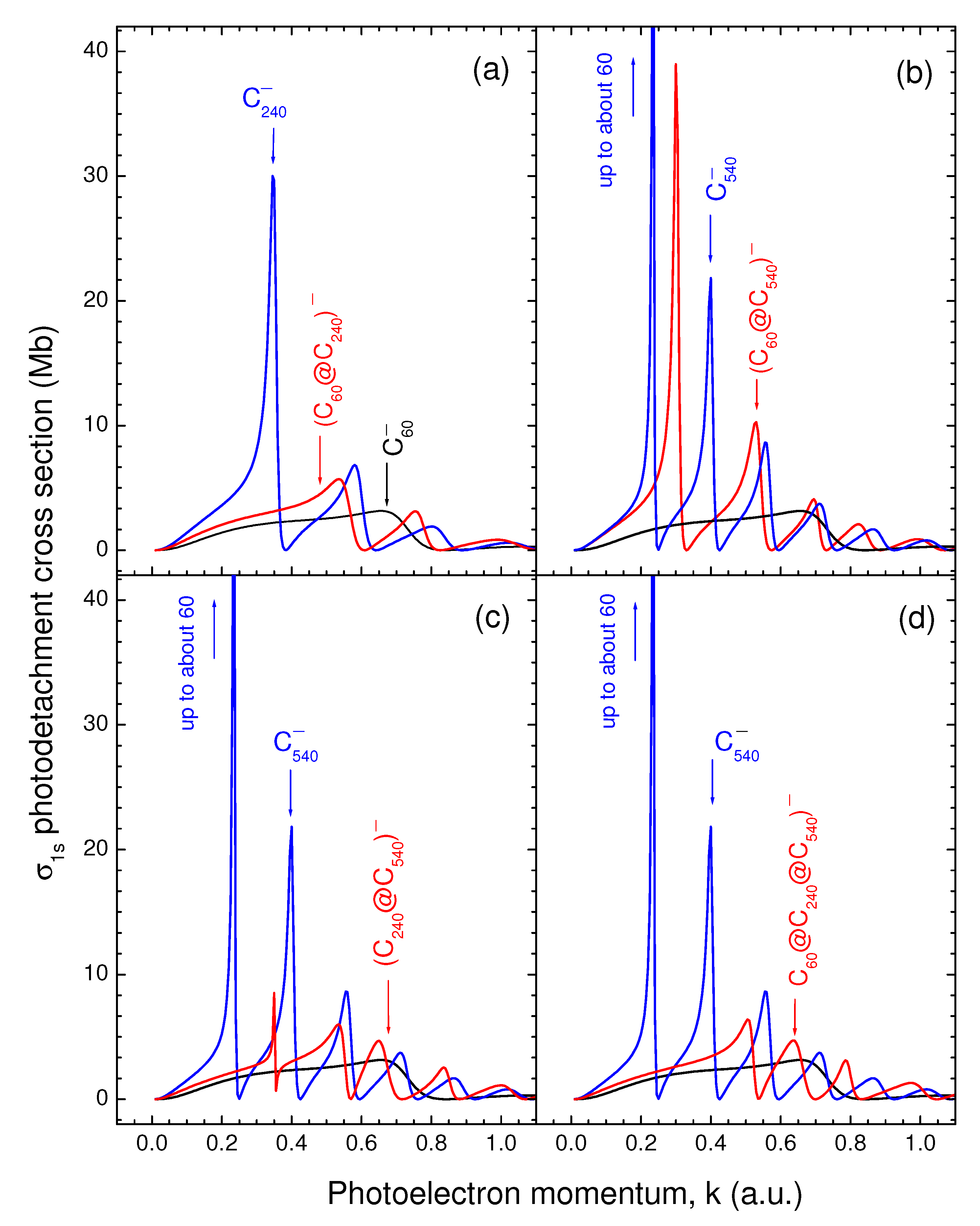
Calculated ’s for C versus , as well as C versus , , and are depicted in Figure 4 as functions of the photoelectron momentum , in order to eliminate the impact of differences in ionization potentials between the fullerene anions on details of ’s, for the adequacy of the comparison between these anions.
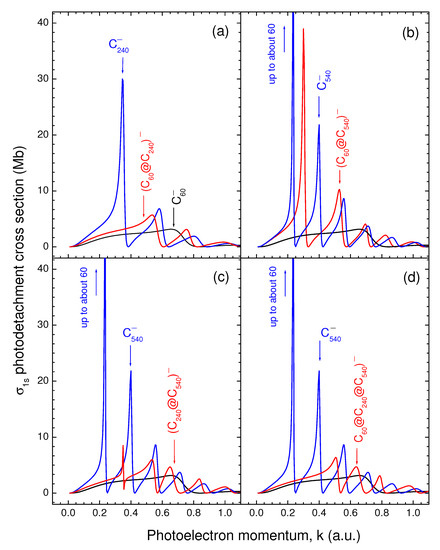
Figure 4.
Calculated photodetachment cross sections of bare fullerene anions and nested fullerene onion-anions, as designated in the figure. Note, on all parts of the figure, the of C is represented by a dashed-line.
We first note that the calculated cross sections exhibit the oscillatory behavior versus the photoelectron momentum, k. Such resonances have been well understood for both photoionization and photodetachment of, as well as electron scattering by, fullerene and endo-fullerene complexes in a large body of research; we refer the reader to the above references, to the review paper [8] for many more references on the subject, as well as, e.g., to [4–8,10–24,29,31,38,39,46] from [21] (and references therein). Following [33], these resonances are commonly referred to as the confinement resonances.
Secondly, note that the prediction mentioned above on the modification of the photodetachment cross section along the path from the bare fullerene anions to the double- and triple-cage fullerene onion-anions is seen to be correct. Indeed, we see the disappearance of one or even two confinement resonance structures (near the lower energy end of the spectrum), and the significant decrease in their amplitudes (except for the case of the onion-anion, which is an extraordinary case anyway, as was discussed above). Furthermore, it is interesting that the resonances in of are seen to be shifted towards higher k’s, compared to of the bare anion, whereas in all other nested fullerene onion-anions they shift toward lower k’s, compared to corresponding bare counterparts.
Thirdly, it is quite interesting that ’s of all fullerene onion-anions, whether double-cage or triple-cage anions, do not differ much in magnitude from of the smallest C anion in this sequence of fullerene anions (except for of extraordinary at a lower end of the spectrum). To emphasize this, we added of C to all plots in Figure 4 to facilitate this comparison. One can see that ’s, associated with the nested fullerene onion-anions, oscillate around of C with average amplitudes that are not much different from of C.
Lastly, we note that, to check the connection of calculated ’s to calculated oscillator strengths, we calculated the oscillator strength of the continuum spectrum, , by appropriately integrating ’s in accordance with Equation (7). These calculated ’s are presented in Table 1, and the fact that they have the same values as those obtained from the oscillator sum rule () speaks to the accuracy of the calculated ’s.
4. Conclusions
In the present paper, we have provided a glimpse into the structure and photodetachment cross sections of bare fullerene anions and nested fullerene onion-anions and uncovered the existence of a number of unusual features. The results were obtained on a zeroth-order basis, so to speak. However, the zeroth-order basis is a valuable and necessarily part of any study of any multielectron atomic and molecular systems and processes. This is because, firstly, it provides a kind of a roadmap where more sophisticated theoretical studies of these systems should be conducted and, secondly, the comparison between the results obtained with a more accurate calculation with those obtained in this zeroth-order study is the only way to understand the importance and strength of the physical interactions that are not accounted in the framework of the zeroth-order approximation. We hope that the results of the present study will serve as an impetus to more complete theoretical studies of the structure and photodetachment spectra of fullerene (onion–)anions, now that we know that they might be quite unusual.
Author Contributions
Conceptualization, V.K.D. and S.T.M.; methodology, V.K.D. and S.T.M.; formal analysis, V.K.D. and S.T.M.; investigation, V.K.D. and S.T.M.; writ-ing—original draft preparation, V.K.D. and S.T.M.; writing—review and editing, V.K.D. and S.T.M.; All authors have read and agreed to the published version of the manuscript.
Funding
The work of STM was supported by the US Department of Energy, Office of Science, Basic Energy Sciences under Award Number DE-FG02-03ER15428.
Institutional Review Board Statement
Not applicable.
Informed Consent Statement
Not applicable.
Conflicts of Interest
The author declares no conflict of interest.
References
- Kato, T. Absorption and emission spectra for C60. Laser Chem. 1994, 52, 155. [Google Scholar] [CrossRef]
- Brink, C.; Andersen, L.H.; Hvelplund, P.; Mathur, D.; Voldstad, J.D. Laser photodetachment of C60- and C70- ions cooled in a storage ring. Chem. Phys. Lett. 1995, 52, 233. [Google Scholar] [CrossRef]
- Bilodeau, R.C.; Gibson, N.D.; Walter, C.W.; Esteves-Macaluso, D.A.; Schippers, S.; Müller, A.; Phaneuf, R.A.; Aguilar, A.; Hoener, M.; Rost, J.M.; et al. Single-Photon Multiple Detachment in Fullerene Negative Ions: Absolute Ionization Cross Sections and the Role of the Extra Electron. Phys. Rev. Lett. 2013, 111, 043003. [Google Scholar] [CrossRef] [PubMed]
- Müller, A.; Martins, M.; Kilcoyne, A.L.D.; Phaneuf, R.A.; Hellhund, J.; Borovik, A.; Holste, K.; Bari, S.; Buhr, T.; Klumpp, S.; et al. Photoionization and photofragmentation of singly charged positive and negative Sc3N@C80 endohedral fullerene ions. Phys. Rev. A 2019, 99, 063401. [Google Scholar] [CrossRef]
- Phaneuf, R.A.; Kilcoyne, A.L.D.; Aryal, N.B.; Baral, K.K.; Esteves-Macaluso, D.A.; Thomas, C.M.; Hellhund, J.; Lomsadze, R.; Gorczyca, T.W.; Ballance, C.P.; et al. Probing confinement resonances by photoionizing Xe inside a C60+ molecular cage. Phys. Rev. A 2013, 88, 053402. [Google Scholar] [CrossRef]
- Tanaka, H.; Boesten, L.; Onda, K.; Ohashi, O. Cross-beam experiment for the scattering of low-energy electron from gas phase C60. J. Phys. Soc. Jpn. 1994, 63, 485. [Google Scholar] [CrossRef]
- Tanaka, H.; Hoshino, M.; Brunger, M.J. Elastic and inelastic scattering of low-energy electrons from gas-phase C60: Elastic scattering angular distributions and coexisting solid-state features revisited. Eur. Phys. J. D 2021, 75, 293. [Google Scholar] [CrossRef]
- Deshmukh, P.C.; Manson, S.T. Electronic structure and dynamics of confined atoms. Eur. Phys. J. D 2021, 75, 166. [Google Scholar] [CrossRef]
- Amusia, M.Y.; Baltenkov, A.S.; Krakov, B.G. Photodetachment of negative C60- ions. Phys. Lett. A 1998, 243, 99. [Google Scholar] [CrossRef]
- Amusia, M.Y.; Baltenkov, A.S.; Chernysheva, L.V.; Felfli, Z.; Msezane, A.Z. Dramatic distortion of the 4d giant resonance by the C60 fullerene shell. J. Phys. B 2005, 38, L169. [Google Scholar] [CrossRef]
- Amusia, M.Y.; Baltenkov, A.S. Effect of plasma oscillations of C60 collectivized electrons on photoionization of endohedral noble-gas atoms. Phys. Rev. A 2006, 73, 062723. [Google Scholar] [CrossRef]
- Amusia, M.Y.; Chernysheva, L.V.; Liverts, E.Z. Photoionization of two-shell endohedral atoms. Phys. Rev. A 2009, 80, 032503. [Google Scholar] [CrossRef]
- Amusia, M.Y.; Chernysheva, L.V.; Dolmatov, V.K. Confinement and correlation effects in the Xe@C60 generalized oscillator strengths. Phys. Rev. A 2011, 84, 063201. [Google Scholar] [CrossRef]
- Amusia, M.Y. Fullerenes and endohedrals as “big atoms”. Chem. Phys. 2013, 414, 168. [Google Scholar] [CrossRef]
- Amusia, M.Y.; Chernysheva, L.V. On the Behavior of Scattering Phases in Collisions of Electrons with Multiatomic Objects. JETP Lett. 2015, 101, 503. [Google Scholar] [CrossRef]
- Dolmatov, V.K.; Amusia, M.Y.; Chernysheva, L.V. Effects of target polarization in electron elastic scattering off endohedral A@C60. Phys. Rev. A 2017, 95, 012709. [Google Scholar] [CrossRef]
- Amusia, M.Y.; Baltenkov, A.S. Time delay in electron-C60 elastic scattering in a dirac bubble potential model. J. Phys. B 2019, 52, 015101. [Google Scholar] [CrossRef]
- Amusia, M.Y.; Chernysheva, L.V.; Dolmatov, V.K. Angle-differential elastic-electron scattering off C60: A simple semi-empirical theory versus experiment. J. Phys. B 2019, 52, 085201. [Google Scholar] [CrossRef]
- Lohr, L.L.; Blinder, S.M. Electron photodetachment from a Dirac bubble potential. A model for the fullerene negative ion C60-. Chem. Phys. Lett. 1992, 198, 100. [Google Scholar] [CrossRef]
- Baltenkov, A.S.; Msezane, A.Z. Doubly-charged Negative Ion of C60- Molecule. Proc. Dyn. Syst. Appl. 2016, 7, 239. [Google Scholar]
- Dolmatov, V.K. Spin-polarized photoelectron fluxes from fullerene anions. Atoms 2020, 65, 8040065. [Google Scholar] [CrossRef]
- Dolmatov, V.K.; Manson, S.T. Photoionization of atoms encapsulated in endohedral ions A@C60. Phys. Rev. A 2006, 73, 013201. [Google Scholar] [CrossRef]
- Wang, L.-S.; Conceicao, J.; Jin, C.; Smalley, R.E. Threshold photodetachment of cold C60-. Chem. Phys. Lett. 1991, 182, 5. [Google Scholar] [CrossRef]
- Msezane, A.Z.; Felfli, Z. Recent Progress in Low-Energy Electron Elastic-Collisions with Multi-Electron Atoms and Fullerene Molecules. Atoms 2022, 10, 79. [Google Scholar] [CrossRef]
- Puska, M.J.; Nieminen, R.M. Photoabsorption of atoms inside C60. Phys. Rev. A 1993, 47, 1181. [Google Scholar] [CrossRef]
- Dolmatov, V.K.; Edwards, A. Role of polarizability of a CN fullerene cage in A@CN photoionization and e−-CN scattering: The size effect. J. Phys. B 2019, 52, 105001. [Google Scholar] [CrossRef]
- Winsted, C.; McKoy, V. Elastic electron scattering by fullerene, C60. Phys. Rev. A 2006, 73, 012711. [Google Scholar] [CrossRef]
- Dolmatov, V.K.; Brewer, P.; Manson, S.T. Photoionization of atoms confined in giant single-walled and multiwalled fullerenes. Phys. Rev. A 2008, 78, 013415. [Google Scholar] [CrossRef]
- Amusia, M.Y.; Chernysheva, L.V. Computation of Atomic Processes: A Handbook for the ATOM Programs; IOP Publishing Ltd.: Bristol, UK; Philadelphia, PA, USA, 1997. [Google Scholar]
- Connerade, J.-P.; Dolmatov, V.K.; Manson, S.T. A unique situation for an endohedral metallofullerene. J. Phys. B 1999, 32, L395. [Google Scholar] [CrossRef]
- Connerade, J.-P.; Mansfield, M.W.D. Centrifugal barrier perturbation of the nf2F series in Ba II. Proc. R. Soc. A 1975, 346, 565. [Google Scholar] [CrossRef]
- Connerade, J.-P. Highly Excited Aroms; Cambridge: Cambridge, UK, 1998. [Google Scholar]
- Connerade, J.-P.; Dolmatov, V.K.; Manson, S.T. On the nature and origin of confinement resonances. J. Phys. B 2000, 33, 2279. [Google Scholar] [CrossRef]
Publisher’s Note: MDPI stays neutral with regard to jurisdictional claims in published maps and institutional affiliations. |
© 2022 by the authors. Licensee MDPI, Basel, Switzerland. This article is an open access article distributed under the terms and conditions of the Creative Commons Attribution (CC BY) license (https://creativecommons.org/licenses/by/4.0/).