
Abstract
The Wigner-Kirkwood expansion of the quantum correction to the classical free energy is generally said to be in powers of and only its first few terms are presented. In this work, we use the Bloch differential equation to obtain a general description of all terms in a dimensionless form. The first corrective term turns out to be proportional to the product of , where is the thermal de Broglie wavelength and is the volume per particle, by an effective coupling constant. This dimensionless parameter can be used to assess the magnitude of the quantum correction. Using the one-component plasma as an illustration we highlight the importance of the magnitude of the potential on the quantum correction. The results presented are not formally new; the emphasis is placed on a simple and didactic presentation.
1. Introduction
Describing the physical properties of matter under a wide range of thermodynamic conditions requires a very diverse set of tools. At low density one can easily use classical approximations, even though ionization effects have to be properly included as temperature increases. But as the density increases one needs to include N-body interactions as well as quantum effects. For low temperatures degeneracy effects become also important. The most complicated systems are probably the ones involving condensed and warm dense matter for which electrons are degenerate and even the nuclei can have a quantum behavior.
Quantum Monte-Carlo (QMC) simulations [1] or path-integral molecular dynamics (PIMD) [2] are able to tackle such systems but with a very high computer cost. At higher temperatures one can advantageously consider nuclei as classical and use Kohn-Sham-density-functional-theory-based molecular dynamics (see references in [3]), path-integral Monte-Carlo [4,5] or even pseudo-atom molecular dynamics [6]. But these techniques are still very computer-time-consuming and it is important to determine what is the proper physics to include and to determine the extent of N-body and quantum effects so as to choose the appropriate tool. The N-body effects can be advantageously anticipated by the consideration of coupling parameters. For the quantum behaviors it is a bit more difficult to properly anticipate their importance.
The thermodynamic properties of a system can be obtained from the partition function Q defined in the canonical ensemble by [7]
where is the Hamiltonian operator of the system, denotes the trace of the argument, and , where T is the temperature of the system and is Boltzmann’s constant. In the classical limit of Boltzmann statistics, the partition function can be simplified and taken equal to [7]
where h is Planck’s constant, N is the number of atoms of the system, m is the mass of the atoms (they are assumed to be identical for the sake of simplicity), , is the 3N-dimensional position vector in configuration space, is the potential energy of the system, and is the classical 3N-dimensional momentum. is a regular function of the position coordinates.
For a nearly classical system, if the fermion or boson exchange effects between quantum atoms are neglected, Q can be expressed through the so-called Wigner-Kirkwood expansion [7,8,9,10,11]. The latter is usually said to be in powers of [7,10], where ℏ is , or equivalently of where is the thermal de Broglie wavelength [11,12]. It is generally stated that the quantum effects are characterized by the dimensionless ratio where l is a typical length of the classical particle system [11] or the average radius of an atom [7]. Besides, the Wigner-Kirkwood expansion is obtained with tedious calculations. The aim of the present work is to use simple calculations to deduce the general form of the Wigner-Kirkwood expansion and of its first corrective term. The interest of the latter term is that it enables one to assess the quantum correction.
2. General Form of the Expansion of the Quantum Correction
Let be the gradient in the 3N-dimensional configuration space. The system is assumed to be confined to a cubic volume . We define a and r’ by
and
In the framework of Boltzmann statistics, the partition function Q can be expressed as [11]
where we have used the bra-ket notation and where is the Hamiltonian operator which is expressed in representation by
By using the closure relation in representation in Equation (5), we find
or equivalently
with
In Equation (9), is the Hamiltonian operator expressed in representation and defined in Equation (6); is applied to regarded as a scalar function of so that is a scalar function of . We define by [7]
where H is defined in the introduction. verifies the Bloch differential equation [7]
Equations (10) and (11) imply
If Q is assumed to be an analytic function of ℏ, it is possible to look for w as an expansion in powers of ℏ [7]:
Note that the analyticity of Q as a function of ℏ does not hold for any potential [13]. We define
We substitute Equation (13) into Equation (12) and equate the coefficients of the same powers of ℏ. With the obvious condition , we get , , where the superscript ’ indicates that the differentiation is carried out with respect to ; we also obtain the following relation
It can be shown with Equation (15) that each is a finite linear combination of terms which are proportional to differentiated l and only l times with respect to , to , and possibly to products of l components of . Note that, for , all terms of this finite linear combination depend on powers of with positive integer as exponent. Note also that the number of such terms depends on N. Let us assume that, up to some integer , verifies the above property. Then the right-hand side of Equation (15) also verifies this property and, since each term depends on as an integer power of , so does obtained by integration of the right-hand side of Equation (15) under the constraint . The property stated about is therefore shown by induction and we can write
where is a dimensionless function which depends on , , and N only, with the dependence on and described above. By substituting Equations (10), (13) and (16) into the right-hand side of Equation (8), we find
with
where the subscript c designates the canonical average [7], and the result has been taken into account. The terms in with l odd are equal to 0 because is an even function of ℏ. is a dimensionless functional of depending on N only; the dependence of on N comes from both the dependence of on N and from the bounds of the integrals on in the calculation of the partition function (all coordinates vary between 0 and ). Besides, as is a linear combination of separable functions of and , depends linearly on canonical averages of differentiations of with respect to . Thus, for instance, can only be of the form
where and are dimensionless real constants.
In practice, we are interested in the system thermodynamic properties, that is, in the canonical ensemble, in the free energy F, which is equal to [7]
In view of Equations (17) and (20), F is equal to
where is the free energy in the classical limit of Boltzmann statistics. Equation (21) shows that F can be expressed as an expansion in powers of
where is a dimensionless functional of depending on N only. It remains to be found how varies with N. As F is an extensive quantity and is an intensive quantity, the ’s must be extensive quantities. As a result, Equation (22) implies
where is a dimensionless functional of depending on no parameter.
3. Discussion
In Equation (23), the quantum correction depends on ℏ through only. Therefore the limit is in fact the limit. This limit can be obtained by decreasing mass density or by increasing temperature. It can be noted that, in order for the terms in the series in Equation (23) to decrease with increasing L in the limit, the decrease of with L must not be compensated or dominated by the possible increase of in this limit. In the present discussion, we consider systems such that, in the limit, the terms in the series decrease with increasing L. It is difficult to find all the sufficient conditions for the existence of such systems. An obvious sufficient condition is for instance the independence of the function with respect to temperature and mass density.
The term of first order in in Equation (23) is of practical interest. If this term is of the same order or greater than the term of order 0, , the limit is not obtained; the quantum correction is large and cannot be evaluated by a perturbative expansion. If the term of first order is small compared to , it can indicate that the quantum correction is negligible or can possibly be used as an evaluation of the quantum correction.
We consider the term of first order in in Equation (23). By noting that, for any regular function ,
and that gives no volume contribution when integrated over , can also be written
where is a dimensionless real constant. It can be found with tedious calculations that [11]. As all particles are equivalent, can also be expressed by
where j designates any arbitrary particle. Equations (21)–(23) show that ; therefore Equations (23) and (26) show that, at order 1 in , is equal to
with
and
In Equation (29), has been replaced by by multipying by . Note that the parameter is an adequate evaluation of the quantum correction for thermodynamics. Let be the heat capacity of the system. If, as a first approximation, is assumed to be independent of T, it can be simply deduced from Equation (27) that the quantum correction to is of the same order as .
We now interpret the parameter . If, as a first approximation, the particles are regarded as having an average oscillation length equal to a under the influence of a potential V which is mainly a quadratic function of the coordinates of the particles, can be regarded as a measure of the potential energy of the individual particle j. Then , or equivalently in Equation (29), can be interpreted as a coupling constant. This coupling constant depends in particular on the typical length of variation of V. Note that, in view of Equation (24), can also be found proportional to , where is the force exerted on particle j. This latter form allows the practical calculation of , for instance in a molecular dynamics simulation. The fact that the coupling constant influences the magnitude of the quantum correction is not a surprise because the latter stems from the non-zero commutator of the operators and , where and are respectively the kinetic energy operator and the potential energy operator [7].
4. Application to the One-Component Plasma
As an illustration, we consider the specific case of the one-component plasma (OCP) which consists of a single species of point ions with charge , where Z is the atomic number and e is the proton charge, immersed in a uniform neutralizing electronic background [14]. The potential energy of the system comes from the Coulombic interaction among ions and from the Coulombic interaction between ions and the neutralizing background; it can therefore be expressed by
where and is the dielectric permittivity of vacuum. From Equation (30), it follows that [11]
Let be for the OCP. By using Equation (31) in Equation (28), we find
where has been taken into account and where
is the usual definition of the coupling constant in the OCP. As interpreted above, is proportional to the coupling constant. This expression of is identical to that found in the literature and expressed as [14,15,16]
where is the plasma frequency defined by
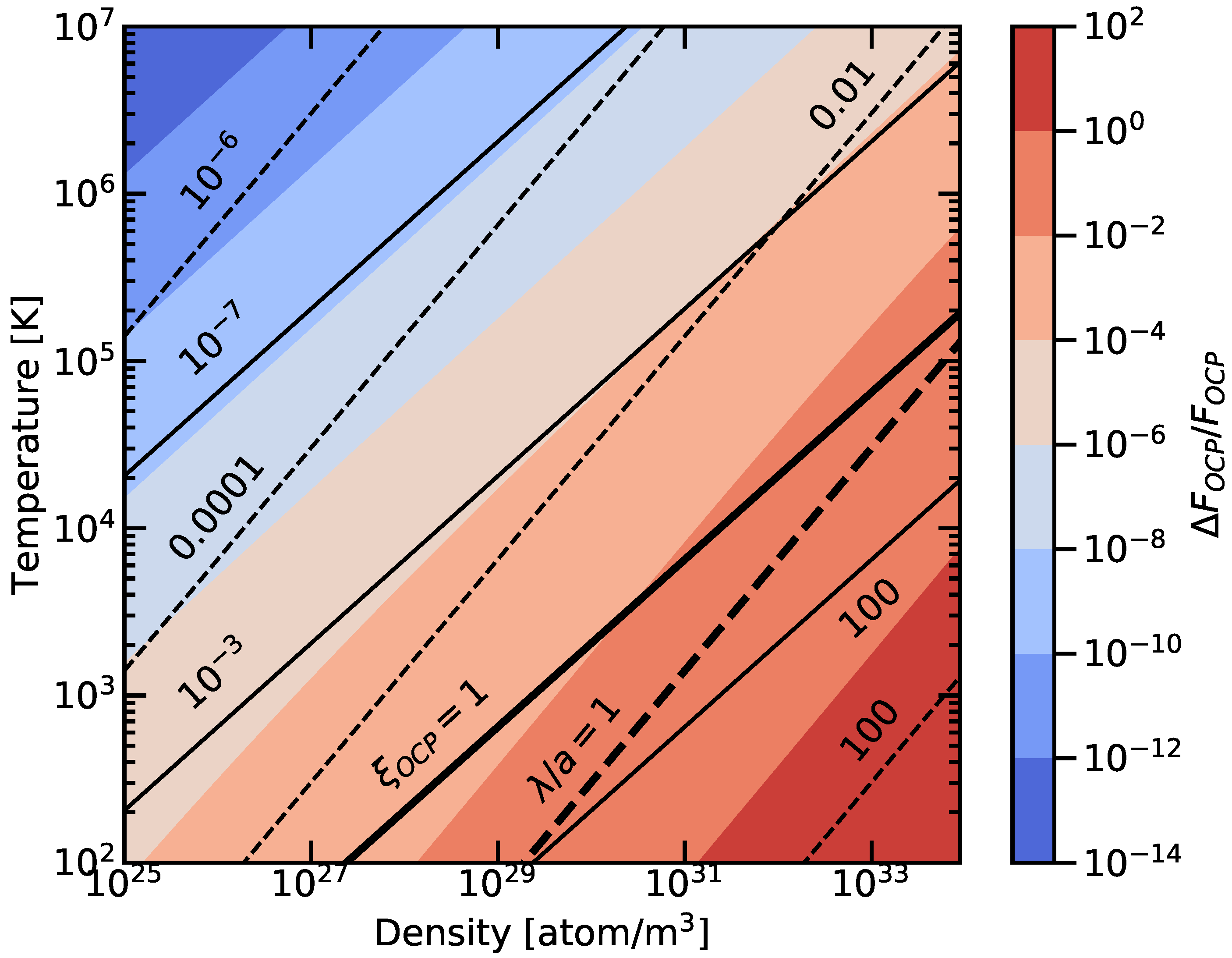
It is worth noting that, in Ref. [15], the authors also derive the term in an explicit form for both the liquid and solid one-component plasmas. The quantum correction is dependent on but also on the relative intensity of the potential energy compared to the kinetic energy. To illustrate the importance of the potential, we plotted in Figure 1 the evolution of the quantum correction to the free energy for a fully ionized hydrogen plasma (an OCP) as a function of density and temperature. The quantum corrections are of course very small at low density and high temperature but become the dominant contribution to the free energy at low temperature and high density. There, they cannot be considered as “corrections” anymore. On this graph it is clear that the evolution of the quantum correction is the same as that of the parameter at high temperature and low density. However, the ratio does not reproduce the density-temperature dependence of the quantum correction. It is thus clear that the “ limit” generally evoked is actually a “ limit”.
Figure 1.
Temperature-density dependence of the first corrective term in the Wigner-Kirkwood expansion of the free energy in the OCP approximation for a fully ionized hydrogen plasma. The OCP free energy corresponds to the ionic classical contribution as defined in Refs. [17,18]. The full lines correspond to iso-values of the parameter and the dashed lines represent iso-values of .
5. Conclusions
In the framework of Boltzmann statistics, we have revisited the expansion of the partition function and of the free energy by using simple calculations. We have shown that, in a dimensionless form, the expansion of the free energy is equivalent to an expansion in whose coefficients are dimensionless functionals of the potential energy (divided by ) depending on no parameter. These coefficients depend in particular (but not only) on the typical length of variation of the potential.
By retaining the first-order corrective term of the expansion in to evaluate the quantum correction, the latter turns out to be characterized by a dimensionless parameter proportional to the product of by an effective coupling constant, as shown in Equation (28). As an illustration, the characteristic parameter of the OCP is considered; then the effective coupling constant is proportional to the coupling constant usually defined, as shown in Equation (32). In order to properly evaluate the intensity of the quantum correction, it is thus necessary to consider not only temperature and density but also the magnitude of the potential in which the particles evolve.
An extreme case is that of the ideal gas. Since there is no interaction among atoms, the operators and trivially commute so that there is no quantum correction under the assumptions of this work, and this for any thermal de Broglie wavelength. However, the fermion or boson exchange effects between particles, which have been assumed to be negligible in the present work, must now be taken into account in the calculation of the quantum correction; for an ideal gas, the latter varies like for small values of [7].
As indicated in the introduction, the main purpose of this work is of a didactic nature. Other approaches allow to obtain the same results. One of them is to deduce w from the identity of the right-hand sides of Equations (9) and (10). Another approach is to consider the Laplace transform of the matrix elements involved in the calculation of Q and to obtain an ℏ expansion of the resulting resolvant of the operator [11]. For obtaining the general form of the ℏ expansion of Q and of its coefficients, we have found these two approaches to be much more tedious than the one presented in this work.
Author Contributions
Conceptualization, L.K., F.S. and J.-C.P.; methodology, L.K., F.S. and J.-C.P.; writing—original draft preparation, L.K. All authors have read and agreed to the published version of the manuscript.
Funding
This research received no external funding.
Institutional Review Board Statement
Not applicable.
Informed Consent Statement
Not applicable.
Data Availability Statement
The data presented in this study are available on request from the corresponding author. The data are not publicly available due to privacy reasons.
Conflicts of Interest
The authors declare no conflict of interest.
Abbreviations
The following abbreviations are used in this manuscript:
| OCP | One-Component Plasma |
References
- Becca, F.; Sorella, S. Quantum Monte Carlo Approaches for Correlated Systems; Cambridge University Press: Cambridge, UK, 2017. [Google Scholar]
- Geneste, G.; Torrent, M.; Bottin, F.; Loubeyre, P. Strong Isotope Effect in Phase II of Dense Solid Hydrogen and Deuterium. Phys. Rev. Lett. 2012, 109, 155303. [Google Scholar] [CrossRef] [PubMed]
- Clérouin, J.; Recoules, V.; Soubiran, F. The advent of ab initio simulations of dense plasmas. Contrib. Plasma Phys. 2021, 61, e202100095. [Google Scholar] [CrossRef]
- Ceperley, D.M. Path Integral Monte Carlo Methods for Fermions. In Monte Carlo and Molecular Dynamics of Condensed Matter Systems; Binder, K., Ciccotti, G., Eds.; Editrice Compositori: Bologna, Italy, 1996. [Google Scholar]
- Militzer, B.; González-Cataldo, F.; Zhang, S.; Driver, K.; Soubiran, F. First-principles equation of state database for warm dense matter computation. Phys. Rev. E 2021, 103, 013203. [Google Scholar] [CrossRef] [PubMed]
- Saumon, D.; Starrett, C.E. Pseudo-atom molecular dynamics: A model for warm and hot dense matter. AIP Conf. Proc. 2020, 2272, 090002. [Google Scholar]
- McQuarrie, D.A. Statistical Mechanics; University Science Books: Sausalito, CA, USA, 2000. [Google Scholar]
- Wigner, E. On the Quantum Correction For Thermodynamic Equilibrium. Phys. Rev. 1932, 40, 749. [Google Scholar] [CrossRef]
- Kirkwood, J.G. Quantum Statistics of Almost Classical Assemblies. Phys. Rev. 1933, 44, 31. [Google Scholar] [CrossRef]
- Brack, M.; Bhaduri, R.K. Semiclassical Physics; CRC Press: Boca Raton, FL, USA, 2003. [Google Scholar]
- Samaj, L.; Jancovici, B. Wigner Kirkwood expansion for semi-infinite quantum fluids. J. Stat. Mech. 2007, 2007, P02002. [Google Scholar] [CrossRef][Green Version]
- Jizba, P.; Zatloukal, V. Path-integral approach to the Wigner-Kirkwood expansion. Phys. Rev. E 2014, 89, 012135. [Google Scholar] [CrossRef] [PubMed]
- DeWitt, H.E. Analytic properties of the quantum corrections to the second virial coefficient. J. Math. Phys. 1962, 3, 1003. [Google Scholar] [CrossRef]
- Hansen, J.-P. Statistical Mechanics of Dense Ionized Matter. I. Equilibrium Properties of the Classical One-Component Plasma. Phys. Rev. A 1973, 8, 3096. [Google Scholar] [CrossRef]
- Hansen, J.P.; Vieillefosse, P. Quantum corrections in dense ionized matter. Phys. Lett. 1975, 53, 188. [Google Scholar] [CrossRef]
- Chabrier, G.; Mazevet, S.; Soubiran, F. A New Equation of State for Dense Hydrogen–Helium Mixtures. Astrophys. J. 2019, 51, 872. [Google Scholar] [CrossRef]
- Chabrier, G.; Potekhin, A.Y. Equation of state of fully ionized electron-ion plasmas. Phys. Rev. B 1998, 58, 4941. [Google Scholar] [CrossRef]
- Potekhin, A.Y.; Chabrier, G. Thermodynamic Functions of Dense Plasmas: Analytic Approximations for Astrophysical Applications. Contrib. Plasma Phys. 2010, 50, 82. [Google Scholar] [CrossRef]
Publisher’s Note: MDPI stays neutral with regard to jurisdictional claims in published maps and institutional affiliations. |
© 2022 by the authors. Licensee MDPI, Basel, Switzerland. This article is an open access article distributed under the terms and conditions of the Creative Commons Attribution (CC BY) license (https://creativecommons.org/licenses/by/4.0/).