Article

A Smart Vehicle Safety-Security System for the Prevention of Drunk Driving and Theft Based on Arduino and the Internet of Things


by
Petros Mountzouris
1,
Andreas Papadakis
1,
Gerasimos Pagiatakis
1,*,
Leonidas Dritsas
1,
Nikolaos Voudoukis
2 and
Kostas Nanos
1
1
Department of Electrical & Electronic Engineering Educators, School of Pedagogical and Technological Education, 15122 Athens, Greece
2
Department of Electrical & Computer Engineering, National Technical University of Athens, 15772 Athens, Greece
*
Author to whom correspondence should be addressed.
Electronics 2026, 15(1), 70; https://doi.org/10.3390/electronics15010070
Submission received: 29 November 2025 / Revised: 20 December 2025 / Accepted: 21 December 2025 / Published: 23 December 2025

Abstract

This paper addresses two safety issues regarding smart vehicles: that of intoxicated drivers (one of the most common causes for car accidents) and that of theft. More specifically, it presents the design and implementation of an intelligent system based on the Arduino-Mega2560 board. The issue of intoxicated drivers is addressed by using an MQ3 alcohol sensor that is capable of sensing the driver’s breath and a relay that immobilizes the vehicle if it detects alcohol above the permissible limit. Regarding theft, there are two safety layers: the first layer uses a fingerprint sensor which would not let the vehicle move unless the user is authenticated, while the second layer includes a GPS module that collects the information about the vehicle’s location and, through an incorporated GSM module, transmits the location data to an Internet-of-Things (IoT) server. The main contribution of the proposed system is that it treats two essential safety-security issues (drunk driving and theft) at the same time with the additional merits of low-cost implementation and easy placement and use within a vehicle.

1. Introduction

Τhis paper presents the design and implementation of an intelligent system employing the Arduino-Mega2560 board with the aim of addressing two essential vehicle safety-security issues: that of intoxicated drivers (one of the most common causes for car accidents) and that of theft. The issue of intoxicated drivers is addressed by means of an MQ3 alcohol sensor that is capable of sensing alcohol in the individual’s breath and a relay which immobilizes the vehicle if the detected alcohol is above the permissible limit. Regarding theft, there are two security layers: the first layer uses a fingerprint sensor that would not let the vehicle move if the user is not authenticated, while the second layer includes a GPS module that collects the information about the stolen vehicle’s location and, through a GSM module, transmits the location data to an Internet-of-Things (IoT) server.
The Arduino platform was introduced in 2005 as a low-cost, low-power, easy way for the development of devices that could interact with their environment through actuators and sensors. Arduino is also capable of exchanging information over the Internet. The hardware that Arduino uses is known as the Arduino development board, while the software for the code development is the Arduino Integrated Development Environment (IDE). Built up with an 8-bit or a 32-bit Atmel microcontroller, Arduino can be easily programmed and reprogrammed by using variants of the C or C++ language in the Arduino IDE [1]. Nowadays, Arduino boards are at the heart of numerous systems in applications ranging from weather and environmental monitoring to laser-cutting machines (e.g., [2,3]). A detailed literature review regarding Arduino boards and fields of applications as well as a description of the steps and the research questions related to prototyping with Arduino is included in [4].
Of the Arduino variants used, the most popular ones are the Arduino Uno, Due, Nano and Mega. Among those, the Arduino-Mega variant, based on the Mega-2560 processor, was chosen due to its superiority regarding memory size, the number of input/output (I/O) pins, and the number of serial (UART) ports. Regarding the presented system, three of its components had to be connected to serial Arduino ports which rendered the use of the Mega-2560 board necessary.
In recent years, several research papers have been published on smart cars that investigate issues such as driving comfort as well as safety and security against accidents, theft and drivers’ intoxication.
Regarding comfort and/or accident prevention, ref. [5] proposes the use of the Internet of Things (IoT) and intra-vehicle wireless technologies in order, on one hand, to reduce the vehicles’ weight (and as a result decrease hazardous emissions) and on the other hand to mitigate traffic congestion, thus improving drivers’ comfort and safety against accidents. In ref. [6], a comparative study of vehicle detection methods regarding prohibited driving actions is presented. Finally, ref. [7] proposes an Arduino-Uno-based system that, in case of an accident, can sent an alert message (that also includes the accident’s location) by using a GPS and a GSM module.
Regarding theft, ref. [8] describes an Arduino-Uno- and GSM/IoT-based car security system capable of notifying the user about his/her vehicle’s theft, tracking the vehicle’s position and possibly immobilizing it, while [9] proposes a security system which, by employing an Arduino board, a fingerprint sensor, a GPS module, and a GSM module, is capable of tracking a stolen vehicle and sending a notification to the owner.
The issue of drunk driving has attracted particular attention due to the large number of serious, often lethal, accidents caused by intoxicated drivers. In that context, ref. [10] proposes a microcontroller-based alcohol-sensing system capable of automatically switching off the car’s engine in case the driver is found drunk. In ref. [11], an Arduino-based system with similar features is proposed, which is capable of locking the car’s ignition when the driver’s intoxication levels exceed limits and/or they are not wearing their seatbelt. In ref. [12], an Arduino-based portable programmable system for alcohol detection is presented, while in [13], an ATMega2560-based system is described that can detect intoxication and lock the vehicle’s engine. In ref. [14], on the other hand, the vehicle’s and the driver’s condition are detected through a number of sensors (including an alcohol one) controlled by an Arduino-Uno board, while in [15], a system for accident prevention and detection is described that includes an alcohol sensor and a vibration sensor controlled by means of an Arduino-Mega board and also a GPS and a GSM module to locate the accident. Finally, ref. [16] focuses on motorcycle drivers and proposes an Arduino-based system for preventing vehicle operation when the driver is intoxicated and/or is not wearing a helmet.
An overview of the proposed vehicle safety-security systems is shown in Table 1. It can be seen that most of the systems are Arduino-based, while several of them use GPS and GSM modules for tracking purposes.
Compared to the systems mentioned above, the system presented in this paper addresses two essential safety-security issues at the same time: that of drunk driving and that of theft. The proposed system can prevent the former while, regarding the latter, it can either prevent it or, if it finally occurs, it is capable of effectively dealing with it afterwards. Given that drunk driving is one of the most common causes of serious, even lethal, accidents while vehicle theft is an ever-growing problem, the work’s main contribution lies on the fact that it provides a low-cost, easily implemented solution for the combined treatment of both the above issues.
The rest of the paper is organized as follows. Section 2 presents a description of the system and its modules, while Section 3 describes the system’s operation including testing. In Section 4, certain issues related to the proposed system are discussed (e.g., power consumption, cost, actual implementation issues, possible further improvements), while Section 5 concludes the article.

2. Description of the System

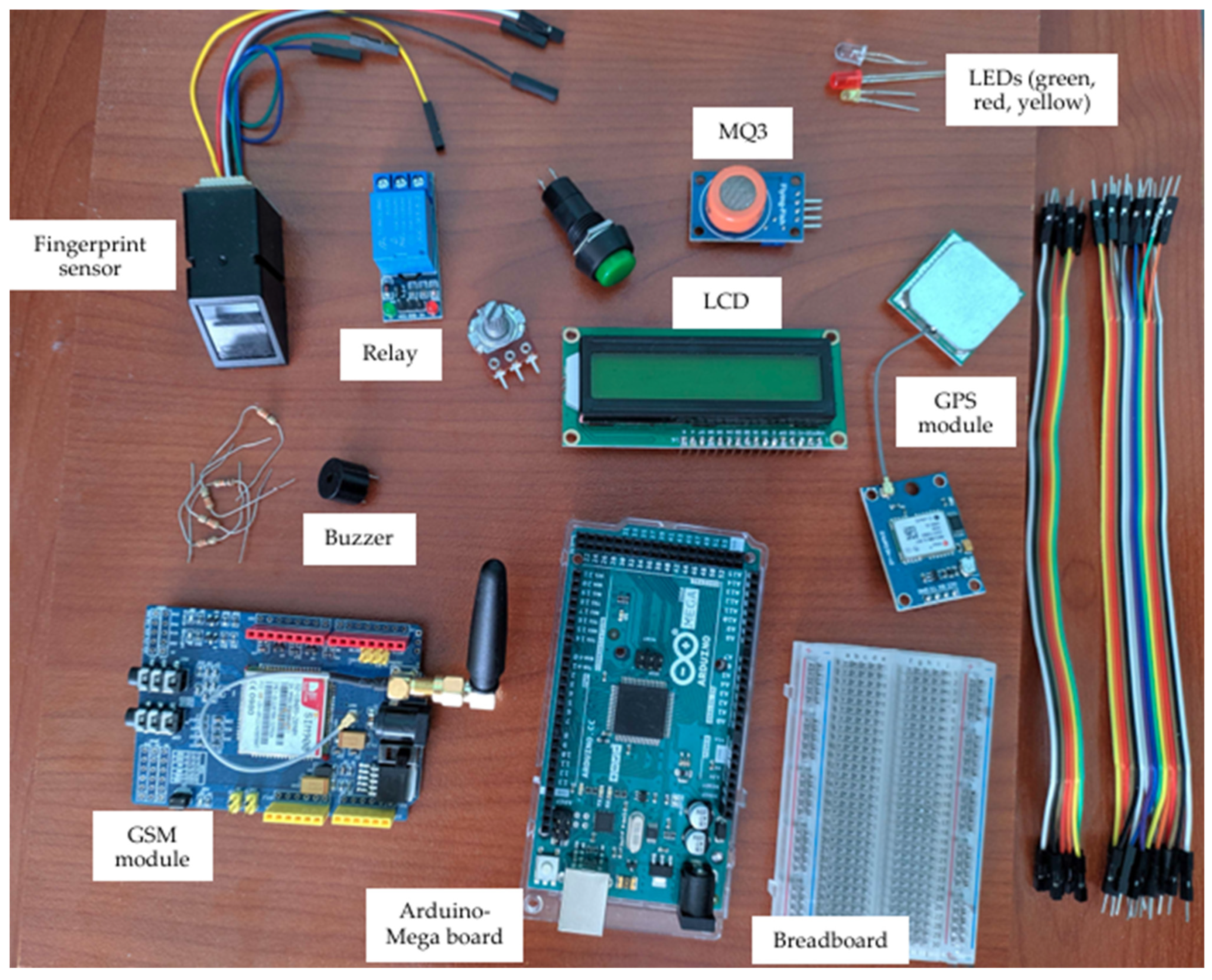
The modules included in the presented system are listed in Table 2 and illustrated in Figure 1.

2.1. The Fingerprint Sensor

The fingerprint sensor is used for the authentication of the user through his/her fingerprints [17]. The sensor is capable of detecting the presence of a finger and authenticating the user in less than 2 s, while it has been proved to properly work even in adverse situations such as the placement of a wet finger, incomplete contact between the finger and the sensor, dirt on the sensor’s glass, etc.
The fingerprint sensor requires a serial communication port of the Arduino board for the transmitter and the receiver pins. The sensor has memory capable of storing up to 127 fingerprints, which is considered quite adequate for the described application.
The connection of the fingerprint sensor to the Arduino-Mega2560 board is implemented as follows:
  • Red cable: Power supply (5 V);
  • Yellow cable: Digital pin 19 (RX1);
  • White cable: Digital pin 18 (TX1);
  • Black cable: Ground (GND).

2.2. The MQ3 Sensor

The MQ3 sensor (part of the MQ series of sensors) measures the concentration of alcohol in an individual’s breath. The sensor has a low power consumption (less than 900 mW) [18].
The sensor’s A0 analog pin is connected to an analog pin of the Arduino board. However, when the sensor is connected to the Arduino board, the sensor’s reading will be a resistance value rather than the alcohol concentration itself, which is why a conversion process is necessary based on the sensor’s datasheet. The conversion is completed according to the formula
x = 104.9y−4.5
which is derived on the basis of Figure 2 of [18]. In (1), x represents the alcohol’s concentration in the driver’s blood in mg/L (milligrams per liter) and y = Rs/Ro with Rs being the sensor’s resistance (depending on the alcohol’s concentration) and Ro = 135.13 Ω being a reference resistance.

2.3. The Relay

The 5 V relay ([19]) is activated and immobilizes the vehicle when the driver’s breath presents an alcohol concentration above the permissible limit. There are six pins in the relay of which the first three are for connecting the relay to the Arduino board, while the rest are for connecting it to the circuit to be controlled (Table 3).

2.4. The Arduino-Mega2560 Module

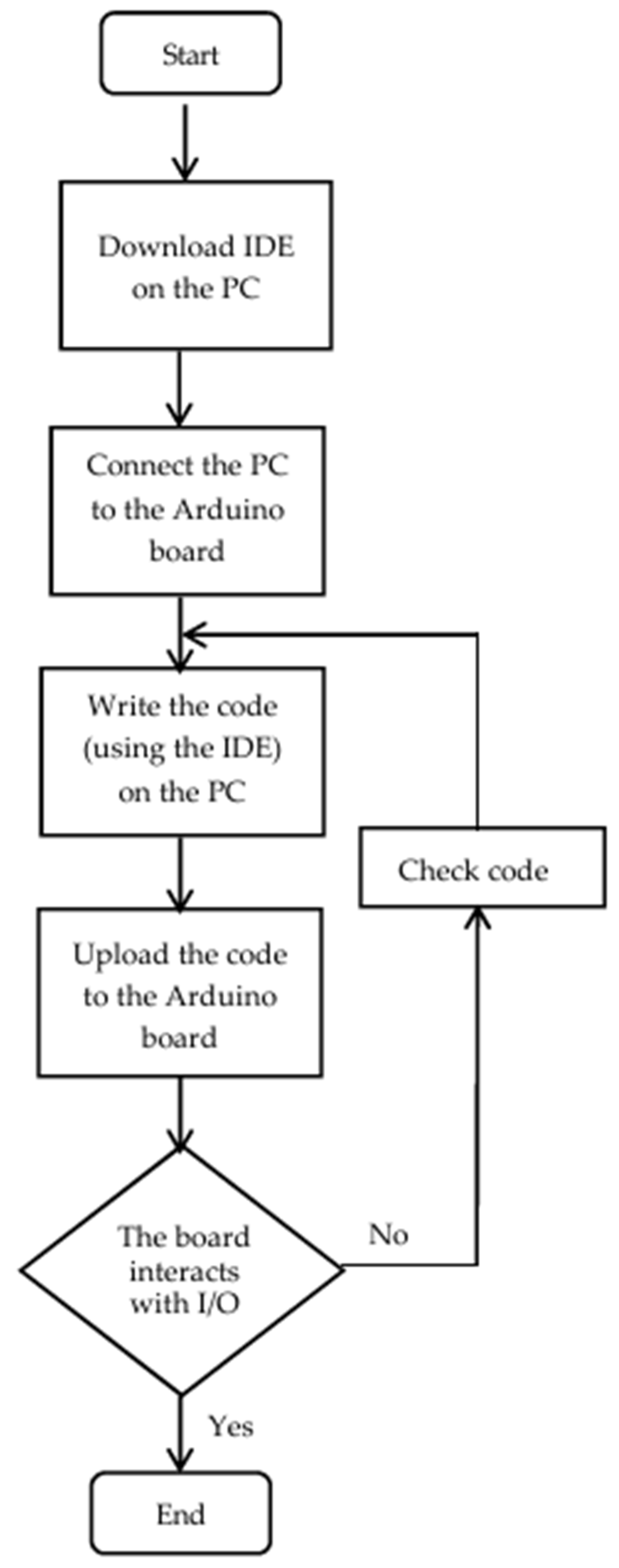
The Arduino-Mega2560 module ([4,20]) was chosen due to its enhanced capabilities regarding memory, the number of I/O pins and the number of serial ports compared to other Arduino boards such as the Arduino-Uno and the Arduino-Nano. The Mega2560 module has 16 analog and 54 digital I/O pins with 15 of the latter being also used as pulse-width modulation (PWM) output pins (Table 4). It also has four serial (UART) ports that are also considered necessary, since three of the system’s modules (the fingerprint sensor, the GPS module and the GSM module) need to be connected to that type of port. The activation of the board’s functions was achieved through the “Integrated Development Environment” (IDE 1.8.12), available at [21], which has the merits of openness, easy use and compatibility with commonly used operating systems such as Windows, Linux and MacOS. The programming of the board was made by means of the Wiring language, which is a variation in C++. The programming process is illustrated in Figure 2.

2.5. The LEDs

There are three LEDs in the system that emit in yellow (592 nm), green (565 nm) and red (633 nm). The yellow LED emits when the fingerprint sensor has authenticated the user, the green LED emits when the alcohol concentration in the breath of the person who enters the vehicle is below the permissible limit, and the red LED emits when the user is found to be intoxicated.

2.6. The Buzzer

The buzzer is designed for low-power applications such as those based on Arduino boards. It operates at a voltage of 4–8 V and requires a current up to 30 mA. The buzzer can provide a sound with intensity of at least 85 dB and, when used, is successively activated and deactivated every 2 s.

2.7. The LCD

The LCD is directly controlled by the Arduino board and is used for displaying messages related to the results of the fingerprint and the MQ3 tests. The display has 2 lines and 16 columns; thus, it is capable of displaying 32 characters at a time [22]. The LCD includes 16 pins, which are described in Table 5.

2.8. The GSM SIM900 Module

The GSM SIM900 module [23] enables easy connection to the mobile telephony network by simply using a SIM card. The main chip of the module is SIM900, which is a low-cost GSM/GPRS modem. SIM900 supports AT commands by a serial (UART) port. Through those commands, the module makes it possible to make phone calls, send and receive text messages (SMSs), and connect to the Internet, thus enabling access to the IoT.
The main technical characteristics of the GSM SIM900 module are shown in Table 6.
Connection of the GSM SIM900 module to the Arduino board is achieved by inserting a SIM card in the respective socket, while the GSM SIM900 is powered either from the Arduino module or from an external source.

2.9. GPS Module

In case the vehicle is stolen, the role of the GPS is to track the vehicle’s position and notify the owner through the GSM network and the IoT. The particular GPS used ([24]) was chosen due to its rather low cost as well as merits such as enhanced portability (owing to its small size and weight) and high sensitivity and accuracy. The module’s technical characteristics are shown in Table 7.

2.10. ThingSpeak

ThingSpeak (created by ioBridge in 2010) is an open-source IoT platform and application programming interface (API) that, by means of the HTTP protocol, is capable of storing and retrieving devices’ data over the Internet or over a local network [25]. Merits of ThingSpeak include its user-friendly interface, its compatibility with development boards such as Arduino and Rasberry, the capability of real-time monitoring the connected IoT systems, the possibility of automatic data movement and communication using third-party services such as X, etc. Another merit of ThingSpeak is that it has a built-in support of the MathWorks’s MATLAB software through which it enables the analysis and visualization of uploaded data.

3. The Operation of the System

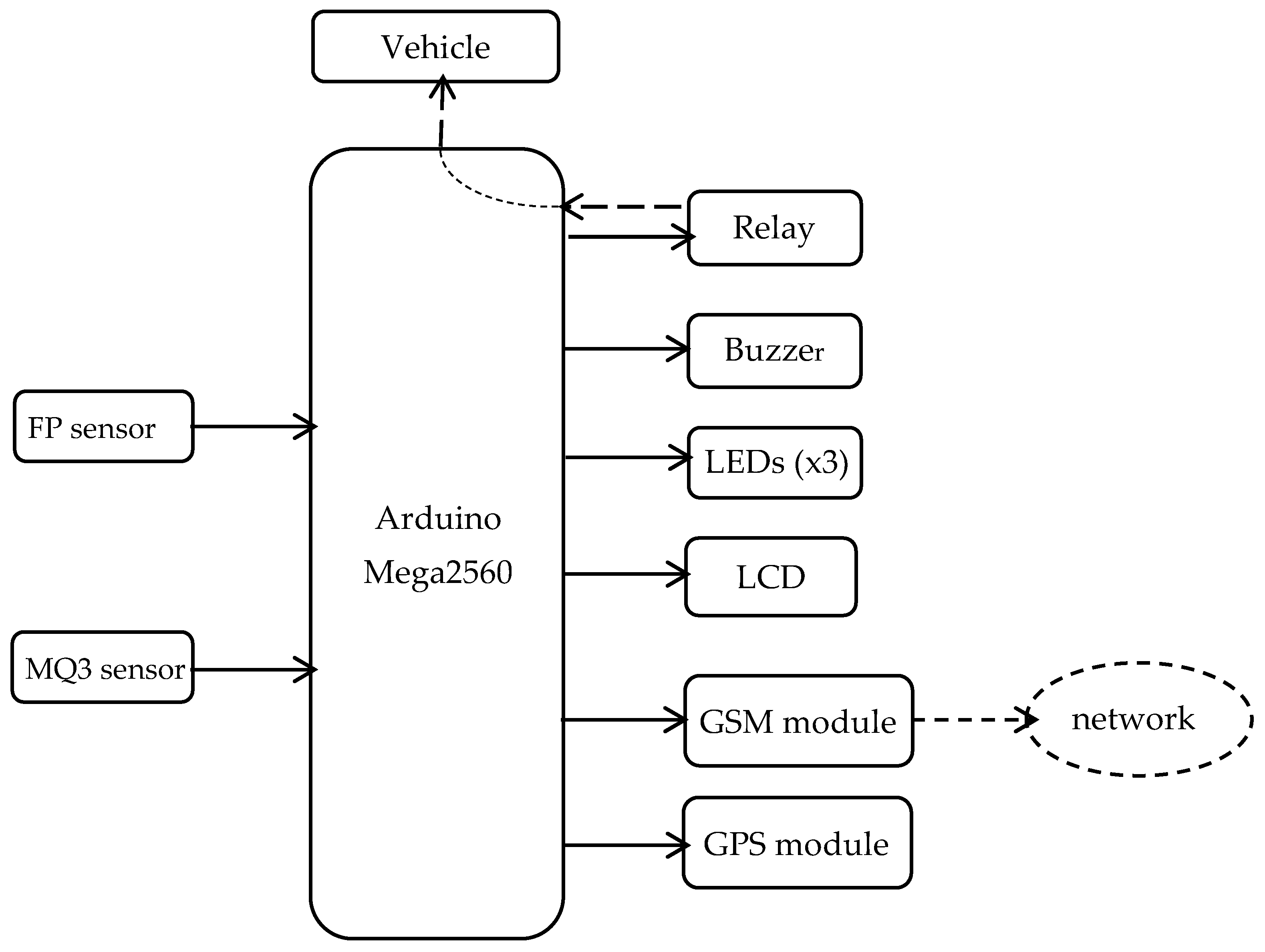
A conceptual diagram of the described system is illustrated in Figure 3. It has to be noted that three of the employed modules (the fingerprint sensor, the GSM module and the GPS module) had to be connected to the serial ports of the Arduino board, which is one of the reasons why the Arduino-Mega board was selected.
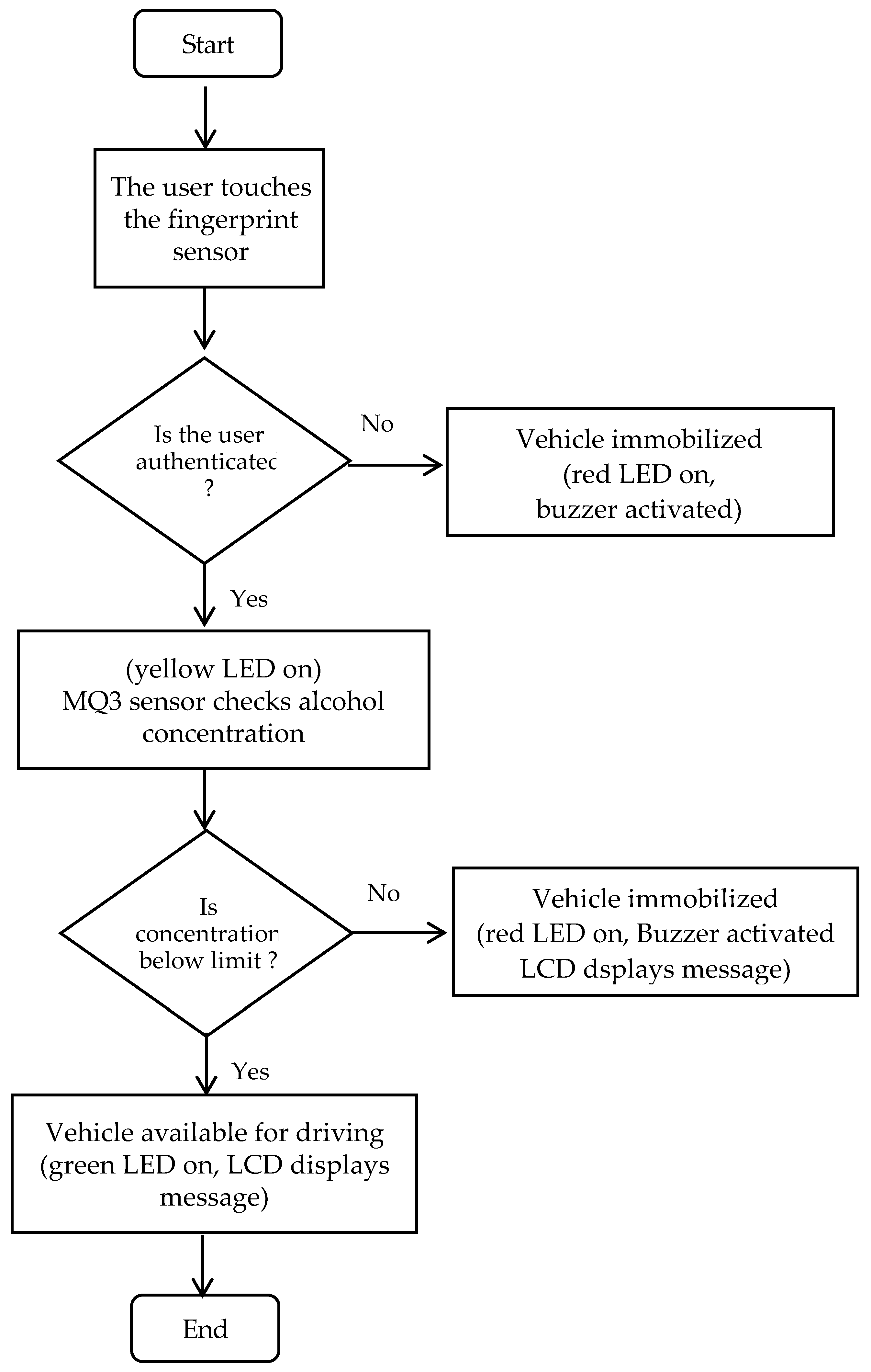
The operation of the system (depicted through the flowchart of Figure 4) is as follows. First, the driver is authenticated by means of the fingerprint sensor. If the authentication fails, the vehicle is immobilized by the relay and the buzzer is activated. When the authenticated driver enters the vehicle, the MQ3 sensor senses the alcohol concentration in his/her breath. If the concentration is below the legal limit, the vehicle is rendered available for driving while, at the same time, the green LED is on and the LCD displays an “able to drive” message together with the alcohol’s concentration. If, however, the MQ3 sensor detects alcohol above the permissible limit, the red LED is on, and the buzzer is activated while the LCD displays an “unable to drive” message plus the alcohol’s concentration. At the same time, the vehicle is immobilized by the relay.
Apart from immobilizing the vehicle, the system anticipates a second level of security: that is the tracking of the vehicle’s position after a possible theft. This is achieved by means of the GPS component, while the GSM module is capable of transmitting the position information by means of the IoT network.
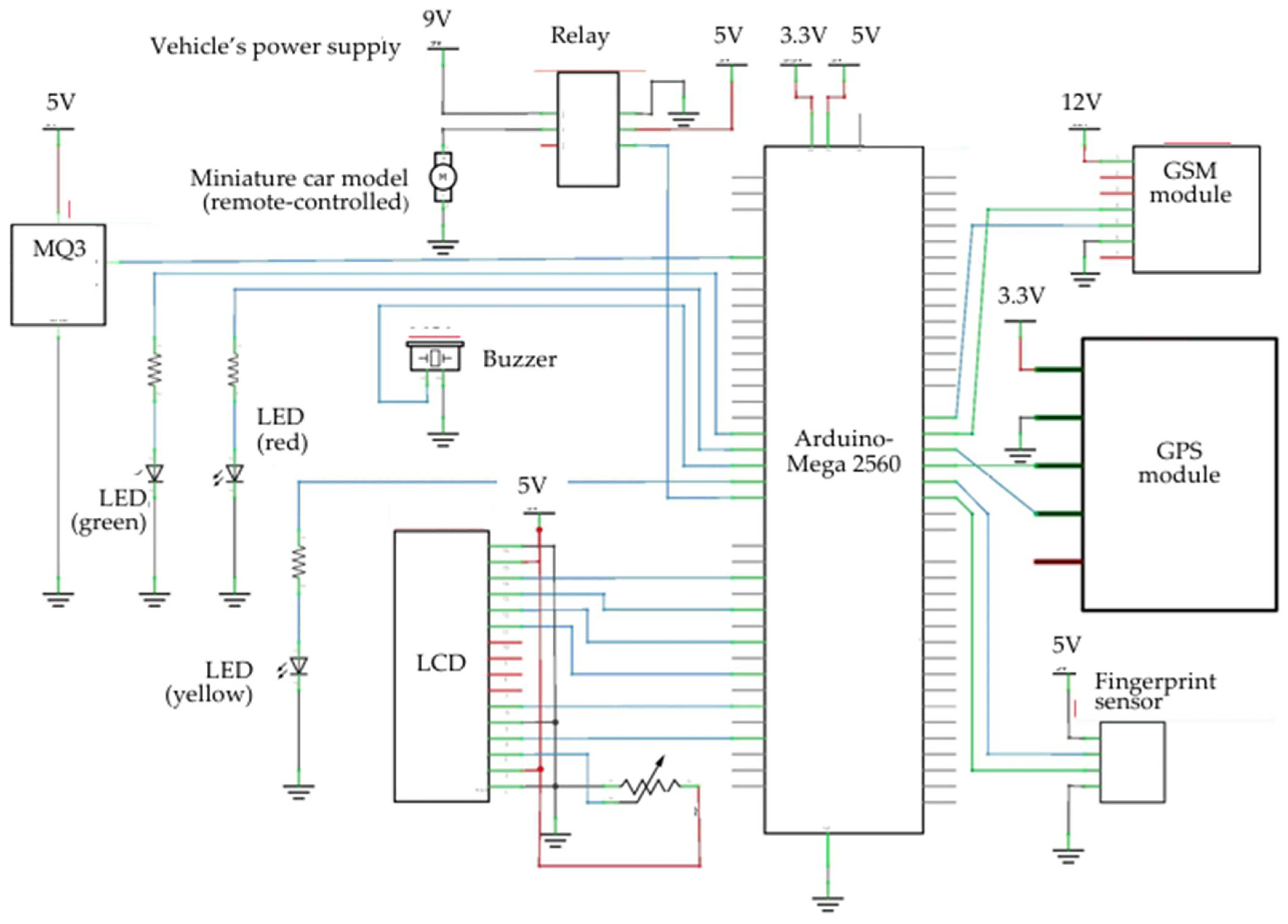
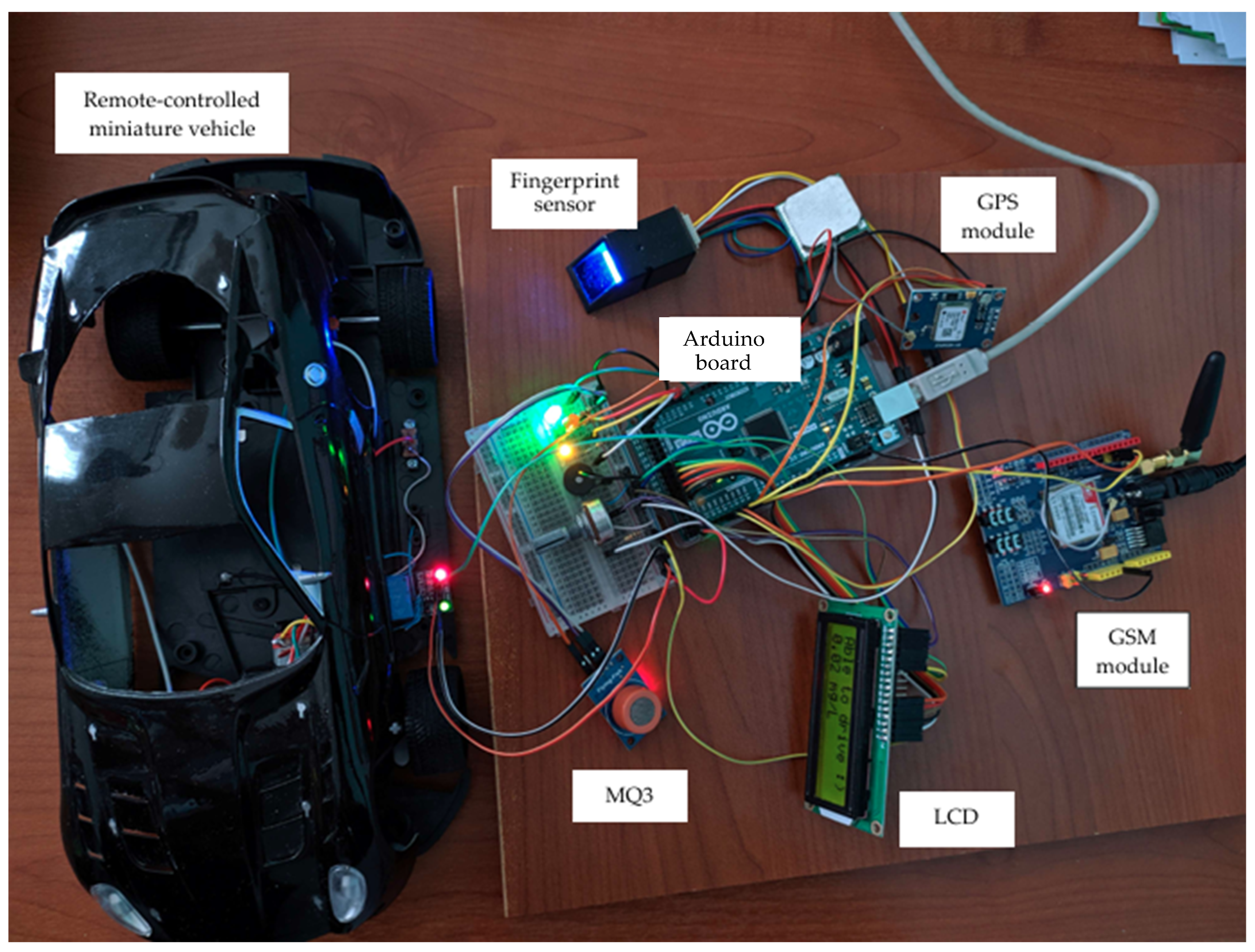
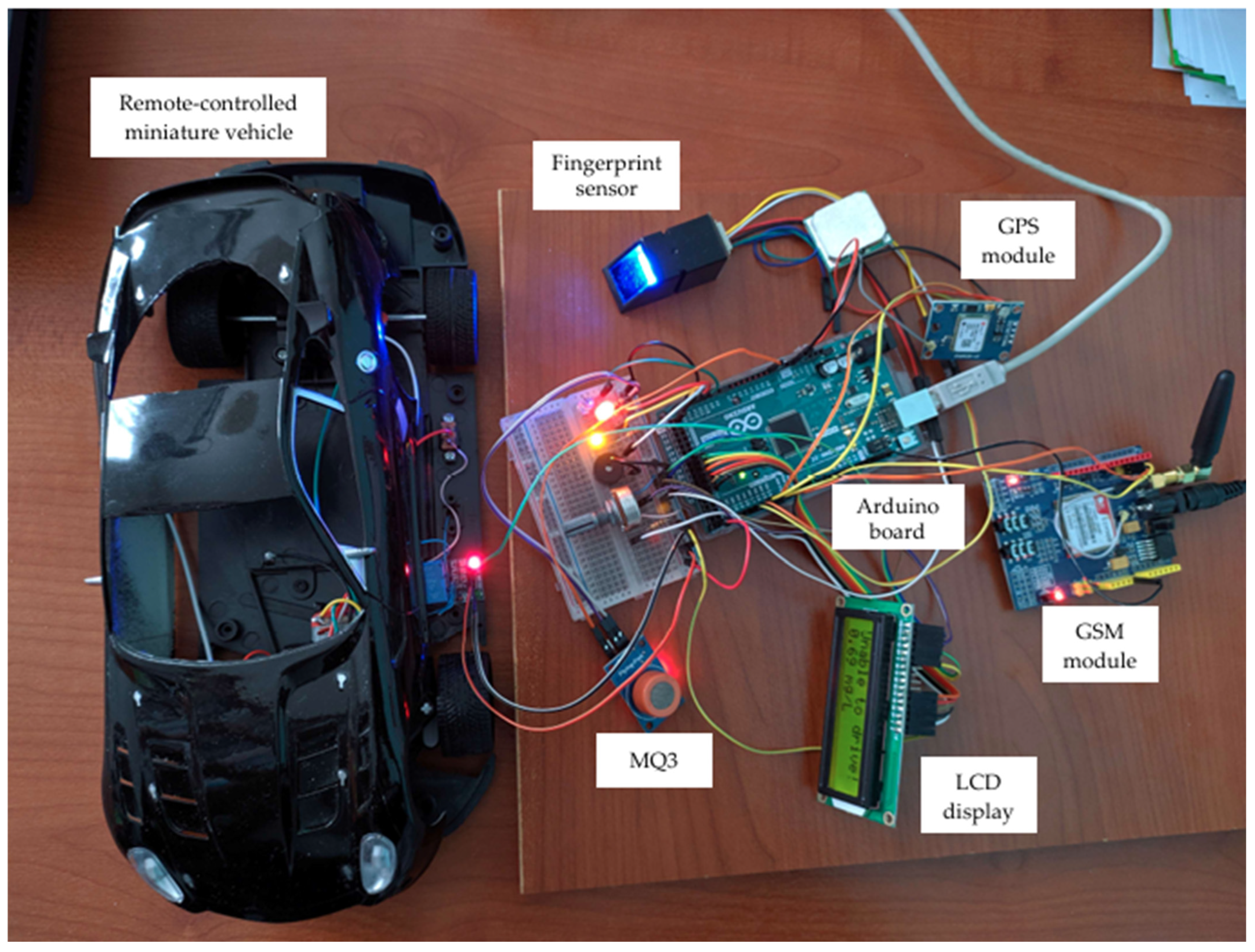
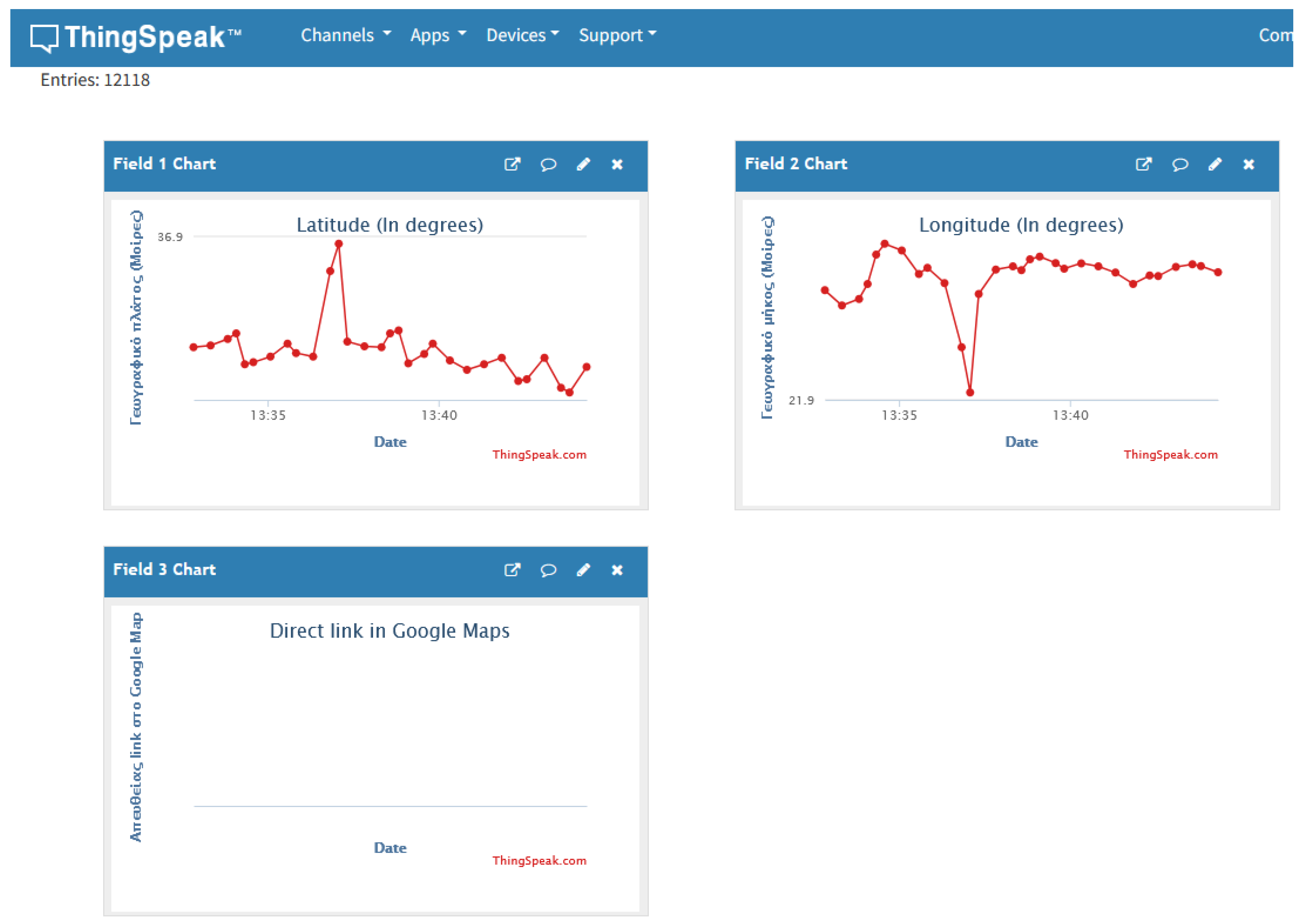
The system was tested on a remote-controlled miniature car model. A block diagram of the system as used for testing is shown in Figure 5. The system responded properly regarding both the user’s authentication (by means of the fingerprint sensor) and the detection of alcohol concentration in the user’ breath (by means of the MQ3 sensor) after a successful authentication (Figure 6 and Figure 7). In either case, the proper LED was activated, while the LCD depicted the driver’s condition and the alcohol’s concentration. For a non-authenticated fingerprint and/or unacceptable alcohol concentration, the miniature car was immobilized. The relevant ThingSpeak screenshots are shown in Figure 8.

4. Discussion

An important issue when it comes to evaluating electrical/electronic systems is the operating time when the system is power-supplied by a battery as well as the consumed power.
Regarding the tested prototype, the scenario chosen was that of an authenticated intoxicated driver, since this is expected to be the most usual case. It was also taken into account that up to two LEDs will simultaneously operate. For each component, the current was measured and the power consumption was calculated as the product of the component’s voltage and the measured current. The results are shown in Table 8.
According to Table 8, the power consumption of the tested prototype is estimated to be about 7.92 W, of which 6.18 W (about 78%) are consumed by the GSM module (owing to the large power requirements for this module’s operation in data mode).
If the prototype is power-supplied by an alkaline battery and given that the typical capacity of such a battery is about 580 mAh, the operating time is estimated to about 580/873.3 h~40 min (or about 580/358.3 h~100 min without the GSM module). An alternative solution would be to use two alkaline batteries (one for the GSM module and one for the rest) in which case the operating time would be equal to min{580/358.3, 580/515} = 1.13 h, which is about 68 min. However, it has to be taken into account that nowadays, electric cars are designed to have rechargeable batteries with a storage capacity of the order of 300 Ah, so an additional current of less than 900 mA (Table 8) which is produced only at the “transmission mode” should not be an issue. In any case, the power consumption could be lowered by reducing the 3 times/min frequency at which the system is put into “transmission mode”; however, this comes at the expense of the vehicle’s security level.
The overall cost of the described system (analyzed in Table 9) is estimated to about 190 € (175 € given that the remote-controlled car is for testing purposes only). Although information on the cost of the proposed vehicle safety and security systems was not found in the literature (to allow comparison), the system can be considered to be a low-cost solution taking into account the essential safety/security issues it addresses and the total cost of a vehicle.
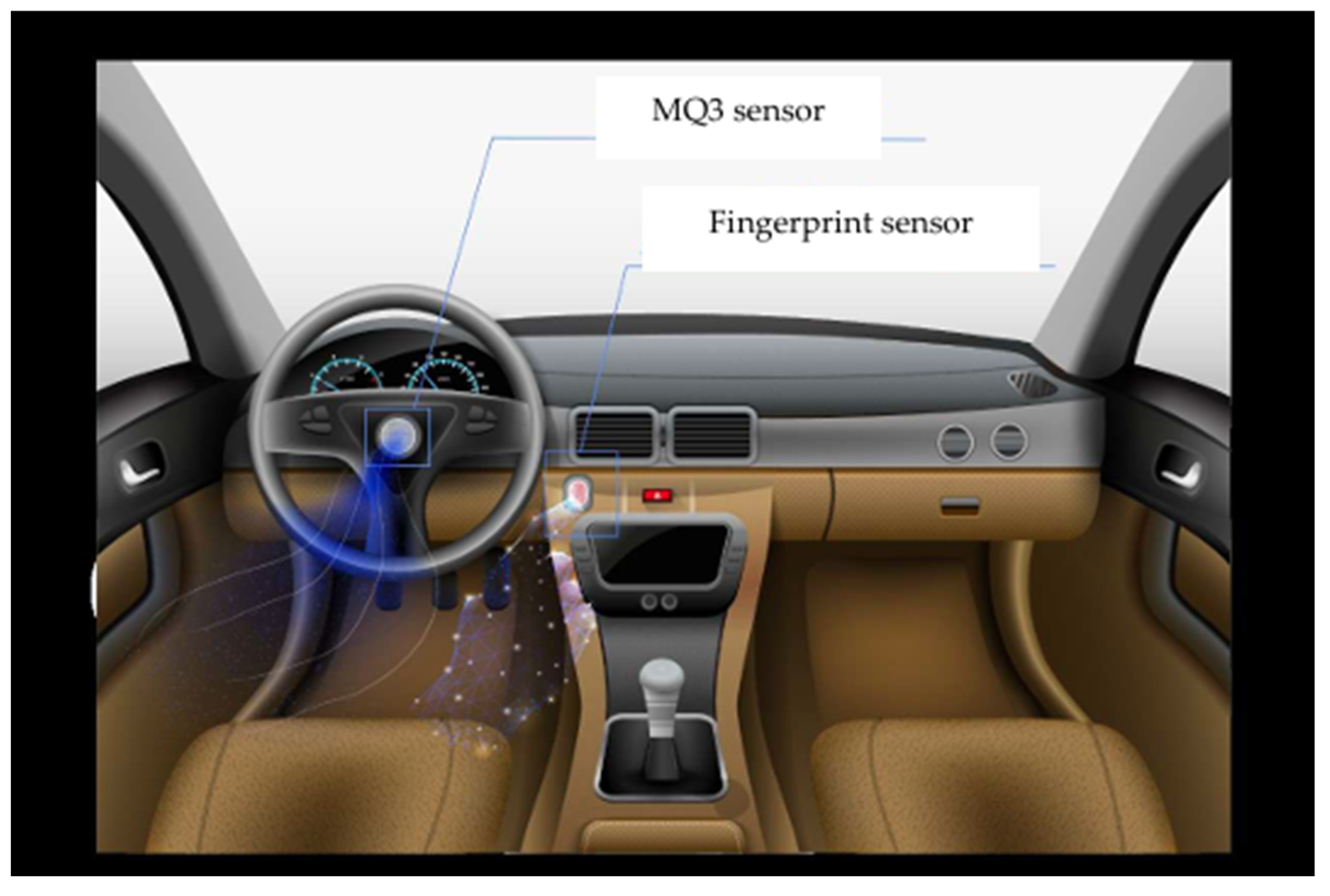
With regard to the deployment of the proposed system, an issue would be its placement within an actual vehicle. Since the system is lightweight and compact in size, it should be easily incorporated into a vehicle; however, their exact placement would mostly depend on the particular vehicle’s design. A possible placement of the fingerprint and the MQ3 sensors within a car is shown in Figure 9.
Regarding the detection of alcohol concentration, another issue would be the treatment of possible actions aiming at preventing the MQ3 sensor from performing a valid test. Given that the system detects the driver’s “unintentional” breath while, during the tests, the system was able to detect low alcohol concentrations (0.02 mg/L, that is 12 times below the legal limit of 0.25 mg/L), it should be considered rather difficult for the driver to evade or “cheat” the detection process. Malicious actions are also a possibility (the MQ3 sensor to have been covered, de-activated or even damaged), however, and despite the fact that the proposed detection system is for the driver’s self-protection (and, as such, it would need his/her cooperation), a manufacturer may have chosen to include a mechanism for immobilizing the vehicle in case the alcohol sensor is found to not be operational.
A manufacturer might also address the issue of the system’s immunity to interference given its importance for the safety and security of the driving process and the vehicle itself. Another issue would be the security of the system against malicious actions by third parties such as communication hijacking and/or false data injection attacks. Several protection strategies to mitigate the problem have been proposed (mainly with regard to the electric grid, e.g., [26]), and the vehicle’s manufacturer could choose to apply such a strategy compromising expected benefits and possible engineering complications as well as cost.
Regarding theft, the issue of GSM availability is an essential one. However, given the wide coverage of GSM, the probability of the stolen vehicle moving in areas not covered by GSM for a long period of time is rather low.
In a possible future development, the system could include the possibility of automatic transmission of a text-message notification to a person having been designated by the driver in advance (e.g., in case the driver is intoxicated and not able to drive).
The system is flexible and could be further extended to provide drivers’ fatigue detection and/or collision warning. Regarding the detection of fatigue, several approaches have been proposed such as eye–mouth detection, head rotation, eye blinking detection, and eye closing in different viewing directions [27]. Among those methods, the eye-blinking detection could be utilized by means of a relevant (e.g., infrared) sensor incorporated in the described system. With regard to collision warning, the system could be extended to include sensors that could monitor the road ahead, alerting drivers with lights, sounds, or vibrations if they come too close to another vehicle or obstacle [5].
Further improvements and extensions of the described system could include the following:
  • Use of a larger LCD screen.
  • The incorporation of a smoke detector (e.g., the MQ2) given that several accidents are caused by smoking drivers, since smoking either slows down the driver’s reaction or can be the cause of fire within the vehicle.
  • Visualization of the vehicle’s route on Google maps (e.g., through programming with Java and retrieving the location data from ThingSpeak).
The prototype described in this paper can be considered to have a technology readiness level (TRL) equal to 5, which corresponds to the components and/or breadboard validation in relevant environment [28].
Apart from the technical aspect, Arduino-based projects can also serve as didactical tools due to the fact that such projects usually require the combination of different knowledge topics while involving cooperative and inquiry-based learning in accordance with the STEM principles (e.g., [29]). In this context, the proposed system could be either demonstrated to students to support relevant teaching and learning activities or, as a more demanding assignment, the students could be called to rebuild parts or the whole of the system. It has to be noted that the system’s development has the features of a “rich” activity, since (i) it allows students to employ diverse engineering topics and skills, (ii) it comprises all three types of knowledge (content, pedagogical, and technological) of the TPACK framework [30] and all six levels (remember, understand, apply, analyze, evaluate, create) of Bloom’s taxonomy [31], and (iii) it fully exploits the attractiveness and potential of project-based and discovery learning. This is particularly important for students who, after their graduation, are to be employed as teachers in technology-oriented schools since it makes them capable of applying effective teaching/learning practices in their own classes.

5. Conclusions

The article describes the design, implementation and testing of a low-cost Arduino-and IoT-based system that addresses two essential safety-security issues: that of drunk driving and that of theft. After driver’s authentication (by means of a fingerprint sensor), an MQ3 alcohol sensor detects the driver’s breath, and if it senses an alcohol concentration above the permissible limit, the vehicle is immobilized. Regarding theft, there are two safety layers: the first one employs the above-mentioned fingerprint sensor to authenticate the driver (with the vehicle being immobilized in case of non-authentication), while the second one includes a GPS module that collects the information about the vehicle’s location and, through an incorporated GSM SIM900 module, it transmits the location data to an IoT server by employing the ThingSpeak software. The system was successfully tested and, regarding deployment, it has the merits of low-cost development and easy adaption to actual vehicles.
A further development of the system could include the possibility of automatically sending a text-message notification to a person having been designated by the driver in advance (e.g., if the driver is intoxicated). It could also anticipate the system’s extension to include additional safety functions such as smoke sensing, driver’s fatigue detection, collision warning, and visualization of the vehicle’s route on Google maps. The system could be also used for teaching/learning purposes, since its implementation is a rich educational activity that fully exploits the effectiveness of discovery and project-based learning.

Author Contributions

Conceptualization: P.M., A.P., G.P. and L.D.; investigation, P.M., A.P., N.V. and K.N.; software, P.M.; data curation, P.M., G.P., L.D., N.V. and K.N.; writing—original draft preparation, G.P., P.M. and A.P.; writing—review and editing, G.P.; supervision, A.P.; project administration, A.P. All authors have read and agreed to the published version of the manuscript.

Funding

This research received no external funding.

Data Availability Statement

The original contributions presented in this study are included in the article. Further inquiries can be directed to the corresponding author.

Conflicts of Interest

The authors declare no conflicts of interest.

References

  1. Luisi, L. Working principle of Arduino and using IT as a tool for study and research. Int. J. Control. Autom. Commun. Syst. 2016, 1, 21–29. [Google Scholar] [CrossRef]
  2. Michailidis, J.; Mountzouris, P.; Triantis, P.; Pagiatakis, G.; Papadakis, A.; Dritsas, L. An Arduino-based portable weather monitoring system, remotely usable through the mobile telephony network. Electronics 2025, 14, 2330. [Google Scholar] [CrossRef]
  3. Koprda, S.; Balogh, Z.; Magdin, M.; Reichel, J.; Molnar, G. The possibility of creating a low-cost laser engraver CNC machine prototype with platform Arduino. Acta Polytec. Hung. 2020, 17, 181–198. [Google Scholar] [CrossRef]
  4. Kondaveeti, H.K.; Kumaravelu, N.K.; Vanambathina, S.D.; Mathe, S.E.; Vappani, S. A systematic literature review on prototyping with Arduino. Comput. Sci. Rev 2021, 40, 2–28. [Google Scholar] [CrossRef]
  5. Berdigh, A.; Kenza, O.; Khalid, E.Y. Connected car & IoT: A review. In Advanced Intelligent Systems for Sustainable Development (AI2SD 2018): Volume 5: Advanced Intelligent Systems for Computing Sciences; Springer: Berlin/Heidelberg, Germany, 2019; pp. 928–940. [Google Scholar]
  6. Baghdadi, S.; Aboutabit, N. A comparative study of vehicle detection methods. In Advanced Intelligent Systems for Sustainable Development (AI2SD 2018): Volume 5: Advanced Intelligent Systems for Computing Sciences; Springer: Berlin/Heidelberg, Germany, 2019; pp. 916–927. [Google Scholar]
  7. Mamatha, T.; Manoj, M.; Nandini, N.; Nikhil, V.; Das, S. Smart accident detection and alert message system. Int. Res. J. Eng. Technol. 2022, 9, 35–38. [Google Scholar]
  8. Sehgal, V.K.; Mehrotra, S.; Marwah, H. Car security using Internet of Things. In Proceedings of the International Conference on Power Electronics, Intelligent Control and Energy Systems ICPEICES, Delhi, India, 4–6 July 2016. [Google Scholar]
  9. Sayyad, J.; Taha, M.; Sankpal, A. Advanced car security system. Int. J. Sci. Res. Netw. Secur. Commun. 2017, 5, 165–169. [Google Scholar]
  10. James, N.; Aprana, C.; Teena, J.P. Alcohol detection system. Int. J. Res. Comput. Commun. Technol. 2014, 3, 59–64. [Google Scholar]
  11. Malathi, M.; Sujitha, R.; Revathy, M.R. Alcohol detection and seat-belt control system using Arduino. In Proceedings of the International Conference on Innovations in Information, Embedded and Communication Systems ICIIECS, Coimbatore, India, 17–18 March 2017. [Google Scholar]
  12. Gasparesc, G. Driver alcohol detection system based on virtual instrumentation. In Proceedings of the International Federation of Automatic Control IFAC, Florianópolis, Brazil, 1–3 September 2018. [Google Scholar]
  13. Ahmad, I.; Suhaimi, M.; Yusri, N. Development of an alcohol sensor/detector with engine locking system for accident prevention. In Proceedings of the American Institute of Physics AIP, Melbourne, Australia, 4–6 December 2019. [Google Scholar]
  14. Bhagya Rekha, K.; Hari Priya, K.; Lakshmi Kalyani, N.; Lakshmi Deepthi, G.; Sai Srithaja, N. Smart accident prevention and identification system. Int. J. Res. Eng. Appl. Manag. 2022, 8, 92–95. [Google Scholar] [CrossRef]
  15. Vyavhare, V.A.; Rajarshri, K.; Pooja, K.; Pol, Y. Accident, detection, prevention and alert system. Int. J. Sci. Res. Sci. Technol. 2023, 10, 133–136. [Google Scholar]
  16. Vijay, J.; Saritha, B.; Priyadharshini, B.; Deepeka, S.; Laxmi, R. Drunken drive protection system. Int. J. Sci. Eng. Res. 2011, 2, 1–4. [Google Scholar]
  17. Adafruit, Optical Fingerprint Sensor Datasheet. Available online: https://cdn-learn.adafruit.com/downloads/pdf/adafruit-optical-fingerprint-sensor.pdf (accessed on 25 November 2025).
  18. Hanwei Electronics Co., Zhengzhou, China. Technical Data, MQ3 Sensor. Available online: https://cdn.sparkfun.com/assets/6/a/1/7/b/MQ-3.pdf (accessed on 12 December 2025).
  19. Faranux Electronics, Kigali, Rwanda. Single Channel 5V Relay Module. Available online: https://www.faranux.com/product/single-channel-5v-relay-module-com41/ (accessed on 25 November 2025).
  20. Arduino-Mega2560 R3. Available online: https://docs.arduino.cc/hardware/mega-2560/ (accessed on 25 November 2025).
  21. Arduino IDE 1.8.12. Available online: https://blog.arduino.cc/2020/02/13/arduino-1-8-12-is-out/ (accessed on 25 November 2025).
  22. Grobotronics, Athens, Greece. LCD 16x2. Available online: https://grobotronics.com/basic-16x2-character-lcd-black-on-green-5v.html (accessed on 25 November 2025).
  23. Grobotronics, Athens, Greece. GSM/GPRS Shield for Arduino SIM900. Available online: https://grobotronics.com/gsm-gprs-shield-for-arduino-sim900.html?srsltid=AfmBOor6xLlkolNLYSfNa9j8UEDzgDh8pVctlNtQ_SoZZQ_g73-TTxzt (accessed on 25 November 2025).
  24. U-blox, Thawill, Switzerland. NEO-6 GPS Module. Available online: https://content.u-blox.com/sites/default/files/products/documents/NEO-6_DataSheet_%28GPS.G6-HW-09005%29.pdf (accessed on 25 November 2025).
  25. Learn More About Thingspeak. Available online: https://thingspeak.com/pages/learn_more (accessed on 25 November 2025).
  26. Wang, X.; Zhu, H.; Luo, X.; Guan, X. Data-Driven-based Detection and Localization Framework against False Data Injection Attacks in DC Microgrids. IEEE Internet Things J. 2025, 12, 36079–36093. [Google Scholar] [CrossRef]
  27. Abbas, Q.; Alsheddy, A. Driver fatigue detection systems using multi-sensors, smartphone, and cloud-based computing platforms: A comparative analysis. Sensors 2020, 21, 56. [Google Scholar] [CrossRef]
  28. Heder, M. From NASA to EU: The evolution of the TRL scale in Public Sector Innovation. Innov. J. 2017, 22, 3. [Google Scholar]
  29. Akritidis, G.; Dritsas, L.; Pagiatakis, G.; Papadakis, A.; Katsiris, I.; Voudoukis, N.; Karaoulanis, D.; Uzunidis, D. Use of Arduino-based projects to support education in electrical and electronic engineering. In Proceedings of the International Conference on Education and New Learning Technologies EDULEARN-25, Palma, Spain, 30 June–2 July 2025. [Google Scholar]
  30. Mishra, P.; Kohler, M.J. Technological pedagogical content knowledge: A framework for integrating technology in teacher knowledge. Teach. Coll. Rec. 2006, 108, 1017–1054. [Google Scholar] [CrossRef]
  31. Armstrong, P. Bloom’s Taxonomy; Vanterbilt University Center for Teaching: Nashville, TN, USA, 2023; Available online: https://cft.vanderbilt.edu/guides-sub-pages/blooms-taxonomy (accessed on 12 September 2023).
Figure 1. The system’s components.
Electronics 15 00070 g001
Figure 2. Flowchart of Arduino programming.
Electronics 15 00070 g002
Figure 3. A conceptual diagram of the described system (the arrows depict the flow of data). The fingerprint (FP) and the MQ3 sensors provide the authentication and the alcohol concentration data to the Arduino-Mega2560 module. Depending on the data provided, the Arduino board activates the proper LED (yellow, green or red) and, in case of non-authentication or driver’s intoxication, it also activates the buzzer and the relay (which immobilizes the vehicle). The Arduino module also activates the LCD which displays the driver’s condition (“able to drive” or “unable to drive”) plus the alcohol concentration. In case of theft, the GPS and the GSM modules track the vehicle’s position and transmit the relevant information.
Electronics 15 00070 g003
Figure 4. System’s operation.
Electronics 15 00070 g004
Figure 5. A block diagram of the described system as used for testing. All modules are connected to the proper pins of the Arduino-Mega board. The fingerprint and the MQ3 sensors provide the authentication and alcohol concentration data for the system to decide whether the vehicle can move or has to be immobilized. In either case, the Arduino board activates the proper LED (the yellow one in case of an authenticated user, the green one if the user is found sober and the red one if the user is intoxicated). In the cases of non-authentication or driver intoxication, the Arduino board activates the buzzer and the relay (which immobilizes the vehicle). In either case, the LCD displays the user condition plus the alcohol concentration in his/her breath. The GPS and the GSM modules are used for tracking the vehicle and transmitting the relevant information through the GSM network.
Electronics 15 00070 g005
Figure 6. A photo of the system (including a remote-controlled miniature model vehicle) during testing. The fingerprint sensor has authenticated the driver (yellow LED on), while the MQ3 sensor has detected the alcohol concentration below the limit of 0.25 mg/L (green LED on and LCD displaying the message “able to drive 0.02 mg/L”).
Electronics 15 00070 g006
Figure 7. A photo of the system (including a remote-controlled miniature model vehicle) during testing. The fingerprint sensor has authenticated the driver (yellow LED on); however, the MQ3 sensor has detected alcohol concentration higher than the 0.25 mg/L limit (red LED on and LCD displaying the message “unable to drive 0.69 mg/L”).
Electronics 15 00070 g007
Figure 8. ThingSpeak screenshots. “Field 1” and “Field 2” depict the vehicle’s position in terms of latitude and longitude shown on the vertical axes, while the horizontal axes show the time. Position accuracy depends on the signal’s intensity; however, it is better than 3 m.
Electronics 15 00070 g008
Figure 9. Possible placement of the fingerprint and the MQ3 sensors within a car.
Electronics 15 00070 g009
Table 1. An overview of vehicle safety-security systems.
RefIssue AddressedCentral UnitCommunication Mode
[5]Vehicle’s weight, traffic congestionn/aIntra-vehicle wireless IoT
[6]Detection of prohibited driving actionsn/an/a
[7]Accident alert messageArduino-UnoGPS, GSM, Bluetooth
[8]TheftArduino-UnoGPS, GSM, IoT
[9]Theft, gas leakageArduinoGPS, GSM, IoT
[10]Drunk drivingMicrocontrollern/a
[11]Drunk driving,
driver not using seat-belt
ArduinoGSM, GPS
(future development)
[12]Drunk drivingArduino-Unon/a
[13]Drunk drivingArduino-MegaBluetooth
[14]Vehicle’ and driver’s condition
including intoxication
Arduino-Unon/a
[15]Accident prevention and detection
(including alcohol sensing)
Arduino-MegaGPS, GSM
[16]Drunk driving, not using helmetMicrocontrollerGPS, GSM
n/a: not applicable.
Table 2. The system’s modules.
ModuleRole
Fingerprint detectorIt authenticates the user by sensing his/her fingerprints.
MQ3 sensorIt senses alcohol in the authenticated user’s breath.
Relay (5 V)It immobilizes the vehicle in case alcohol above the permissible limit is detected.
Arduino-Mega2560 boardIt gathers the sensors’ data.
Light-emitting diode (LED)It emits green or red light depending on whether the detected alcohol is below or above the permissible limit.
BuzzerIt is activated when the vehicle’s user is not authenticated or the detected alcohol is above the permissible limit.
Liquid crystal display (LCD) 16 × 2It displays messages regarding the fingerprint and/or alcohol sensing.
GPS moduleIt collects information about the vehicle’s location.
GSM SIM900 moduleIt transmits the collected location data to the Cloud through the mobile network.
Table 3. The relay pins.
PinRole
VCCTo be connected to a 5 V power supply.
GNDTo be connected to the ground.
INTo be connected to a digital pin of the Arduino board. Depending on the signal received from Arduino, the relay is activated or deactivated.
NONormally Open. The circuit is disconnected when the relay is off.
COMSwitching
NCNormally closed. The circuit is connected when the relay is off.
Table 4. Technical characteristics of Arduino-Mega2560 board [4].
ParameterValue
ProcessorAtmel ATmega-2560
Processor’s frequency16 MHz
Analog inputs/outputs16
Digital inputs/outputs (PWM output pins)54 (15)
Serial ports (UART)4
Flash memory 256 KB
EEPROM4 KB
SRAM8 KB
Operating voltage 5 V
External voltage 7–12 V
Dimensions101.52 × 53.3 mm
Weight37 g
Table 5. The LCD pins.
PinRole
VDDTo be connected to a 5 V power supply.
VSSTo be connected to the ground.
V0Adjustment of the screen’s contrast.
RSRegister select. It connects to a digital I/O put of Arduino to choose whether to activate the data register (HIGH) or the command register (LOW)
RWRead/Write. Choice of whether the action to the register is “read” (HIGH) or “write” (LOW).
EEnable. Choice of the proper register for the writing of the data.
D0–D7 Parallel transmission of 8 bits of data. Usually (and with the aim to economize Arduino’ digital pins), only the D4–D7 pins are connected to Arduino and the 8 bits are sent in two groups of four.
A, KThey are connected to the anode and cathode of the LED that provides the display’s backlight. K is grounded
Table 6. Technical characteristics of the GSM SIM900 module.
ParameterValue
Frequency band850/900/1800/1900 MHz
Technology2 G
Supply voltage5–12 VDC
Maximum supply current2 A
Idle state current30 mA
Temperature of operation−40 °C to 80 °C
InterfaceUART
(default: 115,200 bps at 3.3/5 V)
Table 7. Technical characteristics of the GPS module.
ParameterValue
Central frequency 1575 MHz
Bandwidth±5 MHz
Gain0 dM
Sensitivity−161 dBm
Time to first-fix1 s (hot) to 27 s (cold)
Horizontal position accuracy2–2.5 m
Velocity accuracy0.1 m/s
Operating temperature−40 °C to 85 °C
Dimensions16 × 12.2 × 2.4 mm
Weight4 g
Table 8. Voltage, current and consumed power per component (the power is calculated as the product of voltage and current).
ComponentVoltage (V) Current (mA)Power Consumed (mW)
Fingerprint sensor555.1275.5
MQ3 sensor5108540
Arduino-Mega2560570350
LED 158.944.5
LED 258.944.5
Buzzer53.819
Relay (5 V)561.2306
LCD display512.562.5
GPS module3.329.998.67
GSM SIM900 module55156180
TOTAL---873.37920
Table 9. Cost of the vehicle safety-security system.
ComponentCost (€) 1
Fingerprint sensor36.00
MQ3 sensor5.00
Arduino-Mega256040.00
LEDs3.00
Buzzer1.00
LCD display7.00
Relay (5 V)2.00
GPS module20.00
GSM SIM900 module30.00
Data package15.00
Breadboard5.00
Remote-controlled miniature vehicle15.00
Miscellaneous (cables etc.)11.00
TOTAL COST190.00
1 Approximate cost.
Disclaimer/Publisher’s Note: The statements, opinions and data contained in all publications are solely those of the individual author(s) and contributor(s) and not of MDPI and/or the editor(s). MDPI and/or the editor(s) disclaim responsibility for any injury to people or property resulting from any ideas, methods, instructions or products referred to in the content.