1. Introduction
With the continuous development of power electronics techniques, more and more converters with medium or high input voltages (≥1000 V) are needed in various industry applications, especially in renewable energy and transportation applications [
1,
2,
3]. In these converters, the high voltage issue of each component is the most urgent problem to be solved. The input-series structure is a valid scheme to solve the high voltage problem in the converters with medium or high input voltages, and voltage stress of each component in these converters can be reduced substantially as long as the input voltage sharing of each input-series circuit is achieved [
4,
5].
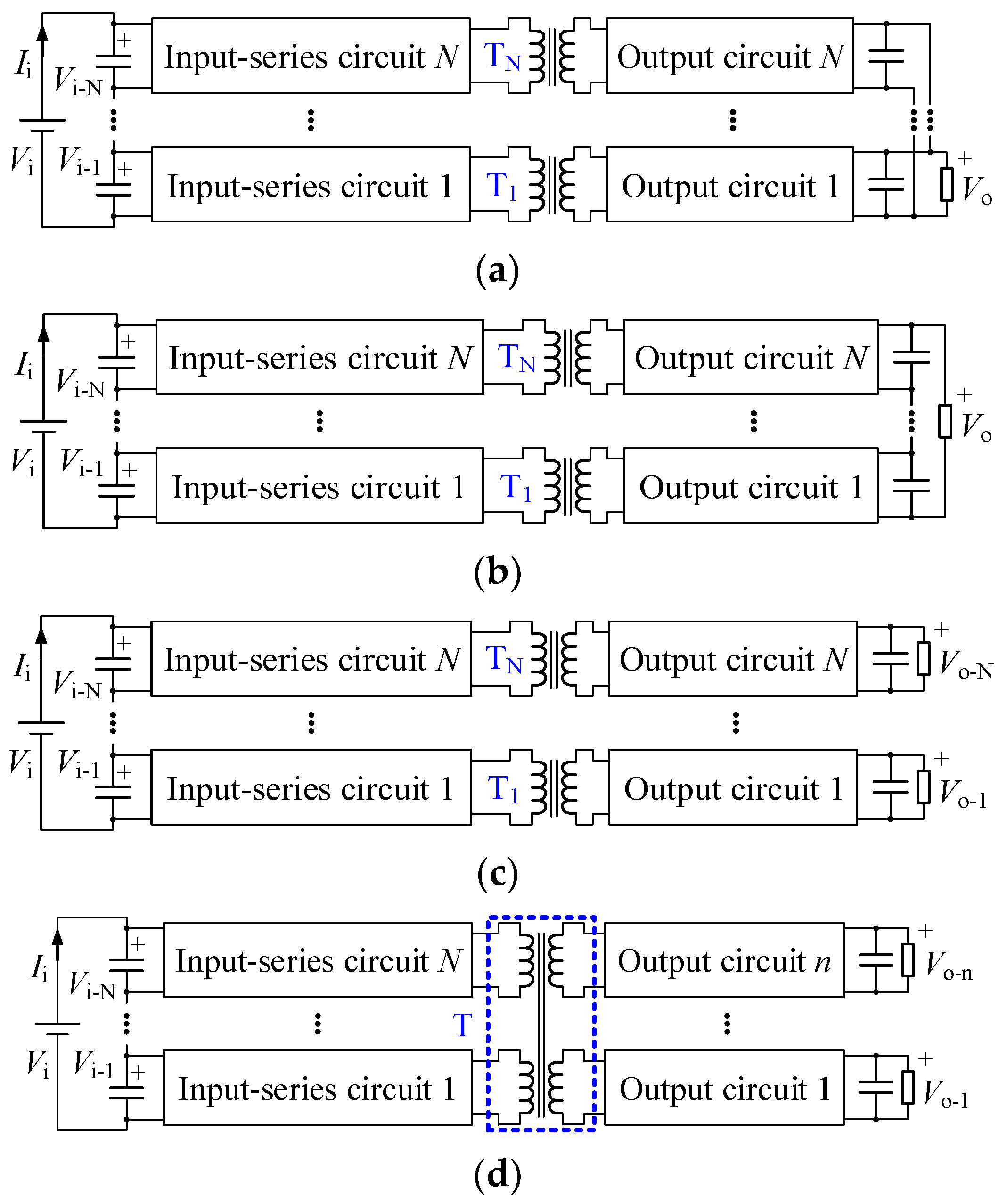
Generally, there are two basic input-series structures: one is the output-parallel strategy, as shown in
Figure 1a, and the other one is the output-series strategy, as shown in
Figure 1b. In addition to the input voltage sharing, output voltage and current sharing should also be ensured in these two kinds input-series converters [
5,
6,
7]. In past years, many voltage or current sharing strategies have been implemented, and a good voltage or current sharing effect could be achieved for each converter [
7,
8,
9,
10,
11,
12]. These two basic input-series structures can be applied in various power applications, provided the suitable circuit topology is adopted in each input-series circuit. However, their output connections will become more complex when multiple outputs are required, so these two basic input-series structures are not suitable to apply in multiple-output applications.
Aiming at multiple-output applications, the output-independent strategy is applied in the input-series converters, as shown in
Figure 1c. The input voltage sharing effect of these converters will be serious when the energies transferring through various output circuits are unbalanced, so the output-independent strategy can only be adopted in applications when the energies transferring through different output circuits are balanced [
13,
14,
15,
16].
In addition to the output-parallel, output-series, and output-independent strategies, the transformer-integration strategy can also be applied in the input-series converters, as shown in
Figure 1d, where all input-series circuits enjoy a common integrated transformer, so the output circuits can be conveniently made in the secondary sides of this integrated transformer [
17,
18,
19,
20]. In these input-series transformer integration (ISTI) converters, natural input voltage sharing can be achieved, provided all input-series circuits are operating synchronously. The transformer-integration strategy can also be applied in various power applications, as long as the suitable circuit topology is adopted in each input-series circuit. Compared to the output-parallel or output-series strategies, the transformer-integration strategy is much more suitable to apply when the multiple-output circuits are required, which is a conventional requirement in low-power applications.
Recently, ISTI flyback converters have been investigated systematically in multiple-output low-power applications [
18,
19]. These investigations provided the following conclusions:
(1) The input voltage sharing of the ISTI flyback converter can be ensured naturally by the coupling relationships of the primary windings in the integrated transformer. The input voltage sharing effects will be achieved more efficiently as the coupling coefficients of the primary windings increase.
(2) Due to inevitable parameter errors, the absolute synchronous operation of all input-series circuits cannot be realized, so input voltage differences occur. The input voltage differences can be reduced through the special design of key parameters, especially the input filter capacitance in each input-series circuit.
(3) Input voltage sharing effects of the ISTI flyback converter cannot be affected by the components in the secondary sides of the integrated transformer. Influences of the coupling relationships among secondary windings in the integrated transformer mainly aim at multiple-output features, which are similar to those in the other traditional flyback converters with multiple-output circuits.
In each ISTI flyback converter, the integrated transformer is the main device, so its design and manufacture are very important. As shown in
Figure 1d, there are
N (
N ≥ 2) primary windings and
n (
n ≥ 1) secondary windings in each integrated transformer, so the influences of the coupling relationships between two arbitrary windings should be clarified. Based on this, the layouts of these windings can be determined in the design process. Presently, the influences of the coupling relationships among primary windings have been clarified, as well as the coupling relationships among secondary windings. However, the influences of the coupling relationships between primary and secondary windings have not been clarified.
In each traditional flyback transformer, a leakage inductance is used to represent the coupling relationship between the single primary winding and the secondary winding. The energy of this leakage inductance is released by the absorbing circuit in the flyback converter, so additional power loss is introduced. Generally, this leakage inductance should be minimized to decrease the power losses of the flyback converter.
However, there are N primary windings and n secondary windings in the integrated-transformer of each ISTI flyback converter, so numerous leakage inductances are needed to represent the coupling between these primary and secondary windings, and the influences of these leakage inductances and their differences will be more complex. Therefore, the influences of these numerous leakage inductances should be clarified, especially their influences on the voltage sharing effects of each input-series circuit, which are the unique issues of each ISTI flyback converter.
Generally, the coupling relationship between two arbitrary windings should be represented by at least one leakage inductance, so N × n leakage inductances are needed to represent the coupling relationships between N primary windings and n secondary windings, which cannot be realized in the existing model of the flyback integrated transformer. Therefore, in this paper, a novel multiple-inductor coupling model is proposed for this flyback integrated transformer, through which the coupling relationships between primary and secondary windings are analyzed and the essential design considerations of the flyback integrated transformer are summarized.
The remainder of this paper is organized as follows. In
Section 2, the ISTI flyback converter and the multiple-inductor coupling model of its integrated transformer are introduced. In
Section 3, the operational process of this converter is analyzed based on the proposed model, where the leakage inductances between primary and secondary windings are considered. In
Section 4, the influences of the leakage inductances are analyzed; based on this, the essential design considerations of the flyback integrated transformer are summarized. In
Section 5, the analysis is verified by experimental comparisons among three flyback integrated transformers with various winding layouts. In
Section 6, conclusions are provided.
2. ISTI Flyback Converter and Its Integrated Transformer
2.1. Configuration of the ISTI Flyback Converter
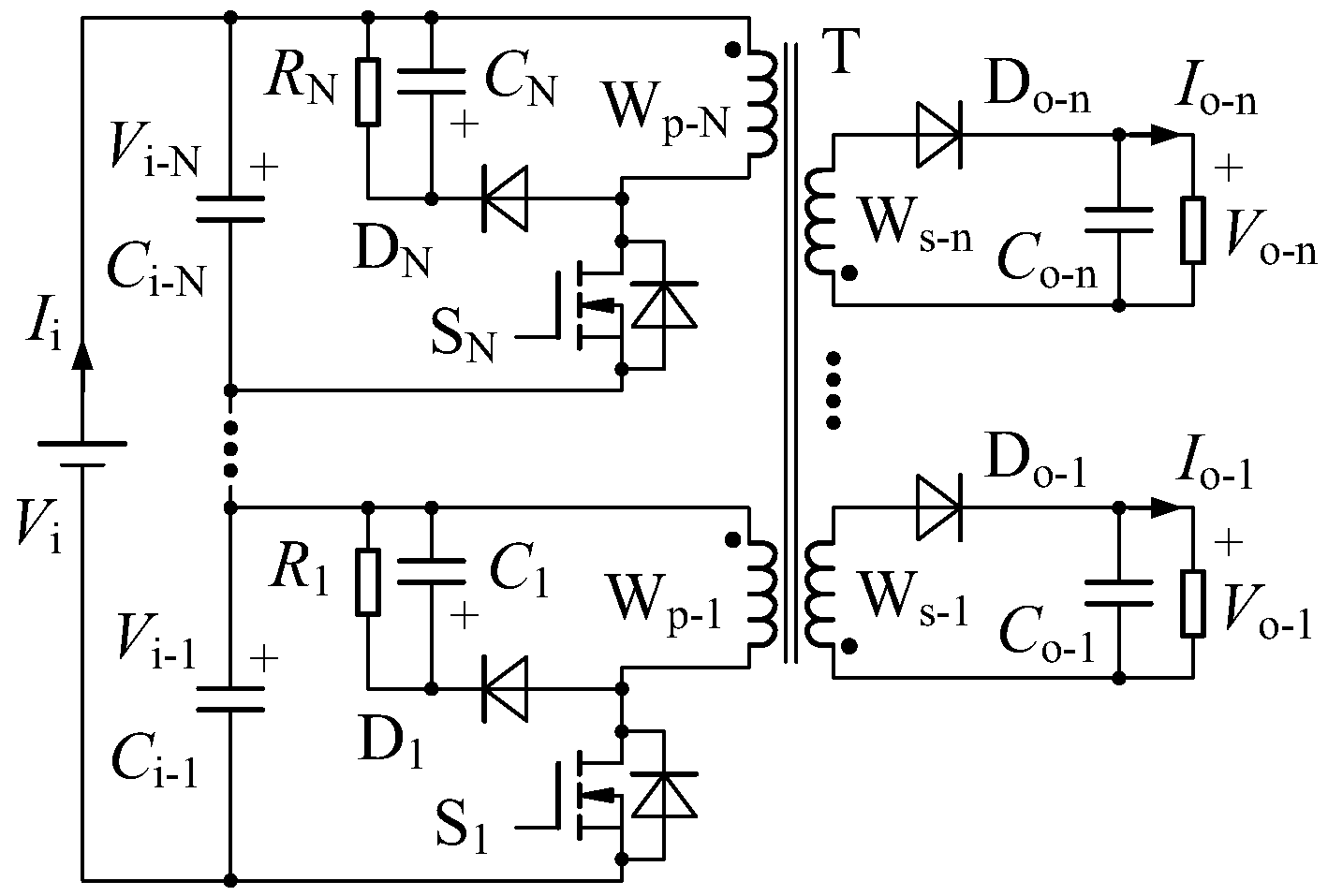
Figure 2 shows the configuration of the ISTI flyback converter, where each input-series circuit is based on the single-switch flyback topology,
Vi and
Ii are the input voltage and input current,
Vi-1, …,
Vi-N are the input voltages of the
N input-series circuits, and
Vo-1, …,
Vo-n and
Io-1, …,
Io-n are the output voltages and output current of the
n output-independent circuits.
In the input-series circuits, there are identical components and parameters, including the input filter capacitors (Ci-1 = … = Ci-N), the switches (S1, …, SN), the turn numbers (Np-1 = … = Np-N), and the self-inductances (Lp-1 = … = Lp-N) of the primary windings (Wp-1, …, Wp-N) in the integrated transformer (T) and the absorbing circuits (R1 = … = RN, C1 = … = CN, and D1, …, DN).
In the output-independent circuits, the turn numbers (Ns-1, …, Ns-n) of secondary windings (Ws-1, …, Ws-n) in T, as well as the output rectifier diodes (Do-1, …, Do-n) and output filter capacitors (Co-1, …, Co-n), are designed according to the special output requirements.
2.2. Multiple-Inductor Coupling Model of Flyback Integrated Transformer
In the integrated transformer (T), there are N primary windings and n secondary windings, so the influences of the coupling relationships among these windings should be clarified. On this basis, the layouts of these windings can be determined in the design process. In previous investigations, the influences of the coupling relationships among primary windings have been clarified, as well as the coupling relationships among secondary windings. However, the influences of the coupling relationships between primary and secondary windings have not been clarified.
Generally, the coupling between two arbitrary windings should be represented by at least one leakage inductance, so N × n leakage inductances are needed to represent the coupling between N primary windings and n secondary windings, which cannot be realized in the existing model of the flyback integrated transformer.
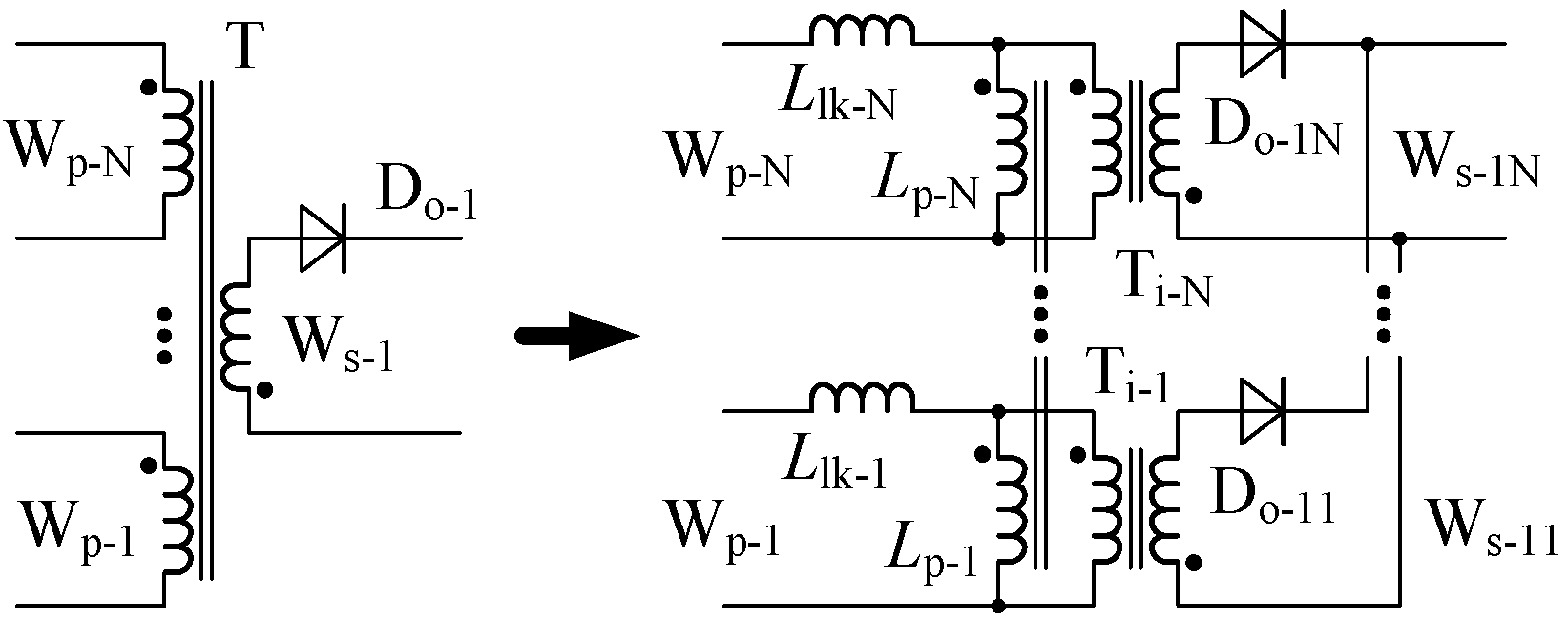
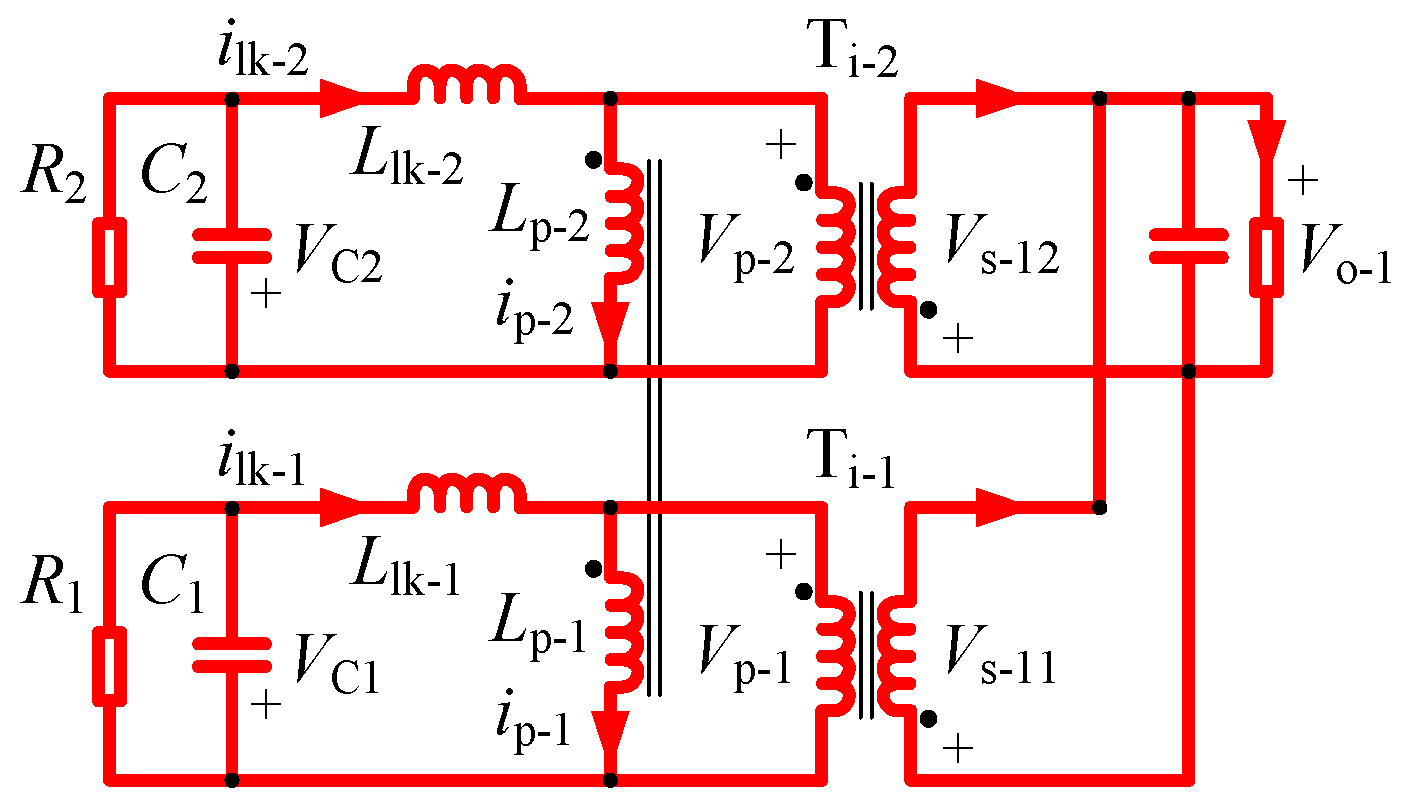
To overcome the shortcomings of the existing model, a novel multiple-inductor coupling model is proposed for this flyback integrated transformer, as shown in
Figure 3, through which the influences of the coupling relationships between primary and secondary windings are expected to be clarified. This novel model is introduced as follows.
(1) The input voltage sharing effects of the ISTI flyback converter cannot be affected by the coupling relationships among the secondary windings of the integrated transformer, and the influences of the coupling relationships among secondary windings are mainly aimed at the multiple-output features, which are similar to those in the other traditional flyback converters with multiple-output circuits. Therefore, to simplify the analysis, an equivalent single secondary winding (Ws-1) is adopted in this model to represent the n secondary windings.
(2) In this model, the equivalent single secondary winding (Ws-1) is divided into N identical parts (Ws-11, …, Ws-1N), and they are used as the secondary windings of the ideal transformers (Ti-1, …, Ti-N). Ti-1, …, Ti-N are connected in parallel in the secondary sides, where their turn ratios are identical (Np-1/Ns-1). Do-11, …, Do-1N are used as the output rectifier diodes.
(3) In this model, a coupled inductor (Lp-1 = … = Lp-N) is adopted to represent the coupling relationships among the N primary windings.
(4) In this model, the leakage inductances (Llk-1, …, Llk-N) are adopted to represent the coupling relationships between the N primary windings (Wp-1, …, Wp-N) and the equivalent single secondary winding (Ws-1), respectively.
3. Operational Process of ISTI Flyback Converter Considering the Leakage Inductances
Based on the model provided in
Figure 3, the operational process of the ISTI flyback converter is analyzed as follows. To simplify the analysis, the following conditions are assumed: (1) this converter operates in discontinuous current mode (DCM); (2) this converter is composed of two input-series circuits (
N = 2) and a single output circuit (
n = 1); (3) in addition to the integrated transformer, all devices in this converter are ideal; (4) the asynchronous turning of S
1 and S
2 is not considered; (5) the input voltage differences between two input-series circuits are not considered (
Vi-1 =
Vi-2 =
Vi/2); and (6)
C1,
C2, and
Co-1 are large enough, so the fluctuations of their voltages (
VC1,
VC2, and
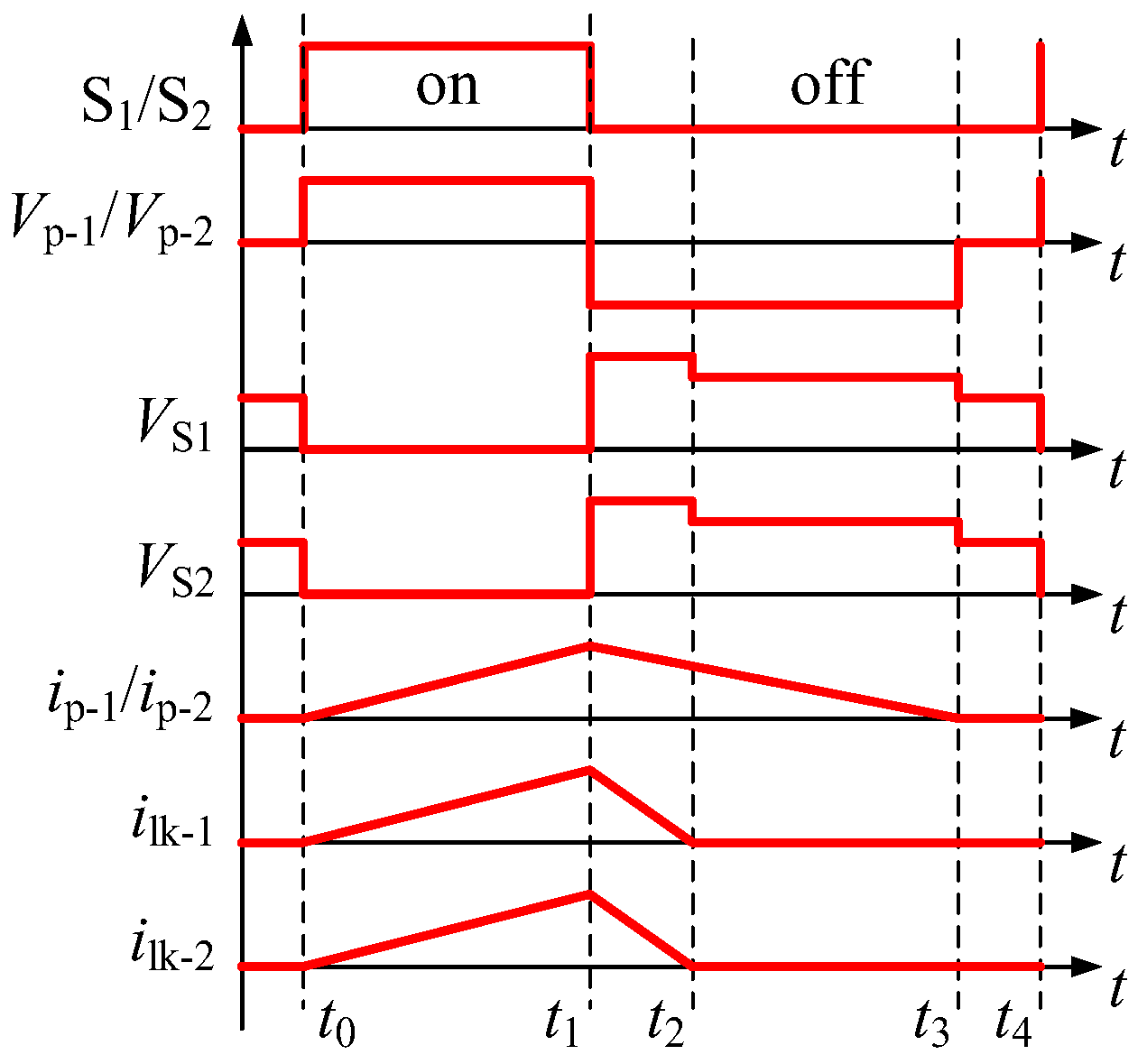
Vo-1) are ignored. During each switching period, there are the following four stages, where the main waveforms in each period are shown in
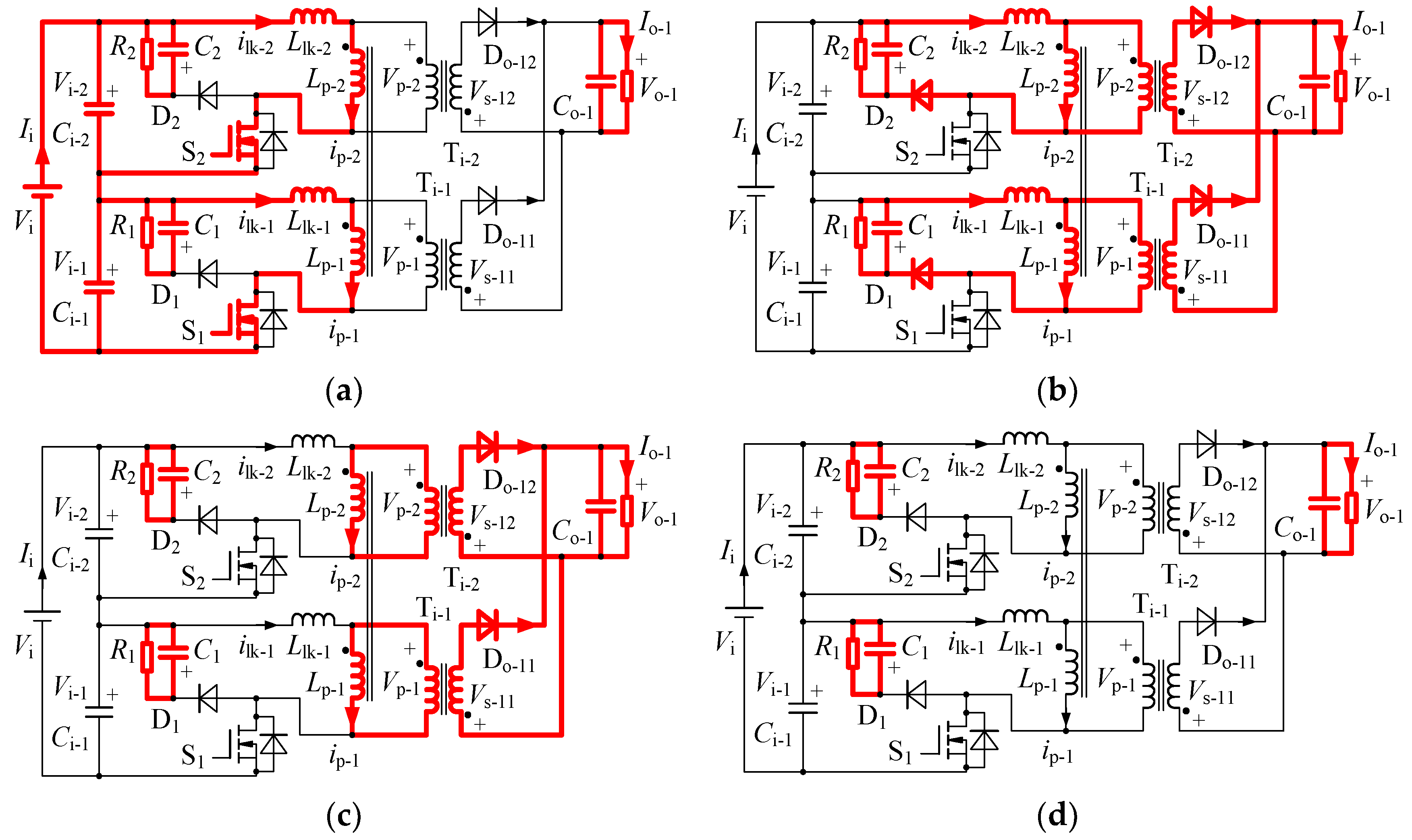
Figure 4 and the equivalent circuit in each stage is shown in
Figure 5.
Stage 1 (
t0~
t1): At
t0, S
1 and S
2 are turned on. After
t0, the coupled inductor (
Lp-1 and
Lp-2) is charged by the input voltages, so its current increases. In the absorbing circuits, D
1 and D
2 are turned off, while
C1 and
C2 are discharged through
R1 and
R2, respectively. In the output circuits, D
o-11 and D
o-12 are turned off, and
Io-1 is only provided by
Co-1. In this stage, the voltages in the primary or secondary sides of T
i-1 and T
i-2 are
Vp-1 =
Vi-1 =
Vi/2,
Vp-2 =
Vi-2 =
Vi/2, and
Vs-11 =
Vs-12 =
Ns-1Vi/2
Np-1. At
t1, the current of these inductors increases to the peak value during the whole period, as shown in Equation (1):
where
ip-1 (or
ip-2) and
ilk-1 (or
ilk-2) are the currents of
Lp-1 (or
Lp-2) and
Llk-1 (or
Llk-2), respectively;
Lp-es = 2(1 +
k12)
Lp-1 is the equivalent series inductance of
Lp-1 and
Lp-2;
k12 is the coupling coefficient between
Lp-1 and
Lp-2; and
Llk-1 (or
Llk-2) is much smaller than
Lp-es, which are not considered here.
Stage 2 (t1~t2): At t1, S1 and S2 are turned off, and their voltages (VS1 and VS2) increase immediately to Vi-1 + VC1 and Vi-2 + VC2, respectively. The durations of these processes are very small, which are not considered here.
After
t1, D
o-11 and D
o-12 are turned on, and the energies stored in
Lp-1 and
Lp-2 are transferred to the loads through T
i-1 and T
i-2, respectively. In the absorbing circuits, D
1 and D
2 are turned on, and the energies stored in
Llk-1 and
Llk-2 are transferred into
C1 and
C2, respectively. In this stage,
Vs-11 =
Vs-12= −
Vo-1 and
Vp-1 =
Vp-2 = −
Np-1Vo-1/
Ns-1; moreover, the expressions of
ip-1 (or
ip-2) and
ilk-1,
ilk-2 can be obtained in Equations (2) and (3), respectively.
where
Lp-ep = (1 +
k12)
Lp-1/2 is the equivalent parallel inductance of
Lp-1 and
Lp-2.
At the end of this stage, ilk-1 and ilk-2 decrease to zero; D1 and D2 are then turned off accordingly.
Stage 3 (t2~t3): At t2, ilk-1 = ilk-2 = 0. After t2, C1 (or C2) is still discharged through R1 (or R2), and the decrease in ip-1 (or ip-2) is continuous. In this stage, Vp-1, Vp-2, Vs-11, and Vs-12 are fixed; however, VS1 and VS2 are changed into Vi-1 + Vp-1 and Vi-2 + Vp-2, respectively.
Stage 4 (t3~t4): At t3, ip-1 = ip-2 = 0. After t3, Do-11 and Do-12 are turned off, Vp-1 = Vp-2 = 0, Vs-11 = Vs-12 = 0, VS1 = Vi-1 = Vi/2, VS2 = Vi-2 = Vi/2, and Io-1 is only provided by Co-1.
At t4, S1 and S2 are turned on again. After t4, this converter will operate in the next period.
4. Design Considerations of Integrated Transformer Based on the Leakage Inductances
According to the operational process, the influences of leakage inductances (Llk-1 and Llk-2) between the primary windings (Wp-1 and Wp-2) and the equivalent single secondary winding (Ws-1) are analyzed in this section. Based on this, the essential design considerations of this flyback integrated transformer are summarized.
4.1. Influences of the Leakage Inductances
In stage 1, S1 and S2 are turned on, and the coupling relationships of two primary windings (Wp-1 and Wp-2) are represented by the coupled inductor (Lp-1 and Lp-2), by which the input voltage sharing of each input-series circuit is achieved. The leakage inductances (Llk-1 and Llk-2) are adopted to represent the coupling relationships between the primary windings (Wp-1 and Wp-2) and the equivalent single secondary winding (Ws-1), which are much smaller than the equivalent series inductance (Lp-es) of this coupled inductor, so the input voltage sharing process in this stage has almost no relationship with Llk-1 (or Llk-2).
In stage 2, the energies of Llk-1 and Llk-2 are transferred into C1 and C2, respectively, so the energies stored in C1 and C2 can be affected. During the whole switching period, the maximum voltages of S1 and S2 are equal to Vi-1 + VC1 and Vi-2 + VC2, respectively. Therefore, the voltage sharing effect of S1 and S2 can also be affected, which cannot be ensured even if a good input voltage sharing effect has been achieved (Vi-1 = Vi-2 = Vi/2).
In stage 3 and stage 4, the current of Llk-1 (or Llk-2) is zero, so there is almost no influence caused by Llk-1 (or Llk-2) in these stages.
Therefore, the analysis concerning the influence of the leakage inductances (
Llk-1 and
Llk-2) is implemented in stage 2 as follows, where the simplified equivalent circuit of the ISTI flyback converter in stage 2 is shown in
Figure 6.
From operational process of the ISTI flyback converter, it can be obtained that, during the whole switching period,
C1 and
C2 are discharged through
R1 and
R2, respectively. Accordingly, the decrease in the energies of
C1 and
C2 during each switching period can be estimated using Equation (4).
where
f is the switching frequency.
In stage 2, the current of
Llk-1 and
Llk-2 will decrease to zero, and their current decreasing durations can be obtained from Equation (3), as shown in Equation (5).
From Equations (3) and (5), the increase in the energies of
C1 and
C2 in stage 2 can be estimated using Equation (6), where
Tlk-1 (or
Tlk-2) is much smaller than
T, so the energies released by
R1 and
R2 are not considered in the estimations.
During the whole switching period, it is required that
EC1+ =
EC1- and
EC2+ =
EC2- Therefore, the relationships in Equation (7) can be obtained from Equations (4) and (6).
In stage 2, the energies stored in Llk-1 and Llk-2 are absorbed by C1 and C2, so VC1 > Np-1Vo-1/Ns-1 and VC2 > Np-1Vo-1/Ns-1 should be achieved. Moreover, it is considered that ilk-1(t1) = ilk-2(t1), as shown in Equation (1). Therefore, it can be obtained from Equation (7) that, when the parameters R1 = R2 and C1 = C2 are fixed, VC1 and VC2 are determined by Llk-1 and Llk-2, which will increase as Llk-1 and Llk-2 increase, respectively.
In the ISTI flyback converter, the energies of
Llk-1 and
Llk-2 are released through the absorbing circuits, and the power losses caused by the leakage inductances (
Llk-1 and
Llk-2) can be estimated using Equation (8).
It can be seen from Equation (8) that, when the parameters R1 = R2 and C1 = C2 are fixed, Pos-lk1 and Pos-lk1 will increase as VC1 and VC2 increase, respectively. Therefore, it can be concluded from Equations (7) and (8) that the power losses caused by the leakage inductances Llk-1 and Llk-2 are also determined by Llk-1 and Llk-2, which will also increase as Llk-1 and Llk-2 increase, respectively.
4.2. Essential Design Considerations of Flyback Integrated Transformer
The influences of leakage inductances (Llk-1 and Llk-2) can be summarized from two aspects: (1) the voltage sharing effect of the switches (S1 and S2) in various input-series circuits and (2) the power losses caused by the leakage inductances (Llk-1 and Llk-2) in two input-series circuits. They are summarized as follows.
(1) The input voltage sharing effect of each input-series circuit has almost no relationships with Llk-1 and Llk-2; however, the voltage sharing effect of S1 and S2 can be affected by Llk-1 and Llk-2. The maximum voltages of S1 and S2 are equal to Vi-1 + VC1 and Vi-2 + VC2, respectively. When a good input voltage sharing effect is achieved (Vi-1 = Vi-2 = Vi/2), the voltage sharing effect of C1 and C2 should be specifically considered. As shown in Equation (7), VC1 and VC2 are determined by Llk-1 and Llk-2, respectively, and VC1 = VC2 can be achieved when Llk-1 = Llk-2.
(2) The energies stored in Llk-1 and Llk-2 are transferred into C1 and C2 in stage 2, and these energies are released through R1 and R2, respectively, so the power losses caused by Llk-1 and Llk-2 should be considered, which are similar to the other traditional flyback converters. As shown in Equations (7) and (8), the power loss caused by Llk-1 (or Llk-2) will increase as VC1 (or VC2) increases, and VC1 (or VC2) will increase as Llk-1 (or Llk-2) increases.
From the influences of leakage inductances (Llk-1 and Llk-2), essential design considerations of the flyback integrated transformer can be summarized: (1) the difference between Llk-1 and Llk-2 should be suppressed to ensure a good voltage sharing effect of S1 and S2, where Llk-1 = Llk-2 is especially expected to be achieved; and (2) Llk-1 and Llk-2 should be minimized to reduce the power losses.