


Abstract
Positioning technology based on 5G networks has been deeply integrated into everyday life. Despite this, severe non-line-of-sight (NLOS) conditions in wireless signal environments can cause signal obstructions, negatively impacting the precision and dependability of positioning services. This paper introduces an innovative algorithm called Simultaneously Transmitting and Reflecting Reconfigurable Intelligent Surface Non-Line-of-Sight Angle of Arrival (STAR-RIS NLOS AOA) to address these challenges. The algorithm initially develops a system model named 5G STAR-RIS localization (GSL). By integrating STAR-RIS into the system, the model effectively overcomes the challenges of positioning in NLOS scenarios. The inclusion of STAR-RIS not only boosts the system’s adaptability but also meets the positioning requirements for users on both sides of the reflective surface simultaneously. The algorithm then utilizes the Root-MUSIC algorithm for estimating user coordinates. An optimization problem is formulated based on these estimations, with the goal of reducing the gap between estimated and real coordinates. To address this optimization, the Inertia Weight Whale Optimization Algorithm is employed, providing high-precision estimations of users’ three-dimensional positions. Simulations reveal that the proposed Simultaneously Transmitting and Reflecting Reconfigurable Intelligent Surface Non-Line-of-Sight Angle of Arrival (SRNA) algorithm substantially outperforms conventional algorithms in positioning performance across different signal-to-noise ratio contexts. Specifically, in challenging NLOS situations, the SRNA algorithm can cut positioning errors by 50% to 62%, demonstrating its outstanding capability and efficiency in addressing the difficulties presented by NLOS conditions within 5G-based positioning systems.
1. Introduction
In the context of continuous advancements in information technology, positioning technology has become deeply embedded in various facets of daily life [1,2], playing an indispensable role in sectors such as smartphone navigation, logistics and supply chain management, smart homes, and autonomous driving technology [3,4]. The advent of 5G positioning technology has markedly improved the quality of positioning services. This technology not only substantially increases the accuracy and response speed of positioning but also provides users with a safer and more convenient navigation experience [5,6,7,8]. Consequently, 5G-based wireless positioning technology has emerged as a prominent area of scientific inquiry, demonstrating extensive application prospects. It not only assumes the crucial responsibility of technological innovation but also signifies immense practical importance and future potential [9,10].
The integration of 5G positioning technology into daily life underscores its essential role in enhancing navigation and logistical operations, holding transformative potential for multiple industries. As this technology continues to evolve, its implications extend beyond mere improvements in accuracy and speed; it paves the way for innovative applications that can significantly impact societal trends. The ongoing research and development in this field are critical to unlocking new capabilities, further solidifying its importance in shaping the future of positioning solutions across diverse sectors.
In 5G wireless localization, conventional methods rely on key parameters like time of arrival (TOA), time difference of arrival (TDOA), angle of arrival (AoA), and received signal strength (RSS) [11,12,13,14]. TOA requires strict time synchronization but can provide high accuracy in line-of-sight environments; TDOA eliminates the need for absolute time synchronization through time difference measurements, thereby reducing system complexity; AoA utilizes antenna arrays to estimate signal direction and does not require time synchronization, but it is significantly affected by multipath effects; RSS is simple to implement and low-cost, but it is susceptible to environmental interference and offers relatively lower accuracy. Among these, AoA stands out as a robust choice for challenging environments, particularly under non-line-of-sight (NLOS) conditions. Its core advantage lies in providing direct geometric spatial relationships without requiring strict time synchronization between transceivers, a common hurdle in practical deployments. While multipath effects can pose challenges, the intrinsic direction-finding capability of AoA makes it a powerful tool for localization where path obstructions are prevalent. Given these general advantages, AoA is particularly suitable for STAR-RIS-assisted systems. Moreover, the structure of STAR-RIS naturally aligns with the directional signal manipulation required for AoA estimation, making it a natural fit for enhancing positioning accuracy in scenarios where multipath and signal blockage are prevalent. As a complementary source of directional information, AoA can significantly enhance overall positioning performance in complex environments when integrated with other technologies [15].
Kutluyil D et al. [13] put forward a method for optimizing sensor placement for 2D AoA target positioning under a Gaussian prior assumption. This approach employs D- and A-optimality criteria, together with an approximate Bayesian analysis of the Fisher information matrix, to figure out the best way to arrange the sensors. Specifically, it ensures that the sensors are positioned along the narrow axis of the prior covariance error ellipse.
Furthermore, research expands into maneuvering target tracking, presenting an innovative closed-form projection algorithm designed to enhance sensor trajectories while adhering to turning rate limitations. Simulation results show that this algorithm outperforms traditional numerical search methods in tracking performance. Wang Z et al. [16] proposed an optimal three-station TDOA base station placement method based on signal beam constraints, examining the influence of receiver station positions on positioning accuracy. By establishing a polar coordinate positioning error model, they revealed the relationship between positioning error and the angle between the target and receiver stations. The critical values of a quarter angle and a fifth angle were used to optimize base station positions, determining that measuring stations should be positioned on boundaries or angle bisectors. The results of simulations illustrate the efficacy of this method across various scenarios, offering a practical solution to target positioning challenges while considering the limitations imposed by signal beams. By effectively addressing these constraints, the proposed approach provides valuable insights and contributes to advancements in accurate target positioning in complex environments. Sihao Z et al. [17] designed a novel TOA system that achieves user equipment positioning and synchronization through a Periodically Asymmetric Ranging Network (PARN). The system consists of primary anchor nodes, secondary anchor nodes, and user equipment, employing Kalman filtering for virtual synchronization and ML methods for simultaneous positioning and synchronization. The experiments prove the system’s high precision in clock bias estimation and positioning synchronization, demonstrating its feasibility and superiority in practical applications. However, modern wireless communication systems face challenges such as signal attenuation due to complex geographical environments and object obstruction, multipath propagation, and interference, which severely impact positioning accuracy. Traditional positioning technologies find it difficult to meet high precision demands. Introducing intelligent reflecting surfaces as a solution provides ways to flexibly adjust reflection signal paths, optimize communication environments, overcome obstruction effects, enhance signal strength and coverage, and significantly improve communication efficiency and positioning accuracy, meeting increasing safety and reliability requirements.
Intelligent reflecting surfaces [18,19,20] have significantly addressed communication challenges between base stations and mobile devices in NLOS environments, making them essential for advancing next-generation wireless communication technologies. As a result, these surfaces have attracted considerable attention in recent years. Among the various categories of intelligent reflecting surfaces [21,22,23,24], STAR-RIS is distinguished by its ability to simultaneously reflect and refract incident signals, showcasing exceptional performance in omnidirectional positioning contexts.
Unlike conventional reconfigurable intelligent surfaces (RISs) that only support signal reflection, STAR-RIS provides unique bidirectional signal manipulation capabilities, which are particularly advantageous in positioning systems requiring full-space coverage. This capability allows STAR-RIS to serve users on both sides of the surface, effectively addressing NLOS challenges where users and base stations are obstructed by physical barriers. By independently controlling reflection and transmission coefficients, STAR-RIS enables precise beamforming tailored to user locations, thereby enhancing angle estimation and overall positioning accuracy. This makes STAR-RIS not only a promising technology for next-generation communication systems but also a key enabler for high-precision localization in complex environments. This key innovation means that each STAR-RIS unit can simultaneously process incident signals in two distinct modes: reflection mode for users on the same side as the signal source and transmission mode for users on the opposite side. This bidirectional functionality delivers three significant practical advantages in positioning systems: (1) full-space coverage through 360-degree service provision to users on both sides of the surface, effectively addressing NLOS challenges where users and base station are separated by physical obstacles; (2) independent beam optimization via separate control of reflection and transmission coefficients (amplitude and phase), enabling precise beamforming tailored to users’ specific locations on either side; and (3) cost-effective deployment by replacing traditional RIS pairs with a single STAR-RIS panel while maintaining equivalent coverage with reduced hardware costs and implementation complexity. In our positioning system, this bidirectional capability is particularly valuable, as it allows simultaneous service for multiple users distributed on both sides of the STAR-RIS, significantly enhancing positioning availability in complex NLOS environments.
This characteristic makes STAR-RIS particularly advantageous in addressing the complexities associated with NLOS scenarios and furthering the development of advanced communication systems. He J et al. [25,26] proposed an innovative positioning system that achieves three-dimensional positioning both indoors and outdoors through STAR-RIS. As a novel reconfigurable intelligent surface, STAR-RIS can provide bidirectional communication functionality, enhancing the system’s coverage and positioning accuracy through its unique transmission and reflection capabilities. Further research on STAR-RIS will undoubtedly contribute to the enhancement of wireless communication networks and their applications in various challenging environments.
The development of angle-of-arrival (AoA) estimation technology has evolved from early-phase interferometry methods [27] to subspace-based algorithms such as MUSIC and ESPRIT. It is worth noting that, in addition to these algorithmic advances, a number of pure hardware-based AoA estimation schemes have also emerged. For example, Avitabile et al. [28] proposed a full-hardware AoA estimation system that directly performs angle estimation in hardware through modular analog and digital circuits, providing a hardware solution for adaptive beamforming that does not rely on software algorithms. Such hardware-oriented work offers an important technical path for low-power real-time positioning of IoT devices. The enhanced solution proposed in this paper, based on STAR-RIS and optimization algorithms, complements these efficient hardware platforms and aims to further improve positioning performance in complex NLOS scenarios through advanced signal processing. In this study, the Root-MUSIC algorithm was selected due to its closed-form solution capability under uniform linear array (ULA) configurations, high computational efficiency, and robust performance in handling coherent signals. This choice is particularly suitable for STAR-RIS-assisted positioning systems, as the ULA structure of the STAR-RIS aligns well with the foundational assumptions of the Root-MUSIC algorithm. However, as wireless positioning systems advance toward higher accuracy and more complex scenarios, traditional algorithms increasingly reveal limitations in addressing challenges, such as massive MIMO, high mobility, and Integrated Sensing and Communication (ISAC). As indicated by recent studies, tensor decomposition-based unified frameworks can integrate channel estimation and target parameter estimation into a single mathematical structure, significantly improving the utilization efficiency of spectral and hardware resources [29]. Meanwhile, research on 6G-oriented terahertz ISAC systems demonstrates that reconfigurable all-digital architectures implemented on specialized hardware such as FPGAs provide essential technical support for low-power and real-time processing [30]. Zhang et al. proposed an intelligent reflecting surface-assisted TDOA-AOA collaborative localization method, which employs the MUSIC algorithm for the high-precision angle of arrival estimation and integrates the Chan algorithm with an enhanced snake optimizer to significantly improve positioning accuracy and robustness in non-line-of-sight environments [31].
Therefore, this study adopts Root-MUSIC as the foundational algorithm, aiming to establish a reliable performance benchmark for STAR-RIS-assisted positioning systems while also laying a theoretical groundwork for the subsequent adoption of more advanced reconfigurable processing architectures. The remainder of this paper is organized as follows. Section 2 elaborates on the system model for STAR-RIS-assisted 5G positioning. Section 3 introduces the proposed core methodology—the SRNA algorithm, comprising Root-MUSIC-based AoA estimation and an inertial weight-enhanced Whale Optimization Algorithm for position refinement. Section 4 validates the performance of the proposed framework through numerical simulations with comparative analysis against conventional approaches. Finally, Section 5 concludes this paper and outlines potential research directions.
The primary contributions of this study are outlined as follows:
- A STAR-RIS-based positioning system model, termed 5G STAR-RIS location (GSL), is developed. It includes a base station, multiple STAR-RIS units, and several users. In this model, NLOS conditions exist between the base station and users, with users located on both sides of the STAR-RIS. Signals are reflected to the base station solely via the STAR-RIS, greatly improving positioning in complex environments. This model offers a robust framework for enhancing accuracy where traditional methods are limited, advancing wireless communication technology. Further analysis and testing may yield valuable insights for real-world applications.
- An AoA positioning algorithm using STAR-RIS technology is designed, estimating user positions via the Root-MUSIC algorithm. A mathematical optimization problem is formulated to minimize the Euclidean distance between estimated and true coordinates, thereby boosting accuracy. This method uses advanced computational techniques to improve localization reliability in challenging NLOS environments. By overcoming traditional limitations, the algorithm represents a significant advance in wireless positioning technology. Further research may provide deeper understanding of achieving higher precision and real-time adaptability;
- The SWOA is introduced to address the previously mentioned optimization problem. The algorithm initially incorporates the social behavior model of whales for global search, subsequently dynamically adjusting and implementing adaptive strategies to improve convergence speed and accuracy across varying environments while preserving diversity, effectively mitigating the risk of local optima. This innovative approach not only enhances the overall performance of the optimization process but also ensures robustness against the challenges posed by complex search landscapes. By maintaining a balance between exploration and exploitation, the SWOA aims to provide a reliable solution to the optimization challenges inherent in positioning algorithms, ultimately contributing to more accurate user localization in practical applications. Further investigations of the SWOA’s performance may reveal additional insights into its effectiveness across diverse scenarios;
- The simulation results demonstrate that the proposed SRNA positioning algorithm exhibits superior positioning performance over traditional positioning algorithms in various SNR conditions, especially in complex NLOS environments. Specifically, the positioning errors are reduced by up to 50–62% relative to traditional algorithms.
2. System Model
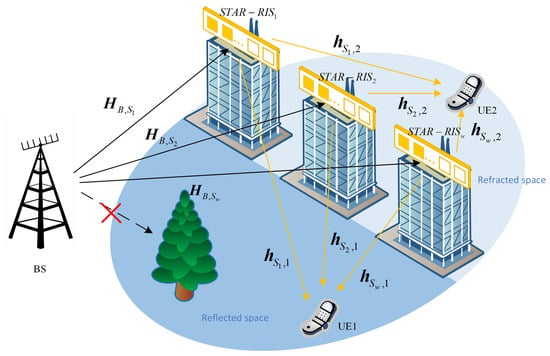
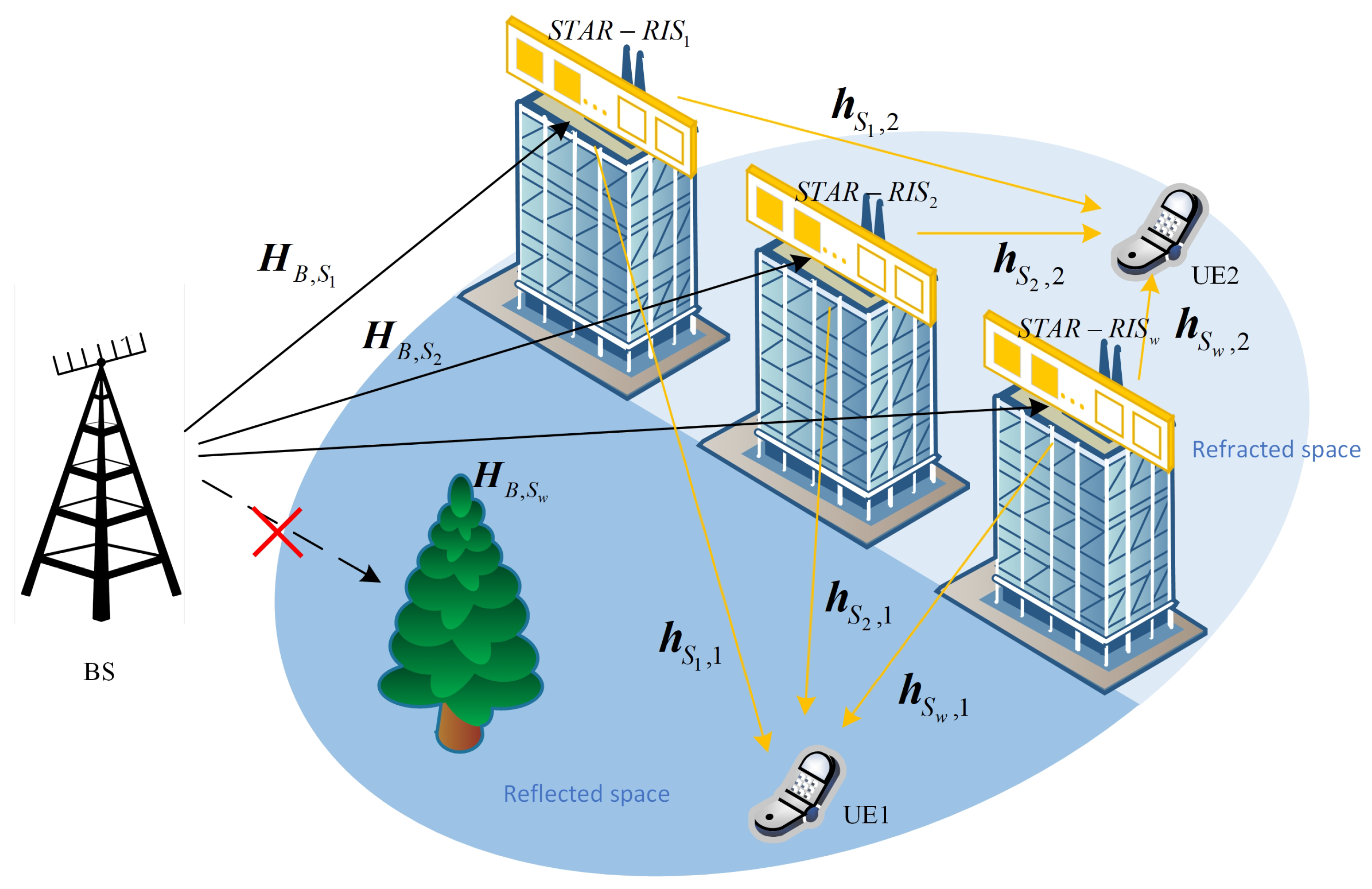
As illustrated in Figure 1, the GSL model comprises a multi-antenna base station and two single-antenna user terminals. And according to , the two single-antenna users are located on either side of . The base station is equipped with a uniform linear array (ULA) of B antennas, the set of these antennas is denoted as , , and the distance between the antennas is d. is equipped with a ULA consisting of S units. The unit of is denoted as , .
Figure 1.
GSL system model.
The refraction and reflection functions of the are achieved based on two independent phase shifters, with each phase shifter represented by a phase control matrix. STAR-RIS represents an advanced reconfigurable intelligent surface, for which its hardware architecture primarily integrates the following four key components: a metasurface unit array composed of numerous subwavelength-scale electromagnetic elements arranged periodically, with each unit capable of independently manipulating the phase, amplitude, and polarization state of incident electromagnetic waves; reconfigurable control elements, typically employing active components such as varactor diodes, PIN diodes, or MEMS switches, to dynamically reconfigure the electromagnetic properties of each unit via external bias voltages; an intelligent control module, often integrating FPGAs or microprocessors, which compute and generate the required phase control matrices in real time based on channel state information and system demands; and a power management unit that provides stable electrical power to the control circuits and active components. (Multiple units work in time division, meaning that only one operates at any given time. The base station sends positioning reference signals, which are reflected or refracted by the to reach the user equipment. The user equipment estimates the angle of departure (AOD) of the reflected or refracted beams from different units and uses geometric relationships to estimate the user’s position. The signal transmission and processing methods for each reflection or refraction path are the same; therefore, for simplicity, the subscript w will be omitted in the following descriptions.) Its reflection phase shift matrix is represented as . The refraction phase-shift matrix is represented as , where represents the diagonal matrix , and represents the phase shift of the reflection or refraction of on , . Define as the energy-splitting coefficient for the reflection, denoted by , and the energy splitting coefficient for the refraction is defined as ; both satisfy . The location of the base station is represented as , and the location of user i is represented as . The position of is represented as , and the position of the base station and is known, while the positions of the two users are unknown. It is assumed that the two users cannot directly receive the signals transmitted by the base station (BS); hence, the users can only receive signals reflected (or refracted) by (i.e., NLOS links). Among them, the position estimated by the signal reflected by is , and the position estimated by the signal refracted by is .
(1) channel
The channel parameter matrix from the BS to the w-th can be expressed as [32]
where f is the carrier frequency, and is the spatial path loss of the signal. is the time for the signal to reach . is the direction vector from the base station to . The direction vector is represented in the following form:
(2) channel
The channel parameter matrix between and can be expressed as follows:
where represents the free-space path loss from to , is the time when the signal reaches , and is the direction vector from to the user, which can be expressed as follows:
where denotes the azimuth angle in the horizontal plane, and represents the elevation angle.
(3) channel
The total channel for communication from the base station to through can be expressed as follows:
where denotes the reflection (or refraction) matrix that characterizes the interaction between and .
When the base station (BS) transmits a known signal w, only one is operational during a specified time period. At time slot t, let represent the signal received by , which can be specifically expressed as follows:
where is the additive Gaussian white noise of , and P is the transmission power of the base station.
3. SRNA Algorithm
3.1. Angle Estimation
To ensure the accurate estimation of user positions, the Root-MUSIC algorithm is employed to determine the azimuth and elevation angles of arrival at the for two users. The covariance matrix for the received signals is expressed as follows:
This formulation provides a critical framework for analyzing the spatial characteristics of the signals, enabling precise angle estimation. By accurately modeling the received signals, the algorithm significantly enhances the robustness and reliability of the positioning system, ultimately contributing to improved overall performance in complex communication environments. By conducting the eigenvalue decomposition of the covariance matrix of the received signals, one can obtain following:
where is the feature vector matrix of the signal subspace, and is the feature vector matrix of the noise subspace. Construct the objective function as follows:
where
Transform the objective function into the form of polynomial roots:
Find the roots of polynomial and select the N roots that are closest to the unit circle. Based on the obtained roots z, the calculation formula for the pitch angle can be expressed as follows:
where is the wavelength of the signal, and d is the inter-element spacing of the array. The calculation formula for the horizontal plane direction angle is as follows:
3.2. User Location Estimation
The user’s location can be obtained based on the estimated AOD of several reflection or refraction beams and the positional relationship between and . The position of is , and the position of is . The direction vector from to is , and this can be concluded based on geometric relationships:
where , , and .
By combining the observed values of AOA and the geometric relationships, the following linear equation can be established:
For all W , combining all the equations into matrix form yields the following:
The linear equation is constructed as follows:
The user position can be obtained by solving the equation using the least squares method:
3.3. SWOA
The inertial weight-enhanced Whale Optimization Algorithm (SWOA) employed in this study constitutes an improvement over the standard WOA. Originally introduced by Mirjalili and Lewis in 2016 [33], the standard WOA simulates humpback whales’ bubble-net feeding behavior through three main phases: encircling prey, bubble-net attacking, and random search. Our enhancement incorporates a linearly decreasing inertial weight mechanism, a strategy previously demonstrated in optimization domains such as Particle Swarm Optimization to effectively balance global exploration and local exploitation capabilities. The primary distinction between SWOA and standard WOA lies in the introduction of the inertial weight factor into the position update equations (see Equations (26)–(29)), which enhances global search capacities during initial iterations while enabling more refined local search in later stages. To find the optimal solution for the Inertia Weight Whale Optimization Algorithm, we construct a fitness function following the principle of minimizing the total discrepancies between each estimated point and its matching real position. By computing these differences one by one and then reducing their overall sum, we seek to pinpoint the individual that shows the closest match between the actual and estimated values. The fitness (error distance) function is formulated as follows:
where N denotes the number of experiments conducted: n = 1, 2, …, N.
3.3.1. Initialization Step
First, initialize the positions of the whale group by randomly generating a set of candidate solutions, where each solution represents a possible position of a user. The initialization formula for the whale group positions is as follows:
where denotes the spatial location of the i-th whale individual at the starting iteration. and denote the lower and upper bounds of the search space, respectively, while represents a uniformly distributed random variable on the interval [0, 1].
3.3.2. Position Update Formula
The behavior of whales is divided into three types: encircling prey, bubble-net attacking (development stage), and searching for prey (exploration stage). The first two parts achieve local optimization through a contraction encirclement mechanism, while the searching prey stage conducts global optimization through random search. By incorporating a hybrid inertia weight strategy, it can better balance global exploration and local development, improving the algorithm’s convergence speed and global search development capabilities. The whale population navigates according to the position of the optimal individual. The position updating process is governed by an inertia weight, which introduces the feature of smooth position transitions. First, we calculate the coefficient vector:
where is the coefficient vector used to control the search range and convergence speed of the whale individuals, gradually decreasing from 2 to 0 during the iterative process; , where t is the current iteration count, and is the maximum iteration count.
The position update formula with the introduction of inertia weight is as follows:
where is the inertia weight, and is the position of the current optimal solution.
When choosing the spiral ascent path, the whale generates a spiral movement based on the distance to the prey. The formula for its spiral movement is as follows:
where b is the spiral shape constant. The selection formula for surrounding or spiraling is the following:
where p is randomly selected within the range , determining whether to choose the surrounding or spiral path.
If an individual in the whale pod does not find the optimal prey position, the algorithm will choose a random search, and the formula for updating the random search position is as follows:
where denotes a randomly sampled position within the search space.
3.3.3. Adjustment of Inertia Weight
After each iteration, it is necessary to dynamically adjust the inertia weight to balance exploration and exploitation capabilities. The formula for adjusting the inertia weight is as follows:
where and are the maximum and minimum values of the inertia weight, respectively.
In summary, the comprehensive process of the SRNA algorithm (Table 1) is outlined as follows:
Table 1.
SRNA algorithm procedure.
4. Simulation Results and Analysis
This article utilizes the MATLAB simulation platform to establish a three-dimensional space measuring 50 m × 50 m × 20 m, thereby verifying the effectiveness of the SWOA algorithm. Accompanied by a Rician fading channel with a K-factor of 3 dB. Shadow fading follows a log-normal distribution with a standard deviation of 8 dB, while multipath effects are simulated through a six-path Rayleigh fading channel exhibiting a delay spread of 100 ns. The Rician channel model is selected to simulate a hybrid channel environment containing both a dominant line-of-sight path and multiple scattered paths, which represents a more general scenario compared to pure NLOS or LOS conditions. The shadow-fading standard deviation of 8 dB is chosen based on typical measured values in urban macrocellular environments, simulating medium-scale signal variations caused by buildings and other large obstacles. In this article, the speed of light is set as . The quantity of antennas deployed at the is set to , the carrier frequency is , the quantity of is , and the coordinate of is (10 m, 13 m, 13.5 m). The coordinate of is (18m, 15m, 13.5m), the coordinate of is (15 m, 10 m, 13.5 m), and the coordinate of is (20 m, 8 m, 13.5 m). The number of reflection units K for each is four. The coordinate of is (0 m, 0 m, 20 m). The spacing of each unit is . This configuration adheres to the standard setup for uniform linear arrays, effectively preventing grating lobes and optimizing beamforming performance. Meanwhile, the actual deployment spacing between different STAR-RIS panels is determined according to their respective coordinate positions. The bandwidth is 20 MHz, the number of carriers is 16, the amplitude reflection coefficient is , and the population size is configured as , while the maximum iteration count is set to .
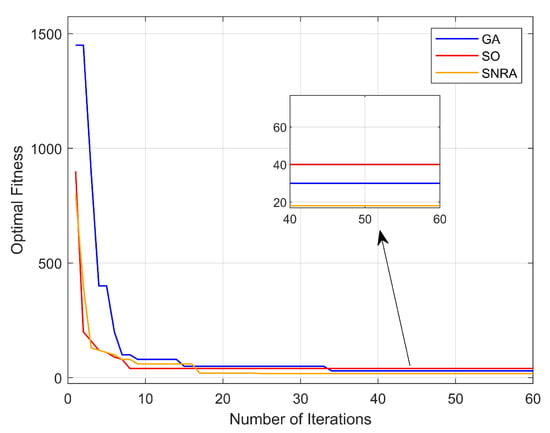
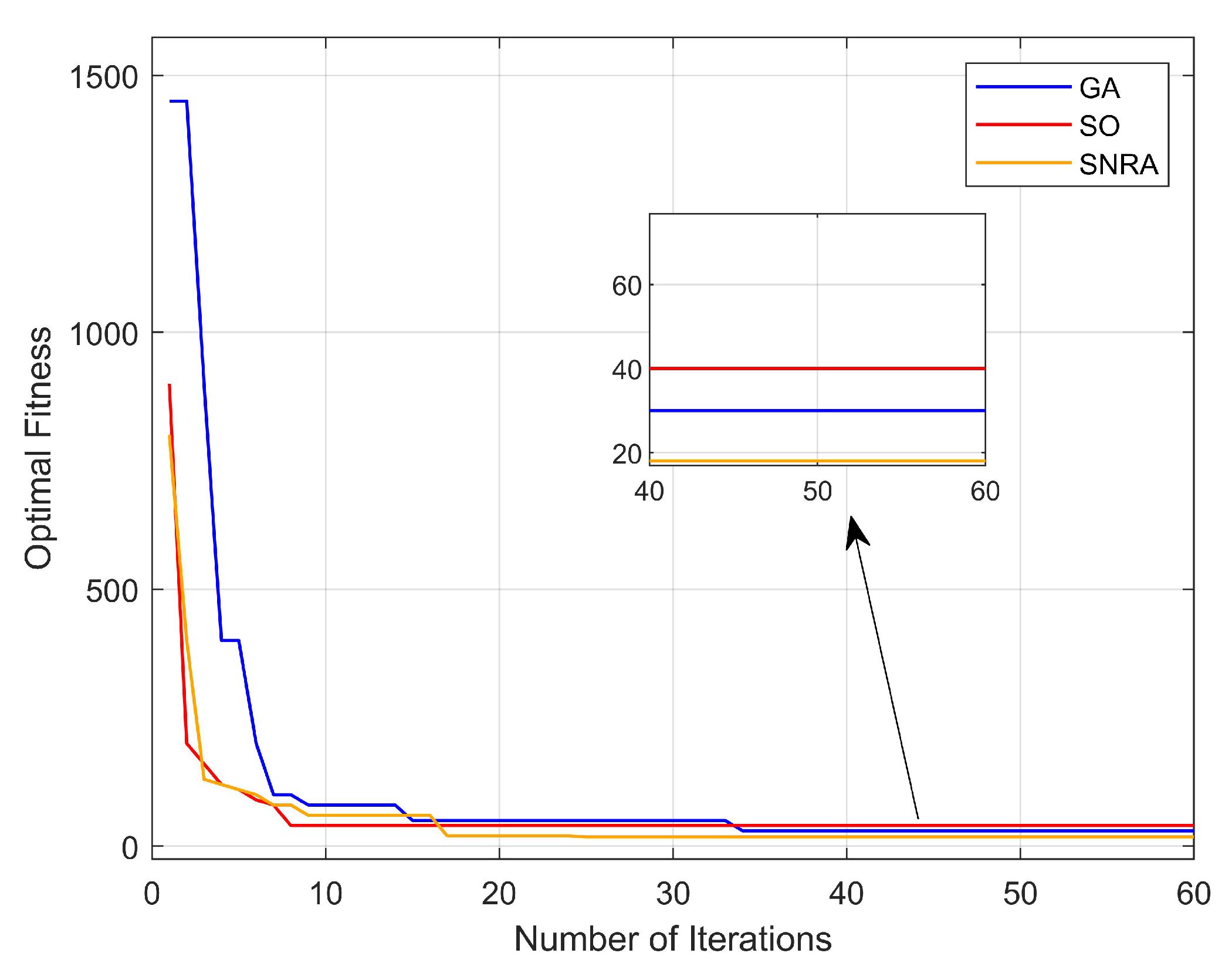
Figure 2 illustrates the simulation outcomes comparing the fitness levels of diverse algorithms throughout distinct iteration numbers. Within this graphical representation, the horizontal axis signifies the iteration count, whereas the vertical axis corresponds to the associated fitness levels. Specifically, the blue curve illustrates the GA (Genetic Algorithm), the red curve relates to the SO (Snake Optimizer) algorithm, and the yellow curve signifies the proposed SNRA algorithm. It is evident that the error distances for all algorithms consistently decrease as the number of iterations increases, ultimately converging to unique values. Significantly, the SNRA algorithm investigated in this research exhibits a reduced convergence error distance when compared to both the GA and SO, thereby validating its superior performance. The findings elucidated in Figure 2 exemplify the comparative efficacy of the algorithms in question, revealing significant trends in fitness levels as influenced by iteration counts. The progressive reduction in error distances across all algorithms implies a robust performance, reinforcing the validity of the iterative optimization methods employed here.
Figure 2.
Fitness varies with the number of iterations.
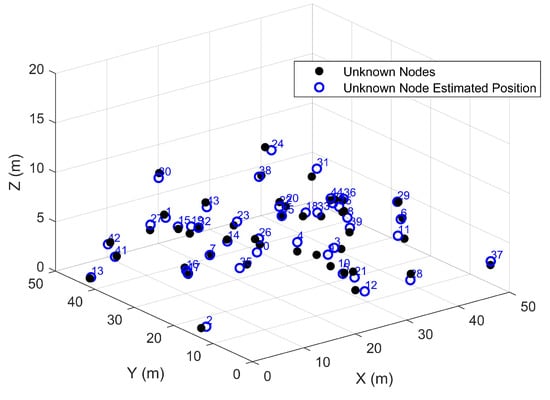
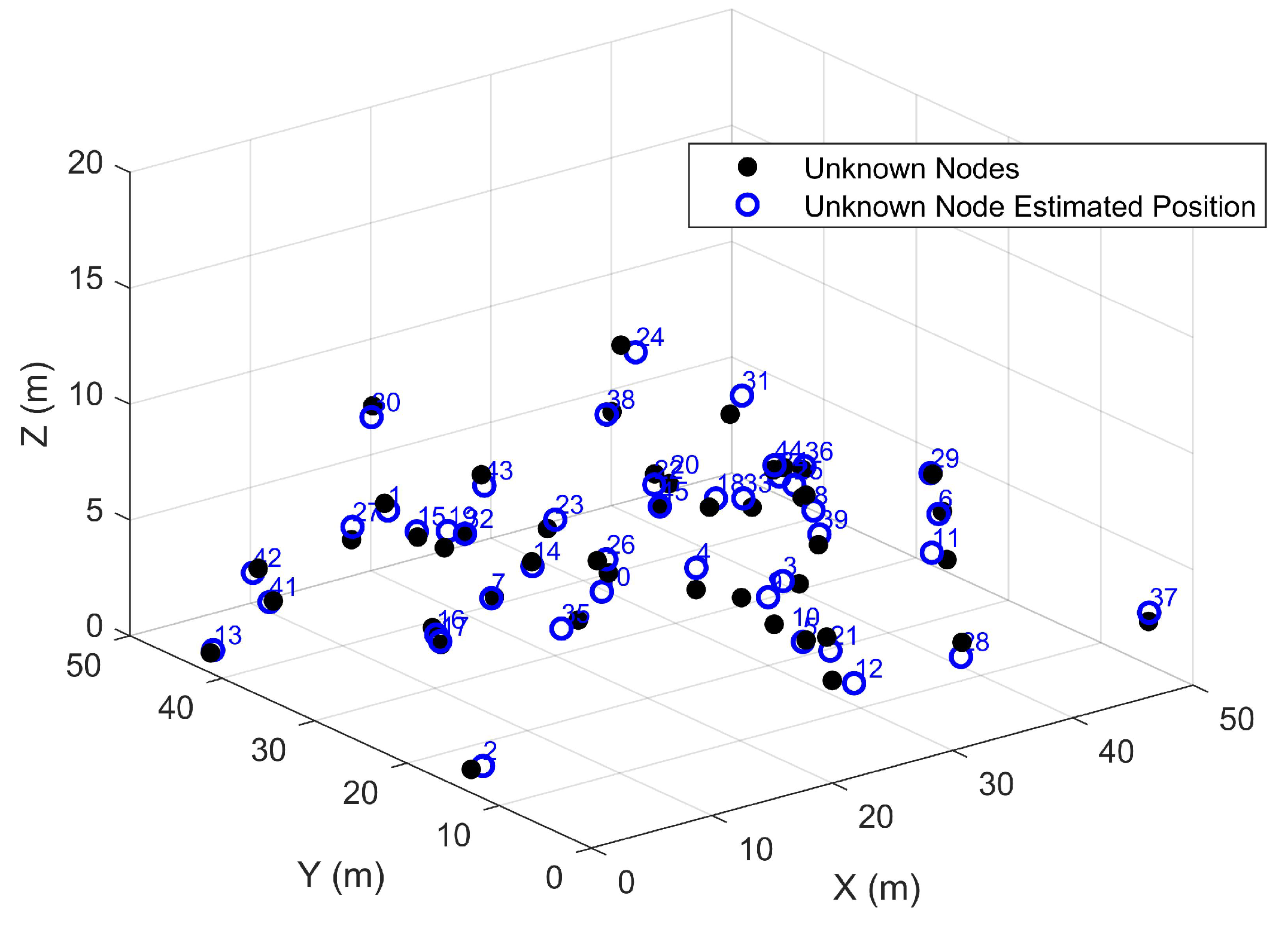
As depicted in Figure 3, the simulation compares the three-dimensional localization results of estimated unknown nodes with those of actual nodes at a signal-to-noise ratio of 20 dB. Within the designated area, 45 known nodes are uniformly distributed throughout the environment. In the figure, the black symbol signifies the actual location of the user to be positioned, while the blue symbol signifies the location of the user estimated by the proposed SNRA algorithm. The figure distinctly illustrates that the positions estimated by the SNRA algorithm predominantly correspond with actual user positions. This observation corroborates the assertion that the proposed algorithm attains a high degree of localization accuracy.
Figure 3.
Three-dimensional localization result graph.
These results highlight the effectiveness of the SNRA algorithm in accurately determining user positions, thus validating its application in scenarios requiring precise localization. The significant proximity of the estimated positions to the actual locations reflects the robustness of the algorithm against environmental variations and potential signal interferences. Further analysis will delve into the implications of these findings and their relevance for future advancements in localization technology.
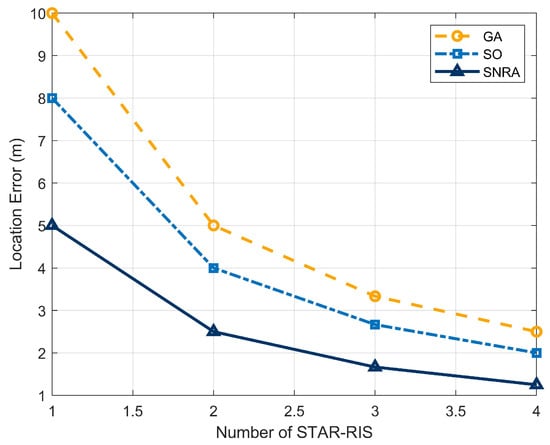
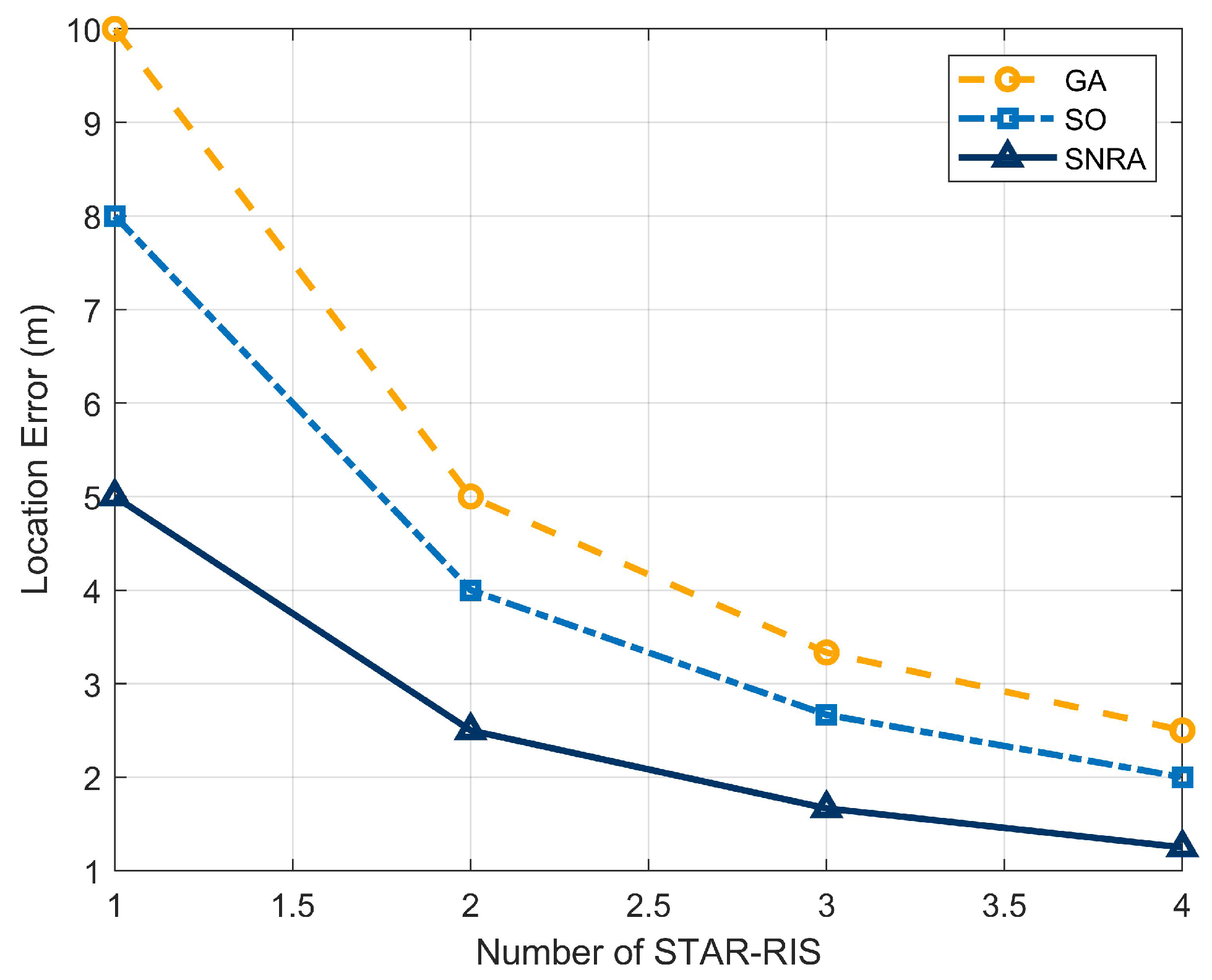
The simulation results presented in Figure 4 compare the localization errors associated with varying numbers of STAR-RIS at a fixed signal-to-noise ratio. In this figure, the x-axis denotes the quantity of STAR-RIS elements, whereas the y-axis represents the localization error. This figure distinctly demonstrates that with the increment in the number of STAR-RIS elements, the localization error of the SNRA algorithm exhibits a gradual decline. The augmentation in STAR-RIS elements enables a more efficient implementation of the Root-MUSIC algorithm, thereby yielding more precise estimated coordinates and improving localization accuracy via the proposed SNRA algorithm. These findings underline the importance of the number of STAR-RIS in achieving precise localization. The enhanced performance observed with an increasing number of STAR-RIS underscores the proposed SNRA algorithm’s capability to leverage improved system components and algorithms.
Figure 4.
Localization error analysis of various algorithms with different STAR-RIS counts.
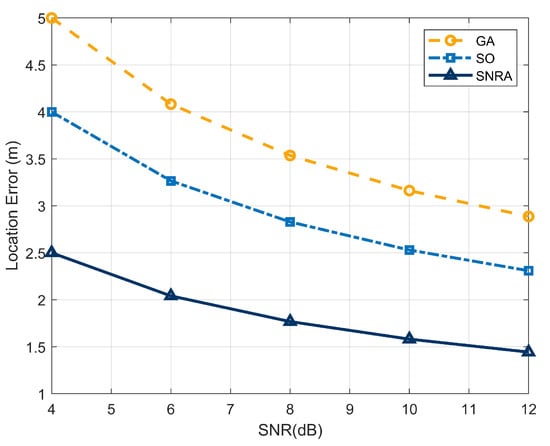
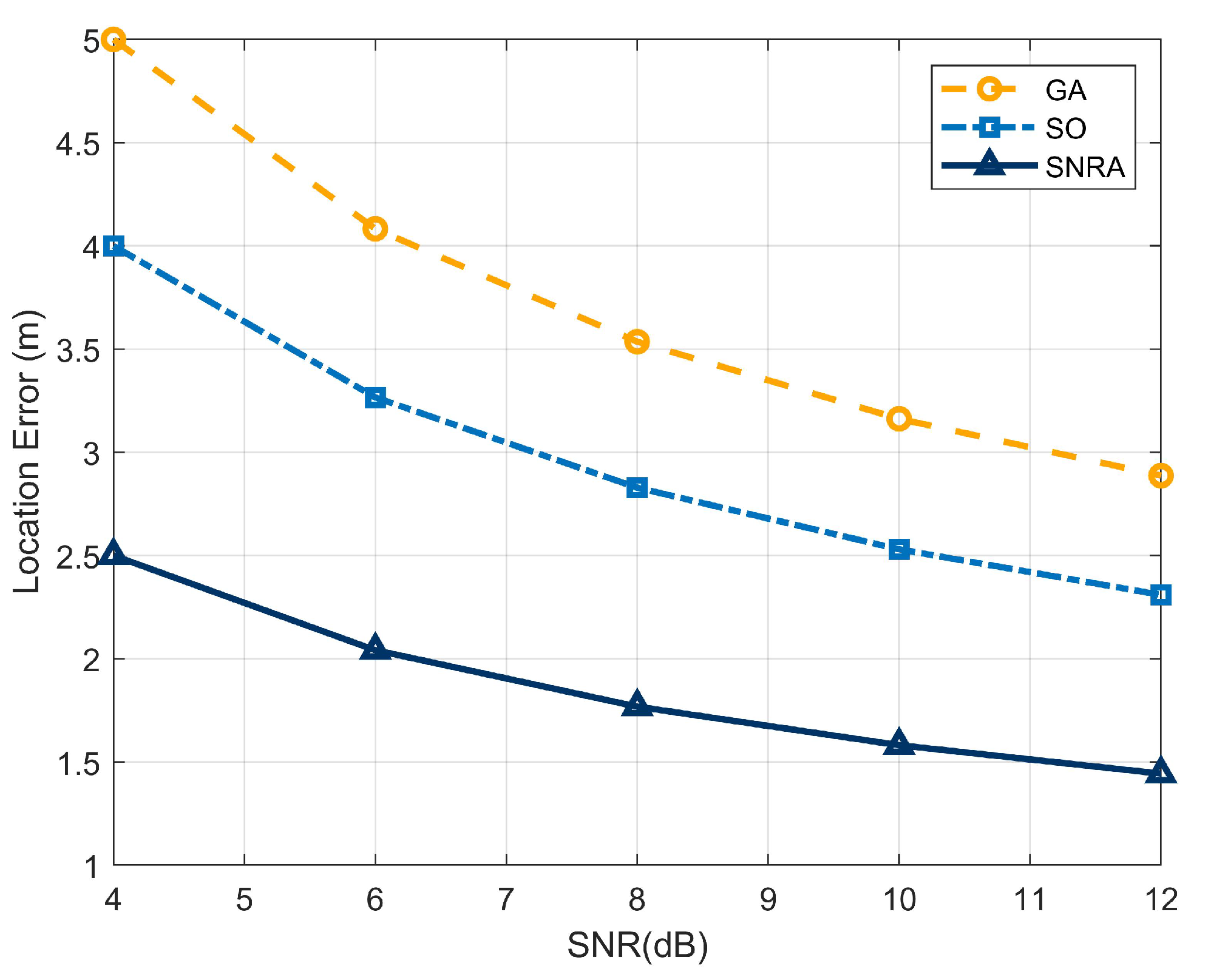
As illustrated in Figure 5, the simulation investigates the variation patterns of localization errors across varying signal-to-noise ratios. The abscissa axis represents the SNR, whereas the ordinate axis denotes the associated localization error. The circular, square, and triangular markers represent the curves of the GA, SO, and SNRA algorithm, respectively. This graphical representation distinctly shows that an increase in SNR leads to a subsequent reduction in localization error. This trend can be attributed to the improved quality of communication transmission associated with a higher SNR ratio, which consequently enhances localization accuracy. Significantly, the SNRA algorithm demonstrates substantial superiority over both the GA and SO. In particular, at an SNR of 30 dB, the SNRA algorithm exhibits a localization error of 0.9129 m, whereas the GA algorithm shows an error of 1.8257 m, and the SO algorithm presents an error of 1.4606 m. These results demonstrate that the localization error of the proposed SNRA algorithm is reduced by up to 50% and 62% relative to the GA and SO algorithms, respectively. This substantiates the effectiveness of the SNRA algorithm proposed in the current study. The comprehensive analysis of localization errors presented at various SNR highlights the importance of optimizing communication systems to enhance localization performance. Such findings not only illustrate the direct relationship between SNR and localization accuracy but also provide critical insights for future research aimed at improving localization strategies in diverse environments.
Figure 5.
Localization error analysis of algorithms under different signal-to-noise ratios.
5. Conclusions
This study successfully developed a non-line-of-sight angle-of-arrival localization algorithm based on STAR-RIS, providing a new approach to tackle complex localization challenges in 5G environments. By combining the Root-MUSIC algorithm with the whale optimization algorithm, the method significantly improves localization accuracy and computational efficiency. In simulation tests, the proposed algorithm demonstrates exceptional performance under various signal-to-noise ratio conditions, showing a marked advantage over traditional localization algorithms. Particularly in complex non-line-of-sight environments, the bidirectional transmission characteristics of STAR-RIS are fully utilized, effectively addressing signal attenuation and path loss issues to enhance localization quality. This research provides a solid theoretical and practical foundation for the future exploration of high-precision localization technologies, advancing the application prospects of intelligent reflecting surfaces in communication systems. By optimizing the power distribution of reflected and refracted signals, this paper presents an innovative solution for the precision and efficiency of wireless localization, offering broad application potential in 5G and subsequent communication technologies. While simulation results validate the theoretical superiority of the proposed algorithm, several key discrepancies are anticipated during real-world implementation: Channel non-idealities including more complex multipath effects, time-varying characteristics, and non-stationary noise may lead to moderately higher positioning errors than simulation outcomes; hardware impairments such as quantization errors in STAR-RIS elements, response inconsistencies, and transceiver nonlinearities will inevitably affect system performance; deployment complexities involving installation positioning, orientation calibration, and coexistence with other systems present additional implementation challenges; and dynamic environment adaptability requirements differ significantly from the static assumptions in simulations, necessitating enhanced real-time adaptation capabilities in practical scenarios. Future work will focus on addressing these practical challenges to facilitate the transition from theoretical research to real-world applications.
Author Contributions
Conceptualization, H.H. and Y.Z.; methodology, H.H. and Y.Z.; validation, H.H.; formal analysis, H.H.; investigation, H.H.; writing—original draft preparation, H.H. and Y.Z.; supervision, Y.Z.; funding acquisition, Y.Z. All authors have read and agreed to the published version of this manuscript.
Funding
This work was supported in part by the Beijing Science and Technology Project (Grant No. Z211100004421009) and in part by the National Natural Science Foundation of China (Grant No.: 62301058).
Data Availability Statement
The original contributions presented in the study are included in this article; further inquiries can be directed to the corresponding author.
Conflicts of Interest
The authors declare no competing interests.
References
- Bach, S.-H.; Yi, S.-Y. Constrained Least-Squares Trilateration for Indoor Positioning System Under High GDOP Condition. IEEE Trans. Ind. Inform. 2024, 20, 4550–4558. [Google Scholar] [CrossRef] [Scilit]
- Li, X.; Tan, Y.; Shen, Z.; Li, X.; Zhou, Y. GNSS-Based Cooperative Instantaneous Precise Positioning Aided by Multi-Epoch and Multi-Agent Associations. IEEE Trans. Veh. Technol. 2024, 73, 7771–7784. [Google Scholar] [CrossRef] [Scilit]
- Liu, J.; Huang, W.; Guo, B. Conjugated-Point Positioning Method Based on Multiview Images. IEEE Trans. Geosci. Remote Sens. 2023, 61, 5604611. [Google Scholar] [CrossRef] [Scilit]
- Wang, Z.; Chen, X.; Li, H.; Zhang, Y.; Wang, Q. PoE-Enabled Visible Light Positioning Network with Low Bandwidth Requirement and High Precision Pulse Reconstruction. IEEE J. Indoor Seamless Position. Navig. 2024, 2, 1–11. [Google Scholar] [CrossRef] [Scilit]
- Bi, S.; Li, K.; Hu, S.; Ni, W.; Wang, C.; Wang, X. Detection and Mitigation of Position Spoofing Attacks on Cooperative UAV Swarm Formations. IEEE Trans. Inf. Forensics Secur. 2024, 19, 1883–1895. [Google Scholar] [CrossRef] [Scilit]
- Wang, Q.; Fan, S.; Zhang, Y.; Gao, W.; Wei, J.; Wang, Y. A Novel Adaptive Sliding Observation-Based Cooperative Positioning Algorithm Under Factor Graph Framework for Multiple UUVs. IEEE Trans. Ind. Inform. 2023, 19, 8743–8753. [Google Scholar] [CrossRef] [Scilit]
- Pan, J.; Li, B.; Zhang, H.; Gao, F.; Li, X.; Zhou, G. Self-Calibration of INS/Odometer Integrated Navigation System with a Large Initial Position Error. IEEE Sens. J. 2024, 24, 11048–11056. [Google Scholar] [CrossRef] [Scilit]
- Yang, X.; Mai, J.; Chen, S.; Zhang, Y.; Ning, C.; Zhong, L. Fast LS Image Matching and Vision-Based DIG Measurement for LSM’s Positioning. IEEE Trans. Ind. Inform. 2024, 20, 6000–6008. [Google Scholar] [CrossRef] [Scilit]
- Zhu, Z.; Zhao, C.; Xi, Y. Micro-Vision Super-Resolution Restoration and Positioning Based on Ultraprecision Machining Topography Guidance. IEEE Trans. Instrum. Meas. 2024, 73, 5033711. [Google Scholar] [CrossRef] [Scilit]
- Park, K.-M.; Lee, B.-h.; Lee, E.; Kim, S.-C.; Choi, J. GPS-Aided Automatic Site Survey Method for WiFi RTT-Based Positioning. IEEE Trans. Veh. Technol. 2023, 72, 13120–13129. [Google Scholar] [CrossRef] [Scilit]
- Gur, E.; Amar, A.; Sabach, S. A dual-based first-order algorithm for ToA asynchronous localization and synchronization. Signal Process. 2025, 206, 108934. [Google Scholar] [CrossRef] [Scilit]
- Liao, Y.; Wang, Y. Source Localization using TDOA Based on Improved Snake Optimizer. Circuits Syst. Signal Process. 2024, 43, 5237–5261. [Google Scholar] [CrossRef] [Scilit]
- Kutluyil, D. Optimal Geometries for AOA Localization in the Bayesian Sense. Sensors 2022, 22, 9802. [Google Scholar] [CrossRef] [Scilit] [PubMed]
- Wu, C.; Wong, C.I.; Wang, Y.; Chen, X.; Zhang, L. Experimental Study of Bluetooth Indoor Positioning Using RSS and Deep Learning Algorithms. Mathematics 2024, 12, 1386. [Google Scholar] [CrossRef] [Scilit]
- Ruan, H.; Sun, P.; Dong, Y.; Tahaei, H.; Fang, Z. An Overview of LoRa Localization Technologies. Comput. Mater. Contin. 2025, 82, 1645–1680. [Google Scholar] [CrossRef] [Scilit]
- Wang, Z.; Hu, D.; Huang, J.; Li, X.; Chen, Y. Optimal Station Placement Method for Three-Station TDOA Localization Under Signal Beam Constraint. Wirel. Pers. Commun. 2023, 132, 110–149. [Google Scholar] [CrossRef] [Scilit]
- Zhao, S.; Zhang, X.-P.; Cui, X.; Lu, M. A New TOA Localization and Synchronization System with Virtually Synchronized Periodic Asymmetric Ranging Network. IEEE Internet Things J. 2021, 8, 9030–9044. [Google Scholar] [CrossRef] [Scilit]
- Zhu, Y.; Mao, B.; Kato, N. On a Novel High Accuracy Positioning with Intelligent Reflecting Surface and Unscented Kalman Filter for Intelligent Transportation Systems in B5G. IEEE J. Sel. Areas Commun. 2024, 42, 68–77. [Google Scholar] [CrossRef] [Scilit]
- Zhou, T.; Xu, K.; Shen, Z.; Xie, W.; Zhang, D.; Xu, J. AoA-Based Positioning for Aerial Intelligent Reflecting Surface-Aided Wireless Communications: An Angle-Domain Approach. IEEE Wirel. Commun. Lett. 2022, 11, 761–765. [Google Scholar] [CrossRef] [Scilit]
- Meng, K.; Wu, Q.; Chen, W.; Li, D. Cooperative Cellular Localization with Intelligent Reflecting Surface: Design, Analysis and Optimization. IEEE Trans. Commun. 2024, 72, 2974–2988. [Google Scholar] [CrossRef] [Scilit]
- Peng, X.; Hu, X.; Gao, J.; Jin, R.; Chen, X.; Zhong, C. Integrated Localization and Communication for IRS-Assisted Multi-User mmWave MIMO Systems. IEEE Trans. Commun. 2024, 72, 4725–4740. [Google Scholar] [CrossRef] [Scilit]
- Zhang, Z.; Wang, Y.; Li, H.; Chen, X.; Liu, K. Multiple Intelligent Reflecting Surfaces Collaborative Wireless Localization System. IEEE Trans. Wirel. Commun. 2025, 24, 134–148. [Google Scholar] [CrossRef] [Scilit]
- Lu, Z.; Zhao, Y.; Xu, C.-Z. RCSIL: RIS-Assisted Cooperative Channel State Information Localization for V2X System. IEEE Internet Things J. 2025, 12, 1016–1031. [Google Scholar] [CrossRef] [Scilit]
- Yu, F.; Zhang, C.; Quek, T.Q.S. STAR-RIS-Enabled Simultaneous Indoor-and-Outdoor Communication Networks: A Stochastic Geometry Approach. IEEE Trans. Wirel. Commun. 2024, 23, 18053–18069. [Google Scholar] [CrossRef] [Scilit]
- He, J.; Fakhreddine, A.; Alexandropoulos, G.C. Simultaneous Indoor and Outdoor 3D Localization with STAR-RIS-Assisted Millimeter Wave Systems. In Proceedings of the 2022 IEEE 96th Vehicular Technology Conference (VTC2022-Fall), London, UK, 26–29 September 2022; pp. 1–6. [Google Scholar]
- He, J.; Fakhreddine, A.; Alexandropoulos, G.C. STAR-RIS-enabled simultaneous indoor and outdoor 3D localization: Theoretical analysis and algorithmic design. IET Signal Process. 2023, 17, e12209. [Google Scholar] [CrossRef] [Scilit]
- MacDonald, V.H.; Schultheiss, P.M. Optimum Passive Bearing Estimation in a Spatially Incoherent Noise Environment. J. Acoust. Soc. Am. 1969, 46, 37–43. [Google Scholar] [CrossRef] [Scilit]
- Avitabile, G.; Florio, A.; Coviello, G. Angle of Arrival Estimation Through a Full-Hardware Approach for Adaptive Beamforming. IEEE Trans. Circuits Syst. II 2020, 67, 3033–3037. [Google Scholar] [CrossRef] [Scilit]
- Zhang, R.; Cheng, L.; Wang, S.; Lou, Y.; Gao, Y.; Wu, W.; Ng, D.W.K. Integrated Sensing and Communication with Massive MIMO: A Unified Tensor Approach for Channel and Target Parameter Estimation. IEEE Trans. Wirel. Commun. 2024, 23, 8571–8587. [Google Scholar] [CrossRef] [Scilit]
- Zhang, R.; Wu, W.; Chen, X.; Gao, Z.; Cai, Y. Terahertz Integrated Sensing and Communication-Empowered UAVs in 6G: A Transceiver Design Perspective. IEEE Veh. Technol. Mag. 2025. [Google Scholar] [CrossRef] [Scilit]
- Zhang, Y.; Liu, C.; Gang, Y.; Wang, Y. TDOA-AOA Localization Algorithm for 5G Intelligent Reflecting Surfaces. Electronics 2024, 13, 4347. [Google Scholar] [CrossRef] [Scilit]
- Yildirim, I.; Basar, E. Channel Modelling in RIS-Empowered Wireless Communications. In Intelligent Reconfigurable Surfaces (IRS) for Prospective 6G Wireless Networks; IEEE: Piscataway, NJ, USA, 2023; pp. 123–148. [Google Scholar]
- Mirjalili, S.; Lewis, A. The Whale Optimization Algorithm. Adv. Eng. Softw. 2016, 95, 51–67. [Google Scholar] [CrossRef] [Scilit]

Disclaimer/Publisher’s Note: The statements, opinions and data contained in all publications are solely those of the individual author(s) and contributor(s) and not of MDPI and/or the editor(s). MDPI and/or the editor(s) disclaim responsibility for any injury to people or property resulting from any ideas, methods, instructions or products referred to in the content. |
© 2025 by the authors. Licensee MDPI, Basel, Switzerland. This article is an open access article distributed under the terms and conditions of the Creative Commons Attribution (CC BY) license (https://creativecommons.org/licenses/by/4.0/).