You are currently viewing a new version of our website. To view the old version click .
Electronics
  • Article
  • Open Access

18 November 2025

Implementation Efficiency of Falcon Digital Signature Scheme on Arty-7 XC7A35T Board

,
,
and
1
University of Transport and Communications, 3 Cau Giay Street, Lang Ward, Hanoi 100000, Vietnam
2
Academy of Cryptography Techniques, 141 Chien Thang Road, Thanh Liet Ward, Hanoi 100000, Vietnam
*
Authors to whom correspondence should be addressed.

Abstract

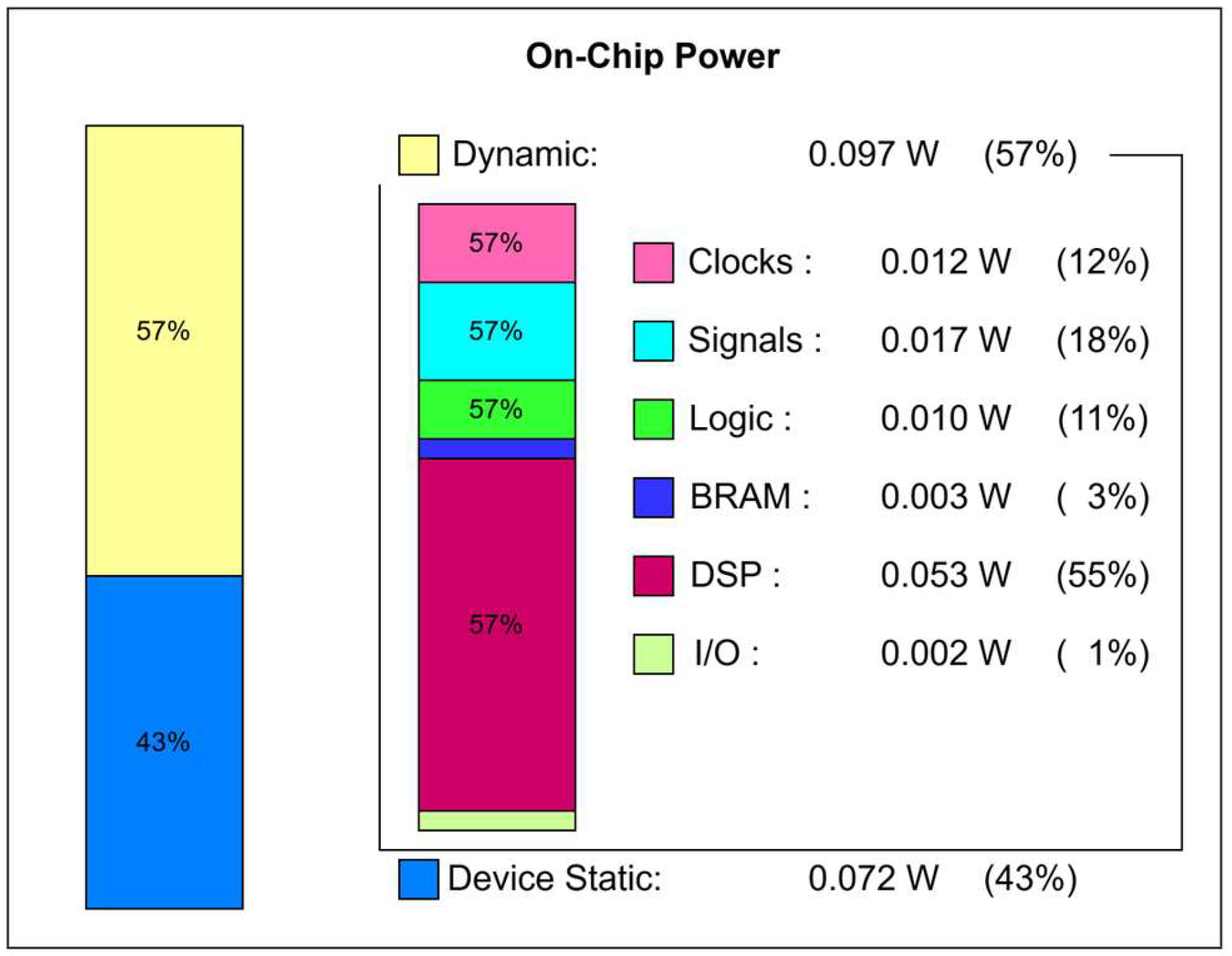
In this study, the authors propose a solution for implementing a digital signature system using the post-quantum digital signature scheme Falcon on the FPGA hardware platform XC7A35T-CPG236. The system is combined with a software component developed in C# using the NET Framework 4.7, capable of running on the Windows operating system. Falcon is selected for its compact signature size and high computational performance, optimizing the signing and verification processes on hardware. The system is designed to leverage the hardware acceleration capabilities of an FPGA to enhance performance compared to software-only signature methods. The integration of the Falcon scheme into both hardware (FPGA) and software components ensures high flexibility for real-world deployment. The obtained results show that key generation execution time is approximately 1516.2 ms, while the signing and verification times are around 2–5 ms. Hardware resource usage has significantly improved, and the power consumption is 0.097 W (57%). However, the software component has not yet undergone thorough security testing. Given the achieved results in terms of execution time and energy consumption, the proposed device and software may be suitable for certain applications that do not require stringent performance and energy constraints. Furthermore, this research demonstrates the feasibility of deploying post-quantum cryptographic solutions on embedded hardware platforms, contributing to the development of secure communication systems in the future.
Keywords:
Falcon; TRNG; NTRU; FPGA Arty-7; SIS

1. Introduction

According to [1], with the advent of quantum computers, many cryptographic systems face potential threats of being compromised. Notably, AES-128, SHA-256 [2], 2048-bit RSA [3], and 256-bit ECDSA [4] have already been shown to be vulnerable. In response to these risks, the cryptographic research community has focused on developing post-quantum digital signature systems and schemes that remain secure against both classical and quantum computer attacks and are also compatible with existing communication infrastructures [5]. This situation calls for a thorough evaluation of cryptographic algorithms to determine which of them can still ensure short-term security in the face of emerging quantum technologies. Among the leading candidates in the Post-Quantum Cryptography (PQC) competition initiated by NIST, Falcon—a digital signature scheme based on the NTRU lattice—has drawn significant attention due to its strong security, high performance, and optimal key/signature size [6,7,8]. Falcon is built upon the GPV (Gentry–Peikert–Vaikuntanathan) framework for lattice-based digital signatures. It employs NTRU lattices and uses fast trapdoor sampling through Fourier transforms [6,7,8]. The security of the Falcon scheme relies on the hardness of the Short Integer Solution (SIS) problem over NTRU lattices, which remains difficult even in the presence of quantum computers [7].
In the fourth round of the NIST PQC standardization process, the NTRU lattice problem [9,10] continues to be recognized as a strong candidate [5]. Publication [11] provides evaluations of the hardware design and performance of post-quantum algorithms on hardware platforms. It also suggests methods indicating the suitability of implementing NTRU lattice-based schemes on FPGA and ASIC hardware platforms. This highlights that most of the post-quantum cryptographic algorithms selected for Round 4 of the NIST competition still lack extensive research on implementation and execution on hardware platforms like FPGA, ARM, and SoC. However, publication [11] also presents results and evaluations of energy efficiency and execution speed for PQC algorithms (selected in NIST Round 2) on various FPGA platforms. While the results demonstrate effectiveness, they also reveal the complexity and high resource consumption associated with FPGA implementations [11]. Due to the complexity of implementing these post-quantum signature schemes on FPGA hardware, studies [12,13] have proposed focusing on implementing only the fundamental components of post-quantum cryptographic schemes—such as NTT, INTT, Keccak, and BaseMul—which are commonly used in the design of signature schemes and cryptographic systems based on NTRU lattices [12]. This modular approach enables flexibility, better adaptability for different applications, and improved execution speed. Publication [7] outlines the implementation results, performance, and limitations of the Falcon signature scheme on various hardware platforms. Furthermore, it proposes solutions to improve these limitations [7]. Publication [8] highlights the distinctive hardware implementation characteristics of the Falcon signature scheme compared to other lattice-based post-quantum signature schemes built on the NTRU problem. Despite Falcon’s strong theoretical and practical advantages, deploying it on embedded devices—where hardware resources are constrained—remains challenging. Based on performance studies of Falcon on FPGA hardware, this research proposes a complete digital signature system based on Falcon, implemented on the FPGA Arty-7 platform and integrated with a control software component running on a PC. The design focuses on optimizing three core components: key generation, signing, and verification. It effectively leverages the parallelism and customizability of FPGA to enhance processing speed and reduce resource consumption. Based on the hardware design analysis of post-quantum cryptographic solutions, the authors implement several fundamental components of the Falcon scheme on the FPGA chip. The post-quantum Falcon signature application then calls these basic hardware functions during key generation, signing, and verification. Finally, the authors evaluate the performance of the proposed solution. The research results are presented in detail in this paper.

3. Design and Development of the Falcon Digital Signature Device Based on FPGA Platform

The implementation of the post-quantum Falcon 1.0 digital signature software is specifically designed for the Falcon hardware signing device. The software is developed using Microsoft Visual Studio and runs on Windows operating system (×86 or ×64 architecture). It communicates with the hardware signing device via a virtual COM port, using libraries based on the NET Framework 4.7. The software was tested and evaluated for performance on a Dell Precision 7520 running Windows 10 Home.
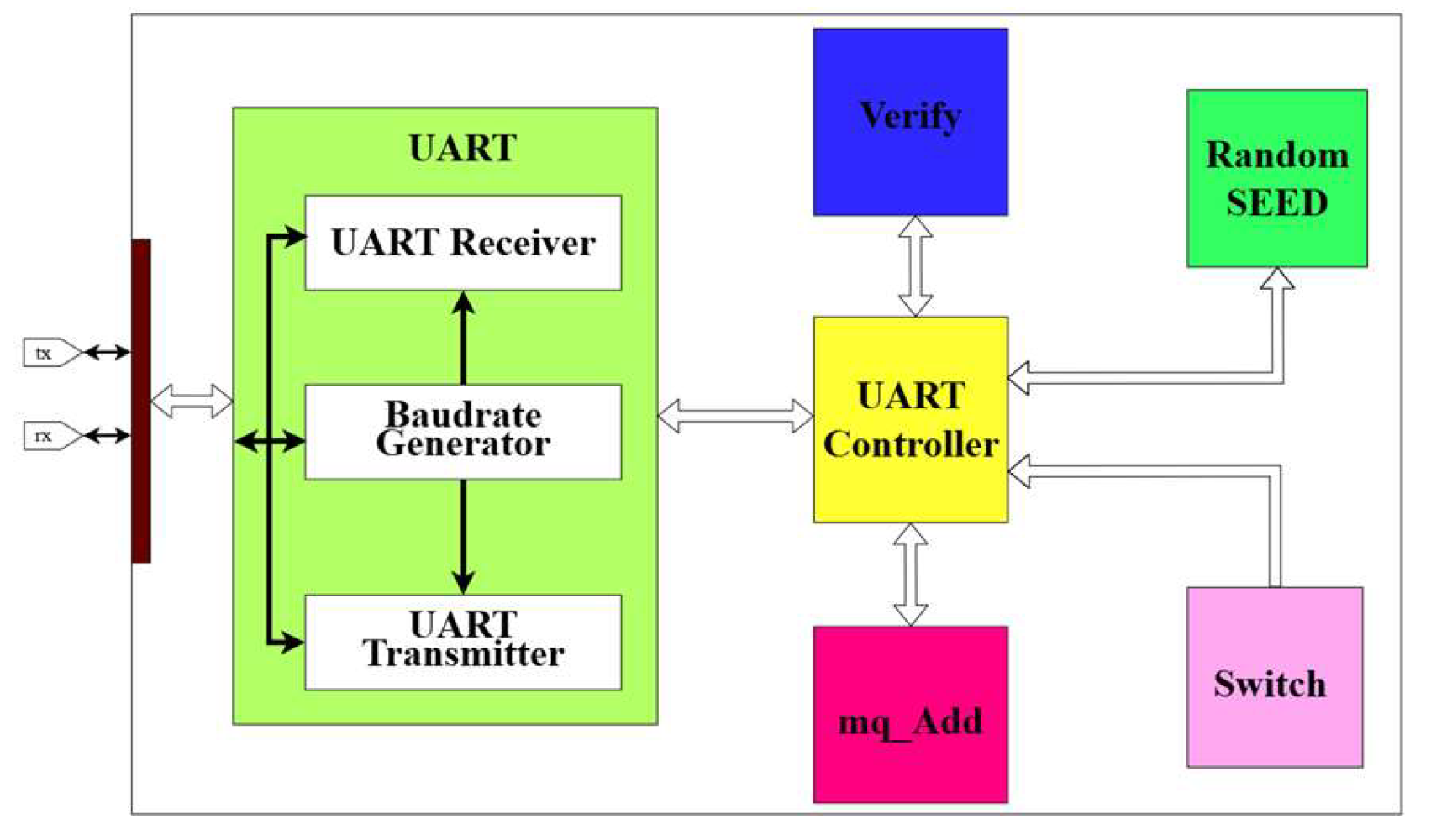
In Figure 4, the authors present the functional blocks designed for the Falcon post-quantum signing device, including the following: (1) UART Block, (2) Verify Block, (3) mq_Add Block, (4) Random_SEED Block, (5) Switch Block, (6) UART Controller Block. The functions of these blocks are detailed as follows:
  • In the hardware design of the Falcon digital signature device, UART interface block (1) is responsible for UART communication between the hardware design and the CP2102 chip (USB to UART). Blocks (2), (3), and (4) correspond to the core functions of signature verification, modulo-q integer addition, and pseudo-random number generation, respectively. This arrangement enables stable communication between the Falcon device and the host computer during operation, ensuring reliable performance for digital signature services.
  • Furthermore, the design incorporates block (5), which consists of physical switches on the device. These switches are used to configure the operational mode of the device, allowing users to identify whether it is currently set to key generation, digital signing, or signature verification. Lastly, block (6) is integrated into the Falcon signature device design to serve as the central processing unit, managing data flow between the blocks and controlling the overall operation of the device.
Figure 4. Hardware circuit architecture diagram.
During the design and implementation phase of the Falcon signing device, the authors developed the pseudo-random number generator (trng_8bit block (4)) and the modulo-q adder (mq_add block (3)) using VHDL code with the Vivado tool. The XC7A35T-CPG236 FPGA chip was selected to implement these two modules. The integration process included simulation and verification using testbenches for both modules to ensure proper functionality.

3.1. Design and Implementation of the Trng_8bit Block

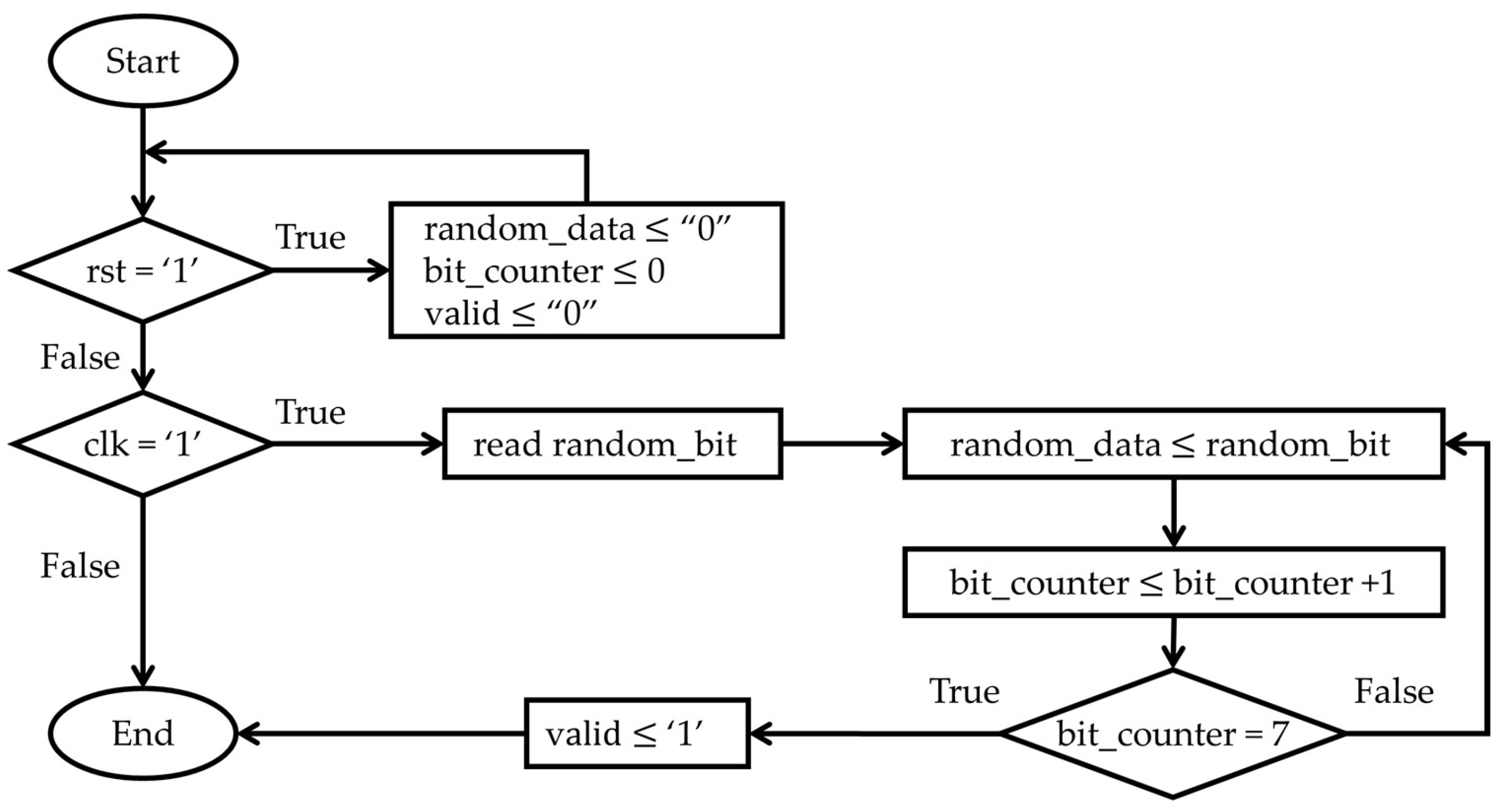
Figure 5 outlines the synchronous operation of the trng_8bit module within the new TRNG architecture. The module’s behavior is controlled by the signals rst (reset) and clk (clock), following the logical flow below: (I) Initialization (Reset): When the signal rst = ‘1’ (true), the module immediately reinitializes all registers. (II) Synchronous Sampling: When rst = ‘0’ (false), the logic waits for the rising edge of clk (clk = ‘1’). At this edge, the module performs the following functions: Reading the raw random_bit signal provided by the base TRNG module; assigning random_bit to the current position in the random_data (8-bit register), as indicated by bit_counter. (III) Counter and Valid Control: After storing the bit, bit_counter is incremented by 1. The logic then checks for byte completion: If bit_counter reaches 7 (meaning 8 bits have been collected), the valid signal is asserted (‘1’) to indicate that a random_byte is ready. Simultaneously, bit_counter is reset to 0 to begin collecting the next byte. Finally, random_byte is assigned to the value of random_data.
Figure 5. Block diagram of the trng_8bit module.
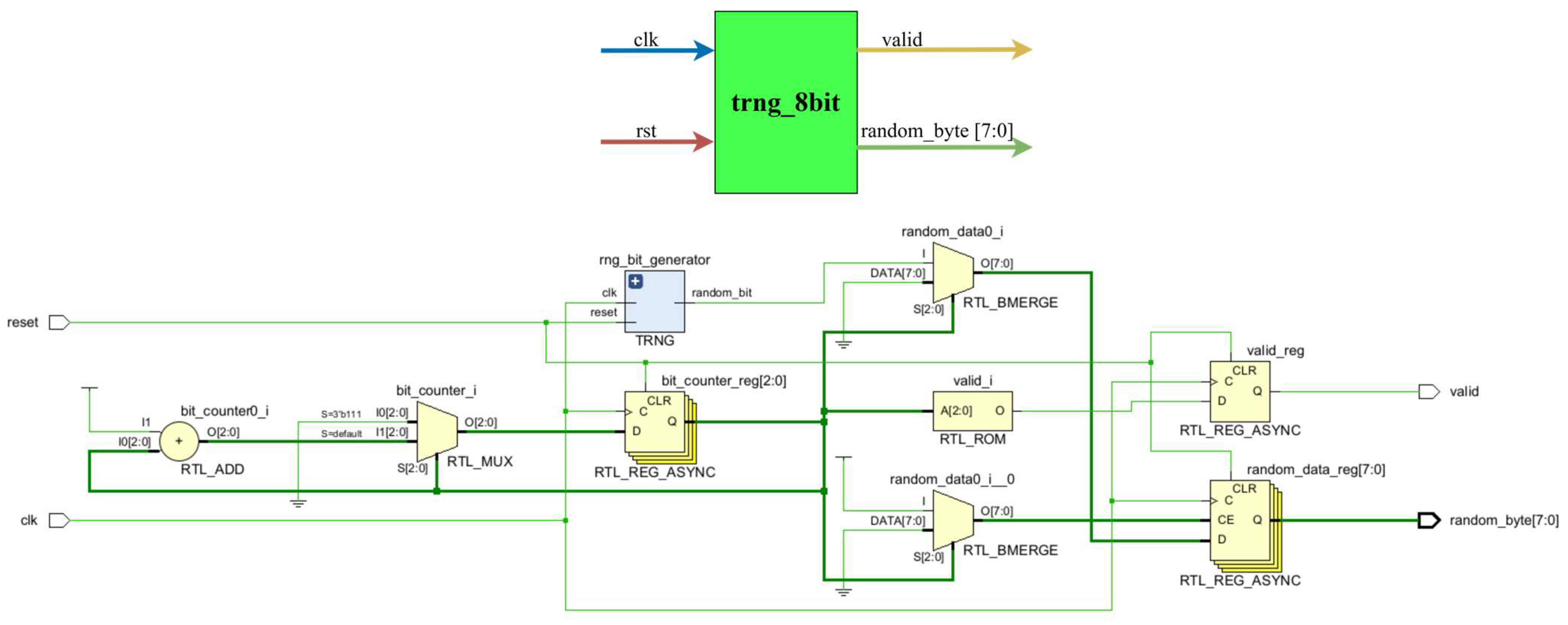
The hardware implementation of trng_8bit (detailed in Figure 6) employs a standard synchronous architecture consisting of the following:
  • A 3-bit counter register;
  • An 8-bit accumulation register;
  • Bit Merge Logic (RTL_BMERGE) to insert the random_bit into the correct position.
Figure 6. Block diagram and circuit design of the random_seed block.
This design leverages a true random source (random_bit) to generate non-repetitive random byte sequences, ensuring the cryptographic unpredictability required for the Falcon scheme.

3.2. Design and Implementation of a Modular Addition Unit for Two Integers (mq_Add Block)

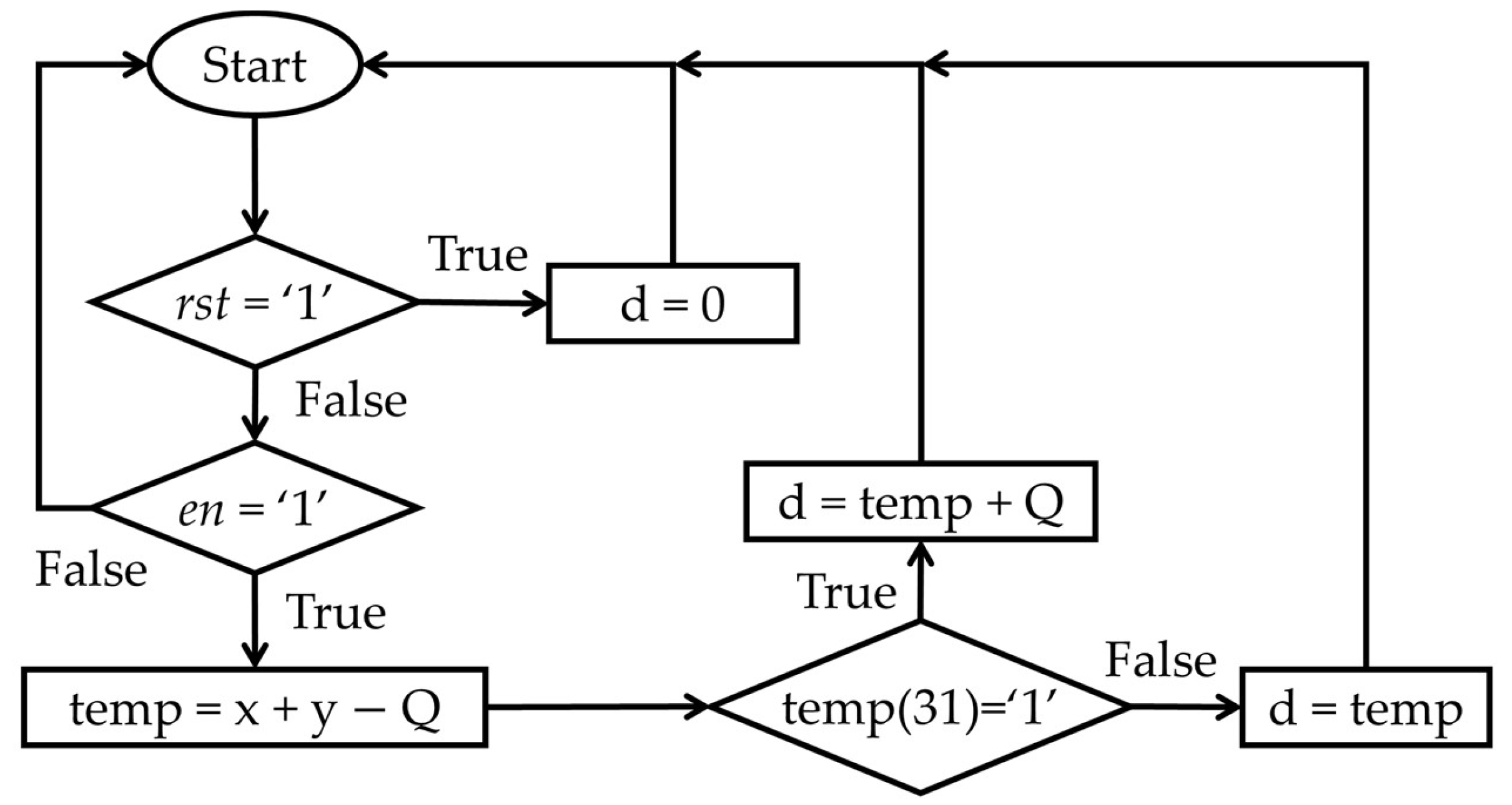
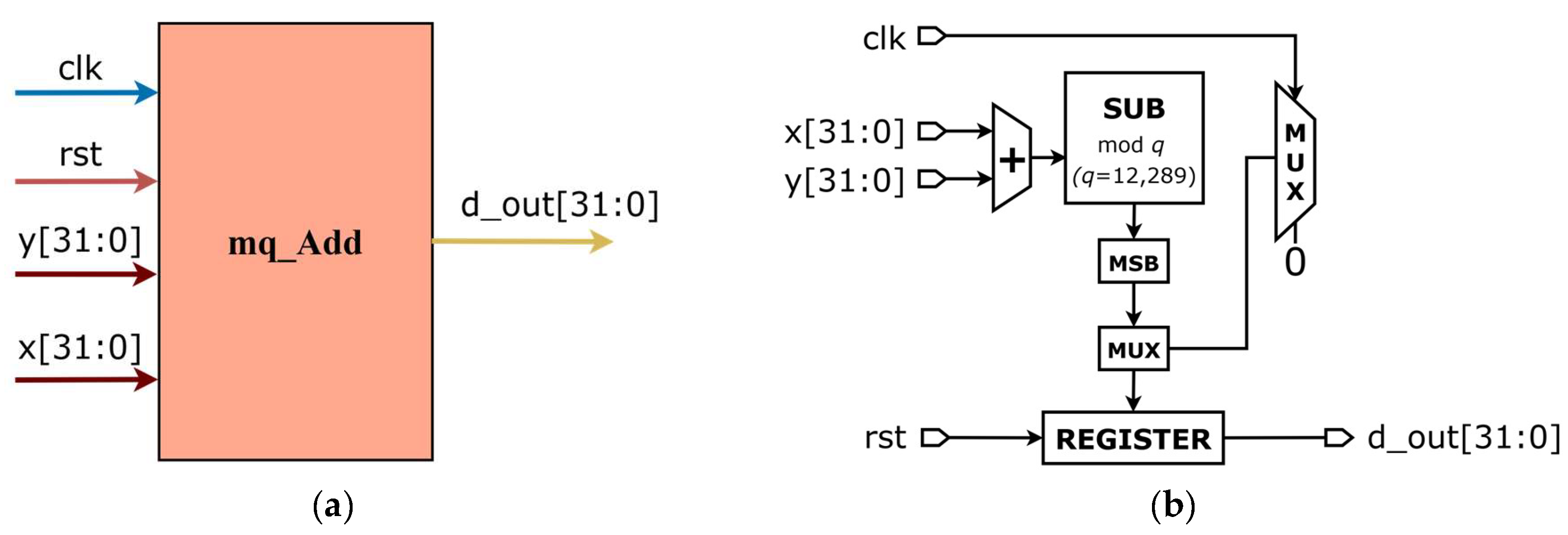
The operation of adding two 32-bit integers modulo-q is illustrated in Figure 7. This represents the algorithm for modular addition of two integers, incorporating conditional addition—specifically, the value q is added back to the result if the initial summation yields a negative value. The hardware schematic of the modular addition unit (mq_add block) is shown with its input and output pins in Figure 8. In this figure, Figure 8a presents the overall block structure of the mq_add module using the Vivado 2023.2, while Figure 8b depicts the detailed RTL (Register Transfer Level) circuit of the mq_add block, also developed with Vivado.
Figure 7. Mq_add module block diagram.
Figure 8. Block diagram and circuit design mq_add block: (a) mq_add block; (b) RTL circuit of mq_add RTL block.
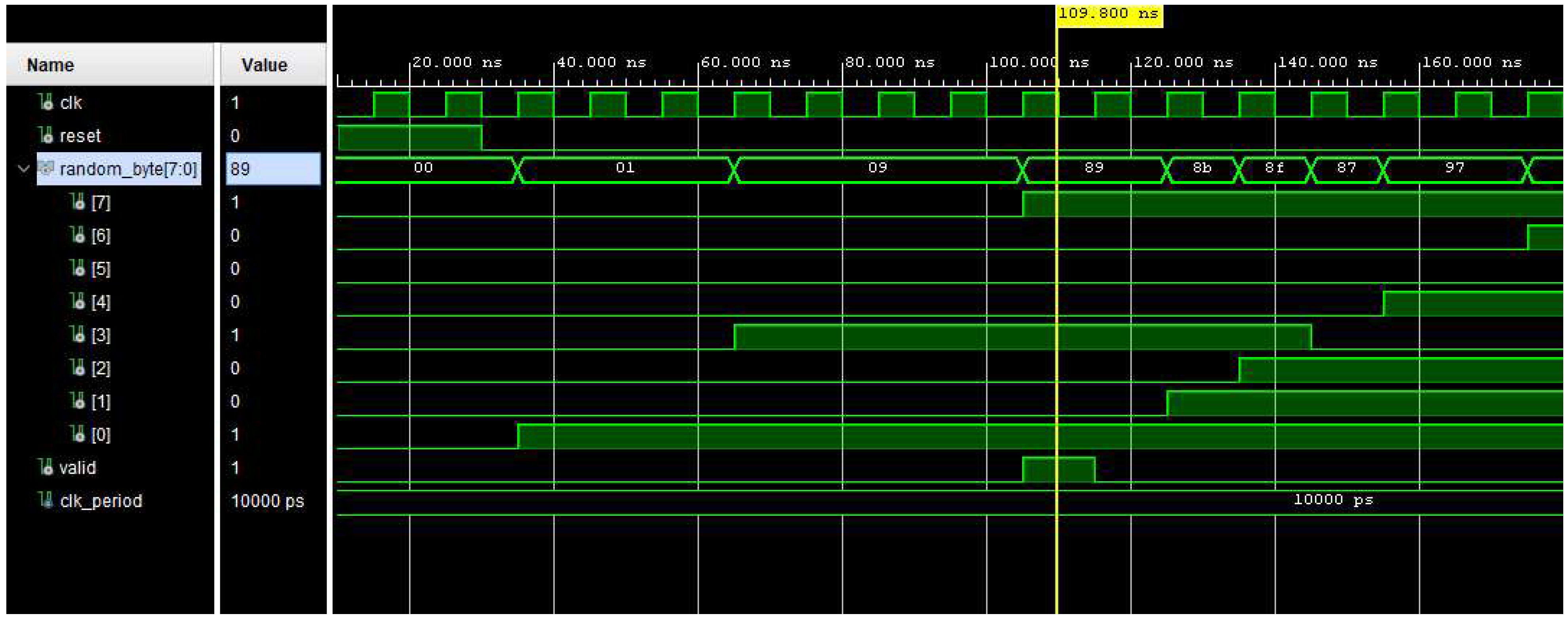
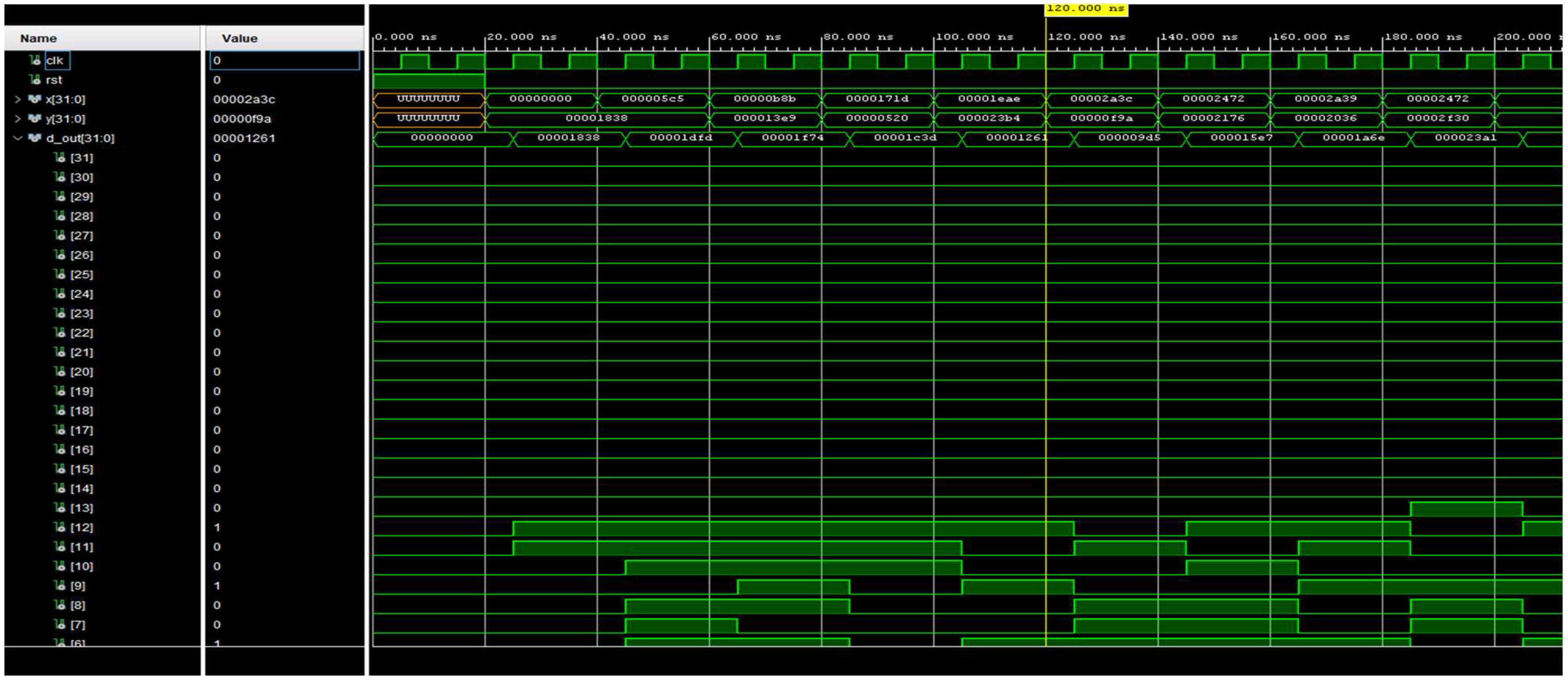
Following this process, the authors proceeded to test the system by running simulation trials using a testbench. The results are presented in Figure 9 and Figure 10, from which it can be observed that for the trng_8bit block—although it generates pseudo-random values—the 255 values it produces are sufficient to meet the design requirements. Meanwhile, for the mq_add block, the summation results (Figure 10) are correct when compared with software-based testing.
Figure 9. random_seed simulation.
Figure 10. Mq_add simulation.
Table 1 summarizes the resource utilization statistics for the two modules (mq_add and random_seed) on the XC7A35T-CPG236 chip. The LFSR design implemented by the research team is lightweight in terms of resource consumption, but it generates low-quality random numbers and does not yet meet the cryptographic security requirements or the NIST standards outlined in references [23,24]. However, this is only a prototype version intended to demonstrate the system’s functionality. The team plans to upgrade the linear pseudo-random number generator in future versions. From Table 1, the research team demonstrates that the random_seed and mq_add modules are compact and suitable for integration into various design architectures.
Table 1. Summary of design resources of random_seed and mq_add on the XC7A35T-CPG236 chip.

3.3. Design and Implementation of the Verify_Raw Block

In the process of designing and implementing the Falcon digital signature system, the research team first converted the C code of the post-quantum Falcon signature scheme into VHDL code (to encapsulate the components of the Falcon scheme into an SoC implemented on FPGA hardware). During this process, the team utilized the High-Level Synthesis (HLS) tool. Below is the result of the HLS of the verify_raw design (Algorithm 1), targeting the XC7A35T-CPG236 chip:
Table 2 provides the details of hardware IP core resource utilization on the FPGA XC7A35T-CPG236 for the verify_raw function. The results show that the synthesized IP core for the verification function is resource-efficient, saving BRAM, FF, and LUT, while also achieving extremely low latency. With a clock cycle count of 70 cycles at 100 MHz, the response time of the module is approximately 0.7 µs, indicating a fast verification response.
Table 2. HLS design summary of verify_raw.
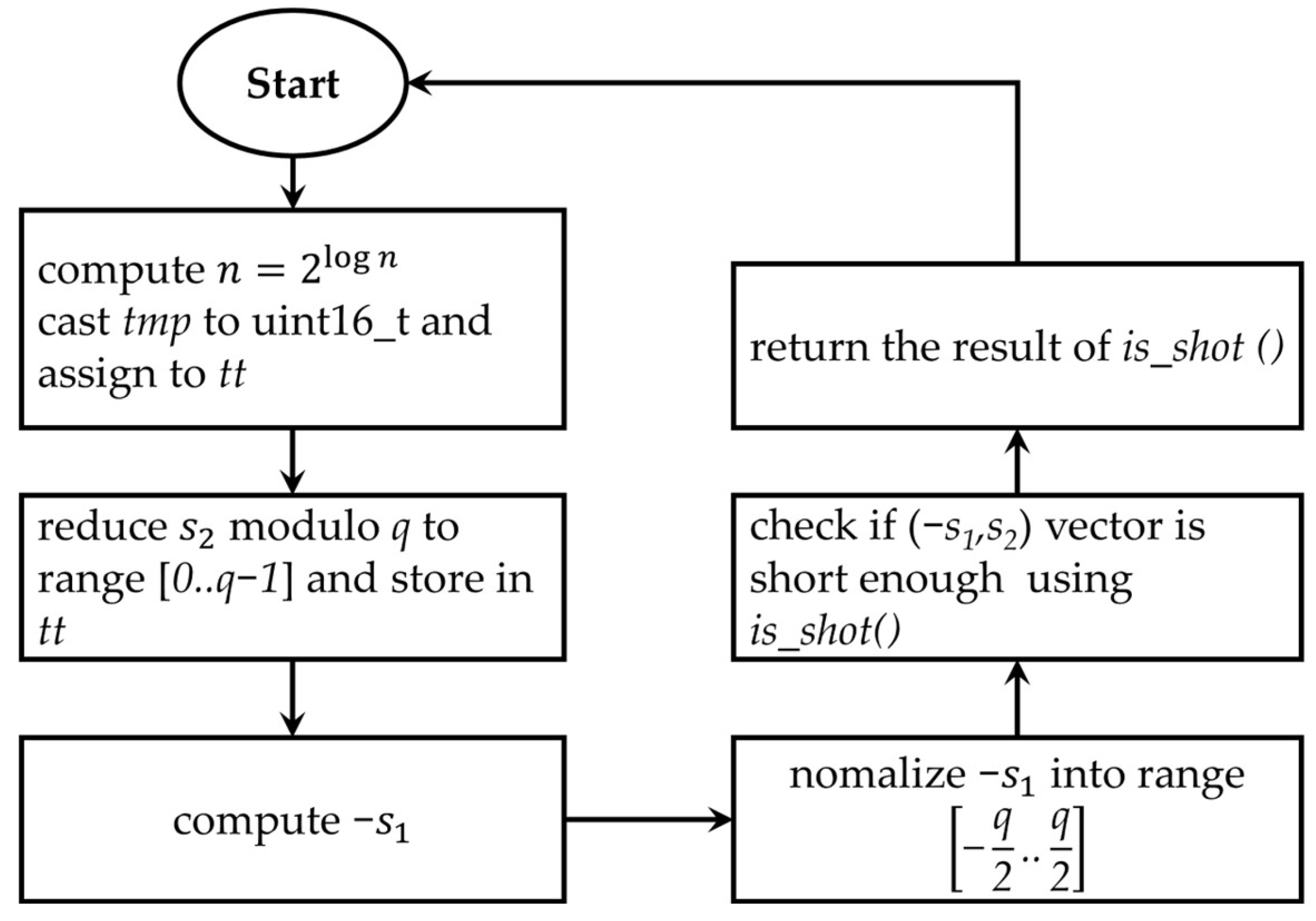
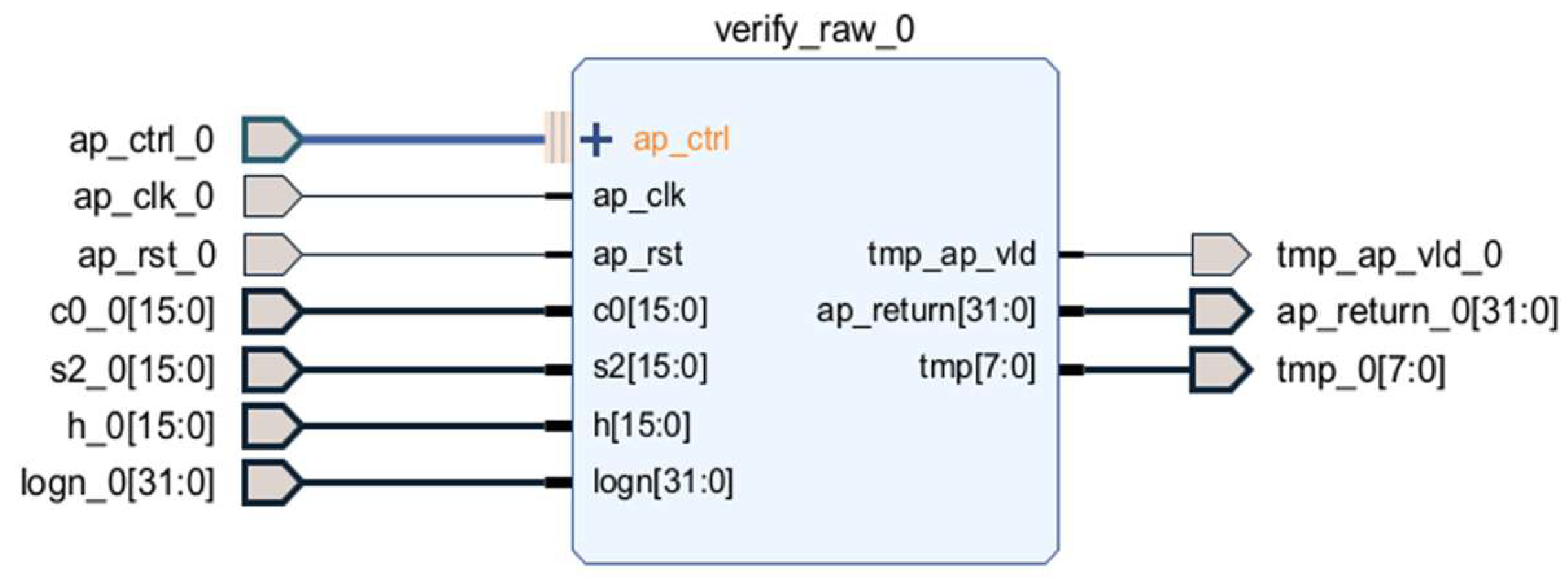
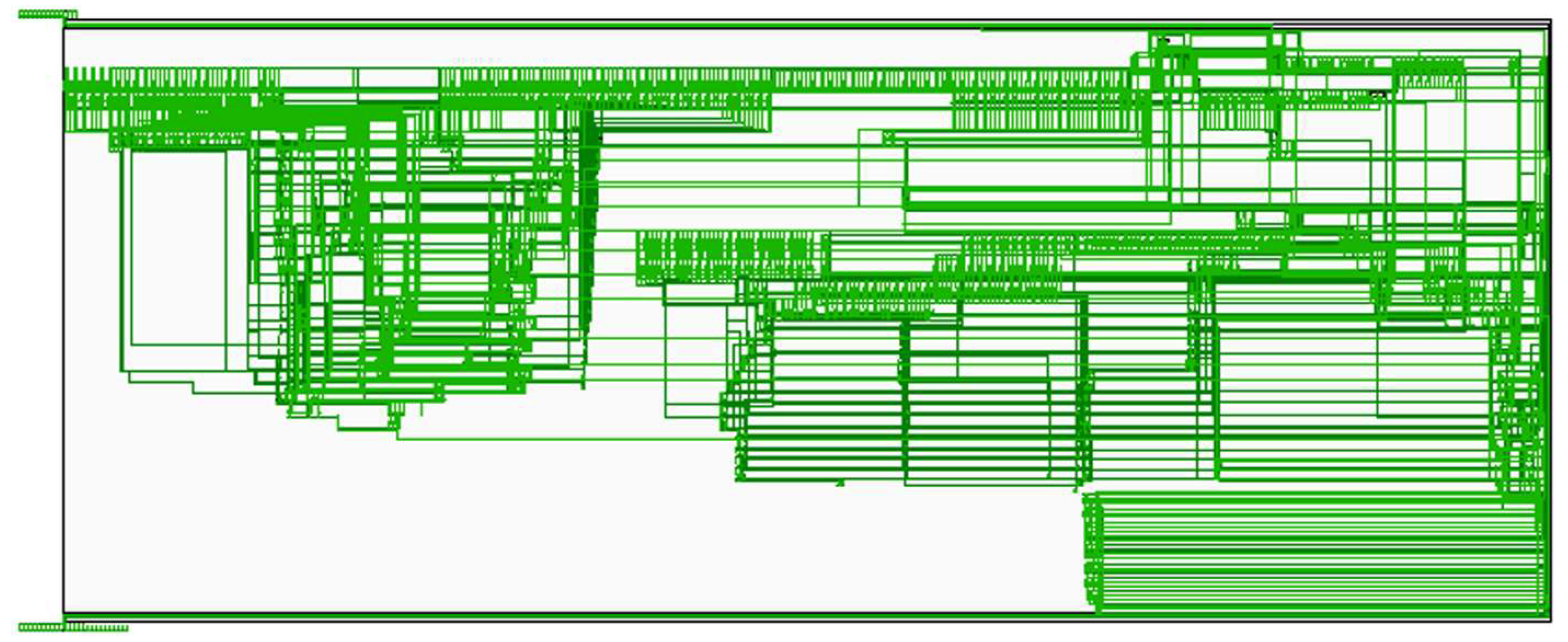
The verification block is designed based on the block diagram shown in Figure 11. The verify_raw function verifies a signature by performing a series of arithmetic operations on the values s 2 , c 0 , and h. First, it normalizes the elements of the s 2 array into the modulo-q range. Then, it computes   s 1 = s 2 h   c 0 in the NTT domain, followed by re-normalization. Finally, the function checks the length of the resulting vector s 1 ,   s 2   to determine whether the signature is valid. The verify_raw function is generated from the original C code using HLS into a hardware IP core, as illustrated in Figure 12 and Figure 13. In this context, Figure 12 shows the verify_raw block with its input and output ports, while Figure 13 presents the RTL schematic design of the verify_raw block in detail.
Figure 11. Verify_raw module block diagram.
Figure 12. verify_raw block.
Figure 13. RTL circuit diagram of the verify_raw block.
Table 3 summarizes the achieved results regarding the resource utilization of the signature verification module (verify_raw block) on the XC7A35T-CPG236 chip. According to the results in Table 3, the verification module uses a moderate amount of hardware resources. This is reflected in its resource usage: 14.3% for LUTs, 3.9% for Registers, and 16.7% for BRAM. The resource consumption of the Verify module indicates that the design has a medium level of complexity, making it well-suited for implementation on the XC7A35T-CPG236 chip. The use of 1 DSP and 14 submodules (instances) suggests that the module performs a variety of arithmetic and logic checks, but it is not overly complex and does not place a heavy burden on the FPGA-integrated system.
Table 3. Summary of verifying raw design resources.

3.4. Design and Implementation of the UART Peripheral Interface Block

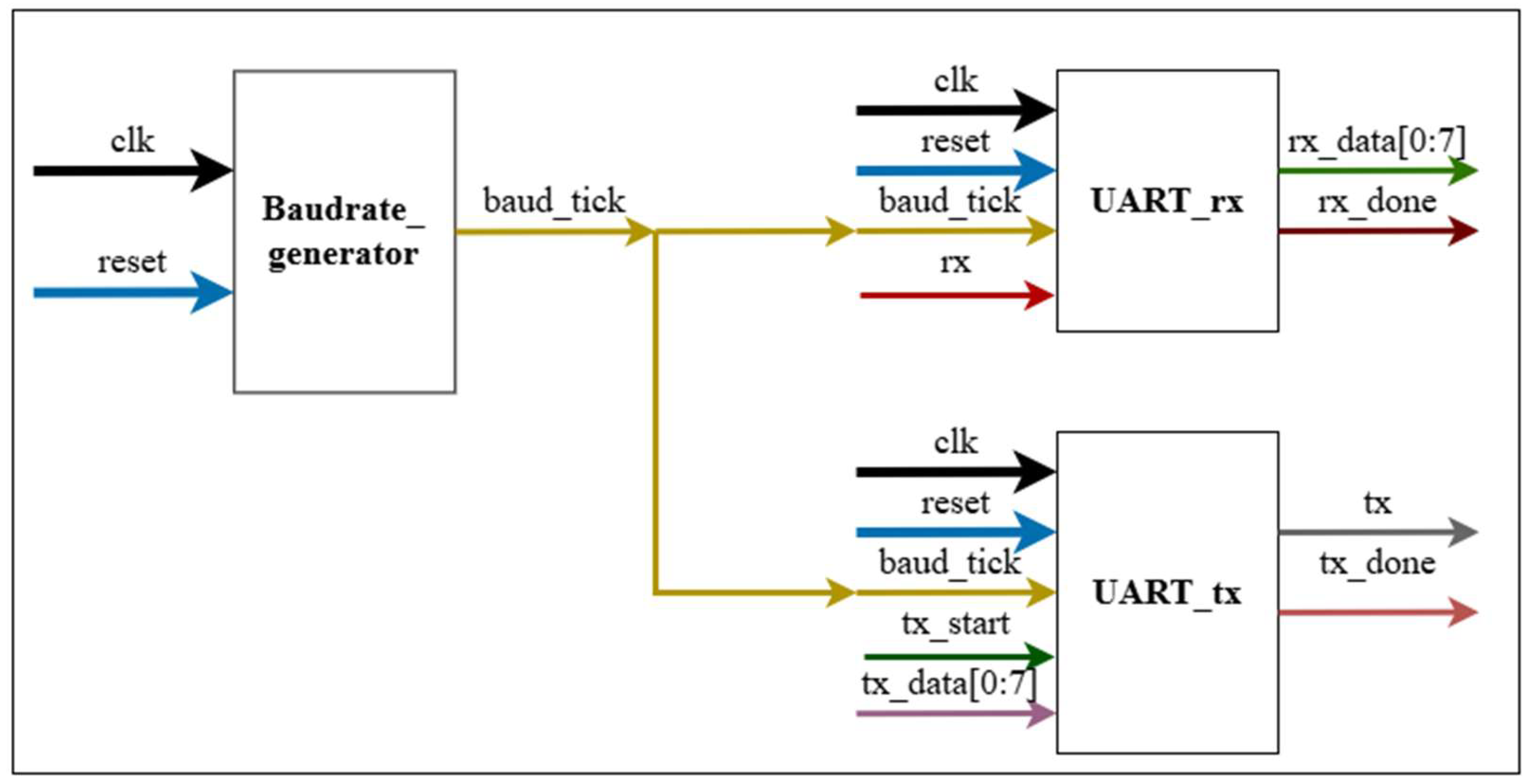
In addition to the modules serving the digital signature functionality of the Falcon device, the authors’ design also includes a UART peripheral interface block (1). This UART block is used to enable the Falcon signature device to communicate with a computer via a virtual COM port. As shown in Figure 14, the operation of the UART block is ensured through several components, including the following:
(1)
Baudrate Generator—This block generates the baud_tick signal to synchronize the UART transmission and reception process based on the system clock and the configured baud rate. The baud_tick signal is issued after a specific number of clock cycles (calculated as CLOCK_FREQ/BAUD_RATE), ensuring correct transmission speed.
(2)
UART Receiver—This is the UART data receiving unit, which receives data from the transmission line (rx), samples and processes the data through multiple states: IDLE, START_BIT, DATA_BITS, and STOP_BIT. Once 8 bits are received, it raises the rx_done = 1 signal and outputs the data.
(3)
UART Transmitter—This is the UART data transmitting unit, which also operates through the following states: IDLE, START_BIT, DATA_BITS, and STOP_BIT. When it receives the tx_start signal, it begins transmission. Each data bit is sent out on every baud_tick cycle, and after transmitting all 8 bits, it asserts the tx_done = 1 signal.
Figure 14. UART module.

4. Results and Discussion

Based on the system service design and implementation solution proposed by the authors in this study, and with the results obtained from the design and construction of the digital signature device and signing software based on the post-quantum signature scheme Falcon according to the proposed approach, this section presents the outcomes achieved during the operation of the scheme on both the hardware device and the software developed for the Falcon digital signature device.
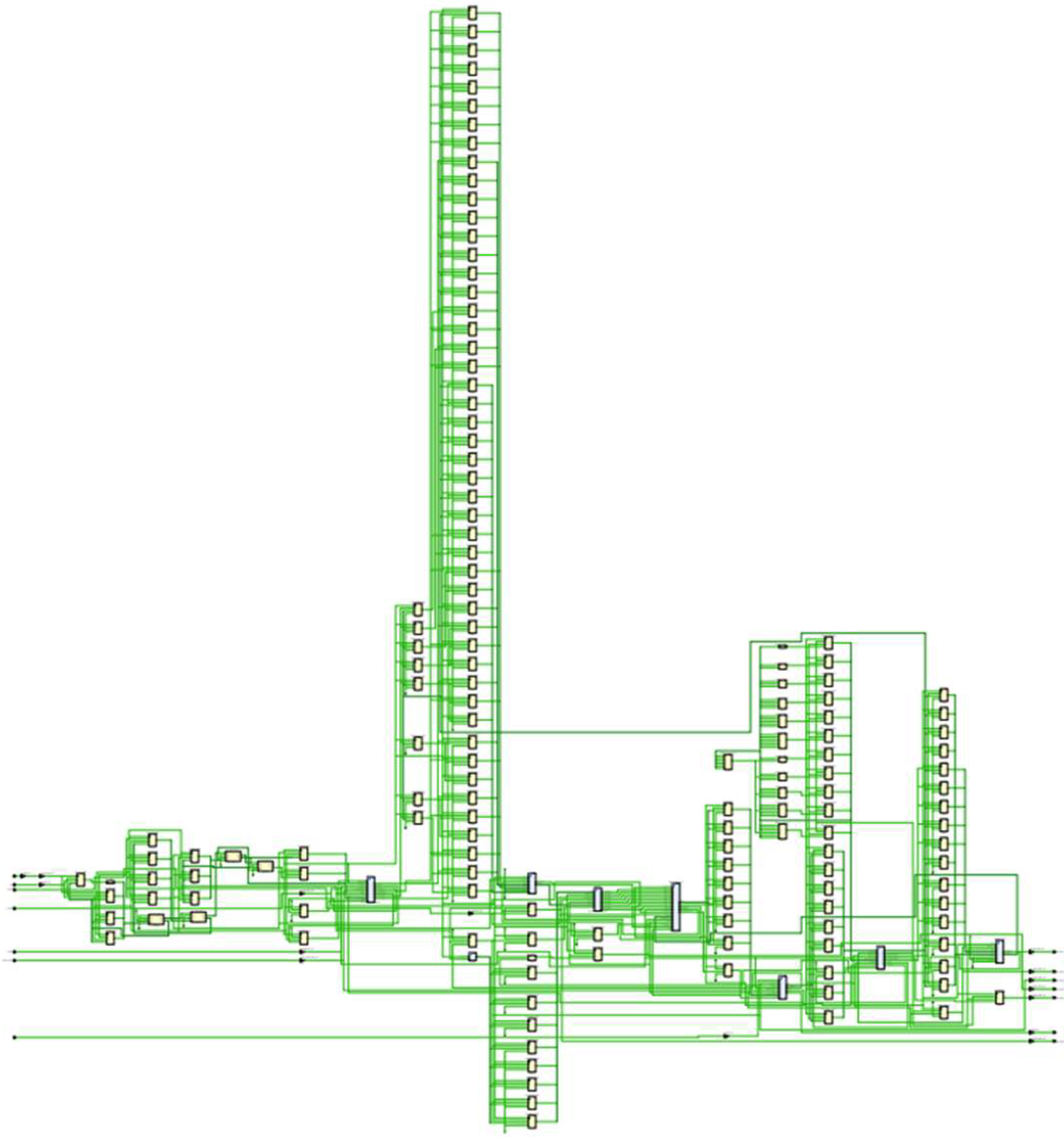
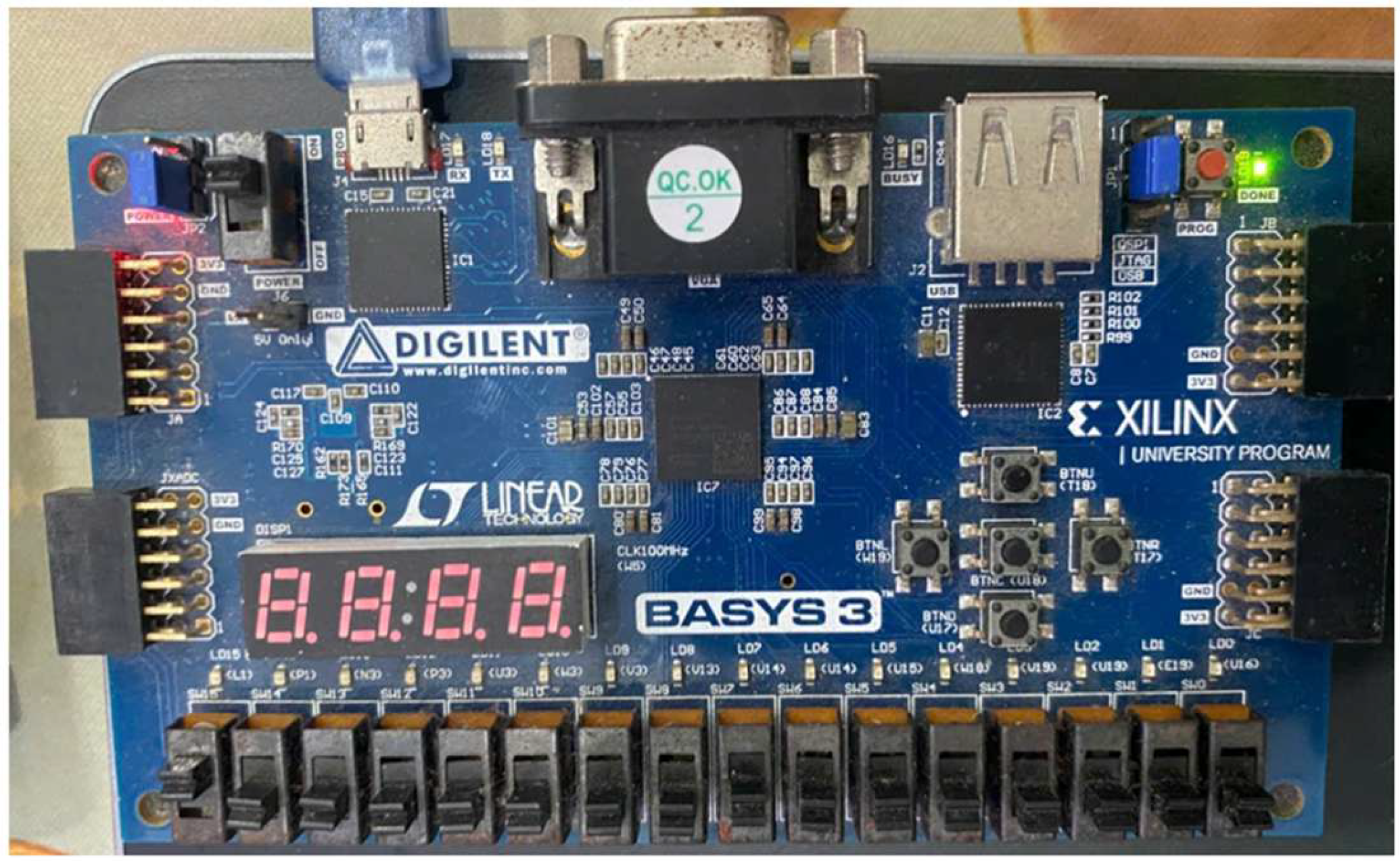
After completing the testing phase using simulation testbenches, the authors finalized the design and deployed it onto the hardware device. Figure 15 shows the detailed RTL synthesized circuit of the modules in the program based on the Falcon digital signature scheme, which will be loaded onto the hardware device using the XC7A35T-CPG236 chip. Figure 16 is a photograph of the device in operation, running the program modules that have been successfully loaded onto the hardware.
Figure 15. Summary of RTL circuit diagram of modules on the XC7A35T-CPG236 chip.
Figure 16. Actual running image of Falcon digital signature device with XC7A35T-CPG236 chip.
In Figure 16, the authors generated the bitstream file and programmed it onto the hardware device. Following that, the authors proceeded to conduct experimental runs and perform comparative testing between the hybrid digital signature system (software combined with hardware acceleration) and the purely software-based digital signature system. Through these experimental runs, the authors collected several results regarding the execution time of the hardware-accelerated device and the software-based signature solution, both implementing the Falcon digital signature scheme. The comparative results on key generation time, signing time, and verification time—alongside existing published benchmarks—are presented in Table 4.
Table 4. Comparison of execution time results of a digital signature device using the XC7A35T-CPG236 chip and software based on the Falcon post-quantum digital signature scheme with other publications.
The results presented in Table 4 show that, for the same key length of 1024 bits in the Falcon digital signature scheme, the key generation and signing times in this study are slower compared to those reported in [20]. However, the signature verification time achieved in this research is faster than that reported in [20]. This discrepancy can be attributed to the use of UART peripheral communication in the design of the Falcon signature device. Since UART has inherent limitations in data transmission speed, the overall execution speed of the digital signature service system is also restricted. This effect is clearly illustrated in Table 5, where the authors compare their results with those published in [7,20]. Typically, key generation in many practical applications is handled externally, outside of the signature system. Therefore, based on the authors’ perspective, the impact of key generation time on the overall system performance in real-world deployment is minimal. Nevertheless, with signature generation and verification times achieved in the range of 2–5 ms, the proposed hardware and software system demonstrates suitability for practical applications that demand strict performance and real-time constraints.
Table 5. Comparison of execution time results based on the Falcon post-quantum digital signature scheme of a digital signature device using the XC7A35T-CPG236 chip with other publications.
Based on the results achieved in this study, the design, development, and implementation of the Falcon digital signature scheme (with a key length of 1024 bits) demonstrate promising performance in terms of signing and verification. Notably, the verification step shows improved execution speed compared to the NIST reference software. However, key generation time remains relatively slow, primarily due to the use of the UART communication protocol and the lack of algorithmic optimization. This reflects certain limitations in hardware resource utilization and algorithm efficiency. In future research, the authors aim to enhance system performance by restructuring the algorithm and strengthening hardware-software co-design. Overall, the current implementation is suitable for applications with low key generation frequency but requires stable and efficient signing and verification performance.
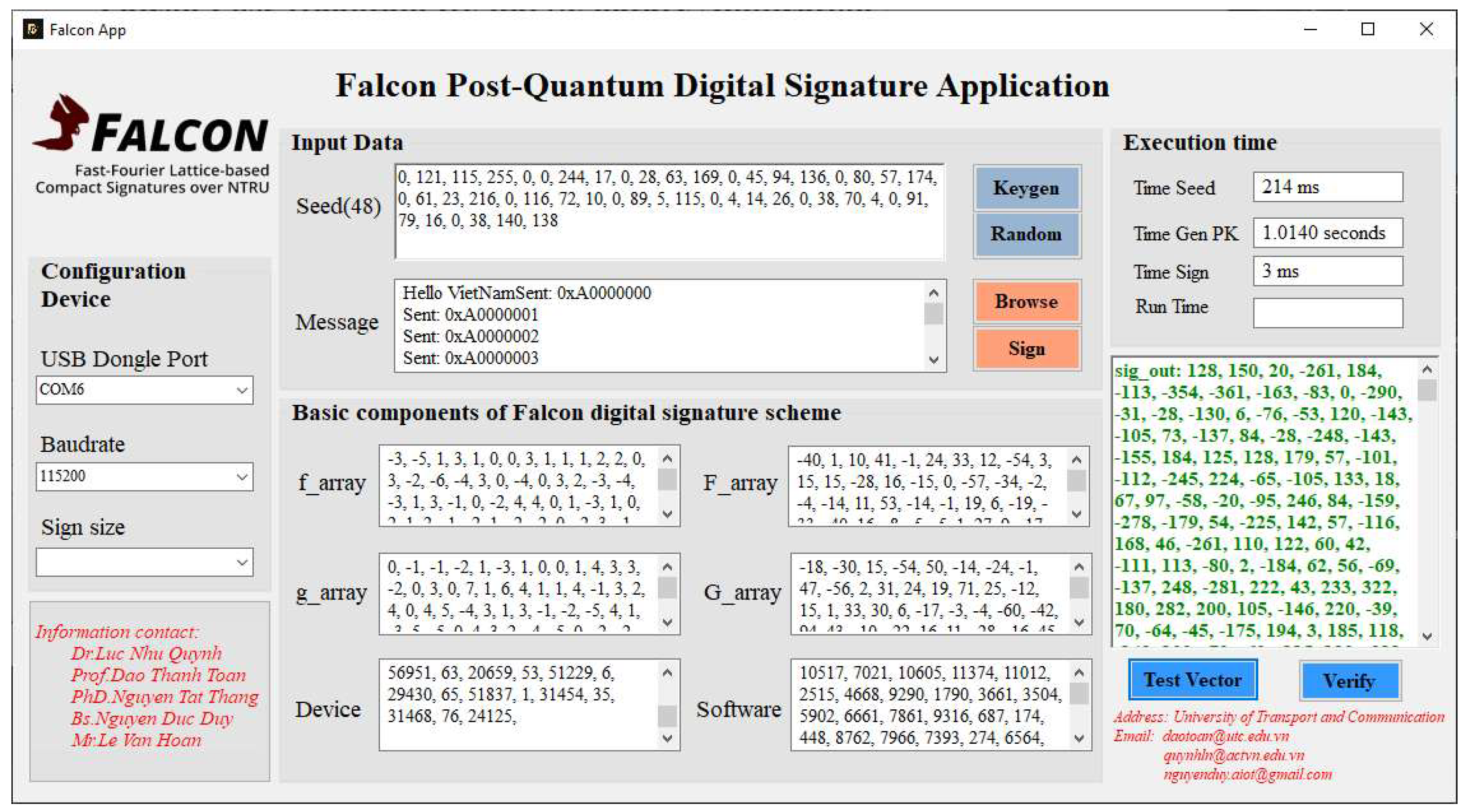
For the software designed to accompany the post-quantum digital signature device Falcon: The interface shown in Figure 17 illustrates the main functionalities of the software, including: connecting to the signing device via UART communication (Configure Device), generating pseudo-random numbers (Random), inputting messages (Browse), digital signing (Sign), signature verification (Verify), and displaying results and execution speed. Figure 17 presents a detailed overview of the complete operation, from pseudo-random number generation, key generation, digital signing, to signature verification, executed through the software using an input message. During the testing phase, the research team conducted multiple experimental runs. The execution results of both the software and the hardware device are summarized by the authors in Table 4 and Table 5.
Figure 17. Results of the performance of Falcon digital signature software when connected to the Falcon digital signature device.
Figure 18 presents the resource utilization results of the algorithms implemented on the XC7A35T-CPG236 chip within the post-quantum digital signature device Falcon. The resource usage achieved in this study shows an improvement compared to the findings in [7]. As shown in Figure 18, the design demonstrates high efficiency in hardware resource utilization, with extremely low usage across key components such as LUTs, Flip-Flops (FFs), and BRAMs, all remaining below 15%. This leaves substantial headroom for system expansion without facing resource constraints, especially given that I/O usage is currently only around 13.21%.
Figure 18. Utilization power device.
Notably, the design virtually does not use any LUTRAM, indicating that the processing architecture does not rely heavily on temporary logic-based memory. This helps reduce latency and improve overall performance. Moreover, it contributes to mitigating the risk of hardware-based side-channel attacks, where adversaries attempt to exploit buffer memory vulnerabilities. However, it is important to highlight that DSP (Digital Signal Processing block) usage reaches 72.22%—a relatively high value. This suggests that certain components of the Falcon signature scheme integrated into the hardware require a significant amount of complex arithmetic computations.
Table 6 provides a comparative analysis of our proposed hardware/software co-design solution with other recent, state-of-the-art implementations of Falcon, specifically highlighting the differences in design philosophy, hardware architecture, and performance.
Table 6. Comparison of the design in this paper with other published works.
The comparative analysis reveals that our work, while achieving slower key generation and signing times compared to [8,25], demonstrates a practical and distinct approach for deploying Falcon. The studies by [8,25] represent advanced, highly optimized hardware accelerators that target specific low-level operations or use a custom processor design, which yields superior performance. For instance, [8] achieved a 3.58× reduction in clock cycles for FALCON-1024 signing compared to a previous accelerator, while [25] customized a RISC-V processor demonstrated a 9× performance improvement for Falcon verification compared to a baseline. Their designs benefit from being implemented on a more advanced process technology (28 nm) or a more powerful platform (AMD Zynq-7000), allowing them to implement complex FPGA operations directly in hardware.
  • Verification Performance—The verification time of the proposed design is 2.238 ms, equivalent to approximately 223,800 cycles (at 100 MHz), which is slower compared to highly optimized implementations.
  • Key Generation Time—The slower key generation time (1516.2 ms) is primarily due to UART communication overhead (low-speed serial interface) rather than computational logic.
In summary, the proposed solution focuses on a more accessible and cost-effective approach. By offloading resource-intensive floating-point operations to software, the authors successfully implemented a complete Falcon system on a standard, low-cost FPGA platform. The main contribution is the demonstration that functional-level hybrid partitioning is a viable strategy for embedded systems where cost and implementation simplicity are the key factors rather than strict performance constraints. Therefore, this work stands as a valuable proof-of-concept for the deployment of post-quantum cryptography on general-purpose embedded hardware.

5. Conclusions

In this study, the authors proposed a design and developed a hardware device and software for digital signatures based on the post-quantum digital signature scheme Falcon. In this design, the hardware device (using the FPGA XC7A35T-CPG236 chip) is responsible for executing key functions such as random number generation (random_seed), modulo-q addition of integers (mq_add), and signature verification (verify_raw). Meanwhile, the remaining core functions of the Falcon scheme are handled by the software component. The results show that the key generation execution time is approximately 1516.2 milliseconds, and the signature and verification times are about 2–5 milliseconds. In terms of hardware resource utilization, significant improvements have been achieved, and the measured power consumption is 0.097 W (57%), indicating that the Falcon signature device operates with moderate energy usage. These findings suggest that the proposed hardware and software solution is suitable for certain applications that do not impose strict requirements on execution speed and power efficiency. Furthermore, the study demonstrates the feasibility of implementing post-quantum cryptographic solutions on embedded hardware platforms, contributing to the development of secure communication systems in the future. In the future, the research team will focus on optimizing the current design to further reduce execution time and enhance overall efficiency. Specifically, we develop to meet the requirements of NIST standards. These efforts will ensure the design is not only functional but also cryptographically secure for future versions.

Author Contributions

Methodology, T.-T.N., T.-T.D. and N.-Q.L.; Software, D.-D.N.; Resources, T.-T.N., T.-T.D. and N.-Q.L.; Writing—original draft, T.-T.N.; Writing—review & editing, T.-T.N.; Supervision, T.-T.D. and N.-Q.L.; Project administration, N.-Q.L. All authors have read and agreed to the published version of the manuscript.

Funding

This work was supported by the Minister of Education and Training (MOET), grant no. B2025-GHA-02.

Data Availability Statement

The original contributions presented in this study are included in the article. Further inquiries can be directed to the corresponding authors.

Acknowledgments

The authors thank the Academy of Cryptography Techniques and Electronic engineering doctoral program of University Transport and Communications for supporting this work.

Conflicts of Interest

The authors declare no conflicts of interest.

Abbreviations

The following abbreviations are used in this manuscript:
AESAdvanced Encryption Standard
DSADigital Subtraction Angiography
DSPDigital Signal Processing block
ECDSAElliptic Curve Digital Signature Algorithm
FFTFast Fourier Transform
FPGAField-Programmable Gate Array
GenAIGenerative Artificial Intelligence
GPVGentry–Peikert–Vaikuntanathan
HLSHigh-Level Synthesis
NISTNational Institute of Standards and Technology
NTRUN-th degree Truncated polynomial Ring Units
PQCPost-Quantum Cryptography
SISShort Integer Solution
TRNGTrue Random Number Generator

References

  1. Bernstein, D.J. Introduction to post-quantum cryptography. In Post-Quantum Cryptography; Springer: Berlin/Heidelberg, Germany, 2025; pp. 1–14. [Google Scholar] [CrossRef]
  2. Sarah, D.; Peter, C. On the practical cost of Grover for AES key recovery. In Proceedings of the 5th NIST PQC Standardization Conference, Rockville, MD, USA, 10–12 April 2024; pp. 1–22. [Google Scholar]
  3. Gidney, C.; Ekerå, M. How to factor 2048 bit RSA integers in 8 hours using 20 million noisy qubits. Quantum 2021, 5, 433. [Google Scholar] [CrossRef]
  4. Webber, M.; Elfving, V.; Weidt, S.; Hensinger, W.K. The impact of hardware specifications on reaching quantum advantage in the fault tolerant regime. AVS Quantum Sci. 2022, 4, 13801. [Google Scholar] [CrossRef]
  5. Alagic, G.; Bros, M.; Ciadoux, P.; Cooper, D.; Dang, Q.; Dang, T.; Kelsey, J.; Lichtinger, J.; Liu, Y.-K.; Miller, C.; et al. Status Report on the Fourth Round of the NIST Post-Quantum Cryptography Standardization Process; US Department of Commerce, National Institute of Standards and Technology: Gaithersburg, MD, USA, 2025. [Google Scholar] [CrossRef]
  6. Karabulut, E.; Aysu, A. A Hardware-Software Co-Design for the Discrete Gaussian Sampling of FALCON Digital Signature. In Proceedings of the 2024 IEEE International Symposium on Hardware Oriented Security and Trust (HOST), Tysons Corner, VA, USA, 6–9 May 2024; pp. 90–100. [Google Scholar] [CrossRef]
  7. Schmid, M.; Amiet, D.; Wendler, J.; Zbinden, P.; Wei, T. Falcon Takes Off-A Hardware Implementation of the Falcon Signature Scheme. Cryptol. Eprint Arch. 2023, 1–17. Available online: https://eprint.iacr.org/2023/1885 (accessed on 14 November 2025).
  8. Lee, Y.; Youn, J.; Nam, K.; Jung, H.H.; Cho, M.; Na, J.; Park, J.-Y.; Jeon, S.; Kang, B.G.; Oh, H.; et al. An Efficient Hardware/Software Co-Design for FALCON on Low-End Embedded Systems. IEEE Access 2024, 12, 57947–57958. [Google Scholar] [CrossRef]
  9. Bai, S.; Jangir, H.; Lin, H.; Ngo, T.; Wen, W.; Zheng, J. Compact Encryption Based on Module-NTRU Problems. In Post-Quantum Cryptography; Springer: Cham, Switzerland, 2024; Volume 14771, pp. 371–405. [Google Scholar] [CrossRef]
  10. NTRU: A Submission to the NIST Post-Quantum Standardization Effort. 2025. Available online: https://ntru.org/ (accessed on 12 May 2025).
  11. Basu, K.; Soni, D.; Nabeel, M.; Karri, R. NIST Post-Quantum Cryptography—A Hardware Evaluation Study. IACR Cryptol. ePrint Arch. 2019, 2019, 1–16. [Google Scholar]
  12. Dione, D.; Seck, B.; Diop, I.; Cayrel, P.-L.; Faye, D.; Gueye, I. Hardware Security for IoT in the Quantum Era: Survey and Challenges. J. Inf. Secur. 2023, 14, 227–249. [Google Scholar] [CrossRef]
  13. NIST.IR.8547; Transition to Post-Quantum Cryptography Standards. National Institute of Standards and Technology: Gaithersburg, MD, USA, 2024. [CrossRef]
  14. Luc, N.Q.; Nguyen, T.T.; Quach, D.H.; Dao, T.T.; Pham, N.T. Building Applications and Developing Digital Signature Devices based on the Falcon Post-Quantum Digital Signature Scheme. Eng. Technol. Appl. Sci. Res. 2023, 13, 10401–10406. [Google Scholar] [CrossRef]
  15. Castelvero, L.; Grande, I.H.L.; Pruneri, V. High-Performance Time-to-Digital Conversion on a 16-nm Ultrascale+ FPGA. IEEE Access 2024, 12, 149569–149579. [Google Scholar] [CrossRef]
  16. Boutin, C. NIST Announces First Four Quantum-Resistant Cryptographic Algorithms. 2025. Available online: https://www.nist.gov/news-events/news/2022/07/nist-announces-first-four-quantum-resistant-cryptographic-algorithms (accessed on 9 June 2025).
  17. NIST.FIPS.203; Module-Lattice-Based Key-Encapsulation Mechanism Standard. National Institute of Standards and Technology (NIST): Gaithersburg, MD, USA, 2024. [CrossRef]
  18. NIST.FIPS.204; Module-Lattice-Based Digital Signature Standard. National Institute of Standards and Technology (NIST): Gaithersburg, MD, USA, 2024. [CrossRef]
  19. Shannon, C. The lattice theory of information. Trans. IRE Prof. Gr. Inf. Theory 1953, 1, 105–107. [Google Scholar] [CrossRef]
  20. Fouque, P.-A.; Hoffstein, J.; Kirchner, P.; Lyubashevsky, V.; Pornin, T.; Prest, T.; Ricosset, T.; Seiler, G.; Whyte, W.; Zhang, Z. Falcon: Fast-Fourier Lattice-based Compact Signatures over NTRU Specifications v1.2. 2020, pp. 1–65. Available online: https://falcon-sign.info/ (accessed on 15 June 2025).
  21. Xilinx Inc. 7 Series FPGAs Datasheet; Xilinx Technology Document: San Jose, CA, USA, 2020; Volume 180, pp. 1–19. [Google Scholar]
  22. NIST.SP.800-90B; Recommendation for the Entropy Sources Used for Random Bit Generation. National Institute of Standards and Technology: Gaithersburg, MD, USA, 2018. [CrossRef]
  23. Zode, P.; Zode, P.; Deshmukh, R. FPGA Based Novel True Random Number Generator using LFSR with Dynamic Seed. In Proceedings of the 2019 IEEE 16th India Council International Conference (INDICON), Gujarat, India, 13–15 December 2019; pp. 1–3. [Google Scholar] [CrossRef]
  24. Tsoi, K.H.; Leung, K.H.; Leong, P.H.W. Compact FPGA-based true and pseudo random number generators. In Proceedings of the FCCM 2003 11th Annual IEEE Symposium on Field-Programmable Custom Computing Machines, Napa, CA, USA, 9–11 April 2003; FCCM 2003. pp. 51–61. [Google Scholar] [CrossRef]
  25. Ye, Z.; Huang, J.; Huang, T.; Bai, Y.; Li, J.; Zhang, H.; Li, G.; Chen, D.; Cheung, R.C.C.; Huang, K. PQNTRU: Acceleration of NTRU-Based Schemes via Customized Post-Quantum Processor. IEEE Trans. Comput. 2025, 74, 1649–1662. [Google Scholar] [CrossRef]
  26. Pendyala, S.; Magesh, R.; Kavun, E.B.; Aysu, A. Outrunning the Millennium FALCON: Speed Records for FALCON on Xilinx FPGAs. Cryptol. Eprint Arch. 2025, 1–23. [Google Scholar]
  27. Berthet, Q.; Upegui, A.; Gantel, L.; Duc, A.; Traverso, G. An Area-Efficient SPHINCS + Post-Quantum Signature Coprocessor. In Proceedings of the 2021 IEEE International Parallel and Distributed Processing Symposium Workshops (IPDPSW), Portland, OR, USA, 17–21 June 2021; pp. 180–187. [Google Scholar] [CrossRef]
  28. Wang, T.; Member, G.S.; Zhang, C.; Cao, P.; Gu, D. Efficient Implementation of Dilithium Signature Scheme on FPGA SoC Platform. IEEE Trans. Very Large Scale Integr. Syst. 2022, 30, 1158–1171. [Google Scholar] [CrossRef]
Disclaimer/Publisher’s Note: The statements, opinions and data contained in all publications are solely those of the individual author(s) and contributor(s) and not of MDPI and/or the editor(s). MDPI and/or the editor(s) disclaim responsibility for any injury to people or property resulting from any ideas, methods, instructions or products referred to in the content.

Article Metrics

Citations

Article Access Statistics

Multiple requests from the same IP address are counted as one view.