A Comparison of Cyber Intelligence Platforms in the Context of IoT Devices and Smart Homes

Abstract
1. Introduction
- STIX adherence: Both syntactic (data format/fields) and semantic (use of standard vocabularies) compliance with STIX 2.1;
- Intelligence quality: The richness and actionability of the information (e.g., does it answer key questions about each incident, and what trends or patterns can be observed?).
- Comparative Analysis of CTI Structure: We evaluate the syntactic and semantic adherence to STIX 2.1 in each platform’s CTI data. Our analysis quantifies what fraction of each platform’s data fields conform to the STIX format and vocabulary versus what portion is platform-specific or unstructured. We also identify common fields across platforms that carry equivalent information, which could be leveraged to interconnect intelligence from different sources.
- Threat Intelligence Quality and Trends: We assess the coverage and completeness of the intelligence provided by each source using the 5W3H framework (Who, What, When, Where, Why, How, How long, and How often). This reveals how well each platform’s reports answer fundamental incident questions. In addition, we analyze the content of the CTI (vulnerability severity metrics and attack vectors) to uncover domain-specific trends. For instance, we show that network-based attacks are predominant in the IoT/smart home domain.
- Implications for ML-Based Security Systems: We discuss how our findings can guide the integration of CTI into intelligent cybersecurity solutions. The observed gaps in standard adherence suggest areas where CTI feeds might require preprocessing or augmentation before feeding into ML models. Conversely, platforms like OTX (with fully STIX-compliant feeds) can provide readily machine-readable intelligence that may streamline data ingestion for automated threat detection. We outline practical considerations for selecting or combining CTI sources to support DL models for intrusion detection, threat hunting, or automated incident response.
2. Background
- Physical attacks: Attacks on the physical hardware layer, usually requiring the adversary to be in close proximity to the device or network. Examples include device tampering and RF (radio-frequency) jamming or spoofing.
- Network attacks: Attacks on the network communication layer. These target weaknesses in network protocols, communication channels, or device connectivity. Examples include traffic interception/analysis and routing attacks.
- Software/Application attacks: Exploits targeting vulnerabilities in the device’s software, firmware, or operating system. This category includes malware infections, authentication bypass, and code injection attacks that compromise the device’s software stack.
- Encryption attacks: Attacks aiming to break or bypass cryptographic measures in IoT systems. Attackers use cryptanalysis to decrypt or spoof encrypted data by taking advantage of weak encryption algorithms.
- Data attacks: Attacks focusing on the data within IoT systems, violating the confidentiality, integrity, or availability of that data. Examples are data tampering and device impersonation to feed false data into the system.
- Side-channel attacks: Techniques that exploit indirect information leakage from IoT devices (such as power consumption) to extract sensitive information like encryption keys.
STIX
- STIX Domain Objects (SDOs): These are 18 types of objects, such as threat actor, attack pattern, indicator, and vulnerability;
- STIX Relationship Objects (SROs), which link domain objects (e.g., an indicator “indicates” a malware or an Attack Pattern “uses” a particular Malware).
3. Related Work
4. Methodology
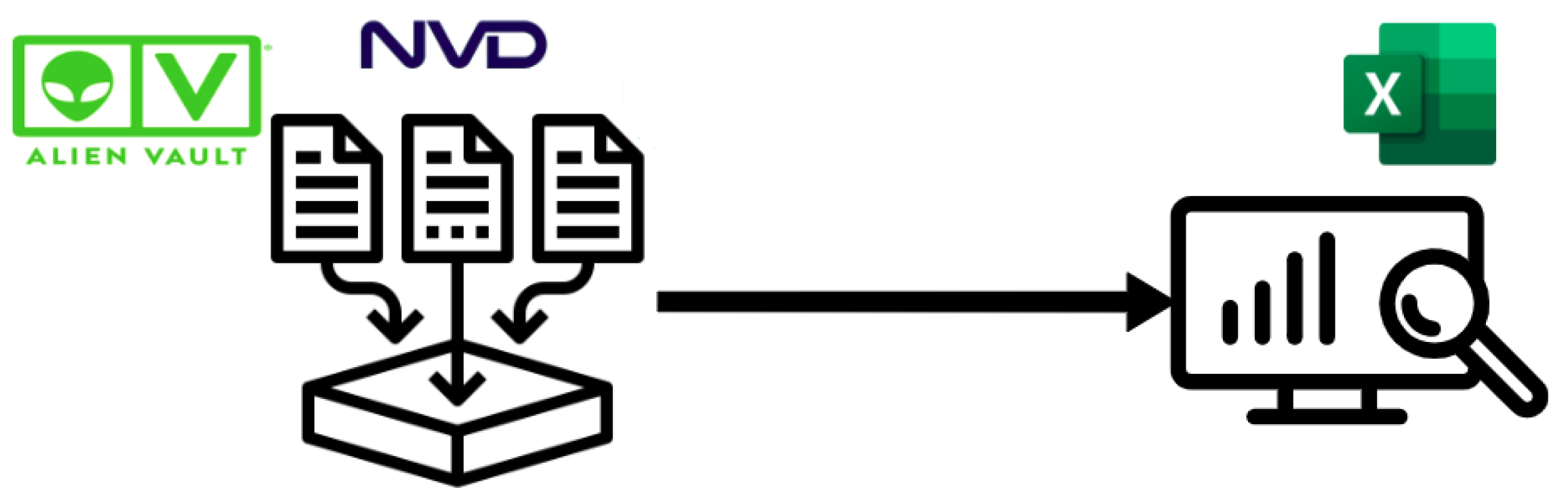
- Data Collection: Gathering IoT-related threat intelligence data from each platform in a structured format (STIX 2.1 where available).
- Preliminary Analysis: Manually inspecting and transforming the raw data to understand its structure, which will then inform the detailed analysis plan.
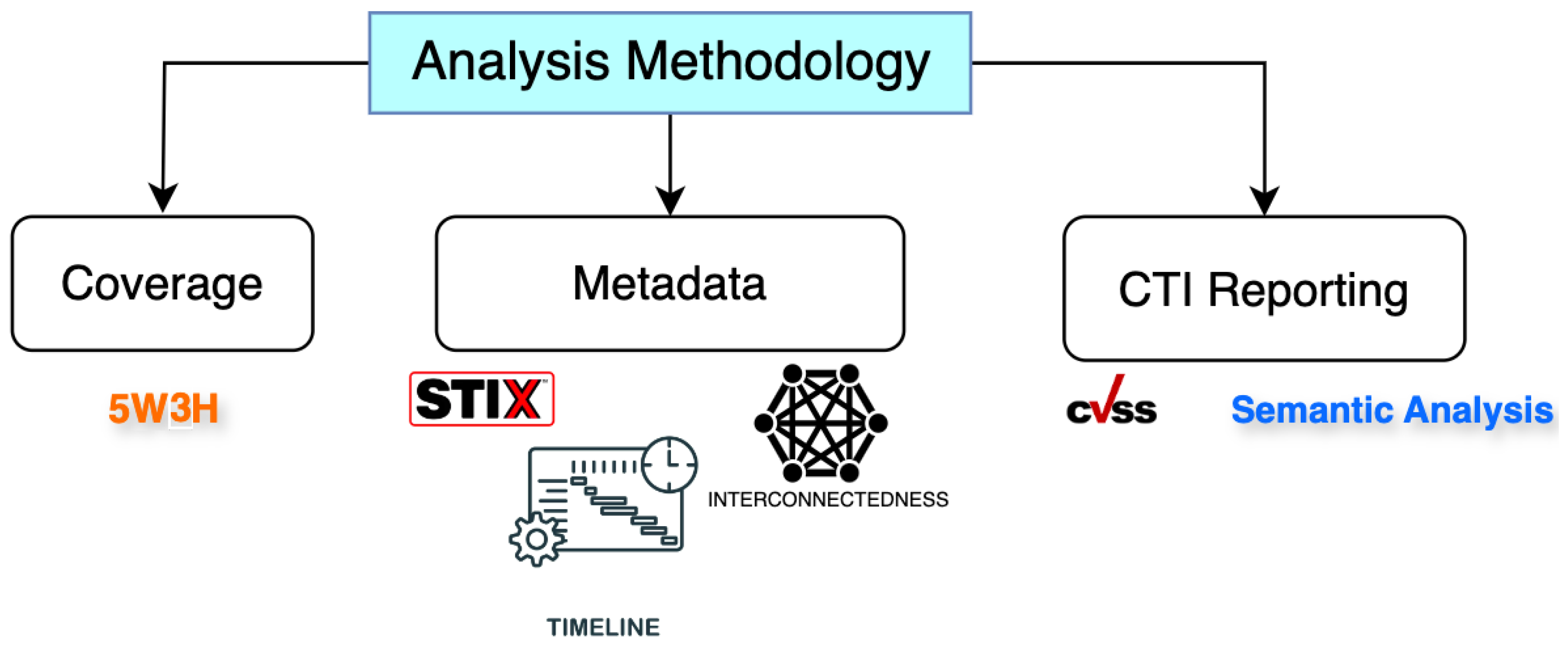
- Detailed Analysis: Evaluating the data along specific dimensions. These dimensions are (a) coverage of intelligence, (b) metadata structure (including STIX compliance and cross-platform field mapping), and (c) the content of threat intelligence reports. Figure 2 illustrates the phases of this analysis pipeline.
4.1. Data Collection
4.1.1. Selection of Platforms
4.1.2. Data Collection Method
4.2. Preliminary Analysis
4.3. Detailed Analysis
4.3.1. Coverage of Intelligence
4.3.2. Metadata and STIX Structure Analysis
4.3.3. CTI Content Analysis
- Vulnerability and Attack Pattern Analysis: Using NVD CVE entries, we examine the distribution of attack vectors and how it relates to the attack severity. This helps identify the predominant attack vectors in IoT vulnerabilities and whether network-based issues tend to be rated more severe.
- Semantic Analysis of Threat Descriptions: We scan the free-text fields of the commercial platform for the presence of standard threat keywords. The objective is to see to what extent the content of reports uses common threat terminology that could be leveraged by NLP for automated classification. If a platform extensively uses standardized terms in descriptions, this could be very useful for ML models to parse those descriptions. We specifically look for keywords from STIX’s open vocabulary (https://docs.oasis-open.org/cti/stix/v2.1/csprd02/stix-v2.1-csprd02.pdf, accessed on 17 November, 2025) and count their frequency. This semantic check complements the structural analysis by checking if the intelligence is not just structurally standardized, but also speaking a “common language” of threats. Further analysis of how NLP techniques can be leveraged to enrich CTI objects is beyond the scope of this paper and is thus left for future work.
5. Results
5.1. Intelligence Coverage Analysis
5.1.1. Commercial Platform
5.1.2. Public Platforms
5.2. Analyzing Metadata of Data Objects
5.2.1. Adherence to STIX 2.1 Structure
- Comm.: Of the STIX fields that are in the data object type, we measure the percentage of fields that fall under the “common properties” as defined by the STIX 2.1 structure.
- Required: For the fields that are adopted from the STIX 2.1 structure, we determine the percentage of required fields as per the STIX standard.
- Optional: Similar to the “Required” column, for the fields that are adopted from the STIX 2.1 structure, we measure the percentage of optional fields as per the STIX standard. Both optional and required complement each other, and thus the sum of both in any given row will always be 100.
5.2.2. Distribution of Classes of Data Objects in the Commercial Platform
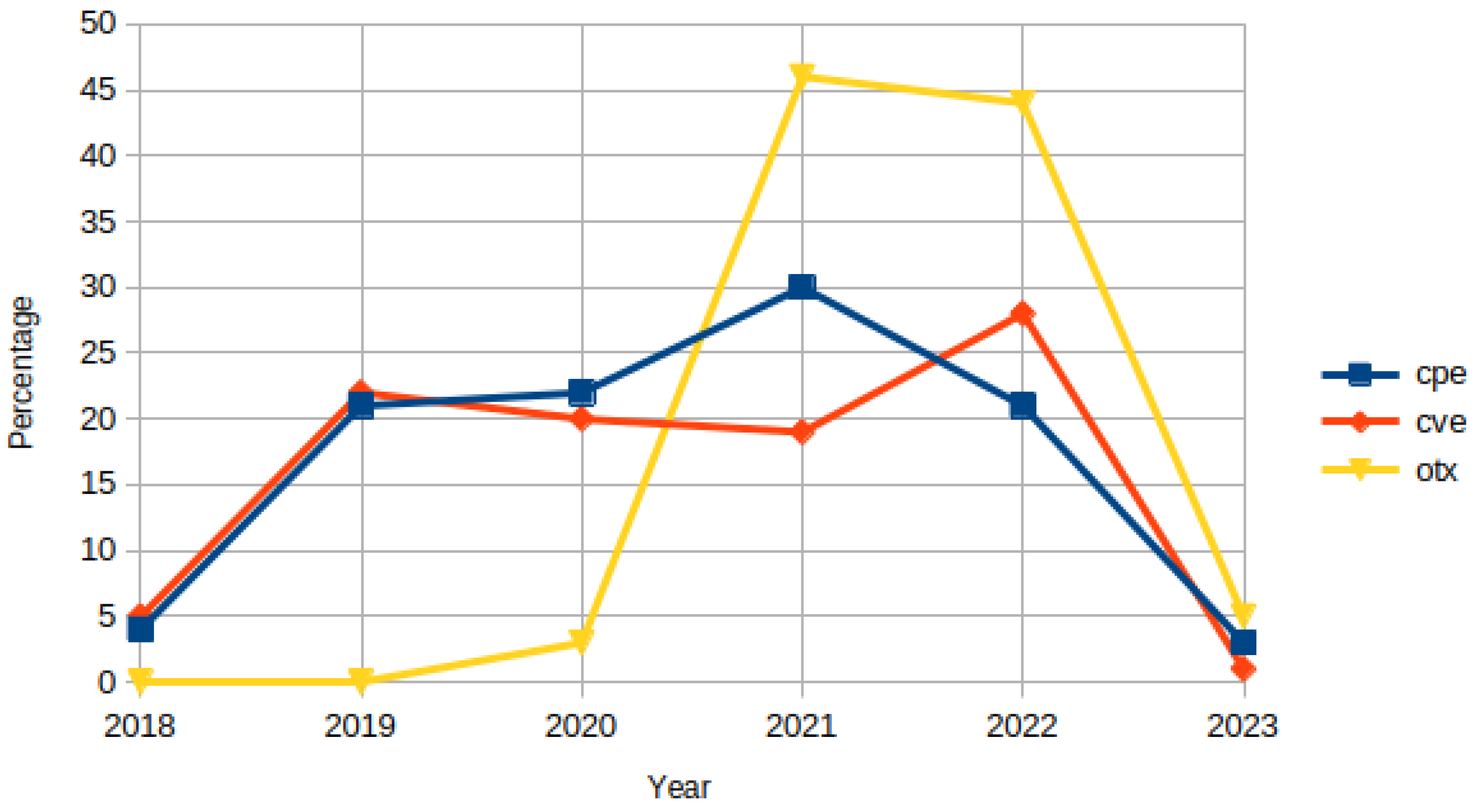
5.2.3. Timeline of IoT and Smart Home Threat Intelligence
5.2.4. Interconnectedness Between Fields Across Platforms
5.3. Analyzing CTI Reporting
5.3.1. Vulnerability Analysis in IoT and Smart Home Devices
5.3.2. Semantic Analysis of Commercial Platform Fields for STIX 2.1 Keywords
- malware_type;
- indicator_type;
- malware_result_type;
- infrastructure_type;
- report_type;
- malware_capabilities;
- grouping;
- tool_type.
6. Discussion
6.1. Quality of CTI Data and Implications for ML/DL Systems
6.2. Interoperability, Correlation, and Data Fusion
6.3. Actionability and Timeliness
6.4. Support for DL and AI in CTI
6.5. Practical Recommendations
- If structured data with completeness are needed, OTX is a strong candidate, especially given that it is free. It gives a standardized feed that covers the 5W3H of incidents well. However, practitioners should be aware that it is community data. Thus, it might include a mix of very relevant and some less relevant information. Also, it often lacks deeper analysis as it mostly provides raw indicators. Yet, these indicators can be enriched with CTI from other sources.
- NVD’s CVE/CPE feed is an essential complement for anything vulnerability-related in IoT. In a proactive defense system, linking threat intelligence about attacks to the known vulnerabilities on one’s devices is crucial. We suggest always including CVE data in the CTI mix for IoT security programs. The good news is that NVD data is consistently structured (though not STIX), and our analysis shows that it can connect to other intel via CVE IDs.
- Focus on network-threat detection: Since most IoT threats use network vectors and show high severity, investing in network traffic analysis with CTI matching is worthwhile. If one is developing a DL-based IDS for IoT, integrating CTI that highlights network indicators (like malicious IPs or domains from OTX pulses) can improve detection of inbound attacks. Our findings support approaches like that of Lin et al. [8], which integrates CTI lookups with an IDS model. Given that CTI can tell when an IP is associated with known IoT malware, the IDS can be more confident in flagging that traffic.
6.6. Limitations
- Given that our collection was in the thousands, we could not verify the resulting objects of our collection manually. Any limitations within the querying processes of the platforms automatically propagate to our work. We only relied on the fact that the platforms enabled the capability to search using keywords. However, our visual review of randomly selected data objects aimed to minimize the noise by making sure that the objects were relevant.
- Our data collection relied solely on keyword searches (“IoT” and “Smart Home”), which may not have captured all relevant CTI. It is possible that some IoT-related threats were described without those keywords and thus were missed. This means that our dataset might not be exhaustive. However, we sought to mitigate this limitation by using two keywords to ensure the results were indeed IoT-related. The inclusion of “Smart Home” (a specific phrase) likely improved precision at the cost of possibly missing generic IoT mentions. Future work could expand the keyword set (e.g., include specific IoT device names or protocol names) to cast a wider net.
- We used the free/public version of the commercial platform. Commercial CTI platforms often have premium data or features we could not access. For example, OTX has only community data, and a paid threat feed might have more consistent semantic labeling. We cannot generalize our results to all CTI platforms or even the full capacities of the ones studied. What we did was establish a baseline for publicly available data. It is possible that the paid versions use STIX more “lazily” or more fully; e.g., Ramsdale et al. [26] talk about “laziness” in using STIX fields correctly, which we did observe to an extent. This point remains open and organizations evaluating CTI should consider that internal formats might differ.
- We did not deeply verify the correctness of every data object. For example, OTX pulses are user-contributed and could contain mistakes. Our assumption was that any noise (like irrelevant hits or erroneous data) is minimal relative to the large dataset (>6K objects). Indeed, we noted a few odd entries (e.g., a CVE from 1998 that probably matched “IoT” as a string in some description erroneously). These very few (pre-2017) CVEs were <3% of CVEs we pulled, so they likely do not impact trends much.
- With a total of 90 fields among the three types of data objects, our cross-platform field equivalence analysis might have missed some relationships. We identified overlaps manually. There could be other relationships that are more subtle, and thus we were unable to capture them. A thorough automated correlation that is based on values (using hash matching or URL matching across datasets) could reveal more interconnections. We leave that level of correlation analysis to future work, as it requires a different approach.
7. Conclusions and Future Work
Author Contributions
Funding
Institutional Review Board Statement
Informed Consent Statement
Data Availability Statement
Conflicts of Interest
References
- What is the Internet of Things? Definition and Explanation. Available online: https://www.kaspersky.com/resource-center/definitions/what-is-iot (accessed on 4 September 2023).
- Internet of Things (IoT) Market Advancements Driving Smart Connectivity Solutions. Available online: https://www.precedenceresearch.com/internet-of-things-market (accessed on 28 October 2025).
- Number of Internet of Things (IoT) Connections Worldwide from 2022 to 2023, with Forecasts from 2024 to 2033. Available online: https://www.statista.com/statistics/1183457/iot-connected-devices-worldwide/ (accessed on 28 August 2024).
- Top 10 IoT Device Vulnerabilities to Enhance IoT Security. Available online: https://www.hostduplex.com/blog/top-iot-device-vulnerabilities/ (accessed on 28 August 2024).
- Sasi, T.; Lashkari, A.H.; Lu, R.; Xiong, P.; Iqbal, S. A comprehensive survey on IoT attacks: Taxonomy, detection mechanisms and challenges. J. Inf. Intell. 2024, 2, 455–513. [Google Scholar] [CrossRef]
- MID-YEAR UPDATE 2023 SonicWall Cyber Threat Report. Available online: https://www.loophold.com/mid-year-2023-cyber-threat-report-sonicwall/ (accessed on 29 August 2024).
- Introduction to STIX. Available online: https://oasis-open.github.io/cti-documentation/stix/intro (accessed on 7 October 2023).
- Lin, Y.D.; Lu, Y.H.; Hwang, R.H.; Lai, Y.C.; Sudyana, D.; Lee, W.B. Evolving ML-based Intrusion Detection: Cyber Threat Intelligence for Dynamic Model Updates. IEEE Trans. Mach. Learn. Commun. Netw. 2025, 3, 605–622. [Google Scholar] [CrossRef]
- Abraham, C.; Bélanger, F.; Daultrey, S. Promoting research on cyber threat intelligence sharing in ecosystems. J. Cybersecur. 2025, 11, tyaf016. [Google Scholar] [CrossRef]
- The 2023 IOT Security Landscape Report. Available online: https://www.bitdefender.com/files/News/CaseStudies/study/429/2023-IoT-Security-Landscape-Report.pdf (accessed on 28 August 2024).
- Overview of IoT Threats in 2023. Available online: https://securelist.com/iot-threat-report-2023/110644/ (accessed on 28 August 2024).
- Roberts, A. Cyber Threat Intelligence: The No-Nonsense Guide for Cisos and Security Managers; Springer: Berlin/Heidelberg, Germany, 2021. [Google Scholar]
- Barnum, S. Standardizing cyber threat intelligence information with the structured threat information expression (stix). Mitre Corp. 2012, 11, 1–22. [Google Scholar]
- STIX and CybOX Parser Data Mappings. Available online: https://knowledge.threatconnect.com/docs/stix-and-cybox-parser-data-mappings (accessed on 29 August 2024).
- Anomali. Available online: https://www.anomali.com/products/threatstream (accessed on 29 August 2024).
- AutoFocus API STIX Support. Available online: https://docs.paloaltonetworks.com/autofocus/autofocus-api/about-the-autofocus-api/autofocus-api-stix-support (accessed on 29 August 2024).
- Our Journey to Support STIX 2.1. Available online: https://blog.eclecticiq.com/our-journey-to-support-stix-2.1 (accessed on 29 August 2024).
- Ring, T. Threat intelligence: Why people don’t share. Comput. Fraud Secur. 2014, 2014, 5–9. [Google Scholar] [CrossRef]
- Ponemon Institute and Norse, July 2013. Available online: https://web.archive.org/web/20160401134059/https://pages.ipvenger.com/PonemonImpactReport_LP.html (accessed on 9 November 2025).
- Sauerwein, C.; Sillaber, C.; Mussmann, A.; Breu, R. Threat Intelligence Sharing Platforms: An Exploratory Study of Software Vendors and Research Perspectives. Proceedings der 13; Internationalen Tagung Wirtschaftsinformatik: St. Gallen, Switzerland, 2017; pp. 837–851. [Google Scholar]
- A White Paper on the Key Challenges in Cyber Threat Intelligence: Explaining the “See It, Sense It, Share It, Use It” Approach to Thinking About Cyber Intelligence. Available online: https://web.archive.org/web/20250326005710/https://www.odni.gov/files/NSP/Private_Sector/Feature/1-15-2020-Loretta_Dusek-ODNI_Key_Challenges_in_CTI_White_Paper_Unclass_FINAL-BW2.pdf (accessed on 9 November 2025).
- Tounsi, W.; Rais, H. A survey on technical threat intelligence in the age of sophisticated cyber attacks. Comput. Secur. 2018, 72, 212–233. [Google Scholar] [CrossRef]
- Schlette, D.; Böhm, F.; Caselli, M.; Pernul, G. Measuring and visualizing cyber threat intelligence quality. Int. J. Inf. Secur. 2021, 20, 21–38. [Google Scholar] [CrossRef]
- de Melo e Silva, A.; Costa Gondim, J.J.; de Oliveira Albuquerque, R.; García Villalba, L.J. A Methodology to Evaluate Standards and Platforms within Cyber Threat Intelligence. Future Internet 2020, 12, 108. [Google Scholar] [CrossRef]
- Rantos, K.; Spyros, A.; Papanikolaou, A.; Kritsas, A.; Ilioudis, C.; Katos, V. Interoperability challenges in the cybersecurity information sharing ecosystem. Computers 2020, 9, 18. [Google Scholar] [CrossRef]
- Ramsdale, A.; Shiaeles, S.; Kolokotronis, N. A comparative analysis of cyber-threat intelligence sources, formats and languages. Electronics 2020, 9, 824. [Google Scholar] [CrossRef]
- OpenCTI Documentation Space. Available online: https://docs.opencti.io/latest/ (accessed on 8 November 2025).
- ATT&CK Matrix for Enterprise. Available online: https://attack.mitre.org/ (accessed on 11 October 2023).
- Ampel, B.; Vahedi, T.; Samtani, S.; Chen, H. Mapping exploit code on paste sites to the mitre att&ck framework: A multi-label transformer approach. In Proceedings of the 2023 IEEE International Conference on Intelligence and Security Informatics (ISI), Charlotte, NC, USA, 2–3 October 2023; pp. 1–6. [Google Scholar]



| CTI Data Object | Count |
|---|---|
| OTX | 1180 |
| NVD CVE | 3776 |
| NVD CPE | 1250 |
| Question | Description |
|---|---|
| What | Directly describes the topic being addressed |
| Where | Specifies geographic references about the topic |
| When | Specifies relevant time frames to the topic like date and time |
| Who | Associates the topic with an entity capable of executing it |
| Why | Describes possible motivations for the occurrence of the topic |
| How | Describes the main characteristics and mechanisms of the topic |
| How much | Refers to the costs and impacts generated by the topic |
| How long | Description of the topic’s effectiveness in terms of time |
| Field | Value (%) |
|---|---|
| STIX 2.1 | 100 |
| Common | 42 |
| Required | 53 |
| Optional | 47 |
| Field Name by Platform | Classif | ||
|---|---|---|---|
| OTX | CVE | CPE | |
| Type | CVE_data_type | dataType | similar |
| Labels | CVE_Items.cve.references.reference_data.tags | similar | |
| Description | CVE_Items.cve.description.description_data.value | equiv. | |
| Created | CVE_Items.publishedDate | equiv. | |
| Modified | CVE_Items.lastModifiedDate | cpes.lastModifiedDate | equiv. |
| ATK | Severity CVSS V3 | Severity CVSS V2 | |||||||
|---|---|---|---|---|---|---|---|---|---|
| VEC. | % | CRTC | HIGH | MED | LOW | % | HIGH | MED | LOW |
| ADJ_ | 3.55 | 0 | 66.67 | 33.33 | 0 | 3.53 | 23.33 | 43.33 | 33.33 |
| NET. | |||||||||
| LOC. | 33.23 | 0 | 77.11 | 22.55 | 0.33 | 35.49 | 44.78 | 37.98 | 17.25 |
| NET. | 62.03 | 54.29 | 36.65 | 9.02 | 0.04 | 60.98 | 65.2 | 33.59 | 1.21 |
| PHYS | 1.18 | 0 | 0 | 100 | 0 | ||||
| Property | Keyword | Name | Description |
|---|---|---|---|
| grouping | malware analysis | - | - |
| indicator_type | anomalous activity | - | - |
| compromised | - | 9 | |
| malicious activity | - | 1 | |
| attribution | - | - | |
| infrastructure_type | amplification | - | - |
| botnet | 49 | 65 | |
| command-and-control | 1 | 6 | |
| command and control | 1 | 16 | |
| exfiltration | - | 1 | |
| phishing | 27 | 20 | |
| reconnaissance | - | - | |
| staging | - | 1 | |
| malware_capabilities | anti-debugging | - | - |
| anti-emulation | - | - | |
| anti-sandbox | - | - | |
| anti-vm | - | - | |
| evades av | - | - | |
| exfiltrates data | - | - | |
| malware_result_type | malicious | 31 | 36 |
| suspicious | 2 | 143 | |
| malware_type | adware | - | 10 |
| backdoor | 1 | 57 | |
| bot | 87 | 99 | |
| bootkit | - | - | |
| ddos | 9 | 34 | |
| downloader | 1 | 42 | |
| dropper | - | 54 | |
| exploit kit | - | 1 | |
| keylogger | - | 1 | |
| ransomware | 9 | 10 | |
| remote access trojan | - | - | |
| rootkit | - | 6 | |
| screen capture | - | - | |
| spyware | 1 | 1 | |
| trojan | 4 | 99 | |
| virus | 5 | 23 | |
| webshell | - | 3 | |
| web shell | - | - | |
| wiper | 1 | 1 | |
| worm | 3 | 17 | |
| report_type | attack pattern | - | - |
| campaign | 8 | 10 | |
| identity | - | 1 | |
| indicator | 5 | 8 | |
| malware | 88 | 145 | |
| observed data | - | - | |
| threat-actor | - | - | |
| threat actor | 3 | 18 | |
| tool | - | 21 | |
| vulnerability | 9 | 19 | |
| threat-report | - | - | |
| tool_type | denial-of-service | - | 8 |
| denial of service | - | 1 | |
| exploitation | 3 | 7 | |
| information gathering | - | - | |
| remote access | - | 8 | |
| vulnerability scanning | - | - |
Disclaimer/Publisher’s Note: The statements, opinions and data contained in all publications are solely those of the individual author(s) and contributor(s) and not of MDPI and/or the editor(s). MDPI and/or the editor(s) disclaim responsibility for any injury to people or property resulting from any ideas, methods, instructions or products referred to in the content. |
© 2025 by the authors. Licensee MDPI, Basel, Switzerland. This article is an open access article distributed under the terms and conditions of the Creative Commons Attribution (CC BY) license (https://creativecommons.org/licenses/by/4.0/).
Share and Cite
Rashed, M.; Viso, I.T.-D.; González-Tablas, A.I. A Comparison of Cyber Intelligence Platforms in the Context of IoT Devices and Smart Homes. Electronics 2025, 14, 4503. https://doi.org/10.3390/electronics14224503
Rashed M, Viso IT-D, González-Tablas AI. A Comparison of Cyber Intelligence Platforms in the Context of IoT Devices and Smart Homes. Electronics. 2025; 14(22):4503. https://doi.org/10.3390/electronics14224503
Chicago/Turabian StyleRashed, Mohammed, Iván Torrejón-Del Viso, and Ana I. González-Tablas. 2025. "A Comparison of Cyber Intelligence Platforms in the Context of IoT Devices and Smart Homes" Electronics 14, no. 22: 4503. https://doi.org/10.3390/electronics14224503
APA StyleRashed, M., Viso, I. T.-D., & González-Tablas, A. I. (2025). A Comparison of Cyber Intelligence Platforms in the Context of IoT Devices and Smart Homes. Electronics, 14(22), 4503. https://doi.org/10.3390/electronics14224503