Synergism of Fuzzy Leaky Bucket with Virtual Buffer for Large Scale Social Driven Energy Allocation in Emergencies in Smart City Zones


Abstract
1. Introduction
2. Related Work on Smart City Zones
3. Socially Driven Energy Allocation Approach
3.1. Problem Statement
3.2. Leaky Bucket
3.3. Fuzzy Leaky Bucket and Energy Virtual Buffer
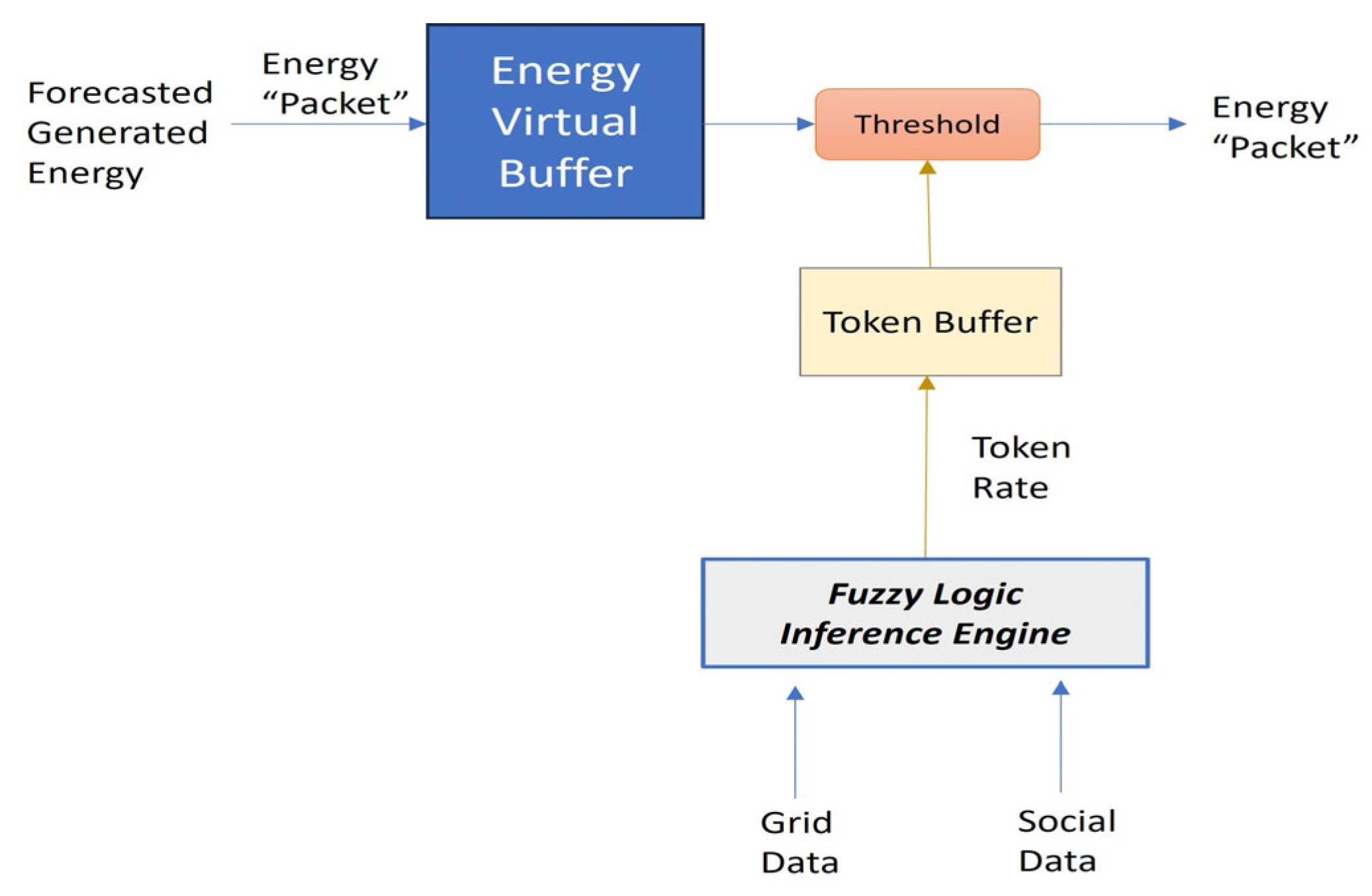
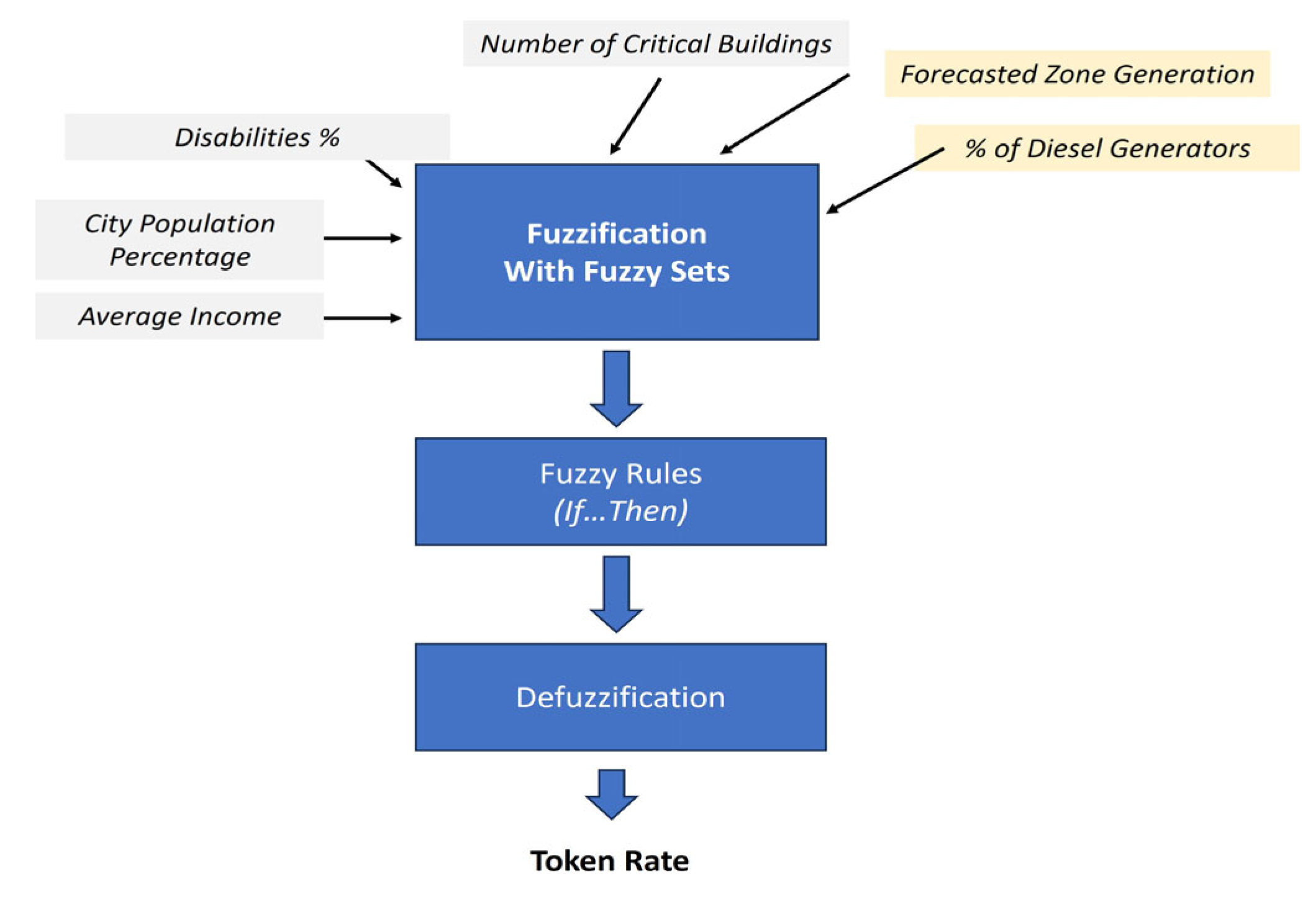
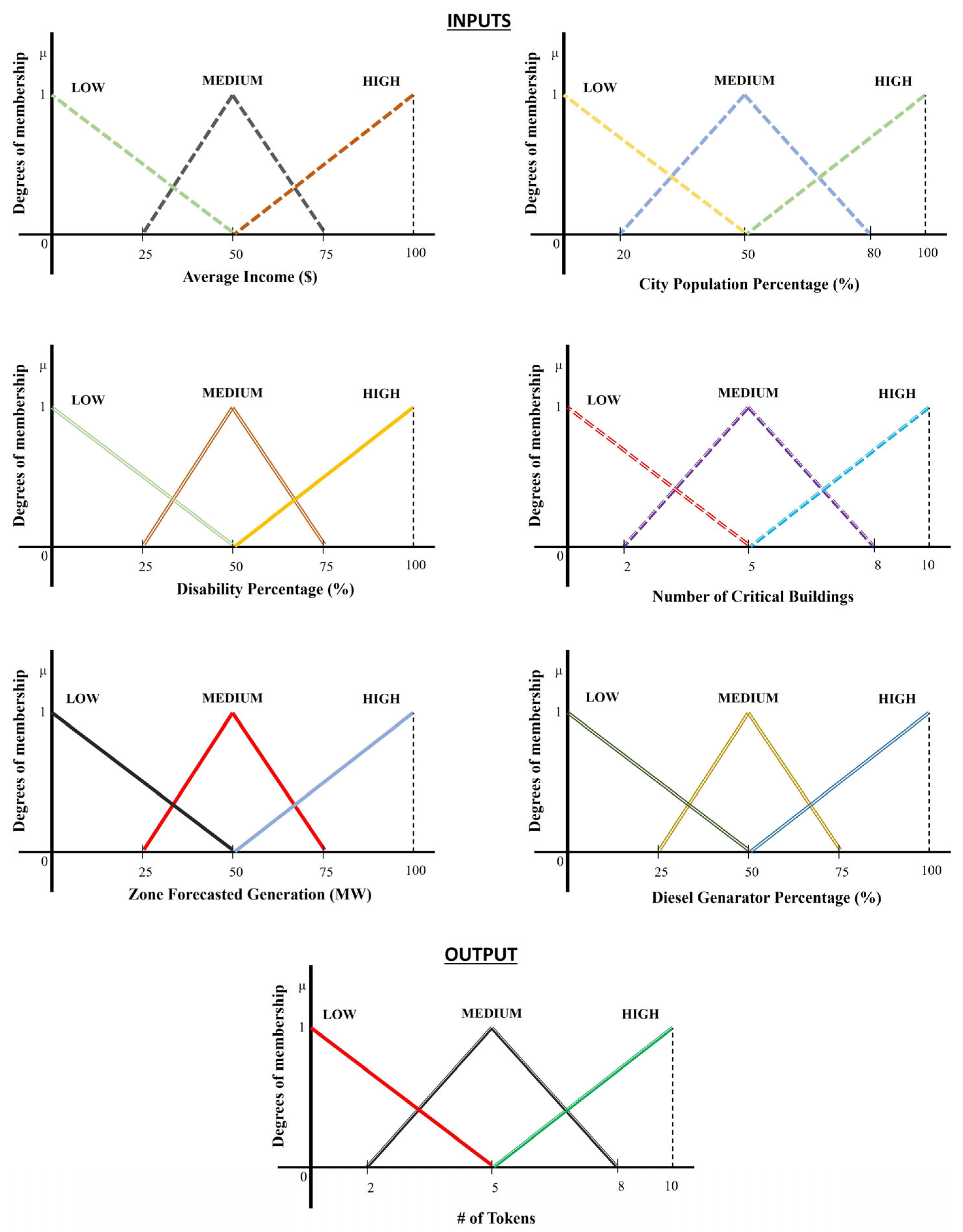
- Average Income (Social): This social variable reflects the average wealth of the zone’s citizens. It helps gauge the economic status of a zone, with “non-wealthy” zones potentially requiring more energy compared to affluent zones, which may rely on individual generators like diesel generators.
- City Population Percentage (Social): This variable indicates the percentage population density of the zone as the ratio of zone’s population residing within the geographical area of the zone.
- Disability Percentage (Social): This variable represents the percentage of the zone’s population officially registered as disabled. It supports zones with citizens with declared disabilities, considering their vulnerability and potential need for energy to operate essential equipment and instruments.
- Number of Critical Buildings (Social): This variable denotes the count of critical buildings within the zone. Critical buildings may include hospitals, airports, and schools, among others.
- Zone Forecasted Generation (Energy): This variable signifies the forecasted generation within the zone from its resources, such as renewables.
- Percentage of Diesel Generators (Energy): This variable indicates the percentage of zone residents who possess secondary electricity generation using diesel generators. Diesel generators can serve as auxiliary suppliers, operating independently of the main power grid or microgrid.
- Token Number (Output Variable): This variable represents the token number determined by the fuzzy system.
- –
- “Income,” refers to Average Income (Social)
- –
- “Population,” refers to City Population Percentage (Social)
- –
- “Disability,” refers to Disability Percentage (Social)
- –
- “Building,” refers to Number of Critical Buildings (Social)
- –
- “Forecast,” refers to Zone Forecasted Generation (Energy)
- –
- “Diesel,” refers to Percentage of Diesel Generators (Energy)
- –
- “Tokens” refers to Token Number (Output Variable)
- The available energy for the next hour is placed in the virtual buffer.
- Zones are organized in a first-in-first-out (FIFO) structure, with the sequence of zones selected randomly.
- The available buffered energy is divided into a set of energy packets, with the number of packets determined by the system operator.
- The fuzzy leaky bucket is invoked, and the number of tokens is obtained for the first zone in the FIFO.
- The number of tokens is compared with a predetermined threshold T.
- If the number of tokens is below the threshold, no energy packet is released.
- If the number of tokens is above the threshold, one energy packet is released.
- If the number of tokens is above 2*T, then 2 energy packets are released.
- If the number of tokens is above N*T, then N energy packets are released.
- The zone is then removed from the list, and the next zone is selected.
- The process returns to step 4.
- Steps 4-11 are repeated for all zones until no energy packets remain or all zones have been allocated energy packets.
- If there are residual energy packets—i.e., all zones have been processed but there is still available energy—then the remaining packets are distributed uniformly among all zones.
4. Test Results
4.1. Simulation Setup
4.2. Results
5. Conclusions
Author Contributions
Funding
Data Availability Statement
Conflicts of Interest
References
- Taha, W.M.; Taha, A.E.M.; Thunberg, J. Cyber-Physical Systems: A Model-Based Approach; Springer Nature: Berlin/Heidelberg, Germany, 2021; p. 187. [Google Scholar]
- Silva, B.N.; Khan, M.; Han, K. Towards sustainable smart cities: A review of trends, architectures, components, and open challenges in smart cities. Sustain. Cities Soc. 2018, 38, 697–713. [Google Scholar] [CrossRef] [Scilit]
- Alamaniotis, M. Challenges and AI-Based Solutions for Smart Energy Consumption in Smart Cities. In Advances in Artificial Intelligence-Based Technologies: Selected Papers in Honour of Professor Nikolaos G. Bourbakis; Tsihrintzis, G., Virvou, M., Tsoukalas, L., Esposito, A., Jain, L., Eds.; Springer: Berlin/Heidelberg, Germany, 2022; Volume 1, pp. 111–124. [Google Scholar]
- Hussain, S.S.; Nadeem, F.; Aftab, M.A.; Ali, I.; Ustun, T.S. The emerging energy internet: Architecture, benefits, challenges, and future prospects. Electronics 2019, 8, 1037. [Google Scholar] [CrossRef] [Scilit]
- Nasiakou, A. Next Generation Energy Markets and Applications. Ph.D. Thesis, University of Thessaly, Volos, Greece, 2020. [Google Scholar]
- Nasiakou, A.; Alamaniotis, M.; Tsoukalas, L.H.; Karagiannis, G. A three-stage scheme for consumers’ partitioning using hierarchical clustering algorithm. In Proceedings of the 8th International Conference on Information, Intelligence, Systems & Applications (IISA), Larnaca, Cyprus,, 27–30 August 2017. [Google Scholar]
- Farmanbar, M.; Parham, K.; Arild, Ø.; Rong, C. A widespread review of smart grids towards smart cities. Energies 2019, 12, 4484. [Google Scholar] [CrossRef] [Scilit]
- Doss-Gollin, J.; Farnham, D.J.; Lall, U.; Modi, V. How unprecedented was the February 2021 Texas cold snap? Environ. Res. Lett. 2021, 16, 064056. [Google Scholar] [CrossRef] [Scilit]
- Kazerani, M.; Tehrani, K. Grid of Hybrid AC/DC Microgrids: A New Paradigm for Smart City of Tomorrow. In Proceedings of the IEEE 15th International Conference of System of Systems Engineering (SoSE), Budapest, Hungary, 2–4 June 2020. [Google Scholar]
- Casalicchio, V.; Manzolini, G.; Prina, M.G.; Moser, D. Optimal Allocation Method for a Fair Distribution of the Benefits in an Energy Community. Sol. RRL 2022, 6, 2100473. [Google Scholar] [CrossRef] [Scilit]
- Alamaniotis, M. Morphing to the mean approach of anticipated electricity demand in smart city partitions using citizen elasticities. In Proceedings of the 2018 IEEE International Smart Cities Conference (ISC2), Kansas City, MO, USA, 16–19 September 2018. [Google Scholar]
- Alamaniotis, M.; Gatsis, N. Evolutionary multi-objective cost and privacy driven load morphing in smart electricity grid partition. Energies 2019, 12, 2470. [Google Scholar] [CrossRef] [Scilit]
- Alamaniotis, M.; Bourbakis, N.; Tsoukalas, L.H. Enhancing privacy of electricity consumption in smart cities through morphing of anticipated demand pattern utilizing self-elasticity and genetic algorithms. Sustain. Cities Soc. 2019, 46, 101426. [Google Scholar] [CrossRef] [Scilit]
- Deakin, M.; Reid, A. Smart cities: Under-gridding the sustainability of city-districts as energy efficient-low carbon zones. J. Clean. Prod. 2018, 173, 39–48. [Google Scholar] [CrossRef] [Scilit]
- Papastamatiou, I.; Marinakis, V.; Doukas, H.; Psarras, J. A decision support framework for smart cities energy assessment and optimization. Energy Procedia 2017, 111, 800–809. [Google Scholar] [CrossRef] [Scilit]
- Alamaniotis, M.; Tsoukalas, L.H.; Bourbakis, N. Virtual cost approach: Electricity consumption scheduling for smart grids/cities in price-directed electricity markets. In Proceedings of the 5th International Conference on Information, Intelligence, Systems and Applications, Chania, Greece, 7–9 July 2014. [Google Scholar]
- Velinov, E.; Petrenko, Y.; Vechkinzova, E.; Denisov, I.; Ochoa Siguencia, L.; Gródek-Szostak, Z. “Leaky Bucket” of Kazakhstan’s Power Grid: Losses and Inefficient Distribution of Electric Power. Energies 2020, 13, 2947. [Google Scholar] [CrossRef] [Scilit]
- Gerla, G. Fuzzy Logic: Mathematical Tools for Approximate Reasoning; Springer Science & Business Media: Berlin/Heidelberg, Germany, 2013; Volume 11. [Google Scholar]
- Gao, R.; Tsoukalas, L.H. Implementing virtual buffer for electric power grids. In Computational Science–ICCS 2007: 7th International Conference, Beijing, China, 27–30 May 2007, Proceedings, Part I 7; Springer: Berlin/Heidelberg, Germany, 2007; pp. 1083–1089. [Google Scholar]
- Chen, X.; Leung, K.C.; Lam, A.Y. Leaky bucket-inspired power output smoothing with load-adaptive algorithm. In Proceedings of the 2017 IEEE International Conference on Communications (ICC), Paris, France, 21–25 May 2017; pp. 1–6. [Google Scholar]
- O’dwyer, E.; Pan, I.; Acha, S.; Shah, N. Smart energy systems for sustainable smart cities: Current developments, trends and future directions. Appl. Energy 2019, 237, 581–597. [Google Scholar] [CrossRef] [Scilit]
- Zhao, C.; Zhao, J.; Wu, C.; Wang, X.; Xue, F.; Lu, S. Power grid partitioning based on functional community structure. IEEE Access 2019, 7, 152624–152634. [Google Scholar] [CrossRef] [Scilit]
- Nasiakou, A.; Alamaniotis, M.; Tsoukalas, L.H. Power Distribution Network Partitioning in Big Data Environment Using K-Means and Fuzzy Logic. In Proceedings of the 10th Mediterranean Conference on Power Generation, Transmission, Distribution and Energy Conversion (Med Power 2016), Belgrade, Serbia, 6–9 November 2016. [Google Scholar]
- Bertsekas, D.; Gallager, R. Data Networks; Athena Scientific: Nashua, NH, USA, 2021. [Google Scholar]
- Wang, D.; Zheng, K.; Chen, Q.; Li, Z.; Liu, S. Quantum annealing computing for grid partition in large-scale power systems. In Proceedings of the 2022 IEEE 5th International Electrical and Energy Conference (CIEEC), Nangjing, China, 27–29 May 2022; pp. 2004–2009. [Google Scholar]
- Li, Q.; Dai, S.; Li, X.; Li, W.; Sun, W. Graph Convolution Networks-Based Island Partition for Energy and Information Coupled Active Distribution Systems. In Proceedings of the 2021 IEEE International Conference on Communications, Control, and Computing Technologies for Smart Grids (SmartGridComm), Aachen, Germany, 25–28 October 2021; pp. 315–320. [Google Scholar]
- Wu, Q.; Xue, F.; Wang, X.; Lu, S.; Han, B.; Piao, L. Planning of Virtual Microgrids by Integrated Partition and DER Allocation. In Proceedings of the 2021 IEEE 5th Conference on Energy Internet and Energy System Integration (EI2), Taiyuan, China, 22–24 October 2021; pp. 66–71. [Google Scholar]
- Chen, J.; Sun, B.; Zeng, Y.; Jing, R.; Liang, G.; Huang, B. An Island Partition Method with Energy Storage Based on Genetic Algorithm. In Proceedings of the 2022 IEEE 6th Conference on Energy Internet and Energy System Integration (EI2), Chengdu, China, 11–13 November 2022; pp. 976–980. [Google Scholar]
- Zhao, J.; Zhu, J.; Jia, R.; Liu, S.; Ye, C. Method for Cluster Partition of Distributed Generation Considering Flexible Supply and Demand Balance and Response Speed. In Proceedings of the 2021 3rd International Conference on Smart Power & Internet Energy Systems (SPIES), Shanghai, China, 25–28 September 2021; pp. 35–38. [Google Scholar]
- Chen, J.; Sun, B.; Li, Y.; Jing, R.; Zeng, Y.; Li, M. An evaluation method of distributed generation credible capacity based on island partition. Energy Rep. 2022, 8, 11271–11287. [Google Scholar] [CrossRef] [Scilit]
- Wu, F.; Li, H.; Ma, X. An Island Partition Method for New Distribution Network. In Proceedings of the 2023 IEEE/IAS Industrial and Commercial Power System Asia (I&CPS Asia), Chongqing, China, 7–9 July 2023; pp. 877–882. [Google Scholar]
- Jay, D.; Shanti Swarup, K. Reactive Power and Network Partitioning. In Market Operation for Reactive Power Ancillary Service: Design and Analysis with GAMS Code; Springer Nature: Singapore, 2024; pp. 47–61. [Google Scholar]
- Wang, Z.; Ding, T.; Mu, C.; Huang, Y.; Yang, M.; Yang, Y.; Chen, Z.; Lin, Y.; Li, M. An ADMM-based power system partitioned black-start and parallel restoration method considering high-penetrated renewable energy. Int. J. Electr. Power Energy Syst. 2024, 155, 109532. [Google Scholar] [CrossRef] [Scilit]
- Li, J.; Fang, Z.; Wang, Q.; Zhang, M.; Li, Y.; Zhang, W. Optimal Operation with Dynamic Partitioning Strategy for Centralized Shared Energy Storage Station with Integration of Large-Scale Renewable Energy. J. Mod. Power Syst. Clean Energy 2024, 1–13. [Google Scholar]
- Parekh, A.K.; Gallager, R.G. A generalized processor sharing approach to flow control in integrated services networks: The multiple node case. IEEE/ACM Trans. Netw. 1994, 2, 137–150. [Google Scholar] [CrossRef] [Scilit]
- Cao, J.; Yang, M. Energy internet–Towards smart grid 2.0. In Proceedings of the 2013 Fourth International Conference on Networking and Distributed Computing, Los Angeles, CA, USA, 21–24 December 2013; pp. 105–110. [Google Scholar]
- Bergan, P.G.; Greiner, C.J. A new type of large scale thermal energy storage. Energy Procedia 2014, 58, 152–159. [Google Scholar] [CrossRef] [Scilit]
- Hameer, S.; van Niekerk, J.L. A review of large-scale electrical energy storage. Int. J. Energy Res. 2015, 39, 1179–1195. [Google Scholar] [CrossRef] [Scilit]
- Wade, N.S.; Taylor, P.C.; Lang, P.D.; Jones, P.R. Evaluating the benefits of an electrical energy storage system in a future smart grid. Energy Policy 2010, 38, 7180–7188. [Google Scholar] [CrossRef] [Scilit]
- Gelenbe, E.; Ceran, E.T. Energy packet networks with energy harvesting. IEEE Access 2016, 4, 1321–1331. [Google Scholar] [CrossRef] [Scilit]
- Gelenbe, E.; Zhang, Y. Performance optimization with energy packets. IEEE Syst. J. 2019, 13, 3770–3780. [Google Scholar] [CrossRef] [Scilit]
- Corzine, K.A. Energy packets enabling the energy internet. In Proceedings of the 2014 Clemson University Power Systems Conference, Clemson, SC, USA, 11–14 March 2014; pp. 1–5. [Google Scholar]
- Ray, P.P. Energy packet networks: An annotated bibliography. SN Comput. Sci. 2020, 1, 6. [Google Scholar] [CrossRef] [Scilit]
- Liu, P.; Zhang, X. A new hesitant fuzzy linguistic approach for multiple attribute decision making based on Dempster–Shafer evidence theory. Appl. Soft Comput. 2020, 86, 105897. [Google Scholar] [CrossRef] [Scilit]
- Adeel, A.; Akram, M.; Koam, A.N. Group decision-making based on m-polar fuzzy linguistic TOPSIS method. Symmetry 2019, 11, 735. [Google Scholar] [CrossRef] [Scilit]
- Seiti, H.; Hafezalkotob, A.; Herrera-Viedma, E. A novel linguistic approach for multi-granular information fusion and decision-making using risk-based linguistic D numbers. Inf. Sci. 2020, 530, 43–65. [Google Scholar] [CrossRef] [Scilit]
- Vashishtha, S.; Gupta, V.; Mittal, M. Sentiment analysis using fuzzy logic: A comprehensive literature review. Wiley Interdiscip. Rev. Data Min. Knowl. Discov. 2023, 13, e1509. [Google Scholar] [CrossRef] [Scilit]
- Alyasiry, A.M.; Forbes, M.; Bulmer, M. An exact algorithm for the pickup and delivery problem with time windows and last-in-first-out loading. Transp. Sci. 2019, 53, 1695–1705. [Google Scholar] [CrossRef] [Scilit]
- Anitha, P.; Vimala, H.S.; Shreyas, J. PQTBA: Priority Queue based Token Bucket Algorithm for congestion control in IoT network. In Proceedings of the 2023 IEEE 8th International Conference for Convergence in Technology (I2CT), Lonavla, India, 7–9 April 2023; pp. 1–7. [Google Scholar]
- Zhao, K.; Zhang, X.; Wang, H.; Gai, Y.; Wang, H. Allocation of Resources for Emergency Response to Coal-to-Oil Hazardous Chemical Accidents under Railway Transportation Mode. Sustainability 2022, 14, 16777. [Google Scholar] [CrossRef] [Scilit]
- Cvetković, D.; Nešović, A.; Terzić, I. Impact of people’s behavior on the energy sustainability of the residential sector in emergency situations caused by COVID-19. Energy Build. 2021, 230, 110532. [Google Scholar] [CrossRef] [Scilit]
- Nygard, K.E.; Ghosn, S.B.; Chowdhury, M.M.; Loegering, D.; McCulloch, R.; Ranganathan, P. Optimization models for energy reallocation in a smart grid. In Proceedings of the 2011 IEEE Conference on Computer Communications Workshops (INFOCOM WKSHPS), Shanghai, China, 10–15 April 2011; pp. 186–190. [Google Scholar]
- Poudel, S.; Dubey, A. Critical load restoration using distributed energy resources for resilient power distribution system. IEEE Trans. Power Syst. 2018, 34, 52–63. [Google Scholar] [CrossRef] [Scilit]
- Saroj, A.; Roy, S.; Guin, A.; Hunter, M.; Fujimoto, R. Smart city real-time data-driven transportation simulation. In Proceedings of the 2018 Winter Simulation Conference (WSC), Gothenburg, Sweden, 9–12 December 2018; pp. 857–868. [Google Scholar]
- Adil, S.H.; Abd Aziz, A.; Akber, T.; Ebrahim, M.; Ali, S.S.A.; Raza, K. 3D smart city simulator. In Proceedings of the 2017 IEEE 3rd International Symposium in Robotics and Manufacturing Automation (ROMA), Kuala Lumpur, Malaysia, 19–21 September 2017; pp. 1–5. [Google Scholar]
- Del Esposte, A.D.M.; Santana, E.F.; Kanashiro, L.; Costa, F.M.; Braghetto, K.R.; Lago, N.; Kon, F. Design and evaluation of a scalable smart city software platform with large-scale simulations. Future Gener. Comput. Syst. 2019, 93, 427–441. [Google Scholar] [CrossRef] [Scilit]
- Dong, S.; Ma, M.; Feng, L. A smart city simulation platform with uncertainty. In Proceedings of the ACM/IEEE 12th International Conference on Cyber-Physical Systems, Nashville, TN, USA, 19–21 May 2021; pp. 229–230. [Google Scholar]
- Yamagata, Y.; Seya, H. Simulating a future smart city: An integrated land use-energy model. Appl. Energy 2013, 112, 1466–1474. [Google Scholar] [CrossRef] [Scilit]
- Vázquez-Canteli, J.R.; Ulyanin, S.; Kämpf, J.; Nagy, Z. Fusing TensorFlow with building energy simulation for intelligent energy management in smart cities. Sustain. Cities Soc. 2019, 45, 243–257. [Google Scholar] [CrossRef] [Scilit]




|
|
|
|
|
|
|
|
|
|
|
|
|
|
|
|
|
|
|
|
|
|
|
|
|
|
|
|
|
|
|
|
|
|
|
|
|
|
|
|
|
|
|
|
|
|
|
|
|
|
|
|
|
|
|
|
|
|
|
|
|
|
| Zone # | Average Income | City Population Percentage | Disability Percentage | Number of Critical Buildings | Zone Forecasted Generation | Percentage of Diesel Generators |
|---|---|---|---|---|---|---|
| Scenario 1 [available Energy: 117.4632 MW] | ||||||
| Zone 1 | 39.8896 | 26.8124 | 83.2513 | 9.9537 | 64.9751 | 70.3953 |
| Zone 2 | 93.2303 | 68.7653 | 56.8354 | 3.8085 | 63.4579 | 36.3229 |
| Zone 3 | 40.7619 | 36.87 | 46.8399 | 5.0341 | 91.0536 | 20.6431 |
| Zone 4 | 33.8604 | 57.4126 | 48.6932 | 2.6222 | 57.9593 | 87.8328 |
| Zone 5 | 6.095 | 44.0876 | 8.4258 | 5.6324 | 53.9311 | 76.8058 |
| Zone 6 | 23.309 | 58.7362 | 45.8974 | 8.6098 | 66.0836 | 35.3879 |
| Zone 7 | 34.7186 | 25.3718 | 95.2528 | 2.982 | 15.8406 | 36.1297 |
| Zone 8 | 74.1629 | 70.59 | 70.0892 | 0.0623 | 37.4346 | 90.1496 |
| Zone 9 | 31.8345 | 59.7083 | 29.7795 | 1.2501 | 38.8356 | 81.7688 |
| Zone 10 | 98.1176 | 86.199 | 8.3821 | 3.3771 | 23.6129 | 31.7805 |
| Scenario 2 [available Energy: 482.1283 MW] | ||||||
| Zone 1 | 67.1151 | 29.9175 | 53.1127 | 0.0146 | 88.3789 | 40.4384 |
| Zone 2 | 30.1206 | 95.0582 | 46.0648 | 2.8765 | 8.4627 | 58.2181 |
| Zone 3 | 15.3069 | 7.3094 | 58.0565 | 2.8701 | 36.192 | 72.4825 |
| Zone 4 | 85.8312 | 34.7916 | 96.1746 | 9.5357 | 20.6037 | 76.8245 |
| Zone 5 | 61.5532 | 91.8922 | 60.2537 | 7.0214 | 74.3675 | 38.5102 |
| Zone 6 | 25.1504 | 3.676 | 47.2123 | 6.4507 | 27.897 | 51.7861 |
| Zone 7 | 24.5667 | 29.7508 | 65.0474 | 8.9139 | 86.1106 | 20.9915 |
| Zone 8 | 39.9094 | 88.7883 | 25.6528 | 9.668 | 61.9157 | 16.5346 |
| Zone 9 | 82.6199 | 65.5693 | 54.6453 | 2.5133 | 4.0156 | 23.3375 |
| Zone 10 | 36.1113 | 63.3455 | 98.6098 | 2.0716 | 75.7084 | 88.6328 |
| Scenario 3 [available Energy: 236.1149 MW] | ||||||
| Zone 1 | 15.8914 | 81.0921 | 47.6508 | 1.1629 | 87.5721 | 63.5186 |
| Zone 2 | 9.7281 | 90.8439 | 3.5016 | 0.3975 | 98.8568 | 68.6182 |
| Zone 3 | 37.6689 | 50.4324 | 76.3496 | 0.4887 | 72.5928 | 70.1328 |
| Zone 4 | 45.8891 | 58.2295 | 33.909 | 1.7063 | 39.9193 | 91.9777 |
| Zone 5 | 22.6045 | 36.1007 | 32.4562 | 0.8358 | 51.2666 | 83.2865 |
| Zone 6 | 90.4613 | 72.3596 | 38.2996 | 2.9802 | 69.1712 | 88.0457 |
| Zone 7 | 92.4548 | 8.1253 | 48.2673 | 1.2827 | 25.2911 | 88.3962 |
| Zone 8 | 19.6277 | 12.1354 | 54.3695 | 3.1462 | 38.2041 | 79.1539 |
| Zone 9 | 83.9179 | 68.0236 | 41.6922 | 6.4289 | 21.4081 | 61.7271 |
| Zone 10 | 67.5191 | 60.1023 | 34.631 | 3.644 | 17.1481 | 79.5362 |
| Scenario 4 [available Energy: 246.3335 MW] | ||||||
| Zone 1 | 35.4623 | 77.5061 | 23.6805 | 8.4483 | 81.6527 | 84.6228 |
| Zone 2 | 37.0187 | 38.323 | 86.1335 | 4.6391 | 57.0548 | 69.5307 |
| Zone 3 | 96.0917 | 54.6313 | 63.6577 | 5.7089 | 92.7112 | 86.3766 |
| Zone 4 | 16.9839 | 17.8699 | 24.3504 | 7.5178 | 19.9134 | 98.2941 |
| Zone 5 | 70.9639 | 17.5436 | 85.8297 | 9.0941 | 96.1663 | 57.06 |
| Zone 6 | 56.2879 | 17.6661 | 51.3679 | 5.4847 | 16.5277 | 49.3893 |
| Zone 7 | 53.5117 | 19.8807 | 62.3169 | 0.2632 | 31.8791 | 53.3 |
| Zone 8 | 32.6774 | 60.219 | 36.1933 | 1.3492 | 91.3814 | 64.0559 |
| Zone 9 | 65.8774 | 67.533 | 74.4558 | 8.4218 | 51.6657 | 15.1869 |
| Zone 10 | 38.0664 | 82.1019 | 17.1364 | 3.2998 | 96.6472 | 80.6293 |
| Scenario 5 [available Energy: 426.6855MW] | ||||||
| Zone 1 | 39.8118 | 11.5494 | 8.0281 | 3.6047 | 82.8906 | 21.461 |
| Zone 2 | 79.104 | 65.4688 | 2.6146 | 7.8578 | 92.2563 | 49.2313 |
| Zone 3 | 83.4012 | 13.1354 | 75.9783 | 9.2574 | 83.2708 | 25.9401 |
| Zone 4 | 21.3022 | 52.2315 | 39.7357 | 4.7911 | 99.3904 | 60.4478 |
| Zone 5 | 94.4909 | 49.0442 | 43.7947 | 7.7266 | 74.4067 | 44.2904 |
| Zone 6 | 5.3 | 8.7822 | 79.7986 | 6.5558 | 3.2336 | 55.7067 |
| Zone 7 | 71.9802 | 11.0408 | 21.6647 | 8.1102 | 13.8662 | 88.1899 |
| Zone 8 | 92.3556 | 1.2756 | 37.7159 | 1.6781 | 54.0223 | 10.1662 |
| Zone 9 | 3.9268 | 93.3229 | 97.1592 | 3.6093 | 64.4205 | 6.7947 |
| Zone 10 | 20.7912 | 3.9604 | 46.9359 | 1.501 | 99.1307 | 42.7062 |
| Scenario 6 [available Energy: 330.8675MW] | ||||||
| Zone 1 | 60.2773 | 47.3818 | 35.6256 | 4.7558 | 67.1022 | 95.9645 |
| Zone 2 | 8.9084 | 79.7742 | 59.0776 | 9.122 | 10.1129 | 29.3295 |
| Zone 3 | 5.1588 | 50.4128 | 76.8376 | 2.8299 | 22.536 | 33.129 |
| Zone 4 | 45.3251 | 73.7385 | 50.9886 | 3.8251 | 90.5483 | 96.5258 |
| Zone 5 | 62.8267 | 13.2031 | 61.8302 | 3.8302 | 99.1194 | 28.6827 |
| Zone 6 | 70.6191 | 53.5206 | 19.3211 | 6.8944 | 5.0455 | 18.4434 |
| Zone 7 | 4.5658 | 88.5042 | 83.9794 | 1.1816 | 41.0415 | 12.0229 |
| Zone 8 | 57.2093 | 94.939 | 25.6385 | 9.8987 | 34.9808 | 20.8522 |
| Zone 9 | 66.5827 | 97.3345 | 62.27 | 0.6354 | 37.351 | 16.6252 |
| Zone 10 | 23.1278 | 5.2209 | 90.1756 | 7.9329 | 37.3014 | 83.2055 |
| Scenario 7 [available Energy: 171.4019 MW] | ||||||
| Zone 1 | 61.8806 | 45.3021 | 1.0163 | 5.9908 | 60.1568 | 64.9417 |
| Zone 2 | 34.2721 | 49.3299 | 70.1774 | 8.8780 | 5.5058 | 9.8362 |
| Zone 3 | 64.9783 | 76.4071 | 98.7959 | 1.2532 | 36.4477 | 67.6230 |
| Zone 4 | 37.5758 | 86.3458 | 29.1977 | 1.3347 | 67.2651 | 20.2585 |
| Zone 5 | 86.8515 | 75.1157 | 41.9380 | 0.0023 | 14.9464 | 27.3834 |
| Zone 6 | 87.2425 | 60.1251 | 32.1188 | 2.8429 | 43.5316 | 90.3759 |
| Zone 7 | 92.5106 | 50.5292 | 62.7582 | 7.1926 | 2.3913 | 57.4933 |
| Zone 8 | 4.6534 | 42.2531 | 46.7734 | 0.2263 | 6.5074 | 92.3956 |
| Zone 9 | 53.4143 | 36.6796 | 36.3946 | 1.5137 | 14.9609 | 35.0802 |
| Zone 10 | 33.5966 | 78.4028 | 48.6739 | 4.6480 | 13.1253 | 88.6391 |
| Scenario 8 [available Energy: 203.2368 MW] | ||||||
| Zone 1 | 95.1807 | 91.1985 | 95.1414 | 3.4600 | 29.0244 | 88.6701 |
| Zone 2 | 21.0031 | 13.0877 | 52.0516 | 9.0546 | 40.2530 | 21.5761 |
| Zone 3 | 7.8739 | 93.3060 | 60.2872 | 3.7749 | 66.4931 | 79.2190 |
| Zone 4 | 33.3492 | 69.2659 | 20.3816 | 9.5871 | 71.1832 | 16.6907 |
| Zone 5 | 44.2777 | 63.2994 | 92.9967 | 5.2933 | 62.6474 | 68.0819 |
| Zone 6 | 92.3198 | 15.2834 | 40.5721 | 3.1248 | 69.3899 | 89.0688 |
| Zone 7 | 49.0671 | 80.5824 | 32.6439 | 5.4988 | 38.8784 | 89.6829 |
| Zone 8 | 67.6120 | 82.8397 | 11.0089 | 2.7923 | 76.7636 | 21.6057 |
| Zone 9 | 3.4062 | 43.6552 | 93.6864 | 2.6209 | 56.9745 | 35.9553 |
| Zone 10 | 2.6839 | 50.0419 | 82.7015 | 2.5898 | 4.5885 | 24.6472 |
| Scenario 9 [available Energy: 31.0735 MW] | ||||||
| Zone 1 | 70.1843 | 8.6482 | 61.6787 | 1.7377 | 65.1401 | 49.8696 |
| Zone 2 | 28.4511 | 83.056 | 81.836 | 9.3817 | 0.0326 | 64.0389 |
| Zone 3 | 0.7356 | 10.6421 | 10.6794 | 3.6711 | 23.9608 | 34.614 |
| Zone 4 | 24.962 | 38.7064 | 42.1038 | 6.4008 | 78.7553 | 26.9994 |
| Zone 5 | 84.3982 | 74.0468 | 82.6102 | 1.8219 | 6.5436 | 61.035 |
| Zone 6 | 70.1553 | 11.1618 | 9.5824 | 5.9783 | 81.2233 | 81.4578 |
| Zone 7 | 8.9437 | 73.1279 | 90.3857 | 4.5223 | 7.0688 | 24.1278 |
| Zone 8 | 73.1865 | 4.0492 | 42.4523 | 5.4022 | 95.3828 | 20.8906 |
| Zone 9 | 11.6332 | 64.622 | 10.8411 | 9.835 | 24.8344 | 60.6356 |
| Zone 10 | 81.6695 | 83.0054 | 48.9039 | 7.6073 | 91.5108 | 90.0975 |
| Scenario 10 [available Energy: 107.1188 MW] | ||||||
| Zone 1 | 54.7061 | 78.4709 | 19.4441 | 7.4689 | 47.5558 | 58.3259 |
| Zone 2 | 26.0548 | 8.4822 | 29.8133 | 9.1713 | 47.0518 | 26.9468 |
| Zone 3 | 76.297 | 77.2172 | 2.13 | 8.7999 | 79.817 | 32.4165 |
| Zone 4 | 66.9044 | 29.6294 | 92.9952 | 2.8196 | 16.888 | 74.5167 |
| Zone 5 | 47.7134 | 65.3445 | 96.6576 | 3.1303 | 7.6439 | 79.1415 |
| Zone 6 | 36.5384 | 58.5099 | 18.3337 | 0.7692 | 15.3663 | 82.6876 |
| Zone 7 | 30.0957 | 38.3884 | 65.0749 | 8.1737 | 76.6266 | 37.4176 |
| Zone 8 | 18.9862 | 64.6502 | 0.3605 | 2.8289 | 63.8601 | 59.2075 |
| Zone 9 | 32.5289 | 98.8951 | 12.3236 | 7.3588 | 15.6617 | 43.4647 |
| Zone 10 | 83.2243 | 35.991 | 7.6238 | 5.5693 | 27.393 | 13.2055 |
Disclaimer/Publisher’s Note: The statements, opinions and data contained in all publications are solely those of the individual author(s) and contributor(s) and not of MDPI and/or the editor(s). MDPI and/or the editor(s) disclaim responsibility for any injury to people or property resulting from any ideas, methods, instructions or products referred to in the content. |
© 2024 by the authors. Licensee MDPI, Basel, Switzerland. This article is an open access article distributed under the terms and conditions of the Creative Commons Attribution (CC BY) license (https://creativecommons.org/licenses/by/4.0/).
Share and Cite
Alamaniotis, M.; Alexiou, M. Synergism of Fuzzy Leaky Bucket with Virtual Buffer for Large Scale Social Driven Energy Allocation in Emergencies in Smart City Zones. Electronics 2024, 13, 762. https://doi.org/10.3390/electronics13040762
Alamaniotis M, Alexiou M. Synergism of Fuzzy Leaky Bucket with Virtual Buffer for Large Scale Social Driven Energy Allocation in Emergencies in Smart City Zones. Electronics. 2024; 13(4):762. https://doi.org/10.3390/electronics13040762
Chicago/Turabian StyleAlamaniotis, Miltiadis, and Michail Alexiou. 2024. "Synergism of Fuzzy Leaky Bucket with Virtual Buffer for Large Scale Social Driven Energy Allocation in Emergencies in Smart City Zones" Electronics 13, no. 4: 762. https://doi.org/10.3390/electronics13040762
APA StyleAlamaniotis, M., & Alexiou, M. (2024). Synergism of Fuzzy Leaky Bucket with Virtual Buffer for Large Scale Social Driven Energy Allocation in Emergencies in Smart City Zones. Electronics, 13(4), 762. https://doi.org/10.3390/electronics13040762