Skip to Content
ElectronicsElectronics
  • Article
  • Open Access

2 July 2024

Fast Screening Algorithm for Satellites Based on Multi-Constellation System

and
School of Mechanical Engineering, Nanjing University of Science and Technology, Nanjing 210094, China
*
Author to whom correspondence should be addressed.

Abstract

This paper proposes a fast satellite screening algorithm aimed at the problem of balancing between positioning accuracy and system computing efficiency in a multi-constellation system environment under the Global Navigation Satellite System (GNSS). The algorithm constructs an observation model based on a positioning error for the larger number of satellites under a multi-constellation. The space region is divided based on elevation and azimuth angles to implement the screening algorithm for the solution of the point to be determined. An analysis of the experimental data shows that the average GDOP value of this scheme is 1.835, and the position error of the point to be determined is controlled within 2.5 m when the cut-off altitude angle is 5° and the screening ratio is more than 70%.

1. Introduction

The successful launch of the last BeiDou-3 satellite in 2020 marked a new addition to the group of global satellite navigation systems in the world, which now are the Global Positioning System (GPS) of the United States, the BeiDou Navigation Satellite System (BDS) of China, the Galileo Satellite Navigation System of the European Union, and the GLONASS system of Russia. At the same time, due to the combination of multi-satellite systems, the number of visible stars at the same epoch moment has gradually increased from 6~10 to nearly 40 [1]. However, the redundancy of navigation information caused by too much observation information does not significantly increase the positioning accuracy, and instead, the large amount of data put a great burden on the receiver system and may even cause a lag in the positioning solution results.
Therefore, a satellite selection method with the ability to identify and eliminate faulty stars under a multi-constellation system and provide optimal navigation constellations is particularly important. The satellite selection method mainly accomplishes two tasks: The first part is to detect the coarseness in the observation information and then exclude the faulty stars, i.e., the screening algorithm. The main goal of this part is to ensure that the faulty stars will not participate in the localization as far as possible and, at the same time, to reduce the amount of computation. The second part is to select the suboptimal observation constellations among the remaining satellites after screening, i.e., the star selection algorithm. The goal of this part is to select a combination of better-configured satellites in the remaining constellations to significantly reduce the computational burden on the computer while ensuring that the positioning accuracy remains within acceptable limits [2].
Among them, reference [3] proposes a satellite screening called the user equivalent range error (UERE) model that takes into account multiple types of errors. The system computation elapsed time for a single-calendar element has been significantly reduced, which greatly improves the real-time performance of the positioning system, but the increase in the geometric dilution of precision (GDOP) value is also more pronounced, and the positioning error is larger. Considering that different satellites are located in different spatial positions, the ranging error has some differences [4]. Considering the heteroskedasticity of satellite pseudo-range measurement errors on the basis of the least squares (LS) method, the screening probability of faulty satellites is further improved by using the weighted least squares (WLS) algorithm. Reference [5] proposes a satellite selection method using the minimum GDOP combined Walker configuration, which maintains the GDOP value better, but the requirements for the receiver location are more demanding and only applicable to the mid-latitude region. Using the symmetric positive definiteness of the measurement matrix, reference [6] proposes a GDOP solution based on the UT decomposition of the matrix to solve the problem of large computation and poor numerical stability in the matrix inversion process in the star selection process of GDOP. Liang Z. and Hanfeng L. et al. [7] take the altitude angle as the starting point of star selection and categorize the visible stars into a high-elevation zone, middle-elevation zone, and low-elevation zone according to the altitude angle information. Through the combination verification, it is concluded that the optimal combination is mainly concentrated in the high-elevation angle region and low-elevation angle region and the number ratio is close to 1:3.
In summary, based on the analysis of GDOP value of a multi-system, combined navigation system, this paper proposes a fast star selection algorithm based on multi-threshold optimization, which judges, analyzes, and screens for the elevation angle, direction angle, and satellite carrier-to-noise ratio and selects a suitable navigation constellation. In order to ensure that the loss of GDOP value is within the acceptable range of the user, at the same time, the real-time performance of the positioning system is greatly improved, and the algorithm is verified by the real test through the sports car experiment.

2. Analysis of Satellite Selection Algorithms in Satellite Positioning System

2.1. Single-Point Position in Multi-Constellation Satellite Position System

For a pseudo-range single-point positioning system with a single constellation, if N satellites are observed at a certain epoch, the pseudo-range observation equation for any one of these satellites can be expressed as
( x ( i ) x u ) 2 + ( y ( i ) y u ) 2 + ( z ( i ) z u ) 2 + c Δ t u c δ t + T ( i ) + I ( i ) = ρ c ( i )
where ( x ( i ) , y ( i ) , z ( i ) ) denotes the positions of the i t h satellite in the Earth-centered Earth-fixed (ECEF) coordinate system; ρ c ( i ) denotes the pseudo-range observation value of the i t h satellite; c Δ t u and c δ t denote the satellite and the receiver clock offset; T ( i ) and I ( i ) denote the tropospheric and the ionospheric delay [8]; and ( x u , y u , z u ) denotes the coordinates of the receiver. To solve the receiver coordinates and receiver clock offset, it is necessary to linearize the system of quadratic nonlinear equations. After linearization, the Equation (1) could be rewritten as
r 1 r 2 r 3 r N = l 1 m 1 n 1 1 l 2 m 1 n 1 1 l 3 m 3 n 3 1 l N m N n N 1 Δ x u Δ y u Δ z u c Δ t u
where r i denotes the geometric pseudo-distance value between the satellite and the target receiver. ( l , m , n ) denotes the direction cosines of the vector from the receiver to the satellite in the ( x , y , z ) directions. Δ x u Δ y u , and Δ z u denote the deviations of the true and estimated values of the target receiver in the X , Y , and Z directions.
We defined the navigation observation matrix as
G = l 1 m 1 n 1 1 l 2 m 2 n 2 1 l N m N n N 1
The positioning accuracy of a satellite navigation system depends on two factors: the measurement accuracy between the user and the satellite and the geometric distribution determined by the spatial constellation configuration [9]. Generally, the quality is assessed by the geometric dilution of precision (GDOP) value. A smaller GDOP value indicates a higher positioning accuracy. The GDOP value can be obtained through the weight matrix formed by the navigation observation matrix, as follows:
G D O P = t r a c e ( G T G ) 1
And the geometric accuracy factor after introducing the weighting of the pseudo-range measurement error variance can be expressed as
G D O P w = t r a c e ( G T W G ) 1
where W denotes the matrix of coefficients representing the weights of the individual satellite positioning errors.
For a single-constellation satellite position system, the calculation of the GDOP value usually does not impose a significant computational burden on the positioning system. Assuming that at an observation epoch, the receiver observes eight GPS satellites and selects m ( m 4 ) of them to perform a weighted least squares positioning calculation, only the C 8 m × 2 matrix multiplication and C 8 m matrix inversion operations are required to obtain the optimal constellation configuration for single-point positioning. Therefore, for a single constellation satellite navigation system, the star selection method of traversing through GDOP values is usually feasible and effective.

2.2. GDOP Values for Multi-System Satellite Position System

In a multi-constellation satellite positioning system affected by the different time bases between systems, it is necessary to consider adding clock biases between the different systems as state variables when forming the navigation observation matrix G [10]. Taking the GPS/BDS/Galileo three-system satellite positioning system as an example, if a set of M BDS satellites and a set of N Galileo satellites are added, the navigation observation matrix G is modified as follows:
l 1 m 1 n 1 1 0 0 l N m N n N 1 0 0 l N + 1 m N + 1 n N + 1 0 1 0 l N + M m N + M n N + M 0 1 0 l N + M + 1 m N + M + 1 n N + M + 1 0 0 1 l N + M + O m N + M + O n N + M + O 0 0 1
At this point, the number of columns in the observation matrix has reached six. With the addition of the BDS and Galileo satellites, the number of observable satellites will significantly increase. Assuming that at a certain epoch, a total of 22 GPS/BDS/Galileo satellites are observed simultaneously, and due to the introduction of clock bias, the number of unknowns in the linearized pseudo-range observation equations reaches six. Therefore, at least six visible satellites need to be selected for positioning. The optimal GDOP value selection method needs to carry out the C 22 m ( m 6 ) times of the GDOP value operation in order to obtain better satellite spatial configurations. If we continue to improve the positioning accuracy by invoking the weighted least squares solver, a total of C 22 m × 2 matrix multiplications and C 22 m inversion operations are required in this calendar element to complete the star selection.
It can be seen that with the increase in the number of satellite systems and satellites, both the number of columns in the observation matrix and the number of satellites increase exponentially. The traditional GDOP-based satellite selection method, which calculates the minimum GDOP value based on permutations and combinations, takes too much system computation time during the satellite selection process. Therefore, the traditional optimal GDOP-based satellite selection method is not suitable for multi-constellation single-point positioning.

3. Fast Satellite Screening Algorithm Based on Multi-Threshold Optimization

In order to control the complexity of positioning settlement in multi-system positioning system, it is necessary to optimize for multi-system satellites. Firstly, the faulty stars are eliminated to ensure the positioning accuracy, and the sub-optimal constellations are selected to compress the number of permutation combinations, which ultimately achieves the purpose of maintaining the positioning accuracy while reducing the amount of computation.

3.1. Satellite Elevation Angle and Carrier-to-Noise Ratio Modeling

In the signal transmission process from the satellite to the receiver, the measurement pseudo-range of low-elevation-angle satellites has a large error caused by, for example, ionospheric error, tropospheric error, and multipath effect, so its ranging accuracy is also lower, and is prone to pseudo-range outliers [11]. Therefore, it is necessary to exclude such satellites by setting a satellite screening threshold based on the elevation angle.
Ionospheric refraction is closely related to factors such as signal frequency, time of observation, and location. If ionospheric errors are not corrected or eliminated, the accuracy of the observation results will be seriously affected. The approximate expression for phase propagation in the ionosphere is
n G = 1 + c 2 f 2
where f is the signal frequency, c 2 is an estimated coefficient, whose estimated value is c 2 = 40.28 N e Hz 2 , and N e is the electron density. Then, Equation (8) is corrected as
n G = 1 + 40.28 N e f 2
Pseudo-range propagation velocity in the ionosphere is
V G = c n G = c ( 1 40.28 N e f 2 )
The ionospheric delay correction can then be expressed as
( V i o n ) G = 40.28 f 2 s N e ds = 40.28 f 2 T E C
where T E C is the total electron content and its value is s N e ds , According to Equation (11), the ionospheric delay is determined by T E C . And the smaller the elevation angle of the satellite, the longer the propagation path of the satellite signal in the ionosphere and the larger the value of T E C .
For tropospheric delays, the Saastamoinen model is usually used for correction or exclusion. According to this model, the tropospheric delay can be divided into two parts, which can be expressed as
T h = 0.0022768 p 1.0 0.00266 cos ( 2 ϕ ) 0.00028 h × 10 3 × 1 cos z
T w = 0.0022768 ( 1255 T + 0.05 ) e × 1 cos z
where T h stands for hydrostatic delay and T w stands for wet delay. In the equation, p is the atmospheric pressure, h is the altitude, T is the atmospheric humidity, e is the water vapor pressure in the atmosphere, and z is the zenith angle. In the case of constant altitude, only z is a variable in Equations (12) and (13), and z can be expressed as
z = π 2 e l
where e l is the satellite elevation angle.
From the above, it can be seen that for low-elevation-angle satellites, due to the long propagation path distance of their satellite signals in the troposphere and ionosphere, it is easy to produce large measurement errors, and these satellites are regarded as ineffective satellites and need to be excluded. This paper adopted the mainstream masking angle standard, and selects the minimum masking angle of 5° for satellites.
Second, a carrier-to-noise ratio-based satellite screening threshold was set. Reference [12] pointed out that satellites in the elevation angle interval of 30~60° have a higher probability of being rejected by the GDOP value selection method, and there are more satellites with similar azimuth values in this interval. Therefore, the satellites with elevation angles in the range of 30~60° can be screened, and the satellites with excessive carrier-to-noise ratios can be eliminated without too much influence on the volume of the polyhedron composed of satellites and users, which ensures the positioning accuracy of the satellites after being screened out.

3.2. Modeling the Relationship between GDOP Values and Star Selection Ratios

According to the multi-constellation combination of the satellite guidance system for satellite selection before and after the GDOP value changes to determine the number of suboptimally distributed satellites, three systems, GPS/Galileo/BeiDou, were selected to establish a simulation platform based on ephemeris parameters and actual observations, and the elevation angle of the masking satellite is set to 5°. The relationship between the results of the optimal GDOP value selection method in Nanjing and the value of the ratio of the selected satellites p is shown in Table 1, and the observation time is a total of 2.5 h, the observation interval is 5 s, and the total number of observable ephemeris is 1800. The ratio p is the ratio of the total number of retained satellites m and the total number of observed satellites K . The GDOP value before and after selection is the GDOP value. ΔGDOP is the amount of loss of GDOP value before and after star selection.
Table 1. The relationship between GDOP value changes and satellite selection ratios.
It can be seen that the GDOP value of the multi-constellation positioning system increases with the decrease in the star selection ratio, but the two do not form a linear relationship [13] However, the GDOP value decreases less when the proportion of the selected stars is larger (≥70%), which does not cause much loss of positioning accuracy, whereas the GDOP value increases significantly when the proportion of the selected stars is lower than 70%. From this, it is conjectured that the GDOP value and the proportion of selected stars follow the negative exponential decay law [14]. The GDOP value star selection ratio model is assumed to be as follows:
GDOP = GDOP * k 1 e ( k 2 ) + k 3
where GDOP′ denotes the GDOP value after the star selection, k 1 , k 2 and k 3 are related to the number of visible stars of the navigation system, and the selected value is determined by a large number of a priori measured data. In this paper, the traditional minimum GDOP value selection method to traverse the simulation of the satellite data of multiple observation calendar elements within 3 h was used to analyze a large amount of data to obtain the GDOP value model as
GDOP K / 8.2 * e ( 0.2 K * p ( 1 0.178 p ) ) + 0.97
K is the total number of observable satellites, and p is the selection ratio. Users can use this model to determine the selection ratio by the number of satellites to optimize the positioning accuracy in real time. The star selection algorithm studied in the following section is affected by the observation time, and the star selection ratio is determined to be 70% on the premise of ensuring a small loss of positioning accuracy.

3.3. Fast Satellite Selection Algorithm Based on Spatial Zoning

For a GNSS positioning system consisting of S constellations, in order to satisfy the needs of positioning solution, at least n = 3 + S visible satellites are required. The accuracy of the GNSS positioning system can be expressed as
σ p = GDOP · σ U E R E
where σ p is the standard deviation of positioning accuracy and σ U E R E is the standard deviation of the user equivalent distance error.
It can be seen that the smaller the GDOP value, the higher the positioning accuracy. Therefore, combinations with smaller GDOP values should be selected as much as possible in the positioning solution. For the single-constellation weighted least squares system, when the visible star is four, the GDOP can be expressed as
GDOP = t r [ ( G T W G ) 1 ] = t r [ ( G T W G ) * ] G = A 6 V
where A = t r [ ( G T W G ) * ] and V denotes the volume of the tetrahedron formed by the endpoints of the unit vector from the satellite to the user, and the situation is similar when multidimensionality is used for positioning.
In a multi-constellation satellite positioning system, if the number of visible satellites N is very large, using the traditional optimal GDOP value selection algorithm, if the percentage of selected satellites is set to 70%, it is necessary to carry out C N 0.7 N times the GDOP value solution. The amount of computation is very large, so the positioning computational resources are very large, which is unacceptable for real-time users.
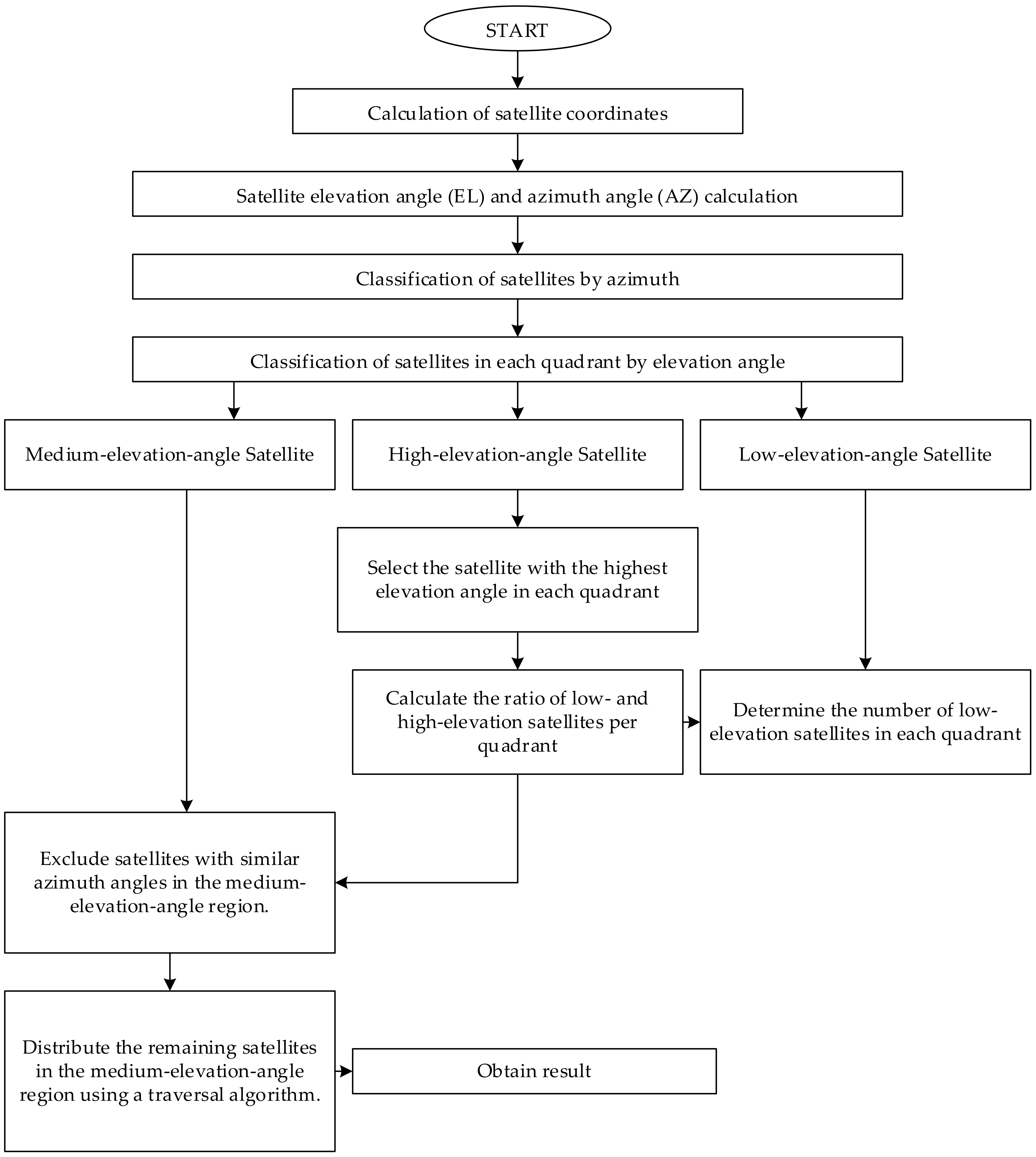
Thus, a fast satellite selection algorithm based on elevation and azimuthal angle division of space is proposed. In this satellite screening algorithm, the larger the selected top star altitude is, the more uniform the azimuthal distribution of the remaining low-altitude angle satellites is, and the smaller the obtained GDOP value [15]. The proposed algorithm can effectively reduce the redundant information involved in positioning, while ensuring the number of satellites, which have a wide range of application:
  • The elevation angles of visible stars are divided into three regions: 5~30°, 30~60°, and 60~90°,which are called the low-elevation-angle region, medium-elevation-angle-region, and high-elevation-angle region, respectively, and the number of satellites in the high-elevation-angle region and the low-elevation-angle region are calculated as k 1 , k 2 , and their ratios, so that we can obtain the distribution information of the elevation angles of the visible stars as a whole.
  • We determined the number of satellites in the low-elevation region based on the ratio of low-elevation and high-elevation satellites in each quadrant and distributed the remaining satellites evenly in different elevation quadrants [16]. The remaining satellites were evenly distributed in different elevation quadrants, and the remaining satellites were selected by the permutation algorithm.
  • With the satellite receiver as the center of the circle, the sky is divided into four quadrants according to the satellite azimuth angles as (0°,90°), (90°,180°), (180°,270°), and (270°,360°), and the satellite with the largest spatial elevation angle in each quadrant is selected as the first of four satellites in the star selection strategy. For the remaining visible stars, sorting is performed according to the azimuth angle, and the azimuth difference between the two satellites before and after is calculated in turn. If the azimuth angle of two satellites is too close, one of them is excluded based on the overall observable satellite elevation angle, and the other satellite information can largely ensure that the volume of the polyhedron composed of all satellites and receivers is kept as constant as possible.
The above satellite selection strategy takes into account both high- and low-elevation-angle satellites and achieves the basic unchanged spatial configuration of the original satellites. The selection of satellites with high-elevation-angles can supplement the altitude direction positioning information, and the selection of satellites with low-elevation-angles can supplement the horizontal plane direction information. The strategy flowchart of the algorithm is shown in Figure 1.
Figure 1. Flowchart of star selection algorithm.

4. Experimental Validation and Result Analysis

We built a multi-constellation positioning system based on C language containing three systems, GPS, BeiDou, and Galileo. We compared different satellite selection algorithms to verify the stability and feasibility of the proposed algorithm, and we evaluated the reduction in computational load of the navigation system when some GDOP values are lost.

4.1. GDOP Values of Fast Satellite Screening Algorithms

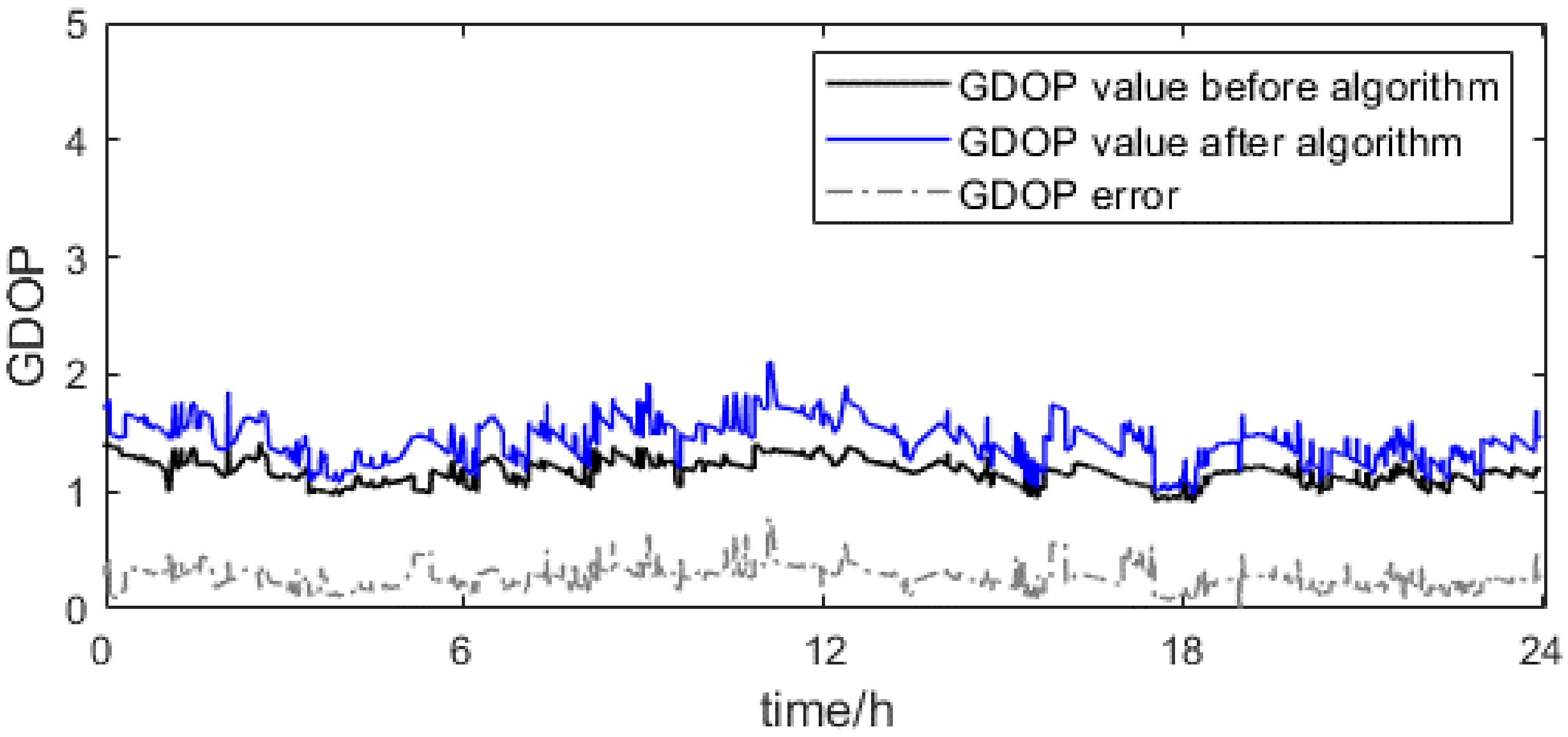
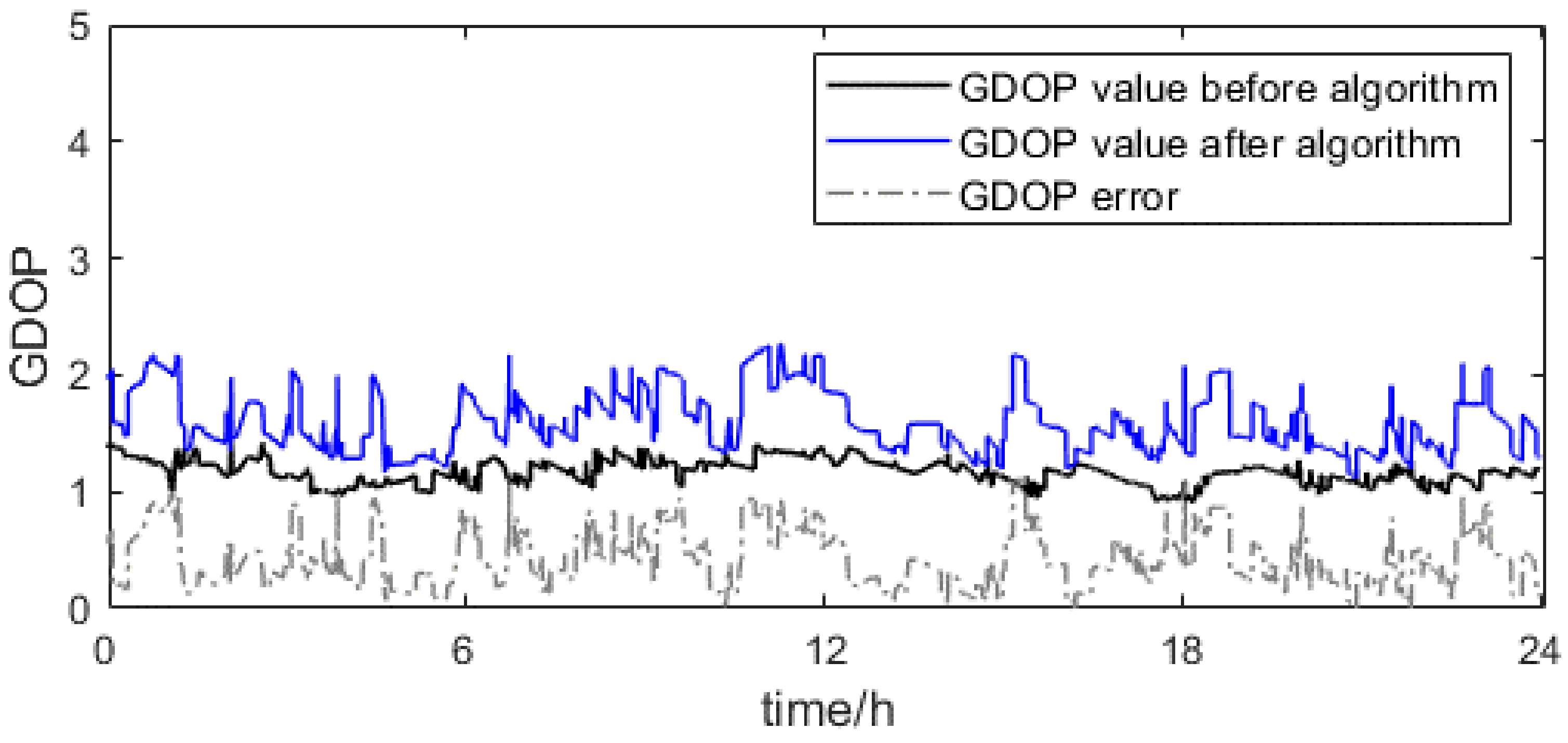
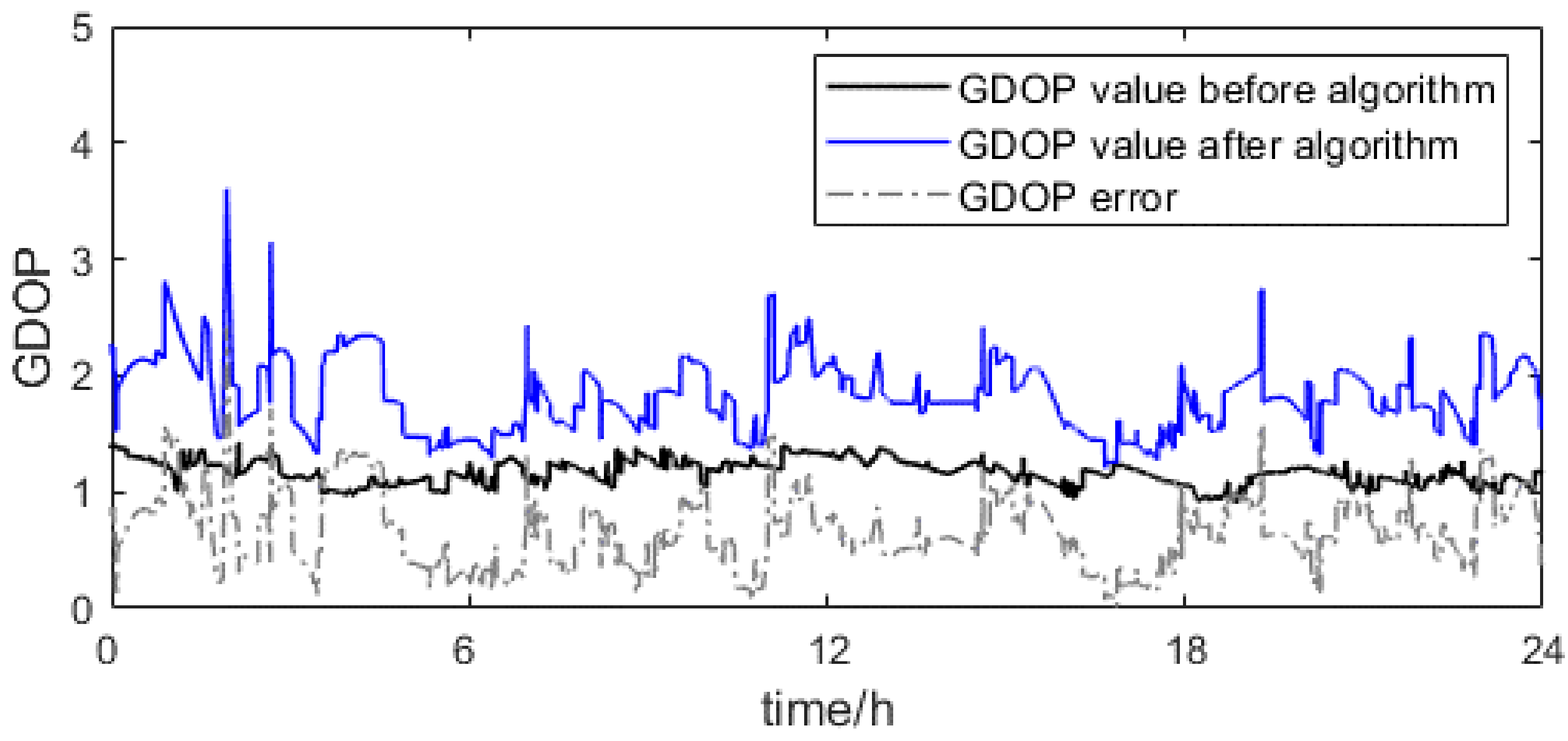
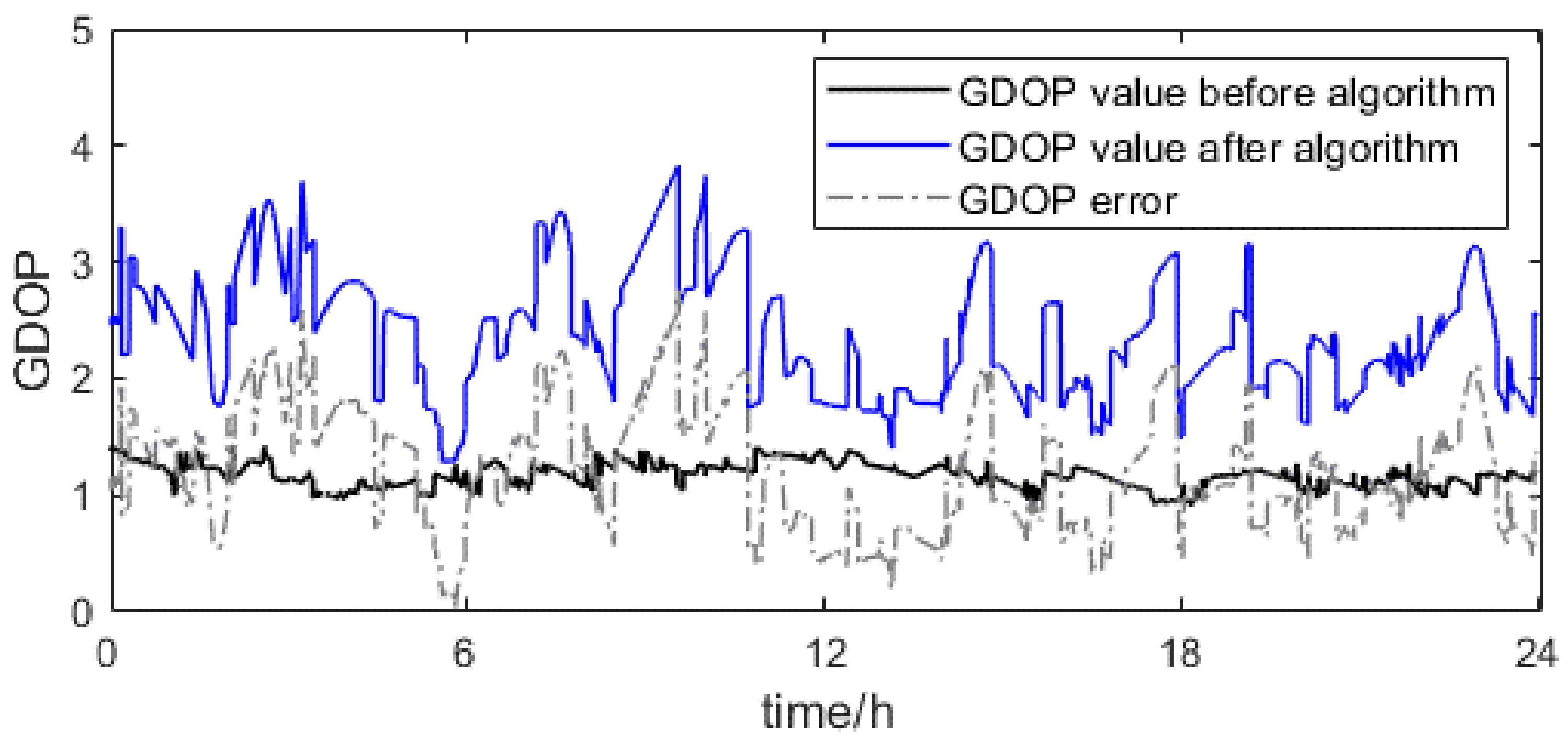
The user is located in the Nanjing area. The GDOP values before and after the fast satellite screening algorithm were used in the experiment, and the experiment duration was 24 h with the observation frequency of 0.2 Hz, and the results of calculating GDOP values are shown in Figure 2, Figure 3, Figure 4 and Figure 5.
Figure 2. GDOP value curve at 90% satellite screening.
Figure 3. GDOP value curve at 80% satellite screening.
Figure 4. GDOP value curve at 70% satellite screening.
Figure 5. GDOP value curve at 60% satellite screening.
The results of the GDOP values for each different percentage of star selections were statistically analyzed to obtain Table 2.
Table 2. Statistical analysis of GDOP values with different star selection ratios.
The following conclusions can be drawn from Figure 2, Figure 3, Figure 4 and Figure 5 and Table 2:
  • When 90%, 80%, 70%, and 60% of the satellites are screened, the GDOP value increases by 20.75%, 37.87%, 58.17%, and 109.44%, respectively.
  • When screening 70% of the satellites or more, this paper’s algorithm maintains its GDOP value well, compared with the optimal GDOP value satellite selection scheme, and it is basically consistent with the satellite selection ratio relationship model obtained from Equation (15).
  • When screening 70% of the satellites or more, the GDOP value results show more sudden jump points on the image, which indicates that the screening algorithm implemented in this paper, and although it can maintain good accuracy under normal circumstances, it is not good at maintaining the positioning accuracy under special circumstances.
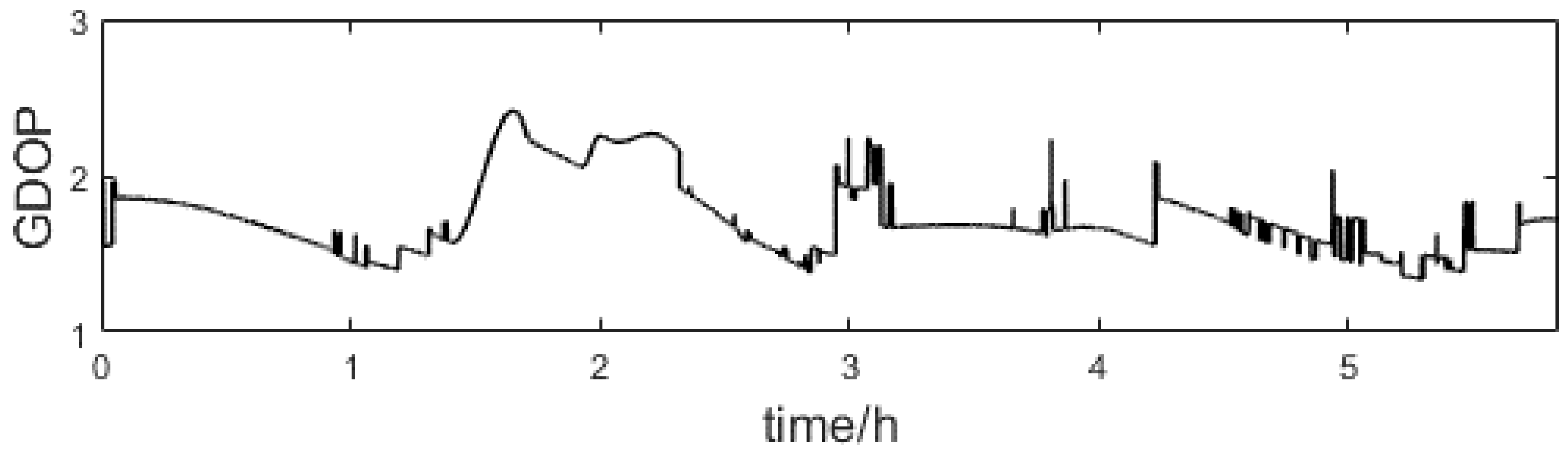
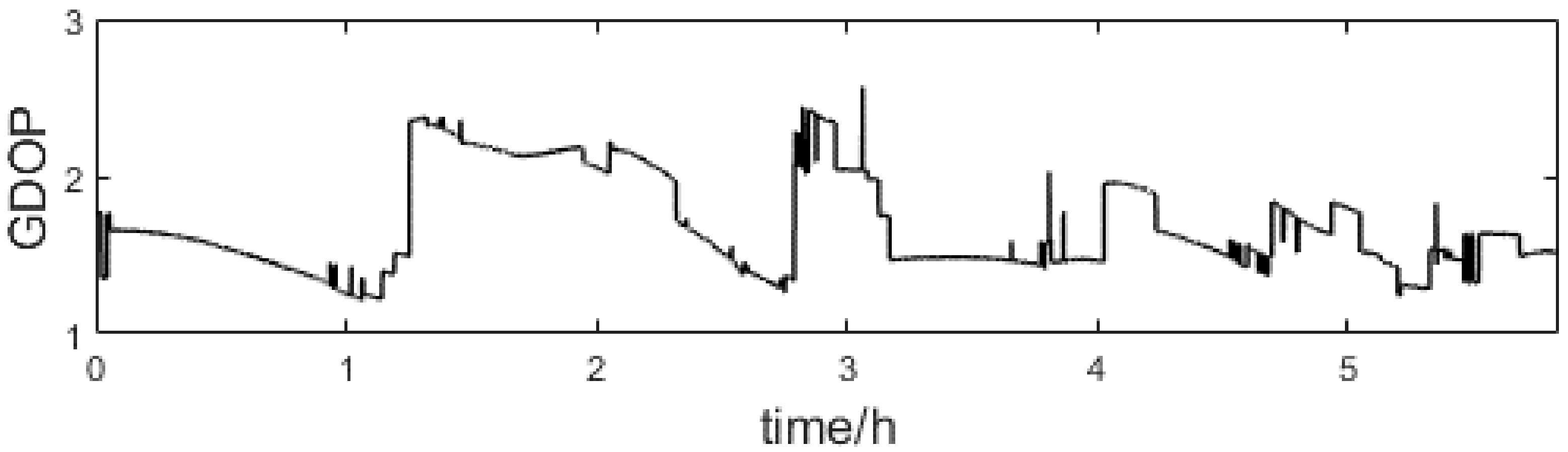
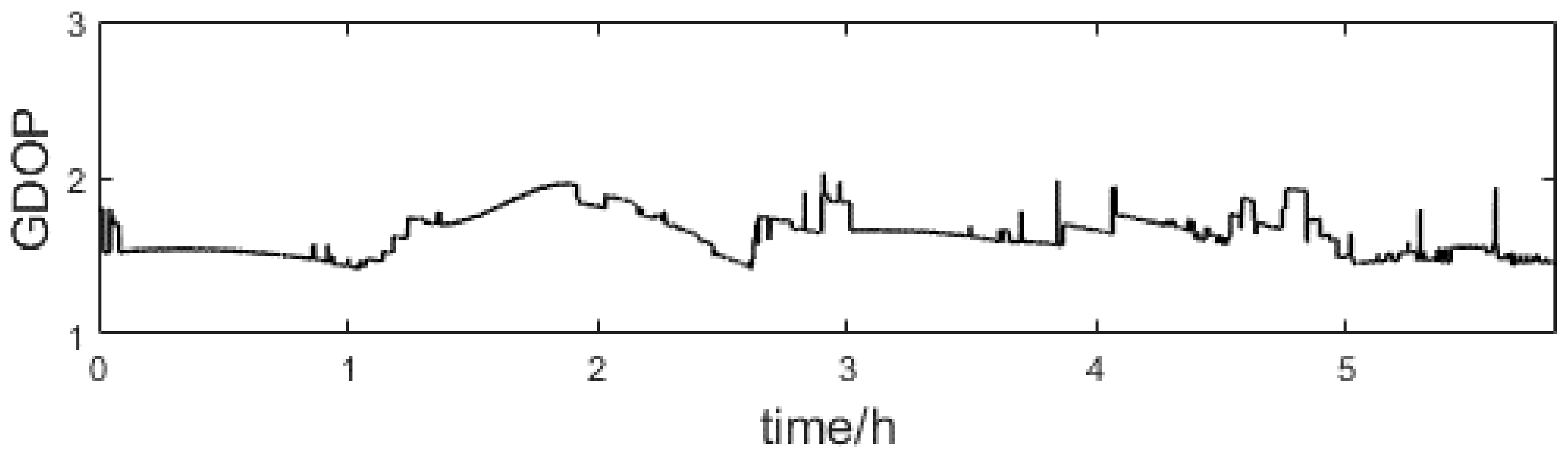
The fast satellite screening algorithm in this paper will be compared with current mainstream satellite selection algorithms. The user is located in Nanjing, and the experiment duration is 6 h with an observation frequency of 0.5 Hz. The comparison algorithms used were the fast genetic star selection algorithm, the traditional GDOP-based selection algorithm, and the position error-assisted selection algorithm. The selection ratio for all satellite selection algorithms was set at 70%. The results of GDOP values are shown in Figure 6, Figure 7, Figure 8 and Figure 9.
Figure 6. GDOP of traditional GDOP algorithm.
Figure 7. GDOP of fast satellite screening algorithm in this paper.
Figure 8. GDOP of position error-aided GDOP algorithm.
Figure 9. GDOP of fast genetic star selection algorithm.
The results of GDOP values for each satellite selection algorithm were statistically analyzed to produce Table 3.
Table 3. Statistical analysis of GDOP values under different satellite selection algorithms.
The following conclusions can be drawn from Figure 6, Figure 7, Figure 8 and Figure 9 and Table 3:
  • When the satellite selection ratio is 70%, the GDOP values of the satellite selection algorithm, position error-aided GDOP algorithm, and fast genetic GDOP algorithm are improved by 8.56%, 5.70%, and 2.89%, respectively, compared with the traditional GDOP satellite selection algorithm. The GDOP increase of this paper’s algorithm is slightly higher than the other two methods, but it also stays at a lower value.
  • The standard deviation of the above four algorithms is when the satellite selection ratio is controlled at 70%: 0.1586, 0.2390, 0.3076, and 0.1355. It is shown that the localization stability of the algorithm in this paper is worse than the traditional GDOP algorithm and fast genetic GDOP algorithm, but better than the position error-aided GDOP algorithm.

4.2. Positioning Accuracy Analysis

A 24 h static experiment was conducted. The localization results of the traditional GDOP selection algorithm and the optimised GDOP value selection with multi-threshold filtering were compared with the localized true values, setting the selection percentage of the selection algorithm to 70%. The observation frequency was set to 0.2 HZ. The results of the positioning error are shown in Figure 10 and Table 4 (The results are not smoothed in order to verify the validity of the algorithm).
Figure 10. Position errors before and after the satellite screening algorithm for the three-constellation combination system.
Table 4. Positioning error between traditional GDOP and the algorithms in this paper.
From Figure 10, it can be seen that the overall positioning accuracy of the proposed star selection algorithm in this paper is maintained better relative to the best GDOP value selection method. In the X-axis component, the overall error is maintained smoothly, and in the Y- and Z-axis components, the number of fluctuations in the positioning error gradually increases after 18 h, but remains within the acceptable range. At the same time, when the satellite configuration changes, the positioning accuracy of the algorithm proposed in this paper is prone to large fluctuations, which is manifested by large jump points. From Table 4, it can be seen that compared with the traditional satellite selection method, the error of the fast satellite selection algorithm proposed in this paper is maintained better, with an increase of 38.77% in the X-axis direction, 14.97% in the Y-axis direction, and 9.96% in the Z-axis direction.

4.3. System Computational Complexity Analysis

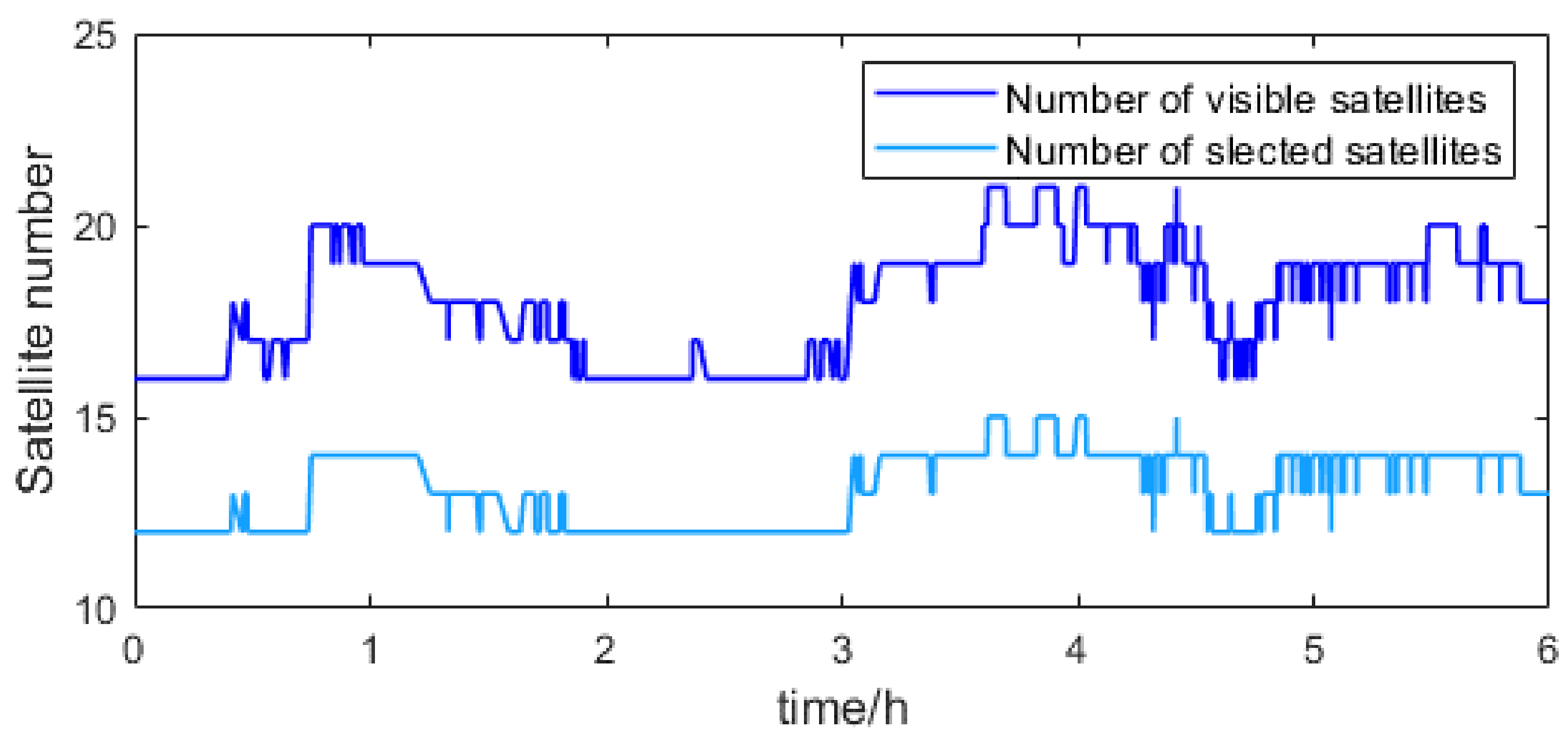
Using the data from the second experiment in Section 4.1, an image of the number of satellites is plotted in Figure 11.
Figure 11. Number of satellites before and after the selection algorithm.
The average number of visible stars of the three-constellation combination system is 18, and the selection ratio is set to 70%, and a total of 13 satellites need to be selected. The statistics of the system computation of four different satellite selection algorithms are shown in Table 5.
Table 5. Complexity of different satellite selection algorithms.
As can be seen from Table 5, in an epoch, compared with the traditional GDOP algorithm, the number of matrix multiplications and matrix inversions are reduced by 81.89%, and compared with the position error-aided GDOP algorithm, the number of matrix multiplications is reduced by 46.01% and the number of matrix inversions is reduced by 44.10%, and compared with fast genetic GDOP algorithm, the number of matrix multiplications is reduced by 44.34%, and the number of matrix inversions is reduced by 44.76%. The satellite selection algorithm designed in this paper significantly reduces the system operations compared to other algorithms.

5. Conclusions and Prospect

This paper designs a new satellite screening algorithm based on the traditional minimum GDOP algorithm and maximum volume algorithm, which ensures that the selected satellites have a better distribution state, and at the same time, the number of satellites involved in the solution is kept at more than 70%. This ensures a significant reduction in computational load with only a small loss in positioning accuracy.
At a cut-off elevation angle of 5° and a satellite selection rate of 70%, the average GDOP value of the algorithm is 1.7303, and the three axial position errors are basically controlled within 2.5 m in the ECEF coordinates.

Author Contributions

Conceptualization, W.Z. and Z.W.; methodology, W.Z.; software, W.Z.; validation, W.Z.; formal analysis, W.Z.; investigation, W.Z.; resources, Z.W.; data curation, W.Z.; writing—original draft preparation, W.Z.; writing—review and editing, Z.W.; supervision, Z.W. All authors have read and agreed to the published version of the manuscript.

Funding

This research received no external funding.

Data Availability Statement

The data presented in this study are available on request from the corresponding author.

Conflicts of Interest

The authors declare no conflicts of interest.

References

  1. Chen, Q.; Yi, J. Brief analysis on global four major navigation satellite systems. J. Navig. Position. 2020, 8, 115–120. [Google Scholar] [CrossRef]
  2. Li, G.; Xu, C.; Zhang, P.; Hu, C. A modified satellite selection algorithm based on satellite contribution for GDOP in GNSS. In Advances in Mechanical and Electronic Engineering; Lecture Notes in Electrical Engineering; Springer: Berlin/Heidelberg, Germany, 2013; Volume 176, pp. 415–421. [Google Scholar]
  3. Niu, Y.; Li, K. A GNSS four-system satellite selection method based on UERE weighted optimization. J. Navig. Position. 2023, 11, 124–130. [Google Scholar] [CrossRef]
  4. Xue, S.; Yang, Y. Combined Walker Configurations with Minimal GDOP. J. Wuhan Univ. (Inf. Sci. Ed.) 2016, 41, 380–387. [Google Scholar] [CrossRef]
  5. Han, T. Research on GNSS Multi-System Satellite Selection Strategy. Master’s Thesis, Shanghai Jiao Tong University, Shanghai, China, 2014. [Google Scholar]
  6. Yang, J.; Zhang, H. Satellite fault diagnosis based on optimal parity vector method. Acta Aeronaut. Astronaut. Sin. 2002, 2, 183–186. [Google Scholar] [CrossRef]
  7. Zhang, L.; Lv, H.; Wang, D.; Hou, Y.; Wu, J. Asynchronous RTK precise DGNSS positioning method for deriving a low-latency high-rate output. J. Geod. 2015, 89, 641–653. [Google Scholar]
  8. Teng, Y.; Wang, J.; Huang, Q.; Liu, B. New characteristics of weighted GDOP in multi-GNSS positioning. GPS Solut. 2018, 22, 74. [Google Scholar] [CrossRef]
  9. Zhang, X.; He, L.; Li, Y.; Zhang, R. An Improved Satellite Selection Algorithm Based on Elevation Angle and GDOP Contribution Value. Softw. Guide 2016, 15, 16–20. [Google Scholar]
  10. Chen, J.; Xu, L.; Li, X. Analysis of receiver position error impact on GNSS timing. Chin. J. Sci. Instrum. 2017, 38, 1458–1465. [Google Scholar] [CrossRef]
  11. Qian, H.; Fu, Z.; Ning, X.; He, R. Fault diagnosis algorithm for GPS/SINS with unknown perturbation distribution matrix. Chin. J. Sci. Instrum. 2013, 34, 208–214. [Google Scholar] [CrossRef]
  12. Lu, Y. GPS Global Positioning Receiver—Principle and Software Solution; Publishing House of Electronics Industry: Beijing, China, 2009; pp. 128–133. [Google Scholar]
  13. Wang, B.; Tian, S.; Zhong, Y.; Deng, j. Design and Accuracy Analysis od Star Selection for Relative Positioning with GNSS Multi-System. Beijing Surv. Mapp. 2021, 35, 500–504. [Google Scholar] [CrossRef]
  14. Mosavi, M.R.; Divband, M. Calculation of geometric dilution of precision using adaptive filtering technique based on evolutionary algorithms. In Proceedings of the 2010 International Conference on Electrical and Control Engineering, Wuhan, China, 25–27 June 2010. [Google Scholar]
  15. Jin, L.; Huang, Z.; Li, R.; Ma, Y. Study on Fast Satellite Algorithm for Integrated Navigation. Acta Electron. Sin. 2009, 37, 1931–1936. [Google Scholar]
  16. Huang, J.; Ba, X.; Liu, H.; Lu, Y.; Chen, J. A Fast Satellite Selection Algorithm Based on Positioning Error for Multi-Constellation Satellite Navigation System. Sci. Technol. Eng. 2015, 15, 87–91. [Google Scholar]
Disclaimer/Publisher’s Note: The statements, opinions and data contained in all publications are solely those of the individual author(s) and contributor(s) and not of MDPI and/or the editor(s). MDPI and/or the editor(s) disclaim responsibility for any injury to people or property resulting from any ideas, methods, instructions or products referred to in the content.

Article Metrics

Citations

Article Access Statistics

Multiple requests from the same IP address are counted as one view.