


Abstract
This paper examines the quantitative and qualitative situation of the current fixed and mobile Internet and its expected future. It provides a detailed insight into the past, present, and future of the Internet along with the development of technology and the problems that have arisen in accessing and using broadband Internet. First, the number of users and penetration rate of the Internet, the various types of services in different countries, the ranking of countries in terms of the mean and median download and upload Internet data speeds, Internet data volume, and number and location of data centers in the world are presented. The second task introduces and details twelve performance evaluation metrics for broadband Internet access. Third, different wired and wireless Internet technologies are introduced and compared based on data rate, coverage, type of infrastructure, and their advantages and disadvantages. Based on the technical and functional criteria, in the fourth work, two popular wired and wireless Internet platforms, one based on optical fiber and the other based on the 5G cellular network, are compared in the world in general and Australia in particular. Moreover, this paper has a look at Starlink as the latest satellite Internet candidate, especially for rural and remote areas. The fifth task outlines the latest technologies and emerging broadband Internet-based services and applications in the spotlight. Sixthly, it focuses on three problems in the future Internet in the world, namely the digital divide due to the different qualities of available Internet and new Internet-based services and applications of emerging technologies, the impact of the Internet on social interactions, and hacking and insecurity on the Internet. Finally, some solutions to these problems are proposed.
1. Introduction
First, the term Internet was used in 1945 by the United States War Department (USWD) in a radio operator’s manual [1]. It was evolved in 1969, under the Advanced Research Projects Agency NETwork (ARPANET) to connect computers at different universities and the United States of America (USA) defense [2]. Before January 1983, which is considered the start date of the Internet, there was no standard way of communicating between different computer networks. At this time, a new communications protocol called the Transmission Control Protocol/Internet Protocol (TCP/IP) was officially adopted and used by ARPANET and the Defense Data Network (DDN). This allowed various computers on different networks to connect and communicate with each other using a universal language [3]. Hence, the Internet has revolutionized the world of computers and communications like nothing before and the invention of the telephone, radio, and computer set the stage for this unique integration of capabilities.
Since the 1990s, fixed access to the Internet began via copper cables and telephone lines using dial-up modems. After that, the Digital Subscriber Line (DSL), Symmetric Digital Subscriber Line (SDSL), Asymmetric Digital Subscriber Line (ADSL) and its enhanced versions, i.e., ADSL2 and ADSL2+, and Very high-speed Digital Subscriber Line (VDSL) were introduced and used [4]. Also, wired access to the Internet using fiber optic cable, partially or completely, became possible, and now many homes and offices can experience very high-speed Internet based on Fiber-To-The-x (FTTx) if located in the service area [5].
By using wireless local area networks (WLANs), wireless-fidelity (Wi-Fi), Worldwide interoperability for Microwave Access (WiMAX), and—from the end of the Second Generation (2G) and practically from the Third Generation (3G) of cellular mobile communications—wireless multimedia communications, access to the Internet was provided through digital devices and mobile phones [6]. Today, wireless access using Fourth Generation (4G), 4.5G, and Fifth Generation (5G) cellular is possible for fixed and mobile Internet applications and services. In addition, wireless access can be based on light-fidelity (Li-Fi) that transmits data via a light emitting diode (LED) or infrared (IR) for indoor applications; there are also clear-sky outdoor nearby nodes and geostationary earth orbit (GEO) and low earth orbit (LEO) satellites and balloons, which are especially useful for Internet access in rural and remote areas [7,8].
Now, the Internet supports millions of digital devices in carrying and transfering volumes of information from one device to another. The current status of the Internet in the world depends on digital technologies and wired and wireless Internet platforms [9,10]. Hence, they need to be evaluated and compared with each other based on the following factors:
- Area covered by operators’ services;
- Penetration on both sides of users and operators;
- Experiences of operators and users based on download and upload speeds, latency, jitter, and packet loss;
- Required time and costs of establishment, setup, subscription, and service.
Some uses of the Internet include social networking, online shopping and banking, digital trading, cryptocurrency, intelligent automation and control, smart home, smart city, virtual education and upskilling, and online interactive games [11]. So, the communications, social, economic, banking, business, industrial, cultural, educational, health, and medical development of countries is highly dependent on the Internet. Also, interactions between Internet technology and other areas of human life open academic, governmental, and global investigations, projects, experimental results, and new ideas.
Nowadays, Internet technology introduces dozens of new applications and services, and most of the new digital technologies (such Internet of Things (IoT), video streaming, online interactive gaming, and the metaverse—which are applicable for digital economics and trading—as well as electronic banking, smart traffic and transportation, industrial automation and remote control, electronic healthcare and treatment, online education, smart cities, smart homes, and online entertainment) require high-speed broadband Internet [12]. Over the next five years, the world’s unconnected population will drop from 45% to 27% [13,14]. This means that the Internet and the digital technologies that require high-speed Internet accelerate each other and the progress of countries in different aspects of human life strongly depends on them. Therefore, three problems will occur. The first problem is the digital divide due to the level of new technologies in different countries and even different parts of a country. Also, the quality of broadband Internet is not the same in sparsely populated rural and remote areas and populated urban and suburban areas. The second problem is the effects of broadband Internet on social behaviors that change interactions and cooperation. Moreover, the third problem is information hacking and insecurity on the Internet.
To highlight the target of this paper and show the main contributions and innovations of this paper compared to previous research, the following items are presented:
- Why is broadband Internet needed based on practical statistics and functional and technical perspectives?
- This paper addresses the extraction of bottlenecks and the challenges of accessing broadband Internet in reality (technology, cost, and time), which shows the impact of the various wired and wireless Internet access platforms on fixed and mobile services and applications, and new technologies on different aspects of human life.
- Why is the development of countries both locally and globally dependent on broadband Internet and related technologies?
- This paper introduces new and emerging technologies that affect and are affected by broadband Internet.
- This paper presented three basic future problems based on services and applications that require broadband Internet and suggests solutions for them.
The remainder of this paper includes three parts. First, statistical, functional, and technical comparisons are made based on the data that show the past and present situations. Second, detailed information on access to broadband Internet today and estimations for the future are provided. Finally, three problems are presented and solutions to them are proposed.
To highlight the state of the Internet, compare different types of access, and present problems and solutions in the field of the Internet and its services, the rest of this paper is organized as follows. Based on the latest results of studies and reports of regional and global institutions and consortia in the field of the Internet and information and communications technology (ICT), Section 2 provides an overview of the current state of wired and wireless Internet in the countries of the world in terms of the number of users, penetration rate, type of services, mean and median downstream and upstream data rates, and number and location of data centers. Section 3 introduces and details twelve technical and functional metrics. In Section 4, different wired and wireless Internet access technologies are introduced and compared based on the values of technical parameters, such as data speed, coverage, and infrastructure, and their advantages and disadvantages are summarized. Section 5 compares the two globally popular broadband Internet access methods, optical-fiber-based access and 5G-cellular-based access, using Australia as an example. Also, Starlink, which is the latest candidate for Internet access in rural/remote areas, is presented. Section 6 looks at new technologies, services, and applications that affect and are affected by Internet technology, undoubtedly changing the course of development for both individual countries and the world. Section 7 focuses on three problems in broadband Internet: the digital divide that occurs due to the different qualities of Internet in different countries and the difference between Internet access in urban/suburban and rural/remote areas; the adverse effects of the Internet on social interactions; information hacking and insecurity on the Internet. The section also presents some potential solutions for these issues. Finally, Section 8 concludes the present paper.
2. The Current State of Wired and Wireless Internet in the World
The Internet is everywhere in human life, and its access speed, variety of services, and various uses are increasing day by day. Two types of broadband Internet access types—wired and wireless—are expanding and improving in academic and industrial research [15,16]. The use of these two is not at the same level, which depends on factors such as the geographical scale of a country, the weather, the population of the country, the level of people’s willingness to use the Internet, and the type of services requested. In the following subsections, the situation of the Internet in different parts of the world is examined.
2.1. Number of Users and Penetration Rate of Internet in Countries
The top 25 countries in the world in terms of the number of fixed and mobile Internet users and the penetration rate of the Internet in these countries, which is defined as the number of Internet users in a region per the total population of that region, are presented in Table 1 [17]. As can be seen, China, India, and the United States of America (USA) have the largest number of users, with a large difference in the penetration rate of the Internet in these countries. By population, India, China, USA, Indonesia, Pakistan, Nigeria, Brazil, Bangladesh, Russia, Mexico, Ethiopia, Japan, Philippines, Egypt, Congo, Vietnam, Iran, Turkey, Germany, Thailand, United Kingdom (UK), Tanzania, France, South Africa, and Italy occupy the first 25 positions. The presence of some low-population countries in this table, such as South Korea, with a population rank of 29 in the 22nd rank, Spain, with a population rank of 32 in the 23rd rank, and Poland, with a population rank of 37 in the 25th rank, shows the high Internet penetration rate in these countries. Also, the absence of the names of some populous countries such as Ethiopia and Tanzania with the 11th and 22nd population ranks indicate the lack of a suitable platform and the low Internet penetration rate in these countries.

Table 1.
The highest-ranking countries in terms of the number of Internet users and their penetration rates [17].
Table 2 shows the top 20 countries in terms of Internet penetration rate. The three countries of Norway, the Kingdom of Saudi Arabia (KSA), and the United Arab Emirates (UAE) have the highest ranking, with a rate of 99% [18,19]. Even for the 20th place in this list, which is Germany, the penetration rate is above 93%. Meanwhile, the average global Internet penetration rate is around 65.4%, and there is a gap of more than 28% between the penetration rate in the countries of this list and the average global penetration rate.
Table 2.
The highest-ranking countries in terms of Internet penetration rate [18,19].
Table 3 compares different regions of the world in terms of two criteria, i.e., the Internet penetration rate and the percentage of Internet users, which is defined as the number of Internet users in a region per the total number of Internet users in the world. About 24% of Internet users live in East Asia [18,19]. This densely populated area of the world has an Internet penetration rate of about 74%, which is 10% higher than the global average of about 65%. This region, together with two other regions of South Asia, with 18.5% and Southeast Asia with 10%, includes more than 52% of all Internet users in the world. The lowest Internet adoption rate in Asia belongs to Southeast Asia, which has a penetration rate of less than 50%. On the other hand, the penetration rate in West Asia is about 75%.
Table 3.
Percentage of users and Internet penetration rate in different regions of the world [18,19].
Table 4 shows the number of Internet users in the statistics of different institutions. The statistics reached 5.16 billion users with a penetration rate of 65.7% in October 2023 [20], compared to a penetration rate of 53% in 2018 and 35% in 2014 [18,19,20]. It is shown that the number of Internet users in 2023 has experienced double growth compared to 2013.
Table 4.
Statistics of Internet users and penetration rate according to different sources [18,19].
2.2. Internet Services in Countries
Looking at Table 5, the average duration of daily use for the 15 countries with the highest Internet usage can be seen. According to these statistics, four countries—the Philippines, Brazil, Colombia, and South Africa—are at the top of the table, with more than 10 h of daily Internet use. The global average daily Internet usage time is about 7 h and 4 min. The latest surveys show that 56.9% of usage is from smartphones and 43.1% is from computers [21]. Also, it shows that the time spent on the Internet is not the same in different countries because it depends on different lifestyles, levels of online access at jobs and workplaces, uses of data streaming and gaming, and some other things.
Table 5.
Top 15 countries based on the average duration of daily Internet use [21].
Comparing the results of [19,21,22] shows that the daily duration of Internet usage has increased by about 10–15% in one year. This is because some services and applications used by young people and adults especially—such gaming, Metaverse, and video streaming—are increasing. Additionally, a higher number of activities, such as e-banking, e-commerce, e-learning, Internet-based traffic control and transportation, and social media, require high-speed broadband Internet.
As seen in Figure 1, the amount of Internet data has grown exponentially in different years in the period from 2010 to 2025. Approximately 328.77 exabytes (328.77 × 1018 bytes) of data are produced every day, which is equivalent to 120 zettabytes (120 × 1021 bytes) in 2023 [19,22]. This amount of data is expected to reach 142 and 181 zettabytes in 2024 and 2025, respectively, more than half of which is video data.
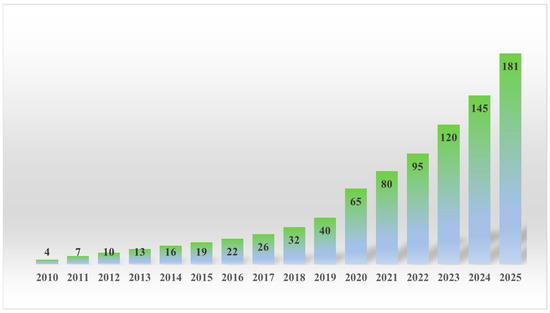
Figure 1.
Global Internet data generated annually (in zettabytes) [19,22].
Table 6 details the data percentage accounted for by various applications; video services, social networks, and online games account for more than 76% of the data. Meanwhile, the volume of data accounted for by audio applications is about 0.31% [22,23].
Table 6.
Internet data ratio in different applications [22,23].
Another factor influencing the speed, processing, storage, and management of Internet data is the number of data centers around the world [24]; there are currently more than 10,000 data centers. The top 15 countries with the highest number of data centers (accounting for more than 90% of all data centers) are reported in Table 7. The largest number of data centers belongs to the USA, with 5375 centers; this was more than 53% of all data centers in the world at the end of 2023. This was an increase from their 2701 data centers, accounting for more than 33% of all data centers, in Dec. 2021. The next countries in this ranking, with a significant difference from the first rank, are Germany (522 centers) and the UK (517 centers) in Europe, China (448 centers) in Asia, Canada (335 centers) in North America, France (314 centers) in Europe, Australia (306 centers) in Oceania, and the Netherlands (299 centers) in Europe. Interestingly, the total number of data centers in these 14 countries (ranks 2–15) is 4005, which is about 75% of the number of data centers in the USA. The 16th rank has more than 130 data centers in the Middle East, located in West Asia, most of which are located in the KSA, the UAE, Israel, and Egypt. The total number of data centers at the end of 2023 [25] increased by about 99% in the USA and 10% for ranks 2–15, which is equivalent to about 25% worldwide compared to the figures reported at the end of 2021 [26].
Table 7.
The top-ranking 15 countries by number of data centers [25].
2.3. Ranking of Countries in Terms of Internet Data Rate
In Table 8 and Table 9, it can be seen that Monaco, Singapore, and Hong Kong (special region of China) are at the top of the fixed-broadband Internet data rate ranking, while the highest ranks in mobile-broadband Internet data speed belong to the UAE, South Korea, and Norway [27,28]. In general, in the competition for high-speed Internet access, smaller countries have an advantage because infrastructure can be upgraded in densely populated areas. Although some large countries such as China (ranked 5th) do well in mobile telephone and Internet rankings, the USA ranks no higher than 15th in mobile Internet and 13th in fixed-broadband Internet. These figures point to the dynamic and evolving nature of the Internet and connectivity technology around the world. Therefore, the right strategic planning can make significant improvements in the performance of the Web and the position of the Internet in any country. It is necessary to explain that, in fixed Internet, the global average download speed is 67.25 Mbps and the upload speed is 28.55 Mbps. Also, in the case of mobile Internet, these rates are 30.78 Mbps and 8.55 Mbps, respectively.
Table 8.
The mean fixed-broadband Internet download rate in different countries [27,28].
Table 9.
The mean mobile-broadband Internet download rate in different countries [27,28].
In another statistical study, the median rate was used instead of the mean Internet rate. Table 10 and Table 11 show the median fixed- and mobile-broadband Internet rates, respectively. Based on the median Internet download rate, in fixed Internet, Singapore, Hong Kong (special region of China), Chile, and the UAE are the best, and in mobile Internet, the UAE, Qatar, Kuwait, and Uruguay have the highest rankings. In the world, for fixed Internet, the median download rate is 82.56 Mbps, the median upload rate is 36.8 Mbps, the latency is 9 ms, and the jitter is 3 ms. For mobile Internet, the median download rate is 42.35 Mbps, the median upload rate is 10.04 Mbps, latency is 28 ms, and jitter is 9 ms. In these four indicators, fixed-broadband Internet is a much better than mobile Internet.
Table 10.
The median fixed-broadband Internet download rate in different countries [27,28].
Table 11.
The median mobile-broadband Internet download rate in different countries [27,28].
In Table 8, Table 9, Table 10 and Table 11, the type of Internet access (fixed or mobile), the type of Internet channel (wired or wireless), the payment for service, the type of services and applications, the geographical extent of the country, the population, the average age of the population, the percentage of young people in the population, the classification of the country in terms of income and economy, the time spent on the Internet-based jobs and related services and applications, daily time spent to the Internet-based entertainment, and other parameters are the main reasons for changing the ranking of countries.
3. Criteria for the Performance Evaluation of Different Internet Access Platforms
New services and applications and present human life need high-speed broadband Internet. In the performance evaluation and comparisons of different wired and wireless broadband Internet channels, criteria (measures) have been proposed by various standards, such as 5G cellular or FTTx, or measured by operators, service providers, and local or global institutions and consortia. Twelve technical and functional criteria for performance evaluation and comparison of different types of Internet access are as follows:
- Download/upload speed;
- Data volume;
- Coverage;
- Availability;
- Reliability;
- Latency;
- Jitter;
- Packet loss;
- Security;
- Setup cost;
- Subscription/service fee;
- Establishment/setup time.
The following factors are important to subscribers (users) and operators (service providers), directly or indirectly: data speed in download and upload transfers; data volume supported in the service time or subscription period; quality and accuracy of downstream and upstream data transmission that will be measured by packet loss and outage probability; time required for establishment and startup; latency and deviation of latency (jitter) due to processing, switching, signaling, and routing processes; delay time due to physical distance between network nodes, i.e., user and service provider; security and privacy of the nodes, processes, and data transfer; costs. Also, the availability of Internet access and the associated services and applications depends on the service provider, type of service, and the time the service is requested. In addition, unreliability shows how much Internet access and supported services are out of service due to physical damages to systems and equipment.
These criteria, especially the data rates, latency, jitter, packet loss, coverage, data volume, and the availability of Internet access are affected by system parameters, including transmit power, transceiver loss and gain, noise level, interference, and the threshold levels of the receiver. This means that all system parameters and performance metrics depend on the type of Internet access, the channel used for data transfer, and technology.
The received power of a link (in dB), , can be determined by considering the transmit power, , total loss, , and total gain, , as follows, in Equation (1) [29]:
In (2), the total loss of a cable platform (in dB), consists of three losses, connector loss, , cable attenuation, , and splice loss, . If the length of the cable is increased, then the attenuation of the cable, , will be increased.
In (3), is the total gain including the transmitter gain, and receiver gain,
The loss of copper cables depends on the type of cable, i.e., two-pair and coaxial, the working frequency of the signal, and the bandwidth. The loss is less for fiber optic cables than it is for copper cables, which means that a higher possible distance between transmitter and receiver can be achieved. Mainly, for wired links, including fiber optic and copper cables, copper cable loss is the dominant loss. In wireless links, the total link loss includes due to path loss, due to the shadowing effect, and due to multipath fading. The transmitter and receiver gains include the gains of the amplifier at the transmitter and receiver sides for wired scenarios plus the gains of the transmitter and receiver antennas or optical amplifiers for wireless scenarios. For scenarios including wired and wireless links, the total loss and gain are the sum of all losses and gains of all links, respectively.
The capacity of wired and wireless links, , which is the maximum information rate, , of a channel, depends on the channel bandwidth, , and the received signal-to-noise ratio () or signal-to-interference plus noise ratio (), as in (4) or (5), respectively [30]. According to (4), in the cable channels, especially the coaxial cable and the optical fiber; where noise dominates, the capacity and data rate can be determined by , because the undesired signal is noise, while the interference can be ignored. In (5), the capacity is based on , which is the main criterion in wireless channels dominated by noise, interference, or both. These can be seen in line-of-sight (LOS) and non-line-of-sight (NLOS) propagations, especially near the base station, in the middle of a cell, or close to the cell boundaries.
Assuming the noise power spectral density is and the total interference is , and are given as (6) and (7), respectively.
Spectral efficiency (SE), bandwidth efficiency, or throughput, as in (8) (in ) [30], refers to the information rate, , that can be transmitted through a certain bandwidth in a given channel.
Today, achieving the maximum data rate with minimal consumption of power, is desired because it guarantees high-speed data transfer in green communications with low impacts on natural resources. Hence, energy efficiency (EE) is defined as the information rate in relation to the consumed power (in ), as in (9) [31]:
In optical fiber and coaxial cables, interference can be ignored; meanwhile, in two-pair copper cables, it should be given due attention. Satellite links mostly experience the LOS propagation mode and additive white gaussian noise (AWGN) channel. In contrast, will change to on 3G/4G/5G cellular platforms. The maximum data download (or upload) rate, is less than the channel capacity, which depends on the signal bandwidth and the acceptable (or ) threshold level of the receiver. The lowest rate determines the total speed on a link, including wired and wireless scenarios.
The maximum distance, , from a service provider (SP)—where the achievable or is greater than the threshold or required by the receiver—determines the coverage radius as (10) [31].
To make a metric useful for wired and wireless channels, the coverage radius (maximum distance) from the service provider is defined. In wired channels, like copper/coaxial/fiber cables, the coverage can be determined by the average performance extracted from the minimum average or to show the maximum distance from the service provider to achieve an acceptable performance. In wireless channels, in addition to noise and interference, users experience three undesired phenomena, namely multipath fading, shadowing, and blockage (in light and millimeter waves). Therefore, the received may be differ from the directions from the service provider due to the three mentioned phenomena. In these locations, the channel falls in outage and the receiver is out of the range of base station. The outage probability is as follows:
Considering the outage probability, the —a circular area in wired channels—has distances that are dissimilar from those on the other sides of the base station due to the outage probability. Hence, in wireless channels, performance metrics, such as bit error rate (, should be corrected by a factor of .
Availability means that the system is ready for immediate use and aims to maximize uptime. According to (12), availability is the ratio of working time (uptime), to total time, [32]. The availability of Internet access depends on the technology, the number of active users, the level of congestion, the server coverage, the type of service, and the desired quality. Availability of 99.999% means only 0.864 s of downtime, in 24 h of operation.
The reliability of an Internet platform is its ability to perform its function without physical failure. This is a measure of how long the infrastructure has been operating without disruption. According to (13), the mean time between failures (MTBF), which is the operating time between outages, is an important measure of reliability [33].
Sometimes, the Internet access platform works well but the user does not have access due to the high number of users or needs high-speed data but is forced to disconnect during peak hours. In these cases, the Internet is not available, but the system is reliable without physical defects. If the platform is unreliable due to physical damage, then it is unreliable, which forces the system to be unavailable. In other words, unreliability causes unavailability while unavailability does not cause unreliability. It is not available when you are not in the coverage area of an Internet access platform. Also, you may be in the coverage area of the Internet platform, but the service quality is below the threshold level due to traffic policies and congestion. In this case, the service is not available.
The latency, , is the subtraction of the start time, , of sending data at the transmitter from the end time, , of receiving data at the receiver as (14) [34]. This value depends on network topology, distance between nodes, wired/wireless technology, order of complexity based on the processing, computation, and memory required, and type of service and application.
Jitter, , as the deviation in latency, can be determined by the standard deviation of latency as (15). This is because packets traversing the same network experience different amounts of latency [35].
The packet loss metric, , is equal to the number of received packets with error, divided by the total number of the transmitted packets, as (16) [36]. It directly depends on the channel bandwidth, the achievable or , and the maximum acceptable packet loss for a service.
Security is the protection of digital information on the Internet throughout its life cycle to safeguard it from corruption, theft, and unauthorized access. It covers memory, software, hardware, and user devices; transmission and access channels; administrative controls; and organizations’ policies and procedures. If at least one of these is not secure, the data must be encrypted to protect information from unwanted access like eavesdropping and active attacks.
Nowadays, with the increase in the number of users, many of whom have more time to access the Internet, it is necessary to supply high-speed, stable, secure, reliable, available, low-cost, and fast-to-establish/setup Internet in both fixed and mobile applications. However, the degree of importance, priority of criteria, and desired amount of these criteria are different from service to service and depend on the type of application. Also, real-time and non-real-time applications and services may differ in the value and level of the required criteria. Some services need a high volume of data, like Metaverse, with short latency, while online gaming is sensitive to latency and jitter. Security is very important in online banking, e-commerce, and cryptocurrency. Non-stop services, such as traffic control and police monitoring, need highly available low-outage Internet access.
4. Wired and Wireless Internet Access Platforms
As shown in Figure 2, Internet access and data transfer between different devices and users are conducted via wired connections (using one or a combination of two-pair, coaxial, and optical fiber cable platforms) or wireless connections (with one or a combination of Wi-Fi, Li-Fi, WiMAX, 3G/4G/4.5G cellular, 5G cellular, GEO and LEO satellites, and balloon platforms) [37].

Figure 2.
Wired and wireless internet access platforms.
In wired networks, nodes are connected to the Internet platform using cables in radio and/or light waves; meanwhile, in wireless networks, data transmissions and communications are carried out using radio waves in very-high-frequency (VHF), ultra-high-frequency (UHF), and microwave bands in general. Alsonfrared and light waves in laser or diffusion modes, can be used in short transparent links which do not use cables, or those which use only a small connection that is based on cables [38,39,40,41,42,43].
In Table 12 and Table 13, different wired and wireless technologies are compared based on the maximum upload/download speed, the coverage area, the type of infrastructure, and important advantages and disadvantages. Without focusing on other functional or technical metrics, including latency, packet loss, coverage area, availability, reliability, and the time and costs required to establish and operate the service—which are important for the delivery of the service and differ by application—these tables show the advantages and disadvantages of each technology, as concluded by these criteria. According to Table 12 and Table 13, if high speed, reliability, secure transmission channels and connections, and low interference are desired, then one should choose a cable network; if affordability, simplicity, speed in setup (startup), and mobility are desired, then one should select a wireless network.
Table 12.
Comparison of wired Internet technologies.
Table 13.
Comparison of wireless Internet technologies.
The growing trend of broadband Internet access reported in the statistics of Internet users shows a high share of broadband Internet comprising wired, optical-fiber-based and wireless 4G/5G cellular [39,40].
In fixed-broadband Internet, optical fiber, which is composed of silica (the second most abundant element in sand) as opposed to two-pair or coaxial copper cables, is of interest due to its high bandwidth [40,41]. Among the various methods of wireless Internet access, special attention has been paid to 5G. In 5G, in addition to increasing bandwidth and data download/upload speed, new services are provided that are not available in 2G/3G/4G/4.5G and wireless Internet networks [42,43]. In wired and wireless broadband Internet access, the goals are as follows:
- More reliable connection;
- Higher speed in downloading and uploading data;
- Lower latency and jitter;
- Higher coverage and availability;
- Easier and faster access;
- More security and privacy;
- Higher support;
- Optimal network management;
- Industrial uses and automation;
- Public and private Internet-based services.
5. The Two Most Popular and the Latest LEO Satellite Broadband Internet Access
The wired and wireless access technologies, listed from oldest to newest, and their advantages and disadvantages, are summarized in Table 12 and Table 13, respectively. These tables show that optical fiber in the wired technologies and 5G cellular in wireless platforms cover more than 90% of users and transfer of data volume can be completed by short-range technologies, such as Wi-Fi and Li-Fi. In this section, optical-fiber-based wired access, FTTx, and the latest wireless technology—5G cellular—are presented with more details and compared to each other. Also, Internet coverage, from satellite Internet to broadband coverage, of rural/remote areas and Wi-Fi and Li-Fi standards for indoor and short-range broadband Internet access are presented.
Fiber-optic-based FTTx, based on light waves, fully or partially, and fixed/mobile 5G cellular based on wireless radio waves are the most popular broadband Internet access platforms. In addition, Starlink Internet is the latest satellite Internet access platform, which is in the testing phase. First, focusing on FTTx and 5G, Section 5.1.3 compares them in terms of the aforementioned technical and functional criteria. Second, as an example, Section 5.2 compares FTTx and 5G in Australia. Then, Section 5.3 has a look at the latest LEO satellite Internet platforms, Starlink, and compares it to FTTx and 5G cellular.
5.1. Wired FTTx-Based and Wireless 5G-Based Broadband Internet Access Platforms
FTTx-based and 5G-based broadband Internet access platforms are widely used and most Internet users have access to one or both of these two, which are expected to expand over time. Deciding between FTTx and 5G depends on the specific needs of each user. For users who have access to FTTx and 5G networks, higher speeds and lower costs make them more attractive options. Businesses must also consider the long-term implications of their choices [44,45,46].
5.1.1. FTTx-Based Internet Access
Wired Internet that is partially or completely (FTTx) based on optical fiber is of interest in many countries, such as Australia, the UK, the USA, the UAE, Germany, Singapore, and China [47]. As shown in Figure 3, there are different versions of FTTx as fiber-to-the-node (FTTN), fiber-to-the-cabinet (FTTC), fiber-to-the-business (FTTB), and fiber-to-the-home (FTTH) or fiber-to-the-premises (FTTP) types. They differ in the type of channel, the length of copper and optical fiber cables, the establishment and setup time, the data speed and volume, and the cost.
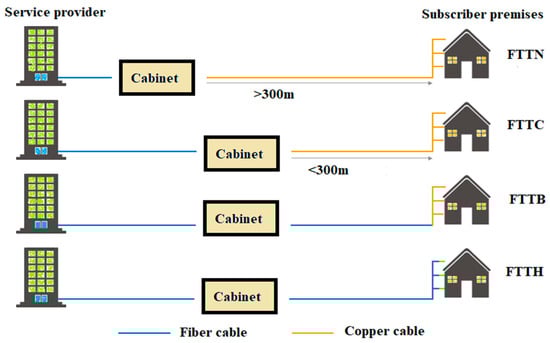
Figure 3.
Different versions of FTTx.
Considering the importance of fiber investment, its impact on global development, and the resulting economic and social dimensions, Omdia—a research company—has evaluated and compared fiber development in the world, creating an index called the Global Fiber Optic Development Index (GFODI) [48,49]. The three main indicators of fiber optic development are fiber coverage, fiber penetration, and broadband experience. In evaluating fiber coverage, two aspects are relevant: FTTx and wavelength division multiplexing (WDM). In measuring fiber penetration, three parts are relevant: FTTH, FTTB, and mobile cell site. In evaluating broadband experience, four parameters are relevant: download speed, upload speed, latency, and jitter [48,49,50]. In previous versions of this index, Omdia used its estimated average download and upload speeds; meanwhile, in the 2022 version, this index used average speeds measured by the end-users, based on Ookla speed test data [27,50]. This upgrade provides a more realistic view of the speed of Internet a user is getting.
5.1.2. Fifth-Generation-Based Internet Access
Low spectral efficiency (SE) and energy efficiency (EE) of 3G cellular, LTE-based 4G cellular, and LTE-A-based 4.5G cellular in data transmission and communications as well as Internet access were the key reasons for the development of the fifth generation of Internet access [51]. As demonstrated in Figure 4, 5G-based Internet access supports high-speed data transfer, low latency, high availability, and high connection density, and therefore high throughput. These features come at the cost of the following downsides of 5G Internet [52]:
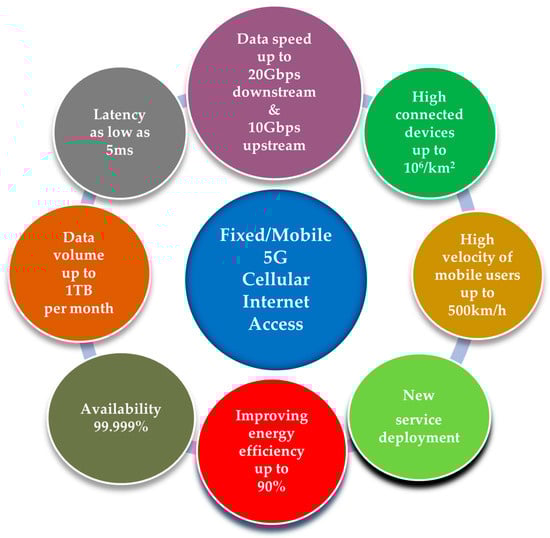
Figure 4.
Fifth-Generation cellular features.
- Faster battery drainage on 5G-enabled devices, especially when downloading or streaming large amounts of data;
- Limited coverage since 5G networks are not available in all areas, and can be spotty in some locations;
- Expensive infrastructure—new cell towers and equipment;
- Signal interference from trees, buildings, and other obstacles.
Fifth-Generation Internet access is divided into three frequency bands—low (less than 1 GHz), mid (1 GHz–6 GHz), and high (24 GHz–40 GHz); each has different capabilities. The low band has greater coverage but lower speeds, the mid band has a balance of both, and the high band offers higher speeds in smaller coverage areas [53]. The 5G-New Radio (5G-NR) has two different frequency ranges (FRs). FR1 includes sub-6GHz bands, some of which were traditionally used by previous systems; this has been extended to a new spectrum of utilization, from 410 MHz to 7125 MHz. FR2 assigns millimeter waves (mmWs) from 24.25 GHz to 71.0 GHz for high-speed applications. There are some frequency bands available for non-terrestrial networks (NTNs) in sub-6GHz. Frequency bands of 600 MHz, 700 MHz, 800 MHz, 900 MHz, 1.5 GHz, 2.1 GHz, 2.3 GHz, and 2.6 GHz are assigned for traditional applications and new specific usages such as IoT, industry automation, and business-critical usages. Fixed wireless access (FWA), utilizing both licensed and unlicensed mmW spectra, is a key technology that can lead to the early usage of 5G-NR [54].
5.1.3. FTTx-Based versus 5G-Based Broadband Internet Access Platforms
Table 14 presents the results that can be achieved through the technical and functional comparison of broadband Internet based on FTTx and 5G cellular.
Table 14.
Comparison of 5G-based and FTTx-based broadband Internet standards.
- Fifth Generation can reach a maximum download speed of 20 Gbps and an upload speed of 10 Gbps, while the data speed that a fiber optic cable can reach is practically 100 Gbps, for upload and download links symmetrically [44,45,46]. The highest speeds are achieved by FTTH, FTTB, and FTTC, respectively [55,56,57].
- Fiber-based Internet has a lower latency than 5G. The type of technology used in FTTx can affect the amount of latency [44,45,46].
- On average, jitter is much lower in FTTx-based fixed Internet connections than in wireless connections.
- Fixed Internet based on optical fiber is more suitable than 5G-home and 5G-mobile Internet; this is because, unlike radio links, it does not experience random propagation changes. Hence, packet loss for FTTx-based access is lower than for 5G-based access.
- Wireless base stations and servers only cover a limited area. When mobile users are far from the coverage area of the transceiver, they drop the connection or start experiencing signal instability. Hence, users always experience a strong signal with optical fiber.
- Convenience due to mobility is an inherent advantage of wireless Internet using 5G.
- In fiber optic connections, there is greater robustness against interference, while interference is highly influential in mobile cellular communications.
- Maintenance and inspection of the channel considering side and middle connections are important for FTTx; for 5G, since it is an air transmission channel, only the inspection and maintenance of the connections are necessary.
- Fifth-Generation platforms require encryption because data are transmitted over a wireless unsecure medium. In fiber-based Internet, the majority of the transmission medium is optical fiber, and because it does not rely on radio waves, data require less encryption [44,45].
- In optical-fiber-based Internet networks, service providers need to install optical fiber cables to establish a connection, which incurs a high cost. However, it is cheaper for subscribers because there is no limit on the amount of data available. On the other hand, 5G technology is more cost-effective to distribute, but more expensive to access. Fifth-Generation technology is wireless technology that does not require cables to install, but fiber-based FTTx Internet connections are more time-consuming and difficult to establish and set up.
5.2. Optical-Fiber-Based and 5G Cellular-Based Internet Access in Australia
Australia has the National Broadband Network (NBN), which is based on optical fiber, 4G/4.5G/5G mobile Internet, and 5G-home fixed Internet. The population of Australia exchanges a large amount of data through the Internet, the most important of which are 4k quality video streaming, virtual education, online interactive games, video conferences, and downloading and uploading a large volume of business and administrative data. The Internet penetration rate in this country is 96.2% (11th place in the world) [18,19] and it ranks 7th in terms of the number of data centers, with 306 centers [25]. Based on mean download rates, Australia ranks 57th in fixed Internet at 82.73 Mbps and 11th in mobile Internet at 135.3 Mbps. Based on the median download rate, it ranks 84th for fixed Internet, with a speed of 53.88 Mbps, and is in the 14th place for mobile Internet, with a speed of 91.22 Mbps [27,28]. About 11 million people are currently connected to the NBN network and 90% of the population of Australia has access to 4G/4.5G. Although 4G/4.5G technology providers offer speeds of 2 Mbps–100 Mbps, their plans are more expensive than those of the NBN, and subscribers have monthly data volume limits.
The federal government established a public company, trademark nbn, in April 2009 to upgrade the country’s aging copper telephone lines that did not meet the needs of the Internet, and it was launched in 2011. Australia’s NBN consists of fiber optic cables, the fixed line telephone network, and a combination of coaxial cable and fiber optic cable used for cable television. The six types of NBN are FTTP, FTTN, FTTB, FTTC, and hybrid fixed cable (HFC), which is a combination of cable TV technology and fixed wireless, and fixed wireless, which is applicable for places where it is not possible to lay optical fiber to connect to the network. The three main NBN service providers are Dodo, Exetel, and Spintel. On the NBN, there are six speeds, 12 Mbps, 25 Mbps, 50 Mbps, 100 Mbps, high-speed 250 Mbps, and ultra-high-speed 1000 Mbps; the latter two are available for the FTTP and HFC platforms. A 1000 Mbps plan with an unlimited data volume is about AUD 110-145, and 50 Mbps and 100 Mbps are the most common plans [58,59,60,61,62].
The world’s first 5G-HotSpot was launched by Telstra in Australia in 2018, initially offering speeds up to the 4G standard in 2019. The first frequency band used in Australia for 5G was 3.575–3.7 GHz [63,64,65,66]. The 5G-Home service is a new competitor to the NBN that does not require cabling and can connect to the network using a 5G modem and receive and send signals to users using Wi-Fi or an Ethernet cable. The frequency bands allocated to 5G in Australia are 850/900 MHz, 3.4 GHz, 3.6 GHz, 26 GHz, and 28 GHz. The maximum speeds reported by the three companies for 5G, namely Optus, Telstra, and Vodafone, are 268.8 Mbps, 242.9 Mbps, and 114.5 Mbps, respectively. For applications like online video games that require no packet loss, latency of less than 20 ms, download speeds of at least 100 Mbps, and upload speeds of around 50 Mbps, 5G is not suitable because 5G subscribers who need to connect to base stations experience high latency and jitter. On the other hand, location and distance from a 5G base station will affect data speed, latency, and jitter, but on the NBN, distance and location do not matter [67,68,69]. In 5G-Home plans, the maximum speed is 500 Mbps, which is not possible in many places and at certain times.
Statistics show that Australians are demanding more mobile data, and this is a threat to the NBN. It is predicted that, for mobile applications, if 5G has high speed and quality, it will take over the market. Five reasons for this are as follows:
- Available networks if covering different areas;
- An increase in the number of mobile users who need high bandwidth;
- Low latency in case of proper coverage of base stations;
- High speed in deploying and launching requested services;
- Serving mobile/fixed users while the NBN is only for users with limited mobility.
On the other hand, current issues with 5G technology in Australia include the following:
- There is no 5G coverage in some areas;
- At home or work with 5G coverage, the signal quality is not good;
- Reduction in quality in case of crowding of users who need high speed and volume;
- Limitation on the allocated bandwidth;
- The need to install and operate the equipment in different regions of the country.
Optus, Telstra, and Vodafone have switched to 5G while 5G-Home broadband Internet is available in some areas. Maximum speeds are higher on 5G, but the current coverage is very limited. Available plans include 50 Mbps, 100 Mbps, and 250 Mbps, all with a limit of 1 TB per month, costing AUD 60–70, AUD 70–80, and AUD 90 per month, respectively. Fifth Generation subscription plans are cheaper than the NBN, but there are three main problems: slow speeds in high congestion, lack of coverage in many parts of Australia, and monthly data volume limits. If the target area is covered by 5G, the speed of service establishment and setup is higher. NBN and 5G plans can reach speeds up to 500 Mbps, but NBN speeds are more guaranteed [70,71,72,73,74].
The type of access and the technology used determine the speed and cost. The latest actual speeds provided for the NBN from the Australian Competition and Consumer Commission (ACCC) and Australian Bureau of Statistics (ABS) statistical reports and reviews show measured values of 25.7 Mbps, 48.5 Mbps, and 98.4 Mbps for the 25 Mbps, 50 Mbps, and 100 Mbps plans. In contrast, the values given for 5G-Home are from companies that are not neutral, i.e., the speeds provided by 5G are less available and depend on the location of homes and existing obstacles. Although 5G claims to have a latency of less than 5 ms, according to Ookla’s report, the average value is between 18 ms and 20 ms with a wide variance. In terms of coverage and availability, the NBN is currently the winner, but it is too early to compare the two technologies in terms of availability. As many areas of Australia currently lack 5G coverage, the three companies, Optus, Telstra, and Vodafone, offer many of their 5G-home services on a limited basis to avoid service interruptions for users and ensure reliable performance to achieve. Fifth Generation services could be a good alternative to fixed and mobile Internet in Australia, but 5G-home cannot yet be a serious replacement for the NBN. As an example, NBN is a trump card for students and young people in Australia who are interested in online video gaming, because of the available high-speed services with low latency, jitter, and packet loss [65,66,67,68,69,70,71,72,73].
In summary, the following results can be obtained from a comparison of NBN and 5G Internet access in Australia:
- The average speed available on 5G is around 225 Mbps, while 50 Mbps and 100 Mbps are more common in NBN and 1000 Mbps is available with FTTP and HFC;
- Ookla shows that actual NBN latency and jitter are lower than those for current 5G services;
- Data volume on NBN plans is unlimited, but on 5G it is unlimited per day with a threshold of 1 TB per month;
- NBN costs less than 5G on average based on speed, data volume, and service;
- Fifth Generation setup is faster if there are fixed or mobile users in the coverage area of 5G service providers or existing base stations.
As mentioned above, NBN is an Australian broadband network based on copper/coaxial/optical fiber cable network supporting FTTx platform, while fixed/mobile 5G cellular like most of the regions of the world is newer, and still in progress in terms of development. Wired and wireless broadband Internet in this country are selected as examples, and the results obtained from functional and technical comparisons are not conclusions that can be generalized to other countries and regions of the world. This is due to the fact that the size and population of the countries, the type of requested applications and services, and many other parameters may differ. It is concluded that, in Australia, FTTx is dominant and 5G is a serious candidate, but it is not leaving the scene. In other words, as a general conclusion, fixed and mobile wired and wireless broadband Internet access are both required and complementary.
5.3. Wireless Internet Access Based on New LEO Satellite Constellations
Wireless Internet access based on satellite is the next priority for users to connect to the Internet because GEO satellite Internet experiences high latency and power loss; near-earth LEO satellites Internet needs to conduct handover procedures between the different satellites in the constellation, and the cost of subscription and service for both of them is high. However, they are of interest for sparsely populated areas where fiber optic networks and 4G/5G coverage are not possible and are not economically justifiable for operators.
Three LEO satellite constellations, Starlink, OneWeb, and Amazon Kuiper, are the newest ones. Among them, Starlink SpaceX’s LEO satellite constellation is being tested and launched as the latest satellite technology to provide broadband Internet, especially for remote and rural areas [75,76]. It provides high-speed Internet for people living in remote areas, by sending signals from a dish at home/office to LEO satellites and then back to Earth. Satellites communicate with ground stations, which are hardwired to the Internet; the connection from the home/office to the Internet is wireless [77,78].
Compared to Starlink, fiber-based Internet is more reliable because it uses a wired connection. The limitation of capacity and power in fiber optic is not so worrying and it has higher speed and lower latency and jitter than Starlink. Starlink’s upfront costs for equipment and monthly service fees are significantly higher than 5G- and fiber-based plans. While Starlink offers faster speeds and more reliable services in clear-sky situations, 5G supports high-speed and wide-coverage Internet that is more widely available than Starlink and generally costs less for urban areas [75,76,77,78,79,80,81].
Starlink is currently in the testing phase; it has many energy and bandwidth issues, its coverage will be limited to areas with a clear view of the sky, it can be affected by weather such as snow, rain, and ice, and some of the bottlenecks will be determined later [82,83]. The technology used for data transmission is the reason for Starlink’s high latency. In addition, the biggest disadvantage of Starlink is its relatively high cost. This service requires an initial setup fee of USD 499 plus a monthly subscription fee of USD 99 [75,77]. Moreover, Starlink is currently only available in limited areas, so there may be some bugs that need to be addressed [79]. For users in areas with limited FTTx and 5G coverage, especially in remote and rural areas [80], it may be the best option, but they must consider the long-term consequences of their choice.
6. New Technologies Requiring and Affecting Broadband Internet
The World Wide Web (WWW) needs high-speed broadband Internet access to eliminate worldwide wait. The Next Generation Network (NGN) offers integrated converged services from the Internet, telecommunications, and broadcast infrastructure anytime, anywhere, to any location, in any mode (voice, image, video, and data), from any device to any device using any media, whether it is wired (two-pair, coaxial, and optical fiber) and/or wireless (3G/4G/4.5G/5G/WiMAX/Wi-Fi/Li-Fi/satellite/Balloon) [84]. The following services and applications are examples which require broadband Internet: voice over internet protocol (VoIP); video on demand (VoD); interactive television (ITV); internet protocol television (IPTV); high-definition television (HDTV); 4k streaming; videoconferencing and multimedia over broadband; quadruple play including data, voice, video, and mobility; online gaming; low-cost secured connectivity via IP-VPN; 4 e’s (e-governance, e-learning/education, e-health/treatment, and e-commerce/trading) [85].
In summary, the emerging technologies and innovations that will shape the future of broadband digital are as follows:
- Broadband Internet access platforms;
- Five emerging technologies in the spotlight;
- Three new related technologies.
6.1. Broadband Internet Access Platforms
As demonstrated in this work, three major types of broadband Internet access platforms are based on FTTx—which has been implemented in some parts of the world and is of particular interest in many other countries—5G cellular, with rapid adoption and deployment, and LEO satellite constellation. The first is the backbone of the fixed Internet, connecting data centers, servers, and routers across the world. FTTx Internet access based on optical fiber offers higher bandwidth, lower channel loss, and acceptable security in comparison with traditional two-pair or coaxial copper cables. The second Internet access platform, 5G cellular, offers mobility, faster speeds, lower power consumption, higher spectral efficiency and energy efficiency, and more advanced features, services, and applications that are suitable for fixed and mobile users. The third access option of interest and investment is LEO satellite broadband Internet, which is in the testing phase, coming with the launch of constellations such as Starlink, OneWeb, and Amazon Kuiper. It is expected to improve speed, coverage, and cost for rural and remote areas.
In addition to the three mentioned platforms, the WiMAX standard aims to provide wireless data over long distances from service providers in a variety of ways, from point-to-point links to full mobile cellular type access, covering the fixed Internet of offices and homes. Moreover, Wi-Fi and Li-Fi are wireless local area networks, supporting broadband Internet and complementary to other types of broadband Internet access.
In order to cope with the imminent shortage of spectrum in RF, wireless communication technologies using very high frequencies have attracted considerable attention. To use the wide bandwidth of the light wave, short-range wireless connection and data transfer using Li-Fi and Free-Space Optical (FSO) communications have emerged; these are very recent mechanisms for broadband Internet in indoor access and short-range clear-sky conditions. Also, it is a good candidate for broadband Internet indoor connectivity, especially when cooperating with other technologies and combined with Wi-Fi. Two main problems are multiple access interference and phase-induced intensity noise; additionally, different detectors are introduced, such as p-i-n photodiode (PIN) and avalanche photo diode (APD) detectors [86]. Also, using adaptive hybrid modulation techniques overcome the channel fading effects that occur for visible light communication (VLC) systems [87].
At present, and largely in the future, hybrid scenarios for broadband Internet connections will be used. For indoor wireless communications, one promising approach is to coordinate Li-Fi and Wi-Fi, creating hybrid Li-Fi and Wi-Fi networks (HLWNets). This scenario combines the high-speed data transmission of Li-Fi and the ubiquitous coverage of Wi-Fi. Another solution to cover fixed and mobile applications is a hybrid Li-Fi/cellular approach. One of the problems is finding a promising low-cost and power-efficient data offloading approach for the expected high demands of high-speed connectivity in the near future [88,89].
6.2. Five Emerging Technologies in the Spotlight
Five emerging technologies, services, and applications in the spotlight that are based on broadband Internet and change the future of human life are 6G and beyond, IoT, metaverse, audio/video streaming, and online and interactive games.
6.2.1. Sixth Generation and Beyond
First- and Second-Generation services, respectively, focused on voice and text in analog and digital mobile access. In contrast, 3G focused on multimedia, 4G focused on mobile Internet, and 4.5G focused on higher data speeds; meanwhile, 5G and beyond are primarily focused jointly on data, connectivity, and user experience [90]. The intension is to cover the following needs of users and operators in the 2020s and beyond [91,92]:
- Ten times more data per unit area;
- Ten–one hundred times more data speed for users;
- Ten–one hundred times more devices and users;
- Ten times lower battery drain for low-power devices;
- Five times less latency.
Communication technologies and Internet connectivity for fixed and mobile access are implementing 5G cellular as standard and are focusing on 6G. The Fifth Generation occupies broadband frequencies in the low/mid band below 6 GHz (sub-6GHz) and the high band above 24 GHz, while 6G will operate in 95 GHz–3 THz frequencies. This means that 6G will deliver speeds that are 10–100 times faster than 5G with enhanced reliability and wider network coverage. Operating at THz frequency bands, 6G will deliver a peak data rate of 1000 Gbps, having an air latency of less than 100 µs. As 6G and beyond will provide a positive experience in life for both fixed and mobile users and transform typical applications, the driving trends are as follows [93,94,95]:
- More bits, more spectrum, more reliability;
- From spatial spectrum to volume and energy efficiency;
- Necessity of smart environments and surfaces;
- Mass access to little data;
- From self-organized networks to self-sustainable networks;
- Integrity of communication, computing, control, localization, and sensing (3CLS).
Hence, the use of the following solutions in 5G technologies and beyond as well as related services and applications is required [96,97]:
- Spectrum sharing, new frequency bands, new waveforms, and non-orthogonal multiple access (NOMA);
- Device-to-device (D2D), machine-to-machine (M2M), vehicle-to-vehicle (V2V), and vehicle-to-everything (V2X) connectivity [98,99];
- Enhanced mobile-broadband services (eMBB), ultra-reliable low-latency communications (URLLC), and massive machine-type communications (mMTC);
- Mobile networks (MNs);
- Ultra-dense networks (UDNs);
- Software-defined networks (SDNs);
- Massive multi-input–multi-output (MIMO) services [99,100];
- Energy harvesting [101].
6.2.2. IoT
The Internet of Things was first used in 1999 by Kevin Ashton. Devices on a large platform collect information with the help of various sensors and exchange data with each other through a combination of communication and Internet technologies [102,103]. This technology can analyze all things in the real world and develop devices. It enables small-scale sensing and unique computing with embedded sensors and actuators via wired and wireless sensor networks. Perception, transmission, and processing are the three main parts of the IoT [104]. It is challenging from different perspectives, such as protocols and interoperability, Internet connection, reliability and latency, security and privacy, and processing and cost. By sharing the information of the sensors of the cars and those of the city, and then exchanging data, the quality of life of the cities can be improved and the navigation of the autonomous car can be facilitated by choosing better routes, reducing the number of accidents, finding available parking spaces, etc. Some of the applications of IoT are smart cities, home monitoring and remote control, lighting control and management, and industrial control and automation [105,106].
6.2.3. Metaverse
Although the term metaverse was born in 1992 by Neal Stephenson, it has been gaining prominence in recent times. The metaverse is the next revolution in human life like the Internet. A three dimensional virtual shared, immersive, and sustainable space where people experience life in a way that they cannot in the physical world. It requires virtual reality (VR), augmented reality (AR), head-mounted displays (HMDs), IoTs, spatial computing, artificial intelligence (AI), broadband Internet, etc. A lot more will be heard about Metaverse, as it is in the early stages of development to become a commercial and social space [107,108].
6.2.4. Audio/Video Streaming
Streaming occurs in real time, and it is more efficient than downloading media files. During streaming, the browser plays the video without actually copying and saving it. The video loads a little bit at a time instead of the entire file loading at once, and the information that the browser loads is not saved locally [109]. Herein, audio and video data are broken down into data packets and then sent over the Internet. Each packet contains a small piece of the file, and an audio or video player on the client device takes the flow of data packets and interprets them as video or audio. Streaming methods use user datagram protocol (UDP) or TCP. UDP and TCP are transport protocols for transferring data packets across a network; but unlike TCP, UDP does not open a dedicated connection before data transmission to ensure that all data packets arrive in order [110].
6.2.5. Online Gaming
The history of online games dates back to the 1970s. In the 2000s, the cost of technology, servers, and the Internet decreased to such an extent that previously unknown genres such as massive multiplayer online (MMO) games became popular fast, as access to the Internet became common [111]. An online game is a video game that is played partially or completely through the Internet or Intranet. Online games can be played on any number of devices from dedicated video game consoles such as PlayStations, Xboxes, and Nintendo Switches, to computers, laptops, and mobile phones [112]. There are two types of interaction in online games, i.e., player versus environment (PvE) and player versus player (PvP), that can be classified as follows:
- First-person shooter (FPS) games;
- Real-time strategy (RTS) games;
- MMO games;
- Multiplayer online battle arena (MOBA) games;
- Battle royale games;
- Multi-user dungeon (MUD) games.
6.3. Three New Related Technologies
Today, three new popular technologies in different aspects of life, especially for broadband digital communications and high-speed Internet, are edge/cloud computing, machine learning (ML) and AI, blockchain, and cybersecurity.
6.3.1. Edge/Cloud Computing
Edge computing refers to the processing and storage of data closer to the source or the user, rather than in centralized servers or data centers. It can reduce latency, bandwidth consumption, and network congestion, as well as enhancing security and privacy [113]. Edge computing can also enable new services and applications that need real-time or near-real-time data analysis, such as augmented reality, smart homes, and the IoT. Edge computing is complemented by cloud computing, which provides scalable, flexible, and cost-effective access to computing resources and services over the Internet. Cloud computing offers backup, recovery, collaboration, and innovation [114].
6.3.2. ML and AI
Machine learning refers to the ability of machines or systems to perform tasks that typically require intelligence, such as learning, reasoning, decision making, and perception. ML is a subset of AI that involves the use of algorithms and data to learn from experience and improve performance [115]. AI and ML can enhance broadband in various ways, such as optimizing network performance, managing traffic, detecting anomalies, improving customer service, and personalizing content. AI and ML can also create new opportunities and challenges for broadband users, such as voice assistants, chatbots, facial recognition, and deepfakes [116].
ML and AI will play a key role in automating network operations and optimizing the user experience. Some of these actions required for broadband high-speed Internet are end-to-end learning frameworks for channel estimation and symbol detection [117], ML for localization and positioning in Internet-based applications [118], improving data speed and quality, interference mitigation in multiple access [119], and prediction and balancing traffic. Service providers can remotely manage networks and troubleshoot problems in real-time with AI-ML. As an example, AI-driven Wi-Fi 7 networks predict network traffic patterns and allocate resources efficiently. Also, with artificial intelligence, Internet providers will be able to offer content that is tailored specifically for users based on their interests and browsing habits.
6.3.3. Blockchain and Cybersecurity
Blockchain is not a centralized book of accounts which registers and verifies transactions without the need for a central authority or intermediary. It can offer benefits such as transparency, trust, efficiency, and security for various applications and industries, such as finance, supply chain, healthcare, and energy [120]. Blockchain can also improve broadband by enabling peer-to-peer communication, data sharing, and micropayments, as well as protecting user privacy and identity. However, blockchain also poses challenges for broadband, such as scalability, interoperability, and regulation, and does not eliminate the need for cybersecurity [121]. Cybersecurity refers to the protection of digital systems and data from unauthorized access, manipulation, or damage. It is essential for ensuring the safety, reliability, and integrity of broadband networks and services, as well as the privacy and rights of broadband users [122].
7. Three Problems in the Broadband World
Today, broadband telecommunications, high-speed Internet, and emerging broadband technologies are key to ensuring strong economic development. Human life has been changed by broadband Internet and related digital services and applications around the world. Despite the availability of more convenient and newer services, three major problems will be faced by the broadband world as we proceed:
- The digital divide;
- Reducing social interactions/participation;
- Information hacking and insecurity on the Internet.
7.1. Digital Divide
The type and quality of digital services and applications that users receive in different regions of the world are not the same because the required infrastructures and related systems are not established/developed or are not economical. Also, access to the Internet in areas with no Internet or low-speed Internet as the world moves toward the development of IoT, 5G and beyond, metaverse, video streaming, interactive online gaming, and various Internet-based services and applications that require high-speed data rate and broadband Internet is a big problem [123,124]. Therefore, there are three reasons for the digital divide in the world:
- Non-similar quality broadband Internet access in different countries and areas;
- No Internet connection or low-speed Internet access in rural and remote areas;
- Unbalanced progress of emerging digital technologies in the world.
The nation-wide development of wired and wireless fixed and mobile broadband Internet access is an important task to reduce the emerging digital divide. Also, serving users in rural and remote areas is a key driver in solving the digital divide due to low-speed Internet or no Internet in these areas. Therefore, the quality of a connection is as important as the connection itself, and the future digital divide and the level of development of different countries will be measured based on high-speed fixed and mobile Internet connections. The difference between urban and rural societies is a big problem in the connected world. Until now, infrastructure costs have limited broadband Internet service delivery to rural areas [125]. Unfortunately, low population and economics leads to a situation where the telecommunications and Internet infrastructures deployed in rural and remote areas are lagging behind their urban counterparts. There is an urgent need for research on coverage, cost, and reliability of rural wireless access [126]; this involves addressing the problem of poor broadband connectivity in rural areas using a novel wireless network architecture called the frugal 5G network [127], as well as LEO satellites [128]. So, to solve the digital divide, the following solutions can be summarized:
- Infrastructure sharing [129,130], which shares the common desire to reduce costs and increase bandwidth coverage.
- Fixed mobile convergence (FMC) [131,132], which is a transition point in telecommunications/Internet; this will finally transform the separate fixed and mobile networks into a unified, fixed mobile network to provide services everywhere.
- A frugal 5G network to connect the unconnected world with a simplified IP-based network that uses dynamic spectrum sharing and a low-cost wireless backhaul.
- Terrestrial–satellite networks [133,134], which combine the advantages of satellite and terrestrial networks and promise global broadband access for all types of users.
- Converged services based on NGN.
7.2. Reducing Social Interactions/Participations
Broadband connections increase social interactions over long distances and effectively connect different cultures and people; however, some social activities and actions require face-to-face or close relationships and physical interactions. Due to the involvement of people in services and applications based on the Internet, such interactions are reduced. Although the Internet has various benefits, it also causes individual and social problems. More use of the Internet makes family members less likely to participate in family and social interactions, which increases depression and loneliness. Broadband access does not replace offline relationships, such as meeting with friends; it decreases watching movies at the cinema and attending concerts and theatre performances. High-speed Internet access significantly reduces civic and political participation and activities that are usually performed in leisure time and which are not pursued to achieve specific goals; such activities are generally related to a non-profit involvement in public affairs [135,136,137]. Hence, Internet penetration changes several dimensions in social capital, creating a major problem for the future of human life. To solve this problem, the following solutions can be used:
- Research on the physical and psychological effects of Internet overuse;
- Limiting the non-working use of the Internet in business activities;
- Teaching the proper use of Internet/virtual media and its services and applications in schools and universities;
- Explanation of disadvantages, such as time waste, distractions, addiction, identity theft, hacking, viruses, and cheating;
- Sharing Internet experiences and any problems that arise from long-term use.
7.3. Information Hacking and Insecurity on the Internet
Today, information hacking and insecurity on the Internet are of great importance. Therefore, the widespread use of the Internet and Internet-based services and applications in various aspects of human life—such as communications, social media and networks based on Internet, banking, commerce, cryptocurrency, economy, culture, policy, healthcare and treatment, education, automation, traffic and transportation, police and public safety, and governance—requires that measures are taken to ensure safety, security, privacy, and responsibility. For example, the following approaches could be taken:
- Finding solutions for problems caused by improper use of the Internet;
- Recognizing relevant risks and preventing them;
- Internet policies aimed at continuity, security, stability, and expansion;
- Legal and civil actions;
- Technical and procedural measures;
- Creating organizational structures;
- Extensive scientific and technical research;
- International cooperation.
8. Conclusions
In this paper, different up-to-date tables and figures demonstrate the increasing unbalanced progress in wired and wireless Internet access. This is a situation that requires global efforts if we are to balance the Internet penetration rate in the world in both urban and rural (and remote) areas; a big part of most aspects of human life today—and increasingly in the future—depend on it. After introducing and describing the technical and functional criteria, different wired and wireless Internet access platforms were compared. Then, special focus was given to FTTx, 5G cellular, and satellite broadband Internet platforms. Referring to the details provided in the literature and in prototype examples from operators, some challenges were described that need more attention in different parts of the world. By focusing on challenges, global solutions to them were proposed that are globally applicable. In addition, four technologies affecting and influenced by broadband Internet were described; the progress of broadband-Internet-based services and applications, locally and globally, depend on these technologies. All countries should focus on them. Finally, three problems were highlighted which affect access to broadband Internet, services, and applications in different parts of the world; and some solutions to them were suggested. Thes apply to dense- or low-population areas, high-speed or low-speed services, wired or wireless connections for fixed and/or mobile applications. Attention was given to new services and applications, such as 6G, IoT, Metaverse, gaming, and video/audio streaming.
Herein, global statistics, user needs, the exponential growth of data volumes and services requiring the Internet, and the advantages and disadvantages of wired and wireless Internet access types were examined. It was shown that the quality of service of Internet-based applications is not the same in different countries and regions of the world. In this way, operators’ concerns and subscribers’ satisfaction can be measured and evaluated based on various technical and functional criteria, such as download and upload speeds, packet loss, network latency and jitter, availability, reliability, security, time and cost of establishment and setting up, and the cost of subscription and services. These parameters were introduced and explained in detail; they depend on the end-to-end distance, bandwidth and network density, hardware configurations and technologies, end-user problems, and physical issues that are different in wired and wireless networks and fixed and mobile scenarios.
Two FTTx-based and 5G-based broadband Internet platforms, covering most parts of the world, especially urban and suburban areas for high-speed Internet, were compared based on these performance metrics. Also, the discussion focused on the LEO satellite Internet that is proposed to cover rural and remote areas. This was compared with the two mentioned Internet access platforms. In addition, it was shown that the following broadband Internet access platforms are are revolutionizing the future of life: emerging services and applications, such as 6G, IoT, metaverse, video streaming, and interactive online gaming; and three new technologies, i.e., edge/cloud computing, ML/AI, blockchain and cybersecurity. This means that broadband Internet and digital services and applications will be affected by each other.
Two popular broadband Internet access platforms—based on FTTx and 5G cellular—are not balanced in implementation and development; LEO satellite Internet is in the testing phase. Therefore, the first problem under the title of the digital divide is due to uneven access to the Internet in urban and rural areas of a country, as well as countries and regions of the world, on one hand, and the type and quality of services and applications on the other hand. The second problem is the reduction in social interactions and participation due to the development of broadband Internet. The third problem is data hacking and insecurity on the Internet and in use of related services and applications, which have spread to various aspects of human life. As the final task of this paper, solutions to these three problems were presented.
In this paper, by extracting the problems and challenges in the access and expansion of broadband Internet technology, solutions were presented. The details of each solution and the comparison of the results are deferred to the future. The priority and effectiveness of the proposed solutions may be different in different parts of the world, depending on the type of country in terms of population and geographical area, the type of services and applications, and other parameters that require modeling, theoretical analyses, and experimental investigations.
Funding
This work was supported by Shahid Rajaee Teacher Training University (SRTTU) under grant number 4973 (06.03.1402).
Institutional Review Board Statement
Not applicable.
Informed Consent Statement
Not applicable.
Data Availability Statement
Data is contained within the article.
Acknowledgments
I would like to thank S.M. Razavizadeh and his colleagues for the help and support they provided.
Conflicts of Interest
The author declares no conflicts of interest.
Abbreviations
The following abbreviations are used in this paper:
| 2G | Second Generation |
| 3CLS | Communication, Computing, Control, Localization, and Sensing |
| 3G | Third Generation |
| 4G | Fourth Generation |
| 5G | Fifth Generation |
| 6G | Sixth Generation |
| ABS | Australian Bureau of Statistics |
| ACCC | Australian Competition and Consumer Commission |
| ADSL | Asymmetric Digital Subscriber Line |
| AI | Artificial Intelligence |
| APD | Avalanche Photo Diode |
| AR | Augmented Reality |
| ARPANET | Advanced Research Projects Agency NETwork |
| AUD | Australian Dollar |
| AWGN | Additive White Gaussian Noise |
| BER | Bit Error Rate |
| CATV | Community Antenna TV (CAble TV) |
| CIA | Central Intelligence Agency |
| D2D | Device to Device |
| DDN | Defense Data Network |
| DSL | Digital Subscriber Line |
| EE | Energy Efficiency |
| eMBB | enhanced Mobile-broadband Services |
| FCC | Federal Communications Commission |
| FMC | Fixed Mobile Convergence |
| FPS | First Person Shooter |
| FR | Frequency Range |
| FSO | Free-Space Optical communications |
| FTTB | Fiber to the Business (Building or Basement) |
| FTTC | Fiber to the Cabinet (Crab) |
| FTTH | Fiber to the Home |
| FTTN | Fiber to the Node |
| FTTP | Fiber to the Premises |
| FTTx | Fiber to the x |
| FWA | Fixed Wireless Access |
| GEO | Geostationary Earth Orbit |
| GFODI | Fiber Optic Development Index |
| HDTV | High-Definition Television |
| HFC | Hybrid Fixed and Cable |
| HMD | Head-Mounted display |
| HSPA | High Speed Packet Access |
| ICT | Information Communication Technology |
| IEEE | Institute of Electrical and Electronics Engineers |
| IIJA | Infrastructure Investment and Jobs Act |
| IoT | Internet of Things |
| IP | Internet Protocol |
| IPTV | IP-based Television |
| IR | InfraRed |
| ITU | International Telecommunications Union |
| ITV | Interactive Television |
| KSA | Kingdom of Saudi Arabia |
| LED | Light Emitting Diode |
| LEO | Low Earth Orbit |
| Li-Fi | Light Fidelity |
| LOS | Line Of Sight |
| LTE | Long-Term Evolution |
| LTE-A | LTE-Advanced |
| M2M | Machine to Machine |
| MIMO | Multi-Input Multi-Output |
| ML | Machine Learning |
| MMO | Massively Multiplayer Online |
| mMTC | Massive Machine-Type Communications |
| mmW | Millimeter Wave |
| MN | Mobile Network |
| MOBA | Multiplayer Online Battle Arena |
| MTBF | Mean Time Between Failures |
| MUD | Multi-User Dungeon |
| NBN | National Broadband Network |
| NGN | Next Generation Network |
| NOMA | Non-Orthogonal Multiple Access |
| NR | New Radio |
| NTN | Non-Terrestrial Network |
| PvE | Player versus Environment |
| PvP | Player versus Player |
| RTS | Real Time Strategy |
| SDN | Software Defined Radio |
| SDSL | Symmetric Digital Subscriber Line |
| SE | Spectral Efficiency |
| SINR | Signal to Interference plus Noise Ratio |
| SNR | Signal to Noise Ratio |
| SP | Service Provider |
| TCP | Transmission Control Protocol |
| UAE | United Arab Emirates |
| UDN | Ultra Dense Network |
| UDP | User Datagram Protocol |
| UHF | Ultra-High Frequency |
| UK | United Kingdom |
| URLLC | Ultra-Reliable Low Latency Communications |
| USA | United States of America |
| V2V | Vehicle to Vehicle |
| V2X | Vehicle to everything |
| VDSL | Very high-speed Digital Subscriber Line |
| VHF | Very High Frequency |
| VLC | Visible Light Communications |
| VoD | Video on Demand |
| VoIP | Voice over IP |
| VPN | Virtual Private Network |
| VR | Virtual Reality |
| WDM | Wavelength Division Multiplexing |
| Wi-Fi | Wireless Fidelity |
| WiMAX | Worldwide Interoperability for Microwave Access |
| WLAN | Wireless Local Area Network |
| WWW | World Wide Web |
References
- Comer, D.E. The Internet Book, 4th ed.; Pearson Prentice-Hall: Upper Saddle River, NJ, USA, 2007. [Google Scholar]
- Russell, S.; Abdelzaher, T. The Internet of battlefield things: The next generation of command, control, communications and intelligence (C3I) decision-making. In Proceedings of the IEEE Military Communications Conference (MILCOM), Los Angeles, CA, USA, 29–31 October 2018. [Google Scholar] [CrossRef]
- Perry, D.G.; Blumenthal, S.H.; Hindedn, R.M. The ARPANET and the DARPA Internet. Library Hi Tech 1988, 6, 51–62. [Google Scholar] [CrossRef]
- Clark, M. Guide to Broadband and ADSL: Broadband, DSL, SDSL, ADSL and ADSL 2+. Available online: http://www.clark-tele.com/Broadband/Guide%20to%20Broadband%20&%20ADSL_May06.pdf (accessed on 17 January 2024).
- Oksman, V. Standard VDSL Technology Overview of European (ETSI), North American (T1E1.4) and International (ITU-T) VDSL Standard Development. Broadcom Corporation. Available online: https://www.ieee802.org/3/efm/public/jul01/presentations/oksman_1_0701.pdf (accessed on 17 January 2024).
- Salazar, J. Wireless Networks. TechPedia. Available online: https://upcommons.upc.edu/bitstream/handle/2117/110811/LM01_F_EN.pdf (accessed on 17 January 2024).
- Lehr, W. Wireless broadband Internet. In Proceedings of the International Symposiumon Advanced Radio Technologies, Boulder, CO, USA, 4–7 March 2003; Available online: https://its.ntia.gov/media/32505/leh_slides.pdf (accessed on 23 December 2023).
- Raéf, B.; Qaffas, A.A. Impact of information and communication technology on economic growth: Evidence from developing countries. Economies 2019, 7, 21. [Google Scholar] [CrossRef]
- Anderson, J.Q. The Future of the Internet. Pew Internet and American Life Project. Available online: https://eloncdn.blob.core.windows.net/eu3/sites/964/2019/06/2010survey.pdf (accessed on 5 February 2024).
- AlQahtani, S.A. Towards an optimal cloud-based resource management framework for next-generation Internet with multi-slice capabilities. Future Internet 2023, 15, 343. [Google Scholar] [CrossRef]
- Lv, K.; Li, J.; Zhao, Y. Can Internet construction promote urban green development? A quasi-natural experiment from the “broadband China”. Int. J. Environ. Res. Public Health 2023, 20, 4709. [Google Scholar] [CrossRef] [PubMed]
- Qiu, L. Does Internet infrastructure construction improve corporate green innovation? Evidence from China. Sustainability 2023, 15, 807. [Google Scholar] [CrossRef]
- OECD. Labour Market Outcomes. Available online: https://gpseducation.oecd.org/revieweducationpolicies/#!node=41763&filter=all (accessed on 2 January 2024).
- Setyadi, D.; Karnowahadi; Sulistyani, E. Probability model for looking for a job educated job seeker at the labor market in central Java province (Sakernas data). In Proceedings of the International Conference on Management, Business, and Technology (ICOMBEST), Jawa Timur, Indonesia, 12 October 2021. [Google Scholar] [CrossRef]
- Nusrat, T.; Dawod, F.S.; Islam, T.; Kunkolienker, P.; Roy, S.; Rahman, M.M.; Ghosh, S.; Dey, S.; Mitra, D.; Braaten, B.D. A comprehensive study on next-generation electromagnetics devices and techniques for Internet of everything (IoE). Electronics 2022, 11, 3341. [Google Scholar] [CrossRef]
- Jembre, Y.Z.; Jung, W.-Y.; Attique, M.; Paul, R.; Kim, B. Mobile broadband performance evaluation: Analysis of national reports. Electronics 2022, 11, 485. [Google Scholar] [CrossRef]
- Duarte, F. Countries with the Highest Number of Internet Users (2023). Exploding Topics. Available online: https://explodingtopics.com/blog/countries-Internet-users (accessed on 27 August 2023).
- GoVisaFree. Internet Speed by Country in 2023. Available online: https://govisafree.com/Internet-speed-by-country (accessed on 22 August 2023).
- World Population Review. Internet Speeds by Country 2023. Available online: https://worldpopulationreview.com/country-rankings/internet-speeds-by-country (accessed on 22 August 2023).
- Worldometers. Countries in the World by Population (2023). Available online: https://www.worldometers.info/world-population/population-by-country (accessed on 9 September 2023).
- Time around the World, Which Nations Spend the Most Time Glued to Their Devices? Available online: https://www.feelgoodcontacts.com/screen-time-countries (accessed on 22 April 2024).
- Duarte, F. Amount of Data Created Daily (2023). Exploding Topics. Available online: https://explodingtopics.com/blog/data-generated-per-day (accessed on 27 August 2023).
- Howarth, J. Alarming Average Screen Time Statistics (2023). Exploding Topics. Available online: https://explodingtopics.com/blog/screen-time-stats (accessed on 27 August 2023).
- Alberro, L.; Velázquez, F.; Azpiroz, S.; Grampín, E.; Richart, M. Experimenting with routing protocols in the data center: An ns-3 simulation approach. Future Internet 2022, 14, 292. [Google Scholar] [CrossRef]
- Taylor, P. Number of Data Centers Worldwide 2023, by Country. Statista2024. Available online: https://www.statista.com/statistics/1228433/data-centers-worldwide-by-country/ (accessed on 27 August 2023).
- United States International Trade Commission. Data Centers around the World: A Quick Look. Available online: https://www.usitc.gov/publications/332/executive_briefings/ebot_data_centers_around_the_world.pdf (accessed on 12 January 2024).
- Speed Test. Median Country Speeds July 2023. Speed Test Global Index. Available online: https://www.speedtest.net/global-index (accessed on 24 August 2023).
- WikiPedia. List of Sovereign States by Internet Connection Speeds. Available online: https://en.wikipedia.org/wiki/List_of_sovereign_states_by_Internet_connection_speeds (accessed on 21 August 2023).
- Carlson, A.B.; Crilly, P.B.; Rutledge, J.C. Communication Systems; McGraw-Hill: New York, NY, USA, 2002. [Google Scholar]
- Proakis, J.G.; Salehi, M. Digital Communications; McGraw-Hill Higher Education: New York, NY, USA, 2008. [Google Scholar]
- Goldsmith, A. Wireless Communications; Stanford University: Stanford, CA, USA, 2005. [Google Scholar]
- Grover, K.C. Foundations of Business Telecommunications Management; Springer: Boston, MA, USA, 1986. [Google Scholar]
- Papoulis, A.; Unnikrishna Pillai, S. Probability, Random Variables and Stochastic Processes, 4th ed.; McGraw-Hill: New York, NY, USA, 2002. [Google Scholar]
- Blokdyk, G. Low Latency Network: A Complete Guide. 5STARCooks: Brendale, Australia, 2019. [Google Scholar]
- Rizo, L.; Torres-Roman, D.; Munoz, D.; Vargas-Rosales, C. Jitter in IP networks: A Cauchy approach. IEEE Commun. Lett. 2010, 14, 190–192. [Google Scholar] [CrossRef]
- Blokdyk, G. Packet Loss: A Complete Self-Assessment Guide; Emereo Publishing: Brisbane, Australia, 2019. [Google Scholar]
- El-Saleh, A.A.; Alhammadi, A.; Shayea, I.; Alsharif, N.; Alzahrani, N.M.; Khalaf, O.I.; Aldhyani, T.H.H. Measuring and assessing performance of mobile broadband networks and future 5G trends. Sustainability 2022, 14, 829. [Google Scholar] [CrossRef]
- European Commission. Comparison of Wired and Wireless Broadband Technologies. Available online: https://ec.europa.eu/information_society/newsroom/image/document/2018-17 (accessed on 27 August 2023).
- Jamiu, M. Difference between Wired and Wireless Networks with Examples. Available online: http://tooabstractive.com/networking/difference-between-wired-and-wireless-network-with-examples/?ez_ssl=1 (accessed on 8 September 2023).
- Nokia. Fiber for Anything. Available online: https://www.nokia.com/networks/fiber-for-everything/? (accessed on 10 September 2023).
- FS Community. The Advantages and Disadvantages of Optical Fiber. Available online: https://community.fs.com/blog/the-advantages-and-disadvantages-of-optical-fibers.html (accessed on 29 August 2023).
- TutorialsPoint. 5G Advantages and Disadvantages. Available online: https://www.tutorialspoint.com/5g/5g_advantages_disadvantages.htm (accessed on 10 September 2023).
- JavaTPoint. Advantages and Disadvantages of 5G. Available online: https://www.javatpoint.com/advantages-and-disadvantages-of-5g (accessed on 10 September 2023).
- Airband. What Is the Difference between FTTC, FFTP and FTTH. Available online: https://www.airband.co.uk/what-is-the-difference-between-fttc-and-fttp (accessed on 5 September 2023).
- Philpott, M.; Fellenbaum, A.; McBride, S. Fiber Development Index Analysis: 2023. OMDIA. Available online: https://omdia.tech.informa.com/-/media/tech/omdia/marketing/commissioned-research/pdfs/fiber-development-index-analysis-2023.pdf?rev=0ec487802cde443da62f20bccc2708c4 (accessed on 18 January 2024).
- Philpott, M. Fiber Development Index: Driving towards an F5G Gigabit Society. Available online: https://www.etsi.org/images/files/ETSIWhitePapers/WP_47_GFDI.pdf (accessed on 16 January 2024).
- Analysys Mason. Full-Fiber Access as Strategic Infrastructure: Strengthening Public Policy for Europe. Available online: https://www.analysysmason.com/contentassets/ae94d4d039a144529906c1a8ca58d1ea/analysys_mason_full_fibre_europe_rdfi0.pdf (accessed on 16 January 2024).
- Aldubaikhy, A.; Wu, W.; Zhang, N.; Cheng, N.; Shen, X. mmWave IEEE 802.11ay for 5G fixed wireless access. IEEE Wirel. Commun. 2020, 27, 88–95. [Google Scholar] [CrossRef]
- VIAVI Perspectives. The Key Differences between Fiber Optic & Wireless Broadband. Available online: https://blog.viavisolutions.com/2022/07/13/the-key-differences-between-fiber-optic-wireless-broadband (accessed on 3 September 2023).
- Comnet. Optical Fiber Communication vs. Cellular Communication. Available online: https://www.comnet.net/about/news/optical-fiber-communication-vs-cellular-communication (accessed on 3 September 2023).
- Xie, H.; Zhang, Q.; Du, S.; Yang, Y.; Wu, X.; Qin, P.; Wu, R.; Zhao, X. Study of resource allocation for 5G URLLC/eMBB-oriented power hybrid service. Sensors 2023, 23, 3884. [Google Scholar] [CrossRef] [PubMed]
- Shehab, M.J.; Kassem, I.; Kutty, A.A.; Kucukvar, M.; Onat, N.; Khattab, T. 5G networks towards smart and sustainable cities: A review of recent developments, applications and future perspectives. IEEE Access 2022, 10, 2987–3006. [Google Scholar] [CrossRef]
- Huawei. 5G-Advanced Technology Evolution from a Network Perspective 2.0 (2022): Towards a New Era of Intelligent Connect X. Available online: https://www-file.huawei.com/-/media/corporate/pdf/news/5g-advanced%20technology%20evolution%20from%20a%20network%20perspective(2022).pdf?la=en#:~:text=The%205G%2DAdvanced%20network%20can,single%20operator%20or%20different%20operators (accessed on 25 January 2024).
- KEMS. Fiber Internet vs. 4G/5G—What’s the Difference and Which Is Better? Available online: https://www.zajil.com/fiber-Internet-vs-4g-5g/ (accessed on 22 August 2023).
- Misra, N.N.; Dixit, Y.; Al-Mallahi, A.; Bhullar, M.S.; Upadhyay, R.; Martynenko, A. IoT, big data, and artificial intelligence in agriculture and food industry. IEEE Internet Things 2022, 9, 6305–6324. [Google Scholar] [CrossRef]
- Data Bridge. Global Fiber to the X (FTTx) Market—Industry Trends and Forecast to 2029. Available online: https://www.databridgemarketresearch.com/reports/global-fttx-market (accessed on 22 August 2023).
- Insight. Fiber-to-the-Home/Building (FTTH/B)—Global Market Trajectory & Analytics. Available online: https://www.prysmiangroup.com/en/insight/telecoms/nexst/global-ftth-b-and-fttx-reports-ongoing-growth-trends (accessed on 25 August 2023).
- Telstra. Your Home Internet Choices Explained: NBN and 5G Home Internet. Available online: https://www.telstra.com.au/connected/5g-and-NBN-your-home-Internet-choices-explained (accessed on 16 August 2023).
- NBN. Upgrade to NBN’s Fast Fiber. Available online: https://www.NBNco.com.au/ (accessed on 10 September 2023).
- Telstra. 5G and NBN at a Glance. Available online: https://www.telstra.com.au/connected/5g-and-NBN-your-home-Internet-choices-explained (accessed on 22 August 2023).
- Canstar. 5G vs. NBN: Is 5G Better than NBN? Available online: https://www.canstarblue.com.au/Internet/ (accessed on 19 August 2023).
- iSelect. 5G vs. the National Broadband Network (NBN). Available online: https://www.iselect.com.au/Internet/5g-australia/5g-vs-NBN/ (accessed on 19 August 2023).
- Choice. 5G vs. NBN: Which Is Best? Available online: https://www.choice.com.au/electronics-and-technology/Internet/connecting-to-the-Internet/articles/5g-vs-NBN-which-is-best (accessed on 20 August 2023).
- Mozo. 5G vs. NBN: Which Is the Better Broadband Option? Available online: https://mozo.com.au/broadband/guides/5g-vs-NBN-which-is-the-better-broadband-option (accessed on 22 August 2023).
- WhistleOut. 5G vs. NBN: Which Should You Choose? Available online: https://www.whistleout.com.au/Broadband/Guides/broadband-war-5g-vs-the-NBN-in-australia (accessed on 19 August 2023).
- Gizmodo. Is 5G Better than the NBN? Available online: https://gizmodo.com.au/2023/05/is-5g-better-than-NBN/ (accessed on 27 August 2023).
- CompareBroadband. Is 5G or NBN Better for Gaming? Available online: https://www.comparebroadband.com.au/broadband-articles/NBN-id58/is-5g-or-NBN-better-for-gaming-id1930/ (accessed on 25 August 2023).
- Spintel. How Does 5G’s Speed Compare to the NBN? Available online: https://www.spintel.net.au/how-does-5g-compare-to-NBN (accessed on 25 August 2023).
- Australian Bureau of Statistics. Internet Activity, Australia. Available online: https://www.abs.gov.au/statistics/industry/technology-and-innovation/Internet-activity-australia/latest-release (accessed on 28 August 2023).
- Australian Bureau of Statistics. How Australians Use Their Time. Available online: https://www.abs.gov.au/statistics/people/people-and-communities/how-australians-use-their-time/latest-release#data-downloads (accessed on 26 August 2023).
- Australian Bureau of Statistics. Characteristics of Australian Business. Available online: https://www.abs.gov.au/statistics/industry/technology-and-innovation/characteristics-australian-business/2021-22 (accessed on 27 August 2023).
- Australian Bureau of Statistics. Measuring Digital Activities in the Australian Economy. Available online: https://www.abs.gov.au/statistics/research/measuring-digital-activities-australian-economy (accessed on 24 August 2023).
- Australian Competition & Consumer Commission. Broadband Performance Data. Available online: https://www.accc.gov.au/consumers/telecommunications-and-Internet/broadband-performance-data (accessed on 24 August 2023).
- Deloitte Access Economics. 5G Unleashed: Realizing the Potential of the Next Generation of Mobile Technology. Australian Mobile Telecommunications Association. Available online: https://amta.org.au/wp-content/uploads/2022/03/5G-Unleashed-Final-Report_combined-21-March-2022.pdf (accessed on 30 November 2023).
- Clarke, N. Is Starlink as Fast as Fiber? Starlink Hardware. Available online: https://www.starlinkhardware.com/is-starlink-as-fast-as-fiber (accessed on 9 October 2023).
- Shaengchart, Y.; Kraiwanit, T. Public perception of the Starlink satellite project in a developing country. Corp. Bus. Strategy Rev. 2023, 4, 66–73. [Google Scholar] [CrossRef]
- Shaengchart, Y.; Kraiwanit, T.; Butcharoen, S. Factors influencing the effects of the Starlink satellite project on the Internet service provider market in Thailand. Technol. Soc. 2023, 7, 102279. [Google Scholar] [CrossRef]
- Ma, S.; Chou, Y.C.; Zhao, H.; Chen, L.; Ma, X.; Li, J. Network Characteristics of LEO Satellite Constellations: A Starlink-Based Measurement from End Users. arXiv 2022, arXiv:2212.13697v1. Available online: https://arxiv.org/pdf/2212.13697.pdf (accessed on 23 October 2023).
- Vruno, F.D.; Winkel, B.; Bassa, C.G.; Józsa, G.I.G.; Brentjens, M.A.; Jessner, A.; Garrington, S. Unintended electromagnetic radiation from Starlink satellites detected with LOFAR between 110 and 188 MHz. Astron. Astrophys. 2023, 676, A75. [Google Scholar] [CrossRef]
- Shreehari, H.; Supreeth, M. Starlink satellite Internet service. Int. J. Res. Publ. Rev. 2022, 3, 4501–4504. [Google Scholar]
- Li, Y.; Li, H.; Liu, W.; Liu, L.; Zhao, W.; Chen, Y.; Wu, J.; Wu, Q.; Liu, J.; Lai, Z.; et al. A networking perspective on Starlink’s self-driving LEO mega-constellation. In Proceedings of the ACM MobiCom’23, Madrid, Spain, 2–6 October 2023. [Google Scholar]
- Liu, G.; Jiang, X.; Li, H.; Zhang, Z.; Sun, S.; Liang, G. Adaptive access selection algorithm for large-scale satellite networks based on dynamic domain. Sensors 2022, 22, 5995. [Google Scholar] [CrossRef]
- Yang, Y.; Zhu, L.A. Knowledge inference and sharing-based open-set device recognition approach for satellite–terrestrial-integrated IoT. Electronics 2023, 12, 1143. [Google Scholar] [CrossRef]
- Zhu, X.; Jiang, C. Integrated satellite-terrestrial networks towards 6G: Architectures, applications, and challenges. IEEE Internet Things 2022, 9, 437–461. [Google Scholar] [CrossRef]
- Saad, W.; Bennis, M.; Chen, M. A vision of 6G wireless systems: Applications, trends, technologies, and open research problems. IEEE Netw. 2020, 34, 134–142. [Google Scholar] [CrossRef]
- El-Mottaleb, S.A.A.; Métwalli, A.; Hassib, M.; Alfikky, A.A.; Fayed, H.A.; Aly, M.H. SAC-OCDMA-FSO communication system under different weather conditions: Performance enhancement. Opt. Quantum Electron. 2021, 53, 616. Available online: https://api.semanticscholar.org/CorpusID:243255396 (accessed on 22 January 2024). [CrossRef]
- Elfikky, A.; Ghazy, A.S.; Khallaf, H.S.; Mahmoud Mohamed, E.; Shalaby, H.M.H.; Aly, M.H. On the performance of adaptive hybrid MQAM-MPPM scheme over Nakagami and log-normal dynamic visible light communication channels. Appl. Opt. 2020, 59, 1896–1906. [Google Scholar] [CrossRef] [PubMed]
- Wu, X.; Soltani, M.D.; Zhou, I.; Safari, M.; Haas, H. Hybrid LiFi and WiFi networks: A survey. IEEE Commun. Surv. Tutor. 2021, 23, 1398–1420. [Google Scholar] [CrossRef]
- Khallaf, H.S.; Elfikky, A.; Elwekeil, M.; Elfiqi, A.E.; Mahmoud Mohamed, E.; Shalaby, H.M.H. Efficiency analysis of cellular/LiFi traffic offloading. Appl. Opt. 2021, 60, 4291–4298. Available online: https://opg.optica.org/ao/abstract.cfm?URI=ao-60-15-4291 (accessed on 17 December 2023).
- Gohar, A.; Nencioni, G. The Role of 5G Technologies in a Smart City: The Case for Intelligent Transportation System. Sustainability 2021, 13, 5188. [Google Scholar] [CrossRef]
- Margaris, A.; Filippas, I.; Tsagkaris, K. Hybrid Network–Spatial Clustering for Optimizing 5G Mobile Networks. Appl. Sci. 2022, 12, 1203. [Google Scholar] [CrossRef]
- Shafi, M.; Molisch, A.F.; Smith, P.J.; Haustein, T.; Zhu, P.; De Silva, P.; Tufvesson, F.; Benjebbour, A.; Wunder, G. 5G: A tutorial overview of standards, trials, challenges, deployment and practice. IEEE J. Sel. Areas Commun. 2017, 35, 1201–1221. [Google Scholar] [CrossRef]
- IEEE Future Networks. IEEE 5G and beyond Technology Roadmap. White Paper, Accessed. Available online: https://futurenetworks.ieee.org/roadmap/roadmap-white-paper#:~:text=IEEE%205G%20and%20Beyond%20Roadmap%20White%20Paper&text=It%20describes%20key%20technology%20trends,of%20service%20and%20network%20slicing (accessed on 25 January 2024).
- Congressional Research Service. Fifth-Generation (5G) Telecommunications Technologies: Issues for Congress. R45485. Available online: https://crsreports.congress.gov/product/pdf/R/R45485 (accessed on 26 January 2024).
- Shimo, M.H.U. Wireless Internet Connectivity: 5G and Wi-Fi 6. Metropolia. Available online: https://www.theseus.fi/bitstream/handle/10024/747311/Shimo_Md%20Hyat%20Ullah.pdf?sequence=2 (accessed on 26 January 2024).
- Cheung, N. A Brief Survey of 5G Wireless Networks. White Paper. Wiley. Available online: https://www.wiley.com/learn/computerscience/pdf/engineering-5g-whitepaper.pdf (accessed on 28 January 2024).
- Huawei. 5G Applications. Position Paper. Available online: https://www-file.huawei.com/-/media/corporate/pdf/public-policy/position_paper_5g_applications.pdf (accessed on 31 January 2024).
- Serôdio, C.; Cunha, J.; Candela, G.; Rodriguez, S.; Sousa, X.R.; Branco, F. The 6G ecosystem as support for IoE and private networks: Vision, requirements, and challenges. Future Internet 2023, 15, 348. [Google Scholar] [CrossRef]
- Hosseini, M.; Shirvani Moghaddam, S. Sub-optimum radio resource allocation in vehicle-to-vehicle communications based on a multi-step Hungarian algorithm. In Proceedings of the Workshop on Microwave Theory and Techniques in Wireless Communications, Riga, Latvia, 6–7 October 2021. [Google Scholar] [CrossRef]
- Shirvani Moghaddam, K.; Shirvani Moghaddam, S. A fast sub-optimum access point selection in ultra-dense networks. In Proceedings of the 10th IEEE International Conference on Communication, Networks, and Satellite, Purwokerto, Indonesia, 17–18 July 2021. [Google Scholar] [CrossRef]
- Shirvani Moghaddam, S. Outage analysis of energy harvested direct/relay-aided device-to-device communications in Nakagami channel. J. Commun. Softw. Syst. 2018, 14, 302–311. [Google Scholar] [CrossRef]
- Miranda, R.; Alves, C.; Sousa, R.; Chaves, A.; Montenegro, L.; Peixoto, H.; Durães, D.; Machado, R.; Abelha, A.; Novais, P.; et al. Revolutionizing the quality of life: The role of real-time sensing in smart cities. Electronics 2024, 13, 550. [Google Scholar] [CrossRef]
- Al-Naime, K.; Al-Anbuky, A.; Mawston, G. Internet of things gateway edge for movement monitoring in a smart healthcare system. Electronics 2023, 12, 3449. [Google Scholar] [CrossRef]
- Ali, J.; Zafar, M.H.; Hewage, C.; Hassan, S.R.; Asif, R. The advents of ubiquitous computing in the development of smart cities—A review on the Internet of things (IoT). Electronics 2023, 12, 1032. [Google Scholar] [CrossRef]
- Khan, Y.; Su’ud, M.B.M.; Alam, M.M.; Ahmad, S.F.; Salim, N.A.; Khan, N. Architectural threats to security and privacy: A challenge for Internet of things (IoT) applications. Electronics 2023, 12, 88. [Google Scholar] [CrossRef]
- Meira, J.; Matos, G.; Perdigão, A.; Cação, J.; Resende, C.; Moreira, W.; Antunes, M.; Quevedo, J.; Moutinho, R.; Oliveira, J.; et al. Industrial Internet of things over 5G: A practical implementation. Sensors 2023, 23, 5199. [Google Scholar] [CrossRef] [PubMed]
- Ruan, J.; Xie, D. Networked VR: State of the art, solutions, and challenges. Electronics 2021, 10, 166. [Google Scholar] [CrossRef]
- Verde, S.; Marcon, M.; Milani, S.; Tubaro, S. Advanced assistive maintenance based on augmented reality and 5G networking. Sensors 2020, 20, 7157. [Google Scholar] [CrossRef]
- Zhang, X.; Wei, X.; Zhou, L.; Qian, Y. Social-content-aware scalable video streaming in Internet of video things. IEEE Internet Things 2022, 9, 830–843. [Google Scholar] [CrossRef]
- Huang, C.-J.; Cheng, H.-W.; Lien, Y.-H.; Jian, M.-E. A survey on video streaming for next-generation vehicular networks. Electronics 2024, 13, 649. [Google Scholar] [CrossRef]
- Koss, H. What Does the Future of Gaming Look Like? Builtin. Available online: https://builtin.com/media-gaming/future-of-gaming (accessed on 31 January 2024).
- Lee, L.-K.; Wei, X.; Chui, K.T.; Cheung, S.K.S.; Wang, F.L.; Fung, Y.-C.; Lu, A.; Hui, Y.K.; Hao, T.; U, L.H.; et al. A systematic review of the design of serious games for innovative learning: Augmented reality, virtual reality, or mixed reality? Electronics 2024, 13, 890. [Google Scholar] [CrossRef]
- Hlophe, M.C.; Maharaj, B.T. From cyber–physical convergence to digital twins: A review on edge computing use case designs. Appl. Sci. 2023, 13, 13262. [Google Scholar] [CrossRef]
- Lee, D.; Park, D. On-cloud linking approach using a linkable glue layer for metamorphic edge devices. Electronics 2023, 12, 4901. [Google Scholar] [CrossRef]
- Louridas, P.; Ebert, C. Machine learning. IEEE Softw. 2016, 33, 110–115. [Google Scholar] [CrossRef]
- Liu, J.; Kong, X.; Xia, F.; Bai, X.; Wang, L.; Qing, Q.; Lee, I. Artificial intelligence in the 21st century. IEEE Access 2018, 6, 34403–34421. [Google Scholar] [CrossRef]
- Elfikky, A.; Rezki, Z. Symbol detection and channel estimation for space optical communications using neural network and autoencoder. IEEE Trans. Mach. Learn. Commun. Netw. 2024, 2, 110–128. [Google Scholar] [CrossRef]
- Tran, H.Q.; Ha, C. Improved visible light-based indoor positioning system using machine learning classification and regression. Appl. Sci. 2019, 9, 1048. [Google Scholar] [CrossRef]
- Elfikky, A.; Soltani, M.; Rezki, Z. Learning-based autoencoder for multiple access and interference channels in space optical communications. IEEE Commun. Lett. 2023, 27, 2662–2666. [Google Scholar] [CrossRef]
- Kovacs, R.; Buzura, S.; Iancu, B.; Dadarlat, V.; Peculea, A.; Cebuc, E. Practical implementation of a blockchain-enabled SDN for large-scale infrastructure networks. Appl. Sci. 2024, 14, 1914. [Google Scholar] [CrossRef]
- Wang, J.; Li, J. Blockchain and access control encryption-empowered IoT knowledge sharing for cloud-edge orchestrated personalized privacy-preserving federated learning. Appl. Sci. 2024, 14, 1743. [Google Scholar] [CrossRef]
- Tsantikidou, K.; Sklavos, N. Threats, Attacks, and cryptography frameworks of cybersecurity in critical infrastructures. Cryptography 2024, 8, 7. [Google Scholar] [CrossRef]
- Ye, L.; Yang, H. From digital divide to social inclusion: A tale of mobile platform empowerment in rural areas. Sustainability 2020, 12, 2424. [Google Scholar] [CrossRef]
- Chen, R.J.C. What can rural communities do to be sustained? Sustainability 2016, 8, 930. [Google Scholar] [CrossRef]
- Lappalainen, A.; Rosenberg, C. Can 5G fixed broadband bridge the rural digital divide? IEEE Commun. Stand. Mag. 2022, 6, 79–84. [Google Scholar] [CrossRef]
- Zhang, Y.; Love, D.J.; Krogmeier, J.V.; Anderson, C.R.; Heath, R.W.; Buckmaster, D.R. Challenges and opportunities of future rural wireless communications. IEEE Commun. Mag. 2021, 59, 16–22. [Google Scholar] [CrossRef]
- Khaturia, M.; Jha, P.; Karandikar, A. Connecting the unconnected: Toward frugal 5G network architecture and standardization. IEEE Commun. Stand. Mag. 2020, 4, 64–71. [Google Scholar] [CrossRef]
- Xiang, M.; Liu, W.; Lai, E.; Gutierrez, J.; Chiaraviglio, L.; Wu, J. Broadband usage for rural communities in the north island of Aotearoa New Zealand. Intell. Converg. Netw. 2022, 3, 244–259. [Google Scholar] [CrossRef]
- Kumar, S.K.A.; Oughton, E.J. Infrastructure sharing strategies for wireless broadband. IEEE Commun. Mag. 2023, 61, 46–52. [Google Scholar] [CrossRef]
- Saif, A.; Alashwal, A.; Abdullah, Q.; Alsamhi, S.H.; Ameen, A.; Salh, A. Infrastructure sharing and quality of service for telecommunication companies in Yemen. In Proceedings of the International Congress of Advanced Technology and Engineering (ICOTEN), Taiz, Yemen, 4–5 July 2021. [Google Scholar] [CrossRef]
- TechTarget Mobile Computing. Fixed-Mobile Convergence (FMC). Available online: https://www.techtarget.com/searchmobilecomputing/definition/fixed-mobile-convergence (accessed on 8 September 2023).
- Sutherland, E. Fixed-Mobile Convergence. Discussion Paper. In Proceedings of the Global Symposium for Regulators (GSR2007), ITU, Dubai, United Arab Emirates, 5–7 February 2007; Available online: https://www.itu.int/ITU-D/treg/Events/Seminars/GSR/GSR07/discussion_papers/fixedmobileconvergence.pdf (accessed on 15 November 2023).
- Fu, I.-K.; Charbit, G.; Medles, A.; Lin, D.; Hung, S.-C.; Chen, C.-C.; Liao, S.; Calin, D. Satellite and terrestrial network convergence on the way toward 6G. IEEE Wirel. Commun. 2023, 30, 6–8. [Google Scholar] [CrossRef]
- Souza, M.A.D.; Kuribayashi, H.P.; Saraiva, P.A.; Farias, F.D.S.; Vijaykumar, N.L.; Frances, C.R.L.; Costa, J.C.W.A. A techno-economic framework for installing broadband networks in rural and remote areas. IEEE Access 2021, 9, 58421–58447. [Google Scholar] [CrossRef]
- Geraci, A.; Nardotto, M.; Reggiani, T.; Sabatini, F. Broadband Internet and Social Capital; Discussion Paper Series; IZA Institute of Labor Economics: Bonn, Germany, 2018. [Google Scholar]
- Geraci, A.; Nardotto, M.; Reggiani, T.; Sabatini, F. Broadband Internet and social capital. J. Public Econ. 2021, 206, 104578. [Google Scholar] [CrossRef]
- Katz, P.; Jung, J. The Economic Impact of Broadband and Digitization through the COVID-19 Pandemic Econometric Modelling. ITU Publications. Available online: http://handle.itu.int/11.1002/pub/819126c2-en (accessed on 22 September 2023).
Disclaimer/Publisher’s Note: The statements, opinions and data contained in all publications are solely those of the individual author(s) and contributor(s) and not of MDPI and/or the editor(s). MDPI and/or the editor(s) disclaim responsibility for any injury to people or property resulting from any ideas, methods, instructions or products referred to in the content. |
© 2024 by the author. Licensee MDPI, Basel, Switzerland. This article is an open access article distributed under the terms and conditions of the Creative Commons Attribution (CC BY) license (https://creativecommons.org/licenses/by/4.0/).