1. Introduction
The rapid digitalisation of education and the tourism sector transformed how learners and professionals engage with information, collaboration, and value creation [
1]. Higher education institutions are re-engineering pedagogical frameworks to align with the technological and sustainability demands of the twenty-first century [
2]. However, while digital tools enable flexibility and scalability, they also introduce challenges of accessibility, engagement, and maintaining meaningful student–teacher interaction [
3]. The growing reliance on smart technologies calls for pedagogical models that preserve the human dimension of learning while leveraging the benefits of automation and interactivity [
4].
At the same time, the tourism and hospitality industries are undergoing digital transformation [
5]. Artificial intelligence, data analytics, and automation are transforming the way tourism firms innovate and co-create value [
6,
7]. Governance and strategic decision-making structures are being redefined as organisations adapt to smart and sustainable management paradigms [
8,
9].
The integration of digital tools in tourism mirrors higher education trends, where value creation increasingly depends on the ability to combine technological efficiency with ethical, systemic, and human-centred thinking [
10,
11].
Gamification has emerged as one of the most promising strategies to enhance motivation and engagement in digital learning environments [
12]. By incorporating game elements, such as feedback, competition, and narrative, into educational systems, gamification fosters deeper learning and sustained engagement [
13,
14]. Furthermore, gamified experiences can help foster social awareness and responsibility, linking play with critical reflection and community values [
15]. However, the educational value of gamification depends on its integration within a broader systemic framework that emphasises interaction, reflection, and authentic learning experiences [
16].
Developing these integrated models requires adopting systems thinking, an approach that views education and tourism as complex, adaptive networks rather than linear processes. Systems perspectives emphasise relationships, feedback, and holistic management [
11]. This approach resonates with the current emphasis on cross-sectoral innovation, where insights from tourism governance, digital transformation, and sustainability can inform the design of educational ecosystems [
17]. Students’ perceptions of digitalisation depend on the coherence of technological design with cognitive and social needs, suggesting that systems-based course structures can help sustain motivation and learning quality [
1].
At the same time, the rise of artificial intelligence and multimodal analytics introduces both opportunities and ethical concerns [
18]. In education, multimodal learning analytics (MMLA) can track behavioural, physiological, and interaction data to provide adaptive feedback [
14]. Similarly, in tourism, AI applications support predictive insights, personalisation, and strategic decision-making, but raise questions about transparency and governance [
7].
From the holistic perspective, the convergence of digitalisation, gamification, and systems thinking [
19] provides fertile ground for reimagining educational experiences in tourism-related fields [
20,
21]. However, gaps remain in understanding how students and teachers experience these innovations in practice and how gamified digital tools influence learning behaviours and perceived value [
22]. To explore this gap, the present study joins teacher observations and student feedback within a digitally supported, gamified course in the MICE (Meetings, Incentives, Conferences, and Exhibitions) sector.
We are trying to address multiple research questions:
RQ1. How do system structures condition the execution of the observed student–teacher interaction in a digitally mediated, gamified learning environment? This includes the role of the environment, the teaching institutions’ management and operational systems, the student systems, and the pre-existing relations between the two systems in interaction.
RQ2. Which related interactions support or constrain the quality of the observed interaction, and were some related interactions missing, underdeveloped, or over-developed?
RQ3. What propositions for future interactions can be identified from observed structural adaptations, which interactions should be conducted differently, how sub-, super-, and other related interactions could be redesigned, and how could the next interaction be directed more effectively?
RQ4. How does the execution of the observed interaction modify the structures of the involved systems, what effects did it have on student operational and management systems, what effects did it have on teaching institutions, did it affect relations between the two systems, and did it have effects on the environment, within the temporal limits of observation?
A mixed-methods exploratory design was used to generate a requisite holistic picture: in the semi-structured interaction observations method [
23], teachers’ observations are blended with survey-based feedback evaluation and interview elaboration.
The paper is structured as follows. Following this introduction, the materials and methods are presented, detailing the interaction observation framework and the student survey used within the MICE Next Evolution (MICENE) pilot course. Next, the results are presented, highlighting both observed behavioural patterns and student feedback on digital learning experiences, followed by a discussion on the findings in relation to gamification, digitalisation, and systems thinking in tourism education. Finally, the paper’s key contributions, implications for educational practice, and directions for future research are summarised.
2. Methodology
2.1. Research Design
This study employed a mixed-methods exploratory design integrating interaction observation, student survey analysis, and semi-structured interviews to examine how digital tools, real-life case studies, gamification, and online/onsite teaching methods support learning within the MICENE pilot course, an experimental educational program in the MICE (Meetings, Incentives, Conferences, and Exhibitions) sector. The design was based on the epistemological premises of systems thinking and second-order cybernetics, which view learning environments as complex adaptive systems rather than linear cause-and-effect mechanisms.
By combining qualitative reflection and quantitative perception data, the study achieves methodological triangulation, allowing for an interpretation of how human and technological agents co-create learning experiences and maintain system viability.
Consistent with second-order cybernetics, the interaction observation presented in this study is explicitly situated and observer-dependent. The observer is not external to the system but participates in the interaction being observed, and the resulting account reflects this positionality. Accordingly, the findings are not treated as objective representations of system behaviour, but as structured observations that make interactional patterns visible from a specific vantage point. Generalisation within this framework is not achieved through abstraction from context, but through comparison across multiple observations of similar interactions, conducted using a shared structural and interactional schema. The structured format of the observation is intended to support such comparability, enabling the accumulation of multi-perspective insights into the structural and interactional conditions that support or constrain collective learning processes.
2.1.1. Interaction Observations Backgrounds
The interaction observation methodology was introduced in 2024 in the book chapter Interactions—A CyberSystemic Model and an Observation Framework Proposal [
23]. It proposes observing structures and related interactions across multiple observation points to construct a richer account of how interactions unfold.
The methodology draws on Second-Order Cybernetics and Stafford Beer’s Viable System Model (VSM). Second-order cybernetics [
24,
25,
26] situates the observer within the system, treating observation itself as an interaction that affects what is observed. Within this perspective, instructors and students are understood as co-constituting the learning system through recursive communication and feedback. The VSM [
27] complements this perspective by defining viability as the capacity of a system to preserve its identity through adaptive coordination among subsystems. Applied to education, the classroom or digital learning platform can be understood as a viable system in which communication, coordination, and feedback remain coherent to sustain learning.
Within this framework, each structure is treated as a system composed of interrelated parts, embedded in an environment of sub- and super-systems [
19]. This systemic framing enables a comparison of interaction structures across different domains and supports analytical generalisation.
Cybernetics complements systems thinking by focusing on communication, information flow, and control mechanisms, including feedforward, feedback, and self-reflective learning processes [
28], all of which are central to modelling interactions.
Interaction observation, grounded in second-order cybernetics, explicitly includes the observer as part of the observed system, acknowledging observer subjectivity as an interactional factor. Rather than producing a single synthesised outcome, this approach generates a structured, multi-perspective description of interaction, designed to support comparative analysis and machine-assisted reasoning.
Structures—Interactive VSM
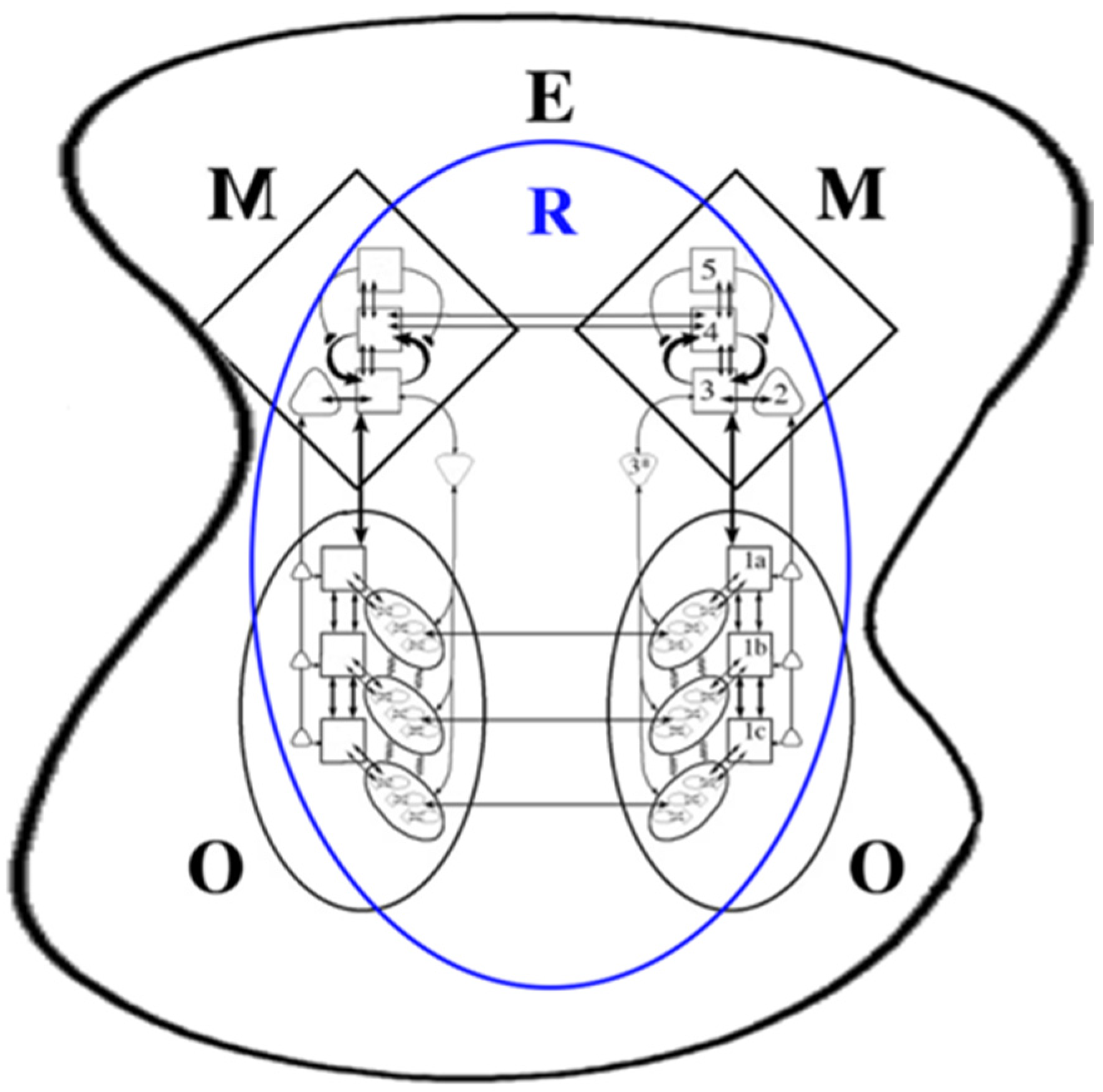
The VSM diagram has been redrawn to make inter-system interactions explicit.
As depicted in
Figure 1, interactions occur between systems as long as each system has the capacity to receive, interpret, and send information.
Each interaction is dependent on and affects the structures as elaborated in Equations (1) and (2).
In Equations (1) and (2), the interaction function parameters are elaborated as follows:
The environment (E) comprises the general structural conditions that enable interactions and sustain the existence of the systems involved in the observed interaction.
The management subsystem of System 1 (M1) guides the mechanisms required to conduct the interaction, while the operational subsystem (O1) executes these mechanisms.
Analogously, the management subsystem of System 2 (
M2) governs interaction-related mechanisms, and the operational subsystem (
O2) [
27].
Relations between Systems 1 and 2 (R1,2) refer to structures specifically established to facilitate interaction between S1 and S2.
Network of Interactions
Interactions are shaped not only by existing structures but also by a wider network of related interactions. Interaction observation is particularly valuable where structures are not fully understood or where processes need to be redesigned to influence higher-level outcomes. However, interactions are more difficult to observe, recall, and analyse than structural results, which justifies the need for structured observational tools to support their systematic examination.
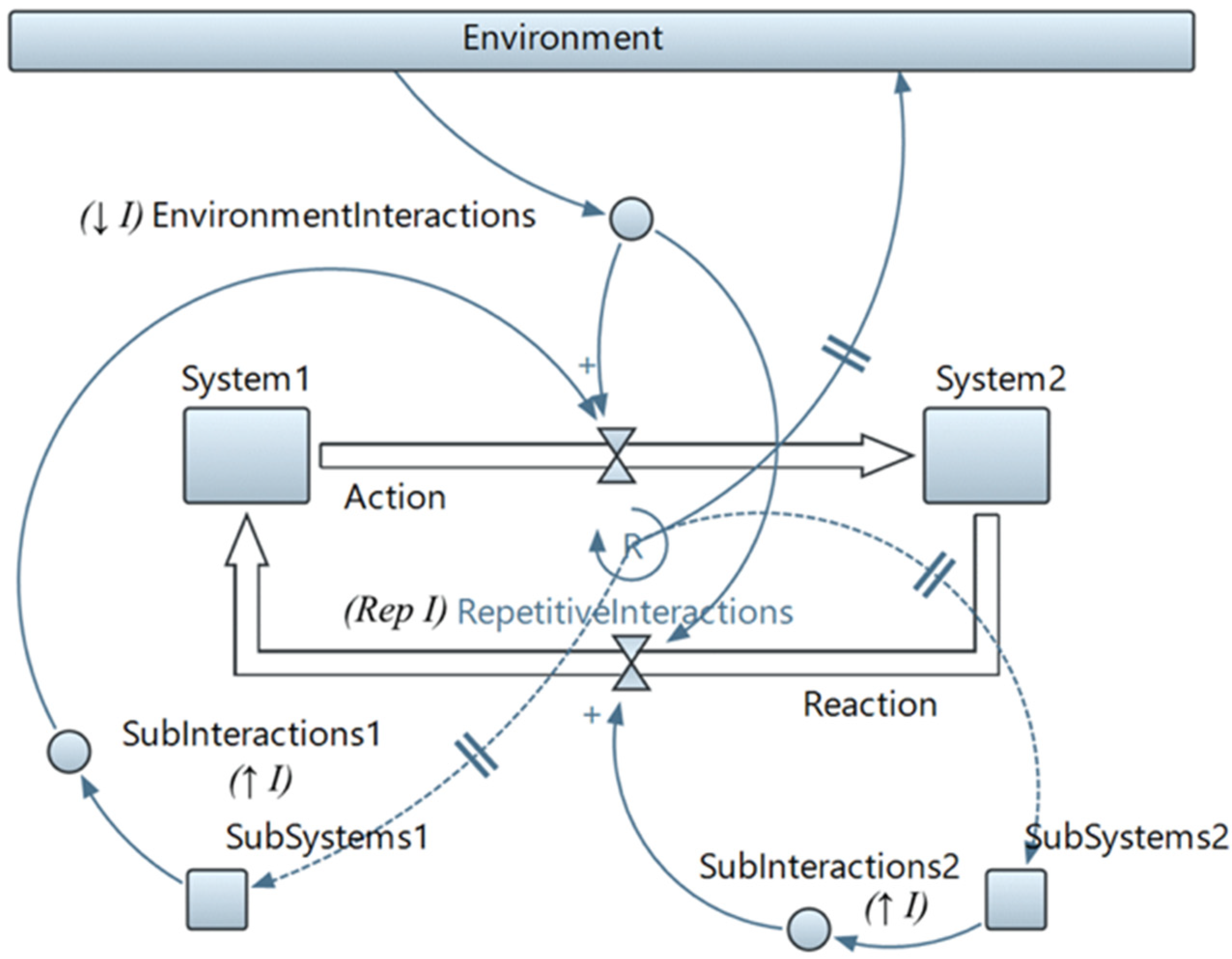
Figure 2 illustrates a cyclical and recursive network of interactions grounded in systems dynamics. At the micro level, the observed interaction unfolds as repeated action–reaction cycles, in the longer run, the observed interaction itself develops a series of interactions shaped by prior outcomes and future expectations. Some interactions are recursive, such that an environment interaction at one level becomes the focal interaction at a higher level and a sub-interaction at another.
In Equations (3) and (4), we can identify multiple interactions that are related to the observed interaction:
Repetitive interactions (Rep I) occur in cycles, where outcomes of earlier interactions influence subsequent ones. Sub-interactions (↑ I) are lower-level interactions embedded within the observed interaction, while environment interactions (↓ I) are higher-level interactions of which the observed interaction forms a part. Loosely related interactions (? I) lack a direct hierarchical relation but may still influence execution. Each interaction type may function as either supportive (→ I) or constraining (← I) for the observed interaction.
Repetitive interactions (Rep I) are often the primary drivers of new interaction patterns, emerging autopoitetically from previous cycles. Their importance lies in generating continuity with minimal structural change. While this makes them energy-efficient, it also introduces risk, as limited adaptation in support and control structures may constrain long-term system development.
The interaction-observation framework integrates these structural and interactional perspectives to support a holistic yet analytically structured representation of complex interactions. Because such complexity often exceeds individual cognitive capacity, the framework is intentionally descriptive and systematic, enabling later synthesis, comparison across cases, and AI-supported analysis rather than premature reduction to outcome variables.
2.2. Interaction Observations Framework
Observation Design and Analytical Dimensions
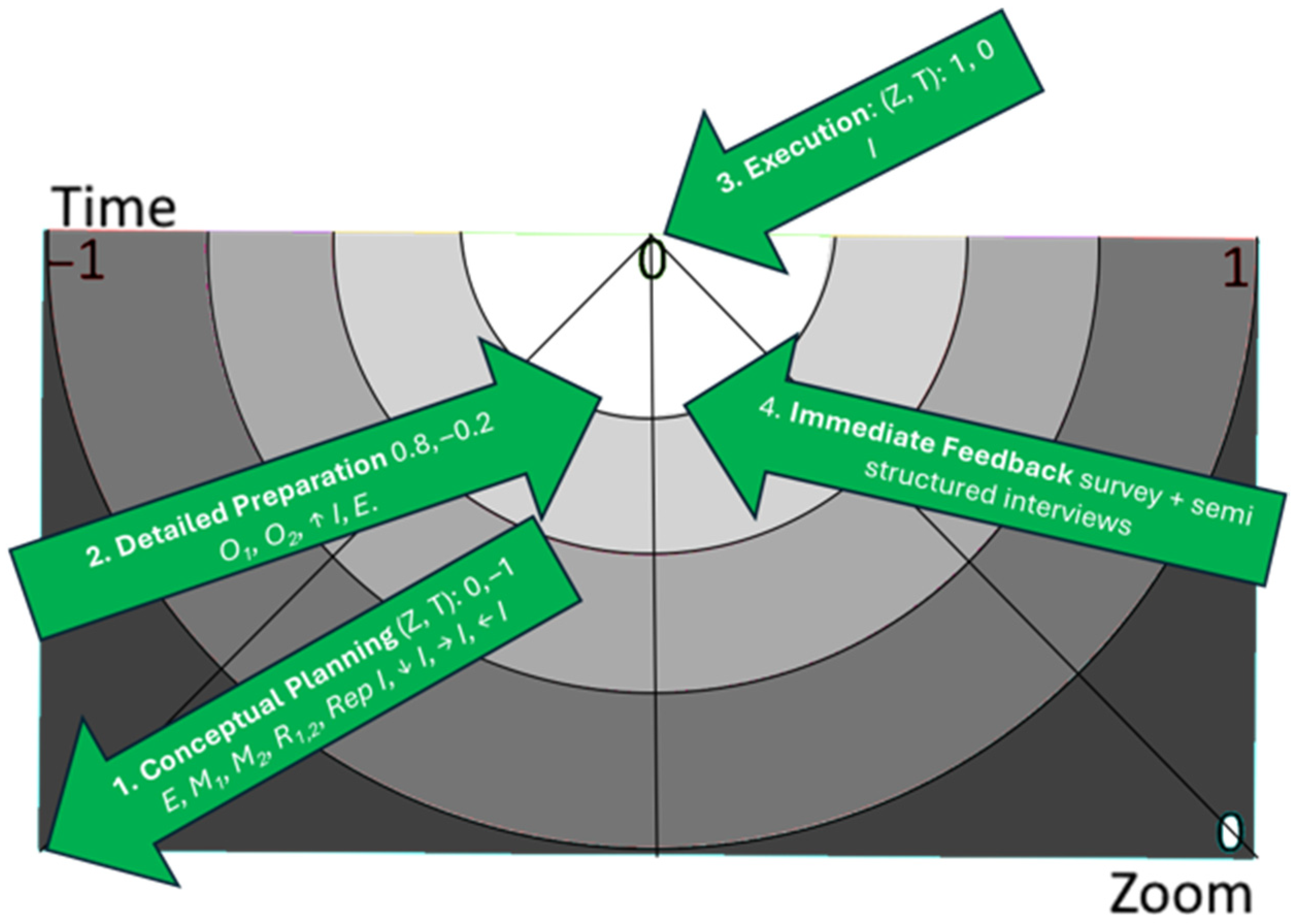
As depicted in
Figure 3, the study adopted the
CyberSystemic coordinate model [
23], which expresses each observation through two variables:
Z(zoom), the observer’s degree of the zoom level, ranging from examining the environment (Z = 0) to examining the interaction details (Z = 1); and
T, the temporal orientation, ranges from examining the pre-interaction stages (−1 ≤ T < 0) to real-time observation (T = 0) to post-interaction anticipatory implications (0 < T < 1).
The combination (
Z,
T) represents both the observer’s epistemic stance and the temporal distance from the observed system, allowing for reflection across multiple cognitive horizons. Four observation points were selected for this study (
Table 1):
Project planning (Z = 0, T= −1). We start by zooming out to see the whole picture at the time when the idea of the MICENE project emerged. Focusing on the environment E; teaching institutions (S1) and students (S2), management systems (M1, M2), relations between teachers and students (R1,2), series of previous repetitive interactions (Rep I); and super interactions (↓ I), which can be supportive and constraining (→ I, ← I).
Detailed Preparation (Z = 0.8, T = −0.2). The observation point examines the interaction immediately before execution, focusing on how planned interactions were translated into operational readiness. The emphasis is on the consolidation of structures required for execution rather than on interaction outcomes. Observations concentrate on the configuration of operational systems (O1, O2) and the formation of sub-interactions (↑ I) intended to support execution, providing insight into how interaction capacity was constructed and constraints anticipated prior to enactment.
Execution (Z = 1, T = 0). Reports observable interactional phenomena that occurred during the enactment of the planned sub-interactions. The focus is on real-time interaction patterns, focusing on supportive and constraining micro-interactions (→ I, ← I),
Immediate Feedback and Follow-Up (Z = 0.8, T = 0.2). Examines immediate post-execution effects, focusing on how the environment and participating systems respond once the interaction concludes. Observations concentrate on feedback from teacher and student subsystems and on after-event interactions. Analysis at this stage addresses observable changes in operational systems (ΔO1, ΔO2), as well as immediate effects on repetitive interactions (ΔRep I) and relations between systems (ΔR1,2).
2.3. Student Survey and Semi-Structured Interviews of the MICENE Pilot Course
The second methodological pillar consists of feedback mechanisms for students participating in the MICENE pilot program (
https://micene.conform.it/). The close-ended survey provided quantifiable feedback and was complemented by qualitative insights from semi-structured interviews.
The survey involved 42 respondents out of approximately 80 students who participated in the pilot course, resulting in a response rate of about 52%. Students answered 25 close-ended questions organised into five thematic blocks using a 5-point Likert scale (1 = Not at all, 5 = Completely) [
29]. Participants from four countries—Italy, Spain, Lithuania, and Slovenia—were involved in the project and subsequently the survey. The sample consisted of undergraduate and master’s students, predominantly enrolled in business and economics programmes, with a small number of exceptions. The survey was administered immediately after course completion; responses were received within the final two months of the project.
The survey was purpose-developed to align with the MICENE project and the interaction-observation framework. It was not adapted from a single validated scale, as its primary role was to support contextual interpretation of observed interactional dynamics rather than psychometric measurement. In this sense, the survey complements interaction observation by capturing internal activation, regulation, and reflection processes that are not directly observable during execution.
Descriptive statistics (mean, median, and standard deviation) were calculated for each block.
Given the ordinal nature of the survey data collected using 5-point Likert scales, non-parametric statistical methods were applied. Spearman’s rank correlation coefficient (ρ) was selected to examine associations between thematic survey blocks, as it does not assume a normal distribution and is appropriate for monotonic relationships between ordinal variables. This choice aligns with the study’s exploratory and descriptive aims, which seek to identify interactional patterns and relational tendencies rather than test causal hypotheses. Statistical significance was assessed using two-tailed tests with a threshold of p < 0.05.
The examination was designed to provide another perspective on the interaction observations, offering first-order evidence of how learners experienced multiple aspects of the learning programme. It addressed the observed interaction parts:
Engagement and motivation fostered by gamification;
Usability and accessibility of the digital learning platform;
Quality of teacher–student and peer on-site and online interactions;
Project work with real-life organisations;
Perceived development of systemic, critical, and collaborative competencies.
Three semi-structured six-question live interviews with students were conducted approximately two weeks after course completion to complement the general feedback gathered through the survey. All students who participated in the pilot course were invited to take part in the interviews; three students responded within the available timeframe and were therefore interviewed.
The interviews were explicitly framed as future-oriented feedback (feedforward) intended to inform proposed adaptations in O1 and M1 rather than to provide evidence of realised structural change. Participants were provided with the interview questions in advance. During the interviews, responses were recorded, transcribed, anonymised, and subsequently combined for manual thematic analysis. Due to the small number of interviewees and the anonymisation procedure, individual trajectories were not compared with non-respondents.
2.4. Integration of Methods
Integrating the interaction observation, student survey, and semi-structured interviews provides a multi-level analytical lens:
The interaction observation represents a second-order semi-structured set of views, a reflective synthesis of systemic functioning and design coherence.
The survey and interviews provide a first-order view of direct, experiential data on learner engagement and perception.
Together, they form a recursive model of inquiry where the observers’ reflections and participants’ experiences validate and inform one another. This multi-method design aligns with the principles of the Viable System Model, ensuring that learning processes are examined simultaneously from the perspectives of system regulation and system experience.
This study adopted a second-order cybernetic position, treating the observer as part of the system under observation and distinguishing explicitly between the observed interaction, proposed adaptation, and structural change that remains temporally unobservable.
3. Results
3.1. Project Planning (Z = 0, T= −1)
We begin by introducing the project’s big picture, the structures that enable and frame the project, and the interactions that lead to the formation of the proposal.
3.1.1. Environment E
At this level of observation, the environment comprises the institutional, policy, and infrastructural conditions that made the MICENE project possible. It also includes selected features of the professional and industrial ecosystem in which the project is embedded, but the core enabling structures remain academic and organisational.
Policy and regulatory frameworks: The European Higher Education Area (EHEA) and the Bologna Process [
30] provide the procedural foundation for inter-university collaboration, credit recognition, comparable learning outcomes, and quality-assurance mechanisms.
The EU Digital Education Action Plan [
31] supports the experimental use of digital tools and AI in higher education, legitimising the project’s hybrid format. Erasmus+ Cooperation Partnerships [
32] provide the financial and administrative framework for cross-institutional work in the EU and beyond.
Data-protection and mobility regulations [
33] set the operational boundaries for sharing learning analytics and hosting students in hybrid environments.
Erasmus+ projects provide financial support for joint teacher work, project meetings, short student exchanges, and digital infrastructure costs. Additionally, the policy supports integration with MICE-related non-teaching organisations.
- 2.
Cultural and linguistic frameworks: None of the participants shares a native language, yet English serves as a functional lingua franca, reflecting its role in both international education and the MICE-related service sectors. The use of real-time translation is promising, but it still falls short of enabling fluid communication in national languages.
Communication protocols and common tools emphasise clarity and visualisation using templates, structured agendas, common documents, and communication platforms such as Microsoft Teams. The culture of collaboration values punctuality, documentation, and role clarity, mirroring established EU-project conventions rather than industry practice.
- 3.
MICE sector as contextual enabler: The MICE field provides a familiar coordination model, planning, execution, and feedback that aligns conceptually with the project’s teaching design. Industry partners contribute occasional inputs such as case examples, guest lectures, or feedback on student projects.
MICE involvement introduces authenticity and external validation but does not shape the project’s internal governance or methodological design.
- 4.
Digital Technology development: Digital technology, especially with the AI set of tools, provides new options for designing more dynamic student interactions, even with larger student groups. Currently, the tools used require a higher level of technical knowledge from the teacher or involve organisations specialised in designing interactive learning environments [
34], such as the use of AI bots in the teaching process [
35]. The pace of technological change also undermines stability: materials or configurations developed in one academic cycle often become obsolete within months, complicating continuity and assessment [
36].
3.1.2. Teaching Institutions (S1) and Their Management Systems (M1)
At Z = 0, T = −1, teaching institutions formed the operational foundation of the project. Each institution represented a distinct but structurally similar S1 system, composed of academic, administrative, and technical components. Within these, the management subsystems (M1) maintained internal coordination and regulatory compliance, while individual teachers functioned as the operational agents executing the system’s educational purpose.
Institutional configuration (M1 within S1): The management subsystems were already established through formal procedures typical of higher education institutions: project offices, finance departments, and e-learning coordinators.
Their role was to ensure compliance with national and European standards, control budgets, allocate workloads, provide quality assurance, and protect personal data. This stabilised the system but introduced procedural inertia.
Because MICENE was integrated into existing teaching structures, it inherited both the strengths (accountability, continuity) and weaknesses (slow adaptation, rigid communication) of institutional management.
The organisation’s strategic management and existing support structures provided incentives that enabled teachers to act as part of the management subsystem (M1). Although teachers typically act as operational agents, in projects like MICENE, they assume the role of expanding the capacity of the teaching institution, thereby linking management protocols to learning activities. Their responsibilities included project planning, curriculum design, communication with other institutions and students, thus translating project goals into practical applications.
Teachers also challenged organisational support to adapt to the project’s requirements, thus preparing the S1 for future projects.
- 2.
Coordination and internal communication: Interactions between M1 and teachers followed a network pattern. By co-planning and co-management, teachers were selected as representatives of the organisation towards other institutions and the project financiers. The internal feedback structure therefore functioned, but with a high frequency, ensuring compliance and rapid innovation.
3.1.3. Students (S2) and Their Management Systems (M2)
At Z = 0, T = −1, students were anticipated to form a heterogeneous subsystem (S2) whose structure would be primarily cognitive and behavioural rather than institutional.
Unlike the teaching institutions, they were not expected to contribute formal management apparatus; rather, they were presumed to bring internalised models of learning shaped by generational experience, digital culture, and institutional expectations.
Their internal management (M2) was projected to rely on self-regulatory mechanisms, including time management, communication habits, attention allocation, and motivation strategies, which would later condition how they participated in and responded to the interaction.
Their motivation was expected to combine a pragmatic career orientation toward MICE with curiosity about novel digital formats and a desire to influence the learning process to better align with their expectations. Access to vast, AI-mediated knowledge was assumed to extend their preferences from acquiring formal content toward seeking instant experiential understanding.
These expectations were not well-aligned with conventional university frameworks, in which learning goals are predefined and feedback is externally provided.
- 2.
Behavioural patterns and digital orientation: As members of Generation Z, students were expected to be fluent in digital communication, comfortable with multitasking, and oriented toward short feedback loops.
They were presumed to perceive digital tools not as technical aids but as natural extensions of interaction. Such fluency was expected to increase the potential for dynamic engagement but to reduce tolerance for ambiguity or delayed response, a behavioural bias toward immediacy that could conflict with the slower rhythm of institutional procedures.
Communication was anticipated to be multimodal and informal, often bypassing official platforms in favour of peer-based digital channels.
- 3.
Self-organisation and coordination: The student subsystem was expected to display features of distributed self-management. Small peer groups would likely form around shared interests or tasks, developing local coordination practices with limited institutional oversight.
These emergent microstructures were envisioned to provide agility and mutual support but were perceived as lacking persistence and accountability. M2 was therefore expected to operate as an internal regulatory function balancing effort, social belonging, and goal orientation without formal hierarchy or stable organisational memory.
3.1.4. Relations Between Teachers and Students (R1,2)
At Z = 0, T = −1, relations between teachers (S1) and students (S2) were grounded in pre-existing institutional and interpersonal connections.
Most participants had already interacted through earlier courses, advising sessions, or administrative exchanges within their home institutions.
These prior experiences provided a relational baseline, a shared understanding of roles, expectations, and communication styles that shaped how both sides approached the forthcoming MICENE interaction.
Teachers, aware of these precedents, approached the MICENE project as an opportunity to extend existing relationships into a trans-institutional context, maintaining familiar forms of guidance while introducing more participatory modes of learning.
- 2.
Feedforward: The communication plan focused on clarifying what students should expect from the MICENE course: a different rhythm, more collaborative assignments, and exposure to international peers.
Teachers sought to align institutional expectations with project objectives, emphasising self-organisation, cross-cultural teamwork, and experimental learning formats. However, it also revealed potential friction points where institutional norms (grading, attendance, formality) met the students’ expectations for autonomy and solution-focused group work.
- 3.
Communication: This was expected to rely on multiple channels: university email systems, LMS announcements, onsite, and online class meetings, internal group communication, each with its own tempo and content.
Teachers anticipated using formal tools to maintain structure and documentation; students, however, viewed them primarily as coordination instruments rather than as spaces for reflection or feedback.
This difference in perceived purpose reflected the asymmetry of R1,2 at this stage: teachers sought to preserve continuity, whereas students interpreted the project as an experimental addition to their routine studies.
3.1.5. Series of Previous Repetitive Interactions (Rep I)
At Z = 0, T = −1, the project environment was structured by a set of repetitive interactions that had occurred before MICENE’s conception.
These recurring exchanges among institutions, teachers, and students formed a background pattern of communication and collaboration that defined what participants considered “normal” academic cooperation.
Institutional precedents: Most universities involved in MICENE had already collaborated through earlier Erasmus+, joint-degree, or mobility projects. These experiences created a stable infrastructure of trust and procedural knowledge—partners knew how to exchange documents, report outcomes, and coordinate schedules. Assessed as a supportive interaction (→ I).
Repetition across project cycles generated institutional reflexes: templates for budgets, memoranda, and teaching plans. However, these reflexes also hardened into routines that favoured predictability over innovation, framing MICENE initially as “another project” rather than a qualitatively new interaction. Assessed as a constraining interaction (← I).
- 2.
Academic and professional collaboration: Some teachers had cooperated previously in conferences, joint publications, or earlier cross-institutional courses. These interactions fostered informal professional networks that eased coordination and accelerated early decision-making. Working on a project resulted from these collaborations. Assessed as a supportive interaction (→ I).
- 3.
Teacher–student interactions: Within each institution, teachers had established recurring patterns of interactions with their students—office hours, feedback cycles, and digital communication routines. These micro-level repetitions defined expectations about responsiveness, authority, and grading logic. Assessed as a supportive interaction (→ I). When projected onto the MICENE project, such expectations provided continuity but also constrained imagination: students anticipated the same transactional rhythm, while teachers approached the new course using familiar pedagogical schemas. Assessed as a constraining interaction (← I).
- 4.
Organisational memory and learning through interactions: Across these layers, repetitive interactions built organisational memory. They provided stability, shared vocabulary, and procedural reliability. However, their repetitiveness also produced path dependence—a tendency to interpret new challenges through the lens of prior experience.
To further expand the system’s learning capacity, a combination of preserved functional coherence and conceptual novelty was provided within each interaction. Assessed as a supportive interaction (→ I).
3.1.6. Super Interactions (↓ I)
National and institutional policy changes: Parallel reforms in higher-education funding, mobility support, and digital-learning incentives influenced what partners could realistically commit to. Although external to MICENE, these adjustments conditioned the institutional readiness to participate and shaped expectations regarding administrative flexibility. Assessed as a supportive and constraining interaction (→ I, ← I).
Erasmus+ agencies’ presentations and dissemination activities: Before the project application, several Erasmus presentations were introduced and elaborated on the policies and frameworks available for conducting cross-institutional cooperation, outlining the options and frameworks. These interactions were intended to encourage the initiatives to participate in such projects and, at the same time, to assess the organisational capacity to undertake the project. The events were coordinated with the publishing project-related information and procedural documentation, such as application forms. Assessed as a supportive interaction (→ I).
3.1.7. Loosely Related Interactions (? I)
At Z = 0, T = −1, a set of peripheral interactions surrounded the MICENE project. They were not part of the formal preparation process but shaped the environment in which the project emerged, influencing motivation, readiness, and the perceived relevance of its objectives.
Inter-institutional coordination: Before the project proposal was finalised, partner universities held several coordination meetings—both online and during Erasmus events—where the project concept, course content, and division of responsibilities were discussed.
While no formal commitments had been made, these early discussions have built trust and procedural familiarity that would carry over into the project phase. Assessed as a supportive interaction (→ I).
- 2.
In-house departmental collaboration: Within individual institutions, teachers organised departmental meetings to explore how the new project could connect with existing courses and resources. These internal discussions often revisited earlier project experiences or joint courses, drawing on established routines for course approval, scheduling, and assessment. Assessed as a supportive and constraining interaction (→ I, ← I).
- 3.
Disciplinary and professional networks: Teachers and coordinators were simultaneously active in professional associations, industry events, and MICE-sector networks. Discussions on digitalisation, sustainability, and post-pandemic recovery indirectly framed the project’s thematic direction and created awareness of shared challenges across institutions. Assessed as a supportive interaction (→ I).
- 4.
Technological experimentation: Several departments were independently testing AI-based teaching tools, virtual-event platforms, and online collaboration systems. Although unrelated to the project itself, these pilots enhanced technical preparedness and influenced attitudes toward hybrid teaching. Differences in local experience with technology later affected coordination and task distribution. Assessed as a supportive interaction (→ I).
- 5.
Socio-cultural and linguistic context: Since all partners operated in non-native English environments, previous exposure to international cooperation—through conferences or joint courses—provided a shared linguistic and cultural frame. Assessed as a supportive interaction (→ I).
- 6.
Institutional rhythms and seasonal cycles: Academic calendars, examination periods, and budget deadlines are defined when planning activities can occur. These institutional cycles constrained the timing and continuity of meetings and decisions, exerting a subtle yet constant influence on the environment. Assessed as a constraining interaction (← I).
3.2. Detailed Preparation (Z = 0.8, T = −0.2)
This observation point examines the interaction immediately before execution, focusing on the final configuration of operational structures and sub-interactions. It captures how preparatory activities shaped the internal capacity for interaction between S1 (teachers) and S2 (students).
3.2.1. Teaching Institutions (S1) Operational Systems (O1)
At Z = 0.8, T = −0.2, the project moved from general planning to finalising its operational preparation. Teaching institutions (S1) activated their operational systems (O1) to make the course teachable. The structures supporting this readiness were designed to ensure alignment between conceptual planning and execution. They represent the stabilised outcome of multiple preparatory interactions: the syllabus design from Project Work Package (WP) 2, the development of digital and contact-learning materials in WP3, and the creation of the technical and organisational conditions for delivery.
Curriculum structure: Defined in WP2, the curriculum provides the didactic framework of the course: thematic scope, intended learning outcomes, partner responsibilities, and the sequencing of 16 modules. It allocates module ownership to individual institutions and defines the delivery format (self-learning in the form of microlearning pills, live and recorded lectures, and group project work).
Curriculum content: The lecture materials are provided in PowerPoint format, ready for teachers to deliver online and in person. The self-learning materials developed in WP3 are organised into self-contained modules following a shared internal architecture: an introduction, a core learning unit, and a reflective or self-assessment component, embedded in a microlearning logic. The project work supporting structures are minimalistic. They provide tasks, guidelines, and support for contact resources to facilitate self-study, where learning materials are prepared in English and translated into the national languages of project team members.
Technical structure: The digital delivery environment serves as the system’s technical backbone. For lectures and project work, MS Teams is used to support lecture delivery, communication, and the storage of course materials. The self-study/gamification activity, supported by the dedicated platform Erudire [
37], introduces interactive learning methods and follows the student learning process through a uniform set of file conventions and metadata. It provides students with the means to self-assess their acquired knowledge and employs gamified learning techniques, such as scenario planning, meeting participation, treasure hunts, and more.
Microlearning pills are short, self-contained interactive learning units designed to address a focused concept or task. Each unit combines concise instructional content with built-in self-assessment tools (e.g., quizzes, reflective prompts, or interactive exercises) that allow learners to test their understanding independently. In this study, microlearning pills were available asynchronously and intended to provide alternative engagement paths alongside synchronous instruction [
38].
Organisational structures: The organisation is distributed among participating institutions through defined roles: teachers, providing content, tutors assisting in student teams’ self-organisation, mentors providing business case insights, and technical support supporting the usability of technical structures. The project leading team coordinates the organisational structures.
Assessment and evaluation structures: Evaluation mechanisms were established to monitor course effectiveness and partner contribution on two levels: automatic checks are placed in microlearning pills to validate the students’ understanding of the concept. In-depth validation of student group performance focused on observing their activity and the results of project work. Assessment tools were standardised to ensure comparability of student performance and course outcomes.
Communication and documentation structure: Consistent with Erasmus+ management conventions, communication was formalised through MS Teams channels, shared drives, and standardised templates. Student groups were formed to store their work-in-progress. Students were encouraged to establish their own inter-project communication channels. Meeting minutes, module drafts, document development, and feedback reports were archived.
From a cybernetic perspective, O1 embodies the system’s capacity to absorb external variety at the interaction execution phase, maintaining viability through structural resilience and procedural clarity.
3.2.2. Students (S2) Operational Systems (O2)
At Z = 0.8, T = −0.2, students (S2) had not yet entered the execution phase, but the structures shaping their operational readiness were already in place. Unlike S1, which formalises operational structures, O2 consists primarily of affordances, expectations, and preparatory mechanisms that enable students to engage with the course once it is launched. These structures do not guarantee performance; rather, they define the conditions under which participation becomes possible.
Digital skills: Students were expected to understand the technologies central to self-learning: navigating microlearning pills, accessing course content, and using communication tools. Their digital competencies were assumed to exceed those of teachers, an asymmetry that makes the pilot particularly relevant for analysing hybrid teaching settings.
Group formation and coordination scaffolds: WP4 introduced predefined mechanisms for forming multinational student teams. Since participants were drawn from different institutions and countries, their prior experience with group work, expectations, and coordination practices differed considerably. These heterogeneities form part of O2 and shape the likely starting conditions for later cooperation.
MICE-related knowledge and experience: Most students were enrolled in business or economics programmes, implying some familiarity with the theoretical foundations of the MICE sector. A subset also possessed practical experience from participation in events or related industry activities. This domain-specific preparedness serves as an enabling condition but varies widely among individuals.
Cultural and linguistic preparation environment: Students bring their own linguistic and cultural backgrounds, while the project environment pre-structures communication norms—English as the working language, templates for group outputs, and instructions emphasising clarity and documentation. These elements stabilise the expected communication practices of O2 and condition how students will later coordinate and contribute.
From a cybernetic perspective, O2 functions less as an internalised operational system and more as a set of enabling interfaces. It provides the minimal scaffolding required for S2 to participate meaningfully in the forthcoming interaction, compensating for the absence of formal management structures within the student subsystem.
3.2.3. Sub-Interactions (↑ I)
At Z = 0.8, T = −0.2, a set of preparatory sub-interactions (↑ I) connected the emerging systems S1 and S2. These sub-interactions were not yet the execution of the learning process itself, but rather immediate precursors that enabled it. They were short, targeted, and often technical or organisational in nature, but collectively, they determined the system’s ability to transition into the pilot (Z = 1, T = 0). The reported interactions are merely those the observer deemed important enough to publish. There are several formal and informal supporting interactions in the project.
Teacher coordination and module alignment: Teachers met (online and in person) to harmonise module materials, finalise learning outcomes, revise the sequence of activities, and ensure consistency across institutions. This included reviewing the WP2 curriculum specifications, integrating WP3 materials, and adjusting content to align with the pilot’s time allocation. The coordination meetings involved a lot of individual work and smaller interactions.
Technical configuration and testing: Prior to student engagement, teachers and technical staff conducted platform tests—uploading content to Erudire, configuring MS Teams channels, verifying access rights, testing assignment repositories, and ensuring that microlearning pills functioned seamlessly. Some of these interactions were actually conducted during the start of the execution phase.
Formation of multinational teams: Based on the WP4 guidelines, teachers initiated the procedures for assigning students to international groups. This involved collecting enrolment data, mapping availability, monitoring balances across institutions, and establishing initial communication channels for each group.
Orientation and expectation-setting: Teachers prepared introductory materials (slides, short videos, written guidelines) to communicate the course logic, assessment criteria, and expected work rhythm with the students. However, the level of detail did not fully meet the student expectations.
Pre-pilot pedagogical design decisions: Teachers jointly refined the flow of the pilot session—the sequence of lectures, timing of group tasks, coordination of breakout rooms, and the anticipated role distribution between teachers, tutors, and mentors, formulated in the MICENE teaching manual.
From a cybernetic perspective, these sub-interactions (↑ I) represent the system’s fine-tuning process: local adjustments, alignment activities, and synchronisations that allow the higher-level interaction (the pilot) to emerge coherently.
3.3. Execution (Z = 1, T = 0)
This section reports observable interactional phenomena that occurred during the enactment of the planned sub-interactions. The observation focuses on real-time interaction patterns between teaching institutions (S1) and students (S2), with particular attention to supportive and constraining micro-interactions (→ I, ← I) as they became visible during execution. The execution unfolded over a four-week intensive course involving approximately 80 international students, 16 online lectures and seminars, self-learning microlearning pills, and group-based project work oriented toward the design of a real MICE event.
3.3.1. First Execution Phase
At the beginning of execution, interaction was strongly teacher-centred. Lectures and seminars were delivered primarily in plenary online settings, with communication flows predominantly directed from S1 to S2. Student responses were sparse, and interaction was largely limited to procedural clarification questions. Although the digital infrastructure (O1) mainly functioned as planned, the volume and density of delivered content exceeded the capacity of many students. This became visible through prolonged silence, limited use of interactive features, and delayed initiation of group coordination.
Group formation was initiated during this phase, but observable collaboration within several groups remained weak or uneven. In some teams, participation was asymmetrical, with a small number of students assuming responsibility while others remained passive. Feedback loops were therefore delayed, and self-organisation processes within O2 were only partially activated.
3.3.2. Second Execution Phase
As deadlines approached, interaction patterns shifted. Student activity increased noticeably, and communication frequency intensified, particularly within project groups. Students began to draw more actively on available materials, including lecture recordings, microlearning pills, and external resources, and initiated more frequent contact with tutors and mentors. While plenary interaction between groups remained limited, intra-group coordination became more visible, supported by both formal platforms and informal communication channels.
Throughout execution, interaction remained asymmetric at the macro level, with S1 framing tasks and maintaining temporal structure. The focus on addressing real-life cases resulted in student-led self-coordination within groups, indicating partial decentralisation of interaction control.
3.3.3. Supportive Micro-Interactions (→ I)
Several micro-interactions supported the unfolding of execution, augmenting interactional dynamics and increasing the system’s capacity to absorb situational variation without interrupting execution:
Provision of alternative access paths. The availability of interactive microlearning pills and lecture recordings served as a compensatory interaction, enabling students to re-engage with content outside of synchronous sessions when immediate comprehension was limited.
Targeted tutor and mentor interventions. Short, focused meetings with tutors and industry mentors provided procedural and conceptual clarification during project work. These interactions supported the activation of O2 by lowering the coordination thresholds and enabling students to proceed despite uncertainty.
Emergent peer coordination. In several groups, informal leadership and task distribution appeared without explicit instruction. These micro-structures supported internal coordination and reduced dependency on S1 for operational decisions.
3.3.4. Constraining Micro-Interactions (← I)
At the same time, constraining micro-interactions limited interactional fluidity and delayed coordination, which in most cases did not halt execution but shaped its rhythm, sequencing, and asymmetry:
Cognitive overload during synchronous delivery. The density and duration of early lectures constrained student responsiveness. Observable indicators included prolonged silence, limited questioning, and delayed uptake of concepts in group work.
Delayed activation of group self-organisation. In several teams, collaboration did not commence immediately after group formation. Uneven participation constrained feedback loops and placed additional coordination demands on more active members.
Competition-induced isolation. Since student groups were competing for recognition, interaction between groups was minimal. This constrained cross-group knowledge exchange, limiting the emergence of collective intelligence beyond local team boundaries.
Platform asymmetry. While formal platforms supported documentation and coordination, students frequently migrated to informal communication channels. This improvement in intra-group efficiency, however, constrained visibility for teachers, limiting their capacity to intervene proactively.
Student churn: Several students who volunteered for participation stopped active participation as they encountered external pressure or could not clearly identify themselves with the course execution.
3.3.5. Emergent Phenomena During Execution (ΔO1 and O2)
Despite extensive preparation, several interactional phenomena emerged during execution that were not explicitly planned and demanded adaptation of O1 and O2:
Sustained silence and partial adaptation in instructional practice (ΔO1). Student silence during plenary sessions persisted throughout execution, altering the expected feedback dynamics. Teachers responded by introducing localised interaction formats, such as addressing students within smaller groups and activating additional communication between local teachers and students. However, the overall structure of plenary delivery remained unchanged, and silence continued to function as a stable interactional feature.
Uneven activation of digital learning resources without systemic correction (ΔO2/no ΔO1). Although microlearning pills were continuously available, their use remained uneven across students. No collective adjustment was introduced to encourage or standardise their uptake during execution. As a result, individual and group-level differences in O2 persisted, with some students integrating these resources into their work and others relying primarily on lectures or peer coordination. The absence of coordinated adaptation suggests that O1 did not intervene to compensate for variability in O2 activation during execution.
Emergent self-organisation with limited institutional integration (ΔO2/no ΔO1). In several multinational teams, rapid internal coordination and task distribution emerged early, supported by informal leadership and communication rhythms. While these adaptations strengthened O2 locally, they were only marginally introduced into shared practices across teams or incorporated into the broader organisational structures.
3.4. Immediate Feedback and Follow-Up. (Z = 0.8, T = 0.2)
Immediately after execution, this observation point examines how the environment and participating systems respond to the interaction. The focus is on immediate feedback from teacher and student subsystems and on the emergence of after-event interactions, capturing early indications of structural adjustment and relational change.
3.4.1. Changes in System 2 Operational Systems (ΔO2)
In this observation, System 2 operational systems (O2) are understood as the cognitive, behavioural, and self-organising mechanisms through which students participate in and adapt within an interaction. O2 operates primarily through internal processes that become visible indirectly—through behaviour during execution and through post-execution self-report.
Three analytically distinct but interrelated O2 processes were considered: activation, regulation, and reflection. These were not treated as linear stages but as functional modes that may overlap and recur during execution.
Activation refers to the transition from passive availability to active engagement. In this study, activation was observed through participation in practical activities and group work, as well as through the reported usefulness of sessions oriented towards activation.
Regulation describes how students manage engagement once activated—allocating effort, coordinating within groups, and selecting resources.
Reflection refers to the process of consolidating and reinterpreting experiences. This was operationalised through survey items related to debriefing and future commitments [
29].
Taken together, activation, regulation, and reflection form a loosely coupled operational loop.
Changes in the operational systems of students (S2) were examined through a student survey administered immediately after the completion of the pilot course. The survey complements interaction observation by capturing 42 valid student responses to 25 questions related to self-reported activation, regulation, and student reflection processes. Closed questions used a 5-point Likert scale (1 = “Not at all,” 5 = “Completely”). Survey questions were grouped into thematic blocks: Consistence, Lexicon, Contents, Navigation Functions, Text and Audio, Start Labs: Inspiration Session, Start Labs: Activation Session, Start Labs: Reflection Session, which reflected the structural and interactional dimensions of the course. For the analysis of ΔO2, the following blocks were the most relevant:
Table 2 summarises the descriptive statistics for blocks most directly associated with student operational behaviour.
Overall, students evaluated activation- and reflection-related elements positively, with medians consistently at 4 (“a lot”). However, standard deviations above 1 across all blocks indicate considerable heterogeneity in student experience, suggesting uneven O2 activation across participants.
In
Table 3, the relations between structural and interactional conditions are presented, using Spearman correlations (
ρ) between organisational, interactional, and reflection-oriented blocks.
All reported correlations are statistically significant and strong, indicating robust associations rather than isolated effects.
Interpretation: Observed Changes in O2
Activation and self-regulation: The data indicate a conditional activation of O2. Strong associations between organisational clarity and activation (ρ = 0.78) suggest that students’ operational engagement depended heavily on explicit structure, sequencing, and task framing. Activation was not continuous throughout execution but increased sharply once interaction became goal-directed and time-bounded.
This aligns with the execution observations: students initially adopted a passive stance and later shifted to active coordination during the project phase. The survey data thus capture a reconfiguration of self-regulatory strategies within O2—from receptive observation to deadline-driven action.
Reflection and internalisation: Reflection-related items were strongly associated with activation and inspiration phases, indicating that internalisation occurred primarily after active participation. Reflection functioned as a secondary regulatory layer, enabling some students to consolidate experience and articulate future-oriented commitments.
At the same time, higher dispersion in reflection scores suggests that O2 adaptation was uneven. For some in the cohort, reflection led to a meaningful restructuring of understanding; for others, it remained superficial, pointing to the limits of O2’s stabilising power within a single execution cycle.
Role of enabling structures: Notably, blocks related to technical quality and navigation showed weaker or non-significant associations with reflection. This confirms that while these elements stabilised participation, they did not drive changes in O2. Instead, O2 adaptation was primarily mediated by interactional pressure and social coordination, rather than the autonomous use of materials.
Based on survey evidence, changes in students’ operational systems (ΔO2) during execution can be characterised as follows:
- (1)
Activation increased under explicit interactional and organisational constraints;
- (2)
Self-regulation shifted from passive reception to task-oriented coordination;
- (3)
Reflection supported partial internalisation but did not uniformly stabilise O2;
- (4)
Enabling structures functioned as stabilisers rather than drivers of change.
In cybernetic terms, O2 demonstrated adaptive responsiveness rather than structural transformation. The observed changes indicate increased capacity to engage under structured interaction. At the same time, longer-term stabilisation of O2 is expected to depend on repeated interaction cycles and subsequent iterations of the course design.
3.4.2. Impact on the Relations Between the Systems (ΔR1,2)
At T = +0.2, changes in the relations between teaching institutions and teachers (S1) and students (S2) were examined through observable interaction patterns following the execution phase. In this study, relations (R1,2) were operationalised not as attitudinal states but as persistent interactional coupling, manifested through reciprocity, feedback continuity, and willingness to engage beyond formally required tasks.
Observed change in interaction quantity: A clear reduction in interaction quantity was observed immediately after execution. While approximately 80 students participated in the pilot course, only 42 completed the post-execution survey, representing a roughly 50% reduction in observable interactions initiated by S1. From an interaction-observation perspective, this constitutes a measurable decrease in interaction density rather than an absence of opportunity. The survey functioned as a follow-up interaction request; partial non-response therefore indicates partial decoupling of R1,2 at this stage.
This pattern suggests that R1,2 was situationally intensified rather than structurally stabilised. Interaction persisted while external constraints and incentives were present, but weakened once these were removed. In cybernetic terms, the relation demonstrated adaptive responsiveness during execution but limited capacity for self-sustaining continuation.
Relation to ΔO2 and execution dynamics: The observed ΔR1,2 aligns with findings related to ΔO2. Survey results indicate conditional activation and regulation of student operational systems, with engagement increasing under explicit organisational and interactional constraints. The post-execution reduction in interaction suggests that changes in O2 did not uniformly translate into sustained relational engagement with S1.
3.4.3. Proposed ΔO1 and ΔM1 (From the S2 Perspective)
As part of the immediate feedback and follow-up phase (Z = 0.8, T = 0.2), three semi-structured live interviews with students were conducted two weeks after the course completion. The interviews were explicitly framed as future-oriented feedback (feedforward) that informs proposed adaptations in O1/M1 rather than evidence of realised structural change. The interviews were designed to elicit forward-looking reflections, so that students could articulate how operational and management structures might be configured to support earlier activation, clearer coordination, and more stable interaction. Within the interaction-observation framework, these interviews function as a form of future-oriented observation, enabling the identification of proposed adaptations without conflating them with realised system change.
The interview data provide insight into how participants in S2 retrospectively interpreted the interaction, enabling the inference of structural conditions supporting future executions. The proposals emerging from these interviews primarily point to adaptations at the operational systems (O1) and management systems (M1) levels, as perceived from the student perspective.
Proposed Adaptations to Operational Systems (ΔO1)
Students articulated a need to structure the early phases of the course more explicitly, so that engagement could be activated earlier and with lower uncertainty. Clearer articulation of project objectives, expected outputs, and evaluation logic at the outset was identified as a way to align conceptual inputs with practical action, allowing students to relate lectures and microlearning materials directly to their project work.
Students further proposed adjustments to sequencing to distribute conceptual input and application more evenly across the execution period, so that cognitive load could be regulated while engagement remained continuous. Tighter temporal coupling among lectures, microlearning pills, and group tasks was described to support incremental activation of O2, enabling students to test their understanding through action rather than deferring application.
Early-stage group coordination emerged as another focal point. Students proposed structured kick-off interactions and initial low-threshold coordination tasks, so that peer groups could stabilise roles and working practices sooner. Such scaffolding was perceived to support self-organisation by reducing ambiguity at the moment of group formation, enabling collaboration to develop on a shared operational baseline.
Students also addressed the integration of support roles, proposing clearer visibility and timing of tutor and mentor involvement, so that assistance could be accessed efficiently when needed. This points to an adaptation of O1 that enhances anticipatory support, enabling a smoother navigation of academic and project-related challenges during execution.
Together, these proposals describe ΔO1 as a refinement of operational design, aimed at increasing anticipatory clarity and reducing early-stage uncertainty, so that student operational systems can activate with less reliance on situational improvisation.
4. Discussion
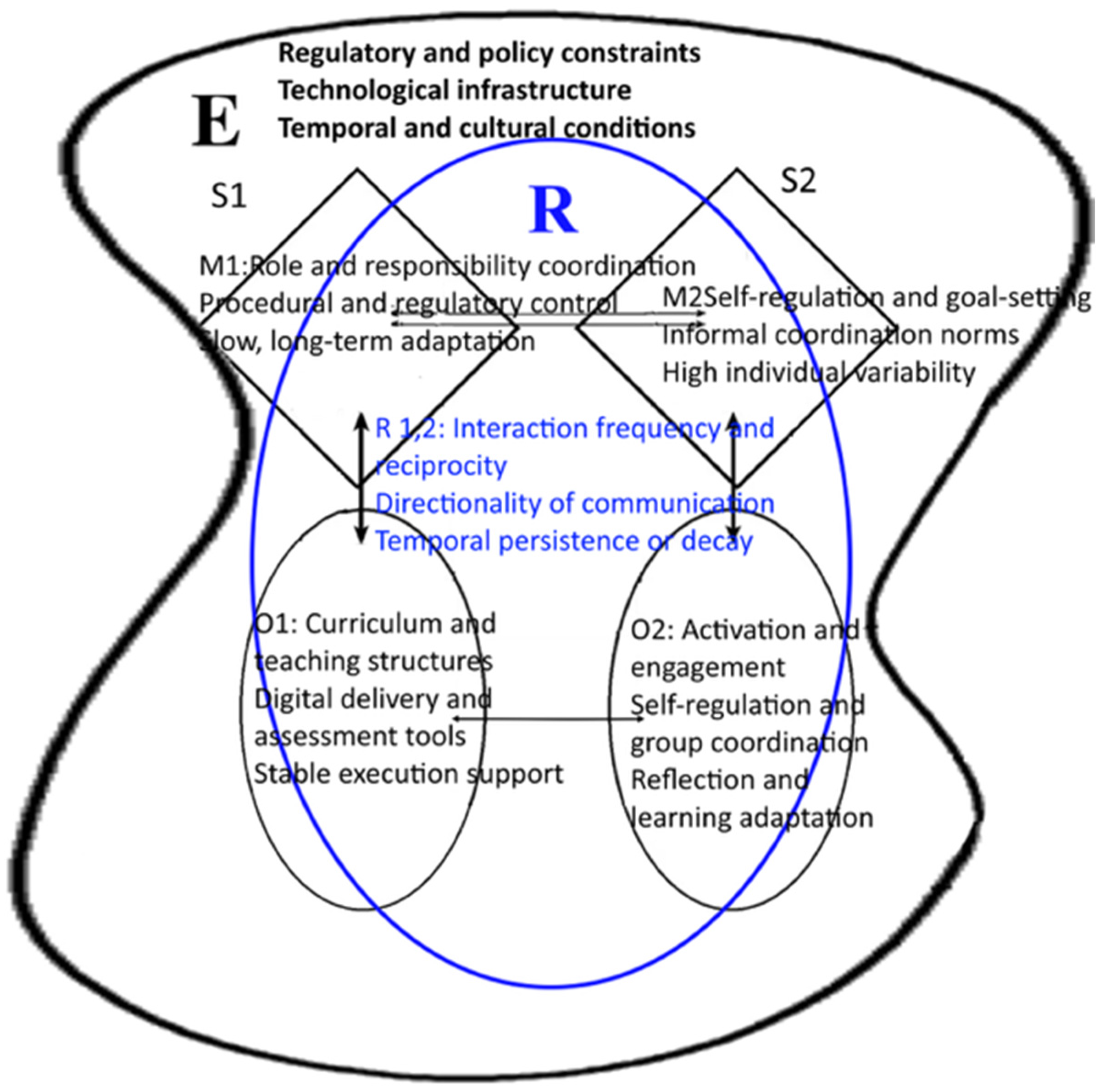
Within these temporal limits, the observation yielded substantive insight into several system structures and their interactional behaviour. The environment (
E) was observable through its regulatory, technological, and organisational constraints, which shaped how interaction could occur. Teaching institutions (
S1) and their operational systems (
O1) were observable in use, revealing how formal structures enabled execution but constrained flexibility. Student systems (
S2) and their operational systems (
O2) were observable through activation patterns, self-regulation, and reflective engagement, particularly as captured through execution behaviour and post-execution survey data. Relations between systems (
R1,2) were observable through interaction density, reciprocity, and persistence across execution and immediate follow-up. Finally, selected supportive and constraining micro-interactions (
→ I,
← I) were observable in real-time, illustrating how local adaptations and frictions shaped the course trajectory. Together, these observations provided insight into
how hybrid collective intelligence is enacted at the interactional and operational level, even as longer-term structural effects remained temporally inaccessible. However, not all structures and interactions were included in
Figure 4.
Changes in System 1 operational systems (ΔO1) could not be observed. O1 functioned largely as designed, supporting execution without undergoing visible reconfiguration. Similarly, repetitive interactions (ΔRep I) remained stable, providing continuity but showing no evolution during or immediately after execution. Nevertheless, interview-based follow-up revealed articulated pressures and proposed directions for future adaptation at these system levels.
Beyond the scope of observations were changes in management systems (ΔM1 and ΔM2) and environmental structures (ΔE), which occurred outside the study’s timeframe. These system layers operate on longer temporal scales, involving processes such as institutional learning, role redefinition, and environmental feedback that extend beyond a single execution cycle.
This suggests that operational adaptation occurs more rapidly than managerial or environmental change, and that collective intelligence in hybrid educational systems unfolds unevenly over time. The present observation, therefore, captures activation and immediate adaptive behaviour, while longer-term structural consolidation remains beyond direct observation.
Several findings of this study are consistent with prior research on gamification and hybrid learning [
39], particularly the observation that task-oriented, interactive, and game-based activities can increase short-term student engagement [
40,
41] and perceived learning value [
42]. Previous studies have repeatedly reported similar effects, especially in digitally mediated and project-based learning environments. In this respect, the present results confirm rather than contradict established findings.
The novel contribution of this study lies not in demonstrating the effectiveness of gamification as a pedagogical tool, but in examining how digitally supported interaction reshapes student–teacher relations over time. By applying a CyberSystemic interaction-observation framework, the analysis examined the required existing structures, but more importantly, captured temporal and relational dynamics, such as shifts between passive reception and active coordination, and the rapid weakening of interaction density after execution, which are typically obscured in outcome-oriented or cross-sectional evaluations. This ontological, interactional, and temporal perspective enables a more nuanced understanding of hybrid learning systems as adaptive yet fragile configurations, carefully balancing structural backgrounds and interactive communication.
Much of the existing literature on gamification and digital learning implicitly relates increased engagement with sustained pedagogical or relational improvement. The present findings challenge this assumption. While gamified and digitally supported activities demonstrably increased situational engagement during execution, interaction observation revealed that this activation was contingent on external structure, facilitation, and time pressure, and weakened rapidly once these conditions were removed. Engagement, in this sense, functioned as a transient operational state rather than as a self-sustaining relational property. The mission of internalising the currently external motivation is a goal to be reached in the future.
5. Conclusions
This study examined a digitally supported, gamified pilot course in the MICE domain as an instance of an observed student–teacher interaction, analysed through a CyberSystemic interaction-observation framework and complemented by student feedback. By structuring the analysis across multiple zoom and temporal levels, the study addressed not only educational outcomes but also how interactional dynamics emerged, stabilised, or weakened during planning, preparation, execution, and immediate follow-up.
With respect to RQ1, the findings indicate that system structures strongly conditioned the execution of the observed interaction. The environment (E) provided regulatory, technological, and organisational constraints that framed the space of possible interaction. Teaching institutions (S1), through their management (M1) and operational systems (O1), functioned primarily as stabilising infrastructures that enabled coordination and delivery while limiting adaptive flexibility during execution. Student systems (S2) demonstrated greater short-term adaptability at the operational level (O2), while pre-existing relations between systems (R1,2) shaped initial expectations and early interactional asymmetries. These observations confirm that interaction quality emerged from the configuration of multiple structural layers rather than from individual behaviour alone.
With respect to RQ2, several related interactions were identified as either supportive or constraining. Supportive interactions (→ I) included structured project deadlines, tutor-mediated coordination, and peer-level communication channels, which increased activation and task engagement within O2. Constraining interactions (← I) included lecture-heavy sequencing, uneven uptake of digital self-learning resources, and limited interaction within and between student groups. Some interaction types, particularly those supporting sustained reflection and cross-group exchange, were underdeveloped or absent. This indicates that interaction quality depended on the density and alignment of related interactions rather than on existing structures in S1 or S2.
With respect to RQ3, the study generated propositions for future interaction design rather than validated prescriptions. Observed structural adaptations and interview-based feedback suggest that future iterations could benefit from rebalancing lecture- and project-centred phases, strengthening feedforward mechanisms between preparation and execution, and redesigning sub-interactions (↑ I), super-interactions (↓ I), and other related interactions (? I) to better support sustained engagement beyond task deadlines. These propositions remain exploratory and cannot be empirically confirmed within the temporal scope of the present observation.
With respect to RQ4, the execution of the interaction produced observable effects primarily at the operational and relational levels. Student operational systems (O2) exhibited increased activation, self-regulation, and partial reflection under explicit organisational and interactional constraints, but we assessed that these changes did not amount to structural transformation. Interaction between systems intensified during execution and weakened immediately afterwards, indicating a limited effect on (R1,2). Changes in management systems (ΔM1, ΔM2), repetitive interactions (ΔRep I), and environmental structures (ΔE) were not observable within the available timeframe and therefore remain analytically open rather than empirically resolved.
Methodologically, the study demonstrates the value of second-order interaction observation for making visible interactional asymmetries, micro-interactions, and emergent phenomena that are not accessible through outcome-focused evaluation alone. At the same time, it clarifies the limits of single-instance observation: several research questions remain only partially answered, mostly due to the temporal boundaries of the observed interaction.
Future research should therefore extend observation across repeated executions and contexts, enabling an assessment of whether situational adaptations in O2 stabilise, whether O1, M1, and M2 reconfigure over time, and whether relations (R1,2) and environmental structures (E) evolve beyond temporary coupling. To better understand this, or similar interactions, observations conducted by additional observers should be created and compared. Such longitudinal and comparative observations will help determine under which conditions interactions can be more effectively planned, executed, and utilised.