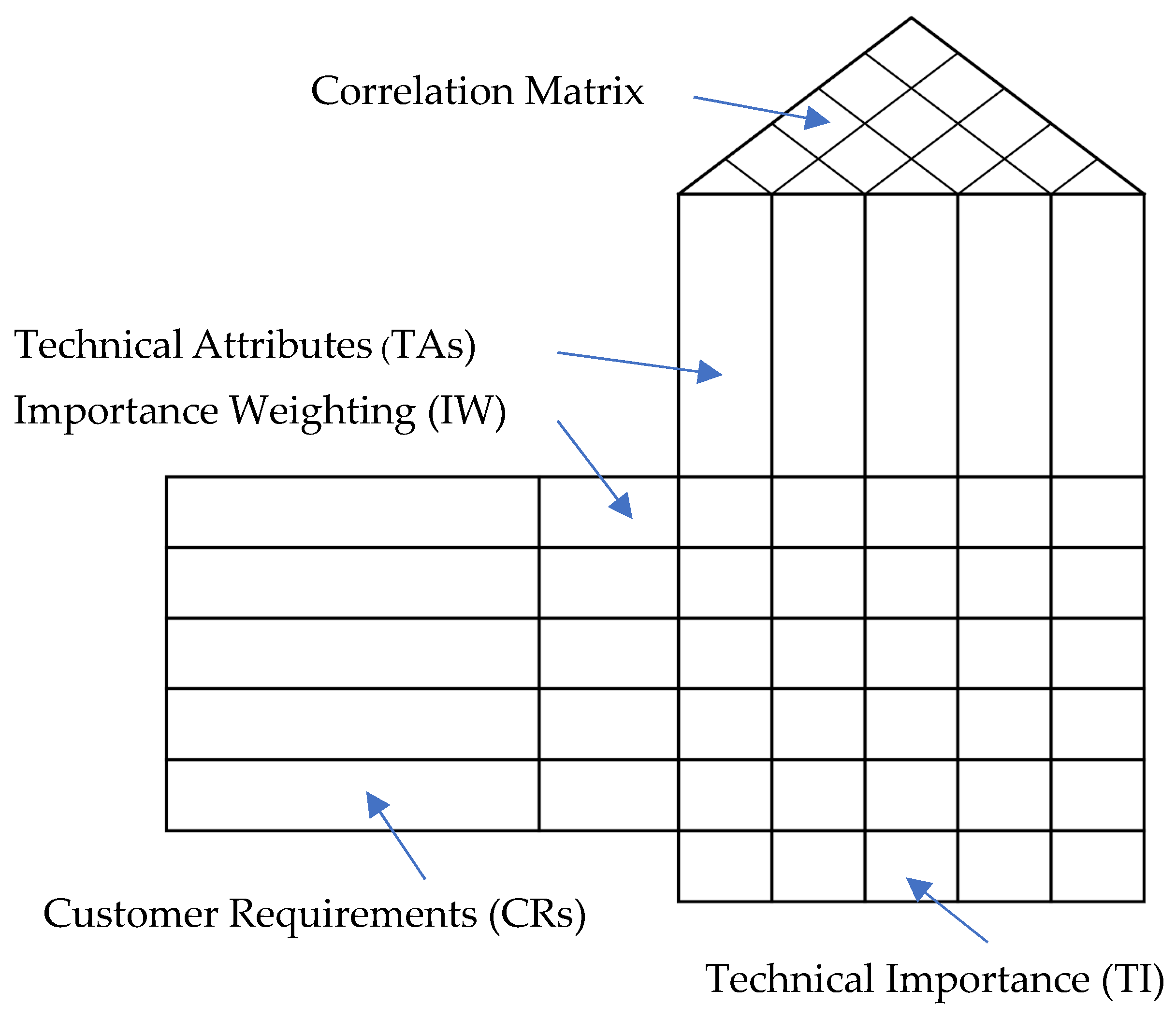
The House of Maintainability (HofM) is proposed as a novel methodological tool for the systematic evaluation of physical asset maintainability, structured as an adaptation of the Quality Function Deployment (QFD) technique and its graphical component, the House of Quality (HofQ).
Within the HofM framework, the maintenance function (or the maintainer) is designated as the ‘customer,’ with requirements defined by the five complexity levels of the UNE 151001 standard. This mapping correlates operational demands with design attributes for a systematic maintainability evaluation. From this assessment, critical insights and inputs are derived to promote the standardization of maintenance procedures and interventions for existing assets.
5.1. Expert Panel Composition and Responsibilities
The execution of the ten-step HofM procedure requires a cross-functional expert team to ensure a holistic assessment that bridges the gap between design and field operations. The panel is ideally composed of professionals from Maintenance, Operations, and Engineering, each contributing a specific perspective to the maintainability evaluation:
Reliability Engineers: Act as facilitators of the HofM process, responsible for coordinating the AHP-based decision-making and validating the consistency of the expert judgments.
Maintenance Specialists (The “Customer”): Represent the primary stakeholders who provide the “Voice of the Maintainer”. They define the relative importance of requirements such as Replaceability (R2), Diagnosability (R3), and Overhaulability (R5) based on their field experience and historical maintenance records.
Design and Project Engineers: Provide technical insights into the asset’s “Hows” or design attributes—such as Modularity (A3), Standardization (A5), and Accessibility (A7)—and are responsible for implementing the resulting design priorities into the asset’s architecture.
Operations Personnel: Contribute to the definition of Environmental Conditions (Step 2), ensuring that the maintainability analysis accounts for site-specific constraints, geographical location, and operational strategies.
This collective expertise allows the HofM to function not merely as a diagnostic tool, but as a decision-enabling mechanism that translates qualitative practitioner knowledge into quantifiable engineering priorities.
5.2. How HofM Operates
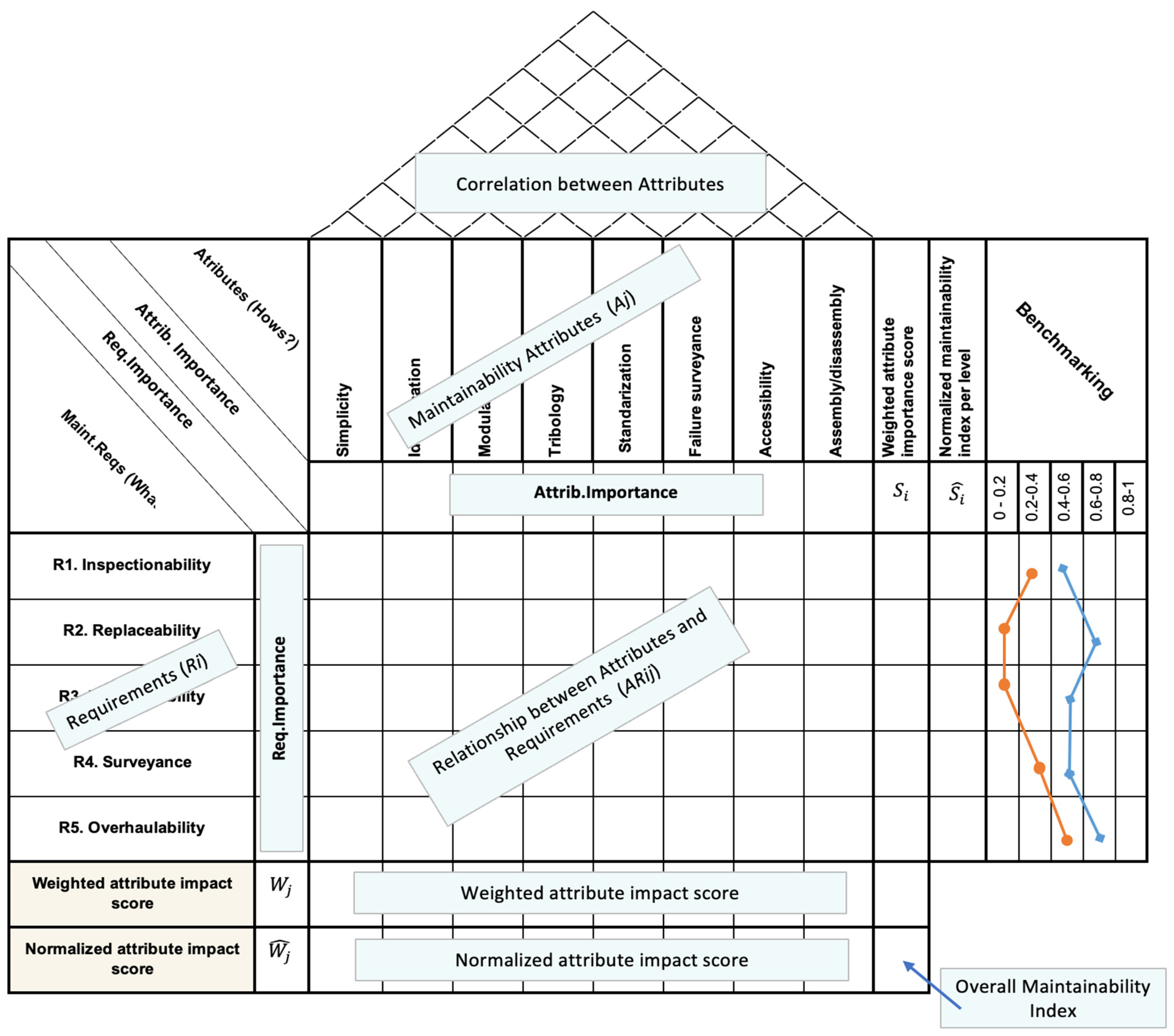
The proposed methodology, designated as the ‘House of Maintainability’ (HofM) and illustrated in
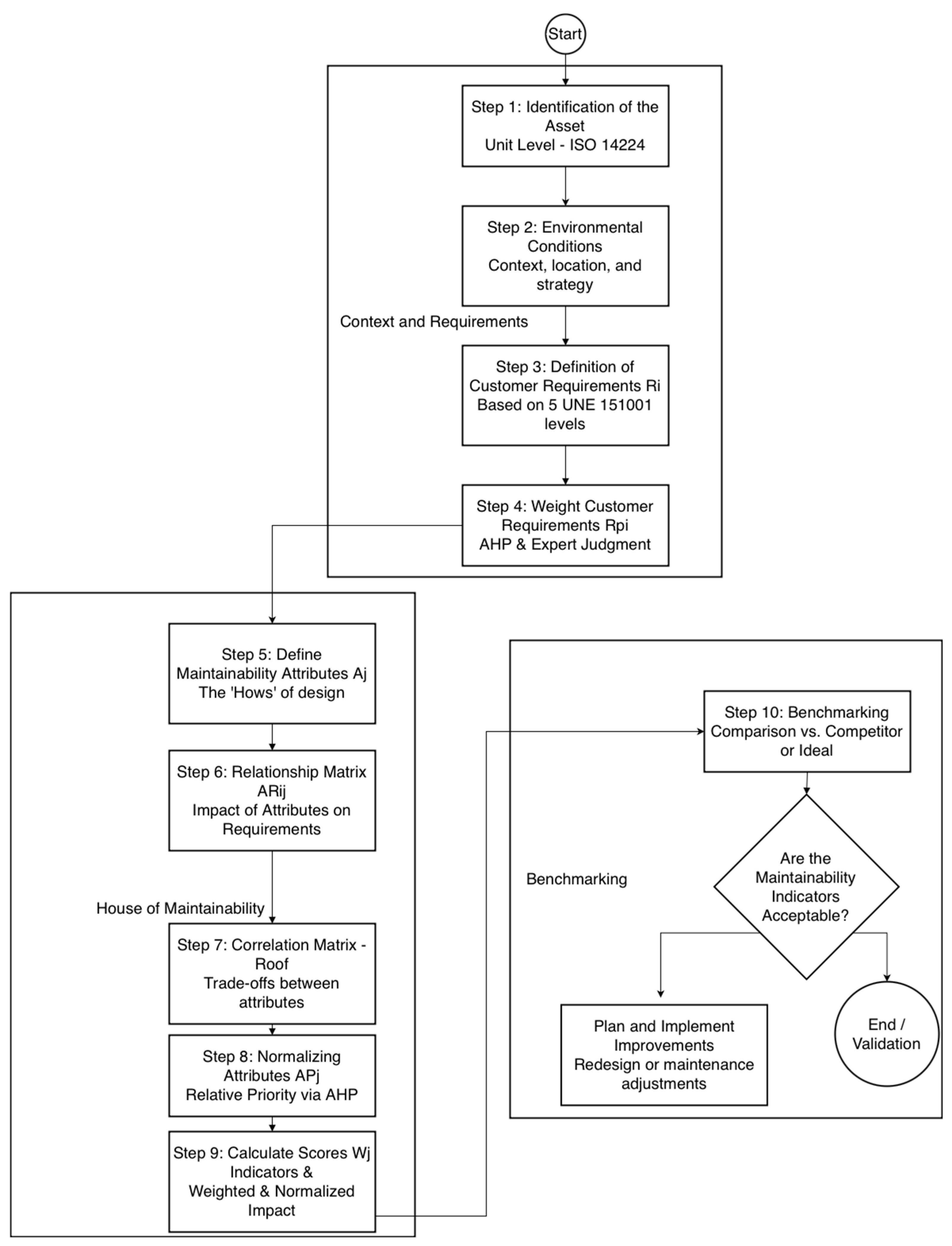
Figure 2, is substantially built upon the procedure defined in the UNE 151001 standard, facilitating the systematic evaluation of physical asset maintainability within the framework of Design for Maintainability (DfM). The HofM integrates the maintenance levels with specific design attributes that influence maintainability. This systematic integration ensures that maintenance requirements are inherently addressed during the design phase, thereby optimizing the efficiency and cost-effectiveness of maintenance activities throughout the asset’s lifecycle. It follows a ten-step procedure, designed to be executed by a cross-functional expert team.
The steps are:
Step 1. Identification of the Asset to be Analyzed: The asset under maintainability analysis is identified. Following the taxonomy defined by the ISO 14224 standard [
7], the analysis is conducted at the Equipment Unit level (Level 6) (e.g., heat exchangers, com-pressors).
Step 2. Environmental Conditions: External factors influencing maintenance, such as geographical location, general maintenance strategies, and organizational characteristics (e.g., plant layout, organizational charts), are documented. While not intrinsic to the asset’s design, these conditions frame the context for maintainability evaluation.
Step 3. Definition of Customer Requirements (
Ri): The primary customer is the maintainer. Requirements are derived from the five maintenance complexity levels defined by UNE 151001, providing a global perspective on maintenance-related issues. These five requirements are shown and commented in
Table 5.
Step 4. The evaluation of requirement importance (
Ri) adopts the maintainer’s viewpoint, employing expert judgment when the methodology is applied to assets in the de-sign stage. Conversely, for in-service assets, the assessment facilitates the use of historical maintenance records to drive the maintainability evaluation. These records may include maintenance plans and strategies, repair-or-replace decision-making frameworks, and technical data regarding the definition of the lowest maintainable item (LMI) [
7]. In cases where expert judgment is prioritized, the assigned importance weights are systematically derived via the Analytic Hierarchy Process (AHP) methodology. This approach mitigates subjective bias by forcing a trade-off analysis, resulting in a comparison matrix that quantifies the specific preference intensity for each maintainability attribute within the context of the analyzed equipment. AHP employs a pairwise comparison framework where experts evaluate the relative dominance of requirement
i over requirement
j using Saaty’s fundamental scale (
Table 6). Consequently, a panel of maintenance experts assesses the five requirements through a pairwise comparison process, utilizing the predefined scale to determine their relative importance. After all the comparisons are made, the matrix A is constructed, where its elements (
aij) represent the estimative of the
wi/wj relation:
Next, the eigenvector, eigenvalue and the IC index are calculated. To estimate the eigenvectors from A matrix the next equation is used:
Eigenvector
Vi is compound by the
n numbers defined as:
Following AHP methodology, the priority vector is obtained by normalizing the eigenvector generated from the pairwise comparison matrix. This process involves dividing each element of
Vi by the
max{Vi} and, each term
Vi/max(Vi) by the sum of all
Vi/max(Vi). Finally:
Finally, λmax = wT.
Furthermore, the robustness of the expert judgments is validated through the Consistency Ratio (
CR). The deviations from consistency are expressed by the following equation:
This index verifies that the transitive logic of the pairwise comparisons is sound; a
CR value below 0.10 is established as the threshold for acceptance, ensuring that the calculated weights reflect a logically consistent prioritization strategy rather than random evaluation. The
CR is computed as shown in Equation (9):
where
RI is the Saaty’s Random Index according to
Table 7.
Step 5. Definition of Maintainability Attributes (
Aj): These are the “Hows” of the HofM, representing the measurable design and support features that the equipment must possess. The attributes are a selected subset of the general (
G) and specific (
V) attributes defined by UNE 151001, ensuring alignment between maintainability goals and equipment design (
Table 8).
Step 6. The relationship matrix constitutes the core component of the House of Maintainability. Each cell of this matrix (
ARij) quantifies the degree to which each of the eight maintainability attributes (
Aj) contributes with or impact a specific maintainability requirement (
Ri). The evaluation employs a four-category scale, with corresponding weighting values as detailed in
Table 9.
To illustrate this step, consider the interaction between Attribute A1 (Simplicity) and Requirement R1 (Inspectionability). The assessment for this pair is based on factors such as component quantity, system redundancy, and visual accessibility. While the specific evaluation guidelines for the A1-R1 pair are outlined below in
Figure 3, the criteria for the remaining attributes are derived directly from the UNE 151001 standard.
These categories allow for the assessment of maintainability attributes based on their contribution or impact to each requirement, providing a clearer understanding of how each design decision or maintenance activity impacts the overall maintainability of the asset.
Step 7. Analogous to the traditional House of Quality (HofQ), the triangular “roof” of the House of Maintainability (HofM) maps the interdependencies among maintainability attributes. While the HofQ employs this structure to analyze trade-offs between technical requirements, the HofM uses it to identify synergistic effects or potential conflicts between maintainability attributes (e.g., the tension between modularity and simplicity). This step operates as a critical proactive design tool, quantifying the strength of these correlations on a scale shown in
Table 10.
Step 8. Normalizing of Weighted Maintainability Attributes (APj): The relative importance of each maintainability attribute is calculated by using the AHP technique (in a similar manner as shown in Step 4). Therefore, APj values prioritizes which attributes have the greatest leverage for impacting maintainability level and facilitates informed decision-making aimed at improving the asset’s maintainability of new equipment or existing ones. Such relative and normalized weights of the maintainability attribute are located at the “Basement” of the HofM to provide a final priority level for design actions. Such weights (ranging from 0 to 1) indicate, from highest to lowest, the relative contribution of each attribute to meeting all maintainability requirements.
Step 9. The Weighted Attribute Impact Score, designated as
Wj, quantifies the aggregate technical significance of each maintainability attribute (
j) relative to the prioritized requirements (
i). This score is derived by computing the linear combination of the im-portance weights assigned to each maintenance requirement (
Ri) and the relationship co-efficient (
ARij) established in the central matrix. Mathematically, the score for each attribute
j is expressed as:
where
n represents the total number of requirements. This calculation ensures that the resulting prioritization reflects the design features (attributes) that contribute most effectively to satisfying the high-priority operational demands of the maintainer. This mathematical synthesis ensures that the final prioritization reflects both the intensity of the correlations between design features and requirements, as well as the relative significance of each attribute within the maintainability framework.
The Normalized Attribute Impact Score, denoted as
(where
∈ [0, 1]), represents the relative contribution of each design attribute to the overall maintainability of the asset. This dimensionless metric is obtained by dividing the individual Weighted Attribute Impact Score (
Wj) of each attribute by the total sum of all weighted scores across the m attributes. The calculation is expressed as:
This standardization facilitates a direct comparison between attributes, allowing for the prioritization of design interventions based on their proportional impact on the global maintainability objective.
The Weighted Attribute Importance Score, denoted as
Si, quantifies the aggregate in-fluence of all design attributes on a specific maintainability requirement
i. This score is computed by performing a weighted summation of the relationship coefficients (
ARij) using the Normalized Attribute Impact Scores (
) as the primary weighting factors. The calculation is defined as:
where
m is the total number of maintainability attributes. This metric allows researchers to identify which operational requirements (e.g., Replaceability or Diagnosability) are most robustly supported by the current set of design features.
The Normalized Maintainability Index per level, designated as
Si, provides a standardized, dimensionless assessment of each requirement’s contribution to the overall maintainability framework. This index is derived by normalizing the individual Weighted Attribute Importance Scores (
Si) against the total sum of scores for the n requirements evaluated. The index is expressed as:
where
∈ [0, 1]. This normalization ensures that the final evaluation remains in-dependent of the scale used in the relationship matrix, facilitating a rigorous comparative assessment of maintainability and a clear ranking of the maintainability priorities for the specific asset under analysis.
Step 10. Benchmarking: The right side of the HofM includes a benchmarking and planning matrix. The performance of the analyzed equipment is compared against a competitor or an ideal benchmark for all maintainability requirements. The benchmark score (
Bi) for each maintainability requirement is calculated as the arithmetic mean of the relationship values (
ARij) across all attributes: The calculation is performed using Equation (8):
where:
Bi represents the benchmark score for the maintainability requirement i.
ARij is the degree of relationship between the maintenance requirement i and the maintainability attribute j.
m is the total number of maintainability attributes considered in the analysis.
This approach allows for a standardized evaluation of maintainability attributes, enabling objective benchmarking and supporting decision-making processes aimed at improving asset performance.
In
Figure 2, an example of the use of the benchmarking section of the House of Maintainability (HofM) is presented. The positions indicated by the red lines represent the performance of the equipment under analysis, while the blue lines indicate the performance of the “control” or “competitor” equipment.
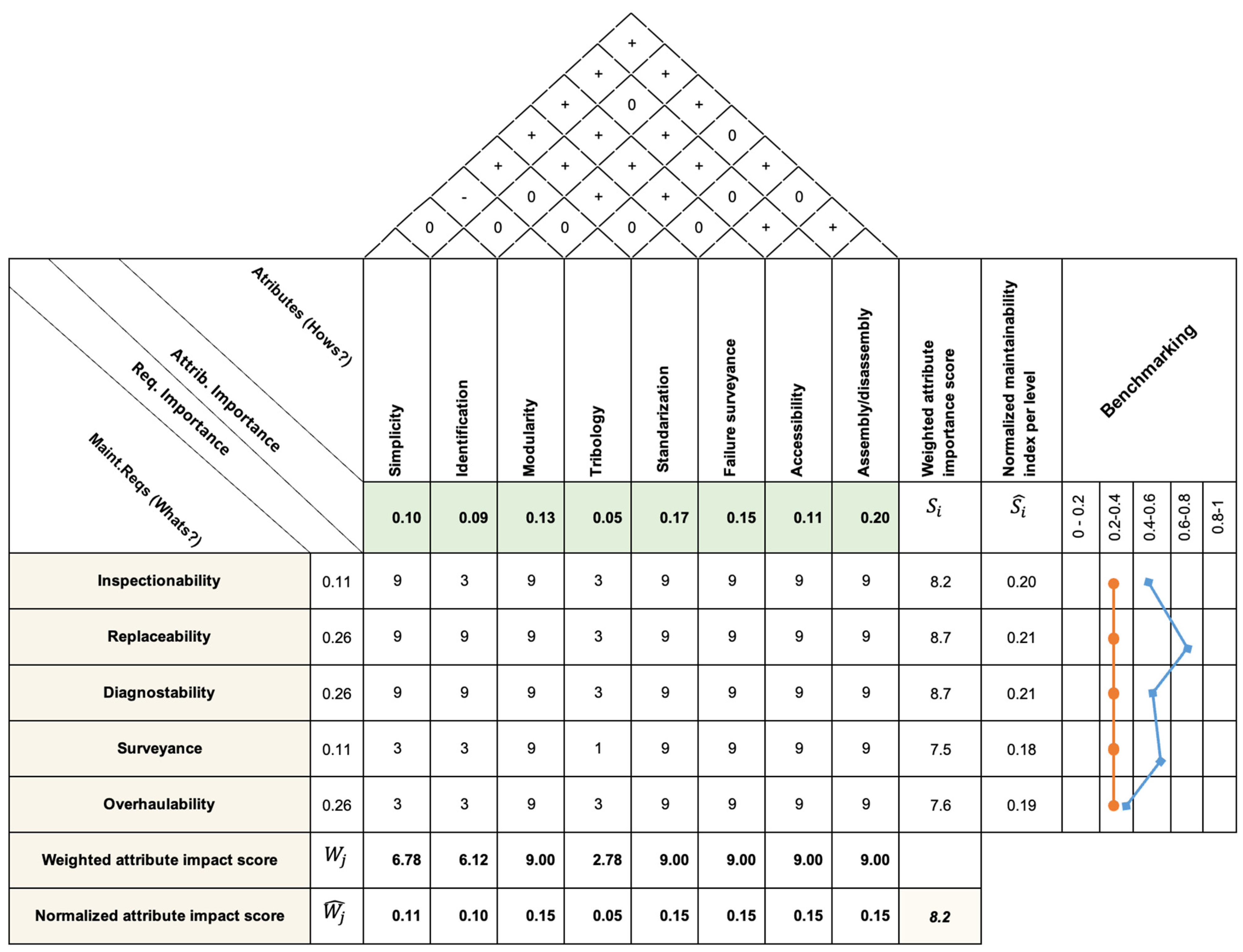
In the following section, a case study is presented to illustrate the practical application of the HofM and maintainability index calculation for a centrifugal compressor. This case study is designed to validate the proposed methodology and demonstrate its feasibility in real-world scenarios.