Abstract
Emergency supplies policies are a key component of regional risk governance, yet their design coherence has received limited systematic examination. Focusing on the Yangtze River Delta (YRD), this study conducts a design-oriented evaluation of emergency supplies policy design by integrating policy text mining with the Policy Modeling Consistency (PMC) index model. Based on a corpus of 212 emergency supplies–related policy documents, the study first examines the structural features and thematic emphases of the regional policy system and constructs a PMC-based evaluation framework within a mission–structure–mechanism perspective. On this basis, 16 provincial- and municipal-level policies issued between 2019 and 2023 are identified as core, system-defining policy texts and subjected to in-depth PMC evaluation. The results indicate that the evaluated core emergency supplies policies exhibit an overall “good” level of design coherence. Mission-oriented dimensions, including normative orientation and policy objectives, are generally well articulated, whereas mechanism-oriented dimensions—particularly linkage response and allocation arrangements—are specified less consistently. Observed interjurisdictional differences reflect institutional roles and governance traditions rather than variations in administrative capacity. By shifting analytical attention from implementation outcomes to design-stage coherence in core policy texts, this study provides a structured diagnostic approach for assessing emergency supplies policy design and offers insights for strengthening regional coordination and institutional resilience.
1. Introduction
As a major driver of economic and social development in China, the Yangtze River Delta (YRD) plays a pivotal role in advancing the modernization of the national emergency management system. Developing a robust emergency supplies system in this region not only concerns regional safety but also provides a model for strengthening the overall emergency response capacity of the country. In February 2023, the YRD jointly launched the Regional Agreement on Collaborative emergency supplies and formulated an integrated emergency response plan—an institutional practice that directly reflects the national goal of China in establishing a “unified and efficient emergency supplies system”. In the latter part of 2023, at a symposium on promoting YRD integration, President Xi Jinping emphasized that the region should “take the lead in exploring the path toward Chinese modernization”, including the modernization of emergency management systems and capacities. The collaborative efforts of YRD in Emergency Supplies thus represent a concrete translation of national strategic directives into regional action. Innovative measures such as cross-provincial coordination mechanisms, shared reserve resources, and unified dispatch standards were taken; nonetheless, the region provides a practical framework for addressing common challenges in cross-regional coordination and resource integration in emergency material governance in China.
Research on emergency management policy evaluation has drawn increasing research attention both domestically and internationally. Existing studies have primarily focused on the evaluation and construction of macro-level emergency management systems [1,2] or drawn insights from specific disasters such as public health emergencies [3] and floods [4,5,6]. However, the policy itself, bridging macro-level strategy and micro-level implementation, has received comparatively scarce attention. Specifically, systematic evaluations of policy texts related to emergency supplies remain limited. Some studies have examined topics such as public demand for emergency supplies during crises [7], the location and planning of emergency logistics [8], and emergency material distribution systems [9,10]; however, the majority of these studies adopt perspectives from management science or logistics optimization. Meanwhile, analyses that deconstruct the internal logic, textual structure, and coherence of Emergency Supplies policies from a public policy perspective remain scarce and urgently needed.
From a methodological perspective, the rise in quantitative approaches has substantially influenced the field of policy evaluation. Techniques such as policy text mining [11] and difference-in-differences models [12] have been widely used to evaluate policies related to public health emergencies, natural disasters, and specialized emergency plans [13]. These methods provide a solid foundation for empirical policy assessment. However, most existing studies focus on evaluating policy implementation outcomes, whereas the proactive application of quantitative models to guide the design and optimization of Emergency Supplies systems remains at the research frontier and lacks systematic exploration.
The geographical scope of existing research presents a further constraint on understanding emergency supplies governance. Policy evaluation studies have predominantly focused on the national level or on single provinces and municipalities [14,15], treating administrative units as independent entities. Yet regional collaborative governance has become a national strategic priority in China and is widely studied in fields such as ecological and environmental management [16,17], where cross-jurisdictional coordination is recognized as essential for policy effectiveness. Despite this recognition, empirical evaluations of emergency supplies policies at the regional level remain limited. For strategically important cross-administrative regions such as the YRD and the Guangdong–Hong Kong–Macao Greater Bay Area, which serve critical national missions, the overall effectiveness of emergency coordination policies and the potential risks of “aggregation fallacy” have yet to be systematically assessed.
These converging gaps underscore the need for a systematic, regionally grounded assessment of emergency supplies policy design. In this context, this study examines emergency supplies policies in the Yangtze River Delta (YRD), with a particular focus on core, system-defining policy texts that structure regional emergency supplies governance. By integrating text mining techniques with the PMC index model, the study develops a design-oriented evaluation framework to assess policy design coherence and structural consistency at the formulation stage, and applies this framework to selected core policies for empirical analysis. Building on these findings, the study further proposes targeted recommendations aimed at improving policy design coherence and coordination in regional emergency governance. Specifically, this study addresses the following research questions:
- What are the main design characteristics of core emergency supplies policies in the Yangtze River Delta?
- Which aspects of policy design exhibit relative strengths and weaknesses at the formulation stage?
- How can the coherence and coordination of emergency supplies policy design be enhanced to support regional emergency governance?
2. Literature Review
2.1. Research on Emergency Management and Supply Chain Resilience
Supply chain resilience is widely regarded as a crucial safeguard for enterprises to achieve long-term survival and stable development in highly uncertain, complex, and vulnerable environments [18]. In the field of emergency management, emergency supply chain resilience is generally understood as the integrated capacity of emergency supplies supply chains to absorb disruptions, recover rapidly, and, where necessary, undergo structural adjustment in response to sudden shocks. Existing research has largely concentrated on the operational dimension of emergency supply chains, with particular attention to whether key functional stages—namely production, storage, transportation, distribution, and replenishment—can sustain continuous operation under extreme conditions [19,20,21]. Within this line of inquiry, scholars have primarily examined performance attributes such as supply chain reliability, responsiveness, and adaptive capacity [22]. Building on these concerns, further studies have explored the risk factors affecting emergency supply chain resilience [23], the restructuring of emergency logistics supply chains enabled by emerging technologies such as blockchain [24,25], and the operational characteristics of critical supplies, including food, under emergency scenarios [26,27]. They emphasize enhancing the operational efficiency and stability of emergency supplies systems under extreme shocks through technological means and management optimization.
In contrast, emergency supplies represents an analytical category with a more pronounced policy and governance orientation. Its core does not lie in the operational efficiency of a single supply chain link but rather in ensuring, through a systematic policy system, institutional design, and collaborative government arrangements, that emergency supplies effectively meet the basic needs of the public in terms of quantity, response time, and spatial allocation [28]. From existing research, although studies on emergency supply chain resilience provide significant support for understanding the operational logic of emergency supplies systems, research that takes the texts of emergency supplies policies themselves as the analytical object remains relatively scarce. In particular, there is a lack of systematic structural analysis and quantitative assessment regarding the internal consistency among policy objective setting, policy tool allocation, and operational mechanism design in emergency supplies policies, which, to a certain extent, restricts an in-depth understanding of the effectiveness and coordination of emergency supplies policy systems.
2.2. Research on Evaluation Methods for Emergency Management Policies
Policy evaluation constitutes a crucial part of public policy research, with its core lying in examining whether policy objectives and operational mechanisms can effectively support established governance goals [29]. Early research on emergency management policies predominantly employed qualitative methods such as normative analysis, case studies, and comparative analysis [30,31,32], focusing on sorting out the objectives in policy texts, dissecting the institutional logic behind the policies, and analyzing the policy formation contexts [33,34]. This approach facilitated an in-depth understanding of the institutional implications and value orientations of policy design. However, qualitative research heavily relies on the subjective judgment of researchers, making it challenging to achieve systematic cross-policy and cross-regional comparisons, and thus somewhat limiting the replicability and verifiability of its conclusions.
With the development of the concept of evidence-based policy and data analysis technology, the application of quantitative methods in the evaluation of emergency management policies has gradually increased [35]. On the one hand, econometric methods such as difference method and regression analysis are widely used to assess the implementation effects of policies [36,37,38,39], focusing on the impact of policies on outcome variables such as public health levels or disaster loss control after their introduction. On the other hand, policy text analysis and text mining techniques have been introduced into public policy research, enabling the characterization of policy focuses and topic structures through methods such as word frequency statistics, topic modeling, and social network analysis [40,41], providing more objective analytical tools for policy evaluation.
However, existing quantitative research primarily focuses on policy implementation performance or outcome effects, with less attention paid to the structural rationality and internal logical consistency of policy texts themselves. For emergency management policies, the clarity of policy objectives and whether the design of operational mechanisms matches governance needs often have a significant impact on their potential performance even before policy implementation. Therefore, applying quantitative analysis methods at the policy design stage to conduct structural diagnoses of policy texts holds significant theoretical and practical value. The PMC (Policy Modeling Consistency) index model can quantitatively encode and comprehensively evaluate key elements in policy texts by constructing a multidimensional indicator system [42], systematically reflecting the completeness and logical consistency of internal policy elements. It has been applied in policy fields like emergency management [43,44,45], but its integrated application with policy text mining methods remains limited for emergency supplies policies. How to systematically test the internal consistency of emergency supplies policies through the combination of these two approaches remains to be further explored.
2.3. Research on Cross-Regional Emergency Governance
Existing research generally holds the opinion that emergencies often exhibit characteristics of cross-administrative regional diffusion, and the emergency response capabilities of a single administrative region are insufficient to effectively address systemic risks [46]. Therefore, it is necessary to enhance capabilities such as resource and information sharing, and joint responses within regions through horizontal government cooperation. Current cross-regional research primarily focuses on regional pollution prevention and control and public health events [47,48], emphasizing the institutional design, organizational models, and operational effectiveness of cross-regional collaboration mechanisms [49,50], and highlighting the enhancement of overall emergency response capabilities through resource co-construction, data interworking, and joint actions.
However, from the perspective of policy evaluation, research on cross-administrative regional emergency governance still exhibits significant shortcomings. On the one hand, relevant research often remains at the level of institutional design analysis or summary of typical cases [51], with less systematic evaluation of the overall structure of policy systems at the regional level. On the other hand, existing research tends to view regions as holistic units of collaborative governance, with less attention paid to differences in policy objective setting and operational mechanism design among different provinces and cities within regions. This, to a certain extent, obscures potential institutional inconsistencies within regions and tends to underestimate the “collaborative risks” posed by policy differences to collaborative governance performance.
These challenges are particularly pronounced in cross-administrative regions that carry national strategic functions. The Yangtze River Delta (YRD), for example, occupies a pivotal position in China’s economic and social development as well as in the national governance system, and has been designated as a key pilot region for advancing regional integration and the modernization of emergency management [52]. Despite this strategic importance, existing studies on emergency governance in the YRD have largely focused on collaborative arrangements or emergency response practices. Systematic empirical assessments of whether regional emergency supplies policies achieve goal alignment and mechanism coherence across administrative boundaries remain notably limited.
2.4. Literature Review and Research Orientation
A review of the existing literature suggests that research on emergency management and emergency supplies policies has established a solid theoretical foundation, yet further progress is needed in terms of analytical focus, methodological orientation, and research scale. Prior studies have largely examined emergency supplies policies through operational perspectives—such as supply chain resilience, logistics efficiency, and system performance—emphasizing technological optimization and managerial improvements. In contrast, policy texts themselves have received limited systematic attention, particularly with regard to the internal alignment between policy objectives and the design of operational mechanisms.
Methodologically, qualitative analysis and quantitative evaluation are both well represented in the literature. While qualitative approaches elucidate normative orientations and institutional meanings, quantitative studies—often based on econometric models or text mining—tend to concentrate on implementation performance and outcome effects. Comparatively little effort has been devoted to assessing the internal coherence and structural rationality of emergency supplies policies at the design stage, and a mature quantitative framework for diagnosing policy design consistency remains underdeveloped.
At the regional scale, cross-administrative collaborative governance has become an important research theme, yet existing studies mainly rely on institutional analysis or case-based discussions. Quantitative evaluations of the overall coherence of regional policy systems are still scarce, despite the fact that misalignment in policy objectives and operational mechanisms across jurisdictions may generate coordination frictions in practice.
Addressing these gaps, this study examines emergency supplies policies in the Yangtze River Delta as an integrated regional policy system. By combining policy text mining with the Policy Modeling Consistency (PMC) index model, it develops a design-oriented quantitative framework to evaluate policy coherence, focusing on the alignment between policy objectives and operational mechanisms. In doing so, the study advances the literature by repositioning policy texts as the core analytical object, introducing a structured method for assessing policy design consistency, and extending policy analysis beyond single jurisdictions to a cross-administrative regional scale. The findings offer empirical insights into the institutional foundations of regional emergency supplies governance and inform efforts to strengthen coordination and resilience in complex risk environments.
3. Materials and Methods
3.1. Overall Research Framework
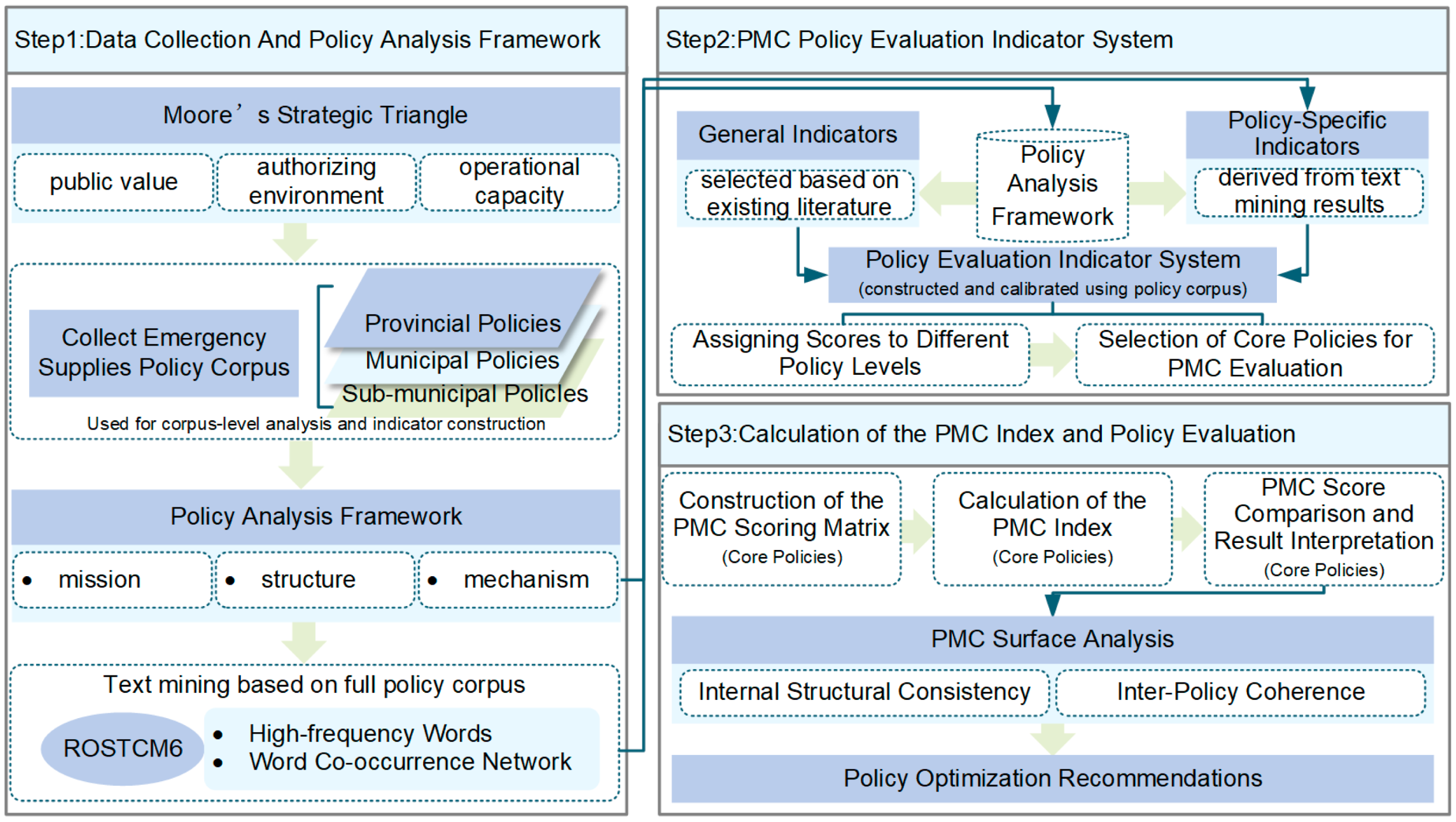
This study evaluates emergency supplies policies in the Yangtze River Delta (YRD) from the perspective of service demand and public value orientation. Following an analytical sequence of analysis–construction–evaluation–optimization, it first examines the regional policy environment, then constructs an evaluation framework, and finally derives evidence-based recommendations for policy improvement.
As illustrated in Figure 1, YRD emergency supplies policies constitute the core objects of analysis. In Step 1, relevant policy documents are systematically collected to form an emergency supplies policy corpus, which is used for corpus-level analysis and indicator construction. Drawing on Moore’s strategic triangle and a mission–structure–mechanism analytical framework, text-mining techniques are applied to this corpus to identify key thematic patterns and structural features of the regional policy system. In Step 2, insights from the corpus-level analysis, together with existing literature, are used to construct and calibrate a PMC-based policy evaluation indicator system. On this basis, a set of core, comprehensive policies are selected for PMC evaluation, reflecting their relevance to system-level governance and their suitability for structural diagnosis. In Step 3, the PMC index is calculated for the selected core policies to assess policy design consistency, with particular attention to internal structural consistency and inter-policy coherence. The evaluation results make it possible to identify key strengths and weaknesses in policy design and provide a structured basis for formulating targeted recommendations to improve the coordination, guidance, and regulatory capacity of the regional emergency supplies governance system.
Figure 1.
Overall research approach of the paper.
3.2. Construction of the Policy Analysis Framework
The emergency supplies policy system is examined in this study as a governance-oriented public service, rather than as a narrowly defined technical or logistical arrangement. Its analytical focus lies in whether policy design and institutional coordination can collectively secure the availability, timeliness, and appropriate spatial distribution of essential supplies under emergency conditions. From this perspective, emergency supplies governance is inherently linked to public value creation and institutional capacity building. Accordingly, this study grounds its analytical framework in public value theory and adopts Moore’s strategic triangle as its core theoretical reference [53]. The strategic triangle posits that effective public governance emerges from the alignment among three interrelated dimensions: public value, the authorizing environment, and operational capacity [54].
Building on this theoretical foundation, the study applies a high-frequency keyword induction approach to systematically examine emergency supplies policy texts in the Yangtze River Delta. On this basis, an analytical framework is developed that emphasizes the dynamic interaction among mission (public value), structure (authorizing environment), and mechanism (operational capacity). Rather than treating policy instruments as isolated elements, the framework highlights that public value in emergency supplies governance is realized through the internal coherence and adaptive coupling of these three dimensions.
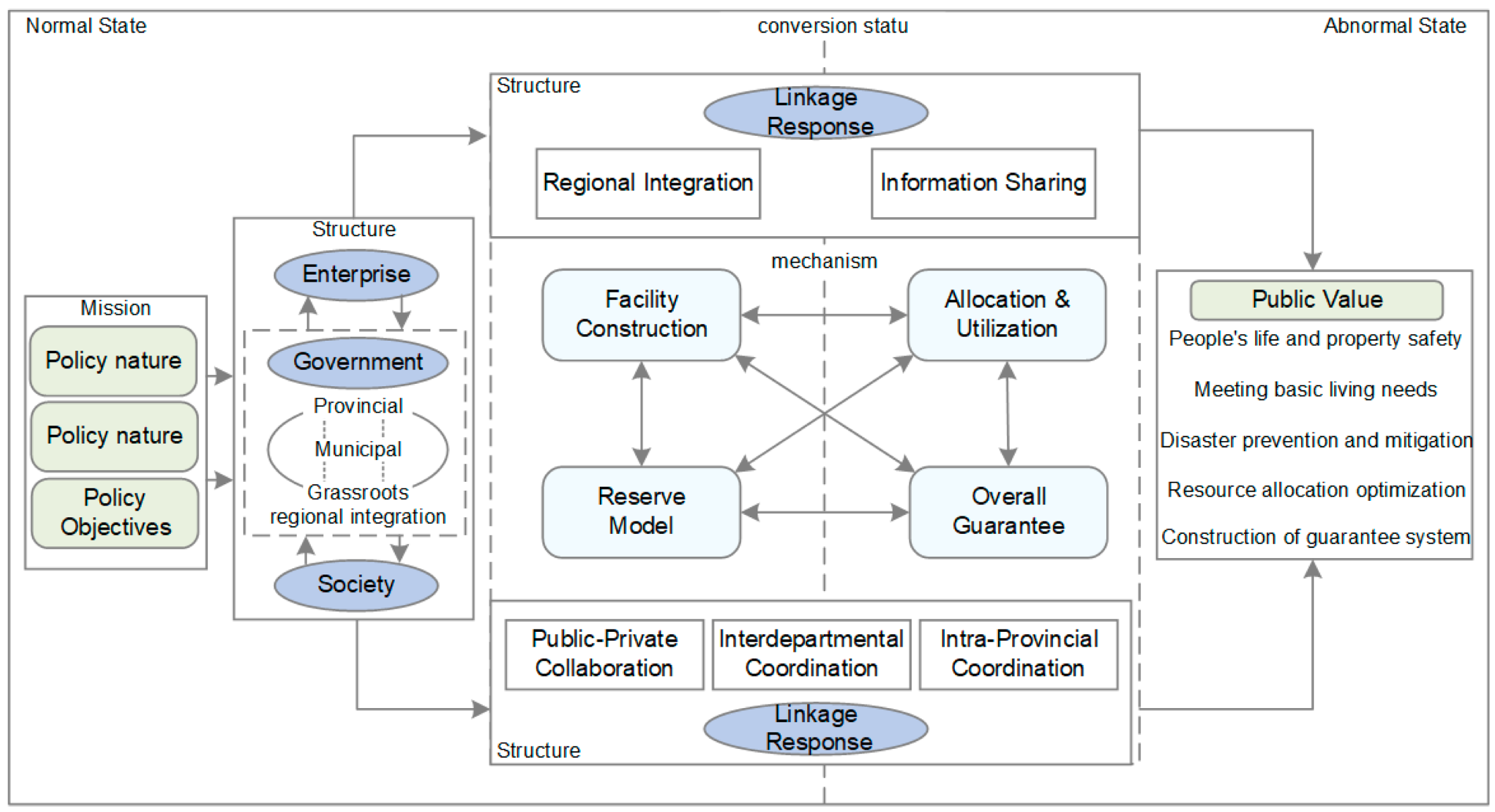
The mission dimension captures the fundamental purpose and normative orientation of policy action [55,56], reflecting the public value that emergency supplies policies aim to generate and safeguard. It is operationalized through policy context, policy nature, and policy objectives, which together define the risk environment, normative stance, and explicit governance goals underlying policy design. Importantly, mission realization is situated along a continuum of emergency states, underscoring the context-sensitive nature of public value in emergency governance.
The structure dimension refers to the political, organizational, and social foundations that confer legitimacy and mobilization capacity upon policy action [57]. It is manifested through the configuration of participating actors and linkage response arrangements, which organize coordination across sectors, administrative levels, and jurisdictions, thereby translating policy missions into institutionally supported collective action.
The mechanism dimension focuses on the concrete resources, infrastructures, and administrative arrangements required to operationalize policy intent [58]. It encompasses facility construction, reserve models, allocation and utilization arrangements, and overarching guarantee mechanisms [59], together constituting the operational backbone through which emergency supplies governance is implemented.
Figure 2 presents the analytical framework derived from Moore’s strategic triangle. The framework connects mission, structure, and mechanism across a continuum of emergency conditions, ranging from routine to abnormal states. Within this framework, mission defines the public value orientation of emergency supplies policy; structure delineates the multi-level and cross-sectoral governance arrangements that authorize and coordinate action; and mechanism represents the interconnected operational components through which policy objectives are translated into practice.
Figure 2.
Analysis Framework of Emergency Supplies Policies in the Yangtze River Delta.
3.3. Research Methodology
The Policy Modeling Consistency (PMC) index model, originally proposed by Estrada [42], is a content-based framework for policy evaluation that converts qualitative policy texts into structured quantitative indicators through standardized coding rules. By focusing on the internal composition and logical alignment of policy elements, the PMC approach is particularly suited to assessing policy design at the formulation stage rather than post-implementation outcomes. A central feature of the model is the use of equal weighting across indicators, which avoids ex ante prioritization among policy components and supports transparency and comparability in aggregation [60].
Existing studies typically construct PMC indicator systems in one of two ways: either by deriving indicators from a small number of representative policies and applying the model to those same texts [61,62], or by building the indicator framework from a broader policy corpus and subsequently evaluating selected policies [63,64]. Given the diversity and heterogeneity of emergency supplies policies in the Yangtze River Delta, this study adopts a corpus-based strategy for indicator construction. Using a comprehensive policy corpus to inform the development of the PMC indicator system allows the framework to capture a wide range of policy objectives, institutional arrangements, and operational mechanisms across administrative levels, thereby strengthening the conceptual completeness of the evaluation system. At the same time, this corpus-based strategy involves inherent trade-offs. The policy corpus includes documents with different institutional functions, from system-level plans to technical or procedural instruments, which are not equally suitable for design-oriented evaluation using the PMC framework. Moreover, corpus-level coverage does not necessarily correspond to institutional salience, as the frequency or operational detail of policy texts does not directly indicate their importance for overall policy design. In light of these considerations, the corpus is used primarily to support indicator construction and system-level contextualization, while PMC evaluation is applied selectively to a set of core, system-defining policies. This strategy reflects an intentional alignment between the study’s design-oriented research objective and the analytical scope of the PMC model, prioritizing interpretability over exhaustive coverage.
On this basis, the PMC index model is employed as the primary evaluation method in this study. All first-level and second-level indicators are assigned equal weights, consistent with the original logic of the PMC framework, in order to assess structural completeness and internal consistency rather than the relative effectiveness of individual dimensions. Indicators are coded according to explicit textual coverage within each policy document: a value of 1 indicates full coverage, 0.5 indicates partial coverage, and 0 indicates absence. This coverage-oriented coding scheme reflects the breadth and structural integrity of policy design and should not be interpreted as a direct measure of implementation intensity, enforceability, or policy performance.
Computation of first-level indices: Using a multi-input–output matrix, we calculate the PMC index for each first-level variable , incorporating its associated second-level variables and their count .
Overall PMC score: The aggregate PMC score is derived by summing the weighted first-level indices. Following existing standards [65,66], policies are classified into four levels: perfect (8.0–9.0), excellent (6.0–7.99), good (4.0–5.99), and poor (0–3.99).
Visualization and analysis: A three-dimensional PMC surface plot is generated to visualize results and internal consistency. Color gradients (from green to gray, representing scores from 1 to 0) and surface smoothness indicate the overall policy quality and internal coherence—flatter and greener surfaces reflect stronger consistency and effectiveness.
4. Evaluation Index System for Emergency Supplies Policies
4.1. Text-Mining Results and Salient Policy Emphases in the YRD
To develop a comprehensive evaluation index system for emergency supplies policies in the Yangtze River Delta (YRD), this study systematically collected and screened relevant policy documents to support the construction of the PMC framework. Policy texts were identified using keywords such as “emergency materials”, “disaster relief materials”, “emergency reserves”, and “material reserves”, and were retrieved from official government websites, the Peking University Law Database (Laws and Regulations Database), as well as other publicly accessible sources. Given that the earliest policy document in the region dates back to 2003, the collection period covers policies issued between 2003 and December 2024. After removing duplicate records, expired documents, and materials with limited relevance to emergency supplies governance (such as administrative approvals and routine public notices), a total of 212 policy documents were retained. Together, these documents form the policy corpus used to inform the construction of the PMC-based evaluation indicator system.
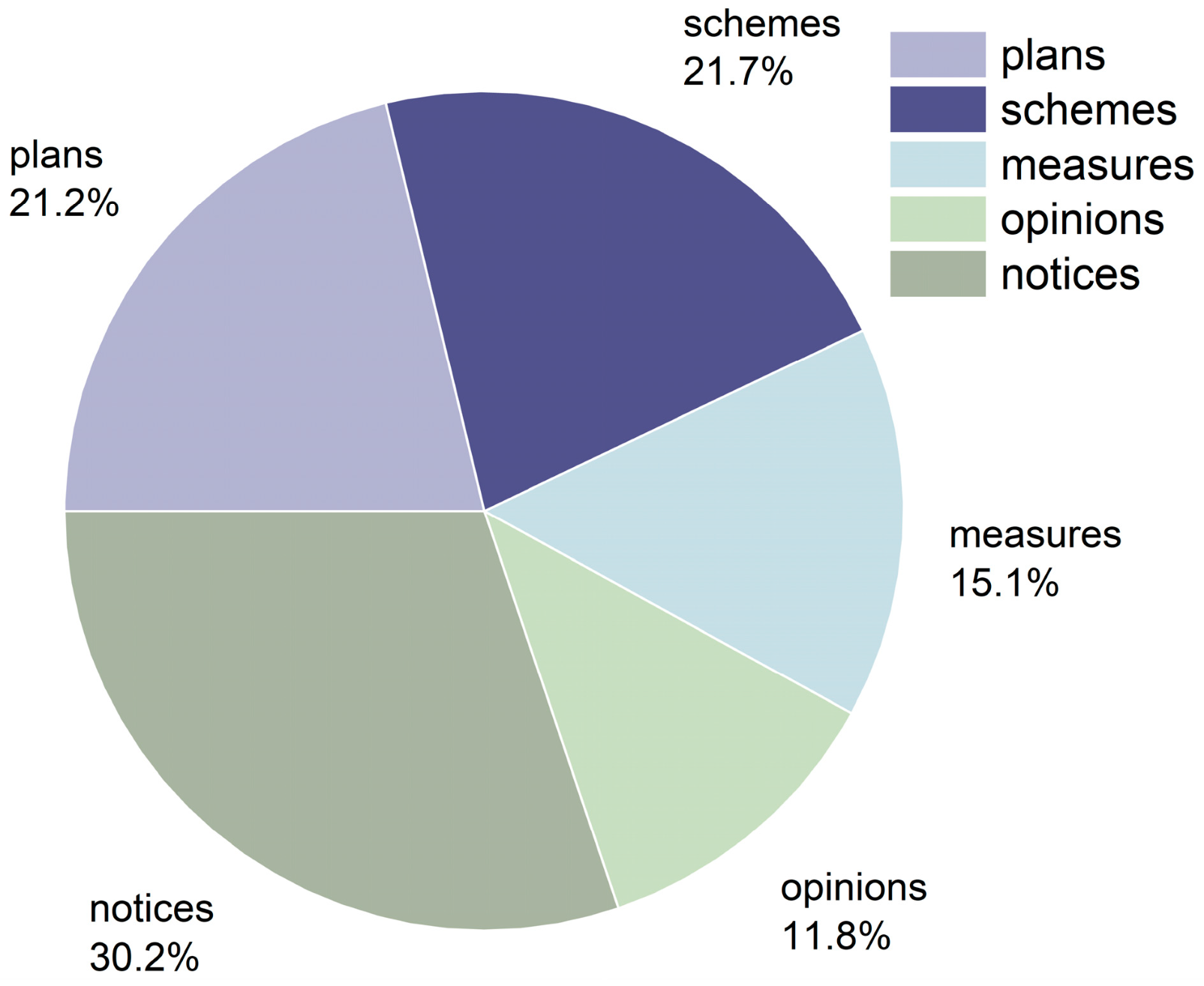
Following Cheng (2021), policy documents were classified into six types: notices, plans, schemes, opinions, laws, and measures [67]. As shown in Figure 3, the distribution of emergency supplies policies in the Yangtze River Delta is clearly dominated by implementation-oriented and task-focused instruments. Notices constitute the largest share of the policy corpus (30.2%), followed by schemes (21.7%) and plans (21.2%), while measures (15.1%) and opinions (11.8%) account for relatively smaller proportions. Overall, policies with explicit planning functions and macro-level coordination roles represent a limited share of the total policy set. This distribution indicates that a substantial proportion of existing policies concentrate on specific tasks, short-term arrangements, or operational rules, whereas system-level policies that articulate overarching objectives, structural arrangements, and governance mechanisms remain comparatively scarce.
Figure 3.
Types of Emergency Supplies Policies in the Yangtze River Delta.
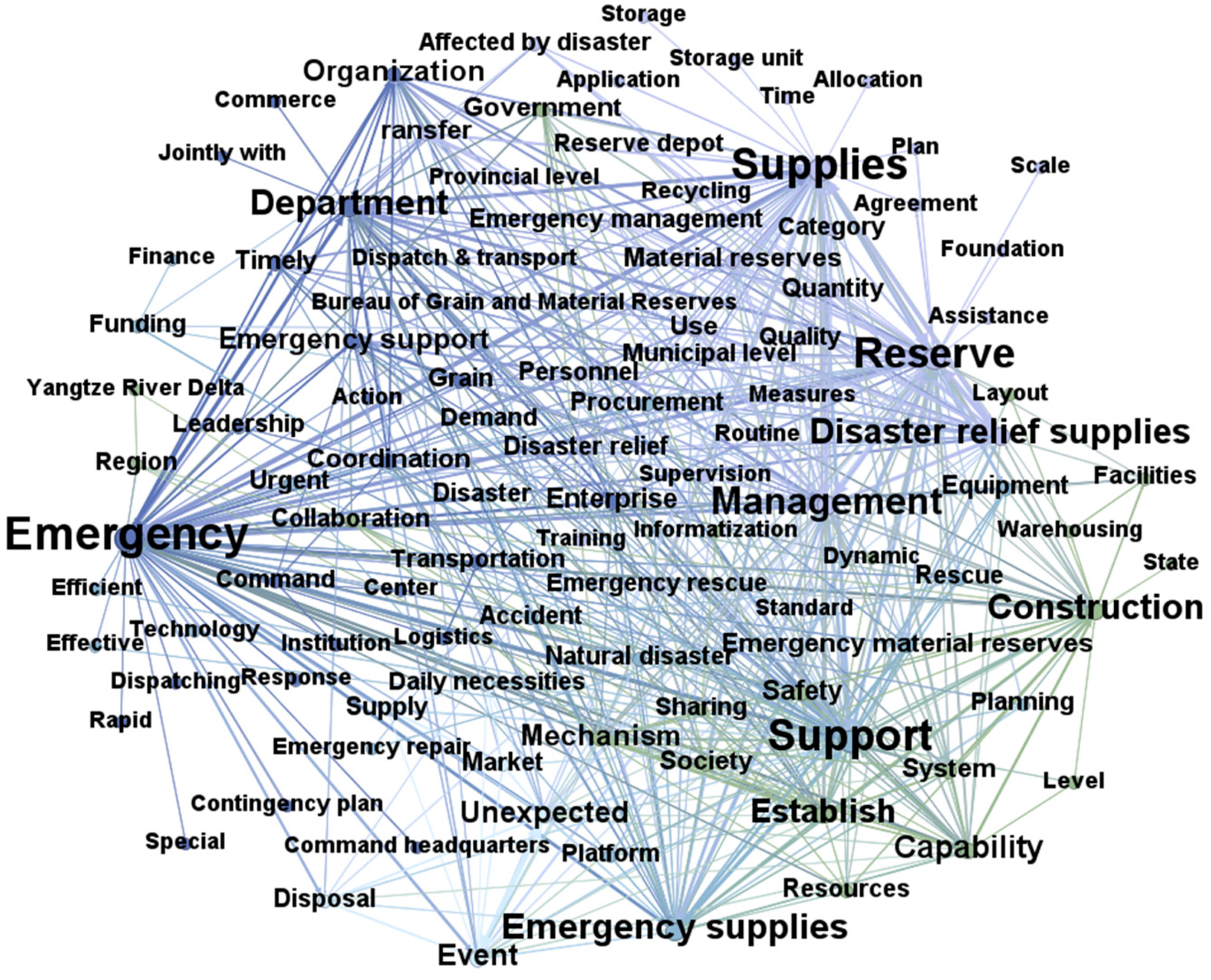
We then applied ROSTCM6 to conduct Chinese word segmentation and frequency analysis. After excluding modifiers and semantically weak terms (e.g., “strengthen”, “enhance”, and “promote”), the top 100 keywords were ranked by co-occurrence frequency to generate the semantic network (Figure 4). Nodes represent high-frequency keywords extracted from the Chinese texts, and edges indicate co-occurrence relationships. For readability, node labels are presented in English using a fixed Chinese–English mapping (Appendix A); the co-word matrix and network statistics are computed from the original Chinese keywords, and translation is applied only at the labeling stage.
Figure 4.
Semantic Network of Emergency Supplies Policies in the Yangtze River Delta.
The semantic network analysis indicates that emergency supplies policies in the Yangtze River Delta are organized around five closely connected thematic domains: linkage response, facility construction, reserve models, allocation and utilization, and institutional guarantees. Among these, cross-regional linkage occupies a central position. The prominence of terms such as coordination, collaboration, and region reflects sustained policy efforts to overcome administrative fragmentation and to formalize interjurisdictional cooperation through arrangements including public–private partnerships and platform-based information sharing.
Facility construction emerges as a second core domain, closely associated with the development of integrated physical and digital infrastructure. Frequent references to reserve depots, logistics, command, and centers suggest an emphasis on building coordinated systems that support storage, dispatch, transportation, and decision-making in a unified manner. Governance of reserves is framed in dynamic and capacity-oriented terms. The recurrent use of concepts such as storage, dispatch and transport, transfer, and rapid response points to a policy orientation toward flexible, multi-tiered reserve arrangements rather than static stockpiling.
Allocation and utilization are articulated from a full life-cycle perspective, linking procurement, deployment, transportation, and post-use recycling or disposal, thereby implying an emerging closed-loop governance approach to emergency supplies management. Finally, the institutional guarantee domain highlights the supporting conditions for system operation. References to organizational coordination, funding arrangements, technological support, human resources, and supervision underscore the importance of leadership alignment, technological enablement, capacity building, and regulatory oversight in sustaining the effective functioning of the emergency supplies system.
4.2. Linking Text-Mining Evidence to the PMC Index Design
To strengthen the construct validity and transparency of the PMC-based evaluation framework, the text-mining results presented in Section 4.1 (Table 1) are explicitly linked to the analytical framework outlined in Section 3.2. The semantic co-occurrence network (Figure 4) reveals stable keyword clusters that correspond closely to the mission–authorizing environment–operational capacity logic. This correspondence provides empirical support that the selected dimensions are not only theoretically grounded but also salient within the YRD policy corpus, thereby offering a transparent basis for standardized coding and subsequent PMC evaluation.
Table 1.
Keyword clusters supporting PMC first-level dimensions (from Figure 4).
Based on this mapping, the mechanism-oriented dimensions identified through text mining (X5–X9) are incorporated as specific first-level indicators in the PMC system. Their operationalization, scoring procedures, and empirical validation are detailed in the sections that follow, ensuring consistency between empirical evidence, theoretical structure, and quantitative evaluation design.
4.3. Construction of the PMC-Based Policy Evaluation Index System
Drawing on the analytical framework and prior literature, this study constructs a PMC-based evaluation index system tailored to the Yangtze River Delta. Given the heterogeneity of emergency supplies policies across three provinces and one municipality, the index system is designed to balance cross-regional comparability with regional specificity. The indicators are therefore organized into two categories: general indicators and specific indicators.
The general indicators capture foundational policy attributes that are common across policy types. Consistent with established policy evaluation research, three first-level dimensions are retained: policy nature (X2), policy objectives (X3), and participating actors (X4). Substantively, policy nature and policy objectives reflect the mission dimension, specifying public value commitments, while participating actors delineate the basic authorizing environment by identifying the core stakeholder configuration.
The specific indicators focus on mechanism-oriented dimensions that operationalize emergency supplies governance in a regional, cross-jurisdictional context. Their selection is guided by two sources: the strategic-triangle-based analytical framework (Section 3.2) and the empirical patterns revealed by text mining (Section 4.2). On this basis, six additional first-level dimensions are incorporated: policy context (X1), linkage response (X5), facility construction (X6), reserve model (X7), allocation and utilization (X8), and overall guarantee (X9). Each dimension is further specified through observable textual features—such as references to command systems, reserve infrastructure, procurement procedures, or supervision mechanisms—which are coded using standardized PMC rules. The complete set of indicators and corresponding evaluation criteria is presented in Table 2.
Table 2.
PMC-Based Evaluation Index System for Emergency Supplies Policies in the Yangtze River Delta.
5. Empirical Evaluation of Emergency Supplies Policies
5.1. Selection of Core Emergency Supplies Policies in the Yangtze River Delta
From the full corpus of 212 emergency supplies–related policy documents identified in the Yangtze River Delta; this study selects a subset of 16 policies for in-depth evaluation using the PMC framework (Table 3). The two sets serve different analytical purposes: the full corpus is used to characterize the overall policy landscape and to support indicator construction, whereas the selected policies provide the empirical basis for assessing policy design coherence.
Table 3.
Core Policies Selected for PMC-Based Evaluation of Emergency Supplies Governance in the Yangtze River Delta.
Policy selection follows a purposive, theory-driven approach rather than statistical sampling. As the PMC framework is designed for structural diagnosis of policy design, adequacy is defined by institutional relevance and analytical suitability. Accordingly, selected policies are authoritative provincial- or municipal-level documents that directly address core aspects of emergency supplies governance, exhibit relatively comprehensive or programmatic features, and collectively ensure balanced coverage across the four YRD jurisdictions and administrative levels.
The selected policies were issued between 2019 and 2023. This period captures a critical phase in the evolution of emergency supplies governance, encompassing the institutional stress test brought by the COVID-19 pandemic and subsequent policy adjustments toward normalization and system refinement. Focusing on this timeframe allows the analysis to reflect both crisis-driven responses and post-crisis institutional consolidation, while avoiding interference from earlier fragmented arrangements or very recent policies whose effects have yet to stabilize.
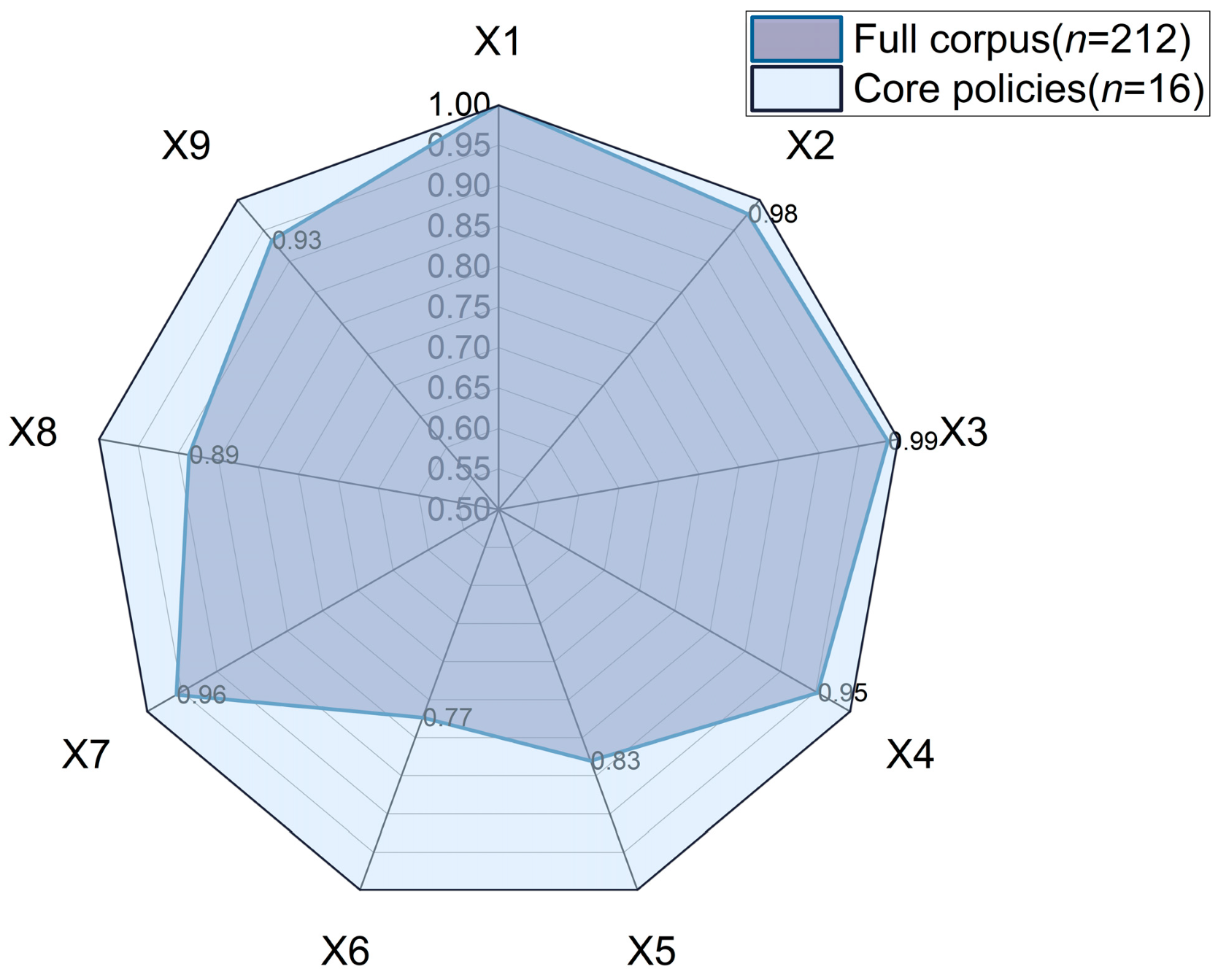
Before conducting the PMC-based evaluation, we examine the alignment between the selected core policies and the full policy corpus in terms of first-level PMC dimension coverage. Figure 5 compares the coverage of first-level PMC dimensions between the full policy corpus (n = 212) and the selected core policies (n = 16). The two profiles show a high degree of alignment across all dimensions, suggesting that the selected policies reflect the dominant structural emphases of the regional policy system rather than a distinct or atypical subset.
Figure 5.
Corpus-level alignment of first-level PMC dimension coverage between the full policy corpus (n = 212) and the selected core policies (n = 16).
5.2. PMC Index Calculation
On the basis of the aligned coverage structure identified above, the PMC index is calculated for the selected emergency supplies policies to evaluate their design coherence across key dimensions.
Following the PMC evaluation framework proposed by Estrada [42], the nine first-level and forty-five second-level indicators were organized into a multi-input–output matrix (Table 4) after the selected core policies were determined. All indicators were assigned equal weights, reflecting the purpose of the PMC model to assess the structural completeness and internal consistency of policy texts rather than the relative effectiveness of individual dimensions. Second-level indicators were coded using a three-point scale (1 = fully covered, 0.5 = partially covered, 0 = absent), and their mean values were used to calculate the corresponding first-level indicator scores.
Table 4.
PMC Multi-Input–Output Matrix of Evaluation Indicators.
For each policy, first-level indicator scores are calculated as the arithmetic mean of their associated second-level indicators, and the overall PMC index score is obtained by summing the nine first-level scores. This standardized procedure yields directly comparable PMC values across policy documents and provides the basis for subsequent result analysis.
5.3. Analysis of PMC Index Results
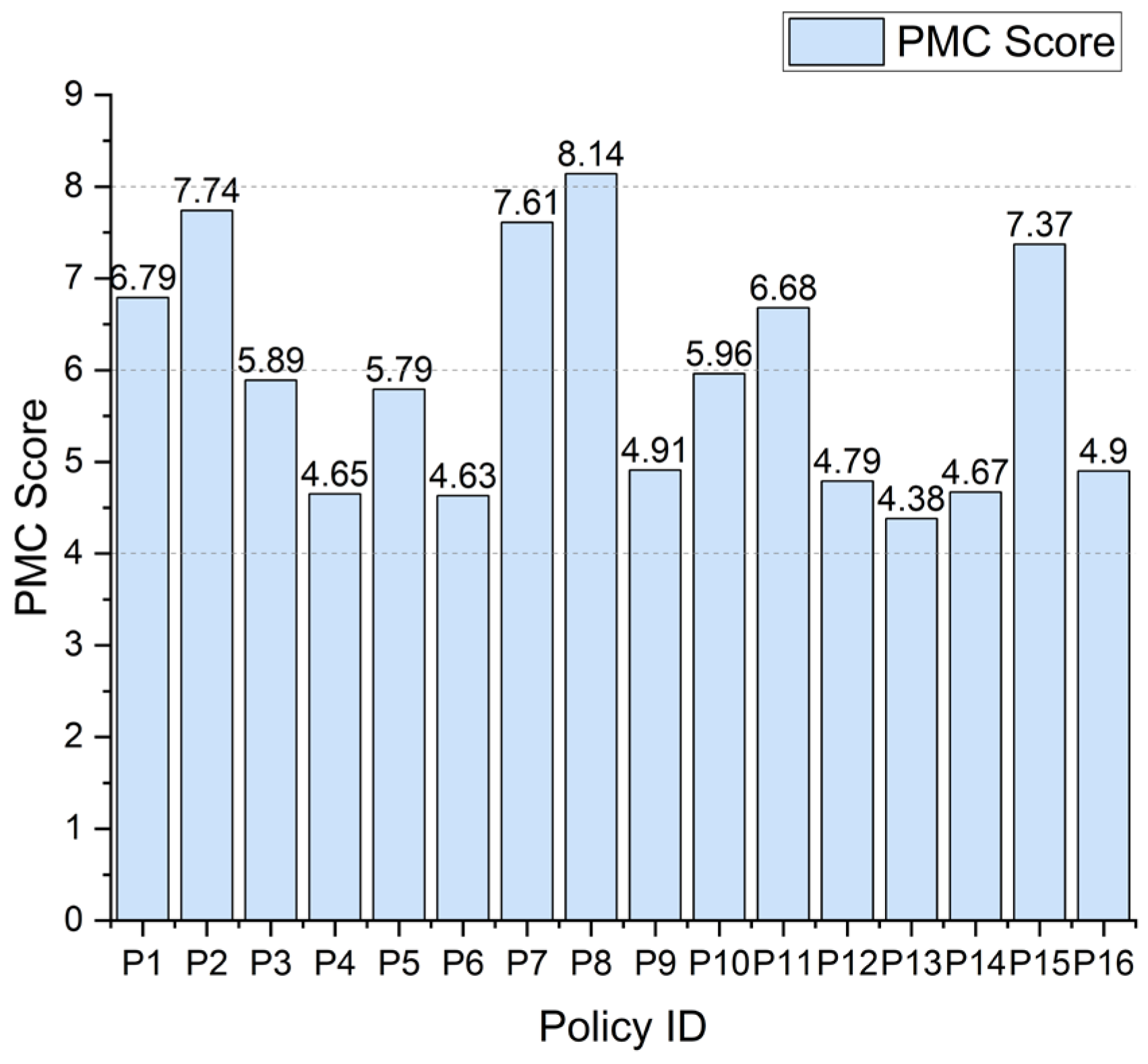
The PMC index values for the 16 selected policies are reported in Table 5. Scores range from 4.38 to 8.14, with a mean value of 5.93, suggesting that most policies achieve a moderate level of structural completeness and design coherence, albeit with noticeable variation across dimensions. According to the PMC classification criteria, one policy is rated as perfect, five as excellent, and ten as good, with no policies falling into the poor category (Figure 6).
Table 5.
PMC Index Scores of Emergency Supplies Policies in the Yangtze River Delta.
Figure 6.
PMC Score of Emergency Supplies Policy in the Yangtze River Delta.
From a mission-oriented perspective, policy texts perform relatively well. The mean scores for policy nature (X2 = 0.79) and policy objectives (X3 = 0.70) indicate that normative orientations and governance goals are clearly articulated in most documents. Core public value commitments—such as safeguarding life, ensuring basic living needs, and strengthening emergency support capacity—are consistently emphasized across the policy set.
By contrast, greater dispersion is observed in the structure and mechanism dimensions. Although participating actors are frequently specified (X4 = 0.81), linkage response arrangements receive a lower average score (X5 = 0.58), reflecting uneven specification of cross-departmental, cross-level, and cross-regional coordination. A similar pattern emerges in the mechanism dimension, particularly in allocation and utilization (X8 = 0.56), where procedural detail and operational integration remain comparatively weak. These results suggest that clearly stated policy intentions are not always matched by corresponding coordination mechanisms or implementation pathways.
5.4. Analysis of PMC Surface Plots
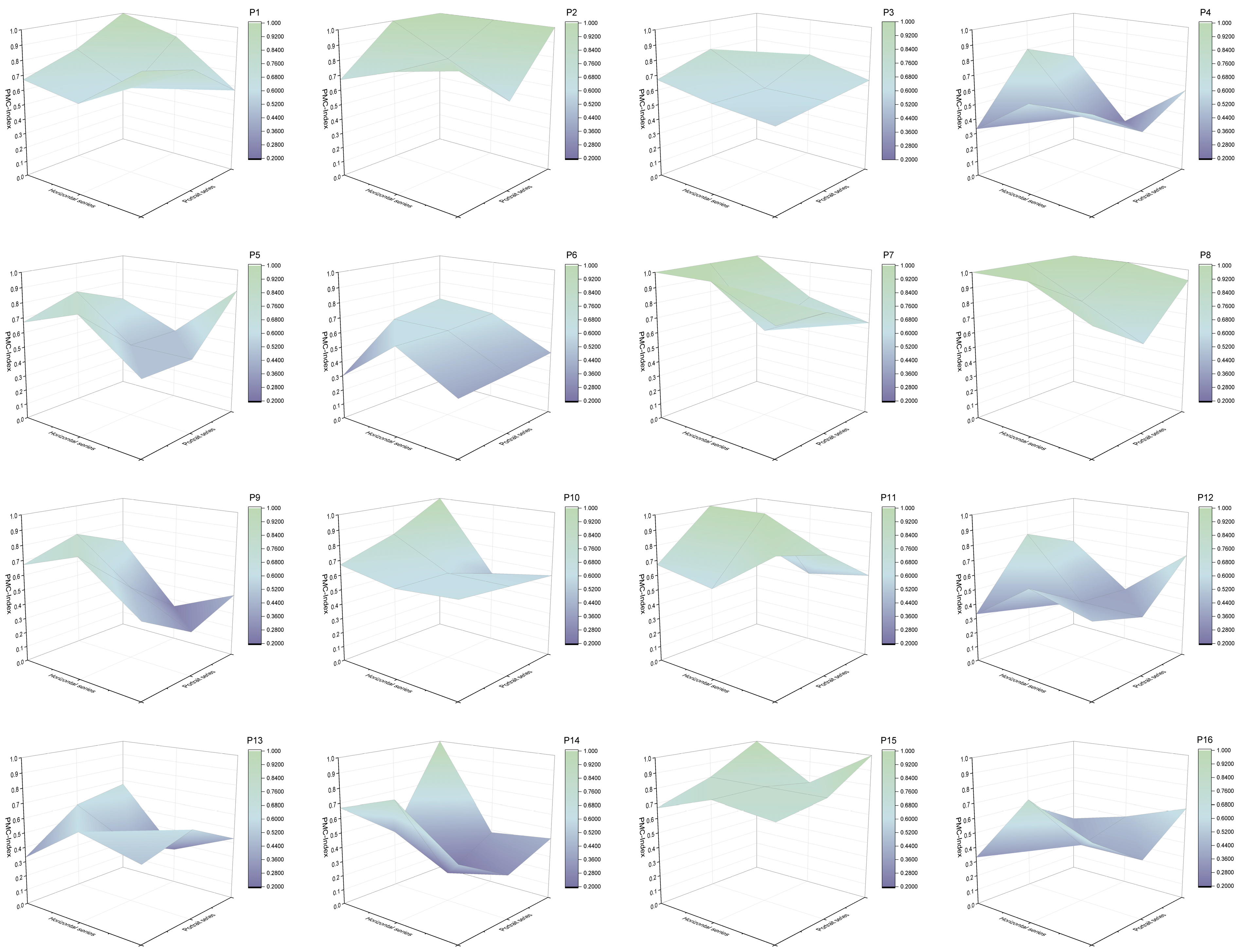
The PMC surface plots (Figure 7) provide a visual assessment of policy consistency along two dimensions: internal structural consistency within individual policy texts and inter-policy coherence across the regional policy system.
Figure 7.
PMC Surface Plots of Emergency Supplies Policy in the Yangtze River Delta.
From the perspective of internal structural consistency, surface smoothness reflects the degree to which key design dimensions are evenly articulated within a single policy. Policies with relatively smooth and elevated surfaces—such as P2, P7, P8, and P15—demonstrate higher internal structural consistency, characterized by coordinated specification of policy objectives, actor arrangements, infrastructure provisions, and supporting mechanisms. In contrast, policies exhibiting pronounced surface depressions or steep gradients—more frequently observed among certain municipal-level documents—indicate internal imbalance, where some dimensions are well developed while others, particularly linkage response or allocation and utilization mechanisms, remain insufficiently specified.
With regard to inter-policy coherence, surface patterns reveal notable variation across jurisdictions. Policies from Zhejiang Province display relatively similar surface shapes and levels across administrative tiers, suggesting stronger structural coherence within the provincial policy system. By contrast, greater divergence between provincial- and municipal-level surfaces is observed in Shanghai and Anhui, indicating inconsistent design emphases and weaker alignment among policies within the regional governance framework. Such variation points to uneven inter-policy coherence and highlights challenges in achieving vertically and horizontally integrated emergency supplies governance across the YRD.
6. Discussion
This study integrates text mining with the Policy Modeling Consistency (PMC) index model to conduct a design-oriented evaluation of emergency supplies policies in the Yangtze River Delta (YRD). By combining corpus-level analysis of the regional policy system with in-depth PMC evaluation of selected core policies, the study focuses on policy design features embedded in textual formulation rather than implementation outcomes.
The results indicate that, within the set of core, system-defining policies evaluated, the mission dimension—reflected in policy nature and stated objectives—is comparatively well specified across the sampled documents. Most policies articulate clear normative commitments to public safety and system capacity building, suggesting a relatively stable articulation of public value orientations within the evaluated set of foundational policy texts in the Yangtze River Delta. This pattern is broadly consistent with prior research on emergency governance and policy design. Existing studies show that, in centralized administrative systems, policy texts tend to prioritize the articulation of goals and normative orientations [71,72]. This tendency is particularly visible at the formulation stage, while detailed procedural and operational specifications often receive less emphasis [63]. Compared with studies that focus primarily on implementation performance or network effectiveness, this study contributes a design-stage perspective, demonstrating that structural and mechanistic gaps are often embedded in policy texts prior to execution. The presence of clearly stated objectives does not necessarily coincide with equally detailed institutional or procedural arrangements, underscoring the analytical distinction between policy intent and design completeness. Consistent with this pattern, the structure and mechanism dimensions display greater heterogeneity. Although most of the evaluated core policies identify relevant participating actors, coordination arrangements—especially those involving cross-departmental, cross-level, and cross-regional interaction—are unevenly specified. In several cases, linkage response mechanisms and operational procedures are framed in broad or principle-based terms rather than articulated through concrete institutional rules, indicating that normative commitments are more consistently expressed than the organizational and procedural pathways required for coordinated action.
Differences across administrative levels further illustrate the role of institutional positioning in shaping policy texts. Municipal-level policies within the evaluated sample generally receive lower PMC scores than provincial-level policies. This result reflects differences in functional roles within China’s multi-level governance system [73] rather than variations in governance capability. From a theoretical perspective, this finding is consistent with expectations derived from multi-level governance and fiscal federalism theories, which emphasize functional differentiation and asymmetric authority across administrative levels [74]. Existing international research on intergovernmental emergency governance similarly finds that subnational governments often operate under tighter vertical constraints [75], limiting their role in system-level coordination and policy integration. Municipal governments, operating under stronger vertical accountability constraints, tend to focus on implementation alignment within their jurisdiction, leaving limited scope for formalizing cross-boundary coordination mechanisms. In this context, lower PMC scores among municipal policies are more appropriately interpreted as outcomes of constrained design scope and selective textual emphasis.
Interprovincial differences point to additional contextual factors influencing policy design. Some Shanghai policies included in the PMC evaluation (e.g., P9 and P10) exhibit lower scores than comparable policies in Zhejiang, despite Shanghai’s stronger resource base. This pattern reflects differences in risk exposure and governance practice rather than relative performance in emergency management. As a highly urbanized metropolitan region, Shanghai faces emergency risks characterized by systemic complexity and high sensitivity, where governance often relies on established administrative routines and professional discretion. Under such conditions, policy texts may place less emphasis on detailed procedural codification. Zhejiang, by contrast, has historically experienced more frequent natural hazards, including typhoons and floods, which has encouraged a more proceduralized approach to policy design. Consequently, higher PMC scores in Zhejiang policies primarily reflect a greater degree of textual specification across design dimensions. These findings suggest that policy design completeness varies with administrative role, risk context, and governance tradition. PMC scores therefore capture differences in design orientation and institutional strategy among core policy texts, rather than serving as direct indicators of overall emergency governance effectiveness. Notably, this finding challenges a common assumption in policy practice and parts of the literature that stronger resource endowment necessarily leads to more comprehensive policy design. Unlike performance-oriented studies that equate governance capacity with resource availability, our results indicate that policy design completeness is shaped more strongly by risk exposure, governance routines, and institutional strategy, underscoring that design rationality and textual completeness do not always scale with material capacity.
7. Conclusions and Policy Implications
7.1. Conclusions
This study undertakes a design-oriented evaluation of emergency supplies policies in the Yangtze River Delta (YRD) by integrating policy text mining with the Policy Modeling Consistency (PMC) index within a mission–structure–mechanism framework. By focusing on textual formulation, the analysis examines policy design coherence and regional consistency at the policy design stage.
The results indicate that the evaluated core emergency supplies policies in the Yangtze River Delta exhibit a relatively strong and consistent mission orientation, with public value commitments and governance objectives clearly articulated. By contrast, institutional and operational dimensions—particularly linkage response and allocation-related mechanisms—are specified less systematically, revealing notable design-level asymmetries prior to implementation. Variations in PMC scores across regions and administrative levels within the evaluated policy set reflect differences in institutional positioning and design choices rather than simple disparities in governance capacity, underscoring the need for contextualized interpretation of policy design metrics.
This study contributes to emergency governance research in three respects. First, it shifts analytical attention from policy outcomes to policy design quality. Second, it demonstrates the methodological value of combining text mining with the PMC index for systematic policy diagnosis. Third, it provides regionally grounded evidence on patterns of design coherence and asymmetry in core policy texts within a cross-jurisdictional emergency governance system.
7.2. Policy Implications
Building on the empirical findings, policy refinement should give greater weight to the structure and mechanism dimensions of emergency supplies governance, particularly by institutionalizing cross-departmental and cross-regional linkage response arrangements. Clear, rule-based coordination frameworks are essential for translating strategic objectives into operationally workable procedures and reducing fragmentation during emergency response.
From a multi-level governance perspective, policy design should explicitly reflect functional differentiation across administrative tiers. Provincial policies are better suited to system integration and rule harmonization, while municipal policies require complementary arrangements that clarify responsibilities and lower coordination costs at administrative boundaries. Such differentiation enables policy layers to operate in a mutually reinforcing manner.
Finally, in the context of ongoing regional integration in the Yangtze River Delta, policy design should avoid reliance on implicit administrative capacity. More explicit coordination procedures and allocation rules can enhance transparency and predictability, thereby strengthening interjurisdictional trust under conditions of uncertainty.
7.3. Limitations and Future Research
This study has several limitations that should be considered when interpreting the findings.
First, the PMC index employs a coverage-oriented scoring scheme (1, 0.5, 0) to assess whether key design elements are explicitly specified in policy texts. As a result, the evaluation captures the breadth and internal completeness of policy design at the formulation stage, rather than differences in legal enforceability, resource commitment, or implementation intensity. Policies with substantially different binding force or operational capacity may therefore receive similar PMC scores if their design elements are articulated to a comparable extent. Accordingly, PMC results should be interpreted as diagnostic indicators of design-stage coherence within the evaluated policy texts, rather than as direct measures of policy effectiveness. Future research may incorporate enforceability-related textual cues and triangulate design diagnostics with implementation and outcome data.
Second, this study does not apply PMC evaluation to the full population of 212 emergency supplies policy documents. Instead, PMC analysis is conducted on a set of core, system-defining policies, with the full policy corpus used to inform indicator construction and provide system-level context. This selective evaluation strategy introduces inherent limitations. Because specialized, technical, and procedurally oriented documents are not directly assessed, certain design features embedded in more operational policy instruments may be underrepresented in the PMC results. At the same time, variation across policy types implies that selective evaluation places greater emphasis on system-level design logic, while capturing less of the fine-grained procedural adjustments reflected in lower-level documents. The PMC findings should therefore be read as diagnostic insights into the structural coherence of core policy texts, rather than as a comprehensive account of all design characteristics across the regional policy system. In this sense, the adopted strategy represents a considered trade-off between analytical depth and coverage, aimed at preserving interpretability rather than maximizing numerical completeness.
Third, consistent with the original design logic of the PMC model, equal weights are assigned across policy dimensions. In practice, different components of emergency supplies governance may contribute unevenly to system resilience and operational effectiveness. An equal-weighting assumption may therefore understate the functional importance of certain dimensions from a performance-oriented perspective. However, within a design-stage diagnostic framework, equal weighting avoids subjective prioritization and supports transparency and comparability across the evaluated policy set. Future studies may explore alternative weighting strategies to examine how design priorities vary across emergency contexts
Author Contributions
D.G. completed the main body of work, including conceptualization, methodology, data collection and analysis, and writing the original draft. Y.W. contributed to the research design, developed the evaluation indicator system, and provided supervision and guidance for manuscript revision. All authors have read and agreed to the published version of the manuscript.
Funding
This research was supported by the Major Project of the National Social Science Fund of China (Grant No. 23ZDA117).
Data Availability Statement
Data derived from public domain resources.
Conflicts of Interest
The authors declare no conflicts of interest.
Abbreviations
The following abbreviations are used in this manuscript:
| YRD | Yangtze River Delta |
| PMC | Policy Modeling Consistency |
| R&D | Research and Development |
Appendix A

Table A1.
Chinese–English Keyword Mapping for Figure 4.
Table A1.
Chinese–English Keyword Mapping for Figure 4.
| Chinese Keyword | English Label | Chinese Keyword | English Label | Chinese Keyword | English Label |
|---|---|---|---|---|---|
| 应急 | Emergency | 基层 | Grassroots | 预案 | Contingency plan |
| 应急物资 | Emergency supplies | 人员 | Personnel | 协议 | Agreement |
| 应急物资储备 | Emergency material reserves | 机制 | Mechanism | 申请 | Application |
| 救灾物资 | Disaster relief supplies | 体系 | System | 时间 | Time |
| 救灾 | Disaster relief | 建立 | Establish | 调拨 | Allocation |
| 物资 | Supplies | 能力 | Capability | 调度 | Dispatching |
| 储备 | Reserve | 资源 | Resources | 调运 | Dispatch & transport |
| 物资储备 | Material reserves | 安全 | Safety | 转移 | Transfer |
| 保障 | Support | 救援 | Rescue | 运输 | Transportation |
| 管理 | Management | 应急救援 | Emergency rescue | 物流 | Logistics |
| 部门 | Department | 抢险 | Rescue operations | 仓储 | Warehousing |
| 政府 | Government | 自然灾害 | Natural disaster | 设施 | Facilities |
| 企业 | Enterprise | 事故 | Accident | 装备 | Equipment |
| 社会 | Society | 灾害 | Disaster | 储备库 | Reserve depot |
| 组织 | Organization | 受灾 | Affected by disaster | 收储单位 | Storage unit |
| 商务 | Commerce | 突发 | Unexpected | 存储 | Storage |
| 财政 | Finance | 事件 | Event | 布局 | Layout |
| 资金 | Funding | 日常 | Routine | 规模 | Scale |
| 领导 | Leadership | 动态 | Dynamic | 品种 | Category |
| 区域 | Region | 响应 | Response | 数量 | Quantity |
| 长三角 | Yangtze River Delta | 及时 | Timely | 质量 | Quality |
| 协调 | Coordination | 快速 | Rapid | 使用 | Use |
| 协同 | Collaboration | 高效 | Efficient | 采购 | Procurement |
| 合作 | Collaboration | 有效 | Effective | 需求 | Demand |
| 会同 | Jointly with | 技术 | Technology | 供应 | Supply |
| 共享 | Sharing | 信息化 | Informatization | 市场 | Market |
| 指挥 | Command | 机构 | Institution | 粮食 | Grain |
| 指挥部 | Command headquarters | 办法 | Measures | 生活必需品 | Daily necessities |
| 中心 | Center | 规范 | Norms | 回收 | Recycling |
| 平台 | Platform | 标准化 | Standard | 处置 | Disposal |
| 应急管理 | Emergency management | 措施 | Measures | 粮食和物资储备局 | Bureau of Grain and Material Reserves |
| 省级 | Provincial level | 计划 | Plan | ||
| 市级 | Municipal level | 规划 | Planning |
References
- Kang, Q. Emergency Management System Evaluation and Fiscal Policy Inspiration—Take Liaoning Province as an Example. J. Econ. Public Financ. 2024, 10, 58. [Google Scholar] [CrossRef]
- Han, J.; Wu, Q.; Zhang, L.; Lei, C. How Can the Urban Emergency Capability Gap Be Measured? Construction of a Standardized Indicator System in China. Int. J. Disaster Risk Reduct. 2022, 80, 103236. [Google Scholar] [CrossRef]
- Guan, X.; Li, W.; Cui, N.; Yu, J.; An, L. Construction of an Evaluation Indicator System for the Emergency Management Capability of Major Infectious Diseases in Urban Communities. BMC Health Serv. Res. 2025, 25, 857. [Google Scholar] [CrossRef]
- Luo, Y.; Chen, X.; Yao, L. Flood Disaster Resilience Evaluation of Chinese Regions: Integrating the Hesitant Fuzzy Linguistic Term Sets with Prospect Theory. Nat. Hazards 2021, 105, 667–690. [Google Scholar] [CrossRef]
- Ekmekcioğlu, Ö.; Koc, K.; Özger, M. Towards Flood Risk Mapping Based on Multi-Tiered Decision Making in a Densely Urbanized Metropolitan City of Istanbul. Sustain. Cities Soc. 2022, 80, 103759. [Google Scholar] [CrossRef]
- Setyonugroho, G.A.; Maki, N. Policy Implementation Model Review of the Post-Disaster Housing Reconstruction in Indonesia Case Study: Aceh, Yogyakarta, and Lombok. Int. J. Disaster Risk Reduct. 2024, 100, 104181. [Google Scholar] [CrossRef]
- Abdolazimi, O.; Pishvaee, M.S.; Shafiee, M.; Shishebori, D.; Ma, J.; Entezari, S. Blood Supply Chain Configuration and Optimization under the COVID-19 Using Benders Decomposition Based Heuristic Algorithm. Int. J. Prod. Res. 2025, 63, 571–593. [Google Scholar] [CrossRef]
- Afshar, A.; Haghani, A. Modeling Integrated Supply Chain Logistics in Real-Time Large-Scale Disaster Relief Operations. Socio-Econ. Plan. Sci. 2012, 46, 327–338. [Google Scholar] [CrossRef]
- Ismail, I. A Possibilistic Mathematical Programming Model to Control the Flow of Relief Commodities in Humanitarian Supply Chains. Comput. Ind. Eng. 2021, 157, 107305. [Google Scholar] [CrossRef]
- Taouktsis, X.; Zikopoulos, C. A Decision-Making Tool for the Determination of the Distribution Center Location in a Humanitarian Logistics Network. Expert Syst. Appl. 2024, 238, 122010. [Google Scholar] [CrossRef]
- Linder, F.; Desmarais, B.; Burgess, M.; Giraudy, E. Text as Policy: Measuring Policy Similarity through Bill Text Reuse. Policy Stud. J. 2020, 48, 546–574. [Google Scholar] [CrossRef]
- Jiang, N.; Jiang, W. How Does Regional Integration Policy Affect Urban Resilience? Evidence from Urban Agglomeration in China. Environ. Impact Assess. Rev. 2024, 104, 107298. [Google Scholar] [CrossRef]
- Li, C.; Wang, Y.; Qing, W.; Li, C. What Makes a Specialised Emergency Plan Effective?—A Case Study of Railway Operation in 33 Prefectural Cities in China. PLoS ONE 2025, 20, e0327007. [Google Scholar] [CrossRef] [PubMed]
- Li, Y.; Gong, S.; Zhang, Z.; Liu, M.; Sun, C.; Zhao, Y. Vulnerability Evaluation of Rainstorm Disaster Based on ESA Conceptual Framework: A Case Study of Liaoning Province, China. Sustain. Cities Soc. 2021, 64, 102540. [Google Scholar] [CrossRef]
- Zhang, B.; Ma, D.; Wang, W. Implementing a Resistance-Relief Approach into Evaluating Urban Disaster Management Capacity: A Case Study of Xuzhou. Int. J. Disaster Risk Reduct. 2024, 103, 104348. [Google Scholar] [CrossRef]
- Ge, T.; Chen, X.; Geng, Y.; Yang, K. Does Regional Collaborative Governance Reduce Air Pollution? Quasi-Experimental Evidence from China. J. Clean. Prod. 2023, 419, 138283. [Google Scholar] [CrossRef]
- Huang, X.; Zhan, W.; Qi, T.; Guo, Y.; Bai, R.; Hong, T. Research on Regional Collaborative Governance between Central and Local Governments under the Background of Green Innovation. Systems 2025, 13, 153. [Google Scholar] [CrossRef]
- Tukamuhabwa, B.R. Supply Chain Resilience: Definition, Review and Theoretical Foundations for Further Study. Int. J. Prod. Res. 2015, 53, 5592–5623. [Google Scholar] [CrossRef]
- Ghaffari, Z.; Nasiri, M.M.; Bozorgi-Amiri, A.; Rahbari, A. Emergency Supply Chain Scheduling Problem with Multiple Resources in Disaster Relief Operations. Transp. A Transp. Sci. 2020, 16, 930–956. [Google Scholar] [CrossRef]
- Taskin, S.; Lodree, E.J. Inventory Decisions for Emergency Supplies Based on Hurricane Count Predictions. Int. J. Prod. Econ. 2010, 126, 66–75. [Google Scholar] [CrossRef]
- Thomas, V.A.; Mahanty, B. Assessment of Emergency Sourcing Strategy of a Supply Chain through Dynamic Simulation Approach. J. Ind. Prod. Eng. 2020, 37, 56–69. [Google Scholar] [CrossRef]
- Yang, C.; Tian, K.; Gao, X. Supply Chain Resilience: Measure, Risk Assessment and Strategies. Fundam. Res. 2025, 5, 433–436. [Google Scholar] [CrossRef] [PubMed]
- Chukwuka, O.J.; Ren, J.; Wang, J.; Paraskevadakis, D. A Comprehensive Research on Analyzing Risk Factors in Emergency Supply Chains. J. Humanit. Logist. Supply Chain Manag. 2023, 13, 249–292. [Google Scholar] [CrossRef]
- Rinaldi, M.; Caterino, M.; Riemma, S.; Macchiaroli, R.; Fera, M. Emergency Supply Chain Resilience Enhanced through Blockchain and Digital Twin Technology. Logistics 2025, 9, 43–67. [Google Scholar] [CrossRef]
- Zhang, J.; Miao, X.; Shang, T. Impact Mechanism of Digital Transformation on Supply Chain Resilience. Financ. Res. Lett. 2025, 76, 106993. [Google Scholar] [CrossRef]
- Singh, S.; Kumar, R.; Panchal, R.; Tiwari, M.K. Impact of COVID-19 on Logistics Systems and Disruptions in Food Supply Chain. Int. J. Prod. Res. 2021, 59, 1993–2008. [Google Scholar] [CrossRef]
- Hecht, A.A.; Biehl, E.; Barnett, D.J.; Neff, R.A. Urban Food Supply Chain Resilience for Crises Threatening Food Security: A Qualitative Study. J. Acad. Nutr. Diet. 2019, 119, 211–224. [Google Scholar] [CrossRef]
- Wang, X.; Wu, W.; Song, P.; He, J. An International Comparison Analysis of Reserve and Supply System for Emergency Medical Supplies between China, the United States, Australia, and Canada. BioSci. Trends 2020, 14, 231–240. [Google Scholar] [CrossRef]
- Sanderson, I. Evaluation in Complex Policy Systems. Evaluation 2000, 6, 433–454. [Google Scholar] [CrossRef]
- Collins, T. Health Policy Analysis: A Simple Tool for Policy Makers. Public Health 2005, 119, 192–196. [Google Scholar] [CrossRef]
- Walt, G.; Gilson, L. Reforming the Health Sector in Developing Countries: The Central Role of Policy Analysis. Health Policy Plan. 1994, 9, 353–370. [Google Scholar] [CrossRef]
- Field, J. What Is Appropriate and Relevant Assistance after a Disaster? Accounting for Culture(s) in the Response to Typhoon Haiyan/Yolanda. Int. J. Disaster Risk Reduct. 2017, 22, 335–344. [Google Scholar] [CrossRef]
- Mushkatel, A.H.; Weschler, L.F. Emergency Management and the Intergovernmental System. Public Adm. Rev. 1985, 45, 49–58. [Google Scholar] [CrossRef]
- McHugh, L.H.; Lemos, M.C.; Morrison, T.H. Risk? Crisis? Emergency? Implications of the New Climate Emergency Framing for Governance and Policy. WIREs Clim. Change 2021, 12, e736. [Google Scholar] [CrossRef]
- Nyankori, J.C.O.; Sadoulet, E.; de Janvry, A. Quantitative Development Policy Analysis. Am. J. Agric. Econ. 1996, 78, 251–253. [Google Scholar] [CrossRef]
- Araz, O.M.; Jehn, M. Improving Public Health Emergency Preparedness through Enhanced Decision-Making Environments: A Simulation and Survey Based Evaluation. Technol. Forecast. Soc. Change 2013, 80, 1775–1781. [Google Scholar] [CrossRef]
- Altiparmakis, A.; Bojar, A.; Brouard, S.; Foucault, M.; Kriesi, H.; Nadeau, R. Pandemic Politics: Policy Evaluations of Government Responses to COVID-19. West Eur. Polit. 2021, 44, 1159–1179. [Google Scholar] [CrossRef]
- Zhang, Q.; Mao, X.; Wang, Z.; Tan, Y.; Zhang, Z.; Wu, Y.; Gao, Y. Impact of the Emergency Response to COVID-19 on Air Quality and Its Policy Implications: Evidence from 290 Cities in China. Environ. Sci. Policy 2023, 145, 50–59. [Google Scholar] [CrossRef]
- Guo, M.; Zhou, Y. Boosting Sustainable Urban Development: How Smart Cities Improve Emergency Management—Evidence from 275 Chinese Cities. Sustainability 2025, 17, 6851. [Google Scholar] [CrossRef]
- Henstra, D. Evaluating Local Government Emergency Management Programs: What Framework Should Public Managers Adopt? Public Adm. Rev. 2010, 70, 236–246. [Google Scholar] [CrossRef]
- Hu, X.; Naim, K.; Jia, S.; Zhengwei, Z. Disaster Policy and Emergency Management Reforms in China: From Wenchuan Earthquake to Jiuzhaigou Earthquake. Int. J. Disaster Risk Reduct. 2021, 52, 101964. [Google Scholar] [CrossRef]
- Ruiz Estrada, M.A. Policy Modeling: Definition, Classification and Evaluation. J. Policy Model. 2011, 33, 523–536. [Google Scholar] [CrossRef]
- Zhao, Y.; Wu, L. Research on Emergency Response Policy for Public Health Emergencies in China—Based on Content Analysis of Policy Text and PMC-Index Model. Int. J. Environ. Res. Public Health 2022, 19, 12909. [Google Scholar] [CrossRef] [PubMed]
- Xu, Y.; Li, J.; Liu, Y. Quantitative Evaluation of Provincial Government Plans for Public Health Emergencies in China. Int. J. Disaster Risk Reduct. 2022, 81, 103292. [Google Scholar] [CrossRef]
- Xiong, Y.; Zhang, C.; Qi, H. How Effective Is the Fire Safety Education Policy in China? A Quantitative Evaluation Based on the PMC-Index Model. Saf. Sci. 2023, 161, 106070. [Google Scholar] [CrossRef]
- Liu, J.; Dong, C. Understanding the Complex Adaptive Characteristics of Cross-Regional Emergency Collaboration in China: A Stochastic Evolutionary Game Approach. Fractal Fract. 2024, 8, 98. [Google Scholar] [CrossRef]
- Liu, J.; Dong, C.; An, S.; Mai, Q. Dynamic Evolution Analysis of the Emergency Collaboration Network for Compound Disasters: A Case Study Involving a Public Health Emergency and an Accident Disaster during COVID-19. Healthcare 2022, 10, 500. [Google Scholar] [CrossRef] [PubMed]
- Stoto, M.A. Regionalization in Local Public Health Systems: Variation in Rationale, Implementation, and Impact on Public Health Preparedness. Public Health Rep. 2008, 123, 441–449. [Google Scholar] [CrossRef]
- Kapucu, N.; Augustin, M.; Garayev, V. Interstate Partnerships in Emergency Management: Emergency Management Assistance Compact in Response to Catastrophic Disasters. Public Adm. Rev. 2009, 69, 297–313. [Google Scholar] [CrossRef]
- Lei, Y.; Zhang, G.; Lu, S.; Qian, J. Revealing the Generation Mechanism of Cross-Regional Emergency Cooperation during Accidents and Disasters Rescue. Saf. Sci. 2023, 163, 106140. [Google Scholar] [CrossRef]
- Harris, J.K.; Clements, B. Using Social Network Analysis to Understand Missouri’s System of Public Health Emergency Planners. Public Health Rep. 2007, 122, 488–498. [Google Scholar] [CrossRef]
- Yin, H.; Xiao, R.; Fei, X.; Zhang, Z.; Gao, Z.; Wan, Y.; Tan, W.; Jiang, X.; Cao, W.; Guo, Y. Analyzing “Economy-Society-Environment” Sustainability from the Perspective of Urban Spatial Structure: A Case Study of the Yangtze River Delta Urban Agglomeration. Sustain. Cities Soc. 2023, 96, 104691. [Google Scholar] [CrossRef]
- Moore, M.H. Creating Public Value: Strategic Management in Government; Harvard University Press: Cambridge, MA, USA, 1997. [Google Scholar]
- Moore, M.H. Managing for Value: Organizational Strategy in for-Profit, Nonprofit, and Governmental Organizations. Nonprofit Volunt. Sect. Q. 2000, 29, 183–204. [Google Scholar] [CrossRef]
- Weinberg, M.L.; Lewis, M.S. The Public Value Approach to Strategic Management. Mus. Manag. Curatorsh. 2009, 24, 253–269. [Google Scholar] [CrossRef]
- Van Gestel, N.; Ferlie, E.; Grotenbreg, S. A Public Value Strategy for Sustainable Development Goals: Transforming an Existing Organization? Br. J. Manag. 2024, 35, 839–853. [Google Scholar] [CrossRef]
- Bryson, J.; Sancino, A.; Benington, J.; Sørensen, E. Towards a Multi-Actor Theory of Public Value Co-Creation. Public Manag. Rev. 2017, 19, 640–654. [Google Scholar] [CrossRef]
- Bojang, M.B.S. Appraising Public Value in the Public Sector: Re-Evaluation of the Strategic Triangle. SEISENSE J. Manag. 2021, 4, 1–10. [Google Scholar] [CrossRef]
- Hartley, J.; Alford, J.; Knies, E.; Douglas, S. Towards an Empirical Research Agenda for Public Value Theory. Public Manag. Rev. 2017, 19, 670–685. [Google Scholar] [CrossRef]
- Ruiz Estrada, M.A. The Policy Modeling Research Consistency Index (PMC-Index). SSRN J. 2010. [Google Scholar] [CrossRef]
- Kuang, B.; Han, J.; Lu, X.; Zhang, X.; Fan, X. Quantitative Evaluation of China’s Cultivated Land Protection Policies Based on the PMC-Index Model. Land Use Policy 2020, 99, 105062. [Google Scholar] [CrossRef]
- Zhao, X.; Jiang, M.; Wu, Z.; Zhou, Y. Quantitative Evaluation of China’s Energy Security Policy under the Background of Intensifying Geopolitical Conflicts: Based on PMC Model. Resour. Policy 2023, 85, 104032. [Google Scholar] [CrossRef]
- Li, Z.; Guo, X. Quantitative Evaluation of China’s Disaster Relief Policies: A PMC Index Model Approach. Int. J. Disaster Risk Reduct. 2022, 74, 102911. [Google Scholar] [CrossRef]
- Liu, Y.; Zhao, H. Quantitative Evaluation of Policy Based on PMC Index Model: A Case Study of China’s Textile Industry Policy. Math. Probl. Eng. 2022, 2022, 1870185. [Google Scholar] [CrossRef]
- Ma, X.; Ruan, Y.; Yang, Q. Evaluating China’s Common Prosperity Policies against the Background of Green Development by Using the PMC Model. Sustainability 2023, 15, 7870. [Google Scholar] [CrossRef]
- Liu, S.; Li, Y.; Ma, H.; Guan, L. Exploring the Scientific and Technological Achievement Transformation Policies in Chinese Universities: Based on Policy Text Analysis and PMC-Index Model. Front. Educ. 2025, 10, 1637921. [Google Scholar] [CrossRef]
- Cheng, Q.; Dong, J.; Chen, Y. Evaluation of original innovation policy under the background of innovative country strategy. Stud. Sci. Sci. 2021, 39, 2281–2293. [Google Scholar] [CrossRef]
- Zhang, X.; Cheng, X.; Qi, X.; Yang, K.; Zhao, Z. Evaluation of China’s Double-Carbon Energy Policy Based on the Policy Modeling Consistency Index. Util. Policy 2024, 90, 101783. [Google Scholar] [CrossRef]
- Wei, Q.; Wang, X.; Zhang, G.; Li, X.; Yang, X.; Gu, D. Internet Healthcare Policy Analysis, Evaluation, and Improvement Path: Multidimensional Perspectives. Healthcare 2023, 11, 1905. [Google Scholar] [CrossRef]
- Chi, H.; Tang, H.; Sun, C.; Zhong, L.; Guo, J.; Li, Y.; Wang, Y.; Ma, M.; Wei, L.; Wang, J.; et al. Quantitative Evaluation of Hospital Workplace Violence Prevention and Control Policies in China: Based on PMC Index Model. Health Res. Policy Syst. 2025, 23, 77. [Google Scholar] [CrossRef]
- T Hart, P.; Rosenthal, U.; Kouzmin, A. Crisis Decision Making: The Centralization Thesis Revisited. Adm. Soc. 1993, 25, 12–45. [Google Scholar] [CrossRef]
- Liu, Y.; Jiao, M.; Wang, Y.; Ma, A. Quantitative Evaluation of China’s Public Health Emergencies Response Policies: A PMC Index Model Approach. BMC Public Health 2025, 25, 266. [Google Scholar] [CrossRef]
- Shi, P.; Ni, M. The Allocation Mechanism of Authority and Accountability in Chinese Government Hierarchies: A Case Study of the “Earmarked Project System”. J. Chin. Sociol. 2017, 4, 4. [Google Scholar] [CrossRef]
- Broadhurst, K.; Gray, N. Understanding Resilient Places: Multi-Level Governance in Times of Crisis. Local Econ. 2022, 37, 84–103. [Google Scholar] [CrossRef]
- Christensen, T.; Lægreid, P.; Rykkja, L.H. Organizing for Crisis Management: Building Governance Capacity and Legitimacy. Public Adm. Rev. 2016, 76, 887–897. [Google Scholar] [CrossRef]
Disclaimer/Publisher’s Note: The statements, opinions and data contained in all publications are solely those of the individual author(s) and contributor(s) and not of MDPI and/or the editor(s). MDPI and/or the editor(s) disclaim responsibility for any injury to people or property resulting from any ideas, methods, instructions or products referred to in the content. |
© 2026 by the authors. Licensee MDPI, Basel, Switzerland. This article is an open access article distributed under the terms and conditions of the Creative Commons Attribution (CC BY) license.