
Overcoming Challenges in the Transition Towards Battery Electric and Software-Intensive Modular Heavy-Duty Vehicles



Abstract
1. Introduction
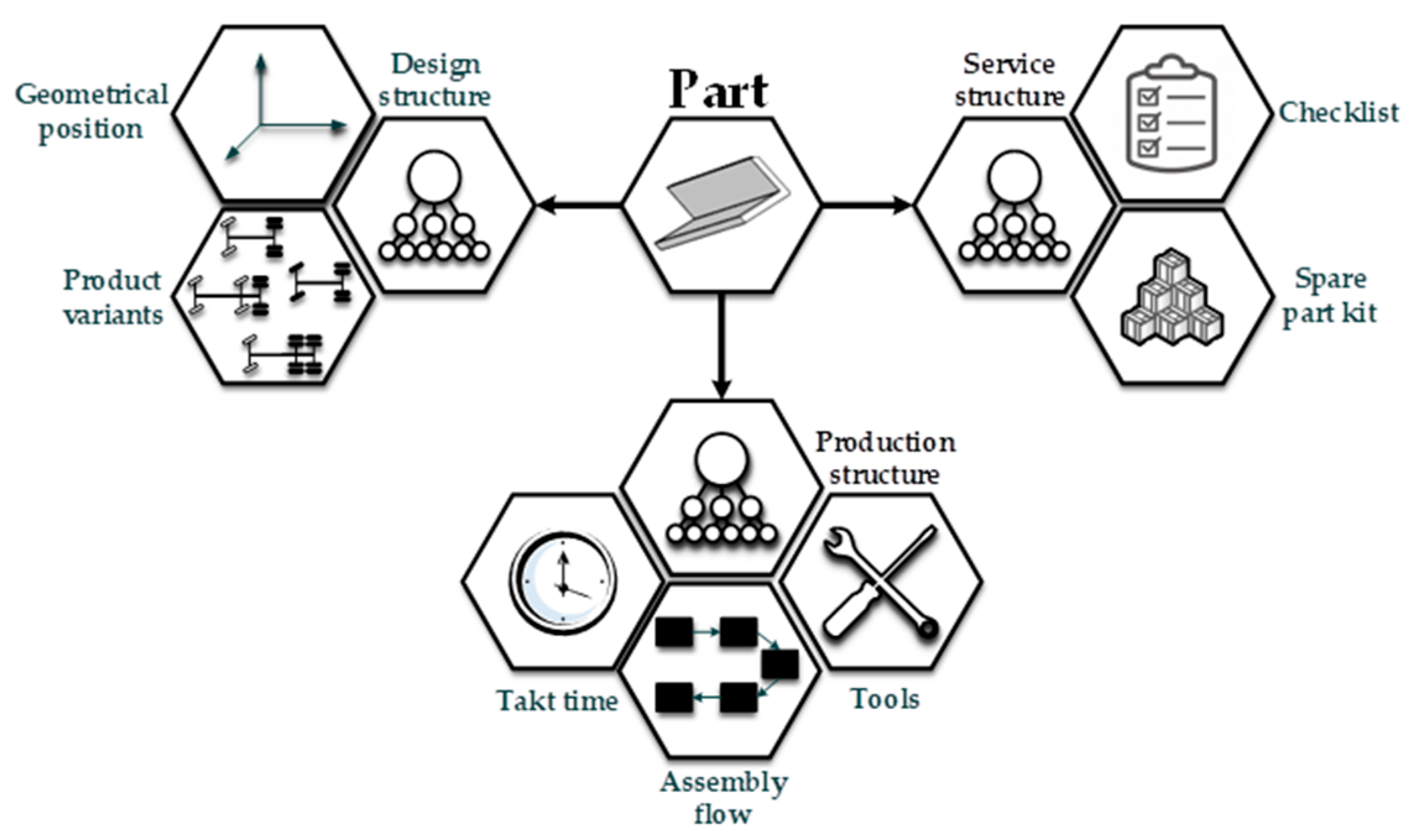
1.1. Scania’s Modular Product Portfolio
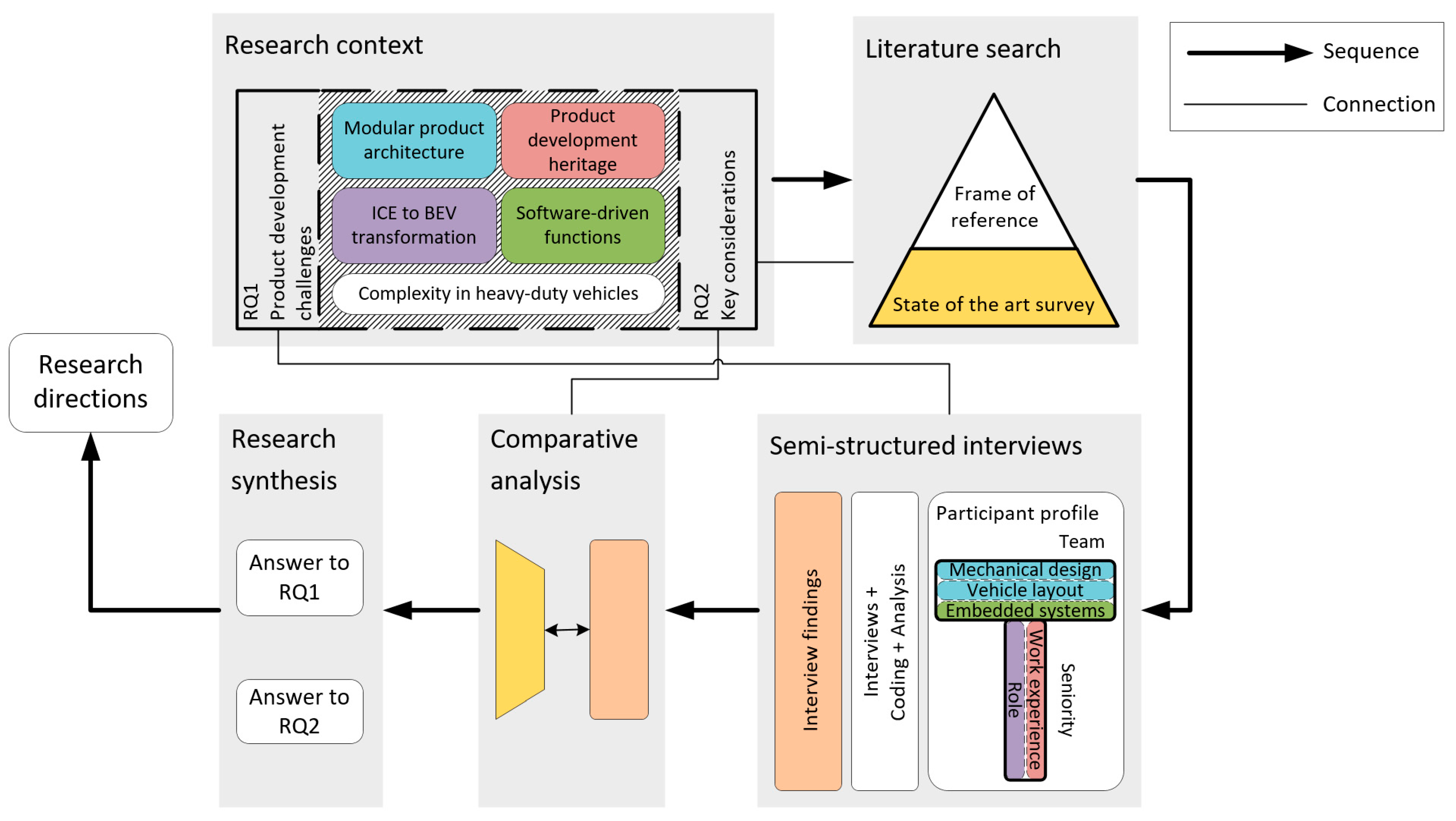
1.2. Overview of the Contribution
2. Frame of Reference
2.1. Cyber-Physical Systems and Their Complexity
2.2. Systems Engineering and Complexity Management
2.3. Role of Architecting
- Create a schematic of the product’s elements and functional structure.
- Cluster elements into logical subsystems and modules.
- Develop a rough geometric layout, arranging modules within the product’s physical constraints.
- Identify and define interactions (fundamental and incidental) between modules and subsystems.
2.4. Model-Based or Model-Centric Systems Engineering
2.5. Modularization and MBSE
2.5.1. Lightweight to Intermediate MBSE Implementations
2.5.2. Formal and High-Rigor MBSE Approaches
2.5.3. Observations and Reflections
3. Methodology
- SE practices in interdisciplinary PD environments for complex systems.
- The role of MBSE in managing complexity, in automotive PD and CPS.
- The application of MBSE to modular products and system architectures.
- MBSE practices, perspectives from a document-based approach, and key adoption challenges of MBSE in industry.
- Factors influencing product complexity in heavy-duty vehicles and their consequences.
- Existing PD processes managing system integration and emerging challenges across cross-functional interactions.
- Perspectives on SE and its integration within the current PD setup.
- The use of models in PD and their utility in comparison to text documents.
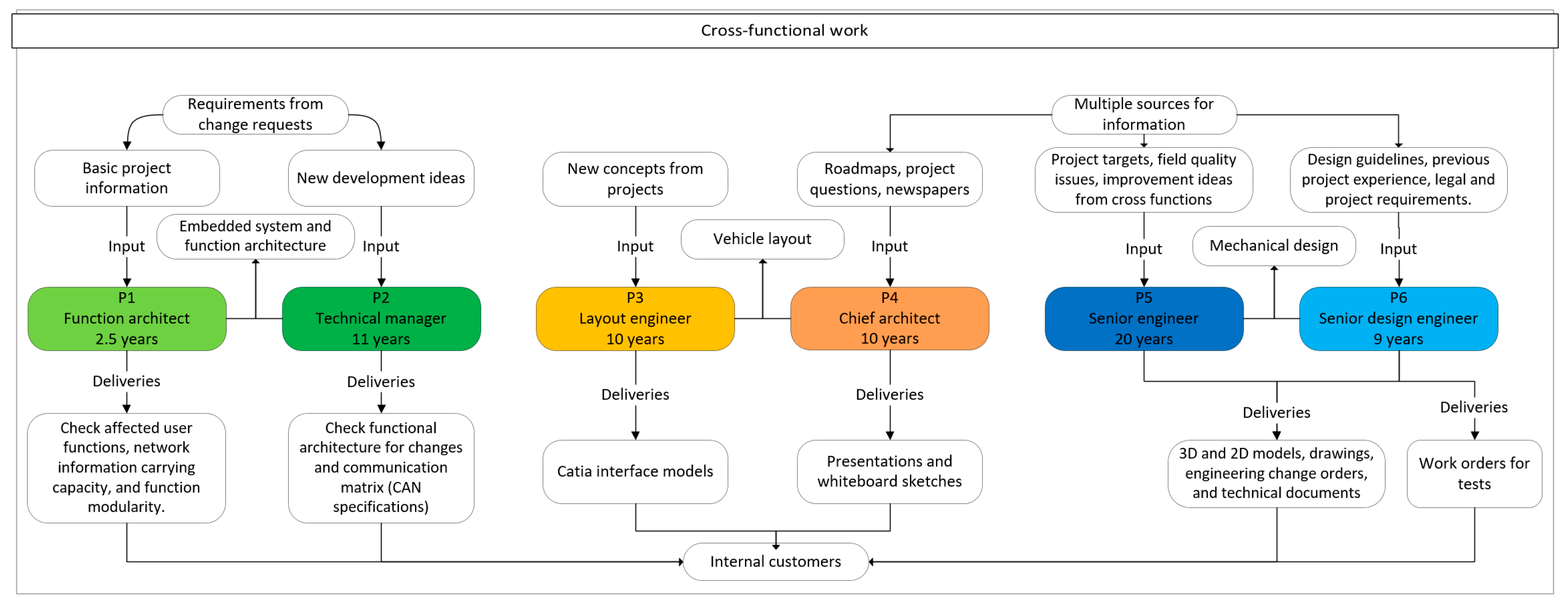
3.1. Participant Profile
3.2. Reliability and Validity
3.3. Delimitations
- Focus lies on a single OEM manufacturing heavy-duty vehicles, not including other modes of road transport such as passenger cars.
- The research concentrates on early PD phases, including concept and design phases. Subsequent life cycle phases, including manufacturing, service, and end-of-life, were not analyzed.
- The research centers on the ICE to BEV transition scenario and how increased software integration reshapes product-level complexity. Technical design details in this transition are beyond the scope of this research.
- The interviews draw insights from internal stakeholders; external stakeholders such as suppliers, customers, and regulators are not interviewed.
4. Results
4.1. Architecture and Design Approach
4.1.1. Product Development Challenges
“Historically, we have a diesel engine, and then if we need a hybrid vehicle, we add components to make it a hybrid. Then, to make a BEV, we use the hybrid vehicle to make the first BEVs, and then we have just improved.”(P4)
“Process performed to manage small changes; if big changes are to be made, then the process is not well adapted. So big changes need to be divided into smaller changes, and it is too much work to manage them.”(P1)
“In the early yellow arrow, a major hiccup occurs because a product structure cannot be created when there is no real project, which is created only in the green arrow […]. We have ideas, but there is no product road map. We should be more proactive.”(P3)
4.1.2. Market Needs and Requirements Management
4.1.3. Legacy Entities
4.2. Engineering Collaboration
4.2.1. Cross-Functional Communication
“It is quite common when you develop something, and you do not have the information you need to continue […] it is a communication question […]. If you have good communication, then you would not end up in such a situation.”(P5)
4.2.2. Decision Management
“For a project, we had ‘this seems to work, let us do this’ approach, a decentralized decision-making process, to achieve things going faster. […] (Reference) was easy as everything was in my head. But in other bigger projects, if someone is not involved from the beginning, then it is often hard to find [decisions].”(P4)
4.2.3. Perspectives on SE and MBSE
“[MBSE] used in conjunction with tools to implement models […] which is common now. The problem is to link all models in a coherent and comprehensive [way]. (Need) Strategy to connect smaller tools that can talk to each other.”(P2)
4.2.4. Role of a Systems Engineer
4.3. Information Management—Modeling Efforts and Data Representation
4.3.1. Information Accessibility Challenges
“A lot of sources of information. Need a lot of experience to find information by oneself; [applicable for] anything which has not gone into the official archive.”(P2)
“Do not update ECO often, […] important to have the right information when you release […]. The traceability is not good, and its dependent on how good you are at documenting.”(P5)
“Many things are not formally documented. The organization has grown quite a lot in recent years, with many new people searching for information and not finding it […] A lot of information can be received when talking to people, but there is a limit.”(P2)
“It depends on what you are looking for […]. But from a development point of view, it is always good to discuss with other people.”(P5)
4.3.2. Model Requirements
- Continuously updated: P1–P3 explained that models are continuously read, requiring them to be continuously updated to achieve the correct information.
- Adequate representation: All participants held a common view that the model must adequately represent the entity to be modeled.
- Conformance to relevant standards: P5 brought up the requirement for geometric models to conform to relevant modeling standards, as the model must be compatible throughout Scania. However, the participant also added that as humans, there are different ways to create a model.
- Ability to produce results: The models are required to produce results that can be interpreted by the participants for their work.
- Adequate abstraction: The model should contain necessary and relevant information depending on the purpose.
4.3.3. Modeling Tools and Techniques
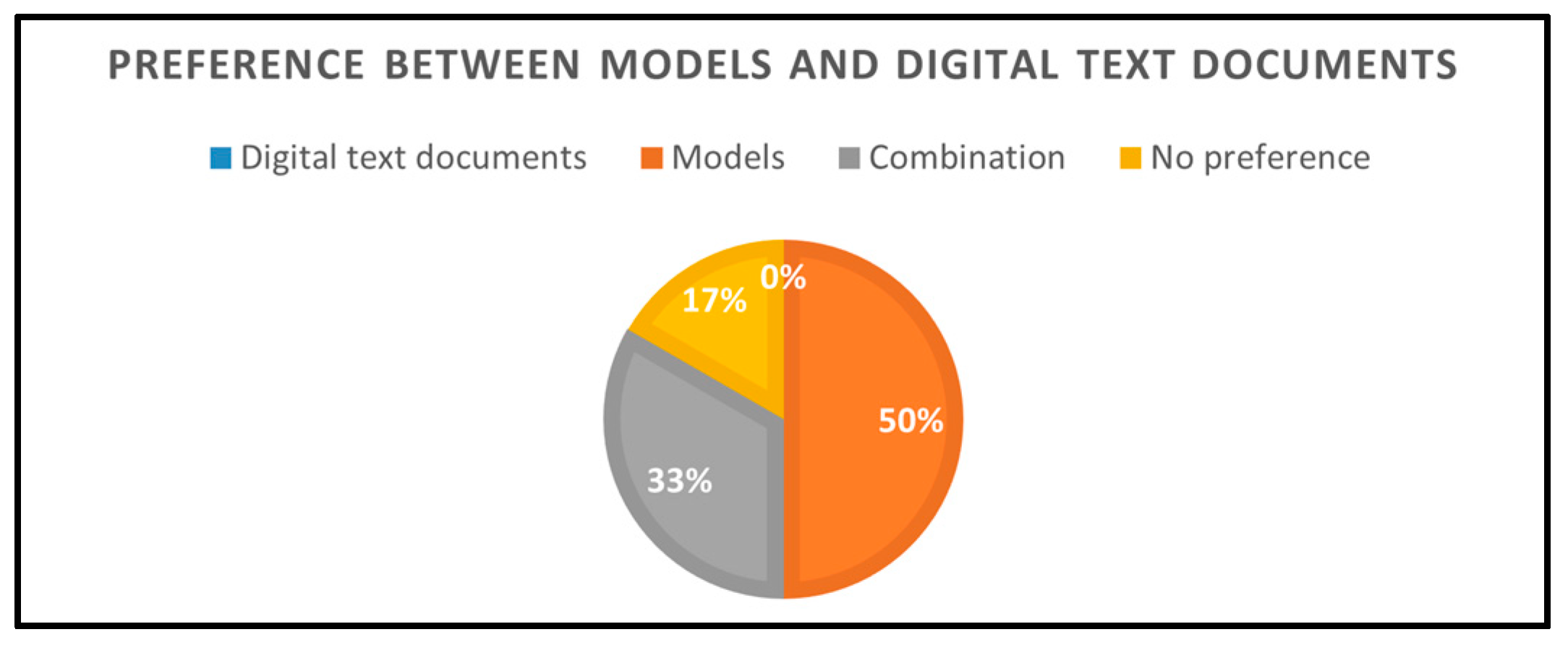
4.3.4. Computer Models Vs. Text Documents
“[…] less convinced that documents work […] the general trend is digitalization, more structure for information”(P2)
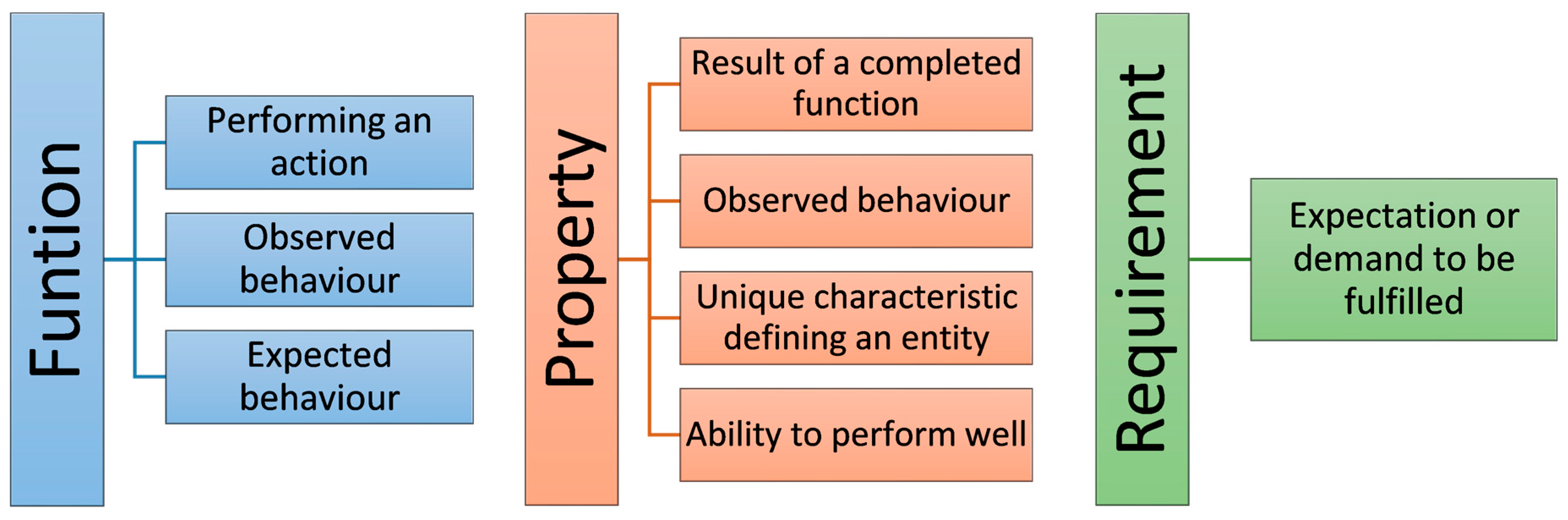
4.3.5. Varied Interpretations of Terminology
“Increasing need for a common view, because of the growing number of people involved and the complexity of the product. ISO 26262 [79] also puts requirements on exchanging data with the same meaning within (Scania) and outside.”(P2)
“A statement that identifies a system, product, or process characteristic or constraint, which is unambiguous, clear, unique, consistent, stand-alone (not grouped), and verifiable, and is deemed necessary for stakeholder acceptability”.[8]

4.4. Complexity and Integration Challenges
4.4.1. Complexity Challenges
“Trying to identify a new interface for future BEV, but it is not as easy as in an ICE truck because the engine position and gearbox have been the same for a hundred years. […] There are no stable interfaces over time because of the changing demands, complexity, or technology.”(P3)
“If you need to introduce something new or change something, you need to involve a lot of people, and it can be time-consuming.”(P5)
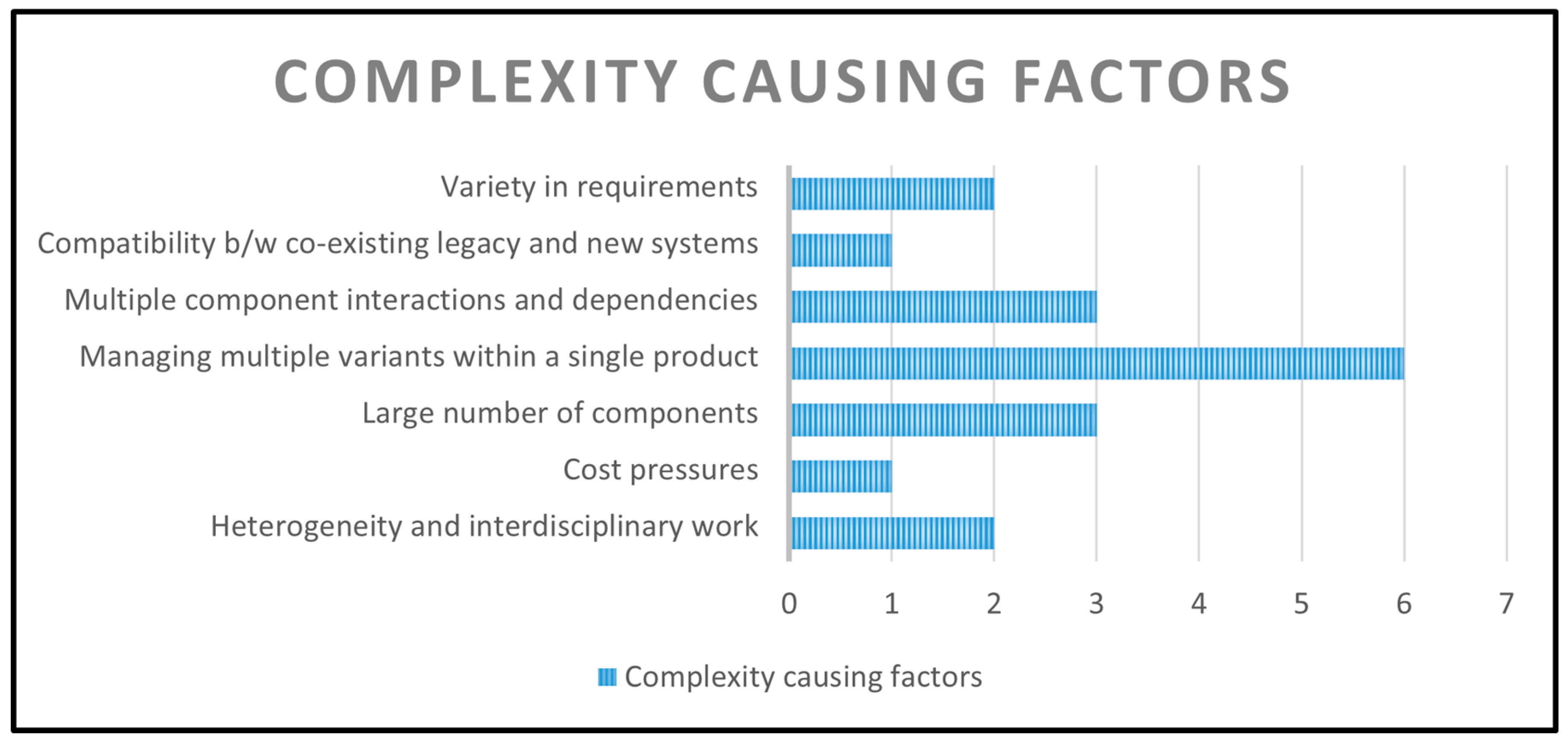
4.4.2. Factors Contributing to Complexity
4.4.3. Perception of Complexity
“[Complexity is] positive when different things are made to work together, can be an advantage over competitors if they cannot provide the same thing.”(P1)
“complex is when it is not easy to understand […] system that is complex at the moment is probably less complex tomorrow when you have implemented some systems to visualize it.”(P6)
5. Discussion
5.1. The Transition to BEV from ICE—Architectural Adaptation
5.2. Context to Product Development
5.3. Outlook on Product Complexity and Its Management

| Outlook on product complexity and its management | Interview Insights | SOTA Insights |
Product structure and MPP:
| Product complexity: Inherent to the architecture and cannot be eliminated [10]. Concept of integrative complexity [12]:
|
5.4. Complexity Beyond Products—the Product Development Ecosystem
| Complexity beyond Products, in Product Development ecosystem | Interview Insights | SOTA Insights |
Strengths and challenges in cross-functional collaboration:
| Complexity in CIPS [3] and integrated processes [91]:
|
| Platform for a model-based approach within the PD ecosystem | Interview Insights | SOTA Insights |
Prevalence of a document-based approach in early phases:
Formalized structured approach to specify systems vs. “generic” use of models. | Document-based approach:
|
5.5. Platform for a Model-Based Approach Within the PD Ecosystem
| Prospects towards a hybrid approach—MBSE and agile | Interview Insights | SOTA Insights |
Concurrent PD and Multidisciplinary Teams:
| Sheard’s 11 SE Roles [24]: Early work categorizes multiple SE roles, each with distinct responsibilities. Who can perform SE activities [25]? Any competent individual with relevant capabilities and experience, irrespective of job title. Opens possibilities for existing roles to incorporate SE responsibilities. Collaborative Learning [103]:
|
- Accessibility and usability: trade-offs between simplicity of text documents and long-term efficiency of models.
- Attitude towards change in the way of working and personal biases: familiarity with using text documents compared to the learning curve of models.
- Fragmentation vs. integration: managing information in text documents relative to models.
- Comprehension and representation: detailed, narrative-style explanations in text documents as opposed to structured information at different abstraction levels.
- The degree of automation possible using models is contrasted with that of text documents.
5.6. Prospects Towards a Hybrid Approach—MBSE and Agile
6. Research Synthesis
6.1. Addressing Research Questions
- Weak link between the context and PD and design requirements:Current PD methods lack a formalized approach to translate high-level transport use-cases into actionable design requirements. The practice of deriving design requirements from the improvement of product properties may tend to a product-centric PD over a user-centric approach. A direct dependency is the varied stakeholder interpretations of use-cases across multiple teams (software, electrical, mechanical) when they collaborate on developing new functions. This adds additional responsibilities to domain experts in clarifications. Incremental innovations benefit from property-driven PD. However, major shifts, such as in modular innovations, are a challenge.
- Holistic vs. Reductionist approaches to manage product complexity:Decomposition strategy (reductionist approach) and high modularity in PD help localize and manage complexity within modules. However, complications may result from unforeseen interactions between modules, requiring holistic oversight. Poorly managed complexity is a significant concern for increasing the engineering workload and poses risks of design errors. This essentially affects the efforts in balancing external variety and internal commonality. While the product structure facilitates managing variants, new functions lead to new performance steps and variants, posing technical challenges to engineers maintaining this balance. As software-driven vehicle functions increase, they challenge traditional module boundaries and interfaces from established architectural practices, needing a re-examination of the decomposition strategy.
- Fragmentation between physical and software architecture descriptions:Lack of a shared vehicle architecture description results in a fragmented view of the product, posing challenges to shared understanding, cross-functional collaboration, and holistic decision-making. A contributor to this issue is the higher architectural challenges for physical systems. A model-based formal methodology is required that provides a holistic view of the vehicle, accounting for energy and mass flows along with spatial interactions. Furthermore, without formal methods to specify high-level vehicle functions, traceability from transport use-cases to architecture decisions remains limited. This widens the gap between physical and software systems development and impairs function-driven development. Hence, early architectural tasks such as visualizing interfaces, evaluating concepts, and creating product roadmaps are difficult.
- Cross-functional collaboration and communication barriers in different forms:Software-intensive vehicle functions require close cross-functional coordination between software teams and traditional engineering disciplines. However, persistent communication barriers impact the cross-functional coordination, which manifests in various ways: a lack of a shared holistic view of the vehicle for collaborating stakeholders, misalignment due to inconsistencies in terminology with emerging technical concepts, and varying stakeholder engagement, seen in the involvement and personal communication preferences of individual stakeholders. Communication barriers may seem manageable in the early phases due to smaller teams and abstract concepts. However, any unresolved interactions can have amplified effects in later phases without a structured communication system. Large OEMs often have multiple processes involving different cross-functional teams. These processes may or may not be in the same network, posing risks to alignment, redundant information, and duplicate work. Also, PDP and best practices influence interpretations of key terms, complicating external collaboration or incorporating new theory into practice.
- Managing early-phase PD information:While specialized modeling tools exist for subsystem design (e.g., CAD for mechanical, dedicated software architecture tools for embedded systems), architectural and early development phases often rely on different forms of text documents. The volume, volatility, and inter-dependencies of information are overwhelming to manage and track with a predominantly document-based approach. Excessive search hinders collaboration and adds risks of overlooked information and reactive communication. Local copies or multiple links for documents create inconsistency and redundancy. Moreover, tacit information in informal, undocumented knowledge or inadequately documented information creates direct dependencies on stakeholders, which is especially challenging for new employees.
- Balancing continuity and innovation:OEMs must ensure short-term operational stability and long-term market competitiveness during the BEV transition. A hybrid innovation strategy allows new product generations to be introduced through modular innovations, followed by incremental improvements within modules or subsystems. This is a pragmatic approach for controlled innovation, where architectural knowledge is preserved and reinforced, while component knowledge is expanded. Proven architecture is leveraged for gradual evolution, balancing time-to-market with risk control. Balancing modularity and innovation risks requires clear guidelines that distinguish which modules or subsystems are shared, and which must be unique. Targeting specific modules or subsystems for further innovation contributes to improved product performance. Here, improved communication between modules or subsystems plays a key role.
- Architecture-driven collaboration:A consistent framework that improves impact propagation tracking, enables rapid iterations, and improves rigor enhances architecture-driven collaboration. This should be supported by structured communication channels and intent documentation that captures tacit knowledge and decisions.Maintaining a balance between holistic and reductionist approaches requires integrating systems thinking with modular development. A decomposition strategy localizes complexity within modules, while an overarching vehicle architecture description is necessary to manage complexity from module interactions.To foster a function-driven innovation, explicitly mapping vehicle functions with a common methodology is important. This should be guided by a user-centered approach, where system requirements are the primary driver and product properties act as constraints or performance optimization targets.Architectural innovations should be pursued towards the desired future architecture state, without disrupting the current modular product. This means distinct models representing the present and future architecture states support planning, communication, and evaluation. A feedback mechanism between these states supports long-term evolution, adaptability, and planning legacy system transitions.
- Layered and hybrid SE strategy leveraging the benefits of document-based and model-based approaches:
- ○
- Layer One: Early conceptual and primarily document-based—prioritizing simplicity and speed.In the early conceptual stages, retaining simplicity and accessibility of text documents offers value for abstract, high-level information. A full-fledged model-based approach is neither necessary nor practical in these early stages; however, they can be complemented with lightweight models. With a large design space and ambiguity, narrative text offers clarity and enables early agility without reliance on heavy tools.
- ○
- Layer Two: Federated vehicle architecture description—transition between conceptual and development stages.Complexity in the information grows as concept development and collaboration on the vehicle architecture progress. This necessitates a structured and integrated environment comprising formal models to address the challenges of manual reconciliation of product architecture information. A federated vehicle architecture description provides a shared platform for cross-functional teams, bridging physical and software systems development. Serving as a backbone for architecture work, it links transport use-cases and detailed design, acting as a bridge between layer one and layer three. Integrating PDM/PLM systems with this layer is essential to maintain information consistency across the PDP. However, an additional formal layer introduces additional responsibilities in managing the architecture model itself and ensuring effective integrations across the layers.
- ○
- Layer Three: Discipline-specific modeling.Comprises primarily discipline-specific engineering models for detailed design in the later development stages.Layer two should act as a formalized bridge between conceptual product planning layer one) and discipline-specific development (layer three). However, this layer is not clearly distinct, either because it is currently merged into adjacent layers or is underdeveloped, resulting in insufficient support for model-based architectural development.
- Standardized terminology and structured information flow:Terminology classes at different abstraction levels (e.g., company-specific, discipline-specific, domain-specific) potentially offer value in robust ontologies, in turn facilitating a model-based approach.
- Emergent SE Role Structure in three steps:A gradual and phased approach to organizational change through a distributed model helps ensure SE responsibilities are scalable. While facilitating cross-functional collaboration, the distributed SE model may provide opportunities to identify tightly coupled teams.
- ○
- Step 1: Lay and strengthen the foundation.Incorporating a practice of focus groups can provide a foundation for architecture-driven collaboration without introducing new SE roles at the outset.
- ○
- Step 2: Introduce the distributed SE model.As a succeeding step, the focus group practice can be extended into a distributed SE model. This creates an adaptable platform to collectively share SE responsibilities and strengthen collaboration across physical and software domains. This setup can foster collaborative learning through feedback loops between vehicle architecture and detailed sub-system design, combining top-down and bottom-up perspectives. Basing Sheard’s work [24] SE roles can be explicitly mapped to focus groups’ responsibilities to highlight overlaps and reveal gaps.
- ○
- Step 3: Refinement of model.As a final step, necessary activities should be identified to refine the distributed SE model, for example, through additional competence or personnel.
- Managing change and building confidence:Pilot projects can support the targeted introduction of layer two, providing an incremental approach to build confidence, measure effectiveness, and scale up within the organization. Dedicated workshops during these projects provide opportunities to understand the scope of changes and also clarify benefits and risks.
6.2. Research Directions
7. Conclusions
Author Contributions
Funding
Institutional Review Board Statement
Informed Consent Statement
Data Availability Statement
Acknowledgments
Conflicts of Interest
Appendix A
- (“Model-Based Systems Engineering” OR MBSE OR “model-based”) AND (“modular”) AND (“product architecture” OR “system architecture” OR “architecture”).
- (“Model-Based Systems Engineering” OR MBSE OR “model-based”) AND (“complex”) AND (“automotive” OR “vehicle” OR “automobile”).
- (“Model-Based Systems Engineering” OR MBSE OR “model-based”) AND (challenge OR limitation OR obstacle OR issue) AND (adopt* OR implement* OR practice OR application).
- Inclusion and exclusion criteria:
- Studies from 2010 were primarily focused on including recent developments and practices.
- The literature search was confined to the Engineering research area, particularly in the context of engineering design-related disciplines. Non-relevant technical domains were excluded, such as Civil engineering, telecommunications, computer science (not related to SE, e.g., Artificial Intelligence, Machine Learning, Big Data), and biomedical engineering.
- Non-engineering studies were outside the scope of the literature search, such as those focused on natural sciences, materials science, medicine, and humanities/social sciences.
- The literature search was limited to publications in English.
Appendix B
- The individual information topic includes:
- Current department and role? Which engineering discipline(s) do you relate your work to, for e.g., mechanical, electrical, software, etc.?
- Previous roles in Research and Development (R&D) and work experience other than R&D?
- Total years of experience?
- Usual inputs in the role and who provides them?
- Usual deliveries in the role, and who are the customers?
- Education background? (optional)
- Product definition topic includes:
- What are product architecture and product structure to you? How would you break them down?
- Do you come across the term system often in your work? How would you describe a system and its constituent elements?
- What is a Cyber-physical System to you?
- How would you describe the terms function, object, property, and requirement with respect to a truck? Who is responsible for the above?
- Is a truck a complex product? How would you describe its complexity? Can you explain its effects? Have you come across efforts to model complexity? Do you see complexity as a negative influence?
- Scania is a global organization, and its products consist of several interacting systems designed by multidisciplinary engineers. Do you see a common view in the definition of terminologies specific to the organization, transportation domain, and engineering disciplines among teams?
- How frequently do you use Scania’s internal glossaries, and do you always find the definition for the terms you need? If not, can you mention what kind of terms you do not find?
- The Product Development topic includes:
- How would you explain the process behind Product Development (PD) for your system? How is it coordinated with the development of other interacting systems? How does this affect the integration activities?
- What do you think of when you hear the term Systems engineering? What are your views on the role of a systems engineer? Would you describe your group as a component or system design group? Do we have such systems engineers at Scania?
- Are there legacy systems, components or applications involved in your work? How are these influencing the PD process?
- How are system requirements recorded in the PD process? How is its traceability maintained throughout the PD process?
- Have you experienced issues due to lack of sufficient information or miscommunication between cross-functional teams during your tasks? If yes, can you provide some examples highlighting the challenges behind them?
- A truck could be linked to several information during its life cycle stages, with concept and development being one of them. What are the different modes of storing this information?
- Do you have the necessary support to identify the location of the information you need? If not, are there any challenges or bottlenecks you would like to share? How would you compare storing information in written documents and models?
- How are trade-offs in the various stages of development managed and recorded? Have there been situations where you re-visit the trade-offs made, after the product is developed?
- Do you have any views concerning challenges and best practices related to the change management?
- Models and modeling tools topic include:
- Do you come across the term model frequently when talking about product development? So, what is a model in your view?
- Can you mention the modeling tools used in the development of your system?
- Do you have any basic requirements for a model? What are the results you expect from these models? What steps are taken to check the correctness of these models?
- How are the interactions and interfaces between different components and systems modeled?
- Are there models exchanging data between each other creating a chain of interacting models? If yes, is it performed manually or with automation?
- Who are the internal and external stakeholders for these models? How are models exchanged between them?
- What are your views on Model-based Systems Engineering?
Appendix C
References
- Sköld, M. The Black Swan. In Modularization: The Art of Making More by Using Less; Modig, K., Ed.; Rheologica Publishing: Halmstad, Sweden, 2017; pp. 43–59. [Google Scholar]
- International Energy Agency. Global EV Outlook 2023-Catching Up with Climate Ambitions; International Energy Agency: Paris, France, 2023; Available online: https://iea.blob.core.windows.net/assets/dacf14d2-eabc-498a-8263-9f97fd5dc327/GEVO2023.pdf (accessed on 25 September 2024).
- Törngren, M.; Sellgren, U. Complexity Challenges in Development of Cyber-Physical Systems. In Principles of Modeling; Lohstroh, M., Derler, P., Sirjani, M., Eds.; Lecture Notes in Computer Science; Springer International Publishing: Cham, Switzerland, 2018; Volume 10760, pp. 478–503. [Google Scholar] [CrossRef] [Scilit]
- Dalla Vecchia, E.; Cherian, P.; Dinh, O.; Hanna, P.; Hess, A.; Hussein, S.; Krause, S.; Lapeyre, J.-M.; Kusefoglu, S.; Sirotti, S.; et al. Software-Defined Vehicles for the Commercial Vehicle Market; Capgemini: Paris, France, 2025; p. 34. Available online: https://www.capgemini.com/insights/research-library/software-defined-vehicles-for-the-commercial-vehicle-market/ (accessed on 20 November 2025).
- Herlt, A.; Deichmann, J.; Kellner, M.; Khan, A. The Big Shift: Moving Commercial Vehicle OEMs to Centralized E/E and Software; Automotive & Assembly, McKinsey & Company: New York City, NY, USA, 2024; p. 8. [Google Scholar]
- Scania How It Works–Scania’s Electric Truck in Eight Steps. Available online: https://www.scania.com/group/en/home/electrification/e-mobility-hub/how-it-works-scanias-electric-truck-in-eight-steps.html (accessed on 9 January 2025).
- Scania E-Mobility School: 25 Terms You Need to Know About Truck Electrification. Available online: https://www.scania.com/group/en/home/electrification/e-mobility-hub/e-mobility-school-25-terms-you-need-to-know-about-truck-electrification.html (accessed on 9 January 2025).
- Walden, D.D.; Roedler, G.J.; Forsberg, K.; Hamelin, R.D.; Shortell, T.M. Systems Engineering Handbook: A Guide for System Life Cycle Processes and Activities, 4th ed.; International Council on Systems Engineering; John Wiley & Sons, Inc.: San Diego, CA, USA, 2015. [Google Scholar]
- Flodmark, F.; Höppö, E. Scania Product Description Methodology-A Way of Thinking, Scania: Södertälje, Sweden, 2018; unpublished internal document.
- Maurer, M. Introducing Complexity in Engineering. In Complexity Management in Engineering Design–A Primer; Springer: Berlin/Heidelberg, Germany, 2017; pp. 9–41. [Google Scholar] [CrossRef] [Scilit]
- Eppinger, S.D.; Salminen, V. Patterns of Product Development Interactions, Proceedings of ICED 01, Glasgow, UK, 21–23 August 2001; pp. 1–8. Available online: http://hdl.handle.net/1721.1/3808 (accessed on 13 November 2023).
- Sinha, K.; Suh, E.S.; De Weck, O. Integrative Complexity: An Alternative Measure for System Modularity. J. Mech. Des. 2018, 140, 051101. [Google Scholar] [CrossRef] [Scilit]
- Lee, E. The Past, Present and Future of Cyber-Physical Systems: A Focus on Models. Sensors 2015, 15, 4837–4869. [Google Scholar] [CrossRef] [Scilit]
- U.S. National Science Foundation Award Abstract # 0647014. Available online: https://www.nsf.gov/awardsearch/showAward?AWD_ID=0647014&HistoricalAwards=false (accessed on 16 January 2025).
- Acatech-National Academy of Science and Engineering. Cyber-Physical Systems; Springer: Berlin/Heidelberg, Germany, 2011. [Google Scholar] [CrossRef] [Scilit]
- Schätz, B.; Törngren, M.; Bensalem, S.; Cengarle, M.V.; Pfeifer, H.; McDermid, J.; Passerone, R.; Sangiovanni-Vincentelli, A. CyPhERS Cyber-Physical European Roadmap & Strategy-Research Agenda and Recommendations for Action; fortiss GmbH: München, Germany, 2015; p. 48. Available online: https://ec.europa.eu/newsroom/dae/document.cfm?doc_id=10077 (accessed on 22 November 2025).
- Energetics Incorporated. Foundations for Innovation in Cyber-Physical Systems-Workshop Report; National Institute of Standards and Technology: Columbia, MD, USA, 2013; p. 60. Available online: https://www.nist.gov/system/files/documents/el/CPS-WorkshopReport-1-30-13-Final.pdf (accessed on 13 November 2023).
- Mohan, N.; Törngren, M.; Izosimov, V.; Kaznov, V.; Roos, P.; Svahn, J.; Gustavsson, J.; Nesic, D. Challenges in Architecting Fully Automated Driving; with an Emphasis on Heavy Commercial Vehicles. In Proceedings of the 2016 Workshop on Automotive Systems/Software Architectures (WASA), Venice, Italy, 5–8 April 2016; pp. 2–9. [Google Scholar] [CrossRef] [Scilit]
- Adamsson, N. Interdisciplinary Integration in Complex Product Development: Managerial Implications of Embedding Software in Manufactured Goods. Ph.D. Thesis, Department of Machine Design, Royal Institute of Technology, Stockholm, Sweden, 2007. [Google Scholar]
- The MITRE Corporation. Systems Engineering Guide; MITRE Corporate Communications and Public Affairs: McLean, VA, USA, 2014. [Google Scholar]
- Lindemann, U. Methodische Entwicklung Technischer Produkte: Methoden Flexibel und Situationsgerecht Anwenden; VDI-Buch; 3. korrigierte Aufl.; Springer: Berlin/Heidelberg, Germany, 2009. [Google Scholar]
- Guérineau, J.; Bricogne, M.; Rivest, L.; Durupt, A. Organizing the Fragmented Landscape of Multidisciplinary Product Development: A Mapping of Approaches, Processes, Methods and Tools from the Scientific Literature. Res. Eng. Des. 2022, 33, 307–349. [Google Scholar] [CrossRef] [Scilit]
- Sillitto, H.; Martin, J.; McKinney, D.; Griego, R.; Dori, D.; Krob, D.; Godfrey, P.; Arnold, E.; Jackson, S. Systems Engineering and System Definitions. 2019. Available online: https://www.incose.org/docs/default-source/default-document-library/incose-se-definitions-tp-2020-002-06.pdf?sfvrsn=b1049bc6_0 (accessed on 27 November 2022).
- Sheard, S.A. Twelve Systems Engineering Roles. INCOSE Int. Symp. 1996, 6, 478–485. [Google Scholar] [CrossRef] [Scilit]
- SEBoK Contributors Systems Engineer (Glossary). Available online: https://www.sebokwiki.org/wiki/Systems_Engineer_(glossary) (accessed on 3 December 2022).
- Herlt, A.; Jana, P.; Kellner, M.; Küchler, S.; Rochlitz, H. Smartphones on Wheels: New Rules for Automotive-Product Development. Available online: https://www.mckinsey.com/industries/automotive-and-assembly/our-insights/smartphones-on-wheels-new-rules-for-automotive-product-development (accessed on 25 September 2024).
- Michalides, M.; Bursac, N.; Nicklas, S.J.; Weiss, S.; Paetzold, K. Analyzing Current Challenges on Scaled Agile Development of Physical Products. Procedia CIRP 2023, 119, 1188–1197. [Google Scholar] [CrossRef] [Scilit]
- Office of the Deputy Assistant Secretary of Defense (Systems Engineering) Digital Engineering. Available online: https://www.dau.edu/glossary/digital-engineering (accessed on 10 December 2024).
- Henderson, K.; Salado, A. Value and Benefits of Model-based Systems Engineering (MBSE): Evidence from the Literature. Syst. Eng. 2021, 24, 51–66. [Google Scholar] [CrossRef] [Scilit]
- INCOSE Technical Operations. Systems Engineering Vision 2020; International Council on Systems Engineering: San Diego, CA, USA, 2007; Available online: https://sdincose.org/wp-content/uploads/2011/12/SEVision2020_20071003_v2_03.pdf (accessed on 15 November 2022).
- Davey, C.; Nielsen, P.; Schreinemakers, P.; Friedenthal, S.; Oster, C.; Sparks, E.; Matthews, S.; Riethle, T.; Stoewer, H.; Nichols, D.; et al. SE Vision 2035: Engineering Solutions for a Better World © 2021 by INCOSE; International Council on Systems Engineering: San Diego, CA, USA, 2021; Available online: https://www.incose.org/docs/default-source/se-vision/incose-se-vision-2035.pdf?sfvrsn=e32063c7_10 (accessed on 20 November 2022).
- Henderson, R.M.; Clark, K.B. Architectural Innovation: The Reconfiguration of Existing Product Technologies and the Failure of Established Firms. Adm. Sci. Q. 1990, 35, 9. [Google Scholar] [CrossRef] [Scilit]
- Simon, H.A. The Sciences of the Artificial; The MIT Press: Cambridge, MA, USA, 2019. [Google Scholar] [CrossRef] [Scilit]
- Weilkiens, T.; Lamm, J.G.; Roth, S.; Walker, M. Model-Based System Architecture, Second Edition, 1st ed.; Wiley: Hoboken, NJ, USA, 2022. [Google Scholar] [CrossRef] [Scilit]
- ISO/IEC/IEEE 42010:2022(E); IEEE/ISO/IEC International Standard for Software, Systems and Enterprise—Architecture Description. IEEE: New York City, NY, USA, 2022; pp. 1–74. [CrossRef] [Scilit]
- Object Management Group® Unified Architecture Framework®. Available online: https://www.omg.org/uaf/ (accessed on 27 November 2022).
- The Open Group The TOGAF® Standard, 10th Edition. Available online: https://www.opengroup.org/togaf (accessed on 27 November 2022).
- Broy, M.; Gleirscher, M.; Merenda, S.; Wild, D.; Kluge, P.; Krenzer, W. Toward a Holistic and Standardized Automotive Architecture Description. Computer 2009, 42, 98–101. [Google Scholar] [CrossRef] [Scilit]
- Góngora, H.G.C.; Gaudré, T.; Tucci-Piergiovanni, S. Towards an Architectural Design Framework for Automotive Systems Development. In Complex Systems Design & Management; Aiguier, M., Caseau, Y., Krob, D., Rauzy, A., Eds.; Springer: Berlin/Heidelberg, Germany, 2013; pp. 241–258. [Google Scholar] [CrossRef] [Scilit]
- Yanjindulam, D. On the Design of an Architecture Framework and Quality Evaluation for Automotive Software Systems. Ph.D. Thesis, Research TU/e/Graduation TU/e, Mathematics and Computer Science, Technische Universiteit Eindhoven, Eindhoven, The Netherlands, 2015. [Google Scholar]
- Pelliccione, P.; Knauss, E.; Heldal, R.; Magnus Ågren, S.; Mallozzi, P.; Alminger, A.; Borgentun, D. Automotive Architecture Framework: The Experience of Volvo Cars. J. Syst. Archit. 2017, 77, 83–100. [Google Scholar] [CrossRef] [Scilit]
- Krog, J.; Şahin, T.; Vietor, T. Towards a Systems Engineering Methodology for Architecture Development of Vehicle Concepts. In Proceedings of the How Product and Manufacturing Design Enable Sustainable Companies and Societies; The Design Society, Copenhagen, Denmark, 16–18 August 2022; p. 12. [Google Scholar] [CrossRef] [Scilit]
- Ulrich, K. The Role of Product Architecture in the Manufacturing Firm. Res. Policy 1995, 24, 419–440. [Google Scholar] [CrossRef] [Scilit]
- Ulrich, K.T.; Eppinger, S.D. Product Design and Development, 6th ed.; McGraw-Hill Education: New York, NY, USA, 2016. [Google Scholar]
- Estefan, J.A. Survey of Model-Based Systems Engineering (MBSE) Methodologies; INCOSE MBSE Focus Group: San Diego, CA, USA, 2008; pp. 1–70. Available online: https://www.omgsysml.org/MBSE_Methodology_Survey_RevB.pdf (accessed on 13 November 2022).
- Akundi, A.; Ankobiah, W.; Mondragon, O.; Luna, S. Perceptions and the Extent of Model-Based Systems Engineering (MBSE) Use–An Industry Survey. In Proceedings of the 2022 IEEE International Systems Conference (SysCon), Montreal, QC, Canada, 25–28 April 2022; pp. 1–7. [Google Scholar] [CrossRef] [Scilit]
- Huldt, T.; Stenius, I. State-of-practice Survey of Model-based Systems Engineering. Syst. Eng. 2019, 22, 134–145. [Google Scholar] [CrossRef] [Scilit]
- Madni, A.M.; Sievers, M. Model-based Systems Engineering: Motivation, Current Status, and Research Opportunities. Syst. Eng. 2018, 21, 172–190. [Google Scholar] [CrossRef] [Scilit]
- Mohamed, M.A.; Kardas, G.; Challenger, M. Model-Driven Engineering Tools and Languages for Cyber-Physical Systems–A Systematic Literature Review. IEEE Access 2021, 9, 48605–48630. [Google Scholar] [CrossRef] [Scilit]
- Melgarejo Oviedo, C.E. The Vehicle Platform Architecting Process: Will Model Based Systems Engineering Help Organizations with the Architectural Transition from ICE to Battery Power? Master’s Thesis, System Design and Management Program: Department of Distinctive Collections, MIT Libraries, Cambridge, MA, USA, 2024. Available online: https://hdl.handle.net/1721.1/155653 (accessed on 29 January 2025).
- Axehill, J.W.; Herzog, E. Don’t Mix the Tenses: Managing the Present and the Future in an MBSE Context. INCOSE Int. Symp. 2022, 32, 824–838. [Google Scholar] [CrossRef] [Scilit]
- Morkevicius, A.; Aleksandraviciene, A.; Armonas, A.; Fanmuy, G. Towards a Common Systems Engineering Methodology to Cover a Complete System Development Process. INCOSE Int. Symp. 2020, 30, 138–152. [Google Scholar] [CrossRef] [Scilit]
- Morkevicius, A.; Aleksandraviciene, A.; Mazeika, D.; Bisikirskiene, L.; Strolia, Z. MBSE Grid: A Simplified SysML-Based Approach for Modeling Complex Systems. INCOSE Int. Symp. 2017, 27, 136–150. [Google Scholar] [CrossRef] [Scilit]
- Vaneman, W.K.; Carlson, R. Model-Based Systems Engineering Implementation Considerations. In Proceedings of the 2019 IEEE International Systems Conference (SysCon), Orlando, FL, USA, 8–11 April 2019; pp. 1–6. [Google Scholar] [CrossRef] [Scilit]
- Hallqvist, J.; Larsson, J. Introducing MBSE By Using Systems Engineering Principles. INCOSE Int. Symp. 2016, 26, 512–525. [Google Scholar] [CrossRef] [Scilit]
- Chami, M.; Aleksandraviciene, A.; Morkevicius, A.; Bruel, J. Towards Solving MBSE Adoption Challenges: The D3 MBSE Adoption Toolbox. INCOSE Int. Symp. 2018, 28, 1463–1477. [Google Scholar] [CrossRef] [Scilit]
- Boggero, L.; Ciampa, P.D.; Nagel, B. An MBSE Architectural Framework for the Agile Definition of Complex System Architectures. In Proceedings of the AIAA AVIATION 2022 Forum, Virtual, 27 June 2022; American Institute of Aeronautics and Astronautics: Chicago, IL, USA, 2022. [Google Scholar] [CrossRef] [Scilit]
- Orellana, D.; Mandrick, W. The Ontology of Systems Engineering: Towards a Computational Digital Engineering Semantic Framework. Procedia Comput. Sci. 2019, 153, 268–276. [Google Scholar] [CrossRef] [Scilit]
- Mørkeberg Torry-Smith, J.; Qamar, A.; Achiche, S.; Wikander, J.; Henrik Mortensen, N.; During, C. Challenges in Designing Mechatronic Systems. J. Mech. Des. 2013, 135, 011005. [Google Scholar] [CrossRef] [Scilit]
- Neureiter, C.; Binder, C. A Domain-Specific, Model Based Systems Engineering Approach for Cyber-Physical Systems. Systems 2022, 10, 42. [Google Scholar] [CrossRef] [Scilit]
- Masior, J.; Schneider, B.; Kürümlüoglu, M.; Riedel, O. Beyond Model-Based Systems Engineering towards Managing Complexity. Procedia CIRP 2020, 91, 325–329. [Google Scholar] [CrossRef] [Scilit]
- Tomiyama, T.; Lutters, E.; Stark, R.; Abramovici, M. Development Capabilities for Smart Products. CIRP Ann. 2019, 68, 727–750. [Google Scholar] [CrossRef] [Scilit]
- Lerat, J. Three Reasons Why Document-based SE (Usually) Works Better than (Most of) MBSE. INCOSE Int. Symp. 2010, 20, 723–738. [Google Scholar] [CrossRef] [Scilit]
- Logan, P.; Harvey, D.; Spencer, D. Documents Are an Essential Part of Model Based Systems Engineering. INCOSE Int. Symp. 2012, 22, 1899–1913. [Google Scholar] [CrossRef] [Scilit]
- Toepfer, F.; Naumann, T. Parameter Management, a Novel Approach in Systems Engineering. In Research into Design for Communities, Volume 1; Chakrabarti, A., Chakrabarti, D., Eds.; Smart Innovation, Systems and Technologies; Springer: Singapore, 2017; Volume 65, pp. 383–395. [Google Scholar] [CrossRef] [Scilit]
- Meißner, M.; Jacobs, G.; Jagla, P.; Sprehe, J. Model Based Systems Engineering as Enabler for Rapid Engineering Change Management. Procedia CIRP 2021, 100, 61–66. [Google Scholar] [CrossRef] [Scilit]
- Pfeifer, S.; Seidenberg, T.; Jürgenhake, C.; Anacker, H.; Dumitrescu, R. Towards a Modular Product Architecture for Electric Ferries Using Model-Based Systems Engineering. Procedia Manuf. 2020, 52, 228–233. [Google Scholar] [CrossRef] [Scilit]
- Stirgwolt, B.W.; Mazzuchi, T.A.; Sarkani, S. A Model-Based Systems Engineering Approach for Developing Modular System Architectures. J. Eng. Des. 2022, 33, 95–119. [Google Scholar] [CrossRef] [Scilit]
- Albers, A.; Bursac, N.; Scherer, H.; Birk, C.; Powelske, J.; Muschik, S. Model-Based Systems Engineering in Modular Design. Des. Sci. 2019, 5, e17. [Google Scholar] [CrossRef] [Scilit]
- Jeong, I.; Alai, S.; Joo, J.; Baloh, M.; Yun, S.; Kim, T.K.; Park, H.S. Hyundai’s Modular MBSE Approach to ‘Purpose Built Vehicle’ Architecture Development. INCOSE Int. Symp. 2024, 34, 1227–1248. [Google Scholar] [CrossRef] [Scilit]
- Schumacher, T.; Kaczmarek, D.; Inkermann, D.; Lohrengel, A. Fostering Model Consistency in Interdisciplinary Engineering by Linking SysML and CAD-Models. In Proceedings of the 2022 IEEE International Symposium on Systems Engineering (ISSE), Vienna, Austria, 24–26 October 2022; pp. 1–7. [Google Scholar] [CrossRef] [Scilit]
- Choosing an Appropriate Research Methodology and Method. In Research Methodology in the Built Environment: A Selection of Case Studies; Ahmed, V., Opoku, A., Aziz, Z., Eds.; Routledge: New York, NY, USA, 2016; p. 18. [Google Scholar]
- Qu, S.Q.; Dumay, J. The Qualitative Research Interview. Qual. Res. Account. Manag. 2011, 8, 238–264. [Google Scholar] [CrossRef] [Scilit]
- Creswell, J.W. Research Design: Qualitative, Quantitative, and Mixed Methods Approaches, 4th ed.; SAGE Publications: Thousand Oaks, CA, USA, 2014. [Google Scholar]
- Williamsson, D.; Sellgren, U.; Söderberg, A. Product Architecture Transition in a Modular Cyber-Physical Truck. J. Comput. Inf. Sci. Eng. 2019, 19, 031002. [Google Scholar] [CrossRef] [Scilit]
- Jacobson, I.; Spence, I.; Kerr, B. Use-Case 2.0. Commun. ACM 2016, 59, 61–69. [Google Scholar] [CrossRef] [Scilit]
- Stachowiak, H. Allgemeine Modelltheorie; Springer: Wien, Austria, 1973. [Google Scholar]
- Ludewig, J. Models in Software Engineering-an Introduction. Softw. Syst. Model. 2003, 2, 5–14. [Google Scholar] [CrossRef] [Scilit]
- ISO 26262:2018; Road Vehicles—Functional Safety. International Organization for Standardization: Geneva, Switzerland, 2018.
- ISO/IEC/IEEE 24765:2017(E); ISO/IEC/IEEE International Standard-Systems and Software Engineering—Vocabulary. IEEE: New York City, NY, USA, 2017; pp. 1–541. [CrossRef] [Scilit]
- SEBoK Contributors Function (Glossary). Available online: https://sebokwiki.org/w/index.php?title=Function_(glossary)&oldid=67441 (accessed on 20 October 2022).
- Dickerson, M.; Oliver, D.; Skipper, J. Semantic Dictionary and Concept Model. INSIGHT 2004, 7, 21–28. [Google Scholar] [CrossRef] [Scilit]
- Romeu Lezama, J.J. Architectural Innovation in the Automotive Industry: Tesla and the Renaissance of the Battery Electric Vehicle. Master’s Thesis, System Design and Management Program: Department of Distinctive Collections, MIT Libraries, MIT, Cambridge, MA, USA, 2016. Available online: http://hdl.handle.net/1721.1/107365 (accessed on 29 January 2025).
- Albers, A.; Bursac, N.; Wintergerst, E. Product Generation Development-Importance and Challenges from a Design Research Perspective. In New Developments in Mechanics and Mechanical Engineering, Proceedings of the International Conference on Mechanical Engineering (ME 2015), Proceedings of the International Conference on Theoretical Mechanics and Applied Mechanics (TMAM 2015) Vienna, Austria, 15–17 March 2015; Mastorakis, N.E., Ed.; Karlsruhe Institute of Technology: Karlsruhe, Germany, 2015; Volume 13, pp. 16–21. [Google Scholar]
- Lau, A.K.W.; Yam, R.C.M.; Tang, E. The Impact of Product Modularity on New Product Performance: Mediation by Product Innovativeness. J Prod. Innov. Manag. 2011, 28, 270–284. [Google Scholar] [CrossRef] [Scilit]
- Carolin, E.; Brandstätter, M.; Stjepandić, J. Using the “Model-Based Systems Engineering” Technique for Multidisciplinary System Development. In Proceedings of the 22nd ISPE Inc. International Conference on Concurrent Engineering, Delft, The Netherlands, 20–23 July 2015; Transdisciplinary Lifecycle Analysis of Systems. Volume 2, pp. 100–109. [Google Scholar] [CrossRef] [Scilit]
- Inkermann, D.; Huth, T.; Vietor, T.; Grewe, A.; Knieke, C.; Rausch, A. Model-Based Requirement Engineering to Support Development of Complex Systems. Procedia CIRP 2019, 84, 239–244. [Google Scholar] [CrossRef] [Scilit]
- Törngren, M.; Grogan, P. How to Deal with the Complexity of Future Cyber-Physical Systems? Designs 2018, 2, 40. [Google Scholar] [CrossRef] [Scilit]
- Simpson, T.W. Product Platform Design and Customization: Status and Promise. AIEDAM 2004, 18, 3–20. [Google Scholar] [CrossRef] [Scilit]
- Pimmler, T.U.; Eppinger, S.D. Integration Analysis of Product Decompositions. In Proceedings of the 6th International Conference on Design Theory and Methodology, Minneapolis, MN, USA, 11–14 September 1994; American Society of Mechanical Engineers: Minneapolis, MN, USA, 1994; pp. 343–351. [Google Scholar] [CrossRef] [Scilit]
- Hoepfner, G.; Nachmann, I.; Zerwas, T.; Berroth, J.K.; Kohl, J.; Guist, C.; Rumpe, B.; Jacobs, G. Towards a Holistic and Functional Model-Based Design Method for Mechatronic Cyber-Physical Systems. J. Comput. Inf. Sci. Eng. 2023, 23, 051001. [Google Scholar] [CrossRef] [Scilit]
- Wan, J.; Canedo, A.; Al Faruque, M.A. Functional Model-Based Design Methodology for Automotive Cyber-Physical Systems. IEEE Syst. J. 2017, 11, 2028–2039. [Google Scholar] [CrossRef] [Scilit]
- Mohan, N.; Roos, P.; Svahn, J.; Torngren, M.; Behere, S. ATRIUM—Architecting under Uncertainty: For ISO 26262 Compliance. In Proceedings of the 2017 Annual IEEE International Systems Conference (SysCon), Montreal, QC, Canada, 24–27 April 2017; pp. 1–8. [Google Scholar] [CrossRef] [Scilit]
- National Academies of Sciences, Engineering, and Medicine (U.S.). A 21st Century Cyber-Physical Systems Education; The National Academies Press: Washington, DC, USA, 2016. [Google Scholar]
- Simon, H.A. Social Planning: Designing the Evolving Artifact. In The Sciences of the Artificial; MIT Press: Cambridge, MA, USA, 1996. [Google Scholar]
- Leveson, N.G. Intent Specifications: An Approach to Building Human-Centered Specifications. In Proceedings of the IEEE International Symposium on Requirements Engineering: RE ’98, Colorado Springs, CO, USA, 10 April 1998; pp. 204–213. [Google Scholar] [CrossRef] [Scilit]
- Conway, M.E. How do committees invent? Datamation 1968, 14, 28–31. [Google Scholar]
- Ramli, M.R.; Asplund, F.; Fornaro, G.; Törngren, M. Aligning Stakeholders Viewpoints in Realizing Trustworthy CPS: Architectural Framework as a Boundary Object. In Advances in Transdisciplinary Engineering; Cooper, A., Trigos, F., Stjepandić, J., Curran, R., Lazar, I., Eds.; IOS Press: Amsterdam, The Netherlands, 2024. [Google Scholar] [CrossRef] [Scilit]
- D’Ambrosio, J.; Soremekun, G. Systems Engineering Challenges and MBSE Opportunities for Automotive System Design. In Proceedings of the 2017 IEEE International Conference on Systems, Man, and Cybernetics (SMC), Banff, AB, Canada, 5–8 October 2017; pp. 2075–2080. [Google Scholar] [CrossRef] [Scilit]
- Devedzic, V.; Djuric, D.; Gasevic, D. Ontologies. In Model Driven Engineering and Ontology Development; Springer: Berlin/Heidelberg, Germany, 2009; pp. 45–81. [Google Scholar] [CrossRef] [Scilit]
- Vaneman, W.K. Evolving Model-Based Systems Engineering Ontologies and Structures. INCOSE Int. Symp. 2018, 28, 1027–1036. [Google Scholar] [CrossRef] [Scilit]
- Malvius, D. Integrated Information Management in Complex Product Development. Doctoral, Skolan för Industriell Teknik och Management; Kungliga Tekniska Högskolan: Stockholm, Sweden, 2009; Available online: https://kth.diva-portal.org/smash/record.jsf?searchId=1&pid=diva2%3A280011&dswid=6160 (accessed on 13 March 2024).
- Doren, A.; Markina-Khusid, A.; Cotter, M.; Dominguez, C. A Practitioner’s Guide to Optimizing the Interactions Between Modelers and Domain Experts. In Proceedings of the 2019 IEEE International Systems Conference (SysCon), Orlando, FL, USA, 8–11 April 2019; pp. 1–8. [Google Scholar] [CrossRef] [Scilit]



| Attribute | Comparison Summary | Example Participant Comments |
|---|---|---|
| Accessibility and usability | Text documents are easier to create and access, but need to be well-written. Tools for text documents are easier to work but managing information in models is better with time. | “Documents are good as anyone can access” (P1) “Document is good if it is well written […] it is easy to create.” (P2) “We should use a model, it will be a quicker way of working” (P5) |
| Information organization and management | When information is stored within documents, it tends to be dispersed or fragmented. Possibility to efficiently link information through models | “documents, you cannot see […] the connections.” (P6) For documents, it is not structured information; you can store it any way, which makes it difficult to find.” (P2) “With different systems and storage areas, it achieves difficult […]. Good to have a common system to have all important information together.” (P3) |
| Stakeholder preferences and adoption challenges | All stakeholders may not be interested in models and prefer text documents Reservations in using complex tools to work with models. | “Depends on who will read […] test engineers do not want to see the model; they just want to see how we should test this part.” (P5) “Models have information in a tool which some people are afraid to use and access” (P1) |
| Comprehension and representation | Models are easier to understand visually. Explanatory information through large texts cannot possible to presented in models Varied levels of abstraction are possible within a single model | “Like figures, it is easier to understand compared to text.” (P1) “We have a lot of requirements, a lot of text […]. We use documents when there is a lot of text” (P5) “Like to use models to access deeper information inside the model.” (P1) |
| Efficiency and automation | Easier and quicker to use models to extract information and produce results. Opportunities to automate using models | “I would like an automated way to achieve information […]. Manual labor should not be used to extract information as today.” (P4) |
| Factors | Participant Views |
|---|---|
| Heterogeneity and interdisciplinary work | “Complexity is due to different areas (disciplines) in the truck. […] Difficult to know about everything and how things work.” (P1) “Each department has its own requirements to fulfill, and it is a challenge.” (P5) |
| Cost pressures | “Trying to produce a truck to have more profits and still achieve customer satisfaction. This is difficult and complex.” (P3) |
| Large number of components | “With new technologies, it (complexity) tends to grow. All of these (parts and functions) need to align” (P5) |
| Managing multiple variants within a single product | “How many types of vehicles possible. The total number of combinations can be the total complexity.” (P2) “Everything is made from scratch to keep the production line smooth and the possibility of having different variants.” (P4) “We offer many specifications, so we have many variants, that is complexity.” (P5) |
| Multiple component interactions and dependencies | “On a top level, it (complexity) is the number of connections in an (embedded systems) network […] between systems” (P2) “Sometimes it is difficult to see the dependencies between things, from a design perspective.” (P6) |
| Compatibility between legacy and new systems | “Complexity comes from backward compatibility. New generations of systems are introduced in parallel to old systems, thus existing together.” (P2) |
| Variety in requirements | “Different markets have different technical requirements, which require different technical performance steps.” (P6), “Complexity due to a lot of demands, laws in different countries” (P3) |
| The transition to BEV from ICE—architectural adaptation | Interview Insights | SOTA Insights |
| ICE knowledge base: Heavy-duty vehicle manufacturers have accumulated architectural and component knowledge over decades with ICE vehicles. BEV development in heavy-duty vehicles:
| Modular innovation in BEV [83]: BEV development in vehicles generally follows a modular innovation pattern. Trade-offs in Radical Innovation [32]: Radical innovation may lead to a dominant design but often disrupts established component and architectural knowledge. Architectural Innovation [32]: Between purely modular and radical innovation, denoting an unchanged core design but changed architecture Product generations [84]:
|
| Context to Product Development | Interview Insights | SOTA Insights |
System requirements as a weak link:
Some aspects of use cases are still viewed through an ICE lens, providing limited insights into BEV user perspectives. | Market-oriented abstract use-cases [86]: Most automotive development projects leverage abstract use cases to capture broader market needs. MBSE for CPS development: |
Disclaimer/Publisher’s Note: The statements, opinions and data contained in all publications are solely those of the individual author(s) and contributor(s) and not of MDPI and/or the editor(s). MDPI and/or the editor(s) disclaim responsibility for any injury to people or property resulting from any ideas, methods, instructions or products referred to in the content. |
© 2025 by the authors. Licensee MDPI, Basel, Switzerland. This article is an open access article distributed under the terms and conditions of the Creative Commons Attribution (CC BY) license.
Share and Cite
Kadaba Jayaprakash, R.; Bergseth, E.; Törngren, M.; Williamsson, D. Overcoming Challenges in the Transition Towards Battery Electric and Software-Intensive Modular Heavy-Duty Vehicles. Systems 2026, 14, 24. https://doi.org/10.3390/systems14010024
Kadaba Jayaprakash R, Bergseth E, Törngren M, Williamsson D. Overcoming Challenges in the Transition Towards Battery Electric and Software-Intensive Modular Heavy-Duty Vehicles. Systems. 2026; 14(1):24. https://doi.org/10.3390/systems14010024
Chicago/Turabian StyleKadaba Jayaprakash, Rakesh, Ellen Bergseth, Martin Törngren, and David Williamsson. 2026. "Overcoming Challenges in the Transition Towards Battery Electric and Software-Intensive Modular Heavy-Duty Vehicles" Systems 14, no. 1: 24. https://doi.org/10.3390/systems14010024
APA StyleKadaba Jayaprakash, R., Bergseth, E., Törngren, M., & Williamsson, D. (2026). Overcoming Challenges in the Transition Towards Battery Electric and Software-Intensive Modular Heavy-Duty Vehicles. Systems, 14(1), 24. https://doi.org/10.3390/systems14010024