1. Introduction
Supplier selection (SS) and order allocation (OA) are two crucial decisions that contribute to the performance of a company, as well as the competitiveness of the entire supply chain [
1]. Supplier selection involves evaluating and identifying suppliers capable of providing the necessary resources or services to an organization, and it significantly impacts the supply chain’s overall effectiveness. The SS decision is typically strategic and not subject to frequent changes, as maintaining long-term supplier relationships offers multiple advantages, such as enhanced stability in strategy and planning, consistent product quality and delivery schedules, deeper supply chain integration, potential cost savings, and improved inventory utilization efficiency [
2]. In subsequent operational phases, the efficient allocation of purchase orders to selected suppliers further helps optimize costs and mitigate supply chain risks [
3]. The SS decision lays the foundation for determining OA, while effective OA, in turn, enhances the practical outcomes of the SS decision. Thus, these two decisions are closely interconnected and mutually influential.
However, earlier literature often treats supplier selection and order allocation as separate decision-making problems. For example, Hosseininasab and Ahmadi [
2], Shyur and Shih [
4] focused solely on supplier selection, while Esfandiari and Seifbarghy [
5], Meena and Sarmah [
6] addressed only the order allocation problem. These studies overlooked the close interdependence between the two decisions. In recent years, researchers have increasingly recognized this intrinsic connection and have accordingly proposed integrated approaches that jointly address both supplier selection and order allocation (SSOA). A common method first evaluates suppliers utilizing multiple criteria decision-making (MCDM) techniques, then uses the evaluation results as objective function coefficients in a single programming model that incorporates decision variables for both SS and OA [
7,
8]. Solving this model yields simultaneous optimal decisions for both problems. Although such an approach acknowledges the interdependence between SS and OA, it fails to account for their sequential decision-making nature. Moreover, particularly under uncertain environments, it neglects the impacts of adaptive OA decisions—made in response to actual operational conditions—on the SS evaluation.
In practice, supplier selection and order allocation occur in two distinct and sequential decision stages, each with different information availability. During the supplier selection phase, key information, such as future supply quality, delivery punctuality, and the firm’s product demand, remains uncertain. In the subsequent operational phase, more accurate information is revealed, enabling order allocation decisions to be made based on these realized conditions. While order allocation is informed by this updated information, it also exerts a feedback effect on the initial supplier selection. Nevertheless, suppliers must be chosen before such information is fully known. Therefore, accounting for information uncertainty during the supplier selection process is essential.
To address these challenges, this paper develops a novel two-stage bi-objective stochastic programming method for supplier selection and order allocation under uncertain environments. Within this framework, the first-stage supplier selection is conducted under uncertainty, with its evaluation objectives relying on the second-stage order allocation. The latter is formulated based on the selected suppliers and newly revealed information. Due to the uncertainty of information, the outcome of the second-stage OA decision remains ambiguous, which consequently renders the performance of the SS decision undetermined. As a result, it is difficult to compare the candidate supplier portfolios. This issue underscores the need for a quantitative measure to estimate the uncertain performance of an SS decision. The Expected Value (EV), a widely adopted measure, has been utilized in prior studies of the uncertain SSOA problem, e.g., [
9,
10]. Hence, it is applied to estimate the uncertain performance of SS decisions. Moreover, since supplier selection is made under uncertain conditions and carries long-term implications, it is essential to account for the associated risks. Conditional Value-at-Risk (CVaR) is a risk measure that evaluates the expected losses exceeding the Value-at-Risk (VaR) threshold, where VaR is defined as the worst loss of an investment or investment portfolio at a given confidence level [
11,
12]. CVaR focuses on extreme risk events and is, thus, suitable for assessing potential risks in supplier selection decisions. Previous studies, such as [
3,
13], have successfully applied CVaR in this field, supporting our decision to incorporate it as a performance measure for supplier selection. Furthermore, given that supplier selection constitutes a classical MCDM problem [
14,
15], this paper thoroughly evaluates suppliers using both cost and purchasing value. Accordingly, two bi-objective models with different treatments of uncertainty are formulated: the EV-based model (EVM) and the CVaR-based model (CVM).
The core contributions of this research are threefold. First, we propose a novel two-stage framework for modeling the integrated supplier selection and order allocation problem under uncertainty. In this framework, the evaluation objectives of the first-stage supplier selection model are contingent upon the adaptive OA decisions made in the second stage in response to realized operational conditions, while the OA decision space itself in the second-stage model is constrained by the preceding SS choices. Second, to handle the uncertainty in the supplier selection evaluation objectives arising from adaptive OA decisions under stochastic conditions, we employ EV and CVaR to assess the stochastic total cost and purchasing value of the supplier selection decision, thereby formulating stochastic programming models with two objectives and two measures of uncertainty for this problem. Third, we design an integrated solution approach, combining the weighted-satisfaction sum method, Monte Carlo simulation, linearization techniques, and a genetic algorithm (GA), together with the Gurobi solver, to tackle the specific structure of the two-stage bi-objective stochastic models. Numerical experiments are conducted to demonstrate the effectiveness of our proposed methodology.
The remainder of this paper is organized as follows.
Section 2 reviews related works and reveals the differences between this study and previous works.
Section 3 describes the SSOA problem under uncertainty in detail and formulates this problem as two-stage bi-objective stochastic programming models based on EV and CVaR measures. The solution methodology for the models is presented in
Section 4 and demonstrated through extensive numerical examples in
Section 5. Conclusions and future research directions are provided in
Section 6.
3. Problem Description and Formulation
In a two-echelon supply chain involving a single buyer and multiple potential suppliers within a make-to-order context, the supplier selection and order allocation problem can be described as follows: The buyer needs to procure various products over a long planning horizon, which is divided into multiple short periods. The potential suppliers can supply one or more products that the buyer needs, and they are distinct from each other in product quality, late delivery rate, production capacity, discount policies, etc. Because long-term partnership can help reduce cost and improve productivity, the buyer prefers to choose one or more potential suppliers (a supplier portfolio) to sign supply contracts and build long-term partnerships before the start of the planning horizon. After that (during the planning horizon), the buyer determines the quantity to order from each selected supplier according to current demand and suppliers’ information for each period. If the demand cannot be met by the selected suppliers, the buyer can purchase from the spot market, which offers all products without volume restrictions but at a higher unit price.
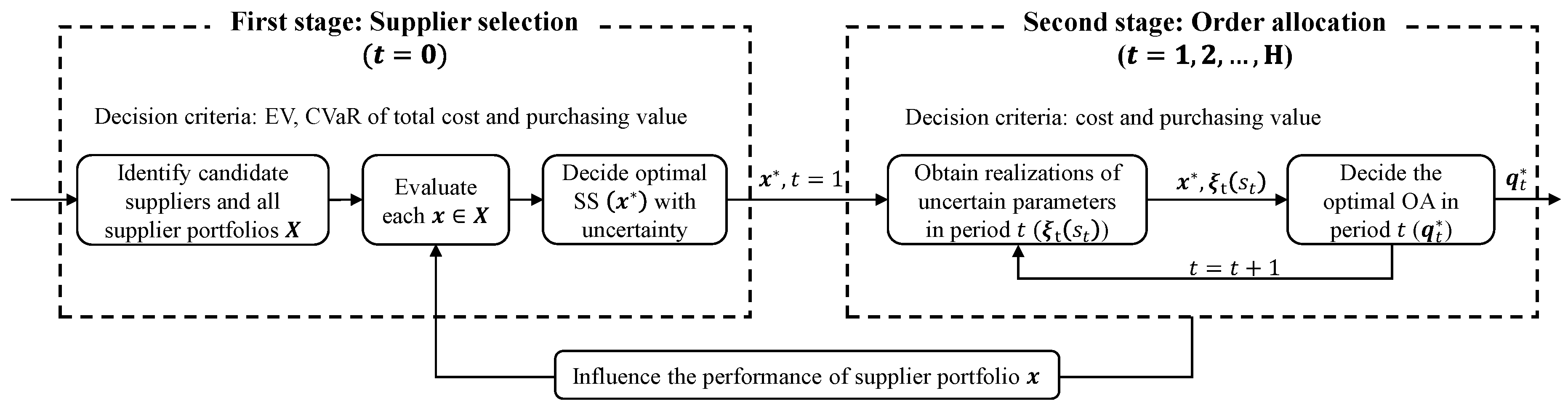
This problem clearly involves two stages of sequential decision making: first-stage strategic supplier selection, and second-stage operational order allocation, with the latter being contingent upon the former. In the supplier selection process, it is essential to comprehensively evaluate the performance of each feasible supplier portfolio based on multiple criteria to identify the optimal selection. In this paper, we employ two conventional criteria—cost and purchasing value—to assess the performance of the SS decision. However, the evaluation of each supplier portfolio on the basis of these criteria depends on some key parameters (e.g., demand, price, defect rate, and late delivery rate) and the order quantities determined in the operational stage. In other words, the performance of the SS decision is influenced by the parameter values of the subsequent operational stage. Considering this, we propose a two-stage bi-objective interactive modeling framework for the SSOA problem. In the first stage, the total cost (TC) and total purchasing value (TPV), encompassing the cost and purchasing value of the OA decision, are used to evaluate the SS decision. In the second stage, the OA decision is made based on the predetermined SS decision.
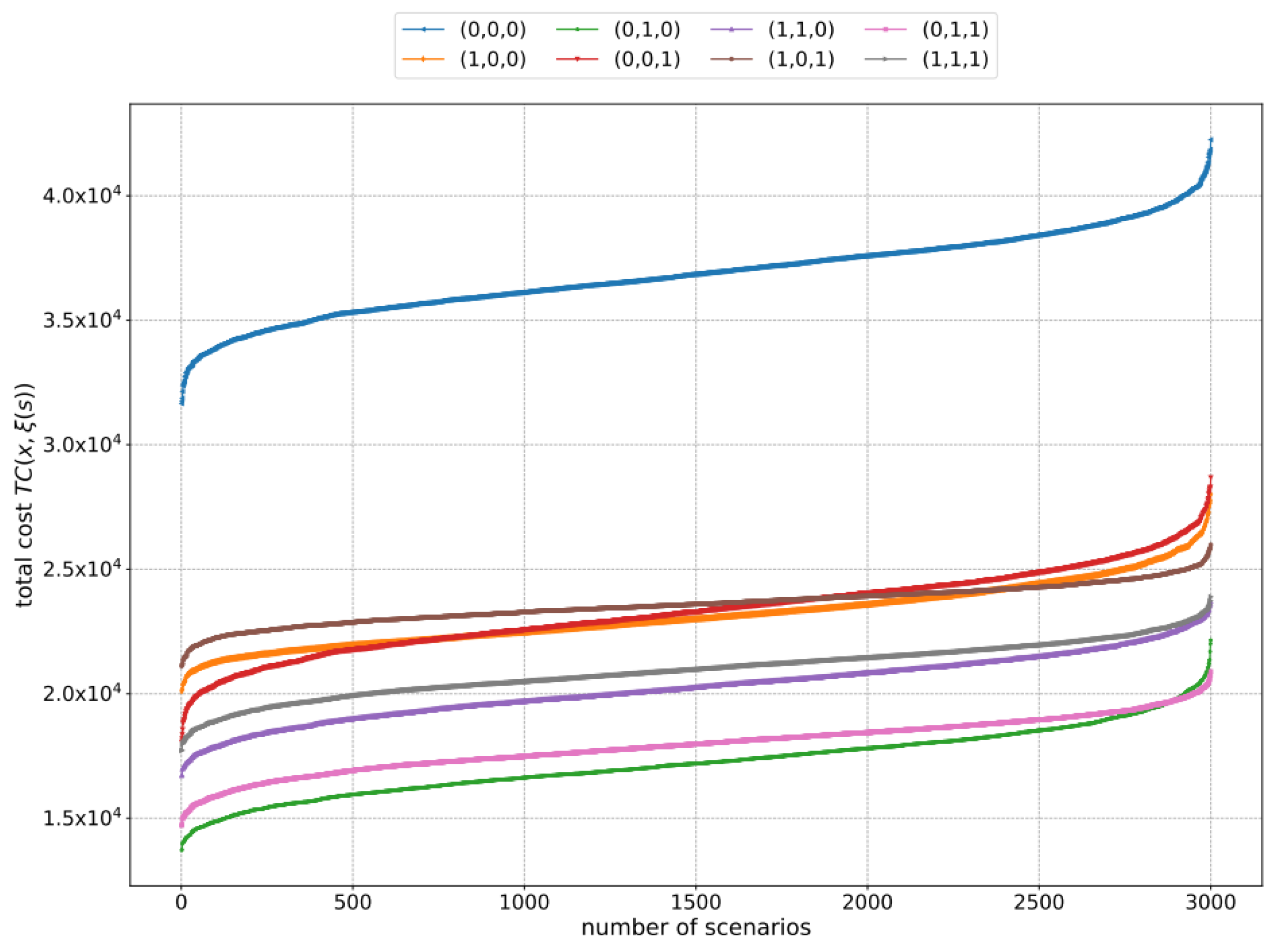
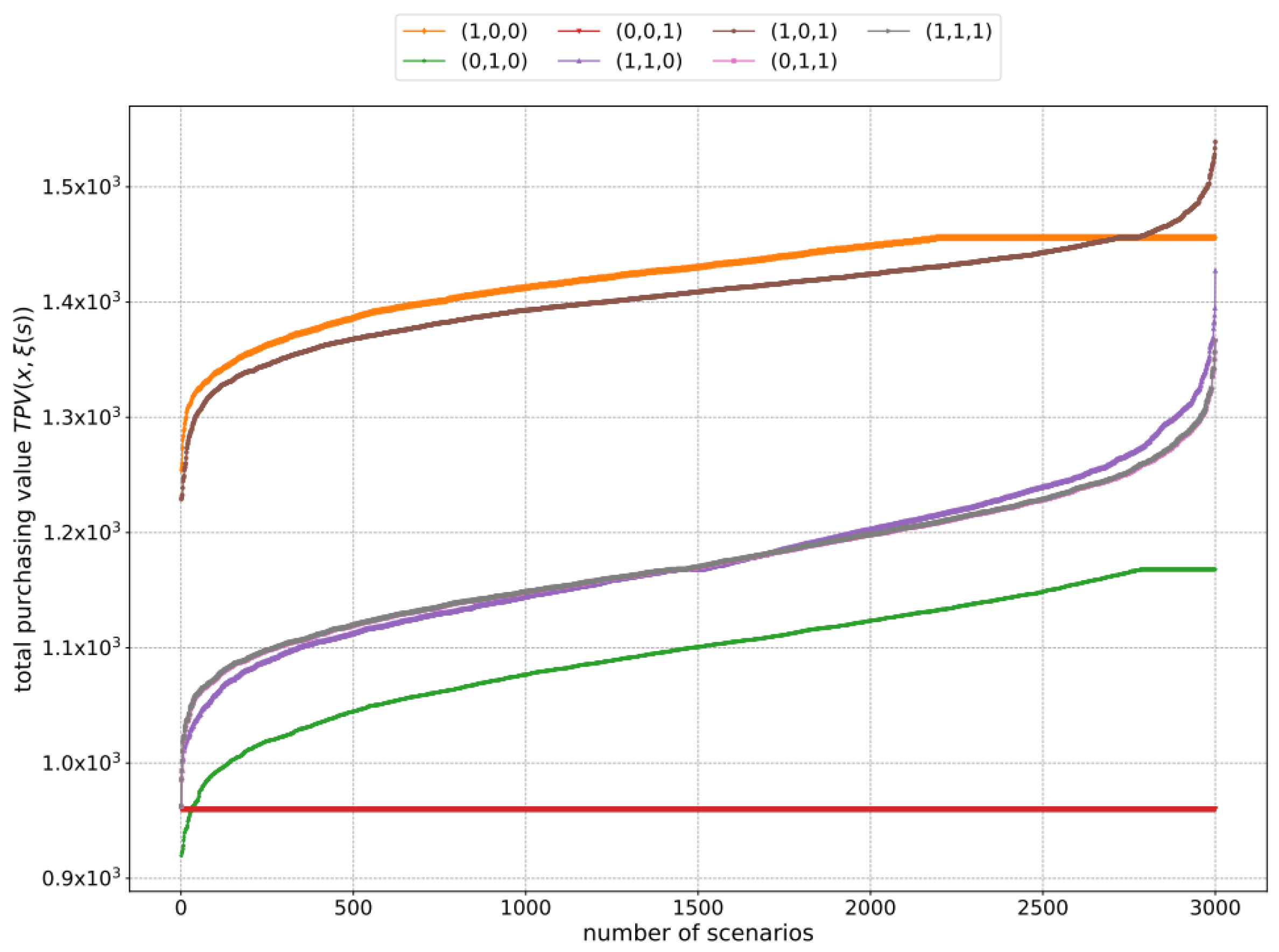
When the data used to assess supplier portfolio performances are deterministic, the definite TC and TPV of an SS decision can be derived; then, the decision maker can easily select out the optimal decision from all possible supplier portfolios by comparing their performance. However, in real life, when making the SS decision, future specific OA decisions and the associated costs and purchasing values are still unknown because precise knowledge about some key parameters for OA decisions cannot be gained in advance due to the volatility of the environment. Consequently, the TC and TPV of a supplier portfolio are not fixed and become stochastic variables dependent on uncertain parameters and adaptive OA decisions. To determine the optimal supplier portfolio, we introduce two measures—expected value and conditional value-at-risk—and develop two corresponding models—EVM and CVM—for the SS decision.
Figure 1 illustrates the whole decision-making process for the SSOA problem under uncertainty.
We construct the two-stage bi-objective stochastic programming model under the following assumptions:
- (1)
Inventory is not considered, as is common practice for perishable or time-sensitive goods with limited shelf lives. Such products should typically be sold or consumed within the current period and are unsuitable for carrying over for future use.
- (2)
The spot market offers all products, and the supply of each product is unlimited but at a higher price.
- (3)
Several suppliers can be selected simultaneously, but the total number of selected suppliers is limited.
- (4)
Each supplier can supply at least one type of product with different price levels depending on order quantity, following an incremental discount policy.
- (5)
For each product type, the total defect rate and late delivery rate must be maintained below acceptable thresholds. A penalty applies to each defective or late-delivered item.
- (6)
The realizations of uncertain parameters in period are known after the OA decision in period t has been made and before making the OA decision for the current period.
The notations used to mathematically formulate the problem are displayed in
Table 2. For the sake of discussion, we assume that some of the key parameters, i.e., product demand (
), defect rate (
), and late delivery rate (
) are independent stochastic numbers. The set of all scenarios with possible realizations of
is denoted as
S. A random scenario (
) is composed of
H sub-scenarios associated with
H periods, denoted as
. Incidentally, when other parameters, such as the emergency purchase price and transportation cost, are also uncertain, the proposed model and solution methodology can be similarly applied.
At the first stage, when
, the buyer is required to choose a supplier portfolio represented by
for the subsequent planning horizon without knowing the realizations of stochastic vector
. To fully evaluate the performance of a supplier portfolio, two criteria—cost and purchasing value—are applied. The total cost of a supplier portfolio includes the fixed cost of cooperating with the selected suppliers and the procurement costs associated with the second-stage operation. The total purchasing value is equal to the purchasing value of the second-stage operation. For a potential scenario (
), the realizations of random vectors
and
are denoted as
and
, respectively. Let
and
represent the procurement cost and purchasing value of period
t in the second stage under scenario
. The total cost and total purchasing value for a given supplier portfolio (
) with respect to a scenario (
) can be expressed as Equations (
1) and (
2), respectively.
Obviously, the
and
formulated in Equations (
1) and (
2) are real-valued functions with respect to a real-valued vector (
). Considering all possible realizations (
), the total cost (
) and total purchasing value (
) of a supplier selection decision (
) become random variables. Since the total cost and purchasing value of each supplier portfolio are random variables, they cannot be directly compared, and appropriate decision criteria are required to determine their optimal values. In this study, we apply two widely used measures—EV and CVaR—to compare the
and
of an SS decision.
The expected value reflects the average level of a random variable, taking into account all possible scenarios. Using the EV measure, the overall performance of a supplier portfolio can be jointly determined by the expected total cost and expected total purchasing value. Thus, the first-stage EV-based supplier selection model (EVM) can be formulated as follows:
where the objective functions aim to minimize the expected total cost and maximize the expected total purchasing value. Constraint (
5) defines the domain for the decision variables.
In the EVM, the performance of a supplier selection decision is assessed by the mean level of total cost and purchasing value. However, in real life, most decision makers are risk-averse and have varying degrees of risk aversion. They usually focus more on the worst-case scenario of a decision. Considering this, we also apply CVaR, a risk measure that focuses on extreme risk events and assesses the expected losses exceeding the VaR threshold. For a random variable (
G) representing a stochastic loss distribution and a specified confidence level (
), CVaR is defined by [
42]
where
is the
quantile of the loss distribution, indicating the maximum potential loss at the given confidence level. The greater the specified confidence level (
), the more attention paid to potential extreme losses. Based on the CVaR measure, the first-stage supplier selection model (CVM) that seeks to maximize the expected purchasing value while controlling extreme loss is expressed as follows:
The CVM has two objective functions: minimizing the CVaR of at confidence level and maximizing the EV of , subject to the same constraints as the EVM. It should be noted that, considering the criteria of EV and CVaR, there may be two other models: one with the objectives of minimizing and maximizing and the other with the objectives of minimizing and maximizing . Since their structures are similar to the EVM and CVM, they are not discussed in this paper.
After signing contracts with the suppliers selected in the first stage, the buyer transitions to the operational phase, where the partnership is maintained throughout the planning horizon, which is divided into
H periods. During each period, the buyer must make order allocation decisions to ensure ongoing production and operations. At the beginning of each period, the values of
are observed, meaning that
is known. Consequently, for given
and
, the order allocation decision (
) for period
t can be derived by solving the single-period order allocation model (OAM-
t) as follows:
The first objective Function (
8) aims to minimize the order allocation cost in period
t, which includes the cost of purchasing from the selected suppliers and the spot market, as well as ordering, transportation, and penalty costs for delayed and defective products. The second objective function (
9) seeks to maximize the purchasing value for order allocation in period
t. Constraints (
10) and (
11) show the relationship between the total order quantity of product
j purchased from supplier
i in period
t and the respective quantity at each discount level. Constraint (
12) requires that the total quantity of each type of product purchased from each supplier exceed the minimum acceptable order quantity and be within the supplier’s capacity. Constraint (
13) ensures a balance between supplies and demands. Constraint (
14) stipulates that the ordered quantity at each discount level must lie within the given quantity interval. Constraint (
15) ensures that the order quantity associated with each supplier and each product type falls into, at most, one specific discount level. Constraint (
16) ensures all available products of a supplier can be supplied, as long as this supplier is chosen at the first stage. For each type of product, constraint (
17) limits the number of chosen suppliers to the maximum allowed. Constraints (
18) and (
19) ensure defect and late delivery rates remain within acceptable limits. Finally, constraints (
20) and (
21) impose integrality and non-negativity restrictions on decision variables.
By combining Equations (
1)–(
5) with Equations (
8)–(
21) and Equations (
1) and (
2) with Equations (
4)–(
21), we formulate two-stage bi-objective stochastic programming models based on the EV and CVaR measures, respectively. Owing to their complex structures—two stages, two objectives, and stochastic parameters—we are motivated to develop an effective solution methodology to solve these models in the following section.
6. Conclusions
In this paper, we formulated the supplier selection and order allocation problem under uncertainty as two-stage bi-objective stochastic programming models. In the models, the second-stage order allocation decision is subject to the first-stage supplier selection, and the performance of the SS decision is influenced by the OA decision. In addition, the performance of the supplier selection decision was jointly evaluated through cost and purchasing value using both EV and CVaR criteria. To solve the models, we then developed a hybrid algorithm integrating the weighted-satisfaction sum method, linearization techniques, Monte Carlo simulation, and a genetic algorithm. Extensive numerical examples were reported to illustrate the effectiveness of the proposed model and solution approach. The illustrative example shows that both the decision maker’s preferences for various objectives and their risk-aversion level influence supplier selection decisions, revealing valuable managerial implications for the practical supplier selection and procurement decision under uncertainty.
It is important to acknowledge several limitations of this study, which also point to directions for future work. First, our proposed models rely on some assumptions, such as independent demand for each period and a lack of inventory used across periods, which may not hold in more generalized cases. Relaxing these assumptions presents an interesting and significant issue for further exploration. Second, more sophisticated solution approaches should be developed for two-stage bi(multi)-objective stochastic models, particularly when applied to large-scale instances. Since multiple objectives should be treated in each stage formulated by sub-models with different solution spaces, the complex structure of these models makes this issue challenging.
Furthermore, given the complex and volatile circumstances, it would also be a compelling and critical direction in future research to incorporate other uncertainty modeling and optimization approaches alongside stochastic methods so as to provide uncertainty-aware decision support for supply chain operations. For instance, to capture the stochastic fluctuation in raw material price and the epistemic uncertainty regarding procurement value, both random and fuzzy variables could be utilized to model mixed uncertainties. In this context, fuzzy stochastic optimization [
47,
48] offers a sound theoretical foundation for tackling such problems. Finally, our proposed two-stage bi(multi)-objective modeling and solution framework could be adapted and applied to related problems involving similar interdependent two-stage decisions under uncertainty, such as location-allocation [
49] and location-routing [
50] problems.