Are All Species Created Equal? A Critique of the “Equal Fitness Paradigm”


Simple Summary
Abstract
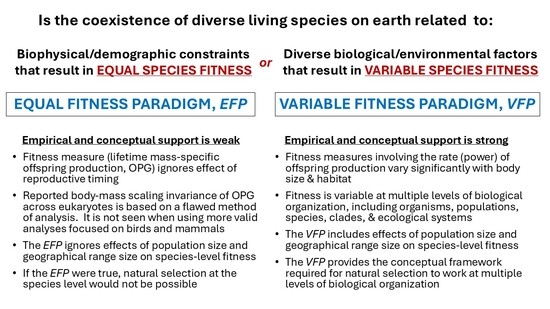
1. Introduction
2. The “Equal Fitness Paradigm”
2.1. EFP Fitness Measure Has Not Been Sufficiently Justified
2.2. The EFP’s Questionable Assumption of Steady-State Populations
2.3. The Rate of Living Theory Assumed by the EFP Is Not Generally Applicable
2.4. Biological Time Is Not an Independent 4th Dimension in Biological Scaling
2.5. The Species-Level Fitness Measure of the EFP Ignores Effects of Population and Geographical Range Sizes
2.6. Problems with Data and Scaling Analyses Used to Support the EFP


2.7. Problems with Basing the EFP on a Supposed Body-Mass Scaling Invariance
2.7.1. Body-Mass Independent Variation in Fitness
2.7.2. There Are Many Kinds of Scaling Invariances That by Themselves Do Not Provide Sufficient Support for the EFP
2.8. If the EFP Were True, Species-Level Selection Would Not Be Possible
2.9. The Biophysical Basis of the EFP Is Questionable
3. The “Variable Fitness Paradigm”
4. Equal or Variable Fitness: A Question of Universal Determinism Versus Contextual Contingency
5. Toward Evolutionary Theory That Integrates the Acquisition and Use of Both Energy and Information
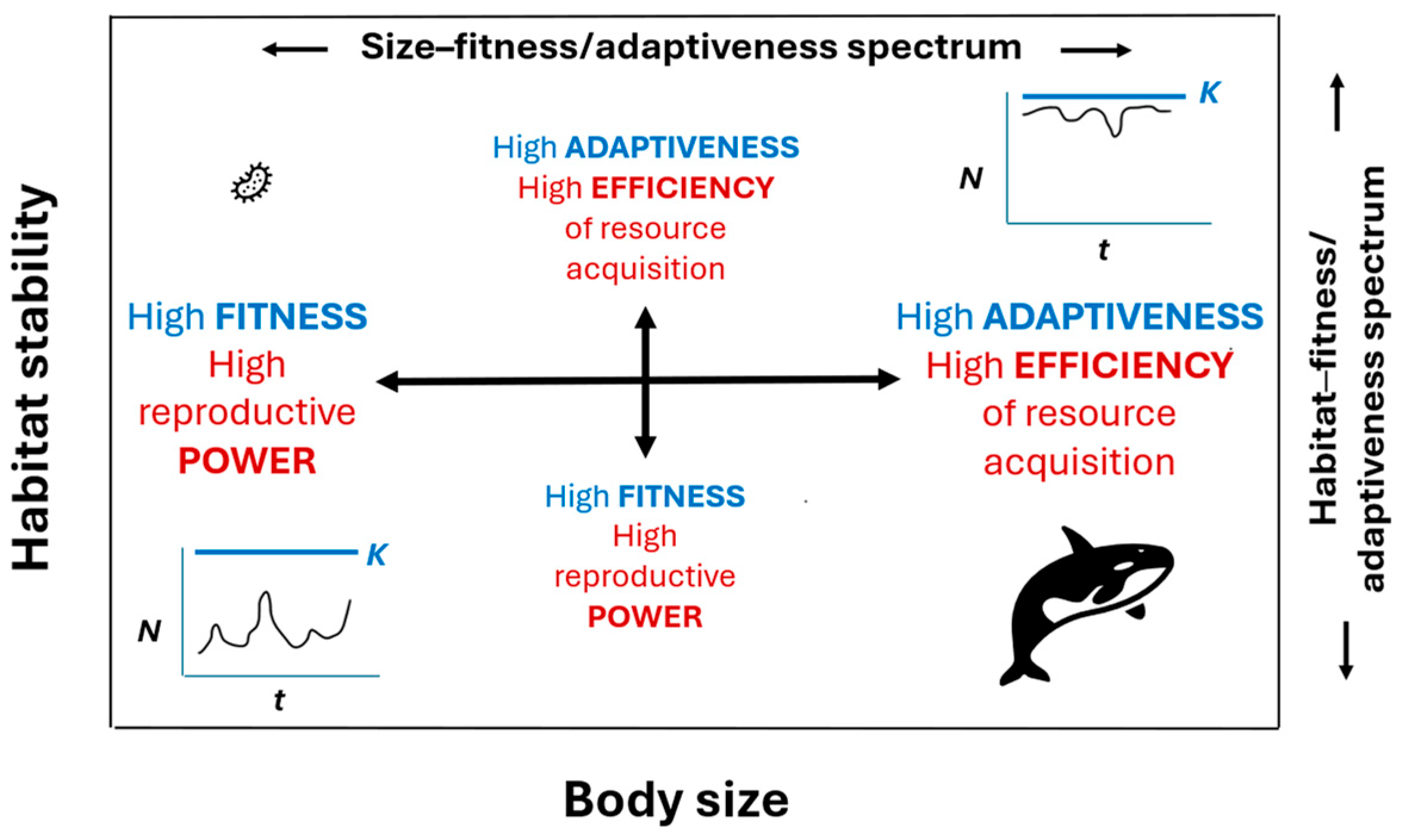
6. Species Diversity and Coexistence Are Enabled by Size and Habitat Spectra of Fitness (Power) and Adaptiveness (Efficiency)
7. Prospectus for Assessing the Equality/Variability of Species Fitness and Adaptiveness
8. Conclusions
Funding
Data Availability Statement
Acknowledgments
Conflicts of Interest
Abbreviations
| EFP | Equal fitness paradigm |
| VFP | Variable fitness paradigm |
| OP | Offspring production |
| G | Generation time (not equal to lifetime) |
| OPG | Offspring production per generation time |
| OPL | Offspring production per lifetime |
| OP/G | Offspring production/generation time |
| OP/L | Offspring production/lifetime |
| OPG/L | Offspring production per lifetime/generation time |
Appendix A
Appendix A.1. Controversy About Defining and Estimating Evolutionary Fitness
Appendix A.2. Energetic Views of Fitness and Adaptation
Appendix A.3. Distinguishing Fitness and Adaptiveness as Power Versus Efficiency
References
- Margulis, L. Symbiotic Planet: A New Look at Evolution; Basic Books: New York, NY, USA, 1998. [Google Scholar]
- Chesson, P. Mechanisms of maintenance of species diversity. Annu. Rev. Ecol. Syst. 2000, 31, 343–366. [Google Scholar] [CrossRef]
- Hubbell, S.P. The Unified Neutral Theory of Biodiversity and Biogeography; Princeton University Press: Princeton, NJ, USA, 2001. [Google Scholar]
- Ostling, A. Do fitness-equalizing tradeoffs lead to neutral communities? Theor. Ecol. 2012, 5, 181–194. [Google Scholar] [CrossRef]
- Zhang, D.Y.; Zhang, B.Y.; Lin, K.; Jiang, X.; Tao, Y.; Hubbell, S.; He, F.; Ostling, A. Demographic trade-offs determine species abundance and diversity. J. Plant Ecol. 2012, 5, 82–88. [Google Scholar] [CrossRef]
- DeLong, J.P.; Hanley, T.C. The rate-size trade-off structures intraspecific variation in Daphnia ambigua life history parameters. PLoS ONE 2013, 8, e81024. [Google Scholar] [CrossRef]
- Jops, K.; O’Dwyer, J.P. Life history complementarity and the maintenance of biodiversity. Nature 2023, 618, 986–991. [Google Scholar] [CrossRef] [PubMed]
- Ontiveros, V.J.; Capitán, J.A.; Casamayor, E.O.; Alonso, D. Colonization–persistence trade-offs in natural bacterial communities. Proc. R. Soc. B Biol. Sci. 2023, 290, 20230709. [Google Scholar] [CrossRef] [PubMed]
- Forsythe, A.B.; Otto, S.P.; Nelson, W.A.; Day, T. Variety is the spice of life: Nongenetic variation in life histories influences population growth and evolvability. J. Evol. Biol. 2024, 37, 1244–1263. [Google Scholar] [CrossRef]
- Brown, J.H.; Hall, C.A.S.; Sibly, R.M. Equal fitness paradigm explained by a trade-off between generation time and energy production rate. Nat. Ecol. Evol. 2018, 2, 262–268. [Google Scholar] [CrossRef]
- Burger, J.R.; Hou, C.; Brown, J.H. Universal rules of life: Metabolic rates, biological times and the equal fitness paradigm. Ecol. Lett. 2021, 24, 1262–1281. [Google Scholar] [CrossRef]
- Brown, J.H.; Burger, J.R.; Hou, C.; Hall, C.A.S. The pace of life: Metabolic energy, biological time, and life history. Integr. Comp. Biol. 2022, 62, 1479–1491. [Google Scholar] [CrossRef]
- Brown, J.H.; Hou, C.; Hall, C.A.S.; Burger, J.R. Life, death and energy: What does nature select? Ecol. Lett. 2024, 27, e14517. [Google Scholar] [CrossRef]
- Vermeij, G.J.; Grosberg, R.K.; Roopnarine, P.D. Energetics and evolutionary fitness. Proc. Natl. Acad. Sci. USA 2025, 122, e2423684122. [Google Scholar] [CrossRef] [PubMed]
- Darwin, C. On the Origin of Species by Means of Natural Selection or the Preservation of Favoured Races in the Struggle for Life; John Murray: London, UK, 1859. [Google Scholar]
- Fisher, R.A. The Genetical Theory of Natural Selection; Dover: New York, NY, USA, 1958. [Google Scholar]
- Lewontin, R.C. The units of selection. Annu. Rev. Ecol. Syst. 1970, 1, 1–18. [Google Scholar] [CrossRef]
- Wallace, A.R. Darwinism: An Exposition of the Theory of Natural Selection, with Some of Its Applications; MacMillan: New York, NY, USA, 1889. [Google Scholar]
- Van Valen, L.M. Energy and evolution. Evol. Theor. 1976, 1, 179–229. [Google Scholar]
- Brown, J.H. Macroecology; University of Chicago Press: Chicago, IL, USA, 1995. [Google Scholar]
- Glazier, D.S. Power and efficiency in living systems. Sci 2024, 6, 28. [Google Scholar] [CrossRef]
- Dawkins, R. The Selfish Gene; Oxford University Press: Oxford, UK, 1976. [Google Scholar]
- Endler, J.A. Natural Selection in the Wild; Princeton University Press: Princeton, NJ, USA, 1986. [Google Scholar]
- Toman, J.; Flegr, J. Stability-based sorting: The forgotten process behind (not only) biological evolution. J. Theor. Biol. 2017, 435, 29–41. [Google Scholar] [CrossRef] [PubMed]
- Lenton, T.M.; Kohler, T.A.; Marquet, P.A.; Boyle, R.A.; Crucifix, M.; Wilkinson, D.M.; Scheffer, M. Survival of the systems. Trends Ecol. Evol. 2021, 36, 333–344. [Google Scholar] [CrossRef]
- Boyle, R.A.; Moody, E.R.; Babcock, G.; McShea, D.W.; Álvarez-Carretero, S.; Lenton, T.M.; Donoghue, P.C. Persistence selection between simulated biogeochemical cycle variants for their distinct effects on the Earth system. Proc. Natl. Acad. Sci. USA 2025, 122, e2406344122. [Google Scholar] [CrossRef]
- Damuth, J.; Ginzburg, L.R. Nonadaptive Selection: An Evolutionary Source of Ecological Laws; University of Chicago Press: Chicago, IL, USA, 2025. [Google Scholar]
- Burger, J.R.; Brown, J.H. Does nature select to maximize power? BioScience 2025, 75, 502–504. [Google Scholar] [CrossRef]
- Gingerich, P.D. Rates of evolution. Annu. Rev. Ecol. Evol. Syst. 2009, 40, 657–675. [Google Scholar] [CrossRef]
- Okie, J.G.; Boyer, A.G.; Brown, J.H.; Costa, D.P.; Ernest, S.M.; Evans, A.R.; Fortelius, M.; Gittleman, J.L.; Hamilton, M.J.; Harding, L.E.; et al. Effects of allometry, productivity and lifestyle on rates and limits of body size evolution. Proc. R. Soc. B Biol. Sci. 2013, 280, 20131007. [Google Scholar] [CrossRef]
- Hennemann, W.W., III. Relationship among body mass, metabolic rate and the intrinsic rate of natural increase in mammals. Oecologia 1983, 56, 104–108. [Google Scholar] [CrossRef]
- Blueweiss, L.; Fox, H.; Kudzma, V.; Nakashima, D.; Peters, R.; Sams, S. Relationships between body size and some life history parameters. Oecologia 1978, 37, 257–272. [Google Scholar] [CrossRef]
- Gotelli, N.J. A Primer of Ecology, 4th ed.; Sinauer Associates: Sunderland, MA, USA, 2008. [Google Scholar]
- Charlesworth, B. Evolution in Age-Structured Populations; Cambridge University Press: Cambridge, UK, 1980. [Google Scholar]
- Clutton-Brock, T.H. (Ed.) Reproductive Success: Studies of Individual Variation in Contrasting Breeding Systems; University of Chicago Press: Chicago, IL, USA, 1988. [Google Scholar]
- Roff, D.A. The Evolution of Life Histories: Theory and Analysis; Chapman and Hall: New York, NY, USA, 1992. [Google Scholar]
- Stearns, S.C. The Evolution of Life Histories; Oxford University Press: Oxford, UK, 1992. [Google Scholar]
- De Jong, G. The fitness of fitness concepts and the description of natural selection. Q. Rev. Biol. 1994, 69, 3–29. [Google Scholar] [CrossRef]
- Kozłowski, J. Adaptation: A life history perspective. Oikos 1999, 86, 185–194. [Google Scholar] [CrossRef]
- Brommer, J.E. The evolution of fitness in life-history theory. Biol. Rev. 2000, 75, 377–404. [Google Scholar] [CrossRef] [PubMed]
- Huey, R.B.; Berrigan, D. Temperature, demography, and ectotherm fitness. Am. Nat. 2001, 158, 204–210. [Google Scholar] [CrossRef]
- van Daalen, S.F.; Caswell, H. Lifetime reproductive output: Individual stochasticity, variance, and sensitivity analysis. Theor. Ecol. 2017, 10, 355–374. [Google Scholar] [CrossRef] [PubMed]
- Kindsvater, H.K.; Juan-Jordá, M.J.; Dulvy, N.K.; Horswill, C.; Matthiopoulos, J.; Mangel, M. Size-dependence of food intake and mortality interact with temperature and seasonality to drive diversity in fish life histories. Evol. Appl. 2024, 17, e13646. [Google Scholar] [CrossRef]
- Gaston, K.J. The intrinsic rates of increase of insects of different sizes. Ecol. Entomol. 1988, 13, 399–409. [Google Scholar] [CrossRef]
- Calder, W.A. Size, Function, and Life History; Dover: Mineola, NY, USA, 1996. [Google Scholar]
- Charnov, E.L.; Warne, R.; Moses, M. Lifetime reproductive effort. Am. Nat. 2007, 170, E129–E142. [Google Scholar] [CrossRef]
- Ginzburg, L.R.; Burger, O.; Damuth, J. The May threshold and life-history allometry. Biol. Lett. 2010, 6, 850–853. [Google Scholar] [CrossRef] [PubMed][Green Version]
- Brommer, J.E.; Merilä, J.; Kokko, H. Reproductive timing and individual fitness. Ecol. Lett. 2002, 5, 802–810. [Google Scholar] [CrossRef]
- Steiner, U.K.; Tuljapurkar, S.; Coulson, T. Generation time, net reproductive rate, and growth in stage-age-structured populations. Am. Nat. 2014, 183, 771–783. [Google Scholar] [CrossRef] [PubMed]
- Fairbairn, D.J.; Reeve, J.P. Natural Selection. In Evolutionary Ecology: Concepts and Case Studies; Fox, C.W., Roff, D.A., Fairbairn, D.J., Eds.; Oxford University Press: Oxford, UK, 2001; pp. 29–43. [Google Scholar]
- Hairston, N.G.; Tinkle, D.W.; Wilbur, H.M. Natural selection and the parameters of population growth. J. Wildl. Manag. 1970, 34, 681–690. [Google Scholar] [CrossRef]
- Doyle, R.W.; Hunte, W. Demography of an estuarine amphipod (Gammarus lawrencianus) experimentally selected for high “r”: A model of the genetic effects of environmental change. Can. J. Fish. Aquat. Sci. 1981, 38, 1120–1127. [Google Scholar] [CrossRef]
- Doyle, R.W.; Hunte, W. Genetic changes in “fitness” and yield of a crustacean population in a controlled environment. J. Exp. Mar. Biol. Ecol. 1981, 52, 147–156. [Google Scholar] [CrossRef]
- Kirkwood, T.B.L. Repair and Its Evolution: Survival Versus Reproduction. In Physiological Ecology: An Evolutionary Approach to Resource Use; Townsend, C.R., Calow, P., Eds.; Sinauer Associates: Sunderland, MA, USA, 1981; pp. 165–189. [Google Scholar]
- Southwood, T.R.E. Bionomic Strategies and Population Parameters. In Theoretical Ecology: Principles and Applications; May, R.M., Ed.; Sinauer Associates: Sunderland, MA, USA, 1981; pp. 30–52. [Google Scholar]
- Southwood, T.R.E. Tactics, strategies and templets. Oikos 1988, 52, 3–18. [Google Scholar] [CrossRef]
- Lande, R. A quantitative genetic theory of life history evolution. Ecology 1982, 63, 607–615. [Google Scholar] [CrossRef]
- Sibly, R.M.; Calow, P. Physiological Ecology of Animals: An Evolutionary Approach; Blackwell: Oxford, UK, 1986. [Google Scholar]
- Sibly, R.M. The life-history approach to physiological ecology. Funct. Ecol. 1991, 5, 184–191. [Google Scholar] [CrossRef]
- Baillieul, M.; Selens, M.; Blust, R. Scope for growth and fitness of Daphnia magna in salinity-stressed conditions. Funct. Ecol. 1996, 10, 227–233. [Google Scholar] [CrossRef]
- Lampert, W.; Trubetskova, I. Juvenile growth rate as a measure of fitness in Daphnia. Funct. Ecol. 1996, 10, 631–635. [Google Scholar] [CrossRef]
- Usinowicz, J.; O’Connor, M.I. The fitness value of ecological information in a variable world. Ecol. Lett. 2023, 26, 621–639. [Google Scholar] [CrossRef] [PubMed]
- Fenchel, T. Intrinsic rate of natural increase: The relationship with body size. Oecologia 1974, 14, 317–326. [Google Scholar] [CrossRef]
- Thompson, S.D. Body size, duration of parental care, and the intrinsic rate of natural increase in eutherian and metatherian mammals. Oecologia 1987, 71, 201–209. [Google Scholar] [CrossRef]
- Ross, C. The intrinsic rate of natural increase and reproductive effort in primates. J. Zool. 1988, 214, 199–219. [Google Scholar] [CrossRef]
- Denney, N.H.; Jennings, S.; Reynolds, J.D. Life–history correlates of maximum population growth rates in marine fishes. Proc. R. Soc. B Biol. Sci. 2002, 269, 2229–2237. [Google Scholar] [CrossRef] [PubMed]
- Hatton, I.A.; Dobson, A.P.; Storch, D.; Galbraith, E.D.; Loreau, M. Linking scaling laws across eukaryotes. Proc. Natl. Acad. Sci. USA 2019, 116, 21616–21622. [Google Scholar] [CrossRef]
- Pianka, E.R. On r- and K-selection. Am. Nat. 1970, 104, 592–597. [Google Scholar] [CrossRef]
- Gaston, K.J. Patterns in the local and regional dynamics of moth populations. Oikos 1988, 53, 49–57. [Google Scholar] [CrossRef]
- Gaston, K.J.; Lawton, J.H. Patterns in body size, population dynamics, and regional distribution of bracken herbivores. Am. Nat. 1988, 132, 662–680. [Google Scholar] [CrossRef]
- Anderson, D.M.; Gillooly, J.F. Allometric scaling of Lyapunov exponents in chaotic populations. Popul. Ecol. 2020, 62, 364–369. [Google Scholar] [CrossRef]
- MacArthur, R.H.; Wilson, E.O. The Theory of Island Biogeography; Princeton University Press: Princeton, NJ, USA, 1967. [Google Scholar]
- Southwood, T.R.E.; May, R.M.; Hassell, M.P.; Conway, G.R. Ecological strategies and population parameters. Am. Nat. 1974, 108, 791–804. [Google Scholar] [CrossRef]
- Spitzer, K.; Rejmánek, M.; Soldán, T. The fecundity and long-term variability in abundance of noctuid moths (Lepidoptera, Noctuidae). Oecologia 1984, 62, 91–93. [Google Scholar] [CrossRef]
- Sæther, B.E.; Engen, S. The concept of fitness in fluctuating environments. Trends Ecol. Evol. 2015, 30, 273–281. [Google Scholar] [CrossRef] [PubMed]
- Rubner, M. Über den Einfluss der Körpergrösse auf Stoff- und Kraftwechsel. Z. Biol. 1883, 19, 535–562. [Google Scholar]
- Pearl, R. The Rate of Living; University of London Press: London, UK, 1928. [Google Scholar]
- Brown, J.H.; Gillooly, J.F.; Allen, A.P.; Savage, V.M.; West, G.B. Toward a metabolic theory of ecology. Ecology 2004, 85, 1771–1789. [Google Scholar] [CrossRef]
- Economos, A.C. Beyond rate of living. Gerontology 1981, 27, 258–265. [Google Scholar] [CrossRef]
- Glazier, D.S. Is metabolic rate a universal ‘pacemaker’ for biological processes? Biol. Rev. 2015, 90, 377–407. [Google Scholar] [CrossRef]
- Stark, G.; Pincheira-Donoso, D.; Meiri, S. No evidence for the “rate-of-living” theory across the tetrapod tree of life. Glob. Ecol. Biogeogr. 2020, 29, 857–884. [Google Scholar] [CrossRef]
- Escala, A. Universal relation for life-span energy consumption in living organisms: Insights for the origin of aging. Sci. Rep. 2022, 12, 2407. [Google Scholar] [CrossRef]
- Glazier, D.S. Does death drive the scaling of life? Biol. Rev. 2025, 100, 586–619. [Google Scholar] [CrossRef]
- Günther, B. Dimensional analysis and theory of biological similarity. Physiol. Rev. 1975, 55, 659–699. [Google Scholar] [CrossRef]
- Hainsworth, F.R. Animal Physiology: Adaptations in Function; Addison-Wesley: Reading, MA, USA, 1981. [Google Scholar]
- Lindstedt, S.L.; Calder, W.A. Body size, physiological time, and longevity of homeothermic animals. Q. Rev. Biol. 1981, 56, 1–16. [Google Scholar] [CrossRef]
- Günther, B.; Morgado, E. Allometric scaling of biological rhythms in mammals. Biol. Res. 2005, 38, 207–212. [Google Scholar] [CrossRef] [PubMed]
- da Silva, J.K.L.; Garcia, G.J.; Barbosa, L.A. Allometric scaling laws of metabolism. Phys. Life Rev. 2006, 3, 229–261. [Google Scholar] [CrossRef]
- Ginzburg, L.; Damuth, J. The space-lifetime hypothesis: Viewing organisms in four dimensions, literally. Am. Nat. 2008, 171, 125–131. [Google Scholar] [CrossRef]
- Glazier, D.S. The relevance of time in biological scaling. Biology 2023, 12, 1084. [Google Scholar] [CrossRef]
- Lambert, R.; Teissier, G. Théorie de la similitude biologique. Ann. Physiol. Physicochim. Biol. 1927, 13, 212–246. [Google Scholar]
- Darwin, C. On the Origin of Species by Means of Natural Selection or the Preservation of Favoured Races in the Struggle for Life, 6th ed.; John Murray: London, UK, 1872. [Google Scholar]
- Stanley, S.M. Macroevolution: Pattern and Process; Freeman: San Francisco, CA, USA, 1979. [Google Scholar]
- Fowler, C.W.; MacMahon, J.A. Selective extinction and speciation: Their influence on the structure and functioning of communities and ecosystems. Am. Nat. 1982, 119, 480–498. [Google Scholar] [CrossRef]
- Glazier, D.S. Ecological shifts and the evolution of geographically restricted species of North American Peromyscus (mice). J. Biogeogr. 1980, 7, 63–83. [Google Scholar] [CrossRef]
- Blumenthal, D.M.; Diez, J.; Pearse, I.; Sofaer, H.R.; Sorte, C.J.B.; Barnett, D.; Beaury, E.M.; Bradley, B.A.; Corbin, J.D.; Dukes, J.S.; et al. Why are non-native plants successful? Consistently fast economic traits and novel origin jointly explain abundance across US ecoregions. New Phytol. 2025, 248, 1192–1204. [Google Scholar] [CrossRef] [PubMed]
- Liow, L.H. Does versatility as measured by geographic range, bathymetric range and morphological variability contribute to taxon longevity? Glob. Ecol. Biogeogr. 2007, 16, 117–128. [Google Scholar] [CrossRef]
- Payne, J.L.; Finnegan, S. The effect of geographic range on extinction risk during background and mass extinction. Proc. Natl. Acad. Sci. USA 2007, 104, 10506–10511. [Google Scholar] [CrossRef] [PubMed]
- Harris, G.; Pimm, S.L. Range size and extinction risk in forest birds. Conserv. Biol. 2008, 22, 163–171. [Google Scholar] [CrossRef] [PubMed]
- Hopkins, M.J. How species longevity, intraspecific morphological variation, and geographic range size are related: A comparison using Late Cambrian trilobites. Evolution 2011, 65, 3253–3273. [Google Scholar] [CrossRef]
- Castiglione, S.; Mondanaro, A.; Melchionna, M.; Serio, C.; Di Febbraro, M.; Carotenuto, F.; Raia, P. Diversification rates and the evolution of species range size frequency distribution. Front. Ecol. Evol. 2017, 5, 147. [Google Scholar] [CrossRef]
- Newsome, T.M.; Wolf, C.; Nimmo, D.G.; Kopf, R.K.; Ritchie, E.G.; Smith, F.A.; Ripple, W.J. Constraints on vertebrate range size predict extinction risk. Glob. Ecol. Biogeogr. 2020, 29, 76–86. [Google Scholar] [CrossRef]
- Brown, W.L., Jr. Centrifugal speciation. Q. Rev. Biol. 1957, 32, 247–277. [Google Scholar] [CrossRef]
- Rosenzweig, M.L. Species Diversity in Space and Time; Cambridge University Press: Cambridge, UK, 1995. [Google Scholar]
- Li, P.; Wiens, J.J. What drives diversification? Range expansion tops climate, life history, habitat and size in lizards and snakes. J. Biogeogr. 2022, 49, 237–247. [Google Scholar] [CrossRef]
- Hay, E.M.; McGee, M.D.; Chown, S.L. Geographic range size and speciation in honeyeaters. BMC Ecol. Evol. 2022, 22, 86. [Google Scholar] [CrossRef]
- Smyčka, J.; Toszogyova, A.; Storch, D. The relationship between geographic range size and rates of species diversification. Nat. Comm. 2023, 14, 5559. [Google Scholar] [CrossRef]
- Gaston, K.J.; Blackburn, T.M. Pattern and Process in Macroecology; Blackwell: Malden, MA, USA, 2000. [Google Scholar]
- Jablonski, D.; Roy, K. Geographical range and speciation in fossil and living molluscs. Proc. R. Soc. B Biol. Sci. 2003, 270, 401–406. [Google Scholar] [CrossRef]
- Jablonski, D.; Roy, K.; Valentine, J.W. Evolutionary Macroecology and the Fossil Record. In Macroecology—Concepts and Consequences; Blackburn, T.M., Gaston, K.J., Eds.; Cambridge University Press: Cambridge, UK, 2003; pp. 368–390. [Google Scholar]
- Jablonski, D. Species selection: Theory and data. Annu. Rev. Ecol. Evol. Syst. 2008, 39, 501–524. [Google Scholar] [CrossRef]
- Roughgarden, J.; Iwasa, Y. Dynamics of a metapopulation with space-limited subpopulations. Theor. Pop. Biol. 1986, 29, 235–261. [Google Scholar] [CrossRef]
- Pulliam, H.R. Sources, sinks, and population regulation. Am. Nat. 1988, 132, 652–661. [Google Scholar] [CrossRef]
- Dias, P.C. Sources and sinks in population biology. Trends Ecol. Evol. 1996, 11, 326–330. [Google Scholar] [CrossRef]
- Brown, J.H.; Kodric-Brown, A. Turnover rates in insular biogeography: Effect of immigration on extinction. Ecology 1977, 58, 445–449. [Google Scholar] [CrossRef]
- Gotelli, N.J. Metapopulation models: The rescue effect, the propagule rain, and the core-satellite hypothesis. Am. Nat. 1991, 138, 768–776. [Google Scholar] [CrossRef]
- Goedert, D.; Jensen, H.; Dickel, L.; Reid, J.M. Multi-generational fitness legacies of natural immigration: Theoretical and empirical perspectives and opportunities. Biol. Rev. 2025, 100, 1250–1271. [Google Scholar] [CrossRef] [PubMed]
- Saatoglu, D.; Niskanen, A.K.; Froy, H.; Ranke, P.S.; Goedert, D.; Reid, J.; Ringsby, T.H.; Sæther, B.E.; Araya-Ajoy, Y.G.; Jensen, H. Metapopulation-level analyses reveal positive fitness consequences of immigration in a small bird. J. Anim. Ecol. 2025, 94, 1180–1192. [Google Scholar] [CrossRef]
- Roff, D.A. Life History Evolution; Sinauer Associates: Sunderland, MA, USA, 2002. [Google Scholar]
- Myhrvold, N.P.; Baldridge, E.; Chan, B.; Sivam, D.; Freeman, D.L.; Ernest, S.M. An amniote life-history database to perform comparative analyses with birds, mammals, and reptiles: Ecological Archives E096–269. Ecology 2015, 96, 3109. [Google Scholar] [CrossRef]
- Bonner, J.T. Size and Cycle: An Essay on the Structure of Biology; Princeton University Press: Princeton, NJ, USA, 1965. [Google Scholar]
- Sokal, R.R.; Rohlf, F.J. Biometry; Freeman: New York, NY, USA, 1995. [Google Scholar]
- Smith, R.J. Use and misuse of the reduced major axis for line-fitting. Am. J. Phys. Anthropol. 2009, 140, 476–486. [Google Scholar] [CrossRef]
- White, C.R. Allometric estimation of metabolic rates in animals. Comp. Biochem. Physiol. A 2011, 158, 346–357. [Google Scholar] [CrossRef]
- Kilmer, J.T.; Rodríguez, R.L. Ordinary least squares regression is indicated for studies of allometry. J. Evol. Biol. 2017, 30, 4–12. [Google Scholar] [CrossRef] [PubMed]
- Glazier, D.S. Trade-offs between reproductive and somatic (storage) investments in animals: A comparative test of the Van Noordwijk and De Jong model. Evol. Ecol. 1999, 13, 539–555. [Google Scholar] [CrossRef]
- Barbraud, C.; Weimerskirch, H. Environmental conditions and breeding experience affect costs of reproduction in blue petrels. Ecology 2005, 86, 682–692. [Google Scholar] [CrossRef]
- Travers, L.M.; Garcia-Gonzalez, F.; Simmons, L.W. Live fast die young life history in females: Evolutionary trade-off between early life mating and lifespan in female Drosophila melanogaster. Sci. Rep. 2015, 5, 15469. [Google Scholar] [CrossRef] [PubMed]
- Wadgymar, S.M.; Sheth, S.; Josephs, E.; DeMarche, M.; Anderson, J. Defining fitness in evolutionary ecology. Int. J. Plant Sci. 2024, 185, 218–227. [Google Scholar] [CrossRef]
- Armstrong, D.P.; Keevil, M.G.; Rollinson, N.; Brooks, R.J. Subtle individual variation in indeterminate growth leads to major variation in survival and lifetime reproductive output in a long-lived reptile. Funct. Ecol. 2018, 32, 752–761. [Google Scholar] [CrossRef]
- Sibly, R.M.; Calow, P. Why breeding earlier is always worthwhile. J. Theor. Biol. 1986, 123, 311–319. [Google Scholar] [CrossRef]
- Stahl, W.R. Similarity and dimensional methods in biology: They promise to show quantitative similarities between biological organisms and models of biological systems. Science 1962, 137, 205–212. [Google Scholar] [CrossRef] [PubMed]
- Charnov, E.L. Life History Invariants; Oxford University Press: Oxford, UK, 1993. [Google Scholar]
- Peters, R.H. The Ecological Implications of Body Size; Cambridge University Press: Cambridge, UK, 1983. [Google Scholar]
- Babich Morrow, C.; Ernest, S.M.; Kerkhoff, A.J. Macroevolution of dimensionless life-history metrics in tetrapods. Proc. R. Soc. B Biol. Sci. 2021, 288, 20210200. [Google Scholar] [CrossRef]
- Levine, H.J. Rest heart rate and life expectancy. J. Am. Coll. Cardiol. 1997, 30, 1104–1106. [Google Scholar]
- Wieser, W. A new look at energy conversion in ectothermic and endothermic animals. Oecologia 1985, 66, 506–510. [Google Scholar] [CrossRef]
- Hendriks, A.J.; Mulder, C. Scaling of offspring number and mass to plant and animal size: Model and meta-analysis. Oecologia 2008, 155, 705–716. [Google Scholar] [CrossRef]
- Humphreys, W.F. Production and respiration in animal populations. J. Anim. Ecol. 1979, 48, 427–453. [Google Scholar] [CrossRef]
- Lavigne, D.M. Similarity in energy budgets of animal populations. J. Anim. Ecol. 1982, 51, 195–206. [Google Scholar] [CrossRef]
- Slobodkin, L.B. On the inconstancy of ecological efficiency and the form of ecological theories. Trans. Conn. Acad. Arts Sci. 1972, 44, 293–305. [Google Scholar]
- Damuth, J. Population density and body size in mammals. Nature 1981, 290, 699–700. [Google Scholar] [CrossRef]
- Damuth, J. Interspecific allometry of population density in mammals and other animals: The independence of body mass and population energy-use. Biol. J. Linn. Soc. 1987, 31, 193–246. [Google Scholar] [CrossRef]
- Perkins, D.M.; Perna, A.; Adrian, R.; Cermeño, P.; Gaedke, U.; Huete-Ortega, M.; White, E.P.; Yvon-Durocher, G. Energetic equivalence underpins the size structure of tree and phytoplankton communities. Nat. Comm. 2019, 10, 255. [Google Scholar] [CrossRef]
- Hayward, A.; Khalid, M.; Kolasa, J. Population energy use scales positively with body size in natural aquatic microcosms. Glob. Ecol. Biogeogr. 2009, 18, 553–562. [Google Scholar] [CrossRef]
- DeLong, J.P. Energetic inequivalence in eusocial insect colonies. Biol. Lett. 2011, 7, 611–614. [Google Scholar] [CrossRef] [PubMed]
- Munn, A.J.; Dunne, C.; Müller, D.W.; Clauss, M. Energy in-equivalence in Australian marsupials: Evidence for disruption of the continent’s mammal assemblage, or are rules meant to be broken? PLoS ONE 2013, 8, e57449. [Google Scholar] [CrossRef] [PubMed]
- Ehnes, R.B.; Pollierer, M.M.; Erdmann, G.; Klarner, B.; Eitzinger, B.; Digel, C.; Ott, D.; Maraun, M.; Scheu, S.; Brose, U. Lack of energetic equivalence in forest soil invertebrates. Ecology 2014, 95, 527–537. [Google Scholar] [CrossRef]
- Malerba, M.E.; Marshall, D.J. Size-abundance rules? Evolution changes scaling relationships between size, metabolism and demography. Ecol. Lett. 2019, 22, 1407–1416. [Google Scholar] [CrossRef]
- Sutherland, W.J.; Grafen, A.; Harvey, P.H. Life history correlations and demography. Nature 1986, 320, 88. [Google Scholar] [CrossRef]
- Sibly, R.M.; Calow, P. Ecological compensation—A complication for testing life-history theory. J. Theor. Biol. 1987, 125, 177–186. [Google Scholar] [CrossRef]
- Lynch, M. Complexity myths and the misappropriation of evolutionary theory. Proc. Natl. Acad. Sci. USA 2025, 122, e2425772122. [Google Scholar] [CrossRef]
- Schmalhausen, I.I. Factors of Evolution: The Theory of Stabilizing Selection; Blakiston: Toronto, ON, Canada, 1949. [Google Scholar]
- Williams, G.C. Adaptation and Natural Selection: A Critique of Some Current Evolutionary Thought; Princeton University Press: Princeton, NJ, USA, 1966. [Google Scholar]
- Promislow, D.E.; Harvey, P.H. Living fast and dying young: A comparative analysis of life-history variation among mammals. J. Zool. 1990, 220, 417–437. [Google Scholar] [CrossRef]
- Jepsen, G.L. Selection, “orthogenesis,” and the fossil record. Proc. Am. Philos. Soc. 1949, 93, 479–500. [Google Scholar] [PubMed]
- Gould, S.J. Ontogeny and Phylogeny; Harvard University Press: Cambridge, MA, USA, 1977. [Google Scholar]
- Levit, G.S.; Olsson, L. ‘Evolution on rails’: Mechanisms and levels of orthogenesis. Ann. Hist. Philos. Biol. 2006, 11, 99–138. [Google Scholar]
- Glazier, D.S. Metabolic scaling in complex living systems. Systems 2014, 2, 451–540. [Google Scholar] [CrossRef]
- Glazier, D.S. Variable metabolic scaling breaks the law: From ‘Newtonian’ to ‘Darwinian’ approaches. Proc. R. Soc. B Biol. Sci. 2022, 289, 20221605. [Google Scholar] [CrossRef] [PubMed]
- Wicken, J.S. A thermodynamic theory of evolution. J. Theor. Biol. 1980, 87, 9–23. [Google Scholar] [CrossRef]
- Wicken, J.S. On the Increase in Complexity in Evolution. In Beyond Neo-Darwinism: An Introduction to the New Evolutionary Paradigm; Ho, M.-W., Saunders, P.T., Eds.; Academic Press: Orlando, FL, USA, 1984; pp. 89–112. [Google Scholar]
- Annila, A.; Salthe, S. Physical foundations of evolutionary theory. J. Non-Equilibr. Thermodyn. 2010, 35, 301–321. [Google Scholar] [CrossRef]
- Bejan, A.; Lorente, S. The constructal law and the evolution of design in nature. Phys. Life Rev. 2011, 8, 209–240. [Google Scholar] [CrossRef]
- Glazier, D.S. Scaling of metabolic scaling within physical limits. Systems 2014, 2, 425–450. [Google Scholar] [CrossRef]
- Kempes, C.P.; Koehl, M.A.R.; West, G.B. The scales that limit: The physical boundaries of evolution. Front. Ecol. Evol. 2019, 7, 242. [Google Scholar] [CrossRef]
- Glazier, D.S.; Avilés, L.; Okie, J.G. Size and Metabolism from Cells to Social Groups: Universal Geometric Constraints and Adaptive Responses. In Scaling in Biology: A New Synthesis; Enquist, B.J., O’Connor, M.I., Kempes, C.P., Eds.; Santa Fe Institute Press: Sante Fe, NM, USA, 2026; in press. [Google Scholar]
- Jacob, F. The Logic of Life: A History of Heredity; Random House: New York, NY, USA, 1973. [Google Scholar]
- Mayr, E. The Growth of Biological Thought: Diversity, Evolution, and Inheritance; Harvard University Press: Cambridge, MA, USA, 1982. [Google Scholar]
- Blount, Z.D.; Lenski, R.E.; Losos, J.B. Contingency and determinism in evolution: Replaying life’s tape. Science 2018, 362, eaam5979. [Google Scholar] [CrossRef]
- Darwin, C. The Variation of Animals and Plants Under Domestication; Appleton: New York, NY, USA, 1896. [Google Scholar]
- Mousseau, T.A.; Roff, D.A. Natural selection and the heritability of fitness components. Heredity 1987, 69, 181–197. [Google Scholar] [CrossRef]
- Newton, I. Lifetime Reproduction in Birds; Academic Press: London, UK, 1989. [Google Scholar]
- Albon, S.D.; Clutton-Brock, T.H.; Langvatn, R. Cohort Variation in Reproduction and Survival: Implications for Population Demography. In The Biology of Deer; Brown, R.D., Ed.; Springer: New York, NY, USA, 1992; pp. 15–21. [Google Scholar]
- Houle, D. Comparing evolvability and variability of quantitative traits. Genetics 1992, 130, 195–204. [Google Scholar] [CrossRef]
- O’Neil, P. Natural selection on genetically correlated phenological characters in Lythrum salicaria L. (Lythraceae). Evolution 1997, 51, 267–274. [Google Scholar] [CrossRef] [PubMed]
- Merilä, J.; Sheldon, B.C. Lifetime reproductive success and heritability in nature. Am. Nat. 2000, 155, 301–310. [Google Scholar] [CrossRef] [PubMed]
- Jager, H.I. Individual variation in life history characteristics can influence extinction risk. Ecol. Model. 2001, 144, 61–76. [Google Scholar] [CrossRef]
- Ellegren, H.; Sheldon, B.C. Genetic basis of fitness differences in natural populations. Nature 2008, 452, 169–175. [Google Scholar] [CrossRef]
- Clutton-Brock, T.H.; Sheldon, B.C. Individuals and populations: The role of long-term, individual-based studies of animals in ecology and evolutionary biology. Trends Ecol. Evol. 2010, 25, 562–573. [Google Scholar] [CrossRef]
- Caswell, H. Beyond R0: Demographic models for variability of lifetime reproductive output. PLoS ONE 2011, 6, e20809. [Google Scholar] [CrossRef]
- Chambert, T.; Rotella, J.J.; Higgs, M.D.; Garrott, R.A. Individual heterogeneity in reproductive rates and cost of reproduction in a long-lived vertebrate. Ecol. Evol. 2013, 3, 2047–2060. [Google Scholar] [CrossRef] [PubMed]
- Vindenes, Y.; Langangen, Ø. Individual heterogeneity in life histories and eco-evolutionary dynamics. Ecol. Lett. 2015, 18, 417–432. [Google Scholar] [CrossRef]
- Vincenzi, S.; Mangel, M.; Jesensek, D.; Garza, J.C.; Crivelli, A.J. Within-and among-population variation in vital rates and population dynamics in a variable environment. Ecol. Appl. 2016, 26, 2086–2102. [Google Scholar] [CrossRef]
- Hansen, T.F. On the definition and measurement of fitness in finite populations. J. Theor. Biol. 2017, 419, 36–43. [Google Scholar] [CrossRef] [PubMed]
- Paterson, J.T.; Rotella, J.J.; Link, W.A.; Garrott, R. Variation in the vital rates of an Antarctic marine predator: The role of individual heterogeneity. Ecology 2018, 99, 2385–2396. [Google Scholar] [CrossRef]
- Flatt, T. Life-history evolution and the genetics of fitness components in Drosophila melanogaster. Genetics 2020, 214, 3–48. [Google Scholar] [CrossRef]
- Armstrong, D.P.; Parlato, E.H.; Frost, P.G. Incorporating individual variation in survival, reproduction and detection rates when projecting dynamics of small populations. Ecol. Model. 2021, 455, 109647. [Google Scholar] [CrossRef]
- Forsythe, A.B.; Day, T.; Nelson, W.A. Demystifying individual heterogeneity. Ecol. Lett. 2021, 24, 2282–2297. [Google Scholar] [CrossRef]
- Bonnet, T.; Morrissey, M.B.; De Villemereuil, P.; Alberts, S.C.; Arcese, P.; Bailey, L.D.; Boutin, S.; Brekke, P.; Brent, L.J.; Camenisch, G.; et al. Genetic variance in fitness indicates rapid contemporary adaptive evolution in wild animals. Science 2022, 376, 1012–1016. [Google Scholar] [CrossRef] [PubMed]
- Arnqvist, G.; Rowe, L. Ecology, the pace-of-life, epistatic selection and the maintenance of genetic variation in life-history genes. Mol. Ecol. 2023, 32, 4713–4724. [Google Scholar] [CrossRef] [PubMed]
- Maynard Smith, J. The Evolution of Sex; Cambridge University Press: Cambridge, UK, 1976. [Google Scholar]
- Crow, J.F. An advantage of sexual reproduction in a rapidly changing environment. J. Hered. 1992, 83, 169–173. [Google Scholar] [CrossRef]
- Waxman, D.; Peck, J.R. Sex and adaptation in a changing environment. Genetics 1999, 153, 1041–1053. [Google Scholar] [CrossRef]
- Colegrave, N. Sex releases the speed limit on evolution. Nature 2002, 420, 664–666. [Google Scholar] [CrossRef]
- Becks, L.; Agrawal, A.F. The evolution of sex is favoured during adaptation to new environments. PLoS Biol. 2012, 10, e1001317. [Google Scholar] [CrossRef]
- Lively, C.M.; Morran, L. The ecology of sexual reproduction. J. Evol. Biol. 2014, 27, 1292–1303. [Google Scholar] [CrossRef]
- McDonald, M.J.; Rice, D.P.; Desai, M.M. Sex speeds adaptation by altering the dynamics of molecular evolution. Nature 2016, 531, 233–236. [Google Scholar] [CrossRef] [PubMed]
- Williams, G.C. Sex and Evolution; Princeton University Press: Princeton, NJ, USA, 1975. [Google Scholar]
- O’Donnell, D.; Armbruster, P. Evolutionary differentiation of fitness traits across multiple geographic scales in Aedes albopictus (Diptera: Culicidae). Ann. Entomol. Soc. Am. 2009, 102, 1135–1144. [Google Scholar] [CrossRef]
- Stanton-Geddes, J.; Shaw, R.G.; Tiffin, P. Interactions between soil habitat and geographic range location affect plant fitness. PLoS ONE 2012, 7, e36015. [Google Scholar] [CrossRef] [PubMed]
- Stanton-Geddes, J.; Tiffin, P.; Shaw, R.G. Role of climate and competitors in limiting fitness across range edges of an annual plant. Ecology 2012, 93, 1604–1613. [Google Scholar] [CrossRef] [PubMed]
- McKellar, A.E.; Kesler, D.C.; Mitchell, R.J.; Delaney, D.K.; Walters, J.R. Geographic variation in fitness and foraging habitat quality in an endangered bird. Biol. Conserv. 2014, 175, 52–64. [Google Scholar] [CrossRef]
- Benning, J.W.; Moeller, D.A. Maladaptation beyond a geographic range limit driven by antagonistic and mutualistic biotic interactions across an abiotic gradient. Evolution 2019, 73, 2044–2059. [Google Scholar] [CrossRef]
- Benning, J.W.; Moeller, D.A. Microbes, mutualism, and range margins: Testing the fitness consequences of soil microbial communities across and beyond a native plant’s range. New Phytol. 2021, 229, 2886–2900. [Google Scholar] [CrossRef]
- Brunot, M.; Morellet, N.; Balandier, M.; Marchand, P.; Gaillard, J.M.; Cargnelutti, B.; Bonnet, A.; Chaval, Y.; Pellerin, M.; Mark Hewison, A.J. Born in heterogenous landscapes: Birth timing, body mass and early development of roe deer fawns in contrasting habitats. J. Zool. 2025, 326, 277–288. [Google Scholar] [CrossRef]
- Bucciolini, G.L.; Morosinotto, C.; Brommer, J.; Vrezec, A.; Ericsson, P.; Nilsson, L.O.; Poprach, K.; Øien, I.J.; Karell, P. Lifetime fitness variation across the geographical range in a colour polymorphic species. Ecol. Evol. 2025, 15, e71051. [Google Scholar] [CrossRef] [PubMed]
- Carley, L.N.; Geber, M.A.; Morris, W.F.; Eckhart, V.M.; Moeller, D.A. Local adaptation is highest in populations with stable long-term growth. Ecol. Lett. 2025, 28, e70071. [Google Scholar] [CrossRef]
- Bayne, B.L.; Moore, M.N.; Widdows, J.; Livingstone, D.R.; Salkeld, P. Measurement of the responses of individuals to environmental stress and pollution: Studies with bivalve molluscs. Philos. Trans. R. Soc. B Biol. Sci. 1979, 286, 563–581. [Google Scholar] [CrossRef]
- Widdows, J.; Johnson, D. Physiological energetics of Mytilus edulis: Scope for growth. Mar. Ecol. Progr. Ser. 1988, 46, 113–121. [Google Scholar] [CrossRef]
- Sibly, R.M.; Calow, P. A life-cycle theory of responses to stress. Biol. J. Linn. Soc. 1989, 37, 101–116. [Google Scholar] [CrossRef]
- Maltby, L.; Naylor, C.; Calow, P. Effect of stress on a freshwater benthic detritivore: Scope for growth in Gammarus pulex. Ecotoxicol. Environ. Saf. 1990, 19, 285–291. [Google Scholar] [CrossRef] [PubMed]
- Haag, W.R.; Berg, D.J.; Garton, D.W.; Farris, J.L. Reduced survival and fitness in native bivalves in response to fouling by the introduced zebra mussel (Dreissena polymorpha) in western Lake Erie. Can. J. Fish. Aquat. Sci. 1993, 50, 13–19. [Google Scholar] [CrossRef]
- Glazier, D.S. Springs as model systems for ecology and evolutionary biology: A case study of Gammarus minus Say (Amphipoda) in mid-Appalachian springs differing in pH and ionic content. In Studies in Crenobiology: The Biology of Springs and Springbrooks; Botosaneanu, L., Ed.; Backhuys: Leiden, The Netherlands, 1998; pp. 49–62. [Google Scholar]
- Hoffmann, A.A.; Hercus, M.J. Environmental stress as an evolutionary force. BioScience 2000, 50, 217–226. [Google Scholar] [CrossRef]
- Sibly, R.M.; Hone, J. Population growth rate and its determinants: An overview. Philos. Trans. R. Soc. B Biol. Sci. 2002, 357, 1153–1170. [Google Scholar] [CrossRef]
- Baillieul, M.; Smolders, R.; Blust, R. The effect of environmental stress on absolute and mass-specific scope for growth in Daphnia magna Strauss. Comp. Biochem. Physiol. C Toxicol. Pharmacol. 2005, 140, 364–373. [Google Scholar] [CrossRef]
- Parsons, P.A. Environments and evolution: Interactions between stress, resource inadequacy and energetic efficiency. Biol. Rev. 2005, 80, 589–610. [Google Scholar] [CrossRef] [PubMed]
- Vila-Aiub, M.M.; Neve, P.; Powles, S.B. Fitness costs associated with evolved herbicide resistance alleles in plants. New Phytol. 2009, 184, 751–767. [Google Scholar] [CrossRef]
- Weitere, M.; Vohmann, A.; Schulz, N.; Linn, C.; Dietrich, D.; Arndt, H. Linking environmental warming to the fitness of the invasive clam Corbicula fluminea. Glob. Change Biol. 2009, 15, 2838–2851. [Google Scholar] [CrossRef]
- Kliot, A.; Ghanim, M. Fitness costs associated with insecticide resistance. Pest Manag. Sci. 2012, 68, 1431–1437. [Google Scholar] [CrossRef]
- Kadri, A.; Julier, B.; Laouar, M.; Ben, C.; Badri, M.; Chedded, J.; Mouhouche, B.; Gentzbittel, L.; Abdelguerfi, A. Genetic determinism of reproductive fitness traits under drought stress in the model legume Medicago truncatula. Acta Physiol. Plant. 2017, 39, 227. [Google Scholar] [CrossRef]
- Sokolova, I.M. Energy-limited tolerance to stress as a conceptual framework to integrate the effects of multiple stressors. Integr. Comp. Biol. 2013, 53, 597–608. [Google Scholar] [CrossRef]
- Sokolova, I.M. Bioenergetics in environmental adaptation and stress tolerance of aquatic ectotherms: Linking physiology and ecology in a multi-stressor landscape. J. Exp. Biol. 2021, 224, jeb236802. [Google Scholar] [CrossRef]
- Harris, B.N.; Josefson, C.C. Stress and Reproduction in Mammals. In Hormones and Reproduction of Vertebrates, Volume 5 Mammals; Norris, D.O., Lopez, K.H., Eds.; Academic Press: London, UK, 2024; pp. 169–197. [Google Scholar]
- de la Fuente, A.; Briscoe, N.J.; Kearney, M.R.; Williams, S.E.; Youngentob, K.N.; Marsh, K.J.; Cernusak, L.A.; Leahy, L.; Larson, J.; Krockenberger, A.K. Climate-induced physiological stress drives rainforest mammal population declines. Glob. Change Biol. 2025, 31, e70215. [Google Scholar] [CrossRef] [PubMed]
- Mauro, A.A.; Velotta, J.P.; Ghalambor, C.K. A systems approach to homeostasis: What euryhaline fish teach us about organismal stress responses. Integr. Comp. Biol. 2025, 65, 546–559. [Google Scholar] [CrossRef]
- Pieper, E.B.; Radich, J.A.; Randklev, C.R.; Berg, D.J.; Ramey, M.; Wright, R.A.; Abdelrahman, H.A.; Stoeckel, J.A. Scope for growth is optimized across a limited temperature range in an imperiled freshwater mussel. Hydrobiologia 2025, 852, 3445–3461. [Google Scholar] [CrossRef]
- Wild, K.H.; Huey, R.B.; Pianka, E.R.; Clusella-Trullas, S.; Gilbert, A.L.; Miles, D.B.; Kearney, M.R. Climate change and the cost-of-living squeeze in desert lizards. Science 2025, 387, 303–309. [Google Scholar] [CrossRef]
- Ten Caten, C.; Dallas, T. Population variability across geographical ranges: Perspectives and challenges. Proc. R. Soc. B Biol. Sci. 2025, 292, 20241644. [Google Scholar] [CrossRef]
- Van Valen, L.M. Group selection, sex, and fossils. Evolution 1975, 29, 87–94. [Google Scholar] [CrossRef]
- Bennett, P.M.; Owens, I.P. Variation in extinction risk among birds: Chance or evolutionary predisposition? Proc. R. Soc. B Biol. Sci. 1997, 264, 401–408. [Google Scholar] [CrossRef]
- McKinney, M.L. Extinction vulnerability and selectivity: Combining ecological and paleontological views. Annu. Rev. Ecol. Syst. 1997, 28, 495–516. [Google Scholar] [CrossRef]
- Purvis, A.; Jones, K.E.; Mace, G.M. Extinction. BioEssays 2000, 22, 1123–1133. [Google Scholar] [CrossRef]
- Cardillo, M.; Mace, G.M.; Gittleman, J.L.; Jones, K.E.; Bielby, J.; Purvis, A. The predictability of extinction: Biological and external correlates of decline in mammals. Proc. R. Soc. B Biol. Sci. 2008, 275, 1441–1448. [Google Scholar] [CrossRef] [PubMed]
- Fritz, S.A.; Bininda-Emonds, O.R.; Purvis, A. Geographical variation in predictors of mammalian extinction risk: Big is bad, but only in the tropics. Ecol. Lett. 2009, 12, 538–549. [Google Scholar] [CrossRef]
- Miao, L.; Liu, X.; Brayard, A.; Korn, D.; Dai, X.; Song, H. Morphological complexity promotes origination and extinction rates in ammonoids. Curr. Biol. 2024, 34, 5587–5594. [Google Scholar] [CrossRef]
- Tamre, E.; Parsons, C. Selection by differential survival among marine animals in the Phanerozoic. J. Theor. Biol. 2024, 590, 111849. [Google Scholar] [CrossRef]
- Alzate, A.; Rozzi, R.; Velasco, J.A.; Robertson, D.R.; Zizka, A.; Tobias, J.A.; Hill, A.; Bacon, C.D.; Janzen, T.; Pellissier, L.; et al. Evolutionary age correlates with range size across plants and animals. Nat. Comm. 2025, 16, 7894. [Google Scholar] [CrossRef]
- Hanski, I. Dynamics of regional distribution: The core and satellite species hypothesis. Oikos 1982, 38, 210–221. [Google Scholar] [CrossRef]
- Diamond, J.M. “Normal” Extinctions of Isolated Populations. In Extinctions; Nitecki, M.H., Ed.; University of Chicago Press: Chicago, IL, USA, 1984; pp. 191–246. [Google Scholar]
- Glazier, D.S. Toward a predictive theory of speciation: The ecology of isolate selection. J. Theor. Biol. 1987, 126, 323–333. [Google Scholar] [CrossRef]
- Pimm, S.L.; Jones, H.L.; Diamond, J. On the risk of extinction. Am. Nat. 1988, 132, 757–785. [Google Scholar] [CrossRef]
- Gaston, K.J. Rarity; Springer: Dordrecht, The Netherlands, 1994. [Google Scholar]
- Gaston, K.J. The Structure and Dynamics of Geographic Ranges; Oxford University Press: Oxford, UK, 2003. [Google Scholar]
- Levin, D.A. The Origin, Expansion, and Demise of Plant Species; Oxford University Press: Oxford, UK, 2000. [Google Scholar]
- Jones, K.E.; Purvis, A.; Gittleman, J.L. Biological correlates of extinction risk in bats. Am. Nat. 2003, 161, 601–614. [Google Scholar] [CrossRef]
- Cardillo, M.; Huxtable, J.S.; Bromham, L. Geographic range size, life history and rates of diversification in Australian mammals. J. Evol. Biol. 2003, 16, 282–288. [Google Scholar] [CrossRef] [PubMed]
- Cardillo, M.; Mace, G.M.; Jones, K.E.; Bielby, J.; Bininda-Emonds, O.R.; Sechrest, W.; Orme, C.D.L.; Purvis, A. Multiple causes of high extinction risk in large mammal species. Science 2005, 309, 1239–1241. [Google Scholar] [CrossRef]
- Koh, L.P.; Sodhi, N.S.; Brook, B.W. Ecological correlates of extinction proneness in tropical butterflies. Conserv. Biol. 2004, 18, 1571–1578. [Google Scholar] [CrossRef]
- Reynolds, J.D.; Webb, T.J.; Hawkins, L.A. Life history and ecological correlates of extinction risk in European freshwater fishes. Can. J. Fish. Aquat. Sci. 2005, 62, 854–862. [Google Scholar] [CrossRef]
- Jablonski, D.; Hunt, G. Larval ecology, geographic range, and species survivorship in Cretaceous mollusks: Organismic versus species-level explanations. Am. Nat. 2006, 168, 556–564. [Google Scholar] [CrossRef]
- Powell, M.G.; MacGregor, J. A geographic test of species selection using planktonic foraminifera during the Cretaceous/Paleogene mass extinction. Paleobiology 2011, 37, 426–437. [Google Scholar] [CrossRef]
- Heim, N.A.; Peters, S.E. Regional environmental breadth predicts geographic range and longevity in fossil marine genera. PLoS ONE 2011, 6, e18946. [Google Scholar] [CrossRef]
- Harnik, P.G.; Simpson, C.; Payne, J.L. Long-term differences in extinction risk among the seven forms of rarity. Proc. R. Soc. B Biol. Sci. 2012, 279, 4969–4976. [Google Scholar] [CrossRef]
- Tietje, M.; Kiessling, W. Predicting extinction from fossil trajectories of geographical ranges in benthic marine molluscs. J. Biogeogr. 2013, 40, 790–799. [Google Scholar] [CrossRef]
- Saupe, E.E.; Qiao, H.; Hendricks, J.R.; Portell, R.W.; Hunter, S.J.; Soberón, J.; Lieberman, B.S. Niche breadth and geographic range size as determinants of species survival on geological time scales. Glob. Ecol. Biogeogr. 2015, 24, 1159–1169. [Google Scholar] [CrossRef]
- Böhm, M.; Williams, R.; Bramhall, H.R.; McMillan, K.M.; Davidson, A.D.; Garcia, A.; Bland, L.M.; Bielby, J.; Collen, B. Correlates of extinction risk in squamate reptiles: The relative importance of biology, geography, threat and range size. Glob. Ecol. Biogeogr. 2016, 25, 391–405. [Google Scholar] [CrossRef]
- Hugueny, B. Age–area scaling of extinction debt within isolated terrestrial vertebrate assemblages. Ecol. Lett. 2017, 20, 591–598. [Google Scholar] [CrossRef]
- Chichorro, F.; Juslén, A.; Cardoso, P. A review of the relation between species traits and extinction risk. Biol. Conserv. 2019, 237, 220–229. [Google Scholar] [CrossRef]
- Casey, M.M.; Saupe, E.E.; Lieberman, B.S. The effects of geographic range size and abundance on extinction during a time of “sluggish” evolution. Paleobiology 2021, 47, 54–67. [Google Scholar] [CrossRef]
- Trubovitz, S.; Renaudie, J.; Lazarus, D.; Noble, P.J. Abundance does not predict extinction risk in the fossil record of marine plankton. Comm. Biol. 2023, 6, 554. [Google Scholar] [CrossRef]
- Brown, J.H.; Stevens, G.C.; Kaufman, D.M. The geographic range: Size, shape, boundaries, and internal structure. Annu. Rev. Ecol. Syst. 1996, 27, 597–623. [Google Scholar] [CrossRef]
- Lloyd, E.A.; Gould, S.J. Species selection on variability. Proc. Natl. Acad. Sci. USA 1993, 90, 595–599. [Google Scholar] [CrossRef] [PubMed]
- Uchmański, J. What promotes persistence of a single population: An individual-based model. Ecol. Model. 1999, 115, 227–241. [Google Scholar] [CrossRef]
- Gould, S.J. The Structure of Evolutionary Theory; Harvard University Press: Cambridge, MA, USA, 2002. [Google Scholar]
- Frankham, R. Genetics and extinction. Biol. Conserv. 2005, 126, 131–140. [Google Scholar] [CrossRef]
- Huxley, J.S. Evolution: The Modern Synthesis; George Allen and Unwin: London, UK, 1942. [Google Scholar]
- Brown, W.L., Jr. General adaptation and evolution. Syst. Zool. 1958, 7, 157–168. [Google Scholar] [CrossRef]
- Van Valen, L.M. Morphological variation and width of ecological niche. Am. Nat. 1965, 99, 377–390. [Google Scholar] [CrossRef]
- Babbel, G.R.; Selander, R.K. Genetic variability in edaphically restricted and widespread plant species. Evolution 1974, 28, 619–630. [Google Scholar] [CrossRef] [PubMed]
- Greenbaum, I.F.; Baker, R.J.; Ramsey, P.R. Chromosomal evolution and the mode of speciation in three species of Peromyscus. Evolution 1978, 32, 646–654. [Google Scholar] [CrossRef] [PubMed]
- Karron, J.D. A comparison of levels of genetic polymorphism and self-compatibility in geographically restricted and widespread plant congeners. Evol. Ecol. 1987, 1, 47–58. [Google Scholar] [CrossRef]
- Robbins, L.W.; Moulton, M.P.; Baker, R.J. Extent of geographic range and magnitude of chromosomal evolution. J. Biogeogr. 1983, 10, 533–541. [Google Scholar] [CrossRef]
- Hamrick, J.L.; Godt, M.W. Allozyme Diversity in Plant Species. In Plant Population Genetics, Breeding, and Genetic Resources; Brown, A.H.D., Clegg, M.T., Kahler, A.L., Weir, B.S., Eds.; Sinauer Associates: Sunderland, MA, USA, 1990; pp. 43–63. [Google Scholar]
- Soltis, P.S.; Soltis, D.E. Genetic variation in endemic and widespread plant species. Aliso 1991, 13, 215–223. [Google Scholar] [CrossRef]
- Frankham, R. Relationship of genetic variation to population size in wildlife. Conserv. Biol. 1996, 10, 1500–1508. [Google Scholar] [CrossRef]
- Gitzendanner, M.A.; Soltis, P.S. Patterns of genetic variation in rare and widespread plant congeners. Am. J. Bot. 2000, 87, 783–792. [Google Scholar] [CrossRef]
- Gibson, J.P.; Rice, S.A.; Stucke, C.M. Comparison of population genetic diversity between a rare, narrowly distributed species and a common, widespread species of Alnus (Betulaceae). Am. J. Bot. 2008, 95, 588–596. [Google Scholar] [CrossRef] [PubMed]
- Soulé, M.E. Allozyme Variation: Its Determinants in Space and Time. In Molecular Evolution; Ayala, F.J., Ed.; Sinauer Associates: Sunderland, MA, USA, 1976; pp. 60–77. [Google Scholar]
- Ellstrand, N.C.; Elam, D.R. Population genetic consequences of small population size: Implications for plant conservation. Annu. Rev. Ecol. Syst. 1993, 24, 217–242. [Google Scholar] [CrossRef]
- Spielman, D.; Brook, B.W.; Frankham, R. Most species are not driven to extinction before genetic factors impact them. Proc. Natl. Acad. Sci. USA 2004, 101, 15261–15264. [Google Scholar] [CrossRef]
- Leimu, R.; Mutikainen, P.I.A.; Koricheva, J.; Fischer, M. How general are positive relationships between plant population size, fitness and genetic variation? J. Ecol. 2006, 94, 942–952. [Google Scholar] [CrossRef]
- Ouborg, N.J.; Van Treuren, R. Variation in fitness-related characters among small and large populations of Salvia pratensis. J. Ecol. 1995, 83, 369–380. [Google Scholar] [CrossRef]
- Buffalo, V. Quantifying the relationship between genetic diversity and population size suggests natural selection cannot explain Lewontin’s Paradox. Elife 2021, 10, e67509. [Google Scholar] [CrossRef]
- Reed, D.H.; Frankham, R. Correlation between fitness and genetic diversity. Conserv. Biol. 2003, 17, 230–237. [Google Scholar] [CrossRef]
- Neher, R.A.; Shraiman, B.I.; Fisher, D.S. Rate of adaptation in large sexual populations. Genetics 2010, 184, 467–481. [Google Scholar] [CrossRef]
- Edinger, E.N.; Risk, M.J. Preferential survivorship of brooding corals in a regional extinction. Paleobiology 1995, 21, 200–219. [Google Scholar] [CrossRef]
- Marquet, P.A.; Taper, M.L. On size and area: Patterns of mammalian body size extremes across landmasses. Evol. Ecol. 1998, 12, 127–139. [Google Scholar] [CrossRef]
- Purvis, A.; Gittleman, J.L.; Cowlishaw, G.; Mace, G.M. Predicting extinction risk in declining species. Proc. R. Soc. B Biol. Sci. 2000, 267, 1947–1952. [Google Scholar] [CrossRef] [PubMed]
- Poulin, E.; Palma, A.T.; Féral, J.P. Evolutionary versus ecological success in Antarctic benthic invertebrates. Trends Ecol. Evol. 2002, 17, 218–222. [Google Scholar] [CrossRef]
- Reynolds, J.D.; Dulvy, N.K.; Goodwin, N.B.; Hutchings, J.A. Biology of extinction risk in marine fishes. Proc. R. Soc. B Biol. Sci. 2005, 272, 2337–2344. [Google Scholar] [CrossRef] [PubMed]
- Devictor, V.; Julliard, R.; Jiguet, F. Distribution of specialist and generalist species along spatial gradients of habitat disturbance and fragmentation. Oikos 2008, 117, 507–514. [Google Scholar] [CrossRef]
- Geiser, F.; Turbill, C. Hibernation and daily torpor minimize mammalian extinctions. Naturwissenschaften 2009, 96, 1235–1240. [Google Scholar] [CrossRef]
- Clavel, J.; Julliard, R.; Devictor, V. Worldwide decline of specialist species: Toward a global functional homogenization? Front. Ecol. Env. 2011, 9, 222–228. [Google Scholar] [CrossRef]
- Kemp, M.E.; Hadly, E.A. Extinction biases in Quaternary Caribbean lizards. Glob. Ecol. Biogeogr. 2015, 24, 1281–1289. [Google Scholar] [CrossRef]
- Tian, Y.; Jiang, Y.; Shao, W.; Wu, Y.; Liao, W. The impact of life-history traits on vulnerability to extinction of the oviparous species in reptiles. Integr. Zool. 2024, 20, 1006–1011. [Google Scholar] [CrossRef] [PubMed]
- Chai, M.W.; Lu, H.P.; Liao, P.C. A historical misstep: Niche shift to specialisation is pushing insular ginger towards an evolutionary dead end. Mol. Ecol. 2025, 34, e17765. [Google Scholar] [CrossRef]
- Moulatlet, G.M.; Merow, C.; Maitner, B.; Boyle, B.; Feng, X.; Frazier, A.E.; Hinojo-Hinojo, C.; Newman, E.A.; Roehrdanz, P.R.; Song, L.; et al. General laws of biodiversity: Climatic niches predict plant range size and ecological dominance globally. Proc. Natl. Acad. Sci. USA 2025, 122, e2517585122. [Google Scholar] [CrossRef] [PubMed]
- Sæther, B.E.; Bakke, Ø. Avian life history variation and contribution of demographic traits to the population growth rate. Ecology 2000, 81, 642–653. [Google Scholar] [CrossRef]
- Oli, M.K.; Dobson, F.S. The relative importance of life-history variables to population growth rate in mammals: Cole’s prediction revisited. Am. Nat. 2003, 161, 422–440. [Google Scholar] [CrossRef] [PubMed]
- Goodwin, N.B.; Grant, A.; Perry, A.L.; Dulvy, N.K.; Reynolds, J.D. Life history correlates of density-dependent recruitment in marine fishes. Can. J. Fish. Aquat. Sci. 2006, 63, 494–509. [Google Scholar] [CrossRef]
- Gravel, S.; Bigman, J.S.; Pardo, S.A.; Wong, S.; Dulvy, N.K. Metabolism, population growth, and the fast-slow life history continuum of marine fishes. Fish Fish. 2024, 25, 349–361. [Google Scholar] [CrossRef]
- De Kort, H.; Prunier, J.G.; Ducatez, S.; Honnay, O.; Baguette, M.; Stevens, V.M.; Blanchet, S. Life history, climate and biogeography interactively affect worldwide genetic diversity of plant and animal populations. Nat. Comm. 2021, 12, 516. [Google Scholar] [CrossRef]
- Andrewartha, H.G.; Birch, L.C. The Distribution and Abundance of Animals; University of Chicago Press: Chicago, IL, USA, 1954. [Google Scholar]
- Bock, C.E.; Ricklefs, R.E. Range size and local abundance of some North American songbirds: A positive correlation. Am. Nat. 1983, 122, 295–299. [Google Scholar] [CrossRef]
- Glazier, D.S. Temporal variability of abundance and the distribution of species. Oikos 1986, 47, 309–314. [Google Scholar] [CrossRef]
- Spitzer, K.; Lepš, J. Determinants of temporal variation in moth abundance. Oikos 1988, 53, 31–36. [Google Scholar] [CrossRef]
- Pyron, M. Relationships between geographical range size, body size, local abundance, and habitat breadth in North American suckers and sunfishes. J. Biogeogr. 1999, 26, 549–558. [Google Scholar] [CrossRef]
- Blackburn, T.M.; Cassey, P.; Gaston, K.J. Variations on a theme: Sources of heterogeneity in the form of the interspecific relationship between abundance and distribution. J. Anim. Ecol. 2006, 75, 1426–1439. [Google Scholar] [CrossRef]
- Borregaard, M.K.; Rahbek, C. Causality of the relationship between geographic distribution and species abundance. Q. Rev. Biol. 2010, 85, 3–25. [Google Scholar] [CrossRef]
- Fristoe, T.S.; Chytrý, M.; Dawson, W.; Essl, F.; Heleno, R.; Kreft, H.; Maurel, N.; Pergl, J.; Pyšek, P.; Seebens, H.; et al. Dimensions of invasiveness: Links between local abundance, geographic range size, and habitat breadth in Europe’s alien and native floras. Proc. Natl. Acad. Sci. USA 2021, 118, e2021173118. [Google Scholar] [CrossRef]
- Zhang, Q.; Hu, J. Do faster-growing holoparasitic plant species exhibit broader niches and wider global distribtions? Plants 2025, 14, 831. [Google Scholar] [CrossRef]
- Arnold, A.J.; Fristrup, K. The theory of evolution by natural selection: A hierarchical expansion. Paleobiology 1982, 8, 113–129. [Google Scholar] [CrossRef]
- Vrba, E.S.; Eldredge, N. Individuals, hierarchies and processes: Towards a more complete evolutionary theory. Paleobiology 1984, 10, 146–171. [Google Scholar] [CrossRef]
- Vrba, E.S.; Gould, S.J. The hierarchical expansion of sorting and selection: Sorting and selection cannot be equated. Paleobiology 1986, 12, 217–228. [Google Scholar] [CrossRef]
- Simpson, C.; Halling, A.; Leventhal, S. Levels of selection and macroevolution in organisms, colonies, and species. Paleobiology 2024, 51, 62–70. [Google Scholar] [CrossRef]
- Darlington, P.J., Jr. Carabidae of mountains and islands: Data on the evolution of isolated faunas, and on atrophy of wings. Ecol. Monogr. 1943, 13, 37–61. [Google Scholar] [CrossRef]
- Williams, E.E. The ecology of colonization as seen in the zoogeography of anoline lizards on small islands. Q. Rev. Biol. 1969, 44, 345–389. [Google Scholar] [CrossRef]
- Pielou, E.C. Biogeography; Wiley: New York, NY, USA, 1979. [Google Scholar]
- Smith, J.M.B. Colonist ability, altitudinal range and origins of the flora of Mt Field, Tasmania. J. Biogeogr. 1981, 8, 249–261. [Google Scholar] [CrossRef]
- Kilroy, C. Diatom Communities in New Zealand Subalpine Mire Pools: Distribution, Ecology and Taxonomy of Endemic and Cosmopolitan Taxa. Ph.D. Dissertation, University of Canterbury, Canterbury, New Zealand, 2007. [Google Scholar]
- Verberk, W.C.; Van Der Velde, G.; Esselink, H. Explaining abundance–occupancy relationships in specialists and generalists: A case study on aquatic macroinvertebrates in standing waters. J. Anim. Ecol. 2010, 79, 589–601. [Google Scholar] [CrossRef]
- Hansen, G.J.; Vander Zanden, M.J.; Blum, M.J.; Clayton, M.K.; Hain, E.F.; Hauxwell, J.; Izzo, M.; Kornis, M.S.; McIntyre, P.B.; Mikulyuk, A.; et al. Commonly rare and rarely common: Comparing population abundance of invasive and native aquatic species. PLoS ONE 2013, 8, e77415. [Google Scholar] [CrossRef] [PubMed]
- Burness, G.P.; Diamond, J.; Flannery, T. Dinosaurs, dragons, and dwarfs: The evolution of maximal body size. Proc. Natl. Acad. Sci. USA 2001, 98, 14518–14523. [Google Scholar] [CrossRef] [PubMed]
- Okie, J.G.; Brown, J.H. Niches, body sizes, and the disassembly of mammal communities on the Sunda Shelf islands. Proc. Natl. Acad. Sci. USA 2009, 106, 19679–19684. [Google Scholar] [CrossRef]
- Millien, V.; Gonzalez, A. The maximal body mass–area relationship in island mammals. J. Biogeogr. 2011, 38, 2278–2285. [Google Scholar] [CrossRef]
- Bürger, R.; Lynch, M. Adaptation and Extinction in Changing Environments. In Environmental Stress, Adaptation and Evolution; Bijlsma, R., Loeschcke, V., Eds.; Birkhaüser Verlag: Basel, Switzerland, 1997; pp. 209–239. [Google Scholar]
- Wright, S. The roles of mutation, inbreeding, crossbreeding and selection in evolution. Proc. Sixth Int. Congr. Genet. 1932, 1, 356–366. [Google Scholar]
- Sibly, R.; Calow, P. An integrated approach to life-cycle evolution using selective landscapes. J. Theor. Biol. 1983, 102, 527–547. [Google Scholar] [CrossRef]
- Svensson, E.I.; Calsbeek, R. (Eds.) The Adaptive Landscape in Evolutionary Biology; Oxford University Press: Oxford, UK, 2012. [Google Scholar]
- Fragata, I.; Blanckaert, A.; Louro, M.A.D.; Liberles, D.A.; Bank, C. Evolution in the light of fitness landscape theory. Trends Ecol. Evol. 2019, 34, 69–82. [Google Scholar] [CrossRef] [PubMed]
- Bank, C. Epistasis and adaptation on fitness landscapes. Annu. Rev. Ecol. Evol. Syst. 2022, 53, 457–479. [Google Scholar] [CrossRef]
- Laughlin, D.C.; Messier, J. Fitness of multidimensional phenotypes in dynamic adaptive landscapes. Trends Ecol. Evol. 2015, 30, 487–496. [Google Scholar] [CrossRef] [PubMed]
- Beausoleil, M.O.; Carrión, P.L.; Podos, J.; Camacho, C.; Rabadán-González, J.; Richard, R.; Lalla, K.; Raeymaekers, J.A.; Knutie, S.A.; De León, L.F.; et al. The fitness landscape of a community of Darwin’s finches. Evolution 2023, 77, 2533–2546. [Google Scholar] [CrossRef] [PubMed]
- Odum, E.P. The strategy of ecosystem development. Science 1969, 164, 262–270. [Google Scholar] [CrossRef]
- Singh, A. R-Reproductive Strategy. In Encyclopedia of Animal Cognition and Behavior; Vonk, J., Shackelford, T., Eds.; Springer: Cham, Switzerland, 2019; pp. 1–6. [Google Scholar]
- Wentzky, V.C.; Tittel, J.; Jäger, C.G.; Bruggeman, J.; Rinke, K. Seasonal succession of functional traits in phytoplankton communities and their interaction with trophic state. J. Ecol. 2020, 108, 1649–1663. [Google Scholar] [CrossRef]
- Glazier, D.S. The evolution of body size and selfhood: Size-scaling from selfless reproduction to enhanced self-preservation. J. Biosci. 2025, 50, 30. [Google Scholar] [CrossRef]
- Uchmański, J.; Grimm, V. Individual-based modelling in ecology: What makes the difference? Trends Ecol. Evol. 1996, 11, 437–441. [Google Scholar] [CrossRef]
- Łomnicki, A. Population Ecology of Individuals; Princeton University Press: Princeton, NJ, USA, 1988. [Google Scholar]
- Uchmański, J. Density or variability: Is it time for a paradigm shift in ecology? Ecol. Quest. 2022, 33, 7–17. [Google Scholar] [CrossRef]
- DeAngelis, D.L.; Mooij, W.M. Individual-based modeling of ecological and evolutionary processes. Annu. Rev. Ecol. Evol. Syst. 2005, 36, 147–168. [Google Scholar] [CrossRef]
- Grimm, V.; Railsback, S.F. Individual-Based Modeling and Ecology; Princeton University Press: Princeton, NJ, USA, 2013. [Google Scholar]
- Birch, J. Natural selection and the maximization of fitness. Biol. Rev. 2016, 91, 712–727. [Google Scholar] [CrossRef]
- Basener, W.; Cordova, S.; Hössjer, O.; Sanford, J. Dynamical Systems and Fitness Maximization in Evolutionary Biology. In Handbook of the Mathematics of the Arts and Sciences; Sriraman, B., Ed.; Springer: Cham, Switzerland, 2021; pp. 2097–2169. [Google Scholar]
- Hancock, Z.B.; Cardinale, D.S. Back to the fundamentals: A reply to Basener and Sanford 2018. J. Math. Biol. 2024, 88, 54. [Google Scholar] [CrossRef]
- McShea, D.W.; Brandon, R.N. Biology’s First Law: The Tendency for Diversity and Complexity to Increase in Evolutionary Systems; University of Chicago Press: Chicago, IL, USA, 2010. [Google Scholar]
- McKinney, M.L.; McNamara, K.J. Heterochrony: The Evolution of Ontogeny; Plenum Press: New York, NY, USA, 1991. [Google Scholar]
- Dobreva, M.P.; Camacho, J.; Abzhanov, A. Time to synchronize our clocks: Connecting developmental mechanisms and evolutionary consequences of heterochrony. J. Exp. Zool. B Mol. Dev. Evol. 2022, 338, 87–106. [Google Scholar] [CrossRef]
- Glazier, D.S. Beyond the ‘3/4-power law’: Variation in the intra- and interspecific scaling of metabolic rate in animals. Biol. Rev. 2005, 80, 611–662. [Google Scholar] [CrossRef]
- Glazier, D.S. The 3/4-power law is not universal: Evolution of isometric, ontogenetic metabolic scaling in pelagic animals. BioScience 2006, 56, 325–332. [Google Scholar] [CrossRef]
- DeLong, J.P.; Okie, J.G.; Moses, M.E.; Sibly, R.M.; Brown, J.H. Shifts in metabolic scaling, production, and efficiency across major evolutionary transitions of life. Proc. Natl. Acad. Sci. USA 2010, 107, 12941–12945. [Google Scholar] [CrossRef]
- White, C.R. There is no single p. Nature 2010, 464, 691–693. [Google Scholar] [CrossRef] [PubMed]
- Dunbar, M.J. The evolution of stability in marine environments natural selection at the level of the ecosystem. Am. Nat. 1960, 94, 129–136. [Google Scholar] [CrossRef]
- Swenson, W.; Wilson, D.S.; Elias, R. Artificial ecosystem selection. Proc. Natl. Acad. Sci. USA 2000, 97, 9110–9114. [Google Scholar] [CrossRef]
- Borrelli, J.J.; Allesina, S.; Amarasekare, P.; Arditi, R.; Chase, I.; Damuth, J.; Holt, R.D.; Logofet, D.O.; Novak, M.; Rohr, R.P.; et al. Selection on stability across ecological scales. Trends Ecol. Evol. 2015, 30, 417–425. [Google Scholar] [CrossRef]
- Doolittle, W.F.; Inkpen, S.A. Processes and patterns of interaction as units of selection: An introduction to ITSNTS thinking. Proc. Natl. Acad. Sci. USA 2018, 115, 4006–4014. [Google Scholar] [CrossRef]
- Boyle, R.A.; Lenton, T.M. The evolution of biogeochemical recycling by persistence-based selection. Comm. Earth Environ. 2022, 3, 46. [Google Scholar] [CrossRef]
- Doolittle, W.F. Darwinizing Gaia: Natural Selection and Multispecies Community Evolution; MIT Press: Cambridge, MA, USA, 2024. [Google Scholar]
- Wilson, D.S. The Natural Selection of Populations and Communities; Benjamin/Cummings: Menlo Park, CA, USA, 1980. [Google Scholar]
- Roopnarine, P.D. Selection, evolution and persistence of paleoecological systems. Front. Earth Sci. 2025, 13, 1528448. [Google Scholar] [CrossRef]
- Pross, A.; Pascal, R. The origin of life: What we know, what we can know and what we will never know. Open Biol. 2013, 3, 120190. [Google Scholar] [CrossRef]
- Ruiz-Mirazo, K.; Briones, C.; de la Escosura, A. Prebiotic systems chemistry: New perspectives for the origins of life. Chem. Rev. 2014, 114, 285–366. [Google Scholar] [CrossRef] [PubMed]
- Gladyshev, G.P. Thermodynamics of the origin of life, evolution, and aging. Int. J. Nat. Sci. Rev. 2017, 2, 7. [Google Scholar] [CrossRef]
- Kunnev, D. Origin of life: The point of no return. Life 2020, 10, 269. [Google Scholar] [CrossRef]
- Kalambokidis, M.; Travisano, M. The eco-evolutionary origins of life. Evolution 2024, 78, 1–12. [Google Scholar] [CrossRef]
- Calow, P. Life Cycles: An Evolutionary Approach to the Physiology of Reproduction, Development and Aging; Chapman and Hall: London, UK, 1978. [Google Scholar]
- Thompson, D.W. On Growth and Form; Cambridge University Press: Cambridge, UK, 1917. [Google Scholar]
- Lotka, A.J. Elements of Physical Biology; Williams and Wilkins: Baltimore, MD, USA, 1925. [Google Scholar]
- Schrödinger, E. What Is Life? The Physical Aspect of the Living Cell; Cambridge University Press: Cambridge, UK, 1948. [Google Scholar]
- Alexander, R.M. The ideal and the feasible: Physical constraints on evolution. Biol. J. Linn. Soc. 1985, 26, 345–358. [Google Scholar] [CrossRef]
- Ginzburg, L.; Colyvan, M. Ecological Orbits: How Planets Move and Populations Grow; Oxford University Press: Oxford, UK, 2004. [Google Scholar]
- Niklas, K.J. Biophysical and size-dependent perspectives on plant evolution. J. Exp. Bot. 2013, 64, 4817–4827. [Google Scholar] [CrossRef]
- Bejan, A. The Physics of Life: The Evolution of Everything; St. Martin’s Press: New York, NY, USA, 2016. [Google Scholar]
- Cockell, C.S. The laws of life. Phys. Today 2017, 70, 42–48. [Google Scholar] [CrossRef]
- Noble, D. Evolution viewed from physics, physiology and medicine. Interface Focus 2017, 7, 20160159. [Google Scholar] [CrossRef]
- Phillips, R. Schrödinger’s What is life? at 75. Cell Syst. 2021, 12, 465–476. [Google Scholar] [CrossRef] [PubMed]
- White, C.R.; Marshall, D.J. Optimisation and constraint: Explaining metabolic patterns in biology. J. Exp. Biol. 2023, 226, jeb245426. [Google Scholar] [CrossRef]
- Duguid, C. Developing the structure of laws in biology. Biol. Philos. 2025, 40, 7. [Google Scholar] [CrossRef]
- Glazier, D.S. Resource Allocation Patterns. In Resource Allocation Theory Applied to Farm Animal Production; Rauw, W.M., Ed.; CAB International: Wallingford, UK, 2009; pp. 22–43. [Google Scholar]
- Van Valen, L.M. Three paradigms of evolution. Evol. Theor. 1989, 9, 1–17. [Google Scholar]
- Eldredge, N. Information, economics, and evolution. Annu. Rev. Ecol. Syst. 1986, 17, 351–369. [Google Scholar] [CrossRef]
- Yun, A.J.; Lee, P.Y.; Doux, J.D.; Conley, B.R. A general theory of evolution based on energy efficiency: Its implications for diseases. Med. Hypotheses 2006, 66, 664–670. [Google Scholar] [CrossRef]
- Donaldson-Matasci, M.C.; Bergstrom, C.T.; Lachmann, M. The fitness value of information. Oikos 2010, 119, 219–230. [Google Scholar] [CrossRef]
- McNamara, J.M.; Dall, S.R. Information is a fitness enhancing resource. Oikos 2010, 119, 231–236. [Google Scholar] [CrossRef]
- Schmidt, K.A.; Dall, S.R.; Van Gils, J.A. The ecology of information: An overview on the ecological significance of making informed decisions. Oikos 2010, 119, 304–316. [Google Scholar] [CrossRef]
- Brose, U.; Hirt, M.R.; Ryser, R.; Rosenbaum, B.; Berti, E.; Gauzens, B.; Hein, A.M.; Pawar, S.; Schmidt, K.; Wootton, K.; et al. Embedding information flows within ecological networks. Nat. Ecol. Evol. 2025, 9, 547–558. [Google Scholar] [CrossRef] [PubMed]
- Calow, P. Homeostasis and fitness. Am. Nat. 1982, 120, 416–419. [Google Scholar] [CrossRef]
- Ellisen, L.W. Growth control under stress: mTOR regulation through the REDD1-TSC pathway. Cell Cycle 2005, 4, 1500–1502. [Google Scholar] [CrossRef]
- Sokolova, I.M.; Frederich, M.; Bagwe, R.; Lannig, G.; Sukhotin, A.A. Energy homeostasis as an integrative tool for assessing limits of environmental stress tolerance in aquatic invertebrates. Mar. Environ. Res. 2012, 79, 1–15. [Google Scholar] [CrossRef]
- Sadoul, B.; Vijayan, M.M. Stress and growth. Fish Physiol. 2016, 35, 167–205. [Google Scholar]
- Texada, M.J.; Koyama, T.; Rewitz, K. Regulation of body size and growth control. Genetics 2020, 216, 269–313. [Google Scholar] [CrossRef]
- Zhang, H.; Zhao, Y.; Zhu, J.K. Thriving under stress: How plants balance growth and the stress response. Dev. Cell 2020, 55, 529–543. [Google Scholar] [CrossRef]
- Ding, Y.; Shi, Y.; Yang, S. Regulatory networks underlying plant responses and adaptation to cold stress. Annu. Rev. Genet. 2024, 58, 43–65. [Google Scholar] [CrossRef] [PubMed]
- Koyama, T.; Saeed, U.; Rewitz, K.; Halberg, K.V. The integrative physiology of hormone signaling: Insights from insect models. Physiology 2025, 40, 343–362. [Google Scholar] [CrossRef]
- Verslues, P.E. Understanding and optimizing plant growth in water-limited environments: ‘Growth versus defence’ or ‘growth versus risk mitigation’? Philos. Trans. B 2025, 380, 20240232. [Google Scholar] [CrossRef]
- West, G.B.; Brown, J.H.; Enquist, B.J. A general model for ontogenetic growth. Nature 2001, 413, 628–631. [Google Scholar] [CrossRef]
- van der Meer, J. Metabolic theories in ecology. Trends Ecol. Evol. 2006, 21, 136–140. [Google Scholar] [CrossRef]
- Hou, C.; Zuo, W.; Moses, M.E.; Woodruff, W.H.; Brown, J.H.; West, G.B. Energy uptake and allocation during ontogeny. Science 2008, 322, 736–739. [Google Scholar] [CrossRef] [PubMed]
- Glazier, D.S.; Butler, E.M.; Lombardi, S.A.; Deptola, T.J.; Reese, A.J.; Satterthwaite, E.V. Ecological effects on metabolic scaling: Amphipod responses to fish predators in freshwater springs. Ecol. Monogr. 2011, 81, 599–618. [Google Scholar] [CrossRef]
- Glazier, D.S.; Borrelli, J.J.; Hoffman, C.L. Effects of fish predators on the mass-related energetics of a keystone freshwater crustacean. Biology 2020, 9, 40. [Google Scholar] [CrossRef]
- Wilson, R.P.; Quintana, F.; Hobson, V.J. Construction of energy landscapes can clarify the movement and distribution of foraging animals. Proc. R. Soc. B Biol. Sci. 2012, 279, 975–980. [Google Scholar] [CrossRef]
- Shepard, E.L.; Wilson, R.P.; Rees, W.G.; Grundy, E.; Lambertucci, S.A.; Vosper, S.B. Energy landscapes shape animal movement ecology. Am. Nat. 2013, 182, 298–312. [Google Scholar] [CrossRef]
- Gallagher, A.J.; Creel, S.; Wilson, R.P.; Cooke, S.J. Energy landscapes and the landscape of fear. Trends Ecol. Evol. 2017, 32, 88–96. [Google Scholar] [CrossRef]
- Long, R.A.; Bowyer, R.T.; Porter, W.P.; Mathewson, P.; Monteith, K.L.; Findholt, S.L.; Dick, B.L.; Kie, J.G. Linking habitat selection to fitness-related traits in herbivores: The role of the energy landscape. Oecologia 2016, 181, 709–720. [Google Scholar] [CrossRef] [PubMed]
- Turner, M.G. Landscape ecology: The effect of pattern on process. Annu. Rev. Ecol. Syst. 1989, 20, 171–197. [Google Scholar] [CrossRef]
- Risser, P.G. Landscape Pattern and Its Effects on Energy and Nutrient Distribution. In Changing Landscapes: An Ecological Perspective; Zonneveld, I.S., Forman, R.T.T., Eds.; Springer: New York, NY, USA, 1990; pp. 45–56. [Google Scholar]
- Palola, P.; Pittman, S.J.; Collin, A.; Benkwitt, C.E.; Thomson, E.; Malhi, Y.; Graham, N.A.; Wedding, L.M. Nutrientscape ecology: A whole-system framework to support the understanding and management of coastal nutrient connectivity. Landsc. Ecol. 2025, 40, 48. [Google Scholar] [CrossRef]
- Day, K.J.; Hutchings, M.J.; John, E.A. The effects of spatial pattern of nutrient supply on yield, structure and mortality in plant populations. J. Ecol. 2003, 91, 541–553. [Google Scholar] [CrossRef]
- Klaus, V.H.; Boch, S.; Boeddinghaus, R.S.; Hölzel, N.; Kandeler, E.; Marhan, S.; Oelmann, Y.; Prati, D.; Regan, K.M.; Schmitt, B.; et al. Temporal and small-scale spatial variation in grassland productivity, biomass quality, and nutrient limitation. Plant Ecol. 2016, 217, 843–856. [Google Scholar] [CrossRef]
- Laundré, J.W.; Hernández, L.; Ripple, W.J. The landscape of fear: Ecological implications of being afraid. Open Ecol. J. 2010, 3, 1–7. [Google Scholar] [CrossRef]
- Gaynor, K.M.; Brown, J.S.; Middleton, A.D.; Power, M.E.; Brashares, J.S. Landscapes of fear: Spatial patterns of risk perception and response. Trends Ecol. Evol. 2019, 34, 355–368. [Google Scholar] [CrossRef]
- Lind, J.; Cresswell, W. Determining the fitness consequences of antipredation behavior. Behav. Ecol. 2005, 16, 945–956. [Google Scholar] [CrossRef]
- Jaatinen, K.; Seltmann, M.W.; Öst, M. Context-dependent stress responses and their connections to fitness in a landscape of fear. J. Zool. 2014, 294, 147–153. [Google Scholar] [CrossRef]
- Tian, L.; Zhao, L.; Wu, X.; Hu, G.; Fang, H.; Zhao, Y.; Sheng, Y.; Chen, J.; Wu, J.; Li, W.; et al. Variations in soil nutrient availability across Tibetan grassland from the 1980s to 2010s. Geoderma 2019, 338, 197–205. [Google Scholar] [CrossRef]
- Palmer, M.S.; Gaynor, K.M.; Becker, J.A.; Abraham, J.O.; Mumma, M.A.; Pringle, R.M. Dynamic landscapes of fear: Understanding spatiotemporal risk. Trends Ecol. Evol. 2022, 37, 911–925. [Google Scholar] [CrossRef]
- Papastamatiou, Y.P.; Binder, B.M.; Boswell, K.M.; Malone, M.A.; Heithaus, M.R.; Huveneers, C.; Mourier, J.; Harborne, A.R. Dynamic energy landscapes of predators and the implications for modifying prey risk. Funct. Ecol. 2024, 38, 284–293. [Google Scholar] [CrossRef]
- Glazier, D.S. Does Death Drive the Size-Scaling of Life-History Traits? In Scaling in Biology: A New Synthesis; Enquist, B.J., O’Connor, M., Kempes, C., Eds.; Santa Fe Institute Press: Sante Fe, NM, USA, 2026; in press. [Google Scholar]
- Mills, S.K.; Beatty, J.H. The propensity interpretation of fitness. Philos. Sci. 1979, 46, 263–286. [Google Scholar] [CrossRef]
- Sober, E. The Nature of Selection: Evolutionary Theory in Philosophical Focus; University of Chicago Press: Chicago, IL, USA, 1984. [Google Scholar]
- Stearns, S.C. Life-history tactics: A review of the ideas. Q. Rev. Biol. 1976, 51, 3–47. [Google Scholar] [CrossRef]
- Dawkins, R. The Extended Phenotype; Oxford University Press: Oxford, UK, 1982. [Google Scholar]
- Murray, B.G., Jr. Population dynamics, genetic change, and the measurement of fitness. Oikos 1990, 59, 189–199. [Google Scholar] [CrossRef]
- Benton, T.G.; Grant, A. Evolutionary fitness in ecology: Comparing measures of fitness in stochastic, density-dependent environments. Evol. Ecol. Res. 2000, 2, 769–789. [Google Scholar]
- Ariew, A.; Lewontin, R.C. The confusions of fitness. Brit. J. Philos. Sci. 2004, 55, 347–363. [Google Scholar] [CrossRef]
- Orr, H.A. Fitness and its role in evolutionary genetics. Nat. Rev. Genet. 2009, 10, 531–539. [Google Scholar] [CrossRef]
- Wagner, G.P. The measurement theory of fitness. Evolution 2010, 64, 1358–1376. [Google Scholar] [CrossRef]
- Abrams, M. Measured, modeled, and causal conceptions of fitness. Front. Genet. 2012, 3, 196. [Google Scholar] [CrossRef]
- Hendry, A.P.; Schoen, D.J.; Wolak, M.E.; Reid, J.M. The contemporary evolution of fitness. Annu. Rev. Ecol. Evol. Syst. 2018, 49, 457–476. [Google Scholar] [CrossRef]
- Suárez, M. The complex nexus of evolutionary fitness. Eur. J. Philos. Sci. 2022, 12, 9. [Google Scholar] [CrossRef]
- Fromhage, L.; Jennions, M.D.; Myllymaa, L.; Henshaw, J.M. Fitness as the organismal performance measure guiding adaptive evolution. Evolution 2024, 78, 1039–1053. [Google Scholar] [CrossRef] [PubMed]
- Spencer, H. Principles of Biology; Williams and Norgate: London, UK, 1880; Volume 1. [Google Scholar]
- Darwin, C. The Descent of Man, and Selection in Relation to Sex; Appleton: New York, NY, USA, 1872. [Google Scholar]
- Arnold, S.J.; Wade, M.J. On the measurement of natural and sexual selection: Theory. Evolution 1984, 38, 709–719. [Google Scholar] [CrossRef]
- Bell, G. Selection: The Mechanism of Evolution; Chapman & Hall: New York, NY, USA, 1997. [Google Scholar]
- Hallgrímsson, B.; Hall, B.K. (Eds.) Variation; Elsevier: Amsterdam, The Netherlands, 2005. [Google Scholar]
- Pigliucci, M.; Kaplan, J. Making Sense of Evolution: The Conceptual Foundations of Evolutionary Biology; University of Chicago Press: Chicago, IL, USA, 2006. [Google Scholar]
- Godfrey-Smith, P. Darwinian Populations and Natural Selection; Oxford University Press: Oxford, UK, 2009. [Google Scholar]
- Darlington, P.J., Jr. Zoogeography: The Geographical Distribution of Animals; Wiley: New York, NY, USA, 1957. [Google Scholar]
- Briggs, J.C. Zoogeography and evolution. Evolution 1966, 20, 282–289. [Google Scholar] [CrossRef] [PubMed]
- Vermeij, G.J.; Dietl, G.P. Majority rule: Adaptation and the long-term dynamics of species. Paleobiology 2006, 32, 173–178. [Google Scholar] [CrossRef]
- Williams, G.C. Natural Selection: Domains, Levels, and Challenges; Oxford University Press: Oxford, UK, 1992. [Google Scholar]
- Mayr, E. The objects of selection. Proc. Natl. Acad. Sci. USA 1997, 94, 2091–2094. [Google Scholar] [CrossRef]
- Bouchard, F. Causal processes, fitness, and the differential persistence of lineages. Philos. Sci. 2008, 75, 560–570. [Google Scholar] [CrossRef]
- Hoehn, K.B.; Harnik, P.G.; Roth, V.L. A framework for detecting natural selection on traits above the species level. Method Ecol. Evol. 2016, 7, 331–339. [Google Scholar] [CrossRef]
- Liow, L.H.; Simpson, C.; Bouchard, F.; Damuth, J.; Hallgrimsson, B.; Hunt, G.; McShea, D.W.; Powell, J.R.; Stenseth, N.C.; Stoller, M.K.; et al. Pioneering paradigms and magnificent manifestos—Leigh Van Valen’s priceless contributions to evolutionary biology. Evolution 2011, 65, 917–922. [Google Scholar] [CrossRef]
- Peters, R.H. Tautology in evolution and ecology. Am. Nat. 1976, 110, 971. [Google Scholar] [CrossRef]
- Maddox, J. Is Darwinism a thermodynamic necessity? Nature 1991, 350, 653. [Google Scholar] [CrossRef]
- Hall, C.A.S. The continuing importance of maximum power. Ecol. Model. 2004, 178, 107–113. [Google Scholar] [CrossRef]
- Tuomi, J. Structure and dynamics of Darwinian evolutionary theory. Syst. Biol. 1981, 30, 22–31. [Google Scholar] [CrossRef]
- Tuomi, J.; Vuorisalo, T.; Laihonen, P. Components of Selection: An Expanded Theory of Natural Selection. In Population Genetics and Evolution; de Jong, G., Ed.; Springer: Berlin, Germany, 1988; pp. 109–118. [Google Scholar]
- Campbell, R.; Robert, J.S. The structure of evolution by natural selection. Biol. Philos. 2005, 20, 673–696. [Google Scholar] [CrossRef]
- Boltzmann, L. Populare Schriften; Barth: Leipzig, Germany, 1905. [Google Scholar]
- Lotka, A.J. Contribution to the energetics of evolution. Proc. Natl. Acad. Sci. USA 1922, 8, 147–151. [Google Scholar] [CrossRef] [PubMed]
- Van Valen, L.M. Evolution as a zero-sum game for energy. Evol. Theor. 1980, 4, 289–300. [Google Scholar]
- Odum, H.T.; Pinkerton, R.C. Time’s speed regulator: The optimum efficiency for maximum power output in physical and biological systems. Am. Sci. 1955, 43, 331–343. [Google Scholar]
- Odum, H.T. Environment, Power, and Society; Wiley: New York, NY, USA, 1971. [Google Scholar]
- Hall, C.A.S. Maximum Power: The Ideas and Applications of H.T. Odum; University of Colorado Press: Niwot, CO, USA, 1995. [Google Scholar]
- Vermeij, G.J. Power, competition, and the nature of history. Paleobiology 2019, 45, 517–530. [Google Scholar] [CrossRef]
- Vermeij, G.J. The Evolution of Power: A New Understanding of the History of Life; Princeton University Press: Princeton, NJ, USA, 2023. [Google Scholar]
- Hall, C.A.S.; McWhirter, T. Maximum power in evolution, ecology and economics. Philos. Trans. R. Soc. A 2023, 381, 20220290. [Google Scholar] [CrossRef]
- MacArthur, R.H. Geographical Ecology: Patterns in the Distribution of Species; Harper & Row: New York, NY, USA, 1972. [Google Scholar]
- Smith, C.C. When and how much to reproduce: The trade-off between power and efficiency. Am. Zool. 1976, 16, 763–774. [Google Scholar] [CrossRef]
- Sebens, K.P.; Sarà, G.; Carrington, E. Estimation of fitness from energetics and life-history data: An example using mussels. Ecol. Evol. 2018, 8, 5279–5290. [Google Scholar] [CrossRef]
- Molina-Montenegro, M.A.; Salgado-Luarte, C.; Oses, R.; Torres-Díaz, C. Is physiological performance a good predictor for fitness? Insights from an invasive plant species. PLoS ONE 2013, 8, e76432. [Google Scholar] [CrossRef] [PubMed][Green Version]
- Smith, E.A. Human adaptation and energetic efficiency. Hum. Ecol. 1979, 7, 53–74. [Google Scholar] [CrossRef]
- Mitchell, R. The evolution of thermophily in hot springs. Q. Rev. Biol. 1974, 49, 229–242. [Google Scholar] [CrossRef]
- Priede, I.G. Natural selection for energetic efficiency and the relationship between activity level and mortality. Nature 1977, 267, 610–611. [Google Scholar] [CrossRef] [PubMed]
- Antonovics, J. Concepts of Resource Allocation and Partitioning in Plants. In Limits to Action: The Allocation of Individual Behavior; Staddon, J.E.R., Ed.; Academic Press: New York, NY, USA, 1980; pp. 1–35. [Google Scholar]
- Bock, W.J. The definition and recognition of biological adaptation. Am. Zool. 1980, 20, 217–227. [Google Scholar] [CrossRef]
- Bonner, J.T. The Evolution of Complexity by Means of Natural Selection; Princeton University Press: Princeton, NJ, USA, 1988. [Google Scholar]
- Bonner, J.T. Why Size Matters: From Bacteria to Whales; Princeton University Press: Princeton, NJ, USA, 2006. [Google Scholar]
- Guderley, H.; Pörtner, H.O. Metabolic power budgeting and adaptive strategies in zoology: Examples from scallops and fish. Can. J. Zool. 2010, 88, 753–763. [Google Scholar] [CrossRef]
- Clauss, M.; Müller, D.W.; Codron, D. Within-niche pace of life acceleration as a fundamental evolutionary principle: A mammal pilot test case. Evol. Ecol. Res. 2019, 20, 385–401. [Google Scholar]
- Kepp, K.P. Survival of the cheapest: How proteome cost minimization drives evolution. Q. Rev. Biophys. 2020, 53, e7. [Google Scholar] [CrossRef]
- Martin, C. Waste not, want not. Curr. Biol. 2022, 32, R589–R590. [Google Scholar] [CrossRef]
- Watt, W.B. Power and efficiency as indexes of fitness in metabolic organization. Am. Nat. 1986, 127, 629–653. [Google Scholar] [CrossRef]
- Kondepudi, D.K.; De Bari, B.; Dixon, J.A. Dissipative structures, organisms and evolution. Entropy 2020, 22, 1305. [Google Scholar] [CrossRef]
- Dobzhansky, T. On Some Fundamental Concepts of Darwinian Biology. In Evolutionary Biology; Dobzhansky, T., Hecht, M.K., Steere, W.C., Eds.; Plenum Press: New York, NY, USA, 1968; Volume 2, pp. 1–34. [Google Scholar]
- Ettinger, L.; Jablonka, E.; McLaughlin, P. On the adaptations of organisms and the fitness of types. Philos. Sci. 1990, 57, 499–513. [Google Scholar] [CrossRef]
- Pérez-González, S.; Luque, V.J. Evolutionary causes as mechanisms: A critical analysis. Hist. Philos. Life Sci. 2019, 41, 13. [Google Scholar] [CrossRef]
- Bourrat, P.; Deaven, K.; Villegas, C. Evolvability: Filling the explanatory gap between adaptedness and the long-term mathematical conception of fitness. Biol. Philos. 2024, 39, 15. [Google Scholar] [CrossRef]
- Southwood, T.R.E. The Croonian lecture, 1995. Natural communities: Structure and dynamics. Philos. Trans. R. Soc. B Biol. Sci. 1996, 351, 1113–1129. [Google Scholar] [CrossRef]
- Žliobaitė, I.; Fortelius, M. All sizes fit the Red Queen. Paleobiology 2020, 46, 478–494. [Google Scholar] [CrossRef]
- Dobzhansky, T. Evolution in the tropics. Am. Sci. 1950, 38, 209–221. [Google Scholar]
- Bonner, J.T. Randomness in Evolution; Princeton University Press: Princeton, NJ, USA, 2013. [Google Scholar]
- Loreau, M. From Populations to Ecosystems: Theoretical Foundations for a New Ecological Synthesis; Princeton University Press: Princeton, NJ, USA, 2010. [Google Scholar]
- Ghedini, G.; Loreau, M.; Marshall, D.J. Community efficiency during succession: A test of MacArthur’s minimization principle in phytoplankton communities. Ecology 2020, 101, e03015. [Google Scholar] [CrossRef]
- Huston, M.; Smith, T. Plant succession: Life history and competition. Am. Nat. 1987, 130, 168–198. [Google Scholar] [CrossRef]
- Smith, F.A.; Payne, J.L.; Heim, N.A.; Balk, M.A.; Finnegan, S.; Kowalewski, M.; Lyons, S.K.; McClain, C.R.; McShea, D.W.; Novack-Gottshall, P.M.; et al. Body size evolution across the Geozoic. Annu. Rev. Earth Planet. Sci. 2016, 44, 523–553. [Google Scholar] [CrossRef]
- Bazzaz, F.A. The physiological ecology of plant succession. Annu. Rev. Ecol. Syst. 1979, 10, 351–371. [Google Scholar] [CrossRef]
- Wilson, E.O. The nature of the taxon cycle in the Melanesian ant fauna. Am. Nat. 1961, 95, 169–193. [Google Scholar] [CrossRef]
- Greenslade, P.J.M. Island patterns in the Solomon Islands bird fauna. Evolution 1968, 22, 751–761. [Google Scholar] [CrossRef]
- Ricklefs, R.E.; Cox, G.W. Taxon cycles in the West Indian avifauna. Am. Nat. 1972, 106, 195–219. [Google Scholar] [CrossRef]
- Roughgarden, J.; Pacala, S. Taxon Cycle Among Anolis Lizard Populations: Review of Evidence. In Speciation and Its Consequences; Otte, D., Endler, J.A., Eds.; Sinauer Associates: Sunderland, MA, USA, 1989; pp. 403–432. [Google Scholar]
- Ricklefs, R.E.; Bermingham, E. The concept of the taxon cycle in biogeography. Glob. Ecol. Biogeogr. 2002, 11, 353–361. [Google Scholar] [CrossRef]
- Pepke, M.L.; Irestedt, M.; Fjeldså, J.; Rahbek, C.; Jønsson, K.A. Reconciling supertramps, great speciators and relict species with the taxon cycle stages of a large island radiation (Aves: Campephagidae). J. Biogeogr. 2019, 46, 1214–1225. [Google Scholar] [CrossRef]
- Osborne, T.R.; Lomolino, M.V.; Rundell, R.J. Flying snails: Immigrant selection and the taxon cycle in Pacific Island land snails. Front. Biogeogr. 2024, 16, e62005. [Google Scholar] [CrossRef]
- Howden, H.F. Expansion and Contraction Cycles, Endemism and Area: The Taxon Cycle Brought Full Circle. In Taxonomy, Phylogeny and Zoogeography of Beetles and Ants; Ball, G.E., Ed.; Springer: Dordrecht, The Netherlands, 1985; pp. 473–487. [Google Scholar]
- Steinbauer, M.J. A generalization of the taxon cycle. J. Biogeogr. 2017, 44, 1110–1112. [Google Scholar] [CrossRef]
- Slatyer, R.A.; Hirst, M.; Sexton, J.P. Niche breadth predicts geographical range size: A general ecological pattern. Ecol. Lett. 2013, 16, 1104–1114. [Google Scholar] [CrossRef]
- Cai, Q.; Welk, E.; Ji, C.; Fang, W.; Sabatini, F.M.; Zhu, J.; Zhu, J.; Tang, Z.; Attorre, F.; Campos, J.A.; et al. The relationship between niche breadth and range size of beech (Fagus) species worldwide. J. Biogeogr. 2021, 48, 1240–1253. [Google Scholar] [CrossRef]
- Alzate, A.; Onstein, R.E. Understanding the relationship between dispersal and range size. Ecol. Lett. 2022, 25, 2303–2323. [Google Scholar] [CrossRef]
- Olsen, K.; Svenning, J.C.; Balslev, H. Niche breadth predicts geographical range size and northern range shift in European dragonfly species (Odonata). Diversity 2022, 14, 719. [Google Scholar] [CrossRef]
- Hurtado, P.; Aragón, G.; Vicente, M.; Dalsgaard, B.; Krasnov, B.R.; Calatayud, J. Generalism in species interactions is more the consequence than the cause of ecological success. Nat. Ecol. Evol. 2024, 8, 1602–1611. [Google Scholar] [CrossRef] [PubMed]
- Dallas, T.A.; Ten Caten, C. Linking geographic distribution and niche through estimation of niche density. J. Anim. Ecol. 2025, 94, 1221–1230. [Google Scholar] [CrossRef]
- Granot, I.; Kulbicki, M.; Vigliola, L.; Belmaker, J. Population-level habitat breadth varies with richness in reef fishes. Glob. Ecol. Biogeogr. 2025, 34, e13948. [Google Scholar] [CrossRef]
- Glazier, D.S.; Eckert, S.E. Competitive ability, body size and geographical range size in small mammals. J. Biogeogr. 2002, 29, 81–92. [Google Scholar] [CrossRef]

Disclaimer/Publisher’s Note: The statements, opinions and data contained in all publications are solely those of the individual author(s) and contributor(s) and not of MDPI and/or the editor(s). MDPI and/or the editor(s) disclaim responsibility for any injury to people or property resulting from any ideas, methods, instructions or products referred to in the content. |
© 2026 by the author. Licensee MDPI, Basel, Switzerland. This article is an open access article distributed under the terms and conditions of the Creative Commons Attribution (CC BY) license.
Share and Cite
Glazier, D.S. Are All Species Created Equal? A Critique of the “Equal Fitness Paradigm”. Biology 2026, 15, 94. https://doi.org/10.3390/biology15010094
Glazier DS. Are All Species Created Equal? A Critique of the “Equal Fitness Paradigm”. Biology. 2026; 15(1):94. https://doi.org/10.3390/biology15010094
Chicago/Turabian StyleGlazier, Douglas S. 2026. "Are All Species Created Equal? A Critique of the “Equal Fitness Paradigm”" Biology 15, no. 1: 94. https://doi.org/10.3390/biology15010094
APA StyleGlazier, D. S. (2026). Are All Species Created Equal? A Critique of the “Equal Fitness Paradigm”. Biology, 15(1), 94. https://doi.org/10.3390/biology15010094