Emesis in Rodents: Present or Absent? A Critical Review of the Evidence and Implications for the Use of Rodents in Biomedical Research
 , and
, and
Simple Summary
Abstract
1. Introduction
2. Search Methodology and Aims of Review
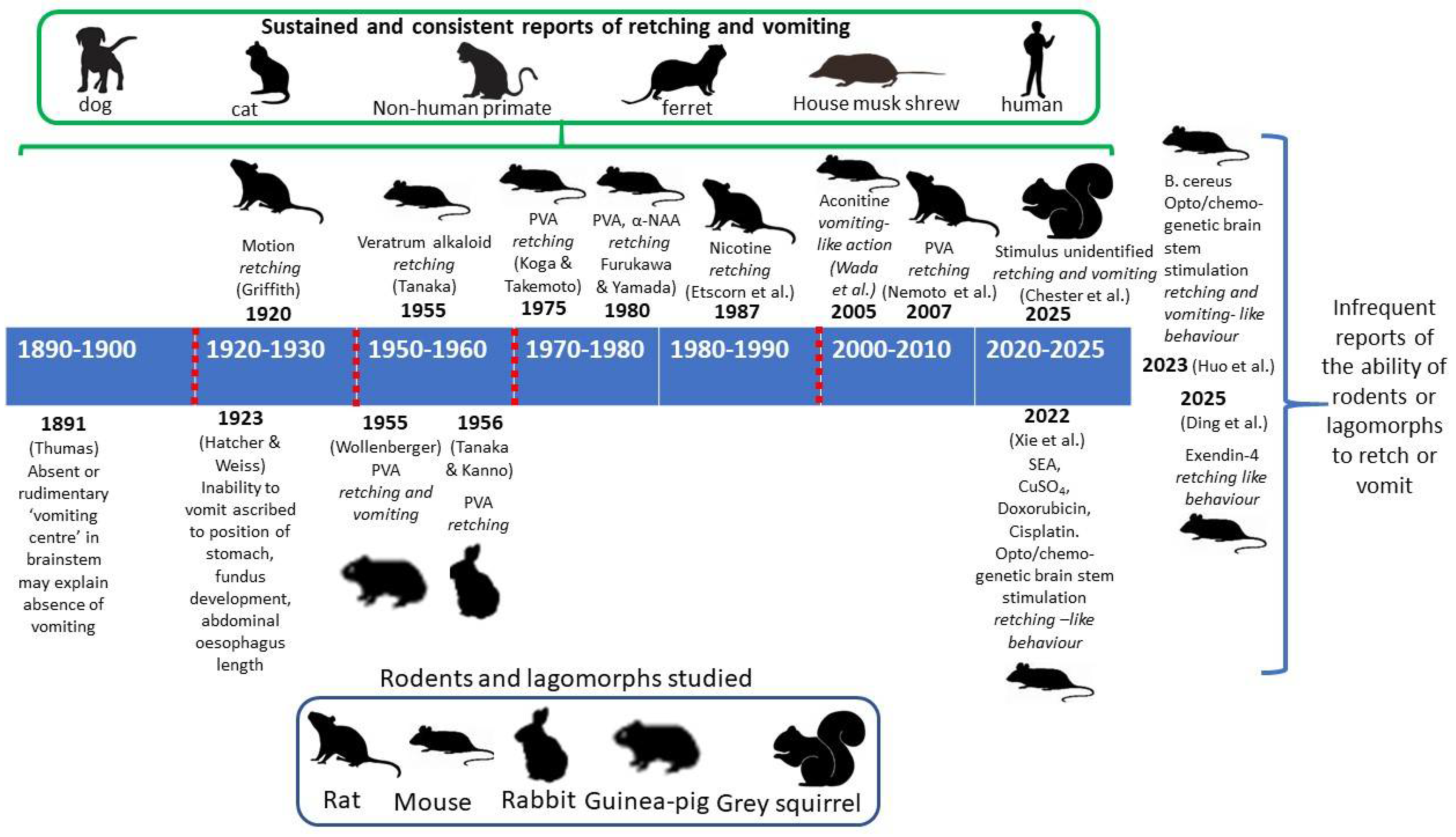
3. A Historical Perspective on the Reported Inability of Rodents to Vomit
3.1. Circumstantial Evidence for the Absence of Emesis in Rodents
3.2. Direct Evidence for the Absence of Emesis in Rodents
4. Analysis of Reports of Retching and Vomiting in Rodents from 1920 to 2025


| Stimulus/Route | Response | Latency | Number of R-like Events; N = Respond/Tested | Ref |
|---|---|---|---|---|
| Veratrum ester alkaloids, s.c. | “movement of head and front part of the body as in the vomiting act”; described as “retching movement” | NS | R = NS N = 5–10/dose (usually 8) | [33] |
| Protoveratrine-A, s.c. | No description other than “retching” | 10–15 min | Respond/tested = Almost 100% in high dose group | [32] |
| Protoveratrine-A, i.p. | “downward and quick opening of the mouth, with upward and downward movement of the thoracic skin”; described as “retching” accompanied by salivation, preening and decrease in exploratory behaviour | NS | R = 11.6 ± 3.8 in 60 min. N = 10/10 | [31] |
| α-naphthoxyacetic acid, i.p. | “recurrent episodes of wide opening of the mouth”; described as “retching” accompanied by salivation, lacrimation and sometimes a sudden jump | 5 min | R = 15.8 ± 4.2 in 30 min N = 10/10 | [31] |
| Aconitine, p.o. | “Vomiting-like action” with mouth opening | 3–15 min | NS | [75] |
| Protoveratrine-A, s.c. | ‘Retching-like behaviour’, mouth opening but also a separate ‘hiccup-like’ behaviour | 10–15 min | R = 14.3 (mean) -; 34.9 in 60 min (dose-related; N = 4) | [72] |
| Species | ‘Emetic’ Stimulus (Dose/Route) | Description of Response | Latency | Ref. |
|---|---|---|---|---|
| RAT | Horizontal rotation | “Frequent and severe retching movements accompanied by defecation and micturition” | NS | [71] |
| RAT | “Poisoned” | “The abdomen retches, the back arches, the head lowers, the mouth gapes, and the tongue protrudes”; described as “Behavioral indices of emesis” | NS | [76] |
| RAT | Nicotine (0.5–3.0 mg/kg; i.p.) | “occasional retching” in all dose groups | NS | [70] |
| RAT | Protoveratrine-A (50–200 µg/kg; s.c.) | ‘Retching’, tongue protrusion, mouth opening downward, forelimb straddling | 10–15 min | [72] |
| GUINEA PIG | Protoveratrine (60% A and 40% B; 150 µg/kg; i.p.) | “violent retching movements were noticed, which were followed by vomiting”………… “The hind legs became immobilized in flaccid paralysis while vomiting continued” | A few minutes | [49] |
| GUINEA PIG | Copper sulphate (i.g.) | “discomfort symptoms similar to vomiting”. Gastrointestinal tract electrical activity was recorded, with the authors reporting “disturbances” (increased frequency and amplitude) coinciding with the “symptoms similar to vomiting” * | 3.7 min | [77] |
| RABBIT | Protoveratrine-A (10 µg/kg; i.v.) | Retching act: “movement of the head and front part of the body as in the vomiting act……. Masticating movements of mouth, licking the lips, marked salivation, dyspnoea and cyanosis were always associated with the retching period” | 1–2 min | [73] |
| RABBIT | Apomorphine | No description; anecdotal report of ‘retching’ | NS | [78] |
| GREY SQUIRREL | ‘Spontaneous’—stimulus not identified | Retching defined as “attempting to vomit without bringing anything up” [79] | NS | [69] |
4.1. Historical Reports
4.2. Recent Mouse Studies Reporting ‘Retching-like Behaviour’ (Table 3)
| Stimulus/Dose/Route | Response to Stimulus | Latency | Number of R-like or V-like Events | Duration | Ref. |
|---|---|---|---|---|---|
| * SEA; 0.3 mg/kg; i.p. | “Retching-like behavior”: wide mouth opening (video camera) and when measured associated with synchronous bursts of EMG activity from diaphragm and abdominal external oblique muscles | 87 ± 14 min | R = 5 ± 3 in 180 min; N = 9 | ~6 s | [35] |
| ** PV-A; 0.4 mg/kg; i.p. | “Retching-like behavior” (VR) | NS | R = NS N = 9 | ~6 s | [35] |
| ** CuSO4; 120 mg/kg; i.g. | “Retching-like behavior” (VR) | NS | R = NS N = 9 | ~1 s | [35] |
| ** Doxorubicin; 10 mg/kg; i.p. | “Retching-like behavior” (VR) | NS | R = NS N = 7 | ~6 s | [35] |
| ** Cisplatin; 10 mg/kg; i.p. | “Retching-like behavior” (VR) | NS | R = NS N = 7 | ~5 s | [35] |
| ** Optogenetic activation of Tac1+ DVC neurons; 10 mW, 20 Hz | “Retching-like behavior” (VR) | NS but ‘Immediate’ from records | R = NS N = 9 | ~6 s | [35] |
| ** Chemogenetic activation of Tac1+ DVC neurons by SEA; i.p. | “Retching-like behavior” (VR) | 88 ± 13 min | R = NS N = 9 | ~10 s | [35] |
| ** Chemogenetic activation of Tac1+ DVC neurons | “Retching-like behavior” (VR) | 15 ± 2 min | R = NS N = 9 | ~20 s | [35] |
| ** B. cereus; 10 µL/g; i.g.; hourly for 3 h. | “Retching-like behavior”: wide mouth-opening angle (VR) and where measured, a simultaneous transient increase in IGP ± diaphragm EMG | ~60 min | R = 5–29 in 3 h N = 10 | NS | [37] |
| ** Optogenetic activation of glutamatergic NTS neurons; 20 mW; 5 s | “Retching-like behavior”: wide mouth-opening angle (VR) | NS but “Immediate” from records | R = ~4 in 5 s N = 4 | NS | [37] |
| ** Optogenetic activation of Calb1+ NTS neurons; 20 mW, 20 Hz, 5 s. | “Retching-like behavior”: wide mouth-opening angle (VR). Also, 10 Hz stimulation induced 2 mouth-opening events and a rise in IGP (<0.2 mmHg) in 5 s. | NS but “Immediate” from records | R = ~4 in 5 s N = 4 | NS | [37] |
| ** Optogenetic stimulation of NTS-Amb-RVLM pathway; 20 mW, 20 Hz | “Retching-like behavior” (VR). In a group of 4 animals, stimulation of the same pathway at 10 Hz for 1 sec evoked a single rise in IGP (<0.2 mmHg), coincidental with wide mouth gaping and increased diaphragm EMG activity. | NS but “Immediate” from records | R = ~4 in 5 s N = 18 | NS | [37] |
| ** Chemogenetic stimulation of B. cereus TRAPed NTS neurons; i.g. | “Retching-like behavior”: wide mouth-opening angle (VR) and where measured, a simultaneous transient increase in IGP | NS | R = ~40 in 60 min. N = 5 | NS | [37] |
| Optogenetic stimulation of NTS-Amb-RVLM pathway; 20 mW, 20 Hz | Repeated activation evoked “forceful vomiting”—oral ejection of gavaged dragon fruit juice | NS | V = Occurred and vomitus weighed N = 6 | NS | [37] |
| Exendin-4; 1–1000 µg/kg; i.p. | “Retching-like behavior”: “unusual wide mouth-opening movements” | ~80 min (1, 10, 100 µg/kg); ~50 min (1000 µg/kg) | 1 µg/kg: R = ~4 in 3 h, (~3–5), N = 10 10 µg/kg: R = ~6 in 3 h (~5–7), N = 10 100 µg/kg: R = ~6 in 3 h (~4–8), N = 10 1000 µg/kg: R = ~7 in 3 h (~6–8), N = 10 | NS | [36] |
4.3. Summary of Historic and Recent Rodent Studies
5. Critical Reappraisal of Retching and Vomiting in Rodents
5.1. What Is Being Observed in the Recent and Historic Papers Reporting Emesis in Rodents?
5.2. Why Has Retching Not Been More Frequently Reported in Rodents?
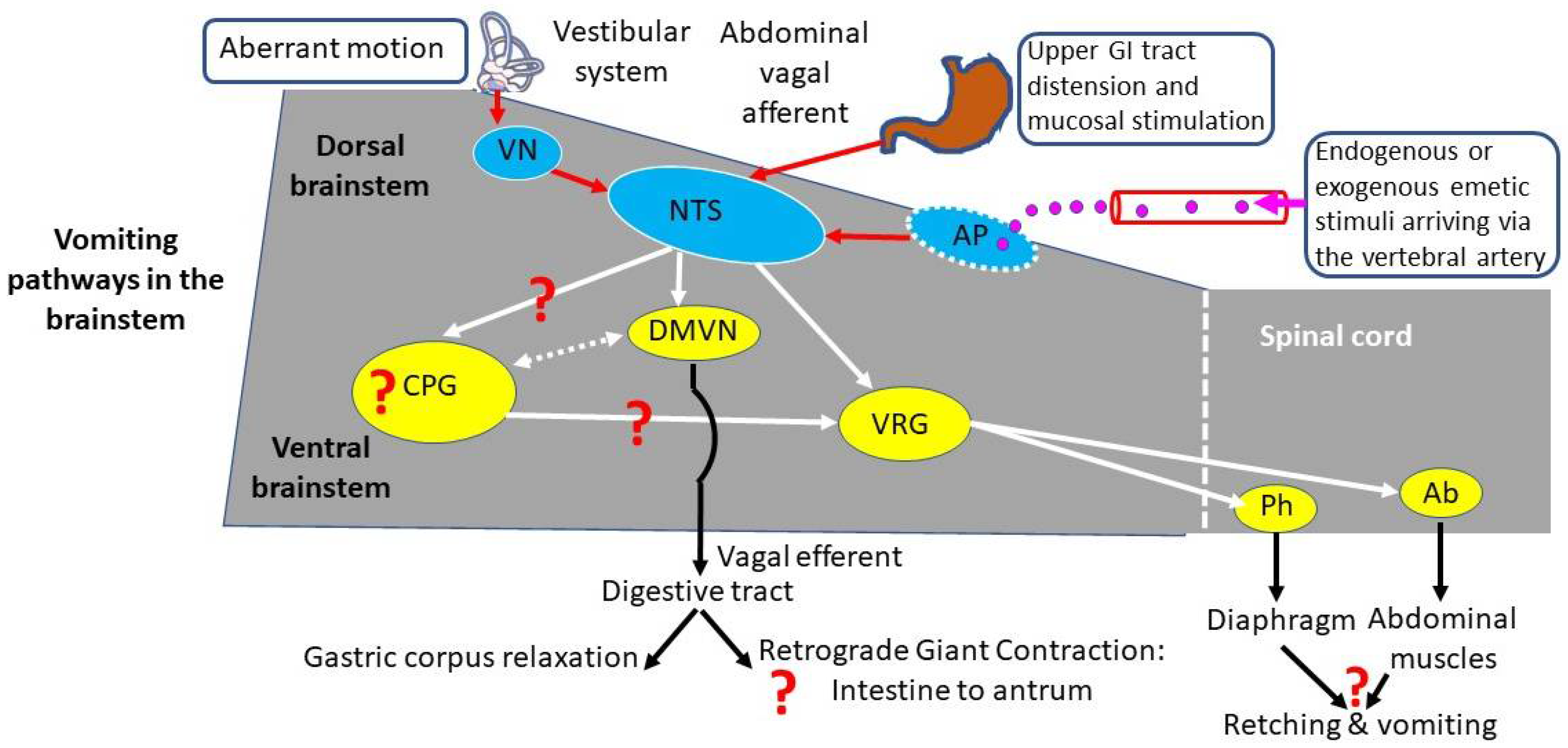
5.3. Are Rodents Capable of Vomiting, and If Not, Why Not?
- Longitudinal shortening of the oesophagus;
- Intense contraction of the costal diaphragm with concomitant inhibition of contraction of the crural (circumoesophageal) diaphragm;
- Relaxation of the upper and lower oesophageal sphincters;
- Compression of the stomach by intense contraction of the rectus abdominis muscle.
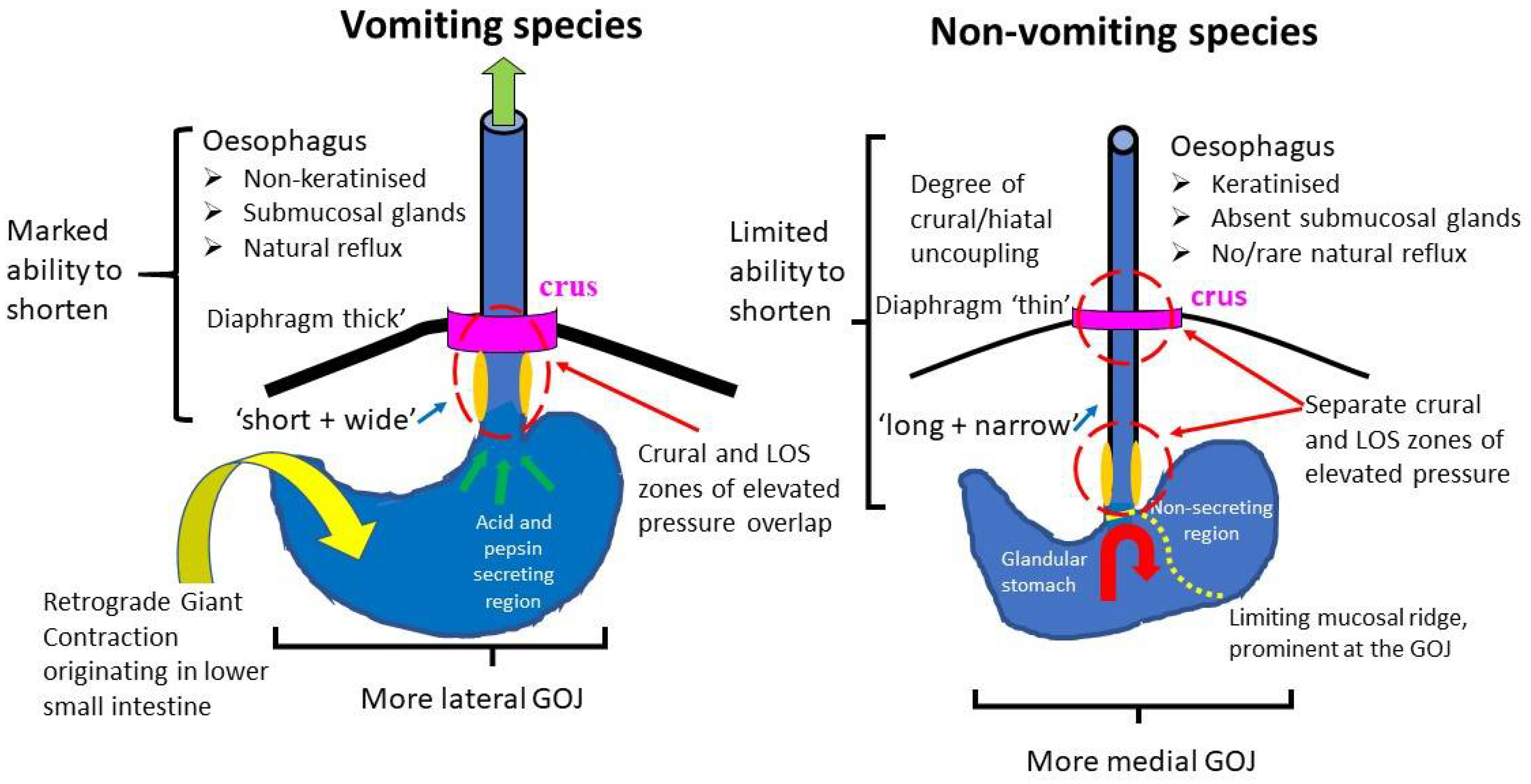
5.3.1. The Characteristics of the Gastroesophageal Junction in Rodents Makes Vomiting Problematic

5.3.2. The Genesis of the Abdomino-Thoracic Pressure Gradient
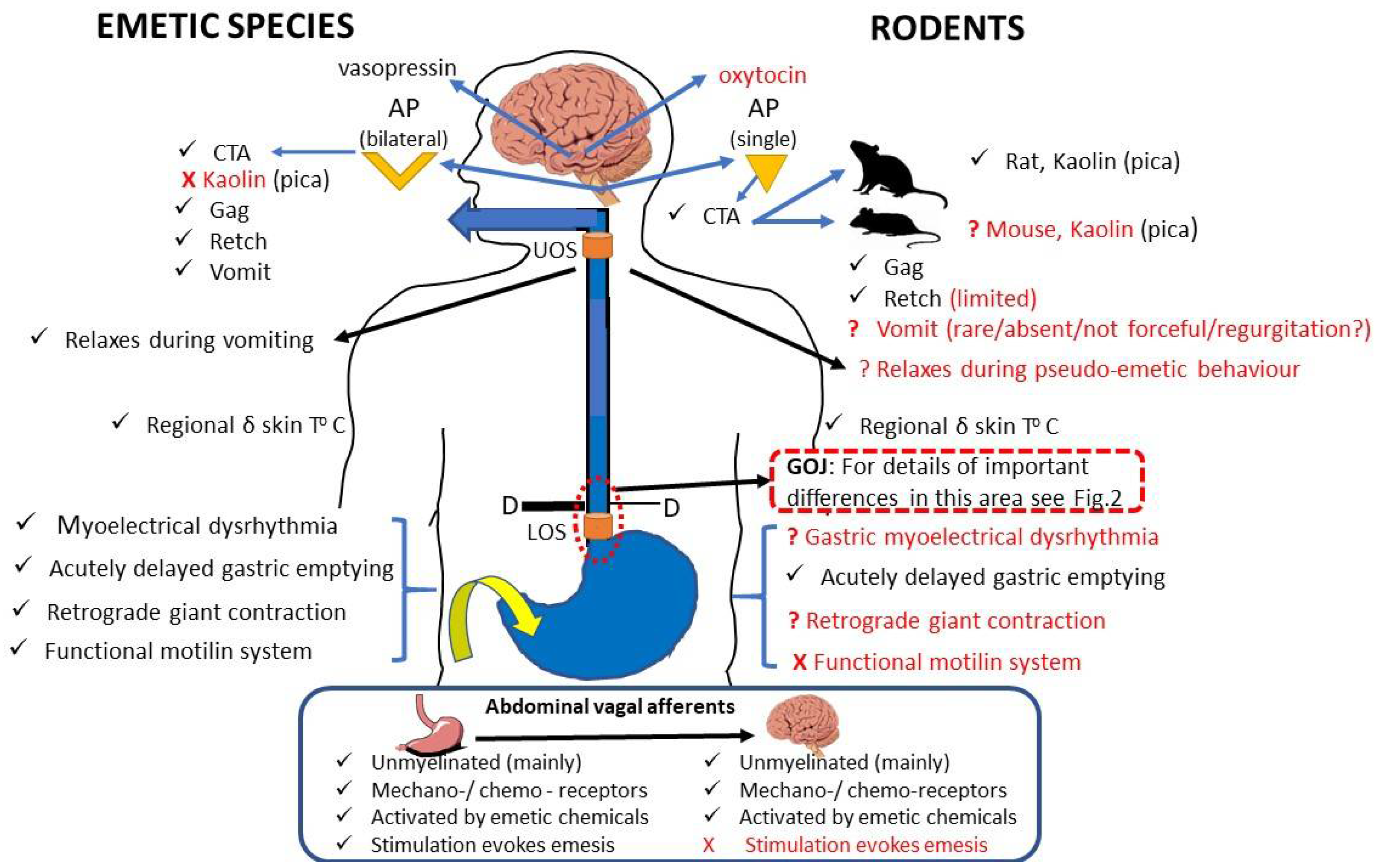
5.3.3. Conclusions on the Ability or Inability of Rodents to Retch and Vomit
5.4. Experimental Approaches to Resolving the Rodent Vomiting Question
6. Conclusions and Implications
6.1. Conclusions
- The reason why ‘retching-like behaviour’ has only been sporadically reported in rats and mice is unclear. Perhaps it may have been mistaken for other similar behaviours (e.g., sneeze, cough) or signs of neurotoxicity, especially as several reports used neuroactive veratrum alkaloids. It is also possible that ‘retching’ or ‘vomiting’ have been observed more frequently, but the finding has been dismissed as anomalous or has proven difficult to publish, as is known to occur with ‘negative data’ [166].
- As exemplified by rats and mice, rodents have a ‘retch-like response’, but the response is small, brief and not comparable in magnitude to that seen in emetic species and could easily be missed by an observer. The limited data on intragastric pressure during ‘retching-like behaviour’ in mice indicates a weak response that is not comparable with that seen in emetic species, despite data suggesting that the mouse diaphragm can generate similar forces.
- Behaviours described as ‘vomiting’ are very rarely reported and the descriptions are not convincing compared to the forceful ejection that occurs in established emetic species, especially when the constraints of the GOR barrier on the bulk flow of semi-solid material into the oesophagus are considered.
- Until additional physiological studies are undertaken to clarify the events underlying ‘retching-like behaviour’ and to better define ‘vomiting’ in mice and rats and other rodents, we suggest that sweeping statements such as “rodents do not vomit” are avoided and are qualified by more specific references to particular species, details of what was observed or measured and under which conditions. The terms ‘retching-like’, ‘pseudo-vomiting’ or ‘pseudo-emesis’ may be more appropriate descriptions until the exact physiological characteristics of the events are defined.
- These terms are consistent with the proposal that during evolution, rodents have ‘lost’ the ability to vomit yet retain some ancient traces of the emetic reflex (and its molecular constituents) that may be more or less apparent in different species, strains or in-bred/wild animals (see below).
- The preliminary evidence for the presence of retching and the possibility of regurgitation or vomiting under specific circumstances (e.g., liquid gastric contents) has a number of implications for biomedical science and rodent biology, as discussed below.
6.2. Implications
Supplementary Materials
Author Contributions
Funding
Institutional Review Board Statement
Informed Consent Statement
Data Availability Statement
Conflicts of Interest
Abbreviations
| α-NAA | alpha-naphtoxyacetic acid |
| Amb/NA | nucleus ambiguus |
| AP | area postrema |
| Calb1 | calbidin-1 gene |
| CNO | clozapine N-oxide |
| CPG | central pattern generator |
| CTA | conditioned taste aversion |
| CuSO4 | copper sulphate |
| DMNV | dorsal motor nucleus of the vagus nerve |
| DVC | dorsal vagal complex |
| ED | effective dose |
| EEC | enteroendocrine cell |
| EECs | enteroendocrine cells |
| EMG | electromyography |
| Fint | fatigue intermediate muscle fibre |
| FF | highly fatigable muscle fibre |
| GDF-15 | growth differentiation factor-15 |
| GFRAL | glial cell line-derived neurotrophic factor family receptor alpha-like |
| GIPR | glucose insulinotropic peptide receptor |
| GLP-1 | glucagon-like peptide 1 |
| GOJ | gastro-oesophageal junction |
| GOR | gastro-oesophageal reflux |
| 5-HT3 RA | 5-hydroxytryptamine type 3 receptor antagonist |
| IAP | intra-abdominal pressure |
| i.g. | intragastric |
| IGP | intragastric pressure |
| i.p. | intraperitoneal |
| ITP | intra-thoracic pressure |
| i.v. | intravenous |
| LOS | lower oesophageal sphincter |
| Na+ | sodium ion |
| NK1 RA | neurokinin-1 receptor antagonist |
| NMDA | N-methyl-D-aspartate |
| NTS | nucleus tractus solitarius |
| PVA | protoveratrine-A |
| R | fast, fatigue-resistant muscle fibre |
| RVLM | rostral ventrolateral medulla |
| S | slow contraction, fatigue-resistant muscle fibre |
| s.c. | subcutaneous |
| SEA | Staphylococcus aureus enterotoxin A |
| SLN | superior laryngeal nerve |
| Tac1 | tachykinin precursor-1 gene |
References
- Davis, C.J.; Harding, R.K.; Leslie, R.A.; Andrews, P.L.R. The organisation of vomiting as a protective reflex: A commentary on the first day’s discussions. In Nausea and Vomiting: Mechanisms and Treatment; Davis, C.J., Lake-Bakaar, G.V., Grahame-Smith, D.G., Eds.; Springer: Berlin/Heidelberg, Germany, 1986; pp. 65–75. [Google Scholar]
- Hatcher, R.A.; Weiss, S. Studies on vomiting. J. Pharmacol. Exp. Ther. 1923, 22, 139–193. [Google Scholar] [CrossRef] [Scilit]
- Horn, C.C.; Kimball, B.A.; Wang, H.; Kaus, J.; Dienel, S.; Nagy, A.; Gathright, G.R.; Yates, B.J.; Andrews, P.L.R. Why can’t rodents vomit? A comparative behavioral, anatomical, and physiological study. PLoS ONE 2013, 8, e60537. [Google Scholar] [CrossRef] [Scilit]
- Holmes, A.M.; Rudd, J.A.; Tattersall, F.D.; Aziz, Q.; Andrews, P.L. Opportunities for the replacement of animals in the study of nausea and vomiting. Br. J. Pharmacol. 2009, 157, 865–880. [Google Scholar] [CrossRef] [Scilit] [PubMed]
- Guénet, J.L.; Orth, A.; Bonhomme, F. Origins and Phylogenetic Relationships of the Laboratory Mouse. In The Laboratory Mouse, 2nd ed.; Hedrich, H.J., Ed.; Academic Press: London, UK, 2012; pp. 3–20. [Google Scholar]
- Bininda-Emonds, O.R.; Cardillo, M.; Jones, K.E.; MacPhee, R.D.; Beck, R.M.; Grenyer, R.; Price, S.A.; Vos, R.A.; Gittleman, J.L.; Purvis, A. The delayed rise of present-day mammals. Nature 2007, 446, 507–512. [Google Scholar] [CrossRef] [Scilit] [PubMed]
- King, G.L. Animal models in the study of vomiting. Can. J. Physiol. Pharmacol. 1990, 68, 260–268. [Google Scholar] [CrossRef] [Scilit]
- Andrews, P.L.R.; Golding, J.F.; Sanger, G.J. An assessment of the effects of neurokinin1 receptor antagonism against nausea and vomiting: Relative efficacy, sites of action and lessons for future drug development. Br. J. Clin. Pharmacol. 2023, 89, 3468–3490. [Google Scholar] [CrossRef] [Scilit]
- Andrews, P.L.; Sanger, G.J. Nausea and the quest for the perfect anti-emetic. Eur. J. Pharmacol. 2014, 722, 108–121. [Google Scholar] [CrossRef] [Scilit]
- Andrews, P.L.R.; Bhandari, P.; Garland, S.; Bingham, S.; Davis, C.J.; Hawthorn, J.; Davidson, H.I.M.; Roylance, R.; Lane, S. Does retching have a function? An experimental study in the ferret. Pharmacodyn. Ther. 1990, 9, 135–152. [Google Scholar]
- Borison, H.L.; Wang, S.C. Physiology and pharmacology of vomiting. Pharmacol. Rev. 1953, 5, 193–230. [Google Scholar] [CrossRef] [Scilit]
- Brizzee, K.R. Mechanics of vomiting: A mini-review. Can. J. Physiol. Pharmacol. 1990, 68, 221–229. [Google Scholar] [CrossRef] [Scilit]
- Lumsden, K.; Holden, W.S. The act of vomiting in man. Gut 1969, 10, 173–179. [Google Scholar] [CrossRef] [Scilit] [PubMed]
- McCarthy, L.E.; Borison, H.L. Respiratory mechanics of vomiting in decerebrate cats. Am. J. Physiol. 1974, 226, 738–743. [Google Scholar] [CrossRef] [Scilit] [PubMed]
- Stern, R.M.; Koch, K.L.; Andrews, P.L.R. Nausea: Mechanisms and Management; Oxford University Press: New York, NY, USA, 2011; p. 462. [Google Scholar]
- Grélot, L.; Miller, A.D. Neural control of respiratory muscle activation during vomiting. In Neural Control of the Respiratory Muscles; Miller, A.B., Bianchi, A.L., Bishop, B.P., Eds.; CRC Press: Boca Raton, FL, USA, 1997; pp. 239–248. [Google Scholar]
- Onishi, T.; Mori, T.; Yanagihara, M.; Furukawa, N.; Fukuda, H. Similarities of the neuronal circuit for the induction of fictive vomiting between ferrets and dogs. Auton. Neurosci. 2007, 136, 20–30. [Google Scholar] [CrossRef] [Scilit]
- Andrews, P.L.; Hawthorn, J. The neurophysiology of vomiting. Baillière’s Clin. Gastroenterol. 1988, 2, 141–168. [Google Scholar] [CrossRef] [Scilit]
- Percie du Sert, N.; Andrews, P.L.R. The Ferret in Nausea and Vomiting Research: Lessons in Translation of Basic Science to the Clinic. In Biology and Diseases of the Ferret; Fox, J.G., Marini, R.P., Eds.; Wiley Blackwell: Hoboken, NJ, USA, 2014. [Google Scholar] [CrossRef] [Scilit]
- Iqbal, A.; Haider, M.; Stadlhuber, R.J.; Karu, A.; Corkill, S.; Filipi, C.J. A study of intragastric and intravesicular pressure changes during rest, coughing, weight lifting, retching, and vomiting. Surg. Endosc. 2008, 22, 2571–2575. [Google Scholar] [CrossRef] [Scilit]
- Miller, A.D. Respiratory muscle control during vomiting. Can. J. Physiol. Pharmacol. 1990, 68, 237–241. [Google Scholar] [CrossRef] [Scilit]
- Murphey, C.P.; Shulgach, J.A.; Amin, P.R.; Douglas, N.K.; Bielanin, J.P.; Sampson, J.T.; Horn, C.C.; Yates, B.J. Physiological changes associated with copper sulfate-induced nausea and retching in felines. Front. Physiol. 2023, 14, 1077207. [Google Scholar] [CrossRef] [Scilit]
- Fukuda, H.; Koga, T. The Bötzinger complex as the pattern generator for retching and vomiting in the dog. Neurosci. Res. 1991, 12, 471–485. [Google Scholar] [CrossRef] [Scilit]
- Fukuda, H.; Koga, T. Non-respiratory neurons in the Bötzinger complex exhibiting appropriate firing patterns to generate the emetic act in dogs. Neurosci. Res. 1991, 14, 180–194. [Google Scholar] [CrossRef] [Scilit]
- Fukuda, H.; Koga, T.; Furukawa, N.; Nakamura, E.; Hatano, M.; Yanagihara, M. The site of the antiemetic action of NK1 receptor antagonists. In Antiemetic Therapy; Donnerer, J., Ed.; Karger: Basel, Switzerland, 2003; pp. 33–77. [Google Scholar]
- Borison, H.L. Area postrema: Chemoreceptor circumventricular organ of the medulla oblongata. Prog. Neurobiol. 1989, 32, 351–390. [Google Scholar] [CrossRef] [Scilit] [PubMed]
- Zhong, W.; Shahbaz, O.; Teskey, G.; Beever, A.; Kachour, N.; Venketaraman, V.; Darmani, N.A. Mechanisms of nausea and vomiting: Current knowledge and recent advances in intracellular emetic signaling systems. Int. J. Mol. Sci. 2021, 22, 5797. [Google Scholar] [CrossRef] [Scilit]
- Andrews, P.L.; Davis, C.J.; Bingham, S.; Davidson, H.I.; Hawthorn, J.; Maskell, L. The abdominal visceral innervation and the emetic reflex: Pathways, pharmacology, and plasticity. Can. J. Physiol. Pharmacol. 1990, 68, 325–345. [Google Scholar] [CrossRef] [Scilit]
- Horn, C.C. The physiology of vomiting. In Nausea and Vomiting; Koch, K., Hasler, W., Eds.; Springer: Cham, Switzerland, 2017; pp. 15–26. [Google Scholar] [CrossRef] [Scilit]
- Lang, I.M. Physiology of the digestive tract correlates of vomiting. J. Neurogastroenterol. Motil. 2023, 29, 20–30. [Google Scholar] [CrossRef] [Scilit]
- Furukawa, T.; Yamada, K. The alpha-naphthoxyacetic acid-elicited retching involves dopaminergic inhibition in mice. Pharmacol. Biochem. Behav. 1980, 12, 735–738. [Google Scholar] [CrossRef] [Scilit]
- Koga, T.; Takemoto, K. Relationship between retching induced by protoveratrine-A and biogenic amines in mice. Fukuoka Acta Med. 1975, 66, 532–535. [Google Scholar]
- Tanaka, K. Studies on veratrum alkaloids. XX. Actions of veratrum alkaloids upon the central nervous system of mice. J. Pharmacol. Exp. Ther. 1955, 113, 89–99. [Google Scholar] [CrossRef] [Scilit] [PubMed]
- Weissman, A. Jumping in mice elicited by α-naphthoxyacetic acid (α-NOAA). J. Pharmacol. Exp. Ther. 1955, 181, 11–17. [Google Scholar]
- Xie, Z.; Zhang, X.; Zhao, M.; Huo, L.; Huang, M.; Li, D.; Zhang, S.; Cheng, X.; Gu, H.; Zhang, C.; et al. The gut-to-brain axis for toxin-induced defensive responses. Cell 2022, 185, 4298–4316.e21. [Google Scholar] [CrossRef] [Scilit]
- Ding, H.; Wang, M.; Zhang, J.; Wan, C.; Huang, Z.; Liu, L.; Liu, J. Exendin-4 induced retching-like behaviour mediated by postsynaptic effect via AMPA receptors in the area postrema of mice. Am. J. Physiol. Endocrinol. Metab. 2025, 329, E254–E265. [Google Scholar] [CrossRef] [Scilit] [PubMed]
- Huo, L.; Ye, Z.; Liu, M.; He, Z.; Huang, M.; Li, D.; Wu, Q.; Wang, Q.; Wang, X.; Cao, P.; et al. Brain circuits for retching-like behavior. Natl. Sci. Rev. 2023, 11, nwad256. [Google Scholar] [CrossRef] [Scilit]
- Mead, A.N.; Amouzadeh, H.R.; Chapman, K.; Ewart, L.; Giarola, A.; Jackson, S.J.; Jarvis, P.; Jordaan, P.; Redfern, W.; Traebert, M.; et al. Assessing the predictive value of the rodent neurofunctional assessment for commonly reported adverse events in phase I clinical trials. Regul. Toxicol. Pharmacol. 2016, 80, 348–357. [Google Scholar] [CrossRef] [Scilit]
- Clements, P.J.M.; Bolon, B.; McInnes, E.; Mukaratirwa, S.; Scudamore, C. Animal Models in Toxicologic Research: Rodents. In Haschek and Rousseaux’s Handbook of Toxicologic Pathology, 4th ed.; Elsevier: Amsterdam, The Netherlands, 2022; pp. 653–694. [Google Scholar] [CrossRef] [Scilit]
- Authier, S.; Arezzo, J.; Delatte, M.S.; Kallman, M.J.; Markgraf, C.; Paquette, D.; Pugsley, M.K.; Ratcliffe, S.; Redfern, W.S.; Stevens, J.; et al. Safety pharmacology investigations on the nervous system: An industry survey. J. Pharmacol. Toxicol. Methods 2016, 81, 37–46. [Google Scholar] [CrossRef] [Scilit]
- Woolley, D.; Woolley, A. Practical Toxicology, Evaluation, Prediction, and Risk, 3rd ed.; CRC Press, Taylor & Francis Group: Boca Raton, FL, USA, 2017; p. 528. [Google Scholar]
- Parker, L.A. The role of nausea in taste avoidance learning in rats and shrews. Auton. Neurosci. 2006, 125, 34–41. [Google Scholar] [CrossRef] [Scilit]
- Parker, L.A.; Limebeer, C.L. Conditioned gaping in rats: A selective measure of nausea. Auton. Neurosci. 2006, 129, 36–41. [Google Scholar] [CrossRef] [Scilit] [PubMed]
- Parker, L.A.; Rana, S.A.; Limebeer, C.L. Conditioned nausea in rats: Assessment by conditioned disgust reactions, rather than conditioned taste avoidance. Can. J. Exp. Psychol. 2008, 62, 198–209. [Google Scholar] [CrossRef] [Scilit]
- Rock, E.M.; Limebeer, C.L.; Parker, L.A. Anticipatory nausea in animal models: A review of potential novel therapeutic treatments. Exp. Brain Res. 2014, 232, 2511–2534. [Google Scholar] [CrossRef] [Scilit] [PubMed]
- Guo, F.; Gao, S.; Xu, L.; Sun, X.; Zhang, N.; Gong, Y.; Luan, X. Arcuate nucleus orexin-A signaling alleviates cisplatin-induced nausea and vomiting through the paraventricular nucleus of the hypothalamus in rats. Front. Physiol. 2018, 9, 1811. [Google Scholar] [CrossRef] [Scilit] [PubMed]
- Kawano, T.; Yokoyama, M. Relationship between analgesic dose of morphine and vomiting in rat model of postoperative pain. Pain Res. 2012, 27, 227–231. [Google Scholar] [CrossRef] [Scilit]
- Valentin, J.P.; Keisu, M.; Hammond, T.G. Predicting human adverse drug reactions from non-clinical safety studies. In Clinical Trials Handbook; Gad, S.C., Ed.; John Wiley & Sons: Hoboken, NJ, USA, 2009; pp. 87–113. [Google Scholar]
- Wollenberger, A. Action of protoveratrine on the metabolism of cerebral cortex. 1. Unstimulated cerebral-cortex tissue. Biochem. J. 1955, 61, 68–77. [Google Scholar] [CrossRef] [Scilit]
- Borison, H.L.; Borison, R.; McCarthy, L.E. Phylogenic and neurologic aspects of the vomiting process. J. Clin. Pharmacol. 1981, 21, 23S–29S. [Google Scholar] [CrossRef] [Scilit]
- Machuca-Márquez, P.; Sánchez-Benito, L.; Menardy, F.; Urpi, A.; Girona, M.; Puighermanal, E.; Appiah, I.; Palmiter, R.D.; Sanz, E.; Quintana, A. Vestibular CCK signaling drives motion sickness-like behavior in mice. Proc. Natl. Acad. Sci. USA 2023, 120, e2304933120. [Google Scholar] [CrossRef] [Scilit]
- Osinski, M.A.; Seifert, T.R.; Shaughnessy, T.K.; Gintant, G.A.; Cox, B.F. Emetic liability testing in ferrets. Curr. Protoc. Pharmacol. 2003, 20, 5.31.1–5.31.8. [Google Scholar] [CrossRef] [Scilit]
- Andrews, P.L.; Horn, C.C. Signals for nausea and emesis: Implications for models of upper gastrointestinal diseases. Auton. Neurosci. 2006, 125, 100–115. [Google Scholar] [CrossRef] [Scilit] [PubMed]
- Ngampramuan, S.; Cerri, M.; Del Vecchio, F.; Corrigan, J.J.; Kamphee, A.; Dragic, A.S.; Rudd, J.A.; Romanovsky, A.A.; Nalivaiko, E. Thermoregulatory correlates of nausea in rats and musk shrews. Oncotarget 2014, 5, 1565–1575. [Google Scholar] [CrossRef] [Scilit] [PubMed]
- Guimaraes, D.D.; Andrews, P.L.R.; Rudd, J.A.; Braga, V.A.; Nalivaiko, E. Ondansetron and promethazine have differential effects on hypothermic responses to lithium chloride administration and to provocative motion in rats. Temperature 2015, 2, 543–553. [Google Scholar] [CrossRef] [Scilit]
- Tu, L.; Poppi, L.; Rudd, J.; Cresswell, E.T.; Smith, D.W.; Brichta, A.; Nalivaiko, E. Alpha-9 nicotinic acetylcholine receptors mediate hypothermic responses elicited by provocative motion in mice. Physiol. Behav. 2017, 174, 114–119. [Google Scholar] [CrossRef] [Scilit]
- Rahman, S.M.; Luebke, A.E. Calcitonin gene-related peptide receptor antagonism reduces motion sickness indicators in mouse migraine models. Cephalalgia 2024, 44, 3331024231223971. [Google Scholar] [CrossRef] [Scilit] [PubMed]
- Redfern, W.S.; Strang, I.; Storey, S.; Heys, C.; Barnard, C.; Lawton, K.; Hammond, T.G.; Valentin, J.P. Spectrum of effects detected in the rat functional observational battery following oral administration of non-CNS targeted compounds. J. Pharmacol. Toxicol. Methods 2005, 52, 77–82. [Google Scholar] [CrossRef] [Scilit]
- Chin, C.L.; Fox, G.B.; Hradil, V.P.; Osinski, M.A.; McGaraughty, S.P.; Skoubis, P.D.; Cox, B.F.; Luo, Y. Pharmacological MRI in awake rats reveals neural activity in area postrema and nucleus tractus solitarius: Relevance as a potential biomarker for detecting drug-induced emesis. Neuroimage 2006, 33, 1152–1160. [Google Scholar] [CrossRef] [Scilit]
- Kato, T.; Matsumoto, Y.; Yamamoto, M.; Matsumoto, K.; Baba, S.; Nakamichi, K.; Matsuda, H.; Nishimuta, H.; Yabuuchi, K. DSP-1053, a novel serotonin reuptake inhibitor with 5-HT1A partial agonistic activity, displays fast antidepressant effect with minimal undesirable effects in juvenile rats. Pharmacol. Res. Perspect. 2015, 3, e00142. [Google Scholar] [CrossRef] [Scilit]
- Goineau, S.; Castagné, V. Comparison of three preclinical models for nausea and vomiting assessment. J. Pharmacol. Toxicol. Methods 2016, 82, 45–53. [Google Scholar] [CrossRef] [Scilit] [PubMed]
- Stevens, C.E. Comparative Physiology of the Vertebrate Digestive System; Cambridge University Press: Cambridge, UK, 1988; p. 300. [Google Scholar]
- Goff, J.P. Gastrointestinal motility. In Duke’s Physiology of Domestic Animals; Reece, W.O., Erickson, H.H., Goff, J.P., Uemura, E.E., Eds.; Wiley Blackwell: Hoboken, NJ, USA, 2015; pp. 467–484. [Google Scholar]
- Plumb, D.C. Plumb’s Veterinary Drug Handbook, 9th ed.; Wiley Blackwell: Hoboken, NJ, USA, 2018. [Google Scholar]
- Frohlich, J. Rats and mice. In Ferrets, Rabbits and Rodents—Clinical Medicine and Surgery, 4th ed.; Quesenberry, K.E., Orcutt, C.J., Mans, C., Carpenter, J.W., Eds.; Elsevier: St. Louis, MO, USA, 2021; pp. 345–367. [Google Scholar]
- Smith, J.E.; Paton, J.F.; Andrews, P.L. An arterially perfused decerebrate preparation of Suncus murinus (house musk shrew) for the study of emesis and swallowing. Exp. Physiol. 2002, 87, 563–574. [Google Scholar] [CrossRef] [Scilit]
- Andrews, P.L.; Wood, K.L. Vagally mediated gastric motor and emetic reflexes evoked by stimulation of the antral mucosa in anaesthetized ferrets. J. Physiol. 1988, 395, 1–16. [Google Scholar] [CrossRef] [Scilit]
- St John, W.M. In memorial: H.L. Borison (1922–1990). In Mechanisms and Control of Emesis; Bianchi, A.L., Grélot, L., Miller, A.D., King, G.L., Eds.; John Libbey Eurotext/INSERM: Paris, France, 1992; pp. 99–103. [Google Scholar]
- Chester, M.; Beck, J.; Potash, A.D. Observation of a grey squirrel (Sciurus carolinensis) suggests that some rodents can vomit. Can. J. Zool. 2025, 103, 1–4. [Google Scholar] [CrossRef] [Scilit]
- Etscorn, F.; Moore, G.A.; Scott, E.P.; Hagen, L.S.; Caton, T.M.; Sanders, D.L.; Divine, K.K. Conditioned saccharin aversions in rats as a result of cutaneous nicotine or intraperitoneal nicotine administered in divided doses. Pharmacol. Biochem. Behav. 1987, 28, 495–502. [Google Scholar] [CrossRef] [Scilit]
- Griffith, C.R. The decrease of after-nystagmus during repeated rotation. Laryngoscope 1920, 30, 129–137. [Google Scholar] [CrossRef] [Scilit]
- Nemoto, M.; Endo, T.; Kowada, J.; Yamamoto, T.; Hirafuji, M.; Saito, H.; Minami, M.; Ito, Y. Evaluation of protoveratrine A-induced retching in rat and mouse. Annu. Meet. Jpn. Soc. Toxicol. 2007, 34, 1045. [Google Scholar] [CrossRef]
- Tanaka, K.; Kanno, T. The role of nodose ganglia in the emetic and hypotensive action of protoveratrine. Yonago Acta Med. 1956, 2, 8–11. [Google Scholar]
- Thumas, L.J. Ueber das Brechcentrum und über die Wirkung einiger pharmakologischer Mittel auf dasselbe. Virchows Arch. Pathol. Anat. 1891, 123, 44–69. [Google Scholar] [CrossRef] [Scilit]
- Wada, K.; Nihira, M.; Hayakawa, H.; Tomita, Y.; Hayashida, M.; Ohno, Y. Effects of long-term administrations of aconitine on electrocardiogram and tissue concentrations of aconitine and its metabolites in mice. Forensic Sci. Int. 2005, 148, 21–29. [Google Scholar] [CrossRef] [Scilit] [PubMed]
- Garcia, J.; Lasiter, P.S.; Bermudez-Rattoni, F.; Deems, D.A. A general theory of aversion learning. Ann. N. Y. Acad. Sci. 1985, 443, 8–21. [Google Scholar] [CrossRef] [Scilit] [PubMed]
- Len, J.; Xu, G.; Liu, W.; Zhang, Q. The regulating effect of electroacupuncture on gastroenteric electric activity in guinea pigs of peripheral vomiting. Zhen Ci Yan Jiu 1991, 16, 69–72. (In Chinese) [Google Scholar]
- Dolowy, W.C.; Fisher, L.E.; Williamson, W. Some observations on vomiting animals. J. Am. Vet. Med. Assoc. 1960, 137, 426–427. [Google Scholar]
- Rudd, J.A.; Ngan, M.P.; Wai, M.K.; King, A.G.; Witherington, J.; Andrews, P.L.R.; Sanger, G.J. Anti-emetic activity of ghrelin in ferrets exposed to the cytotoxic anti-cancer agent cisplatin. Neurosci. Lett. 2006, 392, 79–83. [Google Scholar] [CrossRef] [Scilit]
- Ueno, S.; Matsuki, N.; Saito, H. Suncus murinus: A new experimental model in emesis research. Life Sci. 1987, 41, 513–518. [Google Scholar] [CrossRef] [Scilit]
- Brizzee, K.R.; Neal, L.M.; Williams, P.M. The chemoreceptor trigger zone for emesis in the monkey. Am. J. Physiol. 1955, 180, 659–662. [Google Scholar] [CrossRef] [Scilit] [PubMed]
- Pfaffman, C. Taste: A model of incentive motivation. In The Physiological Mechanisms of Motivation; Pfaff, D.W., Ed.; Springer: New York, NY, USA, 1982; p. 68. [Google Scholar]
- Grill, H.J.; Norgren, R. The taste reactivity test. I. Mimetic responses to gustatory stimuli in neurologically normal rats. Brain Res. 1978, 143, 263–279. [Google Scholar] [CrossRef] [Scilit]
- Grill, H.J.; Norgren, R. The taste reactivity test. II. Mimetic responses to gustatory stimuli in chronic thalamic and chronic decerebrate rats. Brain Res. 1978, 143, 281–297. [Google Scholar] [CrossRef] [Scilit]
- Andrew, B.L. The nervous control of the cervical oesophagus of the rat during swallowing. J. Physiol. 1956, 134, 729–740. [Google Scholar] [CrossRef] [Scilit] [PubMed]
- Scarborough, D.; Isaacson, L. Activation of neurons in the rat medulla following a gag reflex stimulus. Int. J. Speech Lang. Pathol. Audiol. 2014, 2, 11–19. [Google Scholar] [CrossRef] [Scilit]
- Petzelbauer, P.; Zacharowski, P.A.; Miyazaki, Y.; Friedl, P.; Wickenhauser, G.; Castellino, F.J.; Gröger, M.; Wolff, K.; Zacharowski, K. The fibrin-derived peptide Bβ 15-42 protects the myocardium against ischemia-reperfusion injury. Nat. Med. 2003, 11, 298–304. [Google Scholar] [CrossRef] [Scilit]
- Miller, A.J. Oral and pharyngeal reflexes in the mammalian nervous system: Their diverse range in complexity and the pivotal role of the tongue. Crit. Rev. Oral Biol. Med. 2002, 13, 409–425. [Google Scholar] [CrossRef] [Scilit]
- Yamagata, R.; Koga, T. Autonomic responses associated with severe gagging elicited by stimulation of the superior laryngeal nerve in rats. Kawasaki J. Med. Welf. 2012, 18, 1–11. [Google Scholar]
- Barnett, S.A.; Blaxland, J.D.; Leech, F.B.; Spencer, M.M. A concentrate of red squill as a rat poison, and its toxicity to domestic animals. J. Hyg. 1949, 47, 431–433. [Google Scholar] [CrossRef] [Scilit]
- Hu, D.L.; Nakane, A. Mechanisms of staphylococcal enterotoxin-induced emesis. Eur. J. Pharmacol. 2014, 722, 95–107. [Google Scholar] [CrossRef] [Scilit] [PubMed]
- Powley, T.L.; Mittal, R.K.; Baronowsky, E.A.; Hudson, C.N.; Martin, F.N.; McAdams, J.L.; Mason, J.K.; Phillips, R.J. Architecture of vagal motor units controlling striated muscle of esophagus: Peripheral elements patterning peristalsis? Auton. Neurosci. 2013, 179, 90–98. [Google Scholar] [CrossRef] [Scilit]
- Altschuler, S.M.; Bao, X.M.; Miselis, R.R. Dendritic architecture of nucleus ambiguus motoneurons projecting to the upper alimentary tract in the rat. J. Comp. Neurol. 1991, 309, 402–414. [Google Scholar] [CrossRef] [Scilit]
- Damsch, S.; Eichenbaum, G.; Tonelli, A.; Lammens, L.; Van den Bulck, K.; Feyen, B.; Vandenberghe, J.; Megens, A.; Knight, E.; Kelley, M. Gavage-related reflux in rats: Identification, pathogenesis, and toxicological implications. Toxicol. Pathol. 2011, 39, 348–360. [Google Scholar] [CrossRef] [Scilit]
- Andrews, P.; Torii, Y.; Saito, H.; Matsuki, N. The pharmacology of the emetic response to upper gastrointestinal tract stimulation in Suncus murinus. Eur. J. Pharmacol. 1996, 307, 305–313. [Google Scholar] [CrossRef] [Scilit]
- Matsuki, N.; Torii, Y.; Kaji, T.; Nishiyama, N.; Ishiyama, J.; Chida, N.; Saito, H. Emetic responses of Sorex unguiculatus. Jikken Dobutsu 1993, 42, 225–228. [Google Scholar] [PubMed]
- Darmani, N.A.; Wang, Y.; Abad, J.; Ray, A.P.; Thrush, G.R.; Ramirez, J. Utilization of the least shrew as a rapid and selective screening model for the antiemetic potential and brain penetration of substance P and NK1 receptor antagonists. Brain Res. 2008, 1214, 58–72. [Google Scholar] [CrossRef] [Scilit]
- Andrews, P.; Dovey, E.; Hockaday, J.; Hoyle, C.H.; Woods, A.J.; Matsuki, N. The development of the emetic reflex in the house musk shrew, Suncus murinus. Dev. Brain Res. 2000, 121, 29–34. [Google Scholar] [CrossRef] [Scilit]
- Lu, Z.; Qiao, Y.; Huang, X.; Cui, D.; Liu, J.Y.H.; Ngan, M.P.; Liu, L.; Huang, Z.; Li, Z.T.; Yang, L.; et al. A deep learning-based system for automatic detection of emesis with high accuracy in Suncus murinus. Commun. Biol. 2025, 8, 209. [Google Scholar] [CrossRef] [Scilit]
- Gannot, N.; Li, X.; Phillips, C.D.; Ozel, A.B.; Koecklin, K.H.U.; Lloyd, J.P.; Zhang, L.; Emery, K.; Stern, T.; Li, J.Z.; et al. A vagal-brainstem interoceptive circuit for cough-like defensive behaviors in mice. Nat. Neurosci. 2024, 27, 1734–1744. [Google Scholar] [CrossRef] [Scilit]
- Williams, E.K.; Chang, R.B.; Strochlic, E.E.; Umans, B.D.; Lowell, B.B.; Liberles, S.D. Sensory neurones that detect stretch and nutrients in the digestive system. Cell 2016, 166, 209–221. [Google Scholar] [CrossRef] [Scilit] [PubMed]
- Cai, W.; Makwana, R.; Straface, M.; Gharibans, A.; Andrews, P.L.R.; Sanger, G.J. Evidence for tetrodotoxin-resistant spontaneous myogenic contractions of mouse isolated stomach that are dependent on acetylcholine. Br. J. Pharmacol. 2022, 179, 1187–1200. [Google Scholar] [CrossRef] [Scilit] [PubMed]
- Hu, D.-L.; Zhu, G.; Mori, F.; Omoe, K.; Okada, M.; Wakabayashi, K.; Kaneko, S.; Shinagawa, K.; Nakane, A. Staphylococcal enterotoxin induces emesis through increasing serotonin release in intestine and it is downregulated by cannabinoid receptor 1. Cell. Microbiol. 2007, 9, 2267–2277. [Google Scholar] [CrossRef] [Scilit] [PubMed]
- Andrews, P.L.R.; Rudd, J.A.; Sanger, G.J. Substance P in nausea and vomiting. In Substance P—From Pain to Cancer; Vink, R., Ed.; Academic Press: London, UK, 2025; pp. 179–228. [Google Scholar]
- Yamagata, R.; Koga, T. Effects of NK1 and NMDA receptor antagonists on severe gagging induced by superior laryngeal nerve stimulation in rats. Kawasaki J. Med. Welf. 2010, 16, 1–8. [Google Scholar]
- Yamagata, R.; Himi, N.; Koga, T. Emetic responses are mediated via NMDA and/or NK1 receptors in decerebrate rats. J. Physiol. Sci. 2009, 59, 476. [Google Scholar]
- Watson, J.W.; Gonsalves, S.F.; Fossa, A.A.; McLean, S.; Seeger, T.; Obach, S.; Andrews, P.L. The anti-emetic effects of CP-99,994 in the ferret and the dog: Role of the NK1 receptor. Br. J. Pharmacol. 1995, 115, 84–94. [Google Scholar] [CrossRef] [Scilit]
- Sun, X.; Xu, L.; Guo, F.; Luo, W.; Gao, S.; Luan, X. Neurokinin-1 receptor blocker CP-99994 improved emesis induced by cisplatin via regulating the activity of gastric distension responsive neurons in the dorsal motor nucleus of vagus and enhancing gastric motility in rats. Neurogastroenterol. Motil. 2017, 29, e13096. [Google Scholar] [CrossRef] [Scilit]
- Sanger, G.J. Why is motilin active in some studies with mice, rats, and guinea pigs, but not in others? Implications for functional variability among rodents. Pharmacol. Res. Perspect. 2022, 10, e00900. [Google Scholar] [CrossRef] [Scilit]
- Sanger, G.J.; Holbrook, J.D.; Andrews, P.L. The translational value of rodent gastrointestinal functions: A cautionary tale. Trends Pharmacol. Sci. 2011, 32, 402–409. [Google Scholar] [CrossRef] [Scilit]
- Liu, Y.L.; Malik, N.; Sanger, G.J.; Friedman, M.I.; Andrews, P.L. Pica—A model of nausea? Species differences in response to cisplatin. Physiol. Behav. 2005, 85, 271–277. [Google Scholar] [CrossRef] [Scilit] [PubMed]
- Santucci, D.; Corazzi, G.; Francia, N.; Antonelli, A.; Aloe, L.; Alleva, E. Neurobehavioural effects of hypergravity conditions in the adult mouse. Neuroreport 2000, 11, 3353–3356. [Google Scholar] [CrossRef] [Scilit] [PubMed]
- Matsuki, N.; Wang, C.H.; Okada, F.; Tamura, M.; Ikegaya, Y.; Lin, S.C.; Hsu, Y.N.; Chaung, L.J.; Chen, S.J.; Saito, H. Male/female differences in drug-induced emesis and motion sickness in Suncus murinus. Pharmacol. Biochem. Behav. 1997, 57, 721–725. [Google Scholar] [CrossRef] [Scilit]
- Brame, R.E.; Lucot, J.B. Guamanian Suncus murinus responsiveness to emetic stimuli and the antiemetic effects of 8-OH-DPAT. Pharmacol. Biochem. Behav. 2011, 99, 381–384. [Google Scholar] [CrossRef] [Scilit]
- Ebukuro, S.; Wakana, S.; Hioki, K.; Nomura, T. Selective breeding of house musk shrew (Suncus murinus) lines in relation to emesis induced by veratrine sulfate. Comp. Med. 2000, 50, 281–283. [Google Scholar] [PubMed]
- Burrows, G.E.; Tyrl, R.J. (Eds.) Liliaceae Juss. In Toxic Plants of North America; Wiley: Hoboken, NJ, USA, 2012. [Google Scholar] [CrossRef] [Scilit]
- Lang, I.M. Digestive tract motor correlates of vomiting and nausea. Can. J. Physiol. Pharmacol. 1990, 68, 242–253. [Google Scholar] [CrossRef] [Scilit]
- Lang, I.M.; Dana, N.; Medda, B.K.; Shaker, R. Mechanisms of airway protection during retching, vomiting, and swallowing. Am. J. Physiol. Gastrointest. Liver Physiol. 2002, 283, G529–G536. [Google Scholar] [CrossRef] [Scilit] [PubMed]
- Botha, G.S. Comparative Anatomy. In The Gastro-Esophageal Junction; Little Brown: Boston, MA, USA, 1962; Chapter 7. [Google Scholar]
- Bonavina, L.; Evander, A.; DeMeester, T.R.; Walther, B.; Cheng, S.C.; Palazzo, L.; Concannon, J.L. Length of the distal esophageal sphincter and competency of the cardia. Am. J. Surg. 1986, 151, 25–34. [Google Scholar] [CrossRef] [Scilit]
- Montedonico, S.; Godoy, J.; Mate, A.; Possögel, A.K.; Diez-Pardo, J.A.; Tovar, J.A. Muscular architecture and manometric image of gastroesophageal barrier in the rat. Dig. Dis. Sci. 1999, 44, 2449–2455. [Google Scholar] [CrossRef] [Scilit]
- Soto, C.; Qi, B.; Diez-Pardo, J.A.; Tovar, J.A. Identification of diaphragmatic crural component of gastroesophageal barrier in the rat. Dig. Dis. Sci. 1997, 42, 2420–2425. [Google Scholar] [CrossRef] [Scilit] [PubMed]
- Richards, C.A.; Carr, D.; Spitz, L.; Milla, P.J.; Andrews, P.L. Nissen-type fundoplication and its effects on the emetic reflex and gastric motility in the ferret. Neurogastroenterol. Motil. 2000, 12, 65–74. [Google Scholar] [CrossRef] [Scilit] [PubMed]
- Christensen, J.; De Carle, D.J. Comparative anatomy of the esophagus. Gastroenterology 1974, 67, 407–408. [Google Scholar] [CrossRef] [Scilit]
- Kapoor, H.; Lohani, K.R.; Lee, T.H.; Agrawal, D.K.; Mittal, S.K. Animal models of Barrett’s esophagus and esophageal adenocarcinoma—Past, present, and future. Clin. Transl. Sci. 2015, 8, 841–847. [Google Scholar] [CrossRef] [Scilit] [PubMed]
- Olver, I.N.; Roos, I.A.G.; Thomas, K.; Hillcoat, B.L. Development of a murine gastric distension model for testing the emetic potential of new drugs and efficacy of anti-emetics. Chem. Biol. Interact. 1989, 69, 353–357. [Google Scholar] [CrossRef] [Scilit]
- Malik, N.M.; Liu, Y.-L.; Cole, N.; Sanger, G.J.; Andrews, P.L.R. Differential effects of dexamethasone, ondansetron and a tachykinin NK1 receptor antagonist (GR205171) on cisplatin-induced changes in behaviour, food intake, pica and gastric function in rats. Eur. J. Pharmacol. 2007, 555, 164–173. [Google Scholar] [CrossRef] [Scilit]
- Lang, I.M.; Medda, B.K.; Shaker, R. Digestive and respiratory tract motor responses associated with eructation. Am. J. Physiol. Gastrointest. Liver Physiol. 2013, 304, G1044–G1053. [Google Scholar] [CrossRef] [Scilit]
- Chen, J.N.; Evans, J.; Fakhreddine, A.B.; Strover, S.; Islam, E.; Islam, S. Retrograde cricopharyngeus dysfunction: How does the inability to burp affect daily life? Neurogastroenterol. Motil. 2023, 36, e14721. [Google Scholar] [CrossRef] [Scilit]
- Luciano, L.; Reale, E. The “limiting ridge” of the rat stomach. Arch. Histol. Cytol. 1992, 55, 131–138. [Google Scholar] [CrossRef] [Scilit]
- Di Natale, M.R.; Patten, L.; Molero, J.C.; Stebbing, M.J.; Hunne, B.; Wang, X.; Liu, Z.; Furness, J.B. Organisation of the musculature of the rat stomach. J. Anat. 2022, 240, 711–723. [Google Scholar] [CrossRef] [Scilit] [PubMed]
- Pollard, M.J.; Megirian, D.; Sherrey, J.H. Unity of costal and crural diaphragmatic activity in respiration. Exp. Neurol. 1985, 90, 187–193. [Google Scholar] [CrossRef] [Scilit]
- Pickering, M.; Jones, J.F. The diaphragm: Two physiological muscles in one. J. Anat. 2002, 201, 305–312. [Google Scholar] [CrossRef] [Scilit]
- Subramanian, H.H.; Holstege, G. Midbrain and medullary control of postinspiratory activity of the crural and costal diaphragm in vivo. J. Neurophysiol. 2011, 105, 2852–2862. [Google Scholar] [CrossRef] [Scilit]
- Montedonico, S.; Diez-Pardo, J.A.; Tovar, J.A. Gastroesophageal reflux after combined lower esophageal sphincter and diaphragmatic crural sling inactivation in the rat. Dig. Dis. Sci. 1999, 44, 2283–2289. [Google Scholar] [CrossRef] [Scilit]
- Andrews, P.; Hoyle, C.H.V.; Ngoka, T.; Smith, G.E. Differences in the vagal innervation of the oesophagus may explain the lack of emesis in rodents. Neurogastroenterol. Motil. 2003, 15, A142. [Google Scholar]
- Chiocchetti, R.; Giancola, F.; Mazzoni, M.; Sorteni, C.; Romagnoli, N.; Pietra, M. Excitatory and inhibitory enteric innervation of horse lower esophageal sphincter. Histochem. Cell Biol. 2015, 143, 625–635. [Google Scholar] [CrossRef] [Scilit]
- Perry, S.F.; Similowski, T.; Klein, W.; Codd, J.R. The evolutionary origin of the mammalian diaphragm. Respir. Physiol. Neurobiol. 2010, 171, 1–16. [Google Scholar] [CrossRef] [Scilit]
- Gordon, D.C.; Hammond, C.G.; Fisher, J.T.; Richmond, F.J. Muscle-fiber architecture, innervation, and histochemistry in the diaphragm of the cat. J. Morphol. 1989, 201, 131–143. [Google Scholar] [CrossRef] [Scilit] [PubMed]
- Mantilla, C.B.; Seven, Y.B.; Zhan, W.-Z.; Sieck, G.C. Diaphragm motor unit recruitment in rats. Respir. Physiol. Neurobiol. 2010, 173, 101–106. [Google Scholar] [CrossRef] [Scilit]
- Mantilla, C.B.; Sieck, G.C. Phrenic motor unit recruitment during ventilatory and non-ventilatory behaviors. Respir. Physiol. Neurobiol. 2011, 179, 57–73. [Google Scholar] [CrossRef] [Scilit]
- Fogarty, M.J.; Brandenburg, J.E.; Zhan, W.-Z.; Sieck, G.C. Diaphragm muscle function in a mouse model of early-onset spasticity. J. Appl. Physiol. 1985, 133, 60–68. [Google Scholar] [CrossRef] [Scilit]
- Will, L.A.; Leininger, J.R.; Donham, K.J. Regurgitation and choke in rats. Lab. Anim. Sci. 1979, 29, 360–363. [Google Scholar]
- Hultin, L.; Lindstrom, G.; Lehmann, A. In vivo imaging of tachykinin NK1 receptor agonist induced reflux in rats. Neurogastroenterol. Motil. 2005, 17, S60. [Google Scholar]
- Richter, J.E. Heartburn, dysphagia, odynophagia, and other esophageal symptoms. In Gastrointestinal Disease, 5th ed.; Sleisenger, M.H., Fordtran, J.S., Eds.; W.B. Saunders: Philadelphia, PA, USA, 1993; Volume 1, pp. 331–340. [Google Scholar]
- Mitchell, D. Experiments on neophobia in wild and laboratory rats: A re-evaluation. J. Comp. Physiol. Psychol. 1976, 90, 190–197. [Google Scholar] [CrossRef] [Scilit] [PubMed]
- Mitchell, D.; Beatty, E.T.; Cox, P.K. Behavioral differences between two populations of wild rats: Implications for domestication research. Behav. Biol. 1977, 19, 206–216. [Google Scholar] [CrossRef] [Scilit] [PubMed]
- Tashiro, N.; Kataoka, M.; Ozawa, K.; Ikeda, T. The evaluation of whole-body plethysmography as a semiautomated method for analysis of emesis in the house musk shrew (Suncus murinus). J. Am. Assoc. Lab. Anim. Sci. 2007, 46, 81–85. [Google Scholar]
- Huang, D.; Meyers, K.; Henry, S.; De la Torre, F.; Horn, C.C. Computerized detection and analysis of cancer chemotherapy-induced emesis in a small animal model, musk shrew. J. Neurosci. Methods 2011, 197, 249–258. [Google Scholar] [CrossRef] [Scilit]
- Tsukamoto, G.; Adachi, A. Neural responses of rat area postrema to stimuli producing nausea. J. Auton. Nerv. Syst. 1994, 49, 55–60. [Google Scholar] [CrossRef] [Scilit] [PubMed]
- Kodama, N.; Funahashi, M.; Mitoh, Y.; Minagi, S.; Matsuo, R. Purinergic modulation of area postrema neuronal excitability in rat brain slices. Brain Res. 2007, 1165, 50–59. [Google Scholar] [CrossRef] [Scilit]
- Hay, M.; Hasser, E.M.; Lindsey, K.A. Area postrema voltage-activated calcium currents. J. Neurophysiol. 1996, 75, 133–141. [Google Scholar] [CrossRef] [Scilit] [PubMed]
- Blackshaw, L.A.; Grundy, D. Effects of cholecystokinin (CCK-8) on two classes of gastroduodenal vagal afferent fibre. J. Auton. Nerv. Syst. 1990, 31, 191–201. [Google Scholar] [CrossRef] [Scilit] [PubMed]
- Horn, C.C.; Richardson, E.J.; Andrews, P.L.R.; Friedman, M.I. Differential effects on gastrointestinal and hepatic vagal afferent fibers in the rat by the anti-cancer agent cisplatin. Auton. Neurosci. 2004, 115, 74–81. [Google Scholar] [CrossRef] [Scilit]
- Niijima, A.; Jiang, Z.Y.; Daunton, N.G.; Fox, R.A. Effect of copper sulphate on the rate of afferent discharge in the gastric branch of the vagus nerve in the rat. Neurosci. Lett. 1987, 80, 71–74. [Google Scholar] [CrossRef] [Scilit]
- Bokkov, Y.G. Role of nodose ganglion in vomiting reflex to aconitine and veratrine. Fed. Proc. Transl. Suppl. Sel. Transl. Med.-Relat. Sci. 1964, 50, 325–328. [Google Scholar]
- Borison, H.L.; Fairbanks, V.F. Mechanism of veratrum-induced emesis in the cat. J. Pharmacol. Exp. Ther. 1952, 105, 317–325. [Google Scholar] [CrossRef] [Scilit]
- Mullenax, C.H.; Buck, W.B.; Keeler, R.F.; Binns, W. Stimulating eructation and vomition in normal and bloated ruminants with alkaloidal extracts from Veratrum spp. Am. J. Vet. Res. 1966, 27, 211–222. [Google Scholar] [PubMed]
- Taldaev, A.; Terekhov, R.P.; Melnik, E.V.; Belova, M.V.; Kozin, S.V.; Nedorubov, A.A.; Pomerantseva, T.Y.; Ramenskaya, G.V. Insights into the cardiotoxic effects of Veratrum lobelianum alkaloids: Pilot study. Toxins 2022, 14, 490. [Google Scholar] [CrossRef] [Scilit]
- Thompson, P.I.; Bingham, S.; Andrews, P.L.; Patel, N.; Joel, S.P.; Slevin, M.L. Morphine 6-glucuronide: A metabolite of morphine with greater emetic potency than morphine in the ferret. Br. J. Pharmacol. 1992, 106, 3–8. [Google Scholar] [CrossRef] [Scilit]
- Grimaud, J.; Murthy, V.N. How to monitor breathing in laboratory rodents: A review of the current methods. J. Neurophysiol. 2018, 120, 624–632. [Google Scholar] [CrossRef] [Scilit]
- Lu, A.; Percie Du Sert, N.; Chan, S.W.; Yeung, C.-K.; Lin, G.; Yew, D.T.W.; Andrews, P.L.R.; Rudd, J.A. Differential hypoglycemic, anorectic, autonomic and emetic effects of the glucagon-like peptide receptor agonist, exendin-4, in the conscious telemetered ferret. J. Transl. Med. 2014, 12, 327–340. [Google Scholar] [CrossRef] [Scilit]
- Percie du Sert, N.; Chu, K.M.; Wai, M.K.; Rudd, J.A.; Andrews, P.L.R. Reduced normogastric electrical activity associated with emesis: A telemetric study in ferrets. World J. Gastroenterol. 2009, 15, 6034–6043. [Google Scholar] [CrossRef] [Scilit] [PubMed]
- Percie du Sert, N.; Ho, W.S.; Rudd, J.A.; Andrews, P.L. Cannabinoid-induced reduction in antral pacemaker frequency: A telemetric study in the ferret. Neurogastroenterol. Motil. 2010, 22, 1257–1266. [Google Scholar] [CrossRef] [Scilit] [PubMed]
- Percie du Sert, N.; Chu, K.M.; Wai, M.K.; Rudd, J.A.; Andrews, P.L. Telemetry in a motion-sickness model implicates the abdominal vagus in motion-induced gastric dysrhythmia. Exp. Physiol. 2010, 95, 768–773. [Google Scholar] [CrossRef] [Scilit]
- Nimpf, S.; Keays, D.A. Why (and how) we should publish negative data. EMBO Rep. 2020, 21, e49775. [Google Scholar] [CrossRef] [Scilit]
- Percie du Sert, N.; Hurst, V.; Ahluwalia, A.; Alam, S.; Avey, M.T.; Baker, M.; Browne, W.J.; Clark, A.; Cuthill, I.C.; Dirnagl, U.; et al. The ARRIVE guidelines 2.0: Updated guidelines for reporting animal research. J. Physiol. 2020, 598, 3793–3801. [Google Scholar] [CrossRef] [Scilit]
- Keane, T.M.; Goodstadt, L.; Danecek, P.; White, M.A.; Wong, K.; Yalcin, B.; Heger, A.; Agam, A.; Slater, G.; Goodson, M.; et al. Mouse genomic variation and its effect on phenotypes and gene regulation. Nature 2011, 477, 289–294. [Google Scholar] [CrossRef] [Scilit] [PubMed]
- Pecoraro, N.; Ginsberg, A.B.; Warne, J.P.; Gomez, F.; La Fleur, S.E.; Dallman, M.F. Diverse basal and stress-related phenotypes of Sprague Dawley rats from three vendors. Physiol. Behav. 2006, 89, 598–610. [Google Scholar] [CrossRef] [Scilit] [PubMed]
- Ito, H.; Nishibayashi, M.; Maeda, S.; Seki, M.; Ebukuro, S. Emetic responses and neural activity in young musk shrews during the breast-feeding/weaning period: Comparison between high and low emetic response strains using a shaking stimulus. Exp. Anim. 2005, 54, 301–307. [Google Scholar] [CrossRef] [Scilit]
- Lorincz, D.; Drury, H.R.; Smith, D.W.; Lim, R.; Brichta, A.M. Aged mice are less susceptible to motion sickness and show decreased efferent vestibular activity compared to young adults. Brain Behav. 2023, 13, e3064. [Google Scholar] [CrossRef] [Scilit]
- Brunnschweiler, J.M.; Andrews, P.L.R.; Southall, E.J.; Pickering, M.; Sims, D.W. Rapid voluntary stomach eversion in a free-living shark. J. Mar. Biol. Assoc. United Kingd. 2005, 85, 1141–1144. [Google Scholar] [CrossRef] [Scilit]
- Page, A.J.; Martin, C.M.; Blackshaw, A. Vagal mechanoreceptors and chemoreceptors in mouse stomach and esophagus. J. Neurophysiol. 2002, 87, 2095–2103. [Google Scholar] [CrossRef] [Scilit] [PubMed]
- Blackshaw, A.; Grundy, D.G. Effects of 5-hydroxytryptamine on discharge of vagal mucosal afferent fibres from the upper gastrointestinal tract of the ferret. J. Auton. Nerv. Syst. 1993, 45, 41–53. [Google Scholar] [CrossRef] [Scilit]
- Blackshaw, A.; Grundy, D.G. Effects of 5-hydroxytryptamine on discharge of vagal mechanoreceptors and motility in the upper gastrointestinal tract of the ferret. J. Auton. Nerv. Syst. 1993, 45, 51–59. [Google Scholar] [CrossRef] [Scilit]
- Page, A.J.; Blackshaw, L.A. An in vitro study of the properties of vagal afferent fibres innervating the ferret oesophagus and stomach. J. Physiol. 1998, 512, 907–916. [Google Scholar] [CrossRef] [Scilit] [PubMed]
- Clemente, C.D.; Van Breemen, V.L. Nerve fibers in the area postrema of cat, rabbit, guinea pig and rat. Anat. Rec. 1955, 128, 65–79. [Google Scholar] [CrossRef] [Scilit]
- Leslie, R.A. Comparative aspects of the area postrema: Fine-structural considerations help to determine its function. Cell. Mol. Neurobiol. 1986, 6, 95–120. [Google Scholar] [CrossRef] [Scilit]
- Schwartz, M.D.; Jacobsen, P.B.; Bovbjerg, D.H. Role of nausea in the development of aversions to a beverage paired with chemotherapy treatment in cancer patients. Physiol. Behav. 1996, 59, 659–663. [Google Scholar] [CrossRef] [Scilit]
- Smith, J.E.; Friedman, M.I.; Andrews, P.L.R. Conditioned food aversion in Suncus murinus (house musk shrew)—A new model for the study of nausea in a species with an emetic reflex. Physiol. Behav. 2001, 73, 593–598. [Google Scholar] [CrossRef] [Scilit]
- Rudd, J.A.; Yamamoto, K.; Yamatodani, A.; Takeda, N. Differential action of ondansetron and dexamethasone to modify cisplatin-induced acute and delayed kaolin consumption (“pica”) in rats. Eur. J. Pharmacol. 2002, 454, 47–52. [Google Scholar] [CrossRef] [Scilit]
- Yamamoto, K.; Tatsutani, S.; Ishida, T. Detection of nausea-like response in rats by monitoring facial expression. Front. Pharmacol. 2017, 7, 534. [Google Scholar] [CrossRef] [Scilit]
- Andrews, P.L. Vagal afferent innervation of the gastrointestinal tract. Prog. Brain Res. 1986, 67, 65–86. [Google Scholar] [CrossRef] [Scilit]
- Mackay, T.W.; Andrews, P.L. A comparative study of the vagal innervation of the stomach in man and the ferret. J. Anat. 1983, 136, 449–481. [Google Scholar]
- Stakenborg, N.; Gomez-Pinilla, P.J.; Verlinde, T.J.M.; Wolthuis, A.M.; D’Hoore, A.; Farré, R.; Herijgers, P.; Matteoli, G.; Boeckxstaens, G.E. Comparison between the cervical and abdominal vagus nerves in mice, pigs and humans. Neurogastroenterol. Motil. 2020, 32, e13889. [Google Scholar] [CrossRef] [Scilit]
- Phillips, R.J.; Powley, T.L. Tension and stretch receptors in gastrointestinal smooth muscle: Re-evaluating vagal mechanoreceptor electrophysiology. Brain Res. Brain Res. Rev. 2000, 34, 1–26. [Google Scholar] [CrossRef] [Scilit]
- Powley, T.L.; Spaulding, R.A.; Haglof, S.A. Vagal afferent innervation of the proximal gastrointestinal tract mucosa: Chemoreceptor and mechanoreceptor architecture. J. Comp. Neurol. 2011, 519, 644–660. [Google Scholar] [CrossRef] [Scilit] [PubMed]
- Verbalis, J.G.; McCann, M.J.; McHale, C.M.; Stricker, E.M. Oxytocin secretion in response to cholecystokinin and food: Differentiation of nausea from satiety. Science 1986, 232, 1417–1419. [Google Scholar] [CrossRef] [Scilit] [PubMed]
- Verbalis, J.G.; McHale, C.M.; Gardiner, T.W.; Stricker, E.M. Oxytocin and vasopressin secretion in response to stimuli producing learned taste aversions in rats. Behav. Neurosci. 1986, 100, 466–475. [Google Scholar] [CrossRef] [PubMed]
- Stricker, E.M.; McCann, M.J.; Flanagan, L.M.; Verbalis, J.G. Neurohypophyseal secretion and gastric function: Biological correlates of nausea. In Biowarning System in the Brain; Takagi, H., Oomura, Y., Ito, M., Otsuka, M., Eds.; A Naito Foundation Symposium; University of Tokyo Press: Tokyo, Japan, 1988; pp. 295–307. [Google Scholar]
- Nalivaiko, E.; Rudd, J.A.; So, R.H. Motion sickness, nausea and thermoregulation: The “toxic” hypothesis. Temperature 2014, 1, 164–171. [Google Scholar] [CrossRef] [Scilit]
- Makwana, R.; Crawley, E.; Straface, M.; Palmer, A.; Gharibans, A.; Devalia, K.; Loy, J.; O’Grady, G.; Andrews, P.L.R.; Sanger, G.J. Synergistic augmentation of rhythmic myogenic contractions of human stomach by arginine vasopressin and adrenaline: Implications for the induction of nausea. Br. J. Pharmacol. 2022, 179, 5305–5322. [Google Scholar] [CrossRef] [Scilit]
- De Jonghe, B.C.; Lawler, M.P.; Horn, C.C.; Tordoff, M.G. Pica as an adaptive response: Kaolin consumption helps rats recover from chemotherapy-induced illness. Physiol. Behav. 2009, 97, 87–90. [Google Scholar] [CrossRef] [Scilit]
- Radomski, J.L.; Woodard, G. A survey of the present status of red squill as a rodenticide. J. Am. Pharm. Assoc. 1946, 35, 289–295. [Google Scholar] [CrossRef] [Scilit]
- Verbiscar, A.J.; Banagan, T.F.; Gentry, H.S. Recent research on red squill as a rodenticide. In Proceedings of the Vertebrate Pest Conference, San Diego, CA, USA, 4–6 March 1986. [Google Scholar]
- Crabtree, D.G. Red squill—Most specific of the raticides. Econ. Bot. 1947, 1, 394–401. [Google Scholar] [CrossRef] [Scilit]
- Asher, R.J.; Smith, M.R.; Rankin, A.; Emry, R.J. Congruence, fossils and the evolutionary tree of rodents and lagomorphs. R. Soc. Open Sci. 2019, 6, 190387. [Google Scholar] [CrossRef] [Scilit]
- Blanga-Kanfi, S.; Miranda, H.; Penn, O.; Pupko, T.; DeBry, R.W.; Huchon, D. Rodent phylogeny revised: Analysis of six nuclear genes from all major rodent clades. BMC Evol. Biol. 2009, 9, 71. [Google Scholar] [CrossRef] [Scilit]
- Gupta, R.S.; Suggett, C. Conserved signatures in protein sequences reliably demarcate different clades of rodents/glires species and consolidate their evolutionary relationships. Genes 2022, 13, 288. [Google Scholar] [CrossRef] [Scilit] [PubMed]
- Zabara, J.; Chaffee, R.B., Jr.; Tansy, M.F. Neuroinhibition in the regulation of emesis. Space Life Sci. 1972, 3, 282–292. [Google Scholar] [CrossRef] [Scilit] [PubMed]
- Sanger, G.J.; Andrews, P.L.R. A history of drug discovery for treatment of nausea and vomiting and the implications for future research. Front. Pharmacol. 2018, 9, 913. [Google Scholar] [CrossRef] [Scilit]
- Zhang, C.; Vincelette, L.K.; Reimann, F.; Liberles, S.D. A brainstem circuit for nausea suppression. Cell Rep. 2022, 39, 110953. [Google Scholar] [CrossRef] [Scilit]
- Zhang, C.; Kaye, J.A.; Cai, Z.; Wang, Y.; Prescott, S.L.; Liberles, S.D. Area postrema cell types that mediate nausea-associated behaviours. Neuron 2021, 109, 461–472. [Google Scholar] [CrossRef] [Scilit]
- Borner, T.; De Jonghe, B.C.; Hayes, M.R. The antiemetic actions of GIP receptor agonism. Am. J. Physiol. Endocrinol. Metab. 2024, 326, E528–E536. [Google Scholar] [CrossRef] [Scilit] [PubMed]
- McLellan, D.L.; Park, M. Failure to vomit in hereditary ataxia. Neurology 1973, 23, 725–728. [Google Scholar] [CrossRef] [Scilit] [PubMed]
- Yates, B.J.; Grélot, L.; Kerman, I.A.; Balaban, C.D.; Jakus, J.; Miller, A.D. Organization of vestibular inputs to nucleus tractus solitarius and adjacent structures in cat brain stem. Am. J. Physiol. 1994, 267, R974–R983. [Google Scholar] [CrossRef] [Scilit] [PubMed]
- Balaban, C.D.; Beryozkin, G. Vestibular nucleus projections to nucleus tractus solitarius and the dorsal motor nucleus of the vagus nerve: Potential substrates for vestibulo-autonomic interactions. Exp. Brain Res. 1994, 98, 200–212. [Google Scholar] [CrossRef] [Scilit]
- Balaban, C.D.; Porter, J.D. Neuroanatomic substrates for vestibulo-autonomic interactions. J. Vestib. Res. 1998, 8, 7–16. [Google Scholar] [CrossRef] [Scilit]
- Ruggiero, D.A.; Mtui, E.P.; Otake, K.; Anwar, M. Vestibular afferents to the dorsal vagal complex: Substrate for vestibular-autonomic interactions in the rat. Brain Res. 1996, 743, 294–302. [Google Scholar] [CrossRef] [Scilit]
- Porter, J.D.; Balaban, C.D. Connections between the vestibular nuclei and brain stem regions that mediate autonomic function in the rat. J. Vestib. Res. 1997, 7, 63–76. [Google Scholar] [CrossRef] [Scilit]
- Gagliuso, A.H.; Chapman, E.K.; Martinelli, G.P.; Holstein, G.R. Vestibular neurons with direct projections to the solitary nucleus in the rat. J. Neurophysiol. 2019, 122, 512–524. [Google Scholar] [CrossRef] [Scilit]
- Widdicombe, J.G.; Fontana, G. Cough: What’s in a name? Eur. Respir. J. 2006, 28, 10–15. [Google Scholar] [CrossRef] [Scilit]
- Mazzone, S.B.; Undem, B.J. Vagal afferent innervation of the airways in health and disease. Physiol. Rev. 2016, 96, 975–1024. [Google Scholar] [CrossRef] [Scilit] [PubMed]


Disclaimer/Publisher’s Note: The statements, opinions and data contained in all publications are solely those of the individual author(s) and contributor(s) and not of MDPI and/or the editor(s). MDPI and/or the editor(s) disclaim responsibility for any injury to people or property resulting from any ideas, methods, instructions or products referred to in the content. |
© 2025 by the authors. Licensee MDPI, Basel, Switzerland. This article is an open access article distributed under the terms and conditions of the Creative Commons Attribution (CC BY) license.
Share and Cite
Alcantara De Sousa, G.; Nemoto, M.; Rudd, J.A.; Sanger, G.J.; Andrews, P.L.R. Emesis in Rodents: Present or Absent? A Critical Review of the Evidence and Implications for the Use of Rodents in Biomedical Research. Biology 2026, 15, 35. https://doi.org/10.3390/biology15010035
Alcantara De Sousa G, Nemoto M, Rudd JA, Sanger GJ, Andrews PLR. Emesis in Rodents: Present or Absent? A Critical Review of the Evidence and Implications for the Use of Rodents in Biomedical Research. Biology. 2026; 15(1):35. https://doi.org/10.3390/biology15010035
Chicago/Turabian StyleAlcantara De Sousa, Gustavo, Masahiro Nemoto, John A. Rudd, Gareth J. Sanger, and Paul L. R. Andrews. 2026. "Emesis in Rodents: Present or Absent? A Critical Review of the Evidence and Implications for the Use of Rodents in Biomedical Research" Biology 15, no. 1: 35. https://doi.org/10.3390/biology15010035
APA StyleAlcantara De Sousa, G., Nemoto, M., Rudd, J. A., Sanger, G. J., & Andrews, P. L. R. (2026). Emesis in Rodents: Present or Absent? A Critical Review of the Evidence and Implications for the Use of Rodents in Biomedical Research. Biology, 15(1), 35. https://doi.org/10.3390/biology15010035