


Abstract
The paper considers queuing networks with prohibitions on transitions between network nodes that determine the protocol of their operation. In the graph of transient network intensities, a set of base vertices is allocated (proportional to the number of edges), and we raise the question of whether some subset of it can be deleted such that the stationary distribution of the Markov process describing the functioning of the network is preserved. In order for this condition to be fulfilled, it is sufficient that the set of vertices of the graph of transient intensities, after the removal of a subset of the base vertices, coincide with the set of states of the Markov process and that this graph be connected. It is proved that the ratio of the number of remaining base vertices to their total number n converges to one-half for In this paper, we are looking for graphs of transient intensities with a minimum (in some sense) set of edges for open and closed service networks.
1. Introduction
The graph of transient intensities of a queuing network defines the protocol of its operation, and the removal of elements from the network leads to a decrease in possible transitions between network states. Such a change in the graph of transient intensities means a change in the protocol of the queuing network and is associated, for example, with solving problems associated with constructing a transport or computer network (see [1,2,3,4,5,6]). One of the ways to change the network protocol is to introduce blocking probabilities for transitions between network states [7,8,9]. However, this method does not imply the introduction of prohibitions on transitions, which is an urgent applied task and requires connectivity of the graph of transient intensity.
The motivation for the research came from numerous conversations with experts in the field of maritime transport and bus networks, which revealed the need to build mathematical models of network protocols. It was observed that the proposed mathematical models of protocols could reduce the number of rules in them for users of the rules by about half. The use of such rules is decided by the network owner, but the proposed mathematical model provides the opportunity.
When the network protocol is changed, the stationary distribution of the process of its operation remains. It is known that in stationary mode, a network may be considered as a collection of non-interacting nodes. By contrast, in non-stationary mode, there is constant interaction between the nodes of the network. Therefore, the goal in the present context is to preserve this property, which allows us to consider their autonomous functioning instead of studying the interaction between nodes.
The authors have reported their own advancements in this area [10,11], and this paper is their continuation. In these papers, exponential networks with various protocols of operation are studied, including those with randomly changing ones, which are modeled by constructing a graph of transient intensities. The stationary distributions of the networks under consideration are calculated under the conditions of connectivity of the graph of transient intensities.
In this paper, we determine the conditions under which deleting some edges of the graph of transient intensities that determine the functioning of a queuing network does not change the stationary distribution in it. Specifically, we are considering open Jackson networks [12], including those with a total limited number of customers, and closed Gordon–Newell networks [13,14]. The search for the required conditions is based on the representation of the graph of transient intensities as a union of basic graphs. Each base graph consists of a base vertex and is complete. The intersection of the set of edges of any two base graphs is empty. This representation (decomposition) allows us to define a set of base vertices and their corresponding graphs, the removal of which preserves the total set of vertices of the graph and the connectivity of the graph of transient intensities. Graph decomposition leads to decomposition in the product theorems.
Since we were interested in graphs of transient intensities for exponential queuing networks, we limited ourselves to graphs represented by collections of basic subgraphs. This made it possible to significantly simplify the solution of graph-theoretic problems. The main result reported in this paper is the constructive removal of a certain subset of the base vertices, which preserves the stationary distribution of the Markov process describing the functioning of the network. Removing any vertex from the set of remaining base vertices violates the condition for preserving this distribution, which leads to an optimal solution in a certain sense. The set of vertices of the graph of transient intensities after removing a subset of the base vertices coincides with the set of states of the Markov process, and this graph is connected. It is proved that the ratio of the number of remaining base vertices to the total number of vertices n converges to one-half for Additionally, it is proved that the removal of any vertex from the reduced set of base vertices leads to the non-preservation of the stationary distribution.
2. Materials and Methods
All constructions and results in this paper are based on the following theorem. Consider an open Jackson network G with a Poisson input flow with an intensity of , consisting of m single-server queuing systems with exponential intensity service times of The dynamics of customers’ movement in the network is set by the route matrix where is the probability of switching from the ith node to the jth node after service, and node number 0 is an external source.
It is assumed that the route matrix is indecomposable:
Then, the vector is the only solution to the balance ratio system
The functioning of the network (the number of customers at the nodes) is described by a discrete Markov process with multiple states and transient intensities:
Here, has the kth coordinate 1, and the others are
Consider the graph with a set of vertices and the set of edges connecting them (the graphs and where , have no common edges).
A vertex defines the basic graph and the set of all such vertices is the base set. Note that in the case of an open network G.
For some , let
Let us describe the network G with prohibitions by mapping the graph to it (let us denote it as ). A missing edge in the graph means that node k does not receive customers from the outside and does not leave the graph after service. A missing edge in the graph means that after receiving service at node k, customers do not arrive at node where Such permissions and prohibitions on transitions between network nodes determine the protocol of the network’s operation.
Theorem 1.
If and a graph is connected, then the Markov process describing the functioning of the network is ergodic, and its stationary distribution where can be calculated using the formula
Proof.
The proof of Formula (3) is based on the ergodicity theorem formulated in [15,16] for a discrete Markov process. Let us check its sufficient conditions.
- (1)
- To make sure that the allocation (3) satisfies the Kolmogorov–Chapman equationsit is sufficient to make sure that it satisfies, for , the equality
- (2)
- The states of the process are communicating, which follows from the assumption of connectivity of the graph
- (3)
- The regularity condition is also fulfilled, since, for , the inequality is true. Theorem 1 has been proved. □
Remark 1.
The stationary distribution (3) of the Markov process describing the functioning of the network remained unchanged for the network .
Remark 2.
A similar theorem can be formulated and proved for the case of multi-server nodes.
Remark 3.
Theorem 1 may be extended to the case of a finite set of states of a Markov process without restrictions where with being a set of base vertices that also satisfies the conditions that and the graph is connected.
Our task is to construct a subset of the set of base vertices so that, on the one hand, the stationary distribution of the Markov process is preserved, and on the other hand, the ratio of the number of vertices of the set The number of vertices of the set tended toward with an increase in the number of customers on the network. To maintain a stationary distribution in an open network, it is sufficient to require the equality of and the connectivity of the graph The solution of this graph-theoretic problem is first achieved at by a heuristic method using graph drawing and extends to the general case of Then, the minimality of the constructed set is proved analytically.
3. Results
The main results in this paper are devoted to the construction of a reduced set of base vertices for graphs of transient intensities in the cases of open and closed networks. However, we found it convenient to study the case of a closed network first by studying an open network with a limited number of customers; only then did we proceed to the case of a closed network.
3.1. Open Networks
Consider an open network, the functioning of which is described by a discrete Markov process with a set of states and transient intensities (2). Let us build a network with bans. Let us introduce a subset of the set of base vertices
As an example (for the case of ), the graphs are constructed in Figure 1 and ; bold dots highlight the set of base vertices as well as its subset .
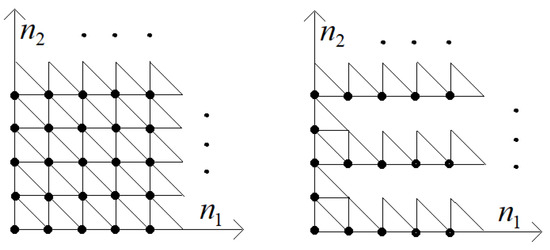
Figure 1.
Graph (left) and graph (right). Sets (left) and (right) are highlighted with bold dots.
Theorem 2.
Consider an open network, described by transient intensities (2). The equality holds, and the graph is connected. Removing a vertex from the set violates either the equality or the connectivity of the graph
Proof.
It is obvious that
Since the graph is connected and the edge connects graphs and for it follows that graph is also connected.
Let us check the fulfillment of the second statement of the theorem. First, let us consider the case of The following options are possible:
- If and then the graph does not contain a path between vertices and and, therefore, is disconnected. If then and therefore,
- If and then in the graph there is no path between the vertices and ; therefore, the graph is disconnected.
- If and then and therefore, If then the vertex is not connected to the vertex in the graph and therefore, the graph is disconnected.
Now, let us move on to the case of Checking conditions 1 and 2 when replacing with and with is similar. When checking condition 3, we assume If then it is not difficult to establish that If then there is no connection between the vertices and in the graph Theorem 2 has been proved. □
Define the set , and denote as the number of elements of the set
Theorem 3.
The ratio is fair:
Proof.
The number of vertices In turn, the number of vertices Hence follows Formula (7). Theorem 3 has been proved. □
3.2. Open Networks with a Limited Total Number of Customers
Consider an open network, the functioning of which is described by a discrete Markov process with a finite set of states
and transient intensities (2). Let us build a network with bans by defining a set of base vertices The set is maximal in the sense that adding the vertex results in the ratio We introduce a subset of the set of base vertices:
As an example (for the case of ), the graphs are constructed in Figure 2 and ; bold dots highlight the set of base vertices as well as its subset
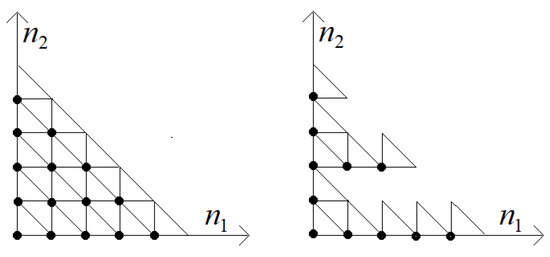
Figure 2.
Graph (left) and graph (right), Sets (left) and (right) are highlighted with bold dots.
Theorem 4.
The equality holds, and the graph is connected. Removing a vertex from the set violates either the equality or the connectivity of the graph
Proof.
The proof of Theorem 4 repeats almost verbatim the proof of Theorem 2. □
Theorem 5.
The ratio is fair:
Proof.
It follows from [17] that the number of solutions of the Diophantine equation that are non-negative integers is Then,
From Formula (9), we obtain the ratio Therefore, there are inequalities
From Formula (10), we have
In turn, for , the asymptotic estimates are valid:
Thus, the relation (8) is fulfilled from the inequality (11). Theorem 5 is proved. □
3.3. Closed Network
Consider a closed network (Gordon–Newell network) in which a constant number () of customers circulate among servers. The movement of customers in the network is described by the route matrix which is assumed to be indecomposable. Then, for any , the solution of the system’s balance ratio with condition exists and is unique.
The functioning of the network (the numbers of customers in nodes) is described by a discrete Markov process with a finite set of states
and transient intensities:
Let us define the set of all base vertices with the equality
The equalities (12) are rewritten for
Using the equalities (13), we define for the set
Consider the graph where with a set of vertices and a set of edges connecting them (the graphs and where do not have common edges). It is obvious that
Let As in the case of an open network, we can describe a closed network G with prohibitions by mapping the graph , which we denote as
Theorem 6.
If and the graph is connected, then the Markov process , describing the functioning of the network , is ergodic, and its stationary distribution where can be calculated using the formula
Proof.
The proof of this theorem is similar to the proof of Theorem 1. □
Let us construct so that the stationary distribution of the Markov process is preserved and the ratio for Due to Theorem 6, in order to preserve a stationary distribution in a closed network, it is sufficient to require the equality and the connectivity of the graph
To construct the set of base vertices , we compare each point of the set to the point and the set of such points is denoted by Then, to the set we match the set Let us now define
Then, we construct the set
Theorem 7.
The equality holds, and the graph is connected. Removing a vertex from the set violates either the equality or the connectivity of the graph
Proof.
By construction, there is a one-to-one correspondence between the sets and as well as between the set and the set . Therefore, the graphs and the graph are isomorphic. In turn, Theorem 4 implies that and that the graph is connected, and removing a vertex from the set violates at least one of these statements. The statement of the theorem is a consequence of the listed facts. Theorem 7 has been proved. □
Theorem 8.
The ratio is fair:
Proof.
Since
the statement of Theorem 5 implies the statement of Theorem 8. □
4. Discussion
The most difficult question in this problem is the question of which graphs of transient intensities may be extended to the constructions given in the paper and the corresponding theorems. Apparently, a relatively simple answer to this question may be obtained by combining already-constructed graphs, especially for the case of a limited number of applications on the network. There may also be cases when the set consists of integer rectangles, although this requires additional conditions.
5. Conclusions
In all the queuing models considered, the set of base vertices is based on the number of vertices and, therefore, on the number of edges in the graph of transient intensities, there is a subset of base vertices containing about half the total, . It was possible to build exponential queuing systems with prohibitions, even while maintaining a stationary distribution, by switching to a graph of transient intensities of a special type. This work began with a special case, namely, the case of for an open network or for a closed one.The proposed variants of the set are not the only ones. We plan to continue our work in this direction, summarizing the results obtained and extending them to queuing systems, the functioning of which is described by Markov processes.
The research was carried out within the state assignment for IAM FEB RAS N 075-00459-25-00.
Author Contributions
G.T. Conceptualization and methodology and formal analysis, M.O. validation. All authors have read and agreed to the published version of the manuscript.
Funding
This research received no external funding.
Data Availability Statement
Date is contained within the article.
Conflicts of Interest
The authors declare no conflicts of interest.
References
- Kvitko, K.B. Comparative analysis of international transport systems: Infrastructure, ratings, transport corridors. Transp. Syst. Technol. 2020, 6, 15–29. (In Russian) [Google Scholar] [CrossRef]
- Komov, M.S. Modern development trends and the importance of international transport corridors in the transport services market. Econ. Entrep. 2022, 6, 243–246. (In Russian) [Google Scholar]
- O’Hara, J. Toward a Commodity Enterprise Middleware: Can AMQP enable a new era in messaging middleware? A look inside standards-based messaging with AMQP. Queue 2007, 5, 48–55. [Google Scholar] [CrossRef]
- Gudehus, T.; Kotzab, H. Comprehensive Logistics; Springer Science and Business Media: Heidelberg, Germany, 2012. [Google Scholar]
- Konfino, K.V. Topical issues of development of international transport corridors and realization of transport potential of Russia. Labour Soc. Relat. J. 2019, 30, 101–108. [Google Scholar] [CrossRef]
- Vinoski, S. Advanced Message Queuing Protocol. IEEE Internet Comput. 2006, 10, 87–89. [Google Scholar] [CrossRef]
- Balsamo, S.; De Nitto, V. A survey of Product-form Queueing Networks with Blocking and their Equivalences. Ann. Oper. Res. 1994, 48, 31–61. [Google Scholar]
- Balsamo, S.; Clo, M.C. A Convolution Algorithm for Product-form Queueing Networks with Blocking. Ann. Oper. Res. 1998, 79, 97–117. [Google Scholar]
- Boucherie, R.J.; van Dijk, N.M. On the arrival theorem for product form queueing networks with blocking. Perform. Eval. 1997, 29, 155–176. [Google Scholar]
- Tsitsiashvili, G.S.; Osipova, M.A. New multiplicative theorems for queuing networks. Probl. Inf. Transm. 2005, 41, 111–122. (In Russian) [Google Scholar]
- Tsitsiashvili, G.S.; Osipova, M.A. Probabilistic distribution in queuing networks with variable structure. Probl. Inf. Transm. 2006, 42, 101–108. (In Russian) [Google Scholar]
- Jackson, J.R. Networks of Waiting Lines. Oper. Res. 1957, 5, 518–521. [Google Scholar] [CrossRef]
- Gordon, K.D.; Newell, G.F. Closed Queuing Systems with Exponential Servers. Oper. Res. 1967, 15, 254–265. [Google Scholar]
- Balbo1, G.; Marin, A.; Olliaro, D.; Sereno, M. Computational Algorithms for the Product Form Solution of Closed Queuing Networks with Finite Buffers and Skip-Over Policy. arXiv 2024, arXiv:2409.08075. [Google Scholar]
- Ivchenko, G.I.; Kashtanov, V.A.; Kovalenko, I.N. Theory of Queuing: A Textbook for Universities; Higher School: Moscow, Russia, 1982. (In Russian) [Google Scholar]
- Kovalenko, I.N.; Kuznetsov, N.Y.; Shurenkov, V.M. Random Processes; Naukova dumka: Kiev, Ukraine, 1983. (In Russian) [Google Scholar]
- Stillwell, J. Mathematics and Its History, 2nd ed.; Springer Science and Business Media Inc.: New York, NY, USA, 2004. [Google Scholar]
Disclaimer/Publisher’s Note: The statements, opinions and data contained in all publications are solely those of the individual author(s) and contributor(s) and not of MDPI and/or the editor(s). MDPI and/or the editor(s) disclaim responsibility for any injury to people or property resulting from any ideas, methods, instructions or products referred to in the content. |
© 2025 by the authors. Licensee MDPI, Basel, Switzerland. This article is an open access article distributed under the terms and conditions of the Creative Commons Attribution (CC BY) license (https://creativecommons.org/licenses/by/4.0/).