


Normalized Laplacian Diffusion for Robust Cancer Pathway Extension and Critical Gene Identification from Limited Data

Abstract
1. Introduction
2. Materials and Methods
2.1. Dataset Collections
2.1.1. Pathway Collections
2.1.2. Protein–Protein Interaction (PPI) Network Construction
2.2. Network-Based Approaches to Retrieve More Relevant Proteins
2.3. Pathway Enrichment Analysis
2.4. Survival Analysis
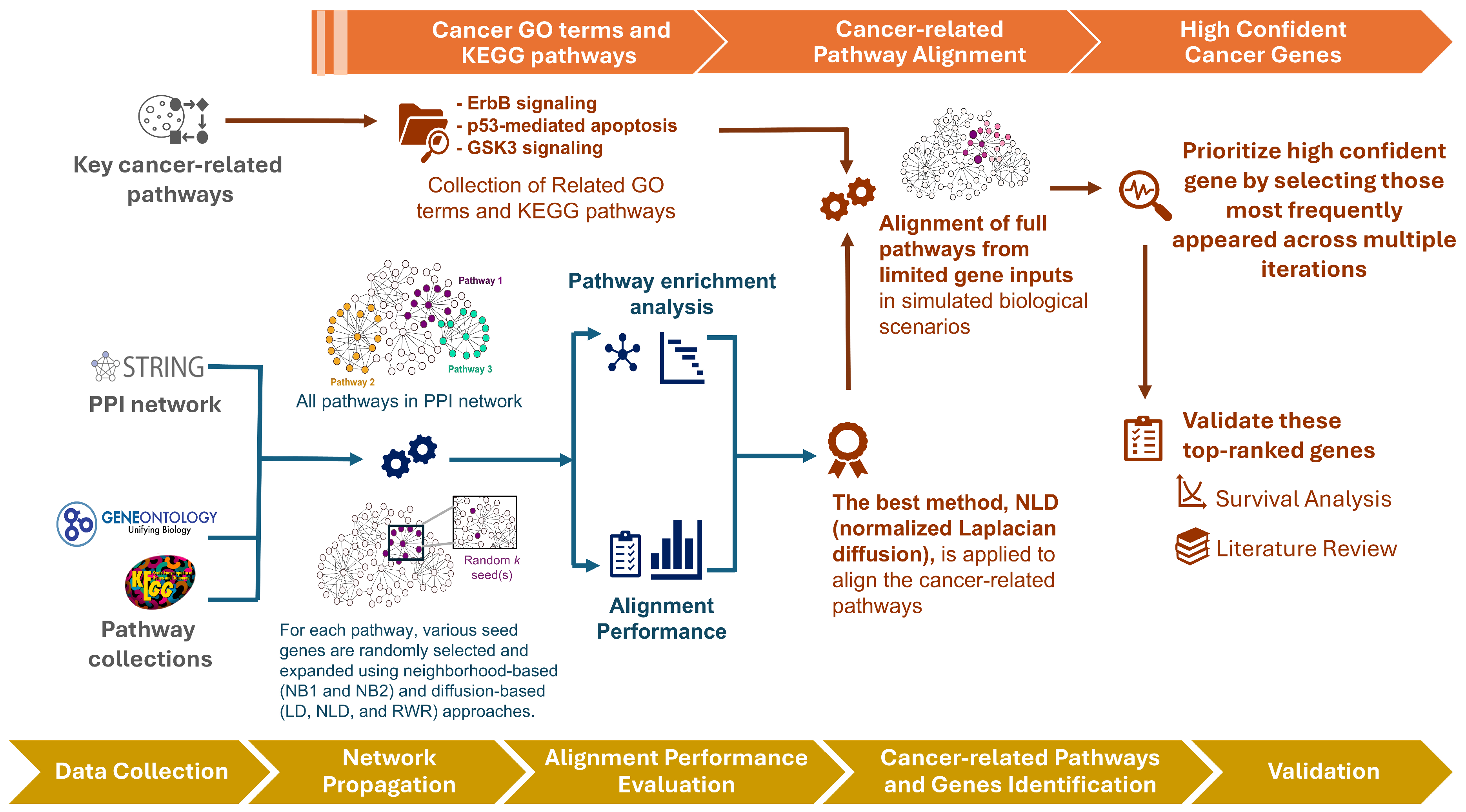
2.5. Methodology Framework to Evaluate Network Diffusion
2.5.1. Framework for Reconstruction of Pathway Membership from PPI Topology
| Algorithm 1: Alignment performance evaluation for each pathway |
 |
2.5.2. Framework for Pathway Enrichment Analysis and Novel Genes Validation in Cancer Biology
3. Results
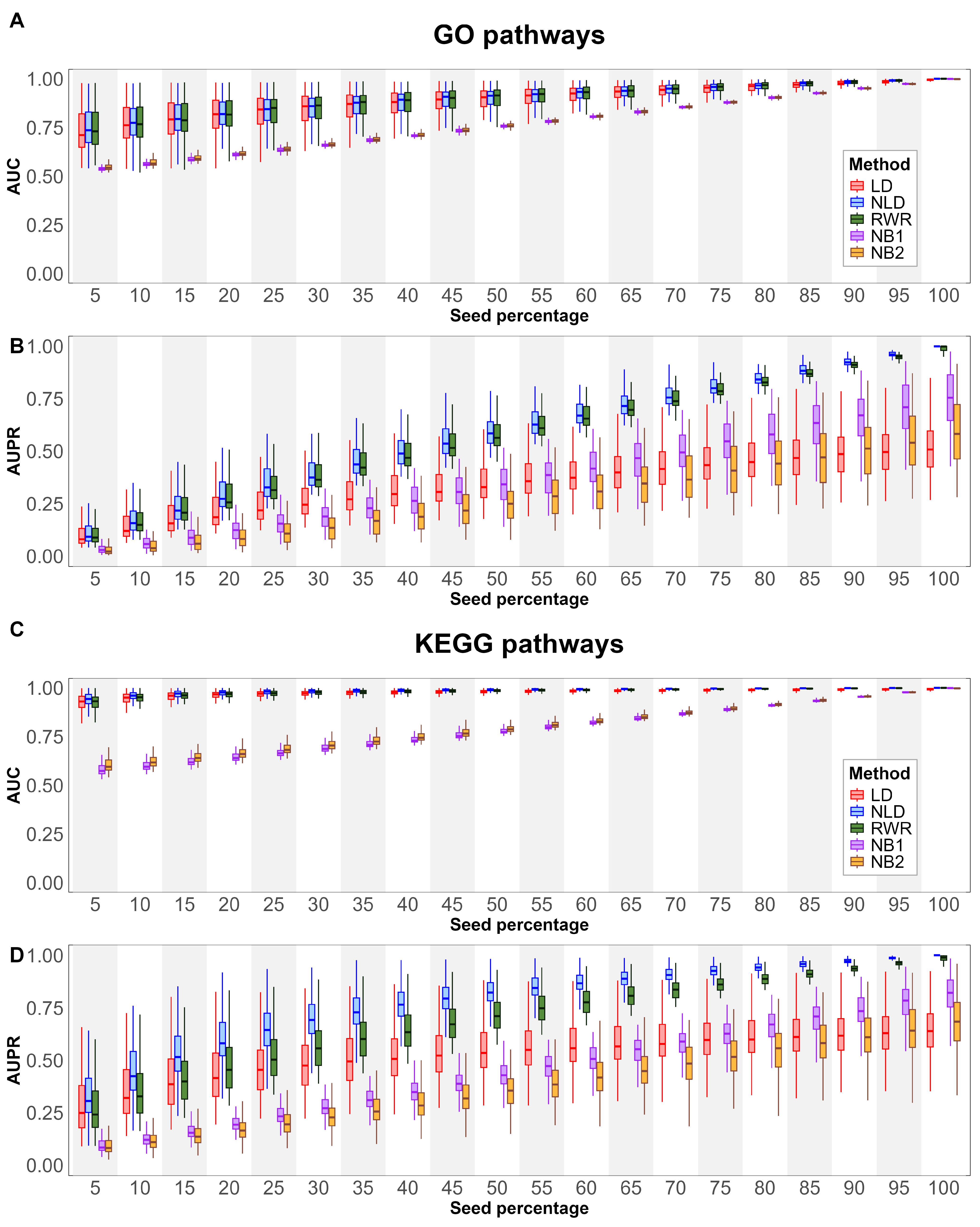
3.1. Assessment of Node Set Expansion Techniques Through Network Topology in PPI
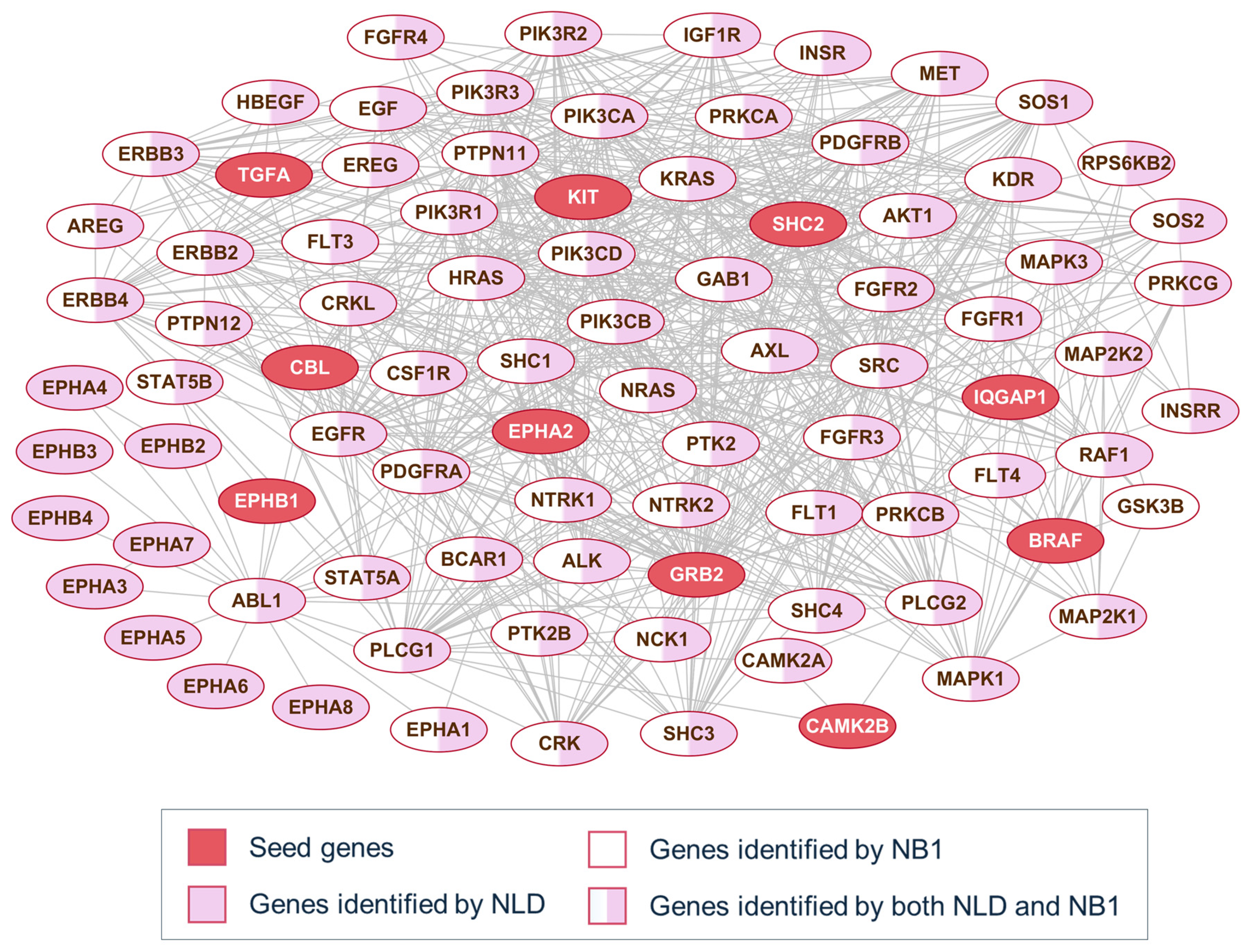
3.2. Cancer Pathway Prioritization Using a Small Set of Seed Genes
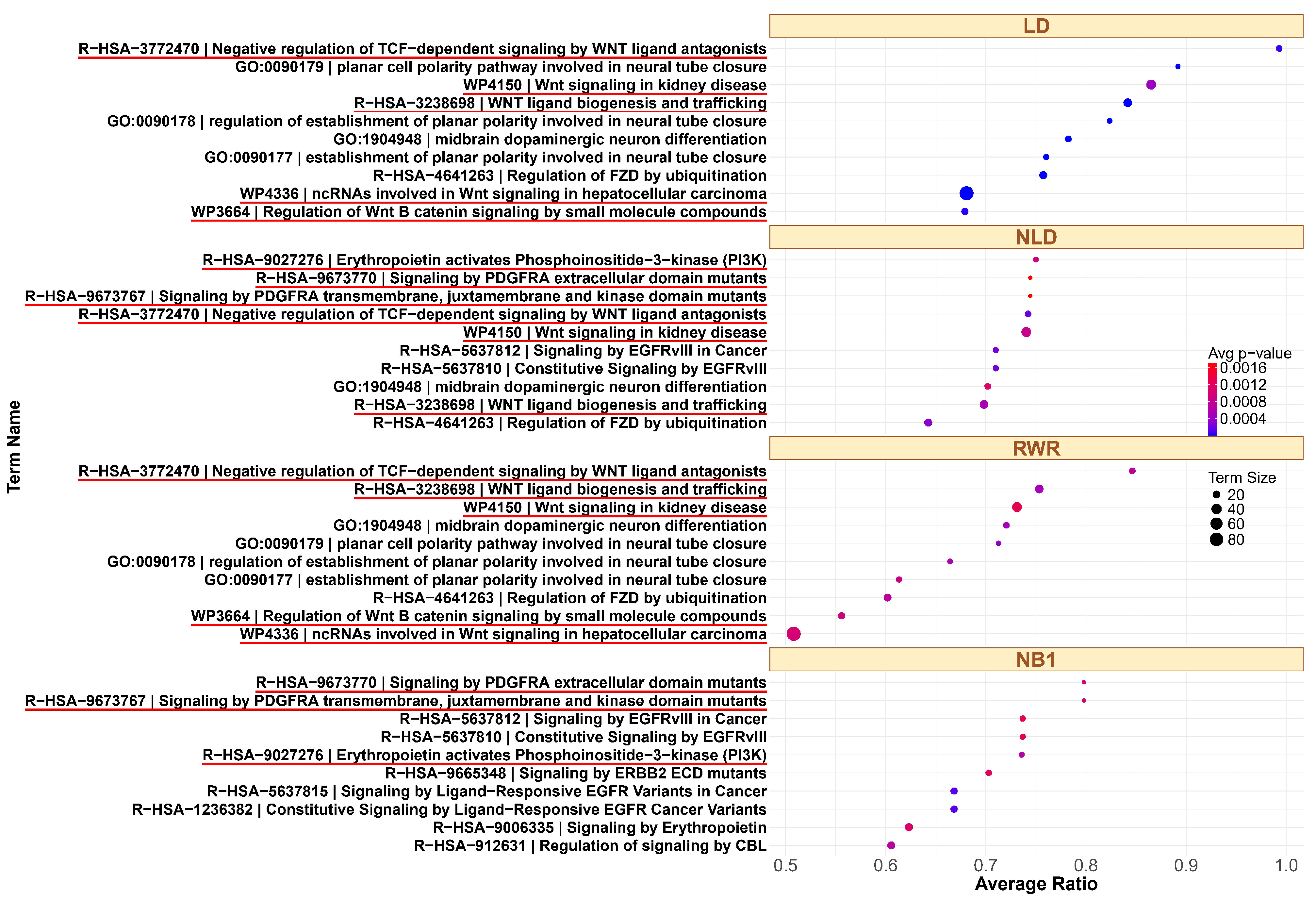
3.3. Top 10 Enriched Pathways and Their Biological Significance
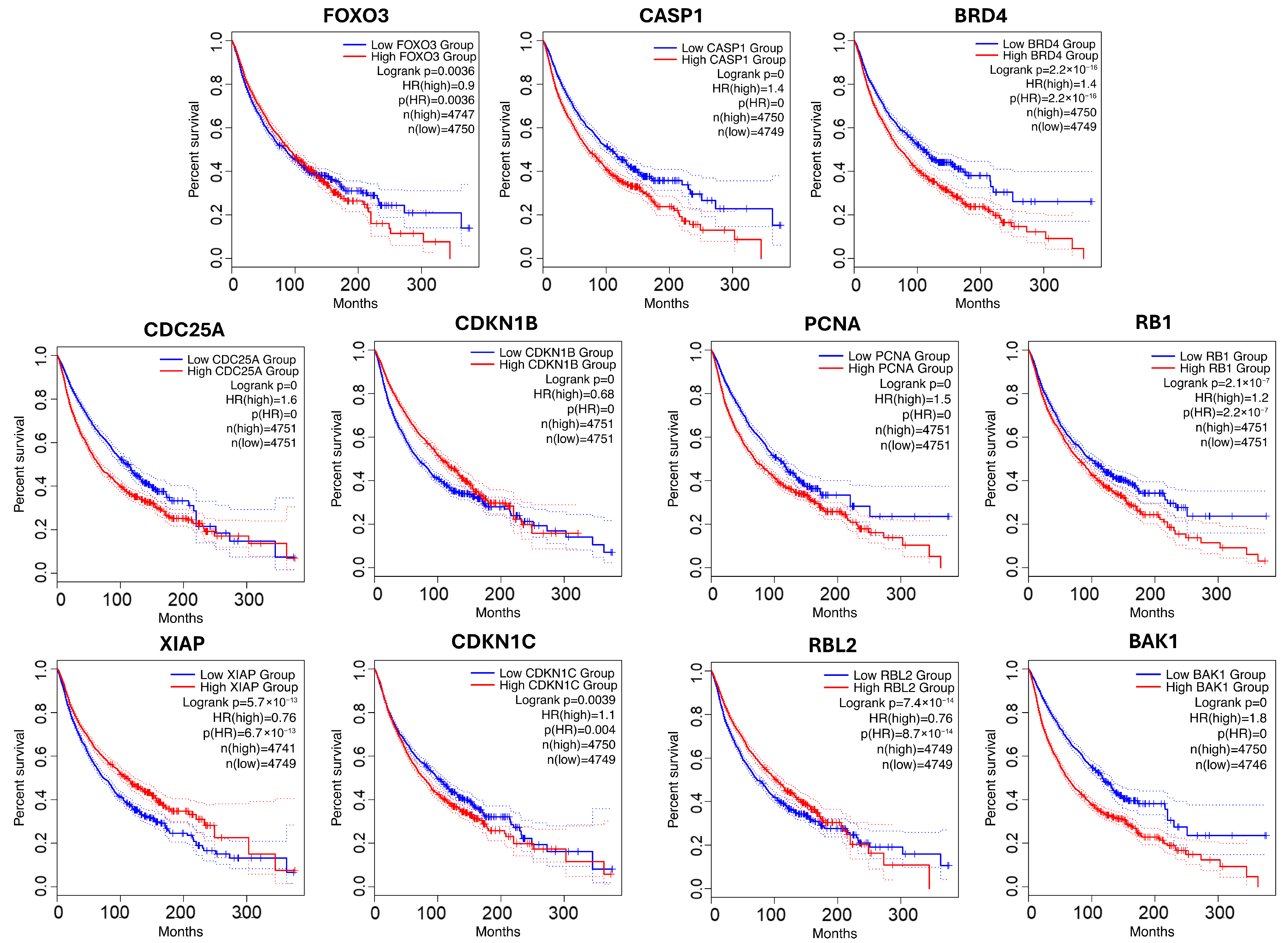
3.4. Survival Analysis and Biological Interpretation of Top-Ranked Genes
4. Discussion
5. Conclusions
Supplementary Materials
Author Contributions
Funding
Data Availability Statement
Acknowledgments
Conflicts of Interest
Abbreviations
| AUC | Area under the ROC curve |
| AUPR | Area under precision–recall curve |
| ErbB | Erythroblastic Leukemia Viral Oncogene Homolog |
| GO | Gene Ontology |
| HR | Hazard ratio |
| KEGG | Kyoto Encyclopedia of Genes and Genomes |
| LD | Laplacian kernel diffusion |
| NB1 | One-step neighborhood |
| NB2 | Two-steps neighborhood |
| NLD | Normalized Laplacian kernel diffusion |
| OS | Overall survival |
| PPI | Protein–protein interaction |
| RWR | Random walk with restart |
| TCGA | The Cancer Genome Atlas |
References
- Tsimberidou, A.M.; Fountzilas, E.; Bleris, L.; Kurzrock, R. Transcriptomics and solid tumors: The next frontier in precision cancer medicine. Semin. Cancer Biol. 2022, 84, 50–59. [Google Scholar] [CrossRef]
- Wang, L.; Pattnaik, A.; Sahoo, S.S.; Stone, E.G.; Zhuang, Y.; Benton, A.; Tajmul, M.; Chakravorty, S.; Dhawan, D.; Nguyen, M.A. Unbiased discovery of cancer pathways and therapeutics using Pathway Ensemble Tool and Benchmark. Nat. Commun. 2024, 15, 7288. [Google Scholar] [CrossRef]
- Borisov, N.; Sorokin, M.; Tkachev, V.; Garazha, A.; Buzdin, A. Cancer gene expression profiles associated with clinical outcomes to chemotherapy treatments. BMC Med. Genom. 2020, 13, 111. [Google Scholar] [CrossRef]
- Khatri, P.; Sirota, M.; Butte, A.J. Ten years of pathway analysis: Current approaches and outstanding challenges. PLoS Comput. Biol. 2012, 8, e1002375. [Google Scholar] [CrossRef]
- Reimand, J.; Isserlin, R.; Voisin, V.; Kucera, M.; Tannus-Lopes, C.; Rostamianfar, A.; Wadi, L.; Meyer, M.; Wong, J.; Xu, C. Pathway enrichment analysis and visualization of omics data using g: Profiler, GSEA, Cytoscape and EnrichmentMap. Nat. Protoc. 2019, 14, 482–517. [Google Scholar] [CrossRef]
- He, H.; Shao, X.; Li, Y.; Gihu, R.; Xie, H.; Zhou, J.; Yan, H. Targeting signaling pathway networks in several malignant tumors: Progresses and challenges. Front. Pharmacol. 2021, 12, 675675. [Google Scholar] [CrossRef]
- Wang, Z. ErbB receptors and cancer. Methods Mol. Biol. 2017, 1652, 3–35. [Google Scholar] [PubMed]
- Shojaie, A.; Michailidis, G. Analysis of gene sets based on the underlying regulatory network. J. Comput. Biol. 2009, 16, 407–426. [Google Scholar] [CrossRef] [PubMed]
- Shojaie, A.; Michailidis, G. Network enrichment analysis in complex experiments. Stat. Appl. Genet. Mol. Biol. 2010, 9, 22. [Google Scholar] [CrossRef] [PubMed][Green Version]
- Suratanee, A.; Plaimas, K. Heterogeneous network model to identify potential associations between plasmodium vivax and human proteins. Int. J. Mol. Sci. 2020, 21, 1310. [Google Scholar] [CrossRef]
- Suratanee, A.; Buaboocha, T.; Plaimas, K. Prediction of human-plasmodium vivax protein associations from heterogeneous network structures based on machine-learning approach. Bioinform. Biol. Insights 2021, 15, 11779322211013350. [Google Scholar] [CrossRef] [PubMed]
- Sevimoglu, T.; Arga, K.Y. The role of protein interaction networks in systems biomedicine. Comput. Struct. Biotechnol. J. 2014, 11, 22–27. [Google Scholar] [CrossRef] [PubMed]
- Liu, L.; Ruan, J. Network-based pathway enrichment analysis. In Proceedings of the 2013 IEEE International Conference on Bioinformatics and Biomedicine, Shanghai, China, 18–21 December 2013; pp. 218–221. [Google Scholar]
- Liu, L.; Wei, J.; Ruan, J. Pathway enrichment analysis with networks. Genes 2017, 8, 246. [Google Scholar] [CrossRef] [PubMed]
- Ran, J.; Li, H.; Fu, J.; Liu, L.; Xing, Y.; Li, X.; Shen, H.; Chen, Y.; Jiang, X.; Li, Y. Construction and analysis of the protein-protein interaction network related to essential hypertension. BMC Syst. Biol. 2013, 7, 32. [Google Scholar] [CrossRef] [PubMed]
- Handen, A.; Ganapathiraju, M.K. LENS: Web-based lens for enrichment and network studies of human proteins. BMC Med. Genom. 2015, 4 (Suppl. 4), S2. [Google Scholar] [CrossRef]
- Chi, L.; Ma, J.; Wan, Y.; Deng, Y.; Wu, Y.; Cen, X.; Zhou, X.; Zhao, X.; Wang, Y.; Ji, Z. HGNNPIP: A Hybrid Graph Neural Network framework for Protein-protein Interaction Prediction. bioRxiv 2023. [Google Scholar] [CrossRef]
- Janyasupab, P.; Singhanat, K.; Warnnissorn, M.; Thuwajit, P.; Suratanee, A.; Plaimas, K.; Thuwajit, C. Identification of Tumor Budding-Associated Genes in Breast Cancer through Transcriptomic Profiling and Network Diffusion Analysis. Biomolecules 2024, 14, 896. [Google Scholar] [CrossRef]
- Sagulkoo, P.; Suratanee, A.; Plaimas, K. Immune-related protein interaction network in severe COVID-19 patients toward the identification of key proteins and drug repurposing. Biomolecules 2022, 12, 690. [Google Scholar] [CrossRef]
- Wang, P.I.; Hwang, S.; Kincaid, R.P.; Sullivan, C.S.; Lee, I.; Marcotte, E.M. RIDDLE: Reflective diffusion and local extension reveal functional associations for unannotated gene sets via proximity in a gene network. Genome Biol. 2012, 13, R125. [Google Scholar] [CrossRef]
- Lovász, L. Random walks on graphs. In Combinatorics, Paul Erdos is Eighty; János Bolyai Mathematical Society: Budapest, Hungary, 1993; Volume 2, p. 4. [Google Scholar]
- Pan, J.-Y.; Yang, H.-J.; Faloutsos, C.; Duygulu, P. Automatic multimedia cross-modal correlation discovery. In Proceedings of the tenth ACM SIGKDD International Conference on Knowledge Discovery and Data Mining, Seattle, WA, USA, 22–25 August 2004; pp. 653–658. [Google Scholar]
- Suratanee, A.; Plaimas, K. DDA: A novel network-based scoring method to identify disease-disease associations. Bioinform. Biol. Insights 2015, 9, 175–186. [Google Scholar] [CrossRef]
- Tangmanussukum, P.; Kawichai, T.; Suratanee, A.; Plaimas, K. Heterogeneous network propagation with forward similarity integration to enhance drug–target association prediction. PeerJ Comput. Sci. 2022, 8, e1124. [Google Scholar] [CrossRef] [PubMed]
- Valdeolivas, A.; Tichit, L.; Navarro, C.; Perrin, S.; Odelin, G.; Levy, N.; Cau, P.; Remy, E.; Baudot, A. Random walk with restart on multiplex and heterogeneous biological networks. Bioinformatics 2019, 35, 497–505. [Google Scholar] [CrossRef]
- Smola, A.J.; Kondor, R. Kernels and regularization on graphs. In Learning Theory and Kernel Machines, Proceedings of the 16th Annual Conference on Learning Theory and 7th Kernel Workshop, COLT/Kernel 2003, Washington, DC, USA, 24–27 August 2003; Springer: Berlin/Heidelberg, Germany, 2003; pp. 144–158. [Google Scholar]
- Hein, M.; Audibert, J.-Y.; von Luxburg, U. Graph laplacians and their convergence on random neighborhood graphs. J. Mach. Learn. Res. 2007, 8, 1325–1368. [Google Scholar]
- Janyasupab, P.; Suratanee, A.; Plaimas, K. Network diffusion with centrality measures to identify disease-related genes. Math. Biosci. Eng. 2021, 18, 2909–2929. [Google Scholar] [CrossRef]
- Picart-Armada, S.; Barrett, S.J.; Willé, D.R.; Perera-Lluna, A.; Gutteridge, A.; Dessailly, B.H. Benchmarking network propagation methods for disease gene identification. PLoS Comput. Biol. 2019, 15, e1007276. [Google Scholar] [CrossRef] [PubMed]
- Sagulkoo, P.; Suratanee, A.; Plaimas, K. Network-based methods with heterogeneous data to identify severe COVID immune-related genes. In Proceedings of the 2022 26th International Computer Science and Engineering Conference (ICSEC), Sakon Nakhon, Thailand, 21–23 December 2022; pp. 334–339. [Google Scholar]
- Xie, M.; Hwang, T.; Kuang, R. Prioritizing disease genes by bi-random walk. In Proceedings of the Pacific-Asia Conference on Knowledge Discovery and Data Mining, Kuala Lumpur, Malaysia, 29 May–1 June 2012; pp. 292–303. [Google Scholar]
- Cowen, L.; Ideker, T.; Raphael, B.J.; Sharan, R. Network propagation: A universal amplifier of genetic associations. Nat. Rev. Genet. 2017, 18, 551–562. [Google Scholar] [CrossRef] [PubMed]
- Aleksander, S.A.; Balhoff, J.; Carbon, S.; Cherry, J.M.; Drabkin, H.J.; Ebert, D.; Feuermann, M.; Gaudet, P.; Harris, N.L. The gene ontology knowledgebase in 2023. Genetics 2023, 224, iyad031. [Google Scholar] [CrossRef]
- Kanehisa, M.; Furumichi, M.; Sato, Y.; Kawashima, M.; Ishiguro-Watanabe, M. KEGG for taxonomy-based analysis of pathways and genomes. Nucleic Acids Res. 2023, 51, D587–D592. [Google Scholar] [CrossRef]
- Consortium, G.O. The Gene Ontology (GO) database and informatics resource. Nucleic Acids Res. 2004, 32, D258–D261. [Google Scholar] [CrossRef]
- Pagès, H.; Carlson, M.; Falcon, S.; Li, N. AnnotationDbi: Manipulation of SQLite-Based Annotations in Bioconductor, R Package Version 1.1; Bioconductor. 2021. Available online: https://bioconductor.org/packages/release/bioc/html/AnnotationDbi.html (accessed on 1 October 2025). [CrossRef]
- Carlson, M.; Falcon, S.; Pages, H.; Li, N. org. Hs. eg. db: Genome Wide Annotation for Human, R Package Version 3.2; Bioconductor. 2019. Available online: https://bioconductor.org/packages/release/data/annotation/html/org.Hs.eg.db.html (accessed on 1 October 2025). [CrossRef]
- Carlson, M.; Falcon, S.; Pages, H.; Li, N. GO.db: A Set of Annotation Maps Describing the Entire Gene Ontology. Bioconductor. 2019, 3. Available online: https://bioconductor.org/packages/release/data/annotation/html/GO.db.html (accessed on 1 October 2025). [CrossRef]
- Manjang, K.; Tripathi, S.; Yli-Harja, O.; Dehmer, M.; Emmert-Streib, F. Graph-based exploitation of gene ontology using GOxploreR for scrutinizing biological significance. Sci. Rep. 2020, 10, 16672. [Google Scholar] [CrossRef]
- Kanehisa, M.; Furumichi, M.; Tanabe, M.; Sato, Y.; Morishima, K. KEGG: New perspectives on genomes, pathways, diseases and drugs. Nucleic Acids Res. 2017, 45, D353–D361. [Google Scholar] [CrossRef] [PubMed]
- Tenenbaum, D.; Maintainer, B. KEGGREST: Client-Side REST Access to the Kyoto Encyclopedia of Genes and Genomes (KEGG), R Package Version 1.36.0; Bioconductor. 2021. Available online: https://bioconductor.org/packages/release/bioc/html/KEGGREST.html (accessed on 1 October 2025). [CrossRef]
- Chandraprasad, M.S.; Dey, A.; Swamy, M.K. Introduction to cancer and treatment approaches. In Paclitaxel; Elsevier: Amsterdam, The Netherlands, 2022; pp. 1–27. [Google Scholar]
- Szklarczyk, D.; Kirsch, R.; Koutrouli, M.; Nastou, K.; Mehryary, F.; Hachilif, R.; Gable, A.L.; Fang, T.; Doncheva, N.T.; Pyysalo, S. The STRING database in 2023: Protein–protein association networks and functional enrichment analyses for any sequenced genome of interest. Nucleic Acids Res. 2023, 51, D638–D646. [Google Scholar] [CrossRef]
- Banerjee, A.; Jost, J. On the spectrum of the normalized graph Laplacian. Linear Algebra Its Appl. 2008, 428, 3015–3022. [Google Scholar] [CrossRef]
- Zhang, Y.; Shen, J.; Zhang, R.; Zhao, Z. Network representation learning via improved random walk with restart. Knowl. Based Syst. 2023, 263, 110255. [Google Scholar] [CrossRef]
- Kolberg, L.; Raudvere, U.; Kuzmin, I.; Adler, P.; Vilo, J.; Peterson, H. g: Profiler—Interoperable web service for functional enrichment analysis and gene identifier mapping (2023 update). Nucleic Acids Res. 2023, 51, W207–W212. [Google Scholar] [CrossRef] [PubMed]
- Milacic, M.; Beavers, D.; Conley, P.; Gong, C.; Gillespie, M.; Griss, J.; Haw, R.; Jassal, B.; Matthews, L.; May, B. The reactome pathway knowledgebase 2024. Nucleic Acids Res. 2024, 52, D672–D678. [Google Scholar] [CrossRef]
- Agrawal, A.; Balcı, H.; Hanspers, K.; Coort, S.L.; Martens, M.; Slenter, D.N.; Ehrhart, F.; Digles, D.; Waagmeester, A.; Wassink, I. WikiPathways 2024: Next generation pathway database. Nucleic Acids Res. 2024, 52, D679–D689. [Google Scholar] [CrossRef]
- Tang, Z.; Kang, B.; Li, C.; Chen, T.; Zhang, Z. GEPIA2: An enhanced web server for large-scale expression profiling and interactive analysis. Nucleic Acids Res. 2019, 47, W556–W560. [Google Scholar] [CrossRef] [PubMed]
- Weinstein, J.N.; Collisson, E.A.; Mills, G.B.; Shaw, K.R.; Ozenberger, B.A.; Ellrott, K.; Shmulevich, I.; Sander, C.; Stuart, J.M. The cancer genome atlas pan-cancer analysis project. Nat. Genet. 2013, 45, 1113–1120. [Google Scholar] [CrossRef]
- Voskas, D.; Ling, L.S.; Woodgett, J.R. Does GSK-3 provide a shortcut for PI3K activation of Wnt signalling? F1000 Biol. Rep. 2010, 2. [Google Scholar] [CrossRef]
- de Villenfagne, L.; Sablon, A.; Demoulin, J.-B. PDGFRA K385 mutants in myxoid glioneuronal tumors promote receptor dimerization and oncogenic signaling. Sci. Rep. 2024, 14, 7204. [Google Scholar] [CrossRef]
- Yu, J.; Zhang, L. PUMA, a potent killer with or without p53. Oncogene 2008, 27, S71–S83. [Google Scholar] [CrossRef] [PubMed]
- Sosa, M.S.; Lopez-Haber, C.; Yang, C.; Wang, H.; Lemmon, M.A.; Busillo, J.M.; Luo, J.; Benovic, J.L.; Klein-Szanto, A.; Yagi, H. Identification of the Rac-GEF P-Rex1 as an essential mediator of ErbB signaling in breast cancer. Mol. Cell 2010, 40, 877–892. [Google Scholar] [CrossRef]
- Goc, A.; Al-Husein, B.; Katsanevas, K.; Steinbach, A.; Lou, U.; Sabbineni, H.; DeRemer, D.L.; Somanath, P.R. Targeting Src-mediated Tyr216 phosphorylation and activation of GSK-3 in prostate cancer cells inhibit prostate cancer progression in vitro and in vivo. Oncotarget 2014, 5, 775. [Google Scholar] [CrossRef] [PubMed]
- McCubrey, J.A.; Steelman, L.S.; Bertrand, F.E.; Davis, N.M.; Sokolosky, M.; Abrams, S.L.; Montalto, G.; D’Assoro, A.B.; Libra, M.; Nicoletti, F. GSK-3 as potential target for therapeutic intervention in cancer. Oncotarget 2014, 5, 2881. [Google Scholar] [CrossRef]
- Ballou, L.M.; Chattopadhyay, M.; Li, Y.; Scarlata, S.; Lin, R.Z. Gαq binds to p110α/p85α phosphoinositide 3-kinase and displaces Ras. Biochem. J. 2006, 394, 557–562. [Google Scholar] [CrossRef]
- Fan, G.; Ballou, L.M.; Lin, R.Z. Phospholipase C-independent activation of glycogen synthase kinase-3β and C-terminal Src kinase by Gαq. J. Biol. Chem. 2003, 278, 52432–52436. [Google Scholar] [CrossRef]
- Alves, M.; Borges, D.d.P.; Kimberly, A.; Martins Neto, F.; Oliveira, A.C.; Sousa, J.C.d.; Nogueira, C.D.; Carneiro, B.A.; Tavora, F. Glycogen Synthase Kinase-3 Beta Expression Correlates with Worse Overall Survival in Non-Small Cell Lung Cancer—A Clinicopathological Series. Front. Oncol. 2021, 11, 621050. [Google Scholar] [CrossRef]
- Moore, S.F.; van den Bosch, M.T.; Hunter, R.W.; Sakamoto, K.; Poole, A.W.; Hers, I. Dual regulation of glycogen synthase kinase 3 (GSK3) α/β by protein kinase C (PKC) α and Akt promotes thrombin-mediated integrin αIIbβ3 activation and granule secretion in platelets. J. Biol. Chem. 2013, 288, 3918–3928. [Google Scholar] [CrossRef]
- Ahmed, Z. The GSK3β pathway in optic nerve regeneration. Arch. Clin. Exp. Ophthalmol. 2020, 2, 10–16. [Google Scholar] [CrossRef]
- Bloedjes, T.A.; de Wilde, G.; Maas, C.; Eldering, E.; Bende, R.J.; van Noesel, C.J.; Pals, S.T.; Spaargaren, M.; Guikema, J.E. AKT signaling restrains tumor suppressive functions of FOXO transcription factors and GSK3 kinase in multiple myeloma. Blood Adv. 2020, 4, 4151–4164. [Google Scholar] [CrossRef]
- Wang, W.; Lu, G.; Su, X.; Tang, C.; Li, H.; Xiong, Z.; Leung, C.-K.; Wong, M.-S.; Liu, H.; Ma, J.-L. Pten-mediated Gsk3β modulates the naïve pluripotency maintenance in embryonic stem cells. Cell Death Dis. 2020, 11, 107. [Google Scholar] [CrossRef] [PubMed]
- Song, H.H.; Shi, W.; Xiang, Y.-Y.; Filmus, J. The loss of glypican-3 induces alterations in Wnt signaling. J. Biol. Chem. 2005, 280, 2116–2125. [Google Scholar] [CrossRef]
- Grisouard, J.; Medunjanin, S.; Hermani, A.; Shukla, A.; Mayer, D. Glycogen synthase kinase-3 protects estrogen receptor α from proteasomal degradation and is required for full transcriptional activity of the receptor. Mol. Endocrinol. 2007, 21, 2427–2439. [Google Scholar] [CrossRef] [PubMed]
- Medunjanin, S.; Hermani, A.; De Servi, B.; Grisouard, J.; Rincke, G.; Mayer, D. Glycogen synthase kinase-3 interacts with and phosphorylates estrogen receptor α and is involved in the regulation of receptor activity. J. Biol. Chem. 2005, 280, 33006–33014. [Google Scholar] [CrossRef]
- Renault, V.M.; Thekkat, P.U.; Hoang, K.L.; White, J.L.; Brady, C.A.; Kenzelmann Broz, D.; Venturelli, O.S.; Johnson, T.M.; Oskoui, P.R.; Xuan, Z. The pro-longevity gene FoxO3 is a direct target of the p53 tumor suppressor. Oncogene 2011, 30, 3207–3221. [Google Scholar] [CrossRef]
- Tsuchiya, K.; Nakajima, S.; Hosojima, S.; Thi Nguyen, D.; Hattori, T.; Manh Le, T.; Hori, O.; Mahib, M.R.; Yamaguchi, Y.; Miura, M. Caspase-1 initiates apoptosis in the absence of gasdermin D. Nat. Commun. 2019, 10, 2091. [Google Scholar] [CrossRef]
- Pan, H.; Yin, C.; Dyson, N.J.; Harlow, E.; Yamasaki, L.; Van Dyke, T. Key roles for E2F1 in signaling p53-dependent apoptosis and in cell division within developing tumors. Mol. Cell 1998, 2, 283–292. [Google Scholar] [CrossRef]
- Feroz, W.; Sheikh, A.M.A. Exploring the multiple roles of guardian of the genome: P53. Egypt. J. Med. Hum. Genet. 2020, 21, 49. [Google Scholar] [CrossRef]
- Chipuk, J.; Green, D. Dissecting p53-dependent apoptosis. Cell Death Differ. 2006, 13, 994–1002. [Google Scholar] [CrossRef] [PubMed]
- Hu, J.; Pan, D.; Li, G.; Chen, K.; Hu, X. Regulation of programmed cell death by Brd4. Cell Death Dis. 2022, 13, 1059. [Google Scholar] [CrossRef]
- Sherr, C.J.; Roberts, J.M. CDK inhibitors: Positive and negative regulators of G1-phase progression. Genes. Dev. 1999, 13, 1501–1512. [Google Scholar] [CrossRef]
- López-Nieva, P.; Fernández-Navarro, P.; Vaquero-Lorenzo, C.; Villa-Morales, M.; Graña-Castro, O.; Cobos-Fernández, M.Á.; López-Lorenzo, J.L.; Llamas, P.; González-Sanchez, L.; Sastre, I. RNA-Seq reveals the existence of a CDKN1C-E2F1-TP53 axis that is altered in human T-cell lymphoblastic lymphomas. BMC Cancer 2018, 18, 430. [Google Scholar] [CrossRef]
- Xu, J.; Morris, G.F. p53-mediated regulation of proliferating cell nuclear antigen expression in cells exposed to ionizing radiation. Mol. Cell. Biol. 1999, 19, 12–20. [Google Scholar] [CrossRef]
- Sørensen, C.S.; Syljuåsen, R.G.; Lukas, J.; Bartek, J. ATR, Claspin and the Rad9-Rad1-Hus1 complex regulate Chk1 and Cdc25A in the absence of DNA damage. Cell Cycle 2004, 3, 939–943. [Google Scholar] [CrossRef]
- Rother, K.; Kirschner, R.; Sänger, K.; Böhlig, L.; Mössner, J.; Engeland, K. p53 downregulates expression of the G1/S cell cycle phosphatase Cdc25A. Oncogene 2007, 26, 1949–1953. [Google Scholar] [CrossRef]
- Duan, L.; Perez, R.E.; Calhoun, S.; Maki, C.G. RBL2/DREAM-mediated repression of the Aurora kinase A/B pathway determines therapy responsiveness and outcome in p53 WT NSCLC. Sci. Rep. 2022, 12, 1049. [Google Scholar] [CrossRef]
- Engeland, K. Cell cycle regulation: p53-p21-RB signaling. Cell Death Differ. 2022, 29, 946–960. [Google Scholar] [CrossRef] [PubMed]
- Abbas, R.; Hartmann, O.; Asiss, D.T.; Abbas, R.; Kagan, J.; Kim, H.-T.; Oren, M.; Diefenbacher, M.; Orian, A.; Larisch, S. ARTS and small-molecule ARTS mimetics upregulate p53 levels by promoting the degradation of XIAP. Apoptosis 2024, 29, 1145–1160. [Google Scholar] [CrossRef] [PubMed]
- Carter, B.Z.; Mak, D.H.; Schober, W.D.; Koller, E.; Pinilla, C.; Vassilev, L.T.; Reed, J.C.; Andreeff, M. Simultaneous activation of p53 and inhibition of XIAP enhance the activation of apoptosis signaling pathways in AML. Blood J. Am. Soc. Hematol. 2010, 115, 306–314. [Google Scholar] [CrossRef] [PubMed]
- Ieguchi, K.; Fujita, M.; Ma, Z.; Davari, P.; Taniguchi, Y.; Sekiguchi, K.; Wang, B.; Takada, Y.K.; Takada, Y. Direct binding of the EGF-like domain of neuregulin-1 to integrins (αvβ3 and α6β4) is involved in neuregulin-1/ErbB signaling. J. Biol. Chem. 2010, 285, 31388–31398. [Google Scholar] [CrossRef] [PubMed]
- Zhang, H.; Berezov, A.; Wang, Q.; Zhang, G.; Drebin, J.; Murali, R.; Greene, M.I. ErbB receptors: From oncogenes to targeted cancer therapies. J. Clin. Investig. 2007, 117, 2051–2058. [Google Scholar] [CrossRef]
- Lee, Y.; Ma, J.; Lyu, H.; Huang, J.; Kim, A.; Liu, B. Role of erbB3 receptors in cancer therapeutic resistance. Acta Biochim Biophys Sin 2014, 46, 190–198. [Google Scholar] [CrossRef]
- Song, X.; Fan, P.-D.; Bantikassegn, A.; Guha, U.; Threadgill, D.W.; Varmus, H.; Politi, K. ERBB3-independent activation of the PI3K pathway in EGFR-mutant lung adenocarcinomas. Cancer Res. 2015, 75, 1035–1045. [Google Scholar] [CrossRef]
- Li, X.; Mak, V.C.; Zhou, Y.; Wang, C.; Wong, E.S.; Sharma, R.; Lu, Y.; Cheung, A.N.; Mills, G.B.; Cheung, L.W. Deregulated Gab2 phosphorylation mediates aberrant AKT and STAT3 signaling upon PIK3R1 loss in ovarian cancer. Nat. Commun. 2019, 10, 716. [Google Scholar] [CrossRef] [PubMed]
- Law, A.J.; Wang, Y.; Sei, Y.; O’Donnell, P.; Piantadosi, P.; Papaleo, F.; Straub, R.E.; Huang, W.; Thomas, C.J.; Vakkalanka, R. Neuregulin 1-ErbB4-PI3K signaling in schizophrenia and phosphoinositide 3-kinase-p110δ inhibition as a potential therapeutic strategy. Proc. Natl. Acad. Sci. USA 2012, 109, 12165–12170. [Google Scholar] [CrossRef] [PubMed]
- Shorning, B.Y.; Dass, M.S.; Smalley, M.J.; Pearson, H.B. The PI3K-AKT-mTOR pathway and prostate cancer: At the crossroads of AR, MAPK, and WNT signaling. Int. J. Mol. Sci. 2020, 21, 4507. [Google Scholar] [CrossRef]
- Huang, R.; Dai, Q.; Yang, R.; Duan, Y.; Zhao, Q.; Haybaeck, J.; Yang, Z. A review: PI3K/AKT/mTOR signaling pathway and its regulated eukaryotic translation initiation factors may be a potential therapeutic target in esophageal squamous cell carcinoma. Front. Oncol. 2022, 12, 817916. [Google Scholar] [CrossRef] [PubMed]
- Yuan, T.; Cantley, L. PI3K pathway alterations in cancer: Variations on a theme. Oncogene 2008, 27, 5497–5510. [Google Scholar] [CrossRef]
- Yu, M.; Grady, W.M. Therapeutic targeting of the phosphatidylinositol 3-kinase signaling pathway: Novel targeted therapies and advances in the treatment of colorectal cancer. Therap. Adv. Gastroenterol. 2012, 5, 319–337. [Google Scholar] [CrossRef]
- Zhang, Y.; Xiong, X.; Zhu, Q.; Zhang, J.; Chen, S.; Wang, Y.; Cao, J.; Chen, L.; Hou, L.; Zhao, X. FER-mediated phosphorylation and PIK3R2 recruitment on IRS4 promotes AKT activation and tumorigenesis in ovarian cancer cells. eLife 2022, 11, e76183. [Google Scholar] [CrossRef]
- Mohamadzade, Z.; Soltani, B.M.; Ghaemi, Z.; Hoseinpour, P. Cell specific tumor suppressor effect of Hsa-miR-1226-3p through downregulation of HER2, PIK3R2, and AKT1 genes. Int. J. Biochem. Cell Biol. 2021, 134, 105965. [Google Scholar] [CrossRef]
- Gao, Y.; Yuan, C.Y.; Yuan, W. Will targeting PI3K/Akt/mTOR signaling work in hematopoietic malignancies? Stem Cell Investig. 2016, 3, 31. [Google Scholar] [CrossRef]
- Lin, W.; Wang, K.; Mo, J.; Wang, L.; Song, Z.; Jiang, H.; Wang, C.; Jin, C. PIK3R3 is upregulated in liver cancer and activates Akt signaling to control cancer growth by regulation of CDKN1C and SMC1A. Cancer Med. 2023, 12, 14413–14425. [Google Scholar] [CrossRef]
- Farhadi, P.; Park, T. The p130Cas-Crk/CrkL Axis: A Therapeutic Target for Invasive Cancers Unveiled by Collaboration Among p130Cas, Crk, and CrkL. Int. J. Mol. Sci. 2025, 26, 4017. [Google Scholar] [CrossRef] [PubMed]
- Tsuda, M.; Tanaka, S. Roles for crk in cancer metastasis and invasion. Genes Cancer 2012, 3, 334–340. [Google Scholar] [CrossRef] [PubMed]
- Knickelbein, K.; Zhang, L. Mutant KRAS as a critical determinant of the therapeutic response of colorectal cancer. Genes Dis. 2015, 2, 4–12. [Google Scholar] [CrossRef] [PubMed]
- Burotto, M.; Chiou, V.L.; Lee, J.M.; Kohn, E.C. The MAPK pathway across different malignancies: A new perspective. Cancer 2014, 120, 3446–3456. [Google Scholar] [CrossRef]
- Maruyama, K.; Shimizu, Y.; Nomura, Y.; Oh-Hara, T.; Takahashi, Y.; Nagayama, S.; Fujita, N.; Katayama, R. Mechanisms of KRAS inhibitor resistance in KRAS-mutant colorectal cancer harboring Her2 amplification and aberrant KRAS localization. NPJ Precis. Oncol. 2025, 9, 4. [Google Scholar] [CrossRef]
- Lucs, A.V.; Muller, W.J.; Muthuswamy, S.K. Shc is required for ErbB2-induced inhibition of apoptosis but is dispensable for cell proliferation and disruption of cell polarity. Oncogene 2010, 29, 174–187. [Google Scholar] [CrossRef]
- Olayioye, M.A. Intracellular signaling pathways of ErbB2/HER-2 and family members. Breast Cancer Res. 2001, 3, 1–5. [Google Scholar] [CrossRef]
- Chen, W.; Martindale, J.L.; Holbrook, N.J.; Liu, Y. Tumor promoter arsenite activates extracellular signal-regulated kinase through a signaling pathway mediated by epidermal growth factor receptor and Shc. Mol. Cell. Biol. 1998, 18, 5178–5188. [Google Scholar] [CrossRef] [PubMed]
- Wilsbacher, J.L.; Zhang, Q.; Tucker, L.A.; Hubbard, R.D.; Sheppard, G.S.; Bamaung, N.Y.; Fidanze, S.D.; Wang, G.T.; Hu, X.; Davidsen, S.K. Insulin-like growth factor-1 receptor and ErbB kinase inhibitor combinations block proliferation and induce apoptosis through cyclin D1 reduction and Bax activation. J. Biol. Chem. 2008, 283, 23721–23730. [Google Scholar] [CrossRef] [PubMed]
- Mishra, R.; Hanker, A.B.; Garrett, J.T. Genomic alterations of ERBB receptors in cancer: Clinical implications. Oncotarget 2017, 8, 114371. [Google Scholar] [CrossRef]
- Chakravarty, D.; Pedraza, A.M.; Cotari, J.; Liu, A.H.; Punko, D.; Kokroo, A.; Huse, J.T.; Altan-Bonnet, G.; Brennan, C.W. EGFR and PDGFRA co-expression and heterodimerization in glioblastoma tumor sphere lines. Sci. Rep. 2017, 7, 9043. [Google Scholar] [CrossRef] [PubMed]
- Perrone, F.; Da Riva, L.; Orsenigo, M.; Losa, M.; Jocollè, G.; Millefanti, C.; Pastore, E.; Gronchi, A.; Pierotti, M.A.; Pilotti, S. PDGFRA, PDGFRB, EGFR, and downstream signaling activation in malignant peripheral nerve sheath tumor. Neuro Oncol. 2009, 11, 725–736. [Google Scholar] [CrossRef][Green Version]
- Chen, S.; Qiu, Y.; Guo, P.; Pu, T.; Feng, Y.; Bu, H. FGFR1 and HER1 or HER2 co-amplification in breast cancer indicate poor prognosis. Oncol. Lett. 2018, 15, 8206–8214. [Google Scholar] [CrossRef]
- Coetzee, A.S.; Carter, E.P.; Rodríguez-Fernández, L.; Heward, J.; Wang, Q.; Karim, S.A.; Boughetane, L.; Milton, C.; Uyulur, F.; Morton, J.P. Nuclear FGFR1 promotes pancreatic stellate cell-driven invasion through up-regulation of Neuregulin 1. Oncogene 2023, 42, 491–500. [Google Scholar] [CrossRef]
- Zhou, Y.; Wu, C.; Lu, G.; Hu, Z.; Chen, Q.; Du, X. FGF/FGFR signaling pathway involved resistance in various cancer types. J. Cancer 2020, 11, 2000. [Google Scholar] [CrossRef]
- Jones, R.B.; Gordus, A.; Krall, J.A.; MacBeath, G. A quantitative protein interaction network for the ErbB receptors using protein microarrays. Nature 2006, 439, 168–174. [Google Scholar] [CrossRef]
- Schulze, W.X.; Deng, L.; Mann, M. Phosphotyrosine interactome of the ErbB-receptor kinase family. Mol. Syst. Biol. 2005, 1, 2005.0008. [Google Scholar] [CrossRef]
- Araki, T.; Chan, G.; Newbigging, S.; Morikawa, L.; Bronson, R.T.; Neel, B.G. Noonan syndrome cardiac defects are caused by PTPN11 acting in endocardium to enhance endocardial-mesenchymal transformation. Proc. Natl. Acad. Sci. USA 2009, 106, 4736–4741. [Google Scholar] [CrossRef]
- Engelman, J.A.; Zejnullahu, K.; Mitsudomi, T.; Song, Y.; Hyland, C.; Park, J.O.; Lindeman, N.; Gale, C.-M.; Zhao, X.; Christensen, J. MET amplification leads to gefitinib resistance in lung cancer by activating ERBB3 signaling. Science 2007, 316, 1039–1043. [Google Scholar] [CrossRef] [PubMed]
- Gao, S.P.; Chang, Q.; Mao, N.; Daly, L.A.; Vogel, R.; Chan, T.; Liu, S.H.; Bournazou, E.; Schori, E.; Zhang, H. JAK2 inhibition sensitizes resistant EGFR-mutant lung adenocarcinoma to tyrosine kinase inhibitors. Sci. Signal. 2016, 9, ra33. [Google Scholar] [CrossRef] [PubMed]
- Colomiere, M.; Ward, A.C.; Riley, C.; Trenerry, M.K.; Cameron-Smith, D.; Findlay, J.; Ackland, L.; Ahmed, N. Cross talk of signals between EGFR and IL-6R through JAK2/STAT3 mediate epithelial–mesenchymal transition in ovarian carcinomas. Br. J. Cancer 2009, 100, 134–144. [Google Scholar] [CrossRef]
- Kivelä, R.; Hemanthakumar, K.A.; Vaparanta, K.; Robciuc, M.; Izumiya, Y.; Kidoya, H.; Takakura, N.; Peng, X.; Sawyer, D.B.; Elenius, K. Endothelial cells regulate physiological cardiomyocyte growth via VEGFR2-mediated paracrine signaling. Circulation 2019, 139, 2570–2584. [Google Scholar] [CrossRef] [PubMed]
- Haq, S.; Michael, A.; Andreucci, M.; Bhattacharya, K.; Dotto, P.; Walters, B.; Woodgett, J.; Kilter, H.; Force, T. Stabilization of β-catenin by a Wnt-independent mechanism regulates cardiomyocyte growth. Proc. Natl. Acad. Sci. USA 2003, 100, 4610–4615. [Google Scholar] [CrossRef]
- Tanabe, S.; Aoyagi, K.; Yokozaki, H.; Sasaki, H. Regulation of CTNNB1 signaling in gastric cancer and stem cells. World. J. Gastrointest. Oncol. 2016, 8, 592. [Google Scholar] [CrossRef]
- Tanabe, S.; Kawabata, T.; Aoyagi, K.; Yokozaki, H.; Sasaki, H. Gene expression and pathway analysis of CTNNB1 in cancer and stem cells. World J. Stem Cells 2016, 8, 384. [Google Scholar] [CrossRef]
- Sharma, M.; Castro-Piedras, I.; Simmons Jr, G.E.; Pruitt, K. Dishevelled: A masterful conductor of complex Wnt signals. Cell. Signal. 2018, 47, 52–64. [Google Scholar] [CrossRef]
- Wu, G.; Huang, H.; Abreu, J.G.; He, X. Inhibition of GSK3 phosphorylation of β-catenin via phosphorylated PPPSPXS motifs of Wnt coreceptor LRP6. PLoS ONE 2009, 4, e4926. [Google Scholar] [CrossRef]
- Krylova, O.; Messenger, M.J.; Salinas, P.C. Dishevelled-1 Regulates Microtubule StabilityA New Function Mediated by Glycogen Synthase Kinase-3β. J. Cell Biol. 2000, 151, 83–94. [Google Scholar] [CrossRef]
- Ren, Q.; Chen, J.; Liu, Y. LRP5 and LRP6 in Wnt signaling: Similarity and divergence. Front. Cell Dev. Biol. 2021, 9, 670960. [Google Scholar] [CrossRef]
- MacDonald, B.T.; He, X. Frizzled and LRP5/6 receptors for Wnt/β-catenin signaling. Cold Spring Harb. Perspect. Biol. 2012, 4, a007880. [Google Scholar] [CrossRef]
- Bikkavilli, R.K.; Malbon, C.C. Wnt3a-stimulated LRP6 phosphorylation is dependent upon arginine methylation of G3BP2. J. Cell Sci. 2012, 125, 2446–2456. [Google Scholar] [CrossRef]
- Kim, J.G.; Kim, M.J.; Choi, W.J.; Moon, M.Y.; Kim, H.J.; Lee, J.Y.; Kim, J.; Kim, S.C.; Kang, S.G.; Seo, G.Y. Wnt3A Induces GSK-3β Phosphorylation and β-Catenin Accumulation Through RhoA/ROCK. J. Cell. Physiol. 2017, 232, 1104–1113. [Google Scholar] [CrossRef]
- Wallingford, J.B.; Habas, R. The developmental biology of Dishevelled: An enigmatic protein governing cell fate and cell polarity. Development 2005, 132, 4421–4436. [Google Scholar] [CrossRef] [PubMed]
- Smalley, M.J.; Sara, E.; Paterson, H.; Naylor, S.; Cook, D.; Jayatilake, H.; Fryer, L.G.; Hutchinson, L.; Fry, M.J.; Dale, T.C. Interaction of Axin and Dvl-2 proteins regulates Dvl-2-stimulated TCF-dependent transcription. EMBO J. 1999, 18, 2823–2835. [Google Scholar] [CrossRef] [PubMed]
- Wang, W.; Li, X.; Lee, M.; Jun, S.; Aziz, K.E.; Feng, L.; Tran, M.K.; Li, N.; McCrea, P.D.; Park, J.-I. FOXKs promote Wnt/β-catenin signaling by translocating DVL into the nucleus. Dev. Cell 2015, 32, 707–718. [Google Scholar] [CrossRef] [PubMed]
- Dai, N.; Su, X.; Li, A.; Li, J.; Jiang, D.; Wang, Y. DVL/GSK3/ISL1 pathway signaling: Unraveling the mechanism of SIRT3 in neurogenesis and AD therapy. Stem Cell. Res. Ther. 2024, 15, 299. [Google Scholar] [CrossRef]
- Fan, J.; Qiu, L.; Shu, H.; Ma, B.; Hagenmueller, M.; Riffel, J.H.; Meryer, S.; Zhang, M.; Hardt, S.E.; Wang, L. Recombinant frizzled1 protein attenuated cardiac hypertrophy after myocardial infarction via the canonical Wnt signaling pathway. Oncotarget 2017, 9, 3069. [Google Scholar] [CrossRef]
- Martinez-Marin, D.; Stroman, G.C.; Fulton, C.J.; Pruitt, K. Frizzled receptors: Gatekeepers of Wnt signaling in development and disease. Front. Cell Dev. Biol. 2025, 13, 1599355. [Google Scholar] [CrossRef]
- Ueno, K.; Hirata, H.; Hinoda, Y.; Dahiya, R. Frizzled homolog proteins, microRNAs and Wnt signaling in cancer. Int. J. Cancer 2013, 132, 1731–1740. [Google Scholar] [CrossRef] [PubMed]
- Carmon, K.S.; Loose, D.S. Wnt7a interaction with Fzd5 and detection of signaling activation using a split eGFP. Biochem. Biophys. Res. Commun. 2008, 368, 285–291. [Google Scholar] [CrossRef]
- Yang, A.; Chidiac, R.; Russo, E.; Steenland, H.; Pauli, Q.; Bonin, R.; Blazer, L.L.; Adams, J.J.; Sidhu, S.S.; Goeva, A. Exploiting spatiotemporal regulation of FZD5 during neural patterning for efficient ventral midbrain specification. Development 2024, 151, dev202545. [Google Scholar] [CrossRef]
- Beaton, H.; Andrews, D.; Parsons, M.; Murphy, M.; Gaffney, A.; Kavanagh, D.; McKay, G.J.; Maxwell, A.P.; Taylor, C.T.; Cummins, E.P. Wnt6 regulates epithelial cell differentiation and is dysregulated in renal fibrosis. Am. J. Physiol. Ren. Physiol. 2016, 311, F35–F45. [Google Scholar] [CrossRef] [PubMed]
- Schaale, K.; Brandenburg, J.; Kispert, A.; Leitges, M.; Ehlers, S.; Reiling, N. Wnt6 is expressed in granulomatous lesions of Mycobacterium tuberculosis–infected mice and is involved in macrophage differentiation and proliferation. J. Immunol. 2013, 191, 5182–5195. [Google Scholar] [CrossRef]
- Jang, H.D.; Noh, J.Y.; Shin, J.H.; Lin, J.J.; Lee, S.Y. PTEN regulation by the Akt/GSK-3β axis during RANKL signaling. Bone 2013, 55, 126–131. [Google Scholar] [CrossRef]
- Duda, P.; Akula, S.M.; Abrams, S.L.; Steelman, L.S.; Martelli, A.M.; Cocco, L.; Ratti, S.; Candido, S.; Libra, M.; Montalto, G. Targeting GSK3 and associated signaling pathways involved in cancer. Cells 2020, 9, 1110. [Google Scholar] [CrossRef] [PubMed]
- Hoffmeister, L.; Diekmann, M.; Brand, K.; Huber, R. GSK3: A kinase balancing promotion and resolution of inflammation. Cells 2020, 9, 820. [Google Scholar] [CrossRef]
- MacDonald, B.T.; Tamai, K.; He, X. Wnt/β-catenin signaling: Components, mechanisms, and diseases. Dev. Cell 2009, 17, 9–26. [Google Scholar] [CrossRef] [PubMed]
- Duarte, A.I.; Santos, P.; Oliveira, C.R.; Santos, M.S.; Rego, A.C. Insulin neuroprotection against oxidative stress is mediated by Akt and GSK-3β signaling pathways and changes in protein expression. Biochim. Et Biophys. Acta BBA-Mol. Cell Res. 2008, 1783, 994–1002. [Google Scholar] [CrossRef]
- Khan, M.Z.; Zugaza, J.L.; Aleman, I.T. The signaling landscape of insulin-like growth factor 1. J. Biol. Chem. 2024, 301, 108047. [Google Scholar] [CrossRef] [PubMed]
- Sionov, R.V.; Hayon, I.L.; Haupt, Y. The regulation of p53 growth suppression. Cell Cycle Checkp. Cancer Landes Biosci. Austin 2001, 106–125. [Google Scholar]
- Nag, S.; Qin, J.; Srivenugopal, K.S.; Wang, M.; Zhang, R. The MDM2-p53 pathway revisited. J. Biomed. Res. 2013, 27, 254. [Google Scholar] [CrossRef]
- Shi, D.; Gu, W. Dual roles of MDM2 in the regulation of p53: Ubiquitination dependent and ubiquitination independent mechanisms of MDM2 repression of p53 activity. Genes Cancer 2012, 3, 240–248. [Google Scholar] [CrossRef]
- Shen, T.; Huang, S. The role of Cdc25A in the regulation of cell proliferation and apoptosis. Anti-Cancer Agents Med. Chem. (Former. Curr. Med. Chem.-Anti-Cancer Agents) 2012, 12, 631–639. [Google Scholar] [CrossRef]
- Morris, E.J.; Keramaris, E.; Rideout, H.J.; Slack, R.S.; Dyson, N.J.; Stefanis, L.; Park, D.S. Cyclin-dependent kinases and P53 pathways are activated independently and mediate Bax activation in neurons after DNA damage. J. Neurosci. 2001, 21, 5017–5026. [Google Scholar] [CrossRef]
- McMahon, S.B. MYC and the control of apoptosis. Cold Spring Harb. Perspect. Med. 2014, 4, a014407. [Google Scholar] [CrossRef]
- Ito, A.; Kawaguchi, Y.; Lai, C.H.; Kovacs, J.J.; Higashimoto, Y.; Appella, E.; Yao, T.P. MDM2–HDAC1-mediated deacetylation of p53 is required for its degradation. EMBO J. 2002, 21, 6236–6245. [Google Scholar] [CrossRef]
- Uo, T.; Veenstra, T.D.; Morrison, R.S. Histone deacetylase inhibitors prevent p53-dependent and p53-independent Bax-mediated neuronal apoptosis through two distinct mechanisms. J. Neurosci. 2009, 29, 2824–2832. [Google Scholar] [CrossRef]
- Verzella, D.; Pescatore, A.; Capece, D.; Vecchiotti, D.; Ursini, M.V.; Franzoso, G.; Alesse, E.; Zazzeroni, F. Life, death, and autophagy in cancer: NF-κB turns up everywhere. Cell Death Dis. 2020, 11, 210. [Google Scholar] [CrossRef]
- Wang, H.; Guo, M.; Wei, H.; Chen, Y. Targeting MCL-1 in cancer: Current status and perspectives. J. Hematol. Oncol. 2021, 14, 67. [Google Scholar] [CrossRef] [PubMed]
- Wensveen, F.M.; Alves, N.L.; Derks, I.A.; Reedquist, K.A.; Eldering, E. Apoptosis induced by overall metabolic stress converges on the Bcl-2 family proteins Noxa and Mcl-1. Apoptosis 2011, 16, 708–721. [Google Scholar] [CrossRef] [PubMed]
- Kale, J.; Osterlund, E.J.; Andrews, D.W. BCL-2 family proteins: Changing partners in the dance towards death. Cell Death Differ. 2018, 25, 65–80. [Google Scholar] [CrossRef]
- Sasaki, S.; Nagai, M.; Aoki, M.; Komori, T.; Itoyama, Y.; Iwata, M. Motor neuron disease in transgenic mice with an H46R mutant SOD1 gene. J. Neuropathol. Exp. Neurol. 2007, 66, 517–524. [Google Scholar] [CrossRef]
- Philipp-Staheli, J.; Kim, K.-H.; Liggitt, D.; Gurley, K.E.; Longton, G.; Kemp, C.J. Distinct roles for p53, p27Kip1, and p21Cip1 during tumor development. Oncogene 2004, 23, 905–913. [Google Scholar] [CrossRef][Green Version]
- Fischer, M. Census and evaluation of p53 target genes. Oncogene 2017, 36, 3943–3956. [Google Scholar] [CrossRef]
- Nyquist, M.D.; Corella, A.; Coleman, I.; De Sarkar, N.; Kaipainen, A.; Ha, G.; Gulati, R.; Ang, L.; Chatterjee, P.; Lucas, J. Combined TP53 and RB1 loss promotes prostate cancer resistance to a spectrum of therapeutics and confers vulnerability to replication stress. Cell Rep. 2020, 31, 107669. [Google Scholar] [CrossRef] [PubMed]
- Chaudhary, A.K.; Yadav, N.; Bhat, T.A.; O’Malley, J.; Kumar, S.; Chandra, D. A potential role of X-linked inhibitor of apoptosis protein in mitochondrial membrane permeabilization and its implication in cancer therapy. Drug Discov. Today 2016, 21, 38–47. [Google Scholar] [CrossRef]
- Mo, X.-B.; Sun, Y.-H.; Wu, L.-F.; He, P.; Cao, R.-R.; Lu, X.; Zhang, Y.-H.; Deng, F.-Y.; Lei, S.-F. A novel long non-coding RNA, lnc-RNU12, influences the T-cell cycle via c-JUN and CCNL2 in rheumatoid arthritis. Rheumatology 2023, 62, 1955–1963. [Google Scholar] [CrossRef] [PubMed]
- Imaizumi, Y.; Furutachi, S.; Watanabe, T.; Miya, H.; Kawaguchi, D.; Gotoh, Y. Role of the imprinted allele of the Cdkn1c gene in mouse neocortical development. Sci. Rep. 2020, 10, 1884. [Google Scholar] [CrossRef] [PubMed]
- Fogal, V.; Hsieh, J.K.; Royer, C.; Zhong, S.; Lu, X. Cell cycle-dependent nuclear retention of p53 by E2F1 requires phosphorylation of p53 at Ser315. EMBO J. 2005, 24, 2768–2782. [Google Scholar] [CrossRef]
- Wu, X.; Levine, A.J. p53 and E2F-1 cooperate to mediate apoptosis. Proc. Natl. Acad. Sci. USA 1994, 91, 3602–3606. [Google Scholar] [CrossRef]
- Leu, J.I.-J.; Dumont, P.; Hafey, M.; Murphy, M.E.; George, D.L. Mitochondrial p53 activates Bak and causes disruption of a Bak–Mcl1 complex. Nat. Cell Biol. 2004, 6, 443–450. [Google Scholar] [CrossRef] [PubMed]



| Methods | GO | KEGG | ||
|---|---|---|---|---|
| AUC | AUPR | AUC | AUPR | |
| LD | 0.8858 ± 0.1005 | 0.3460 ± 0.1662 | 0.9726 ± 0.0343 | 0.5262 ± 0.1683 |
| NLD | 0.8905 ± 0.0981 | 0.5877 ± 0.2718 | 0.9816 ± 0.0325 | 0.7746 ± 0.2107 |
| RWR | 0.8913 ± 0.0996 | 0.5741 ± 0.2681 | 0.9774 ± 0.0336 | 0.6871 ± 0.2300 |
| NB1 | 0.7657 ± 0.1377 | 0.3614 ± 0.2332 | 0.7884 ± 0.1291 | 0.4422 ± 0.2266 |
| NB2 | 0.7697 ± 0.1354 | 0.2769 ± 0.1985 | 0.8015 ± 0.1236 | 0.3711± 0.2002 |
| Cancer-Related Pathways | GO Pathway | KEGG Pathway | ||
|---|---|---|---|---|
| Terms | Pathway Name | Terms | Pathway Name | |
| ErbB Family Pathway | GO:0038127 | ERBB signaling pathway | hsa04012 | ErbB signaling pathway |
| GO:0007173 | Epidermal growth factor receptor signaling pathway | hsa01521 | EGFR tyrosine kinase inhibitor resistance | |
| GO:0038134 | ERBB2-EGFR signaling pathway | |||
| GO:0038128 | ERBB2 signaling pathway | |||
| GO:0038129 | ERBB3 signaling pathway | |||
| GO:0038130 | ERBB4 signaling pathway | |||
| GO:1901185 | Negative regulation of ERBB signaling pathway | |||
| GO:1901186 | Positive regulation of ERBB signaling pathway | |||
| GO:1901184 | Regulation of ERBB signaling pathway | |||
| GSK3 Signaling Pathway | GO:0016055 | Wnt signaling pathway | hsa04310 | Wnt signaling pathway |
| GO:0008286 | Insulin receptor signaling pathway | hsa04910 | Insulin signaling pathway | |
| p53-Mediated Apoptosis Pathway | GO:0072332 | Intrinsic apoptotic signaling pathway by p53 class mediator | hsa04115 | p53 signaling pathway |
| GO:0042771 | Intrinsic apoptotic signaling pathway in response to DNA damage by p53 class mediator | |||
| GO:1902253 | Regulation of intrinsic apoptotic signaling pathway by p53 class mediator | |||
| Case | Source | Method | # Pathways Identified | # Keyword-Matched Pathways | % Keyword Match (All) | % Keyword Match (Top10) | % Keyword Match (Top 20) | AUC | AUPR |
|---|---|---|---|---|---|---|---|---|---|
| ErbB | GO | NLD | 836 | 60 | 7.18% | 80.00% | 70.00% | 0.6697 | 0.1722 |
| LD | 202 | 40 | 19.80% | 90.00% | 90.00% | 0.6517 | 0.1306 | ||
| RWR | 388 | 47 | 12.11% | 90.00% | 85.00% | 0.6578 | 0.1388 | ||
| NB1 | 969 | 66 | 6.81% | 80.00% | 70.00% | 0.6650 | 0.1000 | ||
| KEGG | NLD | 1530 | 68 | 4.44% | 80.00% | 60.00% | 0.8760 | 0.4007 | |
| LD | 800 | 79 | 9.88% | 100.00% | 90.00% | 0.7934 | 0.2607 | ||
| RWR | 935 | 65 | 6.95% | 100.00% | 75.00% | 0.8098 | 0.2316 | ||
| NB1 | 1619 | 66 | 4.08% | 80.00% | 65.00% | 0.8592 | 0.2061 | ||
| GSK3 | GO | NLD | 1203 | 82 | 6.82% | 60.00% | 40.00% | 0.6408 | 0.1801 |
| LD | 331 | 36 | 10.88% | 50.00% | 50.00% | 0.6297 | 0.1404 | ||
| RWR | 591 | 68 | 11.51% | 50.00% | 55.00% | 0.6326 | 0.1654 | ||
| NB1 | 1455 | 82 | 5.64% | 30.00% | 30.00% | 0.6325 | 0.0837 | ||
| KEGG | NLD | 2007 | 94 | 4.68% | 60.00% | 50.00% | 0.8518 | 0.5061 | |
| LD | 1211 | 69 | 5.70% | 60.00% | 55.00% | 0.8096 | 0.4313 | ||
| RWR | 1350 | 89 | 6.59% | 70.00% | 55.00% | 0.8128 | 0.3570 | ||
| NB1 | 2065 | 93 | 4.50% | 40.00% | 35.00% | 0.8083 | 0.2539 | ||
| p53 | GO | NLD | 67 | 13 | 19.40% | 50.00% | 35.00% | 0.5938 | 0.1203 |
| LD | 10 | 7 | 70.00% | 70.00% | 35.00% | 0.5757 | 0.0931 | ||
| RWR | 11 | 6 | 54.55% | 60.00% | 30.00% | 0.5827 | 0.1134 | ||
| NB1 | 94 | 15 | 15.96% | 50.00% | 45.00% | 0.5936 | 0.0301 | ||
| KEGG | NLD | 553 | 34 | 6.15% | 20.00% | 25.00% | 0.7254 | 0.2500 | |
| LD | 214 | 29 | 13.55% | 60.00% | 45.00% | 0.6923 | 0.1751 | ||
| RWR | 286 | 28 | 9.79% | 30.00% | 20.00% | 0.6982 | 0.1959 | ||
| NB1 | 624 | 35 | 5.61% | 20.00% | 25.00% | 0.7231 | 0.1077 |
| Cases | Rank | GO | KEGG | ||||
|---|---|---|---|---|---|---|---|
| Gene | log-Rank p-Value | Found in KEGG Pathways/GO Terms | Gene | Log-Rank p-Value | Found in KEGG Pathways/GO Terms | ||
| ErbB | 1 | ERBB3 | 3.20 × 10⁻⁸ | hsa04012, GO:0007173, GO:0038133 | IGF1R | 6.70 × 10⁻¹⁶ | GO:0007173 |
| 2 | PIK3R1 | 2.00 × 10⁻¹⁰ | hsa04012 | KIT | 4.10 × 10⁻⁷ | GO:0007173 | |
| 3 | PIK3CD | 5.60 × 10⁻⁸ | hsa04012 | PDGFRA | <2.2 × 10⁻¹⁶ | GO:0007173 | |
| 4 | PIK3CB | 5.90 × 10⁻⁸ | hsa04012 | PDGFRB | 2.60 × 10⁻⁹ | GO:0007173 | |
| 5 | PIK3R2 | 1.30 × 10⁻¹ | hsa04012 | FGFR1 | 6.80 × 10⁻¹ | GO:0007173 | |
| 6 | PIK3R3 | <2.2 × 10⁻¹⁶ | hsa04012 | PTPN11 | 5.50 × 10⁻² | GO:0038127 GO:0007173 | |
| 7 | CRKL | 3.4 × 10⁻⁵ | hsa04012 | MET | 7.80 × 10⁻¹⁶ | GO:0007173 | |
| 8 | KRAS | 3.20 × 10⁻⁴ | hsa04012 | JAK2 | 8.50 × 10⁻¹ | - | |
| 9 | SHC2 | 6.10 × 10⁻¹⁵ | hsa04012 | KDR | 1.50 × 10⁻⁷ | GO:0007173 | |
| 10 | SHC4 | 9.60 × 10⁻² | hsa04012 | RAC2 | 1.20 × 10⁻⁵ | - | |
| GSK3 | 1 | CTNNB1 | 8.60 × 10⁻¹ | hsa04310, GO:0060070, GO:0044338, GO:0090090 | FOXO3 | 3.60 × 10⁻³ | - |
| 2 | DVL1 | 2.50 × 10⁻² | hsa04310, GO:0060071, GO:0060070 | GPC3 | 3.00 × 10⁻⁵ | - | |
| 3 | LRP5 | 5.50 × 10⁻³ | hsa04310, GO:0060070 | GNAQ | 6.60 × 10⁻¹⁰ | - | |
| 4 | WNT3A | 8.80 × 10⁻⁷ | hsa04310, GO:0060070, GO:0035567, GO:0090263, GO:0021874 | SRC | <2.2 × 10⁻¹⁶ | - | |
| 5 | DVL2 | 5.00 × 10⁻¹ | hsa04310, GO:0060070, GO:0035567, GO:0060071 | PTEN | 5.20 × 10⁻⁵ | - | |
| 6 | DVL3 | <2.2 × 10⁻¹⁶ | hsa04310, GO:0060070, GO:0035567, GO:0060071 | PRKCD | 1.30 × 10⁻¹⁴ | - | |
| 7 | FZD1 | 3.70 × 10⁻⁴ | hsa04310, GO:0090090, GO:0035567 | ESR1 | <2.2 × 10⁻¹⁶ | - | |
| 8 | FZD5 | 9.90 × 10⁻¹ | hsa04310, GO:0060070, GO:0035567 | FOS | 6.60 × 10⁻² | - | |
| 9 | SRC | <2.2 × 10⁻¹⁶ | GO:0090263 | WLS | 2.60 × 10⁻⁶ | GO:0016055 | |
| 10 | WNT6 | 1.60 × 10⁻³ | hsa04310, GO:0060070 | IGF1R | 6.70 × 10⁻¹⁶ | GO:0008286 | |
| p53 | 1 | MDM2 | 6.80 × 10⁻⁵ | hsa04115, GO:1902254 | CDC25A | <2.2 × 10⁻¹⁶ | - |
| 2 | CDK2 | <2.2 × 10⁻¹⁶ | hsa04115 | CDKN1B | <2.2 × 10⁻¹⁶ | - | |
| 3 | FOXO3 | 3.60 × 10⁻³ | - | PCNA | <2.2 × 10⁻¹⁶ | - | |
| 4 | MYC | <2.2 × 10⁻¹⁶ | GO:1902255 | RB1 | 2.10 × 10⁻⁷ | - | |
| 5 | HDAC1 | 6.00 × 10⁻¹ | - | XIAP | 5.70 × 10⁻¹³ | - | |
| 6 | NFKB1 | 4.40 × 10⁻¹ | - | CCNL2 | 4.00 × 10⁻¹ | - | |
| 7 | MCL1 | 1.00 × 10⁻² | hsa04115 | CDKN1C | 3.90 × 10⁻³ | - | |
| 8 | BCL2L1 | 5.70 × 10⁻¹ | - | E2F1 | <2.2 × 10⁻¹⁶ | GO:0072332 | |
| 9 | CASP1 | <2.2 × 10⁻¹⁶ | - | RBL2 | 7.40 × 10⁻¹⁴ | - | |
| 10 | BRD4 | 2.20 × 10⁻¹⁶ | - | BAK1 | <2.2 × 10⁻¹⁶ | - | |
Disclaimer/Publisher’s Note: The statements, opinions and data contained in all publications are solely those of the individual author(s) and contributor(s) and not of MDPI and/or the editor(s). MDPI and/or the editor(s) disclaim responsibility for any injury to people or property resulting from any ideas, methods, instructions or products referred to in the content. |
© 2025 by the authors. Licensee MDPI, Basel, Switzerland. This article is an open access article distributed under the terms and conditions of the Creative Commons Attribution (CC BY) license (https://creativecommons.org/licenses/by/4.0/).
Share and Cite
Janyasupab, P.; Suratanee, A.; Plaimas, K. Normalized Laplacian Diffusion for Robust Cancer Pathway Extension and Critical Gene Identification from Limited Data. Computation 2025, 13, 266. https://doi.org/10.3390/computation13110266
Janyasupab P, Suratanee A, Plaimas K. Normalized Laplacian Diffusion for Robust Cancer Pathway Extension and Critical Gene Identification from Limited Data. Computation. 2025; 13(11):266. https://doi.org/10.3390/computation13110266
Chicago/Turabian StyleJanyasupab, Panisa, Apichat Suratanee, and Kitiporn Plaimas. 2025. "Normalized Laplacian Diffusion for Robust Cancer Pathway Extension and Critical Gene Identification from Limited Data" Computation 13, no. 11: 266. https://doi.org/10.3390/computation13110266
APA StyleJanyasupab, P., Suratanee, A., & Plaimas, K. (2025). Normalized Laplacian Diffusion for Robust Cancer Pathway Extension and Critical Gene Identification from Limited Data. Computation, 13(11), 266. https://doi.org/10.3390/computation13110266