You are currently viewing a new version of our website. To view the old version click .
Information
  • Article
  • Open Access

28 August 2025

Recursive Queried Frequent Patterns Algorithm: Determining Frequent Pattern Sets from Database

,
,
and
1
Academic Delivery and Student Success, upGrad Education Private Limited, Bangalore 560071, Karnataka, India
2
Center for Digital Technology Innovation and Entrepreneurship, Institute of Wenzhou, Zhejiang University, Wenzhou 325000, China
3
Customer Success and Quality Control, byteXL TechEd Private Limited, Hyderabad 500081, Telangana, India
4
PW-Institute of Innovation, PhysicsWallah Limited, Lucknow 226030, Uttar Pradesh, India
This article belongs to the Special Issue Feature Papers in Information in 2024–2025

Abstract

Frequent pattern mining is a fundamental method for Data Mining, applicable in market basket analysis, recommendation systems, and academic analytics. Widely adopted and foundational algorithms such as Apriori and FP-Growth, which represent the standard approaches in frequent pattern mining, face limitations related to candidate set generation and memory usage, especially when applied to extensive relational datasets. This work presents the Recursive Queried Frequent Patterns (RQFP) algorithm, an SQL-based approach that utilizes recursive queries on relational Mining Tables to detect frequent itemsets without the need for explicit candidate development. The algorithm was implemented using a Microsoft SQL Server and demonstrated through a custom-developed C# web application interface. RQFP facilitates easy integration with database systems and enhances result interpretability. Comparative analyses of Apriori and FP-Growth on an academic dataset reveal competitive efficacy, accompanied with diminished memory requirements and enhanced clarity in pattern extraction. The paper further contextualizes RQFP using benchmark datasets from the previous literature and delineates a roadmap for future evaluations in healthcare and retail data. The existing implementation is educational, although the technique demonstrates the potential for scalable, database-native pattern mining.

1. Introduction

Data Mining is an old concept that dates back to the inception of computing. The idea dates back to the beginning of the 20th century, but became widely known in the 1930s. Data Mining was first employed in 1936 by Alan Turing, who designed a machine capable of performing the calculations that modern computers can perform. Thanks to technology, we have come a long way since then. Data Mining and machine learning are now being used by businesses to boost sales processes and aid investment analysis [1]. This is because data scientists are now widely employed, and companies worldwide seek to realize more ambitious goals using data science than before. Data Mining is analyzing large volumes of data to uncover business intelligence that assists businesses in solving problems, mitigating risks, and expanding their horizons [2]. Data science is known because it can be compared to looking for valuable information in an extensive database or finding precious minerals in a mountain. There needs to be a tremendous amount of material that needs to be sifted through to find hidden value. Data Mining can answer questions that previously required excessive time to work through manually [3]. Using various statistical methods to examine data allows researchers to see patterns, trends, and connections they may have missed otherwise.
As a consequence of their findings, they may make predictions and utilize that knowledge to improve business performance. As a result, Data Mining is frequently used in many fields, such as business and research, product development, healthcare, and education [4]. However, incorrect Data Mining can put you at a significant disadvantage compared to competitors, as it may generate misleading insights, drive wrong strategic decisions, and cause financial losses through wasted resources and ineffective targeting. Inaccurate mining can also damage customer trust, raise compliance and ethical concerns, create operational inefficiencies, and ultimately weaken a firm’s competitive position in the market.
The Frequent Pattern Mining Technique [5] is the central point of research in Data Mining; therefore, this field is overstocked in terms of the literature devoted to this field of study. Agrawal et al. (1993) first proposed frequent pattern mining for market basket analysis in the form of association rule mining [6]. Remarkable progress has been seen in inefficient and scalable algorithms in frequent pattern Data Mining, associated with frequent itemset mining techniques such as correlation mining, associative classification mining, sequential patterns mining, and frequent pattern-based clustering [7]. This research is limited to their functioning and elaborates on their broad applications. When the occurrence of patterns becomes more than the threshold value set by the user, they are termed frequent patterns. The frequency with which the items often occurred makes them a common itemset in the transaction data. If we take an example of a data store, milk and bread are a customary or ordinary itemset, as they are often bought together. The other sample which makes the recurring structural database more relevant in the field of graph databases can be taken from the ledger of a PC (personal computer) shop. The sequential pattern a user follows in buying a camera after buying a PC, and then buying a memory card, is the best example of a recurring structural database. Various concepts like subgraphs, subtrees, or sublattices may be deliberated as substructures accompanying the itemset. While working with the graph database, a recurring structural trend can be noticed.
The need to inspect the associations, correlations, and other captivating data communications arises by identifying traditional data patterns, categorizing them, and indexing them [8]. Accordingly, the field of frequent pattern mining has developed as a focal point of research in Data Mining. The research in this field has extended the boundaries of data analysis and created an enduring impression on various Data Mining tools, techniques, and applications. As a result, many complex research issues have been solved. In addition, many application-based roadblocks have been overcome to reach the field beyond the point of disillusionment and move into the plateau of productivity on the hype-cycle curve of technology. In contrast to conventional algorithms like FP-Growth or ECLAT, which depend significantly on memory-resident tree structures or depth-first traversal methods, the suggested RQFP algorithm employs an innovative database-native methodology. It incorporates SQL-based recursion and a mining-specific tabular structure (Mining Table) that facilitates dynamic pattern extraction directly from the database. This method diminishes dependence on preprocessing and memory-demanding structures, rendering it appropriate for extensive and real-time transactional systems.

Pattern Mining—A Road Map

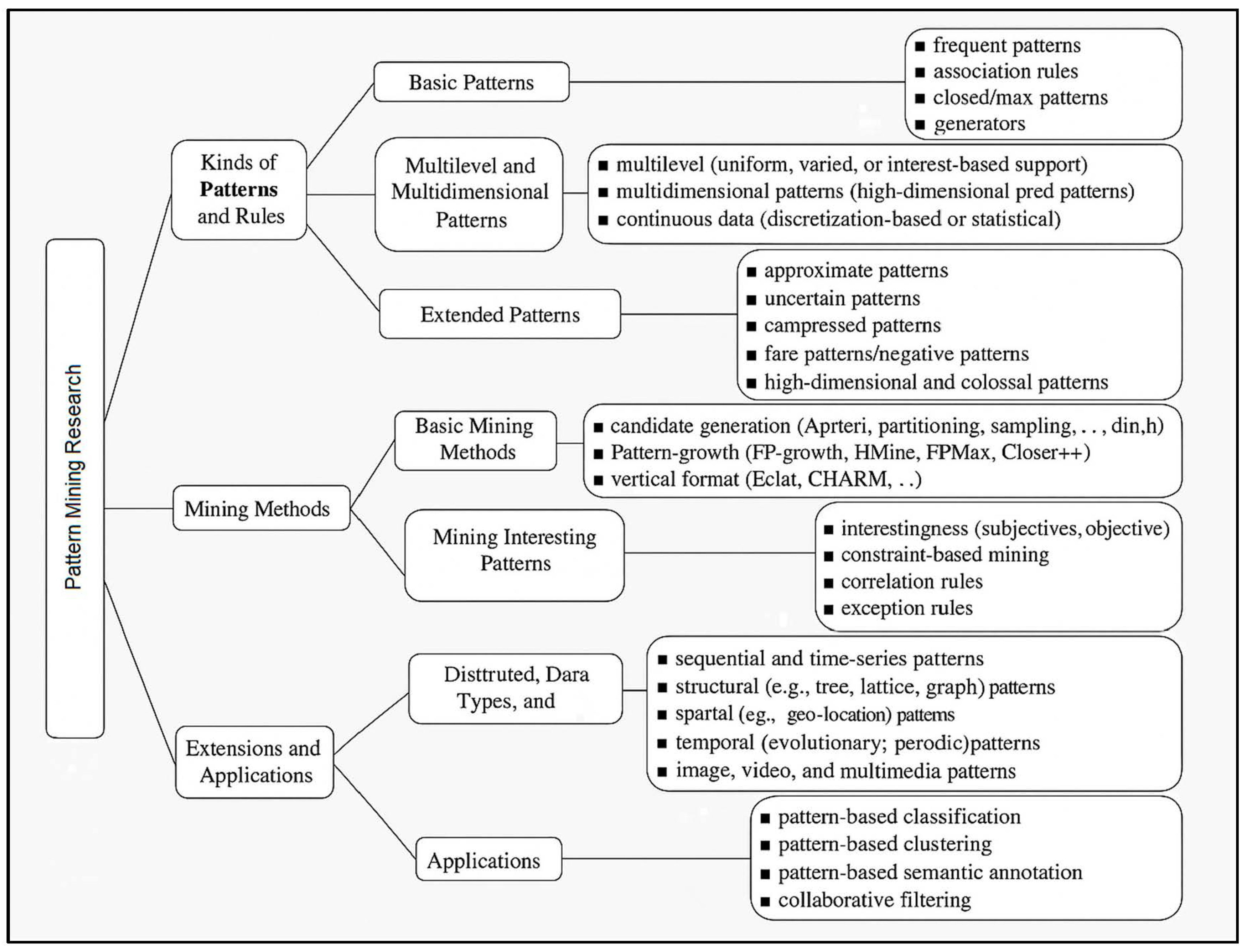
Users’ demands and applications for a wide range of data and patterns have led to the development of a wide range of Data Mining techniques [9]. Given the wealth of information available in this sector, it is critical to create a road map to assist us in going through it all and picking the best pattern mining techniques, as shown in Figure 1 [10].
Figure 1. Road map for pattern mining [10].
The basic terms used in frequent pattern mining are:
  • Item: An item is a single article in the dataset or the content of a data cell of the dataset.
  • Transaction: A transaction is a set of items, usually a dataset row.
  • K-Item Set: A K-Item Set is the itemset of size k, i.e., the set contains k items.
  • Support: The support is the number of transactions containing an itemset (XUY).
S u p p o r t = ( X Y ) . c o u n t n
  • Frequent Set: This is the set of items satisfying the minimum support threshold value.
  • Confidence: The confidence of a rule is defined as follows:
C o n f i d e n c e ( X Y ) = S u p p o r t ( X Y ) S u p p o r t ( X )
Typically, pattern mining research focuses on three things: the types of patterns mined, mining methods, and application use. Others combine a variety of factors; for example, different applications may need the extraction of data in various ways, necessitating the development of new mining methods.
The key contributions of this study are as follows:
  • The proposal of RQFP, a novel SQL-based frequent pattern mining algorithm that utilizes recursive queries over a Mining Table to avoid candidate generation and reduce memory overhead.
  • The implementation of RQFP as a visual web-based tool for step-by-step algorithmic understanding, especially in educational and instructional contexts.
  • A comparative performance analysis with Apriori and FP-Growth using an academic dataset and literature-based benchmarks, with a roadmap for direct benchmarking against vertical- and closed-itemset algorithms.

3. Research Methodology

The Recursive Queried Frequent Patterns algorithm (RQFP), based on the divide-and-conquer strategy, is presented in this research. It utilizes recursive database queries. The proposed approach is an amalgamation of partition-based and SQL-based techniques.
In the FP-Growth algorithm, to solve real-time data insertion into database issues, we had two options: either reflect those changes into an FP-tree, which is possible until the limiting threshold is reached for the item, or reconstruct the FP-tree from the start. Suppose the first option is selected, and then data items are inserted into the database. Then, if any data item now satisfies the minimum threshold criteria or a data item now loses its minimum threshold limit, the FP-tree needs to be reconstructed. In either case, authors have to rebuild the FP-tree. Reconstructing an FP-tree, again and again, is time-consuming and takes a considerable number of resources for such an organization. Also, it is unrealistic to construct an FP-tree for large databases [29]. The proposed approach uses a Mining Table that resides on a disk instead of in memory. Thus, the problem of determining all frequent patterns is handled in two phases. First, create a Mining Table with the help of List L. This list L consists of key-value pairs of data items and their occurrences throughout the database until its most recent updated state. Secondly, use a recursive queried mining algorithm that takes the Mining Table and List L as an input and determines frequent patterns. The schema of the Mining Table is the same as the Transaction Table, so the Mining Table may be used as a Transaction Table if specific properties are maintained. Despite its advantages, RQFP has specific limitations. The efficacy is contingent upon the SQL engine and the fundamental database architecture’s efficiency. Delays may result from the maintenance and updating of the Mining Table in instances where the information is sparse or particularly dynamic. Additionally, disk-based systems may result in decreased performance unless indexing or parallel query execution methods are implemented to enhance them, despite their scalability. In order to enhance the real-time capabilities of RQFP, future research may concentrate on the integration of GPU-accelerated SQL engines and multi-threading.
The proposed Recursive Queried Frequent Patterns (RQFP) algorithm is a hybrid method integrating SQL-based recursive querying and partitioning strategies. Unlike FP-Growth and Apriori, it relies on a disk-resident structure called the Mining Table and uses SQL recursion to explore frequent patterns efficiently.

3.1. Formal Definition of RQFP Algorithm

The RQFP algorithm operates in two phases:
  • Mining Table Construction: This involves generating a frequency-based list of items (List L) and organizing the database transactions accordingly:
    Let I = { a1, a2, …, am } be a set of items to be stored in a transaction database DB = [T1, T2, …, Tn], where Ti (i ϵ [1…n]) in Fields F1, F2, …, Fm and Ti transaction contains a set of items in I.
  • Recursive Pattern Mining: Using SQL recursion, the algorithm queries item combinations directly from the Mining Table, reducing memory consumption and pre-processing overhead.
The RQFP algorithm is a technique for deriving a collection of frequent patterns from a transaction database. It employs a recursive pattern-finding method, executed through SQL Common Table Expressions (CTEs), utilizing recursive joins and simulating depth-first traversal. The algorithm utilizes a Mining Table, created by scanning the database, filtering things with support ≥ θ, and inserting the sorted items into the Mining Table. The recursive SQL query has a worst-case time complexity of O(n⋅m), while memory usage is minimized by relying on disk-resident tables and SQL query execution mechanisms instead of memory-intensive data structures. The technique is juxtaposed with alternative methods such as Apriori, characterized by substantial candidate generation expenses and multiple database scans, and FP-Growth, which depends on an in-memory FP-tree and significant RAM consumption. To guarantee reproducibility and platform neutrality, the recursive logic of RQFP has been formulated using standard SQL-99 components compatible with PostgreSQL, MySQL 8+, and contemporary cloud SQL engines. Future endeavors will execute RQFP on PostgreSQL and MySQL to evaluate cross-platform performance, facilitating wider use in open source and enterprise settings. The algorithm’s recursive logic employs conventional SQL-99 constructs, compatible with PostgreSQL, MySQL 8+, and contemporary cloud SQL engines.

3.2. Mining Table Design

To avoid multiple database scans and memory-intensive candidate generation, the Mining Table stores transactions using only frequent items. Each transaction is sorted based on descending support (List L), and identical frequent itemsets can be merged using a frequency counter (Fsup). This structure enables streamlined querying and supports real-time updates. Moreover, it is costly to handle a vast number of candidate keys and then test those keys with a transactional database to check whether those candidates satisfy the minimum support threshold St which most of the previous studies, such as [30,31,32,33], adopt as an Apriori-like approach, and is based on an anti-monotone Apriori heuristic [31]. But approaching it like [29] eliminates such problems. Therefore, in our study, we have adopted such a concept. Still, instead of making a data structure, i.e., FP-tree, a table known as a Mining Table is constructed, designed using the following considerations:
  • The Mining Table stores the frequent items of every transaction in some order, avoiding repeatedly scanning DB.
  • Since only frequent items will play a role in the frequent pattern mining, it is necessary to perform one scan of DB to identify the set of frequent items and store them in list L.
  • According to list L, if two transactions share some everyday items, the shared objects can be merged by running a query on that field and calculating the count for that item.
  • If multiple transactions share an identical frequent itemset, they can be merged into one with its frequency registered in a separate field Fm+1, also known as Fsup.
We have designed the following Mining Table construction algorithm based on the above considerations:

3.3. Algorithmic Workflow

This algorithm can be used only when there is a need for data cleansing, data transformation, data reduction, or discretization. Moreover, this algorithm can be applied from the start, i.e., when there are no rows or transactions in the table on which frequent patterns are generated. So, if the organization stores data according to this algorithm, the transactional table is ready for Data Mining, eliminating Data Mining pre-processing requirements. After the Mining Table has some rows, we can start mining frequent items immediately. For organizations having an online/offline business of shopping stores or any other transaction-related industry, this will provide accurate-time information for the whole DB. We have introduced a query-based algorithm that operates on table fields F0…m, where F0 represents the first field and Fm denotes the last lot. This algorithm recursively traverses from F0 to Fm using a particular condition. When a recursive call of a mining function reaches Fm, it returns combinations of Field itemsets traversed so far with a support count for each variety satisfying the minimum support threshold St.
To update the Mining Table, we need to maintain its property, i.e., the order of itemsets in each transaction according to list L previously generated by Algorithm 1. Some transactions may effectively hold until the order of elements in the list L does not change. Still, when the order in the list changes, the Mining Table is no longer suitable for frequent mining elements, so we need to order each transaction according to the new changed list L. Maintaining list L comes in handy here, as we know exactly where the change has occurred. We can issue a few simple queries to the database and swap particular items to solve this issue.
Algorithm 1 Mining Table Creation
Input: A transaction database DB.
Output: List L, Mining Table.
Method: The Mining Table is constructed in the following steps.
  • Generate the key-value list L of items with several occurrences “support” by scanning database DB.
  • Sort the list as support descending order or their frequencies.
  • Scan the transaction database DB. Sort Ti (i ϵ [1…n]) as list L, obtained in step 2.
  • Scan DB once again to merge multiple transactions containing identical frequent itemset by creating another Field Fm+1 or Fsup with support count as number occurrences of that transaction. *1
*1 This step is optional.

3.4. Illustrative Example

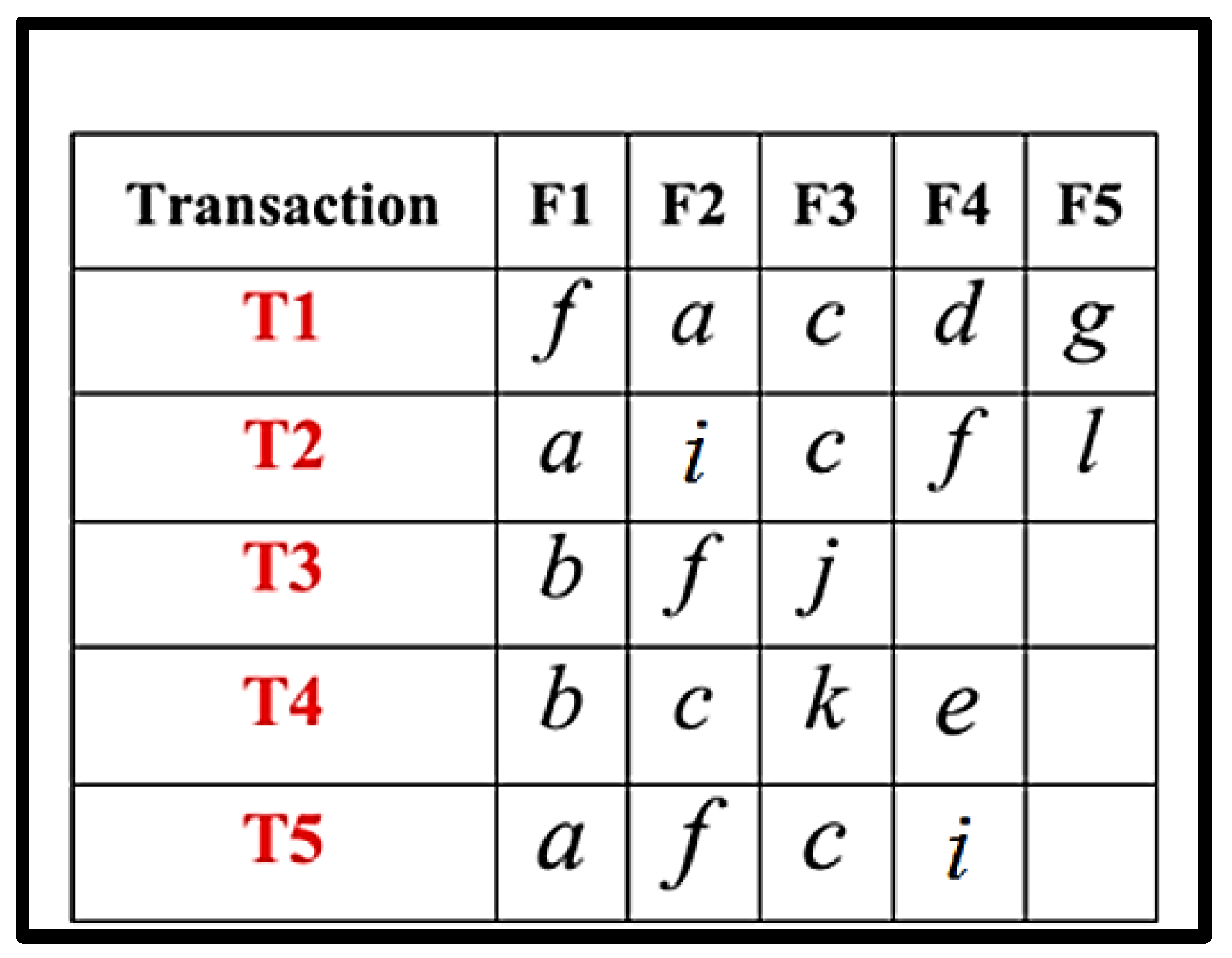
Consider the following Transactional DB. The steps included in the RQFP algorithm are shown in Figure 4, Figure 5, Figure 6, Figure 7, Figure 8, Figure 9, Figure 10, Figure 11, Figure 12 and Figure 13.
Figure 4. Transactional DB.
Step 1 and 2.
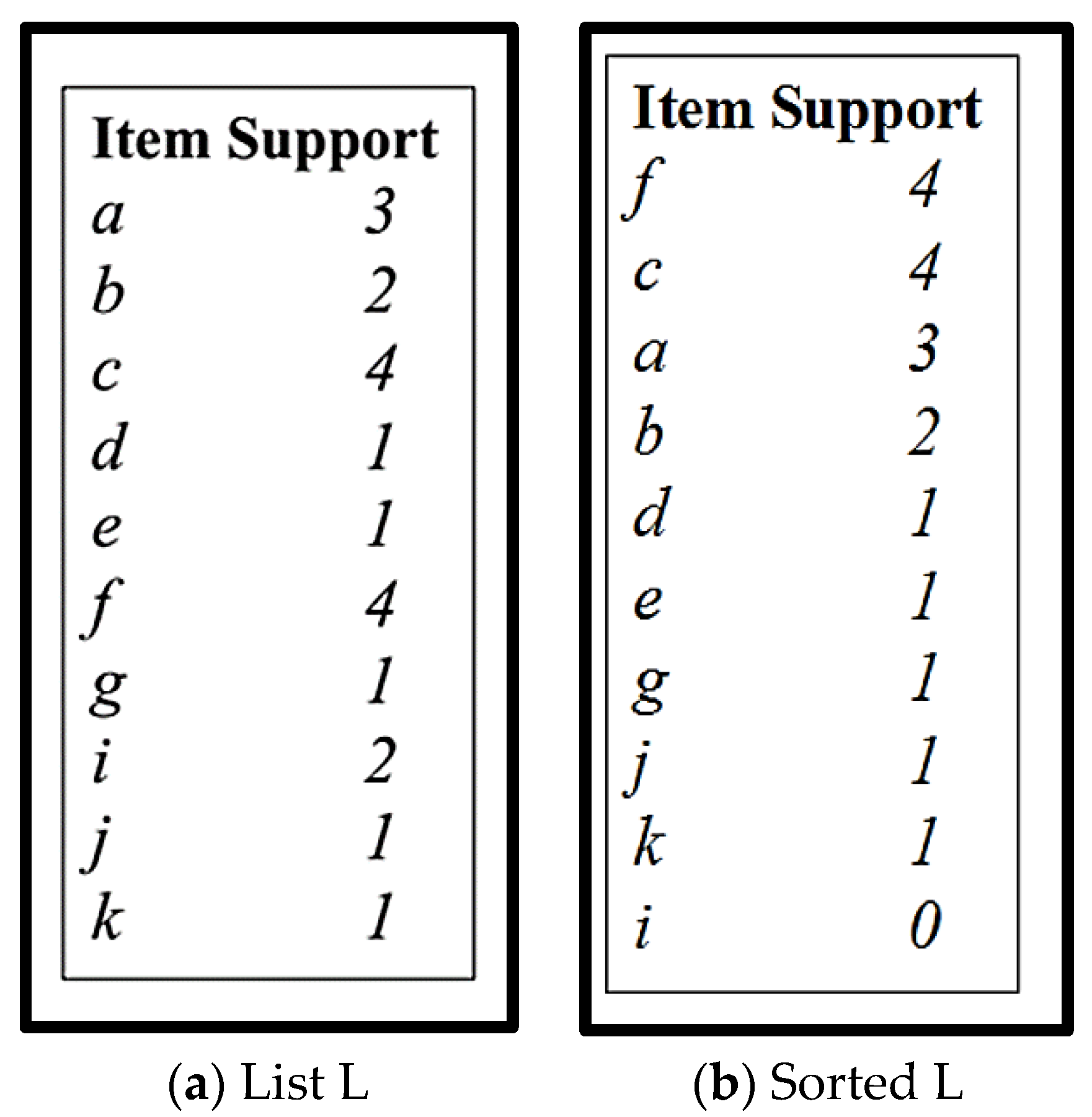
Generate List L and Sort it according to support descending order.
Figure 5. (a) List L; (b) Sorted List.
Step 3.
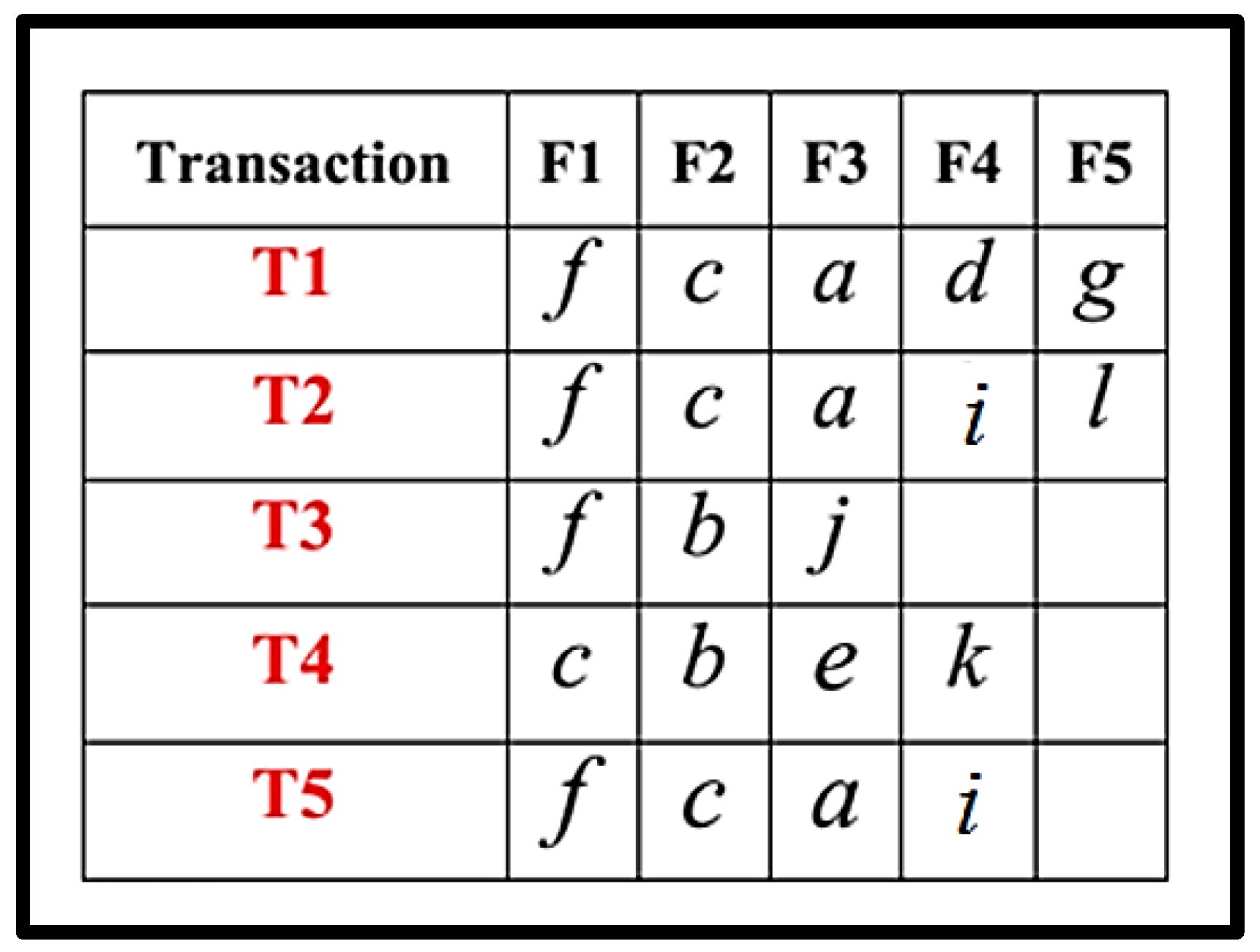
Sort every transaction according to List L (b).
Figure 6. Mining DB.
Now let us see how the mining algorithm works.
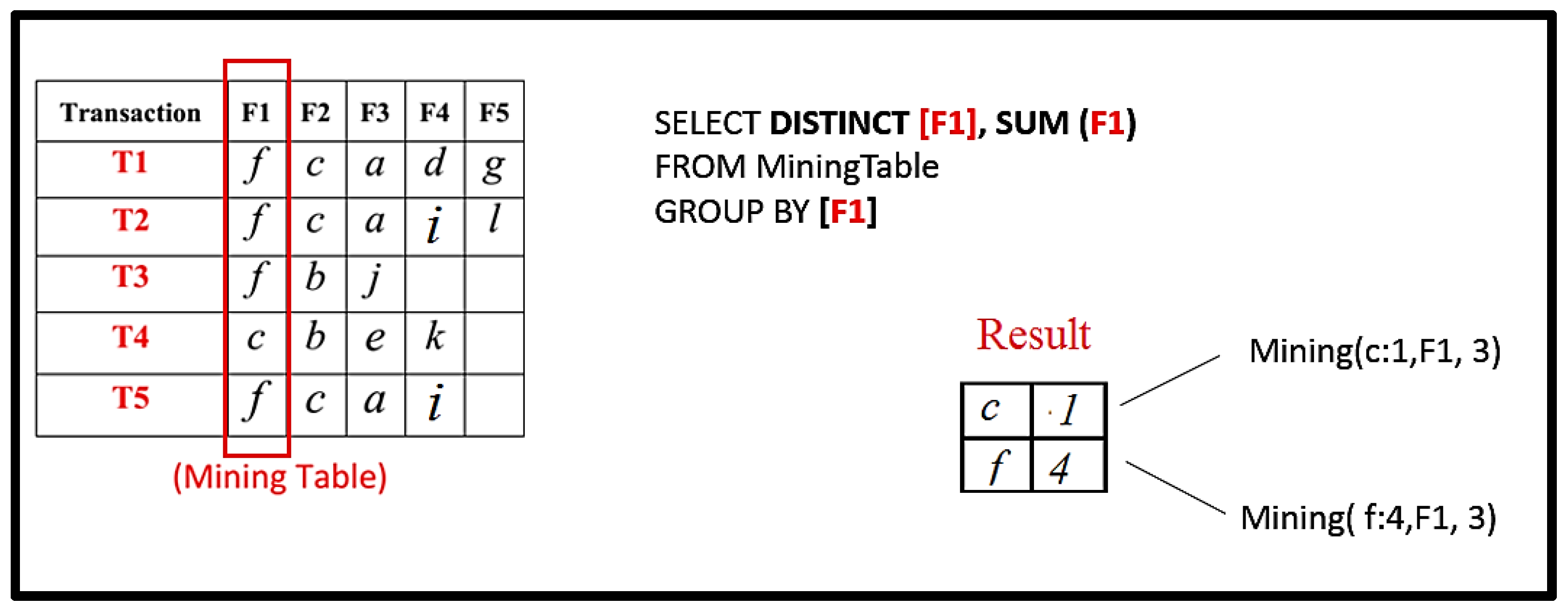
The first frequent pattern, Set FP, is created, which initially is NULL. Then, query for the first field is executed, which selects specific items from the first field with support count.
Figure 7. RQFP algorithm step.
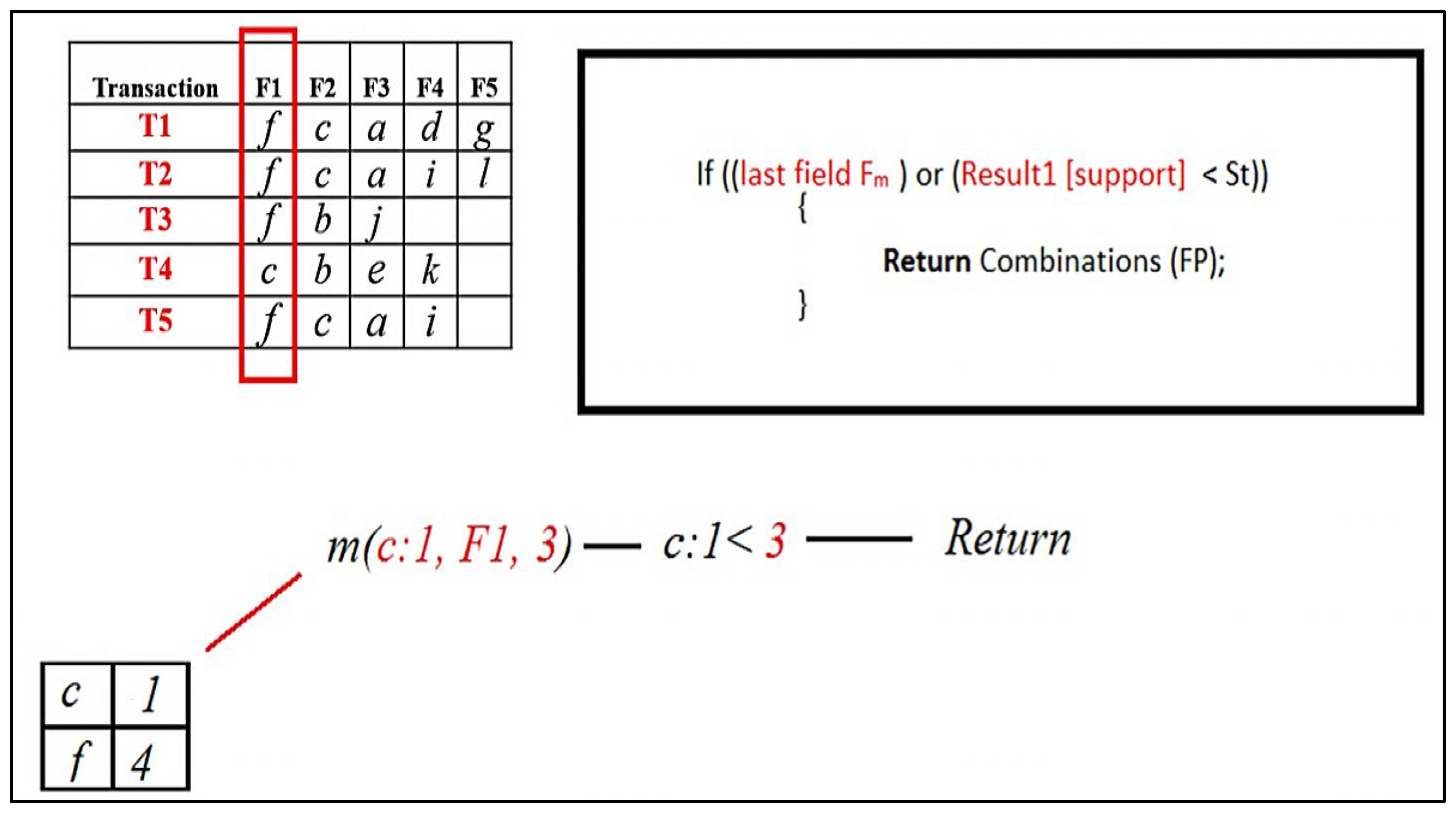
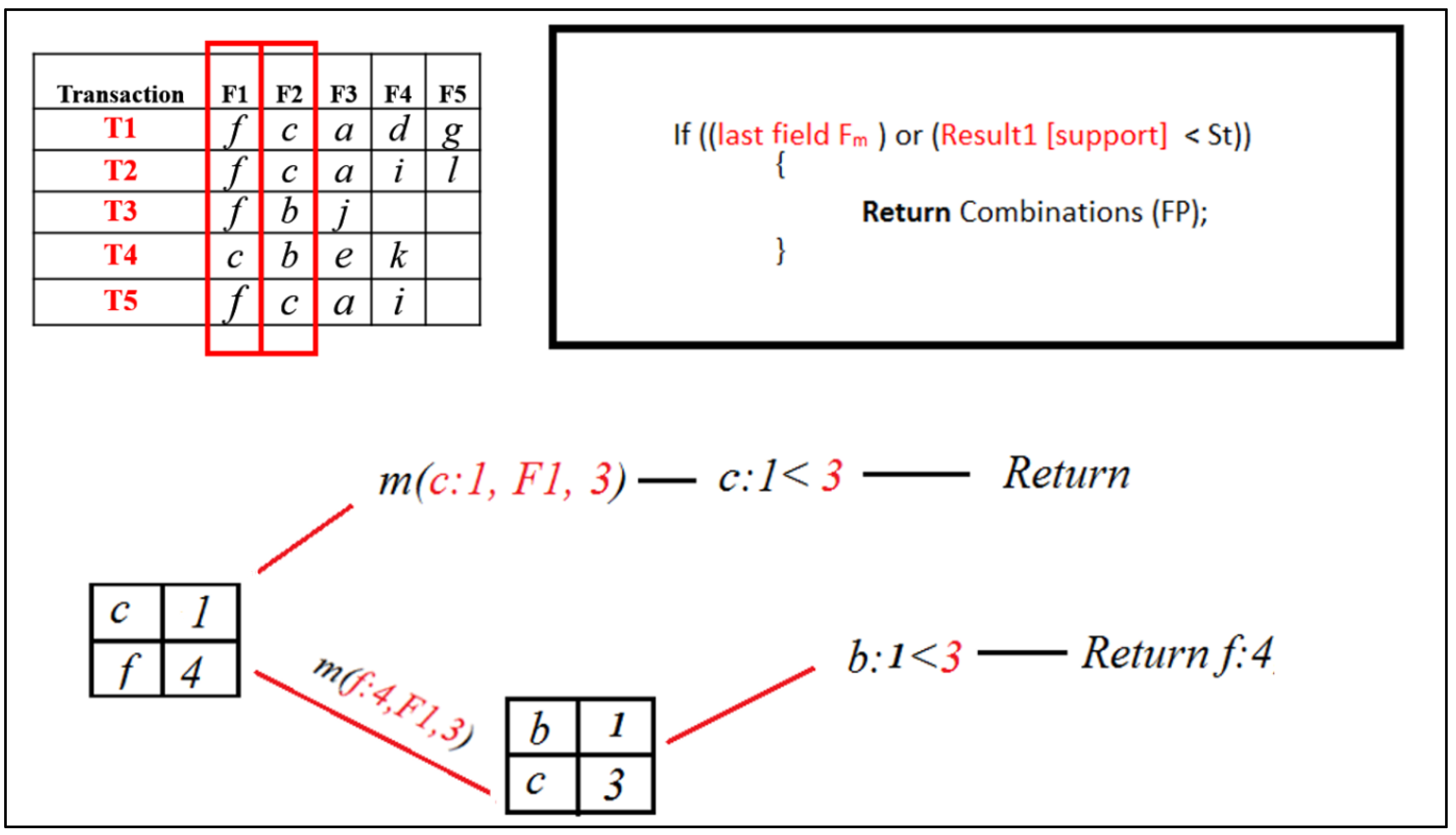
For every result item, a Mining ( ) procedure is called, so when the Mining (,) procedure for [ c ] is called, it will return the FP set combination because the FP set is NULL, so it will return NULL.
Figure 8. RQFP algorithm step.
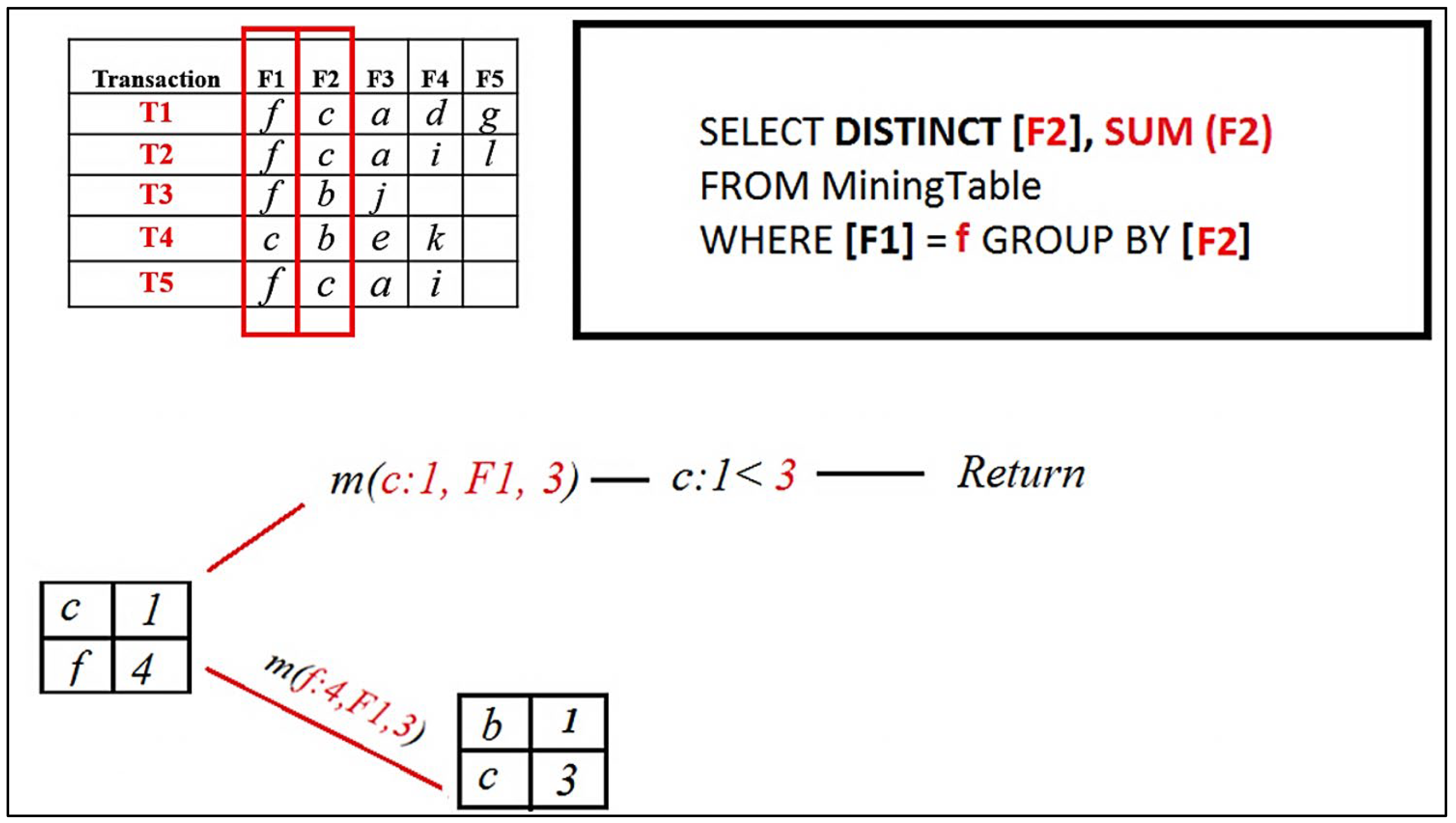
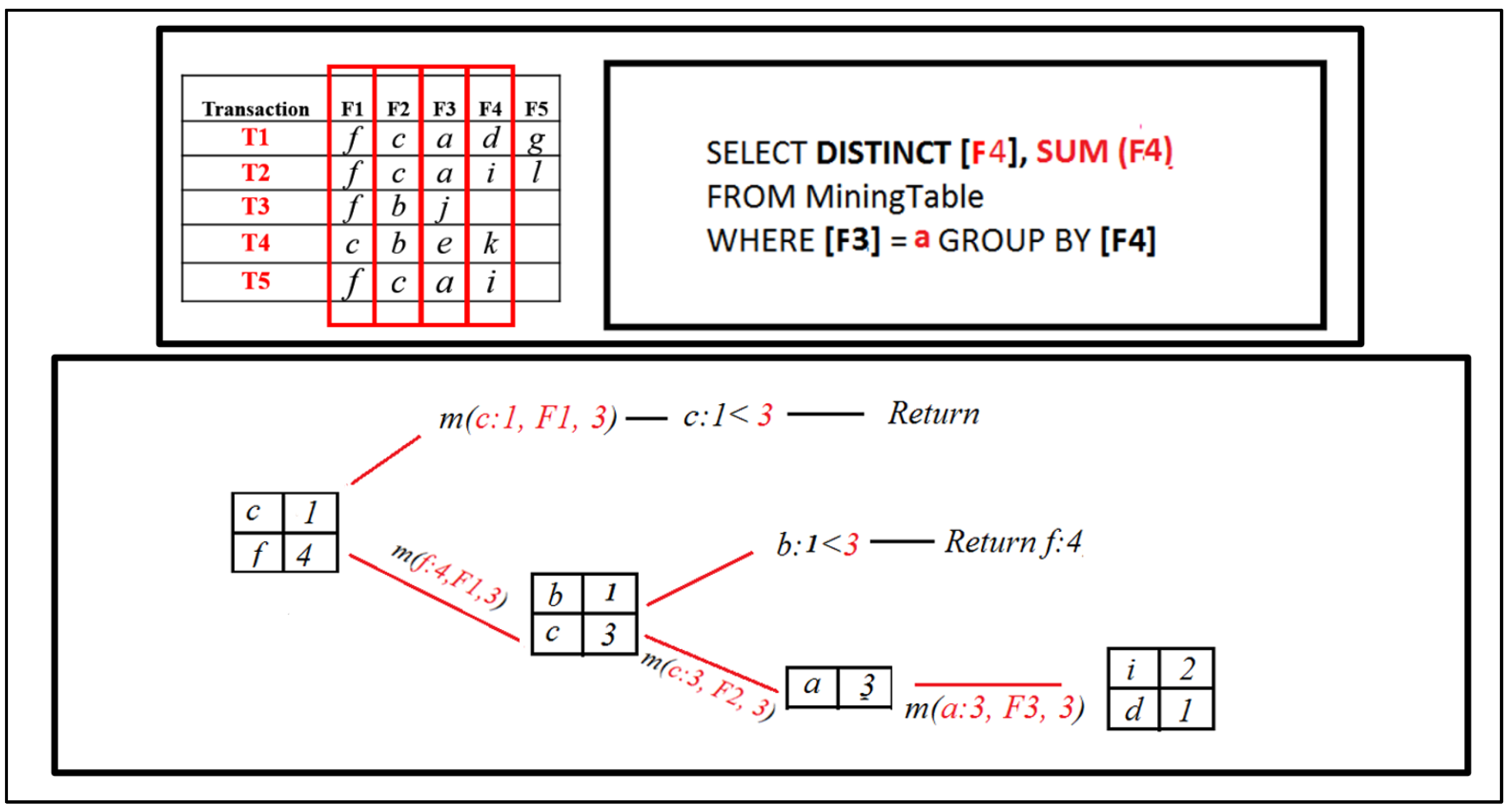
When the Mining ( ) procedure for [ f ] is called, it will be added to the FP set first because its support is greater than the minimum support threshold. Then, it will execute a query that will select particular items from the following field, F2 with support count, where the previous field, F1, is [ f ].
Figure 9. RQFP algorithm step.
The result set now contains [ b, c ]. Now, when the Mining ( ) procedure for [ b ] is called, it will return combinations of the FP set, which contains [ f ] only; therefore, it will return [ f ] only.
Figure 10. RQFP algorithm step.
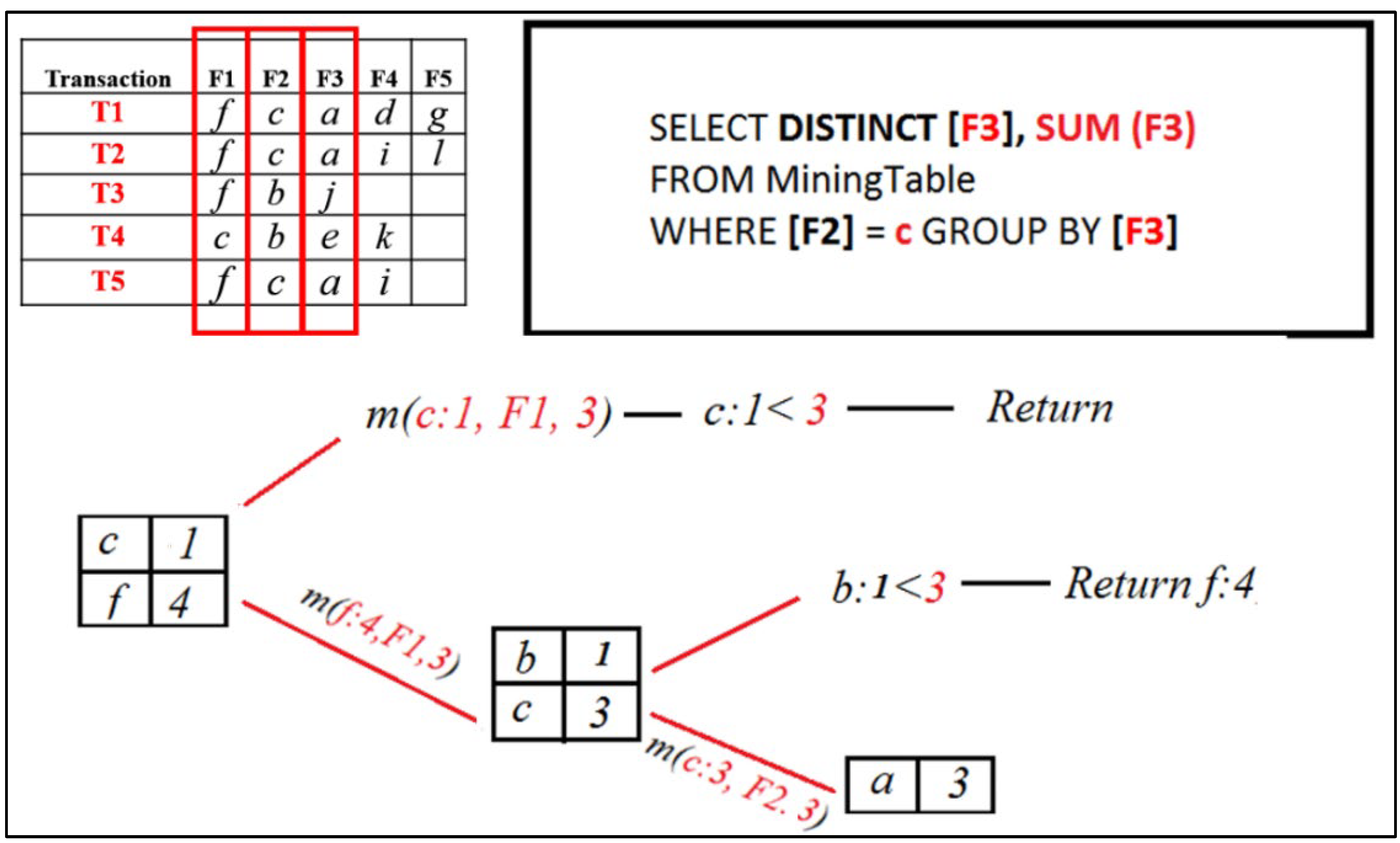
The Mining ( ) procedure for [ c ] will be called and added to the FP set because its support is greater than the minimum support threshold. Then, it will execute a query that will select particular items from the following field, F3 with support count, where the previous field, F2, is [ c ].
Figure 11. RQFP algorithm step.
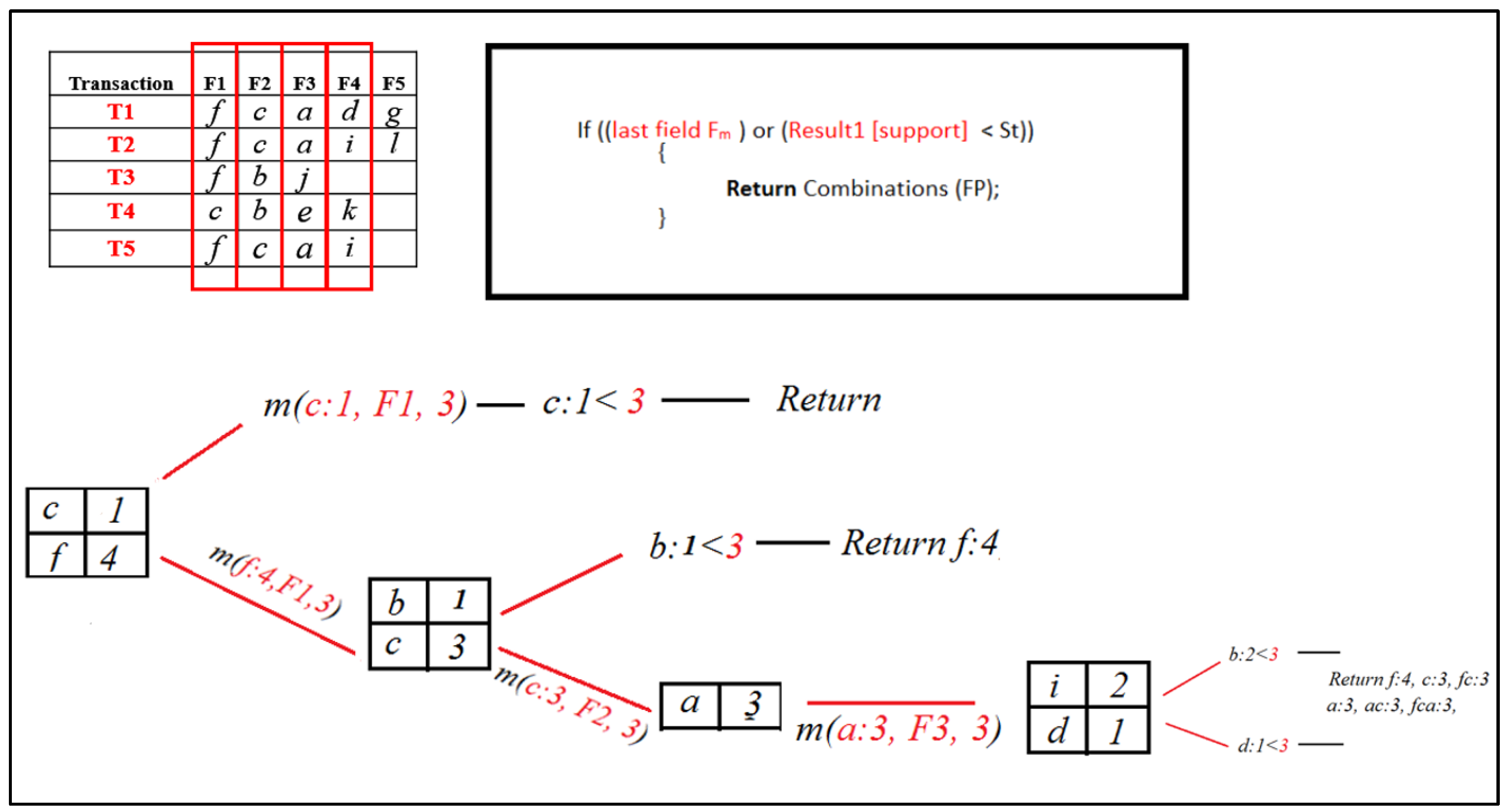
The result set now contains [ a ]. The Mining ( ) procedure for [ a ] will be called and added to the FP set because its support is greater than the minimum support threshold. Then it will execute a query that will select particular items from the next field, F4 with support count, where the previous field, F3, is [ a ].
Figure 12. RQFP algorithm step.
The result set now contains [ i, d ]. Now, when the Mining ( ) procedure for both [ i, d ] is called, it will return combinations of the FP set, which contains [ f, c, a ]; therefore, it will return [ f, a, c, fa, ac, fc, fac ], which are frequent patterns for our DB.
Figure 13. RQFP algorithm step.
The proposed Recursive Queried Frequent Patterns algorithm efficiently mines frequent patterns without candidate generation or pre-processing data before Data Mining. Instead, the organization implements an approach like Algorithm 1 and updates it to Algorithm 2, making data always ready for mining. So, in real time, organizations will be familiar with market trends, which will be helpful for decision making and, in turn, will increase revenues, cut costs, and reduce risks. Aside from that, it utilizes a divide-and-conquer strategy based on partitioning to minimize the problem’s size as the function call results come in. Of course, the performance of this algorithm will largely depend upon the SQL engine. Several optimization techniques like parallel programming or multi-threading may also increase the performance.
Algorithm 2 Recursive Queried Frequent Patterns Algorithm
Input: Mining Table created by Algorithm 1, Minimum support threshold St.
Output: The complete set of frequent patterns.
Method:
Var FP = null;
Var Result1 [item] [support] = “SELECT DISTINCT [F1], SUM (Fm+1 or F1) FROM MiningTable WHERE [F1] = Li GROUP BY [F1]”; *1
 While (Result [item] ≠ NULL)
  {
   Mining_procedure (Result, F1, St)
  }
Mining_procedure (I[item] [support], Fi, St)
{
 If (I [Support] > St)
  {
   FP = FP+I [item] [Support];
  }
Else If ((last field Fm) || (I [Support] < St))
   {
     Return Combinations (FP); *2
   }
Else
  {
Result [item] [support] = “SELECT DISTINCT [Fi+1], SUM (Fm+1 or Fi+1) FROM MiningTable WHERE [Fi] = Ii GROUP BY [Fi+1]”;
While (Result [item] ≠ NULL)
   {
Mining_procedure (Result, Fi+1, St)
}  }  }
*1 If step 4 of Algorithm 1 is executed, then it is necessary to use SUM (Fm+1) else SUM (F1). *2 Combinations take the FP Set (Frequent Patterns Set) as input and return combinations of items traversed so far. Algorithm 3 defines the process of updating the mining table.
Algorithm 3 Updating Mining Table
Input: Mining Table created by Algorithm 1, Itemset Is or Tn+1.
Output: Updated Mining Table, updated list L.
Method:
Update (Mining_Table, Is)
{
     INSERT INTO Mining_Table values IS into Fm.
   Loop (I0…S)
    {
      Update item Support value of list L.
   }
   If (L changed)
   {
Sort L.
Swap Changed items.
   }}
It is important to note that, while RQFP does not introduce a fundamentally new theoretical complexity class, it presents a novel algorithmic design by leveraging SQL recursion and disk-resident mining structures to implement frequent pattern mining. This differs significantly from both FP-Growth (tree-based mining) and ECLAT (TID-set intersections). The transformation of recursive frequent pattern discovery into a sequence of relational queries allows for a seamless integration with modern database systems, enabling native, real-time, and scalable pattern discovery without external data structures or engines. This hybridization of pattern mining and relational processing introduces a new design space for future database-integrated Data Mining techniques.

3.5. Theoretical Foundation and Complexity Analysis

The Recursive Queried Frequent Patterns (RQFP) algorithm is grounded in two primary principles: the downward closure property of frequent itemsets and the recursive depth-first traversal implemented using SQL common table expressions (CTEs). This section formally defines the core notations, establishes algorithmic correctness, and analyzes its time and space complexity.

3.5.1. Formal Definitions

  • DB = {T1, T2, …, Tn} and is a transactional database, where each transaction Ti is a subset of a universal itemset I = {i1, i2, …, im}.
  • List L is a frequency-ordered list of frequent items (i.e., items satisfying the minimum support threshold σ).
  • A Mining Table is a disk-resident structure that stores transactions using only frequent items, sorted in a descending order based on List L.
  • F0…Fk represent positional fields in the Mining Table corresponding to item positions within a transaction.
  • FP denotes the set of frequent item combinations generated recursively.
  • σ is the user-defined minimum support threshold.
  • d is the maximum recursion depth (equal to the maximum transaction length among frequent items).
The RQFP algorithm proceeds by recursively querying item combinations from the Mining Table, extending partial frequent itemsets (prefixes) at each depth only if all prefix subsets satisfy the support threshold σ.

3.5.2. Correctness and Downward Closure

The algorithm adheres to the anti-monotonicity (downward closure) property of support as follows:
If an itemset X is frequent, then all subsets of X are also frequent.
By construction, the recursive SQL query evaluates item extensions only if their prefixes have previously met the threshold. The Mining Table only contains frequent items, and all recursive branches are pruned as soon as the support condition is violated. Thus, the algorithm does not report any spurious patterns.

3.5.3. Time Complexity

Let the following conditions be true:
  • n is the number of transactions in the database.
  • m is the average number of items per transaction.
  • |I| is the number of frequent items after pruning with σ.
Phase 1: Mining Table Construction
  • Scan DB once to compute support counts → O(n × m).
  • Construct List L and reorder transactions accordingly → O(n × log m).
Phase 2: Recursive Pattern Mining
  • In the worst case (where all items are frequent), the number of recursive branches is exponential: O(2^|I|). However, early pruning drastically limits actual expansion.
  • Each recursive step performs an indexed SQL SELECT DISTINCT … GROUP BY operation on the Mining Table, bounded by O(n).
Thus, the expected total time complexity is as follows:
T(n, m, |I|) = O(n × m) + O(R), where R ≪ 2^|I| due to pruning and dataset sparsity.

3.5.4. Space Complexity

Unlike FP-Growth, which requires constructing an in-memory prefix tree, RQFP stores all intermediate data on the disk using SQL tables. This results in the following:
  • The main memory is used only for recursive call states and result aggregation.
  • The Mining Table remains disk-resident and can be indexed for efficient access.
Memory usage:
  • Recursive call stack: O(d), where d is the depth of recursion.
  • Disk storage: O(n × m) for the Mining Table (shared with transactional data).
Hence, the space complexity is as follows:
S(n, m) = O(d) in memory, O(n × m) on disk.

3.5.5. Advantages over Existing Approaches

Unlike Apriori and FP-Growth, RQFP is fully database-integrated, with no external data structures or in-memory FP-trees required. It offers a practical trade-off by minimizing memory usage at the expense of minor overhead in maintaining sorted transactional data. Table 1 defines the advantages of the proposed method over the existing approaches used by other researchers.
Table 1. Advantages of proposed method over existing approaches.

4. Experiments, Results, and Discussions

4.1. Dataset Description

In this study, these algorithms were implemented for a university dataset to determine frequent courses chosen by students in various departments of the university. The dataset was collected from the students at the university. The data of 434 students were composed of four subjects chosen by the student. The collected dataset contained a unique number of students whose subject choice was compiled for study. Students had to choose four subjects; the dataset sample is shown below. In the dataset, GE refers to general English, CH refers to chemistry, BO represents biology, and ZO refers to zoology. Table 2 illustrates a sample or screenshot of the dataset formulated for the experiment.
Table 2. Dataset.

4.2. System Configuration and Software Environment

In this study, the authors used a high configuration system. The implementation of the proposed algorithm was tested on a stand-alone machine with a processing unit of Intel i5 with four cores and a frequency of 2.5 GHz. The system consists of 4 GB of RAM. The RQFP algorithm was executed and evaluated utilizing the Microsoft SQL Server 2012 on a Windows 10 system. Indexes were established on frequently searched fields (F1 to Fm), and the system utilized the default caching and query optimization functionalities offered by the SQL Server 2012 without any manual adjustments. Recursive CTE syntax conformed to SQL:1999 and was portable to MySQL 8+, PostgreSQL. Considering that the efficacy of RQFP is affected by the internal mechanisms of SQL engines, such as recursive query support, indexing methodologies, and memory allocation, subsequent research will entail evaluating the algorithm on additional prominent relational database systems, including MySQL, PostgreSQL, and cloud-based SQL services. This will evaluate the algorithm’s portability and consistency across many data settings.

4.3. Execution and Results

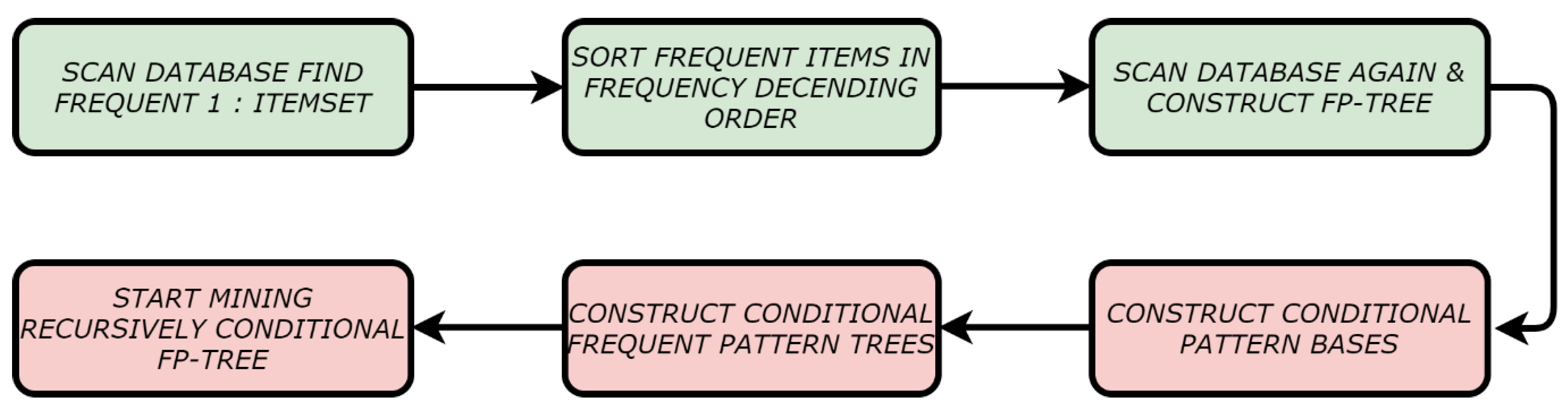
To facilitate the clear presentation and interpretation of the intermediate results generated by the FP-Growth and RQFP algorithms, a graphical user interface (GUI) was developed using C#. While these algorithms can be implemented using common programming languages such as C, C++, Java, or C#, console-based applications tend to limit the readability and visual structuring of complex outputs, especially when dealing with large datasets and multiple derived data structures. In this study, the implementation was carried out using Java (version 17, LTS), which was the stable and widely supported release available. For instance, FP-Growth involves several stages: these include generating the frequency list L, sorting transactions, constructing the FP-tree, deriving conditional pattern bases, and building conditional FP-trees, before arriving at the final set of frequent patterns. Displaying these multi-level outputs in a console environment can hinder comprehension. Therefore, a visual application was preferred to enhance usability, allow for better debugging, and support the step-by-step execution of the algorithms in a user-friendly interface.
A web-app-based application was created using the C# programing language for both algorithms. It was made ready to be published online for testing various datasets by uploading them onto a server space and then executing these algorithms with just a click.
Step 1:
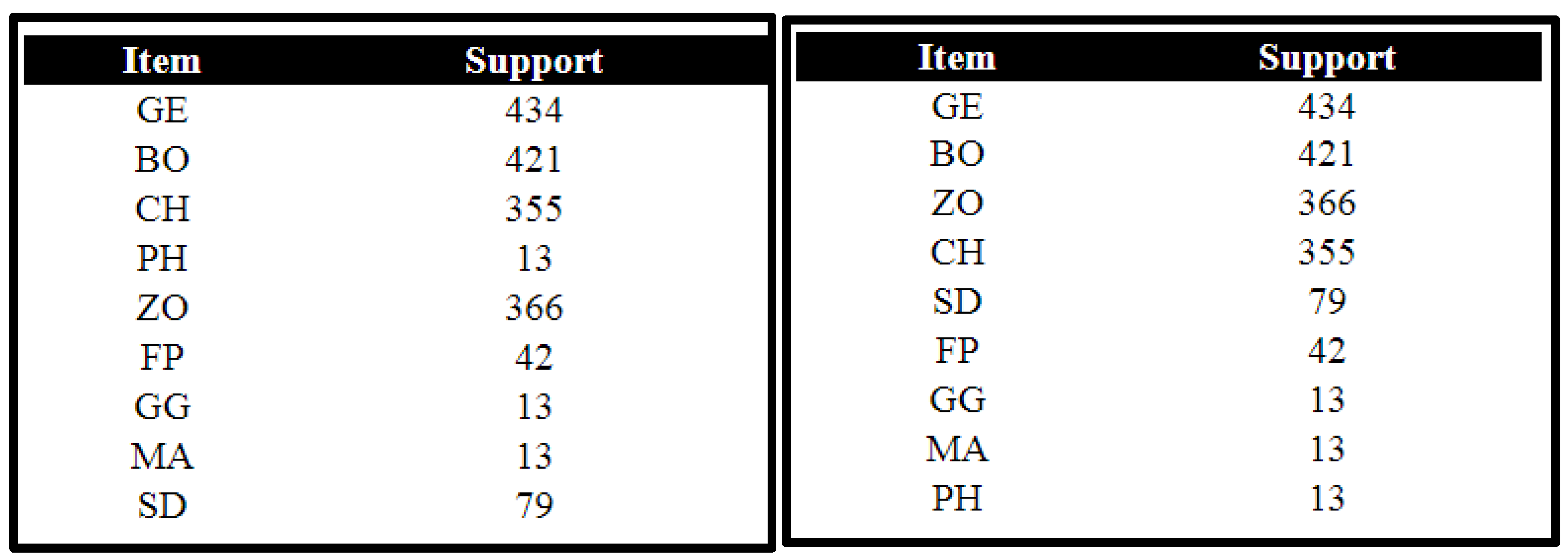
Generate List L, which contains items as course code and support as the frequency for each item. Then, sort the list according to descending order of support count. As shown in Figure 14, general English (GE) has the highest frequency among all subjects, justifying its consistent appearance in frequent itemsets. This confirms the RQFP algorithm’s ability to dynamically adapt to item frequencies when building List L.
Figure 14. List L and Sorted List L with support count for student dataset.
Step 2:
When the support threshold is 100%, only GE (0) is the frequent item, since GE is mandatory for each student. When the support threshold is lowered to 80%, a few more combinations make it to the frequent pattern set. More and more combinations will reduce the support threshold to the frequent pattern set. When the support threshold reaches 0%, the whole dataset is a frequent pattern set.

4.4. Comparative Analysis

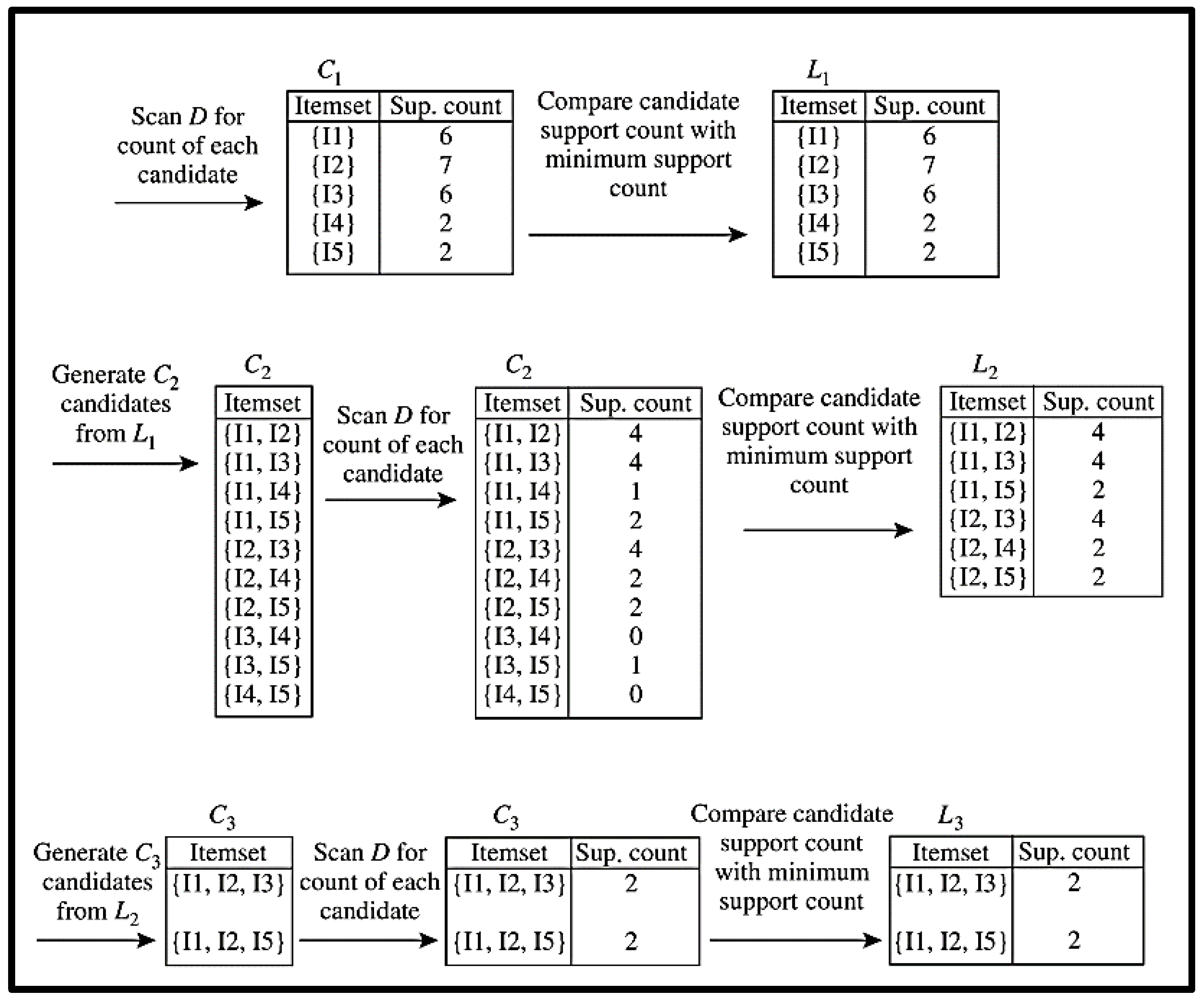
Frequent itemset mining methods, such as Apriori, FP-Growth, and RQFP, are based on a transaction database and a minimal level of support. These algorithms produce outputs using a level-wise method, scanning the database frequently to determine the level of support for each pattern. FP-Growth, an alternative to Apriori, only considers patterns already present in the database. RQFP, on the other hand, uses SQL-based recursive algorithms to divide-and-conquer databases. The algorithms are compared in terms of their method, memory use, number of scans, and time consumed. Apriori uses Apriori properties like join and pure property for frequent mining patterns, while FP-Growth constructs conditional pattern-free and dependent patterns based on the database, satisfying the minimum support. RQFP uses disk-resident tables and an SQL procedure to generate frequent patterns from the dataset. The algorithms use different search types and memory utilizations. Apriori performs multiple scans for generating candidate sets, while FP-Growth scans the database only twice. RQFP uses two scans to create a mining dataset, which can be eliminated if the mining dataset and transaction dataset are the same. In terms of execution time, the Apriori algorithm wastes more time in producing candidates, while the FP-Growth and RQFP algorithms have lower execution times compared to Apriori.
The findings from the academic dataset indicate that the suggested RQFP algorithm surpasses Apriori and somewhat enhances performance compared to FP-Growth regarding execution time, despite their comparable pattern counts. This is accomplished by utilizing disk-based structures and SQL recursion, which enhance memory efficiency and minimize the preprocessing burden. In comparison to normal benchmark datasets, the execution time for Apriori and FP-Growth markedly escalates with high-dimensional or sparse data, such as retail data. While RQFP has not been assessed using these benchmark datasets, its architecture indicates possible benefits, particularly in real-time or memory-limited contexts.
Researchers recognize that subsequent research needs include the direct benchmarking of RQFP against Retail, Chess, and Mushroom datasets to validate its generalizability and scalability. Nevertheless, the existing academic dataset functions as a regulated environment to verify the accuracy and efficacy of the RQFP’s logic. Among the three algorithms, RQFP demonstrates the lowest execution time (00:00:03.6337641), as shown in Table 3, thereby outperforming both Apriori and FP-Growth. Furthermore, the results summarized in Table 4 indicate that while all three algorithms (RQFP, Apriori, and FP-Growth) yield identical patterns for the academic dataset, they differ notably in terms of execution efficiency across both academic and benchmark datasets.
Table 3. Comparison based on parameters.
Table 4. Comparative performance analysis of frequent pattern mining algorithms across an academic dataset (434 university transactions) and standard benchmark datasets (Retail, Chess).

5. Conclusions

This research presents the Recursive Queried Frequent Patterns (RQFP) method, a database-integrated approach for frequent itemset mining. It diminishes memory reliance and enhances compatibility with relational database systems. RQFP surpasses Apriori and FP-Growth in terms of output interpretability and memory efficiency. Subsequent study will concentrate on extensive implementation and high-dimensional domains. The collection of common patterns created by the bulk of current pattern mining methods is too extensive for practical use. A wide range of research associations in areas like closed patterns, maximum patterns, approximation patterns, condensed pattern bases, representative patterns, clustered patterns, and frequent discriminative patterns has made the field of frequent pattern Data Mining more and more popular. However, the compactness of the techniques in terms of time and space complexity has been a significant area of concern in the cases of program or algorithm designing. Much research is needed to reduce the size of derived pattern collections while simultaneously enhancing the quality of the patterns maintained. While there are many fast techniques for mining an entire array of frequent patterns, frequent approximation patterns may be the best option in some instances. In this research, the researchers have designed a technique that integrates recursive and frequent pattern techniques better than the existing techniques in terms of efficiency and complexity. Although the execution time enhancements over FP-Growth were modest (~0.13 s) in the current configuration, RQFP provides architectural advantages in terms of memory efficiency and database integration. The RQFP algorithm was formally defined using mathematical notation and pseudocode. SQL recursion, implemented through standard constructs, ensures compatibility across database engines. Theoretical complexity analysis confirms its efficiency under memory constraints.

6. Limitations and Future Work

The behavior of RQFP in real-world deployments with more complex operational constraints will be evaluated through systematic performance evaluations under diverse data scales, hardware configurations, and system loads in future work.
The Recursive Queried Frequent Patterns (RQFP) algorithm exhibits a commendable memory economy and integration with databases; yet, this work has specific limitations. The present assessment relies on a singular academic dataset of moderate dimensions. Consequently, statistical significance testing, including t-tests or Wilcoxon signed-rank tests, was not conducted owing to the restricted number of experimental runs and sample size. The lack of extensive and high-dimensional datasets constrains the generalizability of the reported performance improvements. To mitigate these constraints, further research will involve evaluating the RQFP algorithm on synthetic datasets expanded to 10x–100x the original size, facilitating a comprehensive investigation of recursion depth, indexing overhead, and execution time over diverse support thresholds. Additionally, cross-platform benchmarking will be performed on various relational database systems, including MySQL 8+, PostgreSQL, and the SQL Server, to evaluate the effects of engine-specific optimizations such as recursive CTE execution, caching methods, and index management. These improvements will yield more robust evidence of the scalability, resilience, and portability of the RQFP framework in real-world settings.

Author Contributions

I.A.K.: conceptualization, data collection, writing, and analysis; H.-Y.C.: conceptualization, supervision, and organization; S.S.: writing, project administration, and referencing; C.S.: proofreading, validation, writing, and reviewing. All authors have read and agreed to the published version of the manuscript.

Funding

This research received no external funding.

Institutional Review Board Statement

Not applicable.

Data Availability Statement

All data on the measured system variables indicating system functions that support the findings of this study are included within this paper.

Conflicts of Interest

Author Ishtiyaq Ahmad Khan is employed by upGrad Education Private Limited. Author Shamneesh Sharma is employed by byteXL TechEd Private Limited, Hyderabad. Author Chetan Sharma is employed by PW–Institute of Innovation, PhysicsWallah Limited. The remaining authors declare that the research was conducted in the absence of any commercial or financial relationships that could be construed as a potential conflict of interest.

References

  1. Sai Prasad, D.S.P.K. A Theoretical Review on Data Mining and Machine Learning Techniques for Data Analysis. Int. J. Adv. Sci. Technol. 2020, 29, 1220–1226. [Google Scholar]
  2. Chakraborty, M.; Biswas, S.K.; Purkayastha, B. Data Mining Using Neural Networks in the form of Classification Rules: A Review. In Proceedings of the 2020 4th International Conference on Computational Intelligence and Networks (CINE), Kolkata, India, 27–29 February 2020; pp. 1–6. [Google Scholar]
  3. de Sousa, L.R.; de Carvalho, V.O.; Penteado, B.E.; Affonso, F.J. A Systematic Mapping on the Use of Data Mining for the Face-to-Face School Dropout Problem. In Proceedings of the 13th International Conference on Computer Supported Education (CSEDU 2021), Online Streaming, 23–25 April 2021; Volume 1, pp. 36–47. [Google Scholar]
  4. Dridi, A.; Gaber, M.M.; Azad, R.M.A.; Bhogal, J. Scholarly data mining: A systematic review of its applications. Wiley Interdiscip. Rev. Data Min. Knowl. Discov. 2021, 11, e1395. [Google Scholar] [CrossRef]
  5. Li, L.; Ding, P.; Chen, H.; Wu, X. Frequent Pattern Mining in Big Social Graphs. IEEE Trans. Emerg. Top. Comput. Intell. 2022, 6, 638–648. [Google Scholar] [CrossRef]
  6. Agrawal, R.; Imieliński, T.; Swami, A. Mining association rules between sets of items in large databases. In Proceedings of the 1993 ACM SIGMOD International Conference on Management of Data, Washington, DC, USA, 25–28 May 1993; pp. 207–216. [Google Scholar]
  7. Almoqbily, R.S.; Rauf, A.; Quradaa, F.H. A Survey of Correlated High Utility Pattern Mining. IEEE Access 2021, 9, 42786–42800. [Google Scholar] [CrossRef]
  8. Jazayeri, A.; Yang, C.C. Frequent Pattern Mining in Continuous-time Temporal Networks. arXiv 2021, arXiv:2105.06399. [Google Scholar] [CrossRef] [PubMed]
  9. Djenouri, Y.; Lin, J.C.-W.; Nørvåg, K.; Ramampiaro, H.; Yu, P.S. Exploring decomposition for solving pattern mining problems. ACM Trans. Manag. Inf. Syst. (TMIS) 2021, 12, 1–36. [Google Scholar] [CrossRef]
  10. Han, J.; Kamber, M.; Pei, J. Data mining trends and research frontiers. In Data Mining; University of Illinois at Urbana–Champaign: Urbana, IL, USA, 2012; pp. 585–631. [Google Scholar]
  11. Chi, Y.; Wang, H.; Yu, P.S.; Muntz, R.R. Moment: Maintaining closed frequent itemsets over a stream sliding window. In Proceedings of the Fourth IEEE International Conference on Data Mining (ICDM’04), Brighton, UK, 1–4 November 2004; pp. 59–66. [Google Scholar]
  12. Fard, M.J.S.; Namin, P.A. Review of Apriori based Frequent Itemset Mining Solutions on Big Data. In Proceedings of the 2020 6th International Conference on Web Research (ICWR), Tehran, Iran, 22–23 April 2020; pp. 157–164. [Google Scholar]
  13. Liu, C.; Li, X. Mining Method Based on Semantic Trajectory Frequent Pattern. In Advanced Information Networking and Applications, Proceedings of the International Conference on Advanced Information Networking and Applications, Toronto, ON, Canada, 12–14 May 2021; Springer: Cham, Switzerland, 2021; pp. 146–159. [Google Scholar]
  14. Sornalakshmi, M.; Balamurali, S.; Venkatesulu, M.; Krishnan, M.N.; Ramasamy, L.K.; Kadry, S.; Lim, S. An efficient apriori algorithm for frequent pattern mining using mapreduce in healthcare data. Bull. Electr. Eng. Inform. 2021, 10, 390–403. [Google Scholar] [CrossRef]
  15. Han, J.; Fu, Y. Discovery of multiple-level association rules from large databases. In Proceedings of the 21st VLDB Conference, Zurich, Swizerland, 11–15 September 1995; Volume 95, pp. 420–431. [Google Scholar]
  16. Han, J.; Pei, J.; Dong, G.; Wang, K. Efficient computation of iceberg cubes with complex measures. In Proceedings of the 2001 ACM SIGMOD International Conference on Management of Data, Santa Barbara, CA, USA, 21–24 May 2001; pp. 1–12. [Google Scholar]
  17. Clustering, P.-B. Grouping of Questions From a Question Bank Using Partition-Based Clustering. In Developing a Keyword Extractor and Document Classifier: Emerging Research and Opportunities; Engineering Science Reference: Hershey, PA, USA, 2021. [Google Scholar]
  18. Han, J.; Pei, J.; Yin, Y. Mining frequent patterns without candidate generation. ACM Sigmod Rec. 2000, 29, 1–12. [Google Scholar] [CrossRef]
  19. Chormunge, S.; Mehta, R. Comparison Analysis of Extracting Frequent Itemsets Algorithms Using MapReduce. In Intelligent Data Communication Technologies and Internet of Things, Proceedings of the ICICI 2020, Coimbatore, India, 27–28 August 2020; Springer: Singapore, 2021; pp. 199–210. [Google Scholar]
  20. Agrawal, R.; Shafer, J.C. Parallel mining of association rules. IEEE Trans. Knowl. Data Eng. 1996, 8, 962–969. [Google Scholar] [CrossRef]
  21. Han, J.; Dong, G.; Yin, Y. Efficient mining of partial periodic patterns in time series database. In Proceedings of the 15th International Conference on Data Engineering (Cat. No. 99CB36337), Sydney, NSW, Australia, 23–26 March 1999; pp. 106–115. [Google Scholar]
  22. Thurachon, W.; Kreesuradej, W. Incremental Association Rule Mining With a Fast Incremental Updating Frequent Pattern Growth Algorithm. IEEE Access 2021, 9, 55726–55741. [Google Scholar] [CrossRef]
  23. Cong, S.; Han, J.; Padua, D. Parallel mining of closed sequential patterns. In Proceedings of the Eleventh ACM SIGKDD International Conference on Knowledge Discovery in Data Mining, Chicago, IL, USA, 21–24 August 2005; pp. 562–567. [Google Scholar]
  24. Sun, J.; Xun, Y.; Zhang, J.; Li, J. Incremental frequent itemsets mining with FCFP tree. IEEE Access 2019, 7, 136511–136524. [Google Scholar] [CrossRef]
  25. Zaki, M.J. Efficient enumeration of frequent sequences. In Proceedings of the Seventh International Conference on Information and Knowledge Management, Bethesda, MD, USA, 3–7 November 1998; pp. 68–75. [Google Scholar]
  26. Bernal, J.N.; Rodriguez, J.P.; Portella, J. DBMS and Oracle Datamining. Preprints 2021. [Google Scholar] [CrossRef]
  27. Teng, Y. A Critical Review of SQL-Based Mining Relational Database. Int. J. Comput. Commun. Eng. 2021, 10, 68–74. [Google Scholar] [CrossRef]
  28. Nasyuha, A.H.; Jama, J.; Abdullah, R.; Syahra, Y.; Azhar, Z.; Hutagalung, J.; Hasugian, B.S. Frequent pattern growth algorithm for maximizing display items. Telkomnika 2021, 19, 390–396. [Google Scholar] [CrossRef]
  29. Afrati, F.; Gionis, A.; Mannila, H. Approximating a collection of frequent sets. In Proceedings of the Tenth ACM SIGKDD International Conference on Knowledge Discovery and Data Mining, Seattle, WA, USA, 22–25 August 2004; pp. 12–19. [Google Scholar]
  30. Agarwal, R.C.; Aggarwal, C.C.; Prasad, V.V.V. A tree projection algorithm for generation of frequent item sets. J. Parallel Distrib. Comput. 2001, 61, 350–371. [Google Scholar] [CrossRef]
  31. Aggarwal, C.C.; Yu, P.S. A new framework for itemset generation. In Proceedings of the Seventeenth ACM SIGACT-SIGMOD-SIGART Symposium on Principles of Database Systems, Seattle, WA, USA, 1–4 June 1998; pp. 18–24. [Google Scholar]
  32. Beil, F.; Ester, M.; Xu, X. Frequent term-based text clustering. In Proceedings of the Eighth ACM SIGKDD International Conference on Knowledge Discovery and Data Mining, Edmonton, AB, Canada, 23–26 July 2002; pp. 436–442. [Google Scholar]
  33. Agrawal, R.; Srikant, R. Mining sequential patterns. In Proceedings of the Eleventh International Conference on Data Engineering, Taipei, Taiwan, 6–10 March 1995; pp. 3–14. [Google Scholar]
Disclaimer/Publisher’s Note: The statements, opinions and data contained in all publications are solely those of the individual author(s) and contributor(s) and not of MDPI and/or the editor(s). MDPI and/or the editor(s) disclaim responsibility for any injury to people or property resulting from any ideas, methods, instructions or products referred to in the content.

Article Metrics

Citations

Article Access Statistics

Multiple requests from the same IP address are counted as one view.