A Review of the Consent Management Literature



Abstract
1. Introduction
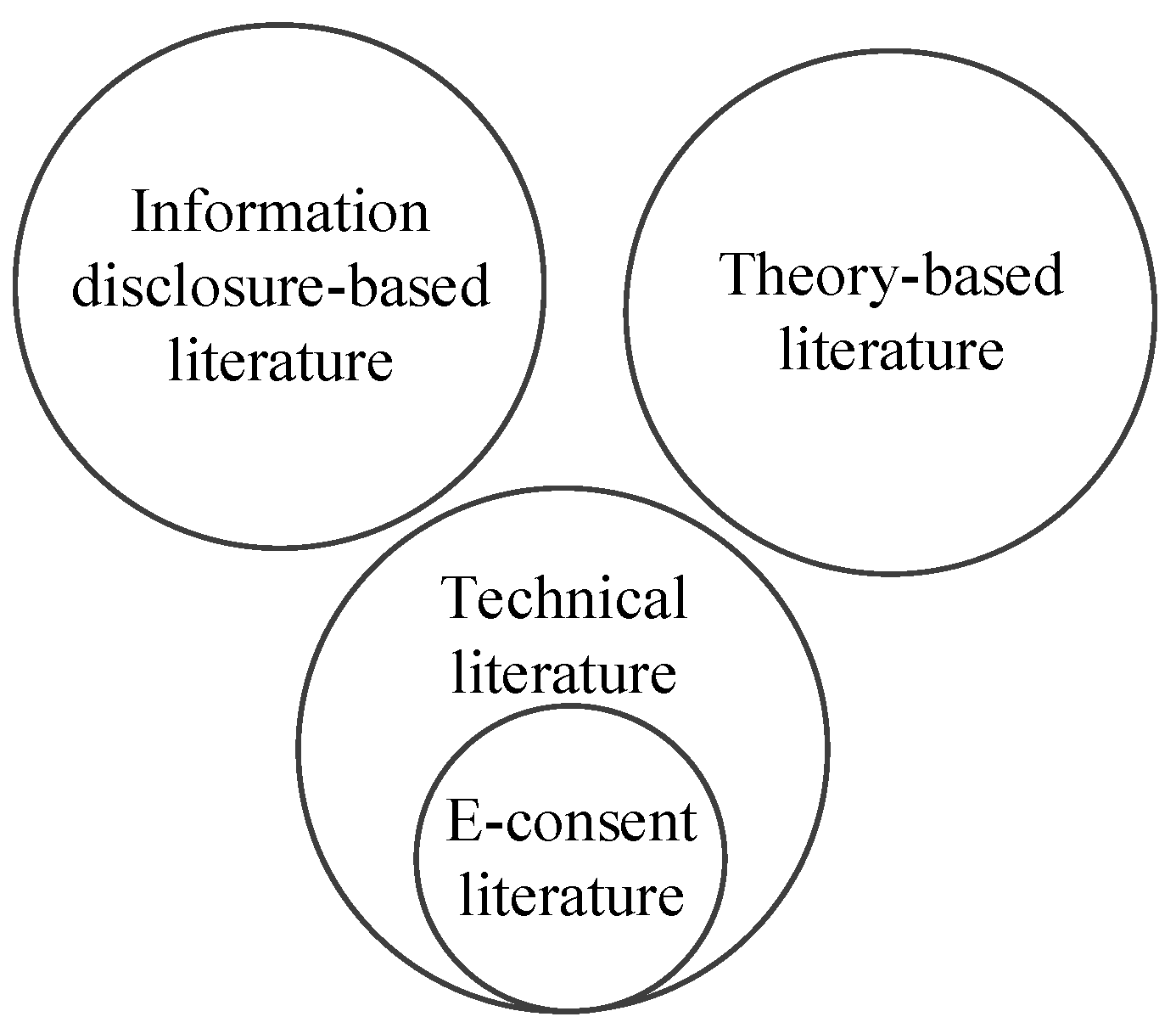
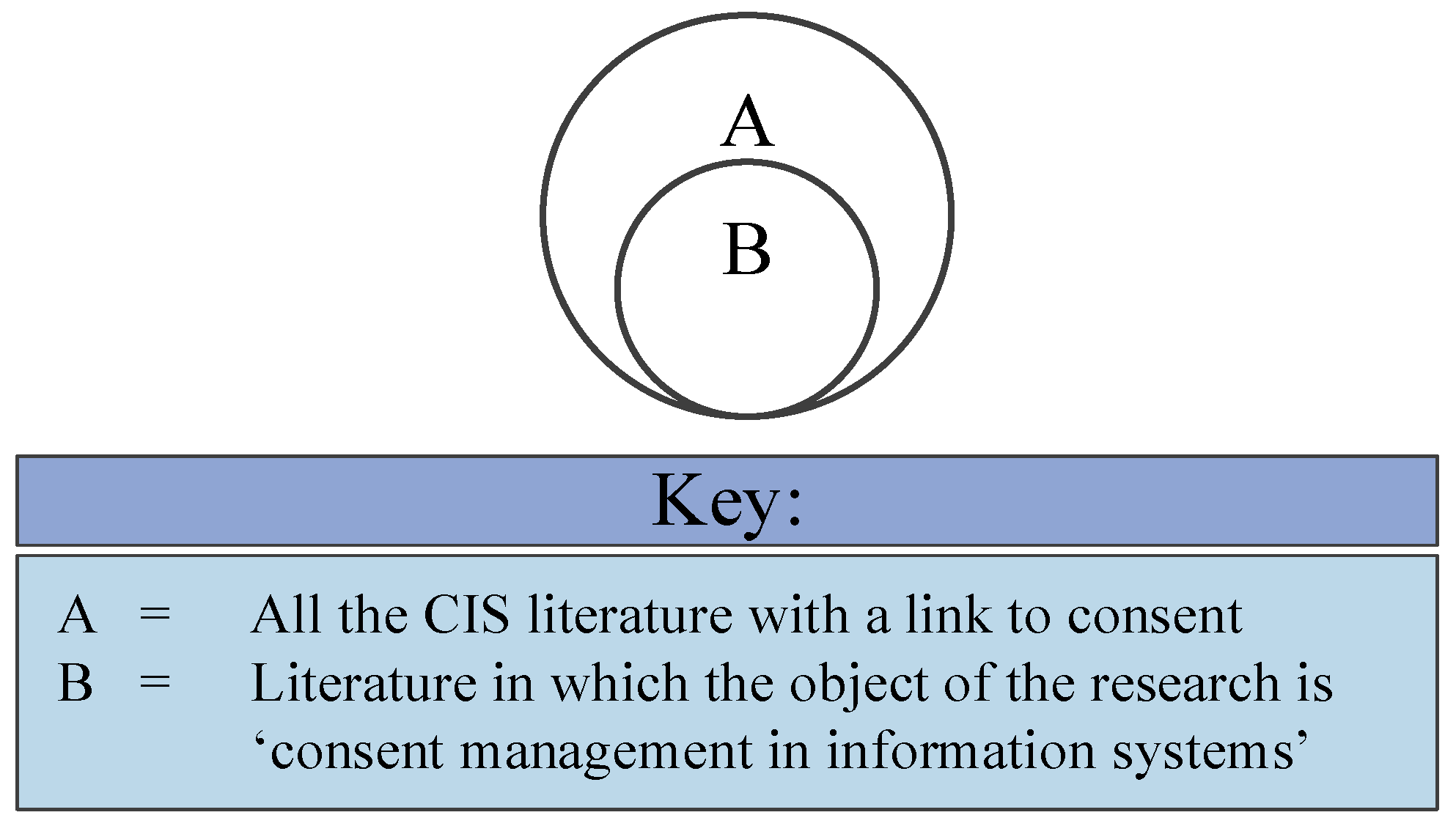
- Exploratory Question 1. What research was conducted in relation to consent and consent management in the context of CIS, and how does this relate to the consent literature in such other disciplines as law and ethics?
- Exploratory question 2. What are some fundamental notions that must be considered towards further contributions to the consent management literature in CIS?
- Exploratory Question 3. Which types of stances, and which stances, are often taken in relation to consent when contributions are made in the consent management literature?
- Exploratory Question 4. With reference to disciplinary and other stances, how does consent as a legal construct relate to consent as an ethical construct?
- Exploratory Question 5. Considering the theoretical stances normally adopted in the consent management literature, which currently reflect a focus on Faden and Beauchamp’s, Berg et al.’s, and Manson and O’Neill’s theories, what are the key requirements for legally and ethically effective consent management?
- Exploratory Question 6. Can the consent-related stances identified in Section 3 be presented in a relevant and useful conceptual model?
2. Consent-Related Definitions and Explanations
2.1. Etymology of Consent
2.2. Consent as a Verb
2.3. Consent as a Noun
2.4. Consent as a Construct
2.5. Consent Management
2.6. Object of Consent
2.7. Consent Transaction
2.8. Consent Process
2.9. Consent Vis-à-Vis Informed Consent
3. Framing Contributions in the Consent Management Literature through Stances
3.1. Types of Stances Framing Contributions in the Consent Management Literature
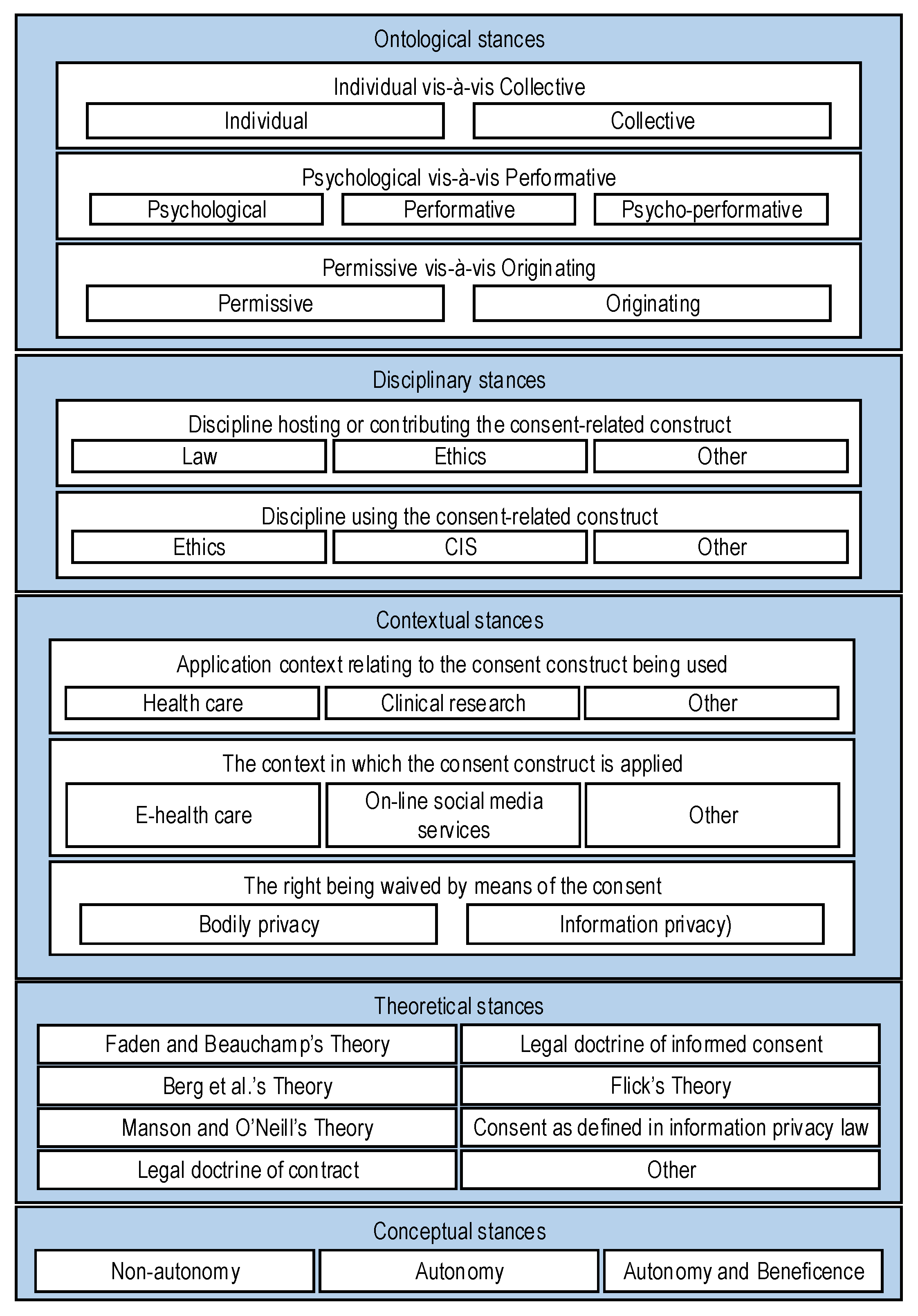
3.2. Ontological Stances Relating to Consent
3.2.1. Individual Vis-à-Vis Collective Consent
3.2.2. Consent as a Psychological Phenomenon Vis-à-Vis a Performative Act
3.2.3. Permissive Consent Vis-à-Vis Originating Consent
3.3. Disciplinary Stances Relating to Consent
3.4. Contextual Stances on Consent
3.5. Theoretical Stances Relating to Consent
- The focus in all three theories is on the notion of individual rather than collective consent, reflecting one of the ontological stances identified in this paper. Had the consent management literature focused on the notion of collective consent instead, it would have been appropriate to consider alternative theories, such as those revolving around the notion of social contract in politics, e.g., [39,40].
- Faden and Beauchamp’s theory is the most widely recognised autonomy-based theory of consent in ethics.
- While Faden and Beauchamp’s theory is largely conceptual, partly because of the authors’ focus on what constitutes ethically valid or effective consent in the mind, the theory proposed by Berg et al. provides useful information on the procedural aspects of informed consent in health care. Hence, combining the two theories provides a balance between the notions of consent as a mind-state and a performative act, reflecting another ontological stance identified in this paper. Manson and O’Neill’s theory complements this insofar as it spans both views.
- While Manson and O’Neill’s theory is a relatively new contribution and not as widely recognised as those proposed by Faden and Beauchamp and Berg et al., it is still considered to comprise the most carefully stated objections to autonomy [37] (p. 59). Hence, the three theories provide a balanced view between contemporary autonomy and non-autonomy-based depictions of consent. Manson and O’Neill’s theory also complements and generally represents some of the views adopted by other prominent authors, e.g., as shown in Section 3.6.4. It may also inform us of possible future evolutions of consent, which may steer away from autonomy.
- The three theories provide conceptualisations based on consent practices in different jurisdictions. The theories proposed by Berg et al. and Faden and Beauchamp are based on consent practices in the US, while Manson and O’Neill’s theory refers to consent law and practice in the UK. Nonetheless, none of the theories is strictly bound to any jurisdiction.
3.6. Conceptual Stances Relating to Consent
3.6.1. The Early Role of Autonomy in Consent
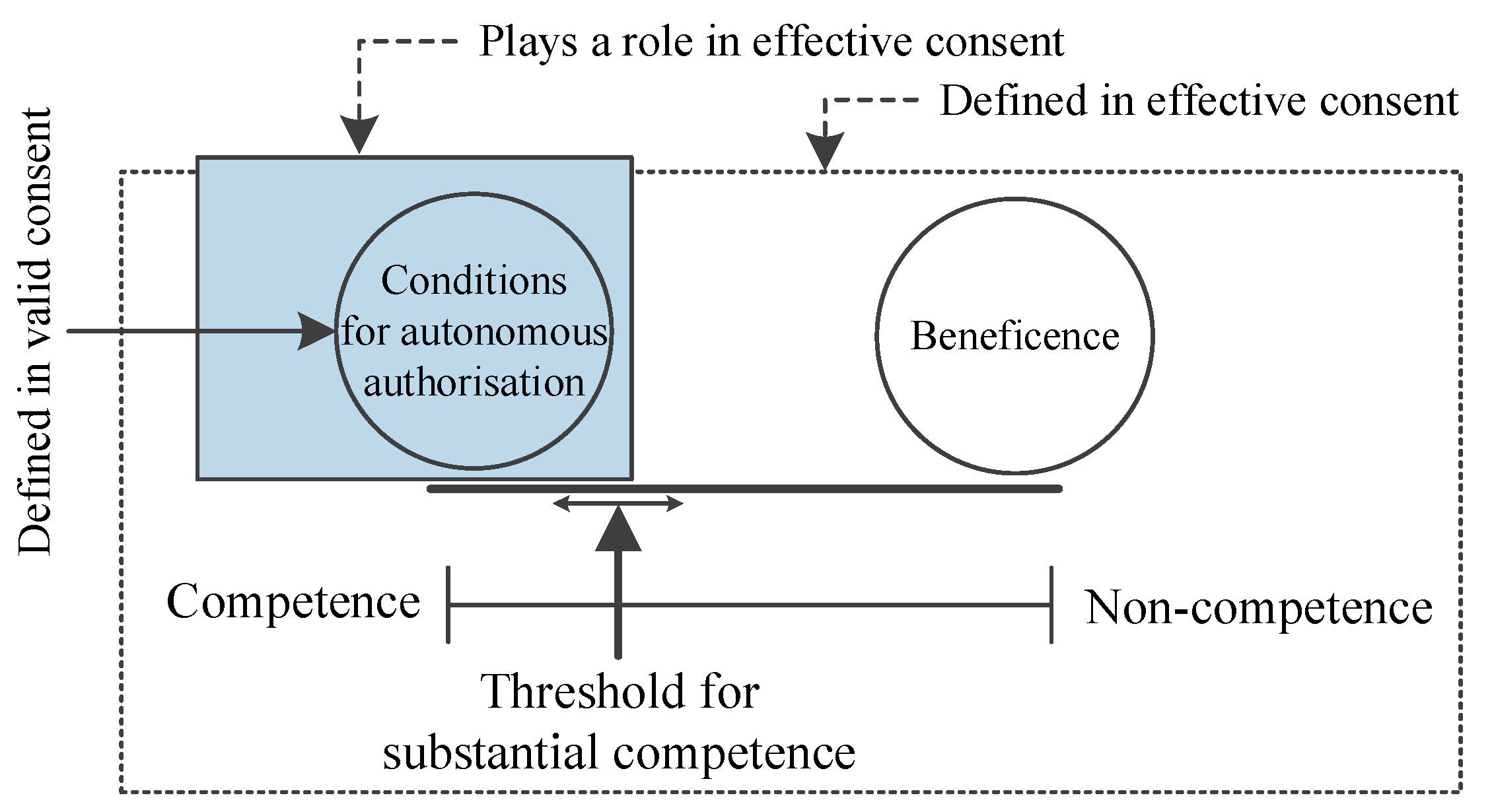
3.6.2. Beneficence and Paternalism in Consent
Quote 1. ‘…I[, the physician,] will follow that system of regimen which, according to my ability and judg[e]ment, I consider for the benefit of my patients, and abstain from whatever is deleterious and mischievous. I will give no deadly medicine to any one if asked, nor suggest any such counsel; and in like manner I will not give to a woman a pessary to produce abortion…’ [57].
3.6.3. Recent Shift to a Balance between Autonomy and Beneficence
3.6.4. A Contemporary Debate on the Role of Autonomy in Consent
3.6.5. Consent as a Construct Based on Autonomy and Beneficence
4. Consent as a Legal Construct Vis-à-Vis an Ethical Construct
4.1. Links between Consent as a Legal and an Ethical Construct
- The different ethical notions that justify the formation of governments over consenting collectives have influenced and were eventually manifested in the legal theory and law that nowadays legitimises the constitution of such legal mechanisms as statutory law.
- Regulatory and ethical tools like the Nuremberg Code, the Helsinki Declaration, the Belmont report [46], and others (e.g., [63,64]) have evolved into and contributed to the formation of the present legal theories of informed consent [3] (p. 59), [5] (p. vii), the legal doctrine of informed consent as applied in the US [5] (p. 12), and the legal doctrine as applied in such other common law jurisdictions as Australia, Canada, England, and Wales [65].
- The physician’s beneficence towards the patient as rooted in the Hippocratic approach to medicine has transcended to the legal doctrine of informed consent [5] (pp. 18–20, 148–149) and to such international, national, and organisational-level tools as laws, regulations, policies, standards, guidelines, codes of practice, procedures, and management systems; e.g., [3] (ch. 4–6), [50] (pp. 101–102).
4.2. Differences between Consent as a Legal and an Ethical Construct
- Responsibility and liability: the focus on responsibility and liability is stronger in legal than ethical consent and is reported to date back to the sixth century [2] (p. 9). It reflects the importance of the definition and assignment of legal responsibility and liability in the legal context. It also reflects that there are stronger links between legal rather than ethical consent and the legal doctrine of tort [65]. According to Berg et al. [5] (ch. 6) and Faden and Beauchamp [3] (pp. 25–30), in the US, it is the tort concept of liability that provides a consequential reason for medical professionals to participate in consent processes trustingly. For instance, if a physician fails to adequately balance beneficence with autonomy (e.g., by failing to override the patient’s autonomy in the case of patient incompetence), the professional could be civilly or criminally blameable, and hence liable, under one of the two predominant theories of liability, i.e.,: (1) battery, which is an intentional tort, or (2) negligence, which is an unintentional tort. In civil cases, such torts could enable the patient to obtain redress for damages resulting from unauthorised treatments.
- Visibility and enforceability: there is a focus, in legal consent, which is not as intense in the ethical counterparts, on what can be seen and therefore verified to have happened. This reflects the fact that mere philosophical distinctions between the legal and the illegal are unlikely to render legal prescriptions enforceable. For instance, from a practical perspective, it would be useless to make a philosophical distinction between intentionality and non-intentionality unless a court of law could use the distinction to determine the presence or absence of intentionality.
- Consent and the transformation of legal rights and duties: in tangential law, consent, as a legal construct, enables individuals to autonomously waive legal rights or agree to legal duties. For example, in the EU and the US, consent, as defined in online privacy legislation, enables a data subject to waive some of the data subject’s information privacy rights [48], [66] (ch. 1), [68] (ch. 13–14). Similarly, by the UK’s Theft Act of 1968, consent enables individuals to transfer valuable things to others and, therefore, to legalise actions that would otherwise constitute theft. As an example of the acceptance of a legal duty, in contract law, which can also be considered tangential in relation to consent, consent enables the parties to a contract to accept the relevant terms and conditions, which necessarily imply agreement to legal rights and duties [69] (ch. 3–11). Note that not all legal rights may be waived by consent. For instance, in most European countries, in England and Wales, a patient cannot legally waive his/her right to physical privacy for euthanasia.
- Links to contract law: the consensus, e.g., among Faden and Beauchamp [3] (p. 310), Bix [38] (p. 251), Gautrais [70], and Schuck [71] (p. 900), is that there are strong links between consent (more so as a legal than an ethical construct) and contract law. Such links are only tangential in the sense that the primary role of contract law is to facilitate legally enforceable promises, with the contractual parties’ consent to such promises constituting just one of many conditions for legally enforceable contracts.
5. The Requirements for Legal and Ethically Effective Consent
5.1. The Requirements Based on Faden and Beauchamp’s Theory
5.1.1. The Conditions for Valid Consent
The Condition of Substantial Understanding
- A differentiation between the ideas of ‘understanding that’ and ‘understanding what’.
- A distinction between ‘belief’ and ‘understanding’.
- A distinction between ‘true’ and ‘false’ belief.
- A distinction between ‘belief’ and ‘accurate interpretation’ contends that false beliefs do not necessarily hinder understanding if there is an accurate interpretation.
- The ambiguity related to the standards regarding the acceptability of beliefs as true or false.
- A distinction between ‘important’ and ‘unimportant information disclosures’.
- A distinction between ‘material’ and ‘relevant’ information, identifying the latter as what is needed for substantial understanding.
- A distinction between ‘objective’ and ‘subjective’ standards regarding the determination of the information that should be disclosed in relation to the object of consent.
- The role of ‘time’ and ‘timing’ in the patient’s understanding.
- The positive impact on the degree of ‘patient involvement’ in communication and decision-making in cases where the consent transaction is framed in a participatory process over an extended period.
- The role of emotion, cognitive capacity, and the physical state of an individual in the individual’s understanding.
- The impact of information framing on a patient’s understanding of that information.
- The role of the mechanisms that enable the authentication, measurement, or testing of the consent decision-makers understanding of the object of consent, especially in the context of research in consent management, e.g., questionnaires to test the patient’s understanding of the physician’s information disclosure on the risks and the benefits involved in the treatment proposed.
The Condition of Substantial Voluntariness
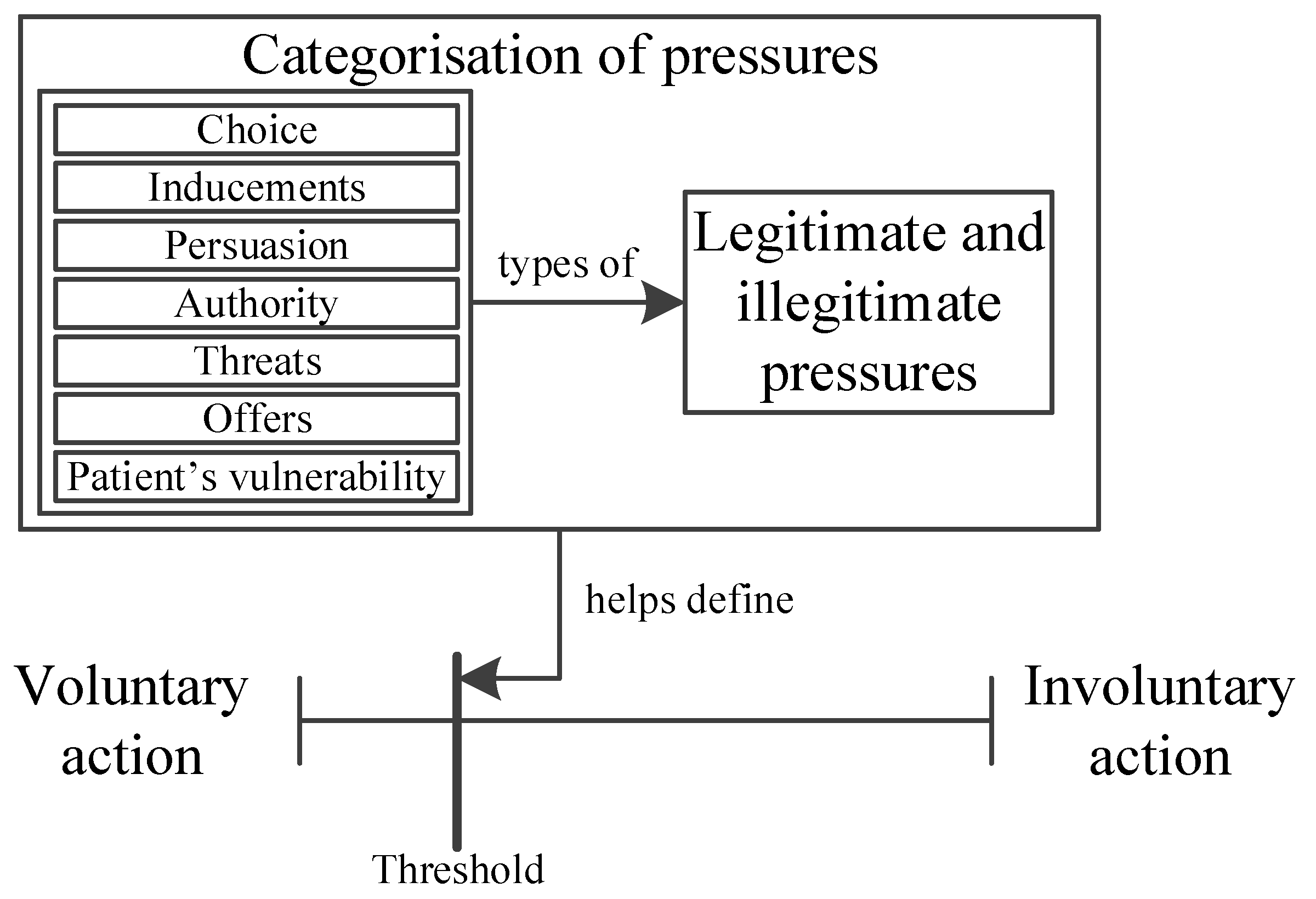
- The nature and role of ‘threats’ and ‘offers’ in the contexts of coercion and manipulation.
- The difference between ‘intentional coercion’ and ‘unintentional coercive situations’.
- ‘Resistibility’ as either an ‘objective’ or ‘subjective’ criterion distinguishing between coercive and non-coercive threats.
- The role of ‘warnings’ and ‘predictions’ in persuasion.
- The links between ‘reason’ and ‘justified belief’ in relation to persuasion.
- The idea of ‘self-persuasion’.
- The distinction between ‘manipulation of options’ and ‘manipulation of information’ is also referred to by Friedman et al. in [60].
- The idea of ‘psychological manipulation’.
- The intricate problem of ‘role constraints’.
The Condition of Intentionality
- If an agent, A, plans to do an action, B, with a conception, C, of how to do B, and A does B by accidentally causing an alternative conception, D, instead of C, then A accidentally and not intentionally does B. In alternative terms, if, upon reflection, A cannot say that A has done B in the planned manner C, then A has not acted intentionally [3] (pp. 242–243).
- If an agent, A, plans to do an action, B, with a conception, C, of how to do B, and A does C, which leads to an alternative action, D, instead of B, then A has accidentally and not intentionally done D. That is, if A substantially understands that C leads to B but C leads to D, then A has not acted intentionally in doing D [3] (p. 243).
- It may be argued that if an agent, A, does a sub-action, B, that A knows to involve another sub-action, C, with the intention of ultimately doing a primary action, D, then A intentionally does B and D, but not C. However, it may also be argued that C is intentional because it is ‘willed in accordance with a plan’ and that A’s motivation for C may reflect conflicting wants and desires. The latter argument reflects Faden and Beauchamp’s view [3] (p. 244) as expressed in their definition of intentional action: i.e., ‘…intentional action is action willed in accordance with a plan, whether the act is wanted or not…’ [3] (p. 243) 763.
- If an agent, A, does an action, B, which A does not know to involve a sub-action, C, then A does not intentionally do C [3] (p. 244) 765.
- ‘Intrinsic wanting’ is when an agent, A, wants to do an action, B because A wants B for its own sake [3] (p. 245) 767.
- ‘Instrumental wanting’ is when agent A wants to do action B to achieve goal C because A believes B to be the means to achieve the wanted goal C [3] (p. 245) 769.
- A ‘tolerated action’ is an intentional action A that agent B does not want or desire, all other things being equal, but tolerates to achieve a goal C. Note that others argue that tolerated actions are unintentional [3] (pp. 245–246).
- Although the condition of intentionality is defined as a dichotomy rather than a continuum construct, it is possible to conceptualise it differently. For instance, it is possible to define subtly different types of intentionality, like ‘willingness’ and ‘eagerness’ [3] (pp. 246–247).
5.1.2. Effective Consent
- A type of consent that should, but is not required to, maximise the satisfaction of the conditions for valid consent [3] (pp. 283–287).
- ‘…[A policy-oriented type of consent] analy[s]able in terms of the web of cultural and policy rules and requirements of consent that collectively form the social practice of informed consent in institutional contexts where groups of patients and subjects must be treated in accordance with rules, policies, and standard practices…’ [3] (pp. 277, 280).
5.2. The Requirements Based on the Theory Proposed by Berg et al. [5]
- A set of legal rules that prescribe behaviours for interactions between physicians and patients and that provide for penalties in the case of deviations from those rules.
- An ethical doctrine that is based on the value of autonomy and promotes the patients’ right to self-determination regarding medical treatment.
- An interpersonal process whereby physicians and patients interact with each other to select an appropriate course of medical care.
5.2.1. Autonomy-Based Conditions for Legally Effective Informed Consent
The Condition of Voluntariness
The Condition of Information Disclosure
- In most US jurisdictions, the physician considers the following properties of risk in deciding which information to disclose to the patient [5] (pp. 55–58): (1) the nature of the risk, (2) the magnitude of the risk, (3) the probability that the risk might materialise, and (4) the imminence of risk materialisation.
- In many jurisdictions, the disclosure of the benefits associated with the object of consent is considered crucial in circumstances where the procedures would be diagnostic rather than therapeutic or where the anticipated benefits would be something less than full relief of the patient’s suffering [5] (p. 61).
- In some jurisdictions, remote, minor, known, or common risks are exempt from mandatory disclosure.
- In some jurisdictions, statutes require that certain risks, such as those of brain damage, be mentioned by the physician, even if they are very unlikely to occur.
- In other jurisdictions, like the state of Texas, panels of physicians and lawyers are appointed to develop lists of the medical procedures and the risks that must be disclosed for each procedure [5] (pp. 57–58).
The Condition of Understanding
- The language used in the applicable judicial opinions often fails to distinguish between terms like ‘inform’, ‘disclose’, ‘tell’, ‘know’, and ‘understand’, causing uncertainty on the true nature of the obligations imposed.
- The courts appear uncertain as to the underlying purposes of the law. It could be primarily about choice, regardless of the nature of the subject’s understanding, or it could be about understanding per se.
- Although most legal cases do not expressly hold that the patients must understand the information disclosure before their decision may be considered legally valid, there is some support in dictum in the case law regarding incompetence for the view that the patients must understand.
5.2.2. Operationalisation of a Balance between Autonomy and Beneficence
- Incompetence: an exception based on the patient’s legal (in)competence; see also Section 5.2.3.
- Emergency: an exception based on the presumption that all patients consent in emergency cases, i.e., based on the view that reasonable persons would consent if they were able to do so [5] (pp. 76–79).
- Therapeutic privilege: a beneficence-based exception that enables the physician to hide relevant information from the patient if the disclosure would be harmful to the patient [5] (pp. 79–85).
- Autonomous waiving: an exemption based on the patient’s right to autonomously waive his/her own right to give autonomous consent, e.g., by authorising the physician to act as deemed appropriate [5] (pp. 85–90).
- Compulsory treatment: an exemption based on the view that it is not solely the individual’s health that plays a role in a consent decision but also society’s interest in protecting others, e.g., by treatment for the dangerous mentally ill or for patients with infectious diseases [5] (pp. 90–91).
5.2.3. The Exception of Incompetence
5.2.4. Liability and Responsibility
5.3. Requirements Based on Manson and O’Neill’s Theory
5.3.1. Two Metaphors of Information and Communication
5.3.2. Rejection of Faden and Beauchamp’s Theory
- The theory corresponds with the conduit/container metaphor [14] (p. 69) but the agency-based metaphor provides deeper and more plausible justifications of informed consent.
- While the theory is based on the ethical principle of autonomy, it should not.
- The justification of medical and research practice need not place sole or excessive weight on the notion of a balance between individual autonomy and beneficence.
5.3.3. Manson and O’Neill’s Theory
- Intelligibility: the consent requesters should use comprehensible language, making what is said intelligible.
- Relevance: the consent requesters should make information disclosures that are relevant to the audience in question, i.e., to the consent decision-maker/s.
- Truth and truthfulness: the consent requesters should accurately and honestly respect epistemic norms of truth and truthfulness to minimise deception.
- Voluntariness: no coercion, duress, force, or constraints should be used to limit the consent decision-maker’s voluntariness.
- Commitment: the claims about the proposed object of consent should be accompanied by the consent requester’s communication that s/he is committed to acting in accordance with the proposal if, and only if, the consent decision-maker consents.
5.3.4. Beneficence
5.3.5. Competence
5.3.6. Trust and Trustworthiness
- Accountability, liability, and transparency.
- Auditing, training, education, performance indicators, investigation, monitoring, disciplinary procedures, and self-regulation.
- The controlling, censuring, sanctioning, rewarding, redressing, ranking, and management of agents and institutions.
- Competence and risk.
- The ‘structure of accountability’.
5.4. Consensus on the Key Conditions for Legally and Ethically Effective Consent
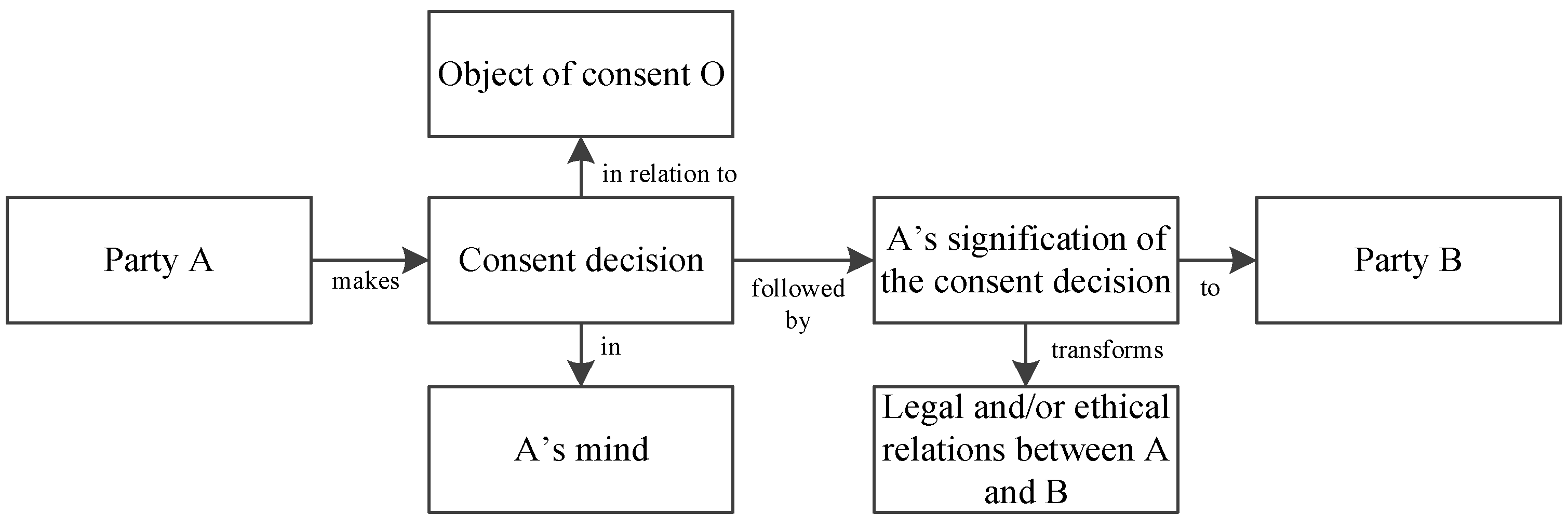
- Party A, who generally adopts the roles of information discloser, consent requester, and consent grantee, discloses information about the object of consent to party B, who normally adopts the roles of consent decision-maker, consent subject, and consent signifier.
- Party B: (1) comprehends the information disclosure made by party A, (2) consents voluntarily, (3) consents intentionally, (4) is sufficiently competent to consent, and (5) signifies agreement to party A.
6. A Novel Conceptual Model on Stances Relating to Consent Management
6.1. The Conceptual Model
6.2. Evaluation of the Conceptual Model
- Novelty: Does the construct say anything that is new or different?
- Relevance: Does the construct (e.g., a theory or conceptual model) address important issues?
- Clarity: Is the construct articulated clearly?
- Usefulness: Is the construct useful for teaching, practice, and research?
6.2.1. Mapping of Stances Underpinning Existing Contributions
6.2.2. Facilitation of Future Contributions
7. Conclusions
7.1. Theoretical Contributions
7.2. Practical Implications
7.3. Future Research
Author Contributions
Funding
Institutional Review Board Statement
Informed Consent Statement
Data Availability Statement
Conflicts of Interest
Abbreviations
| AI | Artificial Intelligence |
| CDA | Communications Decency Act |
| CIS | Computer Information Systems |
| EQ | Exploratory Question |
| EU | European Union |
| ICT | Information and Communications Technology |
| IoT | Internet of Things |
| LLM | Large Language Model |
| RQ | Research Question |
| US | United States |
References
- Johnston, D. A History of Consent in Western Thought. In The Ethics of Consent: Theory and Practice, 1st ed.; Miller, F.G., Wertheimer, A., Eds.; Oxford University Press Inc.: New York, NY, USA, 2010; Chapter 2; pp. 25–54. [Google Scholar]
- O’Shea, T. Consent in History, Theory and Practice; Green paper, Essex Autonomy Project; University of Essex: Colchester, UK, 2011. [Google Scholar]
- Faden, R.R.; Beauchamp, T.L. A History and Theory of Informed Consent, 1st ed.; Oxford University Press Inc.: New York, NY, USA, 1986. [Google Scholar]
- Flick, C. Informed Consent in Information Technology: Improving User Experience. Ph.D. Thesis, Charles Sturt University, Bathurst, Australia, 2009. [Google Scholar]
- Berg, J.W.; Appelbaum, P.S.; Lidz, C.W.; Parker, L.S. Informed Consent: Legal Theory and Clinical Practice, 2nd ed.; Oxford University Press Inc.: New York, NY, USA, 2001. [Google Scholar]
- Miller, F.G.; Wertheimer, A. Preface to a Theory of Consent Transactions: Beyond Valid Consent. In The Ethics of Consent: Theory and Practice, 1st ed.; Miller, F.G., Wertheimer, A., Eds.; Oxford University Press Inc.: New York, NY, USA, 2010; Chapter 4; pp. 79–105. [Google Scholar]
- Wertheimer, A. Consent to Sexual Relations, 1st ed.; Cambridge Studies in Philosophy and Law; Cambridge University Press: Cambridge, UK, 2003. [Google Scholar]
- Corrigan, O.; McMillan, J.; Liddell, K.; Richards, M.; Weijer, C. (Eds.) The Limits of Consent: A Socio-Ethical Approach to Human Subject Research in Medicine, 1st ed.; Oxford University Press Inc.: New York, NY, USA, 2009. [Google Scholar]
- Holzer, J.C.; Gansler, D.A.; Moczynski, N.P.; Folstein, M.F. Cognitive Informed Functions in the Consent Evaluation Process: A Pilot Study. J. Am. Acad. Psychiatry Law 1997, 25, 531–540. [Google Scholar] [PubMed]
- Ryan, R.M.; Lynch, M.F.; Vansteenkiste, M.; Deci, E.L. Motivation and Autonomy in Counseling, Psychotherapy, and Behavior Change: A Look at Theory and Practice. Couns. Psychol. 2011, 39, 193–260. [Google Scholar] [CrossRef]
- Jenkins, S.P.; Cappellari, L.; Lynn, P.; Jäckle, A.; Sala, E. Patterns of Consent: Evidence from a General Household Survey. J. R. Stat. Soc. Ser. A Stat. Soc. 2006, 169, 701–722. [Google Scholar] [CrossRef]
- Macintyre, M. Informed Consent and Mining Projects: A View from Papua New Guinea. Pac. Aff. 2007, 80, 49–65. [Google Scholar] [CrossRef]
- Herman, E.S.; Chomsky, N. Manufacturing Consent: The Political Economy of the Mass Media, 1st ed.; Vintage: London, UK, 1988. [Google Scholar]
- Manson, N.C.; O’Neill, O. Rethinking Informed Consent in Bioethics, 1st ed.; Cambridge University Press: Cambridge, UK, 2007. [Google Scholar]
- Miller, F.G.; Wertheimer, A. (Eds.) The Ethics of Consent: Theory and Practice, 1st ed.; Oxford University Press Inc.: New York, NY, USA, 2010. [Google Scholar]
- Beyleveld, D.; Brownsword, R. Consent in the Law, 1st ed.; Legal Theory Today; Hart Publishing: Portland, OR, USA, 2007. [Google Scholar]
- Xiao, B.; Benbasat, I. Product-related Deception in E-Commerce: A Theoretical Perspective. Manag. Inf. Syst. Q. 2011, 35, 169–195. [Google Scholar] [CrossRef]
- Wang, Q.; Jin, H. Decision Support for Patient Consent Management. In Proceedings of the 1st IEEE International Conference on Healthcare Informatics, Imaging and Systems Biology, San Jose, CA, USA, 26–29 July 2011; Boxwala, A., Chen, X.W., Duncan, J.S., Miyano, S., Tanveer, S.M., Eds.; IEEE Computer Society: Washington, WA, USA, 2011; pp. 142–149. [Google Scholar]
- Clarke, R. eConsent: A Critical Element of Trust in eBusiness. In Proceedings of the 15th Bled Electronic Commerce Conference eReality: Constructing the eEconomy, Bled, Slovenia, 17–19 June 2002; pp. 338–360. [Google Scholar]
- Song, H.; Win, K.H.; Croll, P. Patient E-Consent Mechanism: Models and Technologies. In Proceedings of the 7th Annual Conference on Electronic Commerce, Melbourne, Australia, 1–2 December 2002. [Google Scholar]
- Ruan, C.; Yeo, S. Modeling of an Intelligent e-Consent System in a Healthcare Domain. J. Univers. Comput. Sci. 2009, 15, 16. [Google Scholar]
- Grain, H. E-Consent Design and Implementation Issues for Health Information Managers. Health Inf. Manag. J. 2004, 33, 84–88. [Google Scholar] [CrossRef] [PubMed]
- Batchelor, R.; Bobrowicz, A.; Mackenzie, R.; Milne, A. Challenges of ethical and legal responsibilities when technologies’ users and users change: Social networking sites, decision-making capacity and dementia. Ethics Inf. Technol. 2012, 14, 99–108. [Google Scholar] [CrossRef]
- Whitley, E.A. Informational Privacy, Consent and the “Control” of Personal Data. Inf. Secur. Tech. Rep. 2009, 14, 154–159. [Google Scholar] [CrossRef]
- Fogg, B.J. Mass Interpersonal Persuasion: An Early View of a New Phenomenon. In Proceedings of the 3rd International Conference on Persuasive Technology, Oulu, Finland, 4–6 June 2008; Oinas-Kukkonen, H., Harjumaa, M., Segresåhl, K., Øhrstrøm, P., Eds.; Springer: Berlin/Heidelberg, Germany, 2008; Volume 5033, pp. 23–34. [Google Scholar]
- Stanford Behavior Design Lab. Available online: https://behaviordesign.stanford.edu (accessed on 8 January 2024).
- Coopamootoo, P.L.; Ashenden, D. Designing Usable Online Privacy Mechanisms: What Can We Learn From Real World Behaviour? In Proceedings of the 6th International PrimeLife/IFIP Summer School, Helsingborg, Sweden, 2–6 August 2010; Revised Selected Papers. Fischer-Hübner, S., Duquenoy, P., Hansen, M., Leenes, R., Zhang, G., Eds.; Springer: Berlin/Heidelberg, Germany, 2011; Volume 352, pp. 311–324. [Google Scholar]
- Lai, Y.L. The Malleability of Consumer Behavior: Experimental Studies of Presentation Formats on Consumer Choice and Perception. Ph.D. Thesis, National University of Singapore, Singapore, 2008. [Google Scholar]
- Boehner, K.; DePaula, R.; Dourish, P.; Sengers, P. How Emotion is Made and Measured. Int. J. Hum.-Comput. Stud. 2007, 65, 275–291. [Google Scholar] [CrossRef]
- Ubel, P.A.; Loewenstein, G. The Role of Decision Analysis in Informed Consent: Choosing between Intuition and Systematicity. Soc. Sci. Med. 1997, 44, 647–656. [Google Scholar] [CrossRef] [PubMed]
- Byrne, E.; Alexander, P.M. Questions of Ethics: Participatory Information Systems Research in Community Settings. In Proceedings of the 2006 Annual Research Conference of the South African Institute of Computer Scientists and Information Technologists on IT Research in Developing Countries, Somerset West, South Africa, 9–11 October 2006; pp. 117–126. [Google Scholar]
- Acquisti, A. Privacy in Electronic Commerce and the Economics of Immediate Gratification. In Proceedings of the 5th ACM Conference on Electronic Commerce, New York, NY, USA, 17–20 May 2004; Breese, J.S., Feigenbaum, J., Seltzer, M.I., Eds.; ACM: New York, NY, USA, 2004; pp. 21–29. [Google Scholar]
- Gürses, F.S. Multilateral Privacy Requirements Analysis in Online Social Network Services. Ph.D. Thesis, Katholieke Universiteit Leuven, Leuven, Belgium, 2010. [Google Scholar]
- Harper, D. Online Etymology Dictionary. Available online: http://www.etymonline.com (accessed on 8 January 2024).
- WordWeb Pro (v6.75): Dictionary, Thesaurus and Word Finder; Princeton University: Princeton, NJ, USA, 2012.
- Kleinig, J. The Nature of Consent. In The Ethics of Consent: Theory and Practice, 1st ed.; Miller, F.G., Wertheimer, A., Eds.; Oxford University Press Inc.: New York, NY, USA, 2010; Chapter 1; pp. 3–24. [Google Scholar]
- Beauchamp, T.L. Autonomy and Consent. In The Ethics of Consent: Theory and Practice, 1st ed.; Miller, F.G., Wertheimer, A., Eds.; Oxford University Press Inc.: New York, NY, USA, 2010; Chapter 3; pp. 55–78. [Google Scholar]
- Bix, B.H. Contracts. In The Ethics of Consent: Theory and Practice, 1st ed.; Miller, F.G., Wertheimer, A., Eds.; Oxford University Press Inc.: New York, NY, USA, 2010; Chapter 10; pp. 251–279. [Google Scholar]
- Friend, C. Social Contract Theory. Available online: http://www.iep.utm.edu/soc-cont (accessed on 8 January 2024).
- D’Agostino, F.; Gaus, G.; Thrasher, J. Contemporary Approaches to the Social Contract. Available online: http://plato.stanford.edu/archives/win2012/entries/contractarianism-contemporary (accessed on 8 January 2024).
- Burgess, M.; Tansey, J. Cultural Authority of Informed Consent: Indigenous Participation in Biobanking and Salmon Genomics Focus Groups. In The Limits of Consent: A Socio-Ethical Approach to Human Subject Research in Medicine, 1st ed.; Corrigan, O., McMillan, J., Liddell, K., Richards, M., Weijer, C., Eds.; Oxford University Press Inc.: New York, NY, USA, 2009; Chapter 12; pp. 199–211. [Google Scholar]
- Kaliouby, R.E.; Robinson, P. Mind Reading Machines: Automated Inference of Cognitive Mental States from Video. In Proceedings of the IEEE International Conference on Systems, Man & Cybernetics, The Hague, The Netherlands, 10–13 October 2004; IEEE: New York, NY, USA, 2004; pp. 682–688. [Google Scholar]
- Domes, G.; Heinrichs, M.; Michel, A.; Berger, C.; Herpertz, S.C. Oxytocin Improves “Mind-Reading” in Humans. Biol. Psychiatry 2007, 61, 731–733. [Google Scholar] [CrossRef] [PubMed]
- Friedman, B.; Felten, E.; Millett, L.I. Informed Consent Online: A Conceptual Model and Design Principles; Technical Report 00-12-2; Computer Science & Engineering; University of Washington: Washington, WA, USA, 2000. [Google Scholar]
- Friedman, B.; Howe, D.C.; Felten, E. Informed Consent in the Mozilla Browser: Implementing Value-Sensitive Design. In Proceedings of the 35th Hawaii International Conference on System Sciences, Big Island, HI, USA,, 7–10 January 2002; IEEE Computer Society: Washington, WA, USA , 2002; Volume 8, pp. 247–256. [Google Scholar]
- The National Commission for the Protection of Human Subjects of Biomedical and Behavioral Research. The Belmont Report. Available online: http://www.hhs.gov/ohrp/humansubjects/guidance/belmont.html (accessed on 8 January 2024).
- Mifsud Bonnici, J.P. The Concept of Consent in the Protection of Informational Privacy. In Proceedings of the 4th Annual Network Conference on Human Rights, Göttingen, Germany, 15–16 September 2011. [Google Scholar]
- Proposal for a Regulation of the European Parliament and of the Council: On the Protection of Individuals with Regard to the Processing of Personal Data and on the Free Movement of Such Data (General Data Protection Regulation); Technical Report COM(2012); 11 Final; European Commission: Brussels, Belgium, 2012.
- How will the Data Protection Reform Affect Social Networks? 2011. Available online: https://www.cpdp.bg/userfiles/file/Reform/Reform_3_en.pdf (accessed on 6 January 2024).
- Dawson, A. The normative status of the requirement to gain an informed consent in clinical trials: Comprehension, obligations, and empirical evidence. In The Limits of Consent: A Socio-Ethical Approach to Human Subject Research in Medicine, 1st ed.; Corrigan, O., McMillan, J., Liddell, K., Richards, M., Weijer, C., Eds.; Oxford University Press Inc.: New York, NY, USA, 2009; Chapter 6; pp. 99–113. [Google Scholar]
- Friedman, B.; Peter, H.K., Jr.; Borning, A. Value Sensitive Design: Theory and Methods; Technical Report 02-12-01; Computer Science & Engineering; University of Washington: Washington, WA, USA, 2001. [Google Scholar]
- Friedman, B.; Kahn, P.H., Jr. Human Values, Ethics, and Design. In The Human-Computer Interaction Handbook: Fundamentals, Evolving Technologies and Emerging Applications (Human Factors and Ergonomics), 1st ed.; Jacko, J.A., Sears, A., Eds.; L. Erlbaum Associates Inc.: Mahwah, NJ, USA, 2002; Chapter 61; pp. 1177–1201. [Google Scholar]
- Friedman, B. (Ed.) Human Values and the Design of Computer Technology, 1st ed.; Number 72 in CSLI Lecture Notes; Cambridge University Press: Cambridge, UK, 1997. [Google Scholar]
- Friedman, B.; Kahn, P.H.; Borning, A. Value Sensitive Design and Information Systems. In The Handbook of Information and Computer Ethics, 1st ed.; Himma, K.E., Tavani, H.T., Eds.; John Wiley & Sons, Inc.: Hoboken, NJ, USA, 2008; Chapter 4; pp. 69–101. [Google Scholar]
- Friedman, B.; Hendry, D.; Borning, A.; Zolyomi, A.; Caliskan, A.; Bender, E.; Yip, J.; Zaretzky, J.; Teodorescu, M.; Dors, N.; et al. Value Sensitive Design: Research Lab. Available online: http://www.vsdesign.org (accessed on 6 January 2024).
- Balchin, J. Science: 100 Scientists Who Changed the World, 1st ed.; Arcturus Publishing Limited: London, UK, 2003. [Google Scholar]
- Adams, F. The Oath, by Hippocrates. Available online: http://classics.mit.edu/Hippocrates/hippooath.html (accessed on 8 January 2024).
- DuBois, J.M. Rethinking Informed Consent in Bioethics. J. Am. Med. Assoc. 2007, 298, 2799–2800. [Google Scholar] [CrossRef]
- Kay, M.; Terry, M. Textured Agreements: Re-envisioning Electronic Consent. In Proceedings of the 6th Symposium On Usable Privacy and Security, SOUPS 2010, Washington, WA, USA, 14–16 July 2010; ACM: New York, NY, USA, 2010. [Google Scholar]
- Friedman, B.; Lin, P.; Miller, J.K. Informed Consent by Design. In Security and Usability: Designing Secure Systems that People Can Use, 1st ed.; Cranor, L.F., Garfinkel, S., Eds.; Theory in Practice; O’Reilly Media Inc.: Sebastopol, CA, USA, 2005; Chapter 24; pp. 503–530. [Google Scholar]
- Bonnici, C.J.; Coles-Kemp, L. Principled Electronic Consent Management: A Preliminary Research Framework. In Proceedings of the International IEEE Conference on Emerging Security Technologies, Canterbury, UK,, 6–8 September 2010; Howells, G., Sirlantzis, K., Stoica, A., Huntsberger, T., Arslan, T., Eds.; Conference Publishing Services. IEEE: New York, NY, USA, 2010; pp. 119–123. [Google Scholar]
- Bonnici, C.J. An Extended Conceptual Model of Consent for Information Systems. In Proceedings of the 26th IEEE International Symposium on Computer-Based Medical Systems, Porto, Portugal, 20–22 June 2013; Rodrigues, P.P., Pechenizkiy, M., Gama, J., Correia, R.C., Liu, J., Traina, A., Lucas, P., Soda, P., Eds.; IEEE Computer Society: Washington, WA, USA, 2013; pp. 149–154. [Google Scholar]
- Council for International Organizations of Medical Sciences. Available online: http://www.cioms.ch (accessed on 8 January 2024).
- International Conference on Harmonisation. Available online: http://www.ich.org (accessed on 8 January 2024).
- Earle, M. The Future of Informed Consent in British Common Law. Eur. J. Health Law 1999, 6, 235–248. [Google Scholar] [CrossRef]
- Solove, D.J. Understanding Privacy, 1st ed.; Harvard University Press: Cambridge, MA, USA, 2009. [Google Scholar]
- Solove, D.J. A Taxonomy of Privacy. Univ. Pa. Law Rev. 2006, 154, 477–564. [Google Scholar] [CrossRef]
- Westin, A.F. Privacy and Freedom, 1st ed.; Atheneum: New York, NY, USA, 1967. [Google Scholar]
- Maclntyre, E. Business Law, 3rd ed.; Pearson Education Inc.: Essex, UK, 2007. [Google Scholar]
- Gautrais, V. The Colour of E-Consent. Univ. Ott. Law Technol. J. 2003, 1, 189–212. [Google Scholar]
- Schuck, P.H. Rethinking Informed Consent. Yale Law J. 1994, 103, 899–959. [Google Scholar] [CrossRef] [PubMed]
- Alter, S. Work System Theory: Overview of Core Concepts, Extensions, and Challenges for the Future. J. Assoc. Inf. Syst. 2013, 14, 72–121. [Google Scholar] [CrossRef]





| Stance | C. Flick | ||
|---|---|---|---|
| Ontological stances | Individual consent | -- | The focus of Flick’s theory is on individual rather than collective consent. |
| Collective consent | -- | ||
| Psychological consent | -- | The focus of Flick’s theory is on consent as both a psychological phenomenon and a performative act. | |
| Performative consent | -- | ||
| Psycho-performative consent | -- | ||
| Permissive consent | -- | The focus of Flick’s theory is on permissive rather than originating consent. | |
| Originating consent | -- | ||
| Disciplinary stances | Discipline hosting/contributing the consent-related construct | Law | Flick’s theory is a contribution in ethics, which is largely based on Manson and O’Neill’s theory, which is another contribution in ethics or, more specifically, in bioethics. |
| Ethics | |||
| Other | |||
| Discipline using the consent-related construct | Ethics | Flick’s theory, as the contribution using Manson and O’Neill’s theory, is a contribution in ethics. However, the theory is intended for Information Technology contexts. | |
| CIS | |||
| Other | |||
| Contextual stances | Application context relating to the consent construct being used | Health care | Manson and O’Neill’s thery is intended for health care and clinical research contexts. |
| Clinical research | |||
| Other | |||
| The context in which the consent construct is applied | E-health care | Flick’s theory is intended for use in ethics and Information Technology. | |
| On-line social media services | |||
| Other | |||
| The right being waived by means of the consent | Bodily privacy | While Manson and O’Neill’s theory relates, primarily, to bodily privacy, Flick’s theory relates to information privacy. | |
| Information privacy | |||
| Theoretical stances | Faden and Beauchamp’s theory | -- | Flick’s theory is based on Manson and O’Neill’s theory. Flick, Manson, and O’Neill made refutations of Faden and Beauchamp’s autonomy-based theory. |
| Berg et al.’s theory | -- | ||
| Manson and O’Neill’s theory | -- | ||
| Other | -- | ||
| Conceptual stances | Non-autonomy | -- | Flick, Manson, and O’Neill attempted to refute the notion of consent as an autonomy-based construct, but the extent of their success is debatable. Overall, their theories are based on autonomy. |
| Autonomy | -- | ||
| Autonomy and Beneficence | -- | ||
Disclaimer/Publisher’s Note: The statements, opinions and data contained in all publications are solely those of the individual author(s) and contributor(s) and not of MDPI and/or the editor(s). MDPI and/or the editor(s) disclaim responsibility for any injury to people or property resulting from any ideas, methods, instructions or products referred to in the content. |
© 2024 by the authors. Licensee MDPI, Basel, Switzerland. This article is an open access article distributed under the terms and conditions of the Creative Commons Attribution (CC BY) license (https://creativecommons.org/licenses/by/4.0/).
Share and Cite
Bonnici West, C.; Grima, S. A Review of the Consent Management Literature. Information 2024, 15, 79. https://doi.org/10.3390/info15020079
Bonnici West C, Grima S. A Review of the Consent Management Literature. Information. 2024; 15(2):79. https://doi.org/10.3390/info15020079
Chicago/Turabian StyleBonnici West, Christian, and Simon Grima. 2024. "A Review of the Consent Management Literature" Information 15, no. 2: 79. https://doi.org/10.3390/info15020079
APA StyleBonnici West, C., & Grima, S. (2024). A Review of the Consent Management Literature. Information, 15(2), 79. https://doi.org/10.3390/info15020079