


Abstract
To cover a wider variety of specific aspects of spirituality, which are of relevance also in secular societies, the ASP (“Aspects of Spirituality”) questionnaire was developed. While it was used so far with healthy adults and with adolescents living in a secular society, it was meanwhile used also with Polish students who were predominantly Catholic. Here we compare the factorial structure of the ASP questionnaire in a sample of 871 German (73% non-religious) and 1,017 Polish adolescents/young adults (50% non-religious despite their Catholic denomination). The factorial structure of the ASP questionnaire with its four scales Religious Orientation: Prayer/Trust in God, Search for Insight/Wisdom, Conscious interactions/Compassion, Transcendence Conviction, were similar in the sample of German students and in the Polish students. By means of confirmatory factor analysis (CFA) we were able to use the number of items of the ASP in its student version (ASP-Students). Overall, the instrument is suited to measure a wide variety of vital aspects of spirituality, both religious and secular forms of spirituality. As the instrument avoids exclusive language and operationalizes also non-formal aspects of spirituality in terms of relational consciousness, it is suited, not only for individuals with a skeptical or a-religious attitude, but also for religious individuals.
1. Background
There is a long debate about the relevance of spirituality and/or religiosity in Western societies with a declining interest in institutional religiosity. Several regard the concept of spirituality as an individual, more open and pluralistic approach than formal religiosity. William James (1842–1910) was one of the pioneers to differentiate between institutional religiosity on the one hand and personal religiosity on the other [1]. Later on, Gordon Allport (1897–1967) differentiated extrinsic religiosity and intrinsic religiosity [2,3]. In fact, particularly in Western societies, spirituality is either regarded as a broader concept, which may include private religiosity, or as the counterpart of institutional religiosity [4,5,6]. Depending on the scientific discipline, the definitions of spirituality/religiosity may vary, and often refer to theoretical constructs, which are not necessarily shared by the general population in more secular societies. Particularly, in Western societies there seems to be a decline of interest in traditional Christian issues on the one hand and in turn a growing interest in Eastern spiritual traditions on the other hand [7]. Nevertheless, even individuals who would regard themselves as non-religious and non-spiritual (R−S−) may have specific spiritual and religious needs [8], and, thus, one has to carefully consider what spirituality may mean to them. Is it a matter of meaning finding, a matter of deeper relations to others and/or nature, a matter of specific spiritual practices without accepting the underlying religious implications, a matter of a faithful involvement in their own religious traditions, etc.? Therefore, one has to ask which aspects of spirituality are still vital, and which aspects were regarded as less relevant. This has to be addressed both in secular and in religious societies.
There are several established instruments to measure spirituality and/or religiosity in their unique context [6,9]. These instruments differ not only with respect to the underlying concepts of spirituality/religiosity, but also with respect to the underlying categories (i.e., intensity of spiritual/religious attitudes/convictions; intensity of experiences; frequency of practices/activities; etc.). Although there is a debate whether or not it is useful to distinguish spiritual and religious issues for research [4], particularly in Western societies, it seems to be of relevance to differentiate aspects of formal religiosity, transcendence experience, existential search for meaning, secular humanism, etc. [9]. Among the instruments to measure the intensity of spiritual/religious attitudes, convictions and experiences one may find the 5-item Duke Religion Index (DRI/DUREL) [10], the 15-item System of Belief Inventory (SBI) [11], the 16-item Daily Spiritual Experience Scale (DSES) [12], and the 25-item Aspects of Spirituality questionnaire (ASP) [13,14], which was developed to address these issues also in secular societies. This ASP questionnaire will be further described in detail.
2. Development of the Aspects of Spirituality (ASP) Questionnaire
To cover a wide variety of important aspects of spirituality beyond conceptual boundaries, we have performed an expert survey among 38 individuals from different religious and non-religious affiliations (i.e., Catholics, Protestants, members of the Anthroposophic “Christengemeinschaft”, Bahá´í, Muslims, Jews, Buddhists, and atheists), and asked for their individual view of spirituality and its individual expression in their lives [15]. These statements revealed that the individual concepts of spirituality depend on the contextual world-view and refer to an immaterial, not sensual comprehensible truth (God, “presence”, “powers”), which nevertheless might be experienced and can be an orientation in life [15].
Among these statements, nine relevant topics could be identified: Meaning of life; Ethical norms and perfection; Rituals and practices; Implementation in daily life; Conviction of a pre-/post-existence of man and existence of non-physical higher beings; Experience of unity and Conscious interaction with nature/environment; Reverence and respect; Trust in and turning to God; Search for insight and comprehensive wisdom [15].
2.1. First Version of the Aspects of Spirituality Questionnaire (ASP Version 1.0)
To quantify cognitive, emotional, intentional and concrete activities of theism/belief, pantheism/transcendence, existentialism, humanism, etc., the identified motifs were condensed to 40 items of the ASP (“Aspects of Spirituality”) questionnaire [13]. All items were scored on a five-point scale from disagreement to agreement (0—does not apply at all; 1—does not truly apply; 2—don’t know (neither yes nor no); 3—applies quite a bit; 4—applies very much). The mean scores were referred to a 100% level (4 “applied very much” = 100%). Scores > 60 would indicate a high relevance of the respective aspect of spirituality for the individual, while scores < 40 would indicate a low relevance; scores between 40 and 60 would indicate an indifferent attitude.
This first version was tested among 488 healthy individuals (63% women; mean age: 49.2 ± 13.9; 64% high school education; 73% Christians). Exploratory factor analysis pointed to seven underlying factors [13], i.e.,
- (1).
- Prayer, trust in God and shelter (11 items; alpha = .92);
- (2).
- Insight, awareness and wisdom (9 items; alpha = .87);
- (3).
- Transcendence conviction (5 items; alpha = .85);
- (4).
- Compassion, generosity and patience (5 items; alpha = .76);
- (5).
- Conscious interactions (4 items; alpha = .75);
- (6).
- Gratitude, reverence and respect (3 items; alpha = .58);
- (7).
- Equanimity (3 items; alpha = .68).
These topics are in accordance with the five domains of Martsolf and Mickley [16], i.e., Meaning; Values; Transcendence; Connecting; Becoming.
However, the internal reliability of the factors 6 and 7 was low, and, thus, they were not used in the further development of the instrument.
2.2. Second Version of the Aspects of Spirituality Questionnaire (ASP Version 2.1)
In an attempt to reduce the number of items and focus on the main relevant dimensions, the ASP questionnaire was then tested in a sample of 988 healthy individuals (52% female; mean age: 43.2 ± 15.5; 80% high school education; 80% Christian denomination) and 254 high school students (51% female; mean age was 16.6 ± 0.72 years; 92% Christians). In this sample, the 25-item instrument had a very good internal consistency (Cronbach’s alpha = .94) and differentiated four factors which would explain 64.6% of variance [14], i.e.,
- (1).
- Religious orientation: Prayer / Trust in God (9 items; alpha = .93; religious views);
- (2).
- Search for Insight / Wisdom (7 items; alpha = .88; philosophical/existential views);
- (3).
- Conscious interactions (5 items; alpha = .83; relational views);
- (4).
- Transcendence conviction (4 items; alpha = .85; non-Christian spiritual views).
Due to the reduction of items, the former scales “Compassion, generosity, and patience” and “Conscious interactions” were combined to the new scale Conscious interactions. However, in the sub-sample of 254 high school students, both the factor Search for Insight / Wisdom and, also, the new factor Conscious interaction had two sub-constructs each [14].
2.3. Validity of the Instrument
What are the specific findings that further show the validity of the ASP in its version 2.1?
In healthy adolescents, those who regard themselves as neither religious nor spiritual (R−S−) had the lowest scores for all aspects of spirituality, particularly for Religious orientation: Prayer/Trust in God and, also, Transcendence conviction. The scales Search for Insight/Wisdom and Transcendence conviction scored highest in students with a spiritual attitude (R+S+ and R−S+), while Conscious interactions and Religious orientation: Prayer/Trust in God were highest in those who would describe themselves as religious (R+S+ and R+S−) [14].
With respect to students’ voluntary helping, which can but must not have a religious connotation, Religious orientation: Prayer/Trust in God (r = .33), and also both Conscious Interactions subscales (Compassion/Generosity with r = .30, and Conscious Interactions with r = .24) correlated with students’ concrete (voluntary) service toward others [17]. Refering to the relational and compassionate aspects of spirituality, this attitude of voluntary engagement for others is plausible.
With respect to discriminant validity, only the sub-scale Conscious Interactions was moderately associated with students’ life satisfaction (BMLSS; r = .30), and weakly with self-efficacy expectation (SWE; r = .22) and self-esteem (SES; r = .22), while all other ASP scales were either not or only marginally associated [17]. As one may expect, it is particularly the item which addresses “Conscious interaction with myself” that is correlated with these “self” measures.
3. Factorial Structure of the ASP in German and Polish Students
Thus far, the instrument was used only in individuals from a secular society. Here, age had a significant (and positive) influence on the ASP scores, and, thus, one may either conclude that the specific aspects of spirituality become more and more important during the course of life, or that the younger generation in such societies has lost interest in specific religious issues. In fact, particularly Religious orientation: Prayer/Trust in God and Transcendence conviction scored very low in individuals <30 years of age, indicating no interest, while Search for Insight/Wisdom and Conscious interactions scored high also in the younger individuals, which means that relational and existential forms of secular spirituality are of stronger relevance to them [14]. It might be that the relevance of the different aspects of spirituality is different in individuals from more religious and less secular societies.
Therefore, we intended to apply this instrument to high school students from Poland (which has been a predominantly Catholic society), and to compare both the factorial structure and the pattern of spirituality with a sample of high school students from Germany. We will show that the factorial structure of the ASP questionnaire was more or less similar in the sample of German students on the one hand, that confirmatory factor analysis of both samples resulted in a further reduction of the item number of the students’ version of the ASP (ASP-Students), and that the mean scores of the respective factors differ in both samples.
3.1. Participants
The German students (n = 871) were recruited in academic high schools, business schools, and private (Kolping) education centers of the state Baden-Württemberg. The Polish students (n = 1,017) were recruited from different middle schools in districts of Warsaw and Bialystok.
Poland, which is predominantly Catholic, is situated in an area of cultural and religious borderland, in the sphere of Latin and Greek-Slavonic influence but with different influences from communist ideology and recently from a lasting, stronger impact of secularization processes. In contrast, Germany is predominantly Protestant in the Northern parts, predominantly Catholic in the Southern parts, and, due to the influence of the communist ideology in the former German Democratic Republic, predominantly atheistic/secular in the Eastern parts; however, the fraction of atheistic/skeptical individuals is increasing in all areas of Germany.
Students´ basic socio-demographic data, religious denomination and spiritual/religious self-categorization are depicted in Table 1. With respect to denomination, most Polish students are Catholics, while German students are either Catholic or Protestant. Moreover, Polish and German students significantly differed with respect to the spiritual religious self categorization (Table 1), i.e., a majority of German students would regard themselves as neither religious nor spiritual (R−S−), while a majority of Polish students would regard themselves as either religious and spiritual (R+S+) or as neither religious nor spiritual (R−S−).
The questionnaires in the respective languages were distributed by the respective teachers of the participating school classes. All provided their informed consent to participate and completed the anonymous questionnaires by themselves. The items of the respective instruments were translated by a bilingual scientist, and critically discussed with a committee of Polish psychologists, and also with the primary author of the ASP. Because cultural equivalence is not guaranteed, the team decided to avoid the back-translation procedure. Instead, unclear phrases were discussed and adjusted (with respect to cultural specifics and with reference to the intended construct) to achieve the best-fitting translation suited for the Polish context.

Table 1.
Characteristics of German and Polish adolescents and young adults.
| German sample | Polish sample | |
|---|---|---|
| Number | 871 | 1,017 |
| Mean age (years) | 19.1 ± 2.5 | 18.0 ± 4.6 |
| Gender (%) * | ||
| Religious denomination (%) | ||
| Spiritual / religious self categorization (%) ** |
Notes: * Percentages are rounded, and thus the total number might be 101% in some cases; ** According to the responses to the items f2.6 (“To my mind I am a religious individual” = R) and f1.1 (“To my mind I am a spiritual individual” = S), which were derived from the SpREUK questionnaire [18,19], the students were categorized as both religious and spiritual (R+S+), religious but not spiritual (R+S−), as not religious but spiritual (R−S+), or as neither religious nor spiritual (R−S−) [18,19]. The respective items were scored on a 5-point scale from disagreement to agreement (0—does not apply at all; 1—does not truly apply; 2—don’t know (neither yes nor no); 3—applies quite a bit; 4—applies very much). To avoid internal conflicts, we did not provide information how a religious or a spiritual individual should be defined.
3.2. Factorial Structure in the German Sample
Within the German sample of adolescents and young adults, factor analysis pointed to five sub-scales (three main and two minor factors with respect to the eigenvalues, i.e., characteristic roots), which would explain 60% of variance (Table 2). The respective items load on the same factors as described before [14]. However, in contrast to adults [14], again the items of the five-item factor Conscious interactions diverged in two sub-constructs, one dealing with the three conscious interaction items (alpha = .73) and one dealing with the two items addressing compassion and generosity (alpha = .67) (Table 2). Particularly, the item addressing conscious interactions with others would load strongly also on the Compassion/Generosity sub-construct. A putative four-factor solution would restore the five-item factor Conscious interactions (alpha = .74); however, then item s19 (“Convinced that man is a spiritual being”) from the factor Transcendence conviction would load weakly (<.40) on three different factors. Thus, the five-factor solution is regarded as more suitable. Optionally, one may use the two sub-constructs of the factor Conscious interactions as one scale.
Table 2.
Factors of the ASP questionnaire Version 2.2 (25 items)—German sample.
| Mean | SD | Difficulty Index (2.22/4 = 0.56) | Corrected Item-Total Correlation | Cronbach’s alpha if item deleted | Factor loading | ||||||
|---|---|---|---|---|---|---|---|---|---|---|---|
| I | II | II | IV | IV | |||||||
| eigenvalue | 7.6 | 2.8 | 2.3 | 1.2 | 1.0 | ||||||
| 1. Religious Orientation: Prayer/Trust in God (eigenvalue = 7.6; alpha = .91) | |||||||||||
| Action | s36 Praying for myself and own concerns | 1.73 | 1.50 | 0.43 | .650 | .898 | .853 | ||||
| Emotion | s03 Trust in and turn to God | 1.75 | 1.38 | 0.44 | .681 | .897 | .847 | ||||
| Action | s35 Praying for others | 1.73 | 1.50 | 0.43 | .644 | .898 | .835 | ||||
| Intention | s39 Trying to express the Divine in the creation | 1.02 | 1.13 | 0.26 | .660 | .898 | .776 | ||||
| Emotion | s04 Feeling guided and sheltered | 1.90 | 1.21 | 0.48 | .651 | .898 | .749 | ||||
| Cognition | s33 Having a spiritual orientation in life | 1.77 | 1.29 | 0.44 | .696 | .897 | .683 | ||||
| Action | s37 Reading religious or spiritual books | 0.99 | 1.27 | 0.25 | .538 | .901 | .657 | ||||
| Emotion | s40 Do not feel alone, even when no one is with me | 2.87 | 1.41 | 0.72 | .596 | .899 | .622 | ||||
| Action | s38 Performing distinct rituals | 1.38 | 1.33 | 0.35 | .555 | .900 | .593 | ||||
| 2. Search for Insight/Wisdom (eigenvalue = 2.8; alpha = .83) | |||||||||||
| Action | s11 Aspiring to insight („Erkenntnis“) and truth | 2.81 | 1.09 | 0.70 | .453 | .902 | .784 | ||||
| Action | s13 Aspiring to broad awareness | 2.72 | 1.03 | 0.68 | .448 | .902 | .747 | ||||
| Intention | s10 Trying to develop wisdom | 2.44 | 1.16 | 0.61 | .411 | .903 | .673 | ||||
| Intention | s14 Life is a search and question for answers | 2.35 | 1.16 | 0.59 | .364 | .904 | .638 | ||||
| Action | s15 Searching for deep insight (“Einsicht”) in fabric of life | 2.17 | 1.17 | 0.54 | .481 | .902 | .632 | ||||
| Intention | s16 Trying to achieve frankness/wideness of the spirit | 1.88 | 1.25 | 0.47 | .577 | .900 | .609 | .346 | |||
| Action | s12 Aspiring to beauty and goodness | 2.49 | 1.07 | 0.62 | .337 | .904 | .595 | ||||
| 3. Transcendence conviction (eigenvalue = 1.3; alpha = .74) | |||||||||||
| Cognition | s08 Convinced of a rebirth of man (or his soul) | 1.82 | 1.37 | 0.46 | .438 | .903 | .713 | ||||
| Cognition | s06 Convinced of existence of higher powers and beings | 2.42 | 1.33 | 0.61 | .590 | .899 | .364 | .656 | |||
| Cognition | s05 Soul has his origin in a higher dimension | 1.82 | 1.36 | 0.46 | .631 | .898 | .420 | .642 | |||
| Cognition | s19 Convinced that man is a spiritual being | 2.49 | 1.19 | 0.62 | .511 | .901 | .304 | .510 | |||
| 4. Conscious interactions/Compassion (eigenvalue = 2.3; alpha = .74) | |||||||||||
| Intention | s28 Trying to develop compassion | 3.15 | 0.90 | 0.79 | .358 | .904 | .769 | ||||
| Intention | s26 Trying to practice generosity | 2.94 | 0.86 | 0.74 | .223 | .906 | .759 | ||||
| Action | s21 Conscious interaction with myself | 2.92 | 0.97 | 0.73 | .209 | .906 | .804 | ||||
| Action | s22 Conscious interaction with others | 3.21 | 0.77 | 0.80 | .248 | .905 | .520 | .643 | |||
| Action | s23 Conscious interaction with environment | 2.82 | 0.91 | 0.71 | .258 | .905 | .460 | .588 | |||
Notes: Cronbach’s alpha = .905, Kaiser-Meyer-Olkin measure = .908; Principal Component Analysis; Varimax Rotation with Kaiser Normalization (rotation converged in 7 Iterations); 59.7% explained variance; Factor loadings < .3 are not depicted.
3.3. Factorial Structure in the Polish Sample
In addition, within the Polish sample of adolescents and young adults, primary factor analysis pointed to a five-factor solution. Here, two items had to be removed from the item pool, i.e., item s04 (“Feeling guided and sheltered”) because of a weak factor loading (<.40), and item s10 (“Trying to develop wisdom”) due to its negative loading as an independent 5th factor. After removing these two items, a four-factorial structure seems to be optimal (two main and two minor factors)—which is in line with the primary structure of the instrument (Table 3). Item s26 (“Trying to practice generosity”) loaded much better on the factor Religious Orientation than on the factor Conscious interactions. The resulting four factors would explain 61% of variance.
3.4. Confirmatory Factor Analysis
Confirmatory Factor Analysis (CFA; using ADF estimation with AMOS) allowed the construction of two models, which proved to be a good fit to the data:
- -
- Polish students: ×2 (33) = 109.61, p < 0.001, CFI = 0.92, RMSEA = 0.048,
- -
- German students: ×2 (33) = 45.72, p = 0.069, CFI = 0.99, RMSEA = 0.021.
The resulting model is represented in Figure 1.
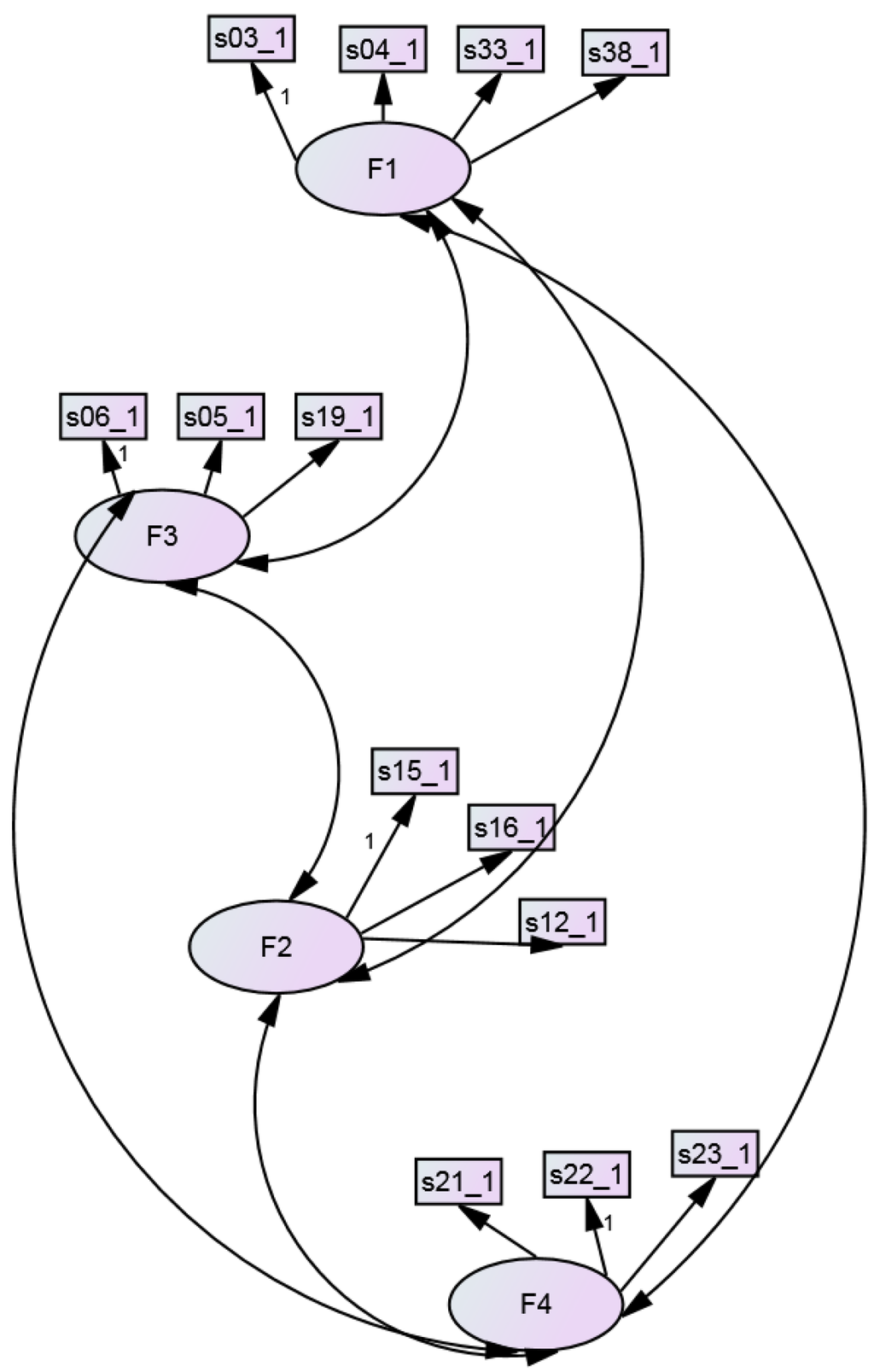
Figure 1.
Resulting model in a Confirmatory Factor Analysis (CFA).
Table 3.
Factors of the ASP questionnaire in its Polish version (23 items)—Polish sample.
| Mean | SD | Difficulty Index (2.50 / 4 = 0.63) | Corrected Item-Total Correlation | Cronbach’s alpha if item deleted | Factor loading | |||||
|---|---|---|---|---|---|---|---|---|---|---|
| I | II | II | IV | |||||||
| eigenvalue | 8.7 | 2.8 | 1.4 | 1.2 | ||||||
| 1. Religious Orientation: Prayer/Trust in God (eigenvalue = 8.7; alpha = .91) | ||||||||||
| Intention | s39 Trying to express the Divine in the creation | 2.17 | 1.33 | 0.54 | .692 | .926 | .758 | |||
| Action | s35 Praying for others | 2.27 | 1.41 | 0.57 | .703 | .926 | .726 | .358 | ||
| Action | s37 Reading religious or spiritual books | 1.58 | 1.38 | 0.40 | .521 | .930 | .722 | |||
| Action | s38 Performing distinct rituals | 2.08 | 1.28 | 0.52 | .588 | .928 | .700 | |||
| Emotion | s40 Do not feel alone, even when no one is with me | 2.40 | 1.33 | 0.60 | .634 | .928 | .695 | |||
| Action | s36 Praying for myself and own concerns | 2.38 | 1.40 | 0.60 | .688 | .927 | .638 | .448 | ||
| Cognition | s33 Having a spiritual orientation in life | 2.20 | 1.27 | 0.55 | .733 | .926 | .632 | .365 | ||
| Emotion | s03 Trust in and turn to God | 2.59 | 1.40 | 0.65 | .704 | .926 | .566 | .538 | ||
| Intention | s26 Trying to practice generosity | 2.26 | 1.18 | 0.57 | .496 | .930 | .524 | .411 | ||
| Emotion | s04 Feeling guided and sheltered | 2.29 | 1.18 | 0.57 | - | - | - | |||
| 2. Search for Insight/Wisdom (eigenvalue = 2.8; alpha = .86) | ||||||||||
| Intention | s14 Life is a search and question for answers | 2.68 | 1.12 | 0.67 | .534 | .929 | .778 | |||
| Action | s13 Aspiring to broad awareness | 2.86 | 1.04 | 0.72 | .516 | .929 | .754 | |||
| Action | s15 Searching for deep insight (“Einsicht”) in fabric of life | 2.90 | 1.04 | 0.73 | .483 | .930 | .703 | |||
| Action | s11 Aspiring to insight (“Erkenntnis”) and truth | 2.93 | 1.06 | 0.73 | .628 | .928 | .600 | .426 | ||
| Intention | s16 Trying to achieve frankness/wideness of the spirit | 2.49 | 1.14 | 0.62 | .643 | .928 | .358 | .587 | ||
| Action | s12 Aspiring to beauty and goodness | 2.85 | 1.06 | 0.71 | .622 | .928 | .584 | .417 | ||
| Intention | s10 Trying to develop wisdom | 3.01 | 0.98 | 0.75 | - | - | - | |||
| 3. Conscious interactions / Compassion (eigenvalue = 1.4; alpha = .80) | ||||||||||
| Action | s22 Conscious interaction with others | 2.90 | 1.00 | 0.73 | .534 | .929 | .827 | |||
| Action | s23 Conscious interaction with environment | 2.83 | 1.00 | 0.71 | .533 | .929 | .791 | |||
| Action | s21 Conscious interaction with myself | 2.88 | 1.04 | 0.72 | .431 | .931 | .706 | |||
| Intention | s28 Trying to develop compassion | 2.66 | 1.15 | 0.67 | .544 | .929 | .417 | .525 | ||
| 4. Transcendence conviction (eigenvalue = 1.2; alpha = .77) | ||||||||||
| Cognition | s06 Convinced of existence of higher powers and beings | 2.33 | 1.45 | 0.58 | .468 | .931 | .698 | |||
| Cognition | s05 Soul has his origin in a higher dimension | 2.24 | 1.36 | 0.56 | .664 | .927 | .350 | .697 | ||
| Cognition | s08 Convinced of a rebirth of man (or his soul) | 2.05 | 1.38 | 0.51 | .442 | .931 | .584 | |||
| Cognition | s19 Convinced that man is a spiritual being | 2.68 | 1.21 | 0.67 | .728 | .926 | .375 | .353 | .516 | |
Notes: Cronbach’s alpha = .931; Kaiser-Meyer-Olkin measure = .930; Principal Component Analysis; Varimax Rotation with Kaiser Normalization (rotation converged in 6 Iterations); 61.0% explained variance; Factor loadings < .3 are not depicted.
As shown in Table 4 highlighting the factor loadings obtained for each model, the main relevant items fit well to the established factors.
Table 4.
Confirmatory factor loading: Classification of items to the established factors.
| German students | Polish students | |||||||
|---|---|---|---|---|---|---|---|---|
| Item | Factor 4 | Factor 3 | Factor 2 | Factor 1 | Factor 4 | Factor 3 | Factor 2 | Factor 1 |
| s23 | 0.22 | 0.01 | −0.02 | 0.00 | 0.29 | 0.05 | −0.02 | 0.07 |
| s22 | 0.36 | 0.02 | 0.01 | 0.02 | 0.39 | –0.01 | 0.04 | 0.01 |
| s21 | 0.14 | –0.03 | 0.01 | −0.03 | 0.18 | –0.07 | –0.01 | –0.10 |
| s19 | −0.02 | 0.14 | –0.01 | 0.08 | –0.09 | 0.26 | –0.04 | 0.30 |
| s05 | 0.00 | 0.17 | 0.05 | 0.01 | 0.03 | 0.11 | 0.02 | 0.11 |
| s06 | 0.01 | 0.15 | 0.07 | 0.06 | 0.01 | 0.00 | 0.00 | 0.00 |
| s12 | 0.00 | 0.04 | 0.16 | –0.04 | 0.07 | 0.05 | 0.34 | 0.06 |
| s16 | 0.01 | 0.05 | 0.33 | –0.12 | 0.08 | –0.05 | 0.28 | –0.09 |
| s15 | –0.01 | 0.09 | 0.19 | 0.09 | –0.06 | 0.06 | 0.12 | 0.08 |
| s38 | 0.01 | 0.05 | –0.03 | 0.23 | 0.01 | 0.03 | –0.01 | 0.06 |
| s33 | 0.01 | 0.07 | –0.03 | 0.27 | 0.02 | 0.09 | –0.03 | 0.19 |
| s04 | 0.00 | 0.14 | –0.01 | 0.35 | –0.02 | 0.13 | 0.00 | 0.23 |
| s03 | 0.01 | 0.06 | 0.06 | 0.20 | 0.03 | 0.07 | 0.04 | 0.15 |
Notes: Factor 1—Religious Orientation: Prayer / Trust in God; Factor 2—Search for Insight / Wisdom; Factor 3—Conscious interactions; Factor 4—Transcendence conviction.
In addition, analysis of covariance confirmed the existence of significant covariance between the factors (Table 5). While among Polish students all factors are intercorrelated, in German students only the relationship between F2 and F4 was not statistically significant.
Table 5.
Covariance between the respective factors.
| German students | Polish students | |||||
|---|---|---|---|---|---|---|
| Estimate | S.E. | p | Estimate | S.E. | p | |
| F2–F4 | 0.034 | 0.022 | 0.118 | 0.33 | 0.04 | 0.00 |
| F3–F4 | 0.094 | 0.027 | 0.001 | 0.29 | 0.04 | 0.00 |
| F1–F4 | 0.135 | 0.026 | 0.001 | 0.44 | 0.04 | 0.00 |
| F2–F3 | 0.495 | 0.048 | 0.001 | 0.31 | 0.04 | 0.00 |
| F1–F3 | 0.818 | 0.058 | 0.001 | 0.71 | 0.06 | 0.00 |
| F1–F2 | 0.415 | 0.045 | 0.001 | 0.46 | 0.04 | 0.00 |
Notes: F1—Religious Orientation: Prayer / Trust in God; F2—Search for Insight / Wisdom; F3—Conscious interactions; F4—Transcendence conviction.
3.5. ASP Scores in German and Polish Students
The shorter students’ version of the ASP lacks some items particularly in the scales Religious Orientation: Prayer/Trust in God and Search for Insight/Wisdom. The mean scores of the long and shortened scale Religious Orientation: Prayer/Trust in God and Conscious interactions did not differ strongly in both samples. In particular, the scale Search for Insight/Wisdom differed between the long and shortened version in the German sample, but not in the Polish sample.
While the mean age and the gender distribution was quite similar, most German students would regard themselves as neither religious nor spiritual (62% R−S−), and only 12% as both religious and spiritual (R+S+), and Polish students would regard themselves as either R+S+ (42%) or R−S− (42%). Thus, particularly, Religious Orientation: Prayer/Trust in God was higher in the Polish sample (Table 6 and Table 7).
Table 6.
Mean values within the German sample (n = 867).
| RO | RO-SF | SIW | SIW-SF | CI/CG | CI-SF | TC | TC-SF | ||
|---|---|---|---|---|---|---|---|---|---|
| All | mean | 42.0 | 42.4 | 60.2 | 54.5 | 75.2 | 74.7 | 53.4 | 56.0 |
| SD | 25.8 | 25.9 | 20.0 | 22.1 | 15.6 | 18.0 | 24.7 | 26.0 | |
| Gender | |||||||||
| female | mean | 45.7 | 45.8 | 60.9 | 55.9 | 78.0 | 77.3 | 56.8 | 59.6 |
| SD | 25.1 | 25.4 | 19.9 | 21.8 | 13.7 | 15.7 | 23.7 | 25.1 | |
| male | mean | 37.4 | 38.3 | 59.3 | 52.7 | 71.8 | 71.3 | 49.3 | 51.8 |
| SD | 25.8 | 26.1 | 20.1 | 22.4 | 17.2 | 20.1 | 25.4 | 26.5 | |
| F value | 22.8 | 18.3 | 1.3 | 4.5 | 35.0 | 23.9 | 19.9 | 19.8 | |
| p value | <.0001 | <.0001 | n.s. | .034 | <.0001 | <.0001 | <.0001 | <.0001 | |
| SpR self categorization | |||||||||
| R/S (R+S+ / R+S− / R−S+) | mean | 61.2 | 61.1 | 67.8 | 63.4 | 79.0 | 78.1 | 67.8 | 71.0 |
| SD | 22.2 | 21.6 | 17.3 | 19.6 | 13.8 | 16.4 | 20.7 | 21.6 | |
| R−S− | mean | 30.2 | 60.9 | 55.5 | 49.0 | 72.9 | 72.5 | 44.5 | 46.8 |
| SD | 20.1 | 21.2 | 20.1 | 21.8 | 16.2 | 18.7 | 22.8 | 24.2 | |
| F value | 449.9 | 410.2 | 85.6 | 96.8 | 32.4 | 20.0 | 231.2 | 223.2 | |
| p value | <.0001 | <.0001 | <.0001 | <.0001 | <.0001 | <.0001 | <.0001 | <.0001 | |
Abbreviations: RO—Religious Orientation: Prayer/Trust in God; SIW—Search for Insight/Wisdom; CIC—Conscious interactions/Compassion; CI—Conscious interactions; TC—Transcendence conviction.
Table 7.
Mean values within the Polish sample (n = 1,013).
| RO | RO-SF | SIW | SIW-SF | CI/CG | CI-SF | TC | TC-SF | ||
|---|---|---|---|---|---|---|---|---|---|
| All | mean | 55.5 | 57.3 | 69.6 | 68.7 | 70.4 | 71.6 | 58.2 | 60.5 |
| SD | 24.6 | 24.8 | 20.6 | 21.7 | 20.7 | 22.0 | 25.8 | 27.3 | |
| Gender | |||||||||
| female | mean | 57.4 | 59.2 | 70.6 | 70.2 | 72.2 | 72.8 | 59.5 | 62.0 |
| SD | 23.3 | 23.4 | 20.3 | 20.9 | 20.4 | 21.7 | 25.2 | 26.6 | |
| male | mean | 52.6 | 54.4 | 68.1 | 67.0 | 68.8 | 70.6 | 56.4 | 58.9 |
| SD | 25.6 | 25.9 | 21.5 | 22.8 | 21.5 | 22.9 | 26.2 | 27.9 | |
| F value | 8.7 | 8.4 | 3.0 | 5.1 | 6.2 | 2.3 | 3.3 | 3.0 | |
| p value | .003 | .004 | .082 | .024 | .013 | n.s. | .068 | .083 | |
| SpR self categorization | |||||||||
| R/S (R+S+ / R+S− / R−S+) | mean | 69.0 | 70.1 | 75.6 | 75.3 | 74.8 | 75.3 | 67.6 | 70.7 |
| SD | 17.4 | 18.3 | 17.6 | 18.6 | 18.9 | 20.4 | 22.2 | 23.7 | |
| R−S− | mean | 36.8 | 40.0 | 61.5 | 59.9 | 64.2 | 66.5 | 45.4 | 46.8 |
| SD | 20.8 | 21.8 | 21.4 | 22.2 | 21.4 | 23.0 | 24.9 | 25.9 | |
| F value | 699.1 | 551.5 | 129.2 | 140.9 | 67.5 | 40.0 | 216.1 | 226.1 | |
| p value | <.0001 | <.0001 | <.0001 | <.0001 | <.0001 | <.0001 | <.0001 | <.0001 | |
Abbreviations: RO—Religious Orientation: Prayer/Trust in God; SIW—Search for Insight/Wisdom; CIC—Conscious interactions/Compassion; CI—Conscious interactions; TC—Transcendence conviction.
In both samples, female students had significantly higher scores for Religious Orientation: Prayer/Trust in God and Conscious interactions/Compassion, but Search for Insight/Wisdom showed only a trend in the Polish sample (Table 6 and Table 7). However, by reducing the number of items of the Search for Insight/Wisdom scale, the scores also differed significantly with respect to gender.
4. Discussion
The factorial structure of the ASP questionnaire was more or less similar in the sample of German students who were predominantly non-religious (73%) and in the Polish students who were non-religious to 50% (despite their Catholic denomination). However, by means of exploratory factor analysis there were some differences between the structure of the German and the Polish versions of the ASP questionnaire worth to mention:
First, in the Polish sample, item s26 (“generosity”) originally from the factor Conscious interactions loaded much better on Religious Orientation, and the religious item s06 (“Trust in and turning to God”) loaded strongly also on Transcendence conviction. This means that generosity is much more a religious issue to Polish students than it is to the German students. In the Polish sample, having trust in God is not exclusively a religious topic but can be associated also with non-Christian spiritual views.
Second, the five-item scale Conscious interactions is comprised of three items addressing conscious interactions with others, self and environment, and two items addressing developing compassion and practicing generosity. In the primary, longer version of the ASP, both scales were separate. In the shortened, second version of the ASP questionnaire both scales were combined. Developing compassion (item s28) is in fact a matter of conscious interaction with others, and thus the loading on both factors is sound from a theoretical point of view.
By means of confirmatory factor analysis, several of the conflicting and also less appropriate items were eliminated from the established factors (Figure 1). Only the best fitting items were used as the students’ version of the ASP (ASP-Students). Nevertheless, several of the eliminated items might be of theoretical and practical importance, i.e., items referring on students’ praying (s35 and s36), compassion (s28), generosity (s26), rebirth (s08), etc. These can be further used as indicator items.
Correlation analyses revealed that Transcendence Conviction was strongly related in the German and Polish samples with Religious Orientation, and existentialistic Search for Insight/Wisdom was strongly associated with all other factors (Table 8). However, in Polish students Conscious interactions was strongly associated with Search for Insight/Wisdom, while in the German sample these associations were only marginal. This may mean that for Polish students, existential and individual issues are not necessarily an opposite of relational form of secular spirituality (“conscious interactions”), and may also have a religious connotation. In German students these issues seem to be only marginally related.
Table 8.
Correlations between the Aspects of Spirituality (ASP)-Student scales in the German and Polish sample.
| Search for Insight/Wisdom (SIW-SF) | Conscious interactions (CI-SF) | Transcendence conviction (TC-SF) | |
|---|---|---|---|
| Correlations in the German sample | |||
| Religious Orientation (RO-SF) | .410 ** | .177 ** | .604 ** |
| Search for Insight/Wisdom (SIW-SF) | .113 ** | .516** | |
| Conscious interactions (CI-SF) | .161 ** | ||
| Correlations in the Polish sample | |||
| Religious Orientation (RO-SF) | .525 ** | .360 ** | .668 ** |
| Search for Insight/Wisdom (SIW-SF) | .542 ** | .511 ** | |
| Conscious interactions (CI-SF) | .330 ** |
Note: Strong correlations were highlighted (bold); ** p < .01 (Pearson; 2-tailed).
5. Conclusions
The ASP questionnaire is suited to measure a wide variety of vital aspects of spirituality, both religious and secular forms of spirituality. Because the instrument avoids exclusive language (the term ‘God’ was used only once, and can be replaced easily with other terms in different cultural contexts) and operationalizes also non-formal aspects of spirituality in terms of relational consciousness, it is suited not only for individuals with a skeptical or a-religious attitude but also for religious individuals. So far the instrument is used both with healthy adult individuals, and also in its student version (ASP-Students) with adolescents and young adults for comparative studies.
Author Contributions
Arndt Büssing, Klaus Baumann and Janusz Surzykiewicz have designed the study, and contributed writing the manuscript. Iwona Pilchowska performed confirmatory factor analysis, Arndt Büssing all other statistical analyses. All authors have read and approved the manuscript.
Conflicts of Interest
The authors declare no conflict of interest.
References
- William James. Varieties of Religious Experience. A Study on the Human Nature. Rockville: Arc Manor, 2008. [Google Scholar]
- Gordon W. Allport. “The Individual and His Religion: A Psychological Interpretation.” New York: Macmillan Publishing, 1957. [Google Scholar]
- Gordon W. Allport, and James M. Ross. “Personal religious orientation and prejudice.” Journal of Personality and Social Psychology 5 (1967): 432–43. [Google Scholar] [CrossRef]
- Harold G. Koenig. “Concerns about measuring ‘spirituality’ in research.” Journal of Nervous and Mental Disease 196 (2008): 349–55. [Google Scholar] [CrossRef]
- Klaus Baumann. “Religiöser Glaube, persönliche Spiritualität und Gesundheit. Überlegungen und Fragen im interdisziplinären Feld von Theologie und Religionswissenschaft, Medizin und Psychotherapie.” Zeitschrift für medizinische Ethik 55 (2009): 131–44. [Google Scholar]
- Arndt Büssing. “Measures of Spirituality in Health Care.” In Oxford Textbook of Spirituality in Healthcare. Edited by Mark R. Cobb, Christina M. Puchalski and Bruce Rumbold. New York: Oxford University Press, 2012, pp. 323–31. [Google Scholar]
- Gert Pickel. “Religionsmonitor. Verstehen was verbindet. Religiosität im Internationalen Vergleich.” Bertelsmann Stiftung. 2013. Available online: http://www.religionsmonitor.de/pdf/Religionsmonitor_IntVergleich.pdf.
- Arndt Büssing, Annina Janko, Klaus Baumann, Niels Christian Hvidt, and Andreas Kopf. “Spiritual needs among patients with chronic pain diseases and cancer living in a secular society.” Pain Medicine 14 (2013): 1362–73. [Google Scholar] [CrossRef]
- Christian Zwingmann, Constantin Klein, and Arndt Büssing. “Measuring Religiosity/Spirituality: Theoretical Differentiations and Characterizations of Instruments.” Religions 2 (2011): 345–57. [Google Scholar] [CrossRef]
- Harold G. Koenig, Keith Meador, and George R. Parkerson. “Religion Index for Psychiatric Research: A 5-item Measure for Use in Health Outcome Studies.” American Journal of Psychiatry 154 (1997): 885–86. [Google Scholar]
- Jimmie C. Holland, Kathryn M. Kash, Steven Passik, Melissa K. Gronert, Antonio Sison, Marguerite Lederberg, Simcha M. Russak, Lea Baider, and Bernard Fox. “A brief spiritual beliefs inventory for use in quality of life research in life-threatening illness.” Psychooncology 7 (1998): 460–69. [Google Scholar] [CrossRef]
- Lynn G. Underwood, and Jeanne A. Teresi. “The Daily Spiritual Experience Scale: Development, Theoretical Description, Reliability, Exploratory Factor Analysis, and Preliminary Construct Validity Using Health-Related Data.” Annals of Behavioral Medicine 24 (2002): 22–33. [Google Scholar] [CrossRef]
- Arndt Büssing, Thomas Ostermann, and Peter F. Matthiessen. “Distinct expressions of vital spirituality. The ASP questionnaire as an explorative research tool.” Journal of Religion and Health 46 (2007): 267–86. [Google Scholar] [CrossRef]
- Arndt Büssing, Axel Föller-Mancini, and Jennifer Gidley. “Aspects of Spirituality in Adolescents.” International Journal of Children’s Spirituality 15 (2010): 25–44. [Google Scholar] [CrossRef]
- Arndt Büssing. “‘Spiritualität’—Worüber reden wir? ” In Spiritualität, Krankheit und Heilung—Bedeutung und Ausdrucksformen der Spiritualität in der Medizin. Edited by Arndt Büssing, Thomas Ostermann, Michaela Glöckler and Peter F. Matthiessen. Frankfurt, Germany: VAS—Verlag für Akademische Schriften, 2006, pp. 11–24. [Google Scholar]
- Donna S. Martsolf, and Jacqueline R. Mickley. “The concept of spirituality in nursing theories: Differing world-views and extent of focus.” Journal of Advanced Nursing 27 (1998): 294–303. [Google Scholar] [CrossRef]
- Arndt Büssing, Philipp Kerksieck, Axel Föller-Mancini, and Klaus Baumann. “Aspects of spirituality and ideals to help in adolescents from Christian academic high schools.” International Journal of Children’s Spirituality 17 (2012): 99–166. [Google Scholar] [CrossRef]
- Arndt Büssing, Thomas Ostermann, and Peter F. Matthiessen. “Role of religion and spirituality in medical patients: Confirmatory results with the SpREUK questionnaire.” Health and Quality of Life Outcomes 3 (2005): 10. Available online: http://www.hqlo.com/content/3/1/10. [Google Scholar] [CrossRef]
- Arndt Büssing. “Spirituality as a Resource to Rely on in Chronic Illness: The SpREUK Questionnaire.” Religions 1 (2010): 9–17. [Google Scholar] [CrossRef]
© 2014 by the authors; licensee MDPI, Basel, Switzerland. This article is an open access article distributed under the terms and conditions of the Creative Commons Attribution license (http://creativecommons.org/licenses/by/3.0/).