


Abstract
The Xingqi (行气, breath circulation) pattern bronze mirrors of the Song Dynasty (960–1279 CE) represent a distinctive category of Daoist material culture in southern China. Despite their unique iconography, systematic research on their functions and religious significance has been lacking. This study examines sixteen Xingqi pattern bronze mirrors through iconographic analysis and textual research, integrating evidence from surviving Daoist scriptures and ritual manuals. Two primary types are identified: the “Tortoise-Swallowing and Crane-Breathing Style” and the “Sun and Moon Observing Style”. The former depicts practitioners imitating the breathing techniques of tortoises and cranes, while the latter shows figures gazing upward to ingest the essences of the sun and moon. Both motifs continue earlier health preservation traditions from the Pre-Qin (221–207 BCE) through Han dynasties, adapted within the Northern and Southern Song context. These mirrors were specifically used by Daoists along the middle Yangtze River for inner alchemy cultivation, particularly in visualized Cunsi (存思, contemplation practices). They were predominantly passed down through generations rather than buried, explaining their scarcity in archaeological contexts. These artifacts illuminate how Song Daoism translated abstract philosophical concepts into tangible, operable practices through material imagery. They provide new physical evidence for understanding historical Daoist cultivation methods and the materialization of religious experience.
1. Introduction
Taoism attached great importance to mirrors in both ritual and metaphysical contexts. This significantly influenced the patterns, shapes, and functions of bronze mirrors across successive dynasties. During the Song Dynasty (960–1279 CE), new iconographic themes emerged alongside the development of Taoism. These included immortals with deer and cranes, immortals slaying dragons, ghost catching, double swords and alchemy furnaces, and tiger-headed talisman patterns. Novel shapes such as bells, tripods, and cloud boards also appeared. Among them, the “Xingqi (行气, breath circulation) pattern” bronze mirrors cast around the Southern Song Dynasty (1127–1279 CE) are typical representatives and unique styles of Taoist mirror patterns along the middle reaches of the Yangtze River. Their basic iconographic features include figures in moon-gazing or Tuna (吐纳, exhalation and inhalation) postures, accompanied by tortoises and cranes. However, academic circles simply concluded them as two styles of “Xingqi diagrams”: “Star-Observing and Moon-Gazing (Guanxing Wangyue 观星望月)” and “Tortoise-Swallowing and Crane-Breathing (Guiyan Hexi 龟咽鹤息)”1. To date, no scholarly article has systematically addressed core issues concerning Taoist doctrines and health preservation philosophy in southern China. These include the geographical scope, historical background, functions, nature, usage, and reasons for the mirrors’ short-term popularity in local areas.
Recent scholarship in Daoist studies and art history has significantly advanced our understanding of ritual iconography and material culture. Scholars such as Huang Shishan has explored the role of visual and material substances in Daoist rituals, emphasizing how images and objects mediated religious experience and practice (Huang 2012). Lennert Gesterkamp has examined the relationship between Daoist ritual painting and court patronage, shedding light on the interplay between visual representation and liturgical performance (Gesterkamp 2011). Peng Bisheng has discussed the evolution and visual representation of the “Three Corpses” (Sanshi 三屍) concept in Daoist internal alchemy (Neidan 内丹) from an iconographic perspective, demonstrating how in-depth analysis of this concept and its corresponding imagery deepens our understanding of the theoretical, practical, and philosophical dimensions of internal alchemy cultivation (Peng 2026). Building on these foundations, this paper investigates Xingqi pattern bronze mirrors as material manifestations of Daoist internal alchemy, demonstrating how iconographic analysis can reveal the embodied and practical dimensions of religious cultivation.
2. Overview of “Xingqi Pattern” Bronze Mirrors
2.1. Iconographic Types
Xingqi pattern was a new pattern on bronze mirrors, which emerged in the Song Dynasty (960–1279 CE). Its basic composition includes a man performing Tuna moves on the left side of the mirror knob, a crane hovering on the upper right, and a tortoise lying at the bottom, with additional patterns such as trees, thickets, and clouds. According to the figures’ movements, the bronze mirrors can be divided into the following two styles:
2.1.1. Tortoise-Swallowing and Crane-Breathing Style
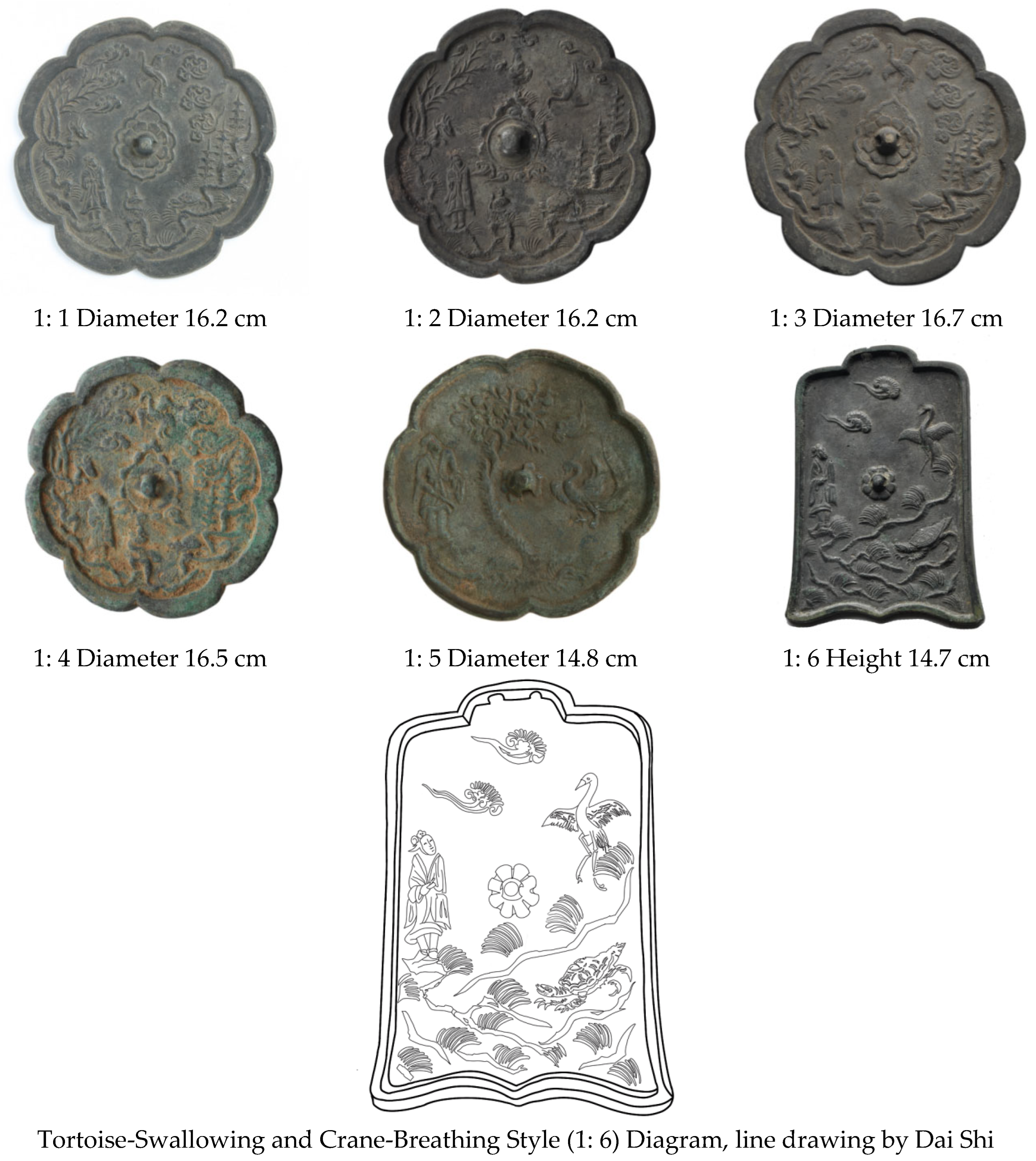
There are 6 bronze mirrors of this style (Figure 1). Their shapes are either the eight-petal (Figure 1: 1–4) or six-petal sunflower shapes which were popular in the Tang Dynasty (618–907 CE, Figure 1: 5). In addition, the special bell-shaped mirror (Figure 1: 6) began to emerge. The bell is a very important ritual tool in Taoist temples and Taoist rites, with functions such as convening people, warning, and rousing divine responses.2 At the same time, compared with aesthetic and practical daily-use bronze mirrors in round shapes or sunflower shapes, such “crossed and angular” artifacts are hardly suitable for daily use3, and the shape itself also implies its religious nature. On the left side, within a pine forest, a man stands upright facing forward. He wears a wide-sleeved, front-opening robe and tilts his head upward toward the sky. His right arm is bent, holding a short object before his abdomen, while his left arm hangs down. (In Figure 1: 5 only, his right hand is placed before his abdomen, and his left hand holds a sword-like object). On the upper right side, there are auspicious clouds and a flying crane spreading its wings in the sky, and on the lower right side, a spiritual tortoise sticks its head out and crawls among aquatic plants.
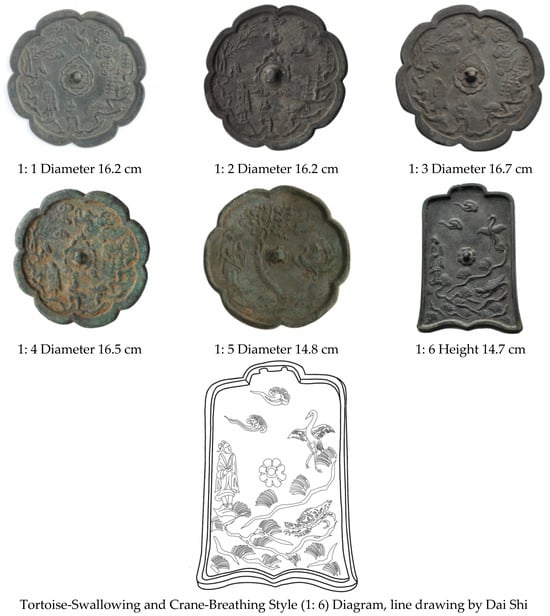
Figure 1.
The Tortoise-Swallowing and Crane-Breathing Style Xingqi Pattern Bronze Mirror Collected by Hunan Museum, photographed by Feng Bi.
The Xingqi is the most basic cultivation method in the process of internal alchemy cultivation.4 Both tortoises and cranes are important objects for imitative techniques (fangsheng shu 仿生术, biomimetic practices, techniques that imitate animal movements for health cultivation). The term “Guiyan” (龟咽, tortoise swallowing) originates from The Cheng Brothers’ Commentary on the Book of Changes (Zhouyi Chengshi Zhuan 《周易程氏传》), which states: “The tortoise can practice throat-breathing and abstain from food; the spiritual tortoise symbolizes wisdom, enabling one to refrain from seeking external nourishment.” (S. Zhang 2021, p. 650). It refers to the tortoise’s adoption of a slow, deep, and subtle breathing method to enhance its vital functions. “Hexi” (鹤息, crane breathing) refers to the crane’s practice of spreading its wings and stretching its neck during flight, characterized by an expansive, prolonged breath that allows it to absorb the pure energy of heaven and earth, thereby promoting the unimpeded flow of qi. In the ode attributed to Zhongli Quan (钟离权, one of the Eight Immortals in Daoist mythology, credited with teachings on internal alchemy), it is said: “Nurturing the breath, make it like a tortoise’s respiration; refining the form, make it like a crane’s skin and flesh.” (Qi et al. 1989, p. 436). The combination of these two methods is believed to achieve the goal of health preservation through the integration of motion and stillness and the extension of lifespan. Therefore, this style of bronze mirror is named “Tortoise-Swallowing and Crane-Breathing Style Xingqi Pattern Bronze Mirror”.
2.1.2. Sun and Moon Observing Style
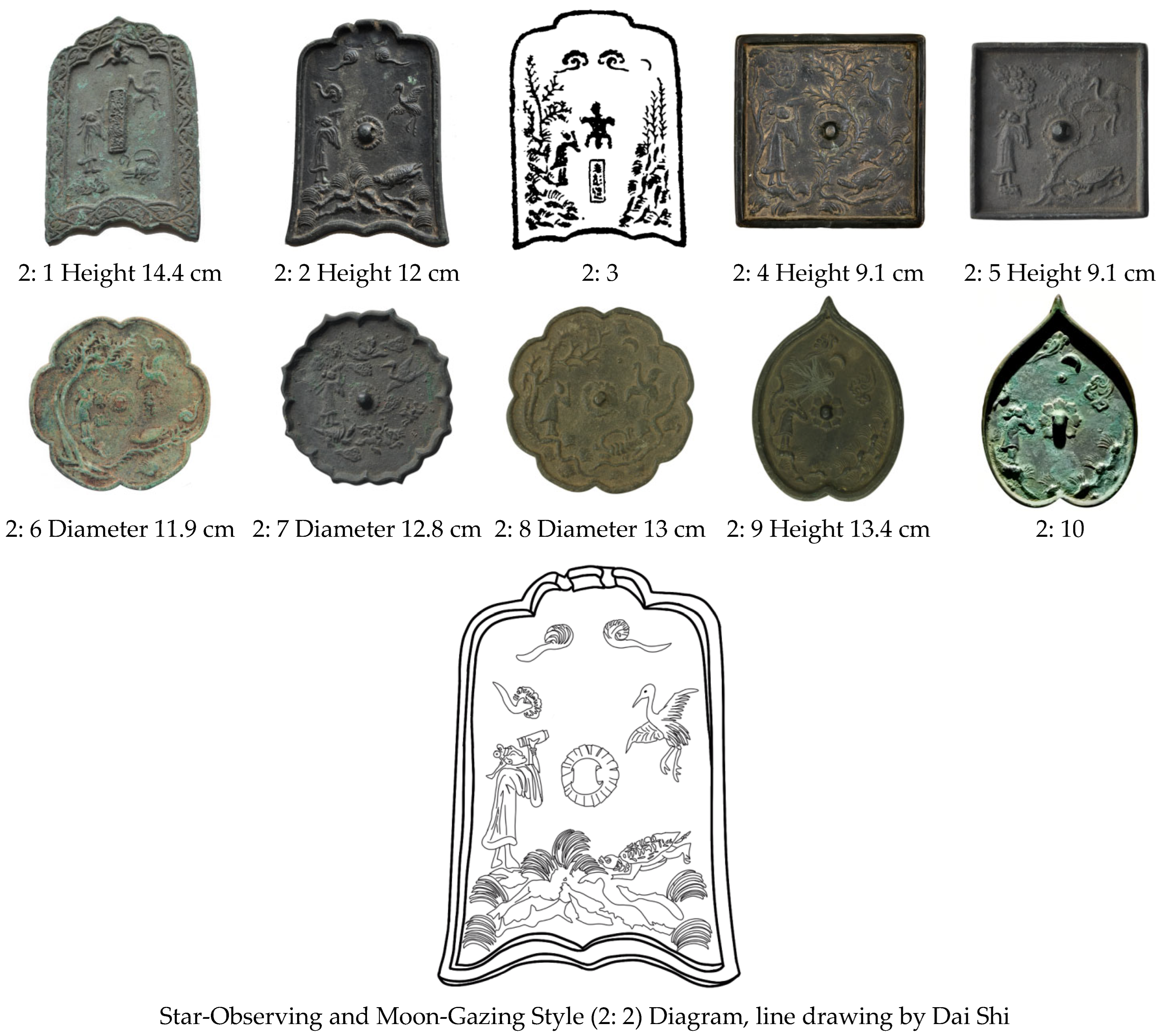
There are 10 bronze mirrors of this style (Figure 2). In addition to inheriting the six-petal or eight-petal sunflower shapes popular in the Tang Dynasty (618–907 CE) (Figure 2: 6–8), the number of new shapes in the Song Dynasty (960–1279 CE) with distinct Taoist characteristics such as bell shape (Figure 2: 1–3), peach shape (Figure 2: 9–10), and square shape (Figure 2: 4–5) increased. The man stands sideways, with his hair tied in a high bun, two hair ribbons hanging behind his head, wearing a long robe, tilting his head back, bending his arms, and raising his hands to hold a cylindrical object. There are three bronze mirrors in this style (Figure 2: 8–10). On the upper right of the mirror knob, along the figure’s line of sight, there is a raised dot adorned with an outer ring and a crescent moon-shaped pattern. According to Seven Slips of the Cloudy Satchel·Miscellaneous Cultivation·Taiqing Exercise Guidance Cultivation Classic (《云笈七签·杂修摄·太清导引养身经》), the “Absorbing Moon Essence Method (Xiyuejing Fa 噏月精法)” in the breath absorption (fuqi 服气) technique states: “Absorbing lunar essence: On the early days of the lunar month, the mid-lunar month, and when the moon sets, stand upright facing the moon, hold your breath eight times consecutively, tilt your head back to inhale the lunar essence, and swallow it eight times—this will nourish and enhance yin qi.” 噏月精,凡月初时,月中时,月入时,向月正立,不息八通,仰头噏月精,八咽之,令阴气长 (Junfang Zhang 1996, p. 191). Absorbing the essence of the moon can replenish yin qi (阴气), so some scholars named this style of bronze mirror “Star-Observing and Moon-Gazing Style Breath Exercise Diagram Bronze Mirror”. In fact, only a minority of these mirrors feature a crescent moon pattern. The circular protrusion opposite the moon’s crescent does not necessarily represent a star; it could also symbolize the sun. Combined with written records from the Pre-Qin (221–207 BCE), Western Han (206 BCE–8 CE), and Eastern Han (25–220 CE) dynasties, it is more accurate to rename this mirror pattern “Sun and Moon Observing Style”, which will be elaborated later.
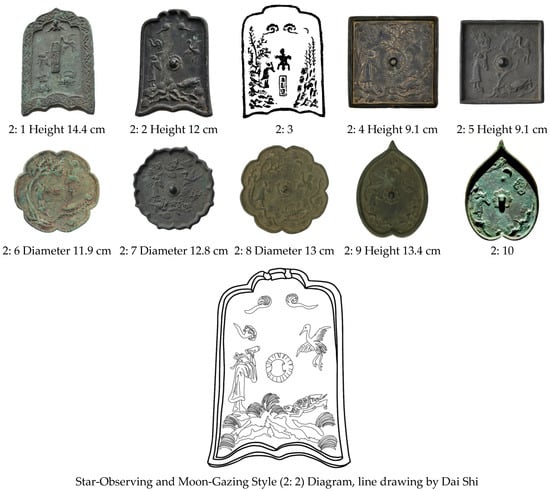
Figure 2.
Star-Observing and Moon-Gazing Style Xingqi Pattern Bronze Mirrors. 2: 1, 2: 2, 2: 5, 2: 7, 2: 8, 2: 9: Collected by Hunan Museum, photographed by Feng Bi; 2: 3 Collected by Hunan Cultural Relics Company, cited from D. Chen (1999); 2: 4 Collected by National Museum of China, cited from its official website; 2: 6 Collected by Changsha Museum, cited from Changsha Museum (2010, p. 204); 2: 10 from 2018 Summer Art Auction of Tang West Market, cited from its official website.
2.2. Production Time and Place
Based on the inscriptions on the bronze mirrors, the production time and place of such bronze mirrors can be inferred. There are three existing Xingqi pattern inscription mirrors. The first one has a vertical wire frame in the center of the mirror back, with five reversed regular script characters “潭州官场造 (made by Tanzhou’s official workshop)” cast inside (Figure 2: 1). “Tanzhou (潭州)” is the ancient name of Changsha city in present-day Hunan Province. According to Gazetteer of the Nine Regions During the Yuanfeng Reign·Jinghu Road (《元丰九域志·荆湖路》), Tanzhou in the Song Dynasty (960–1279 CE) had jurisdiction over 11 Zhou(s) (州,an ancient administrative division) including Changsha (长沙), Hengshan Zhou, Anhua Zhou, Liling Zhou, Youzhou, Xiangxiang Zhou, Xiangtan Zhou, Yiyang Zhou, Liuyang Zhou, Xiangyin Zhou, and Ningxiang Zhou, (C. Wang 1984, pp. 259–60) covering all or part of the areas of present-day Changsha, Zhuzhou, Xiangtan, Yueyang and Yiyang.
The mining industry was developed in the Song Dynasty (960–1279 CE), and most mining areas were in the south. As for copper mines, there was a saying that “nowhere is richer in copper production than the southeast” (D. Ma 2011, p. 515). Therefore, the production areas of bronze mirrors in the Song Dynasty (960–1279 CE) were also mostly concentrated in the south. In addition to the famous Huzhou Mirror in Zhejiang province, Jiankang Mirror in Nanjing, Jiangsu province, Raozhou Mirror in Shangrao, Jiangxi province, and Jianzhou Mirror in Jianou, Fujian province, bronze mirror casting was also found in Tanzhou, Hunan province and Chengdu, Sichuan province. After the Anshi Rebellion (安史之乱, a devastating rebellion led by An Lushan 安禄山 and Shi Siming 史思明 against the Tang Dynasty, 755–763 CE) in the Tang Dynasty (618–907 CE), China’s political, economic, and cultural centers moved southward. The handicraft industry and commerce in Tanzhou, located south of the Yangtze River, developed rapidly. The mining and metallurgy industry was a prominent handicraft sector in Hunan province during the Song Dynasty (960–1279 CE), among which copper metallurgy was an important sector in Tanzhou. In the first year of Yuanfeng reign of Emperor Shenzong (1078 CE) of Song Dynasty (960–1279 CE), Tanzhou collected 1,078,250 jin (a unit of weight = 1/2 kg) of copper, ranking first in Hunan province; during the Shaoxing (1131–1162 CE) and Qiandao reigns (1165–1173 CE) of the Southern Song Dynasty (1127–1279 CE), the Yongxing Field in Tanzhou produced 640,000 jin of Dantong (胆铜 copper produced by replacing copper ions in copperas water with iron), and annually transported 3414 jin of Dantong to the Yongping Mint in Rao Zhou for coin casting (Xu 2014, pp. 6726–27). It can be seen that Tanzhou had become a major copper producer in the Song Dynasty (960–1279 CE). The prosperity of the mining and metallurgy industry inevitably promoted the development of the metal manufacturing industry in Tanzhou. This bronze mirror inscribed with “潭州官场造” should have been cast by the official workshop for bronze mirror casting in Changsha at that time. Hunan Museum also collects a sunflower-shaped bronze mirror of the Song Dynasty (960–1279 CE), with the inscription “潭州小王炼铜无比照子 (mirror made by Xiao Wang’s workshop in Tanzhou with unparalleled refined copper)” on the left side, which was also produced in “Tanzhou” (Zhou 1993, p. 168). At the same time, most of the other 15 uninscribed Xingqi pattern bronze mirrors identified so far were collected in the Hunan province, so it can be inferred that the Hunan region, with Tanzhou at its center, should be the main production area of Xingqi diagram bronze mirrors.
There are two other Xingqi diagram inscription mirrors: one is a sunflower-shaped bronze mirror collected by Changsha Museum, inscribed with “老彭 (Lao Peng)” and “真鉴 (Zhen Jian, refined mirror)” (Figure 2: 6); the second is a bell-shaped bronze mirror collected by Hunan Cultural Relics Company, with the inscription “老彭造 (made by Lao Peng)” below the mirror knob (Figure 2: 3). Hunan Cultural Relics Company also collects a sunflower-shaped flying apsara and peony pattern bronze mirror, with the inscriptions “安楚嫣,永不分离,初改靖康元年□月□日铸作 (An Chuyan, never apart. Cast in the initial period of the Jingkang reign (1126 CE, the first year of the Jingkang reign), □ month □ day)” arranged radially along the inner circle line, and the four characters “老彭” and “真鉴” inscribed symmetrically on the left and right of the outer circle close to the inner circle line. (D. Chen 1999). The content and handwriting are consistent with the previous two examples. Jingkang (1126–1127 CE) was the first reign year of Emperor Qinzong of Song Dynasty (960–1279 CE) and the last reign year of the Northern Song Dynasty (960–1127 CE). From this, it can be inferred that “老彭” was a bronze mirror caster who was active from the Jingkang period to the early Southern Song Dynasty (1127–1279 CE).5 It can be concluded that the Xingqi pattern bronze mirrors were mainly popular in the mid-Song Dynasty.
3. The Origins and Historical Background of the Xingqi Pattern
3.1. Xingqi, Tortoise-Swallowing and Crane-Breathing Style, and Taoist Tuna Xingqi Technique (吐纳行气术)
Xingqi, historically known as “Absorbing Breath (Fuqi 服气)”, “Embryonic Breathing (Taixi 胎息)”, “Tuna”, “Breath Ingestion (Shiqi 食气)”, “Refining Breath (Lianqi 炼气)”, etc., is a method of maintaining health, strengthening the body, and prolonging life through breathing exercises under the guidance of self-awareness, with a long history in China. Laozi (老子) said: “The path to longevity lies solely in Xingqi and nourishing the spirit, expelling stale qi and absorbing fresh qi, moving in and out of the mysterious subtlety of primal energy. Breathing is the gateway to life: if one prevents their body and spirit from separating, they will attain longevity.” 长生之道,唯在行气养神,吐故纳新,出玄入玄,呼吸生门,其身神不使去,人即长生也 (Junfang Zhang 1996, p. 353). Zhuangzi (庄子) also said: “Blowing and exhaling, regulating breath, expelling stale qi and absorbing fresh qi, practicing bear-hanging and bird-stretching: all these are merely for longevity. Such practices are favored by those who cultivate exercises, those who nurture their bodies, and those as long-lived as Peng Zu (彭祖 a Taoist immortal famous for longevity and health preservation).” 吹呴呼吸,吐故纳新,熊经鸟申,为寿而已矣。此道引之士,养形之人,彭祖寿考者之所好也 (He 2020, p. 164) Lao Dan (also known as Laozi) and Zhuang Zhou (also known as Zhuangzi), representatives of Taoist culture, both regarded Xingqi techniques such as deep breathing and exhaling the stale and inhaling the new as the way to longevity, and as the reason for the longevity of people like Peng Zu. It is worth noting that Zhuangzi’s juxtaposition of tuna with “bear-hanging and bird-stretching” (imitative movements of bears climbing trees and birds stretching their wings) provided an intellectual foundation for the later depiction of practitioners imitating the movements of tortoises and cranes in the “Tortoise-Swallowing and Crane-Breathing Style” imagery.
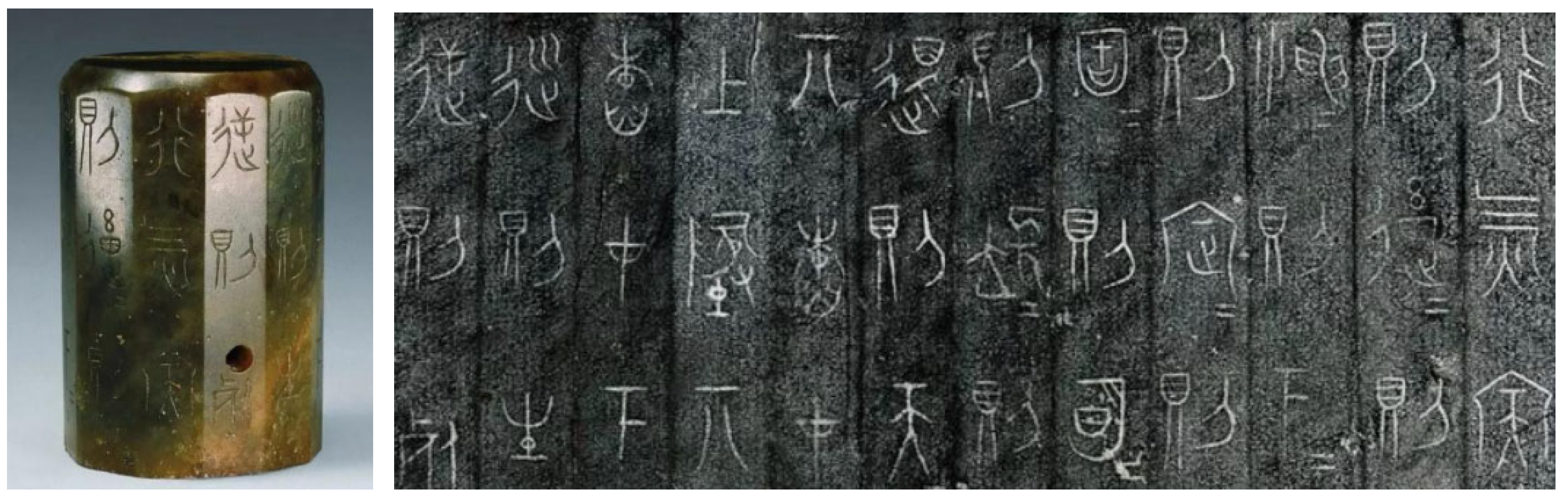
The 45-character inscription on the Xingqi Jade Pendant Inscription (行气玉佩铭) (Figure 3) dating back to the early Warring States Period (475–221 BCE) State: “Xingqi follows a progressive process of deep accumulation—extension—subsidence—stability—solidity—germination—growth—retreat—conformity to the Tao; it must align with the qi mechanism of heaven and earth. Following this pattern, Xingqi can nourish life, while violating it can damage vitality.” 行气,深则蓄,蓄则伸,伸则下,下则定,定则固,固则萌,萌则长,长则退,退则天。天几舂在上;地几舂在下。顺则生;逆则死。It records the precautions for Xingqi, and is recognized as the earliest existing physical material on Xingqi (Yao 1990). The inscription’s description of the progressive stages of Xingqi—”deep accumulation” (深) “extension” (蓄) “subsidence” (伸) and “downward movement” (下)—is consistent with the emphasis on breath rhythm in later inner alchemy cultivation. Therefore, the postures of the practitioners depicted on the bronze mirrors serve as a visual representation of this very breath rhythm.
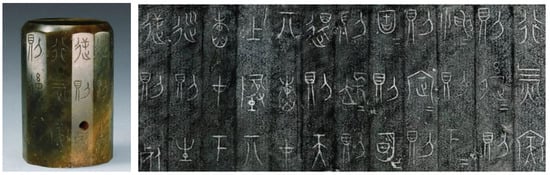
Figure 3.
Xingqi Jade Pendant Inscription and Rubbings, Warring States, collected by the Tianjin Museum, cited from its official website.
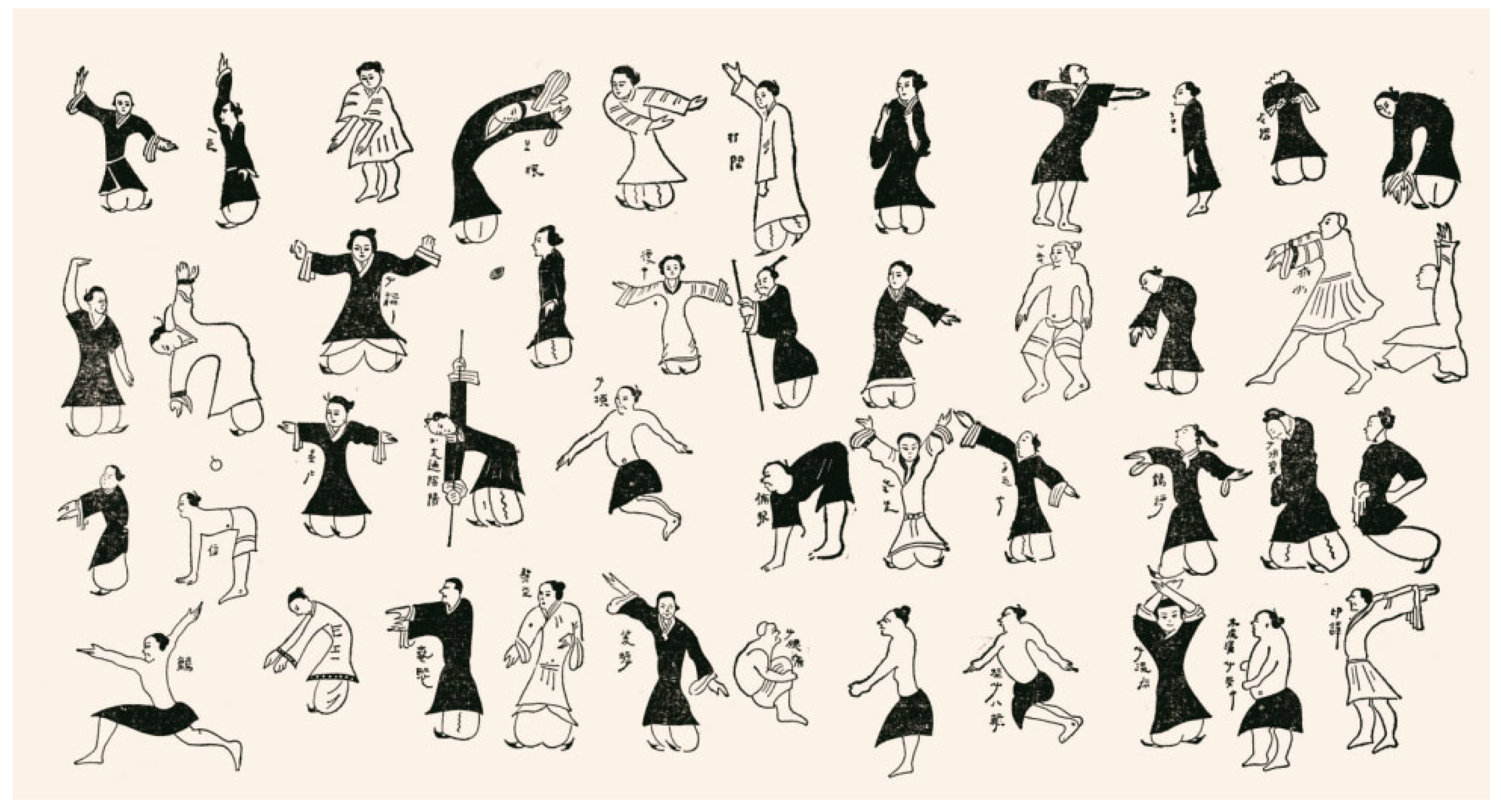
The silk painting Exercise Guidance Diagram (《导引图》) unearthed from the No. 3 Mawangdui Han Dynasty Tomb in Changsha depicts 44 human figures’ techniques or movements (Figure 4). Combined with the inscriptions next to the figures (31 are identifiable) and the content of Guidance Book (《引书》) unearthed from the at Zhangjiashan Han Dynasty Tomb in Jiangling, Hubei province, it can be determined that this painting is the oldest therapeutic and fitness manual discovered in archaeology to date (Zheng 2013, pp. 232–33). The physical movements of the figures in the Exercise Guidance Diagram are usually accompanied by respiratory exercises such as holding breath, exhaling, and roaring, including movements where figures imitate cranes spreading their wings and crying, and tortoises stretching their necks to swallow, with effects such as relieving kidney diseases, benefiting the neck and spine, and improving eyesight (Shen 1980). The tortoise-and-crane imitative movements depicted in the Exercise Guidance Diagram resonate across a millennium with the postures of practitioners on the “Tortoise-Swallowing and Crane-Breathing Style” bronze mirrors, demonstrating that tortoise-crane biomimetic practices had long been an important component of the southern health preservation tradition.
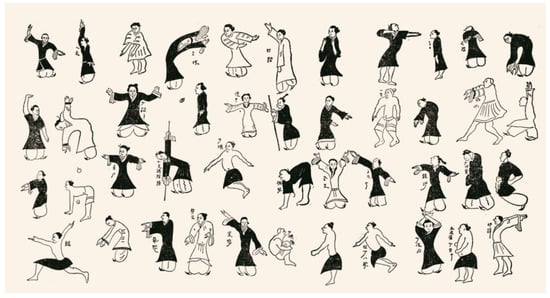
Figure 4.
Restored Image of the Exercise Guidance Diagram, Western Han Dynasty (207 BCE–25 CE), Unearthed from the No. 3 Mawangdui (马王堆)Tomb in Changsha, and Collected by Hunan Museum, cited from its official website.
At the end of the Eastern Han Dynasty (25–220 CE), Taoism, which absorbed Pre-Qin (221–207 BCE) Fang-xian Sect (方仙道, a pre-Daoist tradition focused on immortality practices) and Qin-Han Huang-Lao Sect (黄老道, a Daoist tradition venerating the Yellow Emperor and Laozi), emerged as a formal religious organization. Taoism, with the pursuit of immortality as its fundamental doctrine, had an all-round interaction with ancient health preservation techniques. Commentary on Laozi by Heshanggong (《老子河上公章句》) of the Eastern Han Dynasty (25–220 CE) states: “Cultivate Tao within the body, cherish qi and nourish spirit, so as to prolong life and extend years. To practice thus is to be a Taoist.” 修道于身,爱气养神,益寿延年。其法如是,乃为道人 (Laozi 2017, p. 1647). The so called “Daoren” (道人, Daoist practitioner) is someone who nourishes qi to prolong life. Wei Boyang (魏泊阳), the founder of Taoist Danding theory (丹鼎学说, Daoist alchemical theory centered on elixir refinement) in the Eastern Han Dynasty (25–220 CE), pointed out in his book Zhouyi Cantong qi (The token for the Agreement of the Three According to the Book of Changes 《周易参同契》): “Contain essence and nourish spirit, and unify with the three fundamental qi (yuanqi 元气). Essence and body fluid flow through the whole body, and muscles and bones become firm. All evils are dispelled, and upright qi always remains. Accumulate over a long period of time, and you shall transform your form to become an immortal.” 含精养神,通德三元。精液凑理,筋骨致坚。众邪辟除,正气常存。累积长久,变形而仙 (Wei et al. 2013, p. 1717). Fundamental qi is the root of human and all things in the world. The way to ward off evils and become an immortal is the breath exercise cultivation of containing essence and nourishing spirit, and unifying with the three fundamental qi. More importantly, Wei Boyang was the first to propose that internal alchemy cultivation (内丹修炼)—utilizing the human body as a furnace and refining qi, essence, and spirit to form an “elixir” within oneself—this can be incorporated into the same model as the external alchemy cultivation (外丹炼制) that Taoism adopts for ingestion (F. Han 1997). Based on his cultivation experience at Luofu Mountain, Ge Hong (葛洪) of the Eastern Jin Dynasty (371–420 CE) further advocated that cultivation should emphasize both external and internal alchemy: “Those who attain the Tao must master both breathing techniques and the essentials of ingestion” 得道之士,呼吸之术既备,服食之要又该 (Duisu Chapter 3 《对俗卷三》), “Those who expel stale qi and absorb fresh qi rely on qi to augment their own qi… Those who ingest elixirs rely on (the essence similar to) blood to nourish their own blood…” 吐故纳新者,因气以长气……服食药物者,以血以益血…… (Jiyan Chapter 13 《极言卷十三》), “Although taking elixirs is the foundation of longevity, if one can also practice Xingqi, the benefits will be very rapid. If one cannot obtain elixirs, but practices Xingqi to its fullest, one can also live for hundreds of years” 服药虽为长生之本,若能兼行气者,其益甚速。若不能得药,但行气而尽其理者,亦得数百岁 (Zhili Chapter 5 《至理卷五》) (Ge 2018, pp. 100, 188, 425). Cultivating to become an immortal is based on nourishing qi and strengthening the body, and using internal alchemy Xingqi to assist external alchemy elixirs ingestion, which is the only way to attain limitless longevity and become an immortal through the Tao.
Whether it is the Taoist philosophy of cherishing qi and nourishing the spirit, or Taoist internal alchemy of cultivating qi to pursue immortality, both are closely related to the development of Xingqi. Ge Hong also said: “Knowing that tortoises and cranes enjoy long lives, people thus imitate their methods to prolong their own years. Moreover, the branches and leaves of pines and cypresses differ from those of other trees, just as the physical forms of tortoises and cranes are distinct from those of other creatures.” 知龟,鹤之遐寿,故效其道(导)引以增年,且夫松,柏枝叶,与众木则别,龟,鹤体貌,与众虫则殊。The reason why tortoises and cranes have long lifespans lies in their Tuna Exercise Guidance techniques, and the reason why pines and cypresses are long-lived lies in their “unique inherent qi” (特禀异气). Therefore, the key to nourishing qi and attaining the Tao is to imitate and learn from tortoises and cranes, and pines and cypresses: “Those who practice the Tao can verify that they can live as long as tortoises by imitating them.” 为道者效之,可与龟同年之验也。 As for the physical form of long-lived tortoises and cranes, Ge Hong quoted Jade Inscription Record (《玉策记》) as describing: “A thousand-year-old tortoise has five colors, with two bones protruding on its forehead like horns. It can understand human speech, floats on lotus leaves, or under clumps of yarrow, with white clouds coiling above it. A thousand-year-old crane sings with the seasons, can perch on trees—those less than a thousand years old will never perch on trees. Its feathers are pure white, and its brain has entirely turned into cinnabar.” 千岁之龟,五色具焉,其额上两骨起,似角,解人之言,浮于莲叶之上,或在丛蓍之下,其上时有白云蟠蛇。千岁之鹤,随时而鸣,能登于木,其未千载者,终不集于树上也,色纯白而脑尽成丹 (Duisu Chapter 3 《对俗卷三》) (Ge 2018, pp. 76–81). A thousand-year-old tortoise floats beneath clumps of yarrow, with auspicious clouds above it; a thousand-year-old crane is pure white in color and sings with the turning of seasons. Ge Hong’s depiction of the tortoise and crane as symbols of longevity corresponds precisely with the iconographic elements found on the Song Dynasty (960–1279 CE) “Tortoise-Swallowing and Crane-Breathing Style” Xingqi bronze mirrors—including the practitioner’s posture, the sacred tortoise, the immortal crane, pine trees, clumps of yarrow, and coiling auspicious clouds—thereby serving as a direct textual source for the mirrors’ decorative program.
3.2. Moon-Gazing Style and Sun and Moon Essence Absorption Method
Another popular Xingqi pattern of the same period is the “Sun and Moon Observing Style (望日月式)” (formerly known as “Star-Observing and Moon-Gazing Style 观星望月式”. The content and composition of this style of pattern are similar to those of the “Tortoise-Swallowing and Crane-Breathing Style”, except that the figure’s movement is changed to holding a tube-like object with both hands and looking up at the sky. The ideological origin of the “Sun and Moon Observing Style” is slightly different from that of the “Tortoise-Swallowing and Crane-Breathing Style” breath exercise diagram mentioned above, and it should be closely related to the qi ingestion method and Sun and Moon essence absorption method in the health preservation studies of the Pre-Qin, Western Han, and Eastern Han dynasties.
The core of the Pre-Qin (221–207 BCE) qi ingestion method lies in replacing the turbid qi in the body with the essence of heaven and earth. Qu Yuan (屈原), a poet of the State of Chu, wrote in Chu Ci·Yuan You (《楚辞·远游》, an anthology of Chinese poetry): “I feast on the six vital qi and drink the morning dew, rinse my mouth with the midday yang and hold the morning glow. Preserve the clarity of my spirit and mind, so that vital qi enters and impure qi is eliminated.” 餐六气而饮沆瀣兮,漱正阳而含朝霞。保神明之清澄兮,精气入而粗秽除。Wang Yi’s (王逸) annotation quotes Lingyang Ziming Scripture (《凌阳子明经》) written by an immortal from Lingyang in the State of Chu (present-day southeast of Qingyang, Anhui province): “In spring, ingest the morning glow. The morning glow is the red-yellow qi when the sun is about to rise. In autumn, ingest the twilight yin. The twilight yin is the red-yellow qi after the sun sets. In winter, drink the evening mist. The evening mist is the qi of midnight in the north. In summer, ingest the midday yang. The midday yang is the qi of midday in the south.” 春食朝霞。朝霞者,日始欲出赤黄气也。秋食沦阴。沦阴者,日没以后赤黄气也。冬饮沆瀣,沆瀣者北方夜半气也。夏食正阳。正阳者,南方日中气也。 (Qu 2004, p. 157). The cultivators’ method of “ingesting the six vital qi” involves ingesting the vital qi of different seasons such as midday (midday yang), early morning (morning glow), and midnight (evening mist) according to different seasons, thereby ensuring the elimination of impure qi and the clarity of spirit. Zhuangzi, who once lived in the State of Chu, recorded in Free and Easy Wandering (《逍遥游》) that the divine person on Guye Mountain (姑射山) “does not eat grains, but inhales wind and drinks dew” 不食五谷,吸风饮露, and also said that Liezi (列子), a representative of Taoism in the early Warring States Period (475–221 BCE), could “follow the rules and nature of heaven and earth, and harness the transformations of the six qi” 乘天地之正,而御六气之辩 (Zhuangzi 2018, pp. 9, 11). Immortals also inhale wind and drink dew (probably the origin of the Bigu method (辟谷法, a practice of not eating grain to achieve health and longevity), probably the method mentioned in Quit Grains and Ingest Qi (《却谷食气》, a text on breath cultivation) of the Western Han Dynasty (207 BCE–25 CE) to be discussed later) in accordance with the changes in the six vital qi. The above records of the “method of ingesting the six vital qi” all come from the State of Chu, and it is very likely that it was a popular health preservation technique in the Chu region (centering on the middle reaches of the Yangtze River) at that time.
By the Western Han Dynasty (207 BCE–25 CE), the bamboo slips Ten Questions (《十问》) unearthed from the No. 3 Mawangdui Han Dynasty Tomb in Changsha recorded that King Zhaoxiang (昭襄) of Qin asked Wang Qi (王期) about the way to inhale qi for longevity. Wang Qi replied: “One must be exposed to the sun and moon to absorb their essence, eat pine and cypress fruits, and drink the milk of beasts, so that one can reverse aging, regain vitality, and have moist, radiant skin.” 必朝日月而翕其精光,食松柏,饮走兽泉英,可以却老复庄(壮),曼泽有光。 That is to say, people who practice health preservation should be exposed to the sun or moon, thereby inhaling the essence in the light. At the same time, they should supplement their diet with pine and cypress fruits as well as the milk of beasts (泉英), which can achieve the effects of delaying aging, restoring robust health, and enhancing radiance of the skin. It is recorded in Quit Grains and Ingest Qi (《却谷食气》) that: “In spring, when ingesting qi, one shall first avoid turbid yang, combined with kuangguang (cloudy midday) and morning glow; hunqing (nighttime) is also acceptable. In summer, one shall first avoid tangfeng (hot wind), combined with morning glow and evening mist; hunqing is also acceptable. In autumn, one shall first avoid cool wind, frost, and fog, combined with shuyang(shunrise) and kuangguang; hunqing is also acceptable. In winter, one shall first avoid lingyin (freezing night), combined with zhengyang (midday), kuangguang, shuyang, and shuyin(sunset); hunqing is also acceptable.” 春食,一去浊阳,和以匡光,朝霞,昏清可。夏食,一去汤风,和以朝霞,沆瀣,昏清可。秋食,一去清风,霜雾,和以输阳,匡光,昏清可。冬食,一去凌阴,和以正阳,匡光,输阳,输阴,昏清可。 (J. Ma 2015, pp. 564, 667). Ingesting the qi of the sun and moon shall be carried out according to different seasons and weather conditions. For example, in summer, one should avoid hot wind (tangfeng), and the best times are early morning (morning glow) and midnight (evening mist), and it is also acceptable in the evening (hunqing); in winter, one should avoid freezing nights (lingyin), and the best times are midday (zhengyang), cloudy midday (kuangguang), sunrise (shuyang), and sunset (shuyin), and it is also acceptable in the evening (hunqing). By the Han Dynasty, the “Qi Ingestion Method” of the Warring States Period (475–221 BCE) had further developed into the Fuqi Health Preservation Method (服气养生法) of ingesting the essence of the sun and moon, and it must be carried out facing the sun and moon (必朝日月). Therefore, in this style of mirror pattern, the dot may represent the sun, indicating that health preservers look at the sun and moon to ingest their essence; it may also represent stars, emphasizing that health preservers ingest the essence of the moon at night. For most of the mirrors without astronomical patterns, they may mean ingesting the essence of the sun during the day, or generally symbolizing ingesting the essence of heaven and earth. Therefore, it is more appropriate to name this style of bronze mirror “Sun and Moon Observing Style” Xingqi pattern bronze mirror.
3.3. Historical Background of the Emergence of Xingqi Pattern on Song Dynasty (960–1279 CE) Mirrors
Inheriting the ancient Xingqi techniques, the establishment of Taoist internal alchemy laid the theoretical foundation for the vigorous development of Taoist breath exercise. The external alchemy sect (外丹派) of Taoist alchemy used furnaces to refine medicine and sought immortality by taking elixirs (Ho 2007); the internal alchemy sect (内丹派) took the human body as a furnace, and essence, qi, and spirit as the raw materials for medicine, and ultimately became immortals by refining and cultivating to form an “elixir” within the human body (Kohn 2020; Skar 2003). The belief in external alchemy prevailed from the Han and Wei dynasties to the Sui and Tang dynasties (2nd century BCE–9th century CE). After hundreds of years of experiments and countless absurd lessons of death from taking elixirs, it gradually declined by the late Tang and Five Dynasties (c. 875–960 CE). The belief in becoming immortals through internal alchemy, which originated in the Han and Jin dynasties (c. 2nd century BCE–5th century CE), emerged in response to the times (Pregadio 2006). After the Northern and Southern Song dynasties, internal alchemy became increasingly prevalent and gradually occupied a dominant position in Taoist cultivation theories (Xie 2004, pp. 90–91). In southern China, the practice of refining internal alchemy through breath exercise movements such as the Tuna Method and the Sun and Moon Essence Absorption Method revived.
The Xingqi patterns, depicting practitioners engaged in breath regulation and visualized contemplation, exemplify this new iconographic program: the alchemical furnace is no longer an external apparatus but the practitioner’s own body, and the elixir is no longer an ingestible substance but the yuanshen (元神, original spirit, the primordial spiritual essence in Daoist cultivation) achieved through disciplined cultivation. This bodily turn in Daoist visual culture provided a rich symbolic vocabulary for representing inner experience, making abstract internal alchemy theory accessible through concrete imagery.
The transition from external alchemy to internal alchemy had a profound impact on the iconographic art of the Song Dynasty (960–1279 CE). The visual focus shifted from external alchemical apparatus—such as furnaces, tripods, and minerals—to the human body itself, conceived as the sacred space of alchemical transformation. The Xingqi pattern bronze mirrors exemplify this new iconographic program: through breath regulation and visualized contemplation, practitioners internalized the external furnace as their own body and sublimated the ingestible elixir into the yuanshen (元神, original spirit, the primordial spiritual essence in Daoist cultivation). The intention of this transformation “ is to use tangible images to convey the abstract principles of inner alchemy” (L. Zhang 2017, p. 5), provided a rich symbolic vocabulary for representing inner experience within Daoist visual culture.
At the same time, with the secularization of Taoist health preservation concepts, by the Song Dynasty (960–1279 CE) at the latest, pines, tortoises, and cranes were regarded as symbols of longevity due to their characteristics such as “unyielding vitality”, “calm mind”, and “vigor” respectively. Their combination mode and the meaning of celebrating birthdays were basically fixed. For example, Bi Zhongyou (毕仲游) of the Northern Song Dynasty (960–1127 CE) stated in On the Birthday of Fourth Brother Xilu, the Fengyi Official (《希鲁奉议四兄生日》): “The painter depicts the green pine, capturing its thousand-year grace. The Liao crane bends low without pecking; beneath it lies a tortoise, its shell patterned like fine dark fabric.” 画工画青松,惨淡千年姿。辽鹤俛不啄,下有龟如綦。 The images painted on the birthday scroll for his brother include thousand-year-old green pines, the Liao crane6 bowing its head without pecking, and a green-black tortoise, intending to express his blessing “only you, my brother, can resemble them: bones sturdier than the pine, mind calmer than the tortoise, fitter than the crane, destined by nature for a life that lingers long.” 惟兄能似之:骨强老于松,心静灵于龟。形健瘦于鹤,自与长年期。 (Shanyou History and Culture Research Institute 2014, p. 278). Therefore, against this historical backdrop, the “Tortoise-Swallowing and Crane-Breathing Style” and “Sun and Moon Observing Style” Xingqi pattern revived as a popular theme on Song Dynasty (960–1279 CE) bronze mirrors along the middle reaches of the Yangtze River.
4. Functions and Characteristics of “Xingqi Pattern” Bronze Mirrors
4.1. Functions
With the prevalence of divination theology in the Western Han and Eastern Han dynasties, the function of bronze mirrors, which were regarded as ordinary daily necessities in the Pre-Qin (221–207 BCE) period, gradually became mystified and sanctified. Taoism promoted the development of the mythological concept of mirrors, and by the Wei and Jin dynasties (c. 3rd–4th centuries CE), three mature mirror theories had been developed: demon revealing, form-separating, and Cunshen (spirit preserving 存神) (Han and Zhang 2005). In addition to the magical use of mirrors to illuminate demon and achieve form-separating, the mind-mirror method of inner contemplation and maintaining unity was also an important early Taoist mirror theory, namely “Cunshen”. This function should be the core function of Xingqi Pattern mirrors of the Song Dynasty (960–1279 CE).
4.1.1. Cunsi (存思, Contemplation Practices) Cultivation
The ideological sprout of Taoists using bronze mirrors to achieve the effect of “Cunshen” and internal cultivation originated from the Taoist classic Scripture of Great Peace (《太平经》). A meditation cultivation method in Scripture of Great Peace is called “Cunsi”, which refers to focusing one’s thoughts on a certain part of the body or outside the body to get tranquility and attain the Tao through connecting with spirit. The Xuanxiang Cunsi (Contemplation to Suspended Images 悬象存思) method is one of the ways of Cunsi: “Make the empty room free of people around. The painted image (of the Five Organ Spirit) shall follow their respective colors, correspond to the qi of the four seasons, and be hung in the light by the window—then contemplate it.” 使空室内傍无人,画象随其藏色,与四时气相应,悬之窗光之中而思之。Cultivators hang the spirit they are contemplating—the portrait of the Five Organ Spirit (五藏神, Daoist deities residing in the five major organs)—in front of the window of a quiet room, and contemplate according to the painting, which can achieve the effect of “the Five Organ Spirit coming to help and all diseases being cured”. 五行神且来救助之,万疾皆愈 (Ming Wang 1960, p. 14). Since bronze mirrors are both convenient and more accurate than paintings, Taoists gradually replaced paintings with bronze mirrors. For example, Volume 717 of Taiping Imperial Encyclopedia (《太平御览》) quotes Biography of Liu Gen (《刘根别传》) as saying: “Contemplating one’s own form can lead to longevity. Looking at oneself in the nine-inch bright mirror carefully, make oneself recognize one’s own form, always keep it in mind, and over time, the body and spirit will not disperse, and diseases will not enter.” 思形状可以长生。以九寸明镜照面,熟视之,令自识己身形,常令不忘,久则身神不散,疾患不入。 (F. Li 1994, p. 586). The reflective property of the mirror surface enabled practitioners to contemplate their own countenance, facilitating self-examination. Simultaneously, the motifs engraved on the back—tortoises, cranes, pine trees, and figures in Xingqi postures—provided visual guidance for their contemplation. As practitioners gazed upon their own reflection, they projected the idealized imagery from the mirror back onto themselves. In this process, their mundane self and the sacred imagery merged and integrated within the mirror. This mutual reinforcement between external symbols and internal experience constitutes the fundamental reason why bronze mirrors were particularly favored in visualization practice.
By the Wei and Jin dynasties (c. 3rd–4th centuries CE), the Bronze Mirror Cunsi Method (铜镜存思法) had been widely practiced in Taoism, and developed different usages such as one mirror, the combination of two mirrors, or the combination of four mirrors (J. Han 2010, p. 43). The two styles of Xingqi pattern bronze mirrors, “Tortoise-Swallowing and Crane-Breathing Style” and “Sun and Moon Observing Style”, not only absorb the essence of heaven, earth, sun, and moon, but also are proof of practicing breath exercising methods. They are excellent intermediaries for cultivators to recognize themselves and achieve unity between the body and spirit in the Cunsi Jingfa (Cunsi Quiet Method 存思静法). The essence of Cunsi technique is to establish an orderly, meaningful, and self-sufficient internal universe through vivid and specific imagination of various internal body spirits, and to positively stimulate important acupoints and meridians in the body through synaesthesia of various senses and multiple psychological hints, so that people can obtain psychological stability and physical health (C. Zhang 2004, p. 96). This is similar to the Tuna Method and Sun and Moon Essence Ingestion Method on the bronze mirrors.
4.1.2. Interpretation of Doctrines
“For most people, is not a clear image more powerful than ambiguous oral words and obscure written texts?” The American scholar Most (2007, p. 158) commented on the role of visual images in missionary work. The missionary work of Taoism is also the same. In addition to being used in Taoist rites and self-cultivation, Taoist bronze mirrors sometimes also have the function of propagating Taoist doctrines. The images of the “Tortoise-Swallowing and Crane-Breathing Style” and “Sun and Moon Observing Style” bronze mirrors are the visualized and artistic expressions of Taoist internal alchemy cultivation theories and movements. They make it easy for the public to understand the ways and benefits of Taoist cultivation according to the scenes displayed on the mirrors, directly reflecting ordinary people’s worries about catching diseases and their desire for longevity. At the same time, the Xingqi pattern bronze mirror images are tranquil and gentle, and the patterns such as tortoises, cranes, pines, and auspicious clouds embody positive meanings. Unlike other Taoist mirror patterns such as immortals slaying dragons, immortals catching ghosts, double swords and alchemy furnaces, and eight trigrams talismans, which have a murderous aura or are mysterious and weird, they are more conducive to Taoism spreading among the populace and expanding its influence.
4.2. Usage
The main function of Taoist bronze mirrors is not merely for people’s daily use in checking their images, and their usage vary according to different rites. For example, Taishang’s Comprehensive Essential Secrets for Assisting the State and Saving the People (《太上助国救民总真秘要》) Volume 7: Methods of Assisting the Righteous, Eliminating, Arresting and Interrogating Evils (《辅正除邪考召法》) records the formula for using a mirror to illuminate ghosts and make them appear: “Hold a bright mirror in the right hand, pinch the first section of the left hand’s second finger. Imagine that five-colored circular light emits from the mirror, shining through a place, and revealing all things hidden. Perform the ritual one by one to summon the ghosts causing disasters, which cannot escape and will all appear in front of the ritual mirror.” 右手持明鉴,左手掐第二指第一节目,想鉴中出五色圆光,彻照一方之地,无物不鉴。逐一作法,摄召为祸鬼神,不得逃匿,悉皆出现于法鉴之前。 (Jiyu Zhang 2014, p. 354). The bright mirror here should be a monster-revealing mirror (Zhao Yao Jing 照妖镜) with a handle. In addition, many Taoist classics such as Dao Shu·Cantong Qi (《道枢·参同契》) and Gan Qi: The Sixteen-Circuit Golden Elixir (《感气十六转金丹》) record that Taoists need to hang bronze mirrors when building an altar for alchemy.7
In terms of size, the diameter or height of Xingqi pattern bronze mirrors is mostly between 12–15 cm, belonging to small mirrors, which should be portable and handheld; in terms of shape, one half of the above-mentioned two styles of Xingqi pattern bronze mirrors are sunflower-shaped, and the other half are unconventional shapes such as bell, square, and peach shapes, which may have both daily and magical uses; in terms of the position of the mirror knob, except for one located in the middle of the upper end (Figure 2: 1), the rest are located in the center of the mirror surface regardless of the shape, which may be used for attaching a cord. Compared with mirrors used to ward off disasters, subdue demons and resist other external forces, the core function of Xingqi pattern bronze mirrors is internal Cunsi, transmission of precepts, and internal alchemy cultivation. Therefore, their usage is different from the above-mentioned magical bronze mirrors. In the process of Cunsi, the mirror serves as a medium to show the true form of the cultivators, thereby enabling them to obtain the power to communicate with the spirits of the Heaven (Huang 2016, p. 10).
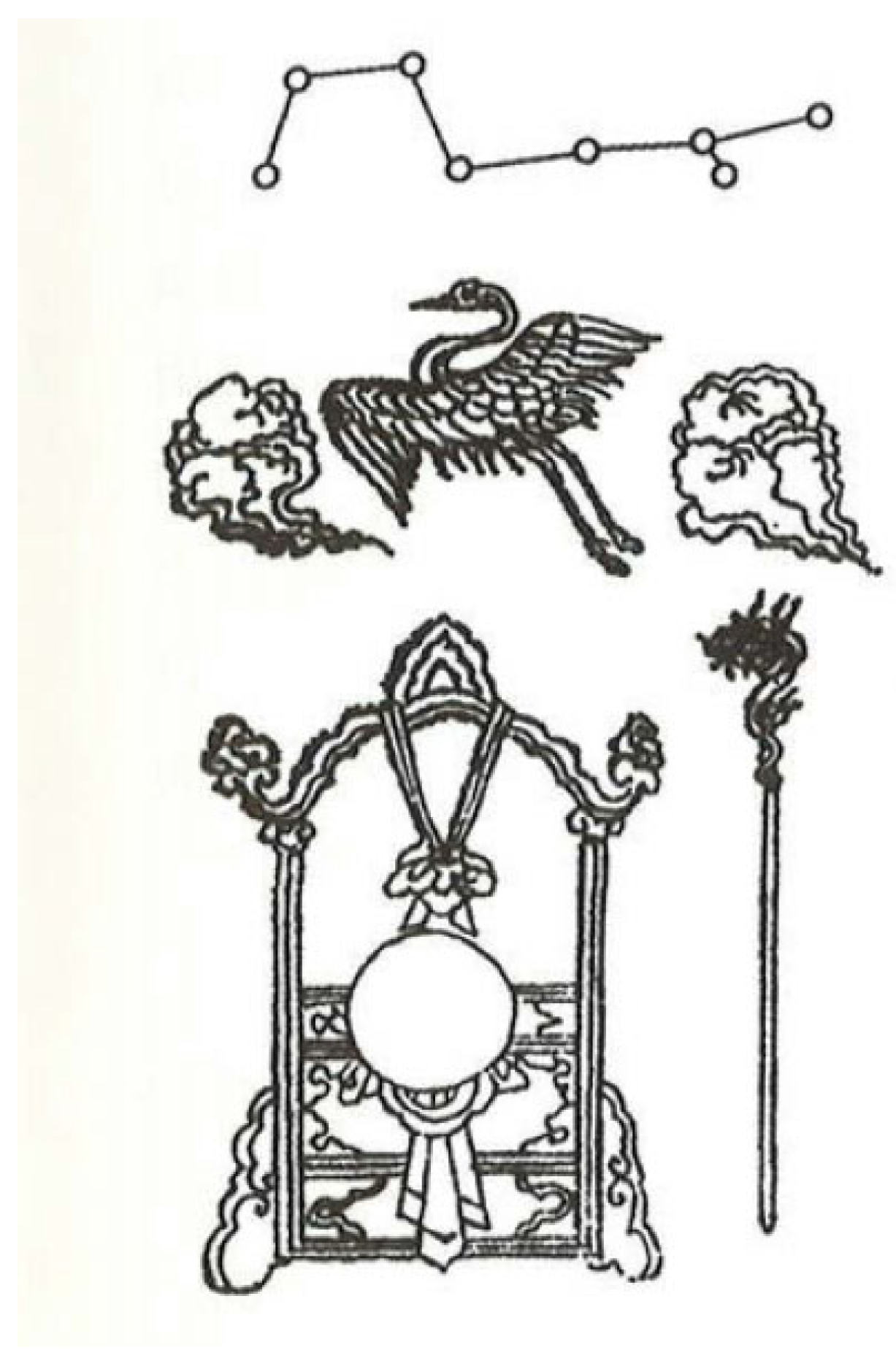
Compilation of Taoist Witchcrafts (《道法会元》) Volume 185: Shang-ch’ing Sect of Taoism Five Jade Tablets and Nine Spirits Flying Steps Memorial Ritual (《上清五元玉册九灵飞步章奏秘法》) records the method of using an ancient mirror for Cunsi and qi filling to transform into an immortal: “Start on the first day of the first lunar month, or the third day of the third lunar month, the fifth day of the fifth lunar month, the seventh day of the seventh lunar month, or the ninth day of the ninth lunar month. Purify yourself through fasting, sit facing east in the room, hold a bright ancient mirror in the left hand, clench the right hand, concentrate your spirit and stabilize your breath. Dress neatly, Cunsi your own form, clearly recognize it carefully. Then choose the Gengshen or Jiazi day, sit in the quiet room at midnight (23:00–1:00) as before, without using the mirror, and silently recite the incantation to fill the body with Taoist qi and transform into an immortal.” 以正月一日或三月三日,五月五日,七月七日,九月九日起首,清净斋戒,入室东向平坐,以古镜一面明莹者,左手持镜,右手握固,凝神定息,严具衣冠,存思己形,明照熟认,再择庚申,甲子日子时入靖室,依前端坐,即不用镜,默念神咒即可道气满充,化为真人。 (Taoist Canon 1988b, vol. 30, p. 177). Unlike ritual mirrors used in public rites, cultivation mirrors need to be used by sitting in the room on a selected day, first “holding the mirror in the left hand” to “Cunsi one’s own form”, then leaving the mirror to exert the function of Cunsi. Seven Slips of the Cloudy Satchel (《云笈七签》) Volume 48: Section of Secret Methods and Essential Techniques: Lord Lao’s Illuminating Method Exposition (《秘要诀法部·老君照明法叙事》) states: “In the past, my master used a two-inch mirror, one in front, behind, left, and right respectively, named the Four-Gui Mirror (四规镜)… Shangzi said: use one nine-inch mirror on each side, named the Sun and Moon Mirror (日月镜), which can also prolong life.” 昔我先师以尺二寸镜,前后左右一焉,名四规……商子云,以九寸镜各一枚,侠(通“挟”)其左右,名曰日月,亦以延年矣。 (Junfang Zhang 1996, p. 280). In cultivators’ Cunsi process, small two-inch mirrors in each of the four directions: front, behind, left, and right are placed, named the Four-Gui Mirror, or place a large nine-inch mirror on each side, named the Sun and Moon Mirror. Volume 72 of Internal Alchemy Section (《内丹部》) states: “The sun and moon are the supreme essence of heaven and earth… If one can grasp the operating laws of the essence of the sun and moon and integrate them into oneself, they will be able to command the mysteries of nature’s creation and transformation. Visiting immortals and contemplating the essence of the sun and moon as the path to longevity is truly valuable.” 天日月者,天地之至精也……如知日月在乎手,造化万灵事无难也。访神仙,瞻日月之精,为长生之道,实可重矣。 By hanging mirrors that have absorbed the essence of the sun and moon, combined with symbolic symbols of the body and spirit such as “clouds, cranes, and longevity staffs” (Figure 5), it can assist in internal alchemy cultivation. Therefore, bronze mirrors were regarded by Taoists as “priceless pearls (无价珠)” and “wish-fulfilling divine pearls (如意神珠)” (Junfang Zhang 1996, pp. 440–41).
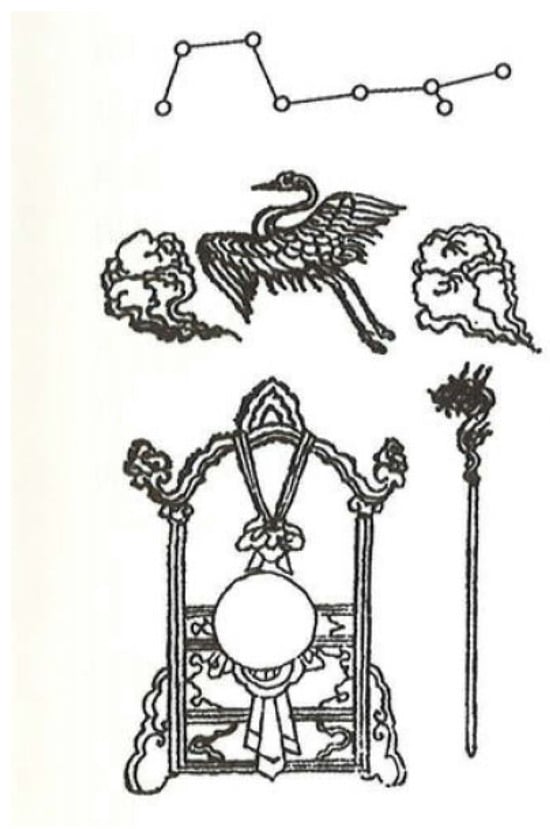
Figure 5.
Diagram of Using a Mirror During Internal Alchemy Cultivation in Seven Slips of the Cloudy Satchel (《云笈七签》), cited from Junfang Zhang (1996, p. 280).
4.3. Characteristics
4.3.1. Limited Quantity, Mainly Passed Down Through the Generations
Based on the currently collected materials, the number of “Tortoise-Swallowing and Crane-Breathing Style” and “Sun and Moon Observing Style” Xingqi pattern bronze mirrors is small, and none of them have been unearthed from tombs. In stark contrast, various types of Daoist-themed mirrors and ritual mirrors with clear functions as Daoist ritual implements have been widely excavated across the country. Their geographical distribution is extensive. For example, mirrors featuring the immortal-tortoise-crane motif have clear archaeological records in Chongqing, Shaanxi, Jilin, and Yanbian. Daoist ritual mirrors with Bagua (八卦, eight fundamental symbols in Daoist cosmology) patterns or alchemy furnace designs have frequently been discovered in Sichuan, Hunan, Jiangxi, and along the southeastern coast. These findings confirm that Daoist iconography had become deeply integrated into both daily life and funerary culture during the Song Dynasty (960–1279 CE). These excavated examples span a vast territory—from the southwest to the northwest, from the Yangtze River basin to the northeastern frontier—demonstrating that the production and use of Daoist bronze mirrors was a widespread, cross-regional phenomenon. This distinction not only confirms the functional divergence between Xingqi mirrors and ordinary Daoist ritual mirrors, but also further substantiates their unique position within the material culture of Song Dynasty (960–1279 CE) Daoism.
The reason is that Xingqi pattern bronze mirrors were originally tools for people who respected internal alchemy cultivation to Cunsi and cultivate Tao, and were rarely used by the common people. They were not commodities circulating in the market, so their quantity should have been small. Although it is recorded in some documents that “Talisman Mirrors (Fu Jing 符镜)” were buried together with its owner when a Taoist passed away8, from the existing materials excavated from tombs, Taoist mirrors are not necessary burial objects in Taoist tombs (Canping Chen 2022). In the second year of Jingde reign in the Northern Song Dynasty (1005 CE), Wu Ji (吴及) once presented a “Hanxiang Mirror (含象鉴)” to Emperor Zhenzong, and wrote Presenting the Bronze Mirror Cast by Master Sima to the Emperor (《进司马天师铸含象鉴表》), which states: “Your servant previously acquired one Hanxiang Mirror cast by Master Sima of the Tang Dynasty (618–907 CE) for Emperor Xuanzong of Tang. It has been passed down through generations of my family and closely guarded in secrecy for many years.” 臣先收得唐司马天师为明皇所铸象鉴表一面,家传累世,掌秘多年。 (Taoist Canon 1988a, vol. 6, p. 668). The “Hanxiang Mirror” was designed and cast by Sima Chengzhen (司马承祯 647–735 CE), a Taoist master of the Tang Dynasty (618–907 CE). Because it contains patterns such as eight trigrams, five great mountains, sun, moon, stars, etc., it is also named “Sun, Moon, Stars, Five Great Mountains and Eight Trigrams Mirror of Tang Dynasty” (唐日月星辰五岳八卦镜), “Astronomical Eight Trigrams Pattern Mirror Tang Dynasty” (唐天象八卦纹镜), etc. (B. Zhang 2013; M. Li 2012). Wu Ji of the Song Dynasty (960–1279 CE) presented this Tang mirror “passed down for generations and kept secret for many years” as a treasure to the emperor, which shows that old or ancient Taoist mirrors are highly valued. It thus could be inferred that such Xingqi pattern mirrors used for internal cultivation were mostly collected by Taoist cultivators and thus mainly passed down through the generations in their families.
Nevertheless, the absence of excavated Xingqi pattern bronze mirrors to date may also be attributed to a range of specific factors, including differences in sectarian traditions, regional customs, and even the economic status of tomb owners. It should also be acknowledged that the boundaries between Daoist practitioners and the broader educated elite were often fluid in the Song Dynasty. Literati such as Su Shi (苏轼, 1037–1101) and Huang Tingjian (黄庭坚, 1045–1105) were deeply engaged in health preservation practices and Daoist cultivation techniques, making it plausible that wealthy intellectuals also owned and used such mirrors, even if their primary association was with Daoist circles.
4.3.2. With a Relatively Specific Geographic Distribution: Mainly Collected in Hunan Region
Most of the existing two styles of Xingqi pattern bronze mirrors were discovered in the Hunan province. The health preservation movements depicted in the Xingqi pattern, such as Tortoise-Swallowing and Crane-Breathing and Sun and Moon Observing styles, are closely linked to the ideas such as “ingesting the six vital qi” which were also popular in the original Hunan-Chu region, as well as the physical evidence, texts, and images such as the “Xingqi Jade Pendant Inscription” of the Warring States Period (475–221 BCE), the Exercise Guidance Diagram, and Quit Grains and Ingest Qi of the Western Han Dynasty (207 BCE–25 CE) unearthed in Hunan. It should be noted that these early materials are cited not as evidence of a direct archaeological lineage—which, given the considerable temporal gap, would indeed be untenable—but rather as testimony to the long-standing cultural and intellectual tradition of breath cultivation and biomimetic practices in the Hunan-Chu region.
“In the past, in the city of Nanying in the State of Chu, between Yuan and Xiang rivers, the folk custom was to believe in ghosts and gods and hold frequent ritual sacrifices. For their sacrifices, local people must play music and dance to please all gods.” 昔楚南郢之邑,沅湘之间,其俗信鬼而好祀。其祠,必作乐鼓舞,以乐诸神 (Qu and Song 2015, p. 50). In ancient times, the territory of present-day Hunan was the residence of barbarian tribes such as “Jiuli (九黎, an ancient tribal confederation in southern China)” and “San Miao (三苗, San Miao, ancient tribes inhabiting present-day Hunan and surrounding regions)”, and witchcraft was prevalent. Since the Spring and Autumn and Warring States Periods (c. 770–221 BCE), people from the State of Chu moved southward, and on this fertile soil of myths, beliefs, and witchcraft, the splendid Chu Witchcraft Culture (楚巫文化, the indigenous spiritual traditions of the ancient Chu state) was nurtured. Song Dynasty (960–1279 CE) official records provide compelling evidence for the persistence of shamanistic practices. An imperial amnesty decree from the third year of the Qiandao reign (1167 CE), preserved in the Song Huiyao Jigao (《宋会要辑稿》), states: “We have learned that among the common people, there are those who kill people to sacrifice to ghosts”民间多有杀人祭鬼 (Xu 2014, p. 8386). Similarly, the Southern Song scholar Chen Chun (陈淳, 1159–1223) observed in his Beixi Ziyi (《北溪字義》): “The customs in Hunan are particularly given to excessive sacrifices, often using human victims to worship ghosts. Villagers either pool money to purchase people for sacrifice or seize passersby for this purpose” 湖南风俗,淫祀尤炽,多用人祭鬼,或村民裒钱买人以祭,或捉行路人以祭 (Chun Chen 1983, p. 65). This demonstrates that shamanistic culture not only persisted into the Song Dynasty (960–1279 CE) but in certain forms even intensified. Compared with the Central Plains culture dominated by traditional Confucianism, the land of Hunan-Chu has always advocated spiritual freedom and physical longevity, which is full of romantic imagination. Therefore, there is the cultural soil for the birth and long-term existence of the “Xingqi pattern” on bronze mirrors.
Secondly, the popularity of this mirror pattern is related to the prevalence of Taoism in southern China. Since Zhang Daoling (张道陵), the founder of Taoism, initiated Taoist activities in Jiangxi during the Eastern Han Dynasty (25–220 CE), the region became a dominant center of Taoism south of the Yangtze River through the Tang, Song, Yuan, and Ming dynasties (618–1644 CE) (Guo 1996). Its influence significantly shaped the development of Taoism in neighboring Hunan, facilitated by close demographic interactions. In addition to the Xingqi pattern mirrors discussed in this paper, the popularity of various Taoist mirror patterns along the middle Yangtze during the Song Dynasty (960–1279 CE), including immortal-tortoise-crane, immortal-deer-crane, and Magu (麻姑, a Taoist goddess associated with longevity) birthday mirrors, reflects the widespread appeal of Taosim longevity beliefs in both Jiangxi and Hunan during this period (H. Li 2023). The concentration of Xingqi pattern bronze mirrors in Hunan could be further related to the activities of multiple Daoist schools in the region during the Song Dynasty (960–1279 CE). Nanyue Mount Heng (南岳衡山) in central Hunan had been an important center for the Shangqing school (上清派) since Wei Huacun (魏华存) established it there during the Eastern Jin Dynasty (317–420 CE), with this tradition emphasizing visualization and inner contemplation. And during the Northern Song (960–1127 CE), Emperor Zhenzong (真宗, r. 997–1022 CE) elevated the status of the Nanyue, and by the Southern Song (1127–1279 CE), Mount Heng had become a crucial imperial blessing site, attracting Daoist practitioners from various regions. Concurrently, new talismanic Daoist movements that emerged during the Northern Song, such as the Tianxin Zhengfa (Celestial Heart Correct Method 天心正法) and Shenxiao schools (Divine Empyrean 神霄派) also spread into Hunan.
Furthermore, the development of the mining and metallurgy industry and the commercialization of metal products in Hunan during the Song Dynasty (960–1279 CE) also provided a material foundation for the emergence of Taoist bronze mirrors such as Xingqi pattern. For example, in the first year of Yuanfeng reign of Emperor Shenzong of Song (1078 CE), Tanzhou collected 1,078,250 jin of copper, ranking first in Hunan; the Yongxing Field in Tanzhou was a major copper producer in the Song Dynasty (960–1279 CE), with 46 copper furnaces in the Wushan area of Tanzhou and more than 100 copper households in Matan Eyang Mountain, which could produce copper tea sets and bronze mirrors with good sales (Yang 2010).
While it is worth noting that the cultural and religious environment of Hunan may have been conducive to the production and use of Xingqi mirrors, the current evidence—all collected rather than excavated—does not permit conclusive claims about the specific reasons for their regional distribution. The reasons for this distribution may involve multiple factors including local collecting patterns, preservation conditions, or historical contingencies. Further archaeological discoveries may illuminate this question in the future.
5. Conclusions
This article revisits the content and functions of the Xingqi pattern bronze mirror patterns mainly from an iconographical perspective. After comparing and verifying both literature and cultural relics, the main conclusions are drawn as follows:
First, the Xingqi pattern bronze mirrors are characterized by iconographic features such as figures practicing Tuna or moon-gazing, tortoises, flying cranes, and pine trees, depicting the practical activities of Taoist cultivators to cultivate and prolong life through breathing exercises.
Second, the two styles of mirror patterns respectively depict two movements: cultivators learning Tuna Exercise Guidance from tortoises and cranes, and looking up at the sky to ingest the essence of the sun and moon. They are a revival of techniques such as Xingqi method and breath ingestion method (Shiqi Fa 食气法) from the Pre-Qin (prior to 221 BCE), Western Han (206 BCE–25 CE), and Eastern Han (25–220 CE) dynasties during the period when internal alchemy beliefs prevailed in the Northern and Southern Song dynasties (960–1279 CE). Therefore, it is more appropriate to name the two styles of bronze mirrors “Tortoise-Swallowing and Crane-Breathing Style” and “Sun and Moon Observing Style”. This clarification of typology establishes a terminological foundation for subsequent research.
Third, different from magical mirrors such as monster-revealing and form-separating mirrors, Xingqi pattern bronze mirrors were dominantly used by cultivators to hold in their hands or hang in different positions during internal alchemy cultivation such as Cunsi in quiet rooms, so as to Cunsi their own forms, achieve the effects of the body and spirit not dispersing, and diseases not entering. In addition, the patterns of such bronze mirrors embody tranquility and positive meanings, and may also have the function of spreading Taoism.
Fourth, Such Xingqi pattern bronze mirrors have rarely been unearthed from tombs. This pattern of absence suggests that they were likely preserved and passed down through generations, possibly within Daoist practitioner circles. Almost all surviving Xingqi pattern bronze mirrors have been collected in Hunan, suggesting a regional concentration during the Song Dynasty. This geographical pattern may be associated with several factors, including Hunan’s enduring Chu shamanistic traditions, its long-standing culture of health preservation, and the flourishing of Daoism in the region during the Southern Song Dynasty (1127–1279 CE).
As the Dutch art historian Johan Huizinga observed in historical research, “Images are primary. Through images, we can see the past ‘more clearly, acutely, and colorfully—in a word, more historically’” (quoted in Haskell 2020, p. 595). The “Tortoise-Swallowing and Crane-Breathing Style” and “Sun and Moon Observing Style” Xingqi patterns on Song Dynasty (960–1279 CE) bronze mirrors in southern China are actually a visual representation of a set of body techniques of internal alchemy. They not only witness to the thousand-year-old health preservation philosophy, but also reveal how Song Dynasty (960–1279 CE) internal alchemy transformed abstract cosmology into operable physical practices which can be passed down through generations.
Meanwhile, from the perspective of material religion, religious beliefs and practices are often mediated through material objects, bodily engagement, and sensory experience (Morgan 2010; Meyer et al. 2010). The Xingqi pattern bronze mirrors thus embody a key insight from material religious studies: they are not passive illustrations of doctrine but active mediators that shape religious practice and subjectivity. Through their dual material properties—the reflective surface enabling self-contemplation and the cast patterns providing iconographic guidance—these mirrors materialize inner alchemy theory and were repeatedly enacted in practitioners’ gazing, breath regulation, and visualization. In this sense, they not only bear witness to history but also participated in its making: as a medium connecting ideas and the body, spirit and matter, the Xingqi mirrors provide invaluable material evidence for understanding the material and practical dimensions of Daoist cultivation.
Funding
This research was assisted by grants from Hunan Museum, Hunan Key Laboratory of Archaeology and Cultural Heritage Conservation Science.
Data Availability Statement
Data are contained within the article.
Conflicts of Interest
The author declares no conflicts of interest.
Notes
| 1 | Zhou Shirong first published two Xingqi-related mirrors as “Tortoise and Crane Pattern Mirror” and “Figure Mirror” (Hunan Museum, Catalogue of Bronze Mirrors Excavated in Hunan 《湖南出土铜镜图录》, 1960). He later renamed them “Star-Observing and Moon-Gazing Breath Exercise Bronze Mirror” and “Tortoise-Swallowing and Crane-Breathing Breath Exercise Bronze Mirror,” linking the patterns to the “Absorbing Moon Essence Method” in Yunji Qiqian (《云笈七签》) and the longevity of tortoises in Shiji (《史记》). (Zhou Shirong, Bronze Mirror Patterns—Bronze Mirrors of Past Dynasties Unearthed in Hunan (《铜镜图案——湖南出土历代铜镜》), 1987) Liu Yi further identified these mirrors as reflecting Taoist cultivation practices (Liu Yi, Interaction Between Mirror Culture and Taoism (《镜文化与道教之互动》), 2004). Subsequent scholarship has largely followed their nomenclature. |
| 2 | For the bell’s ritual functions, see Dongxuan Lingbao Sandong Fengdao Kejie Yingshi (《洞玄灵宝三洞奉道科戒营始》), in Daozang (《道藏》) 24, 1988, p. 752; and Yaoxiu Keyi Jielü Chao (《要修科仪戒律钞》) quoting Taizhenke (《太真科》), in Daozang 6, 1988, p. 429. |
| 3 | Zhang Xunliao and Bai Bin’s judgment on the Taoist nature of tripod-shaped bronze mirrors in the Song Dynasty (960–1279 CE) is also applicable to bell-shaped bronze mirrors (Zhang and Bai 2006). |
| 4 | “In the Zhong-Lü tradition, the description of the alchemical practice is generally divided into four stages: (1) Laying the foundations; (2) Refining Essence to transmute it into Breath; (3) Refining Breath to transmute it into Spirit; (4) Refining Spirit to return to Emptiness.” (在钟吕内丹学传统中,内丹修炼通常划分为四个阶段: (1) 筑基, (2) 炼精化炁, (3) 炼炁化神, (4) 炼神还虚。) (Mu Wang 2011). |
| 5 | There is another view that “Lao Peng” (老彭) refers to Peng Zu (彭祖), a Taoist immortal famous for longevity and health preservation. Based on the mirror inscription “made by Lao Peng” at that time and the convention of inscribing bronze mirrors, the author tentatively infers that “Lao Peng” was the name of a bronze mirror caster or a mirror workshop. |
| 6 | Liao crane alludes to the story in Tao Qian’s (陶潜) Sou Shen Hou Ji (《搜神后记》) Volume 1 of the Jin Dynasty: “Ding Lingwei (丁令威) was originally from eastern Liaoning province. He practiced the Tao at Lingxu Mountain (灵虚山) and later transformed into a crane and returned to Liao.” Later generations often used “Liao crane” to refer to attaining the Tao and becoming an immortal. |
| 7 | For the practice of hanging mirrors during alchemical altar construction, see Dao Shu·Cantong Qi (《道枢·参同契》) Vol. 4, which mentions mirrors hung in the eight directions; and Gan Qi: The Sixteen-Circuit Golden Elixir (《感气十六转金丹》), which specifies the use of an ancient sword and an ancient mirror on a three-tiered altar (Zhou Quanbin & Sheng Keqi, Integrated Annotations on Cantong (《参同集注》), 2013; Zhang Jiyu, Chinese Daoist Canon (《中华道藏》) Volume 18, 2014). |
| 8 | According to The Essentials of Taoist Rituals and Precepts (《要修科仪戒律钞》), Volume 15: The Fifth Ritual of Coffining and Final Enclosure (《入棺大殓仪第五》), Taoists sometimes placed Talisman Mirrors when being buried, which were placed inside the coffin. (Taoist Canon《道藏》Volume 6, 1988). |
References
- Changsha Museum 长沙市博物馆, ed. 2010. Chu Style and Han Elegance—Bronze Mirrors Collected by Changsha Museum (《楚风汉韵——长沙市博物馆藏镜》). Beijing: Cultural Relics Press, p. 204. [Google Scholar]
- Chen, Canping 陈灿平. 2022. On the Dating of Tang Dynasty Taoist Mirrors (《关于唐代道教镜的年代问题》). Cultural Relics of Central China (《中原文物》) 5: 114–20. [Google Scholar]
- Chen, Chun 陈淳. 1983. Beixi Ziyi (《北溪字義》). Collated and punctuated by Guozhen Xiong and Liushui Gao. Beijing: Zhonghua Book Company, p. 65. [Google Scholar]
- Chen, Dingrong 陈定容. 1999. Ancient Mirrors Unearthed in Recent Years and Related Issuess (《近年出土古镜及有关问题》). Cultural Relics in Southern China (《南方文物》) 1: 32. [Google Scholar]
- Ge, Hong 葛洪. 2018. Baopuzi Neipian (《抱朴子内篇》). Translated and annotated by Songhui Zhang. Beijing: Zhonghua Book Company, pp. 76–81, 100, 188, 425. [Google Scholar]
- Gesterkamp, Lennert 葛思康. 2011. The Heavenly Court: Daoist Temple Painting in China, 1200–1400. Leiden: Brill. [Google Scholar]
- Guo, Shusen 郭树森. 1996. A Brief Introduction to Jiangxi Taoism (《江西道教概说》). China Taoism (《中国道教》) 3: 31–33. [Google Scholar]
- Han, Fengyue 韩风月. 1997. A Brief Analysis of the Relationship Between Taoist Internal Alchemy and Traditional Chinese Qigong (《浅析道教内丹术与中国传统气功的关系》). Journal of Guangzhou Sport University (《广州体育学院学报》) 2: 83–86. [Google Scholar]
- Han, Jishao 韩吉绍. 2010. On Taoist Mirrors (《论道教镜》). In Chinese Science and Civilization. Edited by Jiang Sheng. Jinan: Shandong University Press, vol. 1, p. 43. [Google Scholar]
- Han, Jishao 韩吉绍, and Lujun Zhang 张鲁君. 2005. Early Taoism and Ancient Chinese Mirror Thought (《早期道教与中国古代之镜思想》). Journal of Qilu Normal University (《齐鲁师范学院学报》) 6: 48–52. [Google Scholar]
- Haskell, Francis. 2020. History and Its Images: Art and the Interpretation of the Past. Translated by Lingwei Kong. Beijing: Commercial Press, p. 594. [Google Scholar]
- He, Yang 何洋. 2020. Zhuangzi. Translated and annotated by Yang He. Changchun: Jilin University Press, p. 164. [Google Scholar]
- Ho, Peng Yoke 何丙郁. 2007. Explorations in Daoism: Medicine and Alchemy in Literature. London: Routledge. [Google Scholar]
- Huang, Shishan 黄士珊. 2012. Picturing the True Form: Daoist Visual Culture in Medieval China. Cambridge, MA: Harvard University Asia Center. [Google Scholar]
- Huang, Shishan 黄士珊. 2016. Preliminary Study on Taoist Material Culture: Examining Ritual Objects in Song Dynasty Taoism through Images in the Daoist (《道教物质文化初探:从<道藏>所藏图像谈宋代道教仪式用品》). In Taoist Images, Archaeology and Rituals: Evolution and Characteristics of Song Dynasty Taoism (《道教图像,考古与仪式:宋代道教的演变与特色》). Edited by Zhitian Li. Hong Kong: Chinese University Press of Hong Kong, p. 10. [Google Scholar]
- Kohn, Livia. 2020. The Zhong-Lü System of Internal Alchemy. St. Petersburg: Three Pines Press. [Google Scholar]
- Laozi 老子. 2017. Complete Collection of Tao Te Ching (《道德经全集》) 4. Beijing: Beijing United Publishing Company, p. 1647. [Google Scholar]
- Li, Fang 李昉, ed. 1994. Taiping lmperial Encyclopedia (《太平御览》). Collated and punctuated by Ming Ren, Ruiping Zhu and Hongyin Nie. Wuhan: Hebei Education Press, vol. 6, p. 586. [Google Scholar]
- Li, Huijun 李慧君. 2023. Inheritance and Evolution of Human-Tortoise-Crane Pattern Bronze Mirrors in Song, Jin and Yuan Dynasties (《宋金元时期人物龟鹤纹铜镜的传承与演变》). Collector (《收藏家》) 6: 52–59. [Google Scholar]
- Li, Min 李敏. 2012. The Hanxiang Mirror and Religious Politics in Tang and Song China. In The Lloyd Cotsen Study Collection of Chinese Bronze Mirrors. Edited by Lothar von Falkenhausen. Los Angeles: Cotsen Institute of Archaeology Press, pp. 170–83. [Google Scholar]
- Ma, Duanlin 马端临. 2011. Wenxian Tongkao (《文献通考》). Beijing: Zhonghua Book Company, vol. 4, p. 515. [Google Scholar]
- Ma, Jixing 马继兴. 2015. Textual Research, Interpretation and Study of Ancient Chinese Medical Books Unearthed in China (Volume Two) (《中国出土古医书考释与研究》下). Shanghai: Shanghai Science and Technology Press, pp. 564, 667. [Google Scholar]
- Meyer, Birgit, David Morgan, Crispin Paine, and S. Brent Plate. 2010. The Origin and Mission of Material Religion. Religion 40: 207–11. [Google Scholar] [CrossRef]
- Morgan, David. 2010. Religion and Material Culture: The Matter of Belief. London: Routledge. [Google Scholar]
- Most, Glenn W. 2007. Doubting Thomas. Cambridge, MA: Harvard University Press, p. 158. [Google Scholar]
- Peng, Bisheng 彭必生. 2026. Spiritual Alchemy: Centered on the Concept and Iconography of the “Three Corpses 三屍”. Religions 17: 16. [Google Scholar]
- Pregadio, Fabrizio. 2006. Great Clarity: Daoism and Alchemy in Early Medieval China. Stanford: Stanford University Press. [Google Scholar]
- Qi, Shoucheng 齐守成, Ying Zhang 张颖, and Su Chen 陈速. 1989. The Complete Works of the Seven True Daoist Masters of the Quanzhen School (《全真七子全书》). Shenyang: Chunfeng Literature and Art Publishing House, p. 436. [Google Scholar]
- Qu, Yuan 屈原. 2004. Supplemented Annotations on Chu Ci (《楚辞补注》). With chapter and sentence annotations by Yi Wang. Jinan: Shandong Pictorial Publishing House, p. 157. [Google Scholar]
- Qu, Yuan 屈原, and Yu Song 宋玉. 2015. Commentary and Annotation on Chu Ci (《楚辞评注》). Commented and annotated by Zhangping Tang. Beijing: Beijing United Publishing Company, p. 50. [Google Scholar]
- Shanyou History and Culture Research Institute 山右历史文化研究院, ed. 2014. Shanyou Series·First Series 7 (《山右丛书·初编》7). Shanghai: Shanghai Ancient Books Publishing House, p. 278. [Google Scholar]
- Shen, Shou 沈寿. 1980. An Analysis of the Western Han Silk Painting “Exercise Guidance Diagram” (《西汉帛画<导引图>解析》). Cultural Relics (《文物》) 9: 70–76. [Google Scholar]
- Skar, Lowell Dean. 2003. Golden Elixir Alchemy: The Formation of the Southern Lineage of Taoism and the Transformation of Medieval China. Ph.D. dissertation, University of Pennsylvania, Philadelphia, PA, USA. [Google Scholar]
- Taoist Canon (《道藏》) Volume 6. 1988a. Beijing: Shanghai Bookstore, Cultural Relics Press, Tianjin: Tianjin Ancient Books Publishing House, p. 668.
- Taoist Canon (《道藏》) Volume 30. 1988b. Beijing: Shanghai Bookstore, Cultural Relics Press, Tianjin: Tianjin Ancient Books Publishing House, p. 177.
- Wang, Cun 王存, comp. 1984. Gazetteer of the Nine Regions During the Yuanfeng Reign (《元丰九域志》). Collated by Songshan Wei and Wenchu Wang. Beijing: Zhonghua Book Company, pp. 259–60. [Google Scholar]
- Wang, Ming 王明. 1960. Compilation of the Scripture of Great Peace (《太平经合校》). Beijing: Zhonghua Book Company, p. 14. [Google Scholar]
- Wang, Mu. 2011. Foundations of Internal Alchemy: The Taoist Practice of Neidan. Mountain View: Golden Elixir Press, p. 18. [Google Scholar]
- Wei, Boyang 魏伯阳, Wenwang Zhou 周文王, and Borui Zhang 张伯端. 2013. Collected Annotations on Cantong—Integrated Annotations on Zhouyi Cantong qi, the King of Alchemical Scriptures Through the Ages (《参同集注--万古丹经王<周易参同契>注解集成》) 4. Edited by Peiwen Dong. Compiled and annotated by Quanbin Zhou and Keqi Sheng. Beijing: Religious Culture Press, p. 1717. [Google Scholar]
- Xie, Lujun 谢路军. 2004. Origin and Development of Taoism in China (《中国道教源流》). Beijing: Jiuzhou Press, pp. 90–91. [Google Scholar]
- Xu, Song 徐松, comp. 2014. Draft for the Collected Statutes of Song Dynasty (《宋会要辑稿》). Collated by Lin Liu and Zhongmin Diao. Shanghai: Shanghai Ancient Books Publishing House, pp. 6724, 6726–27, 8386. [Google Scholar]
- Yang, Jianhong 杨建宏. 2010. On the Social Changes in the Tanzhou Region During the Song Dynasty—From the Perspective of the Development of Handicraft and Commercial Economy (《论宋代潭州区域的社会变迁——以手工业,商业经济发展为视域》). Journal of Changsha University (《长沙大学学报》) 4: 8–12. [Google Scholar]
- Yao, Cuncheng 姚存成. 1990. A Preliminary Study on the Qigong Thought in the “Xingqi Jade Pendant Inscription” (《<行气玉佩铭>的气功思想初探》). Traditional Chinese Medicine Rehabilitation (《中医康复》) 3: 8–10. [Google Scholar]
- Zhang, Baomin 张保民. 2013. Mirror Containing Images: The Bronze Mirror Cast by Master Sima (《含象鉴:司马承祯所铸铜镜》). China Taoism (《中国道教》) 6: 56–57. [Google Scholar]
- Zhang, Chongfu 张崇福. 2004. A Study on the Cultivation Thought of the Shang-ch’ing Sect of Taoism (《上清派修道思想研究》). Chengdu: Bashu Book Company, p. 96. [Google Scholar]
- Zhang, Jiyu 张继禹, comp. 2014. Chinese Taoist Canon (《中华道藏》) Volume 30. Beijing: Huaxia Publishing House, p. 354. [Google Scholar]
- Zhang, Junfang 张君房, comp. 1996. Seven Slips of the Cloudy Satchel (《云笈七签》). Annotated by Jiang Lisheng 蒋力生. Beijing: Huaxia Publishing House. [Google Scholar]
- Zhang, Lujun 张鲁君. 2017. Study on Images in the Daoist Canon (《道藏》图像研究). Jinan: Qilu Press, p. 5. [Google Scholar]
- Zhang, Shanwen 张善文. 2021. A Dictionary of the Zhouyi (《周易辞典》). Shanghai: Shanghai Ancient Books Publishing House, p. 650. [Google Scholar]
- Zhang, Xunliao 张勋燎, and Bin Bai 白彬. 2006. Chinese Taoist Archaeology 4 (《中国道教考古》). Beijing: Thread-Binding Books Publishing House, p. 1144. [Google Scholar]
- Zheng, Shubin 郑曙斌. 2013. A Study on Silk Paintings Unearthed in Hunan (《湖南出土帛画研究》). Changsha: Yuelu Press, pp. 232–33. [Google Scholar]
- Zhou, Shirong 周世荣. 1993. Authentication of Chinese Bronze Mirrors Through the Ages (《中华历代铜镜鉴定》). Beijing: Forbidden City Publishing House, p. 168. [Google Scholar]
- Zhuangzi 庄子. 2018. Zhuangzi. With guidance, and translated and annotated by Xiao Wubei. Changsha: Yuelu Press, pp. 9, 11. [Google Scholar]
Disclaimer/Publisher’s Note: The statements, opinions and data contained in all publications are solely those of the individual author(s) and contributor(s) and not of MDPI and/or the editor(s). MDPI and/or the editor(s) disclaim responsibility for any injury to people or property resulting from any ideas, methods, instructions or products referred to in the content. |
© 2026 by the author. Licensee MDPI, Basel, Switzerland. This article is an open access article distributed under the terms and conditions of the Creative Commons Attribution (CC BY) license.