Article

Shanxi Merchant Guildhalls as Religious Sites for Theatrical Performances in Late Imperial China

Discipline of Chinese Studies, The University of Sydney, Camperdown, NSW 2006, Australia
Religions 2026, 17(4), 404; https://doi.org/10.3390/rel17040404
Submission received: 30 January 2026 / Revised: 14 March 2026 / Accepted: 17 March 2026 / Published: 24 March 2026
(This article belongs to the Special Issue Temple Art, Architecture and Theatre)

Abstract

Emerging in the early Ming dynasty 明 (1368–1644), Shanxi 山西 merchants pioneered large-scale regional trade in late imperial China. In the Ming and Qing 清 (1644–1011) dynasties, Shanxi merchants established over 500 merchant guildhalls throughout the country to worship gods, settle business issues, and stage theatrical performances. Many of them enshrined multiple patron gods, with Emperor Guan being the most common. Larger guildhalls usually featured one or more theatre stages. During major events and worship festivals, theatrical performances were staged to entertain guild members and the guilds’ patron god(s). Drawing on stele inscriptions about guild regulations and activities, this article demonstrates that Shanxi merchant guildhalls were religious sites with a commercial orientation. Although not part of the official sacrificial system, these guildhalls played a supplementary role in the worship of Emperor Guan. The flexibility of worship, the grand scale, and frequent performances made Shanxi merchant guildhalls ideal venues for the promotion of folk beliefs.

1. Introduction

Shanxi merchants pioneered large-scale regional trade in late imperial China. Their home province, Shanxi, is located around the middle reaches of the Yellow River and west of the Taihang 太行 Mountains. As Shanxi was historically under the jurisdiction of the State of Jin 晉 in the pre-Qin 秦 (BC 221–207) era, it is abbreviated as ‘Jin’. As such, Shanxi merchants were also known as ‘Jin merchants’. Although rich in natural resources such as salt and coal (Shiji 1959, 129.3253; Shanxi tongzhi 1892, 47. 917, 919, 920), infertile soil, mountainous topography, and frequent natural disasters made Shanxi unsuitable for farming. As a result, the natives of Shanxi were compelled to develop a tradition of engaging in trade, traditionally a low-status occupation.
Shanxi merchants did not become a powerful merchant group until the early Ming dynasty, when Emperor Hongwu 洪武 (r. 1368–1398), the founder of the Ming Empire, ordered the construction of nine military garrisons along the northern frontier to prevent Mongol invasions and strengthen his new regime. Military troops stationed in these garrisons required a constant supply of military provisions. As two of these garrisons—Taiyuan 太原 and Datong 大同—were located in northern Shanxi, natives of Shanxi took advantage of the opportunity to deliver grain to the army. The reward for long-distance transportation was a government-controlled certificate for collecting and selling salt in designated areas. Enacted in 1370, this grain–salt exchange system (Mingshi 1974, 80.1935) allowed Shanxi merchants to accumulate large fortunes, which laid a strong foundation for the expansion of their business in the following centuries.
One important step Shanxi merchants took in expanding their trade network was to establish merchant guildhalls in towns and cities where they sojourned. From the Ming to the early Republican era (1912–1949), Shanxi merchants established or jointly established over 550 merchant guildhalls in 31 regions across China (including modern-day provinces, autonomous regions, and directly controlled municipalities) (Shanxi sheng xiju yanjiusuo 2009, p. 231). The majority of these guildhalls were located in the northern part of the country, which Shanxi merchants dominated. Given the frequency with which Shanxi merchants collaborated with Shaanxi 陝西 and Gansu 甘肅 merchants, many guildhalls were named ‘Shan-Shaan 山陝 Guildhall’ or ‘Shan-Shaan-Gan 山陝甘 Guildhall’. Unfortunately, most of these guildhalls no longer exist due to mass destruction in times of social unrest, particularly during the War Against Japanese Invasion (1937–1945) and Mao’s rule (1949–1976; Shanxi sheng xiju yanjiusuo 2009, pp. 219–30; Yan 2007, pp. 371–84). Some well-preserved guildhalls include the Pingyang 平陽 Guildhall of Beijing, the Shan-Shaan Guildhall of Sheqi 社旗 in modern Henan 河南 province, the Shan-Shaan-Gan Guildhall of Kaifeng 開封 in Henan, the Shan-Shaan Guildhall of Liaocheng 聊城 in Shandong 山東 province, and the Quanjin huiguan 全晉會館 (All-Shanxi Guildhall) in Suzhou 蘇州, Jiangsu 江蘇 province.
Shanxi merchant guildhalls carried out multiple functions, the most important of which were providing guild members with venues for worshipping patron gods, settling business disputes, and staging theatrical performances. Existing scholarship has examined these activities from various perspectives. From nineteenth century to the early twentieth century, Western explorers, missionaries, and researchers began to study the general mode of operation of Chinese guilds. Some of these works include Macgowan’s (1886) study on chambers of commerce and trade unions in the late Qing period, which acknowledges the relationship between theatrical performances and business; Noboru (1950)1 study of industrial and commercial guilds in Beijing, which pays close attention to the religious aspect of guild activities and mentions theatrical performances on days of worship; and Burgess’s (1928) investigation of the organisation of craftsmen, literati, and merchant guilds in Beijing, which describes the procedure of business meetings accompanied by religious practices and theatrical performances. These studies present a close connection among business affairs, ritual practices and theatrical performances in guildhalls in late imperial China, laying the groundwork for subsequent research on relevant topics. Among them, Burgess’s research was of particular importance to this paper because his data was directly collected from guild members through questionnaires in 1920s, the majority of whom were middle-aged and had begun their careers in the guilds at a young age (Burgess 1928, pp. 61–64). Also, foreign trade and manufacturing industry did not exert a profound influence on the operation of the guilds in Beijing at that time (Burgess 1928, p. 62). Therefore, Burgess’s research findings based the informants’ responses accurately reflect the guild activities in the Qing dynasty, allowing us to have a glimpse of how religious and theatrical activities were closely interrelated with business issues.
Subsequent decades witnessed a gradual increase in scholarly interest in the history and development of Ming–Qing guildhalls, with limited discussion of their cultural and religious aspects. Ho (1966) conducted a historical inquiry of Chinese guild system, focusing on the geographical distribution of all types of guildhalls. Quan’s (1986) examination of Chinese guilds only provides a sketchy introduction to guilds’ worship in the Song dynasty when the guild system has not yet fully established. In comparison, K.-C. Liu (1988) briefly discusses ritual activities in guildhalls; however, this discussion is not fully accurate. K.-C. Liu (1988, p. 10) states that Chinese merchant guilds worshipped folk deities including Emperor Guan because their guilds, as non-authorised organisations, were not allowed to worship Confucius, the legitimised god. This statement depicts merchants as playing a passive role in worshipping patron gods and misinterprets the intention for worshipping gods in merchant guildhalls. Liu holds that the image of Emperor Guan in merchant guildhalls was a martial god, which is also questionable. Notably, K.-C. Liu (1988, p. 13) suggests that merchants were culturally subordinate, so they had to invite literati elites to write stele inscriptions for them in order to receive legitimacy in bargaining with brokers or sub-bureaucracy. Without an in-depth analysis of historical records, the relations between merchants’ business and worship, the power negotiation between merchants and literati elites, and merchants’ subordinate position as manifested in worship remain unclear.
In recent years, scholars have increasingly perceived merchant guildhalls as religious sites, highlighting similarities between Shanxi merchant guildhalls and common temples and the utilitarian nature of worship in these guildhalls. Shao and Zhao (2015), for instance, analyse the differences between Shanxi merchant guildhalls and Temples of Emperor Guan in terms of their architectural structure and basic functions. Furthermore, Li and Zhao (2011) demonstrate that the worship of gods among Ming–Qing craftsmen and merchant guildhalls served business purposes. In addition, Li and Zhao (2014) see Shan-Shaan guildhalls as a form of ‘temple–guildhall–market integration’, demonstrating that guildhalls were venues for commodity exchange. Gipouloux (2025) acknowledges that merchant guildhalls were venues for temple fairs during major events, such as patron gods’ birthdays. But these studies show a lack of systematic analysis of the commercial oriented nature of Shanxi merchant guildhalls and the interconnection between religious and commercial activities.
Other studies address the theatrical performances staged in guildhalls for worship, such as Tanaka’s (2012) research on theatrical performances in different types of guildhalls in Beijing and the role of guildhall theatres in the history of Chinese theatre. Despite his extensive use of historical sources, Tanaka’s analysis does not clearly distinguish the religious activities in merchant guildhalls from that in other types of guildhalls. In comparison, Hu (2022, 2023) focuses on Shanxi merchants’ sponsorship of guildhall theatres during various occasions such as guild meetings and temple fairs. Hu adopts French sociology Bourdieu’s ([1986] 2011) theory of ‘forms of capital’ in the analysis of Shanxi merchants’ intention behind their theatre sponsorship. This inspires the investigation of the commercial orientation of worship in Shanxi merchant guildhalls in this paper. Also, Hu acknowledges the dissemination of theatrical performances along Shanxi merchants’ trade routes but does not discuss the promotion of religions and folk beliefs, especially the cult of Emperor Guan, through Shanxi merchants’ commercial network.
What is more, as the religious activities in Shanxi merchant guildhalls centred on the worship of Emperor Guan, recent studies on the cult of Emperor Guan and folk beliefs in China are also relevant. Ter Haar (2017, 2022) conducted systematic historical inquiries into the development of the cult of Emperor Guan, his role as an exorcist, and the leaders of the Divine Soldiers during the Boxer Rebellion (1899–1901). But these studies largely omit merchants’ worship of Emperor Guan and the role of merchant guildhalls in the spread of the cult. Other scholars, including S.-W. Li (2023) and Goossaert (2015, 2019, 2022, 2023), have taken interest in the canonisation of gods in the Ming and Qing dynasties, including Emperor Guan, as well as spirit-writing texts produced and circulated in late imperial China. They agree that fuji 扶乩or fuluan 扶鸞 (spirit-writing) texts were used by literati elites to spread moral messages and that Emperor Guan was one of the most important canonised gods in the Ming and Qing dynasties. Goossaert’s studies show that government officials and literati took part in spirit-writing with great honour to praise the merits of gods, including Emperor Guan, and recite piety books daily as part of self-cultivation. These raise questions as to whether merchant adherents paid respect to Emperor Guan in the same way as literati and officials, and for the same purposes. As Li and Goossaert examine the canonised gods from the perspective of literati, the answers to these questions remain unsolved.
Last but not least, Naquin’s (2019) research on the material manifestation of regional culture in northern China sees Shanxi merchant guildhalls as temples and briefly discusses the guildhall roofs decorated with glaze ceramics imported from Shanxi and the iron flagpoles outside front gates. Naquin holds that these materials were used to distinguish Shanxi merchant guildhalls from local temples and show off the merchants’ extravagance and regional culture. Although these finding are insightful, further research is needed to delineate how objects and components of guildhall building complexes manifested Shanxi merchants’ cultural identity, and whether religious activities played a role in this process.
Taken together, while these studies offer valuable insights into guildhalls, theatrical performances for worship in guildhalls, and the worship of Emperor Guan countrywide, none focus on religious activities in Shanxi merchant guildhalls accompanied by theatrical performances, particularly on days for worshipping Emperor Guan. The role of Shanxi merchant guildhalls in promoting folk belief, the distinctive features of Shanxi merchants’ god worship, and the relationship between the imperial court and Shanxi merchant guildhalls in the worship of Emperor Guan have also not been fully discussed.
This paper extends the aforementioned studies and describes religious and theatrical activities in Shanxi merchant guildhalls in the Ming and Qing eras. It argues that as Shanxi merchant guildhalls served merchants’ business needs, their religious activities, accompanied by theatrical performances, were also commercially oriented. Although not part of the official sacrificial system, Shanxi merchant guildhalls created a network of worship across the country and played an important role in enhancing the popularity of the worship of Emperor Guan at the local level. Government protection of cultural activities in Shanxi merchant guildhalls, the grand scale of the guildhalls, the inclusiveness of worship, and frequent performances staged therein made Shanxi merchant guildhalls ideal venues for promoting religions and folk beliefs.

2. Research Questions, Terminations, and Theoretical Framework

Mainly drawing on guild regulations, recorded guild activities, and a newspaper article, this paper attempts to answer several research questions. First, how did their commercial orientation distinguish the religious activities in Shanxi merchant guildhalls from those in other temples? Second, how did power negotiations between merchants and literati mediate the Confucian interpretation of Emperor Guan and his image in popular culture in Shanxi merchant guildhalls? Third, given the hierarchical relationship between Shanxi merchant guildhalls and government, how did Shanxi merchant guildhalls contribute to the richness of religion and beliefs at the local level? Finally, what role did theatrical performances play in the guildhalls’ religious activities and in the promotion of religions and folk beliefs?
To answer these questions, this paper adopts Bourdieu’s ([1986] 2011) theory of ‘forms of capital’ and the theoretical framework of religious economy developed by Stark and Finke (2000). Specifically, Bourdieu classifies ‘capital’ into several types. Economic capital refers to the financial resources that are ‘immediately and directly convertible into money and may be institutionalized in the form of property rights’ (Bourdieu [1986] 2011, p. 79). Social capital refers to ‘a membership in a group—which provides each of its members with the backing of the collectively-owned capital, a “credential” that entitles them to credit in the various senses of the word’ (Bourdieu [1986] 2011, p. 84). Cultural capital includes the ‘embodied state’ or ‘long-lasting dispositions of the mind and body’; the ‘objectified state’ or cultural goods; and the ‘institutionalized state’, such as educational qualifications (Bourdieu [1986] 2011, p. 79). Crucially, cultural capital is the main determinant of social stratification. Any cultural symbol or activity, including religion, ‘embodies interest and function[s] to enhance social distinctions’ (Swartz 1996, p. 72). Therefore, cultural practices are foundational to power negotiations. ‘The exercise of power requires legitimation’ (Swartz 1996, p. 72), and the nature of all social life is ‘the struggle for social recognition’ (Swartz 1996, p. 72). When one’s resources are legitimised in society, they function as an authoritative embodiment of cultural value or symbolic capital. (Calhoun 2002; Swartz 1996, p. 77).
Economic capital is the basis of all other forms of capital. Under certain circumstances, social capital, cultural capital, and economic capital can be converted (Bourdieu [1986] 2011, p. 87). In the case of Shanxi merchants, their patterns of worship reflect the mutual convertibility of these three forms of capital and their desire for social recognition. Literati elites’ presence in the Shanxi guildhalls’ religious activities and their disapproval of Shanxi merchants’ lavish spending can be understood as manifestations of power negotiations between the literati and wealthy merchants in the late imperial eras.
According to Stark and Finke, the religious economy is a subsystem in all social systems where religious activities take place (Stark and Finke 2000, p. 193). It is a “’market’ of current and potential adherents, as set of one or more organizations seeking to attract or maintain adherents, and the religious culture offered by the organization(s)’ (ibid., p. 193). Religious organisations are ‘social enterprises whose primary purpose is to create, maintain, and supply religion to some set of individuals and to support and supervise their exchanges with a god or gods’ (ibid., p. 103). Each market has different niches, which are the ‘market segments of potential adherents sharing particular religious preferences (needs, tastes, and expectations)’ (ibid., p. 193). If a religious economy is unregulated, ‘it will tend to be very pluralistic’. Theoretically, while a religious organisation can use coercion to fully monopolise a religious economy, this can never be achieved, as pluralism always develops (ibid., p. 199). Tension, meanwhile, refers to ‘the degree of distinctiveness, separation, and antagonism between a religious group’ and society (ibid., p. 143). The greater the tension with the outside world, the more exclusive the religious organisation (ibid., p. 144). A high tension between a religious organisation and its surrounding indicates that it is costly to join a religious group, and that high level of commitment is required (ibid., p. 282).
The adoption of the religious economy in this paper draws inspiration from Szonyi’s (2009) discussion of possible theoretical frameworks to be used in studying the history of Chinses popular religion because scholars reject secularisation theory on the grounds that modernisation does not leads to the decline of religion in China. By applying the theoretical framework of the religious economy, this paper attempts to provide an answer to Szonyi’s (2009, p. 315) question as to whether various religious options could coexist while the imperial government implemented Confucian doctrine as the legitimised ideology in the late imperial era.
This theoretical framework can be used to explain the relationship between the imperial court and Shanxi merchant guilds on matters of worship and the inclusiveness and spread of beliefs. However, some elements require modification in the context of late imperial China. First, the imperial court tended to promote orthodox Confucian ideology, which was a school of thought rather than a religion. Second, while this framework describes the supply side of a religious economy, centring religious organisations rather than adherents as mobilisers of religious change (ibid., p. 193), in China, adherents have had an important impact on the diversity of religious and folk beliefs. Finally, although the religious organisations in question—the imperial court and Shanxi merchant guildhalls—maintained and supplied religions and supervised adherents’ activities, they were not the creators of these religions, as defined within this framework. In this sense, they were not churches or sects.

3. Guildhalls as Temples

Shanxi merchant guildhalls resembled temples in many respects, including their daily operations and functions. To establish a guildhall, sojourning Shanxi merchants usually purchased land with funds raised through donations from guild members. Another common practice was to expand a local temple dedicated to Emperor Guan into a guildhall. One example is the Shanxi Guildhall of Haicheng 海城 in modern Liaoning 遼寧 province, which was originally a temple established under the supervision of the zhixian 知縣 (Magistrate)2 Zheng Xiu 鄭繡 in 1682 (Yan 2007, p. 333). In 1861, this temple was transformed into a Shanxi merchant guildhall because of Shanxi merchants’ frequent donation for the renovation of the temple (Yan 2007, p. 333). Another example is the Shanxi Guildhall of Nanjing 南京. This guildhall was expanded from a temple dedicated to Emperor Guan, which was established as early as 446 during the Northern and Southern Dynasties (420–589) (Yan 2007, p. 282). The original temple was a sanjin yuanluo 三進院落 (three-courtyard compound). Before the transformation of the temple, there was no assembly place in Nanjing for sojourning Shanxi merchants. In the Qianlong 乾隆 period (1711–1799) of the Qing dynasty, the five Daoist priests who managed the guildhall, three of whom were natives of Shanxi, offered one of the three yards to the trade association of Shanxi merchants in Nanjing as their workplace (Yan 2007, p. 282). In 1747, Shanxi merchants purchased and demolished dozens of nearby residential houses and expanded the temple into their merchant guildhall (Yan 2007, p. 282), which covered an area of 3600 square meters and could provide accommodation and food to as many as 500 people (Lu and Yang 2001, pp. 120–21).
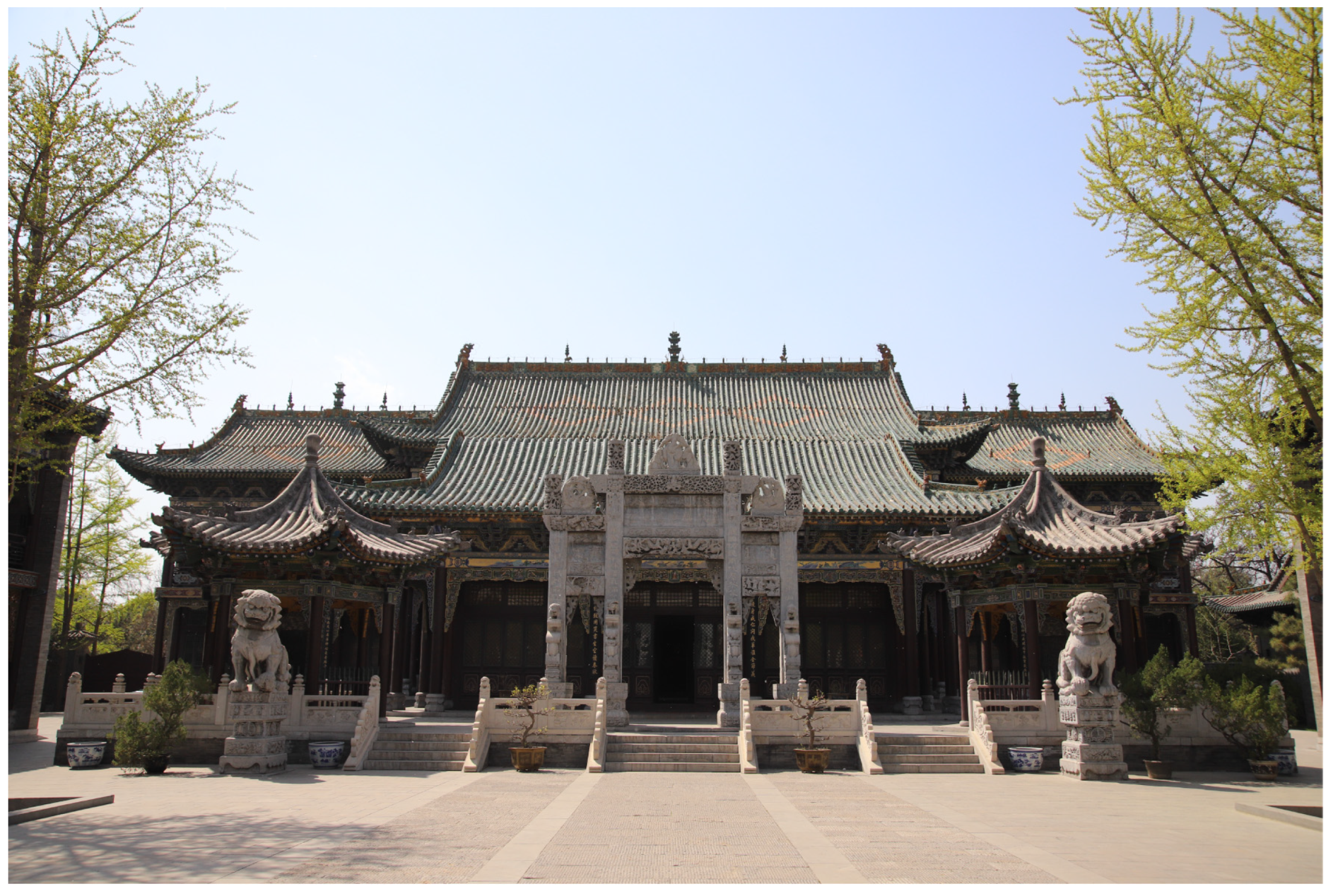
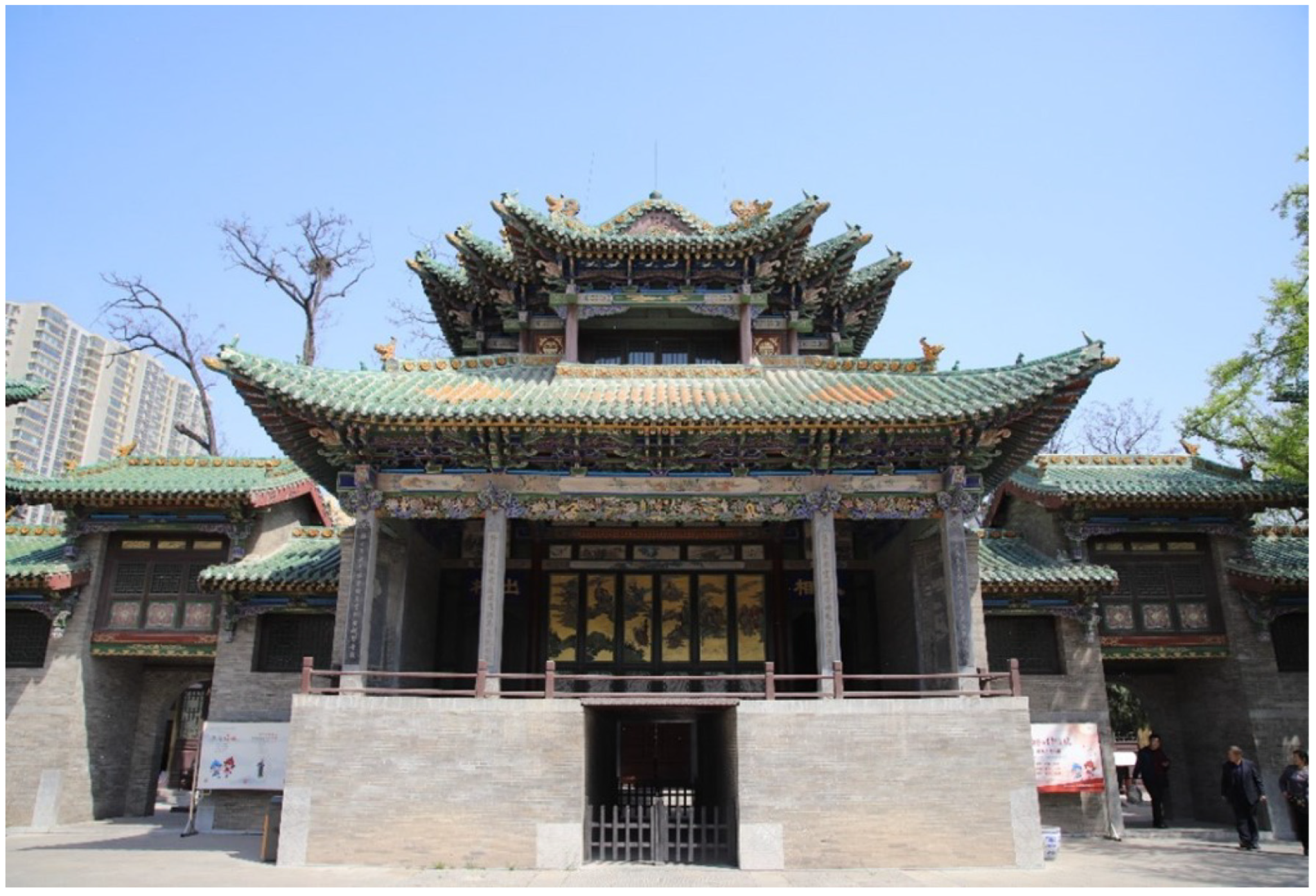
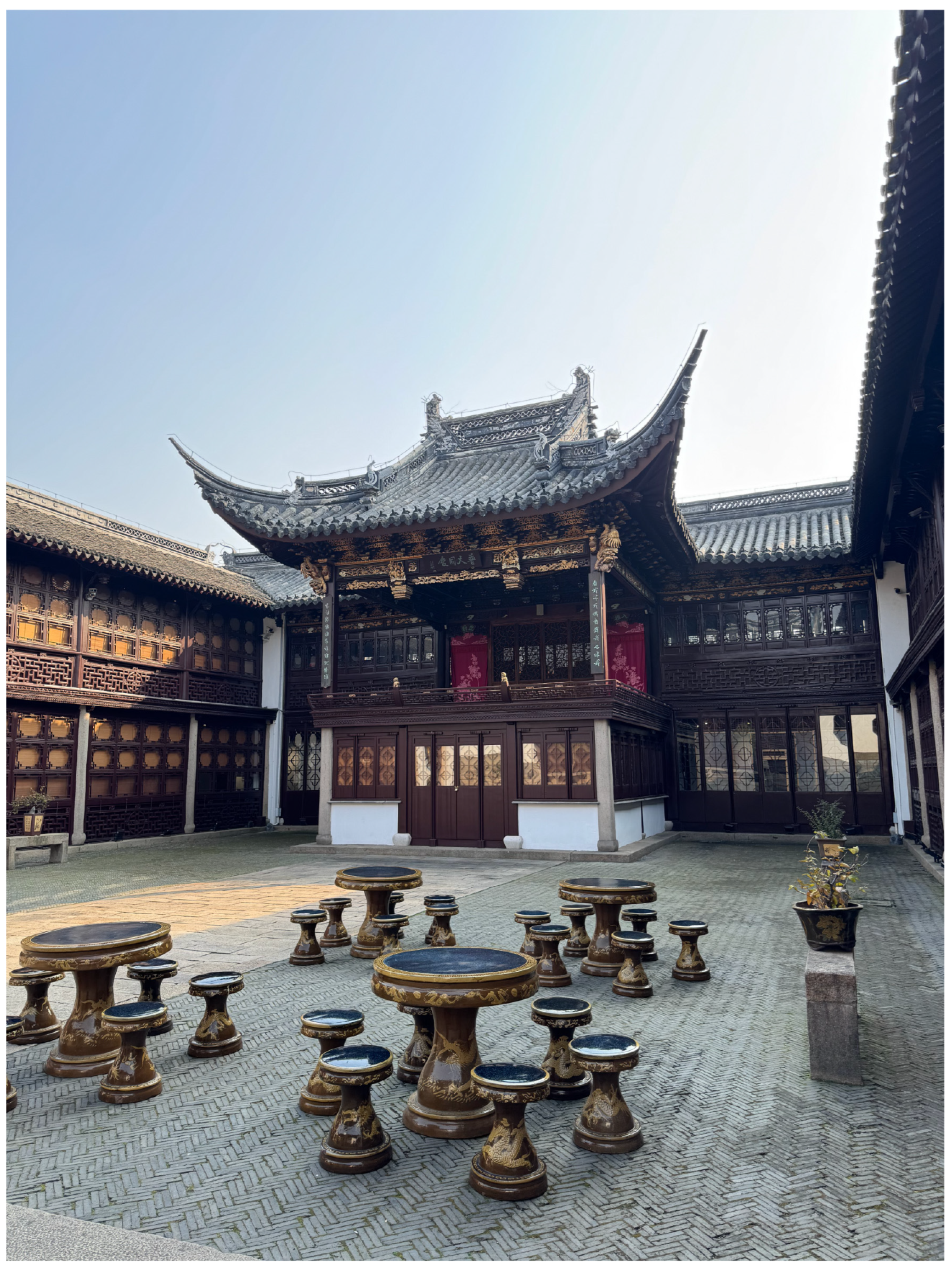
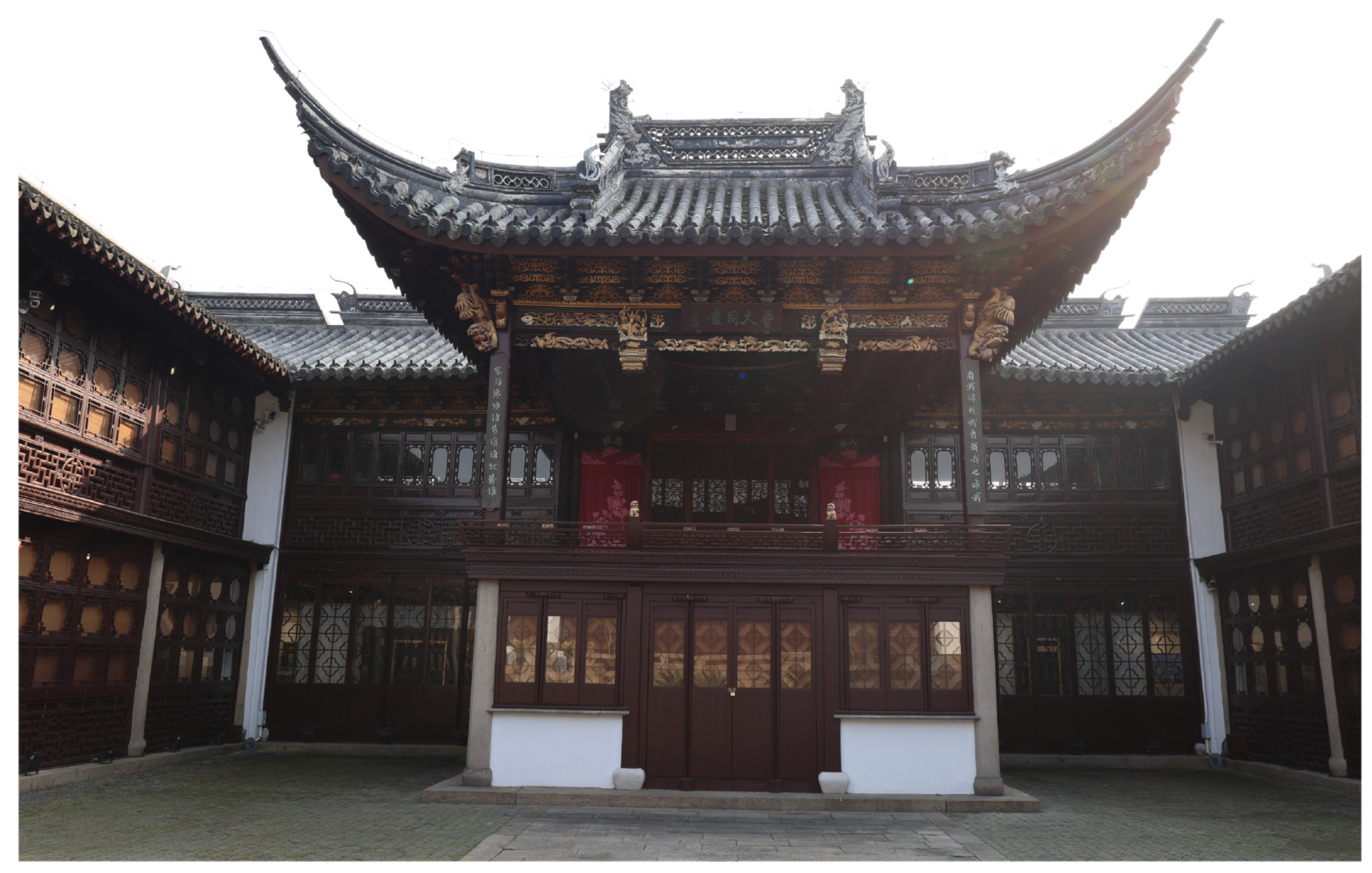
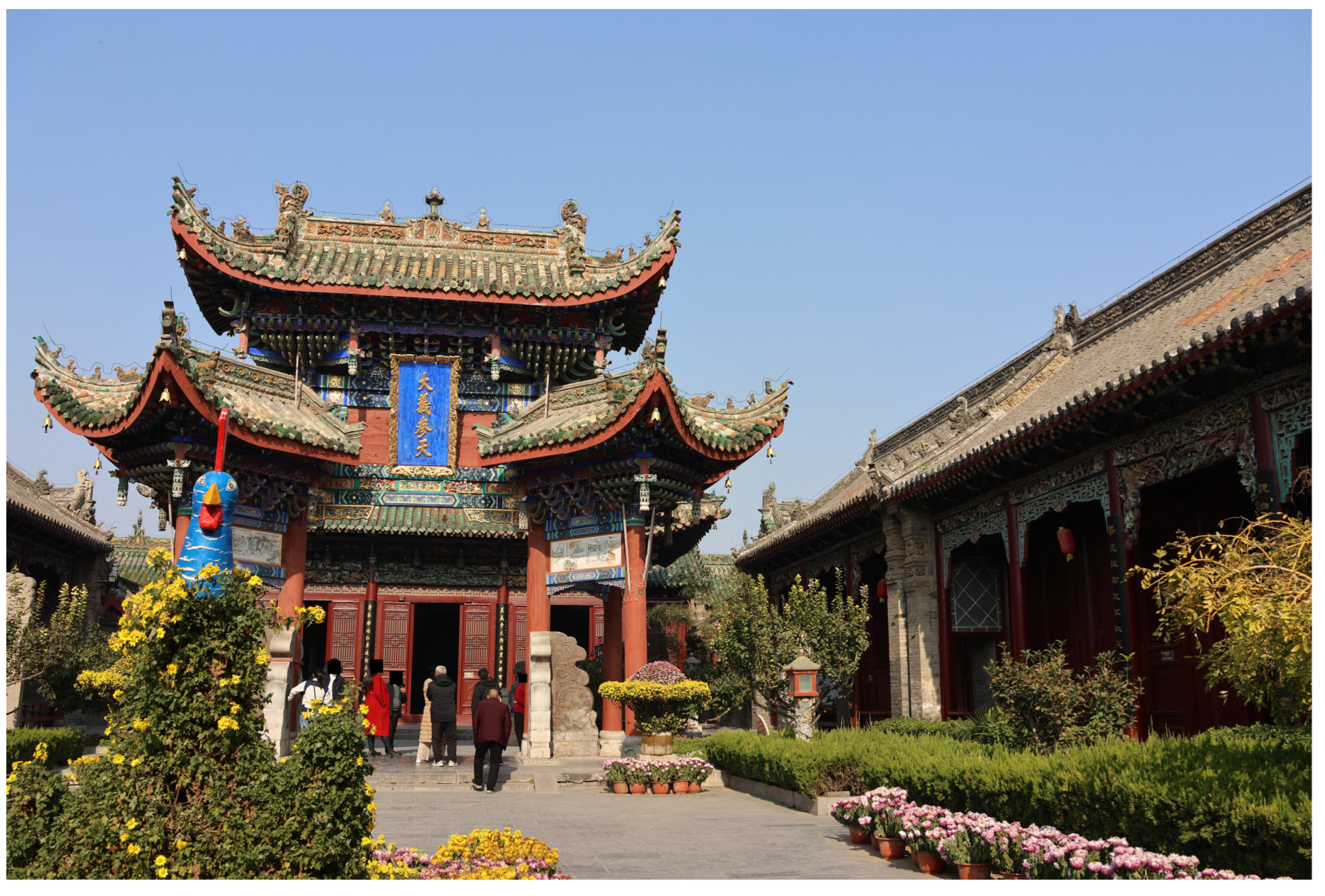
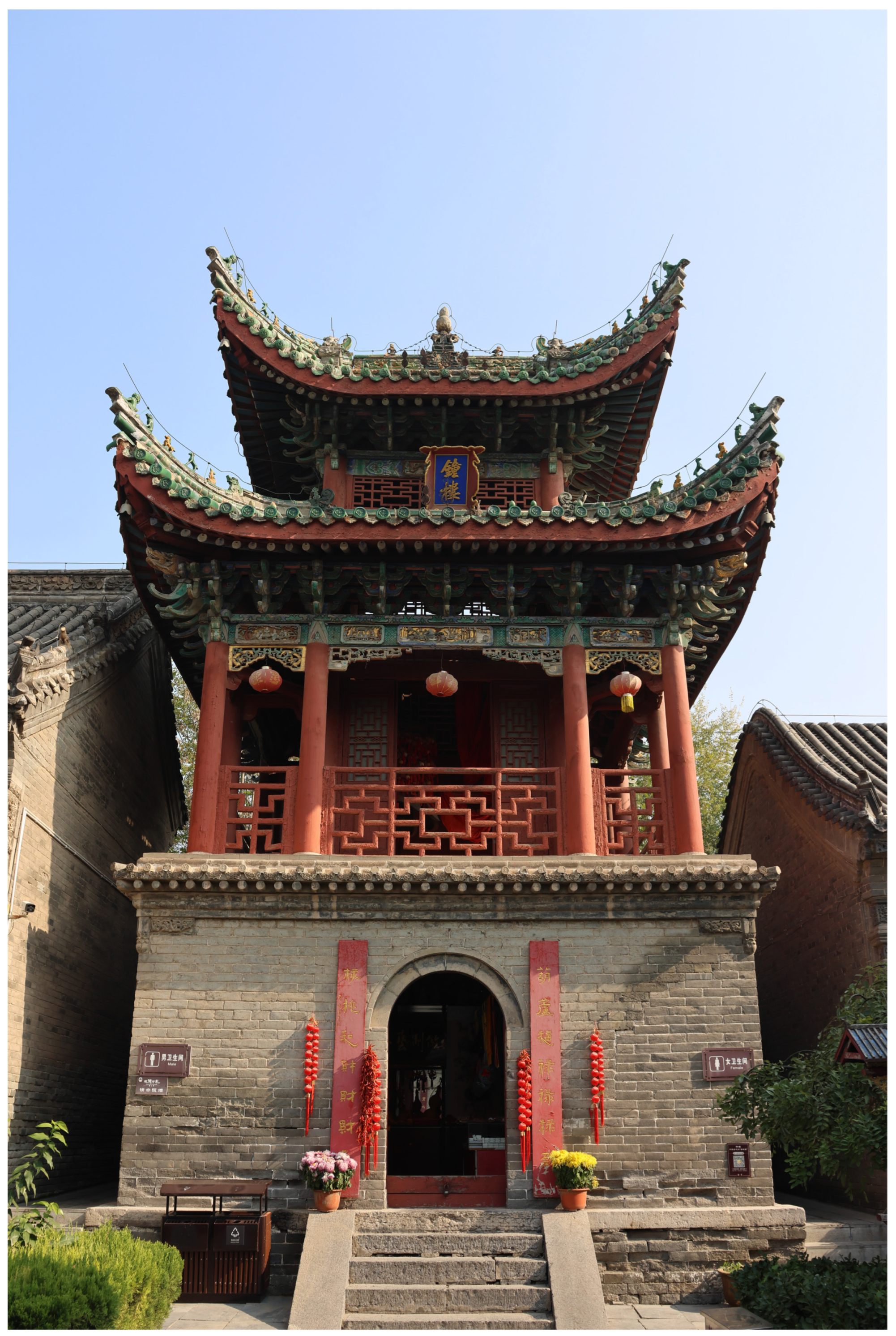
The architectural style of Shanxi merchant guildhalls, particularly larger ones, strongly resembles temples, with a shanmen 山門 (mountain gate), a stage, a dadian 大殿 (main hall) dedicated to the main god, and, occasionally, a Chunqiu ge 春秋閣 (Spring and Autumn Pavilion) or Chunqiu lou 春秋楼 (Spring and Autumn Tower) comprising the major parts of the complex (Figure 1 and Figure 2).
Like temples, Shanxi merchant guildhalls also enshrined wooden or stone statues of their patron gods. Those with lesser financial power enshrined paiwei 牌位 (spirit tablets) or shenxiang 神像 (portraits) instead to represent the gods. Many Shanxi merchant guildhalls were named after their main patron god. Given Shanxi merchants’ special reverence for Emperor Guan, the Temple of Emperor Guan appearing to be the most common one. For instance, all nine of the Shanxi merchant guildhalls in modern Liaoning province were known as Temples of Emperor Guan (Shanxi sheng xiju yanjiusuo 2009, p. 225). Alternatively, some guildhalls, such as the Shanxi Guildhall of Duolun 多倫 in modern Inner Mongolia, were known as Fumo gong 伏魔宮 (the Hall of the Great Emperor Who Subdues Demons) because fumo or ‘subduing demons’ was the title bestowed upon Emperor Guan by Emperor Wanli (r. 1537–1620) of the Ming in 1614. Some other guildhalls did not emphasise the names of their patron gods, as in the case of the Fushan 浮山Guildhall in Beijing, which was known as Sansheng shenci 三聖神祠 (the Deity Shrine of Three Sages) (Shanxi sheng xiju yanjiusuo 2009, p. 220). Nonetheless, this name indicates that the venue was built for worship.
Some guilds purchased other temples or monasteries as part of their estates and religious sites. One example is the Linxiang 臨襄 Guildhall of Beijing, which enshrined many deities, including Emperor Guan, Zengfu caishen 增福財神 (the Fortune-Increasing God of Wealth, Li Guizu 李詭祖), Xuantan 玄壇 (the Dark Altar), Huode zhenjun 火德真君 (the Perfect Sovereign of the Virtue of Fire), Jiuxian酒仙 (the Immortal of Wine), Guanyin 觀音 (Bodhisattva), and Mawang 馬王 (the Horse King) (H. Li 1980, pp. 24–26). In the Qing dynasty, the guildhall was also responsible for managing a nearby temple devoted to Caishen 財神 (the God of Wealth) (H. Li 1980, pp. 27–28).
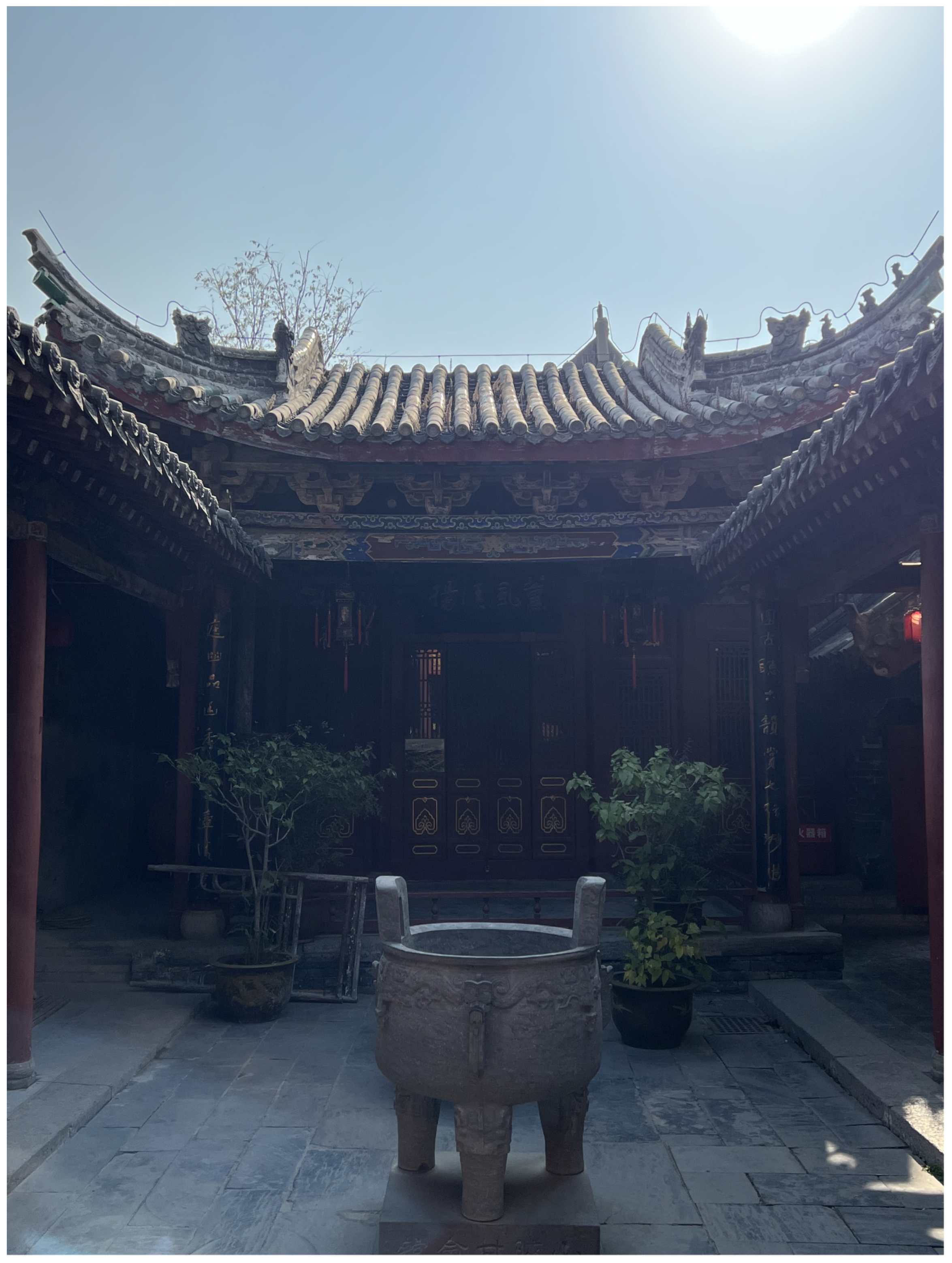
Shanxi merchant guilds with relatively strong financial standing were inclined to build theatre stages inside their guildhalls. If there was only one stage, it usually faced the hall where the main patron god was enshrined, as the god was believed to be the most important audience. Some guilds established more than one stage given the demand for frequent theatrical performances and to display their wealth (Gao and Yao 2021, pp. 302–6). For example, the Shan-Shaan-Gan (Shanxi, Shaanxi, and Gansu) Guildhall of Kaifeng had three stages. That opposite the main hall was used for theatrical performances on occasions for worship, while merchants’ families could enjoy performances on the two smaller stages (Figure 3) in the kuayuan 跨院 (side courtyards) on either side of the main hall (Shanxi sheng xiju yanjiusuo 2009, p. 88).
Like common temples, Shanxi merchant guildhalls served as venues for temple fairs and temple fair performances. On these occasions, the stages became the focal point, as people from far and wide poured into the guildhalls to celebrate. A few guildhalls are documented to have hosted temple fairs in the Qing dynasty, including the Linxiang Guildhall in Beijing, which served as an oil market and could house hundreds of people (H. Li 1980, pp. 26–27). Likewise, the Luze 潞澤 Guildhall of Luoyang 洛陽 in Henan was recognised by residents as the Damiao 大廟 (Grand Temple), indicating its grand scale and local importance (Yan 2007, p. 117). For more than two centuries following the Qianlong period in the mid-Qing era, temple fairs were held in the Shan-Shaan (Shanxi and Shaanxi) Guildhall of Shangjin 上津 (in modern Hubei 湖北 province) on the thirteenth day of the fifth lunar month (Shanxi sheng xiju yanjiusuo 2009, p. 171). The Shanxi Guildhall of Acheng 阿城 (in modern Shandong province) held temple fairs twice each year in spring and autumn (ibid., p. 62). During the event, theatrical performances were staged for eight days, and the market lasted for more than ten days (ibid., p. 62). When temple fairs were held in the Shan-Shaan Guildhall of Liaocheng, theatre performers from many areas, including Hebei 河北, Shandong, Shanxi, and Shaanxi, were invited (ibid., p. 71).
Despite these similarities, there were also significant differences between Shanxi merchant guildhalls and temples. The transformation of a temple dedicated to Emperor Guan usually indicated an expansion in scale and a change in worshippers. Also, deities such as the God of Wine were not commonly seen in local temples because they were patron gods of specific industries. In addition, local Temples of Emperor Guan seldom featured more than two theatre stages. The reason for these differences lied in the more money-oriented nature of Shanxi merchant guildhalls compared to common temples.

4. Guildhalls as Money-Oriented Religious Sites

Shanxi merchant guildhalls were money-oriented because worship of patron gods served the merchants’ business. To elaborate, this section is divided into two parts. The first part demonstrates that the primary intention of Shanxi merchants in worshipping gods in their guildhalls was to seek the protection of patron gods over their safety and business success. The second part analyses Shanxi merchants’ worship of Emperor Guan, demonstrating that they diverged from literati elites in that they expressed admiration for Emperor Guan’s virtues through lavish spending rather than self-cultivation.

4.1. Worship and Wealth

Shanxi merchants’ attention to religion, respect for their patron gods, and the relationship between religion and business are demonstrated in many stele inscriptions in their guildhalls. For instance, the ‘Stele inscription about the establishment of the Jinyi Guildhall 創建晉翼會館碑記’, dated 1735, reads:
In the winter of 1732, traders in the textile industry realised that there were indeed many fellow townsmen sojourning in Beijing. Although they always had a guild, there was no temple for their patron gods. Besides, on occasions for gatherings and socialising on the first and fifteenth days of each lunar month, it was improper to have no place for them to form emotional ties and share their feelings. They had a discussion and decided to purchase a property […] tear down the old structures and build a new building to serve as the guildhall of the people of Jinyi […] to settle down the gods, to comfort travellers and to console literati and guests.
(Quoted in H. Li 1980, pp. 29–30)
Shanxi merchants’ reliance on their patron gods’ protection in business is also described in documented guild activities. They firmly believed that patron gods could assist them in surmounting challenges in business. For instance, in 1779, a stone stele was erected in the Hedong 河東 Guildhall of Beijing to record a business crisis caused by a broker who manipulated the market, making it impossible for guild members to generate profit. When the disputes were solved, the pleased and devoted guild members were willing to refurbish the guildhall to express their gratitude toward the gods. The inscription reads:
Thanks to the holy spirit of the three gods, the broker showed up himself, sincerely asking for a regulation to be put in place to guarantee fair trade. Fellow traders in the tobacco industry were overjoyed beyond expectation and were willing to provide funding to renovate the shrine.
(Quoted in H. Li 1980, pp. 60–62)
In this way, worshipping gods, achieving business success, and upkeeping shrines in guildhalls formed a positive, inseparable cycle. Shanxi merchants established guildhalls to worship gods. Once the gods protected their business, the merchants would provide funding for the proper maintenance of the guildhalls and shrines. The gods, satisfied with this maintenance, would then perform more miracles to protect the merchants’ trade. The relationship between Shanxi merchants and their patron gods was similar to that between consumers and service providers.3
Because of the connection between wealth and worship, Shanxi merchants held ritual observances in their guildhalls on occasions for worship. The most common dates for worship included zhengyue 正月 (the first month of the lunar year), the Lantern Festival on the fifteenth day of the first lunar month, suishi fula 歲時伏臘 (seasonal festivals), jidan 吉旦 (the first day of a lunar month), shuowang 朔望 (the days of the new moon and the full moon), shengdan 聖誕 (birthdays of patron gods), and gonghui 公會 (guild business meetings). As most Shanxi merchant guildhalls worshipped Emperor Guan as their primary god, the official worship day on the thirteenth day of the fifth lunar month, the day believed to be Emperor Guan’s birthday or the day he sharpened his blade, appears to be a key day in many Shanxi merchant guildhalls.
However, as most guilds worshipped multiple patron gods and differed in financial power, they held religious rituals on different days throughout the year, with varying frequency. For instance, the Shan-Shaan Guildhall of Zhoukou 周口 enshrined as many as eleven gods, including Emperor Guan, Yandi 炎帝 (Emperor Yan), Hebo 河伯 (the Lord of Rivers), Yaowang 藥王 (the King of Medicine), Zaowang 灶王 (the Stove King), Jiuxian 酒仙 (the Immortal of Wine), Taishanglaojun 太上老君 (the Ultra Supreme Elder Lord), and Wenshen 瘟神 (the God of Plagues) (Yan 2007, p. 162). The Linxiang Guildhall of Beijing, established in 1718, housed ten gods, including Jiangzu 醬祖 (the Ancestral God of Soy Sauce) and Cugu 醋姑 (Immortal Lady of Vinegar) as the guild members were in the condiment industry (Yan 2007, p. 26). Nearly every month, the guild conducted ritual ceremonies to worship them. In the seventh month of the lunar year, they held ritual ceremonies twice for two different gods (Zhang 2007, pp. 80–81).
As the gods’ birthdays fell on different days, Shanxi merchants gathered regularly in their guildhalls for worship. Noboru (1950, p. 182) notes that although we cannot see guilds as merely religious associations, to a certain extent, it was shared religious belief that bound guild members together as a cohesive group.
The religious activities in Shanxi merchant guildhalls can be divided into those accompanied by theatrical performances and those without. On non-festive days, such as the first and fifteenth days of each month, Shanxi merchants typically did not invite theatre troupes to perform. However, on important days, worship, entertaining, socialising, and settling business all took place at the same time.
Among all of the occasions for worship in guildhalls, the annual meeting was of the greatest importance.4 Burgess’s (1928) investigation of literati, merchant, and craftsmen guildhalls in early Republican Beijing provides a detailed description of guilds’ annual meetings:
The guildsmen on arriving at the place of worship first register and pay their dues. They at once go forward to the altar for worship. Either the wooden effigy or the picture of the patron or master is the main object of worship. In front of this effigy or picture is arranged a feast for the master made up of such dishes as chicken, fish, meats, fruits, nuts, vegetables and rice. Imitation money of silver and gold paper is placed on the altar. Also, prayers printed on yellow paper from wooden cuts that are preserved and made use of each year, are hung near the guild spirit. Food, candles and incense have been prepared in advance by the officers of the guild. The candles are burned on a table in front of the portrait or image. There are also incense burners in which incense is burning. The guildsmen, either one at a time or in groups, walk near to the altar, kneel and bow with their heads to the floor three times. They may or may not light incense themselves to place in front of the altar. In many cases photographs of prominent deceased guildsmen or scrolls containing their names are hung at either side of the main altar. These pictures are worshipped by members who had had some special personal relationship with the deceased guildsmen or whose teachers or shop masters had had such a relationship.
When most of the members have arrived the play for the god begins. Actors, hired for the purpose, give a drama for the benefit of the guild spirit who is supposed to be witnessing the performance. Before or after the play or during intermissions between parts, announcements are made and the business of the guild is discussed.
[…]
In some cases a feast is given for all the members […] Feasts also are considered an honor to the guild god. After the worship, the play and the feast are over, it is customary for the elders or officers to carry out the ceremony known as Sung shen, or the ushering out of the god. This ceremony consists in carrying the paper coins and printed prayers to the outer court and burning them.
(Burgess 1928, pp. 181–82)
This account demonstrates that guild meetings were solemn occasions for religious, commercial, and theatrical activities. As the key part, religious rituals were conducted first. A banquet and theatrical performances ensued, followed by business discussions. Theatrical performances during these occasions were also serious affairs, as they were connected to divine worship and business meetings and decisions.
In comparison, during temple fairs, local residents joined in, turning Shanxi merchant guildhalls from solemn religious sites into spaces of festive revelry. From the perspective of local residents, the theatrical performances undoubtedly freed them from daily chores. However, for Shanxi merchants, these occasions were not only religious or recreational. Theatrical performances during temple fairs were beneficial for business because they functioned as an advertisement, helping merchants gain extra income. Famous Christian missionary Arthur Smith (aka Ming Enpu明恩溥, 1845–1932), who spent more than 50 years in China, described temple fairs accompanied by theatrical performances as ‘remunerative from a financial point of view in attracting attendance, and therefore customers’ (Smith 1899, p. 63). Contemporary researchers have agreed with this assessment. For example, Naquin (2000, pp. 626–27) suggests that ‘salesmen and entertainers accompanied religious festivals, promoting cultural as well as economic integration.’ Likewise, Hu (2023, p. 110) notes that ‘the more attractive the theatrical performances were, the more consumers would attend the fairs, and the higher above usual income merchants could gain’. Apart from the immediate gain from the sudden increase in potential consumers at temple fairs, performances also created a positive public image for guilds, contributing to guild members’ long-term income (Hu 2023, p. 111).

4.2. Guildhalls and the Worship of Emperor Guan

Across China, many Shanxi merchant guildhalls were known as Temples of Emperor Guan in their local communities because of the merchants’ special veneration for Emperor Guan. However, these merchant guildhalls did not belong to the official sacrificial system. Instead, they played a supplementary role and integrated both official and unofficial interpretations of Emperor Guan. The co-existence of these two interpretations reflects the relationship between the imperial court and guildhalls and the negotiation of power between wealthy merchants and literati elites in late imperial times.
Better known as Emperor Guan (Guandi 關帝) or Lord Guan (Guangong 關公), Guan Yu 關羽 (d. AD220) was a military general in the Three Kingdoms 三國 period (220–280). He served Liu Bei 劉備 (161–224), the founder of the Shu Han 蜀漢 (221–261), and died in 220 after being defeated by the army of East Wu 東吳 (222–280), the regime founded by Sun Quan 孫權 (182–252). The cult of Guan Yu emerged in the Jingzhou 荊州 area (in modern Hubei), where he was killed (Ter Haar 2017, p. 22). In the beginning, Guan Yu was seen as a demonic and fear-inspiring figure (Ter Haar 2017, p. 22). Later on, he was apotheosised and became a popular god throughout the country, with his failure on the battlefield and violent image largely concealed and forgotten.
The deification of Guan Yu dates back to the Sui 隋dynasty (581–618) (Fozu tongji jiaozhu 2012, 6.178). The oldest extant temple devoted to him, the Haizhou Guandi miao 解州關帝廟 (Temple of Emperor Guan of Haizhou), was established in the same era (Tian and Zhao 2025, p. 96). From the East Han 東漢 dynasty (AD 25–220) to the Qing dynasty, Guan Yu was bestowed 24 posthumous titles (Tian and Zhao 2025, p. 95), indicating his ever-increasing divine power. As early as the Tang 唐 dynasty (618–907), Guan Yu was listed in the Official Registers of Sacrifices (Xin Tangshu 2013, 13.377–378). Late imperial times, especially after the reign of Emperor Yongzheng 雍正 (1722–1735) in the Qing dynasty, saw the peak of Guan Yu worship. In the Wanli 萬曆 period (1573–1620) of the Ming dynasty, Emperor Shenzong 神宗 (1563–1620) conferred the title of ‘Imperial Lord Saint Guan the Great Emperor Who Subdues the Demons in the Three Realms and Heavenly Worthy Whose Divine Might Shakes from Afar 三界伏魔大帝神威遠震天尊關聖帝君’ (Jihan wuzhi 1990, 7.17).5 For the first time, Guan Yu was given the title of di 帝 (Emperor), the same title given to the paramount ruler of the empire, marking his supreme status in the hierarchy of official sacrifices.
The cult of Emperor Guan became a cultural phenomenon across the country, with his diverging images attracting various groups of adherents. From the early twelfth century onwards, Daoist exorcists viewed Emperor Guan as an exorcist general who could drive away evil spirits, and his ghost-expelling stories continued into the late imperial period (Ter Haar 2017, pp. 47, 73). In the Yuan 元 dynasty (1271–1368), Emperor Guan was seen as the Sangharama Bodhisattva, the protector of Buddhist temples over the country (Cai 2012, p. 291). In popular culture, Emperor Guan was an embodiment of many other images, some of which appeared to be unrelated. He was the God of Wealth, the protector of the realm, the guardian of keju 科舉 (Civil Service Examinations), the bringer of rain, the protector of trade, the protector of sectarian groups, and so on.
In the eyes of the ruling elite, the image of Emperor Guan as a legitimised god underwent continuous changes alongside shifts in the imperial court’s interpretation in response to different demands. For the ruling elite, Emperor Guan has always been an incarnation of loyalty and righteousness (Cai and Wen 2001, p. 79). These Confucian moral virtues were first highlighted by Song 宋 (960–1279) and Yuan literati to articulate their political ideals and advocacy for orthodox Confucian moral principles (ibid., pp. 68–71). In facing threats from the Jurchen regime of the Jin 金 dynasty (1127–1162), Emperor Gaozong 高宗 (r. 1127–1162), the first ruler of the Southern Song 南宋 period (1127–1279), believed in Emperor Guan’s divine power to assist him in restoring the Song regime (ibid., p. 80). Emperor Chongzhen 崇禎 (r. 1627–1644), the last emperor of the Ming dynasty, sought to bolster the sense of loyalty associated with Emperor Guan and his image as the God of War to suppress the peasant uprising through military power (ibid., p. 146). From the late Ming to the early Qing, Emperor Guan was interpreted as a master in Chunqiu 春秋 (The Spring and Autumn Annals) (Ter Haar 2017, p. 206), the chronicled history of the State of Lu 魯 from 722 BCE to 481 BCE and a Confucian classic studied and annotated by subsequent generations. Qing literati participated in the compilation of (spirit writing) canons to express their ‘intense devotion to divine saviours, the hope for self-divination, pessimism toward the collective fate of humanity, and a project of universal salvation through moral reform’ in the name of the gods and ‘at synthesis with Confucian orthodoxy’ (Goossaert 2015, p. 101).
In 1693, the publication of the spirit writing canon titled A Complete Collection of Records with Illustrations about the Holy Deeds of Emperor Guan 關帝圖志聖跡全集 marked the peak of the Confucianisation of Emperor Guan (Duara 1988, p. 784). A preface dated 1693 reads: ‘Master Guan liked reading The Spring and Autumn Annals. When there was no war, he always held the book in hand’ (Guandi shengji tuzhi quanji, preface 1802, 1.6). Not only Emperor Guan but also his envisioned ancestors were depicted as well-versed in The Spring and Autumn Annals. The preface notes:
The father of Chinese historiography [that is, Sima Qian 司馬遷 (145BCE–?)] said: ‘The Spring and Autumn Annals is the origin of rite and morality’ … Ever since the Han 漢 [202 BCE–220AD], Tang, Song, and Ming dynasties, numerous scholars have studied The Spring and Autumn Annals and have been assiduous in singing and chanting the work. However, with regard to becoming an official and serving the court, following the moral principles in the canon, rising to power, and leaving a name in the history, only Master Guan achieved these. Alas! How could The Spring and Autumn Annals simply be a book to read? To trace Master Guan’s pedigree, his grandfather and father were specialists in the study of The Spring and Autumn Annals. The study of the canon was rooted deeply in his paternal teaching.
The following period from the early eighteenth century to the mid nineteenth century witnessed the gradual institutionalisation of official sacrifices to Emperor Guan and a series of imperial canonisations of him in response to revolts and wars, including the uprising in the northern frontier area in the mid-Qianlong period, the White Lotus Rebellion (1796–1804), the Opium Wars in 1840 and 1856, and the Taiping 太平 Rebellion (1851–1864); (Cai and Wen 2001, pp. 190–91). The titles granted to Emperor Guan, such as renyong 仁勇 (Benevolence and Courage), huguo 護國 (Protecting the Country), and xuande 宣德 (Disseminating Virtues), indicate the Qing emperor’s heightened expectations of him and depicted him as an omnipresent saviour of the country accomplished in both Confucian virtues and military power.
With the growth in prominence of Emperor Guan in official sacrifices, his impact at the local level was strengthened and also felt in Shanxi merchant guildhalls across the country. As a stele inscription in the Shan-Shaan (Shanxi and Shaanxi) Guildhall of Kaifeng, dated 1821, describes:
Emperor Lord Guan enjoys illustrious prestige and influence that shakes the universe. Even in remote and backward places, everyone from the children to the elderly knows that he is to be held in reverence.
(Quoted in Zhang et al. 2009, p. 421)
While many Shanxi merchant guildhalls enshrined Emperor Guan as their main god, this was not necessarily true for guildhalls built prior to the Qing dynasty or in the early Qing period. For instance, in the mid-Ming dynasty, merchants from the Pingyao 平遙 county of Central Shanxi established the Dyestuffs Guildhall of Beijing (Shanxi sheng xiju yanjiusuo 2009, p. 220), also known as the Pingyao Guildhall of Beijing. According to a stele inscription dated 1675 (H. Li 1980, pp. 1–8), the main god enshrined at that time was Zhenwu dadi 真武大帝 (the Great Emperor of Perfected Martiality). The accompanying deities enshrined, to his left, were Emperor Guan, the Dark Altar, and the God of Wealth; to his right were Mei Fu 梅福, Ge Hong 葛洪, and Xie Xianweng 謝仙翁 (the Immortal Elder Xie). This guildhall was reconstructed from a temple devoted to the Immortal Elder Xie. Sacrificial offerings were presented and theatrical performances were staged on his birthday, not Emperor Guan’s.
Likewise, the Lujun 潞郡 Guildhall of Beijing, established by Shanxi copper, steel, tin, and coal traders in the Ming dynasty, enshrined Emperor Guan as one of their patron gods. However, the guildhall was known as Lushen an 爐神庵 (the Temple of the Stove God), indicating that the Ultra Supreme Elder Lord, who was believed to be the guardian of the alchemical furnace and thus the tutelary god of the stove (H. Li 1980, p. 40; Yan 2007, pp. 8, 36), took on more importance than Emperor Guan for merchants in the steel and coal industries.
Over time, this gradually changed. Most guildhalls established from the mid-Qing onwards made Emperor Guan the main god of worship, such as the Shanxi Guildhall of Duolun, established in 1745, the Shanxi Guildhall of Zhangye 張掖 (in present-day Gansu province), established in 1730, and the Yizhuangzhen 義莊镇 Guildhall of Gaoping 高平 (in the southeast of modern Shanxi), completed in 1854. This change coincided with the increasingly frequent official canonisation of the god, suggesting a connection.
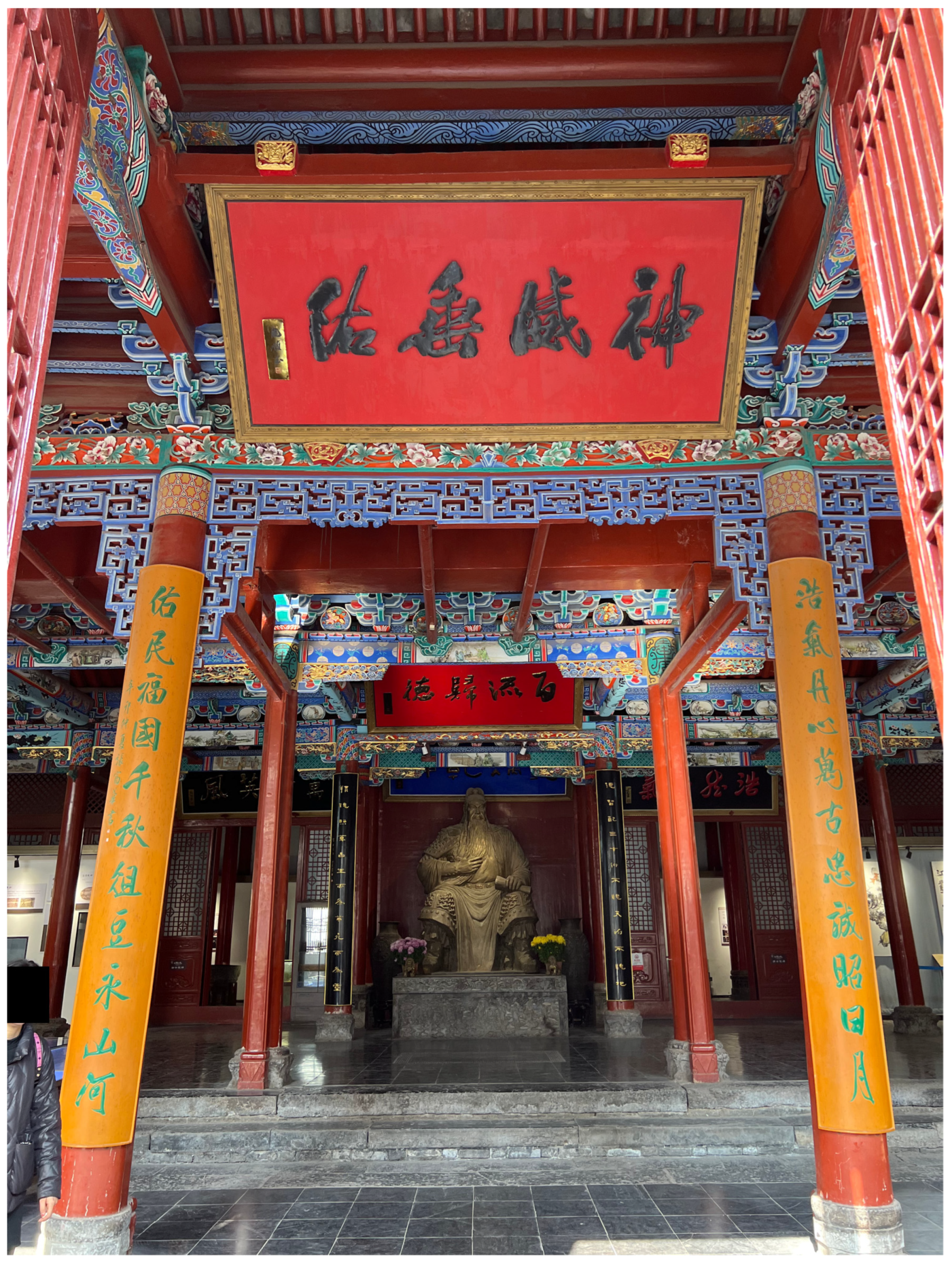
The Confucianisation of Emperor Guan also influenced the image of Emperor Guan in Shanxi merchant guildhalls. Shanxi merchants’ support of the Confucian interpretation of Emperor Guan was demonstrated by their passion for establishing Spring and Autumn Pavilions and statues of Emperor Guan holding a copy of The Spring and Autumn Annals to pay tribute to his literary aspect. Table 1 lists the Shanxi merchant guildhalls that featured a Spring and Autumn Pavilion and the year of completion of the pavilions.
As demonstrated in Table 1, establishing a Spring and Autumn Pavilion in Shanxi merchant guildhalls was a common practice throughout the country in the Qing dynasty. Most of the Spring and Autumn Pavilions were completed after 1720s, consistent with the ever-growing official recognition of Emperor Guan. Although the completion dates of many Spring and Autumn Pavilions are unknown, their establishment dates suggest that they must have been built after the Yongzheng reign.
Notably, the oldest well-documented Spring and Autumn Pavilion listed in Table 1 was established in 1683 at the Shan-Shaan West Guildhall in Hankou 漢口 in present-day Wuhan 武漢. This guildhall was an exception, perhaps because it served both merchants and literati and thus incorporated more elements of literati aesthetics and political philosophy. According to Ter Haar (2017, p. 199), the literary interpretation of Emperor Guan was widely embraced in the late Ming dynasty, but Duara (1988, p. 785) speculates that the general public might not have been aware of the Confucianisation of Emperor Guan until 1725, when Emperor Yongzheng institutionalised his official worship. The existence of the Spring and Autumn Pavilion in the Shan-Shaan West Guildhall of Hankou apparently attests to Ter Haar’s statement and refutes Duara’s suggestion. ‘The stele inscription that records the establishment of the Spring and Autumn Pavilion devoted to Master Guan of the Han 漢關夫子春秋樓碑記’ in this guildhall proves that by at least 1681, there were already literati elites who had managed to introduce the Confucian image of Emperor Guan into popular culture.
Why is this pavilion named Spring and Autumn? The Spring and Autumn Annals is the historical record of the State of Lu. Since the Eastern Zhou 東周 dynasty [25–220 AD), the principle of ruling had been falling. Master Kong 孔 was afraid that the rulers and ministers of all ages would not understand the cardinal principles of dayi 大義 [righteousness]. As a native of Lu, he had no alternative but to show reverence toward the Zhou and express his aspirations through The Spring and Autumn Annals. This is why this canon is titled The Spring and Autumn. Likewise, during the reign of Emperor Ling 靈 [r. 168–189 AD] and Emperor Xian 獻 [r. 189–220], [the rulers] were kept [trapped] in the capital city. This was no different from relocating the capital to the east. At that time, the regime of the Han people was in the State of Shu 蜀. Master Guan wanted to return the Han people in Shu back to the territory of the Han. So, he devoted himself to studying The Spring and Autumn Annals. This is why The Spring and Autumn Annals is related to Master Guan. At the northwest corner on the south bank of the Han River,6 facing the Yangtze River and backed by lakes, worthy men from Shaanxi and Shanxi established a Temple of Master Guan, creating a building of extreme beauty. Later, a high pavilion was built. Immense in scale and of imposing grandeur, it stands facing Qingchuan ge 晴川閣 [the Pavilion of the River Beneath the Azure Sky]7 and Huanghe lou 黃鶴樓 [the Yellow Crane Tower]8 at a distance. [The three pavilions] form a tripartite scene. A statue of Master Guan reading The Spring and Autumn Annals is erected in this Spring and Autumn Pavilion. This is why the pavilion is named The Spring and Autumn. Alas! The Lin Canon [linjing 麟經, that is, The Spring and Autumn Annals] is tied with wangu gangchang 萬古綱常 [the three main-stays and five constant virtues of all ages]. In his time, Confucius composed the canon all on his own. If not the students of Confucius like Ziyou 子游 and Zixia 子夏, then no one could appreciate it. Gongyang Gao 公羊高,9 Guliang Chi 榖梁赤,10 Zuo Qiuming 左丘明11 and Hu Anguo 胡安國12 could only grasp its superficial meaning. Our Master Guan joined the army as a commoner and walked in proper manner among shining spears and armoured horses. His lofty principle of suppressing the invaders was perfectly obvious […] The canon in this building can be called The Spring and Autumn Annals of the State of Lu. It can also be called The Spring and Autumn of the Han […] All born sages must rise under extreme circumstances, just like the sun at its zenith. The principle of governance of Zhou was falling, but there appeared Confucius of Lu. The Han empire was deteriorating, but there appeared Master Guan of Shu […] Someone said: ‘Confucius is a god of all people under heaven. Everyone worships him. But those who established this pavilion are all natives of Shaanxi and Shanxi. Does it mean that he [Master Guan] has special blessings for them?’ It is incorrect. This [his blessing] is like the sun and moon that pass through the sky every day, illuminating all the seas beneath heaven. But Fusang 扶桑13 and Mount Kunlun 昆侖14 lie nearer to the hot radiance. Master Guan is a native of Shanxi. The closeness between Shaanxi and Shanxi people is like the bond between the people of Fusang and Kunlun. They do not ask for special blessings. Rather, they have become accustomed to admiring the sun and moon. No one under heaven can really compare with them [that is, Shanxi and Shaanxi people].
(Quoted in Zhang and Zhang 2016, pp. 41–43)
This stele inscription recognised Emperor Guan as an exceptionally excellent interpreter of The Spring and Autumn Annals, a canon that is so deep and profound that even Confucius’s students and reputable commentators in later generations could not fully comprehend it. Emperor Guan was deemed to have held the same status and moral virtues as Confucius; they were both saviours of their states amid political and social turmoil. This inscription was written by a jinshi 進士 (Metropolitan Graduate) who was a houxuan 候選 (Expectant Appointee) of the libu 吏部 (Ministry of Personnel) (Zhang and Zhang 2016, p. 43), one of the liubu 六部 (Six Ministries) that formed the core of the central government. Although erected in a Shanxi merchant guildhall, this inscription does not mention Shanxi merchants or their business at all. Rather, it is the literatus’s hymn of praise to Master Guan.
Inscriptions with similar content are found in other Shanxi merchant guildhalls. An inscription in the Shan-Shaan Guildhall of Zhoukou, dated 1822, records that the Spring and Autumn Pavilion and a statue of Emperor Guan reading The Spring and Autumn Annals were erected in the guildhall in 1800 to show the guild members’ consideration for Emperor Guan’s personal preferences. Later, a stage was built facing the statue so that the guild members could entertain Emperor Guan with theatrical performances (Zhang et al. 2009, p. 436). ‘The stele inscription that records the establishment of Chunqiu lou 創建春秋樓碑記’ in the Shan-Shaan Guildhall of Sheqi, dated 1782, states that Mencius was the only person who could fully comprehend The Spring and Autumn Annals since its completion, and Emperor Guan was the only one who could carry on Confucius’ ambitions since the late Han. This is why Spring and Autumn Pavilions were built everywhere to commemorate him’ (Zhang et al. 2009, p. 370). These accounts indicate that since the late eighteenth century, the Confucian interpretation of Emperor Guan has been widely embraced across China.
Despite the literati elites’ enthusiasm for promoting Emperor Guan’s Confucian moral values in Shanxi merchant guildhalls, the guildhalls, as non-governmental religious sites, did not belong to the official sacrificial system. Interestingly, some stele inscriptions give the misleading impression that Shanxi merchant guildhalls were part of the system, raising questions regarding their intention. An example is ‘The stele inscription about the newly built Temple of Emperor Guan 關帝廟新建碑文’, dated 1756, written by a Metropolitan Graduate who held wenlinlang 文林郎 (Gentleman-litterateur), a prestige title of the upper seventh rank, and an Instructor of the Confucian School of Puzhou 蒲州 prefecture (in the southwestern part of Shanxi). This inscription intentionally links the Luze Guildhall of Luoyang with the Temples of Emperor Guan built by the central and local governments. The stele inscription reads:
His Majesty the Emperor [that is, Emperor Qianlong] established temples [dedicated to Emperor Guan] with respects and worshipped him in every spring and autumn. The ritual ceremonies are particularly grand. Officials of all ranks in provinces, independent intermediary subprefecture [zhi 直, that is, zhili zhou 直隸州], prefectures and counties all follow faithfully [the ritual]. Because of this, in all areas of the country, even in remote places, temples [of Emperor Guan] were established for worshipping the statue of Emperor Guan with worried look. There is hardly a place without them. [The funding for] constructing the newly established Temple of Emperor Guan at the southeast corner of the city came from the donation of money and grain from Luze merchants Cui Wanzhen 崔萬珍 and others.
The aforementioned inscriptions concerning Emperor Guan and The Spring and Autumn Annals stand in sharp contrast to the one concerning the construction of the Jinyi Guildhall of Beijing discussed in the previous section, which underscored the practical and economic benefits the merchants received from worshipping Emperor Guan. To account for this difference, we must consider their background and the writers’ wording.
Most of the inscriptions in Shanxi merchant guildhalls that record guild regulations, business disputes, and vessel and land purchases were written by merchants. Therefore, these inscriptions were written from the merchants’ perspectives and better reflect the conditions of their work and lives. In comparison, most, if not all, stele inscriptions that praise Emperor Guan’s virtues and the establishment of buildings related to Emperor Guan were written by literati elites, who were sometimes natives of Shanxi or Shaanxi. In the inscriptions, they were inclined to enumerate all of their government posts, academic degrees, and honorific titles and adopt ornamented expressions when addressing Emperor Guan’s moral virtues and devotion to all people under heaven. As such, writing an inscription became a word game that manifested their sophistication and social status and reinforced their identity as part of the ruling elite. Although some literati—such as the Magistrate of Liaocheng, who wrote an inscription to record the reconstruction of the stage, the mountain gate, and the bell and drum pavilions of the Shan-Shaan Guildhall of Liaocheng in 1845—stressed their identity as natives of Shanxi or Shaanxi and saw Shanxi merchants as their townspeople and Emperor Guan as their native god, the diction they chose set them apart from the less educated merchants.
Furthermore, by equating Emperor Guan with Confucius in terms of their virtues, literati writers reinforced the notion that Emperor Guan was a Confucianised and legitimised god listed in the Official Register of Sacrifices. In this way, inscriptions that highlight the official ritual ceremonies for worshipping Emperor Guan made the literati spokesmen for the imperial court who tried to legitimise Shanxi merchant guildhalls as venues for worshipping Emperor Guan.
In addition, the tones, diction, and content of these inscriptions bear strong resemblance to those of spirit writing texts. It is unclear whether the same people who wrote the spirit writing texts also wrote the stele inscriptions in Shanxi merchant guildhalls. If so, the inscriptions might have also served as a means for the literati to express political ideals that could not appear in official canons. ‘The stele inscription that records the establishment of the Spring and Autumn Pavilion devoted to Master Guan of the Han’ in the Shan-Shaan West Guildhall of Hankou was written in 1683, only 39 years after the establishment of the Manchu Qing. As it repeatedly mentions the Han regime, the writer likely used the inscription to voice his discontent with non-Han rule.
Not only buildings and statues were constructed to please the Confucianised Emperor Guan; theatrical performances staged in the guildhalls were also subjected to his Confucian interpretation. On the major days for worship, theatrical performances were staged as an important part of the event and a sacrificial offering. On such occasions, the plays’ content did not have to be religious or connected to the gods, and it differed little from that commonly seen in commercial theatre gardens (Noboru 1950, p. 191). However, not all plays were permitted to performed. According to W. Liu (2015, p. 190), Shanxi merchants took an interest in plays with various themes, including stories about historical events and figures, legendary heroes, and merchants’ lives, as well as erotic plays and folklore. But, on solemn occasions in Shanxi merchant guildhalls, such as the Shanxi Guildhall of Duolun, erotic plays were not allowed, nor were performers permitted to behave indecently during such occasions (Zhang and Zhang 2014, p. 93). The Magistrate of Liaocheng stated that theatrical performances in guildhalls centred around Confucian moral principles, including zhong 忠 (loyalty), xiao 孝 (filial piety), jie 節 (integrity), and yi 義 (righteousness), and that they were used to educate benighted people (Zhang et al. 2009, p. 476). While this statement is marked by a strong Confucian and elitist overtone, it is a true reflection of the theatrical performances in Shanxi merchant guildhalls at that time.
In the Shan-Shaan Guildhall of Liaocheng, there are many writings left by itinerant theatre troupes on the walls. Through his close examination of the writings, Q. Li (2009, p. 95) concluded that the majority of plays were about outstanding military generals and officials, battles against evil, and stories that eulogised righteousness, kindness, honesty, and selflessness. His observation is consistent with the description of the Magistrate of Liaocheng in that only performances about morality were allowed to be staged in front of Emperor Guan. Noticeably, Guangongxi 關公戲 or plays with Emperor Guan as the main character were also prohibited in some guildhalls. For instance, dressing up as Emperor Guan and performing plays about him were considered blasphemous in the Shan-Shaan Guildhall of Liaocheng and the Shanxi Guildhall of Duolun (Yan 2007, p. 248; Zhang and Zhang 2014, p. 93). Among the more than one hundred and fifty play titles recorded on the walls of the Shan-Shaan Guildhall in Liaocheng, only four were adapted from The Romance of the Three Kingdoms, and none of them can be categorised as Guangongxi (Q. Li 2009, p. 95).
Guangongxi originated during the Southern Song and Yuan eras as worship of Emperor Guan spread widely, and it became a popular theme in theatrical performances for both ritual and recreational occasions (Che and Du 2015, pp. 257–61). To show respect to Emperor Guan, his image in Guangongxi from the Yuan to the Qing dynasty was consistently that of a hero or a god of high moral integrity (Che and Du 2015, pp. 262–70), in accordance with his interpretation in Confucianism. Despite this, Ming and Qing rulers repeatedly attempted to ban performances about him on the grounds that they profaned the god, and this influence also spread into Shanxi merchant guildhalls.
Plays preaching moral values, the existence of the Spring and Autumn Pavilions, the statues of Emperor Guan holding a copy of The Spring and Autumn Annals, and the large number of stele inscriptions in Shanxi merchant guildhalls about the literary image of Emperor Guan indicate that Shanxi merchants apparently accepted the Confucian image of Emperor Guan. However, they also preserved their own. As Duara (1988, p. 788) notes, although the imperial court’s recreation of the symbolic image of Emperor Guan as the incarnation of moral values or the protector of the Qing empire shaped folk culture, it could not completely shift the symbolism of Emperor Guan at the local level.
While Emperor Guan was a lofty and virtuous saviour of the country in the eyes of literati elites, he was perceived as an approachable local god in Shanxi merchant guildhalls. Shanxi merchants emphasised that Emperor Guan was a native of Shanxi and saw this as a tie that bound them together. The stele inscription describing the construction of the Jindu 晉都 Guildhall of Tianjin 天津 (later renamed the Shanxi Guildhall of Tianjin in 1806) in 1761 shows that Emperor Guan was deemed the zhengshen 正神 (orthodox deity) of Shanxi province who protected all Shanxi merchants, necessitating a guildhall to repay his kindness (Yan 2007, p. 337). Similarly, a plaque in the Shan-Shaan West Guildhall of Hankou bears the inscription ‘The number one person in Shanxi山西一人’ (Zhang and Zhang 2016, p. 155). Another inscription in this guildhall, dated 1890, reads ‘Blessing the people of the west福庇西人’ (Zhang and Zhang 2016, p. 167).15 These inscriptions form a clear contrast to the description of ‘The stele inscription that records the establishment of the Spring and Autumn Pavilion devoted to Master Guan of the Han’, mentioned earlier, in which the writer refutes the claim that Emperor Guan was merely a patron god of Shanxi natives.
Furthermore, the merchants never forgot the original aim of their worship, which was to pray for blessings for their townspeople and business. The neibian 內匾 (interior inscribed plaque) in the Hall of Emperor Guan in the Shan-Shaan Guildhall of Liaocheng is inscribed ‘Promoting the country’s prosperity and enriching the people富國裕民’ (Yan 2007, p. 243). In the Shan-Shaan West Guildhall of Hankou, in 1864, a firm called Yishenglong 益盛隆 contributed a commemorative plaque in the Spring and Autumn Pavilion with the inscription ‘Protecting the country and supporting the merchants 護國扶商’ (Zhang and Zhang 2016, p. 160).
On other occasions unrelated to business and outside of official days of sacrifice, Shanxi merchants also worshipped Emperor Guan in their guildhalls. In the Shan-Shaan Guildhall of Liaocheng, whenever merchants swore an oath of brotherhood, made a wish when they fell ill, or repaid a vow, they offered incense to Emperor Guan (Yan 2007, p. 221). The power of Emperor Guan seems to have penetrated every aspect of merchants’ lives. Compared with the holy, literary, and serious look of Emperor Guan in official sacrifices, Emperor Guan in Shanxi merchant guildhalls took on a more human warmth and had more to do with worldly affairs.
It was necessary for merchants to integrate the Confucian image of Emperor Guan in their worship given this served the imperial court’s political propaganda. However, Shanxi merchants’ adherence to the Confucianised Emperor Guan was not merely the result of government oversight; it also stemmed from their pursuit of a higher social status. Stark and Finke (2000, p. 198) suggest that in a religious economy, social class is not relevant to niches. However, Shanxi merchants’ pattern of worshipping Emperor Guan proves that social stratification was indeed associated with social stratification in Ming–Qing China.
From the fourth century BC to the end of the nineteenth century, trade was regarded as an inferior occupation and ranked at the bottom of the traditional social stratification of simin 四民, literally meaning ‘four people’. Shi 士 (scholar) stood at the top of all commoners, followed by nong 農 (farmer), gong 工 (craftsman), and shang 商 (merchant). Although the Ming and Qing dynasties saw the rapid upward social mobility of wealthy merchants and a narrowed gap between them and literati elites, merchants’ social standing was still uncertain. Hu’s (2023) research on Shanxi merchants’ theatre sponsorship adopted Bourdieu’s ([1986] 2011) theory to demonstrate the transformation between different forms of capital among Shanxi merchants and explain the relationship between theatre sponsorship and social status. Shanxi merchants sponsored theatrical performances during guild meetings, temple fairs, and gatherings with officials to increase business revenue and establish a positive image to accumulate economic. Eventually, their economic capital could be converted into cultural capital, thereby enhancing the merchants’ social standing (Hu 2023, p. 30).
Shanxi merchants’ worship of Emperor Guan was partly motivated by the same purpose. To demonstrate their faith in Emperor Guan, literati elites would pray devoutly, participate in ritual ceremonies, or engage in spirit-writing, chanting, restraint of desires, and so on. Many of these activities aimed at nurturing inner life, self-cultivation, and moral cultivation of others (Goossaert 2019, p. 49).
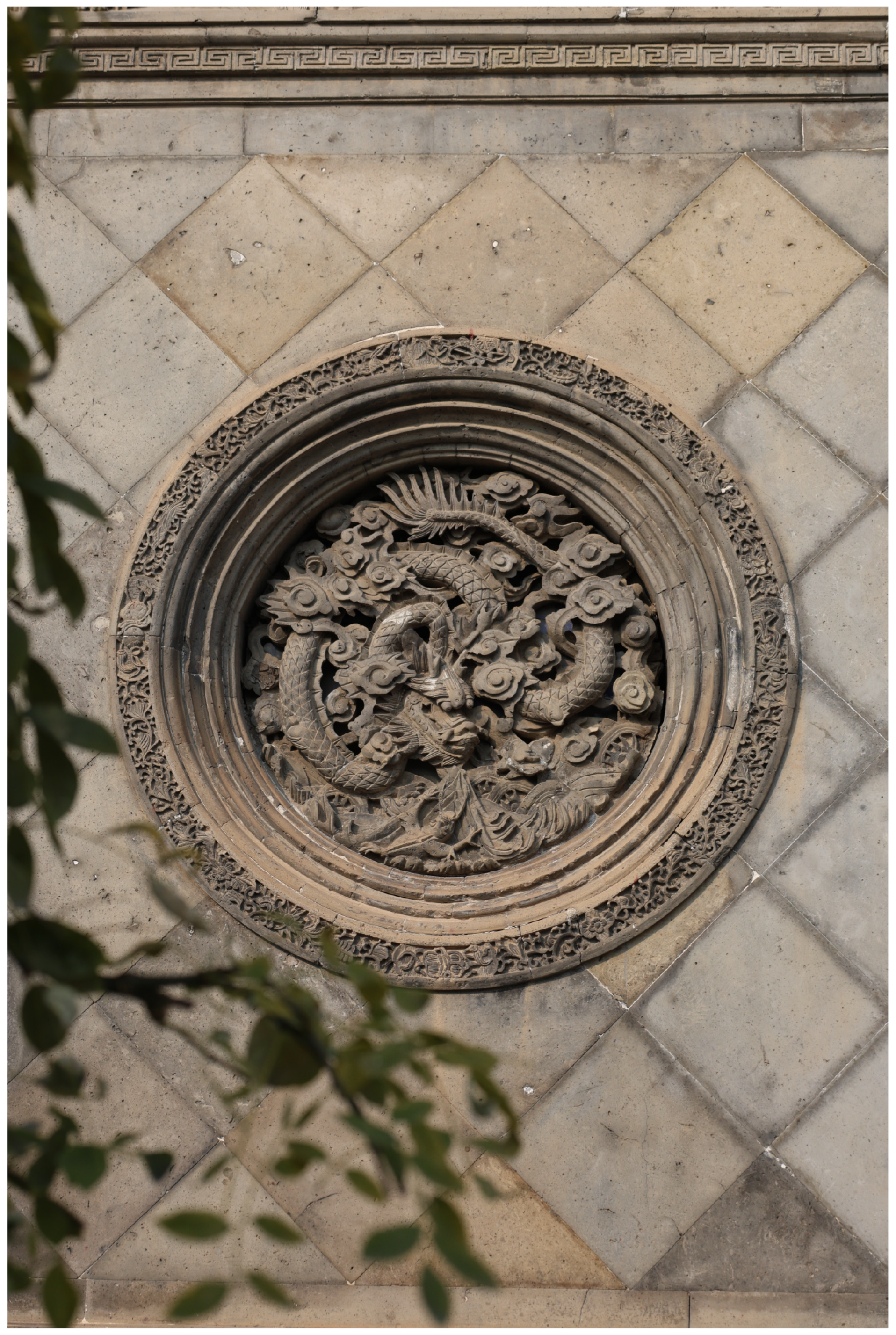
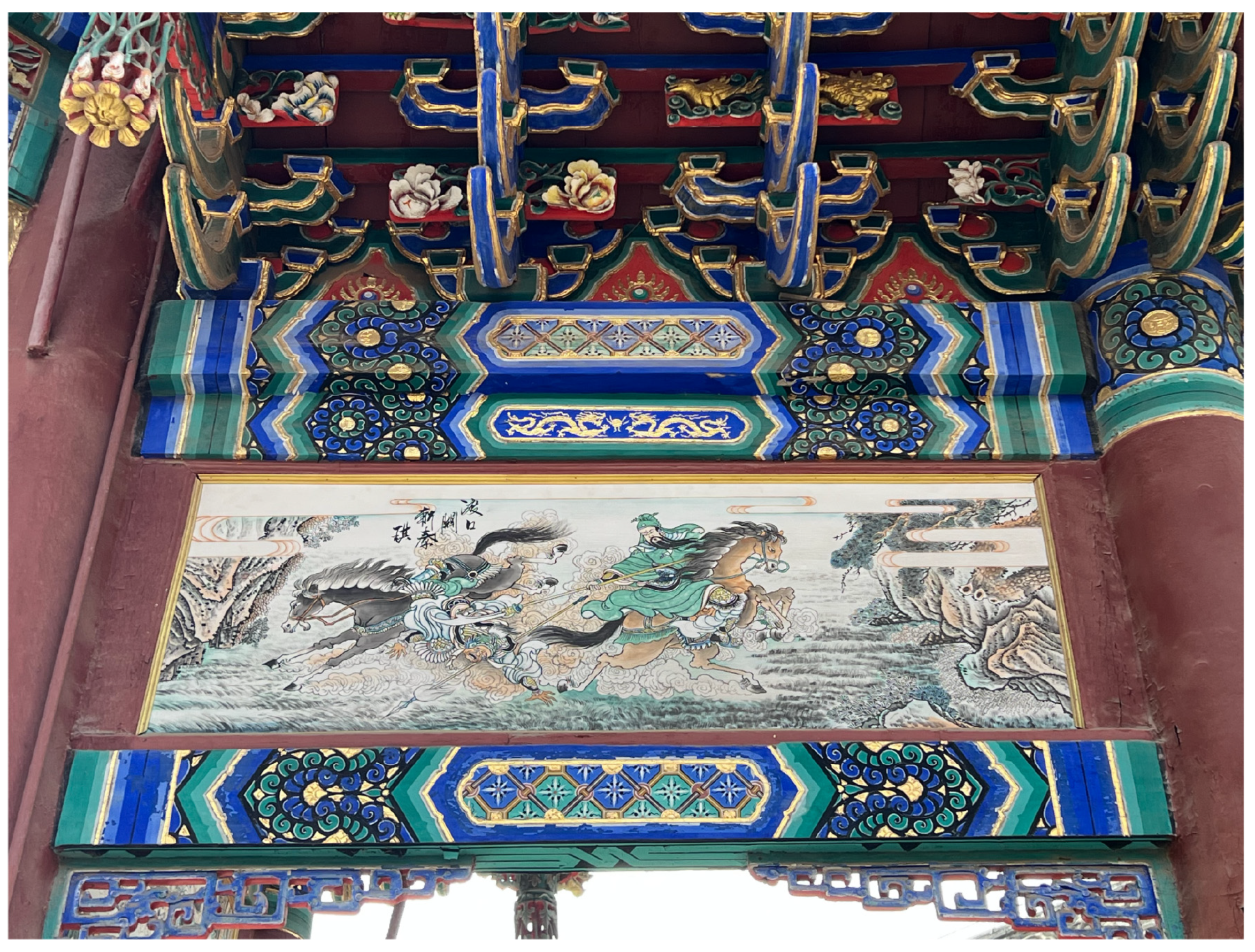
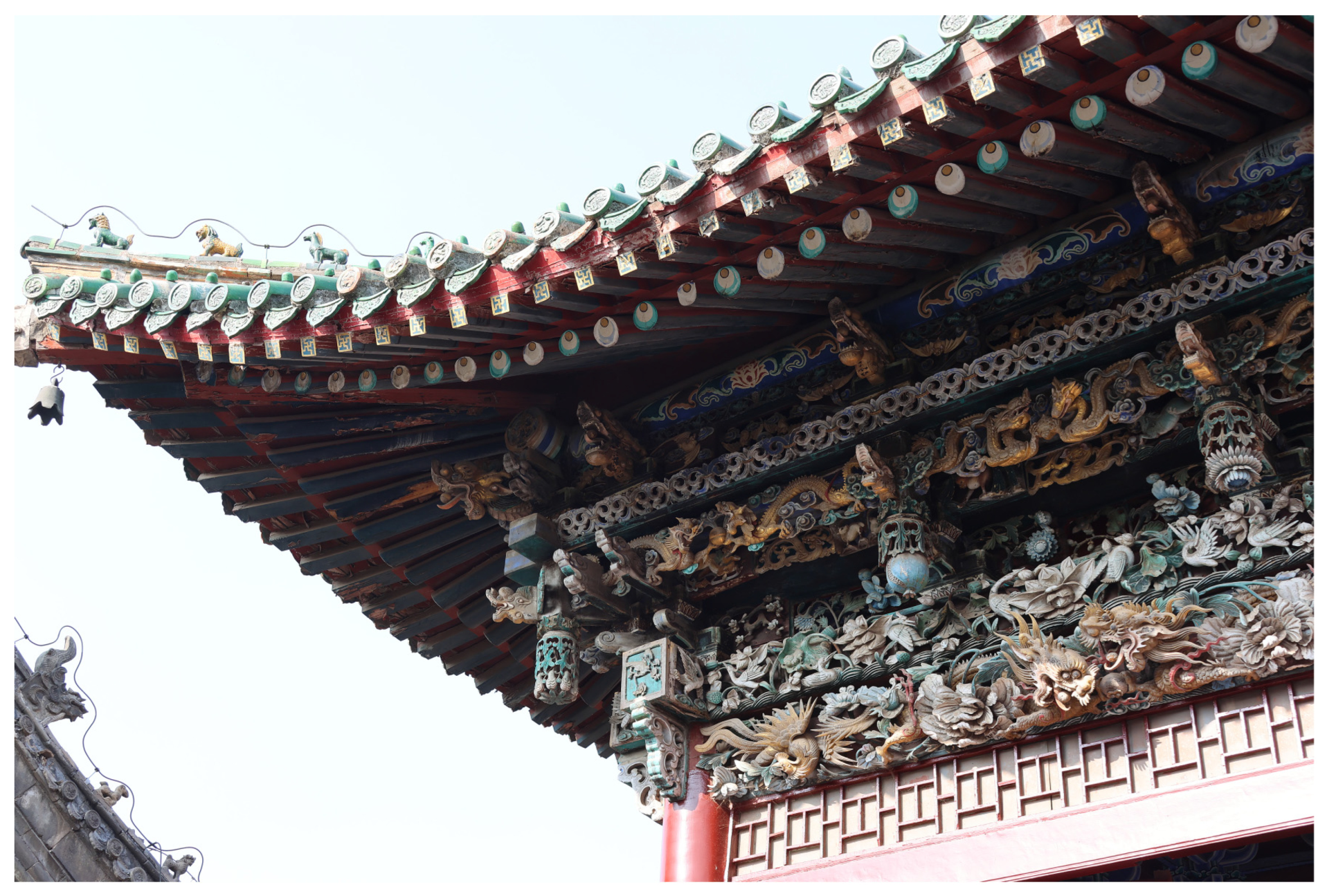
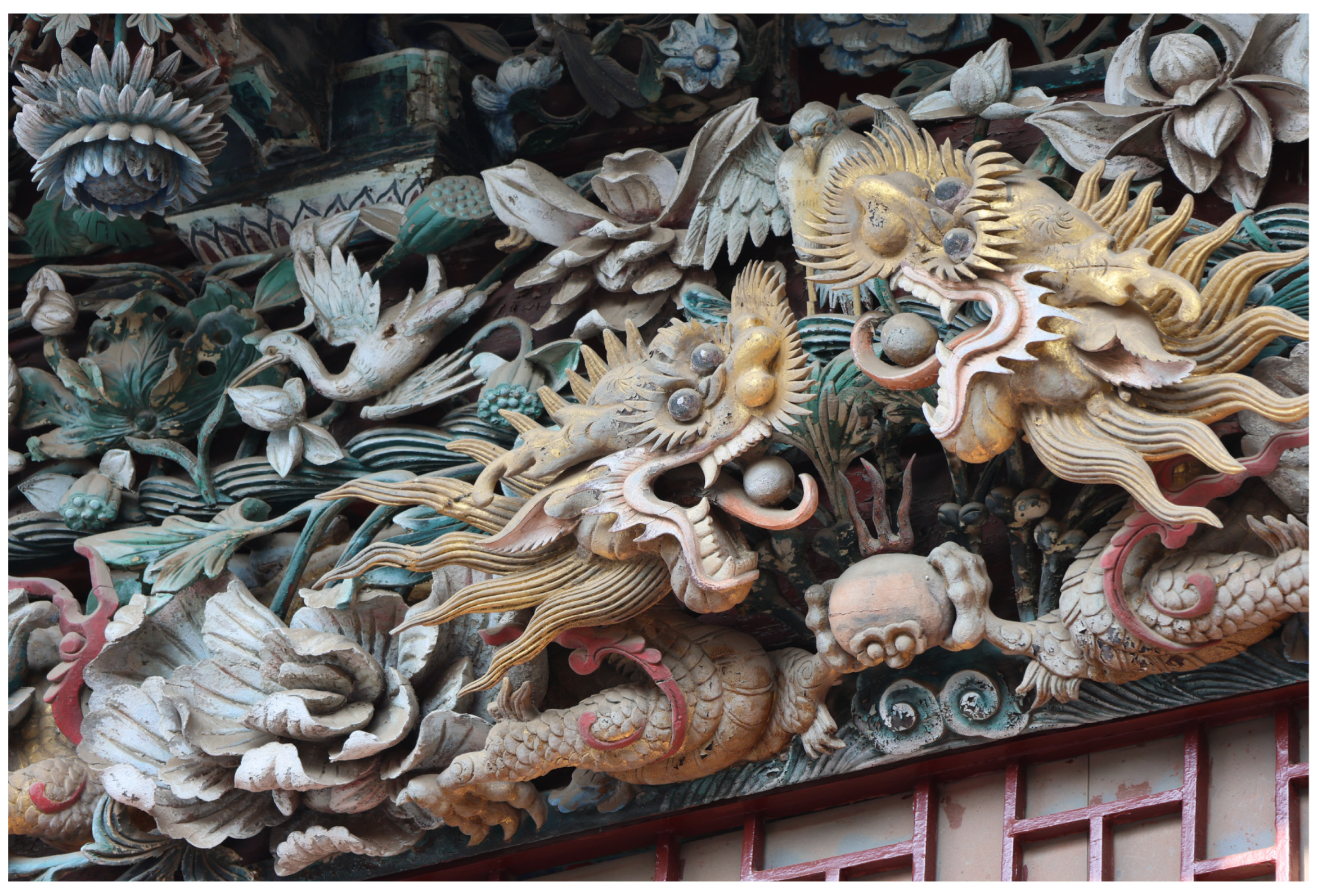
On the contrary, Shanxi merchants practised their faith through substantial monetary input. They spared no expense in making their guildhalls as imposing as possible, and guildhalls were known for their magnificent theatre stages and exquisite wooden and stone carvings (Figure 4, Figure 5, Figure 6, Figure 7, Figure 8 and Figure 9). Establishing statues of Emperor Guan and the Spring and Autumn Pavilions, erecting stone steles, and creating wall paintings depicting scenes from The Romance of the Three Kingdoms also required a powerful financial position. In 1782, 409 members donated over 7700 taels of silver for the construction of the Spring and Autumn Tower in the Shan-Shaan Guildhall of Sheqi. In 1809, 450 firms donated approximately 42000 taels of silver for renovating the main hall dedicated to Emperor Guan, the Hall of the God of Wealth, the hall dedicated to Wenchang 文昌 (the God of Culture and Literature) and the God of Fire, the xitai kanlou 戏台看楼 (the opera watching towers), and a few other structures. A stele inscription in the Shan-Shaan Ghuildhall of Zhoukou, dated 1822, records that the guild members contributed over 29,000 taels of silver for the construction of structures in the Chunqiu ge yuan 春秋阁院 (the yard where the Spring and Autumn Pavilion stands).16 The expenditure was large, but guild members saw investing in the project ‘the duty of Shan-Shaan 山陕之事’ (Zhang et al. 2009, p. 437).
Apparently, the merchants were more than willing to heavily invest in these projects and were proud of doing so. It is likely that the sense of pride that they derived from these projects have been the same as that felt by literati elites who engaged in spirit-writing. By different routes, these two bevies of adherents of the Confucianised and legitimate Emperor Guan reached the same end—to obtain symbolic power. While literati transferred their cultural capital directly into symbolic capital, Shanxi merchants with less cultural capital resorted to their considerable economic capital. The finely carved stone steles and imposing stages, statues, and buildings made many Shanxi merchant guildhalls landmarks in their localities. Naquin (2019, pp. 376–77) describes that the roofs of some Shanxi merchant guildhalls were decorated with bright green glaze tiles imported from Shanxi. As these non-imperial green roofs were rarely seen, they distinguished Shanxi merchant guildhalls from other local temples and manifested the merchants’ culture. Li and Zhao (2014) hold that the merchants established their guildhalls in accordance with the imperial architectural standards of official Temples of Emperor Guan. That is to say, the objective behind Shanxi merchants’ generous investment in the construction of guildhalls was to signal their influence in the local communities and obtain legitimacy.
In return, the symbolic power manifested through the scale of Shanxi merchant guildhalls contributed to the merchants’ income. Hu’s (2022, pp. 99–100; 2023, pp. 110–19) studies present that in the Qing times, local people compared the scale of Shanxi merchant guildhalls with that of local temples and guildhalls established by merchants from other part of the country. They were impressed by the majestic grandeur of Shanxi merchant guildhalls and showed marked preference for enjoying theatrical performances in the guildhalls over smaller temples during major festivals. Shanxi merchants took great pride of their guildhalls and were well aware of the link among worship, theatrical performances, advertisement, reputation and business success (Hu 2022, pp. 99–100; 2023, pp. 110–19). Although no statistical data is available for us to evaluate the effectiveness of this connection, it is reasonable to infer that Shanxi merchants clearly understood the benefits of investing in the worship of Emperor Guan.
Literati elites, however, disparaged Shanxi merchants’ massive expenditures on religious paraphernalia, sacrificial offerings, and the construction of grand buildings in their guildhalls. Their disapproval arose out of fear for their unstable social status and their weaker economic position compared to wealthy merchants, as, in late imperial times, particularly after 1850, money, rather than an academic degree, became the key factor determining one’s social standing (Ho 1980, p. 51). Literati manifested their disparagement for Shanxi merchants’ worship through moral condemnation, turning the guildhalls into arenas for power negotiations between them. The ‘Inscription concerning the records of the purchasing of ceremonial paraphernalia for the worship of Emperor Guan 山陝會館關聖帝君儀仗記’ in the Shan-Shaan Guildhall of Luoyang reads:
[Worshipping Emperor Guan] is to indoctrinate merchants. It can make the ones who come and go for financial gains and compete for meagre profits to serve the Emperor Lord by his side day and night. It prompts them to engage in self-reflection upon seeing the god. It reminds them not to forget righteousness while seeking profit, and not to cheat or deceive each other […] Temples of Emperor Guan were found wherever merchants gathered, but nowhere more so than in Shaanxi and Shanxi merchant guildhalls. They devote themselves earnestly to serve the god. As for the intention behind their devotion to Emperor Guan, it was nothing more than an attempt to curry favour with the god through material things, using the appearance of pursuing righteousness to disguise their true motives of seeking profit.
This account demonstrates that merchants and literati belonged to two different niches, and their intentions and patterns of worship differed. As K.-C. Liu (1988, p. 10) notes, the worship of a deity in merchant guildhalls was ‘inclined toward individual wishes for fulfilment and success. They made little demand on the worshipers’ inner life’. Literati questioned merchants’ intention for worship and the large sum of money spent on sacrificial and ritual activities, indicating that they did not approve of Shanxi merchants’ symbolic capital. Activities that gained legitimacy should be ‘separated from underlying material interests’ (Swartz 1996, p. 77). The merchants’ true purpose in worshipping the deities—namely, to obtain blessings for their business—was too obvious to conceal. If all of society held the same opinion, then the merchants’ endeavours in showing their devotion to Emperor Guan would be in vain. However, this account was written by a literato who had not yet assumed office. His financial situation is easy to imagine. As his statement was not an isolated one, it is likely that some of his viewpoints reflect the literato’s personal bias, while others were generally accepted in literati elite circles.
Interestingly, despite the derogative content, the merchants did not destroy the stone stele. Rather, the inscription was engraved on the stele along with the names of 44 firms that donated to the project and the amount of money they contributed. One explanation may be that the merchants never paid attention to the content of proses for eulogising Emperor Guan composed by literati for guildhalls, focusing instead on inviting a literato to write a eulogy for Emperor Guan, having the prose inscribed on a stone stele, displaying the stone stele to worshippers, and showing what they had invested for worship. Another explanation may be that the merchants were not literate enough to fully comprehend the literato’s prose and saw the stele inscription as a great honour because of the connection between them and literati elites. No matter the explanation, as we shall see in the next section, Shanxi merchants’ ostentatious worship practices and the grandeur of their guildhalls indeed helped them gain social recognition in local communities.

5. Guildhalls’ Role in Promoting Religions and Folk Beliefs

As we have seen, although Shanxi merchant guildhalls were large temples in their locality for worshipping gods, including Emperor Guan in particular, the imperial court never officially recognised the guildhalls as Temples of Emperor Guan. This section discusses the relationship between the imperial court and Shanxi merchant guilds in the worship of Emperor Guan and the role of Shanxi merchant guildhalls in enriching the diversity of religions and folk beliefs at the local levels.
The Ming dynasty and, in particular, the Qing dynasty witnessed the height of the integration of the Three Teachings and the permeation of the Three Teachings in folk religions and beliefs (Mou 2023, pp. 426–27). With Confucianism as the orthodox ideology, all other religions and beliefs were subject to its dominance. However, this does not mean that the religious economy was monopolised by the imperial court. Various religions and folk beliefs, including religions from the Western world, such as Catholicism, were allowed to enter the market as long as they did not violate Confucian moral values (A. Xu 2024, p. 62) or pose threats to the imperial regime. The market was also incompletely regulated, as various folk religions, such as the White Lotus Sect and the Tiandihui, which were considered illegitimised and heretical, continued to flourish despite the imperial court’s frequent prohibitions.
Therefore, while the imperial court exerted force through the promotion of Confucianism, there existed a certain degree of pluralism in this religious economy. In this pluralistic system, large numbers of service providers, including official temples, local temples, and guildhalls, competed for adherents, while adherents in the market were permitted to choose from these beliefs to best meet their demand.
In this market, Shanxi merchant guildhalls had two substantial advantages comparing to other local temples. First, the guildhalls were rather active in organising religious activities and had enough funds to hold large-scale events, providing opportunities to attract adherents. Their worship of Emperor Guan is an example. During the Shunzhi period (1644–1661) of the Qing dynasty, the official day for worshipping Emperor Guan was the thirteenth of the fifth lunar month (Qinding da Qing huidian shili 1886). From 1725, from the third year of the reign of Emperor Yongzheng (r. 1723–1735) onwards, Emperor Guan was officially worshiped on the third day of the second lunar month and one jiri 吉日 (auspicious day) in autumn (Qinding da Qing huidian shili 1886). However, many Shanxi merchants held ritual ceremonies and invited theatre troupes to entertain the god on other dates. For instance, the Shan-Shaan Guildhall of Liaocheng also worshipped Emperor Guan on the twenty-fourth of the sixth lunar month, the day he attended the meeting with Lu Su 魯肅, a prominent strategist in the State of Eastern Wu, carrying his blade in the company of only a few attendants.17 Theatre troupes were invited to perform in the guildhall for three consecutive days (Yan 2007, p. 221). Also, in the Shanxi Guildhall of Tianjin, ritual ceremonies accompanied by theatrical performances were held on the eighth day of the fourth lunar month (Yan 2007, p. 337). Apart from the official dates, the Shan-Shaan West Guildhall of Hankou also worshipped Emperor Guan on the twenty-third day of the sixth lunar month, the anniversary of his birth (danchen 誕辰), and laid out a banquet in the main hall (Zhang and Zhang 2016, p. 138). They also celebrated the day of Emperor Guan’s descent (jiangchen 降辰) on the thirteenth day of the ninth lunar month (ibid., p. 139).
Not every religious ceremony involved a temple fair, and the guildhalls were normally closed to the general public because they mainly served merchants (and, occasionally, literati). However, as discussed earlier, on major festivals, such as the official day for worshipping Emperor Guan in the fifth lunar month, Shanxi merchants held grand events and invited theatre troupes to perform in the guildhalls, attracting locals. On such days, the massive scale of the guildhalls and the attractiveness of theatrical performances gave them greater influence than other religious sites in their local communities.
In the Shanghai-based daily newspaper Shun Pao 申報, there is a record of a grand theatrical performance staged in the Shan-Shaan West Guildhall of Hankou in the tenth lunar month of 1881. It is highly likely that this performance was staged to celebrate the completion of the reconstruction of the Spring and Autumn Pavilion, as this was a significant event for the guild in this year and formally recorded in a stele inscription (Zhang and Zhang 2016, pp. 53–56). The news about the performance reads:
The theatrical performance in the guildhall started on the eleventh of this month. People jostled each other in a crowd and were unable to turn around. When the first half of the performance was about to end, numerous members of the audience cried out in pain after been crushed or losing their shoes, hats, and all other belongings, and asked [the percussion] to stop playing the gong. When the performance was over, they crowded out of the entrance in such a way as if they could topple the mountains and overturn the seas. At that time, a boy about ten years old stood there with his arms down. His arm was crushed and fractured. Everyone asked him to quickly return to see a doctor. It is unknown if his arm can be set properly. There were some other people who were injured too. Ten people said: ‘We have heard about the custom in Hankou. Every time theatrical performances are staged in someone’s place or in guildhalls, all the people will stop working and go to watch the show. If someone tried to stop them from going, they will manage to go by any means possible. Not to mention that this guildhall is so magnificent and grand and so pleasing to people; it makes them even more eager to come and see.’
This excerpt does not specify whether the event was accompanied by ritual ceremonies, but it is likely that worship took place on a day of grand celebration in a guildhall where 34 gods were enshrined. As vividly depicted in the account, the guildhall was known in Hankou for its majestic architecture and theatrical performances. There is no doubt that this guildhall was a centre of social and cultural life in Hankou. We have already considered the highly Confucian image of Emperor Guan in this guildhall and the educational function of theatrical performances in Shanxi merchant guildhalls. Once spectators entered the gate of the guildhall, they would immediately sense the solemn atmosphere at sacrificial ceremonies, hear the lines in plays that centred on Confucian teachings, and catch sight of the statue of Emperor Guan holding a book. They would also see the Spring and Autumn Pavilion and the antithetical couplets and stele inscriptions that eulogised Emperor Guan’s holy deeds and moral integrity. This approach to spreading religious beliefs was realised through subtle and unconscious influence rather than official canonisation and extensive promotion by the government.
Furthermore, the religious and theatrical activities in Shanxi merchant guildhalls were officially protected by the local government, conferring them legitimacy. Support from the local government indicated that there was a clear hierarchical relationship between merchant guildhalls and the local authority and that the guildhalls were under the government’s supervision. But it also served as a protective umbrella for guildhalls, signifying that they were superior to some other common temples established by local communities.
The government’s protection of and influence on Shanxi merchant guildhalls were manifested through its intervention in guild affairs. Merchant guildhalls were essentially self-governed, and funding for their establishment and renovation came from the merchants themselves. Individuals and government institutions could also financially contribute to guilds, although they never constituted the core group of contributors. The names of contributors were inscribed on stone stelae to manifest the merchants’ gratitude. These were often firms’ names, as membership in Shanxi merchant guilds was by firm. In most cases, firm managers joined their guild as representatives of their employees (Burgess 1928, p. 124) and donated to the construction of their guildhalls. Stele inscriptions about the building of guildhalls that listed the names of all contributors usually sorted the names by the amount of funding. The most important members, usually the financially powerful firms, were inscribed at the top. Other types of donors were at the bottom. For example, the stele inscription that records the completion of the construction of the Shan-Shaan Guildhall of Liaocheng in 1746 lists 391 donors, including several dozen individuals and a government institution known as Dongchangfu jingting 東昌府經廳 (the Registry of Dongchang Prefecture). While Xingrizhang 行日章, the firm that contributed the most to the project, donated 900 taels of silver, the Registry of Dongchang Prefecture only donated less than 10 taels.18 The disparity reflects the fact that although individuals and the government could participate in a guild’s activities through financial contribution, it was the merchants who were the key initiators of guild activities.
However, Shanxi merchants could seek assistance from the government when they encountered disputes over religious and cultural activities. One oft-cited case was about the Shan-Shaan Guildhall of Zhoukou in Chenzhou 陳州 prefecture (in present-day Zhoukou in central Henan province) in 1800. The guildhall was established by all Shanxi merchants sojourned in Zhoukou. On every festival to celebrate Emperor Guan’s birthday, guild members would donate money and invite theatre troupes to perform to express gratitude for Emperor Guan’s blessings. Usually, the local administrative office never attempted to impede the event. Surprisingly, on one day for worship, a few local soldiers and corvées forced the theatre troupe to perform for the local government without any pay. All guild members travelled to the provincial capital to report these offenders to the zhifu 知府 (Prefect) of Chenzhou. The Prefect deemed the soldiers’ and corvées’ actions illegal and granted the guild members permission to report any similar conduct aimed at obstructing worship and performances to entertain Emperor Guan in future. An inscription was engraved on a stele recording the Prefect’s decision and the cause and outcome of the incident (Zhang et al. 2009, pp. 380–81).
The organisation of temple fairs was also supported by local authorities. Gipouloux (2025, pp. 432, 434–36) notes that ‘temple fairs were crucial nodes in long-distance trade network’ that contributed to the economic prosperity of the country in the Ming and Qing dynasties. Therefore, local authorities were inclined not to interfere much in the running of events (Gipouloux 2025, p. 439). In the late Qing period, prominent high-ranking official Zhang Zhidong 張之洞 (1837–1909) was recorded to have once attended a temple fair held in Yuci 榆次 county with local gentry and officials and publicly praised the theatrical performances staged that day (Wang et al. 2009, p. 95). No matter who was the organiser, whether it was the local worship community or wealthy merchants, the local authorities did not tightly restrict activities during fairs.
Notably, it is likely that the temple fairs held in Shanxi merchant guildhalls enjoyed even more freedom owing to the merchants’ close connection with high officials, aristocrats, and rulers. In the second half of the Qing dynasty, especially from the 1850s to the late Qing era, business tycoons from Shanxi became the financial backbone of the imperial government in a series of wars, uprisings, and social turmoil (Hu 2023, pp. 122–29). Not only did they manage these social elites’ personal deposits; they also loaned money to the imperial court to support major projects, transferred military provisions, remitted provincial tax revenues to the capital, and so on (Hu 2023, pp. 125–29). Shanxi merchants also invited local authorities to enjoy theatrical performances in their guildhalls during major events (Yan 2007, p. 276; Zhongguo xiqu zhi 1994, p. 412) to cement their relationships. Although there is insufficient evidence, it is reasonable to infer that the temple fairs in Shanxi merchant guildhalls may have been in a more favourable position as long as the religious rituals and content of plays did not contradict Confucian orthodox ideology. Other local temples were unlikely to be favoured as a result of this financial tie.
Apart from these advantages in a large religious economy, each Shanxi merchant guildhall can be regarded as a microsystem of a religious economy that encouraged competition among different gods, facilitating a thriving marketplace of beliefs in the guildhall. In Ming–Qing society, one common feature of Chinese folk beliefs was that shrines and altars to various gods could be erected for worship within a single temple (Zhao 2021, p. 11), regardless of their religious traditions. Accordingly, Shanxi merchant guildhalls did not have a single clear religious orientation. Although there existed a loosely constructed hierarchy of gods, this microsystem allowed for a harmonious fusion of various religions and beliefs. Because the guildhalls were not always accessible to the public, the demand side of the microsystem remained relatively constant, intensifying competition among the gods.
We know that Shanxi merchant guildhalls enshrined multiple gods. The elements of all Three Teachings and folk beliefs are found in many guildhalls, particularly the larger ones. One example is the Shan-Shaan-Gan (Shanxi, Shaanxi, and Gansu) Guildhall of Kaifeng in Henan province, located on the south bank of the Yellow River. Kaifeng was the capital of Henan province in the Qing dynasty. It was ‘the major thoroughfare that led out on all sides. Vessels and boats, chariots and horses, as well as merchants, all converged here. It was a major city’ (Jiaqing chongxiu yitong zhi 1934, 186.8). In the mid-Qing dynasty, Kaifeng experienced rapid development in commerce, with a number of guildhalls established by sojourning merchants from all over the country (T. Xu 2006, p. 170). In the mid-Qianlong period, merchants from Shanxi and Shaanxi established a Shan-Shaan Guildhall on the old site of the Xu 徐 mansion, the former residence of Xu Maoxian 徐茂先, a descendant of Xu Da 徐達, one of the founding fathers of the Ming dynasty (Yan 2007, p. 98). In the Guangxu 光緒 period (1875–1908), merchants from Gansu joined the guild, and the guildhall was renamed the Shan-Shaan-Gan Guildhall of Kaifeng (Yan 2007, p. 99).
Because the main god enshrined in the guildhall was Emperor Guan, the guildhall was known as the Temple of Emperor Guan to local people. Some of the major extant buildings of the building complex include the yingbi 影壁 (spirit screen), xilou 戲樓 (opera tower),19 jizhua pailou 雞爪牌樓 (chicken-feet-shaped decorated archway, Figure 10), main hall, two side courtyards on the two wings of the main hall, and two tangxilou 堂戲樓 (stages for private performances) in each of the courtyards, as well as a gulou 鼓樓 (drum tower) and a zhonglou 鐘樓 (bell tower) (Figure 11).
The image of Emperor Guan in this guildhall is clearly Confucian. The spirit screen at the main entrance is inscribed with four characters—zhong 忠, yi 義, ren 仁, yong 勇 (loyalty, righteousness, benevolence, and courage)—which represent the four major moral values of the god. Also, on the decorated archway, two vertical plaques hang. The plaque facing the stage is inscribed ‘The righteousness that reaches heaven 大義參天’. The one on the other side of the archway reads. ‘A reputation throughout all ages 流芳千古’. These words of praise align with the Qing court’s interpretation of Emperor Guan. In addition, the statue of Emperor Guan (Figure 12) enshrined in the main hall presents both his military identity and his literary image. In his robe and armour, Emperor Guan is seated still, with his right hand stroking his long beard on his chest. Instead of carrying his Qinglong yanyue dao 青龍偃月刀 (Blade of Azure Dragon and Half-moon), he is holding a scroll (a copy of The Spring and Autumn Annals) in his left hand. With a worried and serious look, he appears to be a hero with a strong sense of justice, while his military prowess is relatively downplayed.
Not only Confucian but Daoist elements are found in this guildhall. A stele inscription dated 1812 records the taxes levied on the guild members. It shows that while the guild leader was responsible for collecting the money, it was an abbot named Xu Yanglin 許陽霖 who maintained the daily operation of the guildhall (Zhang et al. 2009, pp. 421–22). Because Shanxi merchant guildhalls were usually maintained by Buddhist monks or Daoist priests and Xu Yanglin was not a Buddhist monk’s dharma name, this abbot must have been a Daoist priest. Furthermore, on the flower-hanging gate (chuihua men 垂花門) on both sides of the main hall that leads to the courtyards, there are two painted taijitu 太極圖 (diagrams of the Supreme Ultimate), which show that this guildhall was more inclined toward a Daoist temple.
In comparison, some other Shanxi merchant guildhalls integrated Confucianism, Buddhism, and Daoism. A good example is the Shan-Shaan West Guildhall of Hankou. We have already seen that the image of Emperor Guan in this guildhall has strong Confucian overtones, but Buddhist monks were also hired to take care of the incense offerings and clean the incense burner tables and halls every day. On major festivals, they were required to stay in the halls to burn incense, offer wine to the gods, and prepare to attend to literati and merchants who came for worship (Zhang and Zhang 2016, pp. 30, 144, 149). Behind the Spring and Autumn Pavilion of the guild stood a fotang 佛堂 (Hall of Buddha) where a statue of Budda was enshrined and a zhongyu 鐘魚 (wooden fish) was placed (ibid., p. 30). There was also a zhaichu 齋廚 (a kitchen for preparing vegetarian food) for the monks who lived in the guildhall (ibid., p. 38). Apart from Emperor Guan, 33 more gods were enshrined in this guildhall, including Buddhist gods such as Shakyamuni and Dipankara, and Daoist deities such as Ziwei dijun 紫薇帝君 (Emperor Lord Ziwei) and Qingling dijun 青灵帝君 (Emperor Lord Qingling) (ibid., pp. 139–41).
Another example is the Shan-Shaan Guildhall of Beiwudu 北舞渡 in Henan province, established in 1722. In 1730, a stone stele was erected bearing an inscription that records the establishment of a theatre stage. The inscription begins with praise of Confucius’s morality, followed by a eulogy of Emperor Guan’s virtues (Zhang et al. 2009, pp. 340–41). By placing the two figures on an equal footing, the inscription apparently shows the Confucian interpretation of Emperor Guan. An inscription on a stela, written eight years later, records the purchase of ritual vessels and lists the names of three Buddhist monks who maintained the daily sacrificial offerings in the guildhall (Zhang et al. 2009, pp. 341–42). Since 1811, the guild members had been accumulating funds to construct the Temple of the Ultra Supreme Elder Lord, a mighty god in Daoism. Due to insufficient funds, this aim was not achieved until 1852 (Zhang et al. 2009, p. 490). The guild members had an intense desire to pay respect to the Ultra Supreme Elder Lord, and the process of saving money was so arduous that they felt compelled to record it. Interestingly, this inscription lists the names of abbot monks who managed the guildhall at that time, suggesting that the merchants’ longing to worship a Daoist deity did not contradict the religious orientation of the Buddhist monks.
These cases demonstrate that the guilds were suppliers of various religions and folk beliefs. In this microsystem, the Confucianised Emperor Guan was the legitimised god supplied by the guilds. Meanwhile, the image of Emperor Guan as the protector of merchants and commerce, as well as all the other gods enshrined in a guildhall coexisted with Emperor Guan’s Confucian image but occupied a subordinate status.
Notably, the types of religions and beliefs the guilds offered were influenced by the official sacrifice but not completely determined by it. The demand side of the system played a significant role in determining which gods were to be supplied by a guild. As long as a god could perform miracles to protect the merchants and local residents, the religious tradition to which the gods belonged was of little importance. Worshipping multiple patron gods in a guildhall did not imply that the guild members’ reverence for Emperor Guan had lessened. It only indicated that the merchants had more demand and wished to receive more blessings from the gods who were special to an industry or society.
The demand for worshipping multiple gods in a microsystem was acknowledged by the ruling elites. A stele inscription dated 1850 that records the establishment of the Temple of Emperor Guan in Yizhuang 義莊 town of Gaoping 高平 (in present-day southwest Shanxi) states that it did not matter which gods were enshrined in a guildhall. As long as ‘they are beneficial to people’s welfare, are listed in the Official Registers of Sacrifices and are good for moral education, then they can be worshipped together at the same place’ (Yan 2007, p. 360). This inscription was written by a Confucian scholar and reflects literati elites’ perspective regarding which gods should be enshrined in merchant guildhalls. The fact is, in such a marketplace, with the worship of Emperor Guan as the legitimised belief, there was intense competition among other gods, regardless of whether the god was the canonised God of Culture and Literature, Emperor Guan as the protector of commerce in popular culture, or the Immortal Lay of Vinegar.
Guild members could not only choose which gods to worship but also create new images for a god to meet their own need. One example is the worship of the Ultra Supreme Elder Lord in the Lujun Guildhall in Beijing, or the Temple of the Stove God. In 1745, prominent Qing official Sun Jiagan 孫嘉淦 (1683–1753), the then Left Vice-Censor-in-Chief 左副都御史, was invited to draft an inscription to record the renovation to the hall dedicated to the Ultra Supreme Elder Lord in this guildhall. In the inscription, he states that the interpretation of the god in this guildhall cannot be verified in historical records. The guild members worshipped him simply because their goods, such copper and coal, all had to be proceeded through fire, and the Ultra Supreme Elder Lord was associated with an alchemical furnace (H. Li 1980, p. 40). He considers the link between the Ultra Supreme Elder Lord and the guild members’ industry absurd, which made it difficult for him to describe the project and praise the god (H. Li 1980, p. 40). He also criticises people who erroneously interpreted gods’ images without consulting the official sacrificial rites. Despite this, he eventually agreed to write the inscription on the grounds that the worship of the Ultra Supreme Elder Lord as the God of Stove in this guildhall could not be regarded as yinsi 淫祀 (H. Li 1980, p. 40).
As a high official of the upper third rank and a Neo-Confucian scholar, Sun Jiagan condemned the ritual activities in the Lujun Guildhall in Beijing from the perspective of the ruling class. His disapproval of the interpretation of the god indicated that, although the god was listed in the Official Registers of Sacrifices, it was impossible that the imperial court would promote this image of the god. His attitude also suggested that it was common for people to create new interpretations of a god based on their own needs. Therefore, the imperial court was not the supplier of the belief. Shanxi merchant guilds were also not the suppliers of this image of the god because it did not originally exist but was instead created through the guild members’ later interpretations. Moreover, the available evidence shows that this image of the Ultra Supreme Elder Lord was not found in other Shanxi merchant guildhalls. Therefore, this interpretation was confined to the market niche constituted of the copper, steel, tin, and coal merchants in the Lujun Guildhall in Beijing.
While the demand side enjoyed autonomy in choosing their gods, they were also subject to some constraints in worship. In some guildhalls, worship rituals were formally prescribed, and the guilds imposed requirements on their members’ ritual practices. It is unclear whether all Shanxi merchant guildhalls conducted ritual ceremonies following the same procedure due to insufficient evidence. The most detailed record of a program for a ritual ceremony is that for worshipping Emperor Guan in the Shan-Shaan West Guildhall of Hankou. The account offers step-by-step instructions for the preparatory work for ritual ceremonies, what each guild member who attended the worship was expected to do, and the titles of all 34 gods and the days for worshipping them. A summary of the seven-page program is given below.
The instructions begin with a description of the official worship days for commemorating Emperor Guan and prescribe that the guildhall holds the ceremony as scheduled, following official requirements. Ritual vessels were very important for the ceremony. When worship was not taking place, the vessels were placed with caution in the Chengjing tang誠敬堂 (Hall of Sincerity and Reverence). The instructions do not explain what the Chengjing tang was. However, judging from its name, it was probably built to show the guild members’ sincere care toward and reverence for Emperor Guan. Keeping ritual vessels in the hall with care demonstrated their respect and awe.
A few days before the ceremony, the sishi zhe 司事者 (ceremony handler) was required to take the vessels out and examine them to determine whether repair and cleansing were needed. Utensils for worship, such as zun 尊 (a tall wine vessel with a flared mouth), jue 爵 (a wine vessel with three legs), zu 俎 (a vessel for holding sacrificial animals), and dou 豆 (a bowl-shaped ritual food holder with a stand and sometimes a lid), had to be washed before and after each ceremony. Sacrificial food did not have to be delicacies because they were sometimes unavailable. What food to prepare and how to organise the ceremony had to follow the instructions of the nianshou 年首 (guild leader of the year), banshi renyuan 辦事人員 (errand-men), and the draft bank traders from Taigu 太谷 and Xiangfen 襄汾, a group of 26 people in total. On the first day of the fifth lunar month, the handler of the ceremony would ask the guanding 館丁 (a person who worked for the guildhall) to notify the guild members of the date of worship. The zhuji 主祭 (chief master of the ceremony) was a senior member selected from either Taigu or Xiangfen merchant groups or the guild leader of the year. A rehearsal was conducted on the eighth day of the fifth lunar month. The day before the ceremony, the ritual vessels were to be cleaned again, and animals were killed for the ceremony. The skin and blood of the animals were placed in small plates and put in a corner of the main hall, waiting to be buried. At midnight, prior to the ceremony, the chief master of the ceremony and all other people involved in holding the ceremony would stay in the east hall to have snacks and tea. Once properly dressed, they would be led by two yinzanzhe 引贊者 (ritual prompters) to the xi piandian 西偏殿 (west side hall). Then, the ceremony started.
The ceremony began with people playing drums and musical instruments while circling the main hall three times. All people who performed the ceremony, such as the chief master of the ceremony, sixiangzhe 司香者 (incense master), sijiuzhe 司酒者 (wine master), and xi maoxue zhe 瘗毛血者 (who was responsible for burying the sacrificial animals), stood in their designated positions in the hall. The next part of the ceremony consisted of a series of rituals, including but not limited to tongchang 通唱 (group chanting), yinchang 引唱 (chanting by ritual prompters), jiangshen 降神 (descending of the divine), guanxi 盥洗 (performing ablutions), mingzhong 鳴鐘 (striking the bell), and jigu 擊鼓 (beating the drum), followed by many rounds of shangxiang 上香 (offering incense), gui 跪 (kneeling down), koutou 叩頭 (kowtowing), and xing 興 (rising), as well as a step-by-step process of xianbo 獻帛 (offering silk), xianjue 獻爵 (offering wine), xianzhuan 獻饌 (offering food), cishen 辭神 (ushering out of the god), du zhuwen 讀祝文 (reading ritual invocation texts), and so on. On the twenty-third day of the sixth lunar month and the thirteenth day of the ninth lunar month, which were outside of the dates of official sacrifices, the guild would worship Emperor Guan again, following the same procedure (Zhang and Zhang 2016, pp. 135–39).20
It is unknown when this detailed program was drafted, but the use of music, silk, and a variety of wine vessels, including jue, dou, zu, and zun, the activities, including chanting, welcoming the god, and ushering out of the god, as well as the multiple rounds of kneeling and kowtowing were similar to the procedure of official rituals for worshipping Emperor Guan formulated in 1727 under the reign of Emperor Yongzheng and further developed in 1853 in the Jiaqing period (1796–1821) (Qinding da Qing huidian shili 1886). Therefore, it is likely that this program was created during or after the reign of Emperor Xianfeng, modelled on the official rituals, and Confucian in its form. Judging from the instructions, the worship in the guildhall seemed to be even richer in detail and carried out with greater solemnity than official sacrifice.
In many guildhalls, discipline was imposed to ensure the members’ regular worship of Emperor Guan. Merchants were required to join the membership of a guild at a certain cost. Guild members were also expected to attend the ceremonies to show their commit-ment to the god. If they failed to fulfil this duty on time, they were punished financially. In addition, as already discussed, there were restrictions on plays performed in guildhalls on days for worshipping. Despite these regulations, the tension between the guilds and society was moderate because the norms and restrictions were generally accepted. On major events, this tension was further reduced. For example, every thirteenth day of the fifth month, the official day for worshipping Emperor Guan, all natives of Shanxi aged over 50 would be invited to the Shanxi Guildhall of Xuzhou 徐州 (in present-day Jiangsu). After worshipping gods, a grand banquet would be prepared for them in the main hall followed by theatrical performances. While Shanxi merchants and their important guests were provided with designated seated, all the local residents in Xuzhou could stand in the courtyard to watch the shows free of charge (Yan 2007, p. 279). Judging from the allocation of seats, there was a clear boundary between Xuzhou local residents and the guild members. But the boundary also implied that the guild held different expectations regarding the commitment of these two groups of people to Emperor Guan. The restrictions placed on the guild members were not applicable to local people. Becoming a disciple of Emperor Guan and worship him in this guildhall were less costly and therefore more attractive to them. During such occasions, the separation between the guild and society was nearly erased. The guildhall functioned as a public space where local residents encountered the guild’s norms of worship while worshipping Emperor Guan in their own way.
G. Li (2024, p. 16) suggests that overemphasising a god’s Confucianised orthodox image would limit the development and spread of the belief. Li’s research focus on the development and decline of the cult of Han Yu 韓愈 (768–824). Although it is unclear whether this finding applies to all Confucianised folk beliefs in China, Li’s discussions provide support for the possibility. It is highly likely that the existence of Shanxi merchant and Shanxi merchant guildhalls helped prevent the decline of the cult of Emperor Guan due to a narrow interpretation of the god. As Shanxi merchants expanded their business, their more than 500 guildhalls constituted a far-reaching network across the country. Whether in present-day Jilin 吉林 far to the north, Guangdong 廣東 to the south, or even in Dihua 迪化, that is, Urumqi in present-day Xinjiang 新疆 Uyghur Autonomous Region in the west, Shanxi merchant guildhalls were commonly recognised as Temples of Emperor Guan (Shanxi sheng xiju yanjiusuo 2009, pp. 224–25). Shanxi merchants’ network of commerce created a network of worship in commercialised urban areas, with Shanxi merchant guildhalls as nodes across the network. The wide geographical distribution of the guildhalls, therefore, ensured the wide spread of the multifaceted image of Emperor Guan.
We cannot say that the spread of Emperor Guan throughout the country was primarily attributed to Shanxi merchant guildhalls. It is also difficult for us to evaluate the impact of Shanxi merchant guildhalls on the spread of religions and folk beliefs. However, analysis using the theoretical framework of the religious economy helps us reconstruct religious life in Shanxi merchant guildhalls and the relationship between worship at the local and official levels in the late imperial period. At least in these commercialised urban areas, Shanxi merchant guildhalls helped foster a diversity of religions and beliefs.

6. Conclusions

The story of Shanxi merchants began in the early Ming dynasty and ended in the transitional period from the late Qing to the Republican era. Shanxi merchants were distinctive in their investment in merchant guildhalls, respect for Emperor Guan, and great passion for theatrical performances. Their guildhalls were venues for settling business issues and also for conducting religious and theatrical activities. These activities formed an integrated whole rather than being mutually exclusive. Business meetings were often accompanied by religious rituals, and theatrical performances were woven into meetings and religious rituals to create a harmonious atmosphere and please patron gods. The pleased gods would protect the merchants and their business from harm. The merchants would then be willing to invest in the construction and maintenance of buildings related to their patron gods.
Shanxi merchants were known for their devotion to Emperor Guan. Although their respect for Emperor Guan has often been ascribed to their common native place, it was the frequent canonisation of Emperor Guan during the Qing dynasty that took his cult in Shanxi merchant guildhalls to its apogee. The Confucian image of Emperor Guan that the imperial court re-created through political propaganda spread throughout the country, including in Shanxi merchant guildhalls. But Shanxi merchants also retained their own interpretation. The coexistence of the Confucian interpretation of Emperor Guan and his image in popular culture, and the difference between the literati’s and Shanxi merchants’ ways of worshipping Emperor Guan, reflected power negotiations between literati elites and wealthy merchants in late imperial times, when the traditional social hierarchy was challenged by merchants’ ever increasing financial power.
While the imperial court promoted Confucian moral principles as the orthodox ideology, the religious economy was not monopolised. Most Shanxi merchant guildhalls incorporated worship of multiple gods, with Emperor Guan as the predominant one. Government protection of guilds’ religious activities, the sheer grandeur of the architecture, the inclusiveness of worship, and the scale of grand events made Shanxi merchant guildhalls ideal venues for promoting religions and folk beliefs at the local level.
This study sheds light on the relationship between the government and Shanxi merchant guildhalls, as well as the relationship between the literati and merchants, as reflected in worship. Future research may expand on this study by comparing patterns of worship in merchant guildhalls with those in other types of guildhalls and temples and by applying the theoretical framework of the religious economy more extensively in discussing religions and folk beliefs in late imperial China.

Funding

This research received no external funding.

Institutional Review Board Statement

Not applicable.

Informed Consent Statement

Not applicable.

Data Availability Statement

All original contributions of this study are contained in the article. Further inquiries can be directed to the corresponding author.

Acknowledgments

I would like to express my sincere gratitude to Xiaohuan Zhao for reading an earlier draft of this paper and providing valuable feedback. My thanks also go to the three anonymous reviewers for their constructive suggestions, which greatly improved the clarity and depth of the manuscript. In addition, I would like to thank the editors for their assistance throughout the review process. During the preparation of this manuscript, I used ChatGPT (GPT-5 series models), M365 Copilot, and Research Rabbit for the purposes of language polishing, literature retrieval, and summarizing open-access scholarly literature. AI tools were not used for generating research ideas, tables, or images. All interpretations and conclusions remain my own. I have reviewed and edited the output and take full responsibility for the content of this publication.

Conflicts of Interest

The author declares no conflicts of interest.

Notes

1
Noboru’s study was translated into English from a paper in Japanese published in 1948. As such, it is considered here a study conducted in the Republican era.
2
The translations of institutions, posts and titles in this article are based on Hucker (1985), unless otherwise noted.
3
I do not intend to offend any religions or folk beliefs here.
4
Because Shanxi merchant guildhalls enshrined different gods and it was not necessary to hold annual meetings during a main god’s birthday, meeting dates varied greatly. For instance, although the Dyestuffs Guildhall of Beijing worshipped seven gods, including Emperor Guan, the annual meeting was on the birthday of the Elder Immortals Mei Fu 梅福 and Ge Hong 葛洪 in the ninth month of the lunar year (Yan 2007, p. 1). On that day, ‘theatrical performances would be staged and sacrificial offerings displayed. Ritual offerings including jinqian 金錢 (joss paper), yunma 雲馬 (paper horses) and xiangchu 香楮 (incense) were all prepared’ (H. Li 1980, p. 1). In comparison, the Jinyi Guildhall of Tongzhou 通州, established by textile merchants from Yicheng (in modern Linfen 臨汾 in the southwest part of Shanxi) in the late Kangxi 康熙 (1661–1722) period, held their annual meetings in the first month of the lunar year (H. Li 1980, p. 39; Shanxi sheng xiju yanjiusuo 2009, p. 219).
5
The translation of this title follows Tian and Zhao (2025).
6
The Han River refers to Hanshui 漢水, also known as Hanjiang 漢江.
7
The Pavilion of the River Beneath the Azure Sky faces the Han River to the north.
8
The Yellow Crane Tower is located on the north bank of the Yangtze River.
9
Gongyang Gao was active in the Warring States period 戰國 (475–221 BCE) and believed to be the author of Chunqiu Gongyang zhuan 春秋公羊傳 (The Gongyang Commentary on the Spring and Autumn Annals).
10
Guliang Chi was active in the Warring States period. He was the author of The Guliang Commentary on Chunqiu Guliang zhuan 春秋榖梁傳 (The Spring and Autumn Annals).
11
Zuo Qiuming was a historian active at the end of the Spring and Autumn period 春秋 (770–476 BCE). He was the author of Zuozhuan 左傳 (The Zuo Tradition).
12
Hu Anguo was a historian in the Northern Song 北宋 period (1074–1138). He was an expert in interpreting The Spring and Autumn Annals.
13
Fusang is a mythical land far in the east.
14
Kunlun is a high mountain in Chinese mythology.
15
People from Shanxi and Shaanxi areas were commonly known as ‘the people of the west’.
16
These numbers are calculated according to the stele inscriptions that record the establishment and renovation of structures in the Shan-Shaan Guildhall of Liaocheng and the Shan-Shaan Guildhall of Sheqi. See Zhang et al. (2009, pp. 370–79, 382–400, 437–38).
17
This story is known as dandao fuhui 單刀赴會 (Going to the Meeting with a Single Sword). It is mentioned in both Sanguo zhi 三國志 (The Records of the Three Kingdoms) by historian Chen Shou 陳壽 (233–297) and in The Romance of Three Kingdoms.
18
These numbers and proportions are calculated according to the stele inscriptions that record the establishment of the Shan-Shaan Guildhall of Liaocheng. See Zhang et al. (2009, pp. 343–53).
19
The original opera tower was destroyed. This opera tower was moved from the Huoshen miao 火神廟 (Temple of the God of Fire) in Kaifeng.
20
For a complete program of the ceremony and the list of gods enshrined in the Shan-Shaan West Guildhall of Hankou, see Zhang and Zhang (2016, pp. 135–41).

References

  1. Bourdieu, Pierre. 2011. The Forms of Capital. In The Sociology of Economic Life. Edited by Mark Granovetter and Richard Swedberg. New York: Routledge, pp. 78–92. First published 1986. [Google Scholar]
  2. Burgess, John Stewart. 1928. The Guilds of Peking. New York: Columbia University Press. [Google Scholar]
  3. Cai, Dongzhou 蔡東洲. 2012. Guan Yu chongbai yu ru shi dao sanjiao關羽崇拜與儒, 釋, 道三教. Zongjiao yu minzu 宗教與民族 1: 289–300. [Google Scholar]
  4. Cai, Dongzhou 蔡東洲, and Tinghai Wen 文廷海. 2001. Guan Yu chongbai yanjiu 關羽崇拜研究. Chengdu: Bashu shushe. [Google Scholar]
  5. Calhoun, Craig, ed. 2002. Symbolic capital. In Dictionary of the Social Sciences. Oxford: Oxford University Press. [Google Scholar] [CrossRef]
  6. Che, Wenming 車文明, and Juan Du 杜鵑. 2015. Guangong xinyang dui Guangong xi de yingxiang yanjiu. Xiqu yanjiu 戲曲研究 3: 256–71. [Google Scholar]
  7. Duara, Prasenjit. 1988. Superscribing Symbols: The Myth of Guandi, Chinese God of War. The Journal of Asian Studies 47: 778–95. [Google Scholar] [CrossRef]
  8. Fozu tongji jiaozhu 佛祖統紀校注. 2012. Shi Zhipan 釋志磐 (Song dynasty). Shi Daofa 釋道法 annot. Shanghai: Shanghai guji chubanshe.
  9. Gao, Yangli 高揚勵, and Xiaofang Yao 姚曉芳. 2021. Huiguan juchang “yi guan duo tai” xianxiang ji qi xiquxue yiyi—yi Hankou Shan-Shaan xi huiguan wei zhongxin de kaocha 會館劇場”一館多台”現象及其戲曲學意義—以漢口山陝西會館為中心的考察. Yishu xueji 藝術學界, 296–311. [Google Scholar]
  10. Gipouloux, François. 2025. The Network of Temple Fairs and Their Actors: Religious Communities, Brokers, and Merchants in Late Imperial China. In Fairs, Cities and Merchants: Spatiotemporal Analyses (14th–17th Century). Edited by Jean-Louis Gaulin and Susanne Rau. Berlin and Boston: De Gruyter, pp. 425–43. [Google Scholar] [CrossRef]
  11. Goossaert, Vincent. 2015. Spirit Writing, Canonization, and the Rise of Divine Saviors: Wenchang, Lüzu, and Guandi, 1700–1858. Late Imperial China 36: 82–125. [Google Scholar] [CrossRef]
  12. Goossaert, Vincent. 2019. Late Imperial Chinese Piety Books. Studies in Chinese Religions 5: 38–54. [Google Scholar] [CrossRef]
  13. Goossaert, Vincent. 2022. Making the Gods Speak: The Ritual Production of Revelation in Chinese Religious History, 1st ed. Cambridge: Harvard University Asia Center, vol. 131. [Google Scholar] [CrossRef]
  14. Goossaert, Vincent. 2023. The Social Networks of Gods in Late Imperial Spirit-Writing Altars. Religions 14: 217. [Google Scholar] [CrossRef]
  15. Guandi shengji tuzhi quanji, preface 關帝聖跡圖誌全集 (序). 1802. Juan 1. Prefaced in 1692 and 1693. Lu Zhan 盧湛 (fl.1692–1693). Lijin tang edition 礪金堂藏本. Chinese Rare Book Digital Collection. The Chinese University of Hong Kong Library: Available online: https://repository.lib.cuhk.edu.hk (accessed on 29 January 2026).
  16. ‘Guanju zhebi’ 觀劇折臂. 1881. Shun Pao 申報. October 25, Reprinted in 1965, Shun Pao. Edited by Wu Xiangxiang 吳相湘. Taipei: Taiwan xuesheng shuju 臺灣學生書局, vol. 33, 21438. [Google Scholar]
  17. Ho, Ping-ti 何炳棣. 1966. Zhongguo huiguan shilun 中國會館史論. Taipei: Taiwan xuesheng shuju. [Google Scholar]
  18. Ho, Ping-ti 何炳棣. 1980. The Ladder of Success in Imperial China: Aspects of Social Mobility, 1368–1911. New York: Columbia University Press. [Google Scholar]
  19. Hu, Yunjie. 2022. Theatre as Business: A Study of Shanxi Merchants’ Sponsorship of Theatrical Performances in Qing China. Asian Theatre Journal 39: 89–109. [Google Scholar] [CrossRef]
  20. Hu, Yunjie. 2023. Theatre as Business: A Study on Shanxi Merchants’ Sponsorship of Theatrical Performance in Late Imperial China. Ph.D. dissertation, The University of Sydney, Sydney, Australia. [Google Scholar]
  21. Hucker, Charles O., ed. 1985. A Dictionary of Official Titles in Imperial China. Stanford: Stanford University Press. [Google Scholar]
  22. Jiaqing chongxiu yitong zhi 嘉慶重修一統志. 1934. Sibu congkan xubian: Shibu 四部叢刊續編·史部. Reprint. Shanghai: Shangwu yinshuguan, vol. 12.
  23. Jihan wuzhi 季漢五志. 1990. Wang Fuli 王復禮 (fl. Qing dynasty). Jiangsu: Guangling guji.
  24. Li, Gang 李剛, and Peng Zhao 趙鵬. 2014. Ming–Qing shiqi gongshang huiguan “miao, guan, shi” heyi xintan—yi Shan-Shaan huiguan weili 明清時期工商會館”廟、館、市”合一新探—以山陝會館為例. Zhongguo gudaishi yanjiu 中國古代史研究 43: 137–42. [Google Scholar]
  25. Li, Gang 李剛, and Yuxian Zhao 趙宇賢. 2011. Ming–Qing gongshang huiguan shenling chongbai duoyanghua yu shisuxing touxi—yi Shan-Shan huiguan weili 明清工商會館神靈崇拜多樣化與世俗性透析—以山陝會館為例. Lanzhou shangxueyuan xuebao 27: 106–11. [Google Scholar]
  26. Li, Guoping. 2024. Reflection on the Spread of Chinese Popular Religion: A Case-Study of the Han Yu Belief in the Chaozhou Region. Religions 15: 1523. [Google Scholar] [CrossRef]
  27. Li, Hua 李華, ed. 1980. Ming–Qing yilai Beijing gongshang huiguan beike xuanbian 明清以來北京工商會館碑刻選編. Beijing: Wenwu chubanshe. [Google Scholar]
  28. Li, Quan 李泉. 2009. Qingmo minchu Liaocheng Shan-Shaan huiguan xilou moji yu quyu xiju wenhua jiaoliu 清末民初聊城山陝會館戲樓墨記與區域戲劇文化交流. Yunhe wenhua yanjiu 運河文化研究 30: 90–97. [Google Scholar]
  29. Li, Shih-Wei. 2023. Knowledge and Ritual: The Dual Nature of the Scripture Illustrating the Holiness of Emperor Guan (Guandi Mingsheng Jing). In Chinese Popular Religion in Text and Acts. Edited by Shin-yi Chao. Amsterdam: Amsterdam University Press, pp. 149–66. [Google Scholar] [CrossRef]
  30. Liu, Kwang-Ching. 1988. Chinese Merchant Guilds: An Historical Inquiry. Pacific Historical Review 57: 1–23. [Google Scholar] [CrossRef]
  31. Liu, Wenfeng 劉文峰. 2015. Shan-Shaan shangren yu bangzixi kaolun 山陝商人與梆子戲考論. Beijing: Beijing shidai huawen shuju. [Google Scholar]
  32. Lu, Haiming 廬海鳴, and Xinhua Yang 楊新華, eds. 2001. Nanjing Ming–Qing jianzhu 南京明清建築. Nanjing: Nanjing daxue chubanshe. [Google Scholar]
  33. Macgowan, Daniel Jerome. 1886. Chinese Guilds or Chambers of Commerce and Trades Unions. Shanghai: China Branch of the Royal Asiatic Society. [Google Scholar]
  34. Mingshi 明史. 1974. Zhang, Tingyu 張廷玉 (1672–1755), and et al., eds. Beijing: Zhonghua shuju, 14 vols. [Google Scholar]
  35. Mou, Zhongjian. 2023. Popularization and Expansion of the Integration of Confucianism, Daoism, and Buddhism (The Ming and Qing Dynasties). In A Brief History of the Relationship Between Confucianism, Daoism, and Buddhism. Singapore: Springer, pp. 409–57. [Google Scholar] [CrossRef]
  36. Naquin, Susan. 2000. Peking: Temples and City Life, 1400–1900. Berkeley: University of California Press. [Google Scholar]
  37. Naquin, Susan. 2019. The Material Manifestations of Regional Culture. Journal of Chinese History 3: 363–79. [Google Scholar] [CrossRef]
  38. Noboru, Niida. 1950. The Industrial and Commercial Guilds of Peking and Religion and Fellow Countrymanship as Elements of Their Coherence. Folklore Studies 9: 179–206. [Google Scholar] [CrossRef]
  39. Qinding da Qing huidian shili 欽定大清會典事例. 1886. Kun, Gang 崑岡 (1836–1907), Li Hongzhang 李鴻章 (1823–1901), and et al., eds. vol. 438. [Google Scholar]
  40. Quan, Hansheng 全漢昇. 1986. Zhongguo hanghui zhidushi 中國行會制度史. Taipei: Shihuo chubanshe. [Google Scholar]
  41. Shanxi sheng xiju yanjiusuo 山西省戲劇研究所, ed. 2009. Jinshang huiguan 晉商會館. Taiyuan: Shanxi jiaoyu chubanshe. [Google Scholar]
  42. Shanxi tongzhi 山西通志. 1892. Reprint in 1969. Wang, Xuan 王軒, and et al., eds. Taipei: Huawen shuju, vol. 2. [Google Scholar]
  43. Shao, Lan 邵嵐, and Kui Zhao 趙逵. 2015. Shan-Shaan huiguan yu Guan Di miao 山陝會館與關帝廟. Shanghai: Dongfang chuban zhongxin. [Google Scholar]
  44. Shiji 史記. 1959. Sima Qian 司馬遷 (ca. 145 BC–86 BC). Beijing: Zhonghua shuju.
  45. Smith, Arthur H. 1899. Village Life in China: A Study in Sociology. New York: F. H. Revell Company. [Google Scholar]
  46. Stark, Rodney, and Roger Finke. 2000. Acts of Faith: Explaining the Human Side of Religion, 1st ed. Berkeley: University of California Press. [Google Scholar] [CrossRef]
  47. Swartz, David. 1996. Bridging the Study of Culture and Religion: Pierre Bourdieu’s Political Economy of Symbolic Power. Sociology of Religion 57: 71–85. [Google Scholar] [CrossRef]
  48. Szonyi, Michael. 2009. Secularization Theories and the Study of Chinese Religions. Social Compass 56: 312–27. [Google Scholar] [CrossRef]
  49. Tanaka, Issei 田仲一成. 2012. Qingdai huiguan xiju kao—qi zuzhi, gongneng, bianqian 清代會館戲劇考—其組織, 功能, 變遷. Wenhua yishu yanjiu 文化藝術研究 5: 80–101. [Google Scholar]
  50. Ter Haar, Barend J. 2017. Guan Yu: The Religious Afterlife of a Failed Hero. Oxford: Oxford University Press. [Google Scholar]
  51. Ter Haar, Barend J. 2022. Divine Soldiers: The Boxers and Their Religious Universe. Studies in Chinese Religions 8: 259–88. [Google Scholar] [CrossRef]
  52. Tian, Ye, and Xiaohuan Zhao. 2025. Crossing a Millennium Cult: Lord Guan Temple and Lord Guan Patrols the City. In The Myriad Faces of Heroes and Heroines. Edited by Julian Patrick Ward, Kelly Kar Yue Chan and Chi Sum Garfield Lau. Singapore: Springer Nature, pp. 93–113. [Google Scholar] [CrossRef]
  53. Wang, Yongnian 王永年, Liu Jucai 劉巨才, Duan Shuren 段樹人, and et al., eds. 2009. Jinju bainian shihua 晉劇百年史話. Taiyuan: Sanjin chubanshe. [Google Scholar]
  54. Xin Tangshu 新唐書. 2013. Ouyang Xiu 歐陽修 (1007–1072) and Song Qi 宋祁 (998–1061). Beijing: Zhonghua shuju.
  55. Xu, Aymeric. 2024. Typologies of Secularism in China: Religion, Superstition, and Secularization. Comparative Studies in Society and History 66: 57–80. [Google Scholar] [CrossRef]
  56. Xu, Tan 许檀. 2006. Ming–Qing shiqi de Kaifeng shangye 明清时期的开封商业. Zhongguo shi yanjiu 中国史研究 1: 161–76. [Google Scholar]
  57. Yan, Aiying 閻愛英, ed. 2007. Jinshang shiliao quanlan huiguan juan 晉商史料全覽·會館卷. Taiyuan: Shanxi renmin chubanshe. [Google Scholar]
  58. Zhang, Zhengming 張正明. 2007. Shanxi shangbang 山西商幫. Hefei: Huangshan shushe. [Google Scholar]
  59. Zhang, Linyu 張林雨, and Zhiyong Zhang 張志永. 2014. Saiwai xiqu yuanliu ji zhongbeilubangzi shi 塞外戲曲源流及中北路梆子史. Taiyuan: Sanjin chubanshe. [Google Scholar]
  60. Zhang, Shu 張舒, and Zhengming Zhang 張正明, eds. 2016. Hankou Shan-Shaan xi Huiguan zhi 漢口山陝西會館志. Taiyuan: Shanxi jingji chubanshe. [Google Scholar]
  61. Zhang, Zhengming 張正明, Ke Dawei 科大衛, Wang Yonghong 王勇紅, and et al., eds. 2009. Ming–Qing Shanxi beike ziliaoxuan xu’er 明清山西碑刻資料選 (續二). Taiyuan: Shanxi jingji chubanshe. [Google Scholar]
  62. Zhao, Xiaohuan. 2021. Form Follows Function in Community Rituals in North China: Temples and Temple Festivals in Jiacun Village. Religions 12: 1105. [Google Scholar] [CrossRef]
  63. Zhongguo xiqu zhi. 1994. bianji weiyuanhui 中國戲曲志編輯委員會, ed. Zhongguo xiqu zhi·Neimenggu juan 中國戲曲志·內蒙古卷. Beijing: Zhongguo. ISBN zhongxin. [Google Scholar]
Figure 1. The main hall and the yard between the stage and the hall in the Shanxi Merchant Guildhall of Taiyuan 太原晋商会馆 (aka Taiyuan Jinshang bowuguan 太原晉商博物館), Shanxi. This complex was renovated in the Qing dynasty and the Republican era. It reflects the typical architectural style of Ming–Qing Shanxi merchant guildhalls. 16 April 2019.
Religions 17 00404 g001
Figure 2. The theatre stage in the Shanxi Merchant Guildhall of Taiyuan. 16 April 2019.
Religions 17 00404 g002
Figure 3. One of the two small stages in the side courtyards of the All-Shanxi Guildhall of Suzhou. 25 December 2024.
Religions 17 00404 g003
Figure 4. Stone carving on a wall: coiled dragon. The All-Shanxi Guildhall of Suzhou. 25 December 2024.
Religions 17 00404 g004
Figure 5. Theatre stage with opera watching towers on both sides of the stage and the yard between the stage and the main hall for worshipping Emperor Guan. The All-Shanxi Guildhall of Suzhou. 25 December 2024.
Religions 17 00404 g005
Figure 6. Theatre stage and opera watching towers. The All-Shanxi Guildhall of Suzhou. 25 December 2024.
Religions 17 00404 g006
Figure 7. A painting on the chicken-feet-shaped archway depicting a story about Guan Yu in The Romance of Three Kingdoms. The Shan-Shaan-Gan Guildhall of Kaifeng. 4 December 2023.
Religions 17 00404 g007
Figure 8. The wooden carvings under the eaves of the main hall dedicated to Emperor Guan. There are seven layers of wooden carvings from the inside out. The pattens of flowers and animals contain auspicious connotations. The Shan-Shaan-Gan Guildhall of Kaifeng. 4 December 2023.
Religions 17 00404 g008
Figure 9. Wooden carvings under the eaves of the main hall that depict the pattern of shuanglong xizhu 雙龍戲珠 (two dragons playing with a pearl). The pearl is represented by a zhu 蛛 (spider) because these two characters are homophones. The Shan-Shaan-Gan Guildhall of Kaifeng. 4 December 2023.
Religions 17 00404 g009
Figure 10. The chicken-feet-shaped decorated archway between the main hall and the theatre stage and side rooms on both sides of the courtyard. The Shan-Shaan-Gan Guildhall of Kaifeng, Henan. 4 December 2023.
Religions 17 00404 g010
Figure 11. The bell tower on one side of the courtyard. The Shan-Shaan-Gan Guildhall of Kaifeng. 4 December 2023.
Religions 17 00404 g011
Figure 12. The stone statue of Emperor Guan holding a scroll in the main hall. The Shan-Shaan-Gan Guildhall of Kaifeng. 4 December 2023.
Religions 17 00404 g012
Table 1. Well-documented Spring and Autumn Pavilions in Shanxi merchant guildhalls.
GuildhallYear of Establishment/Completion of the GuildhallYear of Establishment/Completion of the Spring and Autumn PavilionSource
Henan province
Shan-Shaan-Gan Guildhall (Shanxi, Shaanxi, and Gansu) of Kaifeng17651902(Yan 2007, pp. 98–99; Shanxi sheng xiju yanjiusuo 2009, p. 227)
Shan-Shaan Guildhall of Beiwudu 北舞渡Kangxi 康熙 period
(1661–1722)
After 1738(Shanxi sheng xiju yanjiusuo 2009, p. 124)
Shan-Shaan Guildhall of Jingziguan 荊紫關Daoguang 道光 period (1821–1851)Circa the Daoguang period(Shanxi sheng xiju yanjiusuo 2009, p. 128)
Shan-Shaan Guildhall of Sheqi17821782(Yan 2007, pp. 131–46)
Shan-Shaan Guildhall of Zhoukou16931800(Yan 2007, p. 165)
Shan-Shaan Guildhall of Zhuxianzhen 朱仙鎮1675N/A(Shanxi sheng xiju yanjiusuo 2009, pp. 143, 227)
The Shan-Shaan Guildhall of Jitan 汲灘1726N/A(Shanxi sheng xiju yanjiusuo 2009, p. 140)
The Shanxi Guildhall of Luohe 漯河1769N/A(Shanxi sheng xiju yanjiusuo 2009, p. 148)
Shandong province
The Shan-Shaan Guildhall of Liaocheng1743Completed in 1810(Yan 2007, pp. 218–41; Shanxi sheng xiju yanjiusuo 2009, p. 67)
Modern Jiangsu province
Shanxi Guildhall of NanjingExpanded in 1747N/A(Yan 2007, p. 282)
Modern Hubei province
Shan-Shaan West Guildhall of Hankou 漢口16831683(Yan 2007, pp. 283–96; Zhang and Zhang 2016, pp. 41–43)
Modern Hunan 湖南 province
Bei Wusheng 北五省 Guildhall of Xiangtan 湘潭Qianlong periodN/A(Shanxi sheng xiju yanjiusuo 2009, p. 182)
Modern Yunnan 雲南 province
Shan-Shaan Guildhall of Jinning 晉寧Qing dynastyN/A(Shanxi sheng xiju yanjiusuo 2009, p. 192)
Disclaimer/Publisher’s Note: The statements, opinions and data contained in all publications are solely those of the individual author(s) and contributor(s) and not of MDPI and/or the editor(s). MDPI and/or the editor(s) disclaim responsibility for any injury to people or property resulting from any ideas, methods, instructions or products referred to in the content.