1. Introduction
The autonomous surface vehicle (ASV), as an intelligent, miniaturized, and versatile unmanned marine transport platform that operates through remote control or autonomous navigation, has a variety of applications in offshore ocean engineering [
1,
2,
3,
4,
5,
6,
7,
8,
9,
10,
11,
12,
13]. Among the various applications of ASVs, the trajectory planning of ASVs is particularly crucial to provide a safe trajectory. In order to obtain the optimal trajectory, trajectory planning of the ASV is described as a constrained optimization problem by using local sensor and global map information.
The trajectory-planning problem of an ASV has been widely studied in the literature [
14,
15,
16,
17,
18,
19,
20,
21]. Specifically, in [
14], a temporal-logic-based ASV path-planning method is employed, which enables the ASV to pass through heavy harbor traffic to an intended destination in a collision-free manner. In [
15], an evolutionary-based path-planning approach is proposed for an ASV to accomplish environmental monitoring tasks. In [
16], an extension of the hybrid-A* algorithm is proposed to plan optimal ASV paths under kinodynamic constraints in a leader-following scenario. Another hybrid-A*-based two-stage method is provided in [
17] for energy-optimized ASV trajectory planning with experimental validation. In [
18], a novel receding horizon multi-objective planner is developed for an ASV performing path planning in complex urban waterways. In [
19], an essential visibility graph approach is proposed to generate optimal paths for an ASV with real-time collision avoidance. Furthermore, in [
20], the particle swarm optimization algorithm together with the visibility graph is applied to the ASV path-planning problem among complex shorelines and spatiotemporal environmental forces. Recently, in [
21], a hybrid artificial potential field method is proposed for an ASV cruising in a dynamic riverine environment. However, it is worth mentioning that the works [
14,
15,
16,
17,
18,
19,
20,
21] are dedicated to the path planning of a single ASV.
Compared to a single ASV, multiple ASVs are more likely to complete difficult tasks such as exploration and development, territorial sea monitoring and route planning [
4,
22,
23,
24,
25,
26,
27,
28,
29,
30,
31,
32]. Therefore, the trajectory planning of multiple ASVs, as one of the key topics in the field of marine science, has attracted increasing interest in scientific research, and much success has been achieved. Existing path-planning methods for multiple ASVs include model predictive control [
33,
34,
35], the RRT method [
36], satellite maps [
37], the priority target assignment method [
38], the Voronoi-Visibility roadmap [
39], and the multidimensional rapidly exploring random trees star algorithm [
40], to list just a few. However, due to the uncertainties of obstacles, and limitations in sensor range and communication bandwidth, the trajectory planning of multiple ASVs in an unknown—an especially an obstacle-rich—marine environment still presents a great challenge. In fact, to the best of the our knowledge, as for the autonomous navigation of multiple ASVs, little research is available that constructs a multi-objective optimization problem with optimal energy consumption, dynamic feasibility, and obstacle avoidance distance in unknown environments based on local sensor information.
In light of the above discussions, this paper focuses on the distributed swarm trajectory-planning problem for multiple ASVs in a complex and obstacle-rich marine environment. Firstly, by utilizing local sensors, the surrounding environment’s point cloud data are acquired, and a kinodynamic path-search technique is employed to generate a series of waypoints within a discretized control space. Subsequently, B-spline curves are fitted to these waypoints, and a nonlinear optimization problem is formulated. This problem is optimized using a gradient-based local planning approach, which allows the generation of collision-free, smooth, and dynamically feasible trajectories through a shared network. Compared with the existing trajectory-planning methods, the proposed trajectory-planning method has the following features:
In contrast to the existing trajectory-planning methods dedicated to a single ASV [
14,
15,
16,
17,
18,
19,
20,
21] and multiple USVs [
36,
37,
38,
39,
40], this work constructs a multi-objective optimization problem with optimal energy consumption, dynamic feasibility, curve smoothness, obstacle avoidance distance, and endpoint distance constraints based on local sensor information. By utilizing local onboard sensor information, ASVs can accomplish autonomous navigation requiring no external localization and computation or a pre-built map in unknown complex environments.
By adopting the proposed planning method, the optimal trajectory generation problem for multiple ASVs is divided into initial trajectory generation and back-end trajectory optimization. A heuristic-based kinodynamic path search is employed to efficiently find a safe, feasible, and minimum-time initial path. The initial path is then optimized by a B-spline optimization incorporating gradient-based local planning. By this means, the generated trajectories are able to meet the dynamic feasibility with enhanced safety.
By adopting the proposed planning method, ASVs can perceive the surrounding environment in real time, using point cloud information obtained from local sensors to generate real-time local optimal trajectories. Moreover, this work utilizes multiple local optimal trajectories to form a global trajectory, which better meets the requirements of real-time obstacle avoidance and generates shorter sail distance for short-range autonomous navigation.
The rest of this paper is organized as follows. Some preliminaries and the problem formulation are given in
Section 2.
Section 3 discusses the process of swarm trajectory planning of ASVs.
Section 4 provides some simulation results to demonstrate the effectiveness of the proposed method.
Section 5 concludes this paper with some concluding remarks and future works.
3. Swarm Trajectory Planning
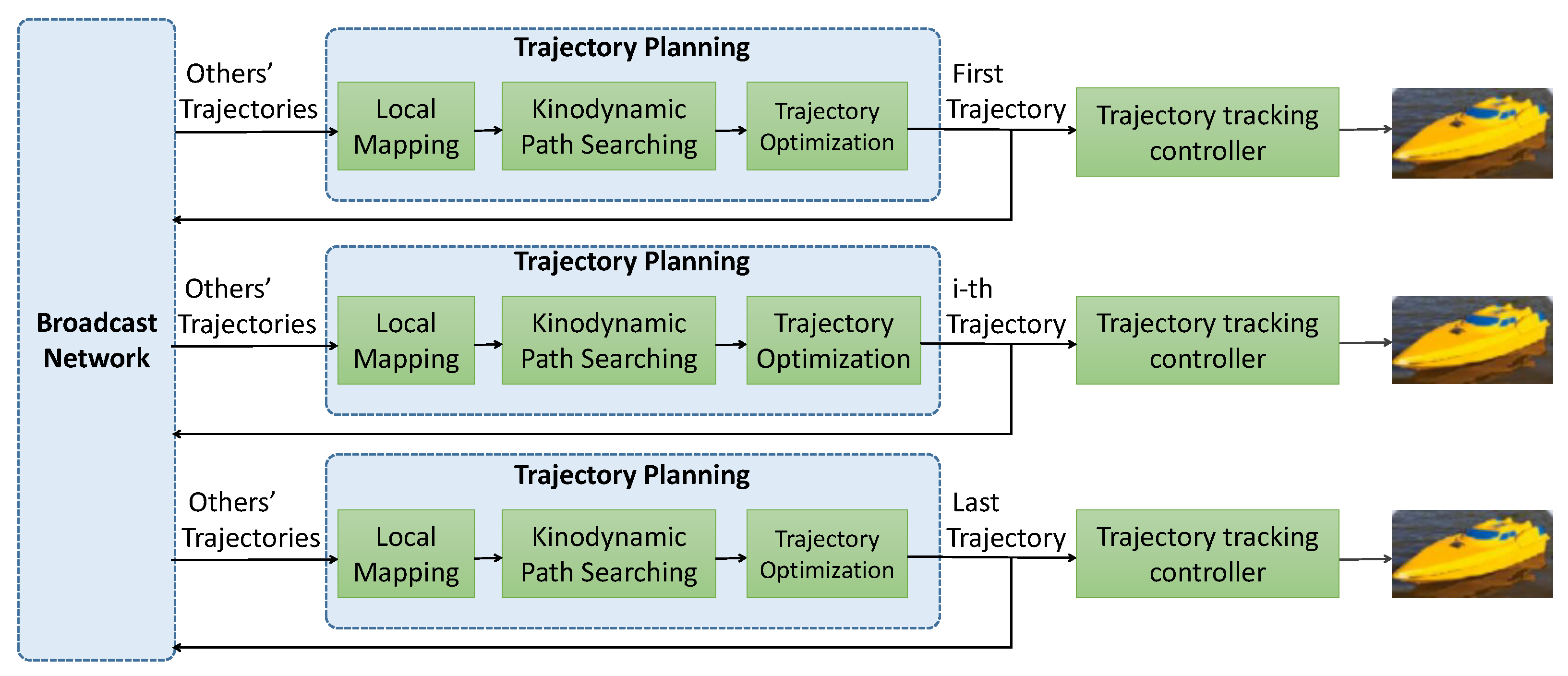
This section gives a general description of the proposed swarm trajectory-planning method, including the construction of occupancy grid maps, the kinodynamic path-searching method, the curve-fitting method based on cubic uniform B-spline, the construction of nonlinear optimization problems under multiple constraint conditions, and the numerical optimization algorithm for solving the formulated optimization problem. The proposed trajectory-planning framework for multiple ASVs is shown in
Figure 2.
3.1. Construction of Occupancy Grid Map
The sensing radius of the sensor is set to
and takes a circular area for point cloud acquisition. The position of the ASV is set to
. The point cloud position coordinates obtained by sampling the surrounding environment are set to
, and the quaternion of the ASV is set to
. In order to obtain the point cloud data within the desired range, the angle value corresponding to the maximum height of point cloud collection is set to
; then, the constraints for point cloud acquisition are given as
According to (
3), a dense point cloud map of the ASVs’ forward direction can be obtained. To represent the presence of obstacles, an occupied grid map is constructed by partitioning the point cloud into grids with each being one of two states: filled or empty. For a grid
in an occupancy grid map, the probability of the grid state being occupied is denoted as
and the probability of the grid state being free is denoted as
. The
t-th observation is set to
. To calculate the posterior probability of the grid state based on existing observations,
and
should be calculated. A grid is occupied if
with
being a preset threshold. The probability of the grid state being occupied can be specifically denoted as
and the
t-th observation is obtained as follows:
According to the Markov assumption that the results of the first
observations are independent of the result of the
t-th observation, one has that
Expanding (
4) based on the Bayes formula, it follows that
and
Define
as the
t-th update posterior probability for a grid
; then, one has that
Further simplifying the above equation using (
7),
can be described as
Substituting (
5) into (
10) yields
By assuming that the sensor model will not change during the environmental modeling process, the sensor model formulas
and
are constant. Then, according to (
9), one has that
where
a is the base of the
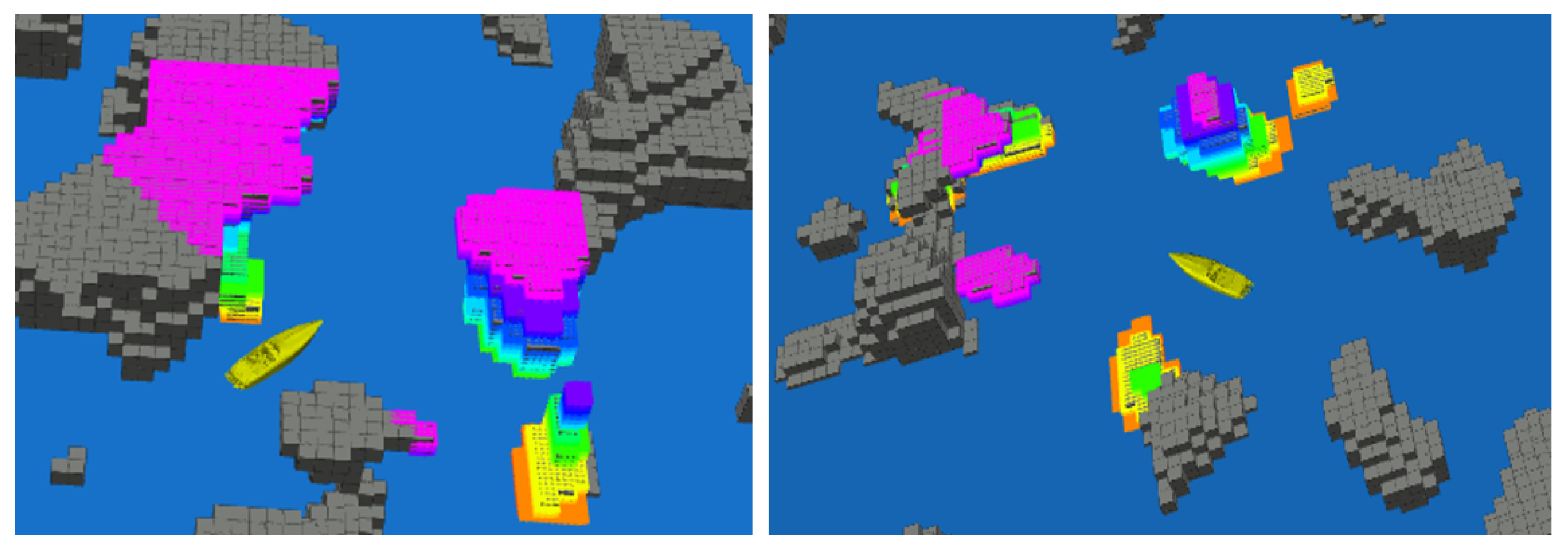
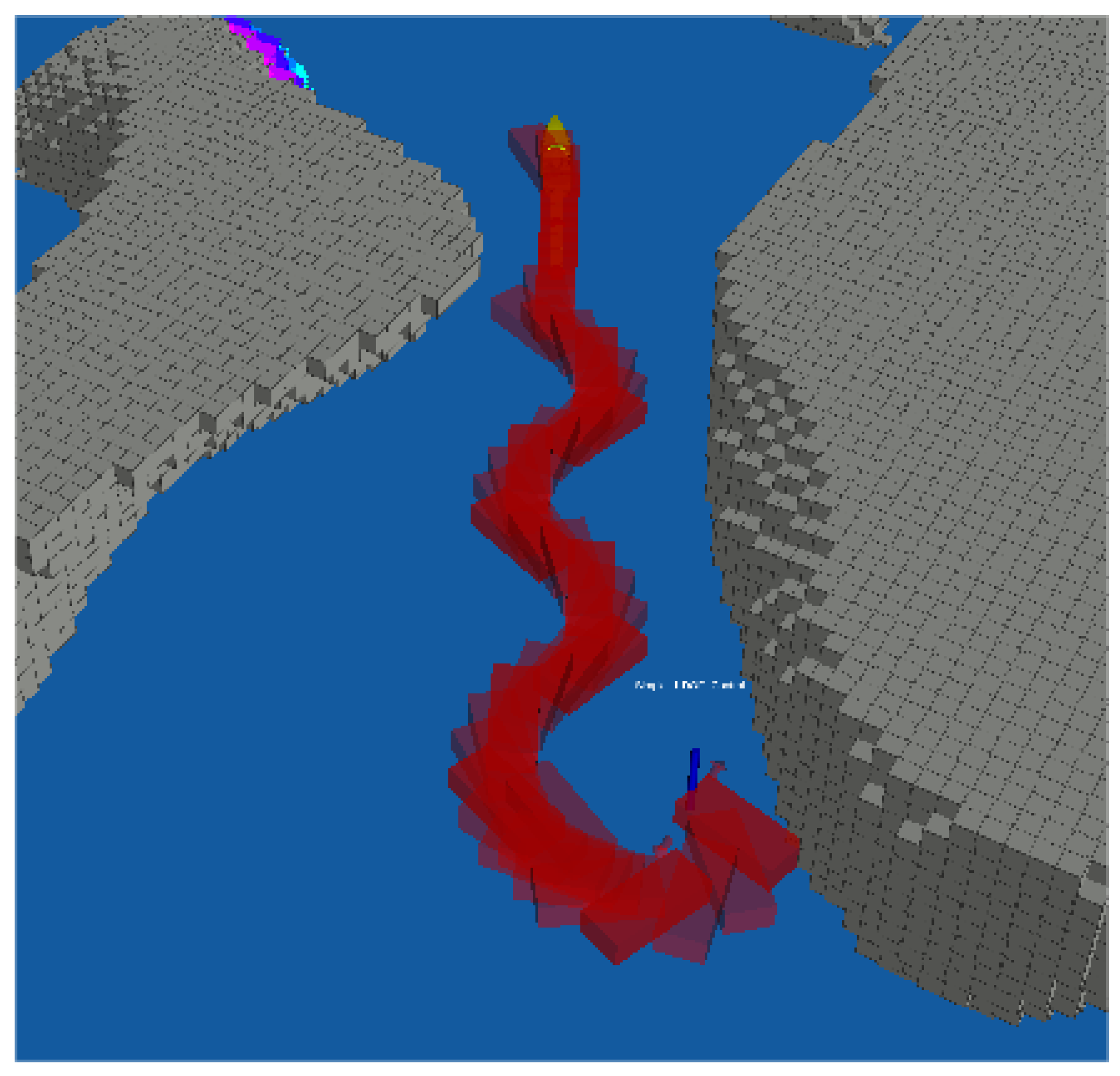
function. Based on the posterior probability, the occupied grid map can be updated. The occupied grid map constructed by ASVs during autonomous navigation is depicted in
Figure 3.
3.2. Kinodynamic Path Searching
Inspired by the hybrid A* search proposed for autonomous vehicles in [
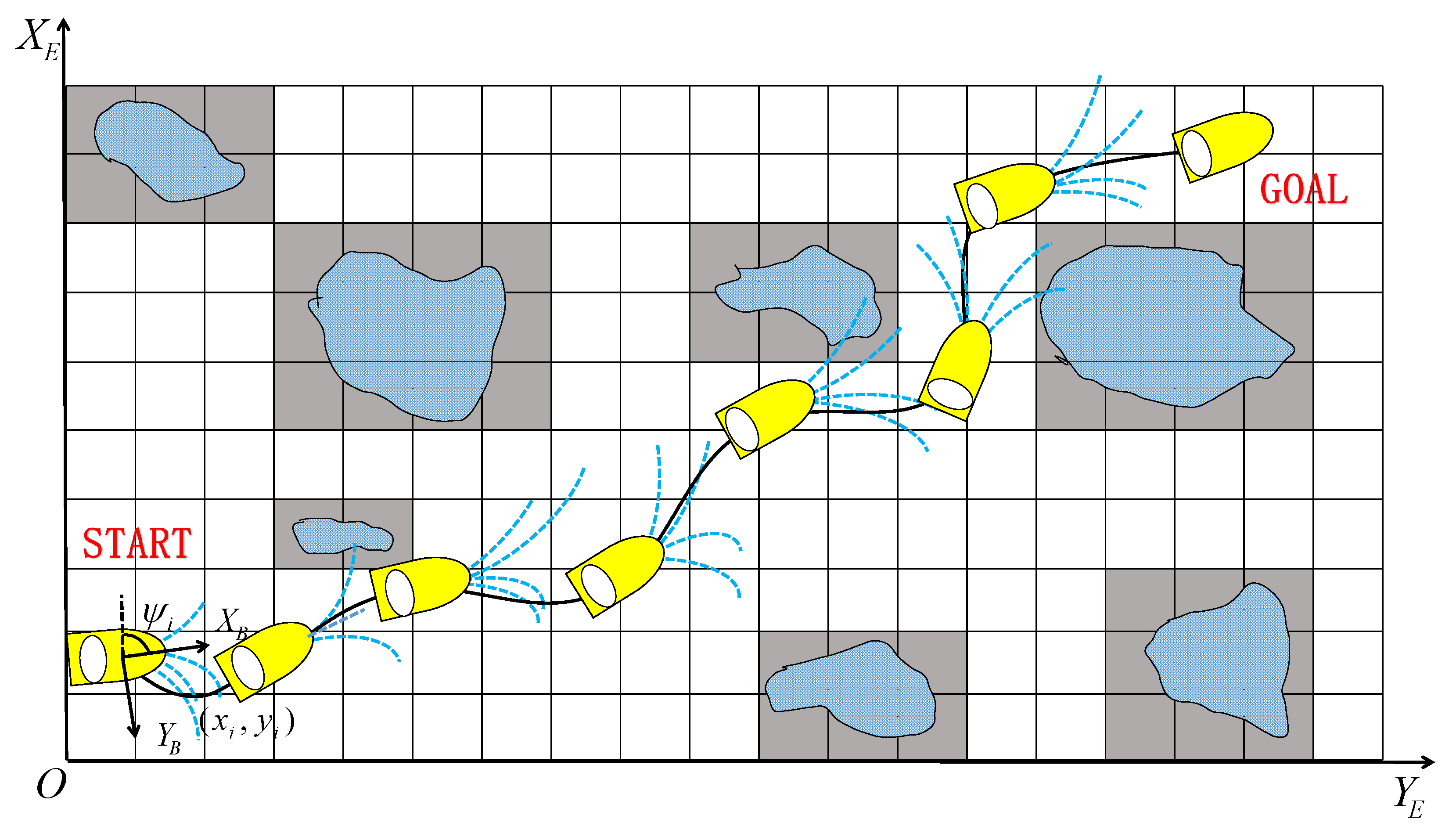
41], the kinodynamic path searching is applied for ASV to obtain a safe and reliable trajectory in an occupancy grid map while minimizing time cost. The mechanism of the kinodynamic path searching is illustrated in
Figure 4.
Similar to the standard A*, we use openlist and closelist to denote the open set and the closed set, respectively. A structure node is used to record the position of the expansion point as well as the
and
cost (
Section 3.2.2). The nodes expand iteratively, and the one with the smallest
is saved in openlist. Then, CheckCollision(·) checks the safety and dynamic feasibility of the nodes. The searching process ends once any node reaches its goal successfully or the AnalyticExpand(·) succeeds. Details of the kinodynamic path searching are shown in Algorithm 1.
| Algorithm 1 Kinodynamic Path Searching |
end if end while for each do if then if
then
if then
end if end if end if end for
|
3.2.1. Primitives Generation
The motion primitives are generated by using NodeExpand(·) in Algorithm 1. Accordingly, we firstly define the discretization sampling of
, and
,
,
,
with
as follows:
where
,
denotes a set of discretized yaw rates,
,
, denotes a set of durations, and
,
denotes the control input.
Let
be the node recording the current pose of the ASV, and let
be the pose of the ASV after sampling. Recalling the ASV kinematic model (
2) and applying the control variables
and
for duration
, the pose of the ASV can be calculated by
3.2.2. Heuristic Cost
In this subsection, a heuristic function is designed to speed up the searching in Algorithm 1 as used in A*. Heuristic cost refers to constructing a boundary optimal problem using the Pontryagin extremum principle, considering multiple target points generated by the A* path search method. Computing the cost values of all candidate target points, the one with the minimal cost is selected as the optimal target point. Then, based on the selected optimal target point, the A* algorithm is used to iteratively search toward the endpoint.
In order to find a trajectory that is optimal in time, the Pontryagins minimum principle is applied to design a heuristic cost function
as follows:
where
,
are the current and goal position, respectively, and
,
are the current and goal velocity, respectively.
In order to obtain the minimum heuristic cost, and are substituted into to obtain the solutions of . The solution which minimizes is denoted as , and represents the heuristic cost for the current node. Moreover, is used to represent the actual cost of the trajectory from the start position to the current state , and it is calculated as = . Thus, the final cost of the current state is obtained by .
3.2.3. Collision Check
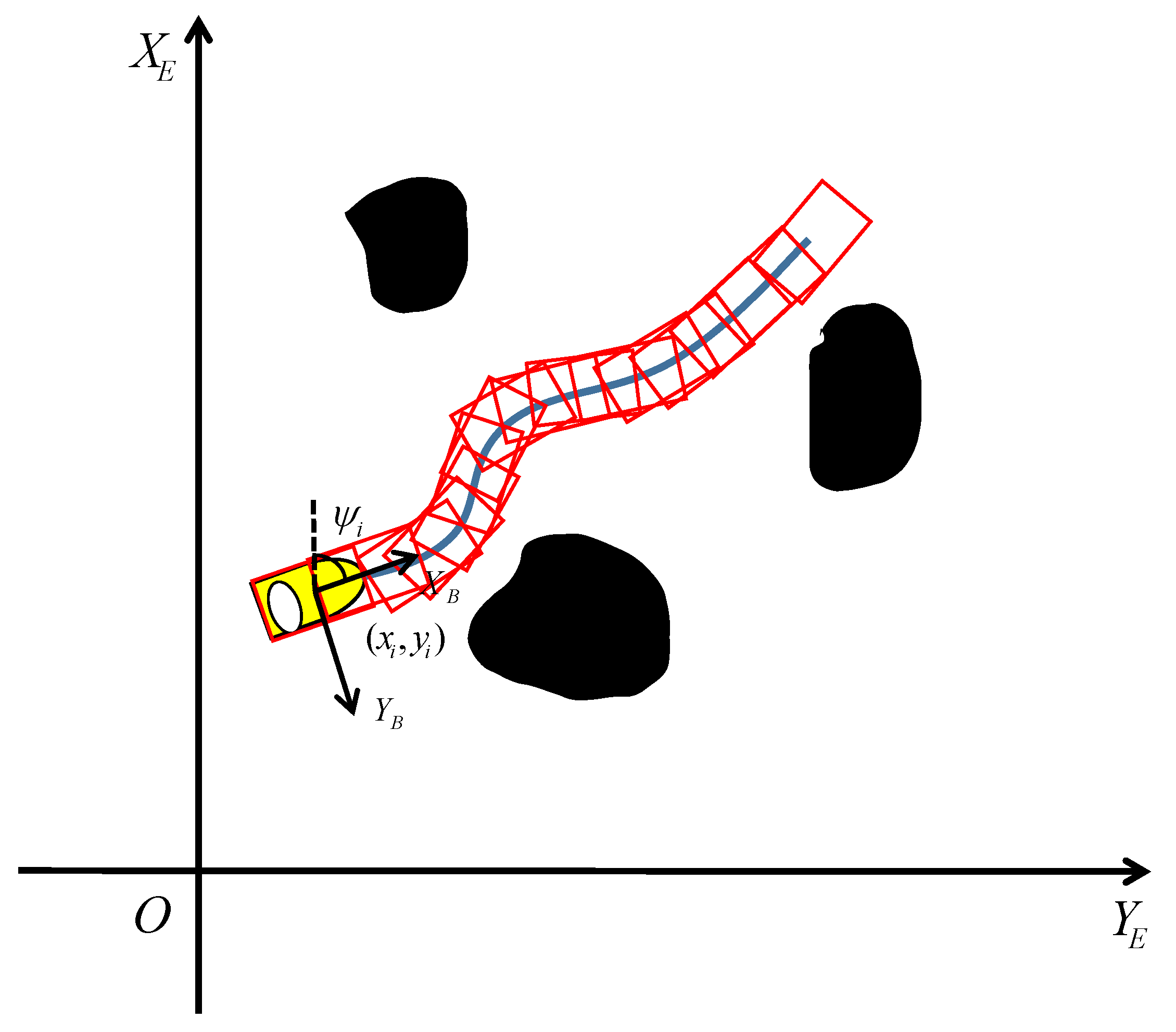
Collisions are checked based on the occupied grid map constructed by point clouds from local sensors. We assume that the entire ASV is included in a maximum rectangular box; then, a series of rectangular boxes is constructed sequentially on the trajectory points along the generated trajectory. All rectangular boxes are detected at a frequency of 20 Hz to determine whether they overlap with the surrounding point clouds or not. If there is overlap, it is determined that a collision has occurred, and multiple ASVs’ trajectories need to be replanned. Otherwise, it is determined that the trajectory is safe.
To be specific, approximating an ASV by a rectangle, a set of footprints
S representing the area occupied by the ASV is obtained by
and
along the footprints, as illustrated in
Figure 5. The union of footprints
S is called the swath along trajectory, which needs to be checked for collisions, as can be found in CheckCollision(·) in Algorithm 1. With the obtained swath, the occupancy grids of the swath are calculated to see if they overlap with obstacles on the occupancy grid map, as shown in
Figure 6.
3.2.4. Analytic Expansion
Generally speaking, it is difficult for discretized input to reach the endpoint accurately. To this end, an analytic expansion scheme AnalyticExpand(·) in Algorithm 1 is induced to speed up the trajectory searching. When the current node
is close to the endpoint
, the same approach used in
Section 3.2.2 is directly applied to compute a trajectory from
to
without generating primitives. If the trajectory can pass the safety and dynamic feasibility check, the path searching is terminated in advance. This strategy proves to be beneficial in enhancing efficiency, particularly in a sparse environment, as it greatly improves the success rate of the algorithm and terminates the searching earlier.
3.3. Trajectory Smoothing
Theoretically, the safety and dynamic feasibility of the path generated by kinodynamic path searching cannot be strictly guaranteed, as kinodynamic path searching ignores the distance information of obstacles and does not consider curve smoothness. Therefore, a B-spline curve is used in this section to fit the path curve.
3.3.1. Cubic Uniform B-spline
Let be the control points obtained from kinodynamic path searching and be the knot vector with , and . A B-spline is a piecewise polynomial determined by its degree p and control points q and . A cubic B-spline trajectory, used to fit the above control points, is parameterized by . For a uniform cubic B-spline trajectory, it is noted that each knot span satisfies .
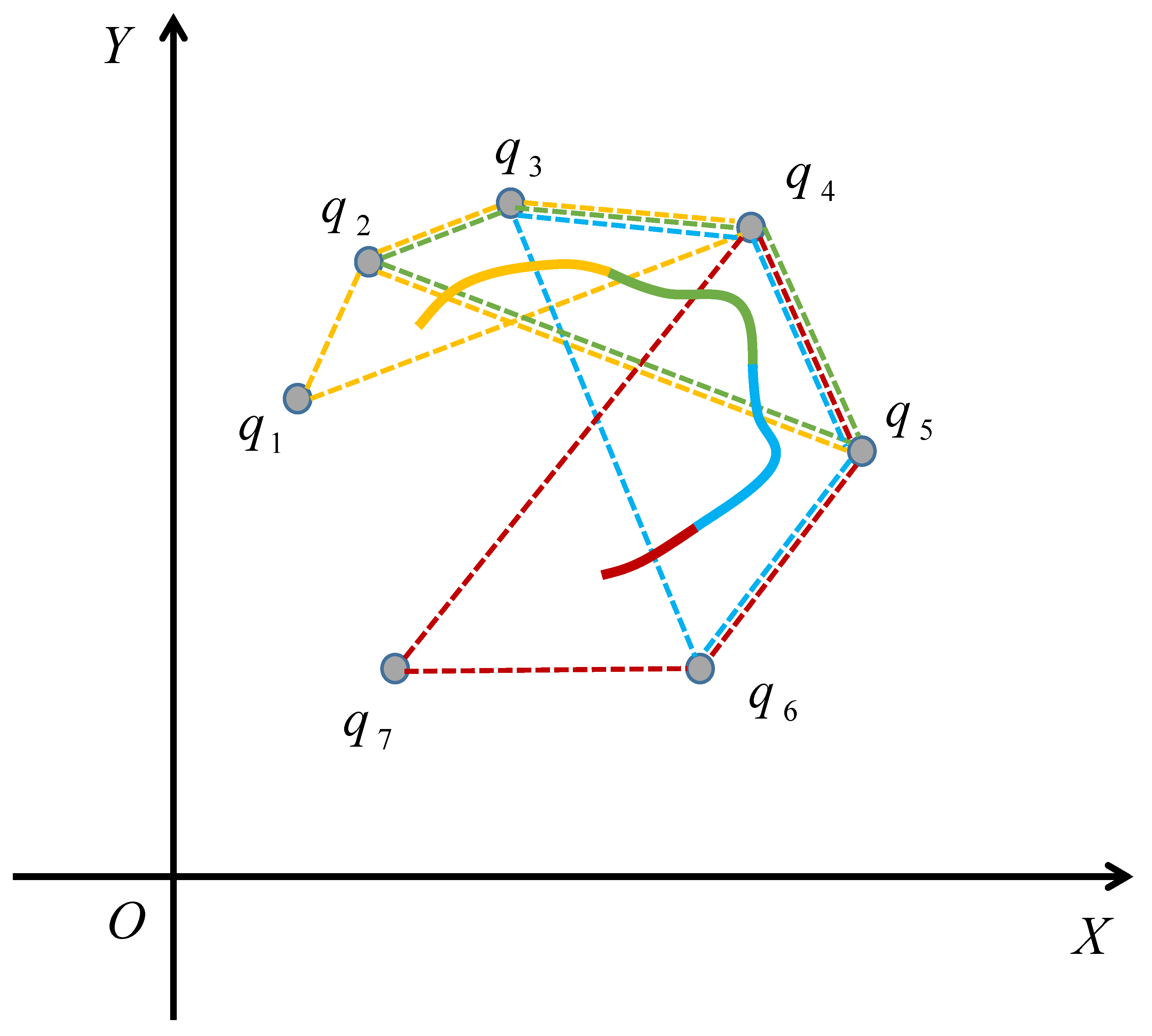
The convex hull property of B-spline curves is illustrated in
Figure 7. For
,
, the four control points of a cubic uniform B-spline trajectory set within the knot vector
are
, where
. To construct B-spline curves, the B-spline basis function firstly needs to be calculated, of which the degree is set to
p. Denoting the
k-th B-spline basis function of degree
p as
, the 0-order and the
-order basis function are given as follows:
For ease of implementation, p is set to . Correspondingly, the four basis functions are set to , and .
Defining a normalized variable
, and substituting
into (
16), one has that
Therefore, the following matrix can be calculated to represent the coefficients of cubic uniform B-spline trajectories:
3.3.2. Convex Hull Property
In order to ensure the dynamic feasibility, it is necessary to construct a nonlinear constrained optimization problem for the first-order and second-order derivatives of B-spline trajectory. For this purpose, it is necessary to prove that the derivative of a B-spline is also a B-spline. With control points
and basis functions
defined above, a
p-degree B-Spline
can be obtained as follows:
with its first-order and second-order derivatives being
Moreover, the first derivative of the basis function is given as follows:
Substituting (
21) into (
20) yields
Thus, the control points of the B-spline
’s first derivative
can be computed by
Since the B-spline trajectory used in
Section 3.3.1 is uniform, Equation (
23) is further simplified as follows:
Similarly, the second-order and third-order derivatives of the B-spline trajectory can be further derived as follows:
3.4. Nonlinear Optimization
For the B-spline trajectory defined by a set of control points
in
Section 3.3, a nonlinear optimization method is constructed in this subsection to further ensure the safety of the curve. The overall optimization function is defined as follows:
where
and
are optimization terms for trajectory smoothness and collision distance, respectively.
and
are constrained optimization terms of velocity and acceleration, respectively.
and
are optimization terms for the collision distance between ASVs and endpoint arrival, respectively.
and
are the designed weight coefficients.
3.4.1. Smoothness Penalty
The smoothness cost
is defined by a function that uses the integral of the squared jerk. According to (
25), the jerk (i.e., the 3rd-order derivative of the position) of the trajectory is minimized to obtain a smooth trajectory.
is defined as follows:
3.4.2. Collision Distance Penalty
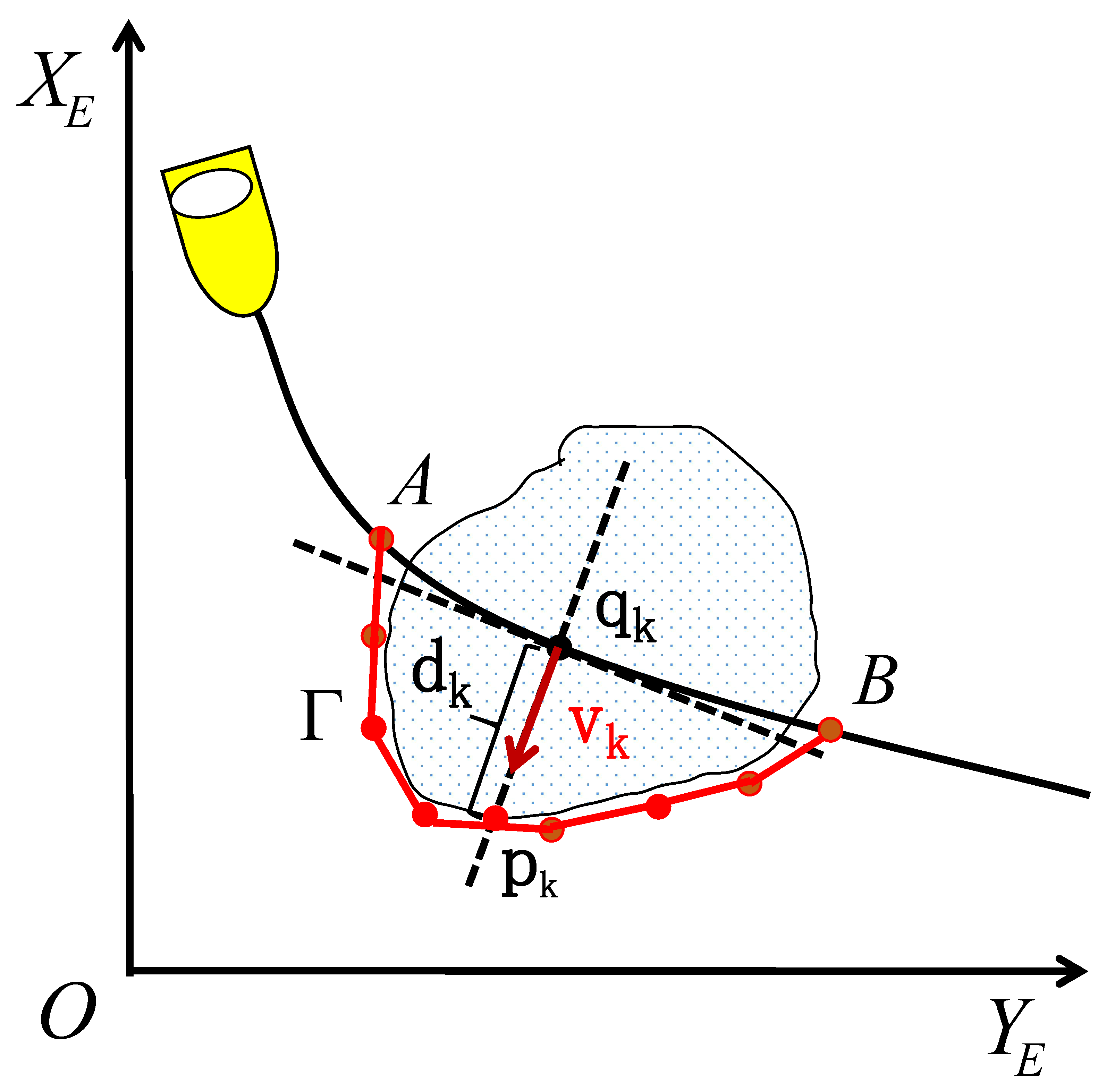
Initially, a naive B-spline trajectory is given regardless of whether the control points collide with an obstacle or not, as depicted by the black solid line passing though the obstacle in
Figure 8. Therefore, the naive trajectory needs to be optimized by the A* algorithm to obtain a collision-free trajectory
.
Specifically, for control points
on the colliding segment, points on the obstacle boundary denoted by
are assigned with corresponding repulsive direction vectors
. The distance between
and
is denoted by
, as shown in
Figure 8. In order to avoid generating
repeatedly, the B-spline trajectory can only be optimized when
. By ensuring that
is less than the safe distance
, the control points can be kept away from the obstacles. In order to optimize the collision distance of the B-spline trajectory, a twice continuously differentiable function
is applied as follows:
The collision penalty function is denoted as
and its derivative can be obtained as follows:
3.4.3. Dynamic Feasibility Penalty
The dynamic feasibility can be ensured by constraining the high-order derivatives of B-spline trajectories at discrete control points
. Specifically, due to the convex hull property, constraining derivatives of the control points is sufficient for constraining the whole B-spline. Therefore, the constrained optimization terms of velocity and acceleration are given, respectively, as follows:
where
, and
are design parameters to ensure the second-order continuous differentiability of
and
.
and
are the derivative limits, respectively.
and
are the splitting points of quadratic and cubic curves, respectively. According to (
24) and (
25), the first-order derivatives corresponding to
and
are given, respectively, as follows:
3.4.4. Swarm Distance Penalty
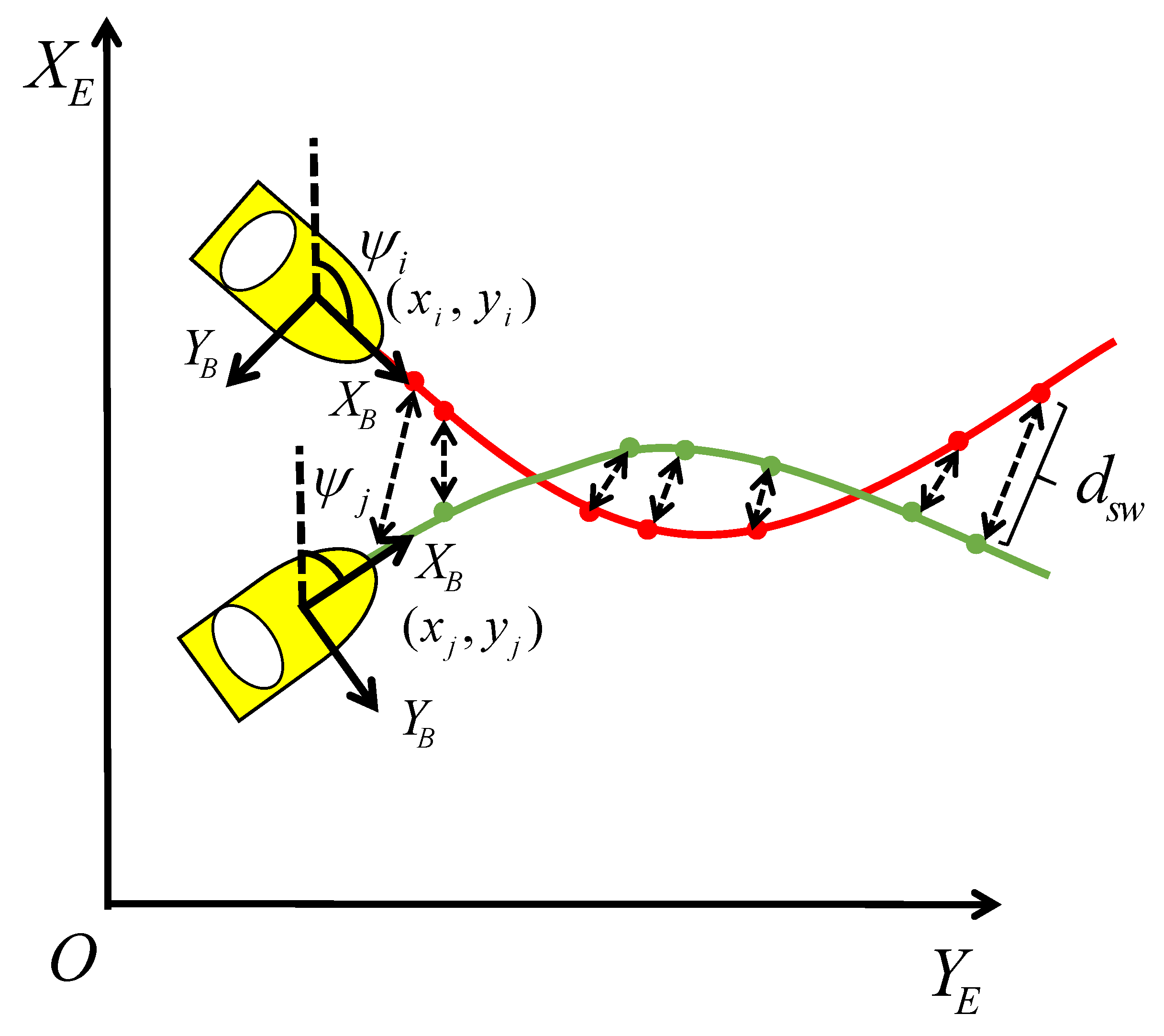
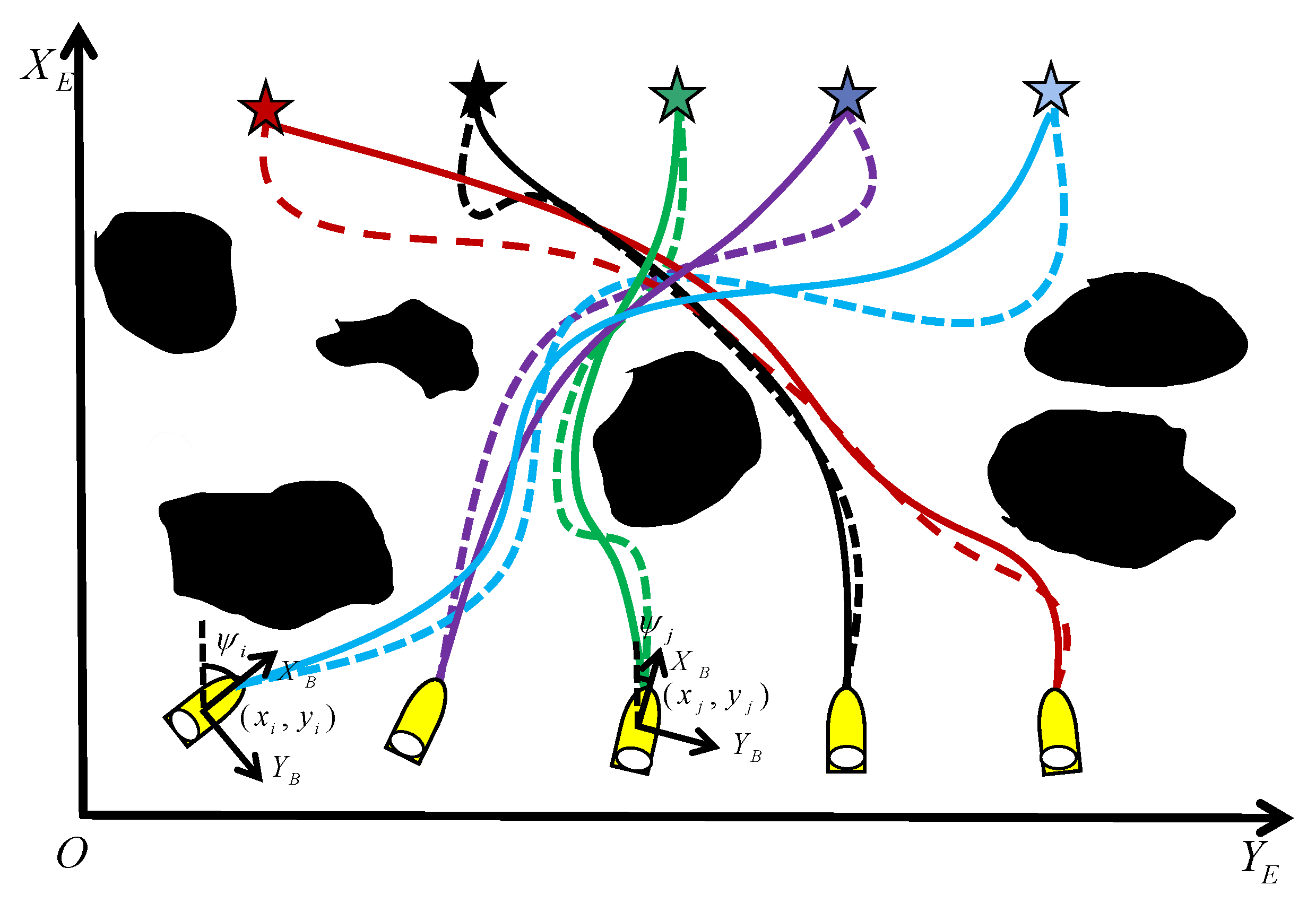
An illustration of swarm distance penalty is depicted in
Figure 9. Similar to the collision distance penalty and dynamic feasibility penalty, the swarm distance penalty function is formulated as follows:
where
and
represent the actual distance between swarm trajectories and the preset safety distance, respectively;
and
represent the control point of the
i-th and
j-th trajectories at time
k, respectively. The derivative of the swarm distance penalty function can be obtained as follows:
3.4.5. Endpoint Arrival Penalty
To ensure that each ASV can reach the endpoint, the last three control points of the B-spline trajectory are set to
, and
, respectively. Let
be the penalty function for reaching the endpoint; then, one has that
where
represents the endpoint. The first derivative of
is obtained as
3.5. Numerical Optimization
The nonlinear optimization problem has the following two characteristics. Firstly, the total penalty function
will be updated in real time based on changes in the environment. Secondly, the quadratic optimization term about dynamic feasibility and obstacle avoidance distance will make
closer to the quadratic form, which means that the utilization of Hessian information can significantly improve the speed of solution. However, in the process of trajectory planning for ASVs, solving the inverse Hessian information is prohibitive in real time. Therefore, the limited memory BFGS (L-BFGS) method is adopted to achieve accurate values through a series of iterations. The details of the optimization process are summarized in Algorithm 2.
| Algorithm 2 Numerical Optimization |
, , , end while
|
For an unconstrained optimization problem
, the iterative updating method for
x is similar to Newton’s method. Specifically, the update of
x is given as follows:
where
is updated at every iteration of the LBFGS method as summarized in Algorithm 3,
represents the gradient at
, and
t is the step length obtained through the Lewis–Overton line search method, as summarized in Algorithm 4.
| Algorithm 3 The L-BFGS algorithm |
do end for for
do
end for
|
| Algorithm 4 Lewis–Overton line search |
, , if then else if
then else end if if
then else end if
|
It is noted that
and
in Algorithm 4 represent strong Wolfe conditions and weak Wolfe conditions, respectively, which are given as follows:
where
.
3.6. Broadcast Network
Once an ASV generates a new trajectory in the complex environment, it will publish the trajectory to other ASVs through a broadcast network. Other ASVs will save the trajectory and generate their own safety trajectory when necessary based on the saved trajectory. Meanwhile, each ASV checks the collision condition when the neighbor’s trajectory is received from the network. If the received trajectory collides with the trajectories of other ASVs, this strategy can solve the problem. In addition, considering the increasing number of ASVs, each ASV should compare its current position with the trajectories received from neighboring ASVs before conducting trajectory planning.
Remark 1. The current algorithm proposed in the article aims at obstacle avoidance and collision avoidance of multiple ASVs in complex static obstacle environments. When dynamic obstacles exist and enter the perception range of the ASV, it will stop and continuously replan until a passable path appears. Therefore, it would still be feasible for online application while meeting unknown moving obstacles. Nevertheless, in the case of unknown moving obstacles, it is necessary for the ASV to have strong braking ability when sailing at a fast speed. In our future work, for the case of unknown moving obstacles, we will try to add dynamic point cloud filtering to complete the reconstruction of the surrounding obstacle environment. Moreover, point cloud recognition and/or clustering algorithms will be added to determine the position and speed of unknown dynamic obstacles. With relevant constraint conditions constructed, the safety of autonomous navigation for multiple ASVs can be guaranteed.
4. Simulation Results
In this section, simulations are provided to illustrate the performance of the proposed distributed trajectory-planning method for multiple ASVs in an unknown environment with lots of static obstacles. Two cases are considered as follows:
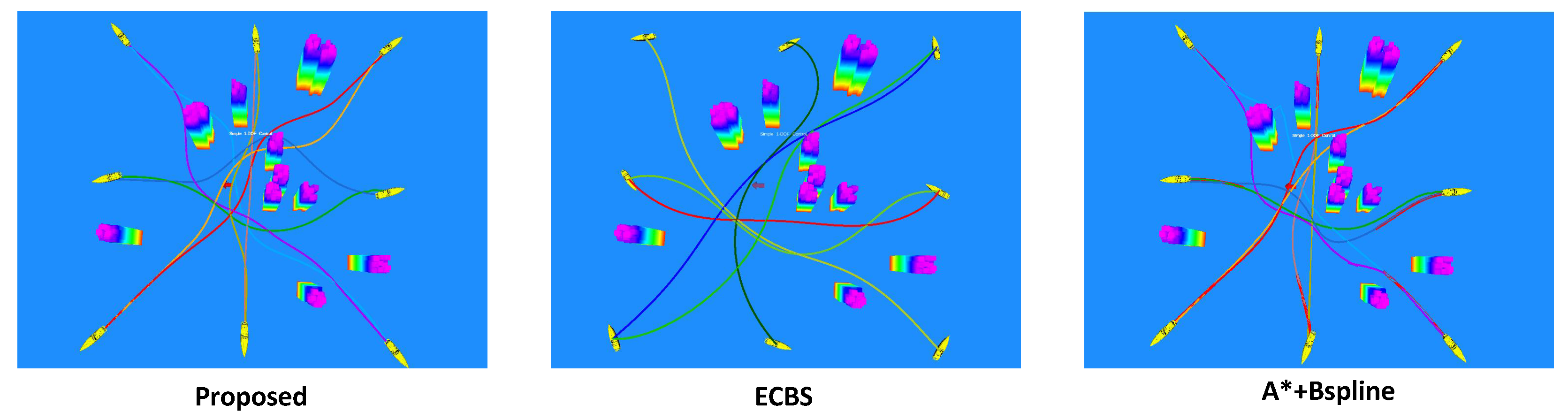
Case 1: Swarm trajectory planning for four ASVs. In the simulation, swarm trajectories were planned for four ASVs by various planners in the same scenario. In particular, the proposed method is compared with the enhanced conflict-based search (ECBS) method and the A* + B spline method in terms of sail distance (), sail time (), and collision times per ASV.
Figure 10 shows trajectories planned by various planners in the same scenario with the same initial and final positions. It is observed from
Table 1 and
Figure 10 that all planners can generate collision-free trajectories, while the proposed one needs shorter sail distance and sail time compared to the other two planners. In particular, compared with the A* + B spline method, the proposed method solves the multi-objective optimization problem and achieves optimization subject to obstacle avoidance distance, curve smoothness, and collision avoidance distance between ASVs, allowing multiple ASVs to reach the specified target points in a shorter time and with lower energy loss. Meanwhile, compared with the ECBS method using global planning, the proposed one utilizes multiple local optimal trajectories to form a global trajectory, which better meets the requirements of real-time obstacle avoidance and generates shorter sail distance for short-range navigation. However, local planning using our method and the A* + B spline method generates a global path using multi-segment local trajectories, which is prone to getting stuck in local optima. This is also what we want to solve in the future.
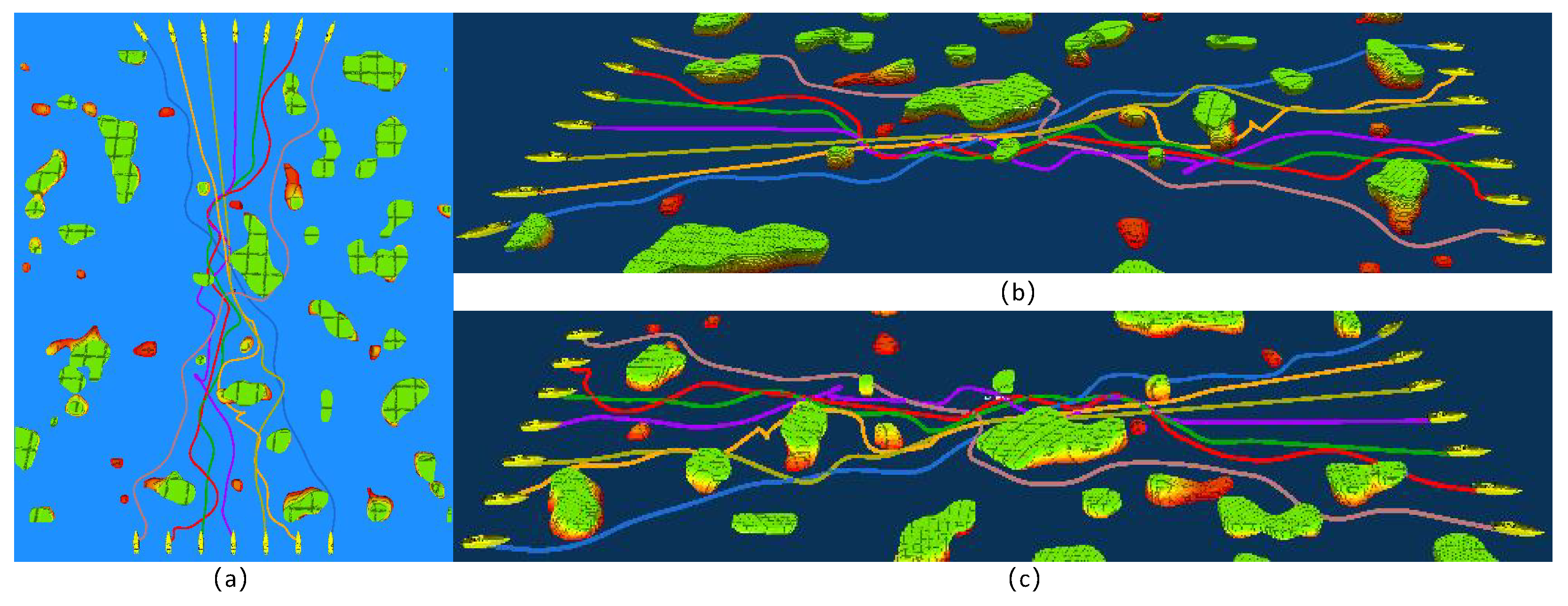
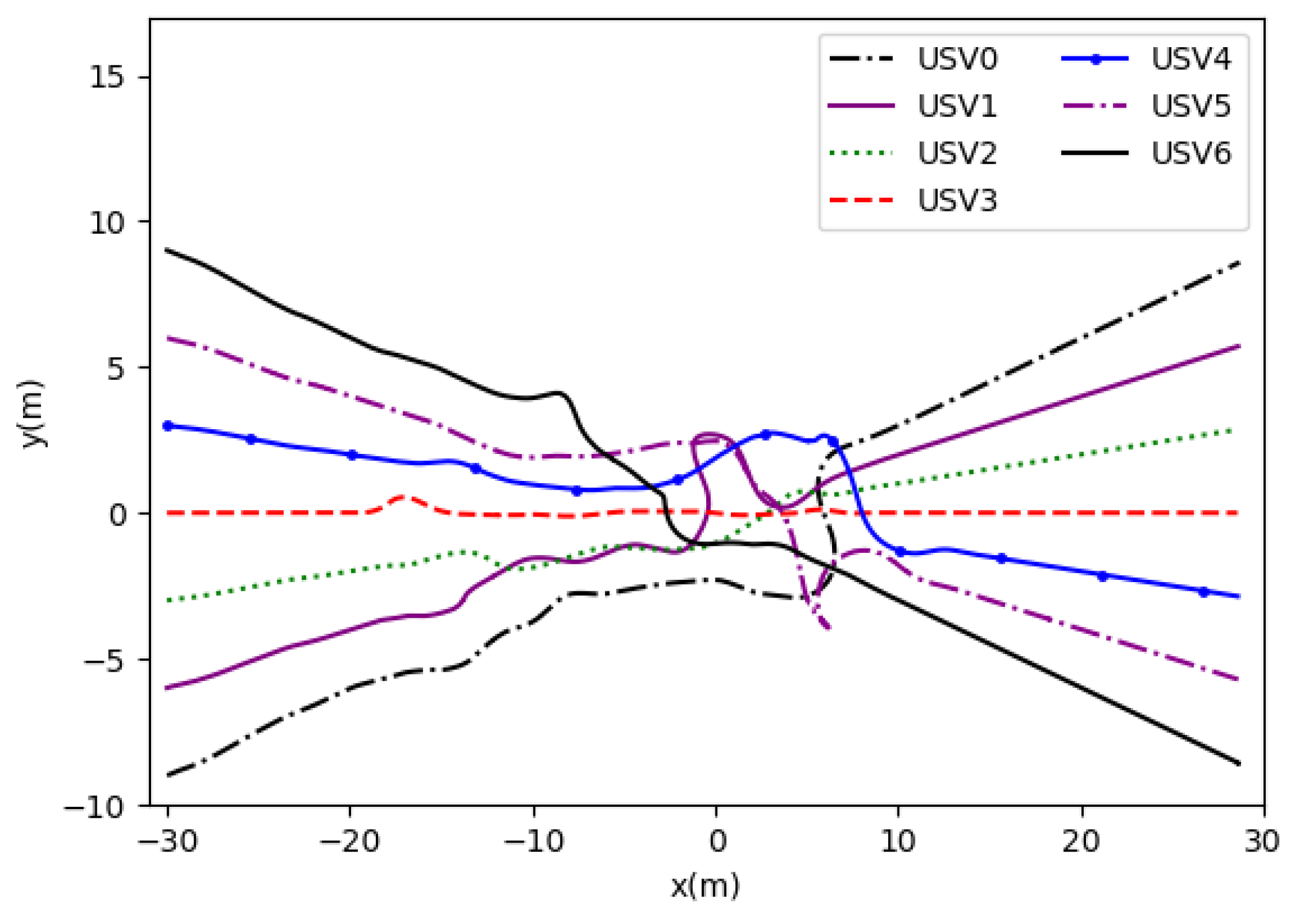
Case 2: Swarm trajectory planning for seven ASVs. In this case, we conducted simulations on seven ASVs with a random map generated by the Berlin algorithm, where the generated trajectories are shown in
Figure 11. The generated trajectories of seven ASVs in the xy-plane are shown in
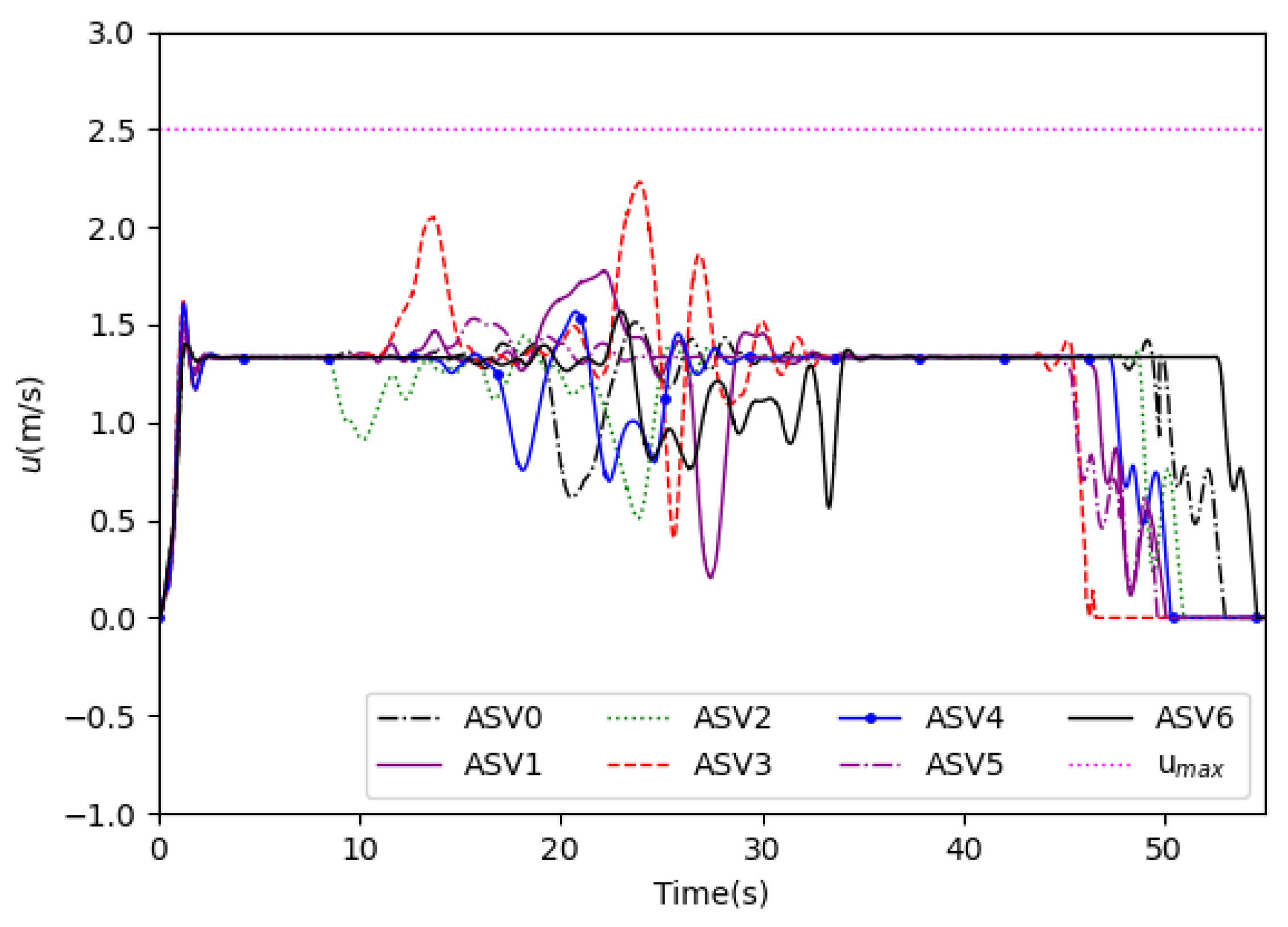
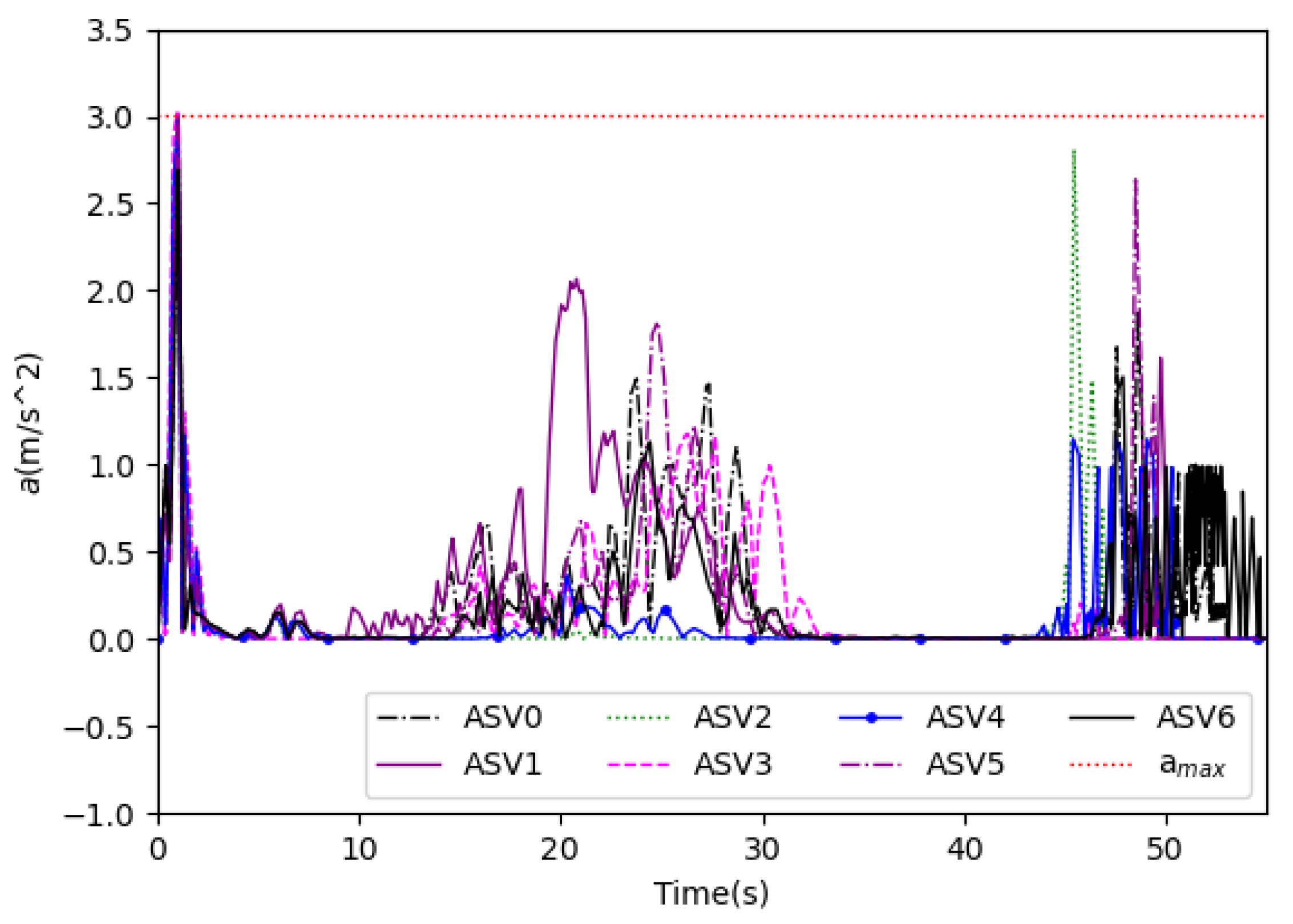
Figure 12. The evolution of the velocity and acceleration of the ASVs are shown in
Figure 13 and
Figure 14, respectively. Due to the existence of speed and acceleration optimization terms, the navigation speed and acceleration of ASVs do not exceed 2.5 m/s and 3 m/s
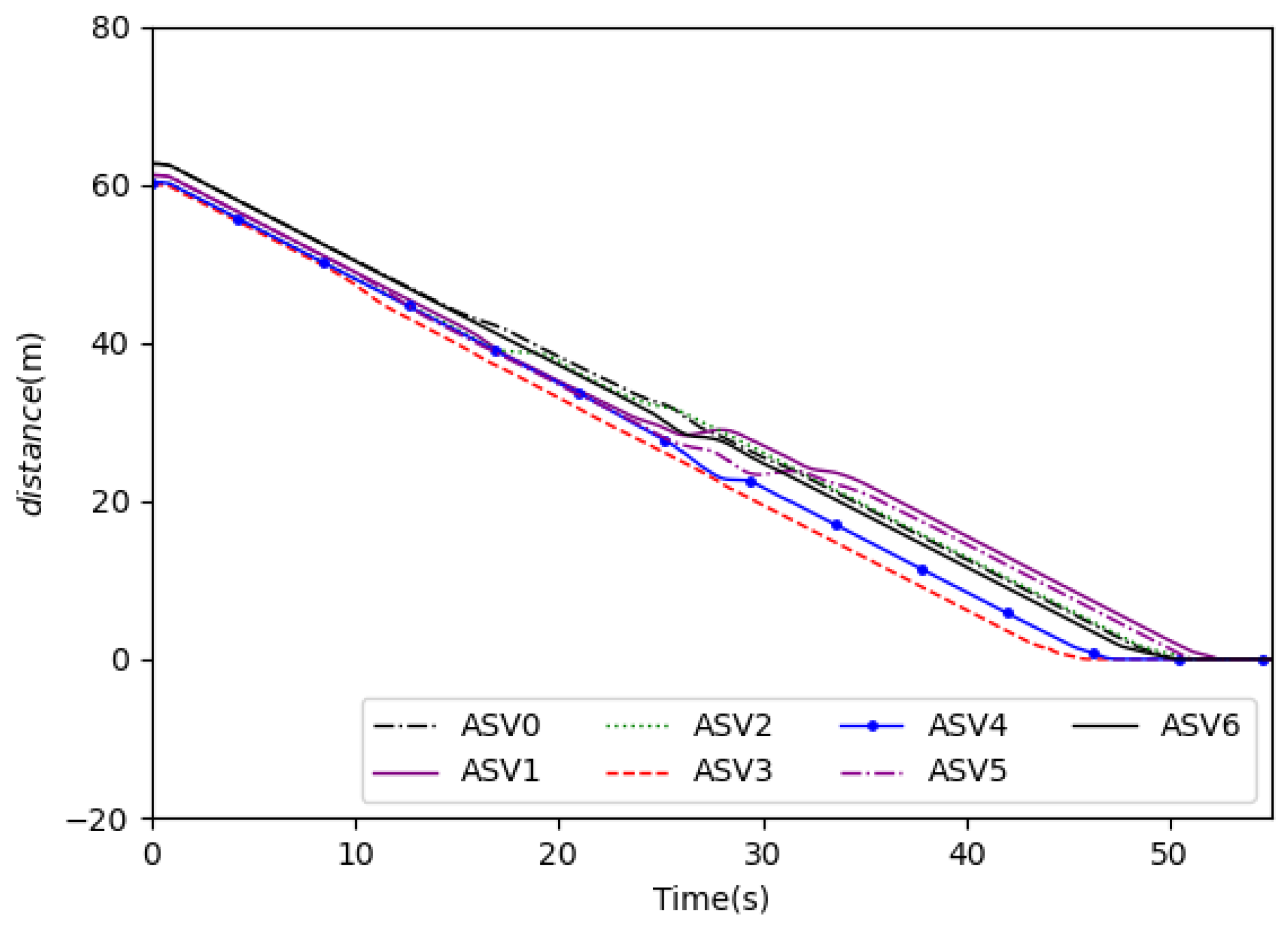
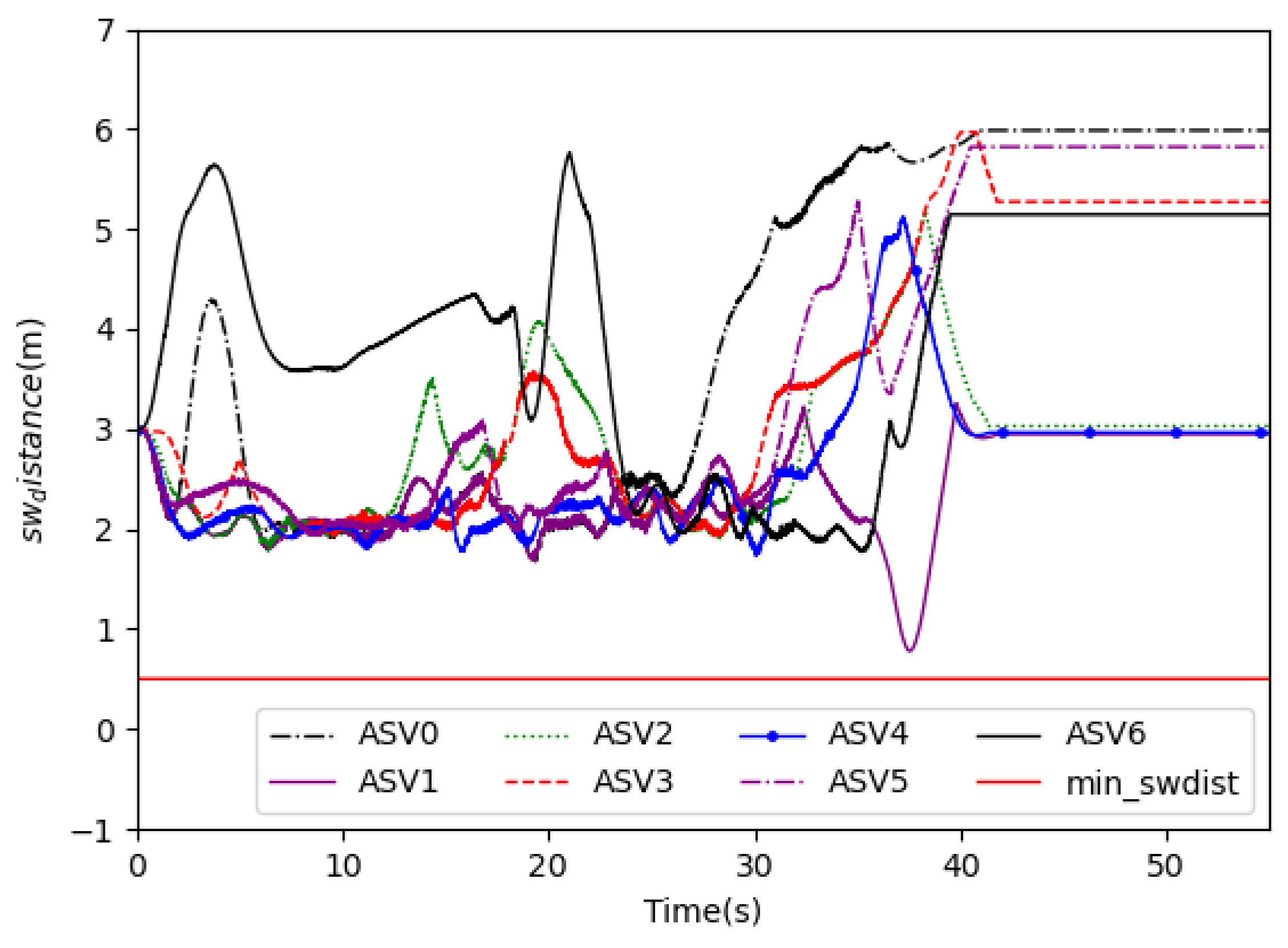
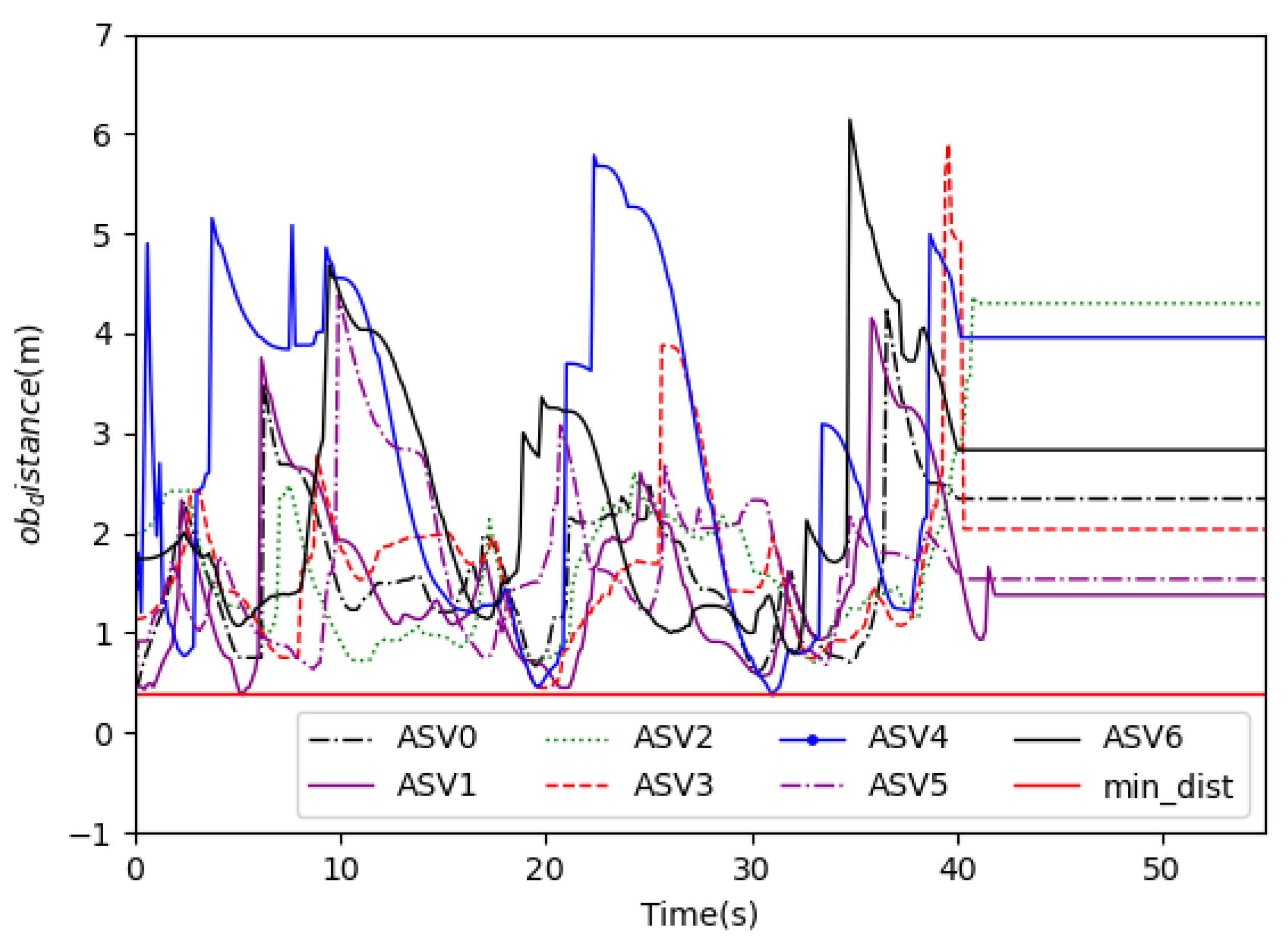
2, respectively. The distances of each ASV to the goals, the distances of each ASV to the closest ASV, and the distances of each ASV to the closest obstacle are shown in
Figure 15,
Figure 16 and
Figure 17, respectively. It is noted that the safety threshold of distance bewteen each ASV and the closest ASV is set to
m, and the safety threshold of distance between each ASV and the closest obstacle is set to
m. At the same time, due to the existence of boundary constraints, ASVs can reduce their speed and acceleration to 0 when they reach the goals. Moreover, when the target arrival constraint exists, the ASVs can reach the goals accurately.
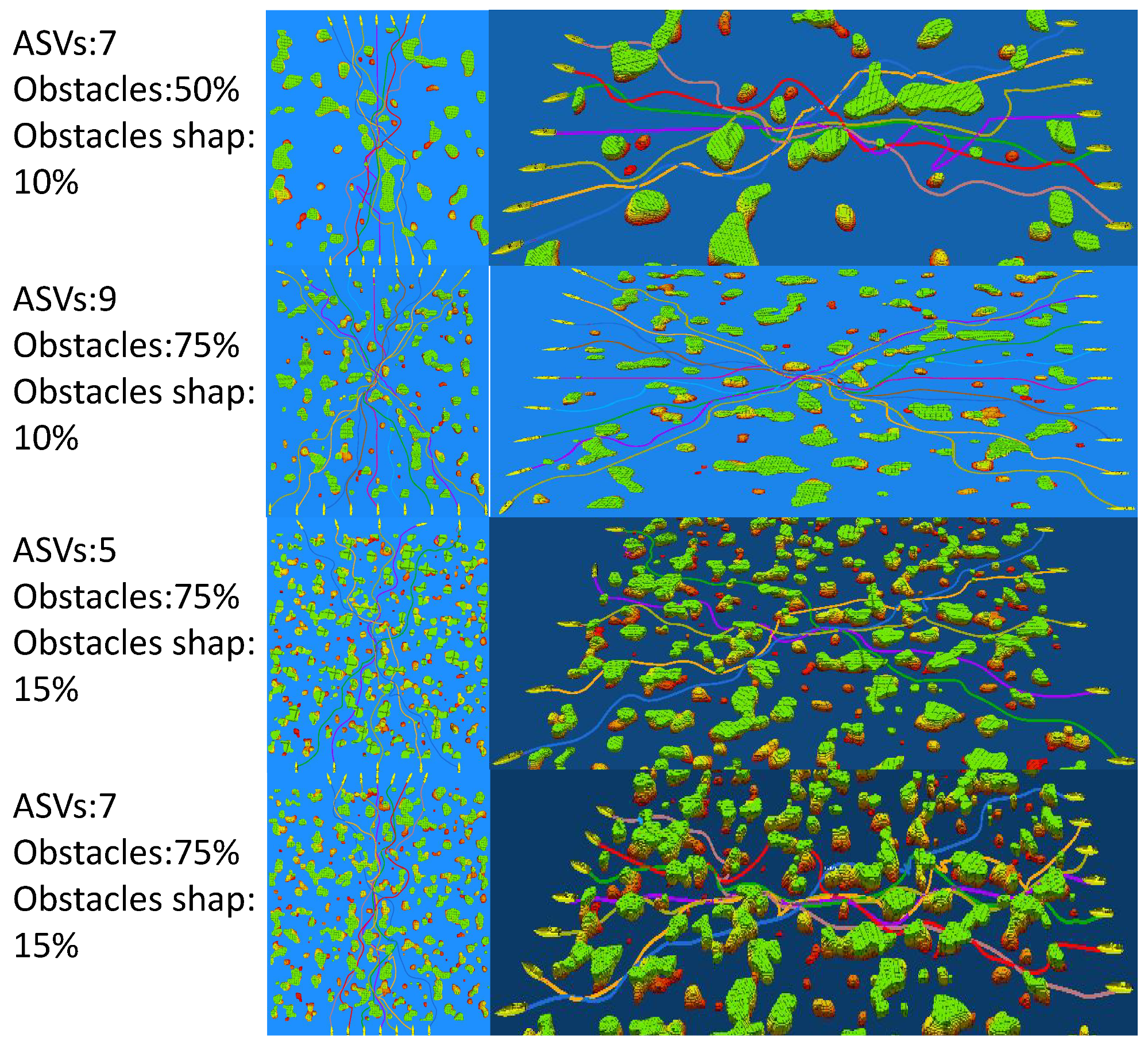
To further verify the effectiveness of the proposed method, we conducted multiple simulations based on different numbers of ASVs under different obstacle coverage ranges and different initial conditions. Setting the obstacle coverage rate to 50% and 75%, setting obstacle shape roughness to 10% and 15%, and setting the number of ASVs to 5, 7, and 9, respectively, different simulations were conducted, as shown in
Figure 18. As a result, one can see that the proposed method performs well under different obstacle coverage ranges and different initial conditions.