
Full-Wave Optical Modeling of Leaf Internal Light Scattering for Early-Stage Fungal Disease Detection

Abstract
1. Introduction
1.1. General Introduction
1.2. Previous Approaches for Modeling Light Scattering Within Leaves
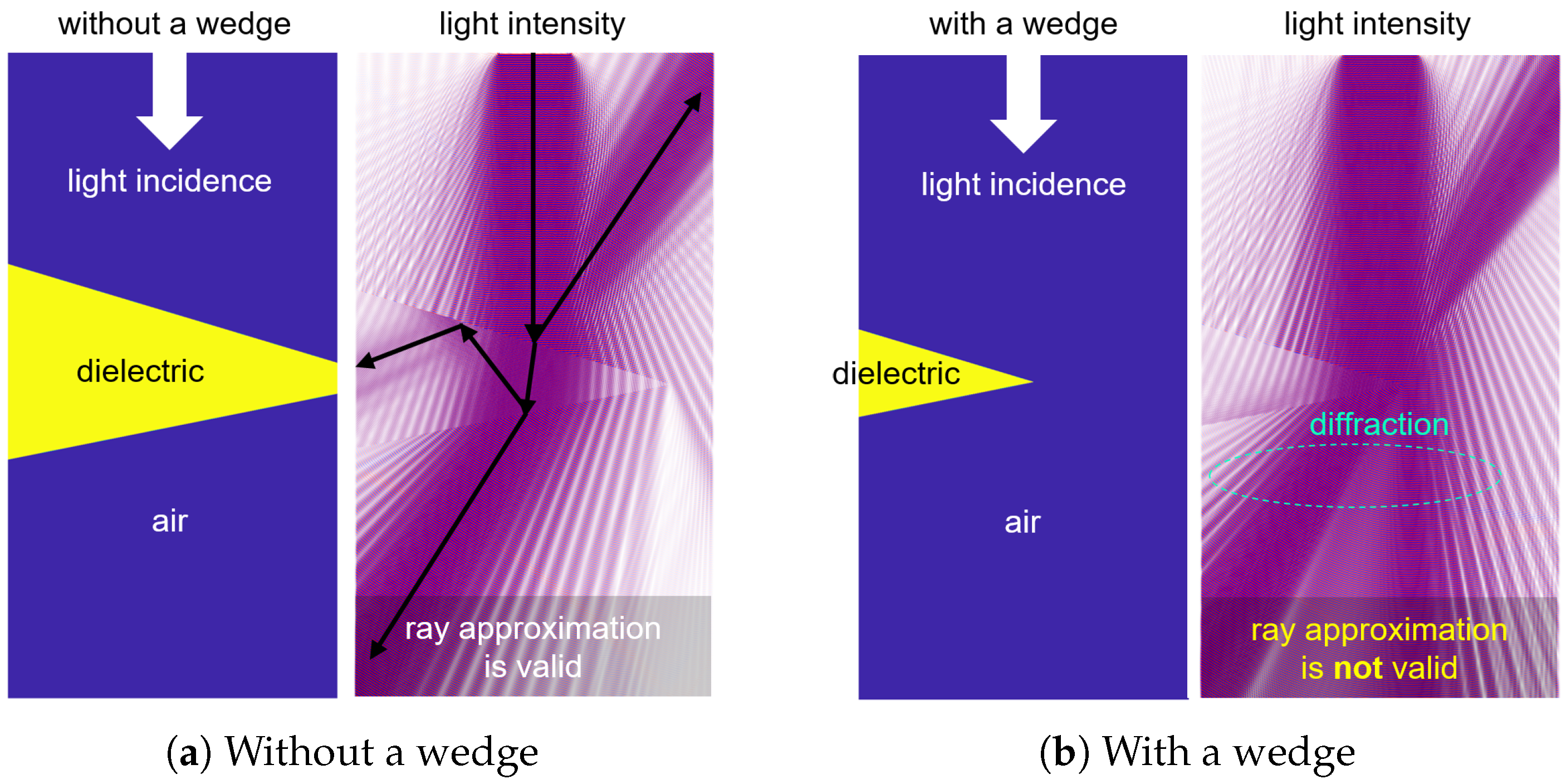
1.3. Fundamental Limitations of Existing Models and the Necessity of Full-Wave Modeling
1.4. Contributions of This Work
2. Materials and Methods
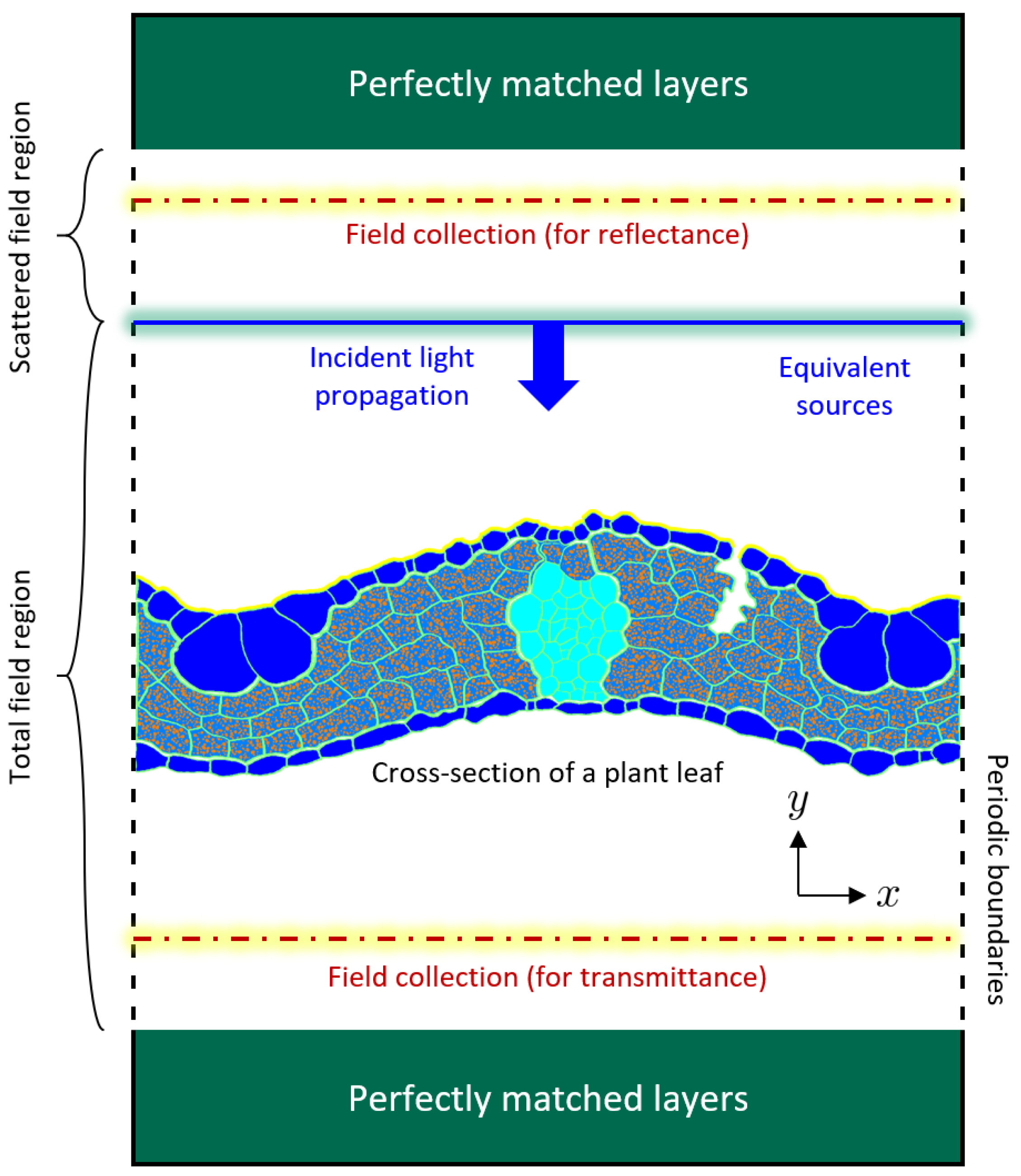
2.1. Problem Description
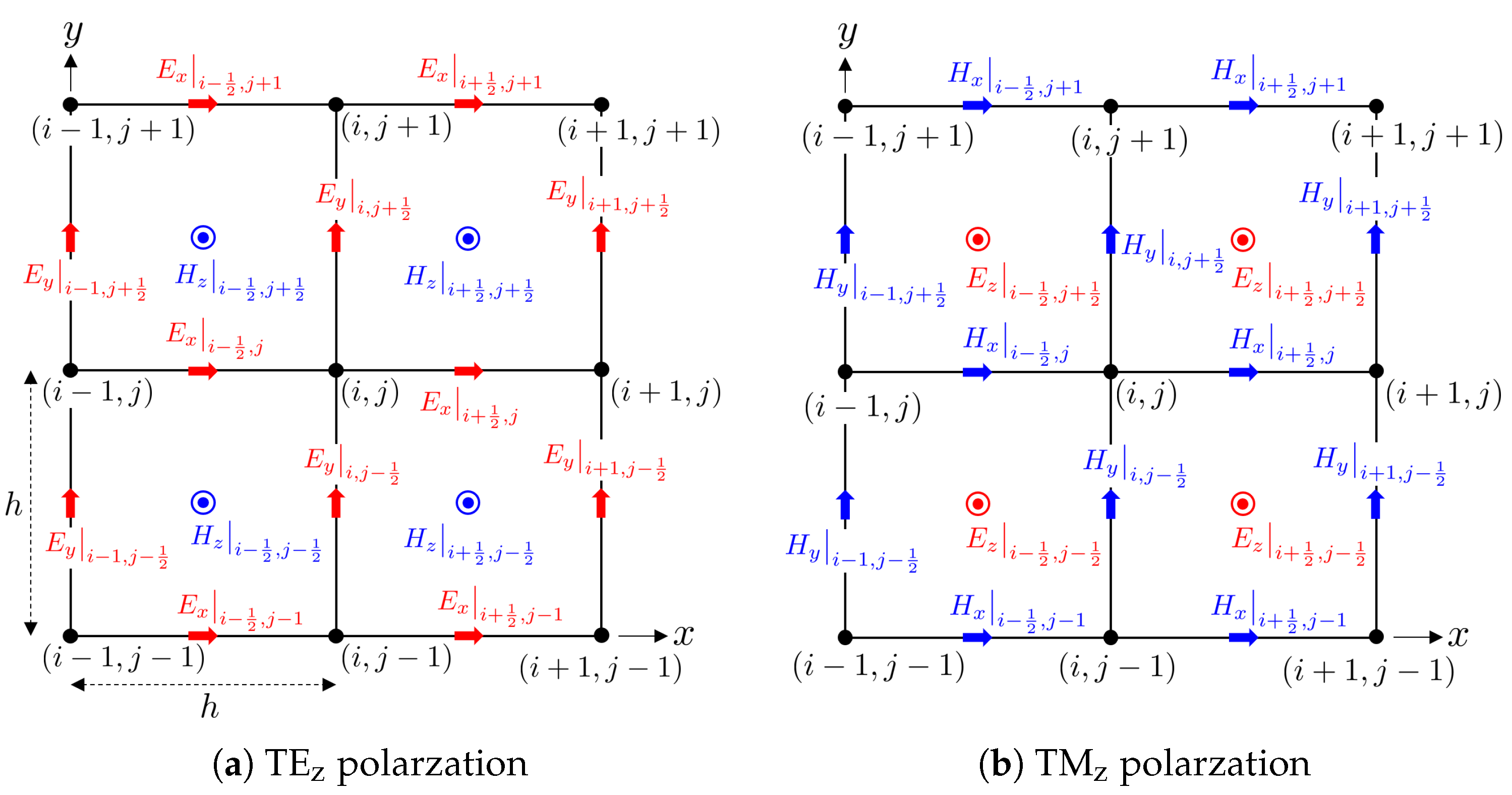
2.2. Maxwell’s Curl Equations for S- and P-Polarized Illumination
2.3. Two-Dimensional Finite-Difference Time-Domain Scheme

2.4. Boundary Conditions of Electromagnetic Fields
2.5. Excitation of Incident Plane Wave at Normal Incidence
2.6. Reflectance and Transmittance Calculation
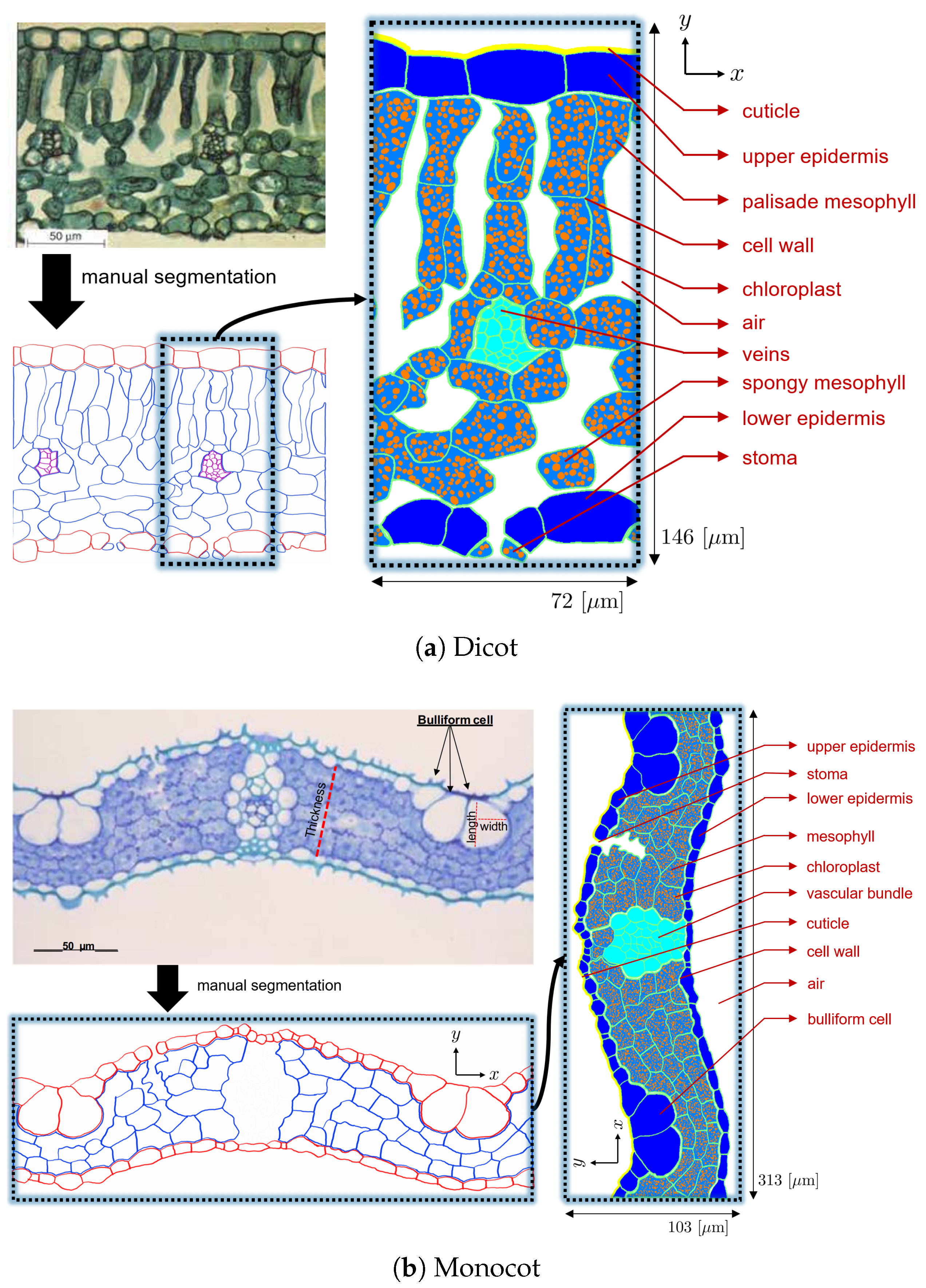
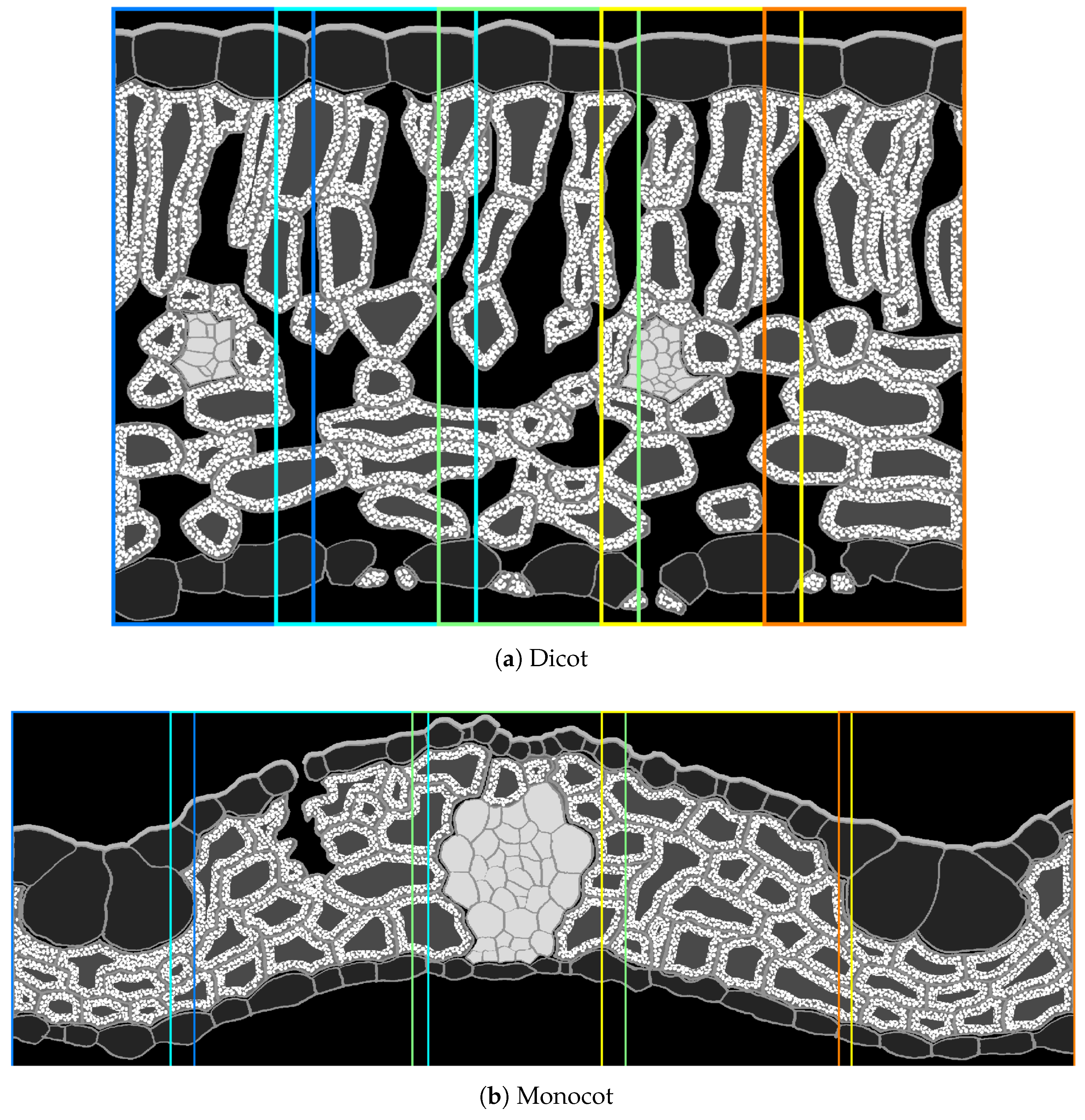
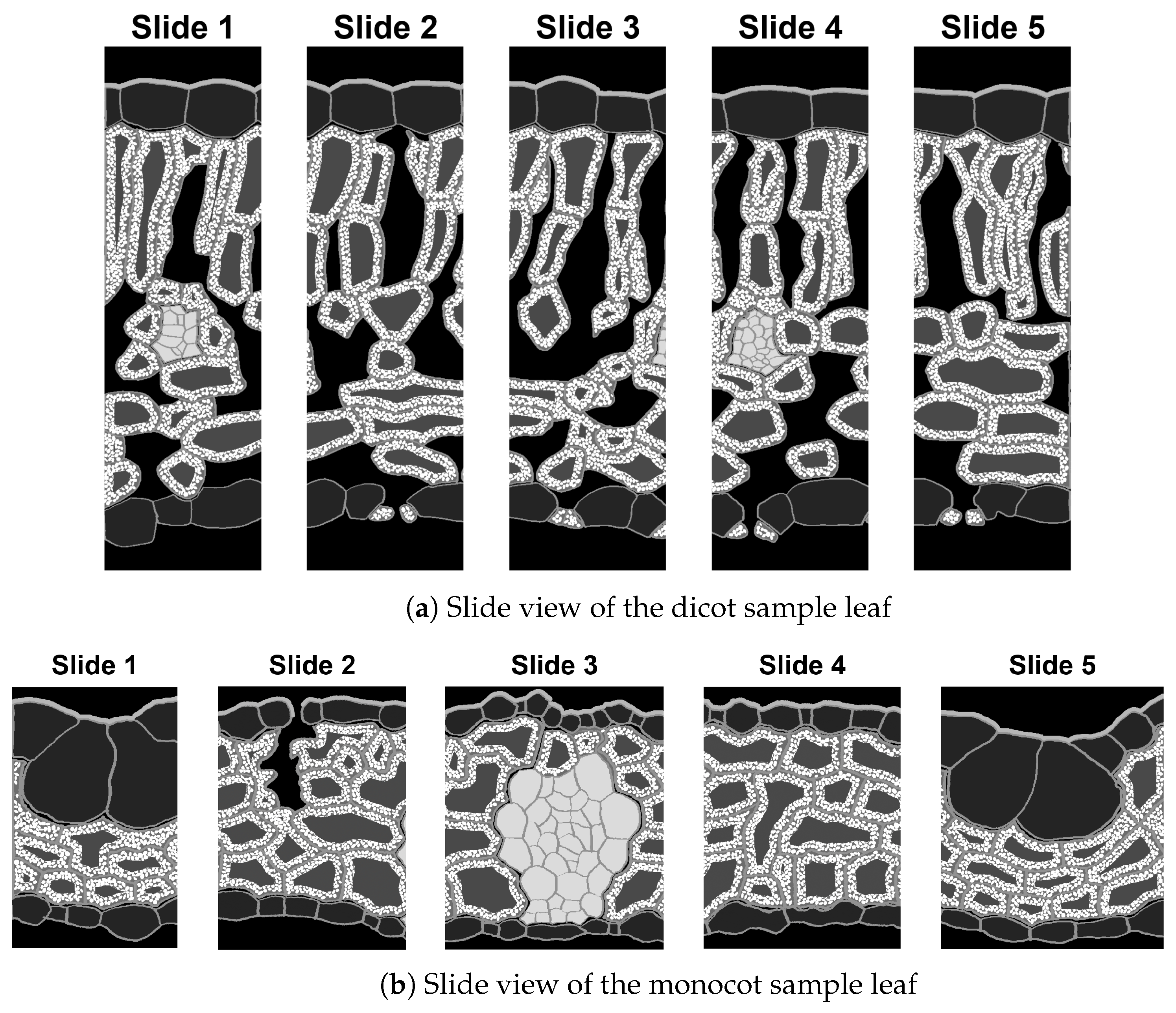
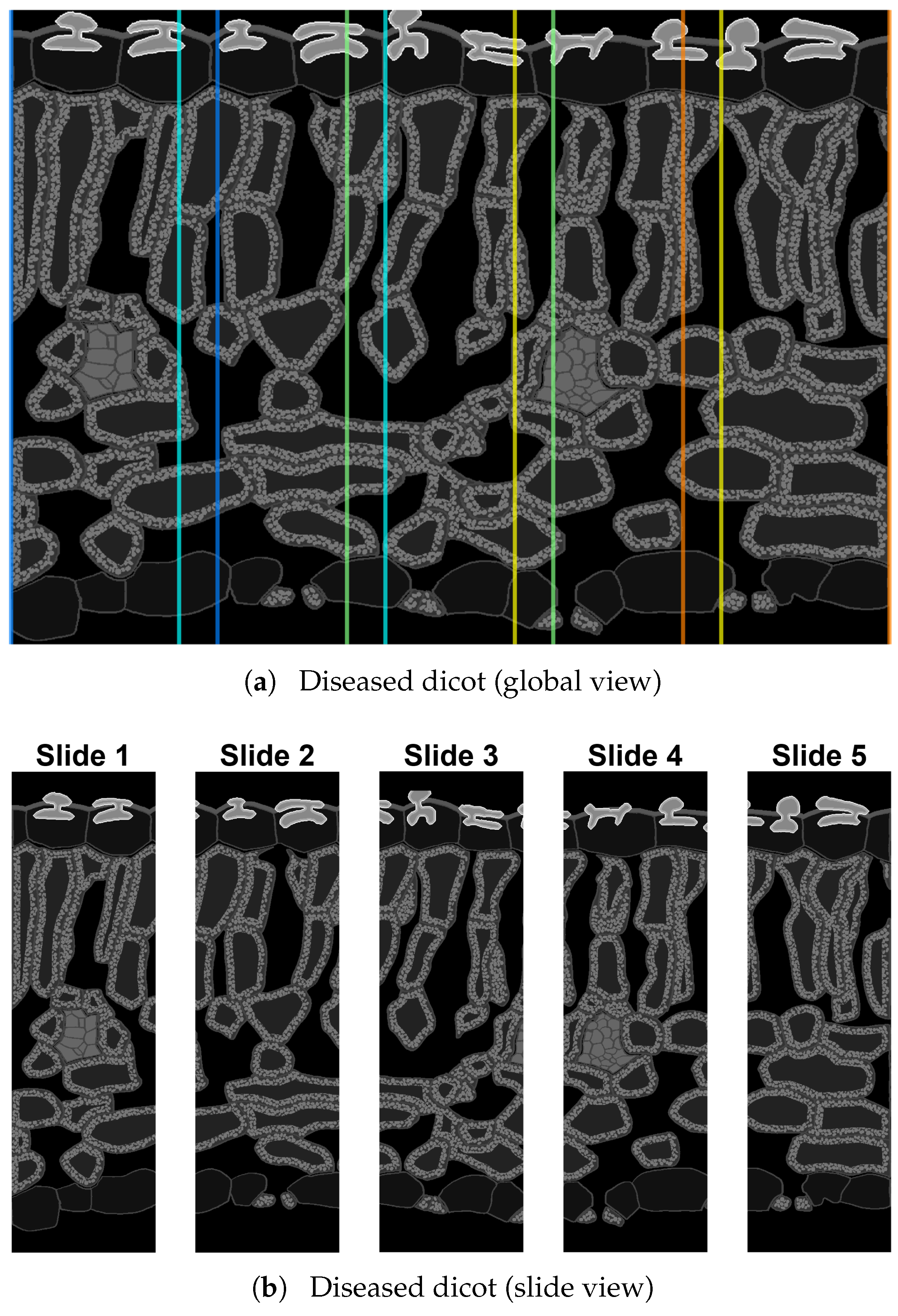
2.7. Reconstruction of Internal Plant Cross-Section Structure
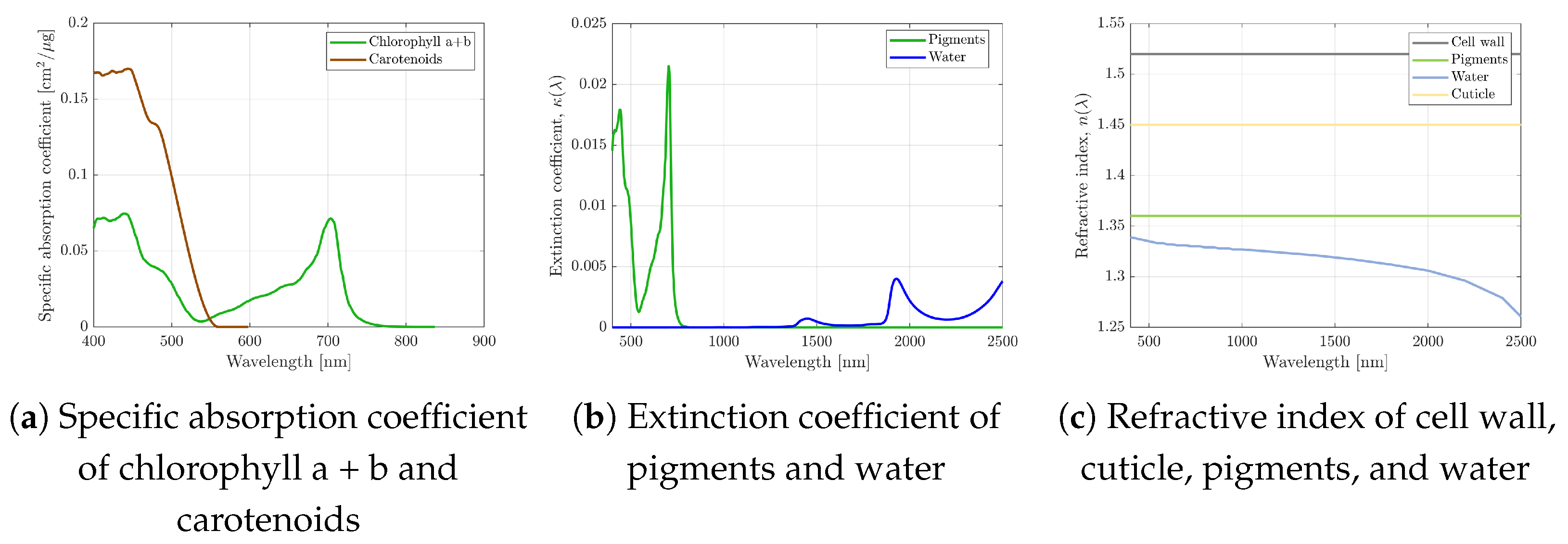
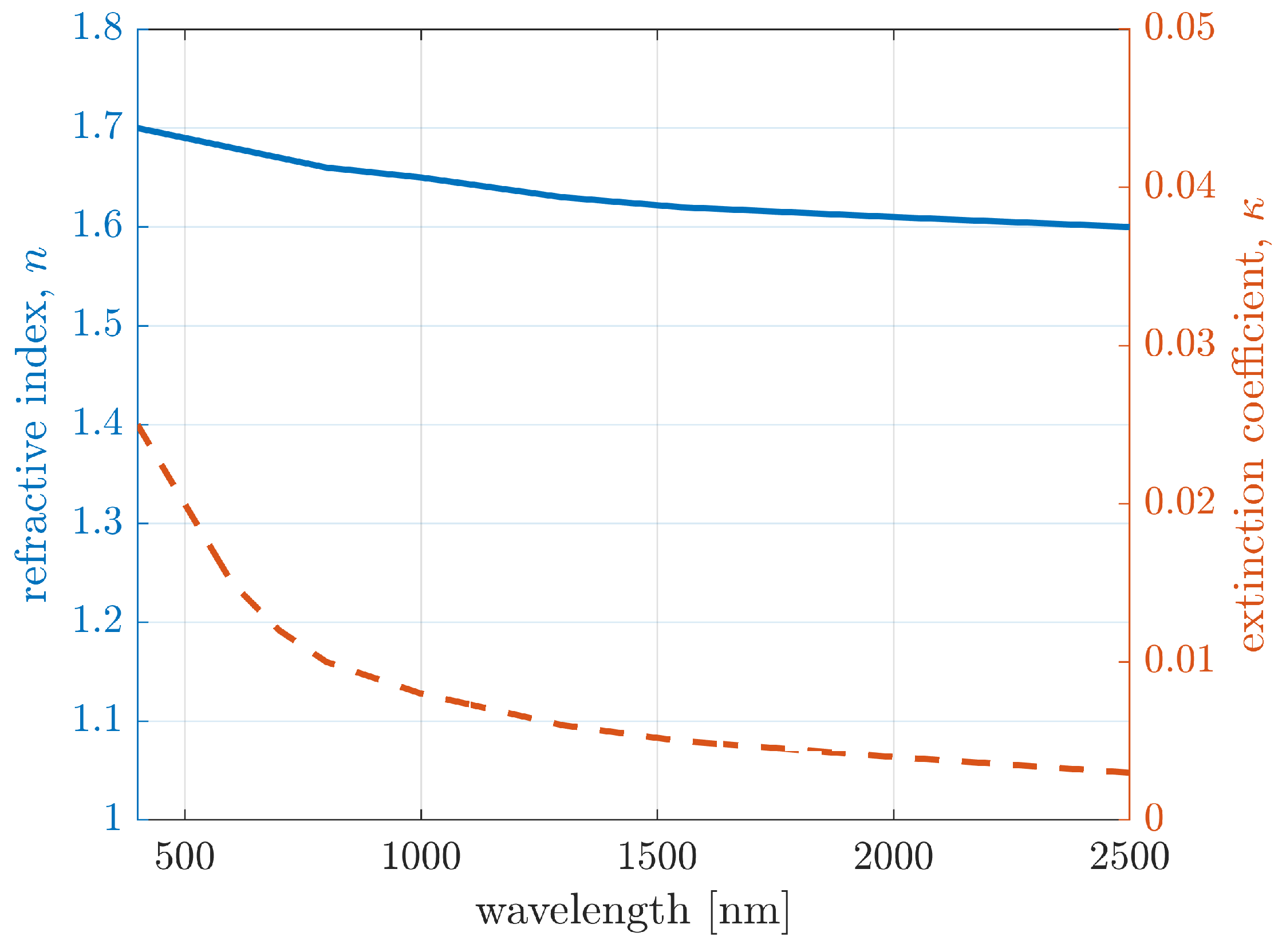
2.8. Optical Properties of Plant Tissues
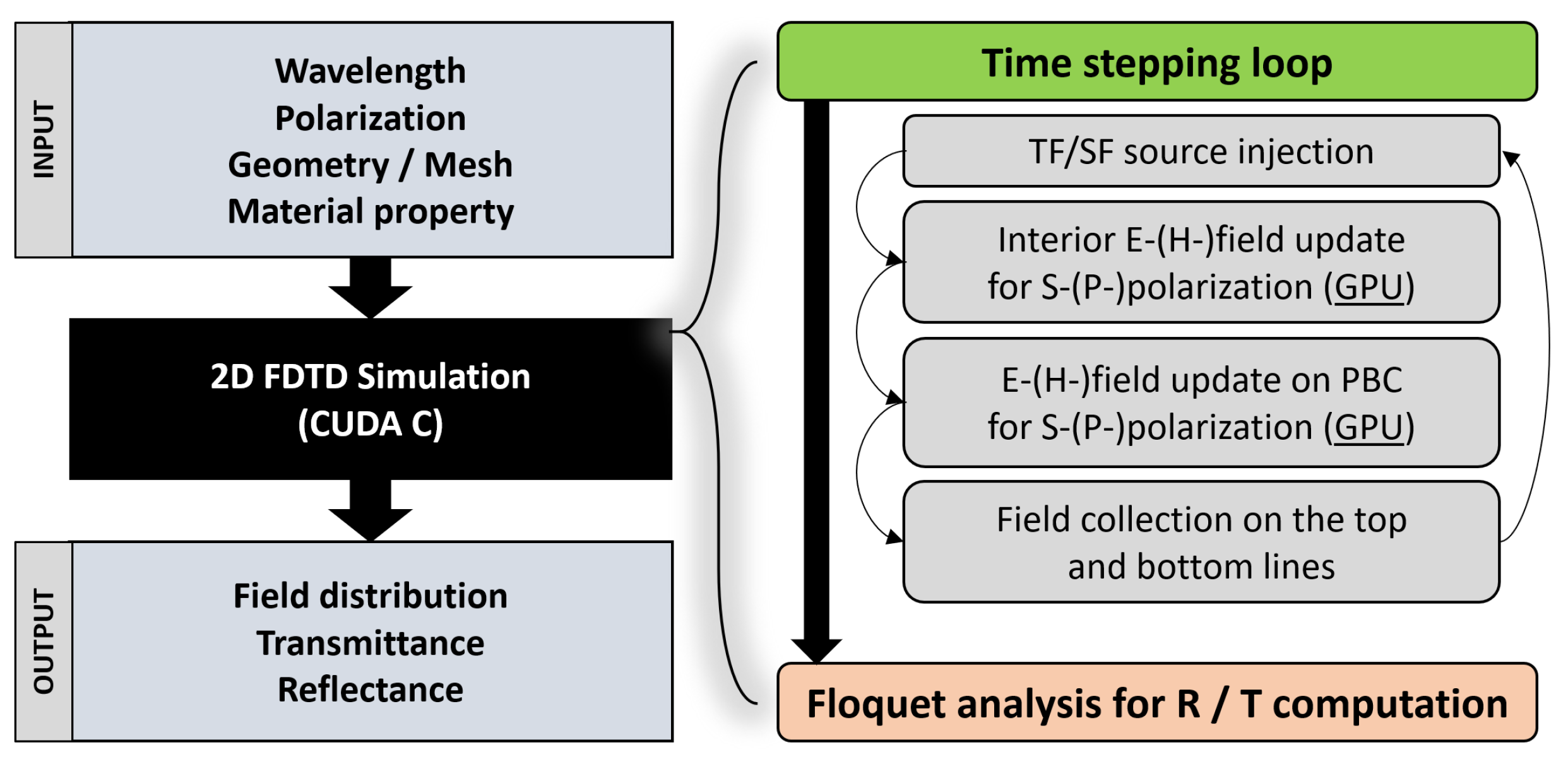
2.9. Implementation with GPU Acceleration and Computing Resources
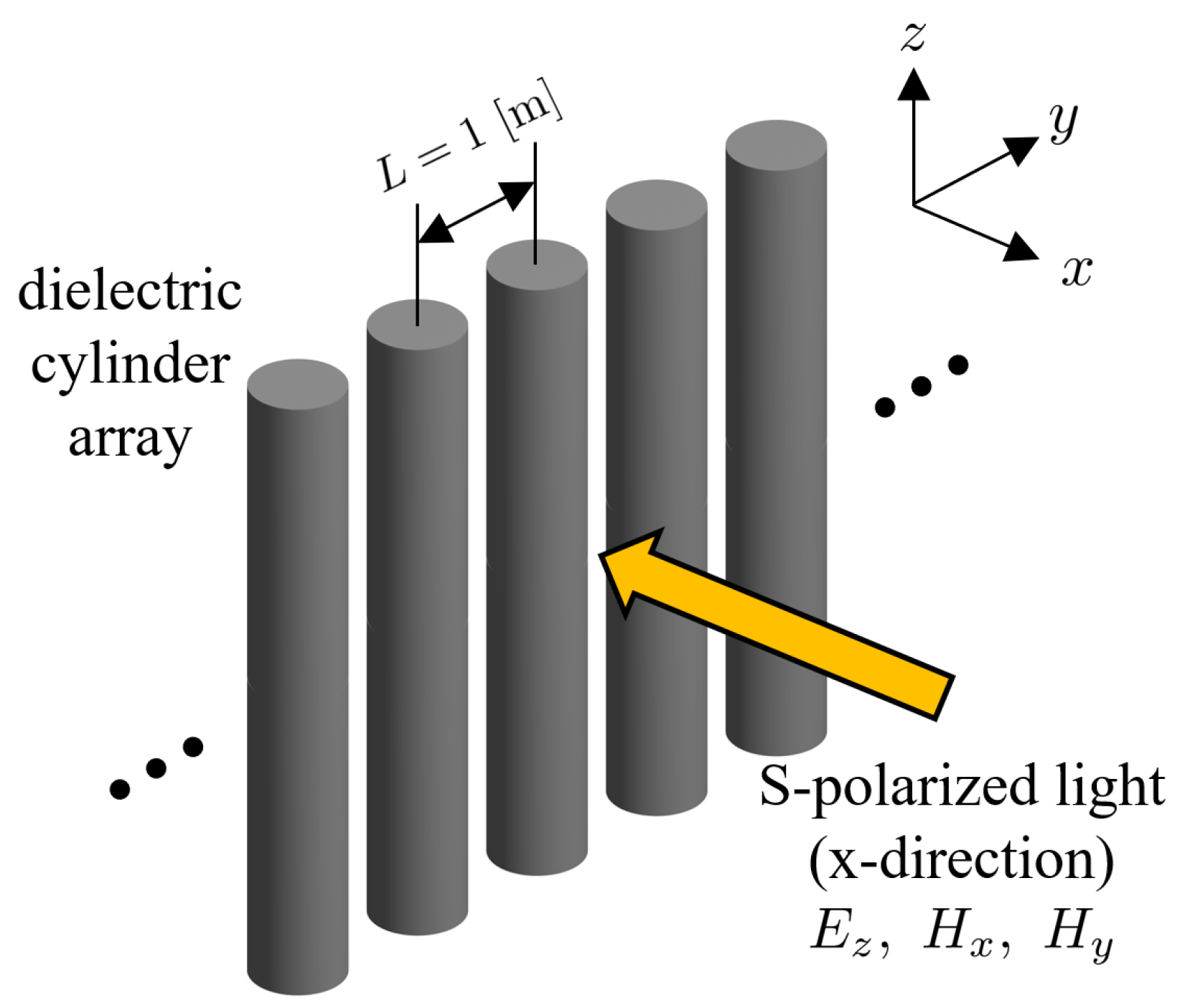
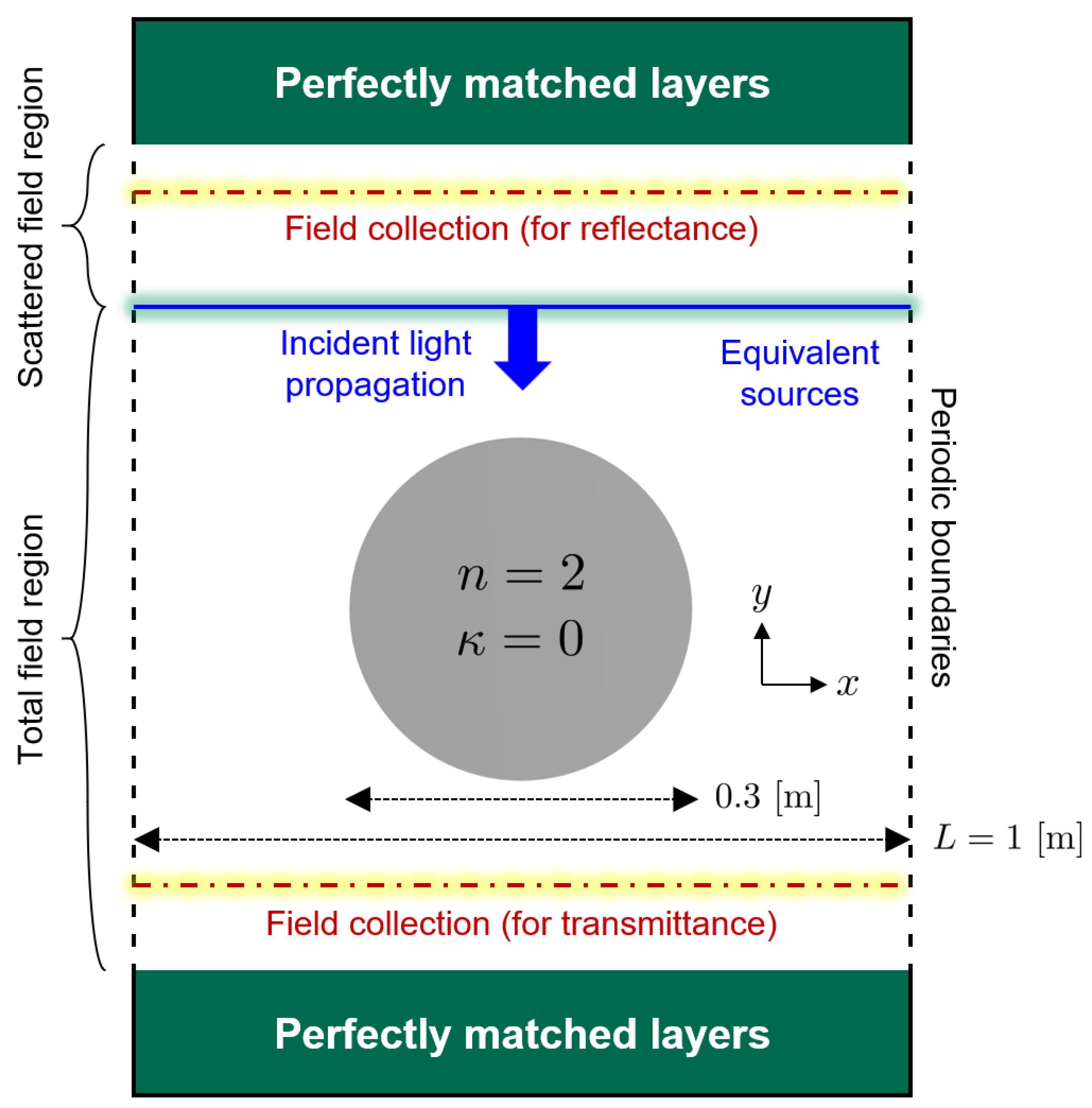
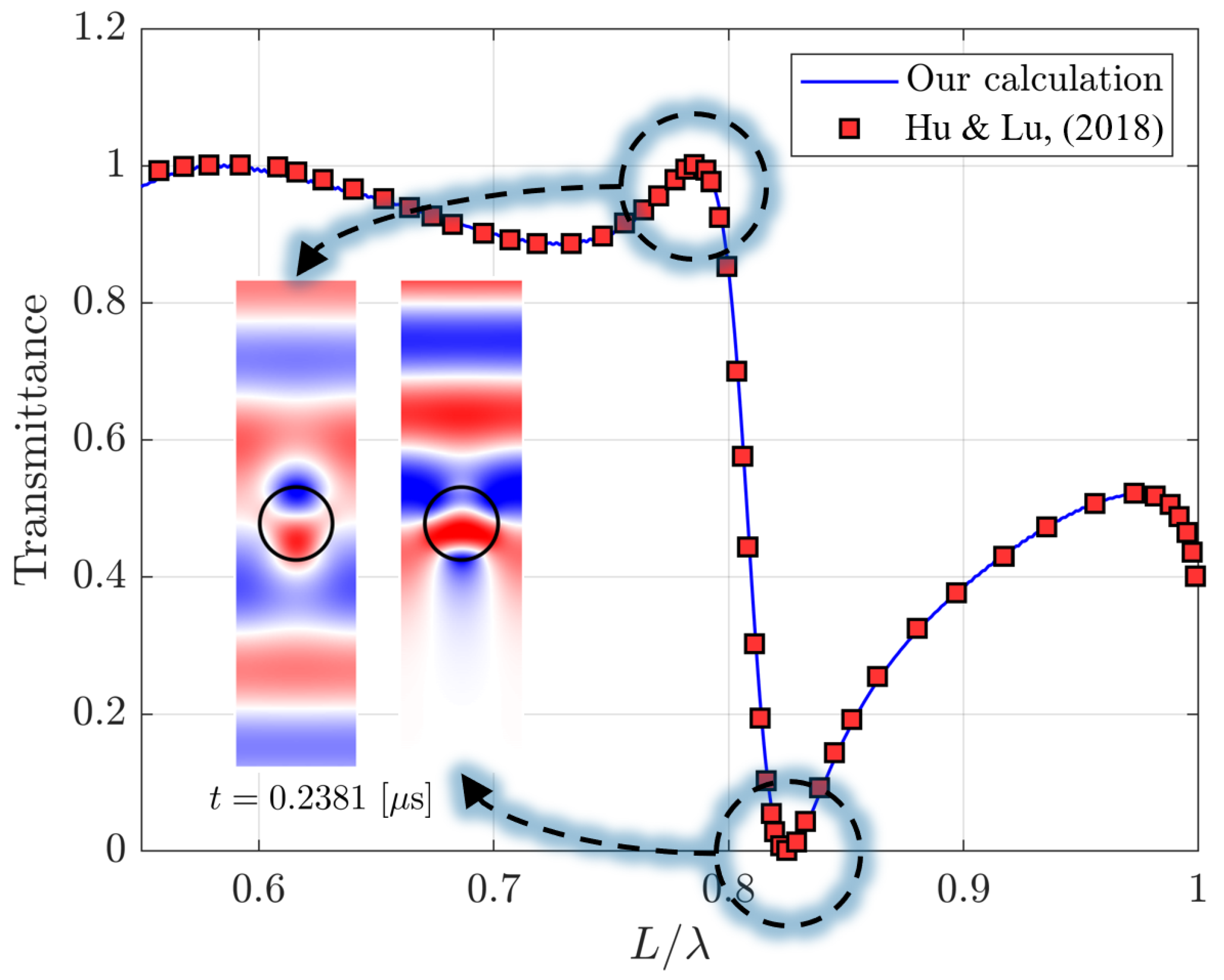
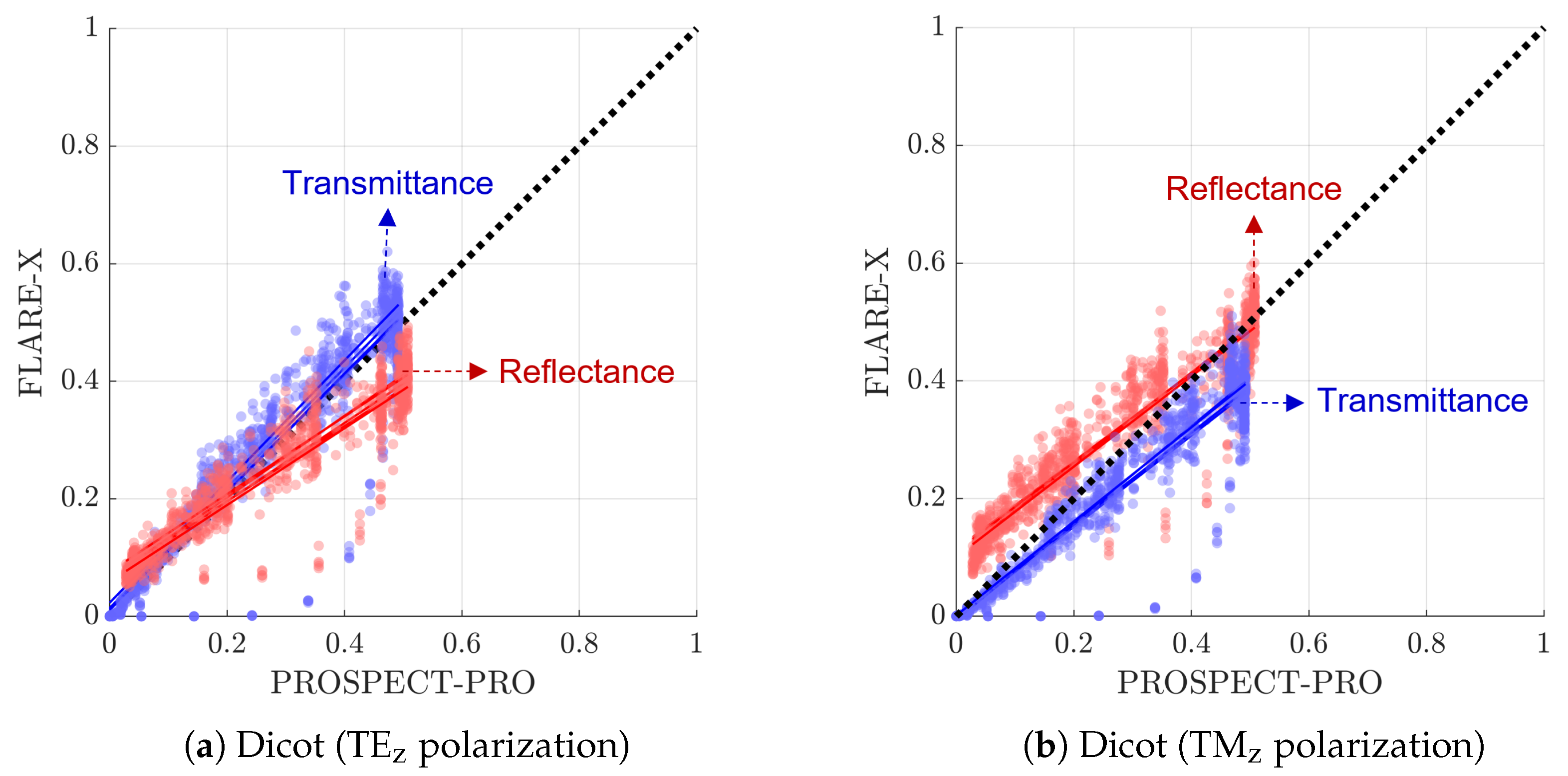
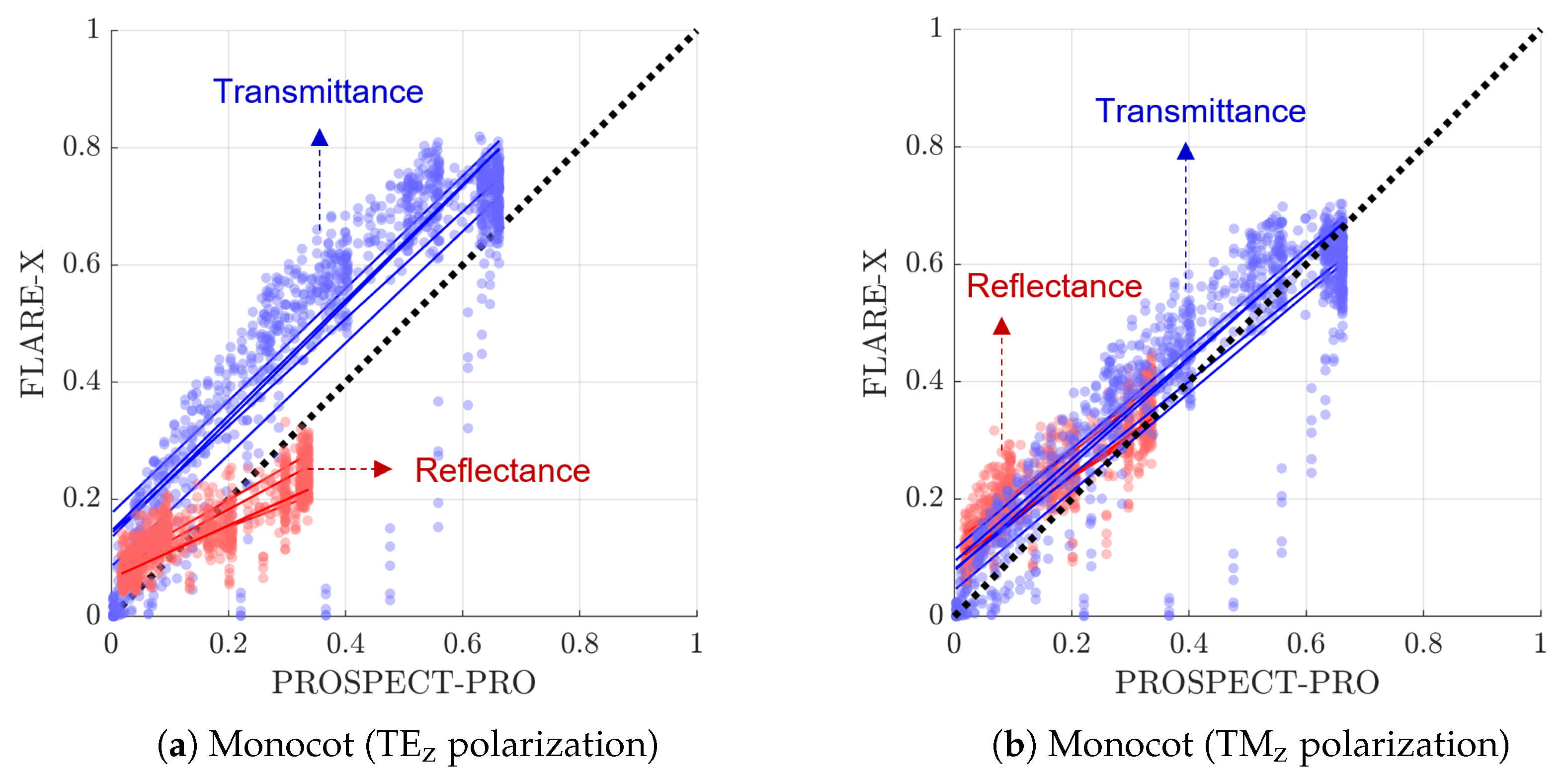
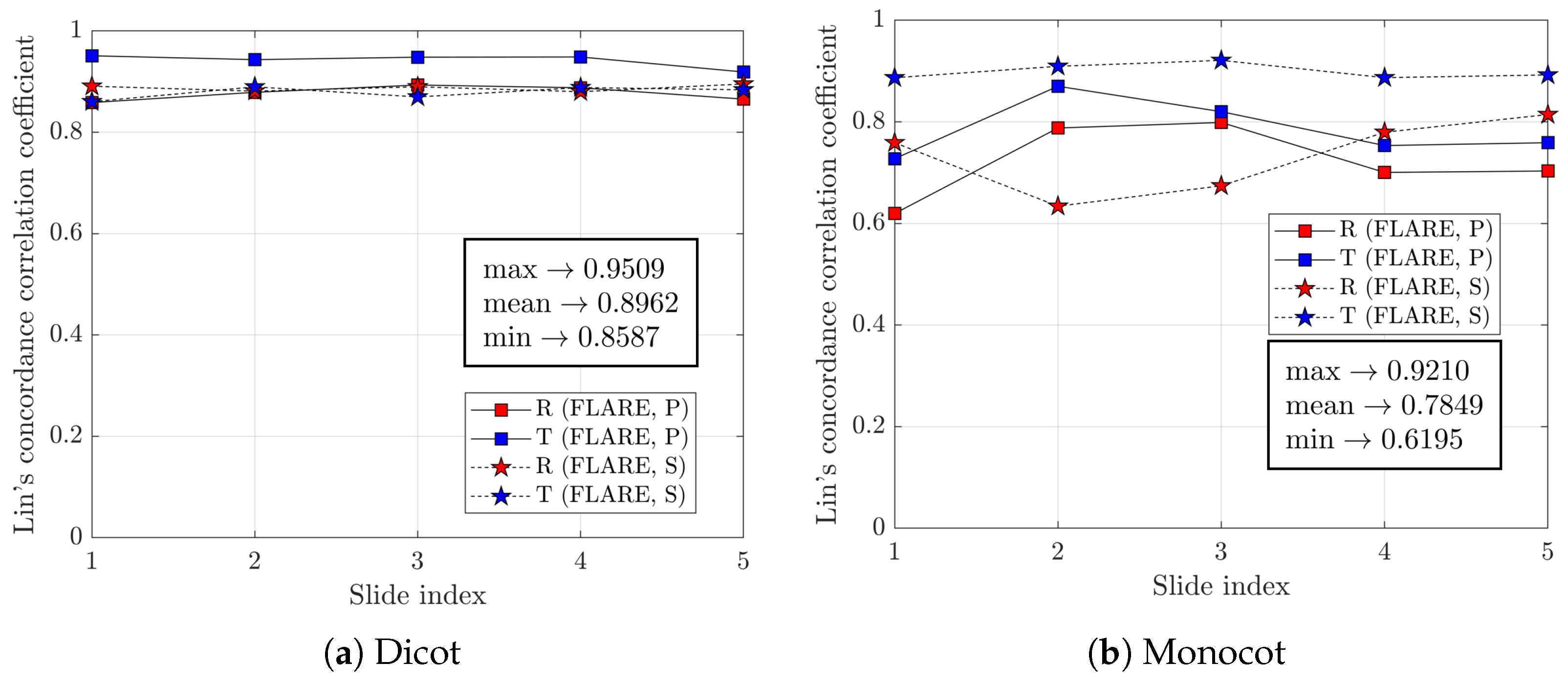
3. Validation
4. Results
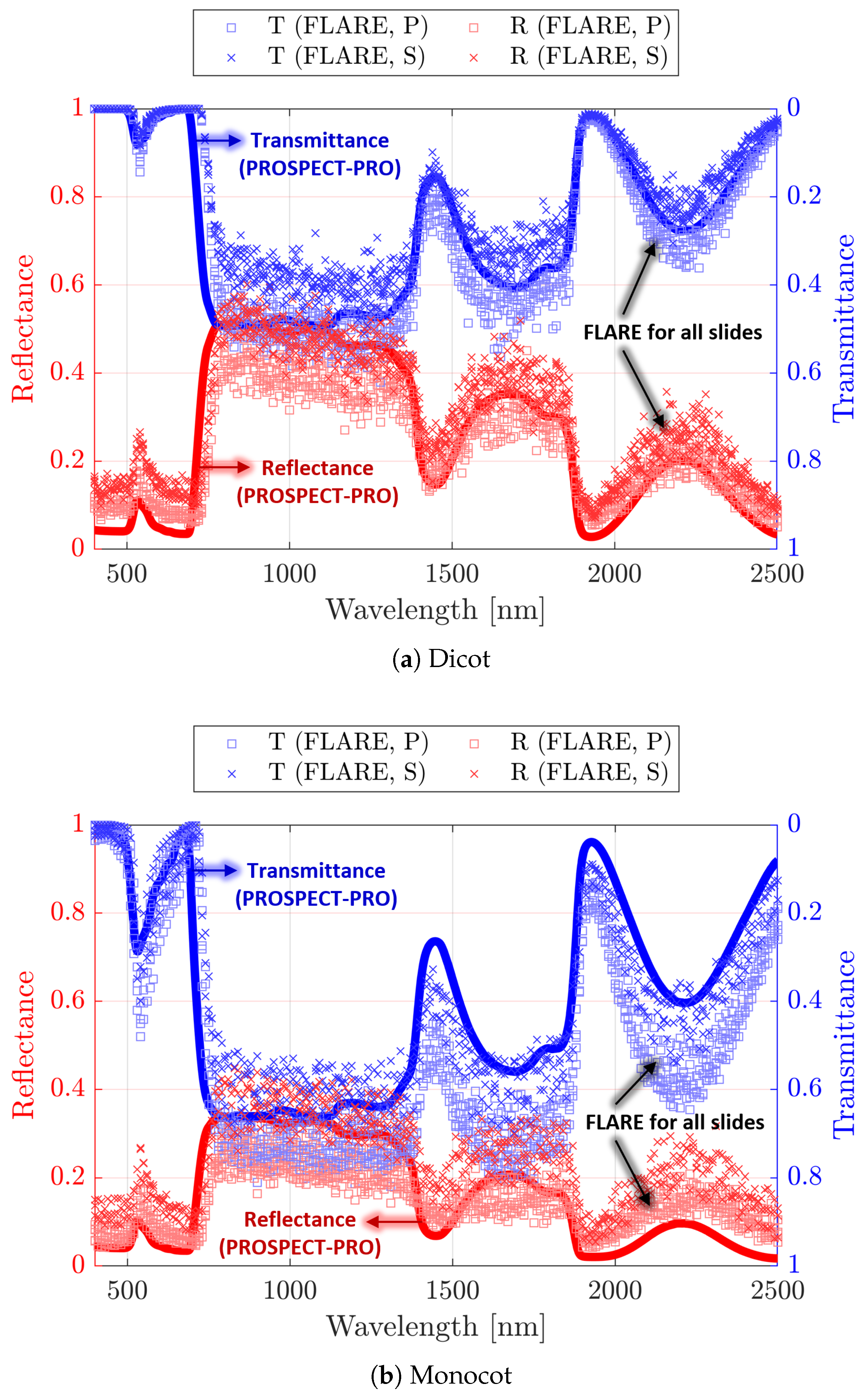
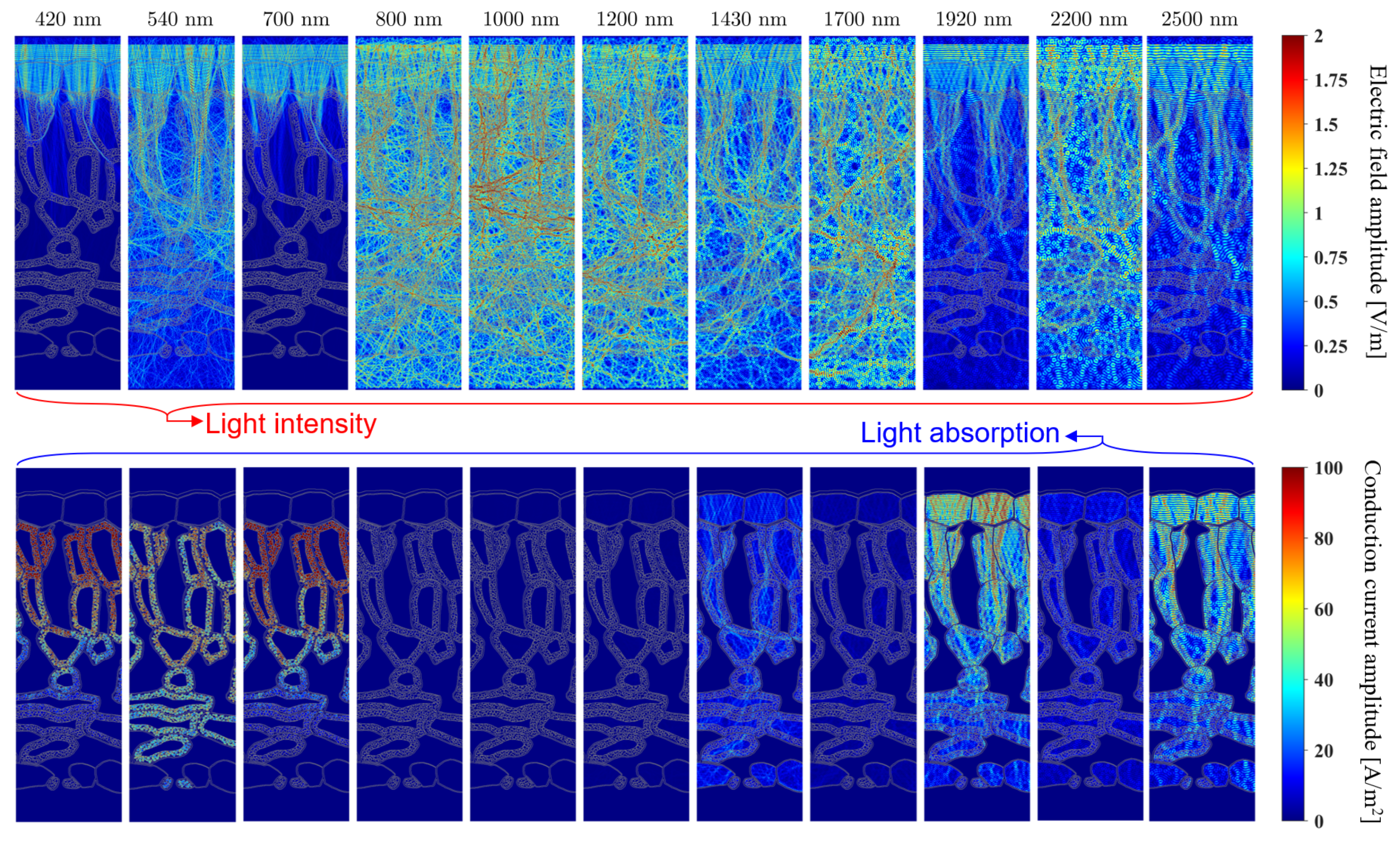
4.1. Simulation Results for Healthy Dicot and Monocot Plant Leaves
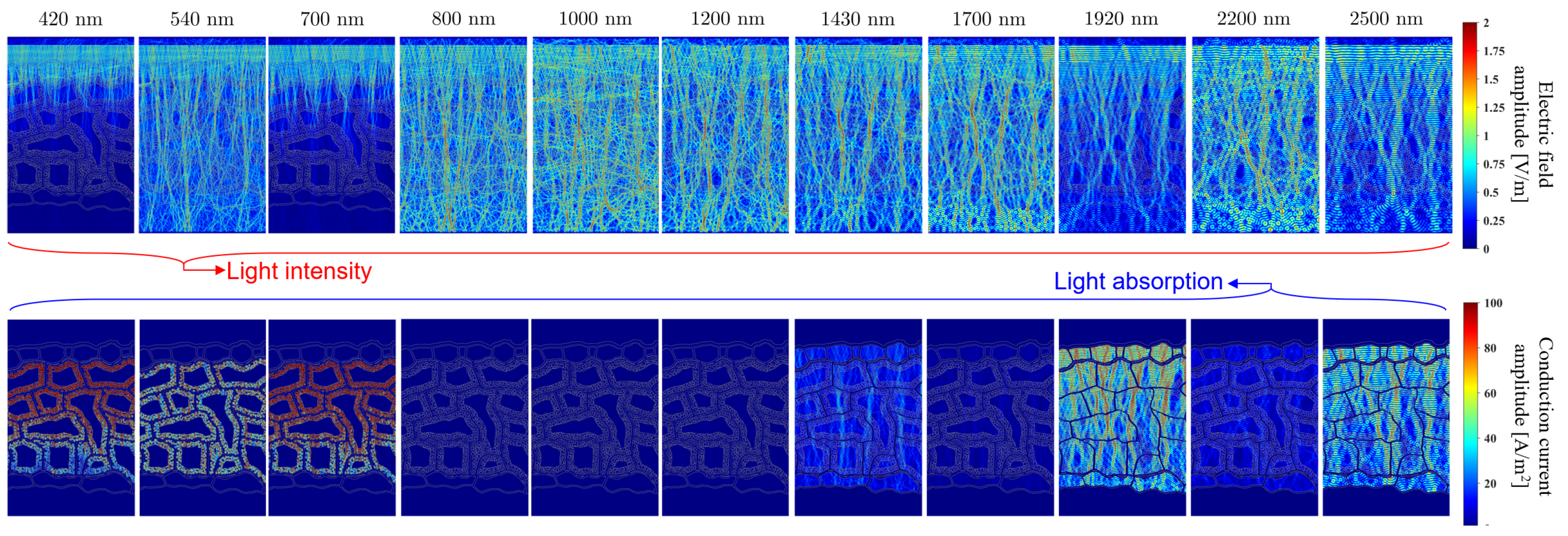
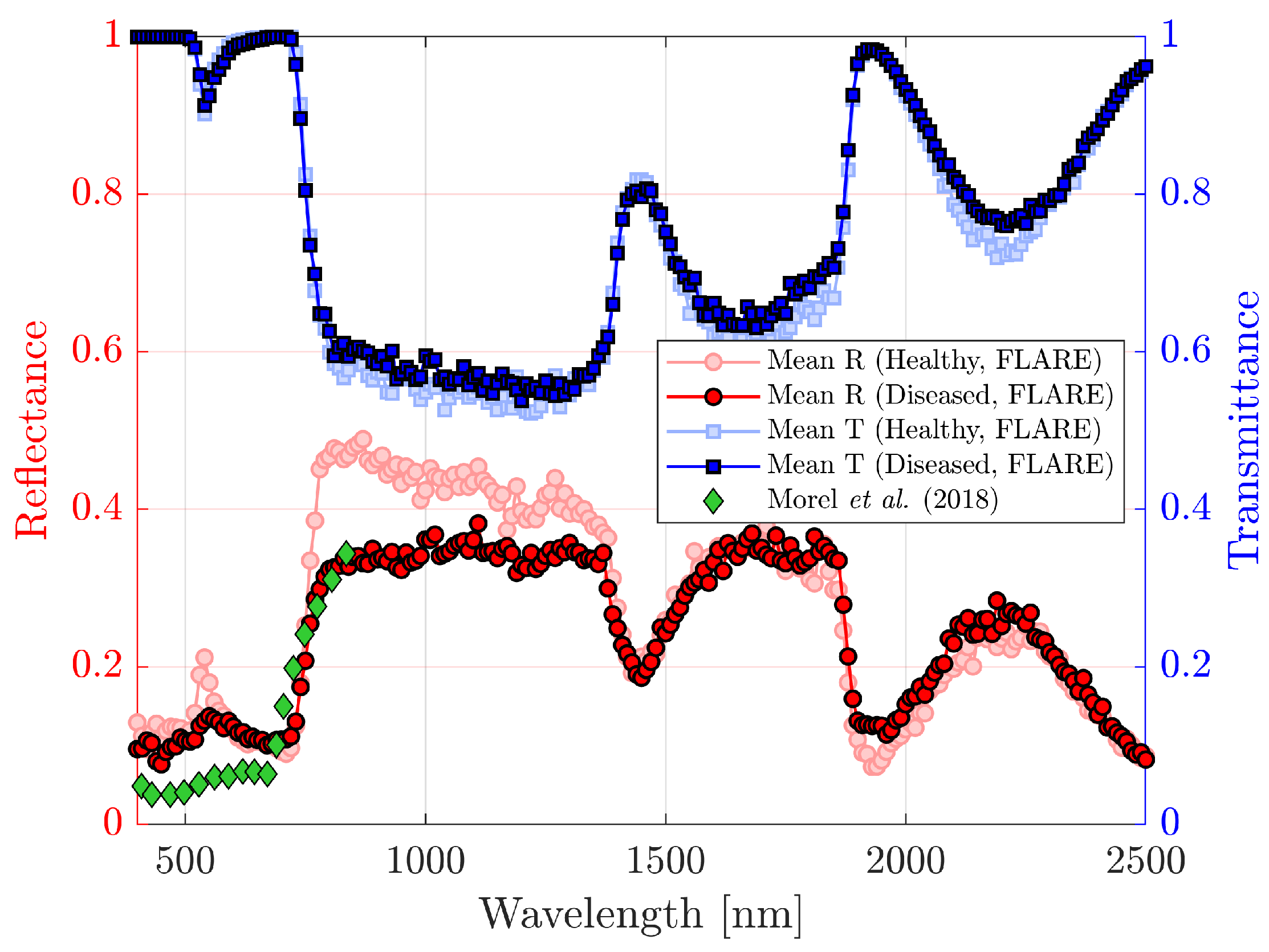
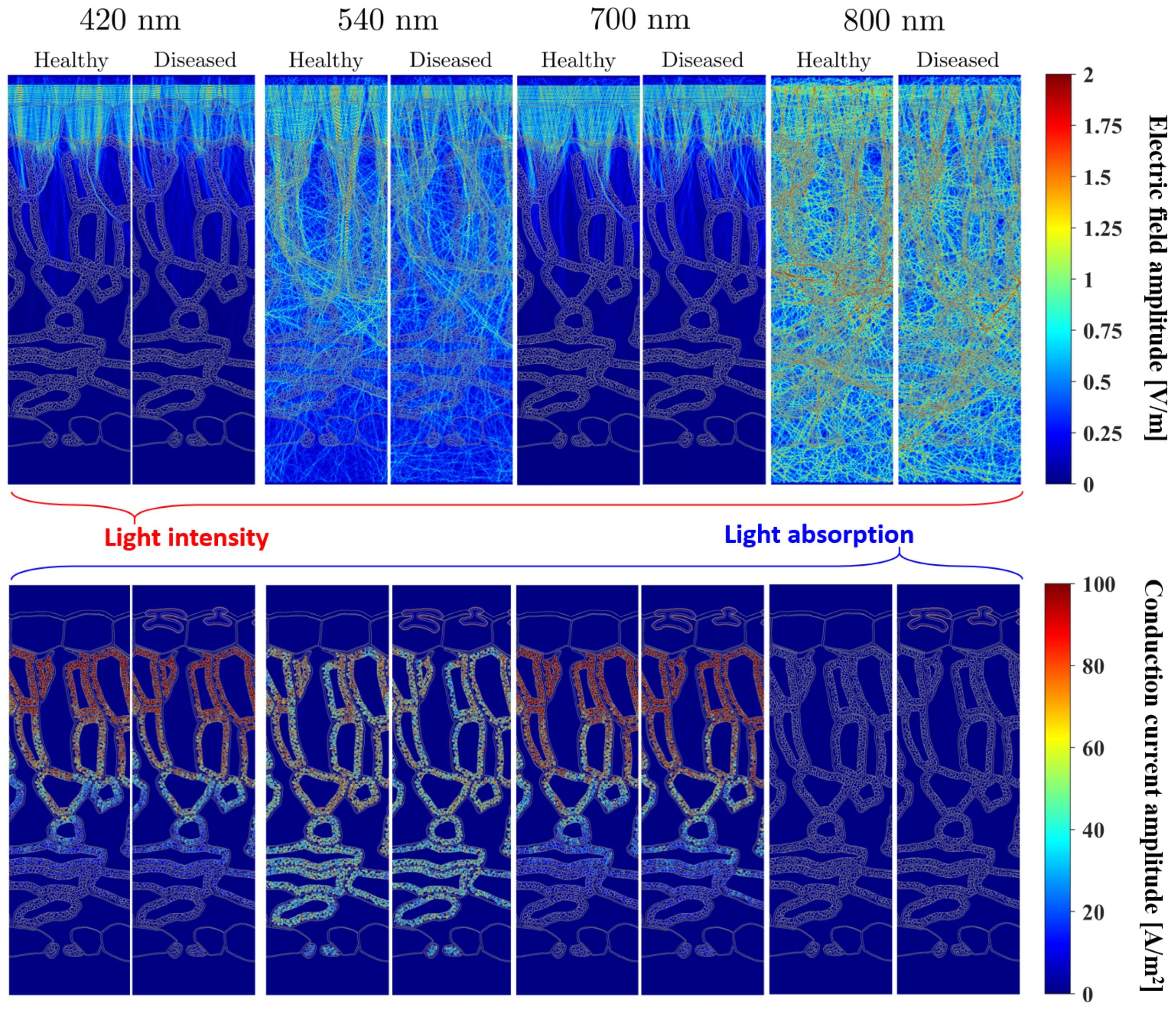
4.2. Fungi-Infected Plant Leaf
5. Conclusions and Future Works
- Three-dimensional volumetric modeling will enable more accurate representation of stomatal chambers, vascular networks, and mesophyll topology.
- Time-evolving simulations of disease progression may clarify how microstructural degradation produces spectral shifts over the infection cycle.
- Integration with inversion or learning-based retrieval algorithms could allow estimation of mesophyll structure or infection severity directly from measured spectra.
- Incorporating polarization and chlorophyll fluorescence will broaden applicability to BRDF polarimetry and solar-induced fluorescence studies.
- Coupling leaf-scale FDTD with canopy-level radiative-transfer models may establish a multiscale pathway linking cellular anatomy to airborne or satellite hyperspectral observations.
Author Contributions
Funding
Institutional Review Board Statement
Informed Consent Statement
Data Availability Statement
Conflicts of Interest
References
- Strange, R.N.; Scott, P.R. Plant Disease: A Threat to Global Food Security. Annu. Rev. Phytopathol. 2005, 43, 83–116. [Google Scholar] [CrossRef]
- Mengiste, T.; Liao, C.J. Contrasting Mechanisms of Defense Against Biotrophic and Necrotrophic Pathogens, 20 Years Later: What Has Changed? Annu. Rev. Phytopathol. 2025, 63, 279–308. [Google Scholar] [CrossRef]
- Oerke, E.C. Crop losses to pests. J. Agric. Sci. 2006, 144, 31–43. [Google Scholar] [CrossRef]
- Dean, R.; Van Kan, J.A.; Pretorius, Z.A.; Hammond-Kosack, K.E.; Di Pietro, A.; Spanu, P.D.; Rudd, J.J.; Dickman, M.; Kahmann, R.; Ellis, J.; et al. The Top 10 fungal pathogens in molecular plant pathology. Mol. Plant Pathol. 2012, 13, 414–430. [Google Scholar] [CrossRef] [PubMed]
- Savary, S.; Willocquet, L.; Pethybridge, S.J.; Esker, P.; McRoberts, N.; Nelson, A. The global burden of pathogens and pests on major food crops. Nat. Ecol. Evol. 2019, 3, 430–439. [Google Scholar] [CrossRef] [PubMed]
- Bebber, D.P.; Gurr, S.J. Crop-destroying fungal and oomycete pathogens challenge food security. Fungal Genet. Biol. 2015, 74, 62–64. [Google Scholar] [CrossRef]
- Vogelmann, T.; Gorton, H. Leaf: Light capture in the photosynthetic organ. In The Structural Basis of Biological Energy Generation; Springer: Dordrecht, The Netherlands, 2014; pp. 363–377. [Google Scholar]
- Gotoh, E.; Suetsugu, N.; Higa, T.; Matsushita, T.; Tsukaya, H.; Wada, M. Palisade cell shape affects the light-induced chloroplast movements and leaf photosynthesis. Sci. Rep. 2018, 8, 1472. [Google Scholar] [CrossRef]
- Terashima, I.; Hanba, Y.T.; Tholen, D.; Niinemets, Ü. Leaf Functional Anatomy in Relation to Photosynthesiss. Plant Physiol. 2011, 155, 108–116. [Google Scholar] [CrossRef]
- Karabourniotis, G.; Liakopoulos, G.; Bresta, P.; Nikolopoulos, D. The Optical Properties of Leaf Structural Elements and Their Contribution to Photosynthetic Performance and Photoprotection. Plants 2021, 10, 1455. [Google Scholar] [CrossRef]
- Vogelmann, T. Light within the plant. In Photomorphogenesis in Plants; Springer: Dordrecht, The Netherlands, 1994; pp. 491–535. [Google Scholar]
- Jacquemoud, S.; Ustin, S.L. Modeling Leaf Optical Properties. Photobiological Sciences Online. 2008. Available online: https://sites.bu.edu/cliveg/files/2023/10/leaf-optics-jacquemoud-ustin.pdf (accessed on 1 December 2025).
- Jackson, J.D. Classical Electrodynamics; John Wiley & Sons: Hoboken, NJ, USA, 2012. [Google Scholar]
- Chew, W.C. Waves and Fields in Inhomogenous Media; John Wiley & Sons: Hoboken, NJ, USA, 1999. [Google Scholar]
- Balanis, C.A. Advanced Engineering Electromagnetics; John Wiley & Sons: Hoboken, NJ, USA, 2012. [Google Scholar]
- Szechyńska-Hebda, M.; Hołownicki, R.; Doruchowski, G.; Sas, K.; Puławska, J.; Jarecka-Boncela, A.; Ptaszek, M.; Włodarek, A. Application of Hyperspectral Imaging for Early Detection of Pathogen-Induced Stress in Cabbage as Case Study. Agronomy 2025, 15, 1516. [Google Scholar] [CrossRef]
- Zarco-Tejada, P.J.; Camino, C.; Beck, P.; Calderon, R.; Hornero, A.; Hernández-Clemente, R.; Kattenborn, T.; Montes-Borrego, M.; Susca, L.; Morelli, M.; et al. Previsual symptoms of Xylella fastidiosa infection revealed in spectral plant-trait alteration. Nat. Plants 2018, 4, 432–439. [Google Scholar] [CrossRef] [PubMed]
- Allen, W.A.; Richardson, A.J. Interaction of light with a plant canopy. J. Opt. Soc. Am. 1968, 58, 1023–1028. [Google Scholar] [CrossRef]
- Allen, W.A.; Gausman, H.W.; Richardson, A.J.; Thomas, J.R. Interaction of Isotropic Light with a Compact Plant Leaf. J. Opt. Soc. Am. 1969, 59, 1376–1379. [Google Scholar] [CrossRef]
- Gausman, H.; Allen, W.; Cardenas, R.; Richardson, A. Relation of Light Reflectance to Histological and Physical Evaluations of Cotton Leaf Maturity. Appl. Opt. 1970, 9, 545–552. [Google Scholar] [CrossRef]
- Allen, W.A.; Gausman, H.W.; Richardson, A.J. Mean Effective Optical Constants of Cotton Leaves. J. Opt. Soc. Am. 1970, 60, 542–547. [Google Scholar] [CrossRef]
- Gausman, H.; Allen, W.; Escobar, D.; Rodriguez, R.; Cardenas, R. Age Effects of Cotton Leaves on Light Reflectance, Transmittance, and Absorptance and on Water Content and Thickness. Agron. J. 1971, 63, 465–469. [Google Scholar] [CrossRef]
- Kumar, R.; Silva, L. Reflectance Model of a Plant Leaf; Technical Report; Laboratory for Applications of Remote Sensing (LARS), Purdue University: West Lafayette, IN, USA, 1973. [Google Scholar]
- Kumar, R.; Silva, L. Light Ray Tracing Through a Leaf Cross Section. Appl. Opt. 1973, 12, 2950–2954. [Google Scholar] [CrossRef]
- Tucker, C.J.; Garratt, M.W. Leaf optical system modeled as a stochastic process. Appl. Opt. 1977, 16, 635–642. [Google Scholar] [CrossRef]
- Tucker, C.J. Spectral estimation of grass canopy variables. Remote Sens. Environ. 1977, 6, 11–26. [Google Scholar] [CrossRef]
- Tucker, C.J. Remote sensing of leaf water content in the near infrared. Remote Sens. Environ. 1980, 10, 23–32. [Google Scholar]
- Maier, S.; Lüdeker, W.; Günther, K. SLOP: A Revised Version of the Stochastic Model for Leaf Optical Properties. Remote Sens. Environ. 1999, 68, 273–280. [Google Scholar]
- Govaerts, Y.M.; Jacquemoud, S.; Verstraete, M.M.; Ustin, S. Three-dimensional radiation transfer modeling in a dicotyledon leaf. Appl. Opt. 1996, 35, 6585–6598. [Google Scholar] [CrossRef] [PubMed]
- Govaerts, Y.M.; Verstraete, M.M. Raytran: A Monte Carlo ray-tracing model to compute light scattering in three-dimensional heterogeneous media. IEEE Trans. Geosci. Remote Sens. 2002, 36, 493–505. [Google Scholar] [CrossRef]
- Watté, R.; Aernouts, B.; Beers, R.V.; Herremans, E.; Ho, Q.T.; Verboven, P.; Nicolaï, B.; Saeys, W. Modeling the propagation of light in realistic tissue structures with MMC-fpf: A meshed Monte Carlo method with free phase function. Opt. Express 2015, 23, 17467–17486. [Google Scholar] [CrossRef] [PubMed]
- Jacquemoud, S.; Ustin, S.; Verdebout, J.; Schmuck, G.; Andreoli, G.; Hosgood, B. Estimating leaf biochemistry using the PROSPECT leaf optical properties model. Remote Sens. Environ. 1996, 56, 194–202. [Google Scholar]
- Feret, J.B.; François, C.; Asner, G.P.; Gitelson, A.A.; Martin, R.E.; Bidel, L.P.R.; Ustin, S.L.; le Maire, G.; Jacquemoud, S. PROSPECT-4 and 5: Advances in the leaf optical properties model separating photosynthetic pigmentsl. Remote Sens. Environ. 2008, 112, 3030–3043. [Google Scholar]
- Féret, J.-B.; Gitelson, A.A.; Noble, S.D.; Jacquemoud, S. PROSPECT-D: Towards modeling leaf optical properties through a complete lifecycle. Remote Sens. Environ. 2017, 193, 204–215. [Google Scholar] [CrossRef]
- Féret, J.-B.; Berger, K.; de Boissieu, F.; Malenovský, Z. PROSPECT-PRO for estimating content of nitrogen-containing leaf proteins and other carbon-based constituents. Remote. Sens. Environ. 2021, 252, 112173. [Google Scholar] [CrossRef]
- Yu, F.; Xiang, S.; Bai, J.; Jin, Z.; Zhang, H.; Zhu, S.; Xu, T. PIOSL: An improved version of PROSPECT model for simulating leaf optical properties by considering leaf internal structural variations. Comput. Electron. Agric. 2023, 211, 108030. [Google Scholar] [CrossRef]
- Su, X.; He, J.; Li, W.; Pan, Y.; Li, D.; Xia, Y.; Cheng, T.; Zhu, Y.; Cao, W.; Tian, Y. Monitoring Rice Leaf Nitrogen Content Based on the Canopy Structure Effect Corrected With a Novel Model PROSPECT-P. IEEE Trans. Geosci. Remote Sens. 2024, 62, 4414317. [Google Scholar]
- Féret, J.; de Boissieu, F. Prospect: An R package to link leaf optical properties with their chemical and structural properties with the leaf model PROSPECT. J. Open Source Softw. 2024, 9, 6027. [Google Scholar] [CrossRef]
- Du, S.; Zhao, D.; Guan, L.; Qi, M.; Liu, X.; Liu, L. PROSPECT-DP: A coupled leaf optical properties model for improving leaf spectra simulation in the red-edge domain by excluding the ChlF effect. Int. J. Appl. Earth Obs. 2025, 141, 104651. [Google Scholar] [CrossRef]
- Bone, R.A.; Lee, D.W.; Norman, J. Epidermal cells functioning as lenses in leaves of tropical rain-forest shade plants. Appl. Opt. 1985, 24, 1408–1412. [Google Scholar] [CrossRef] [PubMed]
- Ustin, S.; Jacquemoud, S.; Govaerts, Y. Simulation of photon transport in a three-dimensional leaf: Implications for photosynthesis. Plant Cell Environ. 2001, 24, 1095–1103. [Google Scholar] [CrossRef]
- Xiao, Y.; Tholen, D.; Zhu, X.G. The influence of leaf anatomy on the internal light environment and photosynthetic electron transport rate: Exploration with a new leaf ray tracing model. J. Exp. Bot. 2016, 67, 6021–6035. [Google Scholar] [CrossRef]
- Xu, K.; Ye, H. Light scattering in stacked mesophyll cells results in similarity characteristic of solar spectral reflectance and transmittance of natural leavess. Sci. Rep. 2023, 13, 4694. [Google Scholar] [CrossRef]
- Borsuk, A.M.; Randall, J.M.; Richburg, J.; Montes, K.G.; Edwards, E.J.; Brodersen, C.R. Palisade cell geometry in relation to leaf optical and photosynthetic properties in Viburnum. Plant Physiol. 2025, 198, kiae659. [Google Scholar] [CrossRef]
- Nikolopoulos, D.; Bresta, P.; Daliani, V.; Haghiou, V.; Darra, N.; Liati, M.; Mavrogianni, E.; Papanastasiou, A.; Porfyraki, T.; Psaroudi, V.; et al. Leaf anatomy affects optical properties and enhances photosynthetic performance under oblique light. Plant Cell Environ. 2024, 47, 1471–1485. [Google Scholar] [CrossRef]
- Kallel, A. Leaf polarized BRDF simulation based on Monte Carlo 3-D vector RT modeling. J. Quant. Spectrosc. Radiat. Transf. 2018, 221, 202–224. [Google Scholar] [CrossRef]
- He, Q.; Zhan, J.; Liu, X.; Dong, C.; Tian, D.; Fu, Q. Multispectral polarimetric bidirectional reflectance research of plant canopy. Opt. Lasers Eng. 2025, 184, 108688. [Google Scholar]
- Pedrós, R.; Moya, I.; Goulas, Y.; Jacquemoud, S. Chlorophyll fluorescence emission spectrum inside a leaf. Photochem. Photobiol. Sci. 2008, 7, 498–502. [Google Scholar] [CrossRef]
- Sarlikioti, V.; de Visser, P.H.B.; Buck-Sorlin, G.H.; Marcelis, L.F.M. How plant architecture affects light absorption and photosynthesis in tomato: Towards an ideotype for plant architecture using a functional–structural plant model. Ann. Bot. 2011, 108, 1065–1073. [Google Scholar] [CrossRef] [PubMed]
- Vos, J.; Evers, J.B.; Buck-Sorlin, G.H.; Andrieu, B.; Chelle, M.; De Visser, P.H. Functional–structural plant modelling: A new versatile tool in crop science. J. Exp. Bot. 2010, 61, 2101–2115. [Google Scholar] [CrossRef] [PubMed]
- Buck-Sorlin, G.; de Visser, P.H.; Henke, M.; Sarlikioti, V.; van Der Heijden, G.W.; Marcelis, L.F.; Vos, J. Towards a functional–structural plant model of cut-rose: Simulation of light environment, light absorption, photosynthesis and interference with the plant structure. Ann. Bot. 2011, 108, 1121–1134. [Google Scholar] [CrossRef] [PubMed]
- Henke, M.; Buck-Sorlin, G.H. Using a Full Spectral Raytracer for Calculating Light Microclimate in Functional-Structural Plant Modelling. Comput. Inform. 2017, 36, 1492–1522. [Google Scholar] [CrossRef]
- Ni-Meister, W.; Yang, W.; Kiang, N.Y. A clumped-foliage canopy radiative transfer model for a global dynamic terrestrial ecosystem model. I: Theory. Agric. For. Meteorol. 2010, 150, 881–894. [Google Scholar] [CrossRef]
- Gerber, F.; Marion, R.; Olioso, A.; Jacquemoud, S.; Da Luz, B.R.; Fabre, S. Modeling directional–hemispherical reflectance and transmittance of fresh and dry leaves from 0.4 μm to 5.7 μm with the PROSPECT-VISIR model. Remote Sens. Environ. 2011, 115, 404–414. [Google Scholar] [CrossRef]
- Gastellu-Etchegorry, J.P.; Yin, T.; Lauret, N.; Cajgfinger, T.; Gregoire, T.; Grau, E.; Feret, J.B.; Lopes, M.; Guilleux, J.; Dedieu, G.; et al. Discrete Anisotropic Radiative Transfer (DART 5) for Modeling Airborne and Satellite Spectroradiometer and LIDAR Acquisitions of Natural and Urban Landscapes. Remote Sens. 2015, 7, 1667–1701. [Google Scholar] [CrossRef]
- Gastellu-Etchegorry, J.P.; Lauret, N.; Yin, T.; Landier, L.; Kallel, A.; Malenovskỳ, Z.; Al Bitar, A.; Aval, J.; Benhmida, S.; Qi, J.; et al. DART: Recent Advances in Remote Sensing Data Modeling with Atmosphere, Polarization, and Chlorophyll Fluorescence. IEEE J. Sel. Top. Appl. Earth Obs. Remote Sens. 2017, 10, 2640–2649. [Google Scholar] [CrossRef]
- Bailey, B.; Overby, M.; Willemsen, P.; Pardyjak, E.; Mahaffee, W.; Stoll, R. A scalable plant-resolving radiative transfer model based on optimized GPU ray tracing. Agric. For. Meteorol. 2014, 198, 192–208. [Google Scholar] [CrossRef]
- Bailey, B.N. A reverse ray-tracing method for modelling the net radiative flux in leaf-resolving plant canopy simulations. Ecol. Model. 2018, 368, 233–245. [Google Scholar] [CrossRef]
- Zhao, F.; Dai, X.; Verhoef, W.; Guo, Y.; van der Tol, C.; Li, Y.; Huang, Y. A Monte Carlo ray-tracing model to compute sun-induced chlorophyll fluorescence of three-dimensional canopy. Remote Sens. Environ. 2016, 187, 385–399. [Google Scholar] [CrossRef]
- Yuan, H.; Dickinson, R.E.; Dai, Y.; Shaikh, M.J.; Zhou, L.; Shangguan, W.; Ji, D. A 3D Canopy Radiative Transfer Model for Global Climate Modeling: Description, Validation, and Application. J. Clim. 2014, 27, 1168–1192. [Google Scholar] [CrossRef]
- Ustin, S.L.; Jacquemoud, S. How the optical properties of leaves modify the absorption and scattering of energy and enhance leaf functionality. In Remote Sensing of Plant Biodiversity; Springer International Publishing: Cham, Switzerland, 2020; pp. 349–384. [Google Scholar]
- Joseph, R.; Hagness, S.; Taflove, A. Direct time integration of Maxwell’s equations in linear dispersive media with absorption for scattering and propagation of femtosecond electromagnetic pulses. Opt. Lett. 1991, 16, 1412–1414. [Google Scholar] [CrossRef] [PubMed]
- Taflove, A. Advances in Computational Electrodynamics: The Finite-Difference Time-Domain Method; Artech House: Norwood, MA, USA, 1998. [Google Scholar]
- Alsunaidi, M.; Al-Jabr, A. A General ADE-FDTD Algorithm for the Simulation of Dispersive Structures. IEEE Photonics Technol. Lett. 2009, 21, 817–819. [Google Scholar] [CrossRef]
- Chew, W. Lectures on Electromagnetic Field Theory—A Comprehensive Overview; Purdue University: West Lafayette, IN, USA, 2020. [Google Scholar]
- Yee, K. Numerical solution of initial boundary value problems involving Maxwell’s equations in isotropic media. IEEE Trans. Antennas Propag. 1966, 14, 302–307. [Google Scholar]
- Courant, R.; Friedrichs, K.; Lewy, H. Über die partiellen Differenzengleichungen der mathematischen Physik. Math. Ann. 1928, 100, 32–74. [Google Scholar]
- Harms, P.; Mittra, R.; Ko, W. Implementation of the periodic boundary condition in the finite-difference time-domain algorithm for FSS structures. IEEE Trans. Antennas Propag. 1994, 42, 1317–1324. [Google Scholar]
- Berenger, J.-P. A perfectly matched layer for the absorption of electromagnetic waves. J. Comput. Phys. 1994, 114, 185–200. [Google Scholar] [CrossRef]
- Gedney, S.D. An anisotropic perfectly matched layer-absorbing medium for the truncation of FDTD lattices. IEEE Trans. Antennas Propag. 1996, 44, 1630–1639. [Google Scholar] [CrossRef]
- Chew, W.; Weedon, W. A 3D perfectly matched medium from modified maxwell’s equations with stretched coordinates. Microw. Opt. Technol. Lett. 1994, 7, 599–604. [Google Scholar]
- Teixeira, F.; Chew, W. Differential Forms, Metrics, and the Reflectionless Absorption of Electromagnetic Waves. J. Electromagn. Waves Appl. 1999, 13, 665–686. [Google Scholar] [CrossRef]
- Merewether, D.E.; Fisher, R.; Smith, F.W. On Implementing a Numeric Huygen’s Source Scheme in a Finite Difference Program to Illuminate Scattering Bodies. IEEE Trans. Nucl. Sci. 2007, 27, 1829–1833. [Google Scholar] [CrossRef]
- Xie, Y.; Zakharian, A.R.; Moloney, J.V.; Mansuripur, M. Transmission of light through periodic arrays of sub-wavelength slits in metallic hosts. Optics Express 2006, 14, 6400–6413. [Google Scholar] [CrossRef] [PubMed]
- Moffitt, K. Mrs. Moffitt’s Class: Leaf Structure and Function. 2013. Available online: https://moffittk.weebly.com/uploads/1/3/2/6/13265153/leafstructure201_procedures_scidiv_bcc_ctc_edu_rkr_biology201.pdf (accessed on 13 November 2025).
- da Rosa Dorneles, K.; Martins, A.C.; Fernando, J.A.; do Amarante, L.; de Avila, L.A.; Deuner, S.; Dallagnol, L.J. Increased atmospheric CO2 concentration causes modification of physiological, biochemical and histological characteristics that affects rice-Bipolaris oryzae interaction. Eur. J. Plant Pathol. 2020, 157, 29–38. [Google Scholar] [CrossRef]
- Jacquemoud, S.; Ustin, S.L. Leaf Optical Properties; Cambridge University Press: Cambridge, UK, 2019. [Google Scholar]
- Jacquemoud, S.; Baret, F. PROSPECT: A model of leaf optical properties spectra. Remote Sens. Environ. 1990, 34, 75–91. [Google Scholar] [CrossRef]
- Pfündel, E.E.; Agati, G.; Cerovic, Z. Optical Properties of Plant Surfaces. Biol. Plant Cuticle 2008, 3, 216–239. [Google Scholar]
- Vogelman, T.C.; Nishio, J.N.; Smith, W.K. Leaves and light capture: Light propagation and gradients of carbon fixation within leaves. Trends Plant Sci. 1996, 1, 65–70. [Google Scholar] [CrossRef]
- Gausman, H.; Allen, W. Optical Parameters of Leaves of 30 Plant Species. Plant Physiol. 1973, 52, 57–62. [Google Scholar] [CrossRef]
- Gausman, H.; Allen, W.; Escobar, D. Refractive Index of Plant Cell Walls. Appl. Opt. 1974, 13, 109–111. [Google Scholar] [CrossRef]
- Roth-Nebelsick, A.; Krause, M. The Plant Leaf: A Biomimetic Resource for Multifunctional and Economic Design. Biomimetics 2023, 8, 145. [Google Scholar] [CrossRef]
- Yang, J.; Chong, P.; Chen, G.; Xian, J.; Liu, Y.; Yue, Y. Shifting plant leaf anatomical strategic spectra of 286 plants in the eastern Qinghai-Tibet Plateau: Changing gears along 1050–3070 m. Ecol. Indic. 2023, 146, 109741. [Google Scholar] [CrossRef]
- Peters, R.D.; Noble, S.D. Characterization of leaf surface phenotypes based on light interaction. Plant Methods 2023, 19, 26. [Google Scholar] [CrossRef] [PubMed]
- Gould, K.S.; Lee, D.W. Physical and ultrastructural basis of blue leaf iridescence in four Malaysian understory plants. Am. J. Bot. 1996, 83, 45–50. [Google Scholar] [CrossRef]
- Chen, M.; Weng, F. Kramers-Kronig analysis of leaf refractive index with the PROSPECT leaf optical property model. J. Geophys. Res. 2012, 117, D18106. [Google Scholar] [CrossRef]
- Green, P.B. Structural Characteristics of Developing Nitella Internodal Cell Walls. J. Cell Biol. 1958, 4, 505–516. [Google Scholar] [CrossRef]
- Woolley, J.T. Reflectance and Transmittance of Light by Leaves. Plant Physiol. 1971, 47, 656–662. [Google Scholar] [CrossRef]
- Nicoletti, S.; Adams, A. Optical Transmittance of a Rice Leaf via Ray Tracing. J. Ark. Acad. Sci. 2000, 54, 81–87. [Google Scholar]
- Krekov, G.M.; Krekova, M.M.; Lisenko, A.A.; Sukhanov, A.Y. Radiative characteristics of plant leaf. Atmos. Ocean. Opt. 2009, 22, 241–256. [Google Scholar] [CrossRef]
- Datt, B. Remote Sensing of Chlorophyll a, Chlorophyll b, Chlorophyll a+b, and Total Carotenoid Content in Eucalyptus Leaves. Remote Sens. Environ. 1998, 66, 111–121. [Google Scholar]
- Hu, Z.; Lu, Y.Y. Resonances and bound states in the continuum on periodic arrays of slightly noncircular cylinders. J. Phys. B 2018, 51, 035402. [Google Scholar] [CrossRef]
- Friedrich, H.; Wintgen, D. Interfering resonances and bound states in the continuum. Phys. Rev. A 1985, 32, 3231–3242. [Google Scholar] [CrossRef]
- Mahlein, A.K. Plant Disease Detection by Imaging Sensors–Parallels and Specific Demands for Precision Agriculture and Plant Phenotyping. Plant Dis. 2016, 100, 241–251. [Google Scholar]
- Morel, J.; Jay, S.; Féret, J.B.; Bakache, A.; Bendoula, R.; Carreel, F.; Gorretta, N. Exploring the potential of PROCOSINE and close-range hyperspectral imaging to study the effects of fungal diseases on leaf physiology. Sci. Rep. 2018, 8, 15933. [Google Scholar] [CrossRef]



| Grid points in x () | 101 |
| Spatial step h | 0.01 m |
| Grid points in y () | 897 |
| Time step | 23.57 ps |
| Parameter | Dicot | Monocot |
|---|---|---|
| 79.54 | 42.22 | |
| 11.23 | 5.04 | |
| 0.0015 | 0.0015 | |
| 1.65 | 0.85 |
| Slide | Reflectance | Transmittance | ||
|---|---|---|---|---|
| -Value | -Value | -Value | -Value | |
| S1 (P) | 0.9326 | 0.9540 | ||
| S1 (S) | 0.9434 | 0.9476 | ||
| S2 (P) | 0.9434 | 0.9515 | ||
| S2 (S) | 0.9502 | 0.9498 | ||
| S3 (P) | 0.9396 | 0.9511 | ||
| S3 (S) | 0.9423 | 0.9474 | ||
| S4 (P) | 0.9493 | 0.9522 | ||
| S4 (S) | 0.9420 | 0.9457 | ||
| S5 (P) | 0.9438 | 0.9365 | ||
| S5 (S) | 0.9454 | 0.9439 | ||
| Slide | Reflectance | Transmittance | ||
|---|---|---|---|---|
| -Value | -Value | -Value | -Value | |
| S1 (P) | 0.8632 | 0.9103 | ||
| S1 (S) | 0.9126 | 0.9208 | ||
| S2 (P) | 0.8706 | 0.9092 | ||
| S2 (S) | 0.8798 | 0.9162 | ||
| S3 (P) | 0.9199 | 0.9199 | ||
| S3 (S) | 0.9222 | 0.9319 | ||
| S4 (P) | 0.8894 | 0.8827 | ||
| S4 (S) | 0.9184 | 0.8997 | ||
| S5 (P) | 0.9064 | 0.9024 | ||
| S5 (S) | 0.9346 | 0.9101 | ||
Disclaimer/Publisher’s Note: The statements, opinions and data contained in all publications are solely those of the individual author(s) and contributor(s) and not of MDPI and/or the editor(s). MDPI and/or the editor(s) disclaim responsibility for any injury to people or property resulting from any ideas, methods, instructions or products referred to in the content. |
© 2026 by the authors. Licensee MDPI, Basel, Switzerland. This article is an open access article distributed under the terms and conditions of the Creative Commons Attribution (CC BY) license.
Share and Cite
Lee, D.-Y.; Na, D.-Y. Full-Wave Optical Modeling of Leaf Internal Light Scattering for Early-Stage Fungal Disease Detection. Agriculture 2026, 16, 286. https://doi.org/10.3390/agriculture16020286
Lee D-Y, Na D-Y. Full-Wave Optical Modeling of Leaf Internal Light Scattering for Early-Stage Fungal Disease Detection. Agriculture. 2026; 16(2):286. https://doi.org/10.3390/agriculture16020286
Chicago/Turabian StyleLee, Da-Young, and Dong-Yeop Na. 2026. "Full-Wave Optical Modeling of Leaf Internal Light Scattering for Early-Stage Fungal Disease Detection" Agriculture 16, no. 2: 286. https://doi.org/10.3390/agriculture16020286
APA StyleLee, D.-Y., & Na, D.-Y. (2026). Full-Wave Optical Modeling of Leaf Internal Light Scattering for Early-Stage Fungal Disease Detection. Agriculture, 16(2), 286. https://doi.org/10.3390/agriculture16020286