Article

Microclimate Effects on Quality and Polyphenolic Composition of Once-Neglected Autochthonous Grape Varieties in Mountain Vineyards of Asturias (Northern Spain)


Misión Biológica de Galicia, Consejo Superior de Investigaciones Científicas (CSIC), Carballeira 8, 36143 Salcedo (Pontevedra), Spain
*
Author to whom correspondence should be addressed.
Agriculture 2026, 16(2), 285; https://doi.org/10.3390/agriculture16020285 (registering DOI)
Submission received: 4 December 2025 / Revised: 16 January 2026 / Accepted: 20 January 2026 / Published: 22 January 2026
(This article belongs to the Section Crop Production)

Abstract

In the southwestern region of Asturias (Northern Spain) lies one of the few mountainous viticulture areas in the world, representing only 5% of global viticulture. The complex topography and differences in altitude, slope, and orientation of mountainous viticulture areas create highly variable microclimates even among nearby plots, with distinct mean temperatures, relative humidity, and solar radiation. These factors strongly influence grape and wine quality, as well as polyphenol concentration. Several production parameters and basic chemical characteristics of must were analyzed over multiple years, along with polyphenol content, in grapes from the same clones of Albarín Blanco and Verdejo Negro (autochthonous genotypes of this viticultural area), grown in geographically close vineyards with different topographies and microclimates. The results revealed significant differences in all analyzed parameters. Both varieties showed polyphenol concentrations slightly higher than those reported in the scientific literature, which may be related to the typical conditions of mountain viticulture or intrinsic genetic factors of these varieties. The best grape and must quality, regardless of variety, was obtained in plots located in sunny, well-ventilated areas with steep slopes and low-fertility soils. These plots exhibited higher potential alcohol content and greater concentrations of anthocyanins, hydrocarbons, and total polyphenols. When comparing varieties, Verdejo Negro showed the highest levels of anthocyanins, flavonols, and total polyphenols, whereas Albarín Blanco exhibited the highest concentrations of total phenolics and hydrocarbons.

1. Introduction

In the southwestern region of Asturias (Northern Spain) lies one of the few areas in the world dedicated to mountain viticulture on steep slopes. This type of viticulture represents only 5% of global grape production, along with that on small islands. These are areas that are mostly difficult to mechanize, where much of the work is carried out manually. Mountain viticulture is considered to be of very high value and should be preserved for its contribution to the conservation of unique landscapes, as well as for helping to maintain rural populations and functioning as a refuge area that harbors a high level of biodiversity. The mountain vineyards of Asturias are sheltered from the direct influence of humid air masses from the Cantabrian coast thanks to the presence of large mountain ranges, which create a microclimate favorable for vine cultivation. Most vineyards are located on steep slopes at altitudes greater than 500 m above sea level [1]. These are small vineyards planted with local varieties that show a high level of adaptation to their environment.
The existence of this viticultural area has been documented since the 9th century, although it is known to have existed earlier. It reached its peak between the late 19th and early 20th centuries, later experiencing a marked decline between the 1950s and 1980s due to the coal mining boom and rural depopulation during the 1960s and 1970s. Its recovery began in the late 1980s thanks to research conducted by the Viticulture, Olive, and Rose Group (VIOR) of the Spanish National Research Council (CSIC), which identified and described ancient local varieties linked to this territory that were on the verge of disappearing. Among these, Albarín Blanco (W) and Verdejo Negro (B) stand out for the quality of the grapes they produce. These studies were key to the revival of this viticultural area and to the approval of the “Cangas” Protected Designation of Origin (2014), under which old vineyards have been restored and several wineries now produce wine.
A typical feature of mountain areas is that certain climatic parameters—such as temperature, humidity, sunlight hours, and light intensity—vary greatly over short distances depending on topography, affecting crop development and fruit ripening [2,3]. Grapevines, particularly varieties grown for winemaking, are highly sensitive to both vineyard management practices (training systems, pruning, etc.) and soil characteristics, as well as to the climatic conditions of their immediate environment. Unlike viticultural areas established on large plains with uniform soil and climate, where all grapes ripen simultaneously and phenological cycles progress at the same pace, mountain vineyards exhibit enormous variability—even within the same plot—which must be considered in order to harvest grapes at the proper ripening stage and produce quality wines.
Among the parameters most affected in steep-slope mountain vineyards is yield (kg of grapes per vine, berry size, must yield, etc.), which is strongly influenced by soil depth in each plot and slope, as these factors determine nutrient runoff from higher to lower areas during rainfall. Slope and topography also directly affect the incidence of spring frosts due to cold air accumulation in lower areas, especially when landforms hinder air circulation, sometimes causing total crop loss or reducing yields by more than half. These yield reductions have the negative consequence of producing fewer grapes, but also a positive effect on grape ripening and must quality: with fewer clusters per vine, there is greater accumulation of sugars and other compounds in the remaining clusters. Another typical characteristic of mountain vineyards on steep slopes is the pronounced thermal oscillation [4,5,6], which also favors the synthesis and accumulation of polyphenols and other compounds in grapes.
Polyphenols are secondary metabolites produced by certain plant species, including grapevine. Their concentration in grapes is closely linked to several factors, such as variety, climatic conditions during growth and ripening (climate, soil, orientation, altitude, etc.), and vineyard management practices (pruning type, training system, irrigation, fertilization, thinning, leaf removal), all of which directly influence the final composition of musts and wines [4,7,8].
Authors such as Gashu et al. [9] report that small differences in seasonal mean daily temperature (approximately 1.5 °C) can cause significant changes in berry primary metabolism. These authors also observed that topographic differences over short geographic distances can generate markedly different daily temperature regimes throughout the growing cycle, creating clearly distinct “terroirs” within a seemingly homogeneous winegrowing region. They further note significant differences between white and red grape groups, as well as among varieties within each group. From this, it can be inferred that in mountain viticultural regions—already highly heterogeneous and rich in unique local varieties—the potential for creating differentiated “terroirs” is much greater.
Similarly, Suter et al. [10] indicate that rising temperatures have a significant effect on grapevine phenology, leading to earlier harvest dates, while characteristics such as sugar accumulation and other compounds are influenced by additional factors both before and during veraison. These authors emphasize that variations in sugar and compound accumulation depend on variety, annual climatic conditions, and their interaction, highlighting the critical role of genetic variability, climatic or microclimatic factors, and phenotypic plasticity in grapevine varieties.
Under high-altitude conditions, where microclimatic differences in temperature, humidity, solar radiation, and other parameters are pronounced, differences in grape composition are also expected to be substantial. This high microclimatic diversity among closely located plots could facilitate the production of differentiated wines by leveraging the phenology of each variety and the microclimate of each plot or subplot. Such differentiation would significantly increase the appeal of mountain viticultural areas in international markets compared to vineyards in uniform terrains with higher temperatures and solar exposure, which tend to produce wines with very high alcohol content and lower polyphenol levels [11,12].
Several studies [2,4,13] confirm that altitude favors increased polyphenol content in grapes (anthocyanins, catechins, or flavonols), although the effect depends on variety, climate, and vineyard management.
Regarding polyphenols, numerous scientific references demonstrate their beneficial effects on human health (antioxidant, antitumor, and immunostimulant activity) [14,15,16,17], as well as their role in plant physiology and defense [18,19,20].
The objective of this study is to analyze the extent to which microclimatic differences generated by the numerous topographic variations typical of mountain viticultural areas—even among plots located very close to each other—affect grape ripening and polyphenol concentration. The study was conducted using a single clone of a white variety and another of a red variety, cultivated in geographically close plots with different topographic characteristics. Both varieties are native to the study area and exhibit a high level of adaptation to their environment. The results obtained will provide valuable insights into grapevine varietal plasticity and adaptation to different climatic scenarios.

2. Materials and Methods

2.1. Experimental Site

The study was carried out over three consecutive years (2017, 2018, and 2019) in four vineyards, named “Tremado,” “Fondos de Villa,” “Carballo,” and “Acebo.” The latter, which was the largest, consisted of two areas with markedly different topography (one relatively flat and another with a steep slope) and was further divided into two subplots: “Acebo Superior” (the flatter area) and “Acebo Inferior” (the steep slope). The maximum distance between the plots was only 8–10 km. All vineyards were commercial plots in full production, owned by different winegrowers.
In parallel with the characterization of these ancient varieties, some of the co-authors of this article initiated a clonal selection program in 1987 for the native varieties Albarín Blanco and Verdejo Negro. Several of the resulting clones were subsequently transferred to a nursery for commercial propagation. From 2007 onwards, the researchers, together with the nursery and local winegrowers, established contracts for their sale and experimental use, ensuring future access to the plots for sampling and monitoring. This initiative has made it possible to develop a network of plots located across the Asturian winegrowing area, all containing mature vines of the same clones under full production. The plots and subplots included in this study form part of this network, and each is equipped with an agroclimatic station that records daily data, enabling the assessment of microclimatic differences among sites.
Table 1 shows the different altitudes, topographies, and orientations of the vineyards. All plots are located in the municipality of Cangas del Narcea (Northern Spain), the heart of the viticultural area in southwestern Asturias, under the “Vino de Cangas” Protected Designation of Origin. The region is characterized by steep mountains and narrow valleys (Figure 1).
In the study area, 67% of the surface area lies at altitudes above 800 m, and more than 80% has slopes greater than 30%. The surrounding mountain ranges act as a barrier that traps clouds on the northern slopes, creating a microclimate different from the rest of Asturias and allowing the presence of vegetation typical of Mediterranean climates (such as Vitis vinifera, Ficus carica, Arbutus unedo) together with species more characteristic of Atlantic climates (Castanea sativa, Quercus robur, etc.). The soil characteristics of each plot are shown in Table 2.

2.2. Meteorological Stations (Condiciones Microclimáticas)

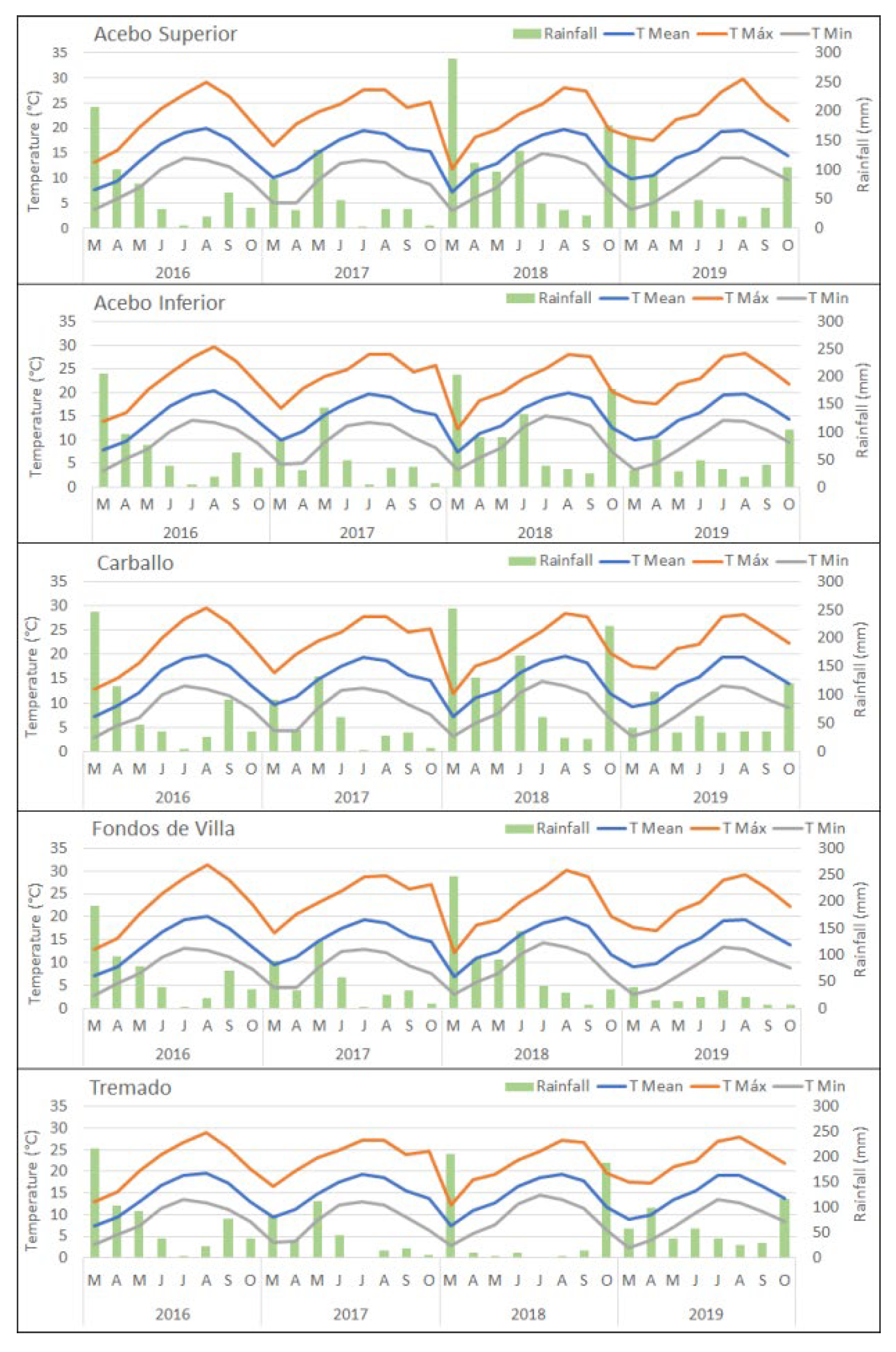
Each plot and subplot were equipped with an automatic agro-weather station (µMCR200 METOS, Pessl Instruments Ltd., Weiz, Austria) (Figure 2) for the duration of the study, which provided daily data on the following parameters: soil, air, and leaf temperature, rainfall, relative humidity, leaf wetness, solar radiation, and other variables.

2.3. Plant Material

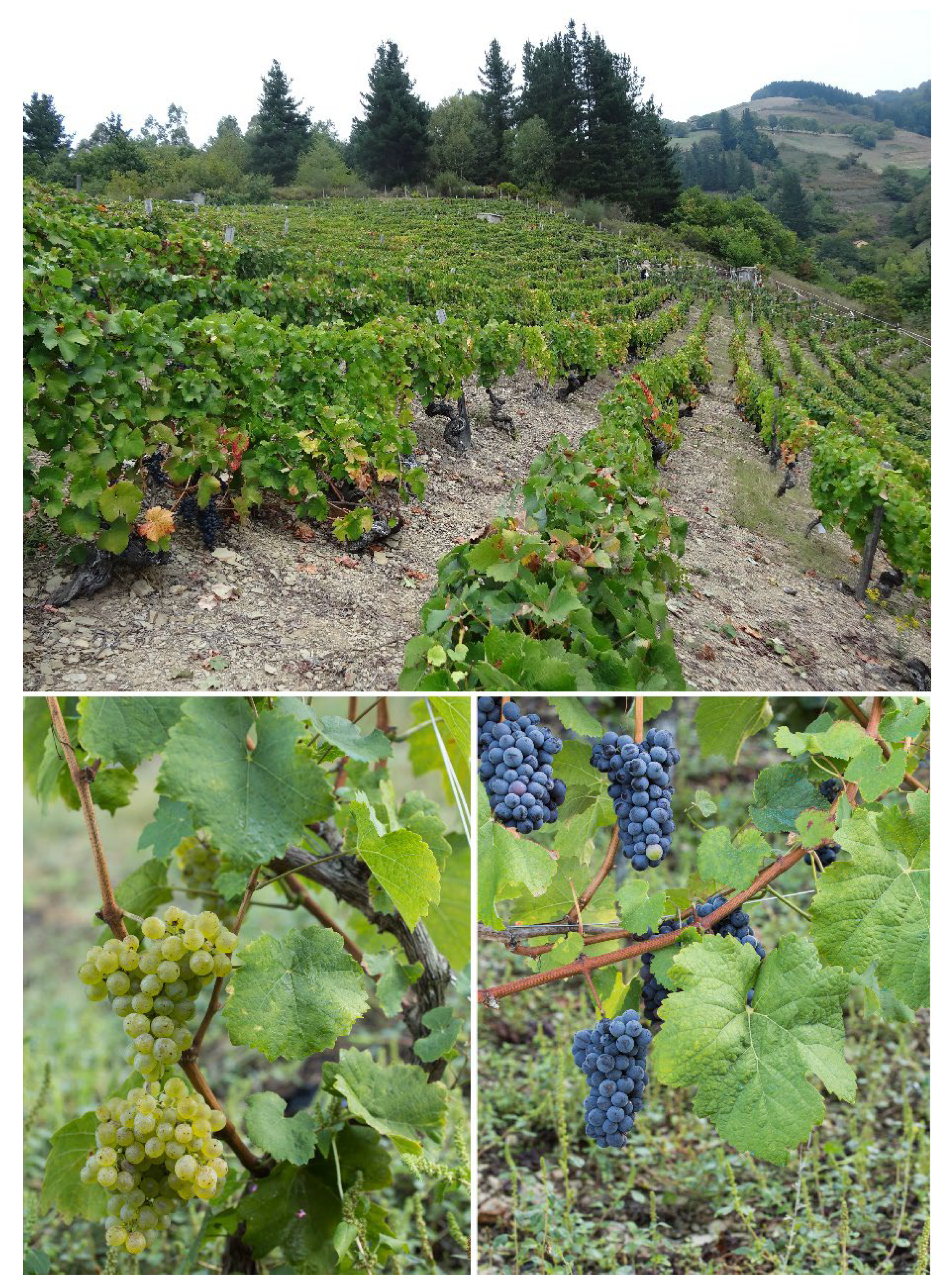
The plant material used in this study comprised a single clone of the white variety Albarín Blanco (CSIC-AS-AB01) and another of the red variety Verdejo Negro (CSIC-AS-V19), all of them grafted onto the 110-Richter rootstock. Both varieties belong to the species Vitis vinifera L., are native to the Asturian winegrowing area, and exhibit a high level of adaptation to this environment, according to previous studies by Martínez and Pérez [21,22] (Figure 3). All plots had been planted for more than 20 years when the study began. Twenty vines of each clone were marked in the different plots (Acebo Superior: N = 20 AB and 20 VN; Acebo Inferior: N = 20 VN; Tremado: N = 20 AB and 20 VN; Carballo: N = 20 AB and 20 VN), except for Fondos de Villa (N = 20 AB), which only contained the white variety. All vineyards used a vertical trellis system and Guyot pruning, typical of the region since the late 19th century. Planting density and trellis height varied slightly among plots, as it was necessary to adapt them to the topography of the terrain, as is common in mountainous viticulture areas. Four phytosanitary applications were performed throughout the vegetative cycle. The first treatment was applied during winter (February) using Captan 80% (fungicide), the second (May) and third treatments (June–July) consisted of Mikal Plus (anti-downy mildew) and Topas (anti-powdery mildew), and the fourth (August) involved Ampexio (anti-downy mildew) and Teldor (anti-Botrytis).

2.4. Agronomic and Chemical Parameters

At harvest time, the entire crop from each vine was collected separately for each variety. The weight of grapes per vine (kg) was recorded, and the number of clusters per vine was counted. For each variety and plot, twenty representative clusters were selected and taken to the laboratory, where the following parameters were measured: cluster weight (g), berry weight (g), must yield (%), probable must alcohol content (°Baumé), total must acidity (g/L tartaric acid), and must pH.

2.5. Hplc-Ms and Ms/Ms Polyphenol Analyses

The musts were diluted 50% with deionized water (1:1), transferred into vials, and analyzed using a high-performance liquid chromatograph coupled to a quadrupole time-of-flight mass spectrometer (HPLC-MS QTOF). The system consisted of an Agilent 1200 series HPLC (Agilent Technologies, Santa Clara, CA, USA), equipped with an Agilent ZORBAX Eclipse XDB-C18 column (4.6 mm × 150 mm × 5 μm) (Agilent Technologies, Santa Clara, CA, USA) at 40 °C. The mobile phase comprised water with 1% formic acid (A) and acetonitrile with 1% formic acid (B), and the elution gradient was as follows: 5% B at 0 min, 15% B at 20 min, 25% B at 30 min, 30% B at 40 min, and 5% B from 32 to 35 min. The flow rate was 1 mL/min. Flavanol identification and quantification were performed by MS and MS/MS (Q-TOF acquisition: 2 GHz, low mass range [1700 m/z], negative polarity, drying gas 10 L/min at 350 °C, sheath gas 11 L/min at 350 °C, nebulizer 45 psi, capillary voltage 4000 V, fragmentor voltage 150 V). A collision energy of 20 V was applied for all MS/MS experiments. Data acquisition and processing were carried out using Data Analysis v.B.02.01 and Qualitative Analysis v.B.04.00 MassHunter Workstation software (Agilent Technologies, Waldbroon, Germany).
Compound identification was based on exact mass and retention time compared with commercial standards. The reference standard for anthocyanins was malvidin-3-O-glucoside; for flavonoids, quercetin-3-O-glucoside; and for phenolic and hydroxybenzoic acids, caffeic acid (except gallic acid, which used its own standard). For hydrocarbons and flavanols, all monomers were quantified using (+)-catechin as the reference standard. All chemical standards used for calibration and compound identification were purchased from Cymit Química (Barcelona, Spain), and results are expressed in ng/mL of must.

2.6. Statistical Analysis

Each evaluated parameter was subjected to an analysis of variance (ANOVA) to determine whether significant differences existed, with a confidence level of 95% or 99.99%, in the performances of the same clone of Albarín Blanco and Verdejo Negro across the different plots. The F-test was applied to assess the significance of each fixed factor against its error term. Sources of variation included the different plots and years, with year considered as a random factor. All parameters showing a significant F-value in the ANOVA were further analyzed using Fisher’s protected Least Significant Difference (LSD) test for mean comparison. Both statistical analyses were performed using SAS System v9.4 [23].

3. Results and Discussion

Significant differences were observed among plots (p < 0.0001) for all parameters and for the variety/clone × year interaction. This preliminary result led us to perform statistical analyses for each year separately (Table 3, Table 4 and Table 5).
Climatic data collected by the agro-weather stations installed in each plot revealed that each site presents a specific microclimate, resulting in markedly different behaviors in the same variety—in our case, even of the same clone—across the plots. The results obtained did not allow us to establish general patterns of behavior for each variety (clone), as observed in other vineyards with uniform topography and climate [24,25,26], but they did reveal specific patterns for each variety/clone within each plot.
Soil analyses also showed that the plots differ greatly from one another despite being located very close together. This is undoubtedly related to the fact that some plots are situated on mountain slopes, where rainfall washes nutrients downslope, leaving soils poorer and shallower, whereas plots located in flatter areas at the lower parts of slopes accumulate these nutrients and have deeper, richer soils. For example, the Fondos de Villa plot, located mid-slope on a terrace-like area open to the landscape at the front and protected by a high embankment at the back, has the most basic soils, with a high percentage of organic matter and high cation exchange capacity. This plot was previously used as a vegetable garden. In contrast, the Acebo Superior subplot is located on the top of a small mountain, in an almost flat area with only a slight slope, open to the landscape and well ventilated. It has the most acidic soils, with a lower percentage of organic matter and low cation exchange capacity.
The Acebo Inferior subplot is located in a different part of the same estate where the terrain drops almost vertically toward the valley bottom, with a very steep slope, and the vine rows are practically arranged on small terraces. The soil has a loam texture and is strongly acidic, with a low percentage of organic matter and a marked cation imbalance. The vines are well ventilated and have little foliage.
The Carballo plot is situated on the mid-lower section of a mountain slope, with a moderately steep gradient, open to the valley. Its soil is loam-textured, well-drained, and moderately acidic, with optimal phosphorus and potassium levels.
Finally, the Tremado plot lies at the bottom of a valley, with a gentle slope, on land formerly used as a vegetable garden, and has relatively deep and moderately acidic soil (pH 5.5) with medium organic matter content, high phosphorus, adequate potassium, and medium magnesium levels.
The Carballo and Acebo plots (Superior and Inferior) proved to be the most favorable for producing high-quality grapes. In Carballo, Albarín Blanco showed low yields compared to studies by other authors for this variety, where up to 3 kg of grapes per vine were reported, and even compared to previous work conducted in the same plot [27]. This was mainly due to the presence of various wild fauna (primarily wild boar and occasionally bears, as well as birds and Asian hornets), which increasingly invade this plot during the two or three weeks prior to harvest, attracted by the aroma and sweetness of this variety, which under the specific conditions of this plot are particularly appealing. This is compounded by the fact, as noted by Boso et al. [28], that this plot is farther from the village houses, making it especially vulnerable to wildlife attacks today, even though it has been traditionally used for vineyard cultivation in that area.
Wildlife pressure was a key limiting factor in plots far from rural settlements and close to forested areas (Carballo and Acebo), causing crop losses of up to 90%. This pressure has increased in recent years due to changes in the agricultural landscape and the scarcity of other food sources for wild animals, highlighting the need to implement effective control measures in these areas. Conversely, Verdejo Negro grown in this plot, being a red variety with later ripening, is less attractive to wildlife, thus achieving higher yields (up to 4 kg per vine in 2017).
In the Acebo subplots, which have been dedicated to vine cultivation for centuries, Albarín Blanco in Acebo Superior reached 1.95 kg per vine in 2017 and high levels of probable alcohol (>14°) in 2018. Regarding Verdejo Negro, the Acebo Superior subplot had higher yields than Acebo Inferior, although grapes from the latter showed greater concentrations of anthocyanins and total polyphenols, likely related to the lower grape yield.
The Tremado and Fondos de Villa plots, both located in areas formerly used for vegetable crops and with no previous viticultural history, exhibited similar behavior. Both share a similar orientation and receive the least solar radiation between veraison and ripening, although some differences exist. In Fondos de Villa, Albarín Blanco vines showed strong vigor, producing abundant foliage and numerous clusters early in the vegetative cycle (flowering–fruit set), which later failed to develop due to severe Botrytis attacks, causing total crop loss in 2017 and significant reductions in 2018 and 2019. The resulting musts had low alcohol content (9.54°) and high acidity (13.07 g/L). Both the high incidence of Botrytis and the difficulty in ripening (low alcohol and high acidity) are undoubtedly related to the presence of a high embankment at the rear of the plot and excessive foliage growth, favored by deep, fertile soil. This creates a poorly ventilated environment with high humidity, promoting Botrytis development and excessive vegetative growth, which consumes plant resources and limits sugar accumulation in the grapes.
In Tremado, Albarín Blanco showed the highest yields (up to 3 kg per vine), although it also suffered Botrytis losses in 2019, as occurred in Fondos de Villa. For Verdejo Negro, yields were variable, with maximum values in 2018 and high alcohol content (14.24°) combined with low acidity in 2019, resulting in poorly balanced musts that would produce wines with limited aging potential.
Regarding polyphenols, Verdejo Negro musts consistently showed high concentrations of total polyphenols, especially anthocyanins, as expected for a red grape, except when harvested earlier from Carballo in 2017 (10.54° probable alcohol; 120 ng/mL anthocyanins). Tremado Verdejo Negro exhibited the lowest anthocyanin concentrations, markedly lower than in other plots. This lower polyphenol content may be due, as suggested by several authors [29,30,31], to the microclimate characterized by higher humidity, lower temperatures (mean, maximum, and minimum), and reduced solar radiation during the veraison–ripening period. A direct relationship was also observed between polyphenol concentration and alcohol content, and although a direct polyphenol concentration–altitude relationship has also been reported in the literature [25,32] and was suggested by some trends in our data, it was not statistically confirmed in our case. Other authors [25,32] have reported that ripening parameters (alcohol content, pH, total acidity, and anthocyanins) are linked to altitude, with higher acidity in vineyards at greater elevations. In our case, the altitude differences among plots (approximately 50 m) were too small to exert a significant effect compared to other factors such as slope, orientation, and soil characteristics. It should be noted that the cited studies were conducted in regions with much greater altitudinal gradients and more homogeneous topography, whereas our plots differ markedly in terrain and exposure. For example, although both Carballo and Acebo Superior are above 500 m, Carballo faces southwest on an open slope, while Acebo Superior lies in a relatively flat, sheltered area facing south-southeast, which strongly influences microclimate and grape composition.
In Albarín Blanco, a white variety therefore lacking anthocyanins, higher concentrations of flavonols and hydrocarbons were observed in Carballo and Acebo Superior, with values exceeding those reported in other regions. This indicates that grapes from these plots are particularly rich in polyphenols, compounds known for their antioxidant properties [15,16,17]. Furthermore, polyphenol concentration showed positive correlations with thermal amplitude, highlighting the role of microclimate in phenolic synthesis, as noted in previous studies [25,33,34,35].
Overall, the results demonstrate a clear interaction between microclimate, yield, and phenolic composition in both varieties. In Verdejo Negro, plots with greater solar exposure and steeper slopes (Acebo Inferior) exhibited lower yields and higher alcohol content, along with elevated concentrations of anthocyanins and total polyphenols. Conversely, Tremado, with lower radiation and higher humidity, showed low anthocyanin and polyphenol values even with reduced yields, despite several authors [8,36] stating that in mountain areas, lower yield per vine is associated with higher polyphenol concentration. In Albarín Blanco, phenolic compound synthesis was favored in Acebo Superior and Carballo, where solar radiation and daily thermal oscillations were more pronounced. These plots also recorded higher summer maxima and lower winter minima, which appear to have contributed to achieving flavonol and total phenolic levels above those reported in other regions. In contrast, cooler, more humid plots with less thermal amplitude (Fondos de Villa and Tremado) showed lower polyphenol concentrations. This may be due to ripening issues previously discussed for these plots, combined with greater vegetative vigor and reduced sunlight exposure. These findings confirm that these areas’ topographies determine solar exposure and, consequently, grape polyphenol content. Differences in ripening among plots require harvest date adjustments according to vineyard location and characteristics, enabling differential vinification and greater typicity. Growers must also adapt vineyard management to edaphoclimatic conditions and additional factors such as wildlife pressure in each plot to ensure good yields and optimize wine quality.
Moreover, polyphenol concentrations in musts from all plots were higher than those reported in most of the scientific literature [36,37], particularly for the white variety Albarín Blanco. This opens the possibility of commercial differentiation for white wines from mountain areas in general, and this region in particular, as numerous authors [15,16,17] have highlighted the well-known health benefits of these compounds.
Based on these results, if white wine were produced from Albarín Blanco grown in Carballo or Acebo Superior, it would likely be richer in polyphenols than most wines currently on the market. Furthermore, previous studies [15] using grapes from the same clone cultivated in Carballo (included in this study) showed that their winemaking residues (skins, seeds, and stems) contained particularly high concentrations of the polyphenolic compounds analyzed, making them a valuable raw material for producing high-value products for cosmetic, health, or food applications.
If rosé wine were produced by bleeding, as described by Boso et al. [15] for the red variety included in this study, polyphenols present in the must would be complemented by those transferred from skins and seeds—both very rich in polyphenols according to the same authors—during the hours of contact between the liquid (must) and solid (pomace) phases before fermentation. This would allow the production of rosé wines with both higher polyphenol concentrations than those currently marketed and moderate alcohol content. The residues from this vinification would be richer in polyphenols than those generated during red wine production, though slightly less rich than those from white wine vinification. These residues would also contain certain polyphenols, such as anthocyanins, absent in residues from white grapes, which are of interest for cosmetic or pharmaceutical applications.
In the case of Verdejo Negro red wine production, where pomace remains in contact with the must until fermentation ends, wines obtained from Carballo and Acebo Inferior would be particularly polyphenol-rich. However, in this case, winemaking residues would be poorer in these compounds compared to those from white or rosé vinification mentioned above.

4. Conclusions

The results obtained allow us to conclude that, overall, grapes and wines originating from mountainous viticulture areas, as well as the by-products generated during the winemaking process, exhibit a higher content of polyphenolic compounds. The polyphenol concentration can increase significantly depending on the specific plot location within mountainous cultivation zones, affecting grapes, wines, and enological residues alike. Given that the same clone of each variety was employed in all cases, alongside uniform cultivation practices, the observed differences can be attributed exclusively to microclimatic variations among the plots under investigation.

Author Contributions

Conceptualization: M.-C.M. and S.B.; methodology: M.-C.M. and S.B.; software: M.-C.M. and S.B.; validation: M.-C.M.; S.B. and J.-I.C.; formal analysis: M.-C.M. and S.B.; investigation: M.-C.M., S.B., J.-I.C., J.-L.S. and P.G.; resources: M.-C.M.; data curation: M.-C.M., S.B., J.-I.C., J.-L.S. and P.G.; writing—original draft preparation: M.-C.M. and S.B.; writing—review and editing: M.-C.M., S.B., J.-I.C., J.-L.S. and P.G.; visualization: M.-C.M., S.B., J.-I.C., J.-L.S. and P.G.; supervision: M.-C.M. and S.B.; project administration, M.-C.M.; funding acquisition: M.-C.M. All authors have read and agreed to the published version of the manuscript.

Funding

This research was supported by internal funds from the Viticulture, Olive and Rose (VIOR) Research Group, Misión Biológica de Galicia–CSIC.

Data Availability Statement

The dataset will be made available by the authors on request.

Acknowledgments

The authors thank E. Zubiaurre and Iván González for their technical assistance (CSIC). We extend our sincere gratitude for the wholly selfless collaboration of the vineyard owners and winegrowers, on whose plots this research was conducted: Bodegas Vítheras; Fernando and Lucía on the Carballo plot; José on the Tremado plot; Carmen and Joaquín on the Fondos de Villa plot; and Domingo on the Acebo plot.

Conflicts of Interest

The authors declare no conflicts of interest.

References

  1. Martínez, M.C.; López Álvarez, J. Asturias entre las regiones pioneras en la modernización de la vitivinicultura española en el siglo XIX. La labor de Anselmo González del Valle, 1878–1901. Sem. Vitivinícola 2015, 3444, 537–542. [Google Scholar]
  2. Mania, E.; Petrella, F.; Giovannozzi, M.; Piazzi, M.; Wilson, A.; Guidoni, S. Managing. Vineyard Topography and Seasonal Variability to Improve Grape Quality and Vineyard Sustainability. Agronomy 2021, 11, 1142. [Google Scholar] [CrossRef]
  3. Ferretti, C. Topoclimate and wine quality: Results of research on the Gewürztraminer grape variety in South Tyrol, northern Italy. OENO One 2021, 55, 313–335. [Google Scholar] [CrossRef]
  4. Mansour, G.; Ghanem, C.; Mercenaro, L.; Nassif, N.; Hassoun, G.; Del Caro, A. Effects of altitude on the chemical composition of grapes and wine: A review. OENO One 2022, 56, 227–239. [Google Scholar] [CrossRef]
  5. Canturk, S.; Kunter, B.; Keskin, N.; Kaya, O. Deciphering Terroirs’ Code: Vineyard Site Selection for Phenolic Performance in ‘Kalecik Karası’ Grape Cultivar (V. vinifera L.). Appl. Fruit Sci. 2024, 66, 1831–1841. [Google Scholar] [CrossRef]
  6. Ferretti, C.G.; Febbroni, S. Terroir Traceability in Grapes, Musts and Gewürztraminer Wines from the South Tyrol Wine Region. Horticulturae 2022, 8, 586. [Google Scholar] [CrossRef]
  7. Van Leeuwen, C.; Seguin, G. The concept of terroir in viticulture. J. Wine Res. 2006, 17, 1–10. [Google Scholar] [CrossRef]
  8. Rebolo Lopez, S. Estudio de la Composición Polifenólica de Vinos Tintos Gallegos con D.O: Ribeiro, Valdeorras y Ribeira Sacra; Departamento de Química Analítica, Nutrición y Bromatología, Facultad de Ciencias, Campus de Lugo, Universidad de Santiago de Compostela: Galicia, Spain, 2007. [Google Scholar]
  9. Gashu, K.; Persi, N.S.; Drori, E.; Harcavi, E.; Agam, N.; Bustan, A.; Fait, A. Temperature shift between vineyards modulates berry phenology and primary metabolism in a varietal collection of wine grapevine. Front. Plant Sci. 2020, 11, 588739. [Google Scholar] [CrossRef]
  10. Suter, B.; Destrac, A.; Gowdy, M.; Dai, Z.; Van Leeuwen, C. Adapting wine grape ripening to global change requires a multi-trait approach. Front. Plant Sci. 2021, 12, 624867. [Google Scholar] [CrossRef]
  11. Sánchez-Monfort, M.; Gracia, P.; Guasch, E.; López-Vicente, M.; Irigoyen, J.J.; Gogorcena, Y. Aptitud enológica de variedades de vid cultivadas en zonas de montaña. In Reuniones del Grupo de Trabajo de Experimentación en Viticultura y Enología Proceedings of the 34ª Reunión, Centro de Transferencia Agroalimentaria, Gobierno de Aragón, Zaragoza, Spain, 10–11 April 2019; pp. 167–173. [Google Scholar]
  12. Mezzatesta, D.S.; Berli, F.J.; Arancibia, C.; Buscema, F.; Piccoli, P.N. Impact of contrasting soils in a high-altitude vineyard of Vitis vinifera L. cv. Malbec: Root morphology and distribution, vegetative and reproductive expressions, and berry skin phenolics. OENO One 2022, 56, 135–149. [Google Scholar] [CrossRef]
  13. Daskalakis, I.; Stavrakaki, M.; Vardaka, K.; Nikolaou, S.; Koukoufiki, S.; Giannakou, T.; Bouza, D.; Biniari, K. How Altitude Affects the Phenolic Potential of the Grapes of cv. ‘Fokiano’ (Vitis vinifera L.) on Ikaria Island. Environments 2025, 12, 320. [Google Scholar] [CrossRef]
  14. Núñez-Iglesias, M.J.; Novio, S.; García, M.C.; Pérez-Muñuzuri, E.; Martínez, M.C.; Santiago, J.L.; Boso, S.; Gago, P.; Freire-Garabal, M. Co-adjuvant therapy efficacy of catechin and procyanidin B2 with docetaxel on hormone-related cancers in vitro. Int. J. Mol. Sci. 2021, 22, 7178. [Google Scholar] [CrossRef]
  15. Boso, S.; Gago, P.; Santiago, J.L.; Gago, P.; Sotelo, E.; Alvarez-Acero, I.; Martínez, M.C. Flavanol content and nutritional quality of wastes from the making of white and rose wines from mountain vineyards. Am. J. Enol. Vitic. 2022, 73, 255–265. [Google Scholar] [CrossRef]
  16. Rudrapal, M.; Rakshit, G.; Singh, R.P.; Garse, S.; Khan, J.; Chakraborty, S. Dietary polyphenols: Review on chemistry/sources, bioavailability/metabolism, antioxidant effects, and their role in disease management. Antioxidants 2024, 13, 429. [Google Scholar] [CrossRef]
  17. Jain, P.K.; Parashar, A.K.; Shrivastava, V. A review on exploring the health benefits and antioxidant properties of bioactive polyphenols. Discov. Food 2025, 5, 367. [Google Scholar] [CrossRef]
  18. Lubin, B.C.R.; Inbar, N.; Pinkus, A.; Stanevsky, M.; Cohen, J.; Rahimi, O.; Anker, Y.; Shoseyov, O.; Drori, E. Ecogeographic conditions dramatically affect trans-resveratrol and other major phenolics’ levels in wine at a semi-arid area. Plants 2022, 11, 629. [Google Scholar] [CrossRef]
  19. Wang, L.; Li, T.; Wu, C.; Gongjian, F.; Dandan, Z.; Xiaojing, L. Unlocking the potential of plant polyphenols: Advances in extraction, antibacterial mechanisms, and future applications. Food Sci. Biotechnol. 2025, 34, 1235–1259. [Google Scholar] [CrossRef]
  20. Li, J.; Yu, Q.; Liu, C.; Zhang, N.; Xu, W. Flavonoids as key players in cold tolerance: Molecular insights and applications in horticultural crops. Hortic. Res. 2025, 12, uhae366. [Google Scholar] [CrossRef]
  21. Martínez, M.C.; Pérez, J.E. The forgotten vineyard of the Asturias Princedom (North of Spain) an ampelographic description of its cultivars (Vitis viinifera L). Am. J. Enol. Vitic. 2000, 51, 370–378. [Google Scholar]
  22. Martínez, M.C.; Boso, S.; Gago, P.; Alonso-Villaverde, V.; Santiago, J.L. Viticultura de montaña en Asturias. Primeros clones certificados de dos de sus variedades autóctonas. Sem. Vitivinícola 2007, 3197, 3846–3847. [Google Scholar]
  23. SAS Institute Inc. SAS OnlineDoc, version 9.4; SAS Institute, Inc.: Cary, NC, USA, 2013. [Google Scholar]
  24. Neethling, E.; Barbeau, G.; Bonnefoy, C.; Quénol, H. Spatial variability of temperature and grapevine phenology at terroir scale in the Loire Valley. OENO One 2020, 54, 1–15. [Google Scholar]
  25. Ramos, M.C.; Martínez de Toda, F. Variability in the potential effects of climate change on phenology and on grape composition of Tempranillo in three zones of the Rioja DOCa (Spain). Eur. J. Agron. 2020, 115, 126014. [Google Scholar] [CrossRef]
  26. Cameron, B.I. Phenology and Terroir Heard Through the Grapevine. In Phenology: An Integrative Environmental Science; Schwartz, M.D., Ed.; Springer: Cham, Switzerland, 2024. [Google Scholar]
  27. Santiago, J.L.; Boso, S.; Vilanova, M.; Martínez, M.C. Characterization of cv. Albarín Blanco (Vitis vinifera L.). Synonyms, Homonyms and errors of identification. J. Int. Sci. Vigne Vin. 2005, 39, 57–65. [Google Scholar]
  28. Boso, S.; Cuevas, J.; Gago, P.; Santiago Blanco, J.L.; Martínez, M.C. La viticultura de montaña asturiana y las amenazas del entorno: Proliferación de las poblaciones de jabalíes. Enol. Mod. 2025, 79, 15. [Google Scholar]
  29. Keller, M.; Torres-Martinez, N. Does UV radiation affect winegrape composition. Acta Hortic. 2004, 640, 313–319. [Google Scholar] [CrossRef]
  30. Berli, F.J.; Alonso, R.; Beltrano, J.; Bottini, R. High-altitude solar UV-B and abscisic acid sprays increase grape berry antioxidant capacity. Am. J. Enol. Vitic. 2015, 66, 65–72. [Google Scholar] [CrossRef]
  31. Del-Castillo-Alonso, M.Á.; Monforte, L.; Tomás-Las-Heras, R.; Martínez-Abaigar, J.; Núñez-Olivera, E. To what extent are the effects of UV radiation on grapes conserved in the resulting wines. Plants 2021, 10, 1678. [Google Scholar] [CrossRef]
  32. Alikadic, A.; Pertot, I.; Eccel, E.; Dolci, C.; Zarbo, C.; Caffarra, A.; De Filippi, R.; Furlanello, C. El impacto del cambio climático en la fenología de la vid y la influencia de la altitud: Un estudio regional. Agric. For. Meteorol. 2019, 271, 73–82. [Google Scholar] [CrossRef]
  33. Castellarin, S.D.; Pfeiffer, A.; Sivilotti, P.; Degan, M.; Peterlunger, E.; Di Gaspero, G. Transcriptional regulation of anthocyanin biosynthesis in ripening fruit of grapevine under seasonal water deficit. Plant Cell Environ. 2007, 30, 1381–1399. [Google Scholar] [CrossRef]
  34. Yang, Y.; Song, C.; Falginella, L.; Castellarin, S.D. Day temperature has a stronger effect than night temperature on anthocyanin and flavonol accumulation in ‘Merlot’ (Vitis vinifera L.) grapes during ripening. Front. Plant Sci. 2020, 11, 1095. [Google Scholar] [CrossRef]
  35. Rodríguez Vuelta, A. Análisis de la Influencia de la Altitud del Viñedo Sobre los Parámetros de Maduración de la uva en la “D.O. Bierzo.” Trabajo de Fin de Grado. Bachelor’s Thesis, Universidad de La Rioja, Logroño, Spain, 2021. [Google Scholar]
  36. Brighenti, A.F.; Silva, A.L.; Brighenti, E.; Porro, D.; Stefanini, M. Viticultural performance of native Italian varieties in high-altitude conditions in Southern Brazil. Pesqui. Agropecuár. Bras. 2014, 49, 465–474. [Google Scholar] [CrossRef]
  37. Boso, S.; Gago, P.; Santiago, J.L.; Gago, P.; Sotelo, E.; Alvarez-Acero, I.; Martínez, M.C. New monovarietal grape seed oils derived from white grape bagasse generated on an industrial scale at a winemaking plant. LWT Food Sci. Technol. 2018, 92, 388–394. [Google Scholar] [CrossRef]
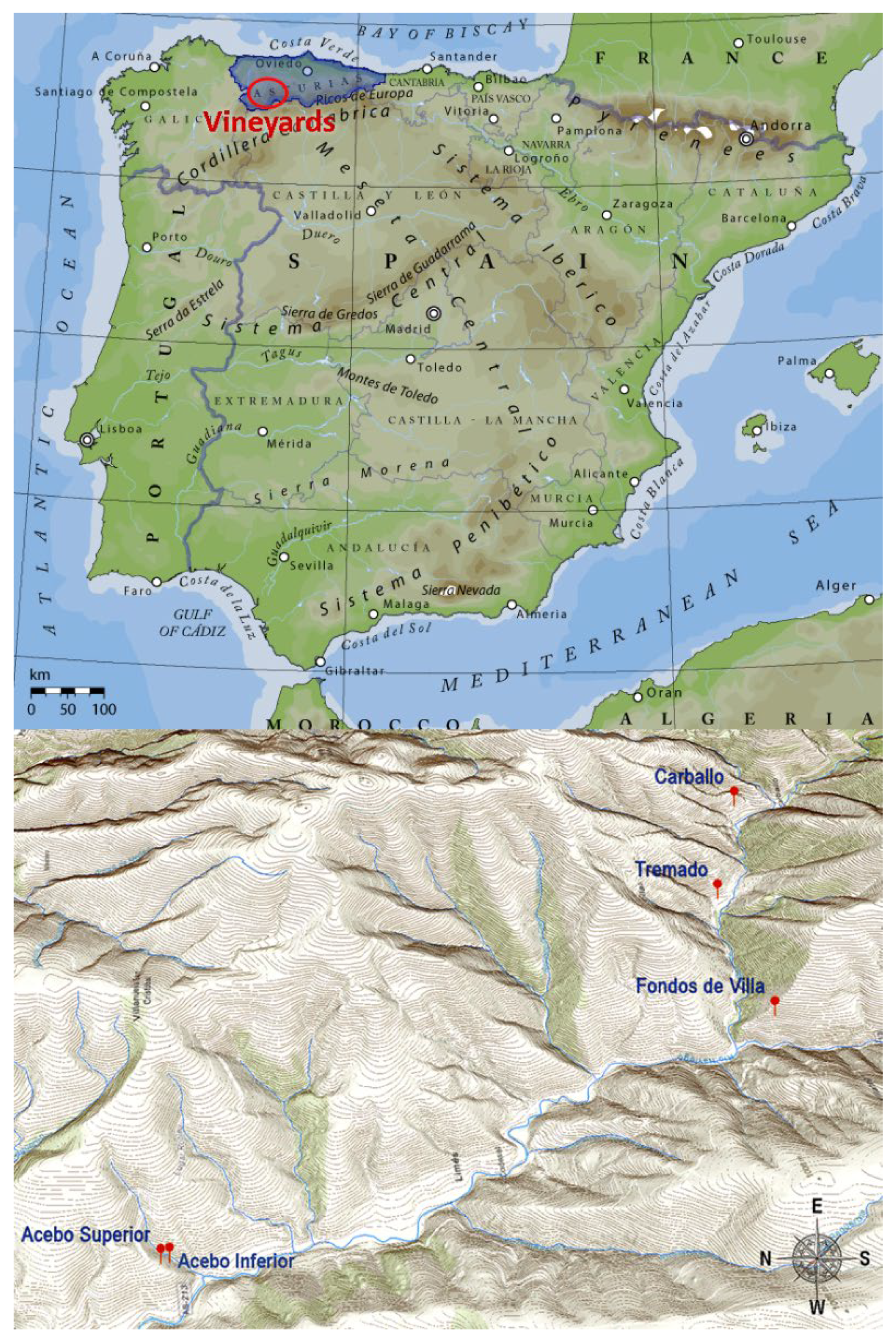
Figure 1. Location of the Asturian vineyards (municipality of Cangas del Narcea) on the Iberian Peninsula and position of the studied plots. VIOR/MBG-CSIC. (2026), 1:35,000. ESRI: World topographic map (FAO, NOAA, USGS). SIPTA IDEAS (Sistema de información territorial e infraestructuras de datos espaciales de Asturias). ArcGIS Pro 3.6.
Agriculture 16 00285 g001
Figure 2. Climatic data for average, maximum, and minimum temperatures and precipitation in the Acebo Superior, Acebo Inferior, Carballo, Fondos de Villa, and Tremado plots from 2017 to 2019.
Agriculture 16 00285 g002
Figure 3. White and red varieties Albarín Blanco and Verdejo Negro. Details of the vines, training system, and pruning in one of the studied plots.
Agriculture 16 00285 g003
Table 1. Altitudes, orientations, and number of vines per clone in the studied plots.
PlotsAltitude (m)OrientationTopographyAlbarín Blanco CloneVerdejo Negro Clone
Acebo Superior495South-SoutheastFlat2020
Acebo Inferior475South-SoutheastSteep slope 20
Carballo529SouthwestSteep slope2020
Fondos de Villa548WestFlat20
Tremado473SouthwestGentle slope2020
Table 2. Soil chemical parameters analyzed in the studied plots.
Soil Parameter/PlotAcebo Superior (Albarín Blanco,
Verdejo Negro)
Acebo
Inferior
(Verdejo
Negro)
Carballo
(Albarín Blanco)
Carballo
(Verdejo Negro)
Fondos de Villa
(Albarín Blanco)
Tremado
(Albarín
Blanco,
Verdejo
Negro)
Soil chemicals
pH H2O (1:2.5)4.64.45.46.87.45.5
pH KCl (1:2.5)3.53.74.25.86.74.4
Organic matter (%)2.82.73.23.56.83.5
Exchange acidity (cmol(+) kg−1)n.d.n.d.n.d.n.d.n.d.n.d.
Available phosphorus (ppm)289644687287
Assimilable potassium (ppm)94122186376632288
Exchangeable magnesium20104628014086
Ca/Mg2263179
K/Mg1.53.81.30.41.41.0
Ca:Mg:K43:23:3434:14:5273:12:1570:21:0987:05:0781:09:10
Granulometric analysis
CG * (%) 2–0.2 mm21.2822.7534.9432.7535.5828.01
FS (%) 0.2–0.05 mm16.7914.9315.3514.9811.7614.47
CSi (%) 0.05–0.02 mm8.297.646.327.695.597.66
FSi (%) 0.02–0.002 mm34.4330.8622.3121.0829.2828.85
Clay (%) < 0.002 mm19.2123.8221.0820.9917.7921.01
Sand (%) 2–0.05 mm38.0737.6850.2847.7247.3442.27
Silt (%) 0.05–0.002 mm42.7238.5028.6331.2934.8736.51
TextureLoamLoamLoamLoamLoamLoam
(*) CG: coarse sand; FS: fine sand; CSi: coarse silt; FSi: fine silt; Cl: clay; n.d.: not detected.
Table 3. Agronomic parameters measured for each study year across the different plots/areas assessed.
201720182019
PlotsKg of Grape/
Vine
n = 20
Total Number of Clusters/Vine
n = 20
Cluster Weight (g) n = 10Berry Weight (g)
n = 30
Kg of Grape/
Vine
n = 20
Total Number of Clusters/Vine
n = 20
Cluster Weight (g) n = 10Berry Weight (g)
n = 30
Kg of Grape/Vine n = 20Total Number of Clusters/Vine
n = 20
Cluster Weight (g) n = 10Berry Weight (g)
n = 30
VERDEJO NEGROAcebo Inferior0.87 c *14.15 b118.87 b1.65 c0.17 c8.75 c56.29 b1.87 c0.48 b11.15 c120.08 b2 b
Acebo Superior2.27 b16.83 b196.03 a2.05 b0.42 c19.77 a93.33 b2.23 b1.3 b19.31 b150.47 ab2.35 a
Carballo4.02 a27.32 a228.18 a2.47 a1.19 b14.42 b148.17 a2.38 b2.94 a24.94 a180.45 a2.15 ab
Tremado0.67 c5.45 c176.09 a2.25 ab1.69 a13.8 b179.74 a2.64 a0.8 b9.52 c145.12 ab2.22 ab
LSD (0.05)0.865.7452.510.260.404.4239.780.240.844.8338.890.22
ALBARÍN BLANCOAcebo Superior1.95 a17.2 a110.09 b2.16 a0.22 c10.9 b62.74 b1.8 c0.92 a16.05 a159.99 a2.08 b
Carballo0.8 b8.25 b154.16 ab1.94 a0.54 b7.89 a65.74 b2 b0.51 b9.65 c121.1 b2.5 a
Fondos de Villa....0.35 c7.6 b185.31 a1.92 bc0.21 c7.05 b90.6 c2.38 a
Tremado1.11 b6.7 b174.84 a2.19 a1.17 a10.7 ab201.69 a2.45 a0.42 b7.1 c134.32 ab2.34 a
LSD (0.05) *0.543.9360.140.280.313.5051.160.190.283.4929.330.21
* LSD: Least Significant Difference. Means followed by the same letter, for each column and each parameter, do not differ significantly.
Table 4. Chemical parameters analyzed in the studied plots.
201720182019
VineyardPotential Alcohol (°Baume) n = 10Total Acidity (g/L Tartaric Acid)
n = 10
pH
n = 10
Juice Yield (%)
n = 10
Potential Alcohol (°Baume)
n = 10
Total Acidity (g/L Tartaric Acid)
n = 10
pH
n = 10
Juice Yield (%) n = 10Potential Alcohol (°Baume)
n = 10
Total Acidity (g/L Tartaric Acid)
n = 10
pH
n = 10
Juice Yield (%) n = 10
VERDEJO NEGROAcebo Inferior12.28 a *5.12 c3.18 c28.63 bc15.42 a8.77 a3.41 a27.08 ab14.14 a5.19 b3.23 b41.32 b
Acebo Superior10.56 c6.36 b3.07 d33.24 a13.79 ab7.33 b3.39 ab31.68 a12.05 c4.79 c3.13 c46.12 a
Carballo10.54 c6.77 a3.23 b24.63 c13.41 abc6.61 c3.34 c23.16 b12.73 b6.30 a3.21 bc35.07 cd
Tremado11.48 b6.43 ab3.3 a32.76 ab11.27 c6.49 c3.64 bc31.68 a14.24 a4.35 d3.41 a32.65 d
LSD (0.05)0.700.360.034.372.430.360.035.560.290.300.032.96
ALBARÍN BLANCOAcebo Superior11.38 b6.25 c3.11 b34.64 b14.06 d7.11 ab3.24 a36.22 d12.28 b8.28 c3.00 d54.17 a
Carballo12.18 a7.45 b3.25 a32.48 b11.63 c9.56 a3.36 b29.51 b13.35 a9.02 b3.15 b41.25 c
Fondos de Villa....9.54 a13.07 b3.18 a35.39 a12.96 b10.69 a3.08 c43.51 b
Tremado10.28 c9.74 a3.03 c38.64 a11.99 c8.62 ab3.22 c24.5212.98 b8.25 c3.23 a41.17 c
LSD (0.05)0.730.980.072.190.570.143.530.570.230.330.032.83
* LSD: Least Significant Difference. Means followed by the same letter, for each column and each parameter, do not differ significantly.
Table 5. Polyphenolic parameters analyzed in the studied plots.
PlotsTotal Anthocyanins (ng/mL) n = 5Total Flavonols (ng/mL) n = 5Total Phenolics (ng/mL) n = 5Total Hydrocarbons (ng/mL) n = 5Total Polyphenols (ng/mL) n = 5
VERDEJO NEGRO2017Acebo Inferior4762.49 a *1440.67 a4020.01 ab010,223.18 a
Acebo Superior256.02 b289.2 bc4854.77 ab05400.00 b
Carballo120.00 b129.52 c3192.53 b03442.05 b
Tremado110.00 b456.97 b5101.82 a05668.8 b
LSD (0.05) *1662.60232.212645.500.003689.90
2018Acebo Inferior2229.02 ab1075.57 a3744.36 a0.00 b7705.32 ab
Acebo Superior1692.54 b1017.02 a3266.56 a0.00 b6405.00 ab
Carballo25,903.19 a531.02 b2807.9 ab211.63 a29,613.16 a
Tremado675.88 b253.84 b1545.1 b0.00 b2474.83 b
LSD (0.05)24,174.00458.321718.30208.5523,217.00
2019Acebo Inferior308.79 a585.44 a5589.79 a0.00 a6484.03 a
Acebo SuperiorND225.93 b5916.88 a0.00 a6142.81 a
Carballo4782.61 a244.42 b6640.06 a14.57 a11,681.66 a
Tremado141.51 a304.55 b6269.57 a0.00 a6715.63 a
LSD (0.05)126,302.00122.901711.00114.9433,510.00
ALBARÍN BLANCO2017Acebo Superior0470.87 a5638.14 a06109.01 a
Carballo0461.53 a8708.7 a09170.23 a
Fondos de Villa0....
Tremado0195.44 b6550.42 a06745.87 a
LSD (0.05)0221.574254.500.004226.10
2018Acebo Superior0612.66 a24,706.33 a152.37 a25,471.36 a
Carballo0112.71 b5479.40 b31.24 b5623.34 b
Fondos de Villa0128.05 b7745.62 b0.00 b7873.67 b
Tremado0248.31 b14,382.63 ab0.00 b14,630.94 ab
LSD (0.05)0224.7810,865.00121.0610,938.00
2019Acebo Superior0327.92 ab3079.92 a157.39 a3565.23 a
Carballo0397.81 a3884.60 a155.95 a4438.36 a
Fondos de Villa039.08 b1618.97 a22.73 a1680.78 a
Tremado037.40 b1898.02 a53.76 a1989.19 a
LSD (0.05)0299.383001.80199.723165.00
* LSD: Least Significant Difference. Means followed by the same letter, for each column and each parameter, do not differ significantly. ND: not detected.
Disclaimer/Publisher’s Note: The statements, opinions and data contained in all publications are solely those of the individual author(s) and contributor(s) and not of MDPI and/or the editor(s). MDPI and/or the editor(s) disclaim responsibility for any injury to people or property resulting from any ideas, methods, instructions or products referred to in the content.