Recruitment of Predator Cheilomenes sexmaculata by Active Volatiles from Lemon Plants Infested with Frankliniella intonsa


Abstract
1. Introduction
2. Materials and Methods
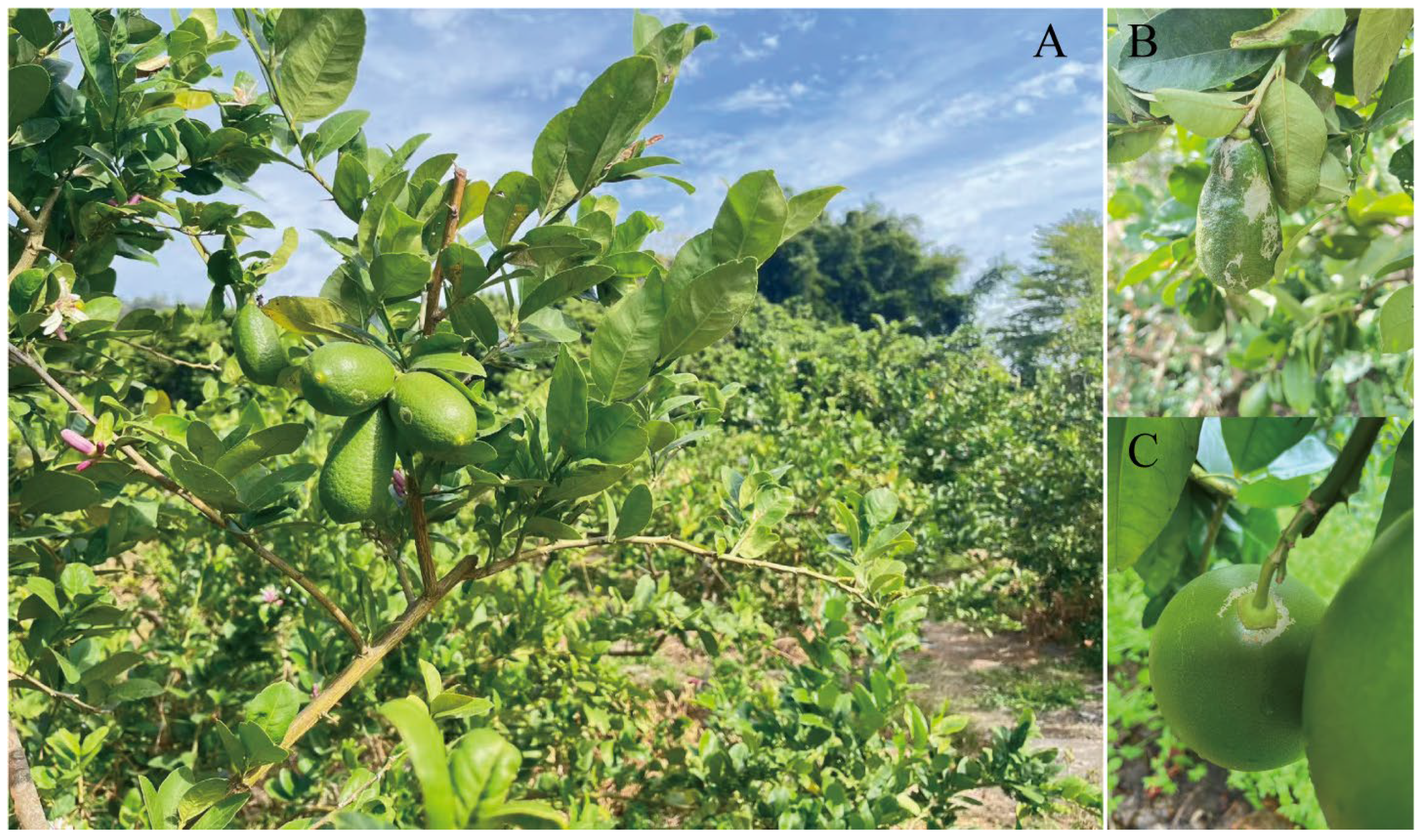
2.1. Insects and Plants
2.2. Dual-Choice Behavioral Assay
2.3. Collection and Analysis of Headspace Plant Volatiles
2.4. Behavioral Responses to Individual HIPVs and Synthetic Blends
2.5. Statistical Analysis
3. Results
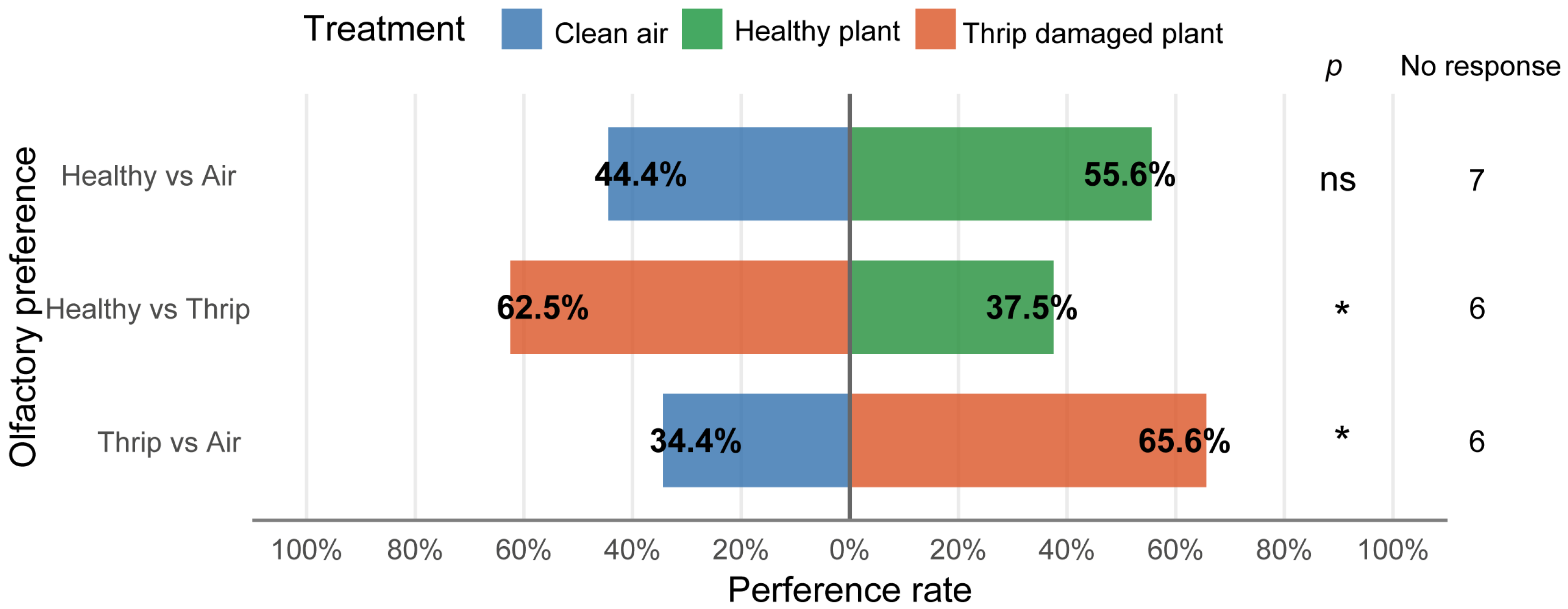
3.1. Olfactory Response of C. sexmaculata to Plant Volatiles
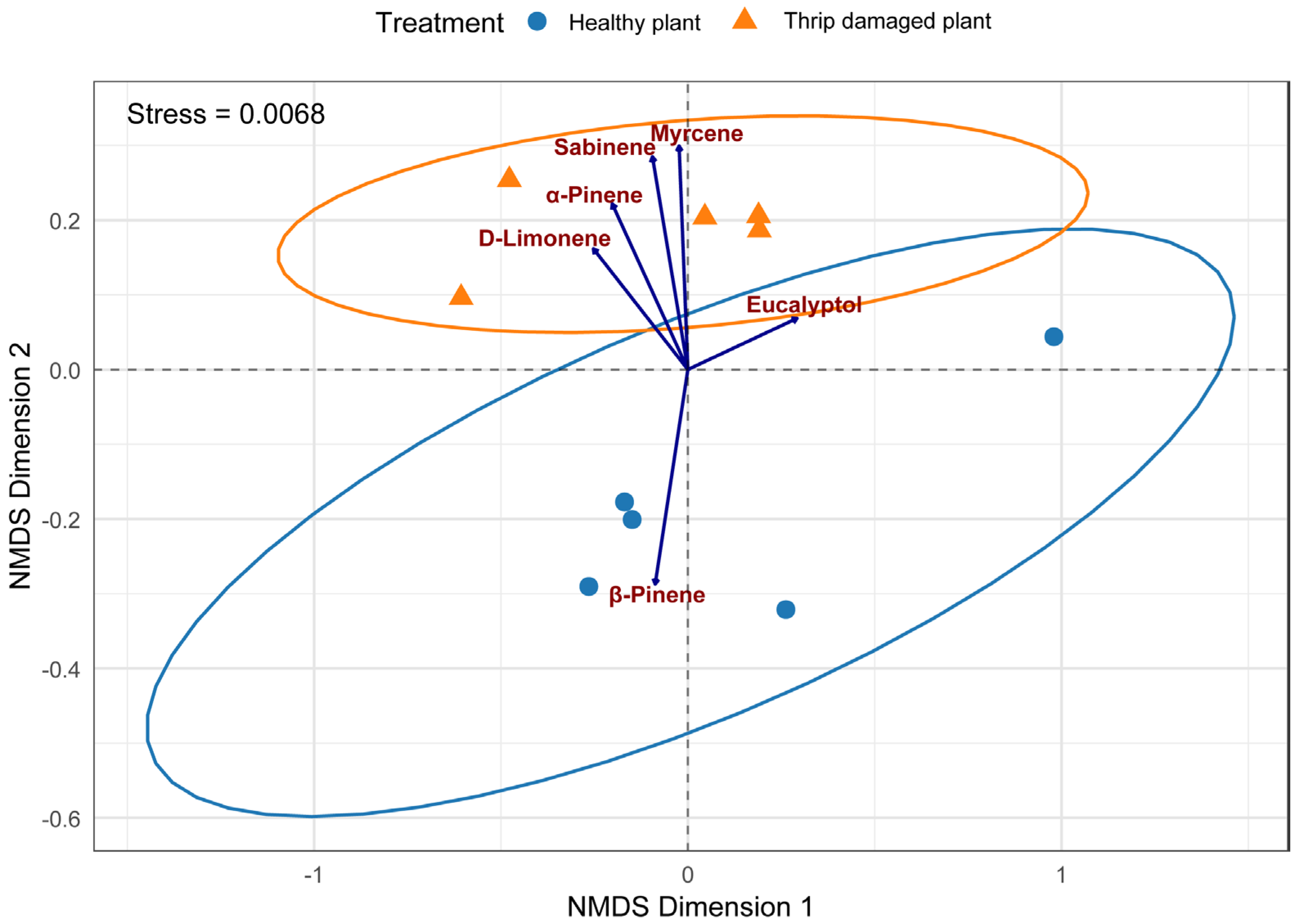
3.2. Identification and Analysis of Volatiles from Lemon Plants in Different Treatments
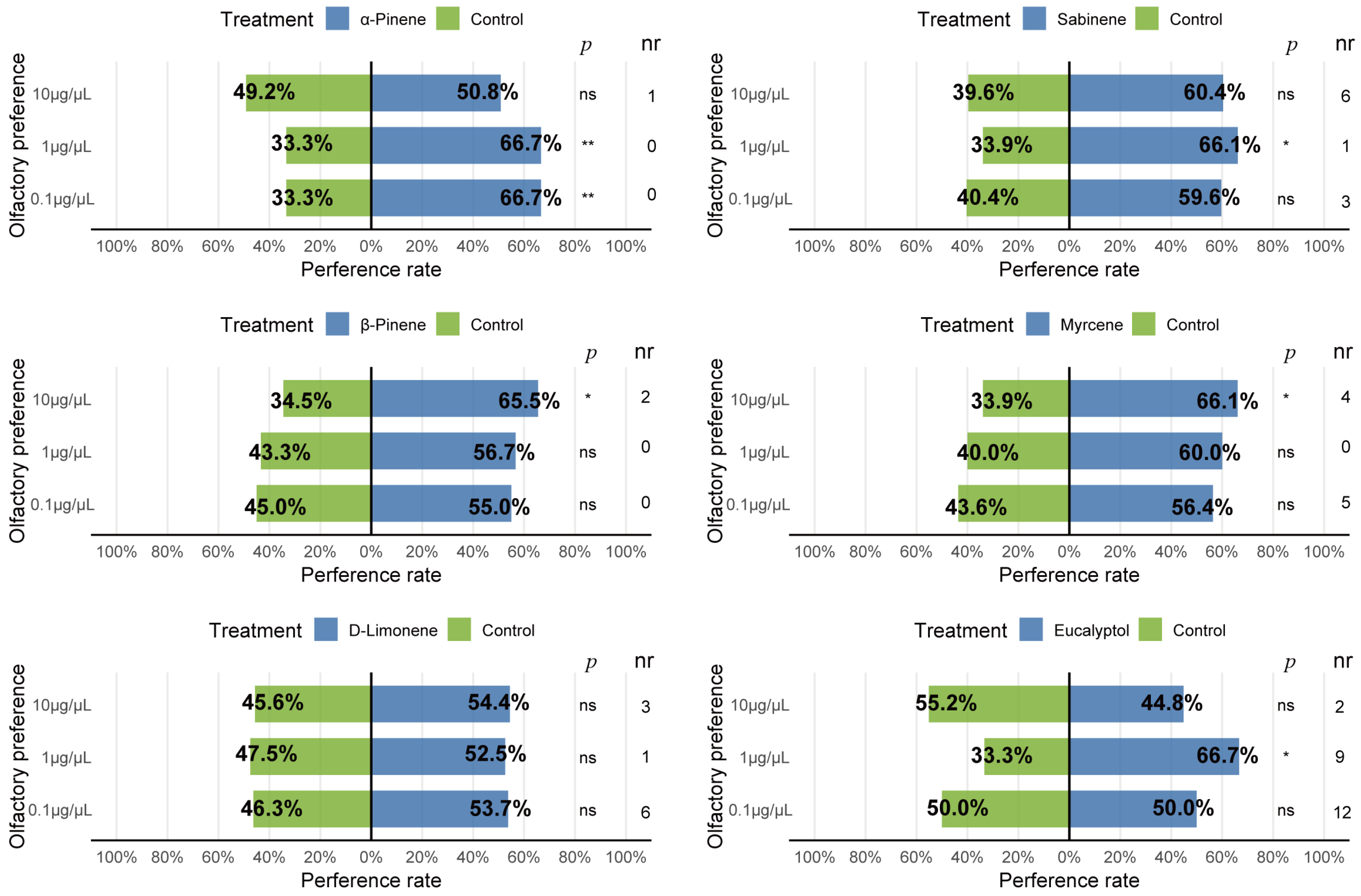
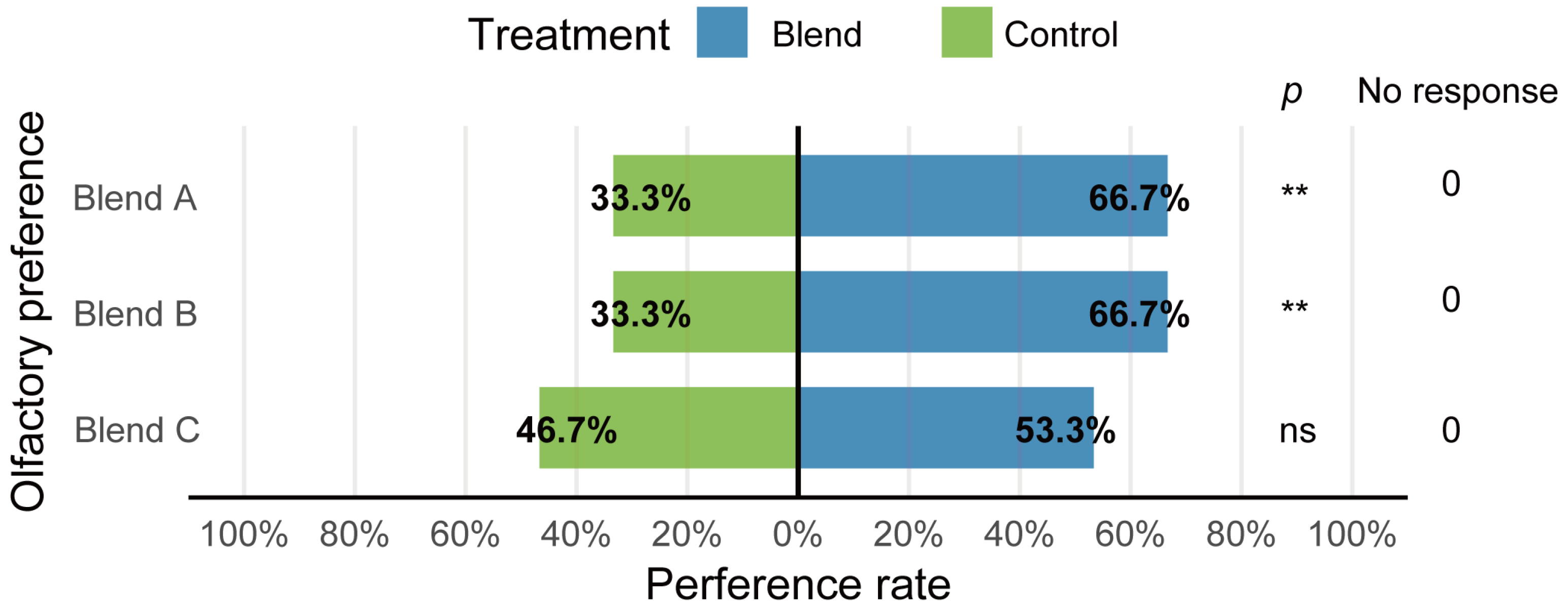
3.3. Behavioral Responses of C. sexmaculata to Detected Compounds and Synthetic Compounds
4. Discussion
5. Conclusions
Author Contributions
Funding
Institutional Review Board Statement
Data Availability Statement
Conflicts of Interest
References
- Vono, G.; Bonsignore, C.P.; Marullo, R. A Comprehensive Thrips Species Assessment for Eco-Consistent Management of Infestations in Mediterranean Citrus Crops. Horticulturae 2022, 8, 137. [Google Scholar] [CrossRef]
- Grafton-Cardwell, E.E.; O’Connell, N.V.; Kallsen, C.E.; Morse, J.G. Photographic Guide to Citrus Fruit Scarring; University of California Agriculture and Natural Resources Publications: Davis, CA, USA, 2003. [Google Scholar]
- Zhang, J.; Huang, P.; Hou, X.; Pan, Y.; Yao, J.; Yu, D. Infestation, Population Dynamics, and Host Preference of Thrips on Flowering Pummelo Plants. Fujian J. Agric. Sci. 2024, 39, 1198–1204. [Google Scholar]
- Xu, S.; Zhang, H.; Xie, Y.; Zhao, Y.; Li, Z. Species and Seasonal Population Fluctuation of Thrips on Citrus. J. Yunnan Agric. Univ. (Nat. Sci.) 2012, 27, 170–175. [Google Scholar]
- Steenbergen, M.; Abd-El-Haliem, A.; Bleeker, P.; Dicke, M.; Escobar-Bravo, R.; Cheng, G.; Haring, M.A.; Kant, M.R.; Kappers, I.; Klinkhamer, P.G.L.; et al. Thrips Advisor: Exploiting Thrips-Induced Defences to Combat Pests on Crops. J. Exp. Bot. 2018, 69, 1837–1848. [Google Scholar] [CrossRef] [PubMed]
- Mockford, A.; Urbaneja, A.; Ashbrook, K.; Westbury, D.B. Wildflower Strips Enhance Pest Regulation Services in Citrus Orchards. Agric. Ecosyst. Environ. 2024, 370, 109069. [Google Scholar] [CrossRef]
- Urbaneja, A.; Ciancio, A.; Droby, S.; Hoddle, M.; Liu, J.; Tena, A. Recent Advances in Biological Control of Citrus Pests and Diseases. Biol. Control 2023, 184, 105271. [Google Scholar] [CrossRef]
- Tang, L.D.; Guo, L.H.; Wu, J.H.; Zang, L.S. Thrips in Genus Megalurothrips (Thysanoptera: Thripidae): Biodiversity, Bioecology, and IPM. J. Integr. Pest Manag. 2023, 14, 8. [Google Scholar] [CrossRef]
- Hua, L.; Zhao, D.; Wang, H.; Wei, T. Residues and Bioavailability of Neonicotinoid Pesticide in Shaanxi Agricultural Soil. Water Air Soil Pollut. 2023, 234, 129. [Google Scholar] [CrossRef]
- Douglas, M.R.; Rohr, J.R.; Tooker, J.F. Neonicotinoid Insecticide Travels through a Soil Food Chain, Disrupting Biological Control of Non-Target Pests and Decreasing Soya Bean Yield. J. Appl. Ecol. 2015, 52, 250–260. [Google Scholar] [CrossRef]
- Calvo-Agudo, M.; González-Cabrera, J.; Picó, Y.; Calatayud-Vernich, P.; Urbaneja, A.; Dicke, M.; Tena, A. Neonicotinoids in Excretion Product of Phloem-Feeding Insects Kill Beneficial Insects. Proc. Natl. Acad. Sci. USA 2019, 116, 16817–16822. [Google Scholar] [CrossRef]
- McClure, M.; Herreid, J.; Jabbour, R. Insecticide Application Timing Effects on Alfalfa Insect Communities. J. Econ. Entomol. 2023, 116, 815–822. [Google Scholar]
- Dunn, L.; Latty, T.; Van Ogtrop, F.F.; Tan, D.K.Y. Cambodian Rice Farmers’ Knowledge, Attitudes, and Practices (KAPs) Regarding Insect Pest Management and Pesticide Use. Int. J. Agric. Sustain. 2023, 21, 2178804. [Google Scholar] [CrossRef]
- Wyckhuys, K.A.G.; Bushley, K.; Gratton, C.; Gurr, G.M.; Pozsgai, G.; Tscharntke, T.; Wanger, T.C.; Lu, Y.; Elkahky, M. Restoring Functional Farmland Biodiversity for Biological Pest Control. Trends Plant Sci. 2025, 30, 1097–1110. [Google Scholar] [CrossRef] [PubMed]
- Niu, J.Z.; Hull-Sanders, H.; Zhang, Y.X.; Lin, J.Z.; Dou, W.; Wang, J.J. Biological Control of Arthropod Pests in Citrus Orchards in China. Biol. Control 2014, 68, 15–22. [Google Scholar] [CrossRef]
- Zhang, H.; Sun, L.; Lin, S.; He, Y.; Wei, H.; Chen, X. Comparative Fitness of Proprioseiopsis asetus (Acari: Phytoseiidae) as a Biocontrol Agent against Megalurothrips usitatus and Thrips flavus. Exp. Appl. Acarol. 2025, 95, 17. [Google Scholar] [CrossRef]
- Fidelis, E.G.; Querino, R.B.; Adaime, R. The Amazon and Its Biodiversity: A Source of Unexplored Potential Natural Enemies for Biological Control (Predators and Parasitoids). Neotrop. Entomol. 2023, 52, 152–171. [Google Scholar]
- Tang, L.; Zang, L. Research Progress on Biology, Ecology and Biological Control of Cheilomenes sexmaculata (Coleoptera: Coccinellidae). Chin. J. Biol. Control 2023, 39, 697–709. [Google Scholar]
- Li, S.; Fu, B.; Qiu, H.; Yang, S.; Ma, X.; Zhou, S.; Tang, L.; Zhang, F.; Liu, K. The Predation of Menochilus sexmaculata (Coleoptera: Coccinellidae) to Thrips hawaiiensis (Thysanoptera: Thripoidae) in the Laboratory. Chin. J. Appl. Entomol. 2020, 57, 1173–1180. [Google Scholar]
- Heil, M. Indirect Defence via Tritrophic Interactions. New Phytol. 2008, 178, 41–61. [Google Scholar] [CrossRef]
- Turlings, T.C.J.; Erb, M. Tritrophic Interactions Mediated by Herbivore-Induced Plant Volatiles: Mechanisms, Ecological Relevance, and Application Potential. Annu. Rev. Entomol. 2018, 63, 433–452. [Google Scholar] [CrossRef]
- Adams, R.M.M.; Wells, R.L.; Yanoviak, S.P.; Frost, C.J.; Fox, E.G.P. Interspecific Eavesdropping on Ant Chemical Communication. Front. Ecol. Evol. 2020, 8, 449074. [Google Scholar] [CrossRef]
- Ebrahim, S.A.M.; Dweck, H.K.M.; Weiss, B.L.; Carlson, J.R. A Volatile Sex Attractant of Tsetse Flies. Science 2023, 379, eade1877. [Google Scholar] [CrossRef] [PubMed]
- Takabayashi, J.; Shiojiri, K. Multifunctionality of Herbivory-Induced Plant Volatiles in Chemical Communication in Tritrophic Interactions. Curr. Opin. Insect Sci. 2019, 32, 110–117. [Google Scholar] [CrossRef] [PubMed]
- Engelberth, J.; Alborn, H.T.; Schmelz, E.A.; Tumlinson, J.H. Airborne Signals Prime Plants against Insect Herbivore Attack. Proc. Natl. Acad. Sci. USA 2004, 101, 1781–1785. [Google Scholar] [CrossRef]
- Khallaf, M.A.; Sadek, M.M.; Anderson, P. Predator Efficacy and Attraction to Herbivore-Induced Volatiles Determine Insect Pest Selection of Inferior Host Plant. iScience 2023, 26, 106077. [Google Scholar] [CrossRef]
- Robert, C.A.M.; Erb, M.; Duployer, M.; Zwahlen, C.; Doyen, G.R.; Turlings, T.C.J. Herbivore-Induced Plant Volatiles Mediate Host Selection by a Root Herbivore. New Phytol. 2012, 194, 1061–1069. [Google Scholar] [CrossRef]
- Ayelo, P.M.; Yusuf, A.A.; Pirk, C.W.W.; Mohamed, S.A.; Chailleux, A.; Deletre, E. The Role of Trialeurodes vaporariorum-Infested Tomato Plant Volatiles in the Attraction of Encarsia formosa (Hymenoptera: Aphelinidae). J. Chem. Ecol. 2021, 47, 192–203. [Google Scholar] [CrossRef]
- Jiang, X.; Zhao, L.; Sergers, A.; Chang, C.; Zhang, X.; Ju, Q.; Ge, F. Herbivore-Induced Plant Volatiles (HIPVs) from Companion Plant Could Enhance Predator Recruitment and Biocontrol of Cereal Aphids. Entomol. Gen. 2025, 45, 1067–1077. [Google Scholar]
- Ayelo, P.M.; Mohamed, S.A.; Chailleux, A.; Yusuf, A.A.; Pirk, C.W.W.; Deletre, E. The Parasitoid Dolichogenidea gelechiidivoris Eavesdrops on Semiochemicals from Its Host Tuta absoluta and Tomato. J. Pest Sci. 2021, 95, 633–652. [Google Scholar] [CrossRef]
- Russavage, E.M.; Hewlett, J.A.; Grunseich, J.M.; Szczepaniec, A.; Rooney, W.L.; Helms, A.M.; Eubanks, M.D. Aphid-Induced Volatiles and Subsequent Attraction of Natural Enemies Varies among Sorghum Cultivars. J. Chem. Ecol. 2024, 50, 262–275. [Google Scholar] [CrossRef]
- Valle, D.; Mujica, V.; Gonzalez, A. Herbivore-Dependent Induced Volatiles in Pear Plants Cause Differential Attractive Response by Lacewing Larvae. J. Chem. Ecol. 2023, 49, 262–275. [Google Scholar] [CrossRef]
- Premawardhane, J.C.; Ueno, T. Behavioral Response of Coccinella septempunctata (L.) (Coleoptera: Coccinellidae) to Plant Volatiles Infested by a Chewing Herbivore, Epilachna vigintioctopunctata versus a Sucking Pest, Aphis gossypii. J. Entomol. Zool. Stud. 2024, 12, 224–231. [Google Scholar] [CrossRef]
- Zhang, J.; Huang, P.; Pan, Y.; Zhao, Y.; Yao, J.; Yu, D. Imidacloprid Soil Drenches Indirectly Weaken the Selection and Predatory Ability of the Coccinellid Predator Propylea japonica (Coleoptera: Coccinellidae). Sci. Rep. 2025, 15, 28316. [Google Scholar] [CrossRef]
- Cook, S.M.; Khan, Z.R.; Pickett, J.A. The Use of Push-Pull Strategies in Integrated Pest Management. Annu. Rev. Entomol. 2007, 52, 375–400. [Google Scholar] [CrossRef] [PubMed]
- da Silva, V.F.; dos Santos, A.; Silveira, L.C.P.; Tomazella, V.B.; Ferraz, R.M. Push-Pull Cropping System Reduces Pests and Promotes the Abundance and Richness of Natural Enemies in Brassica Vegetable Crops. Biol. Control 2022, 166, 104832. [Google Scholar] [CrossRef]
- Rakshith, H.S.; Suroshe, S.S.; Nebapure, S.M.; Chander, S.; Kumari, S. Behavioural Response of Coccinella transversalis to the Volatiles from Aphis craccivora and Cowpea. Indian J. Entomol. 2018, 80, 1331–1337. [Google Scholar] [CrossRef]
- Yasa, V.; Suroshe, S.S.; Nebapure, S.M. Behavioral Response of Zigzag Ladybird Beetle Cheilomenes sexmaculata to the HIPVs Induced by Cotton Aphid, Aphis gossypii. Arthropod-Plant Interact. 2024, 18, 771–780. [Google Scholar] [CrossRef]
- Rioja, T.; Ceballos, R. Citrus Volatiles Induced by Herbivory of Aleurothrixus floccosus (Hemiptera: Aleyrodidae) Elicit Attraction to the Exotic Ladybird Clitostethus arcuatus (Coleoptera: Coccinellidae). Chil. J. Agric. Res. 2024, 84, 181–194. [Google Scholar] [CrossRef]
- Oliveira, M.S.; Pareja, M. Attraction of a Ladybird to Sweet Pepper Damaged by Two Aphid Species Simultaneously or Sequentially. Arthropod-Plant Interact. 2014, 8, 547–555. [Google Scholar]
- Norkute, M.; Olsson, U.; Ninkovic, V. Aphids-Induced Plant Volatiles Affect Diel Foraging Behavior of a Ladybird Beetle Coccinella septempunctata. Insect Sci. 2020, 27, 1266–1275. [Google Scholar] [CrossRef]
- Xiu, C.; Zhang, W.; Xu, B.; Wyckhuys, K.A.G.; Cai, X.; Su, H.; Lu, Y. Volatiles from Aphid-Infested Plants Attract Adults of the Multicolored Asian Lady Beetle Harmonia axyridis. Biol. Control 2019, 129, 1–11. [Google Scholar] [CrossRef]
- Wasternack, C. How Jasmonates Earned Their Laurels: Past and Present. J. Plant Growth Regul. 2015, 34, 761–794. [Google Scholar] [CrossRef]
- De Backer, L.; Megido, R.C.; Fauconnier, M.L.; Brostaux, Y.; Francis, F.; Verheggen, F. Tuta absoluta-Induced Plant Volatiles: Attractiveness towards the Generalist Predator Macrolophus pygmaeus. Arthropod-Plant Interact. 2015, 9, 465–476. [Google Scholar] [CrossRef]
- Silva, D.B.; Weldegergis, B.T.; Van Loon, J.J.A.; Bueno, V.H.P. Qualitative and Quantitative Differences in Herbivore-Induced Plant Volatile Blends from Tomato Plants Infested by Either Tuta absoluta or Bemisia tabaci. J. Chem. Ecol. 2017, 43, 53–65. [Google Scholar] [CrossRef]
- Ayelo, P.M.; Yusuf, A.A.; Pirk, C.W.W.; Chailleux, A.; Mohamed, S.A.; Deletre, E. Terpenes from Herbivore-Induced Tomato Plant Volatiles Attract Nesidiocoris tenuis (Hemiptera: Miridae), a Predator of Major Tomato Pests. Pest Manag. Sci. 2021, 77, 5255–5267. [Google Scholar] [CrossRef]
- Jiang, Y.; Xiu, C.; Pan, H.; Liu, X. Recruitment of Hippodamia variegata by Active Volatiles from Glycyrrhiza uralensis and Alhagi sparsifolia Plants Infested with Aphis atrata. Pest Manag. Sci. 2024, 80, 355–365. [Google Scholar] [CrossRef]
- Zhao, J.; Wang, Z.; Li, Z.; Shi, J.; Meng, L.; Wang, G.; Cheng, J.; Du, Y. Development of Lady Beetle Attractants from Floral Volatiles and Other Semiochemicals for the Biological Control of Aphids. J. Asia-Pac. Entomol. 2020, 23, 1023–1029. [Google Scholar] [CrossRef]
- Yu, H.; Khashaveh, A.; Li, Y.; Li, X.; Zhang, Y. Field Trapping of Predaceous Insects With Synthetic Herbivore-Induced Plant Volatiles in Cotton Fields. Environ. Entomol. 2018, 47, 114–120. [Google Scholar] [CrossRef]
- Zhang, P.J.; Xu, C.X.; Zhang, J.M.; Lu, Y.B.; Wei, J.N.; Liu, Y.Q.; David, A.; Boland, W.; Turlings, T.C.J. Phloem-Feeding Whiteflies Can Fool Their Host Plants, but Not Their Parasitoids. Funct. Ecol. 2013, 27, 1304–1312. [Google Scholar] [CrossRef]
- Xu, Q.; Wu, C.; Xiao, D.; Jin, Z.; Zhang, C.; Hatt, S.; Guo, X.; Wang, S. Ecological Function of Key Volatiles in Vitex negundo Infested by Aphis gossypii. Front. Plant Sci. 2023, 13, 1090559. [Google Scholar] [CrossRef]
- Thomas-Danguin, T.; Sinding, C.; Romagny, S.; El Mountassir, F.; Atanasova, B.; Le Berre, E.; Le Bon, A.M.; Coureaud, G. The Perception of Odor Objects in Everyday Life: A Review on the Processing of Odor Mixtures. Front. Psychol. 2014, 5, 86370. [Google Scholar] [CrossRef]
- Joo, Y.; Schuman, M.C.; Goldberg, J.K.; Kim, S.G.; Yon, F.; Brütting, C.; Baldwin, I.T. Herbivore-Induced Volatile Blends with Both “Fast” and “Slow” Components Provide Robust Indirect Defence in Nature. Funct. Ecol. 2018, 32, 136–149. [Google Scholar] [CrossRef]
- Rodriguez-Saona, C.; Kaplan, I.; Braasch, J.; Chinnasamy, D.; Williams, L. Field Responses of Predaceous Arthropods to Methyl Salicylate: A Meta-Analysis and Case Study in Cranberries. Biol. Control 2011, 59, 294–303. [Google Scholar] [CrossRef]
- Takemoto, H.; Takabayashi, J. Parasitic Wasps Aphidius Ervi Are More Attracted to a Blend of Host-Induced Plant Volatiles than to the Independent Compounds. J. Chem. Ecol. 2015, 41, 801–807. [Google Scholar] [CrossRef] [PubMed]
- Shiojiri, K.; Ozawa, R.; Kugimiya, S.; Uefune, M.; Van Wijk, M.; Sabelis, M.W.; Takabayashi, J. Herbivore-Specific, Density-Dependent Induction of Plant Volatiles: Honest or “Cry Wolf” Signals? PLoS ONE 2010, 5, e12161. [Google Scholar] [CrossRef]
- Bezerra, R.H.S.; Sousa-Souto, L.; Santana, A.E.G.; Ambrogi, B.G. Indirect Plant Defenses: Volatile Organic Compounds and Extrafloral Nectar. Arthropod-Plant Interact. 2021, 15, 467–489. [Google Scholar] [CrossRef]
- Mallinger, R.E.; Hogg, D.B.; Gratton, C. Methyl Salicylate Attracts Natural Enemies and Reduces Populations of Soybean Aphids (Hemiptera: Aphididae) in Soybean Agroecosystems. J. Econ. Entomol. 2011, 104, 115–124. [Google Scholar] [CrossRef]
- Reddy, G.; Murthy, V.N.; Vergassola, M. Olfactory Sensing and Navigation in Turbulent Environments. Annu. Rev. Condens. Matter Phys. 2022, 13, 191–213. [Google Scholar] [CrossRef]
- Uefune, M.; Kugimiya, S.; Ozawa, R.; Takabayashi, J. Parasitic Wasp Females Are Attracted to Blends of Host-Induced Plant Volatiles: Do Qualitative and Quantitative Differences in the Blend Matter? F1000Research 2013, 2, 57. [Google Scholar] [CrossRef]



| Number | Retention Time/Min | Volatile Substance | CAS | Relative Content | |
|---|---|---|---|---|---|
| Healthy Plants | F. intonsa-Infested Plants | ||||
| 1 | 8.70 | α-Pinene | 80-56-8 | - | 2.95 ± 0.83 |
| 2 | 10.12 | Sabinene | 3387-41-5 | - | 5.96 ± 2.10 |
| 3 | 10.26 | β-Pinene | 18172-67-3 | 28.03 ± 12.49 | 14.92 ± 6.77 |
| 4 | 10.79 | Myrcene | 123-35-3 | - | 0.93 ± 0.21 |
| 5 | 12.21 | D-Limonene | 5989-27-5 | 30.03 ± 8.93 | 39.51 ± 9.76 |
| 6 | 12.28 | Eucalyptol | 470-82-6 | 47.95 ± 24.91 | 38.07 ± 18.31 |
Disclaimer/Publisher’s Note: The statements, opinions and data contained in all publications are solely those of the individual author(s) and contributor(s) and not of MDPI and/or the editor(s). MDPI and/or the editor(s) disclaim responsibility for any injury to people or property resulting from any ideas, methods, instructions or products referred to in the content. |
© 2026 by the authors. Licensee MDPI, Basel, Switzerland. This article is an open access article distributed under the terms and conditions of the Creative Commons Attribution (CC BY) license.
Share and Cite
Zhang, J.; Huang, P.; Yi, R.; Huang, S.; Yao, J.; Yu, D. Recruitment of Predator Cheilomenes sexmaculata by Active Volatiles from Lemon Plants Infested with Frankliniella intonsa. Agriculture 2026, 16, 284. https://doi.org/10.3390/agriculture16020284
Zhang J, Huang P, Yi R, Huang S, Yao J, Yu D. Recruitment of Predator Cheilomenes sexmaculata by Active Volatiles from Lemon Plants Infested with Frankliniella intonsa. Agriculture. 2026; 16(2):284. https://doi.org/10.3390/agriculture16020284
Chicago/Turabian StyleZhang, Jie, Peng Huang, Rongxin Yi, Shuhan Huang, Jinai Yao, and Deyi Yu. 2026. "Recruitment of Predator Cheilomenes sexmaculata by Active Volatiles from Lemon Plants Infested with Frankliniella intonsa" Agriculture 16, no. 2: 284. https://doi.org/10.3390/agriculture16020284
APA StyleZhang, J., Huang, P., Yi, R., Huang, S., Yao, J., & Yu, D. (2026). Recruitment of Predator Cheilomenes sexmaculata by Active Volatiles from Lemon Plants Infested with Frankliniella intonsa. Agriculture, 16(2), 284. https://doi.org/10.3390/agriculture16020284