

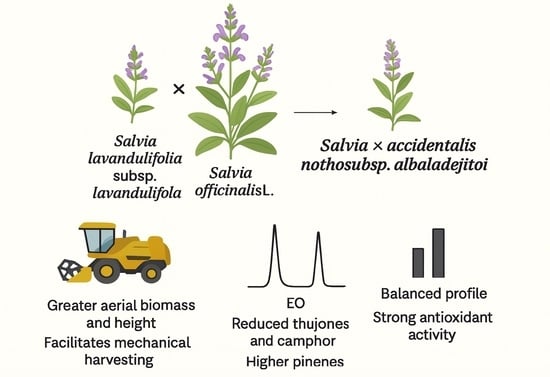
Exploring the Potential of Salvia × accidentalis nothosubsp. albaladejitoi: A Natural Hybrid Sage with Improved Agronomic Performance and Bioactive Extractive Potential

 , , ,
, , ,
Abstract
1. Introduction
2. Materials and Methods
2.1. Description of the Study Area
2.2. Propagation of Plants and Experimental Design
2.3. Morphological and Physiological Parameters
2.4. Germination Capacity
2.5. Phenology Assessment
2.6. Plant Extraction (EOs & EEs)
2.7. Chemical Characterization of Sage Extracts (EOs & EEs)
2.7.1. Chemical Analysis of EOs by Gas Chromatography (GC)
2.7.2. Total Phenol Content (TPC) of Ethanolic Extracts
2.7.3. Phenolic Profile of EEs by HPLC/DAD
2.8. Antioxidant Capacities
- Free radical scavenging activity (DPPH) was determined following the method described by Ortiz de Elguea-Culebras et al. [13]. Briefly, 50 µL of EE (10–100 µg/mL in EtOH) was mixed with 200 µL of 0.005% DPPH, incubated for 1 h at room temperature, and the absorbance was measured at 517 nm. BHT and EtOH served as positive and negative controls, respectively. Each analysis was performed twice, including two replicates per assay. The inhibition capacity (%) was calculated by the formula [((C–T)/C) × 100], where C represents the absorbance of the negative control (EtOH) and T that of the EE.
- Ferric reducing antioxidant power (FRAP): was performed according to Ortiz de Elguea-Culebras et al. [13]. In each well, 50 µL of EE (10–100 µg/mL) was mixed with 50 µL of 0.2 M sodium phosphate buffer (pH 6.6) and 50 µL of 1% potassium ferricyanide (III), followed by incubation at 50 °C for 20 min. After cooling to room temperature, 100 µL of 5% trichloroacetic acid and 10 µL of 0.1% ferric (III) chloride were added, and the mixture was incubated again for 10 min at 50 °C, measuring the absorbance at 700 nm. Analyses were performed in duplicate, with two independent replicates per test. BHT and EtOH were used as positive and negative controls, respectively.
2.9. Statistical Analysis
3. Results
3.1. Agronomic Potential of S. × accidentalis
3.2. Phenological Description
3.3. Commercial Relevance of S. × accidentalis
3.4. Chemical Characterization of Essential Oils
3.5. Phenolic Profile of Ethanolic Extracts

4. Discussion
5. Conclusions
Author Contributions
Funding
Institutional Review Board Statement
Data Availability Statement
Acknowledgments
Conflicts of Interest
References
- Walker, J.B.; Sytsma, K.J.; Treutlein, J.; Wink, M. Salvia (Lamiaceae) Is Not Monophyletic: Implications for the Systematics, Radiation, and Ecological Specializations of Salvia and Tribe Mentheae. Am. J. Bot. 2004, 91, 1115–1125. [Google Scholar] [CrossRef] [PubMed]
- Radosavljević, I.; Bogdanović, S.; Celep, F.; Filipović, M.; Satovic, Z.; Surina, B.; Liber, Z. Morphological, Genetic and Epigenetic Aspects of Homoploid Hybridization Between Salvia officinalis L. and Salvia fruticosa Mill. Sci. Rep. 2019, 9, 3276. [Google Scholar] [CrossRef]
- Ghorbani, A.; Esmaeilizadeh, M. Pharmacological Properties of Salvia officinalis and Its Components. J. Tradit. Complement. Med. 2017, 7, 433–440. [Google Scholar] [CrossRef] [PubMed]
- Sáez, L. Salvia L. In Flora ibérica XII; Castroviejo, S., Aedo, C., Laínz, M., Muñoz Garmendia, F., Nieto Feliner, G., Paiva, J., Benedí, C., Eds.; Real Jardín Botánico, CSIC: Madrid, Spain, 2010; Volume XII, pp. 298–326. ISBN 9788400090418. [Google Scholar]
- Franz, C.; Novak, J. Sources of Essential Oils. In Handbook of Essential Oils: Science, Technology, and Applications; Baser, K.H.C., Buchbauer, G., Eds.; CRC Press: Boca Ratón, FL, USA, 2015; pp. 43–86. ISBN 9781466590472. [Google Scholar]
- Olarte, A.; Mantri, N.; Nugent, G.; Wohlmuth, H.; Li, C.G.; Xue, C.; Pang, E. A gDNA Microarray for Genotyping Salvia Species. Mol. Biotechnol. 2013, 54, 770–783. [Google Scholar] [CrossRef]
- Sánchez-Gómez, P.; Morales, R. Un Nuevo Híbrido de Salvia (Labiatae). An. Jardín Botánico Madr. 1999, 57, 421–422. [Google Scholar] [CrossRef]
- Nilofar; Bahadırlı, N.P.; Elhawary, E.A.; Eldahshan, O.; Singab, A.N.; Saka, E.; Cespedes- Acuna, C.L.; Andruch, V.; Kalyniukova, A.; Zengin, G. Exploring the Chemical Composition and Biological Effects of Four Salvia Hybrids: An Innovative Perspective on Functional Yields. eFood 2024, 5, e70012. [Google Scholar] [CrossRef]
- Celep, F.; Raders, E.; Drew, B.T. Two New Hybrid Species of Salvia (S. × Karamanensis and S. × Doganii) from Turkey: Evidence from Molecular and Morphological Studies. Turk. J. Bot. 2020, 44, 647–660. [Google Scholar] [CrossRef]
- Maral, H.; Çeçen, Ö.; Türk Baydır, A.; Türkmen, M. Determination of Essential Oil Constituents and Antioxidant Activities of Hybrid Species Salvia × karamanensis Celep & B. T. Drew and Its Parents (Salvia aucheri Benth. Subsp. canescens (Boiss. & Heldr.) Celep, Kahraman & Dogan × Salvia heldreichiana Bois. Biochem. Syst. Ecol. 2024, 113, 104795. [Google Scholar] [CrossRef]
- Morrison, E.; Drew, B. Potential Hybridization among Two Species of California Salvia. Trans. Neb. Acad. Sci. Affil. Soc. 2023, 43, 25–33. [Google Scholar] [CrossRef]
- Papafotiou, M.; Martini, A.N.; Papanikolaou, E.; Stylias, E.G.; Kalantzis, A. Hybrids Development Between Greek Salvia Species and Their Drought Resistance Evaluation along with Salvia Fruticosa, Under Attapulgite-Amended Substrate. Agronomy 2021, 11, 2401. [Google Scholar] [CrossRef]
- Ortiz de Elguea-Culebras, G.; Melero-bravo, E.; Jordán, M.J.; Calvo-Martinez, A.; Caceres-Cevallos, G.; Quílez-Simón, M.; Sánchez-Vioque, R. Selection of Populations of Salvia lavandulifolia Vahl. Based on Crop Adaptations, Phenolic Chemotypes and Biological Capacities of the Distillation by-Products. Ind. Crop. Prod. 2024, 213, 118337. [Google Scholar] [CrossRef]
- Tychonievich, J.; Warner, R.M. Interspecific Crossability of Selected Salvia Species and Potential Use for Crop Improvement. J. Am. Soc. Hortic. Sci. 2011, 136, 41–47. [Google Scholar] [CrossRef]
- Sánchez-Vioque, R.; Herraiz-Peñalver, D.; Melero Bravo, E.; Ortiz de Elguea-Culebras, G.; Herrero, B.; Santiago, Y.; Bueno, M.; Perez Magarino, S.; Carmen Asensio, M. Variability of the Essential Oil Composition of Cultivated Populations of Salvia lavandulifolia Vahl. Crop Sci. 2022, 62, 744–752. [Google Scholar] [CrossRef]
- Usano-Alemany, J.; Palá-Paúl, J.; Herráiz-Peñalver, D. Comprehensive Phenological Description of Essential-Oil Chemotypes of Salvia Lavandulifolia VAHL Grown Under the Same Environmental Conditions. Chem. Biodivers. 2014, 11, 1963–1977. [Google Scholar] [CrossRef] [PubMed]
- Herraiz-Peñalver, D.; Ortiz de Elguea-Culebras, G.; Sánchez-Vioque, R.; Santana Méridas, O. Identification of a Hybrid Species of Sage (Salvia Officinalis L. X S. Lavandulifolia Subsp. Lavandulifolia) through the Study of the Essential Oil. J. Essent. Oil Res. 2015, 27, 363–372. [Google Scholar] [CrossRef]
- Ortiz de Elguea-Culebras, G.; Herraiz-peñalver, D.; García-Cardo, O.; Melero-Bravo, E.; Sánchez-Vioque, R. Descripción Morfológica de Un Nuevo Híbrido Natural de Salvia (Labiatae) En Cuenca: Salvia X Albaladejitoi. In Proceedings of the II Annual Symposium of Spanish Botany; Spanish Botanical Society, Madrid, Spain, 12–13 November 2021. [Google Scholar]
- AEMET. Guía Resumida Del Clima En España (1981–2010); Ministerio de Agricultura y Pesca, Alimentación y Medio Ambiente: Madrid, Spain, 2012.
- Vignoni, L.A.; Césari, R.M.; Forte, M.; Mirábile, M.L. Determination of Color Index in Minced Garlic. Inf. Tecnológica 2006, 17, 63–67. [Google Scholar] [CrossRef]
- Meier, U. Phenological Growth Stages. In Phenology: An Integrative Environmental Science. Tasks for Vegetation Science; Schwartz, M.D., Ed.; Springer: Dordrecht, The Netherlands, 2003. [Google Scholar]
- Cornelius, C.; Petermeier, H.; Estrella, N.; Menzel, A. A Comparison of Methods to Estimate Seasonal Phenological Development from BBCH Scale Recording. Int. J. Biometeorol. 2011, 55, 867–877. [Google Scholar] [CrossRef] [PubMed]
- Rojo, J.; Pérez-Badia, R. Effects of Topography and Crown-Exposure on Olive Tree Phenology. Trees—Struct. Funct. 2014, 28, 449–459. [Google Scholar] [CrossRef]
- Jordán, M.J.; Lax, V.; Rota, M.C.; Lorán, S.; Sotomayor, J.A. Effect of the Phenological Stage on the Chemical Composition and Antimicrobial and Antioxidant Properties of Rosmarinus officinalis L Essential Oil and Its Polyphenolic Extract. Ind. Crops Prod. 2013, 48, 144–152. [Google Scholar] [CrossRef]
- Sánchez-Gómez, P.; Soriano-Cano, M.C.; Sotomayor-Sánchez, J.A.; García-Vallejo, M.C. Essential Oils of a New Hybrid: Salvia Officinalis X S. Lavandulifolia Ssp. Vellerea. J. Essent. Oil Res. 1995, 7, 317–318. [Google Scholar] [CrossRef]
- Arraiza, M.P.; Arrabal, C.; López, J.V. Seasonal Variation of Essential Oil Yield and Composition of Sage (Salvia officinalis L.) Grown in Castilla-La Mancha (Central Spain). Not. Bot. Horti Agrobot. Cluj-Napoca 2012, 40, 106–108. [Google Scholar] [CrossRef]
- Jebri, M.; Maaloul, A.; Bon, J.; Romdhane, M. Essential Oils of Salvia Officinalis Cultivated in Tunisia: Variations Regarding Plant Organs, Harvest Time and Drying Process. Chem. Afr. 2023, 6, 2827–2833. [Google Scholar] [CrossRef]
- Rivas da Silva, A.C.; Mnteiro Lopes, P.; Barros de Azevedo, M.M.; Machado Costa, D.C.; Sales Alviano, C.; Sales Alviano, D. Biological Activities of a-Pinene and β-Pinene Enantiomers. Molecules 2012, 17, 6305–6316. [Google Scholar] [CrossRef] [PubMed]
- Pokajewicz, K.; Białoń, M.; Svydenko, L.; Hudz, N.; Balwierz, R.; Marciniak, D.; Wieczorek, P.P. Comparative Evaluation of the Essential Oil of the New Ukrainian Lavandula angustifolia and Lavandula × intermedia Cultivars Grown on the Same Plots. Molecules 2022, 27, 2152. [Google Scholar] [CrossRef] [PubMed]
- ISO 3515:2002; Oil of Lavender (Lavandula angustifolia Mill.). International Organization for Standardization: Geneva, Switzerland, 2002.
- ISO 4719:2012; Essential Oil of Spike Lavender (Lavandula latifolia Medikus), Spanish Type. International Organization for Standardization: Geneva, Switzerland, 2012.
- ISO 3054:2025; Essential Oil of Lavandin Abrial (Lavandula × intermedia Emeric Ex Loisel. “Abrial”) (Ex Lavandula angustifolia Mill. × Lavandula latifolia Medik. “Abrial”). International Organization for Standardization: Geneva, Switzerland, 2025.
- ISO 8902:2025; Essential Oil of Lavandin Grosso (Lavandula × intermedia Emeric Ex Loisel. “Grosso”) (Ex Lavandula angustifolia Mill. × Lavandula latifolia Medik. “Grosso”). International Organization for Standardization: Geneva, Switzerland, 2025.
- Mervić, M.; Štefan, M.B.; Kindl, M.; Blažeković, B.; Marijan, M.; Vladimir-Knežević, S. Comparative Antioxidant, Anti-Acetylcholinesterase and Anti-α-Glucosidase Activities of Mediterranean Salvia Species. Plants 2022, 11, 625. [Google Scholar] [CrossRef]
- Porres-Martínez, M.; Carretero Accame, M.E.; Gómez-Serranillos, M.P. Pharmacological Activity of Salvia Lavandulifolia and Chemical Components of Its Essential Oil. A Review. Lazaora 2013, 34, 237–254. [Google Scholar] [CrossRef]
- Tohma, H.; Köksal, E.; Kılıç, Ö.; Alan, Y.; Abdullah Yılmaz, M.; Gülçin, İ.; Bursal, E.; Alwasel, S.H. RP-HPLC/MS/MS Analysis of the Phenolic Compounds, Antioxidant and Antimicrobial Activities of Salvia L. Species. Antioxidants 2016, 5, 38. [Google Scholar] [CrossRef]
- Harindranath, H.; Susil, A.; Rajeshwari, S.; Sekar, M.; Kumar, B.R.P. Unlocking the Potential of Rosmarinic Acid: A Review on Extraction, Isolation, Quantification, Pharmacokinetics and Pharmacology. Phytomed. Plus 2025, 5, 100726. [Google Scholar] [CrossRef]
- Birtić, S.; Dussort, P.; Pierre, F.X.; Bily, A.C.; Roller, M. Carnosic Acid. Phytochemistry 2015, 115, 9–19. [Google Scholar] [CrossRef] [PubMed]
- Jordán, M.J.; Lax, V.; Rota, M.C.; Lorán, S.; Sotomayor, J.A. Relevance of Carnosic Acid, Carnosol and Rosmarinic Acid Concentrations in the in Vitro Antioxidant and Antimicrobial Activities of Rosmarinus officinalis (L.) Methanolic Extracts. J. Agric. Food Chem. 2012, 60, 9603–9608. [Google Scholar] [CrossRef] [PubMed]
- Mena, P.; Cirlini, M.; Tassotti, M.; Herrlinger, K.A.; Dall’Asta, C.; Del Rio, D. Phytochemical Profiling of Flavonoids, Phenolic Acids, Terpenoids and Volatile Fraction of a Rosemary (Rosmarinus officinalis L.) Extract. Molecules 2016, 21, 1576. [Google Scholar] [CrossRef] [PubMed]
- Zhao, Y.; Sedighi, R.; Wang, P.; Chen, H.; Zhu, Y.; Sang, S. Carnosic Acid as a Major Bioactive Component in Rosemary Extract Ameliorates High-Fat-Diet-Induced Obesity and Metabolic Syndrome in Mice. J. Agric. Food Chem. 2015, 63, 4843–4852. [Google Scholar] [CrossRef] [PubMed]



| S. lavandulifolia | S. × accidentalis | S. officinalis | Mean | |
|---|---|---|---|---|
| Agronomic Potential | ||||
| Plant stem (cm) | 25.55 ± 5.0 c** | 41.50 ± 7.9 b** | 50.00 ± 4.2 a*** | 39.02 ± 11.8 |
| Plant spike (cm) | 32.45 ± 5.3 a** | 27.30 ± 3.7 b** | 23.45 ± 4.2 b** | 27.73 ± 5.7 * |
| Plant weight (kg/plant) | 0.41 ± 0.3 | 0.45 ± 0.1 * | 0.67 ± 0.2 | 0.51 ± 0.2 |
| Plant biomass (kg/plant) | 0.20 ± 0.1 | 0.23 ± 0.1 * | 0.35 ± 0.1 | 0.26 ± 0.1 |
| Plant RWC 1 | 50.61 ± 2.4 a*** | 49.21 ± 0.7 ab*** | 46.94 ± 2.8 b*** | 48.92 ± 2.5 *** |
| Leaf length (cm) | 3.06 ± 0.5 c** | 3.88 ± 0.4 b** | 7.10 ± 0.8 a** | 4.68 ± 1.8 |
| Leaf width (cm) | 0.92 ± 0.2 c* | 1.14 ± 0.2 b** | 2.05 ± 0.3 a** | 1.37 ± 0.5 |
| Leaf area 2 (cm2) | 2.26 ± 0.8 c | 3.53 ± 0.8 b* | 11.56 ± 2.8 a* | 5.78 ± 4.5 |
| Leaf biomass (mg/leaf) | 31.98 ± 0.2 c*** | 51.92 ± 1.4 b*** | 136.48 ± 4.5 a*** | 73.49 ± 48.1 |
| LMA 3 (g/m2) | 158.96 ± 52.2 a | 154.57 ± 34.7 a* | 124.06 ± 26.7 b* | 145.86 ± 41.8 * |
| SLA 4 (cm2/g) | 70.69 ± 26.1 ab | 67.96 ± 15.7 b* | 84.70 ± 20.4 a* | 74.45 ± 22.2 * |
| Germination Ratio 5 (%) | 30.00 ± 25.8 b | 40.00 ± 36.5 ab | 85.00 ± 10.0 a** | 51.67 ± 34.6 |
| Commercial Relevance | ||||
| L* (leaves) | 60.45 ± 2.6 a*** | 58.56 ± 3.0 b*** | 52.93 ± 2.4 c*** | 57.32 ± 4.2 *** |
| a* (leaves) | −3.26 ± 1.3 a | −3.29 ± 0.7 a | −6.16 ± 1.7 b | −4.24 ± 1.9 |
| b* (leaves) | 11.90 ± 2.6 a* | 11.37 ± 2.1 a** | 19.23 ± 3.3 b** | 14.17 ± 4.5 |
| Colour Index (leaves) | −4.74 ± 1.8 b | −5.05 ± 1.1 b | −6.10 ± 1.5 a | −5.29 ± 1.6 |
| Leaves RWC 1 (%) | 58.74 ± 1.4 b*** | 61.61 ± 2.0 ab*** | 64.99 ± 1.9 a*** | 61.79 ± 3.1 *** |
| Essential Oil Yield (%) | 2.88 ± 1.1 a | 1.81 ± 0.2 ab*** | 1.40 ± 0.5 b | 2.00 ± 0.9 |
| Ethanolic Extract Yield (%) | 16.93 ± 1.4 *** | 16.53 ± 1.4 *** | 16.19 ± 3.4 * | 16.50 ± 2.2 ** |
| TPC 6 (g GAE/100 g EE) | 9.36 ± 1.3 b** | 10.64 ± 1.5 b** | 15.90 ± 1.4 a*** | 11.73 ± 3.1 * |
| DPPH 7 (µg/mL) | 45.69 ± 11.4 b* | 59.00 ± 10.2 b** | 23.19 ± 9.0 a | 43.77 ± 17.7 |
| FRAP 7 (µg/mL) | 67.30 ± 10.9 b** | 65.32 ± 9.6 b** | 38.82 ± 9.5 a* | 58.22 ± 16.0 * |
| Component (%) | S. lavandulifolia | S. × accidentalis | S. officinalis | Mean |
|---|---|---|---|---|
| Monoterpene hydrocarbons | 31.59 ± 3.7 b** | 47.42 ± 1.9 a*** | 43.08 ± 5.8 a** | 41.21 ± 7.5 ** |
| α-pinene | 6.30 ± 3.1 b | 11.28 ± 1.9 a** | 3.97 ± 2.8 b | 7.50 ± 3.9 |
| Camphene | 1.82 ± 1.0 | 0.86 ± 0.4 | 1.63 ± 0.9 | 1.39 ± 0.8 |
| Sabiene | 2.66 ± 1.1 a | 1.63 ± 0.2 a** | 0.24 ± 0.0 b** | 1.52 ± 1.1 |
| β-pinene | 7.88 ± 1.6 a* | 6.26 ± 0.6 a*** | 3.40 ± 0.4 b** | 5.88 ± 2.0 |
| Myrcene | 6.66 ± 3.5 | 2.22 ± 0.1 *** | 2.87 ± 3.3 | 3.78 ± 3.0 |
| ρ-cymene | 0.62 ± 0.5 | 1.05 ± 0.2 ** | 0.44 ± 0.5 | 0.73 ± 0.5 |
| Limonene | 4.30 ± 1.3 a* | 1.28 ± 0.2 b** | 1.29 ± 0.4 b | 2.21 ± 1.5 |
| γ-terpinene | 1.32 ± 1.5 | 1.48 ± 0.4 * | 0.93 ± 0.7 | 1.26 ± 0.9 |
| α-thujone | 0.02 ± 0.0 b | 17.74 ± 2.1 a** | 23.01 ± 10.8 a | 13.91 ± 11.0 |
| β-thujone | 0.02 ± 0.0 c | 3.62 ± 0.3 b*** | 5.31 ± 0.7 a** | 3.03 ± 2.2 |
| Oxygenated monoterpenes | 51.01 ± 7.2 a** | 29.60 ± 4.7 b** | 26.15 ± 7.3 b* | 35.12 ± 12.1 |
| 1,8-cineole | 44.07 ± 5.3 a** | 26.63 ± 4.2 b** | 17.12 ± 6.6 b | 29.07 ± 11.9 |
| Camphor | 5.71 ± 3.3 ab | 2.24 ± 0.6 b* | 8.11 ± 3.0 a | 5.11 ± 3.5 |
| Borneol | 1.24 ± 0.7 | 0.73 ± 0.2 * | 0.92 ± 1.0 | 0.94 ± 0.6 |
| Sesquiterpene hydrocarbons | 5.70 ± 2.5 b | 10.14 ± 2.3 ab* | 15.16 ± 4.3 a* | 10.32 ± 4.6 |
| trans-caryophyllene | 4.19 ± 1.7 b | 4.81 ± 1.2 ab* | 7.52 ± 1.6 a* | 5.45 ± 1.9 |
| α-humulene | 1.51 ± 1.4 b | 5.33 ± 1.1 ab* | 7.65 ± 3.6 a | 4.87 ± 3.2 |
| Oxygenated sesquiterpenes | 1.60 ± 1.2 | 4.65 ± 1.7 | 5.13 ± 3.3 | 3.86 ± 2.5 |
| Caryophyllene oxide | 1.56 ± 1.1 | 1.34 ± 0.5 | 0.31 ± 0.1 | 1.09 ± 0.8 |
| Viridiflorol | 0.03 ± 0.1 b | 3.31 ± 1.2 ab | 4.83 ± 3.2 a | 2.77 ± 2.6 |
| TOTAL | 89.89 ± 1.4 | 91.80 ± 1.8 | 89.53 ± 2.5 | 90.51 ± 2.0 |
| Component (mg/g EE) | S. lavandulifolia | S. × accidentalis | S. officinalis | Mean |
|---|---|---|---|---|
| Phenolic acids | 45.40 ± 15.6 | 61.24 ± 13.8 * | 60.74 ± 33.1 | 55.44 ± 21.1 |
| Danshensu | 7.54 ± 2.6 a | 9.91 ± 2.5 a* | 1.07 ± 2.1 b | 6.54 ± 4.3 |
| Chlorogenic acid | 2.30 ± 0.5 a* | 2.18 ± 0.5 a* | 0.59 ± 1.2 b | 1.77 ± 1.0 |
| Caffeic acid | 0.25 ± 0.6 b | 1.96 ± 0.8 a | 1.64 ± 0.5 a* | 1.26 ± 1.0 |
| Salvianolic acid | 3.02 ± 1.2 | 0.97 ± 2.2 | 0.41 ± 0.8 | 1.54 ± 1.9 |
| Rosmarinic acid | 32.29 ± 14.2 | 46.21 ± 13.1 * | 57.03 ± 31.0 | 44.33 ± 21.1 |
| Flavonoids | 15.22 ± 3.7 * | 16.24 ± 0.6 *** | 14.74 ± 3.3 * | 15.45 ± 2.7 ** |
| Luteolin-7-O-glucuronide | 6.17 ± 1.6 * | 7.48 ± 0.8 ** | 7.18 ± 4.0 | 6.93 ± 2.3 |
| Apigenin-7-O-glucoside | 1.21 ± 0.3 * | 2.04 ± 1.7 | 1.54 ± 1.2 | 1.60 ± 1.2 |
| Luteolin | 2.46 ± 0.8 a | 2.23 ± 1.0 ab | 0.59 ± 1.2 b | 1.85 ± 1.2 |
| Cirsimaritin | 1.91 ± 0.7 ab | 1.16 ± 0.2 b** | 2.32 ± 0.6 a* | 1.76 ± 0.7 |
| Salvigenin | 3.46 ± 1.5 | 3.32 ± 1.0 * | 3.12 ± 3.3 | 3.31 ± 1.9 |
| Phenolic Diterpenes | 0.00 ± 0.0 b*** | 0.00 ± 0.0 b*** | 104.21 ± 33.3 a | 29.78 ± 51.4 |
| Carnosol | 0.00 ± 0.0 b*** | 0.00 ± 0.0 b*** | 5.16 ± 4.0 a | 1.47 ± 3.1 |
| Rosmaridiphenol | 0.00 ± 0.0 b*** | 0.00 ± 0.0 b*** | 23.21 ± 9.4 a | 6.63 ± 11.8 |
| Carnosic acid | 0.00 ± 0.0 b*** | 0.00 ± 0.0 b*** | 57.87 ± 24.3 a | 16.53 ± 29.5 |
| Methyl carnosate | 0.00 ± 0.0 b*** | 0.00 ± 0.0 b*** | 17.98 ± 4.9 a* | 5.14 ± 8.8 |
| TOTAL | 60.62 ± 16.0 b* | 77.48 ± 13.6 b** | 182.30 ± 14.3 a*** | 101.41 ± 55.3 |
Disclaimer/Publisher’s Note: The statements, opinions and data contained in all publications are solely those of the individual author(s) and contributor(s) and not of MDPI and/or the editor(s). MDPI and/or the editor(s) disclaim responsibility for any injury to people or property resulting from any ideas, methods, instructions or products referred to in the content. |
© 2025 by the authors. Licensee MDPI, Basel, Switzerland. This article is an open access article distributed under the terms and conditions of the Creative Commons Attribution (CC BY) license (https://creativecommons.org/licenses/by/4.0/).
Share and Cite
Ortiz de Elguea-Culebras, G.; García-Cardo, O.; Romero-Morte, J.; Herraiz-Peñalver, D.; Melero-Bravo, E. Exploring the Potential of Salvia × accidentalis nothosubsp. albaladejitoi: A Natural Hybrid Sage with Improved Agronomic Performance and Bioactive Extractive Potential. Agriculture 2025, 15, 2577. https://doi.org/10.3390/agriculture15242577
Ortiz de Elguea-Culebras G, García-Cardo O, Romero-Morte J, Herraiz-Peñalver D, Melero-Bravo E. Exploring the Potential of Salvia × accidentalis nothosubsp. albaladejitoi: A Natural Hybrid Sage with Improved Agronomic Performance and Bioactive Extractive Potential. Agriculture. 2025; 15(24):2577. https://doi.org/10.3390/agriculture15242577
Chicago/Turabian StyleOrtiz de Elguea-Culebras, Gonzalo, Oscar García-Cardo, Jorge Romero-Morte, David Herraiz-Peñalver, and Enrique Melero-Bravo. 2025. "Exploring the Potential of Salvia × accidentalis nothosubsp. albaladejitoi: A Natural Hybrid Sage with Improved Agronomic Performance and Bioactive Extractive Potential" Agriculture 15, no. 24: 2577. https://doi.org/10.3390/agriculture15242577
APA StyleOrtiz de Elguea-Culebras, G., García-Cardo, O., Romero-Morte, J., Herraiz-Peñalver, D., & Melero-Bravo, E. (2025). Exploring the Potential of Salvia × accidentalis nothosubsp. albaladejitoi: A Natural Hybrid Sage with Improved Agronomic Performance and Bioactive Extractive Potential. Agriculture, 15(24), 2577. https://doi.org/10.3390/agriculture15242577